Showing posts with label Alec Guinness. Show all posts

Monday, October 7, 2024

Doctor Zhivago

 SPOILER ALERT! The plot will be discussed.

Director David Lean explored culture classes in his films, even if they were within one country. In Doctor Zhivago, a long and sad story, he adapts the Boris Pasternak novel that depicts life under the czars that led to the rule of the Communist Party which followed the revolution in Russia. The story distills these sweeping events by focusing on the lives of individuals, with a love story at its center.

The tale begins after the revolution and is told in flashback. The establishing shot shows a mass of women marching through a tunnel at the site of a dam under the supervision of one individual. That image sums up Russian rule under Communism, where only those at the top of the hierarchy have individuality and the rest of the population is lumped together as one organism.

The man observing is Yevgraf Zhivago (Alec Guinness), a general, the half-brother of Yuri Zhivago (Omar Sharif). He tells the Engineer (Mark Eden) that life was intolerable in the past where some resorted to cannibalism to survive. (Notice that the Engineer at this point has no name, only his profession; the job he does for society as a whole is what is important here). Yevgraf is interested in a young woman, Tonya Komarovsky (Rita Tushingham) who may be Yuri’s daughter. The mother would be Lara (Julie Christie), who was Yuri’s inspiration for a book of poems, which the government only recently allowed the populace to read once the Communists gained enough power to allow anything that wasn’t dominated by the Party line.

Tonya is not very informative about her early life, not remembering her father and losing her mother while young. This story is about history and Tonya’s gap of information allows for the retelling of the past by Yevgraf. The shots of Ural Mountains and the expanse of the territory (the film was actually shot in Spain) show the dwarfing of individuals as young Yuri (Tarik Sharif) attends the funeral of his mother. It is a harsh introduction to the finality of the death of an individual in contrast to the enduring sky above.

The Gromykos, affluent family friends who live near Moscow, adopt young Yuri. Alexander Gromykos (Ralph Richardson) gives Yuri the balalaika which the young boy’s mother played so well. Mother Anna (Siobhan McKenna) says Yuri’s mother had a “gift” for playing it. It is this artistic side, like older Yuri’s ability to create poetry, in contrast to medicine and politics, which seems to be inherited. The daughter of the Gromykos. also Tonya, is eight years old, the same age as Yuri. We hear Lara’s theme played on the balalaika as Yuri stares at the instrument which suggests the young boy’s destiny. The harshness of the windy coldness that blows off his mother’s grave markings suggests the wiping away of what would have been Yuri’s life if circumstances were different.

The adult Yuri’s medical mentor urges him to do research, but Yuri wants to go into general practice to experience life. The elder doctor says Yuri will “find that pretty creatures do ugly things to people.” The statement is a foreshadowing. Yuri rides the same streetcar as Lara, but doesn’t see her face since she is bundled up against the cold. But they look out the window at the same time and their traveling in the same direction is more foreshadowing. The shot of her getting off the vehicle is a bookend to the end of the film.

Lara sees Pasha (Tom Courtney), her fiancé, a revolutionary of the Communist movement, handing out leaflets. Lara rescues him from the authorities pretending to be his sister and that she will handle him. Pasha says he is not like the Bolsheviks because they do not know right from wrong, but he does. His self-righteousness is evident, and Lara teases him about him being a “prig.” Her remark also points to her rejection of conformity of behavior. Yet, she has been drawn to him, possibly to balance out her rule-breaking nature.

Victor Komarovsky (Rod Steiger), whose last name tells us of a connection to Tonya, is the opposite of Pasha. He does not worry about ethical behavior as he is the lover of Lara’s mother, a dressmaker, and lusts after the daughter, who is only seventeen (despite Christie looking older). Lara is a passionate woman, and Pasha puts all his drives into the impending revolution.

When Lara’s mother is ill, Victor takes Lara to an upscale restaurant. He says she is his niece to defer any criticism about such a young woman being with an older man. The opulent venue contrasts with the Communist protesters outside who have signs that state the need for freedom and food. As Lara and Victor dine the protesters’ singing interrupts the diners. But Victor’s witty condescending remark about how the disrupters will probably sing in tune after the revolution restores the security of the upper-class clientele. Interestingly, Victor pours some of his alcoholic drink into Lara’s glass. Maybe a symbolic sexual exchange of fluids that suggests the corruption of a young woman?

The next scenes show Victor taking advantage of Lara’s sexual awakening in the sleigh ride as soldiers “mount” their horses to attack the protesters. The images indicate a sort of rape of the lower classes by the privileged. Yuri has been adopted into the upper-class world and he observes the horrifying attack of the soldiers fittingly from a balcony above. The camera moves to the level of the protesters to put the audience in the middle of the chaos. However, there are cuts to Yuri who becomes rattled by what he sees. There are bodies and injured people left in the street and Yuri enters the street to use his medical skills. He is not allowed to help the victims as the authorities just load the people into carts to be hauled away to what is surely a horrible fate. There is blood on the virgin snow, symbolic of the attack on the purity of ideals which is echoed by Lara’s succumbing to the aptly named Victor’s exploiting of Lara’s innocence.

Next, the adult Tonya (Geraldine Chapman) arrives from France saying how well Yuri’s poetry is received in France. It is a happy meeting, compared to the following scene where Pasha shows up at the dress shop with a facial wound he received in the demonstration, the residuals of his battle with the forces in power. Sasha has a gun he wants Lara to keep, and as the Russian Chekhov said, once you show a gun, the writer must fire it at some point. Lara is appalled by this turn of events. Pasha shows how violence will escalate now as he says there will be no more peaceful protests. She feels guilty because she was dining while the violence occurred outside. She also carries guilt for her sexual activity and confesses to the priest. But she continues to see Victor and wears a sexy dress he bought for her. He forces alcohol on her and despite her protests of his crude ways, she doesn’t stop seeing him. She is a young woman torn between her passionate drives and social restrictions on behavior.

Yuri assists with an emergency house call and that is how he becomes involved in Lara’s life. Victor found Lara’s mother after she made a suicide attempt. Victor told the naïve Lara that her mother probably knew of Lara’s affair with Victor. Victor doesn’t want the scandal to come out because he has connections with everyone, no matter what the political party. He is an amoral survivor who uses advantages for himself wherever he can find them.

The doctors pump the mother’s stomach and save her. Yuri goes to tell Lara about her mother’s condition. As he looks for her, we hear Lara’s theme again, letting us know about the connection that will join them. But Yuri witnesses Lara kissing Victor in gratefulness for getting her mother help. Yuri finds out that Victor took care of his birth father’s will and tried to devalue the estate and garner more for himself. Yuri is immediately disgusted by Victor after what he has seen and knows.

There is a meeting between Pasha, Lara, and Victor, who says he wants to ensure that Lara will be well cared for. Pasha, whose mother and father died miserably, says he cares for the revolution even more than Lara. He admits he has little experience in the ways of love, and only kisses Lara on the forehead. The implication is he does not know how to satisfy her sexually. Victor sees that he is a “young crusader” who will only give Lara a meager life.

Back at the dress shop, he tells Lara that Pasha is a “high-minded” man who people say they admire but really despise, most likely because of his holier-than-thou stance. Victor sees Lara as an “alive” woman but also calls her a “slut,” and precedes to take her by force, but she appears amenable once the sexual overture occurs. He says not to delude herself that it was “rape.” As a viewer we dislike Victor, because he has abandoned principles so he can survive and take what he wants at any cost to others. Lara has been used, but she has also allowed herself to be used. Perhaps her life has not led her to find a man who is both passionate and principled. And that is where Yuri comes in.

There is a Christmas party where Yuri’s engagement to Tonya is announced. The scene is one of opulence again and the time of year is supposed to be a joyous one. However, Lara has the gun that Pasha gave her and she shoots Victor in the arm at the party, using her anti-establishment fiancé’s weapon to pierce the rich comfort of the wealthy. In a way, she becomes a sort of comrade in arms in the revolution. She encountered Pasha before the act, and he now parts the crowd escorting her out. Victor wants no police involvement to keep his scandal unofficial, but Yuri, who saw them together at the dress shop, knows of his acts. While Yuri treats Victor’s wound, the latter says Yuri’s father was a good man who was devoted to his mother, and he admits that the revolutionaries may win. Here Victor seems compassionate and open-minded. But then he wants to ensure Yuri will keep Victor’s relationships with Lara and her mother secret, his selfish ways again appearing. When Yuri asks what happens to Lara when Victor is finished with her, the crude and cynical part of Victor says he gives Lara to Yuri as a wedding gift.

We again have contrasting edits as Yuri and Tonya share a loving sleigh ride, hugging and kissing, even though Yuri has his mind on Lara. Pasha reads a letter from Lara in which she confesses her indiscretions. He at first wants to strike Lara, but then reconsiders and then embraces her.

Yevgraf’s narrative voice returns, and we see him look younger as he talks about how his mission was to use the conflict to undermine the peasants sent to fight for a cause that was not in their interests. The “lucky” one lost parts of their bodies while many died. He said those that volunteered to fight may not have been happy in their marriages, and the shot tellingly zeroes in on Pasha who enlists while leaving Lara and their child in the Urals, while Yuri also departs, serving as a doctor. Pasha is a leader and men follow him, but he leads them to death, his “high-minded” ways not allowing for Victor’s realism.

Four years later Yevgraf’s narration says that soldiers who fought gave up, went home, and that was the beginning of the “revolution.” There is a confrontation between the deserters and the reinforcements which shows the inception of what Yevgraf worked for. Lara is there as a nurse volunteer looking for Pasha and encounters Yuri, helping him tend to the wounded. He shows he is on her side when he says Victor was “a good man to shoot at.”

They are with the soldiers when they find out that the czar is in prison and Lenin is in Moscow as civil war occurred. One of the soldiers says that there will be no more czars, that there will be a worker’s country with “no more masters,” and there will be “only workers in a workers’ state.” Sounds good, but as we know, idealism can come crashing down when it confronts the reality of the human condition.

Tonya receives a letter from Yuri and she seems upset that he mentions how good Lara is at helping men heal (could he be talking about his own need for emotional nourishment?). As one of the men there says, going home, which should be joyful, will lead them to the civil fighting. Lara irons clothes (a scene that will affect Yuri later) and says she is happy there even if she is away from her child, but away from conflicts. Yuri is shot in darkness as they talk as he admits he would be jealous of losing her. She reminds him that, so far, they have done nothing that would hurt his marriage, and she doesn’t wish to. Lean is showing us a story that is full of conflicting emotions.

The soldiers leave as does Lara. When Yuri returns to Moscow, the large house he lived in now has resident managers who are humorless and hostile toward Yuri, not because of who he is, but because he was part of the upper class. The Christian hospital is now called a “reformed” institution, meant to obliterate any religious associations that would compromise devotion to the revolution. Yuri says that he understands that there is an outbreak of typhus, but the Communist leader there says it is a false rumor, or in our terms “fake news,” which shows the Red Guard desire to get rid of any negativity involving their rule.

When Yuri sees his boy, Sasha (Jeffrey Rockland), the boy slaps him. Is it because he has been away for so long? Or is it due to Communist indoctrination to despise the upper class? Alexander joins them in the one room now allocated to the family. There is little food, and Alexander wonders how they will survive the winter. There is more to help unfortunate people. But it is the unelected Communist Party that decides who gets what. Yuri notes that those in charge have the “power” but not the “right” to order people about, stressing the unfairness of the situation. He finds one man suffering from starvation, which the Party does not want to acknowledge. Yuri’s attitude of defiance is “noted” by a government official, which is a threat to anyone who wants the truth to surface.

Tonya is in tears because they don’t have enough fuel to keep the stove burning. Yuri goes out and rips wood off a fence and Yevgraf sees his brother for the first time in an act of vandalism. He says, “Nothing ordered by the Party is beneath any man.” His statement shows how those in power have the right to tell others to perpetrate any act, no matter how small or heinous. However, Yevgraf does not apprehend Yuri, perhaps because he is his half-brother. Although he admits that if “you get hold of a man’s brother you’re halfway home.” His words play on his relationship to Yuri, but reveals the total abdication of any personal will to the party in power. He says he admires his brother for his selflessness, but shows his ruthlessness when he adds, “I’ve executed better men than me with a small pistol.” The “small” adjective shows that admirable people can be easily eliminated if they try to defy the Communist Party’s rule.

The local party head carried out his threat and ordered the reduction of living space in Yuri’s apartment and people start taking many of the family’s items. Yevgraf enters and with just a snap of his fingers all the intruders leave without a word, such is the power of those in the upper hierarchy. He revealed that he is Yuri’s brother. Yuri, the caring person that he is, kisses and embraces his brother. Yuri uses his medical background to state a metaphor when he tells Yevgraf that he appreciates that the party was cutting out the “tumors” that had grown under the old regime. But the “body,” the population as a whole, must continue to live while the precise incisions are being made. He implies that the party is killing the country by that lack of precision in making changes. Yuri’s independent thought makes Yevgraf the narrator say that Yuri had a “noose” around his head and didn’t realize it. The brother admires Yuri’s poetry but lies and says it is disliked for its “petty bourgeoisie” content, although he takes a volume away with him which shows his respect for the verse. Yevgraf advises Yuri that he must leave the city so his ideas will not be so apparent and arranges transport.

Yuri and his family get on a train headed out of Moscow, where there are many wanting to depart. The party says there are voluntary workers on board, but they are really part of a forced labor contingent, showing how lies are declared as truths. On the train, Yuri looks out of a small window at the vastness of the frozen countryside and stares at the moon above. It mirrors what he did to find some relief from the dire circumstances at his mother’s burial.

The train stops and Yuri is brought aboard the train with Pasha in charge. We learn that Pasha is a renegade in the wilderness eliminating those White Russians fighting for the old guard. He is ruthless in his devout embracing of the revolution. Pasha says that he once admired Yuri’s poetry but because of the party line he says he shouldn’t anymore. The poems are full of “feelings, insights, affections” which seem “trivial” now. Pasha is saying that everything revolves around the economy of the masses and individual expression is irrelevant. He says, “The personal life is dead in Russia. History has killed it.” That includes even his own family, since he hasn’t seen Lara since the revolution began. He admits that even destroying a village is necessary if anyone even sells horses to the Whites. When there is absolute allegiance to any creed without question, the story is saying that tyranny follows.

Despite Yuri’s objections to Pasha’s tactics, the commander releases him. Perhaps because he is the brother of Yevgraf who is a member of the “secret police.” They finally arrive at Alexander’s family home in Varykino, but here, too, the Reds have acquired it and it is locked. They can live in the cottage nearby. They receive news that the czar and his family have been executed, which shows, as Yuri says, “there’s no going back.” The story shows how complacency in life can quickly be eliminated.

Yuri again gazes out the window looking for that feeling of transcendence, but he feels nothing to inspire his poetry writing as he stares at the barren, wintry landscape and cannot put his pen to good use. Tonya is ironing the clothes and as Yuri looks at the activity we know he is thinking of Lara, who, as noted above, did the same when they worked together. Both Alexander and Tonya suggest Yuri get out and go to Yuriatin. What they don’t know is that is where Pasha told Yuri that Lara now resides.

He doesn’t go then, but spring comes, and the fertility of the countryside suggests a connection to Lara who has become a life force symbol suggesting the stirring of passion. There is a shot of a blooming flower and then there is the face of Lara confirming the connection. Yuri sees her in the town library, a place that implies a merging of poetic and female beauty.

They tell each other their stories, walk arm-in-arm, and go to her place where they release their sexual desires for each other. (One can only feel badly for Tonya, who is kind and optimistic through all the trials they endured and is now pregnant). He continues to visit Lara and gets to know her daughter, Katya (Luxy Westmore). He tries to break it off with Lara, who is in tears, and knows he doesn’t have it in him to abandon her.

Red partisans basically kidnap Yuri on the road because they need a doctor in their relentless attacks against what they see are counterrevolutionaries. They can blackmail Yuri as they know about Lara. They justify their crimes against individuals in the name of political beliefs. It seems that there is no end to the purging of those who are not marching to the step of the new guard. To women wandering through the frozen wasteland it doesn’t matter if there are White or Red soldiers, only “soldiers” since death does not have an allegiance. Yuri asks Razin, the Communist leader here, if he ever loved a woman. Razin echoes Pasha about the death of private life when he says he “once had” a wife and four children.

Yuri deserts those that captured him and walks all the way in the wintry weather only to find his family has left Varykino. The half-frozen Yuri goes to Lara’s place where she left him a note saying she heard in the town that he was alive, and left him some food. She wrote she was going to Varykino. Lara returns and nurses Yuri for three months, telling him his family is safe in Moscow. She met Tonya when people told her to look for Yuri at Lara’s place. Tonya wrote Yuri a letter saying that they now have a daughter, and the family is going to Paris, where Tonya spent time. Tonya left his mother’s balalaika at Lara’s, which starts to show how the story is coming full circle. Both Tonya and Lara find each other good people. If history hasn’t killed individual life, it may have softened it, and it appears the suffering has led to an understanding between the two women.  

Of all people to show up, Victor appears and says he is there to help them get out of Russia by going to the eastern shore. He says that Yuri is a deserter, and his poetry is considered subversive. Alexander and Tonya are engaged in a criminal attempt to leave the country. Victor is useful because of his connections on both sides of the fight which has made him a survivor. But his lack of morals and arrogance disgusts Yuri and Lara, and Yuri throws him out. Victor is spiteful in the rejection saying everyone is made of “clay,” that is lowly. He wants to drag everyone down to his selfish, amoral level. Perhaps he is feeling resentful that he can’t be as upright a person as Yuri.

Yuri and Lara do heed Victor’s warning and wish to delay as much as possible their separation at the hands of the Communist Party. They go to the family home at Varykino, which they find a frozen carcass of its old self, like the rest of old Russia. They make the place somewhat livable. During the night there, Yuri finds ink and paper and begins writing poetry that will become the volume dedicated to Lara.

Victor shows up again. He tells Yuri that Pasha is dead. He was acting on his own and carried out deeds without the sanction of the government. The Communist leaders used Lara as bait and now that he’s dead Lara is in jeopardy. Victor’s continued attempts to rescue the couple demonstrate the complexity of his character as he seems to be seeking some redemption.

Lara and her daughter go with Victor and Yuri gives her the balalaika. There is no room on the sled for Yuri. He says he will follow, but Lara knows Yuri would never leave Mother Russia. This time he looks out a window of the house and sees his loss as Para disappears. Lara says to Victor she went with him because she will be a mother again, carrying Tonya, named, most likely, to honor Yuri’s wife. The scene shifts back to Yevgraf and the grown Tonya. He says that for eight years Yuri and Lara were separated. Yevgraf protected his brother in Moscow and got him a job at his old hospital. On a streetcar Yuri, suffering from a heart condition, saw Lara, and, echoing how they first met and did not connect, they again do not meet. Yuri, trying to go after Lara, left the vehicle and died of a heart attack. At the funeral Lara sought Yevgraf’s aid in locating Yuri’s and her daughter. (Why Lara did not say how she and the young Tonya became separated is confusing, as well as how Yuri saw Lara from the streetcar became known to Yevgraf).

While there is a poster of Stalin on display on a wall, Yevgraf says Lara left him and was never heard of again. He says she probably died in a forced labor camp as so many others under the authoritarian rulers of Russia. Tonya finally divulges how she became separated from Lara. She was a young child and there was fighting in the streets and a fire, and she says her “father” let go of her hand. Yevgraf says it was Victor who abandoned her, revealing that he could not shake his selfish survival drive. Yevgraf says he hopes Tonya will consider that he is her uncle and offers the help of a family member. David is the engineer from the beginning of the movie, and he has a name for Tonya, her boyfriend, despite her country’s erasing individuality.

As the young couple walks away Tonya is carrying the balalaika. When asked if she plays well, David tells Yevgraf that she is a master. She says that no one taught her. Passed down from Yuri’s mother, Yevgraf says that the ability to play is a “gift,” just as it was for Yuri’s mother. Despite the upheaval suffered by the country, somehow the bonds that link a family endure.

Sunday, January 21, 2018

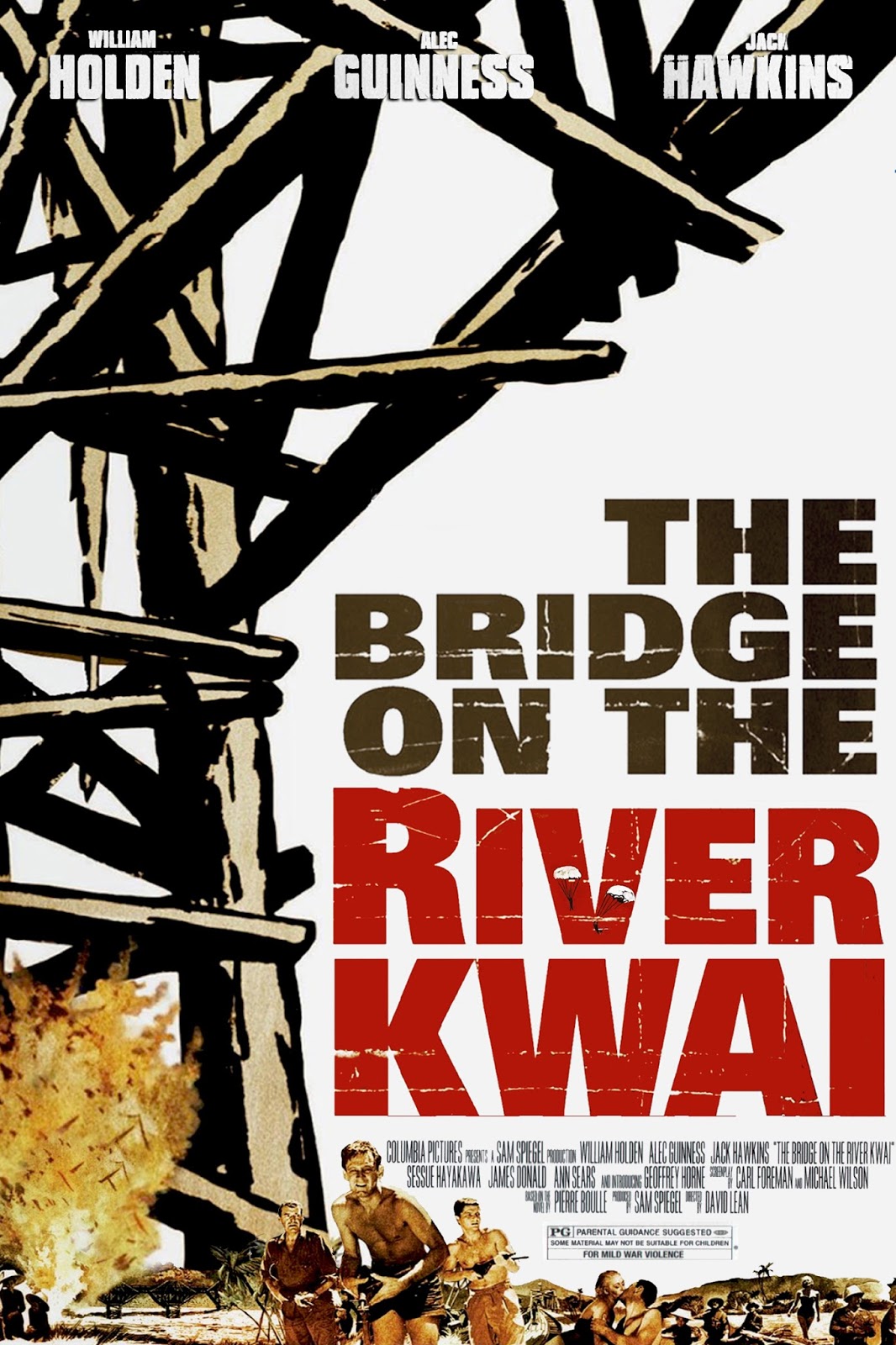
The Bridge On the River Kwai

SPOILER ALERT! The plot will be discussed.

Director David Lean was probably the most successful director of epic films that have at their center thoughtful themes about culture clashes. They include Lawrence of Arabia, A Passage to India, Doctor Zhivago (Czarist Russia versus the communist version), and this Best Picture Oscar winner released in 1957. Here we have individuals representing various attitudes of their countries concerning soldiering in the Asian theater of battle during WWII.
The first shot in this movie focuses on a bird flying high above a vast jungle. The freedom of the winged creature and the vastness of the land below contrasts with the confined world of a Japanese prison camp which seems out of place in the realm of nature. Shears (William Holden) has just buried another POW and there are numerous grave marker crosses at the improvised cemetery, which lets us know that there is danger here. Shears has a name which implies that he wants to cut through the bullshit surrounding the wartime agenda of those around him (which is a sort of human jungle). He represents, at least at the beginning, an American emphasis on the individual’s sometimes selfish concern of taking care of number one. He interrupts a cynical eulogy about the recently deceased by saying, “I’ve forgotten who we just buried.” After being reminded of the name of the British soldier, who died not in some glorious battle, but of a disease (beri beri) in a hostile jungle, Shears mockingly says the man’s death was “For the greater good … What did he die for? … May he rest in peace … He found little enough of it when alive.” He ends his tarnished tribute on a discordant note by slamming his shovel against the grave marker. After enduring the harshness of being a prisoner and witnessing so many deaths, Shears can’t see the fruitful forest for the diseased trees.
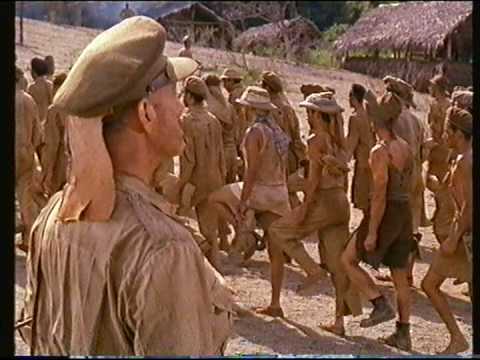
Like most pragmatic prisoners, he bargains to gain personal privileges. He robbed a corpse of a cigarette lighter and trades it with a guard who will put him on the sick list so he can avoid more hard labor while he plans an escape. The new POWs come marching in to the whistling tune made famous by this film. But, the sound fits in with the theme later expressed by the British and the Japanese that one should be happy at work. In Snow White, the seven dwarfs sing “Whistle While You Work,” which implies that in war, and in this threatening place, the whistling sounds like an escape from reality into a fantasy land. Of course to the British soldiers, led by Colonel Nicholson (Alec Guinness in a Best Actor Oscar winning performance), their group demonstration of precision music-making shows their unity of purpose and resolve to not be broken of their patriotic spirit (even as the camera zooms in on their falling apart boots as they march). Shears shows his contempt and for the gung-ho, straight-laced display, which he considers self-destructive in this environment, when he says to his fellow prisoner, “We’re going to be a busy pair of gravediggers.” The other POW says that Shears is neither an officer or a gentleman, the opposite of what we have been taught to admire in a soldier (and which turns out to be literally true concerning his rank). But, surface ideals are hard to come by and can seem fraudulent sales pitches amidst the realities of war (as was discussed recently in the post on Gallipoli).

The commander of the POW camp, Colonel Saito (Sessue Hayakawa), gives the same speech he delivers to all new POW’s, and which Shears mouths the words to. He says their task is to build a bridge over the Kwai River as part of a plan to provide a railroad link to transport troops and supplies between various parts of Burma. It is here that Saito says that they should be happy in their work. The bridge in this story takes on symbolic meaning since it also can pose the question as to whether there is a possibility to make connections among different cultures, even in the presence of hostilities between the various factions. Nicholson’s strict by-the-book position (he literally carries the articles of the Geneva Convention with him) at first indicates the answer is no. He declares to Saito that by the rules the enlisted men must perform labor, but the officers are exempt. But, Saito has his own military set of rules that expect a soldier to commit suicide if he brings dishonor to himself for not having completed his mission. He is just as rigid in his own way as is Nicholson, with harsh rules enforced against those serving under him. We see a man who constantly pulls a rope to fan Saito’s quarters, and a guard who must stay at a designated position in front of those quarters, even though it is where rain water pours off the roof onto the spot where he stands.

When Nicholson talks with Shears we see that the two could not be more different in their approach to soldiering. The colonel says there will be no escape attempts given the chances being slim of surviving the jungle. Besides, his orders were to surrender, and he must follow the rules. Nicholson thinks that he and his men can keep their British Army ways intact in the camp. Shears, of course, tries to open Nicholson’s eyes as to the realities of POW life there. He says that only he and one Aussie soldier have survived out of the group he arrived with. All the others died of disease, snake bites, or by way of Saito’s commands. Shears thinks the odds of survival are better in the jungle, and sticking to Nicholson’s impractical orders is pointless. He asks Nicholson if he intends to “uphold the letter of the law, no matter what it costs?” Nicholson tells Shears that without law, there is no “civilization.” Shears says, “That’s just my point; here, there is no civilization.” Nicholson’s response is, “Then we have the opportunity to introduce it.” Nicholson believes he can transcend the adversities there to maintain his world’s mindset, which, by his desire to impose his idea of civilization on foreign soil, can appear to be imperialistic. Nicholson says that the men must hold onto their self-respect by remembering they are soldiers, commanded by officers (which should not show debasement by being ordered to work); otherwise, they will see themselves as slaves. Shears, again insisting on the reality as he sees it, says that they are slaves here. Shears shows his focus on self-preservation by telling Nicholson’s British doctor, Major Clipton (James Donald, who will play a German POW in The Great Escape), not to fix him up so that he can stay on the sick list.
Saito smacks Nicholson and knocks the copy of the Geneva Convention rules out of Nicholson’s hand. He threatens to shoot the British officers, but Dr. Clipton stops the execution by telling Saito that it would be a scandal if he murdered the men. Saito instead forces Nicholson and his fellow officers to stand out in the hot sun. When they do not capitulate, he places the officers in a detention box, and Nicholson is beaten and put in “the oven,” a small cage. While this action takes place, the British soldiers slow the progress on the bridge by sabotaging the building so that sections fall apart. Saito is a realist. He says rules don’t apply in war, but unlike Shears, he has his orders, and has suspended only those rules that might prevent him from reaching his objective. Saito allows Clipton to try and convince Nichols to give in, since Saito has threatened to close the medical facility, and put the patients to work. Clipton urges Nicolson to relent so that he and the other officers can be released from their small prisons and get medical help. Nicholson says they must not give in. Saito tries to undermine Nicholson’s argument by saying that the officers are lazy and don’t want to take on their share of the labor. Clipton thinks both men are mad, a feeling he reiterates later. Saito starts to change his approach by offering the carrot instead of the stick. He gives the men some time off, and allows them to receive their Red Cross packages. Saito says it is not only the fault of the POWs for the lack of progress on the bridge, it is also due to his incompetent engineer, and so Saito takes over. But, there is still little progress. Saito tries to win Nicholson over by offering him whiskey, cigars, and food, but the British colonel refuses them. Saito is angry, and shows how hard it is to build a figurative bridge between the two men when he lists how different he perceives their respective cultures: “I hate the British! You are defeated but you have no shame. You are stubborn but you have no pride. You endure but you have no courage.”

Eventually, Saito must capitulate. So as not to dishonor himself, he releases Nicholson and says his officers do not have to work because it is the anniversary of Japan’s defeat of the Russians in 1905. So, he is granting amnesty in celebration of that historic event. Nicholson’s men cheer him, since his resistance to being subjugated by the enemy is a triumph. Saito, in private, is the defeated one, now, and he cries.

In the meantime, Shears and two others try to escape, with Shears surviving despite being shot and falling into a river. He makes it to a village just before he is ready to collapse. He recuperates there, and the inhabitants give him a small boat to get back to an Allied base. Again, he is lucky, as he is rescued as his water runs out. He awakes in a hospital in Ceylon. There, while those he left behind in the prison camp must do hard labor, he enjoys the lovely beaches and the affections of a nurse, as he awaits a medical discharge. As opposed to Nicholson, Shears says that he always was “a civilian at heart.” His indulging in selfish individual desires contrasts with those sacrificing their personal needs for bigger endeavors.
However, Nicholson’s larger plans are complicated, and seem contradictory. Saito’s confession that the Japanese engineer was not doing a good job provides Nicholson with what he sees as an opportunity to turn defeat into victory for the principles that make up proper British military behavior. Those ideals will not tolerate sloppy work or malingering with phony illnesses. Nicholson consults with those men who helped him build bridges in India, and they say the Japanese bridge is in the wrong place, and should be placed downstream where it can have a solid foundation. Nicholson tells Clipton that he must keep his troops active and working on the bridge will maintain order and discipline. He also wants the job to be done solely by the British soldiers so that they can show the Japanese how proficient the English are in completing a task. When one of his men says that the trees they will build the bridge with can last six hundred years, Nicholson sees that the building of the bridge will be a monument to future generations who will praise the accomplishment. On the one hand Nicholson’s vision is capable of seeing beyond the current fighting between the nations, but he also loses sight of the war at hand and is driven by patriotic and personal zeal for praiseworthy recognition.

When Nicholson’s team meets with Saito’s, it is Nicholson who is now in command, dictating the plan to build the bridge. As the operation proceeds, Saito becomes a ghost of his former self, looking stunned by the turn of events as he carries out Nicholson’s orders. The Japanese colonel really can’t do anything about this reversal because Nicholson is trying to accomplish what Saito has been ordered to do. Nicholson says he is “not responsible” for losing a month’s time of work because it was Saito who forced his will onto Nicholson and his officers. He uses Saito’s earlier words, because the camp commander said he was “not responsible” for the soldiers’ predicament, since they were ordered by their superiors to surrender. Nicholson does not allow that it was his resistance that also brought about the delay. Nicholson’s British imperialistic ways can be seen in even the smallest actions, as he orders tea while he discusses the building plans. At the camp, Nicholson really has succeeded in defeating his earlier adversary, but, ironically his victory is by actually helping his foe do his job for him. In order to speed up the construction, Nicholson does, ironically, what Saito wanted. He asks his officers to work with the other soldiers, but only if Japanese officers work on the railroad tracks. Under these strange circumstances, the two sides are in a bubble outside the external conflict, actually cooperating with each other. Nicholson also goes into the infirmary and recruits the injured, swaying them with British stiff-upper-lip talk so that they will volunteer to become part of the workforce. Dr. Clipton is upset by what is happening and says sarcastically to Nicholson, “I hope the Japanese appreciate what we are doing for them.”
Back in Ceylon, the British upset Shears’ plans for an early discharge. Major Warden (Jack Hawkins) asks Shears to volunteer to go with Warden as part of a commando group to destroy the bridge being built. It is interesting to note that when going to Warden’s quarters, Shears encounters commandos doing training simulations, and one soldier mistakes Shears for one the opposing participants, and manhandles him. The man says he confused Shears for “the enemy.” This scene echoes what is going on in the building of the bridge where Nicholson no longer seems to know who the enemy really is. In both cases, the narrow focus of wanting to be part of a job well done makes the individual lose sight of the bigger picture. Warden says that Shears will help given his knowledge of the area. Shears, not wanting any part of going back into the jungle and being part of a dangerous mission, says he is not the man for the job. He admits to being a regular enlisted man who happened to escape from a sinking ship with the Commander who later died (Shears up to this point seems to be lucky in escaping his dangerous military situations, and undercuts any praise Warden offers on his escape by emphasizing it was not due to heroic action, again contrasting him with the British outlook on soldiering). Shears assumed the man’s identity because, again looking out for number one, he knew that someone of high rank would get better treatment by the enemy if captured. He also continued the fraud after seeing how officer patients were treated better at the Ceylon hospital. Still trying to work a personal angle, Shears contemplates a psych discharge saying he will argue he assumes other identities because he has mental problems. However, Warden already knows that Shears is not really a Navy Commander. He tells Shears that he is an embarrassment for the Americans, because he should get a medal for his escape from the POW camp, but he is also a fraud. So, the Americans turned him over to the British. As Shears says, the Navy didn’t want to handle “a hot potato.” Shears now realizes he has no choice but to volunteer. Warden makes him a “simulated Major” for the operation, thus continuing Shears’ fraud to get the job done, which, again, takes precedence over other considerations.

Back at the camp, Nicholson can’t understand Clipton’s resistance to the British bridge building plan. Nicholson says that morale is high, discipline has been restored, the men are not abused, and they are eating better than before. Clipton says that it could still appear as collaboration and even treason. Nicholson says it isn’t collaboration because the British are building the bridge alone, which ignores the fact that Nicholson is still providing a means for the Japanese to fight the war. He also makes the argument that as a doctor, Clipton would operate on an enemy soldier to make him better, because that was his job. (Of course what Nicholson doesn’t say is that the doctor would not then arm the man and send him back into battle to shoot more of the doctor’s own soldiers). Nicholson comically says that Clipton may be a good doctor but he “has a lot to learn about the Army.” It doesn’t say much for the military if it operates in this nonsensical way.

Back in Ceylon, Warden, with Shears present, picks out his team. One of the men is Lt. Joyce (Geoffrey Horne). He is Canadian, which sets him apart from the American individualist, Shears, and the British getting-the-job-done-at-any-cost Warden. Joyce says his civilian job and his military one were boring. He wants some excitement, and his character shows the attraction of war as it provides that adrenalin rush. But, when asked by Warden if he could kill someone “in cold blood” with a knife, Joyce allows personal morality to enter into the equation, since he says he isn’t sure because he still feels “killing is a crime.” Warden recognizes that this dilemma has always been a problem in war, but they stick with Joyce, and Warden, employing British understated humor which goes back to Beowulf, tells Joyce he will join them on their “little hike in the jungle.” This way of downplaying danger is consistent with the British stoicism that doesn’t allow room for emotion to interfere with the task at hand. (Nicholson employs the same technique when he asks the camp’s patients if they wouldn’t mind doing a “little light work”). The fact that Shears never used a parachute is not a problem to Warden, since Shears can get in some practice. When there isn’t time for practice, Shears is told he still has a 50-50 chance of survival, so he might as well jump. And in case Shears gets captured, Warden gives him a suicide capsule, called an L-pill, so as not to compromise military operations. Shears does show some admiration for Warden when he learns that he has been captured before by the enemy and is willing to risk his life again.
Their journey is a trying one. Once of the men dies as his parachute goes down among trees. They are plagued by heat, leeches, rains storms, and thick vegetation that they must cut through. Shears, sarcastically, tells the team, which includes women carrying supplies and a local guide, to “be happy in their work,” echoing Saito, and thus showing how both sides try to rationalize away the harsh circumstances. The same point is made when they learn by radio that they must set off their explosives when a VIP Japanese train is crossing over the bridge. The message ends with “have fun,” which refers to the adrenalin rush that Joyce seeks, but also tries to dispel the danger involved. It is ironic that Nicholson has a deadline to meet to finish the bridge, while at the same time soldiers fighting on his side of the war now have a deadline to destroy Nicholson’s creation. Warden’s people encounter some Japanese soldiers, and, in order to not get caught in crossfire, they must use knives. Joyce hesitates in killing one of the enemy. Warden does the job, but chips a bone in his foot. He perseveres though, limping a great distance. However, when he sees himself as an impediment to the mission, he orders the others to leave him behind. He wants no sympathy from Joyce and tells him that he wouldn’t hesitate to leave Joyce behind if the situation was reversed. Shears is angry about the concern for the mission over the welfare of the individual, and tells Joyce that Warden would leave his own mother behind for the sake of the mission. Shears lets loose his contempt for Warden’s rules of war: “You make me sick with your heroics! There’s a stench of death about you. You carry it in your pack like a plague. Explosives and L-pills - they go together, don’t they? And with you it’s just one thing or the other: destroy a bridge or destroy yourself. This is just a game, this war! You and Colonel Nicholson, You’re two of a kind, crazy with courage. For what? To die like a gentleman, how to die by the rules - when the only important thing is to live like a human being.” Shears will not allow Warden to follow his rules and be left behind, and says they go on together.
Warden’s team arrives at the completed bridge in daylight and are able to get a good overview of how to set the explosives to destroy the bridge. Again, ironically, this happens as Nicholson places a plaque on the bridge announcing how it was constructed by British soldiers. The team can’t just set timers on the explosives on the bridge and make a clean getaway because they do not know when the train will be crossing, and must be there at the crucial time. Nicholson and Saito walk the bridge together, symbolizing their strange alliance despite being on opposing sides of the conflict. We then get from Nicholson why the bridge means something more to him than just a way to show the British ability to succeed. He says that he has served in the military for twenty-eight years and was hardly at home. It was a good life, but as he is now older, he wonders, “what the sum total of your life represents. What difference your being there at any time made to anything. Hardly made any difference at all, really, particularly in comparison with other men’s careers.” Nicholson is saying that he wanted to make a difference by contributing something concrete that will endure, which is what many people would want. But even if his motivation is pure, he has picked an odd way of achieving his goal. As he is saying these words, he drops his military crop into the water below, as if symbolically showing that, up until now, the Army has failed to make his dream come true. The lost crop seems to wake him up out of his reverie, and he again assumes the stoical look of a British officer.


Shears and Joyce plant the devices at night and hook them up with a wire to an explosive plunger as Nicholson’s men, in contrast, put on a show to celebrate the completion of the bridge. However, in the morning, as if nature itself is resisting man’s violent intrusion into the jungle, or because, as Warden liked to say “there is always something else” that seems to come up when trying to control an uncontrollable universe, the river has dropped, and the wires are exposed. Clifton, despite Nicholson’s speech of the night before about how this British accomplishment will be an inspiration to people in the future, wishes to view the train crossing from a distance, on a hill because he can’t be a part of what is happening. Nicholson, while doing a last inspection, sees the wires, and goes with Saito down to the water level to investigate. As Nicholson pulls up the wire, he yells out for help because he knows the bridge is in danger. Warden, realizing how Nicholson is about to betray the mission, yells out to Joyce to kill Nicholson. Joyce does stab Saito to death, but is shot to death by Japanese soldiers. Shears, now a true part of the team, runs out to try to complete the mission, but is also killed as he tries to reach the the detonator. Warden has fired mortar shells as backup, and Nicholson is hit ironically by “friendly fire.” In this moment where he has been attacked as an enemy of his own people, Nicholson is brought back to the realities of war and realizes his betrayal of his own military forces as he says, “What have I done?” He stumbles and dies, falling on the plunger, destroying the train as it passes over the bridge he was so proud of building.


We see the plaque that was supposed to last for six hundred years floating on the river. The bird that was in the first shot appears again, soaring freely above the men still imprisoned in their world of violence. The last words of the film are uttered by Clifton, which sums up how the existence of war destroys all the best laid plans, if not of mice, but certainly of men: “Madness - Madness.”

The next film is Goodfellas.

Sunday, March 20, 2016

Lawrence of Arabia

SPOILER ALERT! The plot of the movie will be discussed.
Director David Lean was a maker of intelligent epics about culture clashes and the conflicted characters that mirrored those battles within themselves. Sometimes the war was within a single country, such as in Doctor Zhivago, and sometimes between very different civilizations, such as in The Bridge on the River Kwai, and in this 1962 Oscar winning film.
The movie begins with Lawrence’s death in a motorcycle accident in 1935 in England and his subsequent memorial service. Many people are asked who the man was, which turns out to be a difficult question, since he combined so many often opposing characteristics. One man, the reporter Jackson Bentley (Arthur Kennedy), who covered Lawrence’s exploits, says “he was a poet, a scholar, and a mighty warrior. He was also the most shameless exhibitionist since Barnum and Bailey.” The film explores these different facets. The title of the movie suggests the two worlds which collide in this story. T. E. Lawrence (Peter O’Toole in probably the most impressive film debut ever) is a British officer who assigns himself the task of bringing together the disparate Bedouin tribes to form a united Arabia. He tries to accomplish this goal during World War I when the British explore the possibility of helping Prince Faisal (Alec Guinness) in his revolt against the Turks. We quickly verify Bentley’s opinion that Lawrence is well-read by his learned references. He also voices a craving for a chance to exhibit his abilities. He receives his opportunity when the military assigns him the task of assessing Prince Faisal’s situation.
When Lawrence meets Faisal he says he has allegiance to England and other things, which in this case is the freedom of the Arab people. Faisal questions this split loyalty. He says, “The English have a great hunger for desolate places. I fear they hunger for Arabia.” Lawrence tells him that he must deny the English his land. So, Lawrence does go rogue when it comes to the British agenda. But, Faisal is an insightful man, and tells Lawrence, “I think you are another of these desert-loving English.” That is why Lawrence doesn’t “go native,” converting to the Arabic way of life. He is an Englishman, and the English have a long history of pursuing imperialism. This predisposition includes a condescension toward the peoples in the colonies, thinking that the rulers are the civilized ones who know what’s best for those they lord over.
Lawrence shows this condescending attitude in his superior posturing, even if it is for admirable reasons. In his first meeting with The Bedouin leader, Sherif Ali (Omar Sharif), he says, “So long as the Arabs fight tribe against tribe, so long will they be a little people, a silly people – greedy, barbarous, and cruel, as you are.” But, his egoism exhibits a private imperialism which goes beyond the influence of his countrymen’s ways. He says that the Arabs should have their freedom, but he patronizingly states, “I am going to give it to them.” He at one point says that he comes from a fat country with fat people, but that, “I’m different.” He reveals his extreme self-centered nature and exhibitionism, and his potential to be a warrior, on several instances. When he lets a burning match singe his fingers, an act he has performed before, he says he is able to do it because the trick is not minding the pain, which he feels he can rise above. He is shot by a Turkish soldier in the arm after leading the Arab tribes in blowing up a Turkish train. When asked if he is hurt, he says not at all: “They can only kill me with a golden bullet.” He says to Ali, “Do you think I am just anybody, Ali? Do you?” And when questioned by another Arab tribal leader, Auda Abi Tayi (Anthony Quinn) about the recklessness of crossing the Sinai desert, Lawrence shows his megalomaniac perception of himself by comparing himself to Moses. (He even isolates himself in the desert, like a biblical hero, purifying his resolve, when deciding his course of action). Auda breaks Bentley’s camera because, as Lawrence says, he believes it will steal the Arab’s soul, which may be a cautionary reference to how the seduction of fame can undermine one’s moral center. But, Lawrence has no problem being photographed, as he strides over the derailed train, above the others, his enlarged shadow literally overshadowing his followers.

His hubris can be dangerous, however. He thinks he can infiltrate a Turkish fortified town, despite his blonde, blue-eyed fair-skinned appearance just by wearing Bedouin dirty clothes (more condescension). When going through the city’s streets he says to Ali that there is nothing to worry about because he is “invisible.” This self-delusion of invincibility gets him caught by the men of the sadomasochistic Turkish Bey (José Ferrer), whose persistent cough is symbolic of his diseased nature, and who strips off Lawrence’s upper clothing and fondles him. When Lawrence hits the Bey the latter orders him brutally beaten. This incident so humiliates Lawrence that he no longer considers himself extraordinary, and just wants to be an ordinary soldier. But the British General Allenby (Jack Hawkins) wants to use Lawrence, so he flatters him and brings his egoism to the fore once again. However, his hunger for hero worship blinds Lawrence from recognizing how it can lead to abusive power. He subsequently gives in to his blood-lust when he needlessly goes out of his way to lead his men in the slaughtering of Turks on the way to Damascus.


Lawrence does show how he is truly an extraordinary person, brave and a born leader who actually does care about the Arabs. He wins the admiration of the Bedouins, including Ali, who slowly shows respect for Lawrence, and eventually admires him, honoring him by giving him his tribe’s robes after burning the soldier’s British uniform and thus symbolically showing the substitution of Arabia for England. For instance, despite his recent exposure to the desert, Lawrence will not drink water until the others drink. He shows amazing daring when he leads the Arabic tribes in crossing a brutal desert to conquer Aqaba by land. He rescues a man against all odds who has fallen from his camel in a punishing expanse of desert. (It is ironic that in order to keep the peace between the tribes Lawrence executes the man he saves because the man committed murder, showing that Lawrence must give life and take it away in a God-like manner). Ali admits that Lawrence is one of those rare fate-defying men for whom, “nothing is written unless they write it.” But, despite his charasmatic presence, he is not able to unify the tribes in Damascus so that they will not come under British rule following the defeat of the Turks. Both the British and Faisal used Lawrence to overthrow the Turks, but they now must negotiate and compromise, because Faisal needs the help of England for practical matters, and England wants the Arabs under their colonial influence. Faisal tells Lawrence, “There’s nothing further here for a warrior.” After the war is waged, “old men make the peace.” And the vices of old men are “mistrust and caution.”
 Lawrence’s usefulness is at an end to those who are really in charge. His vision of a united, independent Arabia, a place which he said he loved, is now a fleeting realization. Lawrence rides in a staff car to go back to England. The driver says to Lawrence that the promoted colonel is going “home.” But, Lawrence has no true home now, at odds with his country of birth, and exiled from his land of opportunity. A motorcycle passes the car Lawrence is in, an omen of the nothingness that awaits him.

The next film will be The Treasure of the Sierra Madre.