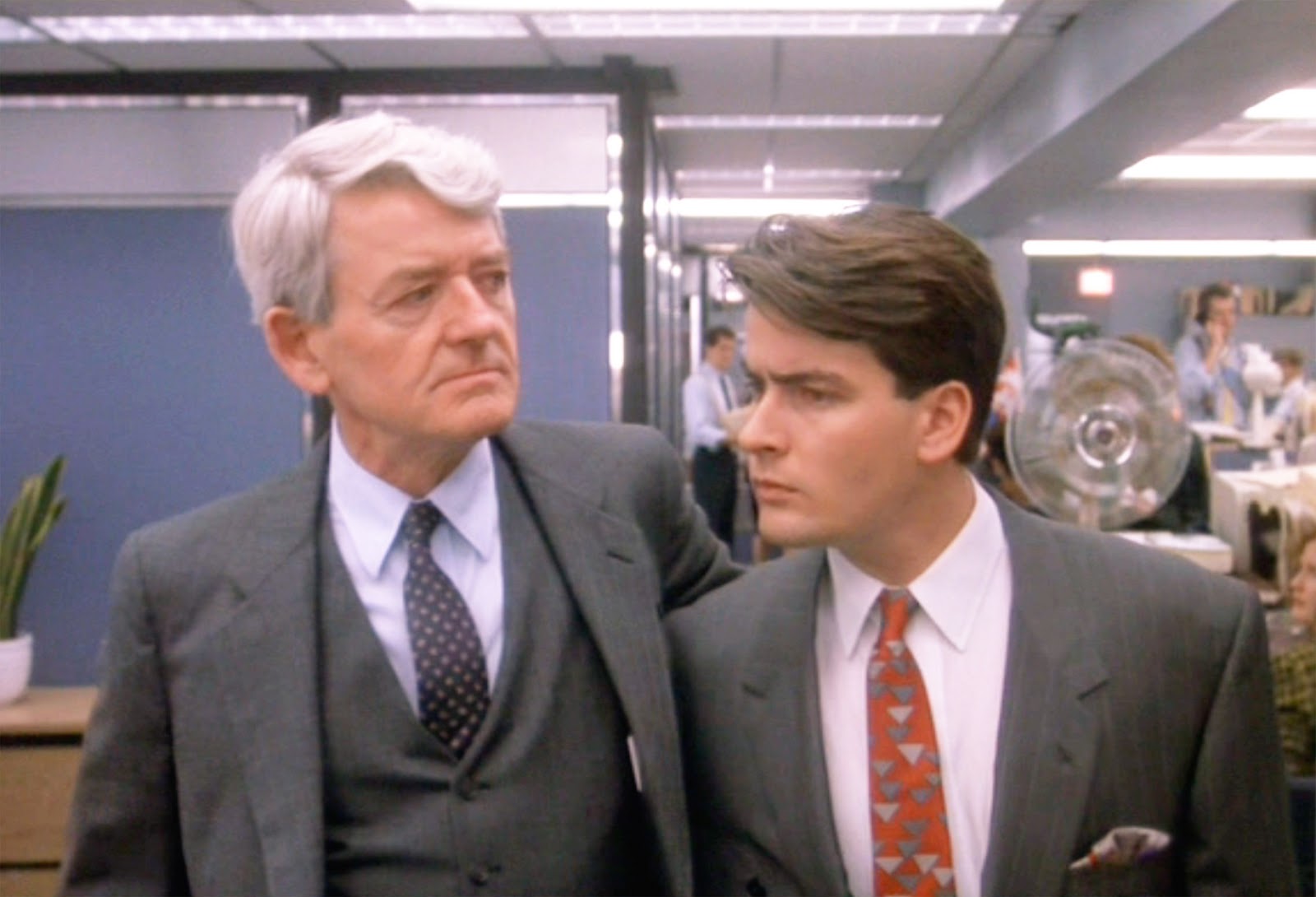
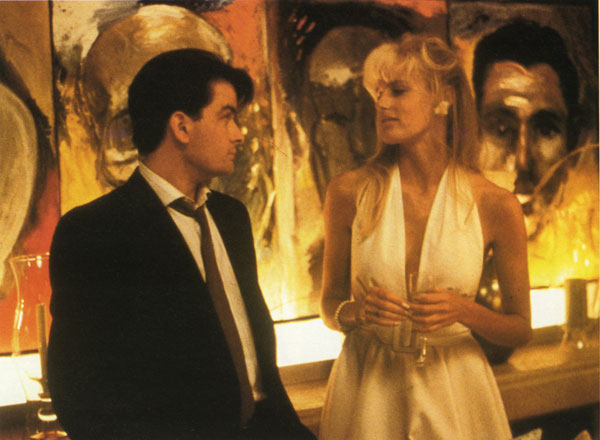
SPOILER ALERT! The plot
will be discussed.
When does reality become
so bizarre that it begins to feel like a surreal experience? Francis Ford
Coppola’s Apocalypse Now gives us a film that uses the Vietnam War to
create that scenario. The movie goes beyond that theme by using Joseph Conrad’s
Heart of Darkness as its source, and dives into the abyss at the center
of the human soul and portrays the mythic ritual of sacrifice and regeneration,
not of man’s hope but of his bestiality. (I am using the 1979 original film,
not the Redux version, because I find the one with added footage slows
the narrative and thus impacts the power of the story).


The film begins with a
shot of the jungle, both natural in its beauty and deadly in its hidden
dangers, as is the nature of humankind. Helicopters fly slowly like mechanistic
dragons, in unreal movement, as bombs reign napalm over the foliage. The fires
of hell are brought to mind. Given the title of the movie, the soundtrack
appropriately plays “The End” by The Doors. The lyrics talk about how “all
elaborate plans” are now useless, which fits with the way the war was waged,
and how we are in a “desperate land,” running out of options as to how to go
on. The propellers of helicopters are then replaced by the ceiling fan blades
of the room occupied by Captain Benjamin Willard (Martin Sheen). We see his
face superimposed over the jungle fires as the external destructive forces are
becoming internalized in this character. The song’s line, “All the children are
insane,” stresses the deranged state of war.

Willard is the narrator
and he is disoriented, as is the effect of this war on those personally touched
by it. He is in Saigon, but keeps thinking he’ll wake up in the jungle, because
after being immersed in the uncivilized part of the world his mind can no
longer adapt to society’s conventions. Like many veterans (as shown in The
Hurt Locker, discussed on this site) Willard says how difficult it was to
wake up when he returned home, unable to deal with the transition from the
theater of war to peace at home. He shows how he is being torn when he says
when he was in Vietnam he wanted to be home, but when back in the United
States, “all I could think about was getting back into the jungle.” He is both
repulsed and drawn to the horror (a word that will be stressed) of the place
that symbolizes confusion and danger. He keeps waiting for a “mission” a
purpose, and the waiting makes him “softer” and “weaker.” He is feeling like a
pacified civilian, which undermines the animal ferociousness he needs to
survive in the jungle, as the enemy in the “bush” gets “stronger.” He feels the
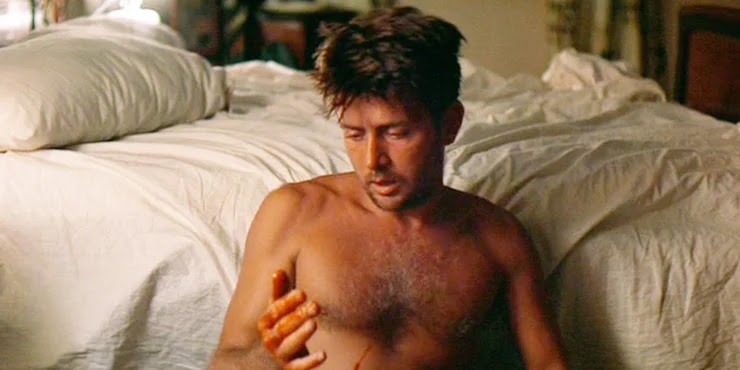
walls of his hotel room are getting closer, caging the animal in him. He
practices martial arts in the room, and at one point smashes a mirror with his
fist, and bleeds. Mirrors, as was noted in other films, can signify the darker
sides of oneself, and here the breaking of the looking glass demonstrates how
the more sinister side can betray and harm a person.
Willard says he wanted a
mission, “and for my sins, they gave me one.” It is an enigmatic statement that
can mean he was rewarded by getting what he desired. But, ironically, the
orders he receives will also be a punishment, a penance for those “sins” he has
already committed, almost like giving a junkie a fix. The foreshadowing of the
terrible task becomes obvious when Willard’s voice-over says that when the
operation was over, he “would never want another.”
He says he didn’t
realize it at that time but he was going to the worst place that existed, far
away from any protected community, up a river “that snaked,” a demonic, ominous
reference to Satan in the Garden of Eden, toward “Kurtz,” the object of the
mission. When he arrives to receive his orders, Willard the narrator says, “It
was no accident that I got to be the caretaker of Colonel Walter E. Kurtz’s
memory.” Very early on in this long tale the film informs us of the almost
mythical force of fate that will define Willard’s future role. He says that
there is no way of telling Kurt’s story without telling his own, and Kurt’s
“confession” (an announcement of sins but also an intimate revealing) is also
his. The story implies that Willard and Kurtz are doubles, resembling each
other’s characteristics and paths, one younger, one older, as their ages will
eventually define what must play out.
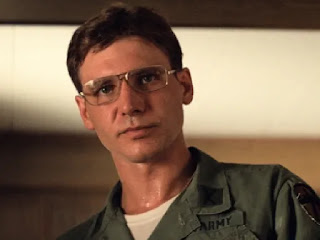
Harrison Ford, following
his Han Solo role, plays a small part here as Colonel Lucas, (a reference to
George Lucas who was supposed to direct this movie) one of the commanders
issuing Willard's orders. Lucas questions Willard about his work in
counterintelligence which included assassinations. But because he is a covert
operative, Willard is reluctant to discuss his past, and the fact that he will
not acknowledge his secret exploits, which were performed outside the
parameters of acceptable rules, may be a test to make sure he will not divulge
any aspects of the current assignment. General R. Corman (G. D. Spradlin, whose
character’s name invokes director Roger Corman) and a quiet man in civilian
clothes only referred to as Jerry (Jerry Ziesmer, the film's assistant
director) are in attendance, and the General invites Willard to a nice lunch
which contrasts with the distasteful mission.
Lucas plays an
intercepted audio transmission from Cambodia which is of Kurtz’s voice. Kurtz
says that he has a “dream” which is also a “nightmare” of a snail crawling
along the edge of a razor and surviving, suggesting what Kurtz will later call
accepting the “horror” of life to be victorious. Kurtz also talks about killing
and burning animals, villages, and armies, and then wonders how the “assassins”
can “accuse the assassin” of wrongdoing. He is questioning the hypocrisy of
those who do horrible things but cover them up with “lies” and pretenses of
“mercy.” Corman says that Kurtz was a brilliant officer, a humanitarian, and a
man of “wit.” But he, like Willard, joined the Special Forces, and his “method”
and “ideas” became “unsound.” The suggestion here is that Kurtz became detached
from being anchored to a superimposed ethical base, which he found phony. Since
Willard’s military history is compared to that of Kurtz, the question is raised
as to whether Willard is on the same track.
Lucas says Kurtz has
gone into Cambodia with a Montagnard army (Vietnamese mountain people) that
follow him “like a god” and they do whatever he says. The implication is that
without any restrictions, anything is permissible. Corman says that Kurtz is
guilty of murder for killing Vietnamese intelligence assets he considered
“double agents.” Willard is confused probably because he doesn’t see how murder
can be a consideration in war where the point is to kill people. Corman admits
in an understatement that in a war, things can get “confused out there.” Corman
says there is a conflict in people “between the rational and the irrational,
between good and evil, and good does not always triumph.” He admits that
sometimes the “dark side” wins (this statement must have sounded familiar to
Ford after Star Wars). Corman says that everyone has a breaking point,
and Kurtz reached his and has gone “insane.” But, there is the sound of a
helicopter in the background reminding us of the irony of Corman delivering
these insights because, the film may be arguing, that everyone involved in war
is somehow complicit in insanity. Corman talks of Kurtz going beyond the bounds
of decency at the same time he is ordering the murder of a military
colonel. Lucas then uses official language as he tells Willard that he
must board a Navy patrol boat to find Kurtz, “infiltrate” his base and
“terminate the colonel’s command.” Thus, Lucas is giving Willard unchecked
authority to kill. Jerry, probably a CIA man, finally speaks to drive home the
goal when he delivers one of the movie’s memorable lines, “Terminate with
extreme prejudice.” It is euphemistic, but he is actually saying Willard is the
executioner who must carry out the already decided sentence of death without a
moment of hesitation.
As he approaches the
Navy boat (whose name is the Erebus which was the name of the Greek god of
darkness, as IMDb states, and which fits with the title of the Conrad novella),
Willard wonders how many people he has killed. Thus, he questions the validity
of his orders when he says charging Kurtz with murder, “was like handing out
speeding tickets at the Indy 500.” The film asks the question how can a country
enter a situation that at its base involves killing and then state it’s against
the rules to do so? Because Willard sees the hypocrisy of the mission, and the
fact he has been ordered to murder an American officer makes him admit that he
isn’t sure what he will do when he finds Kurtz. For Willard, the story
eventually suggests, killing Kurtz would be like destroying himself.


One of the tragedies of
war is that young people are put in a deadly situation, as Willard points out
when he says some of the boat's crew were, “rock and rollers with one foot in
the grave.” Willard observes that Jay “Chef” Hicks (Frederick Forrest) “was
wrapped too tight” for Vietnam, suggesting that the man is jittery and can’t
coolly deal with the pressure of the battle. Lance B. Johnson (Sam Bottoms) is
using a reflector to get an even tan, and Willard narrates that the young man
was a Los Angeles surfer. He looks like he’s at home on a beach instead of on a
boat to hell. (There are many examples in the movie of Americans trying to
escape the terrible circumstances they are in by mentally recreating the
comforts of their lives before becoming soldiers). Tyrone “Clean” Miller (a
very young Laurence Fishburne) came from a Bronx ghetto, and Willard says the
sharp contrast of the “light and the space of Vietnam really put the zap on his
head,” implying the whiplash effect of such a switch in the man’s life was
disorienting for him. Chief Phillips (Albert Hall), according to Willard, made
sure everyone knew that he had jurisdiction over the boat and crew. (Good
writing usually uses actions and words to show who the characters are. The film
is long, and possibly Coppola wanted to save time here with these summations,
but it is legitimate to question his decision).
The Chief warns that
they will be going through dangerous waters controlled by the enemy. He says he
brought a man who was on a special operation once before, saying that man was
“regular Army, too,” thus comparing the soldier to Willard. The Chief follows
by saying that fellow shot himself. He is providing a cautionary tale for his
self-assured passenger. The radio is playing which mentions how the local
government wants to keep Saigon looking clean so soldiers should not hang their
laundry outside. It is a sort of distracting statement to place domestic
activities as a priority so as to not face the daily deadly realities that
exist. “Satisfaction” by the Rolling Stones plays on the radio, and these men
are trying to get some of what the song laments about not having. Clean dances
to the song as Lance water skis behind the boat as they try to hold onto a
piece of their old lives. But Lance creates large waves that buffet the
Vietnamese on the beach and in the river, showing how the out-of-place American
presence overpowers the lives of the locals.
In contrast to this
diverting activity, Willard somberly reviews the information on Kurtz, as the
soundtrack now matches his mood. The documents show that Kurtz graduated at the
top of his class at West Point, following a family tradition of attendance
there. He received a master’s degree in history from Harvard and wrote a thesis
on foreign policy in Southeast Asia, interestingly on the Philippines
Insurrection, which shows he knows about rebellion. He also received many decorations
and it appeared he was being readied for a top spot in the military. But when
he reported his observations about Vietnam, those in power apparently did not
appreciate what he had to say. It is at this point that Kurtz started to become
alienated.


Along with the Conrad
story, the raft ride on the river which turns out to be a journey of discovery
brings Huckleberry Finn to mind here. But, this story is a demonic
version of that tale as the characters’ revelations are of an earthly
apocalypse of the human soul. They meet up with the Air Cav that is to be the
boat’s escort to the “mouth of the Nung River.” As Willard and his men go on
shore, Coppola himself plays the head of a TV team as he says, “Don’t look at
the camera … Go on. Keep going.” Here is an example where reality and illusion
join. There is an actual war going on and the TV man/Coppola tells the soldiers
to pretend like they are not being filmed for TV audiences and urges them to
look “like you’re fighting.” But that is exactly what a director would want for
his actors to do, that is to simulate reality, since this is not a true war,
and actually is a bit of fiction - a movie. In essence, the make-believe
actions are reversed depending on how we approach what we are seeing.
The military outfit is
“mopping up,” adding the finishing touches to an attack. Willard meets the
commanding officer here, Lt. Colonel Kilgore, an appropriate name for this war
lover played by Robert Duvall. Kilgore throws playing cards onto dead enemy bodies
to let the Viet Cong know who killed their men, making it seem like war is some
sort of game. There is a young American soldier sitting on a wall who looks
overwhelmed by the carnage. Kilgore’s incredibly inappropriate comment to the
youth is, “Cheer up, son.” The bombing devastated the area, yet a voice over
the loudspeaker contradictorily declares to the locals that the military is
there to help them. Although Kilgore is fighting for the U. S., he would be
passionate about waging battle whatever side he was on. He says of one of the
enemy soldiers who is holding his guts in after being wounded that the man
deserves to drink from Kilgore’s canteen. Kilgore admires the battle experience
in general. Kilgore is thrilled to meet Lance because he is a famous surfer,
and the commander already has two surfers under him. As he leads Lance away,
prayers are uttered in the background by a chaplain conducting a church
service, which seems like a strange place to be trying to provide
sanctity.
Kilgore airlifts in steaks
and beer as he turns the base of operations into what Willard says is a “beach
party.” Willard’s cynical tone increases as he progresses toward views held by
Kurtz. Willard says, “the more they tried to make it just like home, the more
they made everybody miss it.” But, this desire to transform this land also can
be seen as an imperialistic drive to Americanize a foreign country. Willard
says Kilgore had a “weird light around him. You just knew he wasn’t gonna get
so much as a scratch.” Willard seems to be comparing Kilgore to some kind of
war god that leads his soldiers into battle but is not really risking any harm
to himself. Kilgore becomes convinced to take Willard’s boat to an enemy
stronghold because one of his men says it’s the best spot for surfing. The
interest in surfing goes along with trying to recreate the United States so far
away. Kilgore wants to defy the odds against safety by drawing an odd superior
distinction between the Americans and the enemy when he says, “Charlie don’t
surf!”

Kilgore wears a western
cavalry hat that lives up to the Air Cav name, which is also stressed by having
his bugler sound the Old West cavalry charge as his fleet of helicopters lift
off. He also plays Wagner’s “The Ride of the Valkyries” loudly to scare the
Viet Cong. The Valkyries are female entities from Norse mythology that fly and
announce who will die. It is a fitting and chilling metaphor for these
mechanistic death birds of prey who destroy the villages below. The front of
the helicopter in which Kilgore is riding has “Death from above” written on it
which fits in with the literal and supernatural connotations. Children on the
ground coming out of school and peasants run for their lives along with armed
enemy fighters who try to defend themselves. It is difficult in a guerrilla war
such as this one (and in the conflict in The Hurt Locker) to distinguish
who is the real threat. American soldiers are deployed from the helicopters,
and some become casualties. As a helicopter tries to airlift out wounded Americans,
a seemingly innocent woman hiding a grenade blows up the copter. Kilgore calls
the enemy “savages,” but the film implies that savagery occurs on both sides of
war to one degree or another.


Bombs go off around
Kilgore as he stands while the soldiers dive for cover. The image fits with
Willard’s indestructible vision of the man. Instead of being empathetic about the
loss of life and danger surrounding them, Kilgore is only interested in the way
the waves break. He tells his surfing men that they either surf with bullets
flying all around, or fight, giving them the frying pan or the fire choice. He
calls in a huge napalm bomb strike that totally consumes the enemy area. It is
here that Kilgore delivers the film’s memorable line: “I love the smell of napalm
in the morning... It smelled like victory.” He then says that someday the war
will end, and he sounds disappointed. The burning fires of hell are again
suggested here to mirror the opening shot of the movie, and one wonders if
Kilgore is announcing the way the devil can claim “victory” over the world
through man’s lust for killing.
Willard takes in all of
these happenings with an outsider’s viewpoint now, a Kurtz outlook, and ponders
the reason to want to take out Kurtz when there was already “insanity and
murder” in abundance there. He says the men on his boat just want the war to
end, unlike Kilgore, and wish to go home. Narrator Willard says he’s been back
to the states, and realizes there isn’t a way home anymore, because a soldier
takes the jungle with him. They resume their trip up the river's artery to that
heart of darkness.

While stopping along the
shore, Chef wants to look for mangos and Willard goes with him for protection.
As they walk through this alien land, Chef reveals his nickname comes from his
training to be a saucier in New Orleans. However, the military dampened his
desire to be a cook in the service by the way the Navy ruined food, showing how
refined living was left behind when war is the priority. The conversation of a
faraway civilized world contrasts with the current locale. The discrepancy is
emphasized as the trees and other vegetation completely dwarf them, symbolizing
the power of uncontrollable nature over human beings. The ferociousness of the
jungle literally appears when a tiger emerges, which suggests that humans are
part of nature and violence is a basic drive in all animals. After the two men
escape, Chef shows how he is “wrapped too tight” as he freaks out, screaming
he’s never leaving the boat (the way to navigate around the danger inside and
outside everyone?). Narrator Willard echoes what Chef says about staying on the
boat, “unless you were going all the way,” that is, to accept the truth about
the horror behind existence. He says that Kurtz got off the boat, meaning he
left war’s false morality behind. He began to decide to wage battles on his own
and initiated attacks without authorization. He had great success with
Operation Archangel, the name suggesting that Kurtz saw himself as an
instrument of supernatural wrath. Willard says the “bullshit” piled up so high
in Vietnam, one needed wings to stay above it (like a flying archangel?). It is
telling about the progression of Willard’s mentality that as he continued to
read about Kurtz the more he “admired” him.


Willard and his men dock
at a site that is out of place in the jungle. It has bright spotlights and a
stage. They need fuel, and when there is some bureaucratic hold up, Willard
violently grabs the soldier handling supplies in a threatening way to get what he
needs. Willard is already practicing Kurtz’s rejection of rules. There is a
show that night featuring three Playboy Bunnies. We again have reality turning
into escapist fantasy. It is noteworthy that the locals must watch behind an
enclosed fence. Even though the South Vietnamese were American allies, here
they are not really accepted by the occupiers, and the military fosters the
impossible idea that the soldiers can separate themselves literally and
mentally from their surroundings. The women dance suggestively, using guns as
phallic symbols. The attempt to put on a peaceful show of titillation fails, as
the instinctual sexual urges of the hundreds of men are unleashed and they
start to overrun the stage, clawing at the scantily dressed women, who must be
evacuated. Willard, the observer, comments that the enemy had no rest and
recreation, implying there was no reason to dream of home because they were
home and couldn’t escape that truth. For them, their R&R was rice and rat
meat to eat. They had only two options, “Death or victory,” and the implication
is that is what makes them very hard to defeat by conventional means.
Along the way they
encounter other American boats. They play diversionary games by sailing too
close to each other and one member throws an ignited object onto the covering
of Willard’s craft. Chef has to put out the fire. Just like the Playboy Bunnies
incident, escapism veers very close to dangerous activity, as the less
admirable elements of people come to the surface. Speaking of those uncivilized
aspects, Willard continues to read Kurtz’s dossier. The independent Kurtz,
waging his own war, assassinated Vietnamese individuals, two of which were in
the South Vietnamese Army. Since enemy resistance dropped in his sector, Kurtz
had identified South Vietnamese spies, showing again how the enemy can come
from anywhere. Then Kurtz disappeared into the Cambodian jungle, a place that
now suited him. Kurtz wrote home saying he has been accused of murder, but he
says that being “ruthless” many times is an act of “clarity,” that shows one
what needs to be done. He wrote, “I am beyond their timid, lying morality.”
Kurtz had decided to answer to nobody but himself, an understandable reaction
considering the handling of the war, but a dangerous stance that can lead to
crossing that line that General Corman talked about, and the committing of
atrocities.
As Willard reads the
letter, the boat passes by dead bodies in trees, and a burning helicopter that
crashed into another tree (of course, fire is again present). It is like they
are passing by a grotesque graveyard. The Chief tries to keep order amid chaos
as Chef and Clean argue. They come across a Vietnamese boat. The Chief says he
has to check it out to make sure it isn’t a Viet Cong vessel, since, as was
noted, the enemy may be anyone, including, metaphorically, oneself. Willard
tells him not to stop, but the Chief says he has his orders. He forces the
reluctant Chef to board the other craft and he acts roughly and loudly with the
people there. Tension rises and Clean goes dirty as he loses control and starts
firing his machine gun, killing all but one of the Vietnamese. There is a woman
who is alive and she was only heading for a hidden puppy, not a weapon. The
Chief wants to take the wounded woman to get medical assistance. Willard kills
her, knowing that rescuing her will only delay his mission. The brutality of
hysterical irrationality meets up with dispassionate violence in this scene as
war strips away civilized behavior.


Willard narrates that he
realized that the American occupiers told themselves that they needed to put a
positive spin on their deeds. But, for Willard, it was like treating the
Vietnamese by “cutting them in half” and then giving them a “band-aid.” He sees
this action as a “lie” and the more he becomes like Kurtz the more he hates the
“lies” inherent in American policy. The boat approaches the last American
outpost situated at a bridge. It is totally lit up with rockets going off like
fireworks. Lance, who has painted himself green as camouflage, but which
symbolizes becoming one with the jungle, says he took the hallucinogen LSD. He
carries the puppy retrieved from the boat they shot up. The cute dog is a
symbol of innocence, like many of these young men, caught in a whirlwind of destruction.
Lance says the place looks beautiful, and it appears at a distance like a theme
park at night until there is a closer look. (Lance receives a letter from home
about going to Disneyland and says where he is now is better than that
amusement resort, which stresses the upside-down world he is now in). This
scene very much adds to the theme of life losing its grounding in reality as
rationality becomes insanity. Soldiers swim toward the boat asking to go home,
which is all the soldiers really want as noted earlier, but which Willard said
they can’t really do mentally once being in the war zone. Willard is given a
communication by a man on another boat who then says he now can gratefully
leave because Willard has reached “the asshole of the world.” This excremental
view of humankind mirrors that of satirist Jonathan Swift.
Willard and his men go
ashore and the soundtrack sounds like harsh circus music played in hell. They
come across a bunker ironically called “Beverly Hills” where rock music plays
and the men smoke pot, still trying to escape the nightmare. To stress the
chaos of the situation, Willard asks a man firing his weapon wildly who is his
commanding officer. The soldier asks, “Ain’t you?” His confusion represents
that of all those there. The Chief questions the point of going forward, noting
the cyclical nature of the war as they keep rebuilding the bridge there and
each time the enemy blows it up again. But Willard is determined to find Kurtz,
because the mission has also become an inner quest to meet the man who now
reflects parts of himself.
The information Willard
received is that someone else was sent on a similar mission before Willard. The
man’s name is Captain Richard Colby (Scott Glenn, with no dialogue in this
version) and he has joined the Kurtz cult. He tried to send a letter to his
wife telling her to sell the house, the car, and “the kids” because he was
“never coming back.” Once sucked into the black hole of this heart of darkness,
there is no getting out. Lance plays with a smoke bomb, adding to the
hallucinogenic fun ride theme park the war has become for him. But the smoke of
his diversion turns into trails of incoming fire from the enemy on shore,
coming out of the hostile jungle. Clean is hit and killed while a tape that arrived
from his mother plays, adding to the tragedy as she speaks of the young man
coming home and eventually giving her grandchildren.
The journey continues as
the boat goes through a fog (the fog of war?) which shows the clouded morality
of the conflict. Lance has his arms up behind him as he leans against the craft
and screams. The image reminds one of Odysseus who asked to be bound so he
could hear the seductive song of the Sirens who lured ships to their
destruction. Willard, almost psychically linked to Kurtz now, says he feels
that the man is close. He says it was like the river was paradoxically
(irrationally?) being sucked back into the jungle, (which adds to the black
hole metaphor). A spray of arrows flies toward them, but here again the danger
is misleading, since they are toy weapons, just meant to scare. But the Chief
and Chef fire at the natives on the shore. A real spear then penetrates the
Chief, as weapons now become more primal, barbaric, from a place removed from
modern influence. In his dying action the Chief tries to pierce Willard with
the point of the spear coming out of his chest in his own attempt to stop the
madness.
Willard tells Chef his
mission, which boggles Chef’s mind since it involves killing someone on their
side of the war. Willard is ready to go on land on his own, but possibly
because there has been so much sacrifice for the mission already, and he needs
to hold onto some purpose amid the craziness, Chef tells Willard they will get
him to where he is going. Lance has one of the toy arrows looking like it is
going through his head, something that the comedian Steve Martin used to do.
The image adds to the theme that reality has become so strange it feels like an
illusion.


To add to that feeling,
a Halloweenish landscape appears as there are skeletal heads propped up on
spikes in a hellish graveyard. Willard narrates that more than his fear was the
desire to confront Kurtz (and to face that part of himself that is like Kurtz?).
They finally sail into Kurtz’s jungle kingdom. There are many natives standing
on boats looking at the strangers arriving. They part, allowing the boat to
dock, as if they expected the visit. The natives appear to be covered in some
kind of mud-like substance, as if they sprouted from the land as offshoots of
the jungle, which adds to the surreal atmosphere. There are many more armed
local inhabitants on the grounds of what looks like an ancient temple, which
contributes to the mythological aspect of the conclusion of the story. The
soundtrack has thumping bass sounds that remind one of a loud beating heart
that director John Carpenter later puts to great effect in his version of The
Thing.

We now get one of the
craziest characters ever put on screen, a sort of court jester in the form of
Dennis Hopper’s stoned hippie photojournalist. He acts friendly like a cruise
tour director in this nightmarish theater of war. He tells Chef to blast the
boat siren which disperses the natives, since modern sounds are frightening to
these people from the jungle. The photojournalist warns of mines and biting
monkeys in an upbeat voice which contrasts with the suspended naked dead men
near the docking area. The photojournalist says that the people there are
Kurtz’s children who are afraid Willard and his men are going to take Kurtz
away. He is a disciple, trying to pave the way to meeting Kurtz. He calls Kurtz
a “poet warrior” who has “enlarged” his mind, which may have swelled to madness
with the dispensing of insight into humankind’s soulless state. He babbles,
trying to quote Kurtz who said, “keep your head when all about are losing
theirs and blaming you.” This statement sounds darkly humorous since Kurtz is
literally beheading people. He says he is a little man and Kurtz is great, and
then quotes from T. S Eliot’s “The Love Song of J. Alfred Prufrock,” a poem
that reflects Eliot’s themes of the decay of civilization, a view most likely
held by Kurtz. Even this weird devotee admits that Kurtz “can be terrible, and
he can be mean,” but he can be “right.” An unrestrained god is free to do good
and terrible things. The photojournalist carries cameras and is recording what
Kurtz does, but as he says later he does not see himself as the person who will
present the gospel according to Kurtz. But he also says that Kurtz threatened
to kill him for taking his picture. Perhaps a photograph would render Kurtz as
something too concrete and trivial for what he sees as his exalted purpose.

The photojournalist
escorts Willard past armed men, including Colby, the man sent before him. The
American soldier stares intensely ahead with unblinking eyes, appearing as if
he is under a spell. The photojournalist notes the heads of victims present. He
is Kurtz’s apologist, saying sometimes Kurtz goes too far, and he even tries to
show that Kurtz knows that he has committed atrocities when he says, “He’s the
first to admit it.” But the man has drunk the Kool Aid and says, “No!” when
Chef says Kurtz is crazy.
Kurtz is not there now
as he has gone into the jungle, his true home now. Back at the boat Chef wails
about Kurtz being insane and promises to help Willard with his mission. The
camera pans over Kurtz’s people and the words, “Apocalypse Now” appear painted
on a wall, stating Kurtz’s belief that the end of the so-called civilized life
as we know it is happening. Willard says he will go with Lance to look around
for Kurtz and tells Chef that if he isn’t back by 10 pm, he should call in an
airstrike, with the code “Almighty.” It is an appropriate title for what Kurtz
had become to those under his rule, but which can also affirm the established
military’s superior strength.

Willard narrates that
the bodies of Vietnamese and Cambodians there convinced him that Kurtz was
insane. He realizes that Kurtz wants him alive since his men do not harm him.
They do drag him into the mud, an almost symbolic act to prepare him by being
in touch with the primordial jungle before meeting their leader. Inside Kurtz’s
hideaway is what Willard says is the “end of the river” which involves “slow
death,” “malaria,” and “nightmares.” There is no pretense here of hope for the
future. Kurtz (Marlon Brando) is filmed in shadows which fits the
mysteriousness of this person. He washes himself as he talks about freedom from
the opinions of others, and even one’s programmed opinion of oneself, as he
seems to be cleansing himself of those judgments. Kurtz already knows that
Willard is there to, as Colonel Lucas euphemistically stated, “terminate his
command.” Willard admits that his superiors said Kurtz was insane and his
“methods were unsound.” When asked if that is so, Willard finds no “method” in
Kurtz’s madness. When asked if he is an assassin, Willard says he is a soldier,
which is his excuse for killing another. Kurtz’s response won’t give him the
satisfaction of either title, saying Willard is a lowly, servile “errand boy
sent by grocery clerks to collect the bill.”
The photojournalist
gives water to Willard who is now in a bamboo cell. He says that Kurtz is
“clear in his mind, but his soul is mad.” Kurtz has seen the wrongdoings of man
and the mental self-deceptions that followed, and that knowledge and trying to
deal with those insights has brought on an insanity. The photojournalist says
that Kurtz is dying and when he goes the response will not be to praise him
because of his violations of accepted behavior. He tells Willard that Kurtz has
a plan for Willard, implying the man who has come to kill Kurtz will carry the
man’s message forward.


Chef says he is asleep
and dreaming on the boat, but he is actually awake, talking to himself, which
again shows that blurring of illusion and reality. He tries to make the call
that Willard ordered him to initiate. There is a quick shift to the bound
Willard visited at night by the silent Kurtz, whose face is painted with that
camouflage green that Lance used. Is he showing he has become one with the
jungle or is he mocking the soldiers for pretending that they can artificially
blend into their surroundings? As Kurtz walks away, one of his minions drops
the head of Chef into the lap of the screaming Willard. The action reveals to
Willard Kurtz’s mad soul in a personal way as he kills someone who Willard came
to know. In a bizarre way he is mentoring Willard.
Kurtz’s people now free
Willard after his cleansing of civilized notions, and give him drink and food.
Kurtz reads from Eliot’s “Hollow Men,” which deals with those who have lost
their souls, are empty inside, and despite knowing that they are broken, seem
powerless to act either for their condemnation or redemption. The last famous
lines of the poem are, “This is the way the world ends/Not with a bang, but a
whimper.” It is this passivity, this abdication of will that Kurtz seems to
despise. The photojournalist tries to interpret the poem for Willard in a
roundabout way, saying nothing should be done part way. But, Kurtz throws a
book at him, calling him, “Mutt!” since he sees the journalist as a type of lap
dog, not as an alpha male.
Willard narrates that he
was not under guard but did not leave and stayed with Kurtz for days. He says
that Kurtz knew he wasn’t going and was aware of what Willard would do more
than he did himself. He says these words as the camera reveals books in Kurtz’s
cave. One is The Golden Bough by James G. Frazer which is a study of
ancient religions and fertility rites. This book recounts how religion mirrors
the cycle of death and rebirth in nature through the seasons. A king or god is
sacrificed only to be reborn again in many religious belief systems. A version
of this ritual is what follows.
Willard sees how Kurtz
has been torn apart by what has happened around him and committed by him. Kurtz
says he has seen “horrors” as has Willard, so they are likened by experience.
He admits that Willard has the right to choose to kill him but not a right to
call him a “murderer” or “judge” him, since he suggests that society’s rules
are arbitrary. Kurtz says that “horror and moral terror are your friends. If
they are not, then they are enemies to be feared.” He tells a story of having
gone into a village when he was in Special Forces to inoculate the children
against polio. But, the inhabitants, not accepting any shielding from the
ravages of the disease, cut off all of the vaccinated arms. His first response
was to cry. Then, instead of seeing this action as superstitious ignorance,
Kurtz says he realized these men had the will to do such an act. He says to win
a war there must be those who can kill “without feeling, without passion,
without judgment.” He seems to advocate that one must embrace the darkness or
else be defeated by it, since it is overpowering and should be met with honesty
and not denial. In very simplistic terms it’s like saying one must fight fire
with fire.


Kurtz tells Willard that
he is afraid his son would not understand what he has done and he gives Willard
a new mission which is to tell Kurtz’s boy why his father acted the way he has
and to tell the youth of what Willard has seen. As the radio on the boat tries
to communicate with him, Willard’s voice-over says he wasn’t even in their army
anymore since what he does is not dictated by the orders given to him. Willard
emerges headfirst from the river at night like some kind of phantom, as the
natural and the supernatural blur. “The End” again plays which is appropriate
because as the natives slice to death a water buffalo, Willard sacrifices Kurtz
the same way, as the old god is killed and the new one comes to life. But it is
a deity from the void that is born. Kurtz’s last words are “the horror,” which
is what he teaches is either a friend or else an enemy.

Willard walks out
covered in the mud of the jungle into Kurtz's followers with his scythe,
carrying Kurtz’s writings which have a note about killing everyone. Kurtz’s
people let him pass, even bow down to him, and throw down their weapons as
Willard and Lance leave on their boat. The last image is that of Willard’s face
next to a superimposed statute of an ancient god, possibly one ushering in the
apocalypse now.
The next film is The
Killing.