Showing posts with label hypocrisy. Show all posts

Sunday, July 31, 2022

If....

 SPOILER ALERT! The plot will be discussed!

If …. (1968), directed by Lindsey Anderson, has as its primary theme that abuse by those in power can initiate a violent reaction against such extreme authority and, ironically, produce the type of chaos the ruling class wants to suppress. The title comes from the Rudyard Kipling poem and its upper-class superior tone of reining in freedom is what the film takes aim at.

The story is set at an English boarding school, and Anderson said he likes stories that are a microcosm of society. A note at the beginning urges the need for knowledge, but the result of what these students learn is the opposite of what the educational establishment desired. The somber words of the school song are sung, and they brim with loyalty and duty. As the credits roll, the music is replaced with disruptive sounds of boys in contrast to the lyrics, showing that there is a desire to fight rigidity and just enjoy their youth. The film breaks the story into chapters with different headings and some begin with religious readings and singing which then contrasts with the actions of those in charge and those that revolt against them.

The seniors, or “Whips,” rule as prefects over others. This oppressive hierarchy is entrenched in British custom. At the beginning of the school year, those returning to the school call the first-year students “scum,” and remind them they have no right to address the older students. One Whip tells a new student to carry the senior’s belongs to his room, and in a very derogatory command tells the youth to warm up his toilet seat. Basically, they treat the first-year students as slaves.

When the rulers are not present, the young boys are loud and fight with each other, showing that attempting to overly contain natural impulses only leads to an equal and opposite reaction. New student Jute (Sean Bury) is taken to the “sweat room,” where he finds his circumscribed cubicle that must contain his belongings. The students must not keep food that does not subscribe to ridiculous rules. The new students must not move slowly. Rowntree (Robert Swann), the Head Whip, tells them to “run in the corridors,” to meet the time restraints of their tasks. Also, haircuts must meet certain requirements. The film was made in the ‘60’s when long hair was considered an act of defiance.

When Mick (Malcolm McDowell in his film debut) arrives, he has a scarf over his mouth and nose. He looks like a bandit, and it fits his outlaw-like personality. He is actually hiding a mustache, a forbidden form of appearance. Stephans (Guy Ross) says, referring to Mick, “God, it’s Guy Fawkes back again.” The reference to the British revolutionary is a foreshadowing here. Mick says he grew the mustache to “hide his sins.” Actually, it seems to reflect his inner lawbreaking self, and when he shaves it now, it may imply that the bare face is a pretense to conformity. He shares what he did during the summer with his friend Johnny (David Wood), telling him he spent time with a girl frequenting pubs. It seems that he enjoys living a rowdy life and when a bell rings, he wants to know when they get “to live,” instead of enduring regimentation.

The students gather in a hall and are told that they should “work,” and “play,” but “don’t mix the two.” I guess these students aren’t supposed to whistle while they work. They are urged to see themselves as a family, which as it turns out is quite dysfunctional. Those in charge believe “discipline” will contribute to helping the entire school which, in turn, will help each individual. Sounds good in a speech, but in practice, the result is not what is hoped for.

Rowntree is a sadist who relishes his power over the others. He threatens them if they repeat the prior year’s slackness, and reminds them that they are restricted from going into the nearby town. Bells sound before each activity, used almost like a Pavlovian type of behavior modification. What follows is a humiliating inspection for venereal disease. The boys must drop their trousers and the matron (Mona Washbourne) inspects their genitals with a flashlight.

The dormitory inspection ranks with what the U. S. Marines must endure. The Whips go to each room and the students must be in their beds. Jute can’t even keep his diary there, but must leave it in the sweat room, such is the absurd strictness of the institution. There is “lights out” ridiculously early and “no talking.” After the Whips leave, Mick sarcastically applauds and tells Stephans what a good job he has done, mimicking the Whip’s compliment. Mick’s pals echo Mick, and one says, “One night we’re gonna massacre you, Stephans. I’ll do it for free.” At the time it sounds like an exaggerated schoolboy threat, but it turns out to be more foreshadowing.

There is more religious singing which is offset by the students complaining about the denial of access to girls at another school. The more the institution denies these youths adequate freedom, the more irreverent they become. The history teacher (Graham Crowden) introduces a bit of unorthodox behavior as he rides his bike into the classroom while singing a traditional song, undermining the lyrics. He also opens the windows as if to let fresh ideas enter the minds of the students as he questions them about their ideas. Perhaps his actions suggest that history offers a basis to question the present. However, the film also depicts the corruption of power by showing the geometry teacher, who is also the chaplain (Geoffrey Chater), as someone who preaches proper behavior while hitting students and otherwise manhandling them. There is a stark contrast as he teaches geometric rules while breaking those of human decency. The Headmaster (Peter Jeffrey), while teaching a class, acknowledges that some of Britain’s rules are “silly,” but necessary, nonetheless. However, he does not provide an adequate defense of the statement. He goes on to say that “Britain today is a powerhouse of ideas, experiment, imagination.” He says that the schools must “meet” the “challenge” of dealing with all the changes that are occurring.

But the Headmaster has an idealistic approach to his job, calling it “exciting.” The school is entrenched in regimented behaviors that are anything but adrenalin inducing. What follows his speech is an indoctrination of Jute to learn, in addition to his regular studies, all the jargon and slang that Rowntree requires. That perversion of education includes misogyny, as the Head Whip wants town girls to be called “tarts.” Brunning (Michael Newport), a fellow student, tells Jute that, “it’s not just a matter of knowing the answers. It’s how you say it.” If he fails then they all “get beaten.” Such is the extreme nature of how power can corrupt a child’s school life.

Mick has pictures of soldiers plastered all over his room, and is cutting out photos of ferocious animals, including lions. IMDb points out that there are also pictures of Che Guevara and Geronimo who represent icons of revolution. Later Mick’s tendency toward violence becomes manifest as the means not only to create revolt against oppression but as an end in itself. Despite the desire of the school to clamp down on unacceptable behavior, or maybe because of it due to modeling or as a need to release their frustration with containment, students act sadistically toward other classmates. For example, a group of boys grab Biles (Brian Pettifer) and dunk his head in a toilet.

Denson (Hugh Thomas) chastises his fellow Whips for their “homosexual” remarks about the scums. Given the power arrangement it is more like sexual abuse. Rowntree calls in the nice-looking blonde underclassman Philips (Rupert Webster) to tempt Denson, trying to show that he isn’t as upright as he pretends. Rowntree is right because when he assigns Philips to be Denson’s servant, the latter does not object. The move is trying to show the falseness of the surface integrity of those in charge.

While with his pals, Mick says, “the world will end very soon.” He adds, “There is no such thing as a wrong war. Violence and revolution are the only pure acts … War is the last possible creative act.” He is an anarchist with an apocalyptic vision that seems to say that society is corrupt beyond redemption and must be purged. Wallace (Richard Warwick) complains about going bald, having bad breath, and concerned about becoming senile before he gets out of the institution. He says that his “body is rotting.” His comments add a sense of urgency to break free of the school’s dominance. Mick’s response to Johnny reading the newspaper headline that a person in Calcutta dies of starvation every eight minutes is that “eight minutes is a long time.” His remark heightens the desire to rush into action. When he is presented a picture of a beautiful naked young woman Mick says the only thing you can do with her is make love in the sea and then die. This is one dark fellow who seems to find joy in the moment followed by oblivion. Later, Mick and his pals do some fencing and Mick is ecstatic as he yells “War” and is almost orgasmic when he sees his own blood on his hand from a wound. (Mick seems to have some qualities of McDowell’s character in the later A Clockwork Orange).

Mick hears someone approaching and the young men hide their vodka (a reference to the Russian revolution?) and pornography, assuming the phony upright appearance of what is expected of them. Denson enters and although he suspects transgressions, he can’t prove anything. He still says they will take cold showers for their long hair. It’s as if he must exert some form of punishment as part of his position. Mick does provide one visible act of nonconformity, wearing a necklace of teeth that Denson notes still have blood on them. The image adds to the animal ferocity bubbling beneath the surface of Mick. Denson makes Mick spend a sustained amount of time in the cold shower the next morning, which, instead of cooling Mick down, only inflames his anger.

Mick and friends sit next to the soft-spoken Mrs. Kemp (Mary Macleod), the wife of the House Master of Mick’s dorm, Mr. Kemp (Arthur Lowe). As the boys ask if she wants anything, such as ketchup, with her meal, Mick adds his element of perverse violence by asking if she wants some “Dead man’s leg.” Mrs. Kemp touches her bare throat and the edge of her clothes in a sort of combination of worrying about modesty and experiencing sensuality.


Mick and Johnny escape to the town in defiance of the prohibition against going there and cavort playfully on the sidewalk as they enjoy their freedom. Mick then steals a motorcycle (a car would be too tame) and he and Johnny ride off into the countryside (a precursor to Easy Rider?). They arrive at a restaurant where they are served coffee by a pretty waitress. Mick, fittingly, stresses that he wants his coffee “black.” Then he contrarily dumps a ton of sugar into the cup just to be extreme. He grabs the girl and kisses her. She responds with a slap. This type of male abusiveness is abhorrent, but Mick has found a connection with this young lady. She touches his shoulder as he plays music on the juke box. She tells him it’s okay to look at her body but also says she’ll “kill” him. She says when she looks in the mirror her eyes get large like a tiger and she says, “I like tigers,” and growls at him. He sniffs at her and they act like snarling animals. This type of ferocity is a call to the wild for Mick. The scene abruptly shifts surrealistically to the two grappling on the ground clawing and baring their teeth, naked and making love. (There is a shift here from color to black and white. IMDb notes that economics and technicalities forced Anderson to sometimes shoot in monochrome. However, he then liked that the shifts added a sense of disorientation and movement back and forth between reality and fantasy. The style is consistent with the feeling that the status quo is being disrupted by Mick. Also, the title of the film is If… which suggest a possibility, not a reality. Usually when a work of art calls attention to itself as not realistic it implies that the art form is presenting a fiction that points to aspects of reality).

Philips watches as Wallace practices his routine on a parallel bar and it is a sweetly erotic scene slowed down slightly that allows the audience to marvel at the interaction between the athlete and the observer. The two become close and they share a prohibited smoke together. They are in the armory room that is filled with rifles, a surrounding full of danger if there ever was one. Philips says he wants to be a criminal lawyer, which shows he wants to argue cases against the establishment and points to his anti-authoritarian stance. He says that it will take him twenty years to reach his goal. Wallace says ominously that they’ll be dead by then. Philips accuses Wallace of having no ambition, and Wallace agrees. He is a follower of Mick, which means living only in the moment. We later find the two of them in bed together, which is consensual and out of caring as opposed to the exploitative way the Whips viewed Philip.

Mick is so obsessed with death that he practices his own demise, putting a bag over his head as Johnny times him to see how long he can last without running out of air. Mick wonders what’s the worse way to die, and he, Johnny, and Wallace suggest different ways. Johnny says cancer is bad because his mother endured six months of suffering before the end came. He seems upset by this fact, but Mick shows morbid fascination about how nasty death can be, which shows how pathologically dangerous he is. He even comments that “the night’s dead,” which indicates how he sees lifelessness in everything.

Led by Rowntree, the Whips control Mr. Kemp and get him to allow them to administer strict discipline to those in his dormitory who they see as trying to rock the boat, even if their brutal actions turn the ship into the Titanic. After singing their religious songs the students can indulge themselves in some dessert. But, the deceptively sedate Mrs. Kemp comes down hard on one lad as she yells that he was trying to pick up another bun. She does not want the boys to indulge their appetites.


The Whips call Mick, Johnny, and Wallace into their office. They say they will be punished for being a “nuisance,” and having an “attitude.” Denson criticizes Mick for his “slouching about,” with his hands in his pockets. These so-called offenses present no real harm. Rowntree says that Mick and his mates “have become a danger to the morale of the whole house.” Talk about the crackpot calling the kettle black. Rowntree wants to make an example of the three to ward off anyone who might follow in Mick’s off-road footsteps. Mick’s sharp retaliation is, “The thing I hate about you, Rowntree, is the way you give Coca Cola to your scum and your best teddy bear to Oxfam and expect the rest of us to lick your frigid fingers the rest of your frigid life.” He is attacking Rowntree, and the other privileged members of society, who give crumbs off their table to those deserving souls who need compassion and then expect to be praised for their minimal generosity.

The Whips take the boys to the gym and administer a “caning” punishment. The Whips live up to their name as Rowntree whacks the boys viciously on the buttocks with a slender cane that cause bleeding. Wallace and Johnny receive four lashes each, which we do not see, but only hear the slamming of the cane. After enduring this vicious infliction, the boys must humiliate themselves by shaking Rowntree’s hand and saying, “thank you.” Mick, however, as the ringleader, gets ten lashes, and we do witness this brutal punishment as Rowntree runs up to the bent over Mick so that he can maximize the impact of the beating. The other boys in the school can hear the punishment. One is looking at germs under a microscope, which seems to symbolize how cruelty is like a dangerous virus that spreads when allowed to exist.

While the other students celebrate the winning of a trophy and cheer College House, Mick, in contrast, is alone in his room as he loads a paint gun and shoots at pictures on the wall of British celebrities and even of the Houses of Parliament. His defacing of all things famously English shows his scorn and violence toward the establishment in power. He takes a blood oath with Johnny and Wallace by saying the words, “Death to the oppressor.” The spilling of blood seems to be what intrigues Mick as it appears to represent to him the ultimate example of nonconformist behavior. He says, “One man can change the world with a bullet in the right place.” Mick presents them with “real bullets.” He is talking about assassination of tyrants. However, negative results, can result from a bullet such as in the killings of Lincoln, Gandhi, Martin Luther King, and the Kennedys.

There are scenes which illustrate how people acting pious in public hypocritically indulge in socially inappropriate behavior in private. While Mr. Kemp sings in his bedroom about love and mentions Venus, the goddess of that emotion, and his wife plays the recorder, the school’s matron reacts by becoming sexually aroused. The shot of the bedroom shows husband and wife have separate beds, suggesting an abstinence of sexual activity whose suppression can manifest itself in objectionable ways. Later, Mrs. Kemp walks naked through the student residence as the boys are outside, and touches soap and towels. Again, that sexual suppression finds a way to the surface in an inappropriate manner.

The next section, called “Forth to War,” begins with the chaplain giving an onward Christian soldiers speech, framing devotion to peace-loving Jesus ironically as a call to arms. The students are dressed as soldiers and march as if going off to war. They proceed to engage in war games where they practice “the yell of hate.”  Not quite what Christ intended. This melding of religion and combat gives spiritual justification to violence and sends a message to the students that backfires (gun reference intended). Mick uses real ammunition to fire close to the students and the chaplain, who, despite the call for bravery earlier, now cowers on the ground when he actually faces danger.

The Headmaster tells Mick, Johnny, and Wallace about how the reverend could have been hurt. As he says these words, a bit of surrealism occurs. The Headmaster opens a large drawer in which the chaplain is stretched out as if resting in a coffin. He then rises and shakes the hands of the three students as a sign of accepting their apologies. Again, Anderson is jarring the audience out of the comfort of a standard narrative to show that their status quo is under siege. The Headmaster then says that although he knows that acts of youthful individualism are to be expected, there are limits to that expression. However, he then gets petty about the limitations, focusing on hair length. He spouts the platitude that “Those who are given the most also have the most to give.” However, this statement is not about generosity being disbursed to the needy. Instead, he assigns the boys manual labor as a way of “giving” back to the school and they must clean out the church basement.

Philips joins them, and one object they find during their chore is a stuffed alligator. It could be that the dangerous animal symbolizes what evil can lurk below the surface of a benign exterior. Ditto the deformed fetus they discover in a locked cabinet. The waitress suddenly appears in this scene, another bit of taking us out of the normal course of the narrative. Together they find a large supply of military weapons, including mortars, hand grenades, and various types of guns. The grinning Mick tells us without words what he plans to do with these destructive tools.

The next section is called “Crusaders,” which calls to mind the combatants of the Middle Ages whose wartime exploits were blessed with religious justification. That merging of religion and war is emphasized at a school assembly on Founders Day where parents and dignitaries assemble. General Denson (Anthony Nicolls) and a church bishop are in attendance. The general, most likely the father of the student of the same name, goes on about how some are belittling traditional rules and obedience, and that they must defend those qualities to preserve freedom. What his words imply contradictorily is that one must give up freedom to hold onto it. He then adds the need for warlike actions to preserve liberty. That justification for violence can be used by others who feel that their freedom is being deprived by those in power. That interpretation can encourage insurrection.

Cue the new “crusaders” who start a fire under the auditorium (reminiscent of Guy Fawke’s history) and the smoke causes those assembled to cough and flee from the gathering. As those in attendance emerge outside Mick and his followers open fire from the roof onto the people below. Those on the ground acquire weapons from the school armory and fire back. The Headmaster urges a ceasefire, but it is too late for peace. Mick’s girlfriend takes a pistol and shoots the Headmaster through the forehead.

The film ends with a closeup of Mick firing his machine gun directly at the camera as if telling the audience they better fix things or this story might turn into real life. His image is followed by a dark screen with the word “If …” painted in blood red. The movie has delivered its warning shot.

The next film is Angel Heart.

Tuesday, December 1, 2020

Elmer Gantry

 SPOILER ALERT! The plot will be discussed.


Elmer Gantry, a 1960 film, winner of the Oscar for Best Picture, was controversial for its time in examining Christian revivalism.  It starts with opening notes that, although granting the importance of freedom of religion, state that right “is not license to abuse the faith of people.” The story argues that unscrupulous persons can exploit this basic freedom. The movie, which has multi-faceted characters, explores how American Christian evangelism sometimes uses the techniques of salesmanship and entertainment to further its aims. 


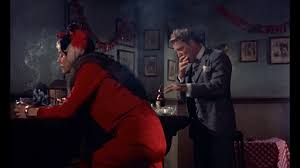
 The opening credits use the Christian symbol of the cross, but it, as well as the names of those making the movie, are askew, suggesting a warping of Christianity’s message. The story, based on the Sinclair Lewis novel, takes place in the 1920’s. Elmer Gantry (Burt Lancaster in an Oscar winning performance for Best Actor) is drinking in a bar close to Christmas while loudly telling a joke to other inebriated men about infidelity. His hair looks like an exaggerated version of the style worn by famed Evangelist Billy Graham. He eyes a beautiful blonde (wearing the passionate color of red) at the bar, so we already see a man who likes to pursue his less than religious inclinations. The men later refer to his “little black book” of names of his female companions. A man and a woman enter and as they appeal to the Christianity of the patrons for charitable donations they receive a negative response. However, Gantry, a charismatic salesman, gives a rousing speech, as he collects money from the tables for contributions, that extols how Jesus was a warrior who took on the Roman Empire with the power of love. The blonde seems impressed, and that may partly be Gantry's reason for the moving remarks. He flashes that oversized Lancaster smile that reveals many teeth, a combination of warmth and intimidation. He says, “Love is the morning and evening star,” words he repeats during the movie, which shows it is a rehearsed line used to appeal to the sentimental person. He says to her he was talking about “divine” love, not the carnal kind, but his words are just a disguise for his true intentions at this point. She thinks he is a “parson,” but learns from the other men as they leave that Gantry is not a cleric. We know he is not financially successful since he can’t even pay the bill (probably squandering his earnings) and tells the owner he’ll have to extend him some credit. For Gantry, charity begins at someone else’s home. 


 Disillusioned, the woman says that the world is devoid of love. He buys her a drink (so to speak), and the next scene shows the hungover Gantry waking up in his hotel sprawled out in the bed with the woman's shoes on the floor. The two may still be clothed, next to each other on the bed, but it is implied that, using his good looks and charm, he has provided sexual passion as a substitute for love to another in a long line of females. The bellhop, whose “Merry Christmas” generates no tip from the fake Christian advocate, says that Gantry’s mother called him. He talks to her on the phone and lies as he says he just returned from church and prayed for her. The man even cons his own mother. He pretends that he sent her a gift that must have been lost in the mail. He tells her not to cry, as he will not be returning home for Christmas, so we know he has broken promises to her many times. He leaves the sleeping blond and writes, appropriately with red lipstick, “Merry Xmas,” on the mirror, which reflects his superficial caring about others.


Gantry hops on a railroad car with other hobos, who, down on their luck, try to take his shoes while he sleeps. He wakes up, and thrashes the desperate men, followed by him throwing his suitcases and himself out of the car. The scene mirrors the hard times of the Great Depression, and Gantry’s first thoughts are for himself. As he walks with his belongings there is a sign in the background promoting a “revival meeting” with the picture of Sister Sharon Falconer (Jean Simmons) and the words that promise “she can save you.” As the film progresses, there is a question as to whether she needs to be saved. Her last name suggests someone who can tame birds of prey, which may refer to sinners. Gantry hears a hymn being sung and enters an African American prayer meeting. They are suspicious of the white man who has entered, but he knows the words to the song and sings them loudly. They join him in the spirit of Christianity, and their innocence contrasts with the dubious devotee among them. He acquires food for shoveling coal at the church. The reverend sees that Gantry has a picture of a scantily clad showgirl, and Gantry covers up his lust by denouncing the lascivious material, tossing the picture into the furnace. He knows the teachings of the Bible and equates the fire with that of God’s wrath. At this point he is that wolf in sheep’s clothing, the threat of danger beneath a pleasing exterior.


Gantry uses his high-powered sales pitch in an attempt to get a storekeeper to buy his small appliances. The man is not convinced, having bought some items before that didn’t sell. Gantry sees another poster of Sharon and asks if she is a good preacher. The store owner says he only goes to prayer meetings when times have been hard, which shows how some are only interested in religion for selfish reasons and not out of true devotion. 


The film continues to display Gantry’s character flaws. There is an almost empty bottle of whiskey that sits in front of him as he tries, without success, to revisit a romantic encounter with a married woman, and loses at gambling on a horse race. His disreputable behavior contrasts with the revivalist music played outside his hotel window. Gantry goes to the tent revival meeting that evening. William L. Morgan (Dean Jagger) hosts the event, which is filled with people singing hymns along with a choir. Sharon enters and Gantry is taken by her beauty and the crowd's adoration of her. She is a salesperson in her own right, except she is promoting religion. She is dressed in a milkmaid’s outfit and enters with a pale of the liquid she supposedly obtained from milking a cow. She relates to the rural people by saying she didn’t want to stay in a church, but instead wanted to see what these people saw every day which is God’s handiwork reflected in nature. She does not want to deliver a solemn sermon, but instead wants them to be joyous in their faith, which works as a selling point. She uses humor to tap into the congregation’s generosity as she passes out several buckets to collect donations, saying people can’t make milk and God doesn’t make money. As she speaks, the skeptical journalist, Jim Lefferts (Arthur Kennedy) casts a cynical eye at her. 


Sharon’s smiling surface drops for a moment when Gantry tries to get a private audience, and Morgan places the bucket in front of Gantry, who has no money, which implies one has to pay a toll to interact with the supposedly approachable preacher lady. The next scene adds to that distance as she says she doesn’t have time for one of the worshippers and delegates others to carry out ministerial duties. Another attendee demonstrates Sharon’s strong influence when she says after Sharon’s prayer gathering her son saw the Virgin Mary on the roof. Gantry pretends to be a preacher, but Sharon is able to see through his guise when he can’t say which church he belongs to, She quickly deduces that his problem is either booze or women, and he lies by saying he indulges in neither. She leaves him standing there and the sarcastic Lefferts, who also recognizes the ploy, tells him it was a nice try.


So, Gantry looks for someone more accessible, and he zeroes in on the woman who sang at the beginning of the prayer meeting, Sister Rachel (Patti Page). He flatters her about her singing and spouts talk about God’s love and its association with music, appealing to her interest. He acts like he only wants apple pie when they go to a restaurant, as he presents a wholesome façade. He lies about being offered an elevated position in the appliance company to impress her. 


 Sharon looks exhausted after literally putting on a happy face, and waves to the crowd at the train station. Gantry hops aboard the train, joins Rachel, who is smitten with him since she says she was concerned he wasn’t going to show. He then continues his devious behavior by pretending to be Lefferts, leaving a message with the conductor that he wants to see Morgan. Gantry continues to get at Sharon through those around her as he talks with Lefferts on the train’s observation platform. Lefferts is modeled after journalist H. L. Mencken (Gene Kelly played another version of the evolutionist devotee in Inherit the Wind, also analyzed in this blog). Gantry asks if he can be frank with Lefferts, who is witty and insightful when he responds, “Try,” knowing full well that Gantry is working an angle. He does admit to Gantry that he will have to get past Morgan to reach Sharon. 


By getting Morgan to leave Sharon to see Lefferts, Gantry is able to sit in Morgan’s seat (Lefferts interviews Morgan, who is a believer in Sharon’s inspirational abilities, as he says she is touched by God). Gantry, using what he learned from Rachel about a riot between the evangelists and some “roughnecks” in Missouri, falsely says he was there at the altercation and he is able to quote her fighting words, which were “Bust ‘em one for the Lord, brother,” back to her. The memory makes her laugh and Gantry has broken through her defenses. He says he tried to be a cleric but there was a girl that he became associated with, LuLu Bains (Shirley Jones, who won the Best Supporting Actress Oscar for this role). He says he went to pray and found LuLu half-naked with a lover behind the altar and he gave up on becoming a preacher. But, he says his faith was revived when he saw her at the prayer ceremony (another lie), and he wants to see her socially. She admits she likes his outrageous nature after being around “sanctimonious” people so much, and that he is “amusing” and “smells like a real man.” So, he arouses her physical nature, as opposed to the spiritual one.  


At the next tent revival, the police tell Sharon that the number of people in attendance will violate fire safety laws. She counters by arguing that the illegal alcohol interests don’t want her preaching intolerance and support of the current law of Prohibition. Gantry tries to convince Sharon to let him share how religious beliefs are practical for the businessman. He begins by fraudulently saying how he loves his job, was offered a junior partnership, and how many customers know him by his first name. It is the same spiel he used before. But, he can see that Sharon is too smart to buy his sales pitch. He is now truthful when he says the work is terrible, “chasing trains, “staying in “filthy” hotels, telling dirty jokes just to keep customers “laughing,” and bringing booze to ingratiate himself with others. He comments on his phony appearance by calling himself “a tramp in a silk shirt.” He then gets the idea to tell the congregation about his miserable, lonely life and then being saved when he found in a hotel drawer a copy of a Gideon Bible. This story of personal redemption, although insincere, fits in well with Sharon’s religious message.


 The next scene nicely follows up on their conversation as Gantry tells the crowd what he pitched to Sharon. He says that after reading from a psalm in the Bible that God was his “fortress,” he was able to be honest with his clients and sell goods with God backing him for finding faith. (All of this is a fiction, but it sells). He is a natural at evangelical preaching as he tells those assembled that businessmen shouldn’t go to church on Sunday and then “cheat on Monday.” He duplicates his “religion is love” lines, which he told Rachel. There is a look on Rachel’s face which reveals that she probably realizes Gantry repeats stock phrases to win others over. He then courts the anti-elitist sentiment felt in the country’s heartland by saying how he is not a well-educated man but knows enough to see that Jesus saved him from the Devil. Morgan rolls his eyes at Gantry’s over-the-top theatrics, most likely feeling that they cheapen the richness of the sacred mission he is part of. Gantry appears surprisingly overwhelmed as a man admits he is a sinner and runs up to him for guidance. Others follow the man to thank Sharon for bringing Gantry to them, as they buy the desire to be blessed that he has sold them.


After the meeting, Gantry talks to a man cleaning up. The janitor says he repeatedly gets “terrible drunk, and then I get good and saved,” by various preachers, including Sharon. He suggests selfish indulgence and finding salvation are both powerful forces. His words can possibly imply that the pull between being unholy and being righteous wrenches people back and forth. His character may also suggest that some people do not have a strong moral center and are easily swayed. (I remember a Cheech and Chong show I attended when one of the duo said he was once stoned on drugs and then he was stoned on Jesus, revealing an addictive personality).


Lefferts is on the sidelines, recording what is happening, almost like the writer of this story gathering material for his work. Sharon sees Gantry on the stage and wonders to him if he plans to take over. She is only half-joking, as she most likely is concerned about being upstaged. She is impressed with how many people they added to their total of converts. She informs him that Morgan thinks he is “vulgar,” and she agrees but confesses to liking it. He kisses her in the moment. She seems to enjoy it and quickly becomes alarmed by the intimacy. He apologizes and says she “hypnotized” him. She says God chose her to have that power, and when he says he was also called by God, she puts him in his place by saying that she, not God, chose him. She is now all business, offering Gantry a position in her organization.


Lefferts talks with Gantry after Sharon leaves and asks how he acquired his “style.” Gantry seems sincere when he says that when he is in front of the gathering he just lets it “rip,” and he feels a powerful connection between himself and the others. He says in the end he feels as if he loves everybody. The cynical Lefferts says Gantry especially likes the attention of the women. Gantry laughs heartily, since he knows that is a weakness of his. Lefferts likens the tent to a circus and Gantry, not putting up any false front with the journalist, laughs along with him when Lefferts likens him to possibly becoming the most successful and “funniest clown of them all.” So, this type of “old time religion” that Gantry praised can also be thought of as a type of exaggerated entertainment, and the comparison is not complimentary.


 Sharon derides her followers’ expenditure of cash by saying those who play cards and the stock market will not get into heaven, but pledging money to her crusade will. Gantry chews up the religious scenery, bringing a chimp onto the stage to decry the evils of evolution. At one fire and brimstone sermon he stirs up the crowd into a religious frenzy to the point where a man howls like a dog as if expelling Satan. 


Morgan tells Sharon all of these shenanigans are in very poor taste, and he says that Lefferts is just using the ridiculous show as material for his column which makes the religious movement appear negatively. He likens the two of them as doing the bad cop-good cop routine, with Gantry scaring them and then Sharon promising them salvation. Sharon thinks that combination makes them a good team since people are confessing their sins and are being saved. The film shows her as wanting to reach worthy ends but with somewhat unsavory means. Morgan did some background checking, and discovered that Gantry was dismissed from a theological seminary for seducing the deacon’s daughter in the church where the father gave a Christmas sermon. This rendition is not the tall tale Gantry told Sharon about his fiancée cheating on him. Before he can provide more information, Gantry enters the area like a performer coming through a theater curtain. He even shouts, “Ta Da!” which sounds like the music played to accompany a performance. Gantry announces that they have been invited to the city named Zenith, which Morgan does not think they should visit. He says that their movement is for common, rural folk, not big city audiences. He calls Gantry a “crude, vulgar showoff.” Gantry counters by saying Morgan is “too good for the people. I am the people.” He is “common” and that is what most of the people are, so he is saying he can connect with the average citizen. But, the movie explores what happens when that connection is exploited and people are manipulated by someone who only appears to be doing good. Sharon says that Christianity started with common people, and wonders what God wants, as opposed to the desires of individual people. Morgan decides to go along with the plan to go to Zenith, a name that means reaching the highest position. Here, the name will carry with it a sense of irony.


There is a meeting in Zenith that includes George Babbitt (Edward Andrews), his last name being the title of another Lewis novel. He is a loud businessman, and the topic of discussion here involves church finances. As Rev. Philip Garrison (Hugh Marlowe) and Rev. John Pengilly (John McIntire) grudgingly bemoan the cash shortages, Gantry, now looking slick in a new suit, brings his salesmanship skills to the business aspect of religion. He says they need to get more people to attend church, and Sharon’s (and his) actions have brought pledged converts in increasing numbers, which means more monetary contributions. Sharon is quiet, at first, suggesting quarreling over money matters cheapens the crusade to save people’s souls. She then complains about how monetary concerns drag down the spiritual mission she is on. She basically says that her independent work goes to pay expenses and contribute funds to their churches. She is looking for them to help her by embracing her efforts. Before walking out, she tells the men that they are not really interested in a religious “revival,” and that means she is not the person they want. 


There is a debate afterwards as to how to spread their religion. Babbitt likens religion to entertainment, saying bingo and baseball games raise money, so why not use Sharon’s enterprise to bring in the crowds? He warns the men of the cloth there that they will lose their positions if their church boards don’t see increased church attendance. Pengilly says that there were only Christ’s disciples that started Christianity, so numbers don’t measure a religion’s success. Garrison argues that having people howl like dogs and transforming what’s supposed to be devout gatherings into circus events is not what they should be encouraging. He tells Babbitt that religion is not a business. But, he further distances himself from Sharon’s, and thus Gantry’s, tactics, by saying “revivalism is not religion,” implying that theatrical performance should not be a part of Christianity. After he leaves, Babbitt implies they have an opportunity to get people excited about religion with revivalism, since the country is grounded in Christianity. He points out that all the presidents have been religious men and Congress opens sessions with quotes from the Bible. The film here suggests there is a lack of separation between church and state.


Babbitt wins the remaining members over, and they will not hold church services on Sundays when Sharon’s traveling tent operation is in Zenith. The implied goal here is to maximize attendance at revival meetings, and thus add donating converts to the evangelical branch of Christianity. Sharon looks relieved and revived herself since probably she hopes raising money to continue her mission will not be so burdensome. 


Zenith conducts a welcoming parade with cheering citizens for Sharon and her organization. The depiction is satirical as the event looks like a circus event as there are acrobats and clowns. The spectacle is a mashup of the patriotic and the religious to arouse enthusiasm. There are marching Boy Scouts, and Gantry walks with Babbitt who is dressed in a military uniform. After the pageant, Gantry briefs the staff like a general giving orders to his soldiers, making sure they get written pledge forms in the hands of attendees. Later there is a large staff answering phones which looks like a corporate operation. Sharon appears overwhelmed by her star status, with many reporters firing questions at her as flashing cameras take her picture and asking about what she is going to wear as opposed to spiritual matters. Lefferts arrives and alerts her that again she is having an issue with the fire department about the size of the crowd that will be attending her meeting. It’s as if this problem is an omen about how people create uncontrollable situations which will punish them for their overzealous ambitions. 


The night of the meeting attracts all sorts of people, including those that warn of the end of the world, while others hold signs for and against revivalism (“Even Jesus drank wine” is one that urges repeal of Prohibition). College students try to drown out the hymn being sung by chanting the words of the Star-Spangled Banner, which stresses the church/state separation issue. The scene lends itself to confrontation. Babbitt wants to arrest the disrupters, but Gantry quiets him down, not wanting to incite adversity. Morgan tells Gantry that Gantry has succeeded in drawing an angry mob, and he doesn’t want Sharon to confront the rowdy audience. But, Gantry sees it as an opportunity, and gives Sharon a pep talk, basically saying city people are just as emotionally accessible underneath since all people fear “death.” So, the thrust here is that one can reach people through their fears. Gantry keeps repeating that Sharon “can” save them, and his voiced support of her abilities seems to cast a spell that allows him to escort her to the meeting.


 Sharon is quiet as she joins the congregation. She says that many have come to judge her motives, but she says that if she has sinned, then God will judge her. By extension, she also says that she has no right to judge her detractors. She quotes from the Bible that says that Jesus showed generosity toward enemies, winning them over with love. By saying these words, she deflects attacks by people against her and diffuses hostilities. She tells the choir not to sing, and her tranquil urging for prayer transforms what would be a loud revivalist commotion into a quiet contemplative meeting. Her sincerity even gets the atheist Lefferts to bend a knee, although he may be succumbing to peer pressure. After the event, her winning over the crowd just escalates her celebrity as throngs surround her car on the way out and at the hotel where she is staying. Gantry is actually protective of her, telling the reporters and others that Sharon needs quiet and rest. Even Morgan can appreciate his efforts here. Sharon collapses into sleep and Gantry sweetly places a rose next to her and tucks her in for the night. 


Lefferts dictates his next newspaper column, saying that Sister Sharon tamed the crowd with “simple prayer,” but he questions how that change in approach in the long run will win over more people than established churches can accomplish. His didactic approach has him asking what defines revivalism: “Is it a church, is it a religion, or is it a circus sideshow complete with freaks, magic and rabble-rousing?” He goes on to explore why a revival attracts so many. He wonders if the appeal is “to see a miracle, to be saved from a lifetime of sin in five minutes,” or to be embraced in “salvation” during a time that seeks physical gratification. The implication is that it contains all of the elements he raises, and offers the possibility of a spiritual uplifting when people seem mired in transient, everyday pursuits. His questioning article points out that there are no qualifications to be a revivalist, and no laws to “protect the public” from those who would exploit religion for personal gain. He argues that those involved in the revivalist movement get the legal benefits of running a tax-free enterprise and collect money “without accounting for how it is used.” 


 The scene shifts to a brothel, where prostitutes read Lefferts’s column, which cynically asks if there will be a decrease in “lust” and “adultery” if one contributes money to the revivalist cause. One of the women humorously says, “I hope not.” LuLu is there hearing about Gantry’s manipulative abilities which Lefferts says can make the innocent feel like sinners, and vice versa. LuLu’s repetition of the same words Gantry uses repeatedly to win over women about God’s love is ironic given this setting. She recounts how he seduced her physically while contradictorily sounding religious. When she says that he “rammed the fear of God” into her, in a church no less, the irony is compounded by the sexual innuendo mixed with holy references. She laughs about how her “bare soul” (another combining of contrasting words) was thrown out into the cold by her father, the reverend. Did these hypocritical actions by Lancaster and her cruel father alienate her from religion and lead her to her present state?


There is a popular backlash against Sister Sharon’s movement because of Lefferts’s article. Babbitt confronts Gantry and says that Lefferts revealed that he bankrolled the revivalist group to enhance his real estate business. He withdraws his financial support. The local Zenith churches also receive complaints based on Lefferts’s writings. The power of the press is demonstrated here, as well as how quickly the public can be swayed. Gantry visits Babbitt’s real estate office and has evidence that some of his properties contain an illegal liquor club and a house of prostitution, and there is an illegal card game going on right at that moment in the back of the building. So much for Babbitt’s proclaimed religious adherence. Gantry is there to blackmail the hypocrite to regain his support, so corruption is lurking beneath the righteous exterior of these men. 


Sharon goes to the Zenith newspaper publisher Eddington (Dayton Lummis), who carried Lefferts’s syndicated column, to complain about what she considers Lefferts’s unfair writing. Gantry and Babbitt show up there, too. She tells Lefferts, who is in attendance, that he implied that she misused funds, and she has only preached the word of God. Since neither she nor Gantry have any qualifying ordainment credentials, Lefferts asks her how they have the right to preach to anyone. She feels that she must have been chosen by God to do His work. He asks her if she had a “burning bush” moment where God spoke to her, and he is knowledgeable to point out that in the New Testament, God only spoke to Jesus. He then quotes a misogynist passage which instructs that women should be silent in religious matters to show how her own religion can be used to silence her. He is using religious texts to undermine Sharon’s self-justification to spread her manner of Christianity. But, Gantry gets Lefferts to admit that he only sees the Bible as great poetry and wisdom, but not that Jesus, through his divinity, can offer “life everlasting.” By getting Lefferts to admit his atheism, which refutes the basic tenets of Christianity, Gantry can persuade Eddington that Lefferts is not a fair and objective reporter, whose beliefs run counter to most Americans. He says he will refute Lefferts on the radio, with Babbitt extorted into paying for the airtime. 


On the ride away from the meeting, Sharon is demonstrably excited by Gantry’s performance in Eddington’s office. She then sends mixed signals, hugging and kissing Gantry. When he stops the car and responds, she pushes him away and says God sent him to her to be an “instrument” not a “lover.” He admits to being baffled by her and says he only wants her, not other women. She says she knows he had sex with Rachel, who he coldly constantly ignores after their physical encounter. She calls him out as a liar when he denies being with Rachel. He says he wants to “tear those holy wings off” and “make a real woman” of her. He says that he can provide her with a heaven of physical “ecstasy.” His words are a contrasting mixture of religious and carnal language, even to the point of suggesting a rape. He says that she wants to consummate their passion, and that all men and women are driven by this drive, and she should admit it to herself.


She drives him to a construction site for a tabernacle, and says that is what she really wants, a place where she can do her good work without running around, like a “circus” (even she compares what they have been doing to a sort of carnival act, which is what Lefferts called it). She says she wants a place for worship for all religions with a soup kitchen to help ailing bodies. She calls that “home” her “first love,” in contrast to what Gantry advocates. He admits that her dream is greater than what he can offer, and he is only a hick from nowhere. She confesses that she invented her current persona, and she is really from “shanty town.” But God brought the two of them together so that she can finish her constructing not only the place of worship, but presumably herself. He calmly agrees that it was God that joined them, and she then warms to him, now feeling that he is not trying to undermine her mission. She follows him under the building’s foundations, and the implication is that they have sex, again the lustful activity hidden ironically in a religious place. Gantry here plays the Eve role of tempting the more spiritual partner into indulging in earthly delights.


 As Sharon dreamily pours sand out of her shoes the next day, reminding her of the previous night’s physical pleasure, Gantry is on the radio ranting against Lefferts. He gives him the first name of “Lucifer,” attacking the man instead of his arguments. (Lefferts takes the attacks with smiles and laughs because he seems to know that Gantry is just using him to magnify Gantry’s brand). Gantry offers examples of a morally decaying society in need of a religious revival by holding up sexy French postcards, and stating he was propositioned by diseased prostitutes on Zenith’s main street. He offers no objective evidence of what he holds up as factual, and we know from his behavior that he is a fraud who projects his own failings onto others. He also attacks “foreigners” for bringing sinful ways to Americans, using those who are different as people to be targeted, a stance in opposition to Sharon’s speech echoing Jesus’s advocating the use of love as a way of dealing with enemies. In fact, Gantry gives his speech in a boxing ring, conveying his pugilistic stance. He again taps into that dislike of Ivy League elitism by saying they are his opponents, and thus, by extension, the foes of the rural citizens. As he speaks we also have LuLu listening and laughing, because she knows from personal experience Gantry’s hypocrisy. 


At an outdoor rally, which is a place he can use his loud voice to incite and turn a crowd into a frenzied mob, Gantry slams bottles of whiskey onto the ground to denounce booze (showing more of his hypocrisy). He implies the police are not cracking down on those that he declares are committing immoral acts. Gantry, accompanied by law enforcement officials, raid “speakeasies” (for dramatic purposes, Gantry knocks down doors) where alcohol is served, and houses of prostitution. At one of these he discovers Lulu, who laughs at his fakery, and Gantry is momentarily taken aback. He recovers enough to tell the cops to arrest her, probably so he can shut her up. He then thinks better of his action, and persuades Captain Holt (Barry Kelley) to release the hookers, probably deciding not to increase the likelihood that LuLu might expose him. To protect himself further, he secretly tells Holt to make sure the prostitutes will leave town quickly so he can cover his lying tracks.


Gantry’s public crusade gains much attention. Flowers, communications from political figures, and people from the city arrive at the revival’s headquarters. Sharon just wants to have a quiet picnic for her and Gantry. She appears to hope for a romantic relationship, but he is wrapped up in expanding her organization’s influence. He charms her and says their personal celebration can wait until after the day’s promotional agenda is over. His position is in jeopardy when Lulu calls, who has not left town, and thanks him for getting her released, implying she knows that he did it as a favor to keep her quiet. After hanging up she says she wants to contact Benny (Peter Brocco), a photographer, which can only mean she is planning some sort of exploitation. 


 She has Benny positioned on the fire escape so he can take pictures of Gantry being seduced. When Gantry shows up she is wearing a sexy negligee. He looks around, and he smartly suspects that the scene is planned for a “shakedown.” She admits that she was angry when he came in the previous evening with the cops to arrest her after he had dumped her long ago. She says she thought of blackmailing him, but when she saw him now, she remembered how much she cared for him. He admits to running out of her. She says her father contacted her and compared her to Jezebel in the Bible. She wonders why people see “hate” in holy scripture. What she says suggests the danger in how some can twist the meaning of words that carry with them divine justification. She refuses some traveling money and asks that he kiss her goodbye. Benny gets a picture of the kiss. But then Lulu shuts out the light and seems to want to abandon the blackmail plan as her desire for him revives. As she sits on the bed, she asks for him to stay a while, and says for him to tell her “lies” that she can “believe.” That comment points to how people believe what they want to believe, regardless of the truth, which they find they can’t accept. But he turns the light back on, showing how he isn’t going to give into his dark, lustful inclinations. She realizes that he will not be intimate with her, and is angry about Sharon winning him over. She then decides to get her revenge by accepting the money he offered, and she sexily stashes it into her garter-securing stockings, revealing a great deal of leg. A definite photo opportunity.


Looking like a rich man with a yacht, not a man of God who has forsaken worldly temptations, Gantry enters Sharon’s room wearing a naval outfit. He tells her he will take her on a picnic cruise. Even though his entrance is full of his usual bluster, when she embraces him, he reveals genuine feelings for her. As Sharon goes to get dressed, that joy is short-lived as Morgan arrives with photos of his encounter with Lulu. She wants $25,000 in cash brought to her by Sharon to where she worked as a prostitute before it was raided. Lulu most likely wants to stress Gantry’s duplicity and the damage he can cause to women he seduces. 


Despite her humiliation, Sharon agrees to the meeting, probably because she doesn’t want to publicize Gantry’s scandalous activity and have her movement associated with it. She arrives per Lulu’s instructions, and a screeching cat greets her and then pokes around some liquor bottles to stress the unseemly location. (Is the feline there to make a reference to the place having been a “cat” house?). There is a contrast between Sharon’s conservative clothing and Lulu’s sexually enticing outfit, but they have both been seduced by the same man. Sharon drops the money on the table and asks for the negatives of the pictures. Lulu just laughs and kicks the money. She apparently just wanted to delight in a form of revenge by embarrassing the supposedly upright Sharon for being complicit in a cover-up and becoming involved with a fake religious zealot.


The compromising pictures show up in the newspaper. Eddington confronts Lefferts about his turning down Lulu’s offer of supplying the pictures to him. Lefferts argues that a free press can refuse to aid a blackmailer by publishing unscrupulous stories. He concluded that the photos were taken secretly to attack an individual, and he says they only revealed that Gantry is “human,” subject to temptations as others. He apparently does not go along with a counterargument that, despite the motivations of the informant, the press must expose hypocrisy to alert the public not to be taken in by con artists. 


There is now a dwindled crowd attending one of the tent meetings, and there are hostile members among them. Lulu also shows up, apparently to gloat. One man pulls out a whip and starts to crack it and others yell derogatory remarks as they throw eggs and other food at Sharon, Gantry, Morgan, Rachel and others. Lefferts is there, but he is disgusted by the ugly response of those in attendance, apparently advocating that two wrongs don’t make a right. As the man with the whip tears down Sharon’s revivalist sign, Gantry is plastered with garbage and one woman spits on him. Lulu did not expect the intensity of the negative response and runs out of the tent, presumably feeling guilty. The mob trashes the congregation meeting area. When Sharon and Morgan reach their offices there is the clamor of ringing phones from people shouting hateful messages. Sharon wonders why God has “forsaken” her. She apparently is not sensing any divine mercy for her human indulgences and mistakes. 


Lulu returns to her place only to be met by her pimp who beats her up for not getting money for the story and the photos. He asks if she did it because she hates Gantry or loves him that much. The answer is that both are probably true, since Gantry hurt her by abandoning her and then she wanted retaliation by exposing him and stopping him from being with Sharon. Gantry arrives and beats Lulu’s attacker and then knocks him out. Despite her ruining his success with the religious movement and with Sharon, Gantry acts like a true Christian here as he tends to Lulu and says he is sorry for everything, which includes how he wrecked her life. 


 Back at the tent space which is in shambles, and which mirrors the condition of the movement, Lefferts and Gantry share a drink of whiskey, exhibiting no hard feelings toward each other. Gantry probably sees it as one of his many enterprises that just didn't work out. He is even funny how he pretends to demonize drinking booze by saying there ought to be a law against it, since Prohibition just says one can’t sell the intoxicant. Gantry wonders why people became so angry. Lefferts says that people don’t like their Gods to be so human. His observation comments on how “fan” is short for “fanatic,” so hero-worship is a sort of madness to which people capitulate their reason. Gantry admits to truly believing in God and religion, which universally comforts people from all walks of life who are “scared or sick, because they got no money, or have too much money, or before a war, or after a war.” He adds that “praying is the cheapest first-rate medicine I know.” After Gantry praises Sharon, Lefferts says Gantry ought to marry the woman. Gantry feels that it’s too late for that. But, Lefferts shows him a copy of the next edition of the newspaper which has Lulu saying that she framed Gantry, and he is cleared of any moral’s charges. Gantry’s good deed toward Lulu engendered one in return.


 The crowd is back, thirsting to worship their hero and heroine again. But, Gantry has been missing for three days (a Cristian number associated with resurrection), and Sharon is convinced he will return for the night’s proceedings at the finished tabernacle. He does show up behind the venue and suggests they leave the movement, go off and get married, have children and lead a private life. She feels her destiny is a public one to help her followers along the spiritual path. But fate works in mysterious ways. One of the men behind the stage tosses a still lit cigarette into a pile of rags and cans, accidentally starting a fire. Sharon says the Holy Ghost is in the building, but so apparently is the destructive nature of existence. A man, who lost his hearing, begs for Sharon to help him. She prays, places her hands over his ears, and he regains his sense of hearing. The crowd shouts praise, and others with various afflictions head up the center aisle seeking a spiritual cure for physical ailments.


At that moment, the place bursts into flames. Sharon shouts that the tabernacle is a place of the Lord and those who believe in him will be saved. It is ironic that the place she built because of her love for God and which was to be a home for the faithful is destroyed. Gantry and others try to save some of those there, but the gathering is a mob now as the people panic. A man smacks Sharon’s Bible out of her hands most likely because he feels cheated by her words, and she is knocked to the ground. Gantry, pulling a woman out of the water near the pier, sees the tabernacle explode into an inferno, killing Sharon.


The next morning, in the rubble again, Lefferts hands Sharon’s bible to Gantry, which can be seen as a token of remembrance of their connection. Outside, people ask if Sister Sharon’s departed soul will forgive them for running out of the burning building. He says there is nothing to forgive since they did the right thing to escape. He starts to sing a hymn and Rachel picks up the tune. Morgan probably sees Sharon’s bible as the baton that Gantry should take to continue the evangelical marathon. But Gantry quotes St. Paul, saying that as an adult he must put off childish ways. He leaves, foregoing the selfish ways of a child clamoring for attention, and maybe his latest actions of charity have changed him from being a selfish man to becoming a true Christian.


Did Sharon actually cure the deaf man, or was it a temporary condition that psychosomatically was alleviated through his own healing abilities? Was the fire the result of demonic forces undermining the righteous? If so, why would God allow it to happen? Or was it just an ironic coincidence that the blaze occurred? The film raises all of these questions, and presents a complex world with many possible answers.


The next film is The Last Seduction.