Showing posts with label Fake news. Show all posts

Saturday, September 26, 2026

Denial

 SPOILER ALERT! The plot will be discussed.

Denial (2016), which is based on a trial revolving around a claim that the Nazi Holocaust did not take place, speaks to us today because in a world with deep fake technology and the difficulty to determine fake information in social media from fact, it has become increasingly difficult to determine what is true and what is a lie.

The movie is based on the book, History on Trial: My Day in Court with a Holocaust Denier by Deborah E. Lipstadt, who is played by Oscar-winner Rachel Weisz. Lipstadt is an American professor whose specialty is The Holocaust. The film opens with a grainy clip that implies authenticity showing a sarcastic and dismissive David Irving (Timothy Spall), who writes about Nazi Germany. He states that “more women died in the back seat of Senator Edward Kennedy’s car at Chappaquiddick than ever died in a gas chamber at Auschwitz.” That there is laughter from the audience giving agreement to the man’s words is very chilling.

The story begins in 1994 at Emory University. The movie shows that although we know the Holocaust occurred through the existence of mass graves and testimonies, it is difficult to prove details of the horrors. For instance, Lipstadt tells her class that the Nazis made sure that there was no evidence of killings in gas chambers because they blew them up.

The camera shows Lipstadt running, gathering materials, basically in constant motion which establishes her as a person of action.

We get immediate evidence of the story’s conflict when Irving, lurking in the shadows exhibiting a demonic face, interrupts a speech by Lipstadt in Atlanta Georgia. She is stating that she will not “debate facts” with a Holocaust denier. It is ironic that is exactly what she must do because Irving sues her in 1996 for libel for calling him a Holocaust denier in her writing. The extent to which denial of The Holocaust is accepted is shown by the fact that Irving has done his own extensive biased research and has been published by prominent publishing institutions. Irving films his stunt so he can use the media to promote himself and his fake argument.

Lipstadt watches the news and her sad face shows her reaction to seeing Irving speaking to Neo-Nazis in Germany, saying they have nothing to feel ashamed about in their past. His audience responds by giving the Nazi salute. It is frightening to realize that some people find community in shared hatred of others. (It is notable that just recently there has been a resurgence of extreme right-wing political forces in Germany and other European nations).

The trial takes place in England where rules are a bit reversed compared to the United States. There a defendant is considered guilty until proven innocent. The same goes for a libel case. Irving deliberately chose England because it makes Lipstadt appear guilty from the start. It is another way of stacking the deck against truth. The film details the legal strategies that Lipstadt’s lawyers, Anthony Julius (Andrew Scott) and Richard Rampton (Tom Wilkinson) use. Julius points out that Irving wants to gain scholastic respect by defeating Lipstadt, and many scholars don’t see the fact that Irving is an anti-Semite to be a disqualifier. Julius is reading a book about how the renowned poet T. S. Eliot was anti-Semitic. Indeed, he was, yet he wrote great poetry. Sometimes the person deserves condemnation, but that individual’s work is laudable. Irving is no Eliot, but he aspires to gain scholarly recognition.

Lipstadt says her mother’s name means “warrior,” and she always felt that her daughter was meant to fight a great battle. She sees that the confrontation with Irving is the war she was destined to fight. Here we see that the battle against evil is a generational one. IMDb points out that while running Lipstadt stops to observe the statue of “Boadicea and her Daughters.” She was a warrior who led a failed uprising against the Romans. That image links to Lipstadt and her mother, but it implies a warning that a noble fight can still be lost.

The story jumps to 1998. Lipstadt’s legal team delivers discovery information to Irving, who tries to gain sympathy for his cause by depicting himself as a David against the Goliath-sized law firm representing his adversary. Irving is charming, smart, and mannerly. He plays with his granddaughter. What Hamlet says fits here: “that one may smile, and smile, and be a villain.” The legal team wants Irving’s personal diary for discovery evidence. They find that one must be careful what one wishes for. The diary consists of volumes which fill a whole room, making it an immense undertaking to plow through.

It is raining heavily and there is thunder outside the London law firm as Lipstadt arrives, symbolizing the storm to be weathered in the courtroom. What might seem an obvious defense is not necessarily what works in an actual courtroom. Lipstadt thinks it should be necessary to have holocaust victims testify to substantiate her remarks about Irving distorting the facts. But Julius points out that Irving will attack the victims if he gets the chance to question them because he will represent himself. Julius says the survivors do not “remember every detail. They forget something. They say the door was on the left when it was on the right.” Irving will say that they are liars and can’t be trusted. It’s like looking at the tiniest flaw in a work of art and condemning the whole painting.

Lipstadt tries to raise money for the defense team from the Jewish community in London. She encounters another argument among those Jews she dines with. One says that instead of giving Irving a spotlight it would be better to settle. She uses the words “appeasement” which brings up bad memories among the British because that is what Prime Minister Neville Chamberlain was accused of in giving into Nazi demands at the beginning of WWII.

Lipstadt is frustrated by others shutting her out of what she wants to accomplish, telling her what she can do and say, or not say. Legal finesse and roundabout ways of dealing with the situation are out of sync with her straightforward way of confronting the situation.

Lawyer Rampton, who will argue the case, travels with Lipstadt to Auschwitz. Rampton takes pictures and the audience gets shots of the misty, hushed place that looks haunted. The moisture that drips from an iron structure implies droppings of blood. There are huge piles of survivors’ belongings with names on them and dates which resemble grave markers. Lipstadt seems tentative as she walks on what remains of the killing factories.

Those who tried to discredit the existence of the Holocaust attributed the cyanide present at Auschwitz to killing of lice. The area where that was done had evidence of high concentrations of the poison. Lipstadt points out that residue was higher at that location because it takes twenty times more cyanide to kill the lice than it does to kill humans. But for Rampton that does not prove that cyanide was used on people. He is outraged that in-depth scientific studies were not made of the area after all this time. One possibility is that it would have seemed disrespectful to assault the shrine-like area with investigators.

When Lipstadt and Rampton share a drink afterwards he admits to feeling shame. He worries that if he were a soldier at the camp he might have carried out orders given to him. He says that the world is full of cowards. His statement suggests that people, out of fear, will not stand up against tyranny. He quotes the poet Goethe who said, “The coward only threatens when he feels secure.” The implication is that it’s easy to be courageous when there is no threat to oneself for opposing what is wrong.

Other decisions that seem logical to Lipstadt are not practical in the courtroom against a manipulator like Irving. The lawyers want the case to be tried by a judge, not a jury. They don’t want Lipstadt to testify. They later get Irving to agree to a judge hearing the case by appealing to his massive ego, saying the regular juror couldn’t comprehend his scholarship. Rampton wants to keep the focus on Irving and “starve” him of any attempt to shift the argument away from his misrepresentations. Lipstadt is afraid that she will look like a coward for not taking the stand. He says it’s the “price” she must pay for “winning.” What seems right may not be so in the long run. And, the question of when to be brave depends on the circumstances.

Lipstadt has support from celebrities, but she also receives threats from onlookers in the crowd on the way to the courtroom. Julius warns her to alter her jogging route, which implies enemies could be tracking her. She must have courage in her fight against the fanatics who see her as a threat to their warped way of thinking.

Irving in his opening statement tries to connect being labeled a Holocaust “denier” to someone who wears a “verbal yellow star.” He is saying that being singled out to society as a “pariah” is what the Nazis did to the Jews. The implication here is that he, an anti-Semite, is comparing his plight to the Nazi discrimination against Jews. Lipstadt, and, of course, we, find the comparison loathsome, as well as being ironic. The film stresses the remark by focusing on the court recorder typing Irving’s words, making them part of the official record.

Rampton shows how historical books do not always show what really happened. He points out that in an earlier text, Irving included The Holocaust and then in a later volume, those references disappeared. He calls Irving not a historian, but a falsifier of history, a “liar.” Rampton said Irving embraced a report that nullified the idea that Hitler ordered the extermination at the camps. Rampton said Irving embraced this invalid report because “he wanted it to be true.” That statement is an accurate insight into how false conspiracy theories become accepted, how bigotry spreads. It’s a defiance of evidence to reinforce twisted notions that somehow give comfort to the believer, absolving him of the responsibility of his own actions and ideas. These warped beliefs may have been propagated among family and friends. The emphasis here is that we must perform due diligence, especially today, in verifying what we decide to accept as facts.

A female holocaust survivor confronts Lipstadt outside the courtroom, shows her numerical tattoo, and tells her that survivors should be allowed in court. Lipstadt already wanted that to happen, so she is torn. She promises the survivor that the stories will be heard, which is in direct contradiction to the defense’s strategy. She tells Julius about her meeting. He says the trial is not therapy for the victims to process their trauma. Lipstadt says it is not for them but for the families of those that did not survive. He is adamant and tells her she must break her promise to the survivor since his main goal is to win the case, while Lipstadt’s motives extend beyond the success of a personal verdict.

Irving interrogates a historian about Auschwitz’s gas chambers. He does what falsifiers do, he focuses on one aspect that doesn’t jive with the rest of the evidence to falsify an opposing argument entirely. There were supposedly columns that protruded through the roof of the gas chamber into which cyanide was deposited. Irving says there have been no observations of holes in the now dilapidated roof. Irving then escalates the rhetoric by calling those who claimed the openings were there are “liars!”

Irving orchestrated the latter testimony to occur at the end of the day so there would be no instant rebuttal. Despite photographs taken from airplanes that indicated openings on the roof, Irving will say that they do not verify holes. They could be shadows, or worse, forgeries. Lipstadt says Irving got his “viral” idea across, which definitely connects with how the internet works today. She says that Irving is suggesting that alternative views of history can be accepted. She wants to testify and wants the testimony of survivors to be part of the trial. Julius points to prior trials when those who were in Auschwitz were humiliated under interrogation, with Irving mockingly stating how a Jewish survivor made money over the years profiting from her tattoo. Julius is suggesting how character assassination undermines broader arguments.

Rampton confronts Irving in the courtroom with evidence of the grating over the gas chambers that contained cyanide residue. Irving says the only gassing was fumigation of cadavers to kill “typhus-bearing lice.” Rampton counters by saying then what was the need to have a secure door with a viewing portal. Corpses don’t have to be viewed or secured in a mortuary. There is a shot of the people inside the gas chamber looking terrified, which is what Lipstadt sees in her mind, the truth compared to what Irving describes. Rampton notes the ridiculousness of gassing corpses and then incinerating them, undermining Irving’s testimony. Why must these obvious contradictions be pointed out? Same answer as before, because truth can be a threat to closed minded beliefs.

Rampton has a private meeting in Lipstadt’s flat. She sees that what appeared from her perspective as coldness at Auschwitz was, as he puts it, checking out “the crime scene.” Her emotionalism must give way to a logical way of handling the problem in a legal manner. It has been difficult for her to give up autonomy. She says, “I have never trusted anyone to do anything on my behalf since I was a child. All I have is my voice and my conscience.” She has had to compromise. As Rampton says, “What feels best isn’t necessarily what works best.” She must engage in “self-denial” and hand over her conscience to another to “win.”

The defense presents a historian who shows that an order came from the German High Command that ordered to not have an individual train carrying Jews be liquidated. Irving altered the translation to say that Hitler himself ordered that no Jews at all were to be killed. The testimony shows how just the alteration of a few words can distort fact.

Rampton in court shows speeches that Irving gave that are bigoted and misogynistic. Irving argues sarcastically that there should be important news on the TV, and that nobody cares about The Holocaust which took place so long ago. Yet, he says, the Jews keep dwelling on it. He says that important news should be read by a man, less important new by a woman, and that a referenced Black newscaster should read about the muggings and other inner-city crimes. He is announcing the hierarchy of his prejudicial ranking. What is frightening is how many in the audience laugh at his ridiculing.

Irving brought the legal action because he believes he was labeled a racist incorrectly. But Rampton reads from the man’s diaries that show he told his own child a bigoted ditty that labels anyone who is not Aryan as being subhuman. Indoctrination into hate and derogatory attitudes towards others starts early on.

The point about leeway in historical texts is raised in court. Rampton argues that there is a difference between “negligence, which is random in its effect, and a deliberateness, which is far more one-sided.” He is saying that Irving intentionally falsified what actually happened in history in a textbook that is supposed to be taken as factual. However, the judge questions that if Irving believes in his antisemitism, then the implication is that he is being honest by saying what he believes. The defense maintains that belief in something should not condone altering the facts of what actually happened.

We get more bad weather. Well, it is England, and it is not ominous at this point. The judge announces that the defense wins the case. Those who refuse to change their slanted beliefs say Lipstadt is guilty anyway and shout out “Filthy Jew” as she walks through the streets with her lawyers. Bystanders also harass Irving, pelting him with an egg, but he receives cheers as well, which is very disturbing.

In a news conference Lipstadt says free speech means you can give your opinions, but you can’t lie and then expect not to be held accountable for those falsifications. Later Lipstadt watches Irving on TV, and the man acts like the judge was incapable of understanding his argument. To the bigot, all contrasting beliefs are invalid from the start. Everything must fit into the warped world view. Lipstadt says of Irving, “he used to be a Holocaust denier, and now he is a verdict denier.”

The movie warns us to be on guard against those who appeal to our unfounded fears and the hatred they spawn.

Thursday, May 9, 2024

JFK

 SPOILER ALERT! The plot will be discussed.

JFK (1991), directed by Oliver Stone, is a conspiracy theory film about an alleged plot to kill President John F. Kennedy on November 22, 1963, that was propagated at the highest levels of the United States government. Donald Trump is not the only person who believes in the idea of a “deep state.” This movie is factually suspicious. However, the craft in making it, especially the editing and cinematography, is exemplary as it presents a vast number of clipped images that explode with information and power. As Roger Ebert said in his book, The Great Movies, the film has “emotional truth,” since it captures the feelings of the country whose citizens were confused, angry, and hungry for answers concerning this national tragedy. I think it might be best to see the film as a fictional thriller based loosely on actual events. Ebert also states that despite the numerous scenes, which include flashbacks, the feel is feverish, which fits the agitated drive that fueled the desire to answer questions about the killing of President Kennedy. The camera work often adds to the feeling of authenticity with the appearance of a documentary, as narrators speak while the images flash before the audience. Stone’s premise is that in a conspiracy, one must look below the fictitious façade to find the truth beneath.

The story is partially based on the book, On the Trail of the Assassins, by New Orleans District Attorney Jim Garrison, played by Kevin Costner, who investigated the shooting of President Kennedy. The film starts with Kennedy’s predecessor, President Dwight D. Eisenhower, the general in the U. S. Army that led the Allies in World War II in Europe, who warned against the danger in the growing power of the “military-industrial complex.” (The opening narration is supplied by Martin Sheen). The opening states that Kennedy didn’t provide air cover for the anti-Castro forces at the Bay of Pigs, which was a disaster for Kennedy’s attempt to overthrow communist-led Cuba and its leader Fidel Castro. The movie states that Kennedy felt the CIA “lied” to him and attempted to “manipulate” him about the operation. In archival footage, Kennedy stated that it would be difficult to win a war in Vietnam. He also stated that he did not want the United States to dominate the world with its military, but instead wanted a one-world community. The film hypothesizes that “military-industrial complex” saw Kennedy as a threat to their existence.

Garrison investigated the New Orleans connection to the assassination by way of private pilot David Ferrie (Joe Pesci). Ferrie’s story about not knowing Oswald, who lived in New Orleans for a while, and who was in Ferrie’s military unit, and his contradictory comments about being in Texas after the assassination, cause Garrison to keep him for the FBI investigation. Garrison was rocking the boat by questioning the cover story of Ferrie, and eventually of the United States Government itself. The Federal Government dismisses any connection between Ferrie and Oswald without notifying Garrison’s office. After Jack Ruby (Brian Doyle Murray) kills the alleged assassin, Lee Harvey Oswald (Gary Oldman), the investigation ends. One member of Garrison’s team, Bill Broussard (Michael Rooker), says, after seeing Ruby shoot Oswald on TV in front of many policemen, “This is crazy.” His words reflect what practically everybody felt at the time.

However, Garrison, following the Warren Commission completed study of the killing in 1966, felt there were discrepancies in the report and reopened the investigation. There is a question as to Oswald’s ability to fire off his weapon with such accuracy and precision, and that shots were heard coming from the infamous “grassy knoll” near the assassination. Supposedly the route Kennedy took was changed which, according to Garrison’s team, would allow for a better attack from multiple shooters.


Jack Lemmon gives a great performance as Jack Martin, a frightened individual who witnessed Guy Bannister (Ed Asner), a brutal man who recruited for far-right extremist organizations and hated Kennedy, meeting with Oswald and Ferrie, along with Cuban anti-communist sympathizers in the midst of the American intelligence center in New Orleans. Bannister also conferred with Clay Bertrand (Tommy Lee Jones), a local bigwig. They were gathering guns for another Cuban invasion, which Kennedy shut down. Bannister considered the president’s death would bring about a “New Frontier,” ironically taking Kennedy’s words. Bannister beat Martin when he questioned Martin’s loyalty.


Effective supporting performances abound in this film. John Candy plays a sweating flamboyant lawyer (the sweat was real) named Dean Andrews, Jr., who says that his client, Clay Bertrand, also known, as we find out as Clay Shaw, a homosexual, wanted to hire Andrews to defend Oswald. Shaw was involved with Willie O’Keefe (Kevin Bacon) and Ferrie in gay parties. (Despite Costner's Garrison's denial of the homosexual element having anything to do with the investigation, the film portrays gay men as villains). Garrison finds out about these relationships when he meets with the imprisoned O’Keefe. The inmate says he met with Oswald once, too, through Clay. He says that Ferrie ranted about Kennedy being a Communist and that he could be taken out in an open area with triangulation of sharpshooters, with one man being sacrificed as a patsy, which is what Oswald said he was later. Garrison learns from witnesses that support Ferrie’s plan. But the belief that there were multiple shooters, and that Oswald knew Ruby were dismissed by the Warren Commission, which also showed that accounts of what happened as reported by people earlier were later changed. O’Keefe spouts pro-fascist beliefs, which makes Garrison question Oswald’s pro-communist backstory since O’Keefe said Oswald associated with far-right men. However, Broussard knows that O’Keefe’s sexual orientation and beliefs would make him less than a credible witness (especially in 1966). Garrison is funny when he says why is it that a woman, just because she is a prostitute, can’t have good eyesight.

Garrison’s group discovers that Oswald’s income tax and other records are “classified” so that even law enforcement people can’t obtain them. He supposedly defected to Russia but was able to get back in the country with his Russian wife with no problem. Garrison suggests to his team that Oswald was a CIA operative who was used by the intelligence community to take the fall for the assassination. Broussard begins to find it difficult to believe that the American intelligence community would kill the Commander-in-Chief. The movie challenges what we want to believe by suggesting there may be an alternative way of looking at what happened.

As Garrison becomes immersed in his suspicions about the assassination, his home life with his wife, Liz (Sissy Spacek), deteriorates, as he misses family events. He has nightmares about the contradictions he sees in the Warren Report. (There is a shot of Garrison’s child watching cartoons that show characters having a shootout and playing with toy guns while Garrison and his team discuss the case. These scenes show how early in life children are exposed to gun violence in the country).

As the story plays out, there is an increasing sense of doom as witnesses die, including Bannister and Ferrie, and Garrison’s investigation hits roadblocks. There is the possibility that unseen powerful forces are trying to tie up loose ends. Garrison’s office is bugged. Martin told Garrison he is “so naïve” to think nobody cares what they are investigating.

Garrison’s team supposedly finds evidence that makes it look like someone was impersonating Oswald, showing up in Dallas, acting conspicuously, so that witnesses would testify that he was staking out the area before the assassination. This activity would aid in setting up Oswald as the fall guy. This information adds to the theme of how false appearances appear to be trustworthy.

While the story continues, Stone inserts TV footage of the Vietnam War cranking up, which implies that that military-industrial complex was benefiting from the change in the presidency from Kennedy to Lyndon Johnson.

Garrison finds out that Clay Bertrand who was seeking counsel for Oswald and knew Ferrie, is really Clay Shaw, a prominent New Orleans citizen, who says he admired Kennedy. Garrison calls him in on Easter Sunday for an interview. The date seems ironic given that the holy day contrasts with the dire events that are discussed. It also adds to the idea that what is on the pleasant surface above hides the dark truth below, which is at the heart of all conspiracies. He accuses Shaw of having conducted business for the CIA, and is a secret operative, adding to the belief that the intelligence agency participated in the assassination. As Garrison said earlier, his team has gone through the looking glass, as did Alice in Wonderland, and reality is being reversed. Garrison says, “white is black, and black is white.” Garrison tries to cut through Clay’s Southern surface charm and hospitality as he tells Clay, who says he is a patriot, that he finds it odd that conspiring to kill a president is likened to being patriotic. Garrison is finding what people claim to be the truth here is suspect. After Shaw leaves, Garrison adds to the movie’s theme of hypocrisy when he quotes Shakespeare, saying, “One may smile, and smile and be a villain.”

After the interview with Shaw, the investigation becomes public, and Garrison suspects Shaw of publicizing Garrison’s actions. Reporters now hound the DA is and he is accused of grandstanding and misusing public funds. Ferrie feels he is now a target due to his association with Shaw and Oswald exposed to the public. In a hysterical scene, Ferrie admits to working for the CIA, as was Oswald. He claims Shaw is an “untouchable” in the Agency. He says that there was so much secrecy, that the truth was even hidden from the actual shooters in the assassination, so deep does the deep state go. He admits that the CIA and the Mafia worked together to try to kill Castro, which indicates that there is no defining line between what is legal and illegal.

Garrison meets with a Mr. “X” (Donald Sutherland) who was involved in “black ops,” and in many overseas coup d’états. He was transferred out just before the assassination and read a whole background story on Oswald in a New Zealand newspaper before Oswald was charged. His professional assessment was that it was a cover story (false appearance again) to distract people from the truth. He believes he was sent to the South Pole to stop him from allowing better security in hostile Dallas, where protection of the President was allowed to be lax. Kennedy fired several powerful intelligence officers and planned to withdraw what troops there were in Vietnam. Kennedy also was slashing defense spending. Kennedy’s actions were a threat to that military-industrial complex, which “X” believes got Kennedy killed. Here we have a man hiding under the surface, not even revealing his own name, but who actually wants to bring truth into the light of day.

After Garrison arrests Clay Shaw, he is dismissed as an agent involved in the assassination by Earl Warren, and the FBI gives no credence to Garrison’s assertions. There are lies put forth about how Garrison intimidated, bribed, and drugged witnesses, and that he was tied to gangsters. In this film, we again have a false front put on again, in this case a negative appearance to cover the positive motives of an individual. Garrison suffers tax audits and is forced to leave the National Guard based on what the movie sees as a persecution of Garrison for getting too close to the truth of the conspiracy.

Broussard can’t tolerate the idea that Lyndon Johnson might have been involved in the assassination, as Garrison implies. He leaves the investigation, but he returns later to tell him that he heard of a hit placed on Garrison, which follows a previous threat against the DA’s daughter. But Broussard trying to help Garrison is phony, and he actually tries to set Garrison up at an airport restroom to insinuate that Garrison had a homosexual encounter. The team discovers that Broussard turned all their findings over to the FBI. The traitor (again, someone who appears to be other than he is) in their midst is especially upsetting to Garrison and his people, who are besieged on all sides.

Martin Luther King, Jr., an outspoken critic of the Vietnam War, was assassinated in 1968. and a couple of months later, Robert Kennedy is killed. Garrison predicted that “they” wouldn’t allow Kennedy to get elected and carry on his brother’s anti-military policies. Garrison’s wife now believes her husband’s quest is a just one as the enormity of what is happening hits them both. Garrison confesses that he is now truly “scared,” not for himself, but for the country, as democracy and the virtues on which the nation was established are threatened. They find solace in each other’s arms as a sanctuary from the assault on the nation.


The trial of Clay Shaw begins, but Garrison has trouble getting subpoenas and extraditions. The defense attorney attacks the character of the state’s witnesses, accusing one of being one a liar, another a drug addict, and another unbalanced mentally. The lawyer Dean Andrews now disavows under oath any of the statements Garrison says Andrews made to him. The judge says that Saw admitting to the alias of Bertrand is inadmissible because a lawyer wasn’t present, which Garrison says is never required when someone is being asked if using another name. Shaw of course denies doing anything wrong or even knowing those who supposedly he conspired with.

Then comes the long speech by Garrison that includes discussion about the “magic bullet” theory propagated by the Warren Commission. He details how impossible is the theory of so much damage being done by one shot. By using the Abraham Zapruder film, which was locked away for five years, his point is to show to what illogical lengths the conspiracy has gone to cover up the truth.

The jury found Clay Shaw innocent based on the evidence, but one juror stated that there was a belief that there was a conspiracy. The end credits note that, later, the CIA admitted that Clay Shaw was a part-time contract agent for the intelligence agency, and that secret records concerning the assassination would not be released until 2029. Some were later released by the Trump Administration.

Garrison at the end of his speech says, “it’s up to you,” to fight for truth, to look behind the lies and preserve the ideals of the United States. He is talking to the jury, but Costner is looking right at the camera, and at us. We are the ones Oliver Stone is addressing.

Sunday, March 28, 2021

Shattered Glass

 SPOILER ALERT! The plot will be discussed.


Shattered Glass (2003), based on an article by journalist Buzz Bissinger, (who wrote Friday Night Lights), deals with what we now call “fake news.” This story is based on reporter Stephen Glass and his invented pieces that he wrote for the magazine, The New Republic (which the film notes “was first published in 1914. It has been a fixture of American political commentary ever since”). The movie suggests that when an esteemed publication allows fiction to be published as fact it not only damages the world of journalism, but also democracy, since accurate information is essential for the population to make informed decisions regarding their lives. The title of the movie uses the writer’s name, which implies transparency, and shows how that pledge of honesty was broken. The movie is subversive, depicting Stephen (Hayden Christensen) pulling off a deception by presenting the audience with a cinematic lie. He addresses a journalism class as a celebrity, and, in the end, we realize we have been conned, just as the real Stephen Glass fooled his readers. 


The film takes place in 1998. Stephen Glass was the youngest of the staff of twenty-something writers and editors at The New Republic, which is an indication of how someone with a lack of maturity found a place there. The opening has Stephen walking around a memorabilia convention. His narration, ironically, criticizes the self-involved players in journalism, “the braggarts and jerks” who contrast with those that can write a “memorable” story that can win a Pulitzer Prize. He mentions that a person stands out if that individual is “humble,” takes time to remember “birthdays” and brings a co-worker lunch. But, is Stephen saying that someone is noticed because he or she is really “self-effacing” and considerate, or can a person attract the same attention if those qualities are an act? And, is a special news article memorable because it is genuine, or just a good tale? He says he is interested in stories about the “quirks” and “flaws” of people, what “moves” and “scares” them. He is an accurate observer, and records details about human behavior. It is what a good writer does, whether the work is fact or fiction.


We get a shot of the outside of Highland Park High School, and then Stephen inside, looking at a display of the magazines he contributed to followed by his former journalism teacher, Mrs. Duke (Caroline Goodall), listing his accomplishments. He is charming as he recalls his days as a student in that very classroom. Mrs. Duke says Stephen is an example of what happens when “greatness” is demanded of one. It all sounds so inspirational, if it were only true. 


 The next scene is at the office of The New Republic in Washington, D. C., and Stephen shows he practices what he preaches. He compliments Gloria (Linda E. Smith), the receptionist, on her necklace and gets small gifts for his colleagues. He even remembers that fellow employee Amy Brand (Melanie Lynskey) likes her diet soda refrigerated, which she mentioned two years ago, and labels a bottle for her with her name on it. Caitlin Avey (Chloe Sevigny) tells him that his most recent piece is good but “a little rough.” Stephen calls it “horrible,” putting his humility on display. He says it’s the worst thing he ever wrote, acting like a devastated child who can’t do anything right after being disciplined by a demanding parent. In a way, Stephen never graduated emotionally from being a child, as his behavior in the film shows. He is overly dramatic, saying he “might have to kill” himself unless he gets help. He gets sympathy and aid by behaving like a hurt boy who needs mothering. He asks Caitlin and Amy if he throws a party, would people play monopoly, which sounds like what kids would do. 


Editor Chuck Lane (Peter Sarsgaard), Stephen’s immediate boss, holds a meeting to check out the status of the stories the staff members are working on. There is a cut back to the classroom where Stephen says that it is a “privilege” to be working for the “in-flight magazine of Air Force One.” He says, again ironically, that it is “a huge responsibility” to write for such a periodical, and “journalism is about pursuing the truth.” However, he allows for the devious means of “assuming a phony identity” to get a story. The film reveals here that the supposedly innocent appearing Stephen has the ability to be deceptive.


Stephen gives an example of the obstacles to overcome in getting a story in print by using his article on a conservative convention for young Republicans, entitled “Spring Breakdown,” as an example. He again talks about how details make a story convincing, “down to the mini-bottles in the fridge.” (A similar speech about writing appears in Reservoir Dogs, analyzed earlier).  We then get a dramatization of what was supposed to have happened when Stephen pretended to be attending the convention. The young men procure a large woman to come to their room so they can humiliate her. She runs out of the hotel room, clinging onto her clothes as the drunken guys jeer at her. Stephen mentions the story to Chuck, noting how these men were binge drinking, doing drugs, and paying for hookers. 


The editor-in-chief, Michael Kelly (Hank Azaria), questions a fact about the story. Kelly says the hotel where the convention was located stated it does not furnish the rooms with refrigerators. Stephen again presents vulnerability to obtain sympathy, stating that he will resign if necessary if the story will cause damage to the magazine’s reputation. When he explains that the young men rented a mini-fridge, the discrepancy seems like a minor flaw in the story. Stephen always says he will check his notes when there is a question about the reporting, since he later says to the high school students that in some instances there is a flaw in the fact-checking system, and “the only source material available are the notes” of the journalist. It is his way of exploiting the verification process.


Stephen’s immediate response when Kelly has a problem with the “Spring Breakdown” piece is, “Are you mad at me?” He sounds like a youngster who is worried that he might have been caught doing something wrong, and wants the adult’s approval that he is still loved. At the party that he does have, Stephen says the same thing to Caitlin about her being angry at him when she disapproves of him for applying to law school. Her response is, “I’m not your kindergarten teacher,” which shows she is aware of his juvenile behavior. Apparently, this child-like need for approval comes from not being able to please his parents unless he becomes a lawyer or a doctor. 


At another meeting, Stephen says that following the infamous Mike Tyson ear-biting incident at a prize fight, he pretended to be a “behavioral psychologist who specializes in human-on-human biting.” He told a radio station that he did extensive research on people who “chomp flesh” when they are under stress. He says that they put him on the air and he took phone calls for forty-five minutes. His lying to the radio station shows how capable Stephen is at making up a story. The whole group laughs, and he follows the response by saying he knows it was “stupid” and “silly,” and he’ll probably just “kill” the story. He always undercuts his accomplishments with self-criticism or acts as if whatever he has in the works is “nothing.” This behavior is consistent with what he said at the beginning about getting attention by being “humble” in a world of self-promoters. It is part of his ploy to win over others. 


The big boss, Marty Peretz (Ted Kotcheff), surprises everyone by showing up at the meeting, and Kelly is immediately tense. He is in conflict with Kelly much of the time on how to run the publication. Stephen tells the class that Kelly is a great editor, one that has the “courage” to defend his writers under all circumstances. That quality is important to someone like Stephen, who we come to realize does not want to be questioned about his writing. So, it is very upsetting to Stephen, and others, when Marty fires Kelly, and replaces him with Chuck, who points out to Marty that he hasn’t built the loyalty of fellow workers the way that Kelly did. Stephen complains that Chuck gets irritated when others fact-check his own writing, and stresses that they have to get their facts right, an ironic statement, as we see, coming from Stephen. As Chuck walks to the Editor’s office, he gets a silent, unsmiling greeting from the rest of the staff. He shakes his head slightly, acknowledging to himself that he’s going to have a difficult time with the transition. 


Stephen does tell Chuck that he’ll help him with moving boxes to his new spot. So, he is already trying to ingratiate himself with his new boss. Stephen narrates that it began to feel more like a job with Chuck, which means work was less enjoyable, presumably. He concedes that he wrote fourteen pieces while Chuck was in his new job, as the titles of the stories appear. Stephen says his biggest story was about computer hackers. He says he met Ian Restil (Owen Roth), who Stephen describes as the “biggest computer geek of all time.” He says that the youth hacked a prominent software company called Jukt Micronics, inserted pictures of naked women on their network and listed employee salaries. Restil supposedly left a message that said, “The Big Bad Bionic Boy has been here, baby!” Stephen says that Jukt found it cheaper to hire Restil as an IT security worker than to attempt to prevent his hacks. 


Stephen says that Jukt met with Restil at a hotel where the “National Hackers’ Conference” was going on. We get a dramatization of Restil demanding a Miata, a trip to Disney World, and subscriptions to erotic magazines. Stephen gets up and imitates how Restil apparently behaved, gyrating his hips and shouting, like in Jerry Maguire, “Show me the money!” The rest of the staff enjoy Stephan telling the story. Stephen says the teenager was treated like a rock star by the other hackers. Stephen then says there are several states trying to pass the “Uniform Computer Security Act,” which would make it unlawful to make deals granting immunity to “hackers and the companies they’ve torched.” Restil has an agent who has another hacker client who received a million dollars and “a monster truck.” Again, he says, modestly, that he may not finish the story, but it is, of course, published under the title “Hack Heaven.”


 The movie switches to the Forbes Digital office in New York City. Adam Penenberg (Steve Zahn) is called into the office of his boss, Kambiz Foroohar (Cas Anvar), and asked why he didn’t get the Restil story first, since the company deals with tech topics. Adam is surprised by the article and starts to do research. He types in Jukt Micronics in a search engine and comes up with no matches for a supposedly prosperous software company in California. We now get the first evidence that Stephen is fabricating the story. Adam tells Kambiz that there is no listing in the phone book for Jukt Micronics. Also, there is no record of taxes paid by such a firm, and there is no license application for the business.  Adam also says his hacker friends never heard of the organization that held the conference, or of Restil or his handle, “The Big Bad Bionic Boy.” Adam found no evidence of the existence of Restil, or Joe Hiert (Terry Simpson), Restil’s agent. Adam is funny when he says the one thing that checks out is that “there does appear to be a state in the Union named Nevada.” 


The sad fact is that Stephen is a mentor and role model for other writers. He tells David Bach (Chad Donella) that he must verify the facts in his pieces, while Stephen is fabricating his. Amy tries to imitate Stephen’s humor, which is not her strength. When Caitlin asks if Amy wants “smoke blown up your ass by a pack of editors,” which is what happens to Stephen, Amy says, “Yes. Yes it is.” Everyone wants acceptance, but the question here is whether that attention is earned for genuine reasons. 


Things begin to fall apart as Adam from Forbes leaves a message for Stephen that he wants to do a follow-up piece to “Hacker’s Heaven,” but can’t locate Restil. Then Chuck asks Stephen for phone numbers associated with the story, eliciting the usual juvenile “Did I do something wrong?” and, “Are you mad at me?” from Stephen. Meanwhile, Adam’s co-worker Andy Fox (Rosario Dawson) becomes curious about the investigation. She tells Adam she discovered that the “Uniform Computer Security Act,” that Stephen wrote was under consideration in several states, does not exist. Another writer adds that the existence of certain individuals mentioned in the story can’t be verified, nor the National Assembly of Hackers.


 Stephen adds typographical errors when he provides the text of emails from sources to add authenticity to his allegations. He tries to dispel suspicions about difficulty contacting his sources by calling them “quirky,” or depicting them as eccentric. He provides the phone number of the chairman of Jukt Micronics, George Sims, who he says, as he does with other contacts, he has spoken to “a million times.” The exaggerated amount also mimics the speech of a child who wants to impress by using a large number. Chuck leaves a voicemail message. When Adam calls and gets the same abrupt instruction to leave a voicemail message, Adam has Andy call at the same time that he does. The fact that one of the calls is always busy confirms his suspicion that it is unlikely that a supposedly large firm gives no other option but to leave a message and has only one telephone line in operation. A person calling himself George Sims returns Chuck’s call and the man is dismissive, saying he will not comment on the article, saying whatever information he gave Glass was supposed to be off the record. He tells Chuck he wants him to “get lost.” Of course the less talk there is with “Sims,” the chances of finding errors in the story are reduced.


Stephen speaks to the high school class, summing up the numerous fact-checking stages an article must go through that is part of the magazine’s protocol, and how lawyers and the publisher review the piece for problems. It is difficult to understand how all these reviews did not catch the fabrications in Stephen’s stories. The publication’s failure to detect the deceptions perpetrated by Stephen shows the magazine’s guilt in allowing the fraud to occur.
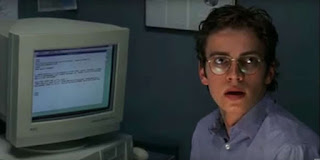

 At the office, Stephen shows Jukt’s website to Chuck, and it looks like it was thrown together, with only a couple of pages of text, one of which criticizes The New Republic. The hostility is meant to evoke a protective response from Chuck, which is what Stephen experienced with Kelly on the “Spring Breakdown” piece. It does not go as Stephen hoped. Stephen hands Chuck the business card of Joe Hiert, Restil’s agent. It is another bare bones offering, and Chuck comments, “This doesn’t look like a real business card.” Of course, Stephen offers his usual eccentricity explanation, calling Hiert a “clown.” 


There is a grueling conference call in Chuck’s office with Stephen present as Adam says they were either only able to get voicemail messages of the people noted in the story, or emails were sent back as undeliverable. Stephen again offers his “million times” hyperbole of the number of occasions he reached those noted in the piece. On the defensive, Stephen starts to backpedal, saying he was told that Jukt was a major software company, but didn’t verify that fact personally. He now says that his story was misleading if it said that he was in Restil’s home with his agent. Adam’s boss, Kambiz, says that the Jukt website looks fake, like it “was created to fool someone.” The camera now stays on Chuck’s face who has been mostly silent, and he has a look of impatience building as his facial features become more tense. He now orders Stephen to provide a requested phone number. As he starts to provide it, Adam points out it does not have the proper area code. Stephen offers that all of the problems that Adam found indicate that Stephen probably was “duped.” That would be bad enough, but it would still place the blame of deception elsewhere. 


After the phone meeting, Stephen continues to push the blame off of himself. He tells Caitlin and others, who see Chuck as the villain for taking over Kelly’s job, that Chuck didn’t back him up and only cared about the magazine. But a subsequent phone call between Chuck and Kambiz shows the opposite. Chuck is concerned about the harm that will be inflicted on Stephen. Chuck knows he has no control over what Forbes will print, and that is only fair since The New Republic must take responsibility for its content. Kambiz at the moment is only going to say that Stephen was the victim of a hoax, but they must responsibly publish what they found. Kambiz tells Chuck that they will be asking him for his comments and he wants to know how much Chuck will stand behind the story. As he holds the bogus-looking business card in his hand, Chuck says he will have to look into things more. He feels he must do his own investigation to see what is true and what is false, and, therefore, how much Stephen is to blame.


Chuck and Stephen go to Bethesda, MD to try to track down the agent Hiert or at least get some clues as to what really happened. Stephen tries to make his recollection appear valid by correcting himself as to where he sat at lunch outside with Restil, his mother (Michelle Scarabelli), and Hiert, and how they moved because someone smoking bothered Mrs. Restil. The shot shows the individuals as Stephen acts like he is recreating the facts, and it seems that what he says actually happened, since we see them, even though they turn out to be phantoms. Chuck and Stephen go to the building next door to where supposedly close to two hundred people were in attendance at the hacker conference in the lobby. The area is obviously too small for such a gathering, and the man at the desk says that the building is closed on Sundays, which is when Stephen said the event occurred. Stephen keeps saying “it’s in my notes,” trying to use that fallback as the journalistic justification for what he is saying. 


 Stephen still insists he was there, and Restil and nine others, including Stephen, went to dinner because it was so cramped in the lobby. He says they went across the street to a restaurant, which has a sign that says it was only open until three in the afternoon on Sunday, which means they don’t serve dinner. Stephen says they just made it before the eatery closed. He just keeps improvising to cover himself. He is starting to talk in a rapid, shaky voice now as Chuck chips away at his story. Stephen says Chuck isn’t really having a back-and-forth conversation anymore, which is true. Chuck begins distancing himself from Stephen, ignoring his claim that he is innocent of any wrongdoing. But Stephen persists with his lies, and Chuck says Forbes is going to check out his whole story since the assertions are not holding up. As Stephen continues to say he didn’t do anything wrong, Chuck knows that is not true and yells, “I really wish you’d stop saying that!” 


As they ride back, Stephen is so rattled he runs a stop sign and almost gets into an accident. He finally admits to Chuck that he wasn’t at the conference. He acts as if he had accounts of the gathering from others and embellished to have an “eyewitness” feel to the story. Stephen says he’ll admit that he made it up if it will help Chuck. He is still acting as if he was fooled. Chuck says, “I just want you to tell me the truth, Steve. Can you do that?” The question gets to the center of Stephen’s character, because he isn’t capable of being honest. Lying is his shield against, as he sees it, being judged unfairly and not getting rewarded as he deserves. 


Lewis Estridge (Mark Blum), who works for The New Republic, falls into the trap that Stephen has created that makes one feel that they must defend this “confused, distraught kid,” as Lewis calls him. But Chuck sees Stephen as a devious person who “doctored his notes” and made up “a bunch of phony quotes” as if they were facts, which Chuck says is offensive. Lewis offers that Chuck should only suspend Stephen because firing him will turn the staff against Chuck, and many will quit their jobs so there may be nobody left to run the magazine. Caitlen joins their conversation, pleads that Stephen is devastated that he lied to Chuck, and says he is hanging by a thread, psychologically. Stephen is acting like a scared child afraid of the punishment his father will dispense on him. Chuck gives in to suspending Stephen, but for two years. At this point Chuck still sees Stephen as being deceived by a source, and then he made up stuff to expand on the amount of information he was fed.


 Stephen then goes to the “good cop,” or benign father figure, Kelly, looking for comfort. He acts contrite about blindly trusting his sources and then lying to complete his story. Stephen tries to sell Kelly the idea that Chuck always hated Stephen because Stephen said positive things about Kelly. He says that the real reason Chuck is “punishing” Stephen is because of his “loyalty” to Kelly. Stephen is trying to get Kelly to see Chuck as his enemy and thus come to Stephen’s side of the fight. But Kelly says that Stephen committed “fireable offenses,” and instead of rushing to support him, Kelly wants to know if Stephen “cooked” stories when he worked for Kelly. He specifically asks about “Spring Breakdown,” and Stephen doesn’t answer, so it’s assumed Kelly realizes Stephen’s offenses go way back.


David, Stephen’s fellow journalist, calls Chuck at home saying that Stephen asked him to drive him to the airport because he was afraid he couldn’t do it safely. Again, Stephen looks for sympathy from others by showing what bad shape he is in. David says Stephen said he was going home for a while. Chuck learns from David that Stephen has a brother at Stanford University in Palo Alto, CA, which is where Jukt Micronics is supposed to exist. Chuck now realizes that there was no manipulative source behind Stephen’s story. He fabricated the whole tale, using his brother to play the CEO of Jukt, George Sims. 


Chuck goes to the office and tells Stephen he knows he faked everything. Stephen tells Chuck, “You got this totally backwards.” He is trying to pass off his fabricated world as the real one. The movie suggests that those who are liars may try to defend themselves by declaring that their accusers are guilty of the crimes they have committed to divert attention away from their own misdeeds. But Chuck says he can easily find the evidence he needs to prove how Stephen engineered his hoax. However, Stephen will not back away from the fantasy. So, Chuck tells Stephen to leave without taking anything but his law books, most likely to secure evidence he needs to show what Stephen has done. When Stephen repeats that he is not a criminal, Chuck says, “Oh, I heard you.” It’s an acknowledgement of Stephen’s words but there is no longer a belief in them. Stephen repeats that he is sorry, like a child who is still learning what and what not to do. But Stephen is an adult and must take responsibility for his actions, and that is why Chuck says, “You have to go.” 


After Stephen leaves, Chuck takes several issues of the magazine that contain articles by Stephen off of a display wall. As he looks at them, Stephen’s voice recites some of the sentences from each in Chuck’s head. Now that Chuck knows that he is dealing with a liar, he views the stories from a cynical perspective. He throws the magazines onto the floor with disgust as the impact of the fraud hits him. Stephen reenters and reinvents his story, admitting that it was his brother pretending to be George Sims, but he insists that the man really exists, and Stephen spoke to him “a million times,” (the exaggeration sounding especially pathetic now). Stephen asserts Sims stopped talking to him and he was buying time to reconnect with him. Stephen is delusional to think that, after all his lies, Chuck will believe a new falsehood. Chuck of course isn’t buying anything Stephen says now and tells him he is fired (IMDb notes that as Chuck replaces the copies of the magazines on the wall, there is one issue that has a headline that reads, “Lie About It,” an appropriate sentence for what is happening in the film). Stephen is now whimpering, and plays the pity card, asking Chuck to drive him to the airport because he is afraid of what he might do to himself. Chuck tells him he can sit and calm himself down, but he declares that he isn’t going anywhere with him. Stephen can’t believe he isn’t getting the emotional response he seeks and asks if Chuck heard him. Chuck’s sarcastic comment is, “It’s a hell of a story.”  As Stephen continues to plead for comfort, Chuck puts the last nail in the professional coffin when he says, “Stop pitching, Steve. It’s over.” Chuck sees through the fake façade and will not be manipulated any more by a tale pretending to be true. 


 There is a return to the high school classroom, as the teacher, Mrs. Duke, recites the list of articles that Stephen wrote as the adoring students listen. That look of praise turns to one of anger as there is a shift back to the even-tempered Chuck who finally explodes when Caitlin challenges him for firing Stephen. She acts as if he is out to get those who were loyal to Kelly. But Chuck says she is a good reporter and if she is objective she will judge appropriately. The suggestion here is that if someone gets away with something once, and is rewarded for the transgression, he will repeat the infraction. He says that there might not be any magazine after he exposes what happened because Stephen “handed us fiction after fiction and we printed them all as fact.” He says they are all guilty of allowing Stephen to get past their fact checking because they “found him entertaining.” He says what was done is “indefensible.” The implication here is that those who are in a responsible position to provide accurate information betray the public trust when they fail to deliver the facts.


As Stephen heads to the conference room for a staff meeting he assembled, the receptionist, Gloria, makes a good point. She says that this problem would have been avoided if pictures were taken since one can’t invent people if they must be photographed. But, that statement shows how faith in journalism is eroding when one can’t trust that a periodical’s reporters are trying to be truthful. Chuck thought he was going to face a hostile group, but he is grateful to find a typed apology to be published for what happened, signed by all the writers and editors. There are cuts back and forth to the classroom where the students applaud Stephen, while at the same time The New Republic staff claps to acknowledge Chuck’s strength of moral character. That reception is real, but Stephen’s adoration is only in his head, as he has imagined the school presentation. He is alone in the classroom, mirroring the emptiness of his world, populated only by fictitious characters. 


The next scene has Chuck and Stephen accompanied by their lawyers. Chuck reads a list of the titles of articles that Stephen wrote and the magazine has found to be suspicious. Stephen can object to any story being considered untruthful. He doesn’t contest any of them. 


The notes at the end of the film state that the magazine apologized for twenty-seven pieces written by Stephen Glass as either being “partially or entirely invented.” He eventually graduated from law school. His novel, The Fabulist, was published in 2003. It is “about an ambitious journalist who invents stories and characters in order to further his career.” It is ironic that the man who wrote fiction and pretended that the stories were nonfiction then created a novel that was based on fact. It was not a commercial success. The movie may be asking what does that say about a population that prefers to believe that invented stories are real?


The next film is Breathless.