SPOILER ALERT! The plot
will be discussed.
Yes, this is a crazy
comedy. But due to screenwriter/director, Harold Ramis, and the performance of
Bill Murray, Groundhog Day (1993) successfully combines humor
with an insightful exploration of various facets of human nature.
The film begins with a
sky that is getting cloudy, as will the fate of the protagonist. The opening
song says, “seasons come, and seasons go,” stressing change. The weatherman is
the person who tries to help others to prepare for the fluctuations in the
climate by foreseeing them. Phil Connors (Murray, who should have received an
Oscar nomination for this role), however, is a self-absorbed Pittsburgh TV
weather forecaster, who is egotistical about his ability to predict what’s
going to happen, which makes him feel superior to others. His forecast on this
day is snow which will miss the city and hit Altoona instead. He is smug in his
condescension toward fellow workers. He calls the local news anchorwoman
“Hairdo,” and says a major network is interested in him. Cameraman Larry (Chris
Elliott) shoots back that it’s probably the Home Shopping Network. So Phil’s
arrogance provokes dislike. He believes he is the “talent,” which he calls
himself, and it’s a waste for him to attend the annual Groundhog Day festival
on February 2nd in Punxsutawney, Pennsylvania. He is snobby about the rural
local citizens, whom he later calls “morons,” who celebrate the silly idea that
an animal, with the same name as Phil, which galls him, is equal to Phil’s
ability to know if the rest of the winter will be cold by whether or not the
critter sees his shadow.
Along with Larry
traveling in the TV station van is new producer Rita (Andie MacDowell). She
wants to stay a bit longer after the ceremony in Punxsutawney because she
thinks it’s a great human-interest story. She has affection for small town
life. Phil ominously says this time will be his last doing this gig, and is
concerned that someone might see him at the festival and think he has “no
future.” How right he turns out to be, at least through a large part of his
journey, if measured by his selfish view of what constitutes success.

The town is an
old-fashioned American community whose citizens have simple, wholesome tastes,
as can be seen as the van passes a local movie theater showing a Heidi
movie. Larry calls Phil a “prima donna” since he won’t stay at the hotel he
labels “a fleabag.” Rita, anticipating his reaction, booked him in a bed and
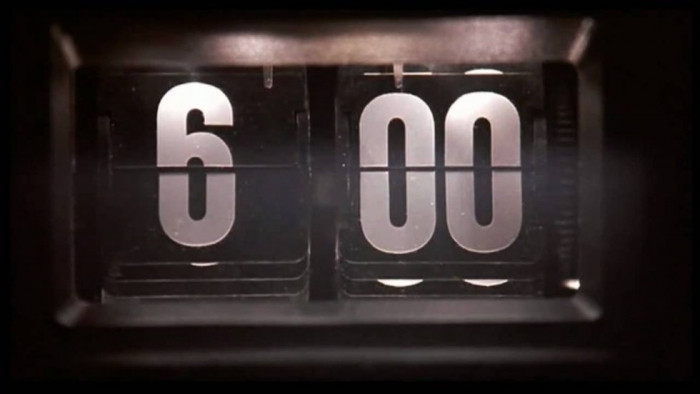
breakfast. Phil wakes up the next day as the clock-radio plays Sonny and Cher
singing “I Got You Babe” at six in the morning, the first of innumerable times
he will hear that song. The local broadcasters joke about the cold weather, and
how the words on everybody’s “chapped lips,” because they are not in “Miami
Beach,” are that it is Groundhog Day.
Phil’s’ misanthropic
attitude is in high gear. He is sarcastic to a man who is cheery anticipating
what the groundhog will predict about the length of the winter. Phil says with
a snobby attitude that he thinks it will end on March 21. After asking the
hostess, Mrs. Lancaster (Angela Paton), for some specialty coffee and getting
no definitive response, he snidely questions under his breath whether the bed
and breakfast hostess can spell, “espresso,” or “cappuccino.” In response to
whether he will be checking out that day, he uses his weatherman terminology
and says, “Chance of departure today, 100 percent.” The man who is so sure of
himself turns out to be 100 percent wrong.

The first time he passes
by an old panhandler, he fakes looking for something in his pockets to give the
man as he walks past. It is a token act of false concern. He meets an annoying
but good-natured insurance salesman, Ned Ryerson (Stephen Tobolowsky) who knew
Phil in high school. Of course the self-centered Phil admits that there’s “not
a chance” that he recalls this fellow. Ned tries to jar Phil’s memory by saying
he “did the whistling belly button trick at the talent show.” Phil pretends he
remembers him and comes up with one of my favorite lines when he asks Ned, “Did
you turn pro with that belly button thing?” Ned may be goofy, but he
insightfully says he doesn’t understand fellow workers who rely on actuarial
charts to predict people’s lives, and he adds that life is all a “crapshoot.”
One of the themes of this story is that wanting to know the future and having
control over it is a form of hubris, and not something to desire if that
knowledge is used only for one’s own purposes. But, the film also stresses that
one should learn and evolve through experience before moving forward. To stress
this point, Phil now steps into an icy, wet hole in the street, the first of
numerous occasions he makes this same mistake which symbolizes it takes him
quite a while before he learns from his prior mistakes.


Phil goes to Gobbler's
Knob for the Groundhog Day event with the Pennsylvania Polka playing in the
background, which adds to the small town’s atmosphere. Rita loves the people
there, who stayed up the previous night, sang songs, and are continuing the fun
the next day. But, Phil has no appreciation for this country charm, calling the
locals, “hicks.” He also is crude and offends Rita, saying she probably didn’t
sleep well without him. The person running the show is Buster (Brian
Doyle-Murray, Bill’s brother), and he says groundhog Phil saw his shadow and
the bad news is there is not going to be an early spring. Phil wraps up the
recording by saying TV can’t capture the excitement of a “large squirrel”
predicting the weather. He walks off even though Rita wants him to do it again
“without the sarcasm,” which at this point would require brain surgery to
remove.

On the way out of town,
the blizzard, that Phil said was supposed to miss this part of the state,
closes the roads, and they can’t leave. Phil can’t accept that his prediction
is wrong. When the state trooper asks him if he listened to the forecast, he
says, “I make the weather.” His ego is so large that he depicts himself as
someone with enough power to control nature. Rita and Larry try to make the
best of the situation, and ask Phil if he wants to go to the Groundhog Day
dinner, but Phil sarcastically says he had “groundhog for lunch,” again showing
his hostility for the animal and the town that celebrates him. He just wants to
go back to his room and read the sex magazine, Hustler, which elicits a
sharp, “Suit yourself,” from the annoyed Rita. Phil doesn’t seem to care if he
offends anyone.
The next day turns out
to be the same day, as the clock radio again plays, “I’ve Got you, Babe,” and
the disc jockeys are doing the same routine. (Ramis and co-writer Danny Rubin
could have chosen any tune, but they picked a light-hearted one about the love
between two people that can survive anything, which, although a simple theme,
is what Phil must learn). Phil at first thinks they are playing yesterday’s
tape. But there is no snow on the ground, and the town is celebrating Groundhog
Day again. Phil will go through different stages as the same scenario repeats
itself. He starts out with denial, confusion and then anger. When Mrs.
Lancaster asks if he will be leaving that day, Phil is already starting to lose
self-assuredness by saying the chances of departure are “75 to 80” percent.
When told that everyone is going to celebrate Groundhog Day, he humorously, but
with worry, says, “It’s still just once a year, isn’t it?” When he encounters
Ned the second time (or, for the first time again), Ned guesses that Phil
doesn’t have any insurance. His line stresses how Phil is the kind of person
who thinks he doesn’t need anything to fall back on because he has it all
figured out. His journey is meant to humble him and teach Phil that he is not
the center of the universe.

When he gets to
Gobbler’s Knob he admits, possibly for the first time in his life, that he “may
be having a problem.” He knows what Rita is about to say, and now that
predictability which comes from repetition and denies change or variety is
frightening to him. On the third time he skips the broadcast and meets with
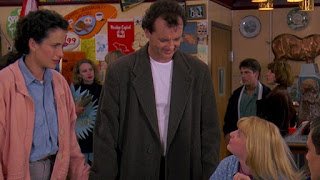
Rita in the local diner. He tells her how he is reliving the same day, and she,
of course, can’t figure out what his angle is to say something so crazy. Larry
arrives and says what he will repeat innumerable times, “We better go, to stay
ahead of the weather.” It’s something that Phil thought he could do, but he no
longer has that ability.

Director Ramis plays the
local neurologist that Phil visits. His physical examination is normal, and the
specialist says he has to go to Pittsburgh for a CT scan or MRI. Of course,
Phil confuses the doctor when he says he can’t go to the city because of the
yet nonexistent blizzard. The irony here is that before, people would rely on
Phil’s educated guesses about the approaching weather, but now his absolutely
correct forecast is not believed, which alienates and unsettles Phil, preparing
him for a change is his outlook on life. The neurologist suggests Phil see a
psychiatrist (David Pasquesi). The shrink says they should meet again
“tomorrow,” which won't allow the shrink to be of any help since nothing will
carry forward. The next day will just be a reset with no cumulative knowledge
except on the part of Phil, who must realize he must take advantage of what he
learns about himself.

Instead of just going
back to his room, Phil goes to the bowling alley and drinks beer with two
blue-collar townspeople, Gus (Rick Ducommon) and Ralph (Rick Overton). Phil
recalls a day in the Virgin Islands where he ate lobster, drank pina coladas,
and made love to a woman, and wonders why he couldn’t relive that day instead.
But this cosmic intervention is meant to realign Phil’s attitude toward others
which would not occur if his behavior wasn’t challenged. As one of the men
says, Phil “is ‘a glass half-empty’ kind of guy,” which stresses Phil’s
negativity if things don’t go according to his plans. Phil asks what would they
do if “stuck in one place and every day was exactly the same, and nothing you
did mattered?’ The response from one of the men is, “That about sums it up for
me.” The movie is a fantasy, but although people may not want to admit it, so
many of them live repetitious, predictable real-life versions of Groundhog Day.
(As the three leave, Ralph looks like he’s going to barf. Phil asks, “you want
to throw up here or in the car?” My daughter and I love to repeat lines from
this movie, and Ralph’s response that we love is, “I think … both.” We also
like to say the follow-up line, after we’ve had a large meal, “Who else could
go for some flapjacks?”).
Phil does the driving
since he isn’t drunk like the other two. He asks them the question that moves
Phil onto the next step on his road to dealing with his situation. He wonders,
“What if there were no tomorrow?” Gus’s response is “That would mean there’d be
no consequences, no hangovers, we could do whatever we wanted!” This revelation
leads Phil to feel liberated from any restrictions, such as those a parent
might dictate such as, “Clean up your room! Stand up Straight!” He says, “I’m
not going to live by their rules anymore!” His statement is attractive to that
part of a person that wants to put individual freedom above all else without
having to worry about effects on oneself or others. It allows one to throw
morality out of the window. Phil drives the car into a large sign of the
groundhog in an act of defiance of the predictable loop he is caught up in. In
terms of his own selfishness, he has turned the half-empty glass into a
half-full one. (Given the premise, the movie could have shown horrendous acts
of immorality, but the film is a comedy, and the mood remains mostly light).


When he wakes up in bed,
and not in jail, Phil celebrates this time around and what follows are a series
of self-indulgences. He decks Ned with one punch and goes to the diner and eats
a table full of desserts in front of the astonished Rita. He also smokes a
cigarette now because he doesn’t have to worry about his health. When she calls
him a man of “advancing years,” he comically responds that his “years aren’t
advancing as much as you think.” Through repetition, he learns all about a
woman he sees in the diner, Nancy (Marita Geraghty) and pretends they were high
school roommates. He says he always loved her, and wants to marry her. His
tactic persuades Nancy to have sex with him. But during their intimate
encounter, he calls “Rita,” which reveals who he truly cares about. He has
memorized down to the smallest detail the arrival of an armored car carrying
money so he can steal a bag of cash while the guards are distracted by the
diner waitress, Doris (Robin Duke). He uses the money to drive a Mercedes,
dress up like a cowboy, and bring a woman who is dressed like a French maid to
the movie. We know time has passed for him since he says he saw the Heidi movie
“over a hundred times.”
After apparently having
satisfied his carnal appetites, which bring limited satisfaction, Phil seems to
focus on Rita. Why her, besides her being physically attractive? Perhaps
because she has so many admirable characteristics that he lacks, and that he
sees in her what he wishes he could be. But, he doesn't understand what true
romance feels like, so he goes through the motions of what he thinks it should
be. He uses the same maneuvers on her he used on Nancy. He asks about her
desires and her views on things, so over time he can learn enough about her in
order to use his one day of opportunity to win her over by acting like they are
compatible. She says she likes someone who is “humble,” but also “intelligent,
supportive, funny,” among other attributes. Phil has very few of these
qualities at this point although he states to Rita that he does. One important
item she mentions is that her ideal man should play an “instrument,” which will
be important later. There are a series of small alterations over time of the
same scene at a bar where Phil acts like he loves Rita’s favorite drink,
repeats her toast to “world peace,” and reads French poetry that she admires.
At the end of one of numerous daily reprisals where Phil tries to get all the
details right, Rita says, “It’s a perfect day. You couldn’t plan a day like
this.” Phil says, “Well you can. It just takes an awful lot of work.” And that
is the problem, because from Rita’s viewpoint she has found out by chance some
wonderful things about someone she undervalued. But the truth is Phil is a
phony, who adopted Rita’s preferences instead of really being genuinely
invested in them so he can have a romantic conquest.

Because he has only one
day, he rushes her, and after kissing, she stops and wants to slow things down
between them. When he pushes too much and sounds like he is making a list when
he recites her dislike for fudge and white chocolate, she rightly accuses him
of constructing a “setup.” He says he loves her, and he does, but he has had
the time to get to know her, while she hasn’t had that experience with him. She
smacks him for making her care about him, and says that he only loves himself,
which isn’t completely accurate at this point, but how would she be able to
know that from his behavior?


He continues to try to
create the perfect day with Rita which becomes as predictable as the rest of
the day he is reliving. The numerous rehearsals destroy spontaneity and become
extremely forced, ending with multiple slaps to Phil’s face. The powers
involved in Phil’s journey require him to learn, through failure, the sin of
selfishness. Because of his personal unfulfillment, Phil then descends into a
deep depression. He slowly and sadly repeats the words of the DJ’s, with his
own alteration, saying, “it’s cold out there. It’s cold out there every day.”
While watching an episode of “Jeopardy,” which he has memorized, he voices the
answers even before the questions are finished, astonishing the others watching
with him in a lobby. There is no thrill to getting the right answers if you
already know them, because there is no excitement in the absence of a
challenge.

At one of his broadcasts
Phil lashes out at the crowd for worshiping “a rat.” He calls the celebration
“a hype.” But isn’t he the unlovable celebrity version of the groundhog who
tries to predict what will happen? The tone in the movie has turned darker now
as Phil offers his “winter prediction.” He says, “It’s going to be cold. It’s
going to be grey. And it’s going to last you the rest of your life.” There are
a series of shots of Phil destroying his clock radio as it plays at six am.
Since time has become a punishment to him he wants it to stop. In another
taping, he says the winter will never end, “as long as this groundhog keeps
seeing his shadow,” thus extending the length of the season over and over. Phil
steals the truck holding the groundhog in his carrier and kidnaps his namesake
because he must put a stop to predictions. The local authorities along with
Rita and Larry follow Phil to a quarry. Phil then pulls a Thelma and Louise
with the groundhog as he plunges the truck off the ledge, smashing the vehicle
onto the ground below. (Another couple of lines my daughter and I like to
repeat when watching a car crash in a movie comes from Larry here when he says,
“He might be okay,” followed by, “Well, no. Probably not,” after the truck
bursts into flames).


Killing himself and the
groundhog doesn't stop the resets. Phil keeps trying to end his life, dropping
a toaster in his bath, getting hit by a truck, and jumping off a building.
There were many more attempts which he relates to Rita at breakfast at the
diner as he tells her about his continually reliving Groundhog Day. He
concludes that he is immortal, like a god. He talks about the lives of the
patrons and can state when one of the waiters will drop a tray of dishes,
because he has witnessed it countless times. He concludes that God may know
everything just by being around long enough to gather all this information. But
this shift to observational knowledge eventually allows Phil to step away from
himself and become involved in the lives of others. The amazed Rita asks if he
also knows about her. He has paid attention to details about her, and Phil for
the first time is touching as he says that she, “likes boats but not the ocean.
You go to a lake in the summer with your family up in the mountains. There’s a
long wooden dock and a boathouse with boards missing from the roof, and a place
you used to crawl underneath to be alone. You’re a sucker for French poetry and
rhinestones. You’re very generous. You’re kind to strangers and children. And
when you stand in the snow you look like an angel.” He says that Larry will
walk in and he writes down what he will say about leaving “to stay ahead of the
weather.” He begs her not to leave him, and, of course, Larry does exactly what
Phil said.


Rita stays with Phil as
they walk around Punxsutawney. He admits what he said has to be true because
how else would he know so much since he’s “not that smart.” Humility has
finally touched Phil’s soul. Rita says she would stay with him to be an
objective observer, sort of like a “science project,” and Phil having Rita as a
companion, not a conquest, allows him to enjoy life again for a day by hanging
out with her. He sadly says that the “worst part is that tomorrow you’ll have
forgotten all about this, and you’ll treat me like a jerk again.” He admits
that is what he is, which shows how he has gained insight into himself. Rita
gives him that “glass half full” twist, saying maybe it’s not a “curse” that
has been visited upon him. She says, “It depends on how you look at it.” She
hugs him and as she falls asleep in the middle of the night he whispers to her
that he does not yet “deserve someone like you,” but promises that if he were
ever worthy, he would love her for the rest of his life. What he says here
contrasts with his early repetition of “Me” as being the right man for Rita.
She stays with him, but she disappears at six in the morning. Phil has to
reboot himself, which is what Groundhog Day has been offering him to do, to act
on Rita’s optimistic take on his situation so he can be free.

In one of the subsequent
Groundhog Days, Phil smiles as he approaches the umpteenth time he films the
event. He brings breakfast to his work colleagues and suggests a better way to
shoot the piece. He helps carry equipment and asks Larry about his life. He is
no longer thinking only of himself and acts like a part of a team. He says at
one of his tapings that “winter is just another step in the cycle of life.” He
even says that being among the citizens of the town, he “couldn’t imagine a
better fate than a long and lustrous winter.” He has come to embrace the cold
season that he earlier despised because now he can see the bigger picture, and
enjoy the emotional warmth of others.
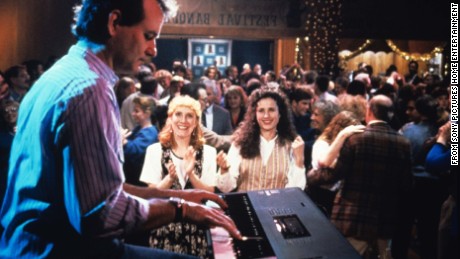
Phil reads books to
educate himself. He becomes artistic, and learns to ice sculpt. He takes piano
lessons, not just because Rita wanted a man who plays an instrument, but
because he uses the time granted to him as a blessing to improve himself. He
greets the man at the bed and breakfast, whom he previously met with sarcasm,
with joy and a poem that says winter holds the promise of spring. He is
definitely making that lemonade out of the lemons.




But he also becomes a
sort of guardian angel. Phil gives all the money he has to the old beggar, and
later helps him to the hospital when he sees him staggering at the end of the
day. When the man passes away, and Phil realizes that Groundhog Day is the last
day on earth for the man, he tries to make it better for him, making sure he
has a nice meal, and even attempts to revive him when he collapses. He now
knows he is not a god because he can’t change some things even if he knows how
they will turn out. He helps Buster by using the Heimlich maneuver on him and
helps a young woman, Debbie (Hynden Walch) get over her fear of marriage to
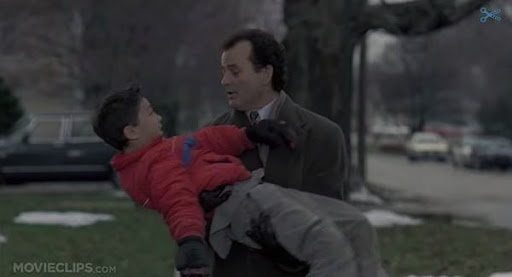
Fred (Michael Shannon, in his film debut). He also catches a boy who falls from
a tree (IMDb points out that the boy is in the hospital with a broken leg in
the scene when Phil takes the old man there, so Phil later prevents the
accident). He also helps change a tire for old ladies who get a flat. He buys
every type of insurance offered from Ned, who says it's the best day of his
life. In an astounding turnaround, Phil agrees, and says, “Mine, too.”


At the Groundhog Day
dinner, which Phil now wants to attend, Rita finds out how popular Phil has
become in one day since he has been very busy helping others as well as giving
pleasure to those hearing him play the piano at the dinner. When she asks him
what he did that day, Phil delivers one of the movie’s best lines, “Oh, same
old, same old.” But he has really made that “same” into something new. She is
amazed and “buys” him at an auction for charity. He makes an ice sculpture of
her face, which Rita says is “lovely,” but she doesn’t know how he can make
such a creation. After the passage of so much time (it has been suggested that
ten years have passed), he says, “I know your face so well, I could do it with
my eyes closed.” He knows how to live in the moment because, he says, that no
matter what happens, he is “happy now.” He admits to loving her, and this time
he is sincere. She says she is happy, too, and they kiss. As IMDb indicates, it
begins to snow, which signals that there is a change coming, as it does in It’s
a Wonderful Life, when George returns to the reality that includes him
among the living. (And the same phenomenon occurs in another Christmas movie, The
Family Man, when Nicholas Cage’s character will soon return to his real
life).

The next morning turns
out to really be the next morning. Even though the same song plays, the DJ’s
are saying something different, and Rita’s hand comes into the shot as she
turns off the radio. Phil says, “something is different,” and when she asks if
that is good, he says, “Anything different is good,” as predictability is no
longer needed. There is snow on the ground, so the blizzard has left its mark,
and it no longer is Groundhog Day. She stayed because he asked her to, and they
just fell asleep. He says it “was the end of a very long day. Is there anything
I can do for you today?” His first desire now is to please another, not
himself. He can now go forward to spread the benevolence he has learned so it
will embrace others.
When they go outside,
Phil looks at the white covering of snow, a hallmark of the season he
originally despised, and says, “It’s so beautiful!” He now is so grateful for
what being in the town has taught him that he says, “Let’s live here!” But he
says they’ll just rent to start. Afterall, it has been a spooky place for him.
The song at the end of the film (from the musical Brigadoon which
appropriately plays here, because it is about a place caught in time) has the
lyrics, “What a day this has been/What a rare mood I’m in/Why it’s almost like
being in love/There’s a smile on my face/for the whole human race.” In the end,
when true love is shared, people can be happy together anywhere. That feels like deja vu. Didn't I just say that?
The next film is Do
the Right Thing.