Showing posts with label redemption. Show all posts

Tuesday, April 11, 2023

Donnie Darko

 SPOILER ALERT! The plot will be discussed!

Donnie Darko (2001) has the theme of sacrifice to save others, but the demonic rabbit costume in this cult favorite has become iconic, so the movie also has an anti-Easter feel to it, too.

The film starts ominously in a dark outdoor setting with thunder in the background. The name of Donnie Darko (Jake Gyllenhaal) fits the setting. He has been lying on a mountain road in his pajamas next to his bicycle. It’s an odd place to have bedded down for the night. He appears to be waking up from a strange dream. His smile seems to contrast with the threatening situation, which points to the opposing forces in the film.

The contrasts continue as what follows is a sunny day with the title of the film then shown, the character’s name offset by the brightness of the image. Donnie rides his bike past a sign announcing a Halloween event, a fitting notice for this spooky tale. The soundtrack song is sung by Echo and the Bunnymen. Rabbits are important to this story, and give a decidedly anti sweet, Easter feel to the tale. Here a rabbit may suggest the White Rabbit in Alice in Wonderland and the idea of going down the nightmarish rabbit hole. (In Celtic folklore, there is the character of a pooka, a kind of ghost, that sometimes manifests itself as a hare, and can bring about good or bad occurrences, which fits in with the contrasting theme of the film). If you want to see all the times that a rabbit appears, go to IMDb.


On a supposedly proper suburban lawn Donnie’s father, Eddie Darko (Holmes Osbourne) uses a leaf blower, but abruptly points it jokingly at his teenage daughter, Elizabeth (Maggie Gyllenhaal) as she strolls by. The phallic-shaped tool adds a twisted incestual suggestion to the scene, sort of like the garden hose at the beginning of Blue Velvet, implying something dark below the tranquil suburban setting. Donnie’s mother, Rose (Mary McDonnell) is outside at the back of the house reading the Stephen King book It, another creepy image undermining the possibility of safety. (IMDb notes that this novel’s nemesis is dressed like a clown, and much later there is a clown in Frank’s car that is dressed likewise. It adds to the Halloween motif). Donnie walks past his mother weirdly not saying a word considering a note is written on a piece of paper on the refrigerator which says, “Where is Donnie?” (Who would post such a message about a missing family member this way? It adds to the surreal nature of the movie).

At the dinner table Donnie is sarcastic and combative with his sister, Elizabeth, who reveals that Donnie has not been taking his medication. We discover he has a history of schizophrenia accompanied by violence and is prone to sleepwalking, which explains why he woke up on a country road. After dinner, Rose confronts her son about where he goes off at night. He is very hostile telling her to get out of his room, and he calls her a “bitch.” She says she doesn’t recognize him anymore, and that may exhort him to later take some of his medication.

Later in the night we hear a distorted, deep voice telling Donnie to wake up. Donnie sleepwalks again, following the voice to the hedges at the back of the house. He sees the image of a man wearing a grotesque rabbit costume with long upright ears. The rabbit, who is called Frank (James Duval), says he has been watching Donnie and announces, “twenty-eight days, six hours, forty-two minutes, twelve seconds … That is when the world will end.” Donnie took his meds. Is he seeing clearly, and this apocalyptic vision is real, or is his mental illness defying treatment?


The night scene cuts to a TV displaying static in front of the sleeping Eddie, an image representing a lack of communication and comprehension (and possibly a reference to the TV in the ghostly film Poltergeist). Elizabeth comes in the door and immediately thereafter the house shakes as a loud noise sounds. Eddie awakes and runs in slow motion adding to the unreal happening. The film abruptly shifts to the daytime and Donnie is asleep on a golf course, another contrasting image of oddness appearing amid suburban tranquility. That same unnerving jolt out of the ordinary occurs when Donnie gets home and finds a jet engine being hoisted off his house. His family is outside and his younger sister, Samantha (Daveigh Chase) tells Donnie that the large piece of debris fell in his room. If it wasn’t for his sleepwalking, his dive into the surreal, his real world would have ended, but in a bizarre way. Elizabeth tells Donnie about the airplane engine, “They don’t know where it came from.” Now that’s very weird, because there is usually a plane around when one of its engines gets detached.

The FAA arranges for the Darko family to stay at a hotel. Eddie remembers about a young man who died on his way to his high school prom, and says people said the boy was “doomed.” Eddie wonders if that could be Donnie’s case. But his son escaped his fate. Or did he?


Back at school Donnie is sort of famous for escaping death. Teacher Karen Pomeroy (Drew Barrymore) is the defiant teacher who worries about losing children to “apathy,” and the principal later fires her for her counter-culture ways. Here she discusses “The Destructors” by Graham Greene. (October 2 is the day on which Frank tells Donny the world will end. That is Greene’s birthday, according to IMDb. It is thus fitting that the man who wrote about destruction is tied to demise here. In the fiction piece, children break into a house not to steal money but to burn it. Donnie comments that it is an act of rebellion to change things. His comments fit with his antisocial, hostile attitude toward the world as it is.

Another strange incident occurs when Eddie drives Donnie to his therapist, Dr. Lillian Thurman (Katherine Ross). A disheveled old lady with fly-away gray hair stops in the middle of the road and checks her mailbox, which she does every day, and there is never any mail. It’s sort of like a Waiting for Godot scenario, where meaningless action perpetuates. Her name is Roberta Sparrow (Patience Cleveland), also known as Grandma Death. Her appearance fits that nickname. When Donnie gets out of the car to see what’s going on, she whispers something to him, which Donnie does not divulge at this time. We later learn that she pessimistically stresses how every living creature dies alone. Since dire events center around Donnie, it makes sense that a reaper-like person should be contacting him.

Donnie tells Thurman that his new imaginary friend, Frank (the guy in the weird rabbit costume), told Donnie to follow him “into the future.” Donnie says that Frank telling him that the world would end soon was “stupid.” Yet, he calls Frank a “friend,” which sounds as if he is conflicted about Frank’s presence.

In a class, the health teacher, Kitty Farmer, an uptight person, doesn’t teach but plays videos featuring Jim Cunningham (Patrick Swayze) which focus on overcoming fear. There is an atmosphere of foreboding in this film right from the opening scene, followed by Donnie’s personality, the scary rabbit, and the airplane engine accident. (By the way, the movie Harvey deals with James Stewart’s character talking to a human-sized rabbit that is invisible to everyone else. This film is a dark version of that scenario).

Spooky Frank wakes up Donnie again and Donnie appears to be sleepwalking (sleepwalking is a kind of twilight area between waking and sleeping). This time he is carrying an axe. Later, the school’s mascot, which is represented by a large statue of a bulldog, has the axe buried in its head. And the words. “They made me do it,” are written in paint on the sidewalk. Since Donnie committed the vandalism, his free will seems to merge with the dictates of the supernatural that charts the destiny for everyone. However, his words also sound like what a schizophrenic would say. The danger surrounding his personality permeates the movie. He also uses the axe to flood the school by breaking a water main. Donnie fits in with the Greene short story since he is a destructor forcing change to occur.

Donnie gets to know the new girl at the school, Gretchen Ross (Jenna Malone). Since she has just arrived, she is an outsider, like Donnie. Her past adds to her lack of normalcy. Her father is at-large for having stabbed her mother and she and her mother changed their names and are in hiding. Donnie says he was once in jail for accidentally burning down a house, which shows his antisocial past, and a foreshadowing (there is a fire in the Greene short story, remember). She comments that his name sounds like a comic book hero. He responds by saying, “What makes you think I’m not?” He is being funny, but the dialogue adds to the unreal nature of the story, and points to Donnie maybe having special abilities. (If you have watched “the Big Bang Theory,” you know the talk about how comic book characters have alliterative names: Peter Parker, Bruce Banner, Clark Kent, etc. As IMDb points out there are many alliterative names in the film and references to comics, which contribute to the film’s imaginary worldly nature). Donnie shows his intelligence by helping her with an assignment. She comments that he is “weird,” and Donnie has heard this before and feels he is being dismissed; but, she tells him it was a compliment. This story inverts what most consider to be positive and negative. He says that if the school hadn’t closed their moment together here would not have happened. His comment suggests the idea of various timelines. The two quickly decide to be a couple since they are compatible in their nonconformity.

In another session with Dr. Thurman, Donnie repeats how he looks in many of his scenes. His head is bent forward and he looks up, unblinking. Jake Gyllenhaal said, according to IMDb, that he used this look to appear more psychotic. Thurman hypnotizes him, but even his subconscious is rebellious as he refuses to answer her questions, dwells on sexual topics, and is about to masturbate when she terminates the session.

At a PTA meeting, Kitty Farmer rants about the teaching of “The Destructors” because the young people in that book break a water main and flood a house. Since the police suspect that students may have been involved with the vandalism that included flooding the school, Kitty is connecting the dots. Teacher Karen Pomeroy defends her selection by saying the story is “ironic,” suggesting the tale is not a “how to” act piece. Rose questions if Kitty even knows who Graham Greene is, and Kitty reveals her ignorance by citing the TV show “Bonanza,” whose star was Lorne Greene. While the PTA meeting takes place, Frank again visits Donnie, telling the youth he got away with his axe-wielding actions. Donnie continues to take his medication which implies Frank’s appearance is real. Frank says he can do anything, and so can Donnie. The will of the one merges with that of the other. When Donnie asks where Frank came from, the crazy rabbit asks Donnie if he believes in “time travel,” which becomes what the movie revolves around.

Kitty is again teaching her class based on Cunningham’s videos. Donnie has a card that notes a hypothetical character finding a wallet. He is supposed to fit her actions onto the evaluation line that stretches between fear and love. Donnie complains how the whole exercise is meaningless because everything cannot be reduced to these two emotions. Later, in the principal’s office, where we learn Donnie’s test scores show him to be brilliant, Kitty reveals that Donnie, basically, told her to shove her exercise card up her ass. Donnie continues to be the defier of social convention.

Donnie asks science teacher Mr. Monnitoff (Noah Wylie) about time travel. He talks about wormholes, and then gives Donnie a book entitled The Philosophy of Time Travel, which was written by Roberta Sparrow, the strange mailbox lady, who once was a nun, and then a schoolteacher where Donnie attends. Her character is a merging of science and spirituality. Donnie relates to Thurman that Frank mentioned time travel and now he finds out about Roberta, so he concludes the linking of the two is not a coincidence. Donnie takes the “alone” part of the message Roberta whispered to him as meaning that it is absurd, given life’s inevitable solitude in death, to search for the existence of God, and thus, the general meaning of life.

Donnie is waking up from a nap in a chair in his house while his father and pals watch a football game. Donnie seems to be between the awake world and the sleep world most of this movie, and just like Edward Norton’s character in Fight Club, it’s difficult to tell whether or not he is in a dream state. He sees fluid-filled tubes coming out of Eddie’s chest, and also out of Elizabeth and himself. They point to where a person is going. In a way they are predictors. IMDb notes that director/ writer Richard Kelly got this idea from watching John Madden make illustrations of where players will go in a play. So, it’s appropriate that Donnie sees this effect while a football game is playing. Donnie follows his tube and it takes him to his father’s closet where he finds a handgun. As Anton Chekhov said, once you introduce a gun the writer better fire it later.

Donnie would like to kiss Gretchen since they have been going out for two weeks, but she wants it to be at a time that the world shows its beauty. She coincidentally mentions time travel now, stating her wish to be able to go back and replace troubling images with lovely ones. Even though they are in a beautiful park there is a “fat guy” as she puts it, watching them while smoking a cigarette. In this place, it is difficult to maintain the beauty Gretchen seeks. Donnie does not share Gretchen’s hope for that wonderful moment. The next scene is that of Dr. Thurman telling Donnie’s parents that their son is becoming more detached from reality because he finds life increasingly “threatening.” She recommends more therapy and medication for his schizophrenia. This scene is intercut with shots of Donnie using a knife to stab at Frank’s eye across an invisible force field that he seems to be penetrating. Is he trying to destroy his hallucination? Or, is he trying to cut across the barrier between the world we know and the one beyond?

Jim Cunningham presents his personal growth spiel to the high school students. He talks about a struggling individual named “Frank.” Could this reference point to Donnie’s own struggle? Cunningham says that fear is intertwined with premarital sex, smoking, and drinking alcohol. IMDb notes Donnie engages in all three in the movie, showing that he defies the restrictions on these temptations. Donnie gets to the microphone and admits to feeling lost and afraid (probably because of his loneliness), but he says Cunningham is “the antichrist,” a guy who is profiteering on the anguish of others, and not offering any real solutions.

Donnie tells Gretchen that what he has been seeing is described in Roberta Sparrow’s book, so he says what is happening to him is not random. He discusses his theory with Mr. Monnitoff that these tube-like projections show one’s destiny, and that are a way of seeing the predetermined future. The teacher says if someone could see his or her destiny, a person could then change it, negating predetermination. But Donnie sees, or wants to see that we are not alone, and that the future paths can’t be altered by individuals since they are part of God’s cosmic plan. Monnitoff wants to stick to science and not religious matters, implying he could lose his job if it appears that he is influencing a child’s faith.

Donnie now finds Cunningham’s wallet and knows where he lives. So, he is in the position of how to act that duplicated the exercise in Kitty’s class that was based on Cunningham’s teachings. Gretchen and Donnie do a presentation to the science class with illustrations about getting parents to put these glasses on their kids when they sleep. They call them IMG’s which are infant memory generators. Gretchen argues that pleasant images will be shown to instill positive memories in the children. Two guys say the nightmare of this dream proposal could occur if parents might show satanic visions, and they mention Gretchen’s violent father. It’s as if Gretchen wants to create a parental experience that would counter her own life events. Gretchen runs out of the school and Donnie follows her, apologizing for the boys’ statements. She then kisses him, maybe because she is realizing she shouldn’t wait any longer for a perfect moment to happen, since it probably never will.

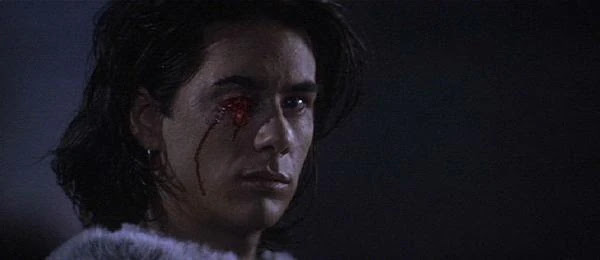
Again, keeping with the Halloween holiday, Donnie and Gretchen go to the movies to see a horror film, The Evil Dead. But that movie is shown in conjunction with The Last Temptation of Christ. It is a foreshadowing since that movie deals with sacrifice to save others. Gretchen falls asleep. It appears Donnie may be nodding off also, and then Frank appears. Dream or reality? Donnie asks Frank, “Why are you wearing that stupid bunny suit?” To which, Franks says, “Why are you wearing that stupid man suit?” What is really below the surface? Is it man or beast? The lighter and darker sides of reality join here as Frank takes off his headpiece and reveals the eye injury that Danny inflicted upon him. Frank apologizes because he knows what’s coming. A portal opens and Cunningham’s house appears. Frank tells Donnie to burn it down.

Even the dance presentations of children for a Star Search competition show contrasting images. One girl awkwardly dances to an angelic soundtrack and then the performance of the young girls called Sparkle Motion (which includes Samantha Darko) is more rock and roll. Cunningham hosts the event, which we find adds a creepy element. The fire reveals a secret room, a “kiddie porn dungeon” in the house. The police arrest Cunningham. The fire, a destructive act, brings to light a horrible crime. The scene reminds us of the opposing movie titles on the marquee and suggests that there must be sacrifice to set things right. It also reflects what Donnie said about how the Greene story shows that “destruction” is a form of “creation.”

Kitty is not willing to see the facts and remains loyal to Cunningham (does his name show he is a cunning fellow, fooling others, another example of false appearances?), thinks there is a conspiracy to frame her beloved idol (the film showing relevance to current events). She will work to defend Cunningham, and, despite Rose’s animosity toward her, she asks the other woman to fly with Sparkle Motion for a competition. This request brings up the airplane aspect of the story.

Rose sees a calendar with an illustration of the scary bunny on it. The days are crossed off, which we know is the countdown to Frank’s “end of the world” prediction. Rose is concerned about Donnie and wants him to be okay. He asks what it’s like to have a “wacko” for a son. She says it feels “wonderful.” Her allegiance reminds us of how Gretchen feels about Donnie’s questioning mind.

In a session with Thurman, the hypnotized Donnie confesses to his crimes and says he must do what Frank says so he can figure out what is happening. He sees Frank (again as he crosses into dreamland) looking upward. Donnie says he must build a time machine. He says, “the sky’s gonna open up.” Here is another reference to the airplane and its missing engine.

There is one day left until Frank’s predicted day of death. Eddie is away on business and Rose is with Sparkle Motion. Donnie and Elizabeth decide to throw a Halloween party with their parents gone. Everyone is wearing a costume except Donnie, whose “man suit” is a costume hiding his nightmarish self. Gretchen arrives distraught because her mother took off. She says, “I guess some people are born with tragedy in their blood.” Obviously, she is a perfect match for Donnie. They make love while Rose does not receive Dr. Thurman’s phone warning about Donnie since the mother is away. There is also a call from Rose saying that she and the girls will be returning on a late flight. Later, Donnie has on a skeleton outfit, which shows the tragedy intertwined with his life.

Donnie sees those fluid tunnels again, which point to what will happen, and he knows that time is running out since it is one hour to Frank’s deadline. He and Gretchen go to Grandma Death’s place. He knows that time travel connects Grandma Death to Frank. Karen Pomeroy wrote on the board before leaving the school the words “cellar door,” which someone said were the best combination of words in English. There is a cellar door at the house. We are going below the surface again to reveal what hides in the shadows. The school bullies are there, with stockings over their faces trying to hide the nastiness underneath. They drag Donnie and Gretchen outside. One puts a knife to Donnie’s throat and Donnie utters, “Deus ex machina.” In Greek theater, the gods were supposed to reside above the stage and when the playwright wanted to resolve conflicts the “god” would be lowered in a box to dispense supernatural abilities. It has come to be a negative term to show resolution by contrived means. Here the film is playing with the idea, since time travel is the story’s “deus ex machina,” and that is why Donnie calls it the “savior,” which also recalls “Christ” mentioned in the film title on the marquee.

A car approaches at a high speed. Grandma Death is in the road, presiding over the events. Gretchen is thrown into the road and the car strikes and kills her. The car stops and turns around. The driver is Frank. He is wearing the scary bunny outfit. He takes his headpiece off. Donnie has his dad’s gun and shoots and kills Frank. Again, the site of the wound is the eye, a frequent symbol in films (Blade Runner, Chinatown, Bonnie and Clyde). Here, it can refer to the terrible visions that Donnie has been seeing. It’s as if the dead Frank came back through time to inform Donnie of the horrors that would occur.


Donnie takes Gretchen’s body with him to his house and kisses his sister goodbye. Donnie envisions dark clouds forming a time tunnel in the sky. He drives to where the film began on a hillside road. We hear Monnitoff’s words about all you need for time travel is a wormhole and a metal craft entering it. Donnie also remembers Gretchen saying that it would be nice to go back in time to make things better. The plane that Rose is on hits the turbulence of the time tunnel, and we see the engine going into the tunnel. Donnie also goes into the tunnel. He comes out laughing in his bed. He is not out of the house as before when the engine hits. He is killed this time.

Donnie wrote a letter to Grandma Death, saying that he hopes the answers to his questions “will come to me in my sleep. I hope that when the world comes to an end, I can breathe a sigh of relief, because there will be so much to look forward to.” He does get his information while asleep, and it is his world that comes to an end. Perhaps he is now at peace, and he may feel that he will survive in some spiritual form, and that those alive will lead good lives.

The camera glides over all the characters in the story, as the song “Mad World plays with the fitting lyric, “The dreams in which I’m dying are the best I ever had.” Those words could fit what happens to Donnie. Gretchen, who in this corrected timeline didn’t meet Donnie, is alive. She rides by on her bike, and exchanges a sad look with Rose, and a wave. It was a worthy sacrifice.

The next film is Lost in Translation.

Wednesday, December 29, 2021

Pickpocket

 SPOILER ALERT! The plot will be discussed.


If you know Dostoyevsky’s Crime and Punishment, you don’t need Roger Ebert to point out the echoes of that story in Robert Bresson’s Pickpocket (1959). However, Ebert’s insights help to clarify this story about a man, Michel (Martin LaSalle), who, like Raskolnikov, sees himself as superior to the rest of society, and thus existing in a plane above the morality of others. However, Ebert notes in his book, The Great Movies, that Michel, “fearing he is worse” than the general population, “seeks punishment” for his crimes. Could it also be that he is an emotional vampire who is empty inside and is attempting to suck out the spirit of others that he robs?

The film begins with a sort of disclaimer which says the filmmaker is not presenting a thriller, but instead is providing a story about a man with a compulsion, and that the situation also brings together two people who may never had otherwise met each other. Bresson, thus, is giving us a character study that is the primary focus, and the events are the vehicle which brings these people together, and to us.

The music that plays as the titles are displayed sounds like a classical dirge that suggests crime can be artistic but also can lead to the undoing of the criminal artist. The beginning has Michel, who is writing in a journal, succinctly summing up what he thinks is his superior nature. We hear his voice as he narrates his tale. He says others think of committing certain acts, but he has actually done them.

At the racetrack, where people are carrying money to bet, he surveys the crowd. His eyes are always moving, observing where he can strike, like a predator. Ebert points out that the pickpocket must get close to the victim, suggesting sexual intimacy. Michel approaches a woman, and his close proximity shows he is penetrating her personal space. The way he strokes the female’s purse (which prostitute’s sometimes call the vagina) appears sensual. When he releases the catch, he gives out a slight sigh and closes his eyes, which is relief he didn’t get caught, but may also imply sexual satisfaction. Even the way he inserts his hand and removes the money is suggestive. As he exits the location he says he was “walking on air,” which stresses his ecstasy at violating the standards meant for the mediocre masses. However, he is arrested, probably because the woman saw him close to her and described him after realizing she was robbed. But, because he was not caught in the act, he is released. He later says he needs to think about what has happened, which implies he is experiencing the exhilaration of getting away with his crime, the fear that he almost was caught, and the guilt of breaking the law. As Ebert points out, Bresson does not allow his actors to show emotion to give away their feelings, and that the audience must surmise what the characters are feeling by the action he, as the director, presents.

As he goes to his mother’s place, Michel admits that he does not visit her often. He does not have a key, which shows his lack of connection to her. The neighbor, Jeanne (Marika Green), lets him in and she is the one who knows more about his mother’s ill health than he does. He will not even go in to see her, and hands Jeanne some money to give to his mother. Ebert suggests that, since we don’t really know, Michel may want to avoid a reminder of his connection to an ordinary woman.

Michel meets with a friend, Jacques (Pierre Leymarie), who appears to know Michel has the talent to be a good pickpocket because he has good ‘hands.” The two join a third man, a policeman, L’inspecteur principal (Pierre Pelegri), who knows about different types of crooks. When pressed about why he thinks some people break the law, Michel is philosophical. He rhetorically asks, “Can we not admit that certain skilled men, gifted with intelligence, talent or even genius, and thus indispensable to society, rather than stagnate, should be free to disobey laws in certain cases?” L’inspecteur principal notes the danger in people deciding that they are “supermen.” Michel says these special individuals will benefit society when they act according to their superiority, which they recognize in themselves. But L’inspecteur principal notes that it would be difficult to find someone who doesn’t consider himself to be “exceptional.” He adds by questioning the concept of a “useful thief,” saying that would create a “world upside down,” a reversal of the social order. Michel counters by saying, “It’s already upside down. This could set it right.” Michel is arguing that if the world is so flawed it needs an outlaw to correct its wayward path. Of course, one could also argue that breaking more laws would only create more chaos. In this exchange we have the closest connection to Raskolnikov in Crime and Punishment. L’inspecteur principal, according to Jacques later, is becoming suspicions of Michel, whose verbal justification of criminal activity could be part of a desire to be found out to get acknowledgement of his talent, but also possibly to get caught as penance for his transgressions.

Michel continues his narration, saying that even though he does not want to return to his seedy apartment, which only has a latch as a lock, he questions if his desire to steal is based on the acquisition of money. While on the metro, he scopes out a victim and feels compelled to pickpocket him, although he does not act yet. He continues to practice his technique and is successful the next time he rides the train. Michel, as Ebert points out, is unremarkable in appearance. Of course, by not calling attention to himself, he is able to perform his illegal actions unnoticed. The idea that this type of criminal act is done by making appearances look innocent is demonstrated when Michel hides a stolen wallet inside a folded newspaper. The fact that the theft is done in an underground vehicle suggests symbolism that implies wrongdoing is propelled by the forces of the underside, that part of one’s psychology that rebels against the standards imposed from without.

One of Michel’s marks stops him on the way out of the metro, confronting Michel with the theft of his wallet. Michel gives it back and quickly leaves, feeling defeated. He then stays in his apartment for a while, probably requiring solitary sanctuary for his failure. His place is full of books that he reads, which also feeds his ego regarding how he values being thought of as an intellectual. As he sits in the small living space, it almost looks like a jail cell, which also implies that Michel is already imprisoned by his compulsion.

Jacques brings Jeanne to Michel to tell him that his mother is very sick. He still is not able to find it within himself to visit her, despite admitting that he loves her. His contradictory attitude is still not explained, and we can only guess at why he feels alienated from his mother. He follows a man who was sizing up his place and finds out that he is a pickpocket who then helps Michel perfect his technique. The classical music is back as the hand maneuvers are put on display, equating the movements with an artistic work, despite the fact they are illegal.

Despite Michel’s intense observational ability, he, ironically, misses seeing a note left by Jeanne urging him to come to see his mother. The implication is that his connection to others is not his primary concern. However, he now visits his dying mother, who passes away after she says he can accomplish anything. Her statement also is ironic, since he can construe her encouragement to justify his pickpocketing enterprise. He cries at her funeral, which is the first time we see any emotion on the part of Michel, thus demonstrating he can have feelings for others.

After bringing his mother’s few belongings to his apartment with Jeanne, he asks her if people are judged. She mistakenly thinks he is talking about his mother, who Jeanne says will be treated kindly in the afterlife. He is most likely thinking about himself. He questions, “Judged how? According to laws? What laws? It’s absurd.” She asks if he believes in “nothing.” His sarcastic response is, “I believed in God, Jeanne, for three minutes.” He is an existential character who has thrown away concepts of absolute rights and wrongs, but he has not replaced any traditional spiritual beliefs with another code. The poet William Blake created his own mythology because, he said, he must build a system to follow or be enslaved by one created by another.


Michel and his accomplice/mentor use their slight-of-hand skills to steal from several people. A second pickpocket then joins the team. Back in his apartment Michel finds Jacques there picking up a book about a famous pickpocket. Jacques is concerned about his friend being interested in a life of crime. He says that thieves “disgust” him because they are “idlers.” But Michel defends the “Prince of Pickpockets” noted in the book, saying the famous crook read constantly. When Jacques stresses that thieves go to prison. Michel asks his friend if he knows what prison is. The implication here is that Michel is already in the prison of his own compulsion to steal, which sprang from his outsider personality.

Jacques brings the book about the pickpocket to a meeting that includes the L’inspecteur principal. The policeman asks Michel if he knows how many of these “supermen” lawbreakers there are. Michel says no, because they are smart enough never to have been caught, which can imply that he is smart enough never to be captured. L’inspecteur principal invites Michel to talk with him about the book. Michel afterwards tells Jacques that he knows the policeman and Jacques suspect him of breaking the law. But, he says he will go see L’inspecteur principal anyway. Here we have his arrogance showing, but also that contrary subconscious desire to have his illegal activities discovered. He meets with the policeman, but it is a brief encounter and Michel believes it was a trap to get him away from his apartment so it could be searched. When he returns he finds that his stash behind the wall molding has not been touched.

He meets with Jacques and Jeanne, only to leave them to steal a watch. The next scene reveals that he has hurt his hand and leg and his clothes are dirty. He must have failed at keeping his theft covert and fallen while running away from the scene of his crime. His pickpocketing is a dangerous activity, but it is the adrenalin rush that makes it attractive. Jacques finds Michel at his apartment in his disheveled state. Michel shows some jealousy, wondering if Jacques and Jeanne have fallen in love. Perhaps he has some genuine feelings for her, but is it enough to save him from his antisocial behavior?

Michel narrates that working with his partners was going along very well. But, he says it can’t last. He is obviously a pessimist about life. There is a wordless sequence which presents a clinic on pickpocketing. The three thieves work seamlessly at a train station removing wallets and substituting purses under the arms of women for the stolen ones. They move the goods between them for safekeeping so none of thieves gets caught with the merchandize. The audience marvels at the skill of these crooks, maybe even cheering for their talents. But these men are victimizing innocent people. In this way, Bresson is like Alfred Hitchcock, who implicates his audience in wrongdoing in his films as he has the viewers get thrills from their voyeurism and vicarious involvement. Bresson, like Hitchcock (think of Psycho, Strangers on a Train, Shadow of a Doubt, Rope), even puts the audience in a position where they wish for the perpetrators to escape capture.

L’inspecteur principal confronts Michel at his place. Michel tells him he knows the policeman suspects him and he shows anger here saying he does not want to be hounded. The inspector says that there was a report that an old woman stated she was robbed but the complaint was withdrawn. Then the woman’s son was at the racetrack right after that and was arrested as a possible pickpocket. He admits he is talking about Michel and confesses that he should have considered Michel as the person who stole from his mother. So, we see that Michel’s compulsion even makes his own mother a victim. Could he have stolen from her as a sort of revenge for coming from an ordinary upbringing? The policeman simply leaves and refuses to tell Michel his future plans concerning the suspected thief.


Michel knows that Jeanne was questioned by the police in connection with his mother’s robbery. Jeanne says that his mother dropped the complaint. Jeanne is the opposite of Michel. She is an innocent and does not suspect Michel until he calls her an “idiot” for not realizing that he lives without any evidence of income, and states that his mother must have come to realize her own son stole from her. She is appalled that he could have done such a horrible thing. Her goodness is a challenge to his amoral behavior. His cynical response is that just knowing a deed is considered wrong doesn’t preclude one from committing it. He is again asserting his option to dismiss conventional morality if he is above it. He says she has accepted her lot in life even though it has inflicted her with a drunken father and an absent mother. He most likely is asserting the right to alter one’s inherited situation if it is detrimental, even if it means breaking the rules to right the wrongs. She provides a sort of spiritual, fatalistic attitude, saying things must occur for a reason. He says to her, “are you that naïve?” This exchange shows how opposite these two are in their approach to life’s tribulations. She admits that she believes that he is a thief, but instead of recoiling from him, she hugs him, as if offering Michel a chance at redemption if he can experience kindness.

He retrieves what he stole and escapes on a train to avoid being arrested. He writes that he went to Italy and then England where he continued being a pickpocket for two years, but he lost all of what he stole on gambling and women. He returned to Paris “penniless.” So, the acquisition of wealth, to “get ahead” as he told Jeanne, was not really his goal. It was the act of stealing that interested him.

He visits Jeanne, whose father has taken all of her belongings. She now has a baby, and Jacques is the father. She says she couldn’t marry him because she didn’t love him, and it would have been a deception. She is above being dishonest. Michel promises to help her, perhaps because her being a good person who has not had an easy life and who showed him compassion brings out the humanity in him. He gets a legitimate job and gives money to Jeanne.

The story returns to the racetrack, where it began, providing a sense of closure. A man there shows Michel that he has a lot of money in his pocket from his winnings. But, Michel sees that the horse the man chose did not win. So, he suspects the man to be a policeman. Out of arrogance, he attempts to pick his pocket anyway, but the cop catches Michel in the act and puts handcuffs on him. Did he subconsciously try to get arrested out of guilt or feelings of inadequacy? In jail, Jeanne visits, and he says, “These walls, these bars – I don’t care. I don’t even see them.” Maybe that’s because he has always felt imprisoned by the way life treated him. What bothers him is that he “let his guard down” and was caught, which undermines his vision of himself as being superior to failure. He says he will confess everything (the prison bars suggest the divider is a confessional) but will then refute what he says just as a way of stubbornly resisting his defeat.

He eventually gets a letter from Jeanne telling him that her baby has been very ill, so she continues to suffer life’s tribulations. She promises, however, that she will see him again. When she visits, they are separated by the barrier, but they touch each other, and he kisses her head gently. The last words are, “Oh, Jeanne, what a strange way I had to take to meet you.” He, ironically, has made a meaningful emotional connection to her at a time when his actions have prevented him from being with the woman he cares about.

The next post deals with recent films.