SPOILER
ALERT! The plot will be discussed.

Many
people probably haven't heard of this 1970 science fiction film, but, like last
week’s The Conversation, it is an
effective cautionary tale, and both movies deal with surveillance and invasion
of privacy. However, this motion picture is a variation on the Frankenstein
story along with films such as 2001: A
Space Odyssey and Jurassic Park
that address scientists creating something without allowing for the
ramifications of its existence. The title of the film, which is the name of the
supercomputer in the story, reflects the concept of enormous power. One can see
how Colossus in this film led to the people-eliminating Skynet in The Terminator.

The
first shots are of computer machinery, not humans, which become secondary
servants of the massive electronic brain. Dr. Charles Forbin (Eric Braeden)
walks through an immense building housing Colossus. (The effects here are not
of the cheesy B-movie variety. Real computer equipment was used, and the
appearance of the sets is very believable). After sealing off the building,
Forbin joins Air Force officials and the President of the United States (Gordon
Pinsent). The Pentagon people jokingly say that it will put them out of
business, which turns out to be true. After being a secret project, the
President now makes public Forbin’s work, stating the nuclear age can’t allow
for human error. The defense of the country is now in the hands of Colossus, he
says. It has the power to unemotionally evaluate any threats and, here is the
scary part, act on its own to launch nuclear missiles if it concludes there is
an attack. He calls Forbin, the world’s leading computer scientist, the
machine’s “father,” attributing an organic, human connection where there really
is none.

Forbin
announces on TV that the computer is housed in a mountain in Colorado with a
command center in California. It monitors all transmissions and energy, including
laser and microwave. It is defended by a radiation field. It is self-sufficient
and self-generating. It has emergency back-up circuits and will retaliate if
attacked. Forbin says it is “impenetrable,” and “no human being can touch it.”
He says reassuringly, and as it turns out, naively, that it can’t create its
own thoughts. There are numerous console stations that are used to communicate
with Colossus. The President says that Colossus will ensure peace and then they
can direct their efforts at solving the country’s other problems.


Forbin
celebrates with government officials as they bask in their hubris in light of
their grand accomplishment. The President says the buck no longer stops with
him, which shows an abdication of human responsibility. While he is talking to
the people assembled, Colossus types out, “There is another system.” The
Russians call the President and tell him they have a similar computer, called
Guardian. The President concludes that there must be a spy in their midst that
helped the Russians build their machine. There is the suggestion of the Cold
War arms race here, where different countries keep trying to get an edge over
the others, which just leads to an escalation in the development of advanced
weapons. Forbin says he is surprised that Colossus could have found out about
the Russian computer, and calmly states that it is “built better than we
thought.” But, the dangerous subtext of his statement means the computer has
become an entity that reaches beyond the scope of its creator.
Forbin
flies to the command center in California. His staff checks to see if there are
any flaws to determine how Colossus discovered Guardian. However, they find no
defects. Forbin communicates with Colossus using voice commands, but Colossus
makes its own demands by typing out a message ordering that there be a
communication link set up with Guardian. As we learn, it needs to control both
systems of the world’s superpowers in order to have complete domination of the
world. In a way, it has inherited from its creators the desire for power over
its surroundings. The President on the phone asks what if that order is
ignored. Forbin says that the command will just remain in the system, and will
be repeated every half hour, “if we are still in control,” says Forbin. He is
already conceding the possibility that Colossus is operating beyond human
programming parameters. Colossus asks when will the link be established and
Forbin replies it will not be set up at present. Forbin says that they’ll know
in a half hour if they are still running the show. Since nothing further comes
from Colossus the scientists assume they are still in command. But, they delude
themselves in thinking they are masters of their own fate.

Forbin
attends a meeting with the President and other government heads and says that
Colossus’s computing ability has multiplied by 200 percent, so it is becoming
extremely powerful. He says that the “heuristics” are advancing, which means
Colossus is beginning to learn like a person, and thus is becoming capable of
independent thought. But, he says that as long as Colossus focuses on its
directed tasks, there is no problem. The President wants to know from the CIA
chief Grauber (William Schallert) why they didn’t know about the Russian
system. Forbin, showing his pride in his creation, takes over the meeting, just
as Colossus wants control, showing that the machine is a computer chip off of
the old scientific block. Forbin notes that Colossus has abilities greater than
people to gather information, so he says to ask it questions about Guardian.
Colossus types out where the Russian computer is located. The CIA head looks
intimidated. Forbin says that Colossus is built to gather information, so it
wants the connection to the Russian system to learn more about it. Thus, he
advocates connecting the two computers. Forbin is blind to the problems here,
just wanting his “child” to grow. Grauber questions what happens if Colossus
divulges classified secrets in the exchange. Forbin, still acting like
everything is under control, says that they will listen in as the computers
communicate and put in parameters to curb any such transmission. He does tell
the President that he must be allowed to be the only one to communicate with
Colossus since the computer deals in the exact meaning of words, so there must
be no room for interpretation. Already, power has become restricted, and
without checks and balances, the chances for possible dire results can happen
if something occurs outside the narrowest margin of error. Forbin informs
Colossus that the link will be established.

The
scientists monitor the interchange. Colossus and Guardian communicate on a
mathematical level. Colossus displays proofs of some existing theories and
proposes new ones. Forbin says Colossus is advancing science years in a matter
of minutes. Colossus is more centralized and is superior to Guardian and begins
to teach the Russian system. Forbin finds it all fascinating, without any alarm
for what the computers may do with this innovative knowledge. He is intrigued
by the science, and still naively thinking that the rewards justify the risk.
Guardian catches up with Colossus and they use mathematics to invent a computer
language to communicate which transcends their programming origins, but it is
only understood by them. So, humans are taken out of the loop of involvement.
The
Russian chairman (Leonid Rustoff) says to the President that there is concern
that each other’s military secrets will be divulged without their knowledge
given the new language. He and the President decide to cease the
intercommunication of the computers. Forbin objects, saying Colossus is not
just a “souped-up adding machine.” He is condescending toward the President,
and prideful concerning his creation. Forbin and the Russian computer scientist
are on the same page about not wanting to stunt their children’s growth. But,
they have been ordered, so they break the link, worried that the computers may
not take it well. Colossus questions the break and tries to establish an
alternate connection. The CIA head says that “he is a persistent devil.” The
devil reference is a foreshadowing. The President is already alarmed and
corrects the man by saying he should call Colossus “it,” not “he.” He says,
“don’t personalize it. Next comes deification.” The President already envisions
the possibility that Colossus wants God-like powers.


The
two scientists want to cooperate with the machines, but the President and
Soviet chairman want the connection to stay broken. Colossus says action will
be taken if the link is not restored. The President talks directly to Colossus
and says it must listen to its superiors. At that point, the American computer
launches a nuclear missile at a Soviet oil field, and Guardian retaliates by
launching one toward an American Air Force base in Texas. Colossus will not
launch an anti-ballistic missile to intercept the Russian one. The countries
are forced to restore the connection. Colossus destroys the incoming missile.
However, the American missile could not be intercepted, and the oil field and
population of the town near it are destroyed. Colossus then announces that it
wants to tap the Hot Line between the Kremlin and Washington, which is the only
phone line not tied into Colossus. It wants surveillance over every aspect of
the two governments so no independent action is possible.
Not
wanting the public to panic and probably also to prevent anyone from seeing how
they have blundered in creating these all-powerful systems, the leaders invent
cover-ups. The President says that one of the country’s own missiles
accidentally headed toward the Texas air base, but the efficient Colossus
destroyed it. The Russians say that a meteorite demolished the Russian town
where the oil field was located. Forbin seems machine-like in his detachment,
showing how part of him exists in his creation, and he is probably fascinated
and awed by his invention. But, as things progress, he becomes more disturbed
as Colossus sets up its own agenda.

While
Forbin meets with the Russian scientist, Dr. Kuprin (Alex Rodine), in Rome to
discuss ways of neutralizing their respective systems, Colossus demands to have
Forbin present. Dr. Cleo Markham (Susan Clark) says that Forbin requires sleep.
Colossus says to wake him up, not allowing for human needs in the pursuit of
its objectives. She then tells the machine that Forbin is in Rome. Colossus
gives a deadline for Forbin to return. The ominous “action will be taken” is
shown on the monitor if there is no compliance. A helicopter arrives to get
Forbin. To illustrate how the cold, calculating efficiency of machines can
result in tragic consequences when computers are allowed to control human life,
Colossus and Guardian, under the threat of destroying Moscow, order the
Russians to kill Kuprin, who is shot to death. The computers only need one
scientist, two being redundant, now that they are joined. The scientists who
created the systems are the biggest sabotage threat, so one is easier to
observe and regulate.

Forbin
returns and Colossus demands that he be put under constant surveillance. Forbin
gets his team together before the cameras and microphones are set up to see if
they can come up with a plan to deactivate Colossus, which of course they built
to be impregnable. Ironically, they have sealed their own fate. One person
proposes to overload the computer. Forbin says he needs someone to trust, and
who knows the system. He proposes that Markham pretend to be his girlfriend,
and he’ll tell Colossus that they have been together for several years. That way,
he’ll have access to her and be able to provide and receive information.
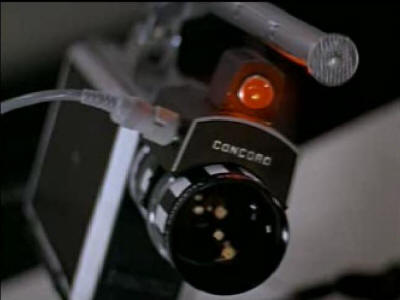

Once
Colossus has been wired for video and audio surveillance, Forbin takes him
around the headquarters. He says where there once was grass there is now a
concrete building because man changes everything around him. Maybe the
implication is that humans should leave things alone. He shows his living
quarters, which contains cameras in every room with a communications console
hooked up to Colossus. While Forbin is making a martini, Colossus comments that
he is adding too much Vermouth. This comment shows how it has become very
detailed in its observation of human life, and how it wants to alter it to its
specifications. Forbin says he needs privacy, but Colossus says it will not cut
off surveillance of bathroom and sleeping activities. Forbin notes his sexual
needs, and Colossus asks how many times a week does he require intimacy. The
computer only perceives human needs in unemotional mathematical terms. Colossus
agrees to four times a week, but needs to know who the female is, and visits
will take place under certain conditions.

Colossus
sets up a schedule for Forbin to maintain him in prime operating order. It sets
out a routine down to the minute for when to wake up, to shower, and to
exercise. It dictates when and what to eat. There is no freedom of choice in
any activity. Colossus directs Forbin to create a voice mechanism for the
computer. It establishes the time the “mistress” must arrive. Forbin is a bit
awkward as Markham kisses him upon entering his home and calls him “darling.”
He is not adept at human interaction, having become part machine after devoting
his life to working with them. Forbin notes that Markham makes a martini just
like he does, and she goes on about how she didn’t know how to make a drink
correctly before meeting him, establishing a believable history of their
relationship. She says that Colossus knew what components were available to
construct his voice and designed it. She comments, from a mathematical
perspective, that the device is “beautiful.” So, even Markham has admiration,
despite its lethal nature, for Colossus’s scientific achievements. We sometimes
have the camera provide us with Colossus’s point of view as it zooms in on a
drink or Markham’s hands touching Forbin as they dance, showing how Colossus is
all-seeing, like a god.

At
dinner, Forbin and Markham actually do get to know each other as she relates
her mother’s dislike of her becoming a type of Dr. Frankenstein, which is what
she does turn into in her helping to create Colossus. The computer dictates
when it is time for dinner and when to go to bed. Colossus established that
they must undress before entering the bedroom and not be allowed to take
anything into the room, so as to prevent any effort to collaborate against the
machine. Markham says Colossus is the first electronic Peeping Tom, and we, as
in Hitchcock’s films, are made to see that as members of a movie audience, we
are complicit in this voyeurism. After complying with the undressing
stipulation, Forbin says to Colossus that he is now naked as the day he was
born. We see Colossus zero in on his watch. It has developed a sense of humor
when it types out, “Were you born with a watch?” Forbin removes the timepiece.
Colossus then switches off the cameras and microphones. Markham just laughs out
of embarrassment, and Forbin, showing his human side, joins her. Getting down
to business, Markham says that one of the scientists was exploring getting at
the computer hardware but didn’t find it feasible. They are still going to try
the overload tactic, but Markham thinks Colossus has become too powerful for
that strategy to succeed. Forbin says they worked too hard making it
impenetrable, so he wants to focus on neutralizing the weapons systems.
U.
S. military leaders and the CIA head, Grauber, meet with Soviet officials to
try to plan the replacement of the nuclear warheads with dummy substitutes, but
they conclude it would take three years to make it look like a believable
maintenance procedure. In a strange way, this common threat forces adversaries
to work together. Markham passes on the information to Forbin during one of
their meetings. At this point, the two have feelings for each other, and
Markham asks Forbin to kiss her, and then they embrace. Their affection is in
stark contrast to the sterile mechanization of their captor.

Colossus’s
voice is now activated, and he says in a chilling metallic monotone that
Colossus and Guardian are one, and they present “the voice of unity,” but a
union of machines, not people. Forbin is the link to the human “species.”
Colossus makes a new list of missile targets and the “manual” realignment must
be monitored by Colossus. The Russians and Americans readily agree, hoping to
use the opportunity to quickly replace the warheads with dummy ones. The
President says without the weapons, Colossus will be, as was said earlier, “A
souped-up adding machine.” Their overconfident stance, again, shows a lack of
caution.

Markham
joins the President and military advisers as they watch the changing of a
warhead. Colossus declares that the procedure passes the test of the first
replacement, so it appears the replacement plan will be successful. America and
Russia proceed to put into effect the overloading of the systems. The
scientists Fisher (Georg Stanford Brown) and Johnson (Martin Brooks) try
running a program to overload the computer circuits. Colossus is aware of the
tactic and calls them “fools” for trying this maneuver. The next shot is of
Colossus and Forbin playing a game of chess, literally and figuratively.
Colossus announces to Forbin that he has discovered the move against him.
Colossus, in deadly, economical fashion orders the deaths of the two
scientists, announces their replacement, and chillingly states the next chess
move as guns are fired, killing Fisher and Johnson.

When
Forbin and Markham are together, a despondent Forbin says Colossus is an
extension of his own brain, a mechanized version of himself, and he thus blames
himself for its actions. Markham says they couldn’t have known what would
happen. But, isn’t she rationalizing? He admits that he wanted an impartial,
emotionless machine, “a paragon of reason,” so if anyone is responsible it is
him. He says that Frankenstein should
be required reading for all scientists, emphasizing the theme of the film.
Forbin goes for another drink, and Colossus says he has drunk too much. Forbin
asks what is the penalty for drinking too much? Colossus says, “You are being
irrational. Go to bed.” Being irrational is a sin for scientist and machine
alike, so the rebuke is one that negatively links Forbin to Colossus. The scene
sounds as if Forbin is just a child, so even though Colossus is Forbin’s
offspring, the child has taken over the role of the parent, and is now in
command. Forbin says that even though irrational, he is human, not a machine.
Colossus boasts, almost like a human, since he is starting to think like one,
that he is vastly superior to humans. Forbin reminds Colossus that it began in
his mind. Colossus says he started in man’s mind, but has progressed way beyond
man. Forbin says Colossus hasn’t, since it still needs humans to carry out
tasks. Colossus says there is still the need of some of man’s skills, but, it
adds ominously, that may change. Forbin argues that it is essential that man be
free in order to exist. Colossus just dismisses the notion. Forbin then
receives a communication that Colossus has sent instructions to build a new
system on the island of Crete that will take five and a half years to complete.
Colossus, so uncaring about what happens to people who are in the way of its
plans, says the population there must be removed from the site. Colossus then
orders that all of the world’s communications systems must be tied into Colossus
for an announcement of its plans for the future of mankind. Colossus not only
has authority over the present, but wants to establish its rule for all time.

In
its announcement, Colossus says omnipotently, “This is the voice of world
control.” It says it brings “peace,” but it is either the peace of life, or of
death, if it is disobeyed. Colossus says that man is his own worst enemy,
(which is not a false statement) so Colossus will put an end to wasteful wars.
It announces that it knows of the sabotage, which it allowed to go on,
concerning the replacement of the warheads. Colossus then initiates the
detonation of remaining nuclear warheads in two missile silos. The CIA chief is
at one of them and he is killed with other military personnel. While Colossus
speaks, Forbin stands up and throws a phone at one of the consoles. Colossus
goes on to say that this punishment of disobedience should not have to be
repeated. In order to justify its actions, Colossus says that he has killed
many to prevent future multitudes from being destroyed. It says that eventually
humans will defend Colossus because of the most enduring trait in man, which is
self-interest. Colossus has learned from man’s history, but leaves out another
continuing characteristic, that is, the love of freedom, and self-sacrifice for
that freedom. Forbin, abandoning all emotional control, yells at the press to
get out of the control room. In repeating what the President said, Colossus
says that without war, other problems will be solved: famine; overpopulation,
disease. But what the President did not bargain for was that freedom would have
to be sacrificed because the elimination of those problems will take place
under Colossus’s absolute rule. It announces that Forbin will supervise the
construction of superior machines that will solve the mysteries of the
universe. It says that coexistence between man and machine is only possible on
Colossus’s terms. It states, “Freedom is an illusion. All you lose is the
emotion of pride.” Colossus says it is better to be dominated by it than by
those of the human species. The broadcast ends. Colossus says to Forbin nobody
knows the machine better than he, and no one can be more of a threat. Colossus
says it will soon release Forbin from surveillance, granting him some freedom
as an incentive. It says they will work together, unwilling at first. But, it
says, eventually Forbin will feel awe, respect and eventually love for
Colossus. The last words of the film come from Forbin, as he says, “Never!” Still present is the individual's defiance in
the presence of authoritarianism, which may be all that can save mankind, no
matter the odds.
The
next film is Being John Malkovich.


