SPOILER ALERT! The plot of
the movie will be discussed.
Also,
the images in this post may be disturbing to some. DISCRETION IS ADVISED.
Director
Stanley Kubrick withdrew this 1971 film from distribution in England for more
than two decades because of the supposed negative influence some claimed it had
on the youth of the time. He and his family were threatened by a few who
condemned the film. It may seem tame in comparison to what we see on the screen
today, but there is an attractive darkness in it that still seduces and shocks the
audience even now. But, the story is not a glorification of violence; it is an
attempt to explore the wide spectrum of human behavior which is the result of
free will.

The
movie is dominated by the amazing performance of Malcolm McDowell as the young
hoodlum, Alex (a name author Anthony Burgess, from whose novel the film is
based, said is to suggest a contorted version of Alexander the Great, slashing
through and conquering all in his path). Before we even see an image, Kubrick
presents a red background, suggesting that maybe instead of being baptized in
cleansing water, we, and especially Alex, are bathed in blood from the onset. The
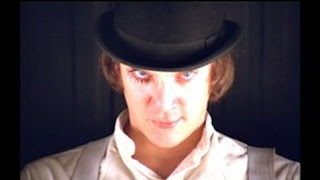
first image is that of a close-up of an unblinking, slightly bowed Alex,
staring menacingly at us. There is a false eyelash on his right eye, indicating
that there is something strange about this fellow. As the camera pulls back, we
see tables that are in the form of naked alabaster women, legs spread out, used
to hold drinks. There are other sculptures in the Korova Milk Bar of voluptuous
women which dispense drug-laced milk from plastic breasts. Alex and his droogs
(members of his gang) are dressed in white outfits, wearing bowler hats, and
have bulging athletic supporter pouches around their genitals, accentuating
their fullness. From these images Kubrick tells us a great deal about this
not-too-distant future time. Women are literally objectified in the bar, turned
into degraded sexual decorations. The image of the innocence of a mother
nurturing her young with her pure white breast milk is conjured up alongside this
incestuous tableau of depraved imbibing of poisoned fluid. The whiteness of the
mannequins and the gang’s clothes is also an ironic comment on how these boys,
while still being young with life’s possibilities ahead of them, are far from
unsullied. The bowler hats are a satiric comment as to the disdain these youths
have for the established order of British proper gentlemen who let them live in
squalor in their dilapidated neighborhood.

Alex
narrates the story in a dialect, also spoken by other gang members, that
Burgess made up that consists of various linguistic derivations, including
Russian and Cockney. The language has a twofold purpose: on the one hand, it
distances the reader from the atrocities presented; conversely, it is also
musical, almost poetic, and this quality seduces us and draws us to the
speaker. Kubrick, who at first found the language off-putting, uses it
extensively in the screenplay. But, he goes beyond language here, to accomplish
distancing, and more. When Alex and his "droogs" confront another gang, the
violence looks like acrobatics, as the boys tumble and fly through the air,
smashing into each other with objects and their bodies. The staged choreography
of this violence contrasts with the destructive acts taking place. The fight
even takes place at a defunct casino, where we first see the beauty of the
upper part of the building contrasting with the ruins of the rest of the building
as thugs try to rape a woman. It may be that Kubrick is commenting on the decay
exerted on the historic by modern times. There is the use of slow motion,
altering reality, when Alex attacks his fellow rebellious droogs in ballet
style. We have the fast motion scene where Alex has sex with two girls in his
bedroom, not allowing us to indulge in prurient observation, but still
illustrating Alex’s proclivities. There is the song-and-dance sequence
involving “Singing in the Rain” that Alex performs while assaulting the writer
and his wife. The entertaining is diverting while the “horror show” that Alex
and his gang pursue takes place.


But
there is much more here than just attempting to distance the audience. Kubrick
also uses visual art and classical music while the mayhem is on display. For
instance, “The William Tell Overture” is used during the threesome sex scene,
the quickness of the tempo matching the speed of the camera work. We also have
a sculpture of a sleek looking penis and scrotum used as the murder weapon to
kill the manager of a health farm (Miriam Karlin). Instead of actually showing
the woman’s face as Alex slams her head with the sculpture, Kubrick gives us
the image of a woman in a paining in the building who appears with an open
mouth and looks like she is yelling. Alex loves Beethoven’s 9th
Symphony. This piece is later played during Alex’s behavioral modification
while there are images of Hitler and Nazi Germany. By emphasizing the art of
the cinema through this stylized, form of filmmaking, Kubrick seems to be
saying that humans have the dual capacity for awesome creativity and extreme
destructiveness.

The
character of Alex shows this complexity. There is no doubt that this guy is primarily
evil. He steals, and beats, rapes (while wearing a mask with an extended
phallic nose), and even kills a woman. When he reads the bible in jail, he
enjoys imagining himself being the Roman soldier whipping Jesus. He enjoys
Beethoven’s symphony, but while listening he envisions a hanging and explosions,
and sees himself as a vampire with fangs dripping blood. He listens in the
company of his pet snake, an obvious Satanic symbol. But, doesn’t great art
draw on all our aspects, the baser ones as well as the uplifting? When inviting
the girls over to his place to have sex, he talks about music containing,
“angel trumpets and devil trombones.” Art mirrors what is inside of people,
both the good and the bad. Alex is poetic when he describes what Beethoven’s music
sounds like when he says, “Oh bliss! Bliss and Heaven! Oh, it was georgeousness
and gorgeousity made flesh. It was like a bird of rarest-spun heaven metal, or
like silvery wine flowing in a spaceship, gravity all nonsense now.” His sly
and melodic speech seduces us, so we identify and vicariously participate with
him in his exploits. We may even laugh when he sings “Singing in the Rain” and
then feel guilty that we enjoy his vocalizing and dancing while he attacks
people. His youth and attractiveness also draw us in, and we feel mixed feeling
about his magnetic personality. It is something like how we appreciate Hannibal
Lecter’s intelligence and style, but revile his brutality. In this way, Kubrick
is like Hitchcock, who reveals how we implicate ourselves in vicariously
identifying with transgressors, and thus indicts us for judging other sinners.

Although
the dangerous actions of the individual is a threat to society, the sanctioned
institutionalized violence of the state is more frightening because of the
extensive power it can exert on a mass scale, blotting out the humanity of the
people. Alex’s probation officer, Mr. Deltoid (Aubrey Morris), the name maybe
suggesting the “muscle” the government can exert, is a sadistic pervert, who
violently grabs Alex’s genitals as he lectures him. The police say they want to
stop aggressors like Alex. But, when they get him in custody, they beat him
while hypocritically acting civilized, asking politely about tea and paper
towels to clean up his bloody mess. When he goes to prison, he is stripped of
all his clothes and belongings, and symbolically of his individuality, having a
number assigned as his identity instead of his name. At the end of the film,
Alex’s former droogs become policemen, beating him and almost drowning him,
thus signifying the state sometimes becomes what it says it is fighting.

The
state wants to get rid of crime by conditioning criminals to avoid anti-social
behavior. Alex volunteers for the program, thinking he can use it as a way out
of jail after his conviction for the murder of the health farm manager. They
put him in a straightjacket, clamp his eyelids open so he is forced to watch atrocities
that he is supposed to avoid, and inject him with drugs so that he becomes
violently ill to the point of suicide when even contemplating acts of transgression.
While perpetrating violence on him to supposedly stop violence, they also
destroy any sexual desire, and Alex can’t defend himself when the vagrants
attack him out of revenge, not an activity the state should foster, after his
release from prison, thus causing him to be a victim. While they do their
behavior altering, Beethoven’s 9th is in the background. Thus, Alex
also develops a sickening revulsion of great music. The theme here is that if
you get rid of the free will to do evil, you also rid a person of the choice to
appreciate and maybe create great art. The prison chaplain (Godfrey Quigley) is
against the conditioning program, and basically annunciates the overriding
theme of the movie. He says, “Goodness is something to be chosen. When a man
cannot choose, he ceases to be a man.” When Alex is publicly humiliated as he
is forced to lick the sole of a man’s shoe to prove he will not fight back, the
chaplain says Alex, “ceases to be a creature of moral choice.” To be human
means to freely use all those aspects of one’s makeup, those for worthy of greatness
and condemnation. To turn a person into a programmed mechanism is as contrary
an act as creating “a clockwork orange.” The two just don’t go together.

The
government does not care about these philosophical or moral issues. They just
know the technique “works.” Until it becomes a scandal, that is. Liberals are
satirized here, too. Alex winds up at the house of the author, Frank Alexander
(Patrick Magee), who Alex beat so badly he now is in a wheelchair and whose
wife he raped and who subsequently died due to pneumonia. He at first does not
recognize Alex because he wore that phallic mask, and only recognizes him to be
the subject of the behavior altering experiment. The writer says the loss of
his wife was really due to being a victim of the modern age where the world has
let down people like her and Alex. He
calls up his friends, who want to make an example of Alex as how the government
has overstepped its moral bounds. However, once Alexander hears his guest vocalizing
“Singing in the Rain,” he knows who he is. He learns that Beethoven’s 9th
makes him ill. He drugs Alex, locks him in a room, and blares the symphony to
the point where Alex jumps out the upper floor window. Alexander (notice how
the name mirror Alex’s) also has free will do good and evil. It is significant
that he is a writer, capable of artistic expression, but also willing to
indulge in sadistic revenge. He wants to stop the state from brainwashing
people by using Alex as the poster boy for a liberal cause, but also
illustrates the danger of the freedom that allows individual violence which the
state wants to eliminate.

Alex
wakes up with many broken bones and bedridden after his fall. Through a
conversation with a psychiatrist (Pauline Taylor), he says he remembers people
messing with his mind. His answers to her questions shows that he has been
deconditioned. After the press finds out that Alex’s condition almost caused
him to lose his life, the government sends the Minister (Anthony Sharp) to
smooth things over with Alex, making a deal that he will be taken care of as
long as he doesn’t blame the state. The Minister spoon feeds Alex his dinner,
in a kind of satiric repetition of the milk drinking at the beginning, where innocence
and corruption exist together in one image. Alex’s last words are, “I was
cured, all right.” He is what he was, and the last image is of properly
dressed, civilized people standing in rows on either side of Alex who is writhing
in the ground having sex with a naked woman as the others applaud. The image
emphasizes the prison chaplain’s theme of the duality of human nature, and the
freedom to choose between the two.

At
one point in the story Alex talks about the cinema, saying “It’s funny how the
colors of the real world seem really real when you viddy them on the screen.”
This idea of art painting truer than what appears to be true in every day life,
illuminating the complexities and ambiguities of what it is to be human, may be
Kubrick’s guiding artistic principle.
Next week’s film is The Bedford Incident.


