SPOILER
ALERT! The plot will be discussed.
There’s
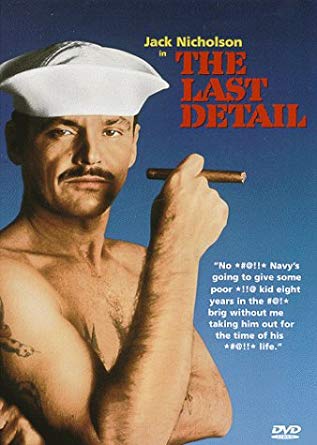
a great deal of talent associated with this 1973 comedy-drama. The director is
Hal Ashby, the man who directed Coming
Home and Bound for Glory. The
screenwriter is Robert Towne, who on an Oscar for Chinatown. And of course, there is Jack Nicholson, receiving an
Oscar nomination for Best Actor for his role here. The script uses a great deal
of profanity, but by doing so it lends an authenticity to a story about sailors
who bond in this different kind of buddy road movie. One of the soldiers is
going on his “last detail,” and the other two, given the nature of the
assignment, wish it was their last.

Before
there is a visual, the sound of marching music is heard, with drums prominent,
stressing how soldiers are supposed to fall into formation with the orders
issued by their superiors. The tale begins on a Navy base in Norfolk. There is
a sign which reads “Transient Personnel” office. The men here are between
assignments, waiting for the next ship to take them out to sea. The impression
as the movie unfolds is that sailors represent social outsiders who prefer
being on ships than on land, and do not fit in well with civilians whose lives
anchor them to their dull lives. The MAA (Master of Arms) summons Petty Officer
Buddusky (Nicholson) and Petty Officer Mulhall (nicknamed “Mule”) (Otis Young).
Neither of these men want to be bothered, acting insubordinate or profane,
wishing to bide their time until they can resume their real jobs at sea. As
Mule says, he doesn’t want to go on any “shit detail.” Mule’s name suggests he
is stubborn about how he is used to living his life in the Navy sailing on the
oceans. He is sarcastic to the messenger the MAA sent, telling him to say to
the MAA that if Mule is in transit, by definition, he can’t be found.

The
MAA Chief (Clifton James) calls them lucky “sons-of-bitches” because they
pulled temporary duty as “chasers,” and have to go to Portsmouth Navy Prison.
Their assignment is to transport a sailor named Meadows (Randy Quaid, nominated
for Best Supporting Actor), who was sentenced to eight years and a dishonorable
discharge. Buddusky emphasizes how extreme the punishment is by jokingly asking
if Meadows killed “the Old Man,” the commanding officer. The Chief says that
Meadows only stole forty dollars. Typical of the earthy humor in the film, Mule
asks the Chief if he is “shitting” him, which prompts the Chief to say he
wouldn’t do that since Mule is his “favorite turd.” The reason Meadows pulled
such a stiff sentence is because he tried to steal the cash from the polio
disease contribution box. That charity happens to be the Commander’s wife’s
favorite charity, and she is responsible for the base contributions. Buddusky
and Mule look sideways at each other, understanding the cruel use of power
surrounding Meadows’s fate. They must travel north to Washington, D. C., New
York City and Boston before dropping their prisoner off at the prison.
Buddusky, wanting to make the most out of this “shit detail,” tells Mule it
will only take two days to get Meadows to Portsmouth, but they’ve been given a
week, so they should deliver him quickly and pocket the rest of the per diem
allowance so they can have some fun with the money. This best laid plan does go
astray.

Buddusky
is placed in charge. They acquire the handcuffs, keys and sidearms for the
trip. Meadows is obviously intimidated and seems very meek, staring down most
of the time. The Chief tells Meadows that Buddusky and Mule are mean bastards
so he shouldn't give them any grief. Buddusky gives Mule a look that implies
that the Chief is unnecessarily piling on the misery given Meadows’s plight.
Before they leave on a bus Buddusky asks Meadows if he has to use the restroom,
and that one of them has to go with him. Buddusky just means they must guard
him at all times, but Meadows reassures him he won’t kill himself. Buddusky
laughs uncomfortably at Mule, and seems surprised Meadows would say such a
thing. But it communicates how awful Meadows feels given the cruelty of his
sentence, which eventually brings sympathy from the other two, who basically
only saw the detail as a way for them to have some leave time. Buddusky already
shows some compassion by taking off the cuffs, telling Meadows that the Navy
says that on certain vehicles a prisoner needs the use of his hands to protect
himself.


Director
Ashby uses ambient sound in places like the snack bar and train stations to
give a realistic feel. Since these guys don’t know each other, they begin to
become acquainted as they embark on their road trip. On the train, Buddusky
asks Mule where he’s from, which turns out to be just outside of New Orleans.
After Mulhall tells Buddusky to call him “Mule,” Buddusky says there were
troubles with his name, too, and people would call him, “Bad Ass,” which is the
kind of nickname a macho sailor would embrace. Meadows chimes in by telling
them that he didn’t even get possession of the forty dollars because he was
caught while trying to lift the cash. They laugh rather immaturely at the
pathetic situation Meadows found himself in. Buddusky says those in power
really “stuck it” to him, and he says they put it in and “broke it off.” His
graphic comment prompts Mule, who also shows sympathy here, to tell Buddusky to
go easy on Meadows.
Buddusky
asks Meadows if he has a record. He says not in the Navy, but a couple of times
with civilian cops. Buddusky’s formal questioning is funny as he asks if it
“was in the nature of a felony or a misdemeanor.” Meadows says it “was in the
nature of shoplifting.” But he never was in jail. Buddusky is trying to find
out if Meadows is a lifetime crook, hoping that he will discover that Meadows
deserves to be imprisoned. Instead, the fact that Meadows is unjustly being incarcerated
for petty infractions for an extended period is only reinforced. Buddusky tries
to lessen the blow by saying that they’ll knock a couple of years off for good
behavior. Buddusky says that’s something, but the look on Mule’s face shows
that two years is little consolation.

Meadows
is asleep and the other two notice he shoplifted some stuff that Meadows stored
in his coat sleeve. When they wake him he panics and runs, but they get him
back in his seat. Meadows starts crying and says he steals stuff that he
doesn’t need, like hair tonic, and model cars. It appears to be a compulsion,
but we find out later the possible reason for his thefts may be related to his
childhood. Buddusky and Mule seem upset by this realization that Meadows has
psychiatric problems. Mule is concerned about how to deal with him, so Buddusky
suggests getting off the train at Washington, D. C., and letting Meadows cool
off.
Here
they are in the seat of the national government dragging the handcuffed Meadows
around as rousing marching music plays, the soundtrack contrasting with the
lack of patriotic arousal inherent in their predicament. The rigid Mule, not
comfortable with any deviation in the plan, is worried they will miss the
train. But Buddusky says they have plenty of time to get to their destination.
Buddusky wants to know if he can trust Meadows not to run away or steal
anything. They hope to get a bite to eat without making a scene. Meadows wanted
cheese melted on his burger, but when the food arrives and it is not as he
ordered, he does not complain, saying it’s okay. Buddusky wants to provide
Meadows with some simple comforts before getting locked up. Acting a bit like
Nicholson’s character in Five Easy Pieces,
Buddusky demands that he send the burger back. When it is returned to Meadows
with the cheese properly melted, he is happy for the first time on the journey.

Encouraged
that he is lightning Meadows’s spirits, Buddusky now wants to get Meadows a
beer. Meadows says he’s not old enough, to which Buddusky says “everybody’s old
enough for a beer,” like it’s sort of an American inalienable right. Buddusky
says Meadows is going away for eight years and receiving a dishonorable
discharge, so the least they can do is get him a beer. Buddusky continues to
try to ease his conscience for having to take Meadows to jail for an unjust
stretch of time. They go to a bar and the bartender (Don McGovern) says the law
says he has to serve Mule (making a racial reference because Mule is black),
but says he needs to see ID for Meadows. Meadows wants to get out, but Mule,
enraged at the racism directed at him, tells the bartender to shove it.
Buddusky says he better not be reaching for a club under the counter. The
bartender says he’ll call the shore patrol. Buddusky then explodes, calling the
man a “redneck,” saying he is the shore patrol, followed by him whipping out
his gun. Mule persuades Buddusky to leave. When they get outside, the three of
them whoop it up, thrilled by the macho confrontation. Buddusky boasts that he
scared that “cracker” and the other two agree loudly that Buddusky lives up to
his nickname “Bad Ass.” Buddusky is excited now playing the role of the tough
party guy who is going to show Meadows a good time before he goes to
Portsmouth. He vows that Meadows isn’t leaving town until he gets some beer.


They
buy some six-packs and get roaring drunk, with Mule’s enjoying the fun
outweighing his strictness for procedure, only momentarily upset that they
missed the next train. Buddusky says they’ll just get a hotel room for the
night and take the train in the morning. Buddusky and Mule say what they are
doing beats being in “Shit City,” and Meadows says it even beats being in
Portsmouth, where he is going to prison. Buddusky is trying not to think about
the end of the trip, and is upset about the reminder. So he says Meadows has “a
hell of a knack for killing a conversation.” Buddusky starts showing Meadows
how to be a signalman, as if he is going to have a career instead of going to
jail. Meadows is quite good at it, which impresses Buddusky. He says Meadows,
like him, has a “flair” for going through the motions. This connection adds to
a feeling of kinship despite their opposing roles of guard and prisoner.
Meadows
asks why did Buddusky get so angry at the bartender, since he was just doing
his job. Buddhusky asks the mild-mannered Meadows if he ever just gets mad just
to get it out of his system. Meadows says he gets angry at injustice (yet he
doesn’t seem angry about what is happening to him), but that is too abstract for
Buddusky. He wants the anger directed toward unfairness to be personal. He asks
if Meadows ever gets angry at the “Old Man” for sending him to prison. Meadows
starts to say, again, the Commander was just doing his job. Buddusky is
incensed about the wrong perpetrated against Meadows, and is upset at Meadows
for not being enraged. Meadows says there was something that made him angry
once. It wasn’t that the Marine guards beat him up, which shows how he has been
excessively brutalized, but that one of them asked him if he believed in Jesus
Christ. The guard said he was Jesus in the brig. Meadows felt that he was awful
to say that. (Meadows is a sort of Christ-figure, since he leans toward turning
the other cheek, and is being sacrificed while others do cruel acts, as they
project their sinful ways onto him, using him as a scapegoat). But Meadows only
response, as opposed to Buddusky’s wanting to have punched out the Marine, was
to hope the Navy chaplain wouldn’t hear what the Marine said. The cynical Mule says
that chaplains just want to cozy up to commanders, but Meadows is a sort of a
defender of the faith, saying that it isn’t easy being a chaplain. Buddusky is
so frustrated with Meadows he tells him to hit him, which Meadows can’t do
because he likes Buddusky, even though he is taking him to prison. Buddusky is
seeking penance for what he is having to do, reminding Meadows of the fact that
he is taking him to jail. Meadows, in a Christ-like way, says Buddusky is only
doing his job. Buddusky is livid because he isn’t being punished for his guilt,
which he feels he deserves, but instead is being forgiven in a Christian
manner.
Buddusky
wants to take Meadows to see his mother. Mule is again resistant at first, but
when the unselfish Meadows says he doesn’t want to get them into trouble since
they have been so nice to him, Mule caves, feeling guilty about not responding
generously when he is treated with kindness. The Golden Rule seems to be in
play here. They go to Camden, NJ. Sadness accumulates as Buddusky hears Meadows
talk about his father having left them and starting a new family far away in
Seattle. Meadows thinks he has a sibling there, but is not sure. This
uncertainty adds to the poignancy. He points out where he graduated from high
school, and says a teacher wanted him to be a veterinarian. That remark makes
Buddusky’s face reflect even more sorrow for Meadows’ pathetic life that never
reached its childhood’s goals. It’s freezing as they go to Meadows’s mother’s
house, but nobody answers the door, adding to the futility of the situation.
Buddusky asks if Meadows wants to wait around despite the cold, or ask a
neighbor, which is what Meadows says he will do. He goes off, and Mule, his
duty kicking in, is worried that they shouldn’t give him a chance to run off.
They find him talking to the neighbor, as he said he would. Buddusky says that
Meadows really wants to go to jail because given his psychological problems,
“on the outside, too many things can happen to him, all of it bad.” Buddusky is
now rationalizing his having to deliver the young man to Portsmouth, as if it’s
the best thing for him.
Meadows
finds out his mother is out for the day. Buddusky says they might want to wait
in the house in case she comes home early. When he pushes open the unlocked
door, the place looks like a garbage dump. During the silent pause that
follows, Buddusky looks like he can see that Meadows had a miserable childhood,
which may have warped him, and made him want to steal stuff, since he had so
little for himself while growing up. Meadows says, “I don’t know what I
would’ve said to her anyway.” It is a way of covering up the disappointment of
not seeing her, but his words also point to him having no connection to his own
mother.
Back
on the train, Buddusky, still trying to relieve his guilt, says that Meadows's
mom should write her congressman to try and get him off. Mule is coldly
practical here, saying that won’t accomplish anything. They would either have
to let Meadows go, or drop him off, and they aren’t going to set him free.
Meadows starts crying and goes to the restroom. Buddusky blames Mule for
upsetting Meadows, but Mule believes he is just being realistic, and says how
much he hates this “detail,” since he knows how lousy it makes him feel to be
part of this unfair activity. Mule finds himself in jeopardy if they don’t
distance themselves emotionally from Meadows, because he can’t do anything
about the young sailor’s plight, and it will only make Mule feel worse if he lets
his feelings interfere with his duty. Mule says that the Navy is the best thing
that happened to him and he doesn’t want to mess it up by straying off the
mission with Buddusky. Mule accuses Buddusky of trying to impress Meadows with
his rebellious actions, but Buddusky, implying that it isn’t about trying to
make himself important, says he’s only trying to show Meadows a good time. Mule
counters by saying that Meadows can’t have “a good time” because he doesn’t
know how, and it won’t help him get through his eight years in prison. Even
though Buddusky argues correctly that Meadows enjoyed himself in Washington,
Mule doesn’t want his fatalistic, detached attitude disrupted. That way, he
won’t feel responsible for the cruel deeds done by the arm of the service he
said was “the best thing that ever happened” to him.
They
have two hours at the station in New York before taking the next train, and
Mule doesn’t want to leave the building to avoid getting into more mischief.
Buddusky puts his shore patrol gear in a locker, as if abdicating his
association with the detail. Mule, reluctantly, follows his action. As if in
defiance of Mule’s directions, Buddusky shows how he can be rowdy without
leaving the train station by getting into a brawl with Marines in the men’s
room. Mule and Meadows help him with the fight, with Buddusky, acting like a
big brother, being proud that Meadows joined in. Afterwards, Buddusky even gets
Mule to admit it was fun roughing it up, as the men engaged in exhilarating, if
juvenile, macho rowdiness.

To
continue his quest to divert Meadows from his fate, Buddusky takes them to a
place he says has the best sausage sandwiches. Then they go to a bar where
Buddusky hustles an opponent in a game of darts. He then splits the money with
the other two, telling Meadows they’re partners which, psychologically, raises
Meadows to a place of equality with his traveling companions. He has treated
Meadows so that feels like he finally belongs with others, which obviously is
something Meadows was deprived of in his life. Both Buddusky and Meadows
perform their signalman movements on the street. When Buddusky says that
Meadows should put in for the job, the three of them then become quiet, reality
silencing them, since they know Meadows will not have that opportunity.
They
hear chanting and Meadows wants to check it out. There is a type of religious
gathering that Buddusky humorously tells Meadows he’ll explain later, while
having no clue about what is going on. Meadows takes a piece of paper which
notes the words to chant, and Buddusky, exercising his sailor’s right to be
profane, says Meadows can pray for all of them to get laid. The sweet Meadows
questions if that is something they should be chanting for. They go to an
X-rated store and Buddusky, continuing his carnal musings, makes a crude
reference pertaining to oral sex. Again, in contrast, the innocent Meadows says
he never experienced that activity. Meadows, again contrasting with the
lascivious Buddusky, is so unworldly that he believes a fictitious sexual story
about the talents of a one-eyed prostitute who “winks” guys to pleasure. More
fitting with Meadows childlike mentality, Buddusky and Mule take their prisoner
to a skating rink where Meadows has fun on the ice. Buddusky, feeling fulfilled
in his quest, gives Mule an “I told you so,” as Meadows shows that he can have
a good time. Buddusky tells Meadows he can have a bracelet inscribed, and
Meadows wants it to read he is a signalman, which shows that is the closest he
will get to his dream.


They
go to a cafe and have some coffee while Meadows is chanting. A woman, Donna
(Luana Anders), hears him and walks over. She knows about the religion, and
says Meadows can chant for anything. When he doesn’t say what he is chanting
for, she says it can be for a girl. Donna invites him over to her table and
then all of them to her apartment for a party, where a culture clash occurs.
The hippie types there and the sailors can’t relate to each other, entrenched
in their lifestyles. There is a young male who pushes Mule to complain about
President Nixon. One of the women wants to know why there aren’t more black
sailors. Mule, satirically, says you have to get a recommendation from a white
guy. Buddusky keeps hitting on one of the women by talking about the sailor’s
life, which couldn’t be any more irrelevant to her world. When another woman
asks how he felt going to Vietnam, Mule says if “the man” says you have to go,
you go. He is a soldier and sees no way around following orders, which is
incomprehensible to the anti-establishment young people of the time protesting
the Vietnam War and racial injustice.

Meadows
reveals to Donna that he is being taken to prison. She says why not go to
Canada, and he again unselfishly says the guys are his friends, and if he escaped,
they would pay for it, which Meadows can’t allow. Meadows, Buddusky’s sexual
preoccupation probably rubbing off on him, probably thought he was going to
have sex when Donna takes him upstairs and takes off her shoes. But, instead,
she chants for his escape. The sailors miss their train again and then catch it
the next day. On the ride to Boston, Meadows now has the desire to stand up for
himself, as he sends eggs back because they weren’t cooked to his liking. The
other two laugh, and Buddusky gives Meadows an approving nod, feeling his
self-assertiveness training is being adopted by his protege, as Meadows says
he’s “learning.”

In
Boston, Buddusky wants Meadows to lose his virginity. They ask a cab driver about a
brothel, and the driver was a sailor himself, so the “manly” kinship of the
military world is exhibited. He takes them to a place where he gets a cut of
the action. Meadows has to pick one of the girls, most of them understandably
looking bored and tired. He chooses a very slight girl (Carol Kane) and
Buddusky tells her to do a good job since, unfortunately, the memory of the
encounter has to last a long time. The inexperienced Meadows climaxes
immediately, and is embarrassed. Buddusky is supportive, telling Meadows it’s
okay, and he’ll pay for him to go again. While they wait, Mule asks if Buddusky
was ever married. He says he was, to a woman who wanted him to go to trade
school and be a TV repairman. He says all of this like it would be a dreary
job, driving around in the smog to fix televisions out of a Volkswagen bus.
Buddusky says, “I just couldn’t do it.” His story stresses the outsider
mentality of the sailor who doesn't want to be tied down to the rules of the
land. Mule never married, and brags about all the places he has been able to
visit. Given his “in transit” preference for living, he says he wouldn’t know
what to do without the Navy. Buddusky says that they are “just a couple of
lifers,” and it almost sounds like they are in jail, too, but it is a
self-imposed imprisonment because they don’t know any other way to be.


Meadows
is able to perform this time with the girl, and he is sweet to her, and she to
him. Later he says that he knows it could be an act, but he tells Buddusky that
he thinks she liked him. He says she probably did, which helps Buddusky believe
he is helping Meadows feel good about himself. They have a little time before
dropping him off. Meadows doesn’t want to repeat anything, most likely because
the first times things are experienced make them feel special. It is a cold
day, with snow on the ground, and Meadows says that if it was nice outside they
could have a picnic.


Buddusky
tries to deliver on that wish, as the next scene finds them at a snow-covered
park where they start a fire to cook hot dogs. Buddusky didn’t remember the
buns, and is pissed because Mule yells at him for forgetting. They’re anger is
misplaced because they are really upset about delivering Meadows to Portsmouth.
Buddusky says to Mule that Meadows has come a long way over only a couple of
days. He most likely feels fulfilled, but also sad that Meadows won’t have time
to continue his growth. Mule, wanting to end their feeling badly about the
situation, says they should get it over with. Buddusky agrees, but doesn't
move. Buddusky then says Meadows won’t stand a chance at Portsmouth, getting
kicked around there. Mule knows where Buddusky is implying, and says he doesn’t
want to hear that, because he can’t entertain the idea of freeing Meadows.
Meadows wanders off and signals “bye, bye.” He takes off, but Buddusky can’t
let him go despite what he said earlier. He is pissed probably because he feels
betrayed that Meadows is running off after he showed the young man some
kindness, and didn’t let Buddusky decide whether to free him. It is almost that
Mule was right, that showing Meadows an enjoyable time, ironically, made his
incarceration seem more intolerable to him. Buddusky catches up with Meadows
and hits him several times, taking out his anger over the situation on Meadows
for making him be part of the lousy detail.


They
drop Meadows off and he is hustled off by the guards without being able to say
goodbye as the prison doors clang shut, the metallic sound echoing the
harshness of the situation. Buddusky and Mule are reprimanded for abusing the
prisoner because they refuse to blame Meadows for trying to escape his unfair
sentence. Also, someone in Norfolk forgot to endorse their orders, so they are
told their trip was not approved, yet they traveled anyway. Mule says they want
to see the superior officer. The Marine officer (Michael Moriarty) doesn’t want
to have a problem, so he tells them to get out. As they march out Buddusky lets
his anger out at the Marines and Mule again says he hates the detail, as if it
is an abstraction, but they are really feeling miserable for what happened to
Meadows. They stride off in their anger which undermines the patriotic music of
“Anchors Away” playing in the background.
After
a short break, the next film is Witness.