Showing posts with label Karl Malden. Show all posts

Sunday, December 3, 2017

Nuts

SPOILER ALERT! The plot will be discussed.

Given the current revelations about sexual assault and harassment occurring in the world of show business and politics, I decided to analyze this 1987 film which explores warped male actions toward a woman and by doing so reveals a great deal about how many men perceive females.
Martin Ritt was a good choice to direct this motion picture since he explored female empowerment in Norma Rae. This story opens with women herded like cattle in jail cells awaiting arraignment. They are literally incarcerated, but they are also symbolically imprisoned by men for not playing the female roles that men have delineated for them. That digressing from the outwardly appropriate norms of behavior particularly fits the main character, Claudia Draper (Barbra Streisand). She is a high-priced call girl who has been arrested for the first degree manslaughter of one of her clients. As she is led to the courtroom, the male prisoners yell out suggestive remarks, and we see Claudia recalling how she had a visual sexual assessment when she walked through a classy restaurant. The two views show how men, no matter the social situation, universally treat women in a sexually demeaning fashion.
We get a hint of Claudia’s problems with her parents when she demands that the court address her by using her married name, Draper. She is aggressive vocally and argumentative, interrupting preliminary court proceedings and questioning the actions of the expensive lawyer hired by her mother, Rose (Maureen Stapleton) and her stepfather, Arthur Kirk (Karl Malden). The judge and the lawyers ignore her as if she is not to speak unless spoken to. The prosecutor says that the psychiatrist gave the opinion that Claudia is incompetent to stand trial because she doesn’t understand the charges against her and can’t participate in her own defense. What the male-dominated system is doing is preventing her from having her day in court. She does not behave in the proper demure and submissive fashion dictated by the men in charge. Thus, they must remove her from society. She could have continued to perform as a prostitute as long as it wasn’t brought to the attention of polite society. But, as soon as she attacked a male, who was abusive toward her, the situation is brought into the light of day, and the ruling males must then punish her for revealing harmful male tendencies.
Because Claudia would not agree to a charge of criminally negligent homicide, her lawyer argues that she should be considered incompetent. The irony here is that the family and the lawyers appear to want to protect Claudia from having to go to prison. In their minds they are acting in her best interests, but they do so by presupposing that she is not innocent of the crime of which she is accused, but instead proposing that she is mentally unstable. They assume that her lifestyle and nonconformist behavior requires the need to separate her from other “normal” people. Claudia’s response is to punch out her defense attorney.
A public defender by the name of Aaron Levinsky (Richard Dreyfuss) happens to be in court during Claudia’s arraignment. He doesn’t want to have anything initially to do with the case after the assaulted defense lawyer quits. But the judge assigns him to Claudia’s case. After a quick review of the records, and because the judge bullied him into taking the job, he decides to challenge the motion to designate Claudia as incompetent to be tried. On his way to question Claudia at the jail, we see colored lines painted on the floor informing people where to get to different locations. It may appear helpful, but it also shows the linear, regimented thinking of how the established authority enforces control over others. Levinsky runs into the state appointed psychiatrist, Dr. Morrison (Eli Wallach), and verifies that Morrison said in his report that Claudia acted “flagrantly sexual.” This phrase condemns Claudia for breaking the rules that men have established about how a woman should act publicly when it comes to sex. This attitude is affirmed by the Latino psychiatrist who says that Claudia is passionate, which is okay in the bedroom, but not outside of it.
In Levinsky’s first meeting with Claudia, she shows contempt for psychiatrists (although Streisand plays an admirable one in The Prince of Tides). She is initially quiet, but when Levinsky asks if she can talk, she says what role does she want her to play. Should she juggle, dance, do card tricks? She says, “What kind of show do I have to put on for you?” Her statement points to the way men force women to play the roles they dictate for them, as opposed to trying to understand the person behind these fronts. She is basically saying that the traditional expectation of men is to have women amuse and entertain them, which denies who they are as complete persons, with their own personalities and aspirations. Claudia immediately delves into Levinsky’s personal life, asking about being married and if his wife is good in bed. She puts her legs up on the table in front of him and spreads them. In a way, she is exaggerating what men expect of women sexually, and is testing Levinsky to see how he will react. He admits to his sexual inclinations and is not like Morrison, who Claudia sees as sexually inauthentic. Levinsky is honest in his responses about how his marriage has had its problems. Claudia wants to expose how the upright appearances of men are deceiving, because under the veneer of respectability lies the selfish need to objectify and possess women to satisfy lustful urges no matter the damage done to the females they desire. Her argumentative ways and in-your-face- sexual references make the audience uncomfortable, which in a way, indicts the viewer for having accepted the male prescribed norms of how women should behave.
When Levinsky mentions that her mother cares about what happens to her, Claudia curses her mother. We again get an indication that there was something in Claudia’s upbringing that points to Claudia not believing Rose is the motherly protector she seems to be. Despite Claudia’s wanting to put everything out in the open, she is not ready to reveal the secrets about the harm done to her in her childhood. She does win Levinsky over as he concedes the possibility that the psychiatric impression that she is incompetent is wrong. She is then willing to go over her case with him. In a subsequent conversation with the prosecuting attorney, MacMillan (Robert Webber), Levinsky says that he has an aunt who is crazier than Claudia, and she is the president of her PTA. Levinsky is acknowledging Claudia’s argument that supposedly proper behavior can be deceiving. A later scene in the psychiatric ward makes this point as Levinsky is fooled by a woman who is a patient, but who pretends to be a visiting psychoanalyst, and who is more insightful than the “legitimate” psychiatrists. Levinsky says the woman seemed so “normal.” Like One Flew Over the Cuckoo’s Nest, and The Shawshank Redemption, here again we have the inmates making more sense than those in charge. Thus the title of the film may be asking who are the people who are really “nuts.”

We get a scene which reveals Dr. Morrison’s phony pretense of wanting to help Claudia. In a session with her he says that she needs treatment because everyone has impulses, but that society requires that the individual control them. “Control” is the operative word here. His putting her in restraints at various times and sedating her is symbolic of the male urge for domination over the female. At no time does he really try to understand Claudia as an individual with a problematic history. He just wants her to comply with what he sees as the proper female pattern of behavior. She is flirtatious with him in order to try to get him to admit his repression of carnal impulses which surfaces as vindictiveness toward an overtly sexual woman. He says he wants to put “order” in her life, but she says that there is no order in life. She essentially believes that disorder is the norm and people try to impose order on the world. Some overcompensate out of a fear of chaos with that urge to control others (like the character of Beth in Ordinary People?). Claudia suggests that Dr. Morrison is one of those zealous control freaks, and may be why he works in a prison, the idea of putting people in cells being particularly appealing to him.

Levinsky’s visit to Claudia’s apartment is revealing. He sees pictures of her mother, which shows she has not totally written her parent off. She has many books, which indicates her intellectual side. There is also a stuffed animal, implying that she retains a childlike quality, and maybe the wish to recreate a better childhood. There is also a Jack-in-a-box toy, which suggests Claudia’s penchant to surprise others with her blunt nature to upset the status quo, but which shows that there may be a vulnerable, youthful side to her inside. Levinsky goes through her clothing to pick out an outfit for Claudia’s court appearance. He has not asked her permission to go through her things, especially her underwear, and in this way, he is acting like a controlling male. She is angry at him for his transgression. He realizes his mistake, and has the decency to apologize.

Levinsky’s impropriety triggers the memory of the man she killed, Allen Green (Leslie Nielsen), and we get the story of why Claudia was arrested. Allen, who appeared to be upstanding, goes through her clothes, acting as if he owns Claudia because he has purchased her sexual services. He wants to stay after having sex and becomes angry and possessive when she has another appointment. He then is verbally abusive, and says she is acting like his wife. He displays the dual attitudes many men have toward women. On the one hand they want females to act socially respectable in public, as a wife is supposed to appear, but they secretly want them to surrender to masculine sexual manipulation. However, they then condemn them for acting slutty. Allen, like many other men, have created the prostitution business to indulge their sexual fantasies, but are ashamed of their unholy drives, and then project their guilt on the women they sought to indulge them. When Claudia resists Allen, he becomes violent, trying to exert his controlling power, and is angry at being rejected. He tries to strangle Claudia, and in the struggle, the bathroom mirror is broken. Claudia is able to grab a shard, and stabs Allen in the carotid area, killing him (possibly an act of vengeful reverse penetration?).

Claudia’s mother testifies that her husband left them and she married Arthur Kirk around the time that Claudia was five years old. Claudia began to exhibit rebellious behavior, including cutting her hair off (to make herself appear less attractive?), but also being promiscuous. Claudia also stopped wanting to kiss or touch her mother. So, she showed conflicting feelings about wanting affection. Claudia, trying to protect her mother despite her anger toward her, denies Levinsky the chance to question her. When her stepfather takes the stand, he acts like he tried to help the young Claudia get over her fear and vulnerability after being abandoned by her father. He says he tried to reward good behavior by giving her money. Thus we see how little girls are trained to get rewards by acting the way the male role model expects. While Kirk is on the stand, Levinsky sees Claudia making illustrations of people who have no mouths. He quietly says the words “speak no evil.” He knows that despite Claudia’s frankness, she and her family are hiding something. He asks Kirk that if he was what he called himself, Claudia’s “champion,” why did she exhibit what Kirk would consider to be abnormal behavior. Kirk can’t explain it, since he always doted on her, including giving Claudia baths. Levinsky now sees what is going on and presses Kirk on this behavior, and the stepfather becomes very defensive when Levinsky wants to know at what age did the bathing stop. Claudia finally blurts out that it went on until she was sixteen years old. We get flashbacks of young Claudia in the tub showing anxiety as the bathroom door handle turns. Kirk would slip money under the door to let him in. We now see how she was abused as a youth and that the money for sexual favors primed Claudia for a career as a prostitute. Rose says she didn’t know, but Claudia says, “No, you didn’t want to know.” Her mother’s self-denial allowed the abuse because she would not face the ugliness of her husband’s aberration.
Claudia, when she takes the stand, says that women legally prostitute themselves all the time. She knows women who married rich men they disliked so they could drive Mercedes cars. Even though she doesn’t admit it, her mother, Rose, may have married the well-to-do Kirk for financial security. At least Claudia is honest about what she does, and she lists how much she is paid for her sexual acts, making the prosecutor embarrassed, but also intrigued as he does not interrupt her. Claudia thus reveals the hypocrisy of male behavior. Claudia later tells Levinsky that she didn’t stop her stepfather because as a girl she just wanted to be loved. Levinsky tells Claudia not to blame herself. The implication is that all children are vulnerable because they want to be loved.

Levinsky angrily confronts Dr. Morrison who has drugged Claudia because he says, falsely, that it is to calm her. In reality he is trying to undermine Claudia’s testimony by impairing her ability to show that she is competent to stand trial. However, Claudia is able to quote the law and argue that if she is not declared competent to have a trial then the authorities could keep her medically institutionalized indefinitely without her ever being allowed to be acquitted of the charges brought against her. The male condescension of the prosecutor is evident as he assumes he can call her Claudia, but she will have none of that, and insists that he address her as Mrs. Draper (she is divorced, her personality and her upbringing not being conducive to a successful marriage and family life. For example, she says she once had an abortion because “she didn’t believe in childhood.”). MacMillan tries to paint her as a paranoid by trying to get her to admit that there is a conspiracy against her. But Claudia is quite lucid as she says of Dr. Morrison, “I’m sure he believes what he believes. He thinks whores are girls who hang out on 8th Avenue and stick needles in their arms. He knows whores aren’t nice white girls from nice white families.” But women go off and have affairs all the time, while pretending to comply with their proper status as faithful wives in society. Her argument is that because she doesn’t fit into the prejudicial pattern of preconceived notions of which women are relegated to unacceptable female behavior that she must, of course, be a mentally deranged.

While the judge goes out to deliberate, Claudia’s mother shows true emotion and says that she hopes her daughter wins the case. Now when Rose says she loves her daughter, Claudia can see that it is not just a phrase that people say for appearance sake. They are able to hug and show genuine feelings for each other.

The judge, Stanley Murdoch (James Whitmore), is convinced that Claudia understands the charges against her and can participate in her own defense. She is set free until the trial. The last shot is of her walking freely in the streets among the other citizens. She sees one man who has obvious mental problems as he looks up into the sky, talking to himself. The shot stresses the unfairness of a society that would let obviously mentally ill people on the street, but would question a woman’s sanity because she does not conform to the imposed male rules about sexual behavior.

The next film is The Man Who Wasn’t There.

Sunday, October 11, 2015

On the Waterfront

SPOILER ALERT! The plot of the movie will be discussed.

We worry today about children caving into peer pressure to commit wrongful acts, and being bullied. Well, this movie, released in 1954, shows that these issues carry into adulthood and how the results can be deadly. The theme here is about either choosing to survive in the existing situation, no matter how oppressive, or making a sacrifice to change the way things are for the good of others.


The controversy surrounding this film centers on whether it is a defense of director Elia Kazan’s decision to “name names” during the Senator McCarthy anti-communist witch-hunts. But let’s put that aside since that real life era existed in a different context than what is presented in this story. Here, on the docks of Hoboken, New Jersey, the longshoremen union has been corrupted by the influence of the mob. The union boss is Johnny Friendly (Lee J. Cobb), whose name is ironic since he is anything but a nice guy. (His actual name is Skelly). He and his goons decide who will work on any given day, and whether they will have to do backbreaking work or pull easier assignments. These exploiters skim money off of the union dues, take a cut from the payment for work done, and keep the workers impoverished so that they must borrow money from the union and pay loan shark interest rates. There is an ironic scene early on where Friendly throws one of his workers out for taking money for himself. Johnny says he can’t tolerate “skimming,” yet he is the ultimate skimmer. There is a telling scene where one of the goons tosses the tokens which allow work for the day in the air. The laborers fight among themselves so they can earn their meager wages, instead of battling the bosses who control their right to work.


The film starts with ex-professional boxer Terry Molloy (Marlon Brando in an Oscar winning performance) luring Joey Doyle to a rooftop where they keep their pigeon coops. He was ordered to do so by Friendly, but Molloy believes that the bosses are only going to “lean on him” a bit because Joey was ready to expose the corruption to the Waterfront Crime Commission. Instead, Joey is thrown off of the roof. Terry’s conscience, long dormant, starts to awaken after this incident involving the murder of a friend. The conflict within him is intensified for three reasons: one, his brother is Charlie the Gent (Rod Steiger), Friendly’s right hand man; two, Terry develops feelings for Joey’s sister, Edie (Eva Marie Saint, another Oscar winner for her role) who he knew when they were in school together as children; three, Terry is goaded into action by Father Barry (Karl Malden).


Barry is shoved in the right direction by Edie, who knows a few things about the Catholic faith. Her father sent her away to study with nuns and become a teacher so she could escape the depressing world in which her father and brother toiled. After Joey’s death. Barry tells Edie that if she needs him, he’ll be at the church. She says with anger, “Did you ever hear of a saint hiding in a church?” The priest holds a meeting in the lower church chapel to urge the discontented workers into action. One of those present says that they were made to be “D and D,” “deaf and dumb,” when it came to the strong-armed tactics of the union leaders. Barry says that “We protect murderers with our silence.”

Terry is ordered to attend the meeting to inform on those present. But, when the workers attending are attacked, he rescues Edie. At this point Brando did a bit of improvisation in a scene with Eva Marie Saint that Kazan left in because it worked so well. Saint dropped her glove. Brando picks it up and handles it tenderly. It shows the gentler qualities of a man that has been used to living a life of brutality. He, like Rick in Casablanca earlier on in that film, feels that that the only side to be on is your own. But, here, Brando puts the glove on, in essence exchanging the boxing glove that he used to wear literally and has worn figuratively, for a feminine item that symbolizes his desire for loving intimacy with a moral, caring woman. She says, “Shouldn’t everybody care about everybody else?” He is cynical about her philosophy of winning people over with kindness and patience, but he admires her and it elevates him to a higher ethical level.


Let’s get back to those pigeons. In a way, Terry’s association with these birds mirrors his own predicament. They can fly, which allows them to rise above the human turmoil below them. But, their freedom has been restrained because they are caged in coops. This becomes a symbol for the loss of the workers’ control over their own lives. There are bars on windows of apartments, too, and fences all around showing how the laborers are imprisoned in their poverty. The workers are boxed in the holds of ships, again stressing the prison theme. Terry also feels confined in his life of being a lackey for Friendly and his brother. But he likes being above it all, on the roof with his birds. He admires the pigeons for mating for life, which shows their commitment to each other. He says the city is full of hawks, and, unfortunately, he must cage the pigeons to protect them. He is shown to care for the underdog, or, in this case, underbird. Of course, the pigeons also are associated with the phrase “stool pigeon,” a term Terry does not want applied to himself. Another bird, a canary, is also a name used to mean someone who informs on others, because they “sing.” The corrupt union men say about Joey, after he is murdered, that he was a canary. One of them says, “Maybe he could sing, but he couldn’t fly.” Terry wants to do both.


Beside Father Barry and Edie being taught by nuns, there are other religious references in the movie. The TV antennas on the roofs resemble crosses. Kayo Dugan (Pat Henning) is killed on the ship after he tells Barry that he will testify against the bosses. (Terry tries to warn him, showing his movement to a moral high ground). The priest gives a speech on the ship about how Dugan’s death along with Joey Doyle’s were crucifixions, and those allowing the deaths to occur share in the guilt. Later, when Charlie defies Friendly by allowing Terry to live, Charlie’s body is hung up on a hook in another crucifixion image. The priest says if you hurt one person, you hurt all others. He echoes what Edie told Terry about caring for everybody, which is basically what Christ taught. As part of his being sorry for his sins, Terry confesses to Barry about his involvement in Joey’s death. The priest tells him he must confess to Edie, too. When he does, all we hear is the blaring sound of a ship’s horn, almost as if the angel Gabriel is sounding his instrument, announcing Judgment Day. Jimmy Doyle’s jacket is given to Dugan, and is then passed on to Terry, like a relic from martyrs. When Terry breaks the glass on a door window to protect himself and Edie from Friendly’s henchmen, he bleeds from the hand like Christ being nailed to the cross.


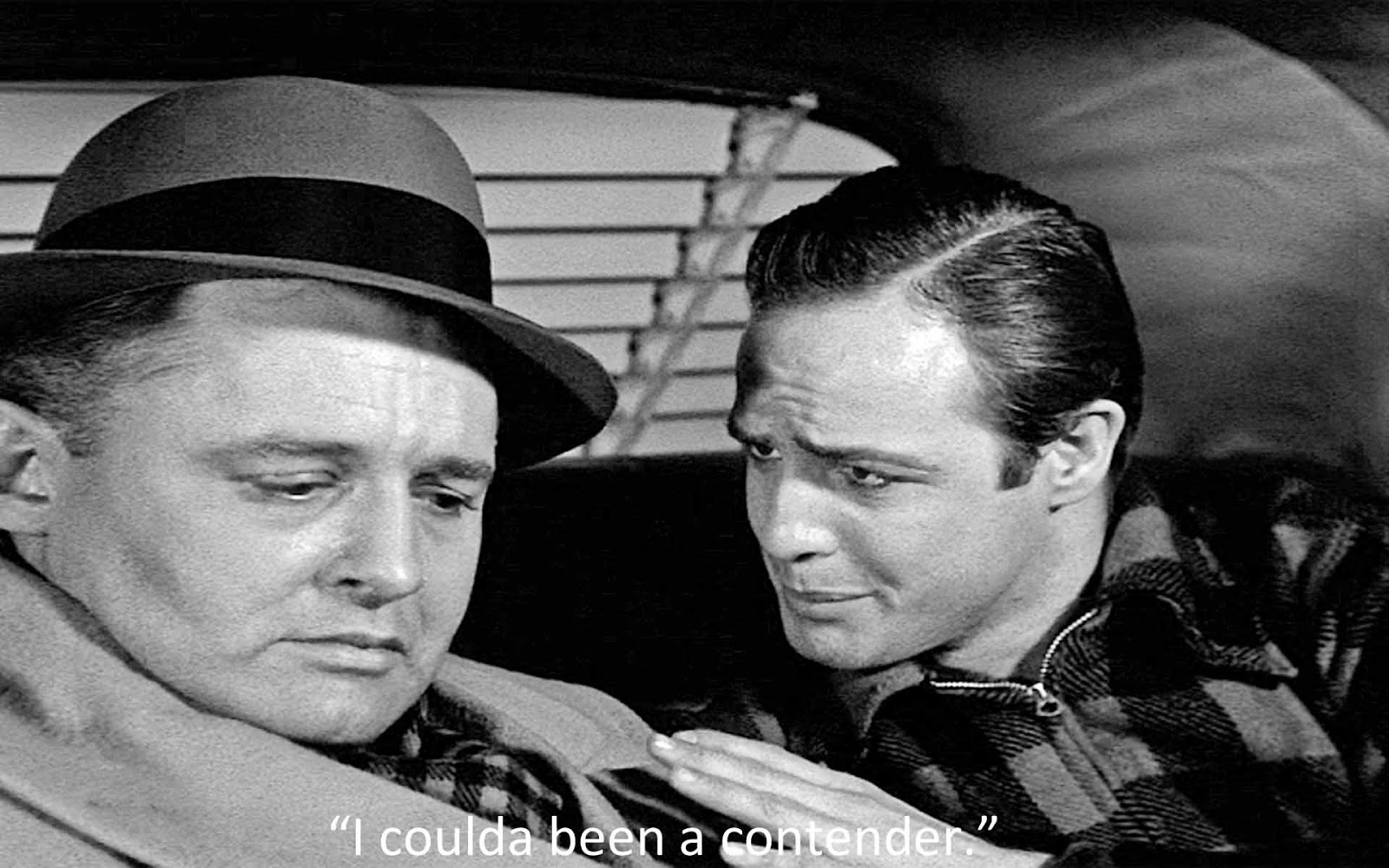
The most famous scene in the movie is the one with Terry and Charlie in the back seat of a cab. During filming, they had difficulty shooting through the back window from inside the vehicle. Someone said they rode in a cab with blinds in the rear. They used that suggestion. The result created an intimate setting for the exchange. Charlie has been told by Friendly that if Terry couldn’t be convinced not to testify, then Charlie would have to kill him. When he tells Terry he has to make up his mind by the time they reach their destination, Terry understands what is really happening: that his own brother has been ordered to kill him. Instead of anger and violence following this realization, we have a quiet scene of disappointment and heartbreak. Terry doesn’t grab the gun or knock it out of his brother’s hand. He gently just pushes it aside with his fingers. His sadness is palpable. When Charlie tries to place the blame onto someone else for Terry’s failure as a fighter, Terry lets him know that it was Charlie’s fault for making him take dives. Terry tells him that he should have looked out for him. That is what a brother should do – love and care for his sibling. Instead Terry makes him understand that Charlie has been betraying him for a long time. When he tells his brother, “It was you, Charlie,” the truth is almost unbearable for the both of them. Charlie then realizes he can’t kill his own brother, and by letting Terry go, he must join the list of those sacrificing their lives to bring about moral change.


Barry convinces Terry that he must fight in a court instead of a boxing ring. After he exposes Friendly, he does not run and hide. He goes to the docks to claim his right to work, and lead by example. The others finally defy Friendly, and say they will only work if Terry does. Even though he is beaten up by Friendly’s goons, he drags himself to the loading dock to put in his day’s work. His fellow longshoremen follow him, pushing Friendly aside. Terry may have lost his actual brother, but he has now become part of an army of kindred souls. As Edie said: everybody should care about everybody else.


Next week’s movie is Julia.