Showing posts with label male and female roles. Show all posts

Sunday, September 15, 2024

Duel

 SPOILER ALERT! The plot will be discussed.

I have been showing films and leading discussions at my housing development. The most recent movie was one made for television in 1971. It’s entitled Duel, and it’s the film that put Steven Spielberg on the map. His directorial ability to build suspense here shows how he was ready to make Jaws.


Richard Matheson wrote the story, and he is a respected writer of horror and science fiction stories, including I am Legend and Hell House. He wrote several episodes for the original Twilight Zone series. This tale involves the character of David Mann (Dennis Weaver) who is on a business trip driving on a fairly desolate prairie road that looks like it belongs in the Old West. He passes a slow-moving truck, and that’s when things go badly for him. The trucker plays a cat-and-mouse game with him, zooming past, slowing down, and preventing him from passing. The harassment escalates as he waves David on when there is oncoming traffic which almost gets David killed. The trucker starts to bang into the back of David’s car and even tries to push him into the way of a train.

The theme of this movie deals with old-fashioned masculinity and emasculation. David’s last name is “Mann,” which implies he stands for a modern male who doesn’t live up to his name. His wife tells him on the phone that she is upset with him because he didn’t confront someone who made a pass at her. She says the fellow tried to “rape” her, but David implies it was more like making a pass at his wife and says he wasn’t going to get into a fistfight with the guy. David listens to a talk radio show and the man calling in says he is not the head of the house any longer because he stays at home, takes care of the house and the babies, and his wife is the breadwinner. A gas attendant says, after David notes he doesn’t need to get a hose fixed, “You’re the boss.” To which David says, “Not in my house.”


The title of the film suggests a deadly old-fashioned confrontation between two combatants. In this case, the weapons have been updated to motor vehicles. The setting is rural and primitive, as if we are dealing with an occurrence at the O.K. Corral. We never see the driver of the truck, only a hairy arm, a cowboy hat, and cowboy boots. He is symbolic of the idea of a rugged, individualistic male of the Old West. The truck he drives is a fuel tanker with the words “Flammable” written on the back. It’s like the truck is announcing its ferocity and making a challenge. At one point the truck sits under a dark underpass, and when its headlights come on it appears like a ferocious animal waiting for its prey.

Let’s get back to that hose that needs repair. It is one of several phallic symbols in the movie. The gas attendant carries the gas nozzle around, suggesting the male organ. On the radio there is a man who plays music on such things as a bicycle pump. The trucker tries to run David down while he is at a rattlesnake farm. And there is that train (think of the end of North by Northwest). All these male symbols stress how David’s manhood is in jeopardy, and how he must try to win it back.


David drives a Plymouth Valiant, the name of the car suggesting that there is that fierceness inside of David, waiting to be released. He does in fact confront the trucker at the climax of the story. He aims his car, damaged after attempting several escapes and with that hose bursting, at the oncoming truck near the edge of a cliff. He transforms his unimposing briefcase into a combatant’s tool and uses it to hold down the gas pedal so his Valiant will ram the truck. The collision causes flames, obscuring the trucker’s view. He is unable to halt his forward movement, and the truck and car tumble over the edge. Spielberg lets the camera linger on the destroyed truck until its wheels no longer turn. It’s like witnessing the death of a modern, menacing, stalking beast.

Mann jumps for joy as he celebrates the primal male urge to vanquish the enemy.

Sunday, September 27, 2020

Ruby Sparks


SPOILER ALERT! The plot will be discussed.


In Stranger Than Fiction (analyzed on this blog) the main character really existed but was channeled by an author who controlled his actions. In The Words, (also discussed here) the author also had difficulty separating fact from fiction, so completely connected to his characters that he didn’t know how to become attached to others. We have a similar situation in Ruby Sparks (2012), but beyond that point, this film explores male and female relationships, the male tendency to objectify women, but even more so, how complicated human beings are.


The first image is of a young woman that is blurry as if not clearly defined who then comes closer and talks to the person looking at her, or in this case the audience since the camera is placed from the observer's viewpoint. It is a dream, and the dreamer is Calvin Weir-Fields (Paul Dano). He is a writer and the image suggests how writers’ stories start as vague ideas. The title of the film is written in the sky as if taken out of thin air, which is what happens to the title character. Calvin stares at the blank page in his typewriter, the daunting task of all writers. The phone rings and he lunges for it like a lifeline to give him a reason not to face his task.


He goes to the gym with his brother, Harry (Chris Messina), who questions him about whether Calvin is ever going out on a date again and have sex. Calvin says the only reason girls are interested in meeting him is because he wrote a book they liked, and are not interested in him as a person. In a way he is not real to them and “they’re interested in some idea of me.” He is only associated with a work of fiction, just like his characters. Ironically he will view Ruby the same way others see him. His brother is all about physically working out to be better looking to attract women. He leans toward being concerned about the physical aspects of a relationship. When Calvin says he had a dream about a woman, the first thing Harry asks is what did she look like. Calvin says it was nice because the woman “just talked” to him. Harry says his brother doesn’t “even get laid” in his dreams, which he finds “sad.” Here, Harry represents the perennially superficial male who never exited adolescence, the kind that thinks the sole purpose in life is to have sexual conquests.


Calvin visits his psychiatrist, Dr. Rosenthal (Elliott Gould), and they discuss his writer’s block. Calvin wants to blame his problem on something outside of himself, even on his dog, Scotty, for making him walk him so much. Calvin is in a state of arrested development, and wants to cling onto a toy puppy that Rosenthal has in his office especially for him. Calvin has been leading a solitary life and Rosenthal reminds him that getting Scotty was supposed to help him meet people, break away from his isolation and world of make-believe. Rosenthal gives him a writing assignment that consists of saying how someone can like Scotty despite any of his shortcomings. In this way, Calvin can write something without literary merit for his shrink, which will at least get him back into practicing his craft. Also, the task shows how he, Calvin, can be liked, just like Scotty, despite a lack of social graces. 


Calvin is at a sold-out literary event where he is to be interviewed by another writer, Langdon Tharp (Steve Coogan). Tharp notes in his introduction that amazingly Calvin’s book was at the top of the bestseller list when he was only nineteen years old, which shows Calvin has a sort of innate talent. But, huge success at an age where there is insufficient maturity to deal with fame can be overwhelming, and may have contributed to Calvin’s social withdrawal. Ten years have passed since his novel was published, and he has only written short stories since then. He still seems immature as he dresses in a teenager’s at-home clothes. The interview itself is not shown but Calvin’s response is. As he walks through the audience he is questioned about what is the true meaning of a color in his story, as if he is supposed to explain his work. One man asks if it’s “weird that you used to be so successful?” The implication is that Calvin is a has-been at the young age of twenty-nine, with a lifetime of failure ahead of him. He has to wash his face off in the men’s room as if to cleanse himself of this negative experience.


He tells his agent, Cyrus Modi (Aasif Mandvi), that he wasn’t prepared for this interview and would have dressed up for it. Cyrus reminds him he hasn’t checked his messages, so much has Calvin withdrawn from contact with others. Langdon, at the reception afterwards, attaches himself like a parasite to Calvin’s achievement, taking credit for guiding the young author toward success since, he says, raw talent isn’t enough to excel. Calvin has to endure the onslaught of a large gathering and the propositions from women who, as he told his brother, seek Calvin to get close to his fame, not him. Langdon tells a few members of the audience that if you produce a great work early, the readers “love you, then they throw you away.” Fans are like hungry followers who want to feed off of the famous person’s notoriety, and are not satisfied with one book, but want to know what he is currently working on in anticipation of what they can devour next. The drunk and burned out Langdon, claiming he didn’t do any cocaine, at least not that night, tells Calvin it’s tougher when you start out on top to rise to those heights again. He says J. D. Salinger had it right by just disappearing after his success. Calvin seems to be going that route, although at the same time he wants to write more. 


When he gets home, Calvin throws his novel to the floor like he unburdened himself of an oppressive object weighing him down to his past. He didn’t get home in time to walk Scotty, who urinated all over his bed, which seems to fit how lousy Calvin feels about his life at the moment. Sleeping on his couch, sort of like a visitor in his own place, he again dreams of his idealized woman, who is Ruby Sparks (Zoe Kazan, who is also the screenwriter, and granddaughter of famed director Elia Kazan). Her first name suggests a beautiful, precious jewel. It could refer to Dorothy’s slippers in The Wizard of Oz, which is a fantasy story, as is Ruby’s. Her last name might point to the electricity that will develop between them, or romantic fireworks going off. In any event, the name is exciting. 


Her features are well-defined now, as she becomes more real to Calvin, and she sits next to him near a tree. She is an artist, creative like him, and sketches Scotty. She never heard of F. Scott Fitzgerald, after whom he named his dog. He informs her that Fitzgerald was one of the great novelists. She says it’s “disrespectful” to name a dog after a great writer. She theorizes that he named his “dog after him to cut him down to size,” which shows that Calvin is envious of Fitzgerald’s literary standing. She advises she is okay to “kill your idols.” Her statement suggests that worshipping others is intimidating and makes one feel inferior and inhibits actualizing one’s talents. Even though the male dog Scotty “pees like a lady” and is afraid of others, she says she likes “him just the way he is,” which fits in with Rosenthal’s writing assignment. 


Calvin starts writing his story based on the dream he had. He tells Rosenthal how the psychiatrist’s suggestion was “genius” about not putting pressure on him by saying he wasn’t looking for a good piece out of him. It is wise advice for all writers who just need to get started on a work. Now, Calvin is inspired and says, “All I want to do is write.” But this “fiction” has a great deal of him in it, since the main character is a writer named Calvin. He says he almost didn’t show up for his session because he didn’t want to leave “her.” He even says, “it’s almost like I’m writing to spend time with her.” He is becoming infatuated with someone he created, as if she is separate from himself, like the way a person produces an offspring. He says he is falling in love with her but is upset because she is a product of his imagination and, therefore, not real. He has trepidations about getting involved with someone because he had a girlfriend named Lila, who he says, “treated me so badly,” by leaving him after his father passed away. He says Lila was a “heartless slut,” which points to some sexist attitudes that Calvin harbors. An actual woman hurt him, so maybe in his mind the virtual one will treat him better. The emphasis here is on Calvin and his needs as opposed to those of another.


He starts to make up a biography, a backstory, for Ruby, which is what writers are told to do when creating their characters. As he talks about her, his words turn into cinematic images, so she becomes more real for us, too. She is twenty-six years old, compatible with Calvin’s age. She is a bit notorious because she had an affair with one of her teachers. She always is on the side of the “underdog,” which means she would support Calvin if he has failures. His favorite aspect of her is that “She’s complicated.” So, he, like most writers, wants to produce a “rounded” as opposed to a “flat” character. She’s made mistakes with men. He says she’s looking for “something new,” which we can assume would be Calvin, both the real and fictitious writer.


Susie (Toni Trucks), Harry’s wife, is with their baby at Calvin’s place doing some cleaning when the two brothers return to the house. The first sign that there is something strange occurring is when Calvin is perplexed to find a woman’s razor in his medicine cabinet. Harry finds a bra on the couch and notes that Calvin has not been telling them that his brother has been having sex. There are panties in a drawer and Calvin makes up a story (which is what he does) and says his dog is dragging the underwear in from other houses' trash. 


Harry’s input into the story Calvin has been writing is that women read love stories and they would not like a tale about “quirky, messy women whose problems make them endearing” because they “are not real.” Harry says women are different “up close,” (as opposed to in a book), and says even Susie can be “mean” for no reason. Harry reminds Calvin that writers are supposed to write what they know, and Calvin hasn’t had enough experience with women to know them. Calvin has retreated from reality and wants to live in his world of idealized fiction. 


But Calvin persists in his story even though his brother says he has written about a “girl” not a “person.” Which means Calvin is producing a fantasy version of a woman not grounded in the real world. Nevertheless, Calvin continues his story about Ruby, which we see dramatized. She says she dated a guy who told her she had a good sense of humor because she laughed at his jokes. That attitude points to how men’s lives revolve around their ego and want women to affirm the man’s perception of self-worth. He says that she was searching in the wrong place and Calvin is the man she has been really looking for, which allows him to stress his value. In his story Ruby dives into the swimming pool and he follows. Their unrestricted movements suggest that his invention has allowed him, at least internally, to become liberated from his self-imposed emotional quarantine. She says she is messy, and he says he loves her “mess,” but that chaos is still under his control since he is the master in charge of the fictitious scenario. It is like he is performing a controlled experiment.


However, what follows is a cliched idealized version of a love story when he says that as soon as he saw her he thought she was the most beautiful woman in the world, the emphasis on physical attributes being the default position of most men. She says when she first saw him she thought, “I’m going to love him forever and ever and ever.” Her words sound like what women want in old-fashioned fairy tales, and also show the male desire for adoration from the female interest in a story. 


 Calvin is supposed to meet Cyrus to show him what he has written so far, but he is late because he fell asleep at the desk typing. He has to walk Scotty first, but then he hears a female voice saying she’ll take care of the dog. The fantasy part of the movie, suggested by the feminine items appearing, now becomes full blown. We get a Twilight Zone feel as Ruby now actually exists in the kitchen saying she missed him in bed the prior night but hopes his working on the story was productive. Calvin, of course, is mind-slammed by what is happening. He starts to think he’s not an inspired writer, but is just “batshit” crazy not being able to separate himself from his creations. When she touches him and he feels it he realizes that he is experiencing more than an auditory and visual hallucination, He runs off in fear trying to convince himself, “It’s not real. It’s not real.” He hopes he was dreaming, but she is still there. 


Calvin calls his psychiatrist, leaving a message saying he is having an emergency (I’ll say!). Ruby is making him breakfast and when he asks if the underwear he found is hers, she asks who else’s, and then becomes jealous, wondering if he is “seeing anyone else.” His response of, “I’m not seeing anyone other than you,” is funny because not only is he not involved with another woman, he isn’t even “seeing” a real woman, only a fictitious one. He hides under his desk and whispers in a call to Harry that he needs help because he fears he is losing his mind. His world contrasts with that of Harry, who is in a business meeting, far removed from the far-flung events happening in Calvin’s house of magic. Harry says call a friend and meet with that person away from his hallucination. Calvin has become so isolated from others that he calls someone from high school who barely knows who he is. He finds the number of the woman, Mabel (Alia Shawkat), who offered it to him at the literary event, which shows how desperate he is to make a connection to someone in the real world.


Calvin tries to sneak out of the house but Ruby confronts him. She pleads to go with him, and his dream girl now feels suffocating in her attention to him. The cautionary advice of, “be careful what you wish for because it may come true,” comes to mind here, because one may not fully understand the ramifications of that wish. Ruby goes with him, but he tells her to window-shop until he returns with his meeting with a “friend.” The woman, like others Calvin mentioned, doesn’t relate to him other than seeing how she could have influenced his starting to write again after the literary event. She is a literary groupie, feeling like a celebrity herself if she sleeps with one. In a sense Calvin’s wanting to create a person makes sense because the people he meets in real life are not genuine in dealing with someone when fame is involved.


The shocker is that when Ruby comes by, Mabel sees her, too, and converses with the young woman. At first Calvin thinks Harry is playing a practical joke on him, but he quickly realizes he has actually conjured up a way to have someone from his imagination cross over into the real world. This fact blurs the difference between what is real and what is an illusion. Her anger at him going on a “date” makes her angry, which is believable. When he grasps how amazing it is that she is really there, they kiss and what follows is the “honeymoon” part of what Harry said is the temporary early stage of a real relationship. In this way, the movie is dealing with what actual couples experience, but through an exaggerated construct. They have fun together, going to a zombie film festival (a fantasy movie, which fits what we are seeing). They then go to other places, such as an arcade and a dance club, all places that get Calvin out among people for a change. But these locations are all escapist venues, where people go to escape reality. In a way, Calvin has exchanged one imaginary world for another.


Calvin meets with his brother and tells him Ruby is real, and that the “situation is crazy,” but he is not. Harry insists that his brother should see Dr. Rosenthal because it is “impossible” that he is having sex with a make-believe character. (Of course we know Harry is right, but we suspend our disbelief and imagine that the “impossible” can be real since that is what watching a movie entails. We believe the fictitious is real). Calvin takes doubting Harry to his house but tells him Ruby doesn’t know she emerged out of his writing and wants his brother to keep that aspect a secret. Ruby is there and confirms that she is a painter from Dayton, just like in Calvin’s story. She is cooking dinner, and Calvin says she is a terrific cook (another aspect that men traditionally want in their women). 


Harry runs through all of the logical explanations, including that maybe the girl is an actress Calvin hired, or is she an opportunist who was able to read Calvin’s manuscript. Calvin says he didn’t hire anyone, and Harry is the only one who read his work. Calvin’s explanation is that love is magical, and just as Susie is Harry’s “dream girl,” that is who Ruby is for him, only she literally came out of a dream. 


Harry finds out that Calvin hasn’t written any more of the story. He suggests an experiment, which is to write more about Ruby, and if Calvin’s claims are true, then writing something more will change Ruby. He types that she speaks fluent French, and immediately Ruby begins talking in the foreign language. Calvin took care of her backstory by saying her parents died when she was young and she traveled around a great deal so there is nothing to tie her to a specific past. After dinner, Harry wants to tell everyone what his brother has done. But Calvin, like most writers, is protective of his creation. He doesn’t want Harry to tell anyone because he wants to keep his “girlfriend” to himself and not subject her to being looked upon as a “freak.” Harry is funny when he says if Calvin marries Ruby wouldn’t it be “like incest” or “mindcest.” Calvin says he loves her and not to ruin things for him, which refers to his disastrous past romantic life due to his inability to have a meaningful relationship with real women. Harry, acting like the typical immature male, says Calvin can “tweak” Ruby, making her breasts larger and her legs longer, and having her perform oral sex anytime Calvin wanted. Harry also says he wished he could remove his wife’s annoying habits so easily. But, these are all the elements that make people individuals. He says, about Calvin’s ability to make Ruby do whatever he wishes, “for men everywhere, tell me you’re not gonna let that go to waste.” Harry’s take is to objectify a woman to the point that she will have no freedom of choice or uniqueness. At this point Calvin vows not to write anything about Ruby again so that he will not be manipulating her any further.


Months have passed and when Calvin’s mother calls he puts off her meeting Ruby again. She wants Calvin and Ruby to come to a birthday party for his brother. It is ironic when his mom, Gertrude (Annette Bening), says she started to believe Ruby “doesn’t exist.” Certainly, as we know, not in the usual sense. But even this prefabricated human starts to exhibit traits of personal preference. She would like to meet the rest of Calvin’s family. She wants to earn some of her own money working at a coffee shop, even though Calvin has promised to play the old-fashioned male role of providing for her while she works on her art. On this night, because she isn’t feeling fulfilled as an individual, she says she is tired and doesn’t want to have sex. 


So, he decides at this time that it’s okay to see the family at Big Sur, giving into Ruby’s wish instead of his own. (In the background on their ride it is funny that the song “The Game of Love” plays which reflects this very different form of romantic participation involving the couple. But also it is sung in French, referring back to how Calvin gave Ruby her bilingual abilities). Calvin’s mother greets them at the large estate where she lives with her husband, Mort (Antonio Banderas). Mort has had an impact on Gertrude’s diving into New Age ideas about growing all medicinal plants, and they have an indoor-outdoor style of living which is quite different, with no doors on the rooms. Calvin tells Ruby that his mother used to wear polo shirts and cook meat when she was with his father. He feels that she has been brainwashed by Mort. Is Calvin's mother a version of Ruby because she has been formed by the wants of the man in her life? Or, is Gertrude really happy and Calvin is just feeling guilty about how he has the power to control Ruby?


Calvin, not able to have his creation, Ruby, for himself, is again withdrawn, literally physically, from his family members, since he sits alone in a tree house structure reading Langdon’s new book. He remains immersed in fiction while the others dive into the pool. He wants Ruby to come up to be with him, above the realm of real people. Mort is entertaining at dinner and they all laugh and enjoy themselves except for the loner Calvin, who does not wish to validate Mort’s ways, and appears not to want to join in with others outside his own world.


Back home, Ruby has the opposite disposition than that of Calvin, because she sings about love while she cooks. The withdrawn Calvin feels annoyed and asks her to be quiet because he is reading, escaping again into fiction. She becomes sad and says that despite Mort and Gertrude trying to engage him in the joy experienced by the others, he just read by himself most of the weekend. She comments that he has no friends, and his statement that he only needs her prompts her to say that it puts a great deal of pressure on her to try to make him happy. Her observation shows he doesn't have the maturity to be generous in a relationship. She admits to being sad, suggests that maybe she should start taking art classes, and spend one night a week at her own apartment. It’s as if he gave birth to a child who is growing into her own person.


Ruby is thrilled by her art class and says she thinks she will learn a great deal from it. His selfishness is evident because he can’t share in her happiness and says his night away from her was terrible, and this “experiment” of hers isn’t working for him. She is the one now feeling emotionally smothered, and says there must be “space” in a relationship, “otherwise, it’s like we’re the same person.” The film suggests that is what would happen not only between people in a romantic situation, but also in any relationship. In this case, Calvin wanted someone to fit his specifications, so in a sense, he did wish for a woman who was like him. 


Ruby expands her independence by calling Calvin one evening and saying she went to a bar with others after her class. This fact spoils Calvin’s plans to cook dinner for them. She says that it might be a late night, so now she is expanding the number of days she will not sleep at his place. There are shots of Calvin alone in bed or with his dog. His disappointment is obvious as his territorial control over Ruby is eroding. 


 To counter that loss of power, he goes back on his promise not to write about Ruby anymore. He types that she is miserable without him, and he immediately gets a call from her where she pleads that she wants to come home. They are in bed and now she is so dependent on him she will not even let him get up to go to the bathroom. They eat cereal out of the same bowl and read the newspaper together while she holds his hand. But even though they are practically attached at the hip, she says, while sobbing, “I miss you right now.” She feels compelled to go with him even to answer the phone. He is now getting a dose of his own possessiveness. The movie seems to be commenting on how men don’t know how to be with women, since they want female adoration but also want space. Calvin can’t find the right state of mind to temper his selfishness with emotional generosity. They watch a film and there is a line uttered by Humphrey Bogart where he says, “No man walks alone by choice.” But before Ruby, Calvin seemed to have chosen that way of living, while contradictorily yearning for companionship. 


To counter her unhappiness due to his inability to cater to her all of the time, he writes that she will now be full of joy. So, then she is overly cheerful and loud as she constantly bubbles over about every single moment, no matter its significance, and is unrealistically optimistic no matter what happens. Calvin talks with Harry about his inability to strike a good balance. Calvin wants him to be what makes her happy without him making her happy. Isn’t that what most of us want, to find fulfillment by contributing to another’s joy by virtue of who we are, not by what we exact? Harry confesses that Susie once left him but came back. The precariousness of relationships is stressed as he says he can lose her at “any moment.” If that is true about our connections to others, the movie suggests that we have to not take for granted those we love.


Calvin tries to make Ruby her own person, typing that she can be sad or happy, however she felt like being. But, that is not enough. She sits around just watching TV and arguing about not wanting to go out. She complains about abruptly shifting from being psychologically up to being down, as if she is bipolar, because his defining her in his writing has been too narrow. The film implies that it is extremely difficult to have a character in a story approximate the intricacies of the personality of a real person. A writer may play God, creating characters for the author’s own purposes, but he or she can’t reproduce what an independent human being is truly like. Ruby complains that she does not have “an internal compass” to direct her because Calvin doesn’t have the ability to create one in her. She says maybe she needs to talk to someone like he did. When he mentions Dr. Rosenthal, she says maybe he should go see him. But, he says they were talking about her. Her warning about becoming the same person is coming true. She is now like he is, being urged by someone else that she has to get out and be social.


 At Langford’s party, documentary filmmakers pitch doing a film based on Calvin’s book, and they boast about making it look completely real. But even a documentary, through content selection, edits, and the fact of intruding on a situation alters the reality of what is being filmed. Calvin runs into his ex-girlfriend, Lila (Deborah Ann Woll) who he vilified earlier. She says she finished her novel and Langford is helping to get it published. When he says he is with a painter now, she says that is less threatening. Did he not get along with Lila because he could not handle a companion he did not feel superior to? Even now, she says he can’t be happy or supportive of any success she has. When they were together, she says that he reluctantly helped her with her writing career. She says he had “an image of who I was. And anything that I did that contradicted it, you just ignored.” So, the way he is acting with Ruby is nothing new for him. He blames her for leaving him right after his father died, but she accuses him of not letting her in emotionally, and that the only one he wanted “to be in a relationship with was you.” We again have Calvin’s narcissism noted.


Langdon meets Ruby and asks what she does, and her response is “nothing,” because she is not a complete person, generated from the mind of someone who doesn’t understand what that constitutes. He starts to come onto her. He invites her into his pool and she starts to get in with just her underwear on. Calvin gets territorial and whisks her out of there and when they get home demands an explanation for her actions. He becomes abusive as he grabs her arm, hurting her. He only cares about how she embarrassed him because his agent, Cyrus, and Lila were at the party, and not that he dragged her to Langford's place and left her alone. She argues that he has rules that she doesn’t know about until she breaks them. He tells her his rules, which are based on sexism and jealousy. She is angry and says that she is not his child (even though he birthed her and thinks he can discipline her like one) and he can’t control her to fit his whims. But he threatens that he can make her do whatever he wants.


She tells him she is leaving and they will talk later. But when she tries to go it’s as if she runs into an invisible barrier and can’t leave. He hands her what he has just written and the pages of the book he has already worked on. She is upset that he is invading her privacy by writing about her. He says no, he isn’t writing about her, “I wrote you.” He admits that he invented her. She thinks he is mentally ill until he makes her speak French, snap her fingers, sing, act like a barking dog, and call him over and over again “a genius.” The film has turned into a horror story where someone becomes an omnipotent being who unmercilessly wields his power to humiliate a subject. The fact that here it is a man completely defiling a woman makes the story an indictment against gender abuse. If that theme isn’t clear, we then have Calvin pounding out his words as if beating upon Ruby, who collapses to the floor. 


When he stops typing, he approaches her but she runs off in fear. He finally realizes what a monster he has been and types that she will be released from the past when she leaves the house, would no longer be “Calvin’s creation,” and that now “she was free.” He leaves the manuscript for her to read and leaves a note that tells her to read the last page. He says that he loves her, but most writers love their characters, no matter how badly they treat them. When he awakes Ruby is gone.


Calvin plays golf with Harry and says nothing helps getting over his broken heart. He says he can’t write, but Harry says Calvin should tell his story. Calvin says people will think he’s crazy, but Harry says, rightfully, they will “think it’s fiction.” Which is what it is because that’s what novels are and, you know, we’re watching a movie that is made up. He does write a book entitled Girlfriend, and in it he apologizes to Ruby. He has left out all identifying information about her to keep her free of him. He confesses that he couldn’t see “her” (to whom he dedicates the book) when she was there, but sees her everywhere now that she’s not around. His words echo those of Joni Mitchell’s song which reminds us that we don’t appreciate what we have until it’s gone. At a book reading, Calvin says that “falling in love is an act of magic,” and “so is writing” to explain why he has written his tale. He quotes a comment about J. D. Salinger’s Catcher in the Rye that says how writing brings human beings to life “out of ink, paper and the imagination.” Calvin, again referencing Salinger, says the woman he wrote about passed through him, inspiring him, and he was lucky enough to “catch her.”


Calvin is walking his dog in the park, and Scotty gets away from him. He calls Scotty’s name and runs into Ruby, who, based on what he wrote, no longer remembers her past with him. She says it’s curious that she is reading a book that has a dog named “Scotty” in it. Of course, it is his novel, and she realizes that he looks familiar because his picture is at the back. She feels badly because she mentioned before she knew he was the writer that a friend thought the story was pretentious. She then asks if they could “start over.” Hopefully the man who wrote about his own history has learned not to repeat it.


The next film is Cold Mountain.

Sunday, September 15, 2019

Shane


SPOILER ALERT! The plot will be discussed.
Shane, released in 1953, directed by George Stevens (nominated for Best Director) and written by A. B. Guthrie, Jr. (also receiving an Oscar nomination) based on the novel by Jack Schaefer, is a western whose themes center on the western United States moving from a rugged frontier to a territory that is settled and domesticated. Within that context, the movie explores what constitutes a man’s role in this society.


The opening shot shows Shane (Alan Ladd) riding his horse toward the Starett house. The Oscar-winning color cinematography depicts sweeping vistas of the planes with the imposing mountains in the background that show reverence for the appearance of the Old West. Child Joey (Brandon de Wilde, in an Oscar-nominated supporting role) holds a rifle and appears ready to shoot a deer, which implies youthful innocence must soon take a back seat to surviving in the wilderness. But the deer shows alertness as both the animal and the boy see the cowboy approaching. Strangers can be an enemy or a friend since the truth is unsure. That is why the father, Joe (Van Heflin) says, “Let him come,” to see which the man will turn out to be. Shane asks to be able to ride through, saying he didn’t expect to find any fences here. His words show he would rather not encounter barriers to his freedom. The two men represent opposing lifestyles: one is a roamer who fought with his guns to survive; the other, is a reliable, peace seeking family man who would like to be allowed to put down roots, but who may seem dull in comparison. Joe’s wife, Marian (Jean Arthur) looks at Shane possibly as a curiosity, but she may feel instant attraction for the wandering strong handsome man who initially contrasts with her ordinary husband. But, she moves away from the window revealing some modesty since she doesn’t want to be caught observing Shane.

Shane shows his observation abilities by saying how he noticed how the boy, although seeming to hide saw Shane approaching. He compliments Joey by saying, “I like a man who watches things go on around. It means he’ll make his mark someday." This remark makes Joey smile, endearing him to Shane. While dismounting to drink some offered water, Joey cocks his rifle but the sound triggers a startled response from Shane who spins around, ready to draw his revolver. As the father notes, he is an excitable type, and the action hints at Shane’s stressful, gunfighter past. Joey says he just wanted Shane to see his rifle, and says he guesses Shane knows how to shoot. Shane doesn’t want to reveal anything about his past, and modestly says he does a bit.  
Men on horses ride toward the Starett house and Joe initially believes Shane is part of the Ryker group who want to run him off his land. Shane says if Joe lowers the gun he’ll leave because he wants his departure to be his decision. This exchange shows that Shane wants to be in charge of his fate and doesn’t like anyone forcing his will on him. He starts to leave. The riders approach. Rufus Ryker (Emile Meyer) says Joe is a squatter like the settlers, but Joe says he’s a legal homesteader, and the land he lives on belongs to him. Ryker wants him gone before the first snow because he signed a beef contract and needs the land for his cattle business. Ryker says he is giving a warning but could just “blast” him off. Joe says those days are past, suggesting that there has been an evolution away from violent ways, and laws have been passed to incarcerate those who violate the rules. Joe is a man caught between the old belief in the survival of the fittest and the newer, civilized social agreement that promotes peace and resolution through shared community rules and cooperation. Marian tries to calm everyone to avoid hostile behavior. A smiling Shane has not left and appears from behind the house to give support to Joe.

Here we have the old-fashioned role of the wife and mother who her husband calls “the little lady,” as she handles the domestic chores. Marian says supper will be ready soon, suggesting Joe should invite Shane to stay. Joe apologizes and says Joey’s rifle isn’t even loaded, showing how he is still fostering Joey’s childhood while also getting him ready for his adulthood. He shakes Shane’s hand and Joey is elated that he will stay. At supper, Joe goes on at length about how one can make a go of it being a homesteader. Shane seems distracted by Marian. A calf makes a noise, and again Shane is startled and goes for his gun, showing his hypervigilant lifestyle has not given him a sense of peace. When asked where Shane is going, his nomadic response is “one place or another. Someplace I’ve never been.” His life may have adventure, but it may not be deeply fulfilling because the satisfactions are transient. Joe says it’s the first real home his family has had and they will have to kill him before he would leave. Marian is upset by Joe talking about something so disturbing in front of their son. Joe says working the farm is too much labor for him and he had a hired hand once. But the Ryker brothers “knocked out his teeth” according to Joey, so the worker left. This story shows how Joe is up against not only the environment but the men who first arrived in the Old West. Joe comments how the extra plates and forks for the pie make it seem like they’re being fancy, but Marian appears to be trying to impress Shane.
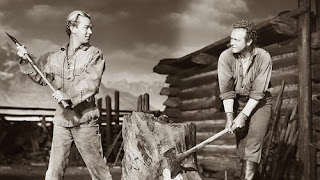
Marian asks Joe to invite Shane to stay the night, pushing to keep the cowboy around. Shane, trying to show that he is worthy of their hospitality, and trying to make a transition to a farm hand, is outside taking an axe to a huge tree stump close to the house. Joe had been fighting for a long time by himself to get rid of the tree remnant. Together they chop at it into the night, and the fit, shirtless Shane and Joe finally are able to use their combined strength to unearth the stump. It’s as if Shane has brought increased manliness to Joe, empowering the man.

The next morning Joey wakes up to see a deer looking for food and water near the house. Showing his desire to grow into a frontiersman, he pretends to shoot it. He comes across the already awake Shane who slept next to the house. Joey wants Shane to teach him how to shoot, and wants him to stay, since his father has delayed showing him how to use a gun. Joey says he heard his dad say to his mother that he wanted Shane to stay to help with the work, but not fight his battles. It is interesting that the male ego is not threatened by needing help to do work, but feels undermined when the man is unable to fight alone, as if violence is a more defining male feature.

While Joey stays with his father as he does chores, Joey asks if Shane will teach him to shoot. Joe says he will do it when he has the time, which shows his desire not to be usurped in his fatherly role, but which also demonstrates how his current role of a family man and tending to the land has taken precedence over other traditional manly activities. Joe admits, however, that he probably can’t shoot as well as Shane, since he knows Shane has probably used his gun more often not being occupied by other activities, and he observed his quick reactions to any threats. Shane went into town to get supplies but didn’t wear his guns, and Joey wants to know why. Joe says he doesn’t wear one himself, but Joey says wearing guns suits Shane, as the boy is aware of the difference between his father and the cowboy. The boy then asks if his dad could beat Shane in a gunfight. Young boys want to emulate their fathers usually, so they want their hero worship to be justified. Joe maturely, though unsatisfactorily, answers by saying there’s no need to know the answer to his boy’s question since Shane is on their side. Joe may be feeling intimidated, however, by his family’s attraction to Shane.

Neighbor Ernie (Leonard Strong) rides up and says the Rykers tore down his fences and let cattle damage his wheat fields. He is ready to bolt because of the harassment. Joe convinces him to meet with others at his place to come up with a plan. Ernie wittily points out his frustration by saying the get-together better come to more than just poking “fingers in the air,” which amounts to angry talk and no action.


At the general store, Shane buys some work clothes and feels strange as he says he hadn’t bought clothes in a while. He is not used to anything resembling a domesticated life. It’s sort of like a skin graft that might be rejected. The Rykers are next store and get wind of a “sodbuster” there, which they derogatorily call “pig farmers.” The desire to settle down and be more civilized draws humiliating insults from the more savage leaning men. Shane just wants to buy “soda pop” for Joey, and the store owner, Grafton (Paul McVey), notes in a sad voice that he wishes more men would drink the harmless liquid, implying the alcohol is fueling repulsive behavior. Grafton is a man who would like to live in a civilized world but must still make a living and so must sell whiskey. When Shane goes to the bar to order the soda, Chris Calloway (Ben Johnson), who is with the Rykers, begins the to inault the Shane. When Shane asks, “You speakin’ to me?” and Calloway says, “I don’t see nobody else standin’ there,” we may have the origin of Robert de Niro’s psychotic version talking to himself in the mirror in Taxi Driver. Calloway then throws whiskey onto Shane’s new work shirt and says now he smells “like a man.” The implications here is that drinking something that submerges one’s rational ability helps to define what constitutes a male. Shane, not giving into his what drove his violent past, stoically takes their derogatory behavior and leaves.
The homesteaders meet at Joe’s place that evening. When Shane shows up, one man says he didn’t like going out at night, and another remarks he won’t move until “the shootin’ starts.” So, there is the suggestion that some of these men have left their violent ways behind them. Torrey (Elisha Cook, Jr.), a man from Alabama, shows up, and he heard about what happened at the bar. He says they can’t count on Shane if it comes to a fight against the Rykers. After they say that Calloway bragged about how he ran Shane out, Joe tries to cover for Shane by saying he told Shane to avoid trouble. Shane walks out saying they can speak more freely without him there, but he really doesn’t want to hear his manliness being questioned. Joe tells them they should go together as a show of force when they need to buy supplies in town. Torrey, who has tried to give up his fighting ways but doesn’t want his masculinity questioned, brags that he doesn’t need any bodyguards and only requires his gun with him. In response, one of them mocks Torrey, playing the rousing “Dixie” and then “Beautiful Dreamer” on the harmonica.
Joey, listening in his bedroom to what the others are saying, tells his mother he can’t believe Shane backed down, since he already has built the stranger into his macho hero. Shane is outside the room in the pouring rain, and Marian opens the window. Joey says he knows Shane wasn’t afraid. Shane says it’s a long story, and Marian has some insight into the man and says she knows, and smiles warmly as she says Shane’s name. She urges him to come in out of the rain, a sort of invitation suggesting he doesn’t have to feel like an outsider here. After Shane walks away, Marian tells Joey not to like Shane too much, because she knows he will not be staying, and then her son will be hurt when he leaves. She can see he is a troubled man and keeps moving to try to escape his past.


Joe and his family are getting ready to head out to meet up with other homesteaders and their families to go into town. Marian is slowing them down, and Joe voices the sexist attitude to Shane that one thing about marriage is a man has to get used to waiting for his wife. He says that it’s worth the wait most times, since Marian looks so pretty, and advises Shane that he should hold out for a woman worth waiting for. Joe doesn’t seem to realize that he is talking up his wife to a man who is attracted to her. But, Shane is also envious of Joe having a family and being settled, while at the same time he is incapable of living such a life.


In town, the families plan an anniversary party for Joe and his wife, and one of the wives says Shane is invited. He is now surrounded by a domestic group of people trying to live decent lives, asking him to join them. However, next to the general store, which represents this settled life, is the underbelly of this world, the bar, where the Rykers and Calloway hang out. Joey gets some candy for returning his soda pop bottle, but Shane deliberately goes into the lion’s den in the bar to return the bottle, trying to redeem his earlier behavior. Calloway starts in on him, reminding him that he should stay out of the bar, and be with the “women and kids, where it’s safe.” Calloway’s words are meant to emasculate. Shane tells him not to “push it,” but of course the man does. Shane orders two whiskeys and says he has to return the favor, so he throws both drinks at Calloway. Shane proceeds to punch him literally and symbolically out of the testosterone laden bar into the “women and kids” area of the store, reversing the castrating image. Some of the farmers tell the others to stay out of it, since it’s not “their fight,” and they don’t want to suffer the ramifications of it. The scene, temporarily, reminds one of Gary Cooper in High Noon, not getting the support of others and having to fight alone. (Although High Noon was released earlier, this movie was completed first, but delayed because of editing).

Shane and Calloway trade punches, but Shane beats him. Joey secretly entered the bar and witnesses the fight. He is eating his candy, showing his youthful innocence, but when Shane lands a hard punch, Joey chomps hard down on his treat, as if his potential for adult brutality is overpowering his childhood. Rufus Ryker sees that Shane would be an asset, and tries to recruit him, but Shane will have nothing to do with him. Rufus, who doesn’t understand honor or loyalty, implies that Shane is sticking around Joe because of his pretty wife. Shane is outraged at the comment. Rufus then says he’ll make Shane pay dearly for his actions. Joey comes up to Shane and says there are too many to fight and he should leave. It is a wise bit of advice, but Shane does not want to show that he will back down again, so he takes on a whole bunch of men. He does well until they finally get a hold of him and Rufus begins to pummel him. Joey tells the others and his dad enters with a club )A phallic symbol?). Together he and Shane beat the others away. Grafton, who continues to represent an evolved male, tries to stop the fighting, and convinces Joe and Shane to leave. Joe seems invigorated as he lets his savage nature surface, spurred on by Shane’s willingness to fight the villains. But Rufus promises the next time they meet up there will be lethal force used.

Marian tends to the men’s wounds, and says they were “wonderful,” which reflects the expected traditional reaction by women who sought protection from men in a hostile situation. The men also show prescribed modest attitudes, with Joe saying Shane did most of the fighting. When Joey says he thought Shane was a “goner” when hit with a chair, Shane says humorously, “It was an easy chair.” Even though Marian says medicating Shane’s head wound will hurt, Joey says Shane won’t complain. The boy is already subscribing to the code of the western hero. Shane can hear Joey telling his mother in the boy’s bedroom that he loves Shane, “almost as much as I love Pa.” Shane looks concerned, because he knows, just as Marian predicted, that he will eventually be moving on. He walks out so as not to embarrass Marian when she comes out of Joey’s bedroom. When she does leave Joey, Joe comes out of their bedroom and Marian asks Joe to hold her tight, almost to reassure herself that she is with the right man.
Ryker sent for Jack Wilson (Jack Palance), a gunfighter, who arrives at Grafton’s store. Torrey visits Ernie, who is ready to leave after the Rykers killed his sow and scared the family. While Torrey is there, the Rykers drive a herd of cattle onto Ernie’s land to damage his property. Torrey still wants to stay, but the fierceness is not as strong in his voice. Shane and Joey see the Rykers as they shout insults across the fields. Joey says that they have cut other farmers’ fences. Shane tells Joey that he would ask them to come through the gate instead if they tried to cut their fences. Shane is trying to model for Joey what peaceful men should do, although he knows that the present world won’t accommodate that behavior. Joey had previously wrapped up Shane’s guns in a blanket, as if putting the violence in Shane’s past to sleep. But the boy now admits that he would like Shane to show him how to shoot. Shane then unwraps the guns, as if awakening the need to use deadly weapons.


Shane agrees to show Joey how to shoot, and demonstrates that he knows quite a bit about being a gunslinger, mentioning the different ways men draw from various holster positions. After Joey asks him to shoot something, Shane fires quickly and hits a target. The sound of the gun is exaggerated, almost sounding like a cannon going off, startling Joey, and Marian, as she approaches. It is the first time a gun is fired in the movie and director Stevens wanted to jolt the audience with the noise. Joey is impressed, but Marian is concerned, and ends the lesson, telling Joey to get ready for the Independence Day celebration. Marian tells Shane that guns won’t be part of Joey’s life. Shane, almost sounding like a representative for the NRA, says that a gun is a tool just like a shovel (not the best analogy, since shovels aren’t meant for killing), and says, “A gun is as good or as bad as the man using it.” Of course the problem lies in the fact that there are many bad men who have access to guns, then and now. Marian, offers the counter argument, saying that they would all be better off, “if there wasn’t a single gun left in this valley,” including Shane’s gun, which shows she is worried about his safety, too. Joe comes riding in and is excited by seeing Marian wearing her wedding dress, and he tells Shane to get ready to celebrate the Fourth of July, which is also the day of Joe and Marian’s anniversary. His entrance stresses Joe is wedded not only to his wife, but to his country’s founding principles of freedom from outside tyranny.

While the celebration takes place, Grafton tries to dissuade Rufus from initiating violence. Rufus says he hasn’t used guns sooner, but he considers the homesteaders to be squatters, and he now must escalate. Wilson has a malicious smile on his face as Rufus speaks. Grafton says he upsets Rufus because, in a way, Rufus is hearing his own conscience bothering him. But Rufus sneers at the word “conscience,” because unlike Grafton, he has no evolved sense of right and wrong. Torrey enters the saloon, and Grafton asks what he wants. Torrey summons up his courage and asks for a drink. He makes a sarcastic toast to Rufus for having run Ernie off of his land. Torrey says that Ernie was a coward, but he is not, and he’s staying. Rufus quietly says that Wilson could easily get Torrey to draw which would give Wilson a reason to gun him down. But, instead they decide that Joe is the one they want, being the leader of the resistance to the Rykers. Torrey, emboldened by getting away with his angry words, breaks the saloon door as he marches out, adding to the atmosphere of violence.
The party has dancing, contests, and fireworks. To emphasize that the United States is a land that welcomes immigrants, Axel (Douglas Spencer), a Swedish farmer, is a friend of the Staretts, and introduces them to the crowd as they have a double reason to celebrate. Joe, demonstrating his domestic bliss, says he wouldn’t trade places with anyone, and gives Marian a kiss. Shane looks downward, showing his envy for what Joe has. Shane does get to dance with Marian, and he is all smiles while doing so. Torrey comes by and describes the gunfighter, whom Shane recognizes as Wilson, noting he’s a fast draw. Torrey suspiciously says that Shane seems to know a lot about the gunslinger business. Torrey says he doesn’t want any part of it, saying the men in that profession are involved in murder. His response seems to be noting it’s one thing to defend your land, but it’s another to make a living out of killing others.

Joe and his family return home from the celebration to find Rufus and Wilson at Joe’s place. Rufus proposes that Joe work for him, and he’ll pay him a good price for his land. Joe refuses, and Rufus says that men like himself “Made this country … with blood and empty bellies.” He says he was wounded fighting Native Americans and fought cattle rustlers. He represents that first wave of tough frontiersmen and is reluctant to give way to the new generation of settlers who benefited from his sacrifices to make the land safe. Rufus says the farmers drain off the water that hurts his cattle. Joe says traders and trappers came before Rufus’s people and tamed the land. He says that Rufus doesn’t have the authority to say nobody else has rights under the law. Joe is making the argument that the settlement of the territory must progress, and the ranchers who came before can’t stop others from settling there.
In town, Wilson sees Axel and Torrey riding up and is ready to gun Torrey down. Rufus doesn’t want any brush with the law, so he wants Wilson to do his dirty work, making it look like a legitimate self-defense if there’s violence. Torrey wants to get a drink, but is confronted by Wilson, sneering as usual, who goads him about the Southern Rebels being trash. Torrey starts to draw, but stops. However, Wilson shoots him, and it justifies the shooting to Grafton after Axel confirmed that Torrey drew his gun.

After Axel tells Joe about Torrey, Joe says he will go into town to confront the Rykers and Wilson. Axel thinks the other homesteaders will leave, so Joe first visits the other settlers, telling them they must stay to attend Torrey’s funeral. After the funeral the others are ready to depart, but Joe says they can have a “settlement” which implies putting down roots. He says they can honor Torrey’s memory by having churches and a school. But one of them notes that also includes graveyards, adding a sense of doom to the talk. Shane says they have a right to stay there and grow, and not give up. Joe says that this land is for more than just people like Rufus, suggesting that things must be allowed to change. After one of their homes has been burned down, the others say they will help as a community to rebuild, stressing the desire to create a place where the preservation of individuality must allow for social responsibility.

Rufus sees Joe as the cement holding the farmers together and vows that he has to go. Joe wants to confront Rufus, which is what Rufus wants. Marian pleads to Shane to convince her husband not to go. But Shane says he can’t tell Joe what’s the right thing to do, since it’s a complicated situation where doing nothing means surrendering his land and his rights. The Rykers invite Joe to a meeting at Grafton’s, saying Rufus is a reasonable man so as to lure Joe into a trap. Calloway, having gained admiration for Shane, doesn’t like an ambush, and admits to feeling a change come over him, and he quits Ryker’s gang. Shane and Calloway shake hands as Shane thanks him for the warning, demonstrating an evolutionary movement away from anger and violence to one of mutual respect.
Joe says to Mariane that he can’t show cowardice that would disgrace his wife and son. It appears, given the circumstances, he feels forced to abandon civilized behavior. Mariane tries to stop him. But if anything happens to him, Joe says that he knows she’ll be taken care of. His words suggest that she will have Shane there for her. Shane shows up wearing his guns and he tells Joe he is no match for Wilson. Marian tries to stop them, saying that the little land and their shack of a house isn’t worth losing life over. But there is a dignity in the code of men that makes it difficult to back down from bullying and injustice. Shane fights Joe to save him. Animals squeal, reflecting the animal instinct in men to fight. Joey is angry about Shane knocking out Joe with a gun, but apologizes when he realizes he was trying to save his dad. Marian asks if Shane is doing this for her, sensing his affection. But, Shane says he is doing it for the family, reflecting a need to use violence in the short term to preserve the peace in the future.
Joey follows Shane to Grafton’s store. Shane tells Rufus his days are over, but Rufus asks what about Shane’s life as a gunfighter? Shane says at least he knows his time is done, illustrating that he has insight into the need to progress away from brutality. Wilson squares off, ready to fight, and Shane calls him “a low-down Yankee liar,” echoing the dead Torrey’s words in a bit of reckoning for how Wilson had killed the man from Alabama. Shane kills Wilson and then shoots Rufus who draws on him. Joey warns Shane about a man with a rifle from the balcony, and Shane takes him out, too.
He tells Joey that he has to ride on because “A man has to be what he is.” By staying with Joey’s family, he tried to “break the mold” but “it didn’t work” for him. But Shane says whether it’s right or wrong, “there’s no going back” from a killing. It brands one, and Shane does not belong in this place where they are trying a way of life that omits that kind of violence. He tells Joey to let his mother know there are no more guns in the valley, like she wanted. In a way Shane was cleaning up that part of land so civilized life could be built upon it. But Joey sees blood on Shane and knows he was wounded. He says the famous line, “Shane! Come back!” but Shane rides away. Will he die? If his time is over, it is a possibility, possibly because sacrifice is needed for a peaceful world to exist.

The next film is Cool Hand Luke.