Showing posts with label horror. Show all posts

Friday, January 30, 2026

2025 Noteworthy Films

 SPOILER ALERT! The plots will be discussed.

Marty Supreme:

This film has a dynamic performance by Timothee Chalomet. He has already received the Critics’ Choice Award and the Golden Globes Award for Best Actor, and he is the favorite for the Oscar. He plays an unlikable person who wants the recognition of being the best table tennis player in the world. The story shows how the single-minded obsession to achieve notoriety can create havoc and collateral damage in that pursuit. In the end, he finally can show his talent without actually being the world champion, and he begins to care for others. The movie is too long and a bit of a mess in the middle (especially the part with the gangster, his cash, and the dog) as Marty moves from one ridiculous situation to another.

After the Hunt:

The title may deal with the results following a trauma. This movie will be seen by some as a betrayal of the MeToo movement and views about discrimination. However, it should not be dismissed on that basis. It challenges entrenched views and can be admired for its courage to take on so many issues without becoming muddled. The story portrays the scholastic community, represented by Alma (Julia Roberts), a philosophy professor at Yale, and Hank (Andrew Garfield), a colleague, vying for tenure. They along with others come off as pompous elites. The film presents the advantages of white privilege. It also shows the devastation of sexual abuse in the person of Maggie (Ayo Edebiri), a PhD student, who says that Hank assaulted her. However, she is not your typical Black oppressed person, since her parents are rich, she plagiarized material in her dissertation, and she violates Alma’s privacy. Alma lied about a sexual assault on herself, and gives advice to Alma that entails surrendering to male oppression in the workplace. Her ulcers symbolize her guilt, and she fakes a prescription to obtain pain killers. The supporting performances by Garfield and Michael Stuhlbarg as Alma’s neglected husband are particularly good.

Bugonia

Here’s another odd and inventive film from director Yorgos Lanthimos (The Lobster, The Favourite, Poor Things). This one involves fringe characters kidnapping a female business executive, Michelle, played by Emma Stone, who they believe is a member of an alien race eliminating the world’s honeybees and manipulating people into passive victims. The story shows her at first to be a victim of a deranged man, Teddy (Jesse Plemons), who puts her in restraints and shaves her head, Samson-like, because he believes it is the source of a power to communicate with her fellow aliens aboard a mothership. He tortures her by inflicting electric shock treatments to prove his theory that the aliens can withstand high voltage. She eventually plays along with him, it seems, but as it turns out she really is the top extraterrestrial. Her race has found that their experiment of creating humans has failed since earthlings are too destructive to exist, and they terminate the species. The other creatures are allowed to live, and the bees again flourish. (The title refers to bees springing forth from the carcasses of animals, which fits here). The problem with the film is that it may inadvertently encourage conspiracy theorists to go down misguided rabbit holes. That is not what the film is saying. Instead, it points to people looking for hidden reasons outside of themselves for answers when it is they who are the problem. A Good performance by Emma Stone, who is again nominated for an Oscar. But the superior performance here is by Plemons, who was snubbed by the Academy.

Hamnet:

Chloe Zhao (Oscar winner for Best Director for Nomadland) directed this movie that uses the loss of William Shakespeare’s young son to place the writing of the great play Hamlet in the context of how to deal with the grief of such a tragedy. Shakespeare (Paul Mescal) is withdrawn, dealing with his emotions, it seems, internally, and not capable of comforting the grieving mother, Agnes, played by Jessie Buckley (Buckley is the favorite to win the Oscar for Best Actress). However, her husband is channeling his emotions into the play. Agnes witnesses the premier of Hamlet, in which Shakespeare plays the ghost of the main character’s father. Mescal, shrouded in white bandages and makeup, is like an apparition of himself after Hamnet’s death. Earlier, the playwright taught Hamnet sword fighting. Now the actor playing Hamlet repeats those moves, and the character becomes Shakespeare’s attempt to say goodbye to his son and grant immortality through the main character in his play. At the end of the performance, Agnes, at the front of the stage, reaches for the actor playing Hamlet, and he holds her hands in his. The rest of the audience extends their hands out also, showing how art and reality join together to raise tragedy beyond grief. It is a transcendent moment.

 One Battle After Another:

This may be director/writer Paul Thomas Anderson’s year. The film may win Oscars for Best Picture, Screenplay, and Directing. Like After the Hunt, this movie, derived from the novel Vineland by acclaimed and reclusive author Thomas Pynchon, critiques the many sides of the social and political landscape. Left-wing radicals are exposed for their violent tendencies, and the right-wing fanatics are satirized for their bigoted, sadistic ways. Sometimes some become attached to a cause just so they can be with the ones they love. That is the case with Pat (aka Bob) (Leonardo DiCaprio, Oscar-nominated for Best Actor). He is romantically involved with Perfidia Beverly Hills (Tevana Taylor, rightly Oscar-nominated nominated for her role), a Black woman who is a leader of the revolutionaries. The name Perfidia implies being deceptive with hidden motives, and the Beverly Hills name suggests Hollywood liberalism. She is not admirable because she later leaves her child with Pat (now Bob after they acquire new identities) and betrays her comrades to gain safety in witness protection. Her name fits as she has a sexual attraction for Colonel Steven J. Lockjaw (Sean Penn, in a Supporting Actor Oscar nomination for his scary, over-the-top portrayal), who presides over a detention camp she liberates. (Anderson is not subtle with his character names). Lockjaw admits later to Pat that he “loves” Black women. Thematically, the relationship between the two works as the they are hypocrites to their causes. But, in reality, it is easier to accept a white man’s exploitation of a Black woman as opposed to that woman being attracted to a fascistic white oppressor. The scenes with DiCaprio becoming exasperated by trying to remember the paranoid leftish code word security are hysterical. That Lockjaw becomes a victim of his own people shows how the right-wing white supremacists eat their young if they discover anything that deviates from their agenda. Benicio Del Toro plays a laid-back neighborhood protector who aids Bob. (Del Toro’s performance, in my opinion, is not as good as either Stuhlbarg’s or Garfield’s in After the Hunt). Perfidia’s grown-up daughter, Willa (Chase Infiniti), goes off at the end of the movie to join protesters, showing how there is, indeed, one battle after another. 

Sinners:

The title of this movie may be exploring who really are sinners given the context of the story. Writer/director Ryan Coogler does not use horror until later in this movie. He first deftly reveals the main characters and their plight. Michael B. Jordan, nominated for a Best Actor Oscar, portrays twin brothers, Smoke and Stack Moore. The last name suggests that these two men can accomplish a great deal more than one might think. Their nicknames suggest fire, implying they are two fellows not to be trifled with. They have been living in Chicago, and their sojourn in the North has given them a news perspective on life. They bring a feeling of empowerment back to their hometown in Mississippi. With the money they earned working for the gangsters up north they buy an old sawmill and turn it into a music club, hiring local talent.

When the vampires do show up, they are symbolic of how the scary local Klan and “crackers” have been scaring the Black folk here for generations. They whites drained the life out of the African American population and now are there to do the same to the formidable Moore brothers. An epic battle occurs with many losses, but there is survival until dawn and the vampires are vanquished.

There is a remarkable scene at the club before the fight. The brothers recruited their cousin Sammy (Miles Canton) to play guitar at their joint. His magical music channels the indomitable African American spirit that can be found in this form of artistic expression. This surrealistic sequence transcends time as we see primitive performers and others that represent modern hip-hop artists.

This is a rich film, and I hope to do an in-depth post on it in the future.

Frankenstein:

Writer/director Guillermo del Toro (disappointing that he was not nominated for this film), as he did in his Oscar-winning The Shape of Water, subverts our preconceived notions of who are the true monsters. The film is structured to show the story from two viewpoints. It begins near the North Pole where an injured Victor Frankenstein (Oscar Isaac) is brought aboard a ship. He tells his story. His father, Leopold (Charles Dance), an aristocrat, was a tyrant. He controlled every aspect of his son’s life to make him into a surgeon. He beat him in the face with a cane to enforce his agenda. Victor lost his mother in childbirth which suggests that is why he wants to use science to defeat death (the subtitle of Shelley’s 19th century work is The Modern Prometheus which reminds us of the mythological being representing hubris and human advancement because Prometheus stole fire from the gods).

Victor is able to fashion the Creature (Jacob Elordi, nominated for a Best Supporting Actor Oscar), because arms merchant Henrich Harlander (Christoph Waltz) offers Victor all the funding he needs. Harlander is dying and wants his brain transferred to the Creature so he can live forever. The film here suggests the power of the ultra-wealthy. The Creature’s body heals any wound and is extremely strong. Victor repeats his father’s cruelty when he tries to teach his creation how to speak. Victor also is attracted to his brother’s fiancée and lies when he says the Creature killed Harlander, who died trying to subvert the experiment for his own purposes. The thrust here is that humans are selfish and sadistic toward the outsider, the other, who is an innocent. Victor tries to burn his lab and the Creature, but he does have a change of heart. However, he is unable to stop a catastrophic explosion.

The Creature, after fighting the sailors in self-defense at the North Pole, then tells his story to Captain Anderson (Lars Mikkelsen). He says that he escaped the explosion and was attacked by hunters who killed him, but he revived. He eventually helps a family of farmers, which shows his natural benevolence. He then encounters a blind man (David Bradley) who teaches him to excel in reading and writing. His blindness appears to signify that he can relate to the Creature without any prejudice, just like the statue of Blind Justice. His teacher dies when wolves attack the man, so the Creature is on his own again.

The Creature says he returned to get Victor to make him a companion since he knows he is immortal and suffers from extreme loneliness. Victor refused, and the Creature attacked him. Elizabeth (Mia Goth), the fiancée of Victor’s brother, sympathizes with the Creature. Victor is jealous of the Creature. He accidently shoots and kills her when he attacks his creation, afraid that the Creature might have offspring. It’s as if the proliferation of purity must be stopped by selfish humans. Victor pursued his creation to the Arctic, where the Creature failed to destroy himself out of despair with an explosive that harmed Victor. “Father,” Victor, and “son,” the Creature, reconcile in the end as Oscar succumbs to his wounds. At the end of the film, the Creature follows Victor’s early advice of reaching for the sunlight, a suggestion that we must try to illuminate our souls with acceptance of others.

Tuesday, April 11, 2023

Donnie Darko

 SPOILER ALERT! The plot will be discussed!

Donnie Darko (2001) has the theme of sacrifice to save others, but the demonic rabbit costume in this cult favorite has become iconic, so the movie also has an anti-Easter feel to it, too.

The film starts ominously in a dark outdoor setting with thunder in the background. The name of Donnie Darko (Jake Gyllenhaal) fits the setting. He has been lying on a mountain road in his pajamas next to his bicycle. It’s an odd place to have bedded down for the night. He appears to be waking up from a strange dream. His smile seems to contrast with the threatening situation, which points to the opposing forces in the film.

The contrasts continue as what follows is a sunny day with the title of the film then shown, the character’s name offset by the brightness of the image. Donnie rides his bike past a sign announcing a Halloween event, a fitting notice for this spooky tale. The soundtrack song is sung by Echo and the Bunnymen. Rabbits are important to this story, and give a decidedly anti sweet, Easter feel to the tale. Here a rabbit may suggest the White Rabbit in Alice in Wonderland and the idea of going down the nightmarish rabbit hole. (In Celtic folklore, there is the character of a pooka, a kind of ghost, that sometimes manifests itself as a hare, and can bring about good or bad occurrences, which fits in with the contrasting theme of the film). If you want to see all the times that a rabbit appears, go to IMDb.


On a supposedly proper suburban lawn Donnie’s father, Eddie Darko (Holmes Osbourne) uses a leaf blower, but abruptly points it jokingly at his teenage daughter, Elizabeth (Maggie Gyllenhaal) as she strolls by. The phallic-shaped tool adds a twisted incestual suggestion to the scene, sort of like the garden hose at the beginning of Blue Velvet, implying something dark below the tranquil suburban setting. Donnie’s mother, Rose (Mary McDonnell) is outside at the back of the house reading the Stephen King book It, another creepy image undermining the possibility of safety. (IMDb notes that this novel’s nemesis is dressed like a clown, and much later there is a clown in Frank’s car that is dressed likewise. It adds to the Halloween motif). Donnie walks past his mother weirdly not saying a word considering a note is written on a piece of paper on the refrigerator which says, “Where is Donnie?” (Who would post such a message about a missing family member this way? It adds to the surreal nature of the movie).

At the dinner table Donnie is sarcastic and combative with his sister, Elizabeth, who reveals that Donnie has not been taking his medication. We discover he has a history of schizophrenia accompanied by violence and is prone to sleepwalking, which explains why he woke up on a country road. After dinner, Rose confronts her son about where he goes off at night. He is very hostile telling her to get out of his room, and he calls her a “bitch.” She says she doesn’t recognize him anymore, and that may exhort him to later take some of his medication.

Later in the night we hear a distorted, deep voice telling Donnie to wake up. Donnie sleepwalks again, following the voice to the hedges at the back of the house. He sees the image of a man wearing a grotesque rabbit costume with long upright ears. The rabbit, who is called Frank (James Duval), says he has been watching Donnie and announces, “twenty-eight days, six hours, forty-two minutes, twelve seconds … That is when the world will end.” Donnie took his meds. Is he seeing clearly, and this apocalyptic vision is real, or is his mental illness defying treatment?


The night scene cuts to a TV displaying static in front of the sleeping Eddie, an image representing a lack of communication and comprehension (and possibly a reference to the TV in the ghostly film Poltergeist). Elizabeth comes in the door and immediately thereafter the house shakes as a loud noise sounds. Eddie awakes and runs in slow motion adding to the unreal happening. The film abruptly shifts to the daytime and Donnie is asleep on a golf course, another contrasting image of oddness appearing amid suburban tranquility. That same unnerving jolt out of the ordinary occurs when Donnie gets home and finds a jet engine being hoisted off his house. His family is outside and his younger sister, Samantha (Daveigh Chase) tells Donnie that the large piece of debris fell in his room. If it wasn’t for his sleepwalking, his dive into the surreal, his real world would have ended, but in a bizarre way. Elizabeth tells Donnie about the airplane engine, “They don’t know where it came from.” Now that’s very weird, because there is usually a plane around when one of its engines gets detached.

The FAA arranges for the Darko family to stay at a hotel. Eddie remembers about a young man who died on his way to his high school prom, and says people said the boy was “doomed.” Eddie wonders if that could be Donnie’s case. But his son escaped his fate. Or did he?


Back at school Donnie is sort of famous for escaping death. Teacher Karen Pomeroy (Drew Barrymore) is the defiant teacher who worries about losing children to “apathy,” and the principal later fires her for her counter-culture ways. Here she discusses “The Destructors” by Graham Greene. (October 2 is the day on which Frank tells Donny the world will end. That is Greene’s birthday, according to IMDb. It is thus fitting that the man who wrote about destruction is tied to demise here. In the fiction piece, children break into a house not to steal money but to burn it. Donnie comments that it is an act of rebellion to change things. His comments fit with his antisocial, hostile attitude toward the world as it is.

Another strange incident occurs when Eddie drives Donnie to his therapist, Dr. Lillian Thurman (Katherine Ross). A disheveled old lady with fly-away gray hair stops in the middle of the road and checks her mailbox, which she does every day, and there is never any mail. It’s sort of like a Waiting for Godot scenario, where meaningless action perpetuates. Her name is Roberta Sparrow (Patience Cleveland), also known as Grandma Death. Her appearance fits that nickname. When Donnie gets out of the car to see what’s going on, she whispers something to him, which Donnie does not divulge at this time. We later learn that she pessimistically stresses how every living creature dies alone. Since dire events center around Donnie, it makes sense that a reaper-like person should be contacting him.

Donnie tells Thurman that his new imaginary friend, Frank (the guy in the weird rabbit costume), told Donnie to follow him “into the future.” Donnie says that Frank telling him that the world would end soon was “stupid.” Yet, he calls Frank a “friend,” which sounds as if he is conflicted about Frank’s presence.

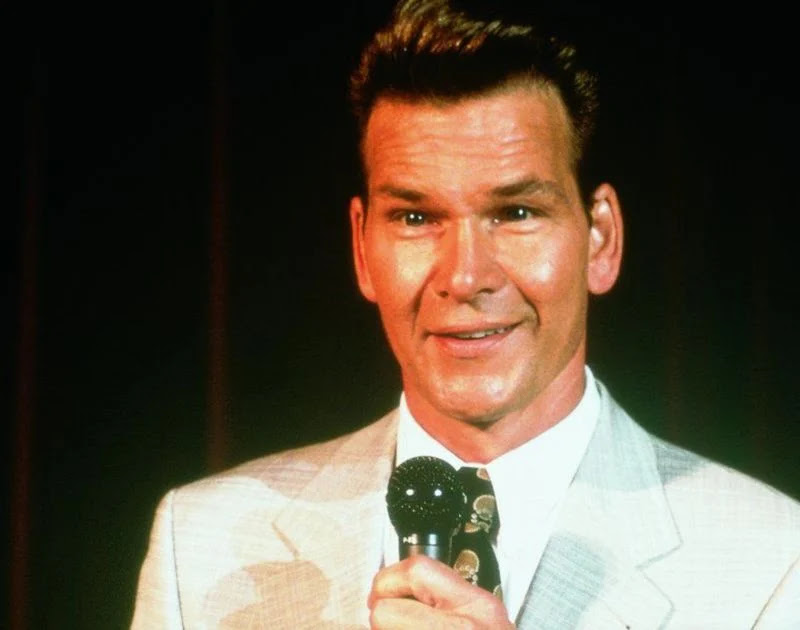
In a class, the health teacher, Kitty Farmer, an uptight person, doesn’t teach but plays videos featuring Jim Cunningham (Patrick Swayze) which focus on overcoming fear. There is an atmosphere of foreboding in this film right from the opening scene, followed by Donnie’s personality, the scary rabbit, and the airplane engine accident. (By the way, the movie Harvey deals with James Stewart’s character talking to a human-sized rabbit that is invisible to everyone else. This film is a dark version of that scenario).

Spooky Frank wakes up Donnie again and Donnie appears to be sleepwalking (sleepwalking is a kind of twilight area between waking and sleeping). This time he is carrying an axe. Later, the school’s mascot, which is represented by a large statue of a bulldog, has the axe buried in its head. And the words. “They made me do it,” are written in paint on the sidewalk. Since Donnie committed the vandalism, his free will seems to merge with the dictates of the supernatural that charts the destiny for everyone. However, his words also sound like what a schizophrenic would say. The danger surrounding his personality permeates the movie. He also uses the axe to flood the school by breaking a water main. Donnie fits in with the Greene short story since he is a destructor forcing change to occur.

Donnie gets to know the new girl at the school, Gretchen Ross (Jenna Malone). Since she has just arrived, she is an outsider, like Donnie. Her past adds to her lack of normalcy. Her father is at-large for having stabbed her mother and she and her mother changed their names and are in hiding. Donnie says he was once in jail for accidentally burning down a house, which shows his antisocial past, and a foreshadowing (there is a fire in the Greene short story, remember). She comments that his name sounds like a comic book hero. He responds by saying, “What makes you think I’m not?” He is being funny, but the dialogue adds to the unreal nature of the story, and points to Donnie maybe having special abilities. (If you have watched “the Big Bang Theory,” you know the talk about how comic book characters have alliterative names: Peter Parker, Bruce Banner, Clark Kent, etc. As IMDb points out there are many alliterative names in the film and references to comics, which contribute to the film’s imaginary worldly nature). Donnie shows his intelligence by helping her with an assignment. She comments that he is “weird,” and Donnie has heard this before and feels he is being dismissed; but, she tells him it was a compliment. This story inverts what most consider to be positive and negative. He says that if the school hadn’t closed their moment together here would not have happened. His comment suggests the idea of various timelines. The two quickly decide to be a couple since they are compatible in their nonconformity.

In another session with Dr. Thurman, Donnie repeats how he looks in many of his scenes. His head is bent forward and he looks up, unblinking. Jake Gyllenhaal said, according to IMDb, that he used this look to appear more psychotic. Thurman hypnotizes him, but even his subconscious is rebellious as he refuses to answer her questions, dwells on sexual topics, and is about to masturbate when she terminates the session.

At a PTA meeting, Kitty Farmer rants about the teaching of “The Destructors” because the young people in that book break a water main and flood a house. Since the police suspect that students may have been involved with the vandalism that included flooding the school, Kitty is connecting the dots. Teacher Karen Pomeroy defends her selection by saying the story is “ironic,” suggesting the tale is not a “how to” act piece. Rose questions if Kitty even knows who Graham Greene is, and Kitty reveals her ignorance by citing the TV show “Bonanza,” whose star was Lorne Greene. While the PTA meeting takes place, Frank again visits Donnie, telling the youth he got away with his axe-wielding actions. Donnie continues to take his medication which implies Frank’s appearance is real. Frank says he can do anything, and so can Donnie. The will of the one merges with that of the other. When Donnie asks where Frank came from, the crazy rabbit asks Donnie if he believes in “time travel,” which becomes what the movie revolves around.

Kitty is again teaching her class based on Cunningham’s videos. Donnie has a card that notes a hypothetical character finding a wallet. He is supposed to fit her actions onto the evaluation line that stretches between fear and love. Donnie complains how the whole exercise is meaningless because everything cannot be reduced to these two emotions. Later, in the principal’s office, where we learn Donnie’s test scores show him to be brilliant, Kitty reveals that Donnie, basically, told her to shove her exercise card up her ass. Donnie continues to be the defier of social convention.

Donnie asks science teacher Mr. Monnitoff (Noah Wylie) about time travel. He talks about wormholes, and then gives Donnie a book entitled The Philosophy of Time Travel, which was written by Roberta Sparrow, the strange mailbox lady, who once was a nun, and then a schoolteacher where Donnie attends. Her character is a merging of science and spirituality. Donnie relates to Thurman that Frank mentioned time travel and now he finds out about Roberta, so he concludes the linking of the two is not a coincidence. Donnie takes the “alone” part of the message Roberta whispered to him as meaning that it is absurd, given life’s inevitable solitude in death, to search for the existence of God, and thus, the general meaning of life.

Donnie is waking up from a nap in a chair in his house while his father and pals watch a football game. Donnie seems to be between the awake world and the sleep world most of this movie, and just like Edward Norton’s character in Fight Club, it’s difficult to tell whether or not he is in a dream state. He sees fluid-filled tubes coming out of Eddie’s chest, and also out of Elizabeth and himself. They point to where a person is going. In a way they are predictors. IMDb notes that director/ writer Richard Kelly got this idea from watching John Madden make illustrations of where players will go in a play. So, it’s appropriate that Donnie sees this effect while a football game is playing. Donnie follows his tube and it takes him to his father’s closet where he finds a handgun. As Anton Chekhov said, once you introduce a gun the writer better fire it later.

Donnie would like to kiss Gretchen since they have been going out for two weeks, but she wants it to be at a time that the world shows its beauty. She coincidentally mentions time travel now, stating her wish to be able to go back and replace troubling images with lovely ones. Even though they are in a beautiful park there is a “fat guy” as she puts it, watching them while smoking a cigarette. In this place, it is difficult to maintain the beauty Gretchen seeks. Donnie does not share Gretchen’s hope for that wonderful moment. The next scene is that of Dr. Thurman telling Donnie’s parents that their son is becoming more detached from reality because he finds life increasingly “threatening.” She recommends more therapy and medication for his schizophrenia. This scene is intercut with shots of Donnie using a knife to stab at Frank’s eye across an invisible force field that he seems to be penetrating. Is he trying to destroy his hallucination? Or, is he trying to cut across the barrier between the world we know and the one beyond?

Jim Cunningham presents his personal growth spiel to the high school students. He talks about a struggling individual named “Frank.” Could this reference point to Donnie’s own struggle? Cunningham says that fear is intertwined with premarital sex, smoking, and drinking alcohol. IMDb notes Donnie engages in all three in the movie, showing that he defies the restrictions on these temptations. Donnie gets to the microphone and admits to feeling lost and afraid (probably because of his loneliness), but he says Cunningham is “the antichrist,” a guy who is profiteering on the anguish of others, and not offering any real solutions.

Donnie tells Gretchen that what he has been seeing is described in Roberta Sparrow’s book, so he says what is happening to him is not random. He discusses his theory with Mr. Monnitoff that these tube-like projections show one’s destiny, and that are a way of seeing the predetermined future. The teacher says if someone could see his or her destiny, a person could then change it, negating predetermination. But Donnie sees, or wants to see that we are not alone, and that the future paths can’t be altered by individuals since they are part of God’s cosmic plan. Monnitoff wants to stick to science and not religious matters, implying he could lose his job if it appears that he is influencing a child’s faith.

Donnie now finds Cunningham’s wallet and knows where he lives. So, he is in the position of how to act that duplicated the exercise in Kitty’s class that was based on Cunningham’s teachings. Gretchen and Donnie do a presentation to the science class with illustrations about getting parents to put these glasses on their kids when they sleep. They call them IMG’s which are infant memory generators. Gretchen argues that pleasant images will be shown to instill positive memories in the children. Two guys say the nightmare of this dream proposal could occur if parents might show satanic visions, and they mention Gretchen’s violent father. It’s as if Gretchen wants to create a parental experience that would counter her own life events. Gretchen runs out of the school and Donnie follows her, apologizing for the boys’ statements. She then kisses him, maybe because she is realizing she shouldn’t wait any longer for a perfect moment to happen, since it probably never will.

Again, keeping with the Halloween holiday, Donnie and Gretchen go to the movies to see a horror film, The Evil Dead. But that movie is shown in conjunction with The Last Temptation of Christ. It is a foreshadowing since that movie deals with sacrifice to save others. Gretchen falls asleep. It appears Donnie may be nodding off also, and then Frank appears. Dream or reality? Donnie asks Frank, “Why are you wearing that stupid bunny suit?” To which, Franks says, “Why are you wearing that stupid man suit?” What is really below the surface? Is it man or beast? The lighter and darker sides of reality join here as Frank takes off his headpiece and reveals the eye injury that Danny inflicted upon him. Frank apologizes because he knows what’s coming. A portal opens and Cunningham’s house appears. Frank tells Donnie to burn it down.

Even the dance presentations of children for a Star Search competition show contrasting images. One girl awkwardly dances to an angelic soundtrack and then the performance of the young girls called Sparkle Motion (which includes Samantha Darko) is more rock and roll. Cunningham hosts the event, which we find adds a creepy element. The fire reveals a secret room, a “kiddie porn dungeon” in the house. The police arrest Cunningham. The fire, a destructive act, brings to light a horrible crime. The scene reminds us of the opposing movie titles on the marquee and suggests that there must be sacrifice to set things right. It also reflects what Donnie said about how the Greene story shows that “destruction” is a form of “creation.”

Kitty is not willing to see the facts and remains loyal to Cunningham (does his name show he is a cunning fellow, fooling others, another example of false appearances?), thinks there is a conspiracy to frame her beloved idol (the film showing relevance to current events). She will work to defend Cunningham, and, despite Rose’s animosity toward her, she asks the other woman to fly with Sparkle Motion for a competition. This request brings up the airplane aspect of the story.

Rose sees a calendar with an illustration of the scary bunny on it. The days are crossed off, which we know is the countdown to Frank’s “end of the world” prediction. Rose is concerned about Donnie and wants him to be okay. He asks what it’s like to have a “wacko” for a son. She says it feels “wonderful.” Her allegiance reminds us of how Gretchen feels about Donnie’s questioning mind.

In a session with Thurman, the hypnotized Donnie confesses to his crimes and says he must do what Frank says so he can figure out what is happening. He sees Frank (again as he crosses into dreamland) looking upward. Donnie says he must build a time machine. He says, “the sky’s gonna open up.” Here is another reference to the airplane and its missing engine.

There is one day left until Frank’s predicted day of death. Eddie is away on business and Rose is with Sparkle Motion. Donnie and Elizabeth decide to throw a Halloween party with their parents gone. Everyone is wearing a costume except Donnie, whose “man suit” is a costume hiding his nightmarish self. Gretchen arrives distraught because her mother took off. She says, “I guess some people are born with tragedy in their blood.” Obviously, she is a perfect match for Donnie. They make love while Rose does not receive Dr. Thurman’s phone warning about Donnie since the mother is away. There is also a call from Rose saying that she and the girls will be returning on a late flight. Later, Donnie has on a skeleton outfit, which shows the tragedy intertwined with his life.

Donnie sees those fluid tunnels again, which point to what will happen, and he knows that time is running out since it is one hour to Frank’s deadline. He and Gretchen go to Grandma Death’s place. He knows that time travel connects Grandma Death to Frank. Karen Pomeroy wrote on the board before leaving the school the words “cellar door,” which someone said were the best combination of words in English. There is a cellar door at the house. We are going below the surface again to reveal what hides in the shadows. The school bullies are there, with stockings over their faces trying to hide the nastiness underneath. They drag Donnie and Gretchen outside. One puts a knife to Donnie’s throat and Donnie utters, “Deus ex machina.” In Greek theater, the gods were supposed to reside above the stage and when the playwright wanted to resolve conflicts the “god” would be lowered in a box to dispense supernatural abilities. It has come to be a negative term to show resolution by contrived means. Here the film is playing with the idea, since time travel is the story’s “deus ex machina,” and that is why Donnie calls it the “savior,” which also recalls “Christ” mentioned in the film title on the marquee.

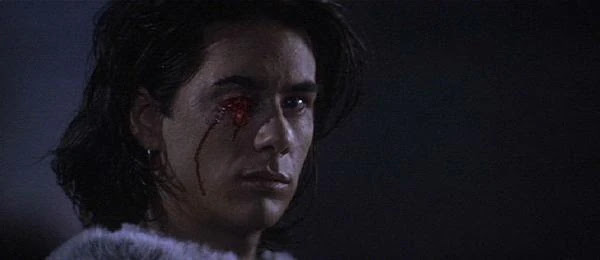
A car approaches at a high speed. Grandma Death is in the road, presiding over the events. Gretchen is thrown into the road and the car strikes and kills her. The car stops and turns around. The driver is Frank. He is wearing the scary bunny outfit. He takes his headpiece off. Donnie has his dad’s gun and shoots and kills Frank. Again, the site of the wound is the eye, a frequent symbol in films (Blade Runner, Chinatown, Bonnie and Clyde). Here, it can refer to the terrible visions that Donnie has been seeing. It’s as if the dead Frank came back through time to inform Donnie of the horrors that would occur.


Donnie takes Gretchen’s body with him to his house and kisses his sister goodbye. Donnie envisions dark clouds forming a time tunnel in the sky. He drives to where the film began on a hillside road. We hear Monnitoff’s words about all you need for time travel is a wormhole and a metal craft entering it. Donnie also remembers Gretchen saying that it would be nice to go back in time to make things better. The plane that Rose is on hits the turbulence of the time tunnel, and we see the engine going into the tunnel. Donnie also goes into the tunnel. He comes out laughing in his bed. He is not out of the house as before when the engine hits. He is killed this time.

Donnie wrote a letter to Grandma Death, saying that he hopes the answers to his questions “will come to me in my sleep. I hope that when the world comes to an end, I can breathe a sigh of relief, because there will be so much to look forward to.” He does get his information while asleep, and it is his world that comes to an end. Perhaps he is now at peace, and he may feel that he will survive in some spiritual form, and that those alive will lead good lives.

The camera glides over all the characters in the story, as the song “Mad World plays with the fitting lyric, “The dreams in which I’m dying are the best I ever had.” Those words could fit what happens to Donnie. Gretchen, who in this corrected timeline didn’t meet Donnie, is alive. She rides by on her bike, and exchanges a sad look with Rose, and a wave. It was a worthy sacrifice.

The next film is Lost in Translation.

Sunday, January 26, 2020

Seconds


SPOILER ALERT! The plot will be discussed.
If you haven’t heard of the movie Seconds (1966), which is very possible since it was a commercial failure that later gained cult status, you should check it out. It is a disturbing cautionary tale that foreshadows many concerns which people still worry about today. The title does not refer to time, but to an opportunity to have a second chance at life. But it also may signify being a glutton at the dinner table, wanting too much of a so-called “good thing.” Also, the title may suggest “secondhand,” which is a negative term implying something that is not new and thus inferior to the original condition.

Director John Frankenheimer specialized in paranoia conspiracy films (The Manchurian Candidate and Seven Days in May). According to movie critic David Sterritt, Frankenheimer did not view the 1960’s as an optimistic era, but instead worried about the “military-industrial complex” (of which President Eisenhower cautioned against), and “the danger of runaway technology.” Sterritt says in this movie, the director blended “horror, noir, science fiction … and an acid critique of American capitalism.” Frankenheimer said that an American Dream that was based solely on making more money was hollow and resembled more of a nightmare, which is what this film depicts. That mercenary outlook pushes one into wanting to “escape” those characteristics that made a person who he or she is. He said he wanted to present a “horrifying portrait of big business that will do anything provided you are willing to pay for it.” He also wished to show the dangers of a society that demanded its members to want to be “forever young” in its “advertising and thinking.” If one is only interested in physical and materialistic gratification, then one only wants more since there is no genuine satisfaction.


There is a face over the opening credits which is distorted, as is this tale about the desires of the world’s inhabitants who want more youth, money, and superficial success. There is gothic organ music in the background which adds an eerie, frightening feel to the visuals. The warped face ends up in bandages covering it, making the visage an image out of a horror movie. The face looks like a Halloween monster mask, possibly that of a mummy, which signifies death. But there is another human mask underneath as we discover that hides one’s true identity, which comments on the facades people erect to hide their true selves. 

Arthur Hamilton (John Randolph) is in a train station and the altered visuals continue as the camera jumps around while the commuters pass into view. Arthur looks despondent as he heads toward a train. His outlook makes him a possible customer for the company that offers a new life. A stranger approaches him and hands him a note before mysteriously leaving quickly. As Arthur is ready to settle back into trying to solve a crossword puzzle, a solitary activity, he pulls out the slip of paper that displays an address. He gets off at Scarsdale. He is a bank executive, whose career revolves around money. His suburban New York life is boring. His wife, Emily (Frances Reid), picks him up and their asking how each other’s day was is a banal exchange, with talk of gardening and their daughter’s successful marriage to a future doctor (financial success again being stressed). She wonders why he was pacing at two o’clock in the morning following a telephone call. He says it was a prank call, but his vagueness suggests that he was first contacted verbally before he received the note.
Later that evening, as Arthur stares at his telephone with the piece of paper in front of it, the phone rings loudly, startling him (and us). The man on the other end is Charlie Evans (Murray Hamilton), who the alarmed Arthur says is supposed to be dead. The man on the other end knows exactly what pictures are hung up in the study, and even how long the telephone cord reaches. He describes events only his friend would know, and mentions that Arthur scratched a note on the bottom of a tennis trophy that sits in the study. Charlie says to go to the address on the note just past noon and use the name “Wilson.” ("William Wilson" is an Edgar Allan Poe short story about alter egos which fits here). Charlie says he feels more alive than he has in the past twenty-five years and questions what Arthur is hanging onto. Arthur, however, is hesitant to do what his friend told him.

Later in their bedroom, Arthur is upset about Emily asking about the phone calls. That he is distraught is implied by the bottle of medicine sitting on his end table. They sleep in separate beds which suggests there has been no sexual activity between them for some time. She comes to his bed and asks him to see the doctor. She kisses him and looks as if she wants intimacy. But there is no spark in their kiss. He is distant and she pulls away, going back to her separate space.

At work, Arthur is paranoid about the presence of a man who entered the bank. He is distracted from his dull dictation involving a loan as he looks at the man. He stares at his phone, which has become an upsetting object. The film continually projects a sense of menace. Arthur decides to go to the address on the note. He must follow a twisting path to get to the Company, which is like going down the rabbit hole of a scary “Wonderland.” His passage through business locations adds to the story’s satire against worshiping capitalism. Sterritt says the laundry Arthur first visits suggests his wrinkled skin will be pressed so as to create a younger, more socially marketable appearance. It’s possible the steam may also symbolize the infernal fires of the hell into which Arthur is descending. Arthur already starts to pretend to be someone else because he must dress like one of the employees at a meatpacking plant so as not to draw notice (the meat company’s slogan states it’s the “used cow dealer,” a pun on a car dealership, but the words carry with them an ominous sense of death). Sterritt points out that the meatpacking establishment uses the same type of truck to transport animal carcasses, many of which are on display, as the one that transports Arthur to the Company. This observation would suggest that companies treat people the same as meat, to be reprocessed and sold for a profit. 
When he finally makes it to the Company, the picture on the wall of the reception room is one of a mother and child, which suggests birth, or in the case of this story, rebirth. Arthur accepts some tea, which turns out to be drugged. We again get close-ups magnifying his face, and the camera work attempts to recreate the dizziness that Arthur is feeling. The shots imply that the world he is entering is mentally unbalanced. The numerous close-ups of human faces stress how the horrors that occur in this movie are personal. Arthur seems to be having a nightmare (mirroring the real one he is in) where the walls and floors of a bedroom are distorted and a beautiful woman in a nightgown in a bed screams inaudibly. It looks as if Arthur is on top of her, implying that a rape is taking place. Arthur then wakes up sitting on the reception room’s couch. Upset, he attempts to leave, but like what might occur in a Twilight Zone episode, there is no button to push to summon the elevator, showing how he is incapable of escaping the situation he has become a part of. He goes into a waiting room that has many eerily silent men sitting at desks, looking as if they are killing (the word fits here) time. Arthur stops at one desk and the man sitting there seems surprised to see him. Arthur asks the man (who turns out to be the rejuvenated Charlie who called Arthur) how to exit the building. The man turns away without answering. A man looking like an orderly dressed in white enters the room, and after Arthur asks him how to leave, the orderly makes a call and tells Arthur he must return to Mr. Ruby’s office. One gets the feeling that the ghost of Franz Kafka wrote this scene, and possibly the whole movie (the screenplay is actually by Lewis John Carlino, based on a novel by David Ely).
Ruby (Jeff Corey) says he is there to talk about the circumstances surrounding Arthur’s death. Arthur is upset, and Ruby says the topic may be “indelicate” but must be discussed because of its complexity, which carries a high price tag. A chicken dinner is brought in for Arthur (a strange action during a meeting discussing one’s demise. Food in the context of the film is used to emphasize the unappetizing nature of what is happening). Ruby says the expense includes cosmetic surgery and getting a “fresh corpse” that will match Arthur’s “physical dimensions and medical specifications” so it can appear as if Arthur has died. Ruby says there must be an “obliteration” of the cadaver’s “identifiable” features before it is found, such as fingerprints and teeth. This tale is about wiping away that which makes people unique. Ruby says they “can’t leave anything to chance.” Arthur’s subdued response is, “No, I guess not,” which is a bit humorous, as if what is being stated is part of a rational, acceptable discussion. Ruby asks if he can eat the food Arthur declined, and, given what is happening in the story, the image suggests a beast devouring its prey. Ruby goes on to say that Arthur’s death must be “very carefully staged” so that there are witnesses and other evidence which will identify him as the one who is dead. 

Ruby presents different ways that may be used to fabricate Arthur’s demise and says that choosing how he will die may be the most important decision of Arthur’s life, which makes it seem as if living one’s life is not all that significant. Men enter Ruby’s office with documents that consist of Ruby’s will and a trust which ensure Arthur’s wife and daughter will be provided for. But there will also be enough money to take care of Arthur in his new life. However, in an ominous note that indicates how Arthur is delegating his freedom, the Company will be the trustees. Ruby offers a pen for Arthur to sign the agreement, and it feels as if he is making a Faustian deal with the devil, selling his soul. Arthur hesitates, and Ruby has the men show Arthur that they staged and filmed the bogus rape scene. So, the lock has been fastened on Arthur’s fate by way of blackmail. 

Ruby and the men leave, and there remains an older man, the Company Chief (Will Geer, who later was the grandfather in the TV show The Waltons and who acts grandfatherly here). As Sterritt says, the Chief is shot making his hat look like a halo around him. One might argue that he sounds as if he is recruiting his flock to enter the afterlife. The Chief says that Arthur’s friend, Charlie, wanted Arthur to know “that rebirth is painful,” most likely since it symbolically replicates one’s first traumatic emergence out of the comfort of mother’s womb into a much different surrounding. Instead of blackmail, the Chief calls the video “insurance” that makes it “easier to go forward when you know you can’t go back.” The Chief smiles and acts reassuring, but what is occurring is criminal, thus adding to the theme that appearances can be deceiving. 


The Chief presents the proposition that Arthur’s life is meaningless to him and others, and then allows Arthur to do the talking which presents the evidence that justifies what the Chief stated. Arthur has no proof to refute the fact that his relationship with his wife consists of habitual repetition with no humor or passion. His daughter lives far away and hardly communicates. He says he has friends but they are equated with the boat he uses in the summer, which stresses that people in his life are the equivalent of things. There is no emotion in Arthur’s voice, only a sense of regret. The Chief implies that the “dreams of youth” have been unrealized, which, unfortunately, is true for the majority of people. He goes on to say that Arthur and his family no longer need each other, and it’s “time for a change.” The close-up of Arthur presents a man who seems to be mourning his own life. The scene is shot with Arthur in close-up and the Chief in the background, and it appears like Arthur is making a confession to his priest. But, the religious reference here is ironic. 
As Arthur uses a pen to sign the contract, the next scene neatly segues into showing the doctors drawing surgical lines around Arthur’s ear, his face already covered, implying that he is disappearing. They look at annotated drawings of what they must do to transform Arthur. When Arthur is bandaged, and literally loses his face (“defaced,” as Sterritt calls it, which also carries with it the intent to wipe out the value of the original work) he also is in danger of losing his identity. The scars turn out to be physically literal and also psychological. There is a cut to an obituary which shows Arthur died in a fire, sort of a symbolic cremation, his past life having been turned to ashes.
Arthur is now Antiochus (in Greek means "unwavering," ironic here) “Tony” Wilson (Rock Hudson, in what I think is his best performance). He has had teeth replaced and a vocal cord reconstruction, and must heal before he can speak (which allows a new actor to play the role, both literally and as part of the plot). But the initial scars on his face remind us of Frankenstein’s monster, to emphasize that this is a horror tale. Tony starts to cry, and one could wonder if Hudson took this role to reflect his personal story of re-imagining himself as a straight leading man while hiding his gay orientation. 


Tony must heal and undergo physical therapy. He then meets with Davalo, (which sounds like the Italian word “diavolo” that means “devil”) who is his “guidance adviser.” (The actor, Khigh Dhiegh, is the same person Frankenheimer used as the brainwasher in The Manchurian Candidate, thus adding a chilling aspect to his presence here). From a drug-induced psychological assessment, another example of how the Company covertly controls Arthur/Tony, Davalo says that Arthur wished to be a painter (“Arthur” has the word “art” in it). Sterrett notes Arthur’s desire to be a painter contrasts with drawing surgical lines on him. The critic’s note suggests Arthur’s wish to create art contrasts with what the Company does to him to enhance their commerce. 

Davalo presents Tony with authentic documents from universities which show he studied art at prestigious institutions. The fact that the documents are real illustrates how powerful the Company is that they can acquire such validation. It is ironic that the papers are real, but Tony is a human forgery. Davalo has “evidence” that galleries displayed Tony’s paintings. To enhance the phony facade, Davalo says that they will furnish Tony with paintings on occasion to keep up the front until he adopts a painting style of his own. Because he will be able to show that he is a successful painter, Davalo tells Tony, “you don’t have to prove anything anymore.” These are scary words, because on the surface they sound as if Arthur already paid his dues. But, the statement also shows that with money and connections to technology, what is false can be made to appear to be real. The film here speaks to us today since technological manipulation of information in the media can blur the difference between lies and facts. Davalo also says Tony is a bachelor, and his parents are deceased. He is “alone in the world, absolved of all responsibility except to your own interest.” In this brave new world, caring about others is vanquished by the drive to satisfy selfish wants.

Tony flies to Malibu, California, which is where the Company has relocated him. We hear Davalo in a voice-over saying Tony will have what every middle-aged man wants, total “freedom.” The movie is addressing the male tendency to have a mid-life crisis, where there is anguish that youthful hopes for a grand, significant life most of the times made way for settling for a more downsized version of occupational and family success which entailed accommodations to others. As Arthur, he was not used to female attention. But now the pretty flight attendant seems to want to flirt with the handsome Tony. His reaction (which may covertly fit Hudson’s personal satirical take on the scene) is to run to the bathroom and pull out some pills. The scene also suggests that the Tony transplant is being rejected by Arthur. 


A stranger rushes up to Tony as he acquires his luggage at the airport, loudly calling his name and implying he knows him as an artist, possibly adding authenticity to his new persona. But, Tony is puzzled by this event since, despite his metamorphosis, the incident still feels odd. The quick scene also highlights the fact that Tony has no friends here. Tony has an expensive home with an artist’s studio. A man named John (Wesley Addy) says he’s there to assist him as a servant to make the transition for as long as Tony needs him to become oriented. John informs him that professional businessmen and writers live in the local community. But John says he thinks Tony is the only artist, which Tony hopes is true so nobody there can question his painting ability. Tony, despite his new appearance, is still very much the older Arthur, and is thus having difficulty shedding the outlook of his previous self.

John suggests throwing a cocktail party for the locals living there, but Tony feels he is not ready, which again suggests he is not yet comfortable in his new skin. He is unhappy with his early painting attempts, and looks lonely walking on the beach and eating alone. John pushes for meeting others, probably wanting the transplant not to be rejected, since a successful rebirth would benefit company business. But Tony impatiently resists. He is not sleeping, and looks unhappy. 

Tony meets a beautiful woman named Nora Marcus (Salome Jens) on the beach. She is alone, too, and at first looks like she wants it that way. As he starts to walk away, she calls to him and asks to walk with him. She then runs into the ocean shouting that she wants to ask the sea a question. Tony is still morose, not getting caught up in her exuberance. He asks what did she ask, and she says, “Who is Tony Wilson?” A very appropriate question for this identity blurring film. She says the ocean answered by telling her, “to mind my own business.” Her statement reflects Tony’s mood, but also makes him admire her insight, since he offers a tiny smile and keeps walking with her.

At her house, she shows Tony a picture of her family as she tells her story, which mirrors Arthur’s. She had all the comforts of an affluent family life, but was unfulfilled. She says she left four years prior, and sees her family occasionally, but the connection is not the same, because she is “different.” This admission connects with Tony’s outsider feelings. He says he understands, and she can’t believe he would, given his free artistic life. He says she doesn’t know anything about him. She says she does because she can see who he is by looking at his face. What an interesting statement, since it’s not his real face. But maybe his true identity somehow surfaces through the superimposed features. She says she sees “grace,” but it isn’t “pure.” She adds, “it pushes at the edge of something still tentative. unresolved, as if somewhere in the man there is still a key unturned.” She comforts him by saying what she said fits just about everyone. He warms to her “analysis” of his current alienation, and she strokes his new face. It is only later that we find that there is a reason why she knows him so well.
Tony asks Nora if he can join her at what she describes as a wild party in Santa Barbara to help to turn that “key” to unlock the prison of his self-imposed isolation. The gathering mimics a bacchanalia with loud celebrating, music, and wine drinking. Most of the people there are young and they strip off their clothes and jump into a huge wooden vat together to stomp on grapes to make wine. Nora, while drinking and hugging the still unsure Tony, says, “Now, in dying, Bacchus gives us his blood so we may be born again.” These words seem to mimic what happens in a Catholic mass, where the blood of Jesus Christ is supposed to open the door to spiritual, not carnal rebirth. The whole scene adds to the theme advanced by the Company of abandoning self-sacrifice for others to indulge selfish desires. 


Nora wants Tony to be a part of the ritual, but he feels like a stranger here, not a willing convert to this new life with people he does not know, which possibly reveals his continuing attachment to those he cared for and left behind. Nora takes off her clothes and joins the other naked people. The juice of the grapes that coats their bodies is like amniotic fluid and the vat resembles a womb that will give birth to a new life steeped in self-indulgent intoxication. Tony calls to Nora and wants the two of them to leave. However, the others pull off his clothing and throw him into the vat. Nora hugs him and wants him to kiss her. In a way she is the Eve of the bible who tempts Adam to join in the sinning through the partaking of physical satisfaction. At first Tony seems to be drowning in the juices, but then lets go and gives way to the physical temptations as he laughs and commits to the new life, repeatedly saying the word, “Yes!” The movie can be seen as a resurrection tale, but as it turns out, a demonic one. 

After breaking out of his reclusive existence, Tony now takes John’s advice and hosts a large cocktail party with Nora at his house. He is drinking and his intoxication, fueled by the pagan wine ritual, is reflected in staggering camera shots, not unlike what was used at the beginning of the film. This symmetry suggests that the loss of focus in Arthur’s life repeats itself in that of Tony. Interestingly, the wild Nora of the wine party at this moment sounds like a stereotypical suburban wife of the time as she chides Tony for consuming too much alcohol. She says the excessive drinking is “not like” him, which is true, since he is still Arthur, too. Her remarks imply that Tony has not progressed in his journey of reincarnation, and in fact he is being reintegrated into the same prescribed life, only with a different appearance. 

He takes Nora aside and says he will have her sexually later. Her kidding comment about Tony being a “dirty old man” stops Tony short, and the grim look on his face implies he is thinking about how he is still the aging Arthur underneath, which makes him feel pathetic. His smiling agreement that “Yes I am” a dirty old man is a sad confirmation of his past life. He explains that he needed the booze to give him courage to deal with meeting the residents of the community he has invited to his party. He says that he will behave, but then pours what remains of his drink onto the floor. Arthur then comes through and says he is sorry and that he has embarrassed her. She says no, and wants to get the party over with so they can have sex. She says she thinks she loves him, but he does not return the sentiment. Instead he says she is beautiful (stressing physical appearance), and jokingly calls her “evil” for her sexual ways, which is an odd word to use, and adds a disturbing feel to the scene.

Tony is in a conversation with Nora and another woman and a man. It is revealed that the man is a Harvard lawyer. Arthur almost surfaces as Tony says that’s a coincidence, but he is interrupted before he undermines the supposed art background of Tony by revealing Arthur’s education. The alcohol breaks down Tony’s inhibitions and undermines his ability to maintain a separation between his two identities. When the other woman calls the other man “two-faced,” Tony starts to laugh at the remark, because he himself is literally a man of two faces. The jokes about how California is the place where strange movements and cults thrive is satirized here. Tony talks to one woman who says she belongs to a group that routinely changes “sects.” It sounds like “sex,” but even with the idea of pursuing rotating systems of beliefs the interchange points to the lack of finding stability and anchoring oneself to a code of behavior. 

Tony continues to drink and when a woman asks what is his artistic process, he says he paints naked to get in touch with his primitive self, which is what happened at the wine party. But, his delivery seems to be mocking what he is saying. He spills a drink onto the questioner’s dress, and she and her husband are outraged at his unbecoming behavior, which again shows how even after the unrestricted behavior at the bacchanalia, he has not attained the world of total freedom that the Company promised. The film shows the attraction of unhindered actions, but also suggests that having no boundaries is not the way to go in a social environment.
Tony approaches a table where the attorney is with Nora and other men. Tony apologizes for interrupting, but nobody there is speaking, similar to the room of workers at the Company, which lends a surreal, inhuman element to the scene. When he starts a joke by saying, “Have you heard the one about …” they interrupt in robotic unison that they know it, without even hearing what Tony is about to say. It is an eerie restriction on Tony’s freedom of speech. When Tony starts to ask about where the lawyer stayed at Harvard, the group quickly disperses, as if questions about the past are forbidden. The drunken Tony follows the lawyer outside and says he was a Harvard alumnus, but just stopped being one since he became a painter. He starts to sing the Harvard school song. When the lawyer tries to shut Tony up, he suggests that they play golf. Tony exhibits fake shock that he the artist would play golf, but says Arthur Hamilton would play the game, thus letting his personal cat out of the bag. The others stare at him like pod people from Invasion of the Body Snatchers. Men carry him away to the bedroom as Tony says he has a nephew at Harvard. As they pin him down, we see their stern faces staring down at the prone Tony, like he was still on the operating table, being molded into something he is not. One man says Tony has no nephew, and if we haven’t already, we now suspect that this community consists of clients of the Company. Tony laughs and says “right,” but follows with the fact that he does have a nephew. And then he says the same about the existence of his daughter, and that he may be a grandfather now. John enters and confirms the fact that the others are “reborns.” Tony wails in tears at the revelation. Nora enters and tells him to stop crying and asks, “Who the hell do you think you are?” Thematically, it is a pertinent question, since the film questions what elements make us who we are.

Charlie calls the distraught Tony the next morning warning him of what he is doing about exposing the process. Tony says he has to get out, which is what he was doing the first time around. He says that Nora is a “reborn,” but Charlie says she is an employee of the company, a different sort of fraud, who was trying to make sure Tony would adapt and not reveal his secret. After hearing this ultimate betrayal, Tony is finding it difficult to trust anybody since authenticity is hard to come by. Charlie says the Company supplied Nora because the initial “adjustment” is a difficult process. Charlie seems afraid of what could happen to him, because the two men were connected in their prior lives. The suggestion is that if Tony is exposed, Charlie’s arranged death may be questioned, and he would be a liability for the Company. 


Charlie begs Tony to stay put, but we see him at the airport, trying to escape his life again. Reborns follow him to the airport, so we know Tony will not be free. Tony goes to his old house, trying to reconnect to the life that he undervalued. He looks around the converted living room and picks up a picture of himself as Arthur. There is a reflection of Tony in the glass covering the picture of Arthur, stressing his dissociative existence. He called Emily before visiting, and what follows is a strange meeting between a wife and a husband she doesn’t recognize. Perhaps the movie is suggesting how spouses over time begin to feel estranged from each other. 

Tony says he met Arthur just before he died to explain why Arthur never mentioned him. She is puzzled that Tony knows that the room they are sitting in was once a study, which reveals knowledge not usually shared in a recent acquaintanceship. He says he and Arthur talked about painting and he wondered if he could have one of Arthur’s watercolors that was stored away as a memento. She says the garage that housed Arthur’s paintings has been cleaned out, which is a metaphor for what has happened to his prior identity. Tony says that Arthur spoke a great deal about his house and his family. Emily is surprised, saying it wasn’t like him to do that. Her statement demonstrates how she knew that Arthur didn’t seem to have strong feelings about his life, or her in particular. Tony, through his disguise, is able to learn about what his wife thought of him which he didn’t realize when he was actually himself. 
Tony, using painting as a metaphor, says that he wants to have a detailed portrait of Arthur, but all he has are sketches and “lines,” (Surgical? Could the movie be implying that his genuine connection to “art” was cut out of “Arthur,” when he let the surgeons remove him from his old life. Also, maybe Frankenheimer is making a cinematic reference to bits of a character sometimes being left on the cutting room floor). Tony’s words indicate how he wants to understand himself through his wife’s perspective. Emily says that she mostly remembers Arthur’s quiet nature, his “silences.” She says that he seemed to be listening to a voice inside him, and wasn’t touched by anything. She says he lived like a “stranger” there who may have been upset about the life he “surrendered” to. She says that Arthur fought for what he was supposed to want, and when “he got it, he just grew more and more confused.” These lines show how the human spirit is prone to be an outsider, never satisfied with what it has been told should bring happiness. As she talks she stands in front of Arthur’s picture as if she is talking to him, which she actually is. She says that Arthur had been “dead a long, long time before they found him in that hotel room.” So, in essence, his soul died before his body supposedly did. As Frankenheimer does in his other movies, one person is in close-up here as we see the effect of the words of another character in the background. The only memento she can give him is the trophy he won in college that was used by Charlie to prove his identity. It somehow symbolizes a time in his life long ago when he felt he was happy and a winner.

Outside, John pulls up in a car, and says he is sorry. At this point, Tony is resigned to his fate, saying, “it doesn’t matter,” which can sum up his attitude toward his attempts at living so far. He tells John that he wants to go back to the company to kill off Tony and start again. He later says to Ruby that mistakes were made this time around, but Ruby first wants to know if Tony can recommend someone else who “would benefit by the company’s services.” Charlie had been the one to give them Arthur’s name, and the Company relies on a “word-of-mouth” means to recruit its subjects. Tony says he has to think about who he could suggest.

Company workers take pictures of his undressed body as Tony questions the procedure, which apparently is different from what happened during his prior surgery. The audience should be getting suspicious now. He is brought back to that same silent room filled with men. The attendant is putting pills in little paper cups, (Nutrients? Sedatives? It’s like a mental ward) to be consumed by those present. An attendant tells Tony to take a seat. Charlie is there, and seems to recognize that Tony is Arthur. Charlie quietly talks with Tony, revealing who he is. He confesses that he has been in that room waiting for a long time for the next body. Tony seems to have gained insight through his talk with Emily. He says he spent years trying to get “things” that he was told were important. How he should get meaning out of life, not possessions, and make connections with people should have been emphasized. He says in California, “They made the decisions for me all over again,” but the emphasis was still on getting the same “things.” Charlie, now called Mr. Carlson, sobs, and hopes that Tony is right when the latter says, “It’s going to be different from now on. A new face and a new name.” Tony doesn’t realize that running away from one’s self which is defined by one’s actions will not end well. A loud buzzer sounds and Charlie is picked to leave. 

In a contentious meeting with Ruby, Tony says that he doesn’t have anyone to offer as a recommendation for the company. Ruby accuses him of deliberately not cooperating, and Tony does not deny that. After Tony leaves, Ruby makes a call and says that they are ready to go “to the next stage” with Tony. Oh, oh. 
The Chief wakes up the sleeping Tony and says he had hoped Arthur’s dream would have come true. The bedroom, as does the waiting area, look like cells, which undermines the quest for freedom. Despite his being aroused from a sleep state, which incorporates dreams, Tony says maybe the problem was that he never had a dream of his own (except for the ones imposed on him). The Chief says that they keep trying to improve the process, but they had a significant failure rate, which is not what a company wants to divulge. Perhaps the significant number of unsuccessful reborns is because the emphasis was on superficial external changes and not meaningful internal ones. As Sterritt says, “the body is reborn but the spirit stays dead.” The Chief says he didn’t start the business for rich people. He really wanted to help everyone, and didn’t care about profits. But, the business grew, and then there was a board of directors, so the acquisition of money became foremost. He is basically stating what happens when corporations become so large and powerful that the welfare of clients becomes secondary.  
Men come in with a gurney and say Tony is being taken to surgery. But there has been no discussion about his new identity. They put him in restraints, so he won’t fall off, says the fake, grandfatherly Chief. As they wheel him away, Tony ironically keeps stressing how freedom is important at the same time he has been immobilized. A man is there who confirms Tony’s Protestant religious orientation. Tony starts to understand that the cleric is there to administer last rights. He thrashes about as he is gagged and given what turns out to be a lethal injection. He is now to be one of the cadavers used for the next fake death of another reborn. (Could Tony be the cadaver used for the fake death of Charlie's latest incarnation?) The words read by the clergyman speak of spiritual resurrection, and that is the only type of rebirth that is left for Arthur/Tony. The last sound we hear is that of the whirring noise of a cranial drill as the Frankenstein doctor is at it again. 

The movie appears to be saying that in a society that worships materialism and external appearance over intangibles, such as love and friendship, people themselves may be seen as objects, even as parts on an assembly line, or obsolete objects for disposal.

Next, controversy over the 2019 films Joker, Parasite, and Little Women.