Showing posts with label Stanley Kubrick. Show all posts

Sunday, April 12, 2020

The Killing


SPOILER ALERT! The plot will be discussed.
The Killing (1956), one of director Stanley Kubrick’s earlier projects, starts with a horse race, something to gamble on. One wants to make a “killing,” that is, to win big when betting on something. That is the legal variation on the definition. The illegitimate side refers to scoring a large sum of money on an illegal act. Of course “killing” may also involve the non-wagering reference to ending someone’s life. All of these meanings are presented in this film. The movie has a Dragnet narrator like Jack Webb in the old TV series, who supposedly is just telling you “the facts.” But, the voice-over adds stylistic embellishments at times in this story. The narration lends a documentary feel to the story, but it can feel intrusive, and Kubrick inserted it when the studio insisted upon it, according to IMDb.


Marvin Unger (Jay C. Flippin) doesn’t care about gambling, but places a bet on every horse in a race, which usually means a person will lose money. His action is the opposite of what a person does to test one’s luck and skill at predicting an outcome. But his action shows early on that he has the cash to bet on something else, a robbery that is in the works. He goes to the track bartender, Mike O’Reilly (Joe Sawyer), and Unger gives the man an address and time written on the racing program, which stresses that what they are attempting, despite planning, is a gamble. Unger then gives the winning ticket to the cashier, George Peatty (Elisha Cook, Jr.), which has the same information written on it. The narrator says that Unger saw himself as a small piece in a jigsaw puzzle that can only be understood when all the pieces fit together, and the complete picture comes into view in a “predetermined” plan, just like the plot of a movie. But the unpredictability of people and events shows another theory of the universe at work, that is Murphy’s Law, which says whatever can go wrong probably will go wrong. (As IMDb points out, Kubrick revisits the theme of humanity’s failure to control existence through technology in Dr. Strangelove and 2001: A Space Odyssey).

Earlier that day policeman Randy Kennan (Ted De Corsia) goes to a club where he sees an acquaintance, Leo (Jay Adler), a loan shark. Kennan owes Leo $3,000 but says he is broke. Kennan says he has something in the works that will pay out big, like a slot machine. So, Kennan is also one of the cogs in the mechanism, but the reference to a slot machine shows how unreliable gambling can be, no matter the strategy one uses. He wants a two-week extension, which Leo grants. 
The narrator introduces Johnny Clay (Sterling Hayden) as the “the most important thread in the unfinished fabric.” He’s actually the designer. It is another metaphor that implies things are coming together, like the assembling of a puzzle. But that which is woven can unravel. The name Clay implies someone who can mold things, maybe people and events. But, there is the possibility of a religious allusion, since being made of clay suggests fallibility. He is talking to his girlfriend, Fay (Coleen Gray), who he helps dress, suggesting they had just slept together. He says how the men he has assembled don’t have any criminal records, which makes them difficult to investigate. He says, “They’ve all got jobs. They all lead seemingly normal, decent lives. But, they’ve got their problems and they’ve all got a little larceny in ‘em,” Thus, they are capable of illegal activity. Clay uses the word “seemingly,” and there is a theme in the film that appearances can be deceptive.

He notes that Unger owns the building Clay is staying at so he can run the operation from there. Unger is also a bookkeeper, which is one of those legitimate jobs Clay spoke of. Unger handled money the socially accepted way before now. But, he is using his capital in an illegal manner here, like Leo, the bookie, which shows how one can easily cross the line from abiding by the law and breaking it. Fay has known Clay since they were young, and has been waiting for five years for him to get out of prison. He says that people get locked up no matter what the crime, so one should go for the big score. His words may comment on how the justice system isn’t very just, if petty crimes are severely punished. But, he may also be saying that getting locked up is a terrible experience to endure, so one should take the risk of getting imprisoned for something worthwhile. She says he was locked away, but she felt “locked out.” She has low self-esteem, and says she isn’t pretty or smart, so she is all in, to use another gambling phrase. When it comes to Clay, she will “go along with anything” he says. (Their names even rhyme, showing the couplet connection between the two). He seems to really care about Fay, and wants her to stay away except to make a plane reservation (the getaway), and to tell her boss she is going away to get married, which is the couple’s intention. He reassures her that “Everything's gonna be alright,” but this turns out to be a promise that can’t be relied upon. Unger arrives and reassures Fay that there’s “nothing” he wouldn’t do for Clay, which resonates later in the story.
Earlier, O’Reilly the bartender, comes home to his wife, Ruthie (Dorothy Adams). She is asleep and there are medicines next to the bed, so his motivation is that he needs money to take care of his spouse. A little later Peatty, the racetrack cashier, comes back to his apartment. Sherry (Marie Windsor) is his wife, and she is very attractive, and one would think would be out of her husband’s league. She knows that, and as she leisurely lounges while reading a magazine, she is condescending and sarcastic to Peatty. He says his stomach isn’t feeling well (anxious about the robbery?), but she says maybe he has a hole in his stomach that matches the one in his head. She orders him to make her a drink because she is starting not to feel well, implying his presence makes her sick. He tries to tell her he observed a couple that were sweet to each other, suggesting how that is the way a husband and wife ought to be. She continually interrupts him and gives him odds, “seven to five,” that she knows how the story ends. Here is another reference to gambling, trying to use one’s knowledge of the past to take a chance on predicting the future. She is very witty in her comments, which is consistent with film noir dialogue. She basically is telling him he is giving her a headache, but then says, “if people didn’t have headaches, what would happen to the aspirin industry anyway?” He wonders why she married him, and she reminds him that he promised her a lavish lifestyle. When he says he will be coming into a large sum of money, she says he hopes he put the right address on his letter “to the North Pole,” equating his hopes of getting rich with the chances of having Santa Claus granting his wish (in other words, the odds are bad here). However, she knows he doesn’t lie to her, and she manipulates him by implying she will go out and possibly be unfaithful to him until he gives in and she gets him to tell her what he is up to. At this point, we don't hear the operation’s details, but we do know that telling them to Sherry is risky. The relationship between these two contrasts with the mutual affection between Clay and Fay. 

While Peatty goes out to meet with his co-conspirators, Sherry is also involved in another type of unethical arrangement. She visits Val Cannon (Vince Edwards), obviously the man with whom she is having an affair. (Does his name suggest his power and danger?) In this relationship, Cannon appears to have the leverage, as Sherry questions why she couldn’t reach him and notes he is out a great deal. He says he is his own man and doesn’t like being questioned about his activities. She says she loves him, so now she is the one wanting attention, although he suggests that she isn’t honest with him either, saying she told him she went to an afternoon movie and came home late at night. Again, appearances may be inaccurate as she may have another lover, too. There is some stylized dialogue here, as she shows she enjoys the passion between them. He tells her not to be greedy, but she says she is a “glutton” when it comes to him. He says it sounds like she is “going to eat” him “alive.” She then says she just might do that. She is the femme fatale character here, and the linking of eating and sex demonstrates the need to satisfy primal appetites, with her sounding almost like someone capable of devouring others. 

There is a break, which suggests the two were intimate between the scenes. Sherry tells Cannon that he found out from her husband that he's involved with a gang to rob the racetrack where he works. She says she has been preparing to leave her husband (although Cannon says she has been saying that for a while, so maybe she has been stringing him along). But now, she says she wants Cannon to get Peatty’s share after the heist. But, Cannon (the big gun) is thinking on a larger scale, wanting to find out more so he can rob the robbers. Sherry found the note containing the address of the meeting, which they can use for their purposes.
The meeting takes place between the men as they discuss the project. (The influence on Quentin Tarantino’s Reservoir Dogs is evident in this film, not only in this scene where the perpetrators gather, but also, according to IMDb, in the non-linear plot). Clay says there are two more men that the others don’t know about but who are reliable and who will receive flat rates as they don't know about the details of the job. They still will be taking chances (gambling?) as to how well these other two men perform their tasks, one starting a fight, the other using a gun, and keep their roles secret. Unger is footing the bill up front and Clay hopes for a two-million-dollar payoff. Clay is meticulous and knows about the security involved. But as he ticks off all the blocks, his flow is interrupted by a sound at the door, which of course means there’s always that monkey wrench someone is ready to throw into the machinery. 

Clay goes to investigate. The other men hear a brief struggle and a slap. They find Sherry unconscious. Peatty acknowledges that it’s his wife, but despite threats, and Kennan smacking him, he lies by saying he told her nothing. Kennan gets off a good sarcastic film noir line by saying Sherry is really just the building inspector “measuring the keyhole.” The tear in that “fabric” the narrator noted is starting to open up. Kennan is the only one that strikes Peatty, showing his impulse to harm others. Peatty covers up by actually guessing that Sherry found the note with their location, but then makes it seem like she was checking up on him to make sure he wasn’t cheating on her (quite a reversal of the truth). Clay orders Kennan and O’Reilly to take Peatty home. Clay tells Unger to take a walk while he interrogates Sherry. This is one of the incidents that makes Unger feel useless except for the money he is contributing to the heist. Outside, Cannon waits in a car with another man, as the kinks are starting to appear in the plan.
As soon as she wakes up, Sherry, instinctively, puts her femme fatale tools to work. Clay compliments while he threatens, saying she has a pretty head on her shoulders, and it would be a shame if it were knocked off. She sees that he is interested and says wouldn’t it be better if her head was on his “shoulder.” She seems to corroborate her husband’s story, but Clay isn’t buying it. He knows, given her looks and Peatty’s mousy character, that she couldn't care less about the possibility that her husband was unfaithful. He says to her, “You’re a no-good nosy tramp.” But, he sees she is cunning and is right when he says he can “read” her “like a book.” He knows she’s interested in money and says she has “a great big dollar sign there, where most women have a heart.” He says that if she keeps her mouth shut, she’ll get her husband’s share. Clay knows Peatty will only keep enough money for a cheap cigar and spend the rest on her. Sherry shows the extent of her selfishness when she says she won’t even let her husband have the cigar. She’s like a monetary vampire. Clay says if she talks, they won’t pull off the job, and she’ll get nothing. She tries to seal their deal with a kiss, but he backs off, resisting her seduction, and tells her to leave. 

Sherry isn’t just Peatty’s Achilles’s heel, she stretches his weakness all the way up to his head. He is talking to Sherry back in their place, while she applies cosmetics to her face, like a carpenter sharpening the most efficient tool. He questions the intentions of his cohorts, given the way they turned on him. He shows his lack of self-respect when he asks what Sherry was really doing at the meeting, knowing full well she knows no other woman would take an interest in him. He is also worried that something happened between Clay and Sherry. His insecurity matches that of Fay, which causes both of them to allow the stronger partners to have control over them. Sherry dismisses his fears, saying that his partners wouldn’t hurt him or her because of his job at the racetrack. But he is too upset and says he’s dropping out. She urges him to stay part of it, and says that if he quits it shows he doesn't really love her. He’s her puppet and she knows how to pull his strings. She gets him to believe that she will always love him with a mind-blinding kiss. He agrees to not withdraw from the robbery. 
The narrator says it’s three days later and Clay is making “the final preparations.” He is at the Academy of Chess and Checkers, suggesting the moves and counter moves needed to win not only games of strategy but also contests between criminals and the law. He meets up with Maurice (Kola Kwariani), who is barking at the shortcomings of two men playing chess, revealing that Maurice knows how to play the game, but the movie shows that skill isn't always enough to win at life. Maurice is a bit of a philosopher and tells Clay that safety is in “mediocrity,” and Clay hasn’t learned that. He says for most of the world, “individuality is a monster and it must be strangled in its cradle” so that the rest of society feels unthreatened by the superiority of certain talented people. Maurice likens artists to gangsters, probably because they challenge restrictions placed on those with exceptional ways of expressing themselves. He warns, “They are admired and hero-worshipped, but there is always present the underlying wish to see them destroyed at the peak of their glory.” The implication here is that those that think outside the box are admired but also envied and feared by those living inside that box. Clay wants the burly Maurice to start a fight with the bartender O’Reilly to distract the racetrack cops. Maurice wants a piece of whatever the enterprise is, but Clay says the $2,500 is enough to keep Maurice in the dark and assure him of a relaxing time for his brief jail sentence for disorderly conduct if used wisely. Maurice accepts the offer.
Clay then visits Nikki (Timothy Carey) to hire him as the gunman. Nikki lives in a secluded, run-down place which shows his poverty. But at least he doesn’t get into trouble there, he says. It does not stop him from being interested in what Clay has to say. Nikki lets Clay try out a high-powered rifle, and he provides targets to practice on. Yet this peddler of violence carries a cute little puppy, possibly an ironic touch. Especially since his job is to shoot the favorite horse in a high stakes race from a somewhat remote location. The idea is to not have the favorite win so the racetrack won’t pay out on bets because the race will be invalidated and there will be more cash on hand to steal. Also, there will be a major distraction. Clay convinces Nikki the $5,000 is worth the risk.

Clay rents a cabin from a friend of his roommate in Alcatraz. Four days later, the day of the robbery, Sherry is acting nice to Peatty to encourage her husband to follow through on the heist. But, she is also working an angle to get Peatty to not trust Clay so she can keep a hold on her power to manipulate him. She implies that Clay forced himself sexually on her, as she tugs on those puppet strings that control her husband’s jealousy. 

The narrator offers a possibility that this day may be Clay’s last, which adds to the theme of the unpredictability of events. He visits Unger and tells him everything is in place. He does, however, allow for the possibility that things can go sideways, so he tells Unger the same thing he told the others, that is, to keep silent. Unger says he wishes he could do more and says he sees Clay as being like a son to him, and tells Clay he’s had bad luck and maybe made a few mistakes, but he can start new after he gets his share of the money. He tells Clay he will have a rich and fulfilling life afterwards. (To make sunny forecasts is foolish, since the film is saying that predictions are unreliable in a chaotic world). Even though Clay says they won’t see each other after they split up their stash of cash, Unger says he wishes that the two of them could go off together. One gets the feeling that Unger has led a lonely, boring life and participated in this caper for some excitement and a chance to connect with Clay. Unger also seems to warn Clay that getting married can be risky because it is difficult to find the right person to share life with. He sees Fay as his competition (could there be a gay attraction subtext at work here?). The offer of the two of them sticking with each other is dismissed good-naturedly by Clay. He just smiles and rubs the older man’s head, as Unger looks sad as Clay leaves.
Clay confirms his reservation at the airport for him and Fay. He goes to the florist to pick up a box that will hold the rifle he received from Nikki. He tells the motel operator that Kennan will drop off a “bundle” later. He then puts the flower box containing the rifle in a storage locker at a bus station. Clay then puts the key to the bus locker in O’Reilly’s apartment mailbox. 

O’Reilly is very attentive and sweet toward his sick wife, urging her to eat her breakfast to keep her strength up. He says someday they will have a nice house and she will get the proper medical care (another wish that will not be granted). Their love is seen in details as he promises to bring home magazines to read and she says he should not drink too much beer when he has a get-together with some friends later that day. All of these men are trying to fix what has gone wrong in their lives and there is a tender side in each of them, except possibly the one who should be the most caring about others, the cop Kennan. But they try to rectify their lives at the expense of the laws that are supposed to protect others.

O’Reilly takes the key from his mailbox and goes to the bus station, picks up the flower box, and takes a bus to the racetrack before starting his bartending shift. As he tells fellow workers in the locker room that the flowers are for his wife, Peatty is in another row pulling a handgun out of his lunch box, (another deceptive container) which shows he has plans of his own, derived from the lie that Sherry told him. Another seam opening up in the fabric of the scheme occurs when a drunk Unger appears and approaches O’Reilly’s bar counter. Kennan calls into the precinct to say his car radio isn’t operating properly so he’ll have an excuse for not being reached. A woman approaches his police car asking for help, saying people are trying to kill each other. Kennan ignores her and coldly drives away, showing his lack of caring about anybody but himself, but also demonstrating how the plan’s timetable has priority over other people’s lives. 

Earlier in the day, Maurice tells the man running the Academy of Chess and Checkers to call a number if he does not return at a designated time. When the man asks about the mysterious request, Maurice says with a smile on his face that asking questions is like looking into the sun for too long and becoming blind. It is said as an anecdote, but it is really a threat underneath the pleasant surface, just like the rifle inside the flower box, and the seemingly meek Peatty. There is a suggestion here that when humans try to control their fate because they are arrogant and fly too high toward the realm of the gods, they will be like Icarus, and will fail.

Maurice and O’Reilly start their fight and Maurice draws all of the guards to take his beefy body away. While the security force leaves their office to stop the fighting, Peatty allows Clay to sneak into the area reserved for employees only. Nikki shows up at the parking lot where he’s supposed to shoot the horse. Even though the lot is closed, he convinces the parking attendant (James Edwards) to let him park there and watch the races because he is a wounded war veteran, and he gives the man a good tip. He is nice to the man after finding out the attendant served in the military. But the fellow keeps coming around, telling Nikki how he appreciates the way Nikki treated him. In order to get rid of him Nikki tells the man harshly to get lost and uses the “n” word since the man is an African American. The attendant had brought him a horseshoe for good luck, another reference to gambling and how nothing is a sure thing. After the ethnic slur, the attendant angrily leaves, throwing the horseshoe on the ground, possibly signifying that Clay’s chances of success are dwindling. Nikki gets off his shot, but he has trouble backing up his car. A security cop, one of those variables not accounted for, shows up and shoots Nikki, killing him. The horseshoe had punctured the tire of his car as it ran over it, demonstrating the bad luck now affecting the crime. 


Clay retrieves the rifle from O’Reilly’s locker and puts on a clown mask, but there is nothing funny about Clay’s true intentions beneath the harmless surface. (Earlier, when the men discover Sherry outside their door, Kennan calls Peatty a “clown”, implying he is a fool. As the story unfolds, Clay turns out to be the real clown for trying to pull off this heist, and the joke is on him). He enters the room where the money is and gets the employees there who have no security to protect them to give him the cash. He makes them stay behind another door, takes off outer clothing, and has a different set of clothes underneath. (Appearances again are deceptive). He hides the removed apparel, his mask, and the gun in the large bag holding the cash and throws the bundle out of the window where Kennan is waiting to retrieve it. However, when Clay exits the door leading out to the public area, a guard stops him, another unexpected occurrence, and Clay knocks him out and blends into the crowd. 

The men are waiting for Clay at the agreed upon time and place following the robbery. Kennan dropped the money at the motel where Clay was staying so it wasn’t in the cop’s patrol car when he went back to the police station. They hear on the radio that two million dollars was stolen from the track. Peatty complains that the punctual Clay is strangely late for the dividing up of their shares and walks into another room for a drink. Then Cannon and his pal show up with guns, as they know about the plan from Sherry. Peatty comes in with the gun we saw earlier in the locker room. He shoots Cannon, guns then go off, and everyone gets killed, except Peatty, who is seriously wounded. 

Clay was late because of traffic. He goes to the wrong cabin at the motel before correcting himself. The incident shows how even the cool Clay can be shaken and is making mistakes. When he arrives at the meeting place, the shooting has already occurred, and Peatty stumbles out, bleeding, as he goes to his car. If it wasn’t for an unforeseen event, the traffic, Clay could have been on time for the meeting and might have been killed, too. It’s just another factor that couldn't have been taken into account, and just happened by chance. There was an arranged consideration among the robbers that if anything didn’t go as planned, then whoever had the money should hold onto it. Clay drives away and buys a large suitcase which he stuffs with the stolen money. However, the key doesn’t lock the bag, another glitch in the machinery. 

Peatty arrives home and asks why Sherry double-crossed him. She starts to lie, then drops the pretense, saying he should have just let things play out, and he better go away because she is expecting Cannon. When he asks her to get him an ambulance, she cruelly tells him to leave and get a cab. Peatty shoots and kills Sherry before he dies, so her scheme also ends in failure.


Fay greets Clay at the airport. There are cops there staking out the area to see if anyone suspicious is trying to leave following the robbery. When the couple go to check in under assumed names, Clay runs into another unexpected problem. The bag holding the money is too large to be carried into the passenger section of the airplane. Clay is now very rattled and has to let the airline check the bag. There is a woman with a dog on the tarmac waiting for her husband and the dog unpredictably jumps out of her arms and causes the man driving the luggage tram to swerve so as not to hit the animal. The dominoes keep falling as these unexpected events lead to the unlocked cash bag falling off of the vehicle, spilling the money all over the ground, and the wind blows the loot around the area. Clay looks like he has been blind-sided, and Fay tries to lead them out of the airport. But, she can’t even get a cab to stop for them (another stumbling block) before the police hear from an airline employee that the bag of money belongs to Clay standing just outside the doors. 
Fay tells Clay he has to run. He stays still as the cops come through the doors. His comment is, “What's the difference?” The film appears to be saying that no matter the effort, trying to impose one’s order onto a world filled with multiple, incalculable possibilities is a fruitless act.

The next film is The Asphalt Jungle.

Sunday, November 4, 2018

Paths of Glory


SPOILER ALERT! The plot will be discussed.


Director Stanley Kubrick’s 1957 film that is set during WWI is his first great work, and points to the techniques and themes he would later use in satiric masterpieces on men and war.

The film is shot in black and white which helps to stress the grim state of warfare and the fate of the soldiers made to fight for the questionable honor of their countries. The opening of the movie has the French national anthem playing in the background, but the drum pounding sounds are loud, almost brash, which suggests a patriotism that has been distorted. There is a voice-over narration which sets the scene. The action takes place in France in 1916, which is two years after the start of hostilities between France and Germany. The “battered” French pushed the Germans back from the Marne River after their quick advancement against the French Army. The front was stabilized and turned into trench warfare for “two grisly years,” with little change in the positions of the two military forces. The narrator says, “Successful attacks were measured in hundreds of yards, and paid for in lives, by hundreds of thousands.” From this statement, we see the futility and lethal nature of warfare, as large numbers of soldiers are sacrificed to gain small patches of land for their countries.


General George Broulard (Adolphe Menjou) arrives to meet with the local commander, General Paul Mireau (George Macready), who set up his headquarters in a sumptuous French chateau. Broulard comments on the lovely accommodations and Mireau says he tries to create a pleasant atmosphere in which to work. An ironic statement, considering his “work” involves sacrificing his men to kill others. Broulard’s statement about how he wishes he had Mireau’s taste in carpets adds to this feeling of a disconnect between the military brass and the men fighting the battles. Broulard says they want to break through the German lines by capturing “the Anthill,” a German stronghold, which is key to the German defenses in the area. The insect name of the hill implies that it is something insignificant when measured against the loss of human life to capture it. Mireau says it’s out of the question and thinks trying to do it in a couple of days is absurd. He says that his division is in pieces now. Broulard tempts him by saying he would get another star and a promotion to a better assignment. Mireau says his reputation and commitment to his men are more important than his ambition. But this is all surface nobility, what he’s supposed to say as a father figure to his men. Once Broulard says maybe Mireau’s men aren’t capable of accomplishing the objective, it seems like a challenge and a questioning of Mireau’s leadership abilities. Mireau changes his stance that the mission is impossible and now says, “We just might do it.” As they speak, they walk around the large room, which emphasizes its majesty, but also shows how small these men are that have somehow gained the power to send hundreds of thousands to their deaths. The institution of the military, and later religion, seem to take on a life of their own and everyone is manipulated by the organizations' stagnant procedures.


We then get a shot through an opening in the earthen trenches, a far cry from the luxury of the chateau. Mireau walks among the men and his phony patriotic words about being “ready to kill more Germans,” and saying to a soldier that his mother must be “proud” of him, give little comfort to the serviceman whose face and voice appear and sound defeated from enduring the carnage. Mireau repeats the same lines as shells explode close by, the sounds of the death-dealing weapons deflating his presenting war as glorious and heroic. (IMDb points out that the title of the film comes from the line, “The paths of glory lead but to the grave,” from Thomas Gray’s “Elegy Written in a Country Churchyard.”). Mireau then comes to a soldier who doesn’t respond right away and seems confused about whether he has a wife. He then breaks down and says he won’t see his wife because he is going to get killed. Another soldier says he suffers from shell shock. Mireau, who has a scar on his face and at least once was in battle, shows how he has forgotten what war does to a man as he rose through the ranks when he says there’s “no such thing.” Mireau slaps the soldier and says the man is acting like a coward. He wants the man transferred out before he “infects” the others, characterizing the man’s suffering as a type of communicable disease that must be stopped, instead of understanding the nature of his condition. (This episode is echoed later in a similar scene in Patton). From a stylistic perspective, Kubrick uses the first of several narrow tracking shots as Mireau moves through the trench. If the men are going to take the Anthill, then they are used as warrior insects and the trenches are their trails. The effect is claustrophobic, compared to the large, airy chateau room. Kubrick’s style here seems fresh, new, pointing to the future of experimentation in filmmaking.


Mireau visits Col. Dax (Kirk Douglas). The general acts like he doesn’t want to sit, saying he’s not comfortable behind a desk. He’s trying to come off as if he’s not a bureaucrat, but is still an active fighting man, which is just posing. Mireau says a soldier behind a desk is only worried about small things, like a mouse running up a soldier’s leg. Dax, preferring the mundane over the self-destructive nature of men who thirst for the deluded glory of war, and showing he is capable of wordplay, says, “If I had the choice between mice and Mausers, I think I’d take the mice every time.” They look through a scope to see the Anthill, and Mireau says he has encountered more formidable objectives. His downplaying is invalidated by more shells exploding right next to them. He calls the objective “pregnable.” Mireau makes it sound as if a battle to take over a spot of land is similar to having a romantic conquest. Dax says Mireau’s speech is like saying something about “giving birth,” which is usually about producing life, but here war is the midwife delivering death. (Kubrick will brilliantly draw connections between the sexual urges of men and their desire to wage war in Dr. Strangelove). Mireau says Dax is clever, and we learn that Dax was a respected lawyer before entering the military, and this bit of information sets the stage for the trial to come later.

Dax had several casualties in a previous battle, but Mireau’s executive officer, Major Saint-Auban (Richard Anderson), says, with a condescending tone, their defeat was “a kind of animal thing,” because they acted like less evolved animals, subject to the herd instinct, bunching together, and making themselves vulnerable. Dax, understanding what a soldier experiences, counters by saying it was “kind of a human sort of thing,” to do so, as their lives were threatened, and they sought protection. As characters speak, there is machine-gun fire in the background constantly, implying that there is no escape from danger here. Mireau, despite the extreme probability of defeat, says that Dax’s men will storm the Anthill the next day. The general coolly provides the percentages of men who will get killed by friendly fire, going through “No-Man’s-Land,” (the area between the two military forces), and as they approach the barbed wire defense lines. He acts like it’s their job to “absorb” shrapnel and gunfire so others can get to the goal. He sounds like an accountant spouting statistics involving numbers, not people. Dax says that half of his men will die. Mireau, not showing any empathy, says the losses are “regrettable,” but they will have obtained their objective, which is their duty. Dax quietly objects to not needing to have the French flag waved in front of him to make him charge into battle like a patriotic bull. Dax says that Samuel Johnson had a different view of patriotism, calling it, “the last refuge of a scoundrel,” emphasizing how some put on a disguise and drape themselves in patriotic fervor to get what they want. Mireau threatens Dax, saying he needs his enthusiastic support, or else he must relieve him of his command. Dax, not wanting to abandon his men in the inevitable battle to come, says his soldiers can take the Anthill.


Three men are assigned to do reconnaissance in preparation for the assault. The men are weary and the leader, Lt. Roget (Wayne Morris) has drunk too much to adequately deal with the mission. He and the other men, Cpl. Phillipe Paris (Ralph Meeker) and Pvt. Lejeune (Kem Dibbs) look like ants, insects ruled by the hive, as they crawl toward the appropriately named Anthill. Drums in the background again reinforce the rhythm of troops marching into war. Dead bodies litter the battlefield, which looks like an open grave cemetery. Roget is a coward, and incompetent. He breaks up the night patrol, which is not a good strategic idea, since it’s difficult to see comrades at night. Roget gets scared and runs off. Paris discovers Lejeune’s body which has steaming smoke emanating from it like he was burned in hellfire, which backs up the saying that “war is hell.” Back at the camp, Paris accuses Roget of cowardice which resulted in Lejeune’s death. Roget, only thinking of saving his own skin, threatens Paris with charges of insubordination and threatening a superior officer. Col. Dax shows up and Roget lies, saying that Lejeune started coughing, thus drawing the attention of the enemy and almost getting the other two killed.

Dax tells his men about the assault on the Anthill the next day. The fact that the weather prediction is for sun all day, making it easier to be seen by the enemy, shows how even the weather adds to the odds of success being against them. We never see any enemy soldiers, which implies that the French soldiers don’t really know who the enemy is, only that they are told by their superiors that they must kill these “others.” After we see how their own commanders treat the men, the audience may well question if leaders such as Mireau and Broulard are just as lethal to soldiers as those shooting at them from the other side. Dax informs his men that they won’t receive backup until the end of the day, which demonstrates how the military is not concerned about its infantrymen and will not waste its artillery shells until after the task is accomplished to capture the Anthill. The men begin to accept that they will die in the battle and what’s left to talk about is whether it’s better to be killed by a bayonet or a machine gun, the latter being quicker. One soldier argues that everyone is mortal, so people are more afraid of getting hurt and suffering rather than dying; it’s the manner of demise that we are afraid of. The other soldier says it doesn’t matter how one dies, everyone is afraid of dying. In the face of such a dire situation, all hope is lost, and morbid conversations are all that remain.


On the morning of the battle, the commanders drink cognac, toasting themselves as they hope for victory, but their lives are not at risk. The cut to the trenches shows a different atmosphere, one of dread, as explosions bombard the ears of the soldiers. They huddle against the sides of the trenches as Dax grimly walks among them. The wide-angle tracking shots suggest being caught in a hellish, inescapable maze. The infernal vision of the trenches contrasts with the opulence of the general’s chateau. There is a countdown as to when they will charge, like a countdown to death. Dax leads the assault. As he moves forward with his rallying whistle, men die all around him. Back at command headquarters, Mireau yells that the men are not advancing, and that they are cowards. He orders artillery fire on his own positions to spur his men forward, but which makes him the real enemy, a traitor to his own soldiers.  The Battery Commander, Capt. Rousseau (John Stein), says he can’t carry out such a command unless the general takes official responsibility by writing and signing the order. Mireau relieves Rousseau of his command. Dax tries to get his men who sought refuge in the trenches to try again, but a dead body falls on him as he tries to climb out. It becomes clear to him that any further attempt is futile. Mireau rants and wants the soldiers to receive the death penalty for falling back into their own trenches. He says if the men “won’t face German bullets, they’ll face French ones.” So, the soldiers are in a deadly no-win situation, as they are just as threatened by their own side as they are by that of the enemy.
Back at the chateau, Mireau tells Broulard that he will have ten men from each company in his regiment tried for cowardice and they will receive the death penalty. Dax argues that the men were pinned down, and it wasn’t that they were refusing orders. Mireau says they have “skimmed milk” in their veins, not blood. Dax counters with, “it’s the reddest milk I’ve ever seen. My trenches are soaked with that red skimmed milk.” Dax is angry and says he’s not going to mince words. The outraged Mireau says he’ll place him under arrest. Broulard, who sounds reasonable and calm on the surface, but underneath is just as cruel as Mireau, tries to avoid giving Dax the opportunity to present a negative case against command orders. He says if brought to trial, Dax would be granted all sorts of latitude in presenting his case. Dax does say he didn’t mean to be insubordinate. However, he presses his argument that the men didn’t advance because they couldn’t. The verbally combative Mireau (it’s the only way he allows himself to fight) says that all of Dax’s men are “scum,” and the only way that it could be proven that they couldn’t advance would be if they were killed in the assault. That is quite a lethal argument, not allowing for any survivors. Mireau’s argument is one that most military backers make which is that individual soldiers can’t make any decisions, but must only follow orders, no matter how absurd those orders may be, to avoid chaos in the ranks.

At first Mireau wants a hundred soldiers tried. Dax says why not execute all of them, if they are all to blame. Broulard, always looking to avoid any bad publicity, rejects that idea as extreme. So, Dax is willing to sacrifice himself for his men, and says place the blame with the officer in charge, him. But Broulard doesn’t want to put any blame on officers, he being one in the command hierarchy, and says that would exacerbate the problem. He offers that twelve soldiers can be the scapegoats to take the symbolic blame for the failure to take the Anthill, making sure the General Staff is free from responsibility. When Mireau quibbles, Broulard says they shouldn’t haggle, which is exactly what they are doing, only it isn’t over the price of fruit, but men’s lives. Mireau dwindles the number to three soldiers, who will be picked by the troops. He sheds the blame for singling out specific men by forcing the soldiers to betray their own comrades. The soldiers are made into killers of their own colleagues. In essence they are doing the job of the enemy for them. Of course, it is ridiculous given how many retreated to zero in on only three, but for Dax that’s better than condemning many others. Dax requests that he be able to defend the men, which Broulard accepts, despite Mireau’s disappointment.

Mireau, while with Broulard, runs into Battery Commander Rousseau, and now tries to cover up his order to shell his own men. He says that Rousseau’s shells fell short in the fight, and instead of charging him with disobeying an order, Mireau says Rousseau should report back to his post for further orders. Broulard says the man should be disciplined for his miscalculations, but Mireau doesn’t want an inquiry that might reveal his twisted order, so he tells Broulard that he’ll just reassign the man. Afterwards, in private, behind Broulard’s back, Mireau says he’ll break Dax if he doesn’t drop his defense of the accused three men.


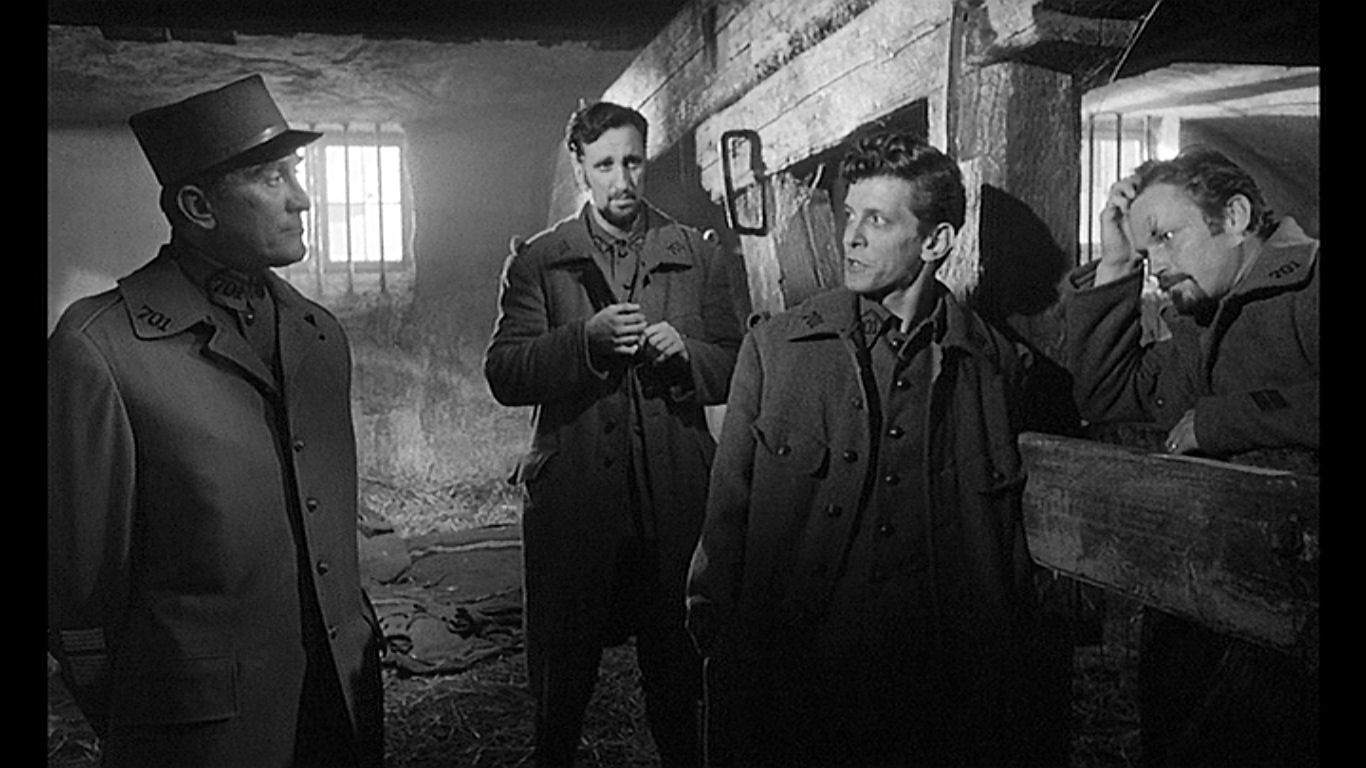
Dax tells three officers to pick one man each for trial. Dax meets with the men chosen. One, Pvt. Pierre Arnaud (Joe Turkel), was picked by a lottery, so arbitrary is the way of determining who might be executed. Paris was chosen by Roget because he confronted the lieutenant about his cowardice and getting Lejeune killed. So, the real coward is not put on trial. Another, Pvt. Ferol (Timothy Carey) who says he was marked as “socially undesirable,” so he was picked simply because others did not find him likable. Dax tells Paris that accusing Roget, an officer, of retribution will only get him in more hot water, and that despite the reasons for how they became defendants, they must deal with the accusations against them. Dax is a bit naive to believe he has a case as he advises the defendants to give simple statements, stick to the facts involving the battle, don’t argue or complain, and look the judges in the eyes.
The trial takes place in the chateau, a civilized, grand place, which is far removed from the cruel reality of the war, and which makes the soldiers who were caught up in the battle seem out of place in comparison. Dax complains that the full charges were not read, but the judges dismiss his complaint, saying they are simply accused of cowardly action. Already, it seems that the proper rules of a fair proceeding are dispensed with. The prosecutor, Saint-Auban, asks Ferol what he did, and will not hear his description of the situation, what he saw, or anything about the bullets zinging around him, thus not allowing for any true picture of the circumstances. Ferol said he advanced to “No-Man’s-Land,” and then retreated. The court isn’t even ready to give Dax a chance to question Ferol, and he must ask for permission. Dax says Ferol was with another private, so why did they not try to capture the Anthill. Ferol says he must be kidding, which is the point that Dax is making, that it was absurd for them to continue to attack. The chief magistrate (Peter Capell),  however, doesn’t see the point, because he believes a soldier follows orders, no matter the circumstances.

Arnaud is next and testifies that he advanced until ordered to stop. He made it only to his own wire defenses. The prosecution gets him to say that he did not advance “many” meters before stopping. He is also asked if he urged others to move forward, to which Arnaud says everyone around him was either dead or wounded. Yet, the prosecutor again asks the absurd question in order to get his negative answer. Dax asks if his action was any different than the others, and Arnaud says no. Dax is trying to show how the choosing of these men to stand trial is unfair, saying that Arnaud was singled out based on a lottery, not because he was a coward. The judge says Arnaud had as much chance as any other to not be accused, which dispenses with the questionable point of having the lottery to start with, and zeroes in only on the fairness of the steps following the acceptance of the method of choosing who was tried. Dax wants to read into the record how Arnaud has no record of cowardice in his past, and in fact that he distinguished himself in battle. The judge says it’s irrelevant, that only his current behavior is on trial, which dispenses with the question as to whether it is valid to accuse this one man of cowardice out of all the others who retreated without considering what may distinguish him from the others not accused. It would be as if five men allegedly robbed a bank, and the prosecutor picked only one name out of a hat to determine who should stand trial, and then the judge threw out all the evidence that could show him as less guilty than the others.

When questioned, Paris says he never left the trenches. Dax asks him why he didn’t leave, and he says a man who was shot dead fell on him and knocked Paris out during the attack. The judge, presuming the man is guilty instead of innocent, takes over the prosecutor’s job, showing the court’s prejudice, by saying Paris has no witnesses to back him up, and the large scar on his forehead could have been self-inflicted afterwards, and not incurred from the falling man.

In his summation, the prosecutor says the attack on the Anthill was a “stain” on the nation’s honor, and there must be atonement by executing the guilty. Dax does not hold back, saying, “There are times that I’m ashamed to be a member of the human race and this is one such occasion.” He says he protests the authenticity of the court by not allowing him to present witnesses to support his arguments, and yet the prosecution offered no hard evidence or witnesses to support its case. He also complains that there were no written charges, and there was no recording of the proceedings. Dax reverses the prosecutor’s charge as to where dishonor really exists, and says not the battle, but the trial is a “stain” on the nation’s honor.

We don’t even hear a verdict. It is a foregone conclusion. Instead, we have a scene where the soldier in charge of the execution squad tells the men that they must carry out their orders, or they will be held responsible. Basically, there is the threat of putting guns to the heads of the men in the firing squad if they don’t shoot their weapons. Thus, there is no room for free choice in the military. The story presents the different reactions of the sentenced men in order to be realistic in depicting how soldiers might truly respond to such a situation. The condemned are given a last meal (like one really has an appetite before one’s own execution), but Ferol, after first taking some bites of roast duck, spits out the food, thinking they are being drugged into being docile for the firing squad. He still says Dax will think of something to get them freed. He is still in denial. Arnaud is angry and desperate. Paris wants to escape, but eventually realizes it’s hopeless.

The chaplain, Father Dupree (Emile Myer) comes to the cell and says that Dax sent him. The priest says that Dax found no men in charge wanted to be involved in the case, washing their hands, like Pontius Pilate, trying to absolve themselves of responsibility. Ferol, the reality crashing in on him, cries. Paris asks that the priest send his letter to his spouse, in which he says he tried to tell what happened, but concedes that there is no way to really explain the absurdity of what has occurred. Even though not religious, the priest gets Paris to make his confession. However, Arnaud says the priest’s line about how “Death comes to us all,” is a sanctimonious cliché. Arnuad says his religion is the wine he drinks, and mocks confession as he prays to the bottle. For him right now, religion is equated with the numbing effects of alcohol, both providing an escape from reality. The priest says God has the power to save, but Arnaud says there is no saving here. He hits the priest, and is ready to attack Paris, who hits him hard, causing a skull fracture. He is unconscious, and the priest says they wouldn’t execute him in this state. But, the doctor (Halder Hanson), who says the man might not last the night, and is supposed to care about the well-being of patients, says the execution will occur, so they should make sure that Arnaud is vertical for the firing squad. He adds that the general will want Arnaud conscious, so he can experience his execution. In other words, God forbid he should die before the military gets its scapegoat blood spilled, or that the commanders don’t get a chance to see the man face the horror of his own death.
The coward, Roget, is with Dax, saying how unfortunate the executions will be, and how no one is happy about them. Dax repeats his words, mocking Roget’s watered-down sense of being upset. Dax asks why he picked Paris? Roget responds with the explanation that somebody had to be picked. Dax knows that Roget did it to get rid of Paris and his accusations against Roget. As retribution, Dax says he needs to pick someone to head up the firing squad, so it will be Roget. He tells him that he has to tie the men to the posts, offer blindfolds, give the order to shoot the men, and then use his revolver to put a bullet in each man’s brain to ensure the execution. He wants the weak-willed Roget to feel the weight of his guilt for sending innocent men accused of being cowards to their deaths, when it was Roget who was the one who was truly guilty of the charge. Rousseau enters saying he has information that bears on the trial. We know he is going to tell Dax about Mireau’s order to fire on his own troops, which shows that there are still honorable men in the military.

The next scene has a tracking shot, though in contrast to the horrific one in the trench, showing dancers at a military ball amid elegant surroundings and music as those present enjoy themselves while others suffer their fates at the hands of the privileged men in attendance. Broulard’s dance is interrupted because Dax wants to speak with him. The general admits that the number of casualties shows that Dax’s men may have made a good attempt to take the Anthill. Dax says if so, how can the execution of the men take place. Broulard admits that the General Staff may have known how the attack had a zero chance of success, but the commanders are subject to criticism from the press and elsewhere, and they have to put up a show of strength in the waging of the war. So, he says, “why should we have to bear any more criticism for failure than we have to.” Instead those in charge delegate the blame for being unsuccessful onto the almost anonymous innocent soldiers who have no power to fight the injustice they must endure. Broulard goes on to say that the executions boost morale because seeing someone else die is “fundamentally encouraging and stimulating,” even motivational. He uses “morale” in a strange way here, because it is supposed to be a positive stimulant, not the negative reaction to fear of punishment invoked by lethal means. Broulard condescendingly says that the troops are “like children.” They crave discipline like from a father. Kubrick’s satiric voice is now heard, one to be sounded loudly in Dr. Strangelove and Full Metal Jacket, when Broulard says “one way to maintain discipline is to shoot a man now and then,” hardly the equivalent of a parent’s grounding a child or issuing a stern reprimand. Not being able to believe his own ears, Dax asks, “Do you sincerely believe all the things you’ve just said?” Broulard looks at Dax askance, as if to say this is no time to be honest, because he must maintain this front to justify the despicable actions of turning the pursuit of victory into a public relations show. Dax then drops the bomb about Mireau ordering the firing on his own men. Dax gives him sworn statements attesting to Mireau’s orders. Dax says it will be a publicity nightmare (using Broulard’s language). He argues that if the three soldiers are not executed, then it will show that the General Staff was acting justly in blaming Mireau for his failure to take the Anthill and recklessly endangering his own men as he desperately tried to deal with his failure. He then tried to shift his blame onto innocent soldiers by putting them on trial. Broulard excuses himself, making no promises.


The next day, the detail of men to carry out the execution show up where the prisoners are confined, so we know Broulard is not stopping the executions. Paris engages ironically in small talk with the sergeant in charge, but then breaks down, and says that he doesn’t want to die. The sergeant tells him to act like a man in his moment of death since he is not alone as many of them will, sadly, be joining him soon. The ceremony of execution is formal and staged in front of the large chateau. They carry Arnaud in a stretcher, making the scene even more pathetic. Ferol walks with the priest, but cries, saying he fought on the battlefield with the others, so why is he being singled out? He is scared, and the film tries to show how men might really feel and act at this moment, not in the John Wayne stoicism that men are told to exhibit, which is not authentic and allows them not to be genuine about their feelings. The priest tells Ferol he can’t question the ways of God, but it is like admitting to the man there is no reasonable explanation to resolve what is happening to Ferol and the other two. The sergeant pinches the cheek of Arnaud so he can be alert to be killed, conjuring up the phrase “cruel and unusual punishment.” Roget is there offering blindfolds, and apologizing to Paris, which is too little, too late. This scene somewhat resembles Jesus Christ’s crucifixion, since Jesus, like these soldiers, made a sacrifice so others would be spared condemnation. The drums sound like exaggerated heartbeats, that then cease as the weapons are fired.


The next scene ironically offsets the horror of the previous scene, as Broulard and Mireau eat in the chateau, with Mireau thanking Broulard for being there at the execution, supposedly to lend him support at such a grim scene. Mireau says, however, there was “splendor” in the scene, and Broulard says he had never seen this type of “affair” (a euphemism, like it was an entertainment event) handled better. Mireau says one worries that the condemned might spoil it with an unsightly display, again showing how appearances are more important than the awful truth of what is happening. Today we call it “optics.” Broulard had summoned Dax. Mireau tells Dax his men “died very well,” as he stuffs his mouth, still able to enjoy the pleasures of being a living general, who can easily dispense with those down the chain of command. Then Broulard casually brings up the order to attack Mireau’s own troops. Of course, Mireau denies it despite the evidence. Broulard says then he will be able to clear his name in an inquiry, since he doesn’t want this to become a public smear. Broulard did not stop the executions, not wanting Dax to think he could control him. But, he doesn’t want a scandal, so he makes Mireau a scapegoat, ironically just as Mireau made his men play the same part. Mireau tells Broulard that he was the only “innocent” man being harmed here, which is the opposite of what happened, the true innocent men having been put to death. Mireau is a murderer, (but so is his accomplice, Broulard), but he gets away without being executed. Mireau says that Broulard’s treachery was inflicted on “a soldier,” which is what he calls himself, but Mireau himself brought harm to the real soldiers in his command. After Mireau leaves, Broulard says to Dax it had to be done, because they can’t have fools running the show. What he’s really saying is Mirerau wasn’t smart in playing his role in the planned massacre. Broulard then offers Dax Mireau’s job. Dax bluntly asks if he wants him to tell Broulard where to shove the promotion. Broulard angrily says he better apologize. Dax, really apologizing to himself, says he apologizes for not “being entirely honest with you. I apologize for not revealing my true feelings. I apologize, sir (a sarcastic use of the title), for not telling you sooner that you’re a degenerate, sadistic old man, and you can go to hell before I apologize to you now or ever again.” Broulard smiles and says Dax is a disappointment. He thought he was like himself, just angling for himself to get Mireau’s command. Broulard now realizes that Dax is an idealist, and was sincere in his defense of the men, and was not after personal ambition. He sees Dax as naive as “the village idiot.” He tells him he “spoiled the keenness of your mind by wallowing in sentimentality.” Broulard says they have to win a war, and the men were shot because they didn’t fight to reach that objective. He insisted that Mireau be made to answer for the charges against him, and then asks where has he done anything wrong? Dax says if he doesn’t know the answer, then he pities him, for Broulard has no empathy or compassion for others.


The story ends with a scene at a tavern, where the host brings out a German woman. The French soldiers at first boo, then jeer, and objectify her sexually. But then she sings a melancholy song, as tears appear on her face. The soldiers listen, and then the men sing along, some joining her with their own tears. The German woman, supposedly representing the enemy, becomes a maternal symbol, singing to them a lullaby, as if trying to soothe the frightened children inside these men. They join in the desire for release from the anger and hatred that rips people apart. Outside, away from the womb-like comfort of the tavern, Dax is told that that they have been ordered back to the front. He says the men should be given a few more minutes of escape from the realities of war.

The next film is The Shape of Water.