SPOILER
ALERT! The plot will be discussed.

The
first scene of this 1967 film has Luke (Paul Newman) taking the tops off
parking meters with a wrench. The devices flash the word “Violation.” Luke is obviously drunk, and is consuming
more alcohol. We have images of a person who is an outsider that does not
comply with established rules. Luke is literally and figuratively the monkey
wrench which disrupts the social machinery from running along smoothly. Even
though the story takes place probably in the 1950’s after the Korean War, Luke
reflects the 1960’s anti-hero who rebels against a corrupt society.

The
police arrive and arrest Luke. The irony is the man who wants total freedom is
put in the most restrictive place, prison, because of his behavior. The next
scene shows men working on a convicts’ work gang, which includes the hulking
Dragline (George Kennedy, who won a Best Supporting Actor Oscar for this role).
Drag must say he is taking off his shirt because of the heat. Free will is
almost totally obliterated here as the prisoners have to announce everything
they are going to do in order to get permission from the guards, even for the
simplest of actions. For example, Rabbit (Marc Cavell) and Gambler (Wayne
Rogers) (all of the men have nicknames) request that they wish to wipe away
sweat and drink some water.


Luke
arrives with other convicts. The dogs in the camp are noisy because, as one
guard says, they smell “new meat,” an intimidating phrase that depicts the
inmates as possibly nothing more than animals to be hunted down if they try to
escape. The Captain (Strother Martin) is in command of the institution. Each of
the guards is called “Boss,” which shows the dominance they have over these
convicts. One of the prisoners tries to make an excuse for his crime, which is
followed immediately by one of the guards hitting him with a stick. Freedom of
expression is met with violent retribution. When the Captain reads Luke’s crime
of destroying municipal property while under the influence, the Captain concedes
they never had that kind of infraction before. Luke is even a unique individual
when it comes to his breaking of the law. Luke’s sentence is two years for his
victimless prank which points to the unfairness of the judicial system in the
story. The Captain notes that Luke won a Silver Star, Bronze Star, and a couple
of Purple Hearts in military service. Luke excelled in the combat part of an
organization that has a rigid code of conduct off of the battlefield. However,
he was not interested in rising in the ranks and becoming an unbending link in
that fortified chain of command. The Captain says the new men must learn “the
rules,” which is the opposite of what these men are used to doing. If they
don’t, the Captain, almost in a deceptively congenial manner, says their time
will be extended and they will be put in leg chains if they try to escape. The
Captain says, “It’s all up to you,” basically pretending that they have free
will, but really giving them the choice between two submissive options. He says
he “can be a good guy or I can be one real mean son of a bitch.” Luke sneers,
showing that he probably has seen this kind of authority figure often in his
life, bringing to mind the line from one of The Who’s song, “Here’s the new
boss, same as the old boss.”

Boss
Carr (Clifton James) announces in rapid monotone a slew of rules including not
being in the “prone” position when smoking a cigarette, not losing one’s
“spoon,” or putting the wrong sheet on one’s bunk, or else the man will spend a
night in the “box.” Even Dragline says within the community of convicts, there
are rules. Luke laughs, and calls him “Boss,” equating him with the guards. One
man says a convict doesn’t have a name until Drag gives that person one. Drag
says maybe they should call Luke “No Ears,” since he doesn’t listen. Luke
comments that there’s not much worth listening to except for a lot of men
laying down rules and regulations, basically limiting people’s freedom. People
lose everything, including their prior identity when in prison, and are reborn
with new names to define them. But the guards are in prison, too, in a way, as
they are confined to keep the convicts locked up. People take on names that
represent their characteristics or roles in this outcast world.
Carr
leaves the bright light on next to Luke’s bed, trying to make it hard to sleep
because the guard zeroes in on him as being difficult since Luke smiled as Carr
stated the rules. The guards bully the prisoners, and then the stronger group
of cons bully the newcomers. They act like they can sell their work details to
the new cons, but they don’t really have the authority to switch jobs, so they
exploit the new prisoners. Here, power runs downhill. Drag even bets a cold
drink that Luke won’t make it through the first day of work. When Drag goads
Luke about the silliness of his crime, Luke says there wasn’t much to do in a
small town, but then reveals that he was “settling an old score.” We never
learn what he is upset about, but given his character, Luke probably wanted to
retaliate against something that threatened his free will.

There
is one guard, Boss Godfrey (Morgan Woodward), who Drag later labels as The Man
with No Eyes, who wears mirror sunglasses so that his eyes can’t be seen, which
makes him appear like an ominous abstraction of evil. Godfrey takes out a
bullet, loads his rifle, and shoots a defenseless bird. One con asks if the guy
ever talks, and Luke, commenting on the gunshot, darkly jokes, “I think he just
said something” stressing the man’s deadly power over them all. At the end of
the workday, Luke, exhausted and aching, is the last one trying to get in the
truck. The guard kicks him in the butt to get him to board the vehicle, piling
on the torment. Luke gets in a victory by showing he made it to the end of the
day, and tells Drag that he owes the other man that cold drink. It’s the first
of several actions by Luke that reveals his amazing endurance to withstand
suffering.

Alibi
(Ralph Waite) passes out in the hot field and has to be put in the truck. He is
further punished when he is told his work was unsatisfactory. They put him in
the “box,” which is about the size of a small closet with only a pot to deposit
the man’s body waste. It was the first day at the prison camp for the man, and
he is the one who thought he could buy a better job. Drag doesn’t take
responsibility for playing a prank on the new guy, and says Alibi talked back
to a free man (the guard) about switching details. Drag says “They got their
rules and we ain’t got nothing to do with that.” Luke is sarcastic with Drag
about this comment when he says how the guards need the prisoners’ help to
maintain their rules, as if the correction officers aren’t the ones with the
upper hand.

While
the men are working, there is a sexy blonde (Joy Harmon) wearing nothing under
a clingy revealing dress as she washes a car. She uses the phallic shaped
nozzle of the hose suggestively, and her squeezing the soap out of her sponge
symbolizes the male orgasm. Drag calls her Lucille, and another says she
doesn't know what she’s doing. But, Luke doesn’t give in to the denial of
reality, and says that she knows exactly what she's doing, and that she is
enjoying it, commenting on the sadistic teasing of the young woman. Later in
the bunks at night, Drag keeps ruminating on how sexy the girl is, and Luke
again wants to stifle the fantasy world by telling him to quit, basically
saying Drag was making the torture of the denial of sex worse. Drag is upset
with Luke complaining about his talk, and threatens that Luke better rest up,
since he will need it for the next day.

The
two men have a boxing match and the much larger Drag thoroughly beats Luke who
refuses to stay down, showing his abject resistance to being dominated by
anyone. Those watching begin to feel sympathy for Luke at the one-sided fight,
and seeing such a lopsided battle humiliates them as some walk away. Even Drag
picks Luke up and carries him, telling him to stay down as he begins to be won
over by Luke’s ability to withstand all that Drag can throw at him. Luke
emerges as a Christ figure who sacrifices his safety as he did as a soldier.
Drag says Luke is beaten, but Luke says Drag will have to kill him before he
gives up. Drag walks away as Luke is still standing and takes swings at the
retreating Drag.

That
evening they are having a poker game, with Gambler dealing the cards. Luke
keeps raising the bet, and scares the others off by bluffing. Drag smiles out
of respect and says Luke beat the con with “nothing,” just the way he kept
coming at Drag in the bout with nothing. Luke says, “Well, sometimes nothin’
can be a real cool hand.” So Drag labels him Cool Hand Luke, which shows how
much style Luke has even when he doesn’t have anything to call his own. Luke’s
words imply that there may be a way of fighting back when it looks like a
person is defeated.

Arletta
(Jo Van Fleet), Luke’s mother, visits her son. She is on her back, smokes and
coughs, and generally appears ill. He wonders how she found him, which shows
that they have been estranged. She says she wishes people were like dogs, where
a mother eventually forgets about her pups, and has no expectations about her
offspring. She is suggesting that she wishes she could deny her humanity, thus
demonstrating she was not cut out to be a mother. She thought he “was strong
enough to carry us.” Luke says that a man has to go his own way, which again
stresses his desire to be emancipated from any traditional responsibility. She
says that Luke’s father didn’t stick around but made her laugh. Luke says he
wishes he got to know him. He probably has a great deal in common with his
father, not wanting to be tied down. He adds he never had enough “elbow room”
in his life, an image that shows that he feels that the world confines him. His
mother agrees with him, saying that whenever he worked at thinking about
getting married or being respectable, he was boring to be around. She feels
that she will leave her house to his brother John because she didn’t show as
much affection for him. It appears mom was won over by bad boys. Luke is okay
with her decision, saying his brother earned it, implying John sacrificed his
liberty to help his mother. Arletta cries as her son walks away, and Luke
appears as if he knows this is the last time he will see his mother. He
lectures his nephew John-Boy (John Pearce), who came with Arletta, telling the
boy that making mistakes means he will have to answer to “The Man,” thus
warning him of the penalties for defying society’s rules. So even though Luke
couldn’t lead a law-abiding life, he doesn’t advocate his choices for others to
follow. Tramp (Harry Dean Stanton) sings a gospel song in the background here,
as he does in other scenes, whose religious nature contrasts with the unholy
lives these men and their captors lead.

The
sunglasses man, Godfrey, walks around carrying a cane, which he does not need
and shows how the men are the ones doing backbreaking labor without any aids as
they work tarring a road. They have to shovel dirt, and Luke, with Drag’s
blessing, gets the convicts to work harder and faster as a kind of defiance to
show the bosses they can’t break their spirit. The crew finishes the job with
two hours of daylight left. When one of them asks what do they do now, Luke
smiles and says “nothing.” Drag laughs, saying Luke wins again, just as he did
with the card game, and how he didn’t give up in the boxing bout, because he is
a “wild, beautiful thing. You crazy handful of nothing!” Luke shows that even
when things seem hopeless one can persevere and prevail, and turn nothing into
something.
Part
of the agony that the incarceration system inflicts on these men is that they
must close all the windows in their barracks when the rain pours, or their
building will flood. The men strip down to their briefs and sweat profusely. To
pass the time they devise gambling contests beyond just playing cards. Drag
complains about losing a bet on a fellow prisoner, Dynamite (Buck Kartalian),
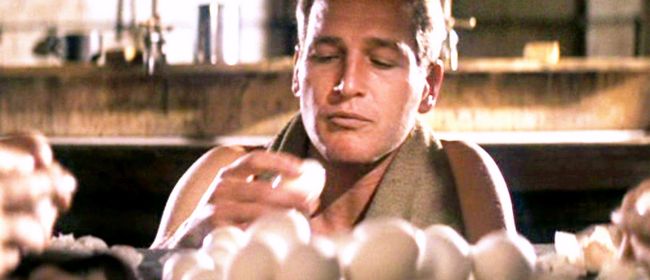
who is the champ in eating contests. Luke steps up and says he can eat fifty
hard-boiled eggs in an hour, without vomiting. Drag says that he’ll back Luke,
but confidentially says that he should have picked a lower number. Luke states
the reason for these outlandish acts when he says it will be, “something to
do,” since even when they are not working, the passage of time in prison can be
cruel.
Drag
gets laxatives to clean out Luke’s digestive system to make room for the eggs
and peels the shells off them despite the protests of those betting against
Luke. These men who break the laws still crave rules, showing the social desire
for contracts. Drag says when it comes to the law, “nothing is understood.”
Drag’s actions point to how there are holes in any rule system that can be
exploited. Luke’s belly looks like it is going to burst, but he persists, trying
to defy even nature’s restrictions. Someone is in denial and says, “nobody can
eat fifty eggs,” like it’s a universal fact. Luke smiles even though he is flat
on his back because his anti-authoritarian personality has triumphed by defying
what was thought to be an absolute dietary edict. In a way, Luke’s Christ-like
persona is performing miracles as if he is defying the laws of nature. IMDb
notes that after the egg eating challenge, Luke is on his back in a crucifixion
position, and points out that Luke’s prisoner number. 37, refers to,
appropriately, Luke 1.37 in the bible, which reads, “For with God, nothing is
impossible.”
Out
doing the road clearing work, a rattlesnake slithers between the men. Luke,
again defying the usual way of behaving, is the one who shows no fear by
picking up the snake so the sunglasses man can shoot it. He does so with ease.
Luke says with a smile that the man should not forget his walking stick and
hands it to the guard. He calmly compliments Godfrey on his shooting. Afterwards,
Drag tells Luke he shouldn’t engage The Man with No Eyes, making the sunglasses
fellow sound like some sort of demon.

It
starts to storm, and everyone is told to get back in the trucks. Luke doesn’t
rush, and Drag asks if he isn’t afraid of dying. Luke defies even the idea of
God by yelling up at the sky saying the deity can take his life anytime he
wants. “Come on,” he says, “You’re welcome to it old timer.” Luke says he’s
just “standin’ in the rain, talkin’ to myself.” He doesn’t even have the religious
faith which bolsters some. For someone like Luke, religions are just more ways
to control a person. Luke and the prisoners are at the bottom of society’s
barrel, and for Luke, valuing one’s life isn’t worth the effort. Bob Dylan’s
line comes to mind which says, “When you got nothin,’ you’ve got nothin’ to
lose.” If we view his action as coming from a type of Christ figure, he could
be seen as questioning God the Father for subjecting his son, or for that
matter all of His children, to the adversities of this world.
Drag
runs all the monetary goings on in the camp, and lends out cash and collects
loan paybacks. Luke is part of Drag’s inner circle now. One of the men wanting
a loan flatters Luke by saying he knew Luke could eat the eggs. Luke admits that
he didn’t know he could, which shows he is not all that secure in his actions.
He flips a coin which allows the man to get the loan, demonstrating the
precariousness of each person’s fate. Drag, describing Luke’s contradictory
nature, says Luke, “Smiles like a baby, but bites like a gator.”

Luke
receives a message and walks away looking dejected. Drag hands the letter to
another inmate, which shows that Drag’s deprived life hasn’t even given him the
opportunity to learn how to read. The note says that Luke’s mother passed away.
All of the men have gained a great deal of reverence toward Luke and they give
him space so he can grieve in private. Luke strums a banjo and sings the
mocking song about having a “plastic Jesus,” and an icon of the Virgin Mary. Even
in his sadness and loss, Luke does not revert to the comfort that requires him
to relinquish his independence in order to subscribe to rigid belief systems.
In the thematic sense, Luke may be questioning whether he is a worthy example
of rebellious justice, and he may be referring to himself as the “plastic
Jesus.”
Instead
of being compassionate about losing his mother, the Captain says that her death
will just make Luke want to escape to visit her before her burial. So, as a
cruel preventative measure, they put Luke in the “box” to keep him off of the
road. The guard who prepares Luke for his isolation says he feels bad about
what he is doing, but it’s his job. Luke, scoffing at the man, says, “Calling
it your job don’t make it right, Boss.” Luke won’t grant the man the comfort of
using the employment excuse as a crutch to support the guard’s capitulation to
the unjust rules he carries out. In this sense, Luke is not a “turn the other
cheek” Christian.

They
finally let Luke out once his mother is buried which supposedly means he has no
incentive to now run off to see her one last time. But, Luke doesn’t play by
established rules. In his white “box” robe, Luke looks like an angel walking
among the prisoners. He is released to celebrate the Fourth of July, an ironic
holiday to enjoy for the incarcerated since it symbolizes freedom. While they
make a lot of noise in the barracks, Luke cuts a hole through the building’s
floor. When the guard enters to end the revelry, Luke tries to escape under the
barracks. But, he is seen trying to climb the fence, and the guards beat him.
He is up on a post, and the scene suggests another crucifixion image (after
all, Christ was a “criminal,” too). Luke does get over the fence while dogs try
to track him. Luke is crafty, as he tries to throw them off by jumping back and
forth over a fence to confuse the animals, and by not leaving tracks or scent
by crossing a creek holding onto an elevated wire. He swims in a river as part
of his attempt to flee. The patrol returns to the prison camp with one of the
dogs having run himself to death. Luke appears to have succeeded in his escape
attempt.


But,
Luke is captured and brought back. And as the Captain promised, Luke is placed
in leg chains. The Captain says the sound of those restraints will always
remind Luke of how his freedom has been further deprived. The Captain says it’s
for Luke’s own good, to which Luke sarcastically says he wishes the Captain
would stop being so good to him. Enraged by Luke’s lack of submissiveness, the
Captain’s sadistic nature, usually covered by phony polite speech, surfaces,
and he beats Luke to the ground. The Captain then reverts to his fake civilized
rhetoric, delivering the movie’s famous understated line; “What we’ve got here
is failure to communicate.” Only The Captain’s communication goes one way, with
him dictating the rules and the prisoners listening and accepting.
In
the food line while in the work field, one of the men serving the lunch says
that Luke smells so badly, he could track him if he tried to run again. Luke,
not broken by his ordeals, gives a snappy canine reference by saying that it
should be easy for the man, since he is a “genuine son of a bitch.” After
others ask how far he was able to get before being caught, he says about a mile
and a half. He stole a car, but a policeman drove next to him at a traffic
light and saw Luke in prison garb. Drag says that he should lay low, the “heat”
will be off of him, and Luke can try to run off again. It’s as if the others
are trying to vicariously keep their dreams of escaping through Luke. Luke just
wraps a string around his hand, as if he is feeling the prison’s restraints
tightening around him.
While
on the work detail, Luke asks to urinate. But, he must keep shaking the bush he
is behind to show he hasn’t run off. The Man with No Eyes takes a rifle and
shoots around the bush, as if to curtail Luke’s movements. Not exactly a
relaxing way to relieve oneself. Crafty Luke has tied string to a bush branch
and continued to shake it as he put some distance between himself and the
others. Luke has again turned a negative, the confirmation of his imprisoned
presence, into a positive by creating a diversion. When the guards realize what
has happened, they call for the dogs again to search for the runaway.

The
leg restraints restrict Luke’s movements as he reaches a rural town. He
encounters a couple of young boys who get him an axe and he breaks the chains,
a literal and figurative action to illustrate his freedom. They also provide
him with spicy food ingredients that Luke uses to throw off the scent of the
dogs, who sneeze as the boys laugh in private. Luke’s intelligence is on
display in his escapes. Later, Drag receives a magazine, which is odd since he
can’t read. In it is inserted a photograph of Luke in a suit between two
beautiful women, and Drag references Luke’s nickname by saying he is playing it
“cool.” The others revel vicariously in Luke’s good fortune. Later, the value
of hope lingers on in the picture as Drag charges a cold drink for one of the
men to look at the photo to boost his morale. (IMDb provides an astute
observation of foreshadowing. Opposite to where Luke’s photo is placed is a
picture of a hunter firing a rifle which appears to be aimed at Luke’s chest).
But,
the authorities catch up with Luke again and bring him back beaten badly to the
barracks. The Captain says Luke will be wearing two sets of chains now. It’s as
if the laws of physics fight Luke’s running away from being imprisoned: every
action triggers an equal and opposite reaction. The other convicts offer words
of comfort and encouragement to Luke who has blood on his face. He tells them
that the photo with the women was a fake he had someone make. They don’t want
to believe him, but he yells at them and says that if they want to escape, do
it themselves, and “Stop feeding off of me.” This scene may call to mind
Christ’s Agony in the Garden, where he seemed to sweat blood, and questions
whether he is the vessel to save others. The word “feeding” might refer to The
Last Supper, where followers will find redemption through the death of Jesus’s
body. That last allusion is reinforced a little later as different men use
their spoons to take rice off of Luke’s plate of food.
Out
on the road, Luke can hardly work, and one of the guards whacks him with a
rifle, the way Roman guards punished Christ as he carried his cross. They put
Luke in the box for his lack of labor. There is now dissension in the ranks of
convicts, as some say Luke will not make it. Drag, however, says the box can’t
break Luke. But, another says at least he doesn’t wear chains for defying the
system, suggesting it’s better not to admire Luke. Later Drag says to Luke that
he made it through the week and he’ll now have some time to rest. But the
bosses are there to destroy Luke’s independent spirit as an example to
discourage the others from breaking the rules. They make him dig a deep ditch
just to have him fill it up again to drain his strength. When they say to dig
it back it up, he attacks the guard, but is hit with a blackjack. He starts
digging again into the night but they order him to fill up the hole again. They
hit him as he falls into the ditch, as if sending him to his grave. Luke prays
to God, whom he previously disavowed, to not have them hit him anymore. He says
he’ll do anything they say. The guard asks if he got his mind “right,” which
means no more resistance, and Luke surrenders, stating he has. The other
prisoners see him promise to never try to escape or talk back to the guards.
The corrections officers vow if he doesn’t abide by his promises, they will
kill Luke. There is then a cut to The Man with No Eyes. He is in the dark, so
even though his sunglasses are not worn, his eyes are still not visible. He is
like the Grim Reaper, a constant threat of death. As Luke heads back to the
barracks for rest, one convict takes the photo of Luke stashed in the magazine
and rips it up, his faith shaken by his hero’s defeat. The others turn away
from him as Luke lurches toward his cot. He yells at them, saying “Where are
you? Where are you now?” His anger shows how many abandon their heroes when
they show that they are flawed like their followers.
The
guards now test Luke’s pledge by making him do chores on the road. He is told
to give water to the convicts. He must fetch the rifle for The Man with No Eyes
who then shoots a turtle. The man loves to kill defenseless creatures. Luke
must then retrieve the dead turtle. He cheerfully compliments the shooter,
sounding like a slave, trying to please his master in order to survive. He is
told to cut up the turtle for lunch. But instead of following that order, he
drives off in one of the trucks, and stole the keys out of the other vehicles
so the guards can’t follow him. Drag jumps into the truck with Luke, inspired
by him, and the other prisoners smile as they have their faith restored.
On
the side of the road, Drag covers up the truck with branches and laughs about
how Luke fooled the guards and was planning his escape. Luke is honest and
humble, saying the guards broke him, and he never plans anything. At night,
Drag says he can get them some food and women and then they will free another
prisoner. Drag is like a pumped-up disciple, riding the high of being
emancipated. Luke says he has to be on his own, probably knowing that he will
just draw fire. Drag says he only had a couple of years left to serve and he
would have been released, but he got caught up in Luke’s escape. He agrees
reluctantly to the splitting up, saying it’s probably safer for the two of them
to separate.

Luke
goes into a church and pleads to God, which is contradictory for Luke, since
God is the ultimate authority figure. He says he knows he killed people in the
war and broke the law, but says God “ain’t dealt me no cards in a long time,”
which refers back to his struggling to succeed with a losing hand. The “rules
and regulations and bosses” wielding those laws have made it impossible for him
to win, he says. He stresses the contradiction of his existence by saying that
God made him an outsider, someone who can’t deal with restrictions, so he asks,
“Now just where am I supposed to fit in?” He asks what does God have in store
for him, what does he do now? He concludes that there is no outside help coming
and he has to “find my own way,” and continue as a loner living outside the
frame of society’s restraints. The additional material on the version of the
film I viewed noted that Luke’s situation mirrors the fate of the mythic
Sisyphus, who was doomed to push a rock uphill for eternity, constantly using
his will to overcome the impediment, but never succeeding. However, the
existentialist Albert Camus found that one can find dignity in the struggle.

Police
cars with the Captain and his men show up outside. Drag comes in and says there
are dogs and cops with plenty of firearms and they caught up with him. He said
he made a deal that if Luke gives up without a struggle, they won’t beat him,
and they can bunk next to each other again. Luke knows this is a lie and
laughs, saying God is a “hard case” like him, and is willing to sacrifice him,
(as he did his son, Jesus). At an open window Luke repeats sarcastically the
Captain’s words about having a “failure to communicate.” A split-second later
The Man with No Eyes speaks by shooting again, hitting Luke on the side of the
neck. Drag carries Luke out, but attacks the shooter with a vengeance, trying
to strangle him. The Captain won’t let the local police take Luke to the
closest hospital, but instead wants to go to the prison medical center. One of
the cops says it’s too far and Luke won’t make it, which, of course, is the
plan. As they pull out, Luke is smiling, and the sunglasses of The Man with No
Eyes are smashed underneath car tires, showing that this lethal person has been
somewhat diminished by Luke’s defiance.
Later,
back at the prison, Drag, who now also wears leg chains as a kind of inheritor
of Luke’s legacy, tells Luke’s final story, saying that he had that smile on
his face as he rode away, showing that the authorities could never diminish
this unique individual’s spirit. The movie implies that finding a person guilty
for violating the law does not include the use of cruel and unusual punishment
meant to break one’s desire for individuality, freedom and justice.
The
next film is Falling Down.


