Showing posts with label greed. Show all posts

Friday, January 3, 2025

It's a Wonderful Life


 It’s a Wonderful Life (1946), directed by and co-scripted by Frank Capra, explores how a person finds a purpose in life. Sometimes that goal leads to the selfish acquisition of wealth. It may mean performing a heroic act on a large scale. And just sometimes it occurs in a small town in helping others find a little happiness in their lives.

This movie is a bit dark for a Capra film, whose credits include It Happened One Night and A Pocketful of Miracles, although another Jimmy Stewart /Capra movie, Mr. Smith Goes to Washington, shows the cynical side of politics. This story takes place between 1919 and Christmas Eve, 1945. The opening seems tacky today as twinkling stars in the sky, which represent angels, discuss the need to help George Bailey (Stewart). They have received prayers that he is in despair. They choose the angel Clarence (Henry Travers) for the job so he can finally earn his wings. What follows is a summation of George's life up to December 24 of 1945 so that Clarence knows what he is dealing with.

A couple of incidents in young George’s life set the stage for how even what seems like an insignificant life can have important consequences in the grand scheme of things. The local druggist in the small town of Bedford Falls, Mr. Gower (H. B. Warner) owns a soda shop where George, the boy, works. Gower is distraught because his son died most likely due to the Spanish Flu pandemic. He accidentally puts a poison in a prescription, and George brings that mistake to his attention. George also saves his younger brother from drowning in a break in the winter ice in a pond.

George's father (Samuel S. Hinds) and Uncle Billy (Thomas Mitchell) work at the struggling Building and Loan company that makes low interest loans to people to buy houses. The greedy man who owns most of the town is Henry Potter (Lionel Barrymore). He is on the Building and Loan’s board and would like to put it out of business so he can have a monopoly on charging exorbitant rates on loans to the people of the town. There are references to “Potter’s Field” in the film, which is where poor people were buried when they died, and the implication is that Potter is the nasty capitalistic force that drains the life out of deprived people during their lives. Potter’s appearance almost looks like a ghost and IMDb states that Capra wanted to depict him to look like the famous painting “American Gothic.

The film was seen by some as leaning toward Communism since the banker is depicted as the villain. George’s father says, “All you can take with you is that which you’ve given away,” which suggests that generosity is the true virtue because one is putting others above one’s own needs. George as an adult tells Potter, “this rabble you’re talking about, they do most of the working and paying and living and dying in this community. Well, is it too much to have them work and pay and live in a couple of decent rooms and a bath? Anyway, my father didn’t think so. People were human beings to him. But to you, a warped and frustrated old man, they’re cattle. Well, in my book my father died a much richer man than you’ll ever be.” These statements sound more Christian that communistic, and a Marxist wouldn’t put much stock in prayers and angels.

George is not so altruistic as a young man. He finds his father’s work dreary and wants to get out of “this crummy little town.” He wants to go to college and eventually gain success by building “airfields,” and “skyscrapers,” and “bridges a mile long.” However, his father dies, and his brother Harry (Todd Karns) first goes to college and then marries. His father-in-law offers him a job upstate. George sacrifices his ambitions to take over the family business. He even sees a friend, Sam Wainwright (Frank Albertson), become prosperous. His dreams for himself become eclipsed by his commitment to his father’s vision.

One positive aspect that comes from George’s staying in Bedford Falls is that he marries his childhood sweetheart, Mary Hatch (Donna Reed). Her character is an example of American positivity as she works hard to turn their broken-down house into a welcoming, lovely family home. On their honeymoon night, though, the house is a wreck before her renovations. George’s friend, Bert (Ward Bond), a policeman, and Ernie (Frank Faylen), a cab driver, serenade the newlyweds in their leaky home. The scene stresses how love and friendship overcome financial distress. The couple sacrificed their honeymoon money to keep the business open after Potter maneuvered a run on the Building and Loan company. The investors in the family business also compromise to keep the business afloat, which shows the story’s theme of how generosity toward others aids the community. (Apparently Jim Henson did not consciously name his Muppet characters after the Bert and Ernie characters in this film).

George's company provides several families a chance to own their own homes which aggravates the killjoy, Potter. He offers George an exorbitant salary to work for him and dissolve the Bailey business. Potter is like Satan tempting the Christ-like figure of George. Although leaning toward accepting the job at first, George quickly recovers his moral vision and vehemently rejects Potter’s deal. Capra’s view of moral fortitude offsetting selfish temptation seems a lost hope in our egocentric present times.

Another Job-like event occurs which sends George into despair. Uncle Billy accidentally leaves the $8000 that he is to deposit in the company’s account in a newspaper that Potter acquires. When George learns that the money went missing he becomes desperate. He goes to Potter to beg for a loan but all he has is a small amount of cash surrender value in his life insurance policy. Potter refuses of course and mentions that George is worth more dead than alive based on the payoff upon his death. That plants the seed of suicide in George's mind.

George’s positive disposition turns dark, and he becomes cruel when he goes home, knocking things over and bemoaning the fact that he even has children he must raise. Stewart’s acting ability is strong here as he delves into the depths of a lost soul. He goes to a bridge and is ready to jump off when Clarence appears and dives into the icy waters below. This action sparks a momentary return of George's unselfish nature, and he dives in to save Clarence. As they dry out Clarence realizes that he must show that George’s life has worth. He erases George’s existence. There is a cold wind that blows through the scene and the desolate winter setting points to George's absence in the town’s life.

 George, of course, is unbelieving of what Clarence says he did. But as he goes through the town nobody recognizes him. Bedford Falls now is called Pottersville. There are bars and seedy clubs in place of small family stores. (This scenario may have influenced the story line in Back to the Future II when Biff alters history and takes over the town. Also, this “glimpse” of another life is echoed in another Christmas movie, The Family Man with Nicholas Cage). Martini (William Edmunds) does not own the bar because he never was able to establish himself with his on home the Bailey business provided. George wasn’t there to prevent Mr. Gower from causing the poisoning of his customer. And, George’s brother, Harry, died in the ice water as a child. So, he never became a fighter pilot in the war and didn’t win the Congressional Medal of Honor for saving a whole convoy of soldiers. Mary is a woman without the love of another and has no children, which deeply affects George as she is frightened by his pursuing her. Clarence states the Butterfly Effect when he says, “Each man’s life touches so many other lives. When he isn’t around he leaves an awful hole, doesn’t he?” He goes on to say, “You see George, you’ve really had a wonderful life. Don’t you see what a mistake it would be to throw it away?”


When George finds himself back on the bridge he prays and says he wants to live. Clarence reverses his act, and George is now part of the community he helped build. When he returns home Mary has done a “Go Fund Me” action and tapped into the generosity that Capra sees as exiting underneath all the greed and selfishness in the world. Everyone contributes to save George’s business, and there is a welcoming home of Harry as a war hero. Clarence left a note for George in a copy of Tom Sawyer which says, “Remember, George, no man is a failure who has friends.” The film is saying that it is one’s worth to others that enriches a person.  

Clarence said that when a bell rings an angel gets his wings. A chime on the Christmas tree sounds, telling us that Clarence has been promoted. The film has all sorts of bells ringing, including cash registers, telephones, and doorbells. These chimes not only announce the winning of an angel’s wings but also the saving of human souls. It is thus fitting that the last image of the film is a huge bell ringing, suggesting the possibility of the triumph of human morality.

Sunday, April 3, 2022

Wall Street

 SPOILER ALERT! The plot will be discussed.

Wall Street (1987), directed by Oliver Stone, whose father worked on that avenue of affluent dreams and financial nightmares, starts off with Frank Sinatra singing, “In Other Words.” It contains the lyrics, “Fly me to the moon/And let me play among the stars/Let me see what Spring is like/On Jupiter and Mars.” In the context of this film, it suggests there are those people who want to be so powerful that they don’t even see the sky as the limit. And that power comes from accumulating money, no matter what the cost is to others who the wealthy use as their stairway to the affluent heavens. The opening montage shows all levels of society in New York City, from laborers to those going to financial institutions as they crowd onto sidewalks and into elevators, trying to make a living.

The story takes place in 1985. Bud Fox (Charlie Sheen) works at a Wall Street brokerage firm, trying to get ahead in the cutthroat business of selling stocks through cold calls. (Bud’s last name is Fox, but is he as sly as one? At the beginning of the movie it is an ironic name, but he lives up to it by the end). When someone cancels a deal, Bud must make up the loss the firm sustains. His pal, Marvin (John C. McGinley), says it could have been worse if it was “my money.” He is joking, and offers Bud some spending money, but his selfishness epitomizes the central work ethic of his profession.

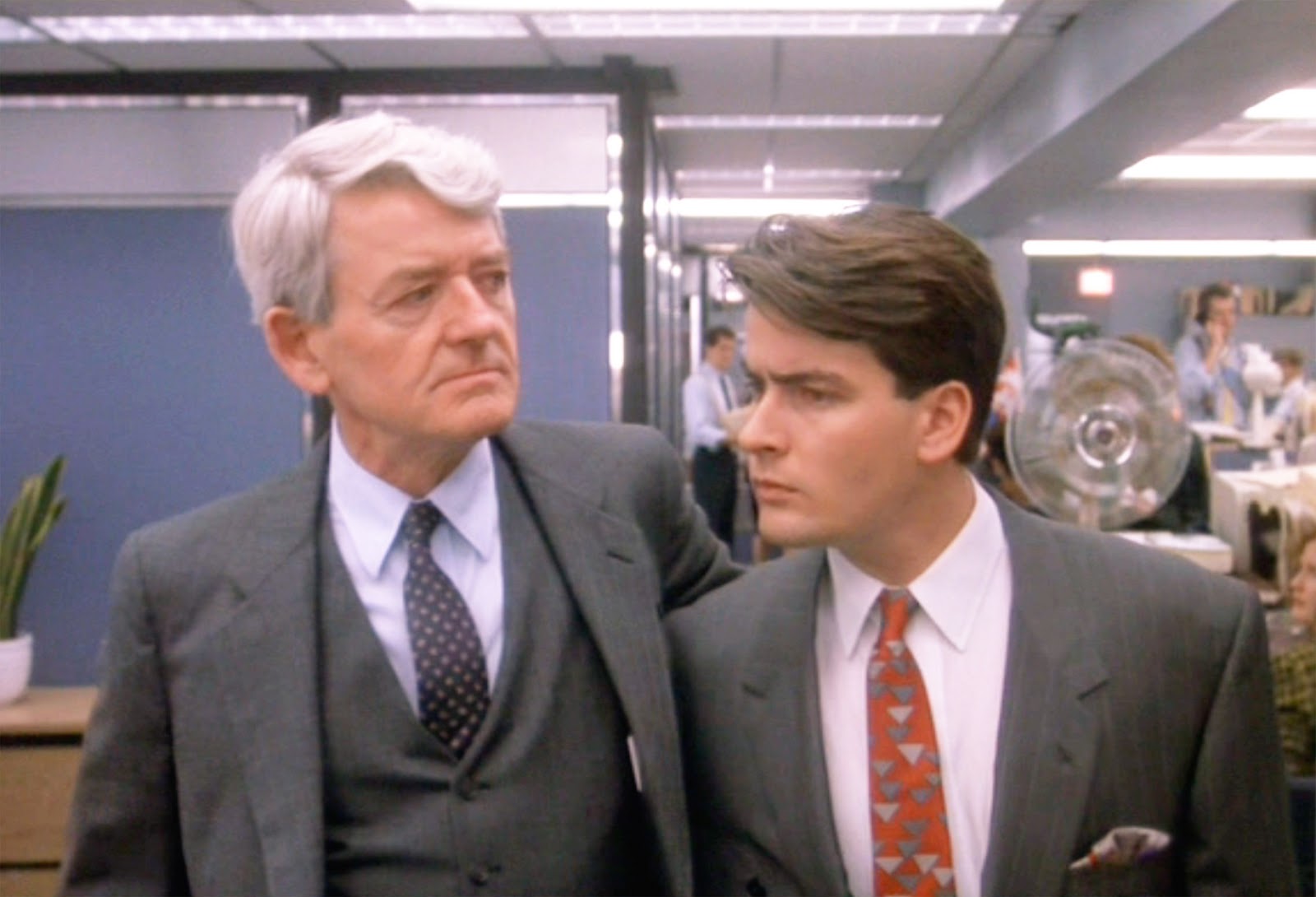
Bud is desperate to rocket out of his current job, unlike coworker Lou Manheimm (Hal Holbrook), who believes in patience and sticking with the stock of a company that creates good products, no matter if it takes five years to fulfill its potential. He says, “Good things sometimes take time.” Marvin, in contrast, says on the phone he needs information immediately, because in a very short time, if he doesn’t get it, he’ll be a “dinosaur.” His point is that in the stock market world, sure and steady doesn’t win the race; if that is the practice, one becomes a financial evolutionary failure.

Director Stone said that he wanted to make a “movie about sharks, about feeding frenzies.” So, the camera keeps moving, in circular fashion many times, like a “predator.” There’s no letup until we get to Bud’s father “where the stationary camera gives you a sense of fixed immutable values.” In this way Stone uses motion to contrast the loose ethical ways of the Wall Street types with the steady, honest, hard-working members of society.

Bud continually calls Gordon Gekko (Michael Douglas, who won the Best Actor Oscar for this role), an unscrupulous giant in the stock and real estate investment area, to work with him. However, Bud is a nobody who never gets through to Gekko. (Gekko suggests a gecko. As IMDb notes there is a Golden Gecko, which sounds like Gordon Gekko, and which may point to Gekko’s lust for riches. We may think of the creature as a friendly lizard from insurance ads and forget that it is a carnivorous animal). Even the mercenary Marvin sees how Gekko is beyond the edge of acceptable moral behavior when he says that the man had “an ethical bypass at birth.”

Bud goes to a tavern to see his father, Carl (Charlie’s real dad, Martin Sheen). When Carl uses the word “spaghetti,” Bud says his dad should use the word “pasta,” since spaghetti is out of date. Carl says so is he. The film implies that Carl’s morality is becoming extinct. Carl notes he is taking blood pressure medication, and Bud wants him to stop smoking. These facts are a foreshadowing of what is to come. Bud needs to borrow more cash. The lifestyle which he maintains to be a player in his job cuts right through his earnings. He can’t even pay off his college loan. So far, he has been staying inside the ethical playing field, but his profession makes it difficult to stay there. Living a working man’s life is not good enough for Bud. He says, “There’s no nobility in poverty anymore.” So, when his father mentions that the airline he works for, Bluestar, has been cleared of any wrongdoing in an accident (which Carl knows was due to lax standards on the part of the manufacturer, pointing to more unethical behavior due to stress on the bottom line), Bud has access to information that has not been made public yet. If used to purchase stock, it is insider trading, which is illegal.

Bud finally gets a meeting with Gekko when he shows up in person on Gekko’s birthday with Gekko’s favorite Cuban cigars. This contrasts with his dad’s pedestrian cigarettes, but both men are subject to the same threats to mortality. However, Gekko has the money for technology that monitors his heart in the office. He doesn’t even stop for a smoking break if a buck is to be had. As Bud says, for people on Wall Street, Fortune Magazine is the “bible,” which is substituted for religious values. Around him, Gekko has cutthroat businessmen who will do anything for a monetary killing. Gekko actually uses lines like “lock and load,” and being in the “kill zone,” which metaphorically illustrates the brutality of the big business mentality. On the phone, Gekko says, “Lunch is for wimps.” For him, taking time out to enjoy a midday meal shows weakness. Gekko does admire Bud’s persistence, but the only thing that gets some attention from Gekko is the information about Bluestar achieving a clean record form the FAA.

Bud thinks he struck out with Gekko, but the bigshot calls him and tells him to buy Bluestar stock for him. Bud is now ready to fly to the moon, as the song says, since he will make money off the purchase. The newspapers then announce that the airline was exonerated in the crash, and the stock price soars, just like a jet plane. Gekko meets Bud at a high-class restaurant, but Gekko doesn’t have the meal with him, following his own rule. He does give Bud a million dollars to invest and says he doesn’t like losses, so if Bud continues to do well, there will be lots of “perks” to reward him. He orders steak tartare for Bud, which is raw meat topped with an uncooked egg, which fits in with the predator theme of the film.

After taking a loss on an investment for Gekko, Bud meets with Gekko at a sports club where Gekko handily beats Bud at squash. The competition jives with how Gekko sees the world divided up between winners and losers. He sees himself as a self-made man. Those with “Ivy League” diplomas who he sees were given advantages that he had to earn now kiss up to Gekko. He says, “Give me guys that are poor, smart, and hungry, and no feelings.” For him, caring about others just gets in the way of accumulating wealth. Unlike most people, he says he doesn’t “throw darts at a board.” He only bets on “sure things.” To have that surety, he goes outside the law. For Gekko, all is fair in love (which he thinks is an emotional scam) and war, and he sees monetary acquisition as warfare. That is why he tells Bud he should read Sun-Tzu’s The Art of War. He says that “every battle is won before it is fought.” He doesn’t gamble, but wants the game rigged in his favor.  

Gekko is a complicated person. He makes valid comments about how little invested in their own companies the executive officers are. Even though he is a self-made man he has disdain for those that just labor their whole lives without success, including his own father, who died of a heart attack at an early age. This fact is another foreshadowing, and the story suggests that he is linked to Bud through their fathers. Gekko sees things in binary ways. When he observes a beggar standing next to a well-dressed businessman, he says nobody can convince him that only luck was the factor between success and failure. He seems to think that being rich and being poor are the only choices. He doesn’t concede that those who work hard should be deserving of more than being poor. He tells Bud that the choices are either being rich enough to own an airplane, “or nothing.” Yet, he is also able to appreciate that the beauty of a sunrise is not something that can be measured in dollars and cents.

He wants Bud to follow a rival, Sir Larry Wildman (Terence Stamp. The character’s name suggests staid nobility and a rulebreaker at the same time). Sir Larry had a “mole” in Gekko’s organization and burned Gekko on a deal. Gekko wants “payback.” He has seduced Bud and will dump him if he doesn’t spy on Sir Larry in the U. S. and provide Gekko with insider information. After tailing Sir Larry, Bud and Gekko realize the Englishman is investing in Anacott Steel. Bud and Gekko start buying stock in the company which drives the price up and makes it expensive for Gekko’s nemesis, Sir Larry, to purchase the company. When Bud tells Lou about it, the latter dismisses the idea of a sure thing, and says a steady investor gets through the “bear” as well as the “bull” markets. Lou reminds Bud to keep his eye on the larger picture that goes beyond individual gain, stressing how the money invested wisely “creates science and research jobs.” In response to Bud saying a person must make it big before he or she can do good, Lou says, “You can’t get a little bit pregnant.” The point is once you cross the line that leads to corruption it means you’re all in.

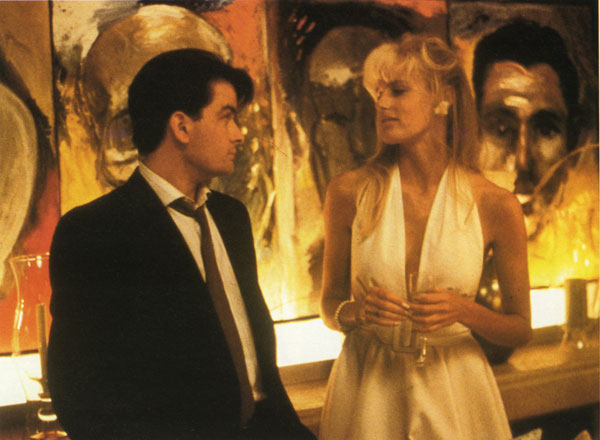
Bud brings documents for Gekko to sign at his house where he is having a party. It is there that he meets Darien Taylor (Daryl Hannah), an interior decorator, who is quite snobby in her attitude toward design. Gekko notices that Bud admires her beauty, and Gekko and Darien stroke each other’s hands, so we know that there was a sexual connection between the two. Darien says she’s a spender of other people’s money, so Bud uses that information to make a direct play for her, saying he will be moving up in the world after a couple of deals with Gekko. Acquiring people is the next step after obtaining things in this world of high finance.

Sir Larry arrives to confront Gekko about how he has driven up the cost of obtaining Anacott Steel. Sir Larry recognizes Bud, and probably realizes that he was following him. The references to war continue to make the connection to how big business is carried out. Gekko has a wall of firearm collectibles, including a German Luger, joining him metaphorically to Nazi war tactics. This time, Sir Larry wants to turn the company he is buying around. He’s in it for the “long haul,” harkening back to the beneficial principles that Lou espouses. Gekko gets him to buy his shares of the company at a high price, but his motives are revenge as well as profit. Bud now quotes Sun-Tzu, which impresses Gekko, since battle tactics to win the immediate confrontation are what he is teaching Bud, not long-term prosperity.

Gekko wants to be continually “surprised,” by new information that will get those sure things he can invest in. So, Bud visits a college buddy, Roger Barnes (James Spader), a lawyer at an upscale legal firm. He tries to bait the hook by offering lots of cash if Roger will provide information on a certain deal. Roger is wary about getting disbarred, but still seems interested. He notes that the records in his uncle’s office at the firm contain loads of great information about company transactions. So, Bud gets involved in the janitorial service that cleans the office building where Roger works so he can delve into the uncle’s files. It is interesting that he does his dirty business by pretending to be working in a business that involves dirt.

Bud’s fortunes are rising, so he now can afford to date Darien. He even adopts Gekko’s phrase, “I’ll talk at you,” showing Gekko’s influence. The words suggest giving dictation, as opposed to listening to the needs of others. He plays rich games, like riding dune buggies with Gekko and Darien on the beach. Their vehicles are filmed in front of fisherman with their nets who have no time for play as their survival exists from day to day. Bud is decent about paying his father back for all the money he borrowed from him. But the workers at the airport kid him about joining them in doing a “honest day’s work,” as opposed to the slick Wall Street manipulations he’s involved in. His father compares his recent big monetary gains to winnings at the racetrack, which is a gamble, and which one can lose soon after.

Gekko always protects himself first so his lawyer gives Bud a limited power of attorney that allows Bud to make trades and assume any possible liability, since Gekko can claim plausible deniability. They use offshore accounts such as in the Cayman Islands to hide money. As Bud gets richer, another worker who has been with the firm for a long time is fired, showing how loyalty in the investment business does not last based on past accomplishments. As Marvin says, they are only one stock trade away from “humility,” which shows how precarious their profession is.

Time passes and Bud moves to an expensive penthouse apartment with Darien, who is also his decorator. They enjoy the high life together way above the worker bees below them. But Bud hasn’t forgotten his roots. At one point, staring out at the view high up in the clouds where he now resides, he asks himself. “Who am I.” It is more like what has he become.

Gekko wants to take over Teldar Paper and goes to a stockholder meeting to give his famous “greed is good” speech. He says, “greed works. Greed clarifies, cuts through, and captures the essence of the evolutionary spirit. Greed, in all of its forms: greed for life, for money, for love, knowledge has marked the upward surge of mankind.” He makes a valid point about how the drive of the individual to excel brings about changes moving forward. However, he leaves out that not all change is good, especially when it comes to technology. And, his sermon sounds like he is preaching Social Darwinism, where only the strongest can survive as they vanquish all others. He says according to him, “You either get it right, or you get eliminated.” Again, we have his extreme binary way of looking at things. But “getting it right” for Gekko only means making huge profits no matter the cost to others. He often breaks up companies he buys and sells them for their components that pay more than what the company were worth when combined, regardless of who loses their jobs and benefits. We again hear the lyrics, “Fly me to the moon,” which fits in with these men who have the hubris to think of themselves at gods on high, ruling the earth below.

The film nicely segues to Bud telling Darien that he is “shooting for the stars,” and, appropriately, he wants to run an airline. He tries to convince Gekko to help build Bluestar Airlines into a bigger and better company after he hears from his dad that layoffs are coming. Bud says he knows the people working at Bluestar, and they will trust him that they can turn the company around if there is a cut in wages. Trust is the branch that Bud is hanging onto here, and betrayal will be what breaks that trust.

Bud (whose hair is greased back now like Gekko's, reflecting their slick maneuvers) and Gekko meet with the airline union leaders, including Carl. What Gekko and Bud propose seems like a good plan to turn Bluestar around, but Carl knows Gekko’s love of greed and doesn’t believe he will follow through once he owns the airline. Bud may have some good general plans, but Carl points out that his son only worked at the airline for a short time and isn’t ready to be president of the company. Gekko calls Bluestar’s management “scum” who have ruined the company. Carl points out that the management of Bluestar built the company over thirty years from scratch when they started with one plane. Carl’s argument is that management is in it for the long haul, and he knows that Gekko is a short-term speculator who gets his money and then dumps what he buys.

Bud is of course embarrassed by his father’s lack of support, and they have an emotional confrontation after Carl walks out of the meeting. Carl says Gekko is using Bud, but Bud says, “What I see is a jealous old machinist who can’t stand the fact that his son has become more successful than he has!” It is an incredibly hurtful statement, and Carl feels that he has failed in raising his boy if that is what he believes. Carl marks an individual’s success by the morality of an individual, not by the “size of his wallet.” But, Carl does agree to let the union members vote on the proposal.

Bud’s lawyer friend Roger calls Bud into his office because he’s worried about the SEC looking into offshore purchasing of Teldar Paper that Roger is complicit in. Bud learns from Roger that Gekko is using the law firm to instigate plans for Bluestar. In a meeting, Bud finds out that his father was right, that Gekko is planning on breaking up Bluestar and selling its components, including the property for housing development and the planes, and plundering the overfunded pension for a substantial profit.

Bud confronts Gekko, who says he was reading his son the story of Winnie the Pooh, and how the bear became stuck in the honeypot, supposedly relating the tale to the Bluestar situation. Bud wittily says maybe Gekko should have read the story of “Pinocchio,” which talks about someone who lies, obviously referring to Gekko. Gekko gives a speech which some may feel is shockingly true to this day. He says how the richest one percent of the United States own most of the country’s wealth. He says that “I create nothing. I own.” The stock and real estate speculators just manipulate the capitalist system to profit from it, but not by creating anything or helping others. The amount of gain is not important to Gekko. He just sees things in that binary way, where there are only winners and losers. He says that we don’t live in a “democracy.” It’s the powerful wealthy who “make the rules.” As he says this speech, the camera includes a shot of a man washing the windows of Gekko’s high-rise office. The movie is saying with another visual example that the manipulative wealthy live in extreme comfort as others must labor for meager earnings.

Bud is feeling guilty about being played by Gekko. Darien is frightened by Gekko’s wrath if Bud fights him on the Bluestar deal, and says she will not stick around because she will lose all her clients through Gekko’s influence. She tells Bud that he should look in the mirror and should not act self-righteous concerning Darien’s plans to bail. After he throws her out, she looks at herself in the mirror in the hallway, and Darien, like Bud, is not happy with what she sees.

The foreshadowings are realized as Carl has a heart attack and he and Bud have a tearful bedside meeting where Bud says he will make things right and use Carl’s “words,” which come from an “honest” man, when he speaks to the union leaders. Bud wants the unions to confront Gekko when the stock begins to rise once he implements his plan. He also knows that Sir Larry wants to hurt Gekko over the Anacott Steel deal. Bud and the union leaders give the same deal to Sir Larry that they gave to Gekko so long as he agrees to make a contract not to break up Bluestar. Sir Larry is agreeable, since he seems to be willing to help companies, not exploit them at this point.

Bud then tells his fellow workers at the investment firm where he works to start buying Bluestar to drive up the price. Ironically, Bud uses Gekko’s connections against Gekko to create enthusiasm for Bluestar stock. The union people tell Gekko they know his plan and will disrupt the airline’s activities, causing the company to be worthless before he can break it up. Bud then gets everyone to sell stock and take gains, thus lowering the price so that Gekko takes big losses on the shares he bought as the price went up. Sir Larry buys the stock at a cheap price and he is the only person willing to buy Gekko’s shares, which amounts to a total defeat for Gekko.

However, Gekko lets the Federal authorities know that Bud was involved in insider trading violations, and they arrest Bud. Bud meets Gekko in Central Park. He smacks Bud around for how he caused Gekko to lose millions. However, Bud is wearing a wire and makes a deal with the authorities to get Gekko on illegal activity.

Bud will be going to jail, but he saved Bluestar, and Sir Larry has offered him a job at Bluestar once he gets out. As his parents drive him to the courthouse, Carl states the theme of the movie, telling Bud “Stop going for the easy buck and start producing something with your life. Create, instead of living off the buying and selling of others.” The camera pulls away, a bookend which compliments the opening shot, to take in the whole skyline of New York City, as if to suggest people should look beyond their own interests to the bigger picture that includes the welfare of others.

The next film is Manchester by the Sea.

Sunday, March 27, 2016

The Treasure of the Sierra Madre

SPOILER ALERT! The plot of the movie will be discussed.


Early on in this 1948 film directed by John Huston, Howard (Walter Huston) talks about how the search for gold ignites an all-consuming fire inside a man, his greed always wanting more, never satisfied with his original declarations of what would be sufficient. While the man just wants to take the gold, the desire for the precious metal takes his soul. But, Dobbs (Humphrey Bogart) questions if the gold changes a man or whether the man is already soulless. The movie explores these arguments by following three men who go off prospecting together.
We find Dobbs broke in a Mexican town. Shots are more important than words many times in a screenplay, and the look of Dobbs coveting a thrown away cigarette in the street conveys how destitute he is. He begs for money, and receives gold coins three times from an American (John Huston). The gold currency emphasizes for Dobbs what he doesn’t have, and what he needs to get in order to be on the other side of the begging situation. However, when he cleans himself up with the money he received, he dismisses the Mexican boy who tries to get him to buy a lottery ticket. So, we can see immediately that Dobbs is a taker, not a giver. He succumbs to the boy’s persistence, purchases the cheapest ticket, and eventually wins a small amount on the number he thought would be unlucky, thirteen. He now feels himself to be fortunate, and uses the money to help buy the gear and supplies needed to search for gold with Walter and another impoverished American by the name of Curtin (Tim Holt), who joined Dobbs doing some strenuous work for a cheating boss. These early scenes demonstrate how poor these men are, and why they would go to extremes to better their lot in life. As it eventually turns out, the lottery number is not lucky for Dobbs.

Walter is an older man who caught the gold prospecting bug a long time ago. He knows the pitfalls of the greedy pursuit, has gained and lost fortunes, and continues on these type of adventures anyway. But, he has a philosophical way about him that tempers the search for wealth with an enjoyment of the prospecting itself. He says they want to go where few have traveled since that is where undiscovered gold most likely will be. But, this fact also means that they must go where there is no civilization, where there are bandits and the dangers of being out in the wild. There, they are tested to see if they can maintain their humanity. Dobbs is surprised how difficult the trip is. He is not prepared for this trip. He can’t even saddle his burro properly. He thought it would be easy money. As he says, he expected that he would just pick gold nuggets off of the ground and bring them to a bank. Instead they have to dig a mine and rig up a water stream to flush out gold dust. Howard had said before that gold was valuable not because it was rare, but because it represents how much work so many men performed to find it and dig it up. Obviously, Dobbs’ personality does not allow him to appreciate the scarifies he must make to get what he wants.
He and Curtin find pyrite and think they discovered large chunks of the precious metal. But, Howard points out that it is just “fool’s gold.” Perhaps the desire for huge amounts of wealth is a foolish mission, instead of seeing what is really important. When they wash off the sand to see better what they think is gold, Howard points put that water is more valuable than what they seek under the circumstances. A very revealing scene about the characters in the story takes place when they talk about what they will do with their fortunes. Curtin remembers how much he enjoyed being on a peach farm when he was younger where people liked being around growing things, and thinks he will become a fruit farmer. Howard says he will be done with prospecting and maybe open up a hardware store. Each sees himself content immersed in a simple life. Not so Dobbs. He sees himself relishing a life of excess. He will buy the most expensive clothes, and order everything on a fancy restaurant’s menu. He will then send the food back as unacceptable, even if it is excellent. Dobbs is an example of the corruption of wealth on those who use it to lord it over the less fortunate.

Dobbs’ greed starts to warp his mind. He sees treachery wherever he looks, thinking that the other two men want to steal his stash, He refuses to go into town for supplies because he is paranoid about being away from his gold. His lust for the metal makes him want to divide up the gold as they acquire it, unlike the trusting Curtin, who says they can get their portions when they finish their work. Dobbs begins talking to himself about the conspiracy against him. Even though Curtin saved Dobbs’ life in a cave-in, Dobbs greediness has poisoned his mind and he thinks Curtin is after his portion of gold. Curtin goes to town instead, and another American, Cody (Bruce Bennett), follows him back to the prospectors’ camp. He wants to become a partner. He is a guest for the night, but when Hobbs wakes up the next day, he accuses Cody of stealing their water. Cody says he thought he was among civilized men. Dobbs then says “Who’s not civilized?” and then precedes to show how he has become uncivilized by punching Cody.
 Dobbs convinces the others to follow him down the barbaric path by saying that Cody is a threat who will make each of their future shares amount to less, and who may divulge their luck to claim jumpers. The three men are ready to shoot Cody when bandits, who say that they are government soldiers, led by a man they call Gold Hat (Alfonso Bedoya), whose name signifies the same desire for wealth, attack them. Gold Hat’s famous line that they do not have to show “no stinking badges” points to the absence of civilized laws in this wilderness where selfishness reigns. The bandits kill Cody while he is, ironically given what the prospectors have planned for him, helping to defend the other three. They discover a letter from Cody’s wife which says he was a poor farmer with a child. She misses him. Her words annunciate the theme of the film. In the letter, she says, “No treasure, no matter how great, is worth this separation.” Their love and family are worth more than gold. She has decided that they, “already found life’s true treasure.” But the selfish Dobbs, only thinking about his own skin, responds to Cody’s death with the complaint that now they have “one less gun” to help fight off the bandits. In contrast, Howard and Curtin’s response is that they want to give up a portion of the gold to Cody’s widow.

The real Mexican soldiers show up and drive off the bandits. Some villagers seek help from Howard, who has some medical knowledge, to save a boy who is unconscious after almost drowning. He saves the boy, and the tribe requires that he accept their hospitality, or else, they believe, the spirits will be angry. Howard goes off with the villagers, trusting the other two men to take the burros, supplies, and the gold to Durango. Dobbs at first gripes that they have to be burdened with Howard’s belongings, but then proposes that they take his gold. Curtin says he will protect Howard’s share. Dobbs then thinks that Curtin wants it all for himself, and shoots Curtin. He thinks the man is dead, but Curtin drags himself off. Dobbs must now confront his demons, trying to quell his conscience, afraid to bury Curtin, fearing that his accusing eyes will still be open. Huston then provides an image of Dobbs’ camp fire building to a symbolic raging blaze, indicating the hell in which Dobbs now resides.
On his own, Dobbs looks exhausted and ill from the toll the trip to Durango takes on him. His greed was about getting gold for himself, and now all he has left is himself, with no help from others. He runs into the bandits again. He doesn’t mention the gold, and says he is on his way to sell the burros. Gold Hat recognizes him as one of the men who shot at his gang, and he then kills Dobbs with a machete. They dump the bags of gold dust, thinking they are filled with sand that will make the burros seem heavier, thus fetching a higher price. When the bandits reach town, the brands on the animals’ hides show them to be thieves. They are executed by the soldiers. So they, along with Dobbs, are examples of how self-destructive greed can be. They are the ones whose ways are fertile soil for greed to grow and take over their souls. Curtin and Howard, although desirous of wealth, hold onto their civilized humanity.

Howard is living a life of ease as the villagers pamper him. The villagers come across the wounded Curtin, and bring him to Howard, who, with the help of others, nurse him back to health. The idea that “it takes a village” of people for all to get by in life is illustrated here. The two men learn that Dobbs was killed. They go to the site of his death in a wind storm, and all the gold has been blown away. Howard laughs heartily, seeing it as a big cosmic joke, where their folly has been exposed by the universe.
 Earlier, Howard said that they had to fill up the mine they dug because they must heal the wound in the mountain that they inflicted. Now, at the end of the tale, nature has taken back what the men thought would bring them happiness, but which obscured what was really precious in life. Curtin gets the message, and joins in the laughter. He will go visit Cody’s widow, maybe becoming a farmer there. Howard will live a happy retirement in the embrace of the worshipful villagers. Their last words are to wish each other “luck” – not as for monetary gains but for what really counts in life. The title of the film emphasizes that the “treasure” belongs to the land, not men, and that humans should seek a less materialistic type of reward.

Next week’s film is Syriana.