Showing posts with label corruption. Show all posts

Sunday, May 26, 2024

O Brother, Where Art Thou

 SPOILER ALERT! The plot will be discussed.

In the film Sullivan’s Travels, the main character is a filmmaker who travels to find what real life is about and make a film entitled O Brother Where Art Thou? In the Coen Brothers movie with that title, we have a farcical version of true life, reversing the process of the earlier motion picture’s protagonist, but showing the real-life situations beneath the exaggerated exterior. The opening notes cite The Odyssey as the film’s source material, but the tone here is mock epic.

The main character is Ulysses Everett McGill (George Clooney), and his real goal is to return to his wife, Penny (Holly Hunter). So, the names and the quest establish the link to Homer’s epic, Penny referring to Penelope in Homer’s epic. This Ulysses, however, is a convict, not a war hero, a character that can be associated with everyday life. Clooney excels in delivering fast-paced, pretentious speech here, as he also does in the Coens’ Intolerable Cruelty. His language is in contrast to the lowly situation he is in, since he is incarcerated in a chain gang. There are many contrasts here as the whimsical, humorous aspects contrast with the bigotry and corruption in the tale. As Adam Nayman points out in his book The Coen Brothers, the song included in the film, “The Big Rock Candy Mountain,” suggests a utopia where “the downtrodden and dispossessed” do not exist, which is in direct contrast to what the Coens depict in their Depression-era movie. Nayman says the colors used in the cinematography are vivid, making the film a “gilded Dust Bowl” story. Again, there is that sense of artifice stressed in the midst of a movie relating a dark time in American history. (The soundtrack of traditional, downhome music was a hit and received the Grammy for “Album of the Year.).

The movie begins with this Ulysses handcuffed to other convicts on a chain gang, the volatile Pete (John Turturro) and the intellectually challenged but sweet Delmar (Tim Blake Nelson). Being bound together physically brings about an emotional bonding despite the differences in these characters and adds an optimistic aspect to the story.

The three men escape their captivity, and as Nayman points out, we see them popping into the horizon like plants growing out of the soil. Nayman says that the whole film has this universal homage to what is basic and universal to humankind, as if the men were “products of the rich, fertile Delta soil.” Perhaps the Coens using a mythological structure means that they are aiming at the universal that binds us all.

They visit Pete’s cousin who removes the shackles, change out of their prison garb, and spend the night in the barn. Everett tells the other two men he has over a million dollars that he hid from a robbery and will split it with them if they help him. However, the cousin called the police to get the reward on the men. Greed is a continuing theme in the Coens’ films, and it does harm to those who worship profit and the collateral damage associated with monetary gain. Everett utters a repeated phrase here when he says, “We’re in a tight spot!” The words are in opposition to his usual long-winded style when not in immediate danger. They are able to escape with the help of the cousin’s son, which shows compassion in the midst of selfishness.


The travelers come across a religious group. Delmar and Pete feel the need for salvation and are baptized. Everett, the rational-minded member, does not participate. However, despite the draw of splitting Everett’s cash, the desire for the other two to mend their ways shows that they are more upstanding than others in society who appear upright morally. Delmar is childlike, and it is that incorruptible aspect that puts him in contrast to the schemers that the men encounter on their journey. It’s as if the real culprits of society are on the loose, and the three convicts are minor transgressors in the scheme of things. These scenes are played broadly, but, as Nayman says, “lowbrow humor is deployed in the service of social commentary.”

The men then meet a hitchhiker, a black musician named Tommy Johnson (Chris Thomas King), who plays guitar and says he made a pact with the devil to become talented. Tommy says that Satan is not the scaly creature people envision, but is actually “white, as white as you folks. With empty eyes and a big hollow voice. He likes to travel around with a mean old hound.” For the black man, the devil is white, especially at this time. As it turns out later, we discover the demon is a policeman, one who is supposed to stand for morality, but instead is the devil beneath the trappings of justice.


The foursome come across a radio station run by a blind man (Stephe Root) who thinks the fellows are a black musical group. They record a song, “Man of Constand Sorrow,” as the “Soggy Bottom Boys” and collect some money for the performance. They do not realize it, but the recording becomes a hit, which helps them later. Nayman says that the blind DJ shows a white man’s not recognizing the music of African Americans and it is an example of cultural appropriation. However, could it also mean that music is universal, and thus it addresses people of all backgrounds despite its source?

The police are on their trail, headed by the devil-like Sheriff Cooley (Daniel von Bargen). They escape but become separated from Tommy. They run into “Baby Face” Nelson (Michael Badalucco) and are drawn into a bank robbery. Nelson is an unhinged character, and his nickname is in sync with the theme of the film in that the gangster’s innocent name hides a nasty fellow underneath.

The next attack on their innocence comes in a form that mirrors the temptation of the Sirens in The Odyssey. Beautiful women sing and do their laundry in the river. They are awash in clingy, wet clothes that stress their allure that draws the men to them. The next morning Delmar finds Pete missing. Inside his strewn clothes is a frog, and the superstitious Delmar believes the women cast a spell and turned Pete into the creature. The Coens continue to give us a magical exterior to the story, but it again is a coating of artifice that storytellers use to embellish the harshness of reality.

At a restaurant Everett and Delmar meet Big Dan Teague (John Goodman). He has that way with words that reflects a kinship with Everett. Big Dan has one eye, so he is the cyclops character in this version of the Ulysses tale. He is a bible salesman. All of this is a front that hides a mean character beneath the friendly surface. In a field where they are having a picnic, he beats up the two men, steals what money they have, kills the frog Delmar was carrying, and steals their car. Big Dan is the Mr. Hyde to Everett’s Dr. Jekyll.  

Everett and Delmar arrive at Everett’s hometown where Everett tries to talk with his wife, Penny, who is taking care of their seven daughters (seven being a magical number which fits in with the mythic framework of the story?) She is so ashamed of him she told the children he was killed. Penny is now engaged to Vernon T. Waldrip, who is the campaign manager for Homer Stokes (Wayne Duvall), who is running for governor. Nayman believes Waldrip is a reference to a writer, Howard Waldrop, who wrote a story that re-envisioned the labors of Hercules to the time of the Depression. In a way is what the Coens are doing with this film, reimagining a mystical tale. Stokes is another fraud. He acts like he is planning on getting rid of corruption, while in fact he is the head of the local KKK. He has a little person with him on the campaign using a broom to symbolize sweeping things clean for the “little” people in society. As Nayman points out, it is a condescending image, and the man’s campaign smacks of the “proximity of populist rhetoric and fascist ideology.”

Everett and Delmar find Pete (not a frog) as part of a prison chain again. The prisoners are in the audience in a movie theater (a film within a film? The Coens stressing storytelling?). He was turned in by the Sirens (more deviousness). They help Pete escape. Everett now reveals that there is no armored car stash of money. He was arrested for practicing law without a license – not so horrendous a crime compared to acts committed by some others - and all he wants to do is get back with his wife. His other character flaw may be his vanity, insisting on using “Dapper Dan” pomade. The problem is they will get fifty years for escaping, a geometrical multiplication of original infractions, which points to inequities in the legal system.

These three Depression musketeers come upon a KKK meeting where the white-robed Klansmen are ready to hang their pal, Tommy. Although the KKK rally mimics The Wizard of OZ, a fantasy, with its chanting like the scene in the 1939 film, what is happening is actually frightening. Stokes says, “Oh brothers … our women … looking to us for protection. From Darkies! From Jews! From papists, and from all those smart-ass folks say we come descended from monkeys! That’s not my culture and heritage!” The call to “brothers” echoes the title of the film, which here questions what people stand for. The three men are admirable as they rescue their African American friend in a dangerous situation (like the Scarecrow, Tin Man and Cowardly Lion helped Dorothy), and show their place on the moral measuring stick. They topple a burning cross onto KKK member Big Dan in a bit of ironic justice, apparently killing the brute.


The four men come upon a campaign rally for governor. When they sing “Man of Constant Sorrow,” they reveal themselves as the Soggy Bottom Boys, and are wildly popular. The dancing and mugging as they sing the song is diverting, but the song identifies the four men with the hardships of everyday people. The crowd condemns Homer Stokes who derails himself by attacking the Boys for ruining his KKK rally. The shrewd current governor, Pappy O’Daniel (Charles Durning), embraces the Boys, knowing he will win the popularity of the masses. He pardons them. It is a left-handed way of doing the right thing.

Penny says she will take Everett back, but he must retrieve her wedding ring from their old cabin. The men go there but Sheriff Cooley is present and doesn’t care about a pardon. His men have dug their graves. Everett prays and then there is divine intervention this time to save them. A biblical-like flood immerses the valley. The men come across a floating desk and retrieve a ring from it (it almost reminds one of how Ishmael is saved in Moby Dick). However, when Everett gets back to Penny, she tells him that it’s not the right ring, which is now at the bottom of the lake. The man is always in that tight spot. Finding the ring at the end is like a Herculean task, an impossible thing in the real world, which fits with the mythic, mock-epic feel of this story.

Nayman sums up the way the Coens present their story by saying, “art with a message is less valuable than that which sets out, energetically and unpretentiously, to entertain.”

Tuesday, August 15, 2023

The Dark Knight

 SPOILER ALERT! The plot will be discussed.

Before analyzing the next film, I’m following up one Christopher Nolan film, The Prestige, with a brief discussion of the characters in another movie of his, The Dark Knight (2008). This post springs from a viewing and class focusing on the second story in the Nolan trilogy recently held at the Bryn Mawr Film Institute.

Nolan explores the two sides of individuals in his films. Sort of a take on the superego and the id. He does it in Memento and The Prestige, and there is certainly a dark side in Oppenheimer. The punning title of The Dark Knight reminds us that Batman is, like the animal he has adopted as his persona, a creature of the night, but a person who wants to champion good over evil. However, as the Joker asks, is he also the catalyst that brings about dangerous side-effects? Vigilantes mimic him and are harmed, and one is killed. Batman (Christian Bale) bypasses the justice system by doing unlawful acts, as he unlawfully kidnaps the Asian banker, Lau (Chin Han), and beats up Joker in custody (even if we applaud it. What does that say about us?). He taps into everybody’s cell phone in Gotham to find out Joker’s location. He tampers with crime scenes, not sharing his technology with the police to analyze evidence. Do the ends always justify the means?


Harvey Dent (Aaron Eckhart) was called Two-Face because he worked for internal affairs at one point, investigating criminality in the police department. So, cops considered him to be a policeman but also a traitor. Bruce Wayne, Batman’s legitimate front man (is he really the disguise and Batman the true version of Wayne?) sees Harvey as a way to get out of the vigilante business. Harvey appears through most of the story as a white knight, a hero not needing a mask, whose goodness is uncompromised, who fights crime through legal channels, and has won over Rachel (Maggie Gyllenhaal), Bruce’s love. In a way, Harvey is Bruce’s legitimate surrogate, who Bruce wishes he could be, who deserves to get the girl. Bruce hopes that if he no longer must be Batman, then he can go legit, and win back Rachel. But Joker will have none of that. He wants to keep Batman in the game to expose his true identity behind the mask. Symbolically it also means revealing Batman’s darker tendencies can’t be separated from the supposedly legitimate person wearing the costume. When Harvey literally becomes two-faced after the explosion, it reveals how the dark side of his personality can take over as it can for anyone who sees the world’s rules as unjust. In his own way Harvey becomes a vigilante to avenge the corruption that led to the murder of Rachel. As our instructor pointed out, Batman and Joker wage their war over Harvey’s soul. Joker wants to show that everyone’s nature, once stripped away from the socially acceptable façade, is destructive. In the end, Joker wins when it comes to Harvey.

The most interesting character is, of course, Joker, played perfectly by the late Heath Ledger in a supporting Oscar-winning performance. Joker tells the defaced Harvey that he is a true outlaw. He is not a schemer, a planner, like the other leaders of society. He is chaos, which he sees as the natural state of humankind.  As Alfred (Michael Caine) says to Bruce, there are some people “who just want to see the world burn.” Joker crafts situations where people must act on their selfish, anti-social drives. For example, after he infiltrates a criminal organization (that criminals should organize is a joke to the Joker), he breaks a pool stick so that two of the crooks must use the splintered weapon to fight to the death to survive and join his gang. Of course, as is shown by the opening scene, survival is not guaranteed if one joins the Joker, whose associates are mostly anti-social misfits. He shows Batman that he can’t save Rachel, that his heroic efforts will not triumph.


Writer/director Nolan gives us several images that show how Joker subverts what we consider is worthwhile about society. Joker uses school buses to transport his band of criminals, which contrasts the innocence of children with the depravity of criminals. Joker and his band of outlaws dress up as policemen and use police cars, showing that those who we think can protect us can’t. Indeed, he kidnaps Rachel and Harvey with the help of corrupt cops. To divert the police caravan to the underground road, he sets on fire a fire engine to block the planned (that word again) passage. The vehicle that is meant to protect us from flames is negated by being consumed by them. (Observe how the police escort goes underground, the place where, for the Joker, we all genuinely belong, in the selfish id of our personalities). Joker masquerades as a nurse at the hospital where Harvey is a patient. Nurses are supposed to care for others, but Joker does not even leave angels of mercy unsoiled. He blows up the hospital, showing how pointless it is to seek sanctuary anywhere. Even Joker’s makeup in this film is nightmarish. He looks like a demon from hell, not the happy clown that is meant to make children laugh. When Batman captures Joker at the end, the criminal hangs upside down, showing how he is in opposition to society, But the camera rotates the shot, and he becomes right-side up. The suggestion is that, like in Stranger Things, the upside-down, the darker side of reality, can become the norm.

There is hope toward the end of the film. As one student insightfully pointed out, those individuals on the ferries do not give into selfishness and refuse to destroy passengers on the other boat to save themselves. Even the transported criminals on one craft do the right thing, indicating that redemption is possible. These are unsung heroes, who have no names, do not have fancy technology, or Ninja skills. Yet, they upstage the high-profile crimefighters, Batman, the police commissioner, and the mayor.

However, the darkened character of Harvey Dent threatens any hope of saving Gotham. Batman and Gordon (Gary Oldman) decide that Harvey’s character must remain untarnished, and that Batman must shoulder the sins of others, Christ-like, to save the soul of the city. In other words, they determine that, ironically, salvation should rely on a lie.

The next film is Europa, Europa.

Sunday, July 3, 2022

Night and the City

 SPOILER ALERT! The plot will be discussed!

The first shot of Night and the City (1950), directed by Jules Dassin, is, of the London Tower Bridge. It is nighttime and we see only the silhouettes of people, as if just the dark sides of individuals exist here. The opening voice-over announces, “The night is tonight, tomorrow night, or any other night. The city is London.” The joining of continual darkness and the setting of a city epitomizes elements of film noir, where the underside of humanity thrives (although Dassin, in a 2004 interview, said he didn’t know about film noir elements when he made the movie).


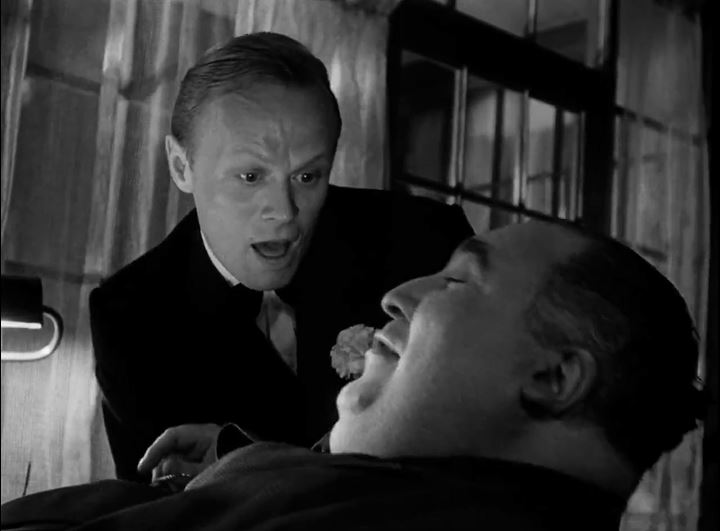
The first scene after the credits starts with an overhead shot showing a person running, trying to escape from danger, which is always present in this world. The image of “running” and the repetition of the word becomes a motif in the film. (Dassin said producer Darryl F. Zanuck warned him to leave the country because he would be targeted by the House Un-American Activities Committee and its “blacklist” of alleged Communist sympathizers, so he fled to London. That running away had its influence on the film).  The fleeing man is Harry Fabian (Richard Widmark). He runs through narrow, twisting alleys and streets. The impression is one of a maze, a puzzle that is meant to thwart a solution.


Harry’s pursuer follows him to his flat and stays outside. Harry places a flower in his lapel that he dropped on the street. It’s as if he is trying to clean up for appearance’s sake the dirty part of himself. He enters the flat and calls for his girlfriend, Mary Bristol (Gene Tierney). (Zanuck, unlike some of the characters in the story, showed compassion by wanting to help Gene Tierney who was suicidal after a disastrous love affair. He wanted her cast in the movie, according to Dassin). When she doesn’t answer, he picks up her purse. She then surprises him, saying there isn’t money there. We immediately realize that she is aware of his seedy nature, but, contrarily, still is with him, showing how illogical relationships can be. His first response is anger, and his face is ugly as he accuses Mary of spying on him, as if she is the one doing something wrong, not him. He then quickly switches to a charming smile and tries to cover up his transgression by saying he was just looking for a cigarette. It’s a lame excuse since there is a whole glass full of smokes next to the purse.

She asks who he was running from now, and he acts like that doesn’t happen to him, although we know otherwise. She was worried that he was the victim of foul play since he was gone for three days. He says he was away trying to become a partner in a greyhound racing track operation. She knows he wants her money for the investment. She says they have been through this routine “a thousand times.” It appears that Harry is always looking for a get-rich-quick scheme at the expense of others to satisfy his selfish wants. In contrast to Harry’s pie-in-the-sky activities, she is working hard at a bar to make a decent living. She holds up a happy picture of the two of them in a boat. She describes them as if they were strangers, good people who wanted to lead “decent” lives. It’s as if they have left that part of themselves behind, and what’s left are just empty shells of their former selves. However, the boat they are in is still an object of movement, suggesting the hope for stability was an empty dream. His response to her words is, “I just want to be somebody,” a self-centered statement given that she was talking about their life together.

Mary knows Harry is hiding from Phillip Nosseross (Francis L. Sullivan) and she sees the man Nosseross sent to follow Harry at a phone booth below the window of their place. (“Nosseross” sounds a bit like “rhinoceros,” a large, dangerous, charging animal, something one would run to escape from. Harry says that Nosseross is heavy, equating him with the large creature).

Harry needs five pounds to discharge his debt to Nosseross. While Mary goes out of the flat to see if she can get some money from a neighbor, Harry appears sad as he looks at the photo of the two of them that Mary held, and probably sees something of his past self in that picture. Mary goes to the flat of Adam Dunn (Hugh Marlowe) who has burned his spaghetti and Mary helps douse the flame. He is a designer, and he may have designs on Mary since he says he wishes that they had different schedules. He works during the day (which probably means he is not a creature of the night, like Harry). Does the fire show that he has the “hots” for her, and only she can douse his passion? She works at night at Nosseross’s club, not because she wants to go to the dark side, but has been dragged there by Harry.

Mary says it’s difficult to resist Harry’s charismatic imagination and zeal for his projects. Adam says, “Harry is an artist without an art.” He explains that Harry wants to express himself but doesn’t have the “means,” the specific skill or outlet, to put his imagination into concrete form. Adam says that can “make a man very unhappy,” creating a frustration that may be “dangerous.” He is suggesting that the search to make Harry’s dreams a reality can lead him to the criminal underside of society. In contrast, Adam is artistic in his designs of objects, including figurines and a replica of a bank that holds his money and plays music. Adam has been able to focus his imaginative skills in a creative and not destructive way.

Harry goes to Nosseross’s club, the Silver Fox, where his wife, Helen (Googie Withers), firmly sets the rules for the young women workers as to how to get the male customers to spend more money. The attractive women are the pleasant exterior which hides the mercenary practices in which they are engaged. Nosseross also assigns Harry to engage in a deceptive practice of drumming up business for his club. Harry gets information about a trio of successful American businessmen at a venue. He acts like he found a lost wallet, which is really his, and turns it over to one of the employees there, who is on the take. This action makes it appear (the operative word) that Harry is an honest fellow. He then pretends that he knows an acquaintance of the three men, and thus bonds with the men. It is then he suggests they go to a “private” club for some entertainment. Harry retrieves his wallet just before the three gentlemen depart for Nosseross’s club.

Harry goes to a wrestling match to hustle more customers. However, a bouncer recognizes him and prepares to toss Harry out. Harry says it’s a public place, and the bouncer says, “so is the morgue,” a darkly witty line that suggests that is where Harry may end up. There is an outburst by a man named Gregorius (Stanislaus Zbyszko), a once world-famous wrestler who is there with a young wrestler named Nikolas (Ken Richmond). He yells at his son, Kristo (Herbert Lom), for bringing them to an inferior match. Gregorius blames his son for the extent to which wrestling has declined.

Harry sees a financial opportunity in Gregorius’s displeasure, and stages an outburst where he demands his money back for such a terrible “spectacle” as Gregorius and Nikolas pass by. His rant and some subsequent flattery endear him to the ex-champion. He gets them to have a drink with him. Meanwhile, at the Silver Fox, Nosseross gives a silver fox fur to his wife and asks for a kiss in return. Helen is looking away from him and displays a look of revulsion, but she allows the kiss. The large Nosseross grabs her and is rough with her as she breaks away from him. His base nature here rises and transforms his sophisticated surface.

Harry bursts in and says he can control professional wrestling in London, but Nosseross loudly laughs at him, and Helen wants Harry thrown out. Harry is angry at the dismissive way Nosseross treats him, and says he will get 200 pounds on the condition Nosseross will match it for the investment. Harry goes to the underbelly of society seeking funds from beggars, forgers, and those operating in the black market since he resides in the illegitimate area of finance.

There is a scene where Nosseross and Mary do not know where their romantic partners are. Harry is at a bar and Helen finds him there. Harry is angry at her for forcing him to put up the 200 pounds before Nosseross will commit to supplying some cash. Helen kisses Harry, and we realize there was an intimate connection between the two, and that is why Harry feels betrayed by Helen’s prior statements. However, she has the 200 pounds which causes Harry to be elated. But, she wants him to get the other 200 from her husband to get her a license for her own nightclub which she bought unknown to Nosseross. She can’t tolerate her husband anymore and needs to break away. She says she knows all about running a nightclub since she currently does all the work. She wants Harry to scam her husband and Gregorius. He says he’ll go along with her schemes, but we wonder if he will. So, there is deception upon deception here.


Fergus Chilk (Aubrey Dexter), Kristo’s lawyer, along with a henchman, pay a visit to Nosseross. The attorney tells the club owner that Kristo is “disturbed” by Harry’s attempt to be a rival wrestling promotor, and Chilk wants to meet with Harry. (Nosseross’s office looks like a cage, with bars for its ceiling. The design conveys a feeling of entrapment, as if those dwelling in the darkness of the city create paths that lead to confinement. Similar images are in Alfred Hitchcock’s The Birds, where people, instead of the winged creatures, are caged. Think of Tippi Hedrin in the phone booth, the car, the attic, etc.).

When Helen returns, her husband says he wants to sell the club, and that he has more wealth than she knows. He wants them to travel and enjoy life. But, escape from the world he has attached himself to is not possible. He’s a parasite feeding off a dark part of society, and he can’t leave the host. Helen latched onto him and doesn’t want to leave, since she wants to draw what she can from his nefarious enterprises to start her own. Harry shows up with the money and expects Nosseross to match the sum and they will be wrestling promotion partners. But Nosseross is suspicious as to how Harry attained the cash, and finds that some of his stash is missing. He concludes that Harry and Helen are conspiring against him. Nosseross gives Harry the money, but says he is to be a “silent partner,” and wants the business only in Harry’s name. He doesn’t want any evidence that he was competing with the powerful Kristo. Nosseross rips up the lawyer’s card as he talks to Harry. Nosseross is preventing Kristo’s warning from reaching Harry and is supplying the rope for Harry to hang himself.

It appears that Harry has double-crossed Helen as he has established Fabian Promotions and has his own office and gym for wrestlers to work out. Gregorius and Nikolas are there. He is thrilled to get a desk sign in the mail that announces he is in charge, since feeding his ego has dominated his life. One of Kristo’s wrestlers, The Strangler (Mike Mazurki), shows up to intimidate the men there on behalf of Kristo, but Harry gets him thrown out. However, Kristo shows up in person with his lawyer and tells Harry that he can’t promote matches in England. Kristo rips up Harry’s promotional contract for an upcoming match just like Nosseross ripped up the lawyer’s card that Nosseross was to hand to Harry. The tearing image suggests how there are no ruled to abide by in the world of film noir. However, Kristo thought his father left for Greece and doesn’t know that Gregorius is now Harry’s partner. When Harry reveals this fact, Kristo tells his father that Harry is a swindler. His dad takes no heed of this warning and Kristo tells Harry that if he continues to do business, he better not try and cheat Gregorius. As Harry and Kristo talk, Harry hits a punching bag and Kristo tries to grab hold of it. The action shows the violent interaction present, and the situation is so precarious that even the relationship between father and son takes on sinister connotations.

Harry calls Helen and says that he has her nightclub license, but then tries to dodge a meeting to hand it to her since he is not telling the truth. She is talking to Harry secretly, thinking her husband is asleep (more deception). But Nosseross overhears the conversation, which adds evidence to how Harry and Helen are working against him. Harry pockets the fee from Helen that he says he needs to secure the license, but instead he gives her a forged paper. Everybody here is using everybody else for personal gains.

Despite Nosseross trying to keep his name out of Harry’s business to avoid repercussions, Kristo knows Nosseross’s money is behind Fabian Promotions. Kristo says Harry has promised to conduct wrestling matches in legitimate Greco-Roman fashion. Kristo says Harry will fail from a business standpoint because the public wants showmanship type of wrestling matches. His cynical observation shows how corruption is preferred and prevails in the dark side of life. But economic failure is not enough for Kristo. He wants to defame Harry in Gregorius’s eyes so that Kristo’s father will leave Harry. Nosseross no longer fears Kristo because he openly wants to help him reach this goal.

To do Kristo’s bidding, Nosseross tells Harry that he is pulling out and will not provide extra money for licensing. He says that Greco-Roman wrestling be a failure financially. He says he will only back Harry if he has big names in a match, and suggests booking The Strangler. Harry knows that Gregorius hates The Strangler’s style that panders to the audience’s baser instincts and will leave Harry’s business. Nosseross knows that Harry is only in it for the cash and has no ethics, so Harry promises to set up a match with The Strangler.

Harry attempts to create enough animosity between The Strangler and Gregorius that the latter will agree to a match between The Strangler and Nikolas. At a restaurant he makes The Strangler overhear his remarks about how Gregorius scared The Strangler away at the gym, and that Gregorius demeaned him. The Strangler runs to the gym, threatens Gregorius, and wants to fight right there. Harry passionately tells Gregorius that they should have Nikolas crush The Strangler in the ring and end The Strangler’s cheap form of wrestling that dishonors the sport. (There’s no argument here that Widmark really chews up the scenery in this role). Gregorius agrees. So, Nosseross was right – Harry is a swindler and will lie and manipulate for his own selfish reasons.

Harry goes to Nosseross to supposedly tell him the good news that he has The Strangler signing up for a match that Harry is promoting. Nosseross makes a call to talk to Kristo to Harry’s shock. Nosseross says that he will tell Kristo that Harry stole The Strangler from Kristo. There is now honesty as Nosseross admits that he wants Harry dead because he stole something he paid for. Harry understands that he means Helen, which her husband views only as dehumanized goods. Of course, Helen only married Nosseross so she could inherit his wealth. There is no morality to be seen anywhere. Harry reveals that Gregorius wants the match, so Kristo didn’t put a wedge between his father and Harry. But, Nosseross refuses to give Harry the money to pay The Strangler’s manager for his client’s participation. Without backing, everything Harry planned will fall through. Nosseross calls Harry, “a dead man,” and this conclusion about Harry continues in the story.


Again not caring about the feelings of others, Harry calls Mary to say he’s in trouble to get her out of the flat so he can steal her money to make the wrestling match possible. But Adam sees Harry go into the apartment after Mary leaves and when he runs into Mary tells her that he saw Harry at their building. When she finds him rummaging through her things, she warns him that others are “killing” him. This remark is another reference to declaring Harry as a dead man figuratively and literally in a foreshadowing way.

Harry goes back to the gym and The Strangler is there, drunk, and he taunts Gregorius who is training Nikolas. They begin to fight (the restrictive area of the wrestling ring is another symbol of imprisonment). In an attempt to protect Nikolas, Gregorius tosses him out of the ring, accidentally breaking Nikolas’s wrist. The Strangler’s agent, Mickey Beer (Charles Farrell), says they can’t stop them now because the wrestlers are “like mad bulls.” Civilized rules have been stripped away in this underworld zone and only brutality remains. Gregorius gets The Strangler in a bear hug (more animal imagery) and causes his opponent to temporarily pass out. Kristo arrives and Gregorius says that is what he does to his son’s “clowns.” But the fierce struggle is too much for the older wrestler and he dies. Before that happens he tells Kristo that he should preserve the “art” and “beauty” of Greco-Roman wrestling. Gregorius comes to represent the lofty accomplishments of ancient cultures that have fallen into decay in the modern world, which is mirrored by his own descendant’s corruption.

Harry doesn’t stick around. Krsito does not seem to blame The Strangler. He most likely sees Harry as using him as a tool in to implement his schemes. Beer confirms this suspicion when he confesses to Kristo that Harry taunted The Strangler by making up antagonizing remarks that he attributed to Gregorius. Harry gave The Strangler booze, adding fuel to his irrational rage. The Strangler hears what Beer says and he sees that Harry manipulated him. Kristo puts a bounty on Harry’s head of 1000 pounds and the word goes out to the denizens of the underworld to hunt Harry (an earlier equivalent of what happens to John Wick).

The Strangler barrels through Nosseross’s china shop club like that mad bull that Beer called him. The image of him wrecking the place is very effective in showing how the dark drives of humans can subvert the attempt to suppress them. The Strangler warns Nosseross that he better not be protecting Harry, and says it was not himself but Harry that killed Gregorius. Harry’s selfish ambitions have caused a domino effect that has destroyed lives.

Helen is packed and tells Nosseross her club permit is now her “birth certificate,” implying she can be reborn into a new life. When she tells her husband that she will partner up with Harry, he doesn’t go into details, but he tells her there is no future with Harry. She says she can control Harry, another instance of how people in the film noir story seek power over others. He tells her she will fail and come crawling back to him. But he does not show anger here; it is more like describing the sad inability to escape the vicious circle which the darkness of the city inflicts upon individuals.

That futility in not being able to break free from this dangerous wheel of fortune is stressed by seeing Harry running again through the rat maze of the city streets, repeating his activity at the beginning of the movie. Harry reaches out to Figler (James Hayter), the leader of the city’s beggars, for help. Harry has not shown caring for others so there is no help for him. Figler is just as deceptive as Harry. Even though he pretends to offer sanctuary for Harry, he calls Kristo with information about Harry, hoping to collect the reward.

As Helen prepares to open her new club a police officer stops by saying he received no word that the establishment was cleared for business. Helen shows him her license and offers him a drink. The officer says he is on duty, but he can have some ginger ale. He remarks that he is a new recruit. He represents innocence that has not been corrupted, at least not yet. When he puts his glass down its condensation blurs the print on the license and he concludes that it may be fraudulent. He says he will have it checked out. A dejected Helen returns to the Silver Fox, trying to renew her prior meal ticket, just as Nosseross predicted. But, Nosseross has committed suicide, death apparently being the only way to escape the festering corruption thriving here. Molly (Ada Reeve), a lowly, older worker at the club, who Helen treated badly earlier, informs her that Nosseross left his estate to her. Perhaps it was Nosseross’s last attempt at to repent for his sins. Helen’s hope of being born into a better life is aborted.

Harry goes to Figler’s place. Harry knows the selfish ways of people, it taking one to know one. When Figler acts too protective of him, assuring Harry it wouldn’t be safe if he should leave, Harry gets suspicious. After Figler receives a cryptic phone call, Harry knows he is being sold out and knocks out Figler and leaves. He winds up at the shack of Anna O’Leary (Maureen Delaney) near the riverfront. He is exhausted and says he has been running his whole life, from “welfare officers, from thugs, my father.” It appears that his whole life has felt like a trap from which he has tried to escape. He says he can’t run anymore, and in this fallen world with no way out, that makes him a dead man walking.

Harry mourns the fact that he was so close to achieving the acclaim he sought, but then “an accident” occurred (the fight between the wrestlers) and “everything fell apart.” The best laid plans, etc. But, Harry set those wheels of chaos in motion. He seems to get some insight into his bad actions, repeating, “The things I did.” He says that he hurt Mary, who loved him.

Mary shows up and Harry can’t even look at her. He is so ashamed, as he says to her, “Don’t be kind to me” when she offers him money to get out of London. Admiring his “brains” and “ambition, she generously tells him, “You could have been anything, anything.” (Her words sound like Marlon Brando’s speech in On the Waterfront,” when he says he could have been a “contender,” instead of a “bum”). However, Harry always chose “the wrong thing.” The implication is that when one goes down certain paths a person can lose one’s moral way.

Harry tells Mary he can sacrifice himself and make it look like she betrayed him so she can collect the 1000 pounds. He is duplicating what Nosseross did, attempting a last act of repentance for his misdeeds. She, being a decent person, tells him goodbye, wanting no part of the blood money. Harry still tries to get her the reward by yelling so that Kristo will believe that Mary deserves the bounty. The Strangler appears and lives up to his name, choking Harry and throwing him into the river, granting Harry’s death wish. Adam arrives with the police who supposedly will arrest The Strangler who again has been treated like a tool used by others.

Kristo observes all this activity standing high up on a bridge, like a demonic god ruling over this fallen place where even those who survive are still tainted by the darkness of the nature of this world.

The Next film is If….

Sunday, April 3, 2022

Wall Street

 SPOILER ALERT! The plot will be discussed.

Wall Street (1987), directed by Oliver Stone, whose father worked on that avenue of affluent dreams and financial nightmares, starts off with Frank Sinatra singing, “In Other Words.” It contains the lyrics, “Fly me to the moon/And let me play among the stars/Let me see what Spring is like/On Jupiter and Mars.” In the context of this film, it suggests there are those people who want to be so powerful that they don’t even see the sky as the limit. And that power comes from accumulating money, no matter what the cost is to others who the wealthy use as their stairway to the affluent heavens. The opening montage shows all levels of society in New York City, from laborers to those going to financial institutions as they crowd onto sidewalks and into elevators, trying to make a living.

The story takes place in 1985. Bud Fox (Charlie Sheen) works at a Wall Street brokerage firm, trying to get ahead in the cutthroat business of selling stocks through cold calls. (Bud’s last name is Fox, but is he as sly as one? At the beginning of the movie it is an ironic name, but he lives up to it by the end). When someone cancels a deal, Bud must make up the loss the firm sustains. His pal, Marvin (John C. McGinley), says it could have been worse if it was “my money.” He is joking, and offers Bud some spending money, but his selfishness epitomizes the central work ethic of his profession.

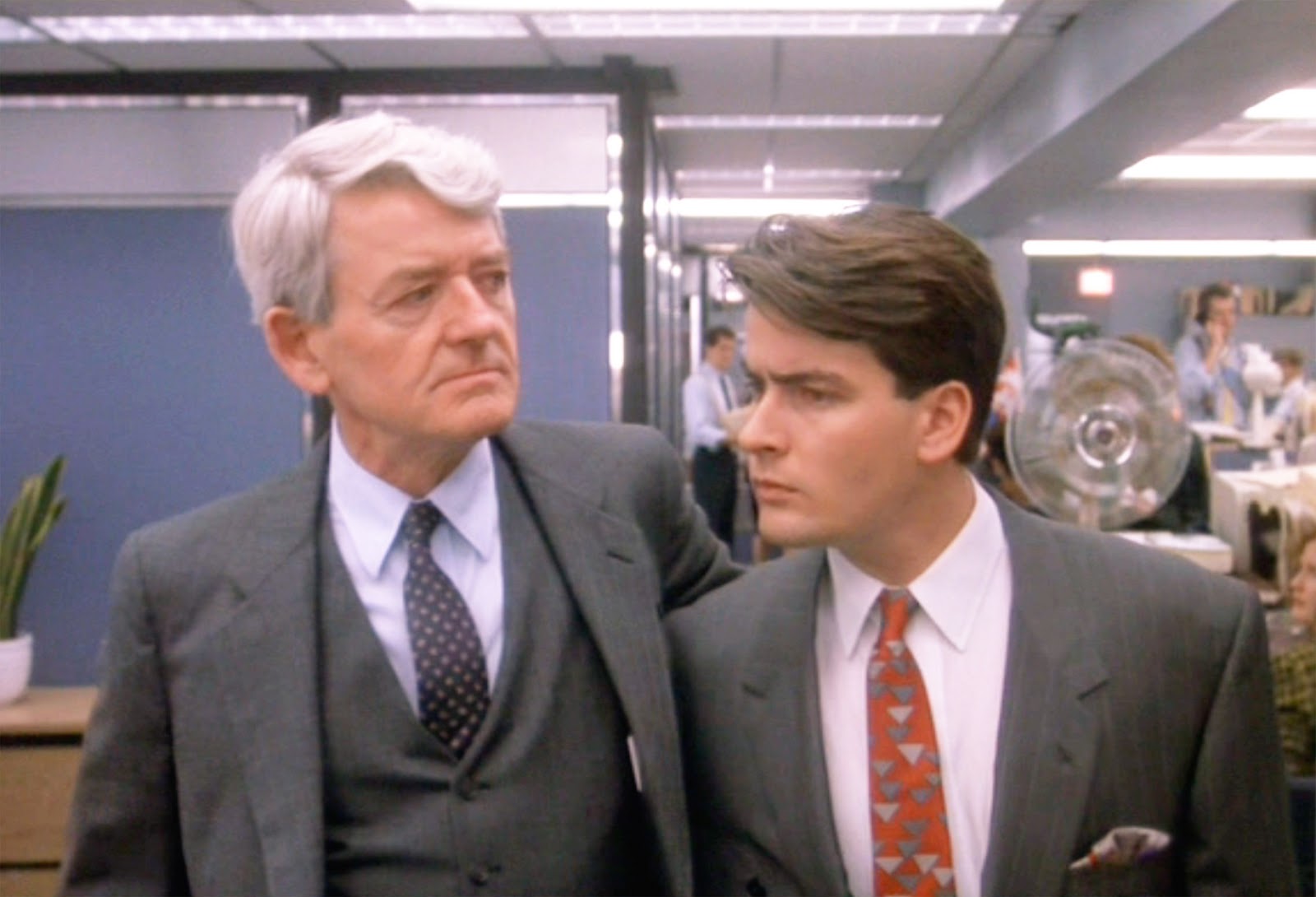
Bud is desperate to rocket out of his current job, unlike coworker Lou Manheimm (Hal Holbrook), who believes in patience and sticking with the stock of a company that creates good products, no matter if it takes five years to fulfill its potential. He says, “Good things sometimes take time.” Marvin, in contrast, says on the phone he needs information immediately, because in a very short time, if he doesn’t get it, he’ll be a “dinosaur.” His point is that in the stock market world, sure and steady doesn’t win the race; if that is the practice, one becomes a financial evolutionary failure.

Director Stone said that he wanted to make a “movie about sharks, about feeding frenzies.” So, the camera keeps moving, in circular fashion many times, like a “predator.” There’s no letup until we get to Bud’s father “where the stationary camera gives you a sense of fixed immutable values.” In this way Stone uses motion to contrast the loose ethical ways of the Wall Street types with the steady, honest, hard-working members of society.

Bud continually calls Gordon Gekko (Michael Douglas, who won the Best Actor Oscar for this role), an unscrupulous giant in the stock and real estate investment area, to work with him. However, Bud is a nobody who never gets through to Gekko. (Gekko suggests a gecko. As IMDb notes there is a Golden Gecko, which sounds like Gordon Gekko, and which may point to Gekko’s lust for riches. We may think of the creature as a friendly lizard from insurance ads and forget that it is a carnivorous animal). Even the mercenary Marvin sees how Gekko is beyond the edge of acceptable moral behavior when he says that the man had “an ethical bypass at birth.”

Bud goes to a tavern to see his father, Carl (Charlie’s real dad, Martin Sheen). When Carl uses the word “spaghetti,” Bud says his dad should use the word “pasta,” since spaghetti is out of date. Carl says so is he. The film implies that Carl’s morality is becoming extinct. Carl notes he is taking blood pressure medication, and Bud wants him to stop smoking. These facts are a foreshadowing of what is to come. Bud needs to borrow more cash. The lifestyle which he maintains to be a player in his job cuts right through his earnings. He can’t even pay off his college loan. So far, he has been staying inside the ethical playing field, but his profession makes it difficult to stay there. Living a working man’s life is not good enough for Bud. He says, “There’s no nobility in poverty anymore.” So, when his father mentions that the airline he works for, Bluestar, has been cleared of any wrongdoing in an accident (which Carl knows was due to lax standards on the part of the manufacturer, pointing to more unethical behavior due to stress on the bottom line), Bud has access to information that has not been made public yet. If used to purchase stock, it is insider trading, which is illegal.

Bud finally gets a meeting with Gekko when he shows up in person on Gekko’s birthday with Gekko’s favorite Cuban cigars. This contrasts with his dad’s pedestrian cigarettes, but both men are subject to the same threats to mortality. However, Gekko has the money for technology that monitors his heart in the office. He doesn’t even stop for a smoking break if a buck is to be had. As Bud says, for people on Wall Street, Fortune Magazine is the “bible,” which is substituted for religious values. Around him, Gekko has cutthroat businessmen who will do anything for a monetary killing. Gekko actually uses lines like “lock and load,” and being in the “kill zone,” which metaphorically illustrates the brutality of the big business mentality. On the phone, Gekko says, “Lunch is for wimps.” For him, taking time out to enjoy a midday meal shows weakness. Gekko does admire Bud’s persistence, but the only thing that gets some attention from Gekko is the information about Bluestar achieving a clean record form the FAA.

Bud thinks he struck out with Gekko, but the bigshot calls him and tells him to buy Bluestar stock for him. Bud is now ready to fly to the moon, as the song says, since he will make money off the purchase. The newspapers then announce that the airline was exonerated in the crash, and the stock price soars, just like a jet plane. Gekko meets Bud at a high-class restaurant, but Gekko doesn’t have the meal with him, following his own rule. He does give Bud a million dollars to invest and says he doesn’t like losses, so if Bud continues to do well, there will be lots of “perks” to reward him. He orders steak tartare for Bud, which is raw meat topped with an uncooked egg, which fits in with the predator theme of the film.

After taking a loss on an investment for Gekko, Bud meets with Gekko at a sports club where Gekko handily beats Bud at squash. The competition jives with how Gekko sees the world divided up between winners and losers. He sees himself as a self-made man. Those with “Ivy League” diplomas who he sees were given advantages that he had to earn now kiss up to Gekko. He says, “Give me guys that are poor, smart, and hungry, and no feelings.” For him, caring about others just gets in the way of accumulating wealth. Unlike most people, he says he doesn’t “throw darts at a board.” He only bets on “sure things.” To have that surety, he goes outside the law. For Gekko, all is fair in love (which he thinks is an emotional scam) and war, and he sees monetary acquisition as warfare. That is why he tells Bud he should read Sun-Tzu’s The Art of War. He says that “every battle is won before it is fought.” He doesn’t gamble, but wants the game rigged in his favor.  

Gekko is a complicated person. He makes valid comments about how little invested in their own companies the executive officers are. Even though he is a self-made man he has disdain for those that just labor their whole lives without success, including his own father, who died of a heart attack at an early age. This fact is another foreshadowing, and the story suggests that he is linked to Bud through their fathers. Gekko sees things in binary ways. When he observes a beggar standing next to a well-dressed businessman, he says nobody can convince him that only luck was the factor between success and failure. He seems to think that being rich and being poor are the only choices. He doesn’t concede that those who work hard should be deserving of more than being poor. He tells Bud that the choices are either being rich enough to own an airplane, “or nothing.” Yet, he is also able to appreciate that the beauty of a sunrise is not something that can be measured in dollars and cents.

He wants Bud to follow a rival, Sir Larry Wildman (Terence Stamp. The character’s name suggests staid nobility and a rulebreaker at the same time). Sir Larry had a “mole” in Gekko’s organization and burned Gekko on a deal. Gekko wants “payback.” He has seduced Bud and will dump him if he doesn’t spy on Sir Larry in the U. S. and provide Gekko with insider information. After tailing Sir Larry, Bud and Gekko realize the Englishman is investing in Anacott Steel. Bud and Gekko start buying stock in the company which drives the price up and makes it expensive for Gekko’s nemesis, Sir Larry, to purchase the company. When Bud tells Lou about it, the latter dismisses the idea of a sure thing, and says a steady investor gets through the “bear” as well as the “bull” markets. Lou reminds Bud to keep his eye on the larger picture that goes beyond individual gain, stressing how the money invested wisely “creates science and research jobs.” In response to Bud saying a person must make it big before he or she can do good, Lou says, “You can’t get a little bit pregnant.” The point is once you cross the line that leads to corruption it means you’re all in.

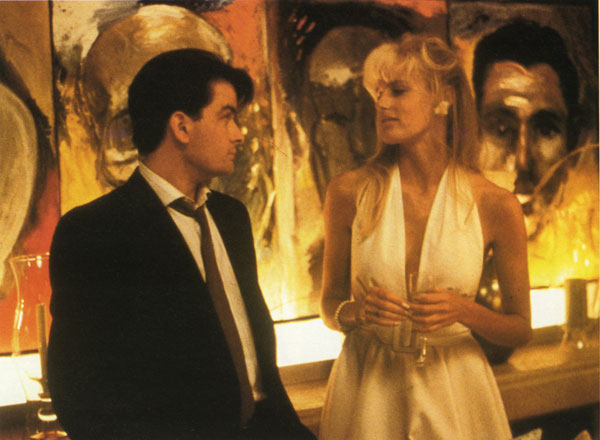
Bud brings documents for Gekko to sign at his house where he is having a party. It is there that he meets Darien Taylor (Daryl Hannah), an interior decorator, who is quite snobby in her attitude toward design. Gekko notices that Bud admires her beauty, and Gekko and Darien stroke each other’s hands, so we know that there was a sexual connection between the two. Darien says she’s a spender of other people’s money, so Bud uses that information to make a direct play for her, saying he will be moving up in the world after a couple of deals with Gekko. Acquiring people is the next step after obtaining things in this world of high finance.

Sir Larry arrives to confront Gekko about how he has driven up the cost of obtaining Anacott Steel. Sir Larry recognizes Bud, and probably realizes that he was following him. The references to war continue to make the connection to how big business is carried out. Gekko has a wall of firearm collectibles, including a German Luger, joining him metaphorically to Nazi war tactics. This time, Sir Larry wants to turn the company he is buying around. He’s in it for the “long haul,” harkening back to the beneficial principles that Lou espouses. Gekko gets him to buy his shares of the company at a high price, but his motives are revenge as well as profit. Bud now quotes Sun-Tzu, which impresses Gekko, since battle tactics to win the immediate confrontation are what he is teaching Bud, not long-term prosperity.

Gekko wants to be continually “surprised,” by new information that will get those sure things he can invest in. So, Bud visits a college buddy, Roger Barnes (James Spader), a lawyer at an upscale legal firm. He tries to bait the hook by offering lots of cash if Roger will provide information on a certain deal. Roger is wary about getting disbarred, but still seems interested. He notes that the records in his uncle’s office at the firm contain loads of great information about company transactions. So, Bud gets involved in the janitorial service that cleans the office building where Roger works so he can delve into the uncle’s files. It is interesting that he does his dirty business by pretending to be working in a business that involves dirt.

Bud’s fortunes are rising, so he now can afford to date Darien. He even adopts Gekko’s phrase, “I’ll talk at you,” showing Gekko’s influence. The words suggest giving dictation, as opposed to listening to the needs of others. He plays rich games, like riding dune buggies with Gekko and Darien on the beach. Their vehicles are filmed in front of fisherman with their nets who have no time for play as their survival exists from day to day. Bud is decent about paying his father back for all the money he borrowed from him. But the workers at the airport kid him about joining them in doing a “honest day’s work,” as opposed to the slick Wall Street manipulations he’s involved in. His father compares his recent big monetary gains to winnings at the racetrack, which is a gamble, and which one can lose soon after.

Gekko always protects himself first so his lawyer gives Bud a limited power of attorney that allows Bud to make trades and assume any possible liability, since Gekko can claim plausible deniability. They use offshore accounts such as in the Cayman Islands to hide money. As Bud gets richer, another worker who has been with the firm for a long time is fired, showing how loyalty in the investment business does not last based on past accomplishments. As Marvin says, they are only one stock trade away from “humility,” which shows how precarious their profession is.

Time passes and Bud moves to an expensive penthouse apartment with Darien, who is also his decorator. They enjoy the high life together way above the worker bees below them. But Bud hasn’t forgotten his roots. At one point, staring out at the view high up in the clouds where he now resides, he asks himself. “Who am I.” It is more like what has he become.

Gekko wants to take over Teldar Paper and goes to a stockholder meeting to give his famous “greed is good” speech. He says, “greed works. Greed clarifies, cuts through, and captures the essence of the evolutionary spirit. Greed, in all of its forms: greed for life, for money, for love, knowledge has marked the upward surge of mankind.” He makes a valid point about how the drive of the individual to excel brings about changes moving forward. However, he leaves out that not all change is good, especially when it comes to technology. And, his sermon sounds like he is preaching Social Darwinism, where only the strongest can survive as they vanquish all others. He says according to him, “You either get it right, or you get eliminated.” Again, we have his extreme binary way of looking at things. But “getting it right” for Gekko only means making huge profits no matter the cost to others. He often breaks up companies he buys and sells them for their components that pay more than what the company were worth when combined, regardless of who loses their jobs and benefits. We again hear the lyrics, “Fly me to the moon,” which fits in with these men who have the hubris to think of themselves at gods on high, ruling the earth below.

The film nicely segues to Bud telling Darien that he is “shooting for the stars,” and, appropriately, he wants to run an airline. He tries to convince Gekko to help build Bluestar Airlines into a bigger and better company after he hears from his dad that layoffs are coming. Bud says he knows the people working at Bluestar, and they will trust him that they can turn the company around if there is a cut in wages. Trust is the branch that Bud is hanging onto here, and betrayal will be what breaks that trust.

Bud (whose hair is greased back now like Gekko's, reflecting their slick maneuvers) and Gekko meet with the airline union leaders, including Carl. What Gekko and Bud propose seems like a good plan to turn Bluestar around, but Carl knows Gekko’s love of greed and doesn’t believe he will follow through once he owns the airline. Bud may have some good general plans, but Carl points out that his son only worked at the airline for a short time and isn’t ready to be president of the company. Gekko calls Bluestar’s management “scum” who have ruined the company. Carl points out that the management of Bluestar built the company over thirty years from scratch when they started with one plane. Carl’s argument is that management is in it for the long haul, and he knows that Gekko is a short-term speculator who gets his money and then dumps what he buys.

Bud is of course embarrassed by his father’s lack of support, and they have an emotional confrontation after Carl walks out of the meeting. Carl says Gekko is using Bud, but Bud says, “What I see is a jealous old machinist who can’t stand the fact that his son has become more successful than he has!” It is an incredibly hurtful statement, and Carl feels that he has failed in raising his boy if that is what he believes. Carl marks an individual’s success by the morality of an individual, not by the “size of his wallet.” But, Carl does agree to let the union members vote on the proposal.

Bud’s lawyer friend Roger calls Bud into his office because he’s worried about the SEC looking into offshore purchasing of Teldar Paper that Roger is complicit in. Bud learns from Roger that Gekko is using the law firm to instigate plans for Bluestar. In a meeting, Bud finds out that his father was right, that Gekko is planning on breaking up Bluestar and selling its components, including the property for housing development and the planes, and plundering the overfunded pension for a substantial profit.

Bud confronts Gekko, who says he was reading his son the story of Winnie the Pooh, and how the bear became stuck in the honeypot, supposedly relating the tale to the Bluestar situation. Bud wittily says maybe Gekko should have read the story of “Pinocchio,” which talks about someone who lies, obviously referring to Gekko. Gekko gives a speech which some may feel is shockingly true to this day. He says how the richest one percent of the United States own most of the country’s wealth. He says that “I create nothing. I own.” The stock and real estate speculators just manipulate the capitalist system to profit from it, but not by creating anything or helping others. The amount of gain is not important to Gekko. He just sees things in that binary way, where there are only winners and losers. He says that we don’t live in a “democracy.” It’s the powerful wealthy who “make the rules.” As he says this speech, the camera includes a shot of a man washing the windows of Gekko’s high-rise office. The movie is saying with another visual example that the manipulative wealthy live in extreme comfort as others must labor for meager earnings.

Bud is feeling guilty about being played by Gekko. Darien is frightened by Gekko’s wrath if Bud fights him on the Bluestar deal, and says she will not stick around because she will lose all her clients through Gekko’s influence. She tells Bud that he should look in the mirror and should not act self-righteous concerning Darien’s plans to bail. After he throws her out, she looks at herself in the mirror in the hallway, and Darien, like Bud, is not happy with what she sees.

The foreshadowings are realized as Carl has a heart attack and he and Bud have a tearful bedside meeting where Bud says he will make things right and use Carl’s “words,” which come from an “honest” man, when he speaks to the union leaders. Bud wants the unions to confront Gekko when the stock begins to rise once he implements his plan. He also knows that Sir Larry wants to hurt Gekko over the Anacott Steel deal. Bud and the union leaders give the same deal to Sir Larry that they gave to Gekko so long as he agrees to make a contract not to break up Bluestar. Sir Larry is agreeable, since he seems to be willing to help companies, not exploit them at this point.

Bud then tells his fellow workers at the investment firm where he works to start buying Bluestar to drive up the price. Ironically, Bud uses Gekko’s connections against Gekko to create enthusiasm for Bluestar stock. The union people tell Gekko they know his plan and will disrupt the airline’s activities, causing the company to be worthless before he can break it up. Bud then gets everyone to sell stock and take gains, thus lowering the price so that Gekko takes big losses on the shares he bought as the price went up. Sir Larry buys the stock at a cheap price and he is the only person willing to buy Gekko’s shares, which amounts to a total defeat for Gekko.

However, Gekko lets the Federal authorities know that Bud was involved in insider trading violations, and they arrest Bud. Bud meets Gekko in Central Park. He smacks Bud around for how he caused Gekko to lose millions. However, Bud is wearing a wire and makes a deal with the authorities to get Gekko on illegal activity.

Bud will be going to jail, but he saved Bluestar, and Sir Larry has offered him a job at Bluestar once he gets out. As his parents drive him to the courthouse, Carl states the theme of the movie, telling Bud “Stop going for the easy buck and start producing something with your life. Create, instead of living off the buying and selling of others.” The camera pulls away, a bookend which compliments the opening shot, to take in the whole skyline of New York City, as if to suggest people should look beyond their own interests to the bigger picture that includes the welfare of others.

The next film is Manchester by the Sea.