Showing posts with label moral decay. Show all posts

Tuesday, February 14, 2023

The Cincinnati Kid

 SPOILER ALERT! The plot will be discussed!

I recently watched The Cincinnati Kid (1965) for the first time in many years and decided to write about it after realizing how much talent is involved in the production. It has Steve McQueen, looking like Mr. Cool, as usual. The supporting cast includes Edward G. Robinson, Ann-Margret, Karl Malden, Tuesday Weld, Joan Blondell, Jack Weston, Cab Calloway, and Rip Torn. The story was adapted by Ring Lardner Jr., and Terry Southern. And Norman Jewison directed the film. Not too shabby.

The film opens with The Cincinnati Kid (McQueen) walking next to a New Orleans funeral, which, of course, is not a somber event, with a band playing. Does this scene symbolically predict that the Kid will be participating in his own figurative burial? He meets a young shoeshine boy who has challenged him at pitching coins before and asks for another chance. The Kid beats him and says the youth is not ready for him yet. In a subsequent scene, he bests the boy at a coin toss and says the same thing about being ill equipped to beat the Kid. At this point the Kid is an undefeated winner.


The movie is a sort of card gambling version of The Hustler, with McQueen playing the Paul Newman role and Robinson assuming the position of the Jackie Gleason character. The Kid is the upstart, a pretender to the crown worn by the best stud poker player. He has marks on everybody since he has beaten everyone, but he still lives in a lowly apartment since he hasn’t really cashed in on the big time yet. In contrast is senior citizen Lancey Howard (Robinson), the reigning poker king. He dresses stylishly and stays at a luxurious New Orleans hotel, where everybody knows his name. A one-time great player is Shooter (Malden), who is known for his honesty and ethical behavior. He is the go-between who wants his friend, the Kid, to get his shot at Lancey.

The Kid has a girlfriend, Christian (Tuesday Weld). She is not living a chaste life with the Kid, but her name is significant since she represents the possibility of the Kid leading an ethical life with her. She tells a salacious tale in which men “cared more about their lives than they did about their honor. Does that seem right to you?” His response is a selfish one as he says, “what good is honor if you’re dead.”

The story is a battle between the ethical, generous world and the selfish one. Shooter is married to the seductive Melba (Ann-Margret). (Shooter’s name suggests he is a “straight shooter, a righteous man). But he has married Melba who goes through the movie in sexy outfits and plays the archetypal Eve role, chomping on an apple. She is putting together a puzzle by trimming the pieces so they will fit. She is a cheat in more ways than one. She goes shopping with Christian, who is tempted to follow in Melba’s path. But she is reluctant to go down that road as she tells Melba that she can’t see herself wearing a provocative bathing suit.

Shooter arranges a card game with a rich, arrogant man named Slade (Torn). After he loses to Lancey, his arrogance gives birth to revenge in his mind, and he wants to pay Shooter a large sum of money to help the Kid when he plays Lancey. Shooter is very reluctant, but he knows he can’t hold onto Melba, who he already suspects of cheating on him. Indeed, she attempts to seduce the Kid, who shows some morality in not succumbing to her charms so as not to betray his friend. Shooter has business and asks the Kid to take Melba to a cock fight (a sexual reference to show Melba’s carnal nature?). The brutality of the event is repulsive as people show how ugly they can be as they bet on which bird will kill the other. After the event, the Kid brings Melba back to her place where she says she needs a drink because of “all that dust at the pit. I always feel so dirty after one of those things.” The Kid knows what type of person Melba is and says, “Brings out the best in you, Melba.” The best of the worst.

Christian, realizing the Kid loves card playing more than he could a woman, leaves him. He appears distraught by her decision, but when he hears her intention, he grabs her bag to help her on her way out. His selfishness is showcased here. Christian comes from a pastoral life and goes back to be with her parents, who are farmers. It represents the moral, upstanding life in the country as opposed to the decadence of the city. Eventually the Kid visits Christian at the farm. It’s as if he is torn between the world of spirituality and materialism and selfishness. Christian’s parents are stern and judgmental concerning their daughter’s relationship with the Kid. However, the Kid wins them over with a card trick. It’s as if he has brought trickery with its seductive aspect that has the potential to corrupt this innocent environment.


 The anticipated game between the Kid and Lancey begins. Just as with the game involving Slade, Shooter is the dealer because of his highly regarded reputation. The Kid does quite well, and at one point Lancey’s age seems to catch up with him as he almost keels over. But, he is a resilient man and keeps playing. The Kid is no dummy, and he realizes he has been getting too many good hands. He gets Shooter alone who confesses that he has been bought by Slade to swing the game. The Kid is honorable enough (despite his earlier negativity toward honor) to want to only win on his own merits. He tries to get some sleep between poker rounds. Melba slips into his bed and since his hero, Shooter, has become corrupted, he no longer values the friendship, and he has sex with Melba.

In a case of exceptionally bad timing, Christian returns to be with the Kid and arrives at the room just as Melba is leaving. She leaves too and it seems that all the Kid has left is the game. In a conversation, Lancey advises the Kid that to be the top gambler one can’t get involved in serious attachments. Lancey may be the best there is, but he is in the end a lonely man.

To keep the game above board, the Kid says Shooter was sick all night and there should be another dealer. Lady Fingers (Joan Blondell) takes over, and the game reaches a climax when Lancey has a possible straight flush and the Kid has a full house with aces on top. The Kid goes all in and loses because Lancey indeed has the straight flush.


The Kid exits the game broke and mentally defeated. The shoeshine boy asks him to play once again at coin toss. The Kid decides to compete to desperately show himself that he hasn’t turned into a loser. But the boy beats him and throws his words back at him, telling the Kid he isn’t ready for him yet. In the original version, that is the end of the film, with the Kid walking away. A subsequent version has him walk and run into Christian. She embraces him. This ending adds a redemptive quality to the story by suggesting The Kid had to undergo a Fortunate Fall, He had to reach rock bottom in order to be saved from a corrupt life.

The next film is Stand by Me.

Sunday, July 3, 2022

Night and the City

 SPOILER ALERT! The plot will be discussed!

The first shot of Night and the City (1950), directed by Jules Dassin, is, of the London Tower Bridge. It is nighttime and we see only the silhouettes of people, as if just the dark sides of individuals exist here. The opening voice-over announces, “The night is tonight, tomorrow night, or any other night. The city is London.” The joining of continual darkness and the setting of a city epitomizes elements of film noir, where the underside of humanity thrives (although Dassin, in a 2004 interview, said he didn’t know about film noir elements when he made the movie).


The first scene after the credits starts with an overhead shot showing a person running, trying to escape from danger, which is always present in this world. The image of “running” and the repetition of the word becomes a motif in the film. (Dassin said producer Darryl F. Zanuck warned him to leave the country because he would be targeted by the House Un-American Activities Committee and its “blacklist” of alleged Communist sympathizers, so he fled to London. That running away had its influence on the film).  The fleeing man is Harry Fabian (Richard Widmark). He runs through narrow, twisting alleys and streets. The impression is one of a maze, a puzzle that is meant to thwart a solution.


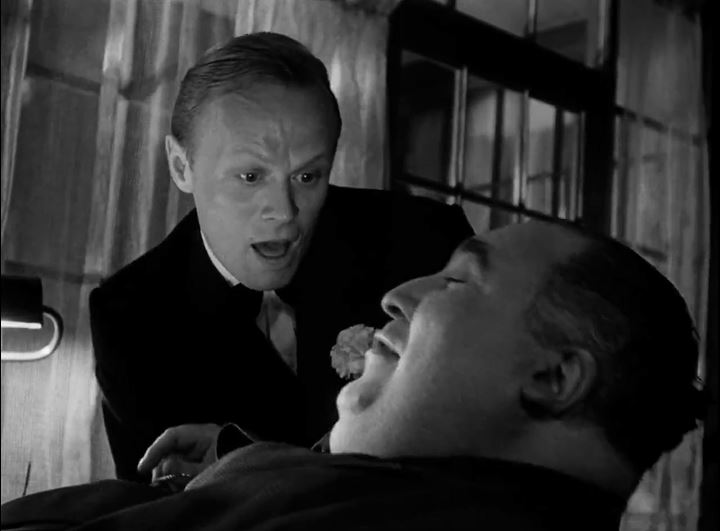
Harry’s pursuer follows him to his flat and stays outside. Harry places a flower in his lapel that he dropped on the street. It’s as if he is trying to clean up for appearance’s sake the dirty part of himself. He enters the flat and calls for his girlfriend, Mary Bristol (Gene Tierney). (Zanuck, unlike some of the characters in the story, showed compassion by wanting to help Gene Tierney who was suicidal after a disastrous love affair. He wanted her cast in the movie, according to Dassin). When she doesn’t answer, he picks up her purse. She then surprises him, saying there isn’t money there. We immediately realize that she is aware of his seedy nature, but, contrarily, still is with him, showing how illogical relationships can be. His first response is anger, and his face is ugly as he accuses Mary of spying on him, as if she is the one doing something wrong, not him. He then quickly switches to a charming smile and tries to cover up his transgression by saying he was just looking for a cigarette. It’s a lame excuse since there is a whole glass full of smokes next to the purse.

She asks who he was running from now, and he acts like that doesn’t happen to him, although we know otherwise. She was worried that he was the victim of foul play since he was gone for three days. He says he was away trying to become a partner in a greyhound racing track operation. She knows he wants her money for the investment. She says they have been through this routine “a thousand times.” It appears that Harry is always looking for a get-rich-quick scheme at the expense of others to satisfy his selfish wants. In contrast to Harry’s pie-in-the-sky activities, she is working hard at a bar to make a decent living. She holds up a happy picture of the two of them in a boat. She describes them as if they were strangers, good people who wanted to lead “decent” lives. It’s as if they have left that part of themselves behind, and what’s left are just empty shells of their former selves. However, the boat they are in is still an object of movement, suggesting the hope for stability was an empty dream. His response to her words is, “I just want to be somebody,” a self-centered statement given that she was talking about their life together.

Mary knows Harry is hiding from Phillip Nosseross (Francis L. Sullivan) and she sees the man Nosseross sent to follow Harry at a phone booth below the window of their place. (“Nosseross” sounds a bit like “rhinoceros,” a large, dangerous, charging animal, something one would run to escape from. Harry says that Nosseross is heavy, equating him with the large creature).

Harry needs five pounds to discharge his debt to Nosseross. While Mary goes out of the flat to see if she can get some money from a neighbor, Harry appears sad as he looks at the photo of the two of them that Mary held, and probably sees something of his past self in that picture. Mary goes to the flat of Adam Dunn (Hugh Marlowe) who has burned his spaghetti and Mary helps douse the flame. He is a designer, and he may have designs on Mary since he says he wishes that they had different schedules. He works during the day (which probably means he is not a creature of the night, like Harry). Does the fire show that he has the “hots” for her, and only she can douse his passion? She works at night at Nosseross’s club, not because she wants to go to the dark side, but has been dragged there by Harry.

Mary says it’s difficult to resist Harry’s charismatic imagination and zeal for his projects. Adam says, “Harry is an artist without an art.” He explains that Harry wants to express himself but doesn’t have the “means,” the specific skill or outlet, to put his imagination into concrete form. Adam says that can “make a man very unhappy,” creating a frustration that may be “dangerous.” He is suggesting that the search to make Harry’s dreams a reality can lead him to the criminal underside of society. In contrast, Adam is artistic in his designs of objects, including figurines and a replica of a bank that holds his money and plays music. Adam has been able to focus his imaginative skills in a creative and not destructive way.

Harry goes to Nosseross’s club, the Silver Fox, where his wife, Helen (Googie Withers), firmly sets the rules for the young women workers as to how to get the male customers to spend more money. The attractive women are the pleasant exterior which hides the mercenary practices in which they are engaged. Nosseross also assigns Harry to engage in a deceptive practice of drumming up business for his club. Harry gets information about a trio of successful American businessmen at a venue. He acts like he found a lost wallet, which is really his, and turns it over to one of the employees there, who is on the take. This action makes it appear (the operative word) that Harry is an honest fellow. He then pretends that he knows an acquaintance of the three men, and thus bonds with the men. It is then he suggests they go to a “private” club for some entertainment. Harry retrieves his wallet just before the three gentlemen depart for Nosseross’s club.

Harry goes to a wrestling match to hustle more customers. However, a bouncer recognizes him and prepares to toss Harry out. Harry says it’s a public place, and the bouncer says, “so is the morgue,” a darkly witty line that suggests that is where Harry may end up. There is an outburst by a man named Gregorius (Stanislaus Zbyszko), a once world-famous wrestler who is there with a young wrestler named Nikolas (Ken Richmond). He yells at his son, Kristo (Herbert Lom), for bringing them to an inferior match. Gregorius blames his son for the extent to which wrestling has declined.

Harry sees a financial opportunity in Gregorius’s displeasure, and stages an outburst where he demands his money back for such a terrible “spectacle” as Gregorius and Nikolas pass by. His rant and some subsequent flattery endear him to the ex-champion. He gets them to have a drink with him. Meanwhile, at the Silver Fox, Nosseross gives a silver fox fur to his wife and asks for a kiss in return. Helen is looking away from him and displays a look of revulsion, but she allows the kiss. The large Nosseross grabs her and is rough with her as she breaks away from him. His base nature here rises and transforms his sophisticated surface.

Harry bursts in and says he can control professional wrestling in London, but Nosseross loudly laughs at him, and Helen wants Harry thrown out. Harry is angry at the dismissive way Nosseross treats him, and says he will get 200 pounds on the condition Nosseross will match it for the investment. Harry goes to the underbelly of society seeking funds from beggars, forgers, and those operating in the black market since he resides in the illegitimate area of finance.

There is a scene where Nosseross and Mary do not know where their romantic partners are. Harry is at a bar and Helen finds him there. Harry is angry at her for forcing him to put up the 200 pounds before Nosseross will commit to supplying some cash. Helen kisses Harry, and we realize there was an intimate connection between the two, and that is why Harry feels betrayed by Helen’s prior statements. However, she has the 200 pounds which causes Harry to be elated. But, she wants him to get the other 200 from her husband to get her a license for her own nightclub which she bought unknown to Nosseross. She can’t tolerate her husband anymore and needs to break away. She says she knows all about running a nightclub since she currently does all the work. She wants Harry to scam her husband and Gregorius. He says he’ll go along with her schemes, but we wonder if he will. So, there is deception upon deception here.


Fergus Chilk (Aubrey Dexter), Kristo’s lawyer, along with a henchman, pay a visit to Nosseross. The attorney tells the club owner that Kristo is “disturbed” by Harry’s attempt to be a rival wrestling promotor, and Chilk wants to meet with Harry. (Nosseross’s office looks like a cage, with bars for its ceiling. The design conveys a feeling of entrapment, as if those dwelling in the darkness of the city create paths that lead to confinement. Similar images are in Alfred Hitchcock’s The Birds, where people, instead of the winged creatures, are caged. Think of Tippi Hedrin in the phone booth, the car, the attic, etc.).

When Helen returns, her husband says he wants to sell the club, and that he has more wealth than she knows. He wants them to travel and enjoy life. But, escape from the world he has attached himself to is not possible. He’s a parasite feeding off a dark part of society, and he can’t leave the host. Helen latched onto him and doesn’t want to leave, since she wants to draw what she can from his nefarious enterprises to start her own. Harry shows up with the money and expects Nosseross to match the sum and they will be wrestling promotion partners. But Nosseross is suspicious as to how Harry attained the cash, and finds that some of his stash is missing. He concludes that Harry and Helen are conspiring against him. Nosseross gives Harry the money, but says he is to be a “silent partner,” and wants the business only in Harry’s name. He doesn’t want any evidence that he was competing with the powerful Kristo. Nosseross rips up the lawyer’s card as he talks to Harry. Nosseross is preventing Kristo’s warning from reaching Harry and is supplying the rope for Harry to hang himself.

It appears that Harry has double-crossed Helen as he has established Fabian Promotions and has his own office and gym for wrestlers to work out. Gregorius and Nikolas are there. He is thrilled to get a desk sign in the mail that announces he is in charge, since feeding his ego has dominated his life. One of Kristo’s wrestlers, The Strangler (Mike Mazurki), shows up to intimidate the men there on behalf of Kristo, but Harry gets him thrown out. However, Kristo shows up in person with his lawyer and tells Harry that he can’t promote matches in England. Kristo rips up Harry’s promotional contract for an upcoming match just like Nosseross ripped up the lawyer’s card that Nosseross was to hand to Harry. The tearing image suggests how there are no ruled to abide by in the world of film noir. However, Kristo thought his father left for Greece and doesn’t know that Gregorius is now Harry’s partner. When Harry reveals this fact, Kristo tells his father that Harry is a swindler. His dad takes no heed of this warning and Kristo tells Harry that if he continues to do business, he better not try and cheat Gregorius. As Harry and Kristo talk, Harry hits a punching bag and Kristo tries to grab hold of it. The action shows the violent interaction present, and the situation is so precarious that even the relationship between father and son takes on sinister connotations.

Harry calls Helen and says that he has her nightclub license, but then tries to dodge a meeting to hand it to her since he is not telling the truth. She is talking to Harry secretly, thinking her husband is asleep (more deception). But Nosseross overhears the conversation, which adds evidence to how Harry and Helen are working against him. Harry pockets the fee from Helen that he says he needs to secure the license, but instead he gives her a forged paper. Everybody here is using everybody else for personal gains.

Despite Nosseross trying to keep his name out of Harry’s business to avoid repercussions, Kristo knows Nosseross’s money is behind Fabian Promotions. Kristo says Harry has promised to conduct wrestling matches in legitimate Greco-Roman fashion. Kristo says Harry will fail from a business standpoint because the public wants showmanship type of wrestling matches. His cynical observation shows how corruption is preferred and prevails in the dark side of life. But economic failure is not enough for Kristo. He wants to defame Harry in Gregorius’s eyes so that Kristo’s father will leave Harry. Nosseross no longer fears Kristo because he openly wants to help him reach this goal.

To do Kristo’s bidding, Nosseross tells Harry that he is pulling out and will not provide extra money for licensing. He says that Greco-Roman wrestling be a failure financially. He says he will only back Harry if he has big names in a match, and suggests booking The Strangler. Harry knows that Gregorius hates The Strangler’s style that panders to the audience’s baser instincts and will leave Harry’s business. Nosseross knows that Harry is only in it for the cash and has no ethics, so Harry promises to set up a match with The Strangler.

Harry attempts to create enough animosity between The Strangler and Gregorius that the latter will agree to a match between The Strangler and Nikolas. At a restaurant he makes The Strangler overhear his remarks about how Gregorius scared The Strangler away at the gym, and that Gregorius demeaned him. The Strangler runs to the gym, threatens Gregorius, and wants to fight right there. Harry passionately tells Gregorius that they should have Nikolas crush The Strangler in the ring and end The Strangler’s cheap form of wrestling that dishonors the sport. (There’s no argument here that Widmark really chews up the scenery in this role). Gregorius agrees. So, Nosseross was right – Harry is a swindler and will lie and manipulate for his own selfish reasons.

Harry goes to Nosseross to supposedly tell him the good news that he has The Strangler signing up for a match that Harry is promoting. Nosseross makes a call to talk to Kristo to Harry’s shock. Nosseross says that he will tell Kristo that Harry stole The Strangler from Kristo. There is now honesty as Nosseross admits that he wants Harry dead because he stole something he paid for. Harry understands that he means Helen, which her husband views only as dehumanized goods. Of course, Helen only married Nosseross so she could inherit his wealth. There is no morality to be seen anywhere. Harry reveals that Gregorius wants the match, so Kristo didn’t put a wedge between his father and Harry. But, Nosseross refuses to give Harry the money to pay The Strangler’s manager for his client’s participation. Without backing, everything Harry planned will fall through. Nosseross calls Harry, “a dead man,” and this conclusion about Harry continues in the story.


Again not caring about the feelings of others, Harry calls Mary to say he’s in trouble to get her out of the flat so he can steal her money to make the wrestling match possible. But Adam sees Harry go into the apartment after Mary leaves and when he runs into Mary tells her that he saw Harry at their building. When she finds him rummaging through her things, she warns him that others are “killing” him. This remark is another reference to declaring Harry as a dead man figuratively and literally in a foreshadowing way.

Harry goes back to the gym and The Strangler is there, drunk, and he taunts Gregorius who is training Nikolas. They begin to fight (the restrictive area of the wrestling ring is another symbol of imprisonment). In an attempt to protect Nikolas, Gregorius tosses him out of the ring, accidentally breaking Nikolas’s wrist. The Strangler’s agent, Mickey Beer (Charles Farrell), says they can’t stop them now because the wrestlers are “like mad bulls.” Civilized rules have been stripped away in this underworld zone and only brutality remains. Gregorius gets The Strangler in a bear hug (more animal imagery) and causes his opponent to temporarily pass out. Kristo arrives and Gregorius says that is what he does to his son’s “clowns.” But the fierce struggle is too much for the older wrestler and he dies. Before that happens he tells Kristo that he should preserve the “art” and “beauty” of Greco-Roman wrestling. Gregorius comes to represent the lofty accomplishments of ancient cultures that have fallen into decay in the modern world, which is mirrored by his own descendant’s corruption.

Harry doesn’t stick around. Krsito does not seem to blame The Strangler. He most likely sees Harry as using him as a tool in to implement his schemes. Beer confirms this suspicion when he confesses to Kristo that Harry taunted The Strangler by making up antagonizing remarks that he attributed to Gregorius. Harry gave The Strangler booze, adding fuel to his irrational rage. The Strangler hears what Beer says and he sees that Harry manipulated him. Kristo puts a bounty on Harry’s head of 1000 pounds and the word goes out to the denizens of the underworld to hunt Harry (an earlier equivalent of what happens to John Wick).

The Strangler barrels through Nosseross’s china shop club like that mad bull that Beer called him. The image of him wrecking the place is very effective in showing how the dark drives of humans can subvert the attempt to suppress them. The Strangler warns Nosseross that he better not be protecting Harry, and says it was not himself but Harry that killed Gregorius. Harry’s selfish ambitions have caused a domino effect that has destroyed lives.

Helen is packed and tells Nosseross her club permit is now her “birth certificate,” implying she can be reborn into a new life. When she tells her husband that she will partner up with Harry, he doesn’t go into details, but he tells her there is no future with Harry. She says she can control Harry, another instance of how people in the film noir story seek power over others. He tells her she will fail and come crawling back to him. But he does not show anger here; it is more like describing the sad inability to escape the vicious circle which the darkness of the city inflicts upon individuals.

That futility in not being able to break free from this dangerous wheel of fortune is stressed by seeing Harry running again through the rat maze of the city streets, repeating his activity at the beginning of the movie. Harry reaches out to Figler (James Hayter), the leader of the city’s beggars, for help. Harry has not shown caring for others so there is no help for him. Figler is just as deceptive as Harry. Even though he pretends to offer sanctuary for Harry, he calls Kristo with information about Harry, hoping to collect the reward.

As Helen prepares to open her new club a police officer stops by saying he received no word that the establishment was cleared for business. Helen shows him her license and offers him a drink. The officer says he is on duty, but he can have some ginger ale. He remarks that he is a new recruit. He represents innocence that has not been corrupted, at least not yet. When he puts his glass down its condensation blurs the print on the license and he concludes that it may be fraudulent. He says he will have it checked out. A dejected Helen returns to the Silver Fox, trying to renew her prior meal ticket, just as Nosseross predicted. But, Nosseross has committed suicide, death apparently being the only way to escape the festering corruption thriving here. Molly (Ada Reeve), a lowly, older worker at the club, who Helen treated badly earlier, informs her that Nosseross left his estate to her. Perhaps it was Nosseross’s last attempt at to repent for his sins. Helen’s hope of being born into a better life is aborted.

Harry goes to Figler’s place. Harry knows the selfish ways of people, it taking one to know one. When Figler acts too protective of him, assuring Harry it wouldn’t be safe if he should leave, Harry gets suspicious. After Figler receives a cryptic phone call, Harry knows he is being sold out and knocks out Figler and leaves. He winds up at the shack of Anna O’Leary (Maureen Delaney) near the riverfront. He is exhausted and says he has been running his whole life, from “welfare officers, from thugs, my father.” It appears that his whole life has felt like a trap from which he has tried to escape. He says he can’t run anymore, and in this fallen world with no way out, that makes him a dead man walking.

Harry mourns the fact that he was so close to achieving the acclaim he sought, but then “an accident” occurred (the fight between the wrestlers) and “everything fell apart.” The best laid plans, etc. But, Harry set those wheels of chaos in motion. He seems to get some insight into his bad actions, repeating, “The things I did.” He says that he hurt Mary, who loved him.

Mary shows up and Harry can’t even look at her. He is so ashamed, as he says to her, “Don’t be kind to me” when she offers him money to get out of London. Admiring his “brains” and “ambition, she generously tells him, “You could have been anything, anything.” (Her words sound like Marlon Brando’s speech in On the Waterfront,” when he says he could have been a “contender,” instead of a “bum”). However, Harry always chose “the wrong thing.” The implication is that when one goes down certain paths a person can lose one’s moral way.

Harry tells Mary he can sacrifice himself and make it look like she betrayed him so she can collect the 1000 pounds. He is duplicating what Nosseross did, attempting a last act of repentance for his misdeeds. She, being a decent person, tells him goodbye, wanting no part of the blood money. Harry still tries to get her the reward by yelling so that Kristo will believe that Mary deserves the bounty. The Strangler appears and lives up to his name, choking Harry and throwing him into the river, granting Harry’s death wish. Adam arrives with the police who supposedly will arrest The Strangler who again has been treated like a tool used by others.

Kristo observes all this activity standing high up on a bridge, like a demonic god ruling over this fallen place where even those who survive are still tainted by the darkness of the nature of this world.

The Next film is If….

Monday, June 17, 2019

The Last Picture Show


SPOILER ALERT! The plot will be discussed.
Sometimes I like to write a post about a film discussed at a movie class at the Bryn Mawr Film Institute. I hadn’t seen this film since it was initially released so I thought I would revisit it by attending a recent viewing and analysis at the theater. The Last Picture Show (1971), adapted from the novel of the same name, was directed by Peter Bogdanovich, and takes place from November, 1951 to October, 1952 in the fictional Texas town of Anarene (the name sounds like Abilene in the 1948 western, Red River), which was based on author Larry McMurtry’s home town of Archer City, where the movie was shot. This period in American history is a scary time since the end of WWII introduced the specter of a mushroom cloud hanging over civilization as the fear of a nuclear confrontation existed in the background of the Cold War with the Soviet Union. Pessimism replaced optimism for the future. The technology of television drew people away from the communal gathering to watch movies at a theater to the seclusion of the living room.
The closest literary equivalents to this tale are the valley of ashes depicted in F. Scott Fitzgerald’s elegiac The Great Gatsby, and T. S. Eliot’s The Waste Land, both works commenting on the spiritual barrenness of the human soul in modern times. Bogdanovich wanted to show the town in decay, bleak and colorless, and his houseguest, the great Orson Welles, encouraged the director to shoot the movie in black and white, which was unheard of at the time of its making, since Hollywood had been filming its feature films in color. The opening of the film has a shot of the town’s movie theater, the Royal, its name conjuring up images of the past majesty of classic cinema. That image is followed by a pan to the left to reveal a main street that looks like a ghost town, with howling wind the only sound heard, as if people have been blown off the face of the earth. The town’s population is so small that the cafe waitress, Genevieve (Eileen Brennan) says at one point, “A person can’t sneeze in this town without somebody offering them a handkerchief.”


Sonny Crawford (Timothy Bottoms) is trying to get his dilapidated truck to start. He keeps pulling on the choke knob as the engine sounds like an old man coughing. Our instructor pointed out that the effect was to make the audience feel that the whole place was choking on the dust that seemed to be replacing the town. The sound could signify the community’s death rattle. Sonny and his high school friend, Duane Jackson (Jeff Bridges) are on the football team, and they just played the last game of the season. They were badly beaten by their opponents, and the fact that it is the last game and they failed so miserably lends to the atmosphere of defeat that permeates the area. Sam the Lion (Ben Johnson, in a Best Supporting Actor Oscar win for his brief performance, the shortest ever to win the award) says, “This is what I get for betting on my hometown ball team. I ought’a have better sense.” To which oil driller Abilene (Clu Gulager) comments, “Wouldn’t hurt to have a better hometown.” This exchange is darkly funny, but it also shows the awareness of how decrepit the location has become. Even understanding that dire reality, Sam, financially and spiritually, continues to invest in the town, despite the odds. He owns the cafe, the theater, and the pool hall. (There is a bit of foreshadowing as to what will happen to Sonny when, in the pool hall, Abilene tells Sonny to be careful with a pool cue so as not to poke out Abilene’s eye). Sam shows old movies, many of them western classics made by John Ford and Howard Hawks, which depict heroic versions of real-life cowboys who now can only exist, like ghosts, on the theater’s screen.
Sonny and Duane share the truck and live in a boarding house, instead of with their parents, suggesting how the family units here are falling apart. The boys take their girlfriends to Sam’s movie theater, with Duane and Jacy Farrow (Cybill Shepherd) arriving in the truck a bit later, and using the theater to neck. (The movie being shown is Father of the Bride, an idealized version of a marriage and parent-child relationship that ironically contrasts with what happens to Jacy later). Sonny is attracted to Jacy, wanting to share more than just the truck, the football experience, and the place where they live with Duane. Sonny now takes his turn using the truck and parks with his girlfriend, Charlene (Sharon Taggart). Their interaction is anything but romantic. With no foreplay, she mechanically takes off her top and Sonny fondles her breasts as they kiss. Sonny wants to have intercourse, but she seems to think that she is keeping her chaste reputation despite her sexual behavior. She also is angry with Sonny because he hasn’t remembered the one-year anniversary of when they began dating. Her being upset about an anniversary is only a hollow pretense of a bygone romantic era, like a false building front on a movie lot. Preoccupied with his thoughts about Jacy, and not feeling any fulfillment, emotionally or physically with Charlene, he abruptly and inconsiderately breaks off the relationship, a foreshadowing of how he acts later.


As our class instructor stated in his handout, the characters from the younger and older generations “try to find solace and escape from boredom in lost dreams, drinking, temporary and manipulative sexual encounters” and “the local movie theater’s shows.” Roger Ebert, who considered the movie the best film of 1971, said the inhabitants of Anarene seem to have lost their “reason to exist,” and their “only hope is in transgression.” Maybe many of the characters are sexually promiscuous and adulterous because subconsciously they are revolting against the choices they made and the cards that fate has dealt them. We do have a sort of sexual liberation theme here on the part of the women in that characters such as Lois and Ruth seek physical fulfillment for themselves instead of adopting the traditional female role of satisfying male needs.

Coach Popper (Bill Thurman), at a basketball practice session, tells Sonny that he can get him excused from a class if he will drive his wife, Ruth (Cloris Leachman, winning the Best Supporting Actress Oscar for this role) to a doctor appointment. He agrees, but when he shows up to give Ruth the ride, she is disappointed that her husband delegated the job to a student. Ruth is an introvert, but she can’t hide her longstanding emotional pain any longer, and on the way home she starts to cry. She invites Sonny into her home for some soda, and he tries to awkwardly console her, although he appears out of his maturity depth as to what to do to help.


In contrast to the sensitivity between a child and parent in Father of the Bride shown at the movie house, Jacy has a cynical encounter with her mother, Lois (Ellen Burstyn). She is married to a man that has struck it rich in the oil industry, but that hasn’t made her life happy, and Lois doesn’t expect that her daughter will turn out any better than she did. She drinks a great deal, and is having an extramarital affair with Abilene (his name, recalling Red River, indicates how the noble cowboy of western mythology has declined into this womanizing driller who plunders the land, and who does his drilling in places other than the oil fields). She tells Jacy not to marry Duane, but just go to bed with him. Lois says then her daughter will realize that “there is nothing magic about it.” Lois’s jaded view on her current life is devoid of any real connection to another person, and she sees life as a tease heading to a big letdown.
Perhaps because of the negative view on life that her mother dispenses to Jacy, the young woman accepts an invitation from Lester Marlow (Randy Quaid), a rich kid, like herself, to go to a nude swimming party at the house of a wealthy boy, Bobby Sheen (Gary Brockette). Jacy most likely wants to transcend the limitations on life that her mother predicted for her and seeks excitement, acceptance, and maybe adulation from others. She tries to gain being the center of attention by being sexually manipulative. The film is not shy about displaying nudity, and in this pool scene there is, again, no romance or happiness, only sordid lustful preoccupation.

There are other instances in which the movie presents an unseemly sexual environment. The male youths joke about wanting to have sex, and even bring up the idea of bestiality (which apparently was more overt in the book). Later in the movie, one youth, Joe Bob Blanton (Barc Doyle), who is supposedly a religious person, is apprehended before he molests a small girl, implying that religion has fallen on hard times in the twentieth century. The character of Billy (Timothy’s actual brother, Sam Bottoms) is Sonny’s young friend. He is mentally challenged, and is always smiling and friendly. Sonny, and, later, even Duane, have an affectionate ritual they perform with Billy, taking his cap off and turning the bill backwards, a gesture that seems to want to preserve his childlike personality. He is the representation of pure innocence in this fallen world. However, Duane, upset by Jacy’s abandonment of him in favor of the rich crowd, joins his friends in an attempt to get Billy to lose his virginity. Here, the young men act as if they are doing him a favor by introducing Billy to sex, but there is no affection in the encounter, no fulfilling intimacy here. They bring Billy to a woman (Helena Humann) who will agree to having sex for money. She is crude and cruel to Billy, punching him after he prematurely climaxes without successfully having intercourse. Sonny shows up but is too late to stop the prank.
Sam the Lion takes care of Billy, and is outraged at how the boys treated the youth. As Duane cowardly hides in the truck, Sam tells the young men, “You boys can get on out of here, I don’t want to have no more to do with you. Scarin’ a poor, unfortunate creature like Billy so’s you could have a few laughs. I’ve been around that trashy behavior all my life. I’m gettin’ tired of puttin’ up with it.” Sam bans the boys from his cafe, pool hall, and theater as punishment for their behavior. The older man is the moral center of the story and knows the importance of forgiveness. Later, when Genevieve, who is another kind soul in the town, allows Sonny to have some food in the cafe, Sam shows up and allows her to serve Sonny.


Sam takes Sonny and Billy on a fishing trip out to the local pond. Sam reminisces about how he had an exciting love affair with a woman twenty years prior. They would go skinny-dipping in the water next to where he now sits, an older man who has no love in his life. But, the thoughts of her are strong and have fueled him through the years. He tells Sonny, “If she was here, I’d probably be just as crazy now as I was then in about five minutes. Ain’t that ridiculous? Naw, it ain’t really. ‘Cause being crazy about a woman like her is always the right thing to do. Being an old decrepit bag of bones, that’s what’s ridiculous. Gettin’ old.” She was already married, so they could not have a life together. He at least was able to have experienced a true, passionate love, unlike the empty sexual experiences of those in the present. But he, like the town, maybe the country, is in a state of decline, and all he has left are memories, which are sort of like a movie projection in his mind.
Sonny and Duane are looking for some escape from their dull lives and decide to take a short holiday to Mexico to celebrate New Year’s Eve (although the new year doesn’t promise to be any improvement over the old one). Before leaving they encounter Sam, who seems to have regrets about not being carefree like the boys. They ask Sam if he wants to join him. There is a significant pause as he weighs the possibility, (which will be echoed later in a scene with Lois and Sonny). But, he realizes that kind of partying is in his past. He gives the boys some money in a form of vicarious enabling of the younger generation to enjoy the exuberance and thrills he once experienced. After they return from their trip, the boys learn that Sam died of a heart attack. It’s as if whatever was left of the meaningful old times passed away with him. Sam left the theater to Jessie Mosey (Jessie Lee Fulton), who worked there. He gave the cafe to Genevieve, and he left the pool hall to Sonny, which surprises the young man.


Sonny and Ruth begin an affair. It is uncomfortable at first, and they appear unable to communicate their feelings as they go through the physical motions. They probably feel strange about the age difference between them and the fact that Ruth is married. She hints at the problem as to why she has had such a sterile love life. Despite everybody supposedly knowing each other’s business in the town, Ruth asks Sony, “Don’t you know?” Apparently, her husband is gay, so in Ruth’s marriage we have another example of the lack of a meaningful connection. As time passes however, the two become comfortable and happy with each other, and this period of their relationship is a bright spot in an otherwise psychologically overcast world.
The lack of any belief in romantic love is mirrored by how the rich kid, Bobby Sheen, tells Jacy that he won’t have anything to do with her until she loses her virginity. It’s as if the lost souls here don’t want anyone uncorrupted to exist in their defiled existence. Jacy, trying to find her place of acceptance, now recruits Duane to have sex with her so she can be initiated into Bobby’s world. Duane has been treated dismissively by Jacy, and, although he wants to have sex with her, must realize subconsciously, that she is not sincere about caring for him. He is impotent in the encounter, and she scolds him in humiliating fashion. In a reversal of ideas about traditionally acceptable behavior, Jacy complains that she does not want the other young people in the town to think she is still a virgin. Duane is eventually able to do the deed. The unscrupulous Jacy breaks up with him, saying she would rather be with Bobby. Duane, devastated by Jacy’s rejection, again, leaves for an oil drilling job. However, Jacy’s plans are thwarted when Bobby marries someone else, demonstrating a sort of retribution cycle for bad behavior. Jacy is constantly looking for adoration, and comes on to Lois’s lover, Abilene, in a strange bit of competition, as if she is trying to out-seduce her mother. They desecrate the memory of the moral Sam by having sex on one of the pool tables there after hours. But, she does not get the adulation she seeks from Abilene. He has only used her for carnal satisfaction, and coldly disposes of her after they have sex.

Jacy, now feeling rejected herself, and seeking attention again in this vacuous world, finds out from her mother, Lois, (who tries to comfort her daughter since she, too, has some redeemable qualities) about the affair between Sonny and Ruth. Jacy now sets her sights on Sonny, who she knows is attracted to her. Sonny, despite his kindness toward Bobby and his admiration of the ethical Sam, allows himself to be manipulated by Jacy. As he did with his girlfriend, Charlene, he now dumps Ruth. In a heartbreaking scene, the happy Ruth is painting her bedroom blue, Sonny’s favorite color, at the same time he betrays her. As our class instructor pointed out, In the background the song “Blue Velvet” is heard, whose romantic lyrics echo her actions. But, the reality is that her heart will be broken when Sonny does not appear to appreciate her efforts to make him happy. (The songs in the soundtrack are mostly country western, which have a tendency to emphasize the pain of failed romances, which is appropriate for this story).


Duane returns home and has learned that Jacy is dating Sonny. Duane now feels betrayed by his best friend, and the two get into a fight. Duane is holding a beer bottle which breaks, and Sonny’s eye is injured, causing him to have impaired vision. Duane has lost the girl he loved and the loyalty of his best friend. He feels that he has nothing left for him in Anarene, and leaves to join the Army. Sonny, maybe out of guilt for also betraying Ruth, refuses to see her when she comes to visit him at the hospital.


Jacy, in her distorted view of love which amounts to narcissism in this emotionally disconnected environment, feels special because there was a fight between two men for her affection. She tells Sonny that they should elope, which they do, but it is just a pretend marriage, another romantic facade without substance. She left a note for her parents to discover what Jacy planned to do. It was as if the young woman wanted to get caught, and only wished to attain recognition, like a current reality star, who can’t become popular through meritorious achievement, but only through being infamous. They are caught by a policeman and returned home. The marriage is eventually annulled since there wasn’t even time for a consummation, and Jacy eventually goes away to college. Will she find a purposeful path elsewhere? The movie does not offer us any hope that such will be the case.


Lois drives Sonny home after he and Jacy are caught. She seems to understand Sonny’s desire to have a special relationship with someone. She reveals that she is the woman who was Sam the Lion’s great love. She, like him, felt alive in that time together, but all she has now are those memories to remind her of what true love was really like. She is different from other women around her because Sam showed her how alive life can be. She says, “If it wasn’t for Sam, I would have missed it, whatever it is. I’d have been one of them amity types that thinks that playin’ bridge is about the best thing that life has to offer.” But, she stayed in her unfulfilling marriage for the money, and sacrificed an enhanced life with Sam. She now pauses, as did Sam when he contemplated about going with the boys to Mexico. She is thinking about being intimate with Sonny, who may be able to give her back that optimism that young love once promised. But, she passes, realizing, just as did Sam, that the time has passed, and she can’t return to it.

Months pass, and Sonny is at a football game, the sport now a part of his past that can’t be recovered. He learns that Duane is on leave from the Army and he seeks out his old friend. The two reconcile, with Sonny forgiving Duane for the eye injury and Duane renewing their friendship despite Sonny’s relationship with Jacy. It’s as if they are channeling Sam’s quality of compassion. They attend the last movie to be shown at the Royal, which is closing because of poor attendance. The film is Red River, the classic movie about heroes that are now anachronistic in a cynical time. The next day, Sonny sees Duane off at the bus station. He and Jacy could not find meaning for themselves there, and those who have stayed seem to simply exist without purpose.

After Duane leaves, Sonny sees men crowded together on the main street of the town. He finds Billy on the ground after being hit and killed by a truck. The men assembled don’t show any strong feelings, as if dead inside. They just seem to wonder what the boy was doing with a broom in the middle of the street. Sonny is outraged at their lack of compassion. He yells that Billy was just “sweeping.” The boy symbolically seems to be a type of Sisyphus, trying to perform the pointless act of spiritually cleaning a place whose soul had become buried in hopelessness.

With Billy’s death, we have an end to the purity of innocence. Sonny drives out of town, but he can’t leave, and returns. Mythical stories seem to require suffering in order to gain understanding. Sonny is sort of like Oedipus. He has slept with a mother figure in the form of Ruth, and, like Oedipus, sees his wrongdoings only after he is blind. He has hurt others by his betrayals, but he now returns to the town and to Ruth. Perhaps he must symbolically take up Billy’s broom, a sort of moralistic baton inherited by him from Sam. She is angry at him for how she has irreparably hurt her, yelling, “You’ve ruined it and it’s lost completely. Just you needing me won’t make it come back.” Her words could refer to the world’s spiritual loss at large. He silently reaches out to her and gently holds her hand. This simple physical act carries more feeling, caring, and intimacy than all of the detached sexual couplings between the others in the story. Ruth now also shows the genuine human quality of forgiveness that can heal emotional wounds, and she comforts Sonny by saying, in a motherly tone, “Never you mind, honey. Never you mind.”
At the end of the film, we have a sort of bookend to the beginning. The story started in the fall and ends there, showing there has been no progress in the town. The howling wind is back. The camera now pans from left to right and stops as the movie began with a shot of the Royal movie theater, its marquee blank, now dethroned. All that remains are fleeting happy moments and memories.

The next film is Blood Simple.