Showing posts with label loss of children. Show all posts

Monday, July 3, 2023

The Accidental Tourist

 SPOILER ALERT! The plot will be discussed.

The film title, The Accidental Tourist (1988), based on Anne Tyler’s novel and directed by Lawrence Kasdan (Body Heat, The Big Chill, Silverado) suggests traveling is something problematic. It implies the danger in the act of traveling, possibly referring to life itself as being a scary trip. Kasdan said that he likes to explore how life is chaotic and how people try to control it. As William Hurt’s Macon Leary (an appropriate last name, suggesting a fear of what may occur) packs a suitcase, he delivers a voice-over narration about the business traveler needing to be aware of things going wrong. However, Macon acts in opposition to his advice, carrying more than one book since he knows he will use them as a tool to not be social. When he says don’t pack anything “dear,” that losing it would “devastate you,” we see him holding a picture of his young son, who he has already lost, and whose picture and memory he carries with him, despite his advice to leave anything precious behind.

On the plane he talks with Lucas Loomis (Bradley Mott), a large man who literally “looms” over others. He swears by Macon’s book, The Accidental Tourist, and says following its advice makes it seem he is traveling in a “cocoon.” That word stresses the isolation that Macon uses to protect himself from the pain that personal relationships can lead to. Loomis points out that despite Macon saying reading a book protects one from intrusive travelers, it didn’t work with Loomis. So much for Macon’s attempt at insulation.

Hurt reunites with his Body Heat co-star, Kathleen Turner, who plays his wife, Sarah. After his return home, we see a distance between the two, as they do not embrace or kiss after his time away. Macon shows more affection for his dog than Sarah. She mentions how the pooch still expects “Ethan to come home.” It’s been a year and the pain of the memory of the loss of their boy has made life with Macon intolerable for Sarah. She tells him she can’t live with him anymore, wants a divorce, and has already secured an apartment. He wants to persevere, but she sees people now as “evil,” since their son was killed by a gunshot wound to the head. Macon certainly wants no close contact with others. She says that his books show how people can travel without feeling “touched” by where they go, as if they never left home, which is what Macon desires. It is interesting that Macon is a man who wants to stay home, but travels a great deal. Perhaps this is either ironic or shows how he is torn about what he wants out of life.

Sarah sounds suicidal as she wonders how she can live in a world of “evil,” and asks what’s the point of existing? After she moves out, Macon continues his daily routines like shaving and eating, probably hoping that maintaining activities will propel him forward through life while not enjoying it.

Macon needs to board his dog, Edward, while he is away again. (Kasdan said that the dog is the “agent” that causes the plot to move forward). The prior place will not accept him because he did some biting (the animal’s anti-social attitude mirrors that of his human companion). Macon notices a boarding place and drags the reluctant Edward inside. There he encounters Muriel Pritchett (Geena Davis, who won the Best Supporting Actress Oscar for this role). Muriel discovers quickly that Macon is available since he says that the apartment complex where his wife lives doesn’t allow pets. Edward seems to take to her right away, and the fact that Muriel smiles and repeats her own name to Macon shows that maybe she is drawn to the dog’s owner, also.

We again have Macon narrating for his readers. He says he encourages the use of the London “underground,” the subway there. Does he like the underground because he suppresses his feelings below the surface? He complains about the abrasive fabrics used in bedding, stressing how foreign traveling can be inhospitable. He says in London one can find food similar to what is in Cleveland. Macon emphasizes that the business traveler is not voluntarily visiting other lands for recreation. So, he wants him to feel like he is not away from home as best as he can. It fits his own desire to stay safe in a secure domicile. He does not wish to take chances on local adventures or cuisine.

Macon returns to pick up Edward. The camera lingers on Muriel to stress her unique expression in her appearance. She has flowers in her hair and very long fingernails. Her clothes are bright with patterns which are a far cry from Macon’s gray-suit wearing advice. She says he can call just to talk with her, but he admits he has no social desire to do so given his preference for being alone.

Macon has a nightmare where his son calls saying he is still at camp and his father forgot to pick him up. It’s an unconscious denial dream about his son’s death, and it also may contain guilt for not being there to protect his son. Macon receives a call from the pushy Muriel, who volunteers to take care of Edward’s growling when Macon leaves the house. She even invites Macon to dinner at her place. He says he would rather handle things on his own, which is his default position. She seems to understand that he is not ready to socialize so says she will leave it up to him if he wants to get in touch.

Macon sustains a broken leg in a Keystone Cop-like accident. He attaches a laundry basket to a skateboard so that it will catch the clothes coming down a shute that he can then wheel to the washer. But Edward hears the washer make a loud noise, gets freaked, and jumps on Macon, who puts his leg in the traveling basket. The broken leg makes the staid Macon even more stationary. Macon winds up at his deceased parents’ house where his quirky siblings live. Amy Wright plays his sister Rose, who drives a beat-up car showing a distaste for change. David Ogden Stiers is brother Porter, and Ed Begley, Jr. portrays brother Charles. They don’t answer the phone since it just interrupts their static way of life with intrusive information. They play a game called “Vaccination,” which is significant because they want to immunize themselves against the invasive elements of everyday disorder.


Julian Hedge (Bill Pullman) arrives. He is Macon’s publisher who came up with the slogan for Macon that says that armchair travelers want to leave home, while traveling armchairs want to stay put, equating some people with furniture, which would seem not to be a complimentary comparison. Julian comments that the family house is really “something.” It looks like a museum and Macon says that it was his grandparents’ home. Apparently, the Leary family likes living a static existence. When Julian discovers that Macon is separated from Sarah, Macon’s explanation for the split is that these things happen for no apparent reason. He is again in the underground, not wanting to bring deeper feelings to the surface. Edward growls as Julian leaves and when Macon reaches for the dog, he bites him. Porter says he should get rid of the dog. We then get a flashback of Ethan (Seth Granger) playing with Edward. Macon says he can’t discard Edward. He retains a connection to his son through the dog.


 Rose mentions obedience school. That suggestion brings Macon back to Muriel. She has a way with Edward, but she is not initially successful with training Macon. Muriel tells him that Edward isn’t taking him seriously. So, Macon even has trouble interacting with his dog. Muriel shows her unconventional side again, wearing a tiger-striped dress. She plays with items on the fireplace mantlepiece and has no qualms about exploring family pictures. When she finds out he writes travel books, she says she loves traveling. It fits with her extroverted style. In contrast he says travel is not liberating for him as he lets himself get bogged down in “red tape,” consisting of “ticket lines, custom lines.” She would love to see “romantic” Paris, but instead of acknowledging the wonder of the city, he mentions the rudeness of the citizens. Just like she helps to get the dog back in step with his surroundings, Muriel will help Macon return to a worthwhile life. As Maude in Harold and Maude is the mentor for Harold so he can see the total spectrum of life, it is Muriel’s job to add dimension to Macon’s limited world view.

Even from their first encounter, Julian asks about Rose, who smiles when she sees Julian. When Julian delivers some notes on Macon’s writing, the attraction between the two is obvious as they exchange agreement on the desire for marriage and children. Porter is not there because he went to a hardware store and may have become lost. This family is a real stay-at-home bunch.

That preference carries over in the scene where Macon, after having his cast removed, tells Muriel that he doesn’t go out to see films because he doesn’t “care for movies.” This fellow is such a fun guy. His words are ironic since he is a character in a movie. He says that films make everything seem too close up, while Kasdan gives us a close-up of the two, showing how filmmaking stresses its intentions. Muriel reveals about having a child and is divorced, so her son could use a father figure. Her romantic overtures are quite loud, but Macon is Beethoven-deaf to her flirtations.

Julian is at the Leary’s Thanksgiving dinner where Macon and Charles discovered the turkey was cooked at too low a temperature. Even cooking is a peril to these people. They don’t say anything about their trepidations concerning food safety until the bird is ready to be served, which embarrasses Rose, who prepared the meal. She shows her feelings, saying that they are conspiring to dampen Julian’s love interest in her because they want her to stay and take care of them and the house. She states that her brothers lost their chance at romantic happiness, and she will not give up her opportunity for success in love. Julian, showing his dedication for Rose, says he will have some turkey. Turns out he has two helpings and doesn’t get sick, which makes Rose feel vindicated about her feelings for him.

Muriel’s son, Alexander, has allergies to everything, maybe even what’s in the air, she says. She, too, has her burden in life to carry. She invites Macon to dinner with her and her son. He reluctantly accepts but then goes to deliver a hand-written note to Muriel saying he can’t make it. She opens the door to her place when he slips the note under the threshold. He finally shares his trauma with her and says he can’t have dinner with a child since it is too painful a situation for him. She silently holds him, allowing him to make an embracing confession. He says the loss of his son seemed unreal at first but now he feels worse because, instead of adapting over time to his death, the loss has become more real. He tells her, “Now, I’m far from everyone. I don’t have friends anymore. And everyone looks trivial and foolish, and not related to me.” His words ring true to anyone who has suffered a great loss. It jolts one into a broader perspective about life where everyday matters seem inconsequential. The numbing of emotions is an emotional defense to allow the individual to continue to exist, albeit in a blunted manner. Muriel tucks him into her bed as if comforting a child and says he can sleep there. She cuddles with him, and that closeness that he needed resurrects his physical need for intimacy which he consummates with her.

The next scene has Macon arriving at Muriel’s house and the neighbors recognize him, so we know he’s been around a great deal lately. He is even okay with spending time with Alexander, shopping for clothes, going to movies (which Macon used to dislike). When Alexander experiences negative behavior from other boys, Macon is there to comfort him. The boy holds onto Macon’s hand, establishing a father-son relationship that Macon lost. Macon is more upbeat now, even joking a bit, showing the effect of Muriel’s positive influence on him. The better-behaving dog, Edward, reflects the improvement in Macon’s personality.

In a way, Julian’s relationship with Rose mirrors that of Macon and Muriel. The publisher and the sister are also going through a rebirth cycle, as Julian is excited by Rose’s presence. He has an engagement ring and will ask her to marry him on Christmas. He says to Macon, “Isn’t it amazing how two separate lives can link up together? I mean two differences.” His statement could accurately apply to Macon and Muriel, too.

Porter wants to know what Macon is doing with, “this Muriel person.” The brother is condescending, saying that Macon is too good for the woman living in the slum with the diseased child, and that Macon has changed, obviously for the worse according to Porter. Macon knows he wasn’t such a “catch,” given his downbeat personality, and he probably is grateful for the change in himself. He tells Porter to shut up.

When Macon is concerned about Alexander’s inability to do math problems, he offers to pay to send the child to a private school. Muriel is sternly forthright when she asks about Macon’s intentions. She points out that she can’t jerk the boy in and out of schools if Macon is not committed to the relationship. She feels that sometimes he shows being ashamed to be with her, echoing what Porter said. She suggests that maybe he’ll even go back with Sarah. Their argument continues as he says in response to the possibility of them getting married that the institution is seriously flawed. She is angry, saying his decisions are selfish. Her words point out that Macon has no idea as to what he wants in the long term, and that lack of consistency impacts others with whom he is involved.

On Rose and Julian’s wedding day, showing the couple are not afraid to move forward with their lives, Macon encounters Sarah, who has learned that Macon is living with someone. The looks of Muriel from across the gathering show her worry about Macon having used her and is ready to return to his prior life. The man officiating at the wedding says that marriage is a sort of home, a sanctuary, where people can find solace in turbulent times. His words could imply that Macon might consider obtaining that peace either with Sarah or Muriel.

Muriel wakes up and sees a packed bag on the bedroom floor. Macon is just going to Canada for his writing, but she says that she doesn’t want to fear all the time that he will leave her. He says that he is not, but he tells her to go to sleep instead of definitively declaring his love for her.

Sarah calls Macon while he is in Canada, and says her lease is running out. She asks if she can temporarily stay at the family house. Rose is back there, too, taking care of her brothers, while delivering meals to Julian at their apartment. Sarah expresses feeling an emotional jolt when she received their divorce papers. Macon agrees to the living accommodations, but ends the call abruptly, showing he is upset. The past lives of both Rose and Macon are like black holes, trying to suck the two back into their insulated, womb-like existence. Sarah calls again after moving back to the house and says she is lonely, asks him to come “home” (that safe place) and that they can try to be together again. They do attempt a reconciliation, and even have sex. But, Sarah complains that Macon still lives “sealed up” and doesn’t share what he is feeling. He becomes angry and wants the discussion to end since it reminds him of how Sarah would bring up his faults and say that she knew him “better than he knew himself.”

Macon goes back to the house and Sarah says that she feels happy about being together again, enjoying the little things they shared doing together. She says, “anything different just doesn’t feel right.” The thrust here is that change is unwanted because it is upsetting. Rose tells Sarah, who asks when she is going to move back with Julian, that their apartment’s location would consistently confuse her and she would get lost when she left it. Her statement reminds us of Porter’s inability to navigate outside the family house. The Leary’s are definitely out of their element when outside of their comfort zone.

Macon types and narrates that travelers should not be “lulled into a false sense of security.” He pauses after typing and the sentence could reflect what is happening to him back at the house. Julian is worried that Rose has left him. Macon agrees that Rose (like himself and his brothers) has worn a “groove” in the house and can’t get out of it. Macon actually offers a helpful suggestion. He says that Julian should offer Rose the chance to help him at the office. He says to tell her that he needs her to “get things under control.” Macon knows of the appeal of a steady, safe routine, and believes his sibling Rose will respond to that request.

Macon gets on a plane to Paris. Apparently, Muriel is not ready to give up on Macon, and gets on the same plane after borrowing money for the trip to go to that romantic spot she hoped to visit, Paris. She argues that he needs her because he “was falling to pieces” before being with her. Macon clings to home by waking up Sarah with a phone call to maintain the umbilical cord to his safe past. Muriel pressures him into eating with her. Do they have beef bourguignon? No, they dine at Burger King, because, as Dorothy in The Wizard of Oz would say, “There’s no place like home.”

Macon sprains his back. He seems to require recovery after setbacks, which includes the psychological one involving the loss of his son. His accidents, which fit in with the film title, show how life is an unexpected obstacle course that one can’t escape. Sarah finds out about the back problem from Rose and arrives ready to help Macon. She will visit the other cities on his itinerary so she can help him with his writing. She informs him that Julian moved into the house with the brothers. This fact suggests that Julian is capitulating to the influence of the emotional gravity of the Leary household.

Sarah offers that they go on a second honeymoon after she is done traveling to the other cities. But she saw that Muriel was at the same hotel as Macon. Sarah wants to know if the other woman’s son was what attracted him to Muriel. She also brings up the idea of having another child, which Macon dismisses. It must seem to Sarah that he was fine having another child in his life, but not with her. She feels that Macon could have done something to prevent Muriel from traveling to Paris. There is the implication that Macon’s passiveness may have led to the death of their child. She gives him pills that anesthetize his pain, but the action is symbolic of her wanting to control him, to lull him back into his prior life.

Macon seems to realize that going backward is not the right path for him. He tells Muriel in the morning that he is going back to Muriel. He admits he didn’t take “steps” in the past in a proactive way, but thinks he should now. He says, “I’m beginning to think that maybe it’s not just how much you love someone. Maybe what matters is who you are when you’re with them.” Macon seems to be saying what an individual becomes with the person one loves is what’s important. If loving someone diminishes oneself, then the relationship is unhealthy. He realizes that one can’t plan life like “a business trip.” Life is too complicated and full of variables, so “things just happen.” Muriel helped him “step out,” and “stay out” of the “Leary groove.” He is opening himself up to the sometimes scary randomness of life, which can bring its joys.

A young boy helps Macon get a taxi, and the youth reminds him of his son. It is a sign that he is on the right path, as he encounters Muriel, who is ready to leave, thinking she has lost Macon. They see each other and they smile. He has found a new home.

The next film is The Prestige.

Tuesday, December 14, 2021

The Station Agent

 SPOILER ALERT! The plot will be discussed.

 The Station Agent (2003) deals with some of society’s outsiders who come in different shapes, genders, and races, and how they struggle to make connections to each other and the world at large.

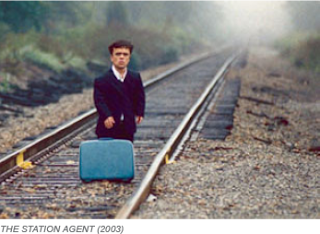
The film opens with Finbar McBride (Peter Dinklage) observing a train arriving at a city station. He pulls out a pocket watch that looks like the kind used by train conductors in the past. The image immediately tells us how he is linked to trains. He is a dwarf, and IMDb notes that St. Finbar was a religious hermit born in the sixth century. He founded a monastery which, ironically, attracted many people and the place became the Irish City of Cork. Fin’s name implies that he, too, wishes to be left alone, but may not be able to escape into a fortress of solitude. At this point, his attachment to trains may show how he would like to settle down in one secure place but must keep moving to find sanctuary.

Fin works at a train shop in New Jersey owned by Henry Styles (Paul Benjamin). It is called The Golden Spike, which refers to the spot where different railroad companies joined their tracks together. It suggests connection. But, at this point, Fin is quite a loner. One can understand why he wants to avoid people since as he walks on the street boys ask him if he knows Snow White, and when he shops at the supermarket, people stare at him and giggle.

Henry and Fin plan on going to a screening of a home movie made on a train trip, but their expectations are not great, and they are right since it is a boring presentation. There are several train enthusiasts attending, but there is no conversation between them, so the impression is that they are content in their oddness which brings them together, but not in a personal way.

In a quick foreshadowing, one of the miniature figures that Finn is painting at the train store topples over, and Henry immediately collapses in the shop and dies. Could the tiny figure represent the upheaval that the diminutive Fin will encounter? Fin meets with Henry’s attorney, Louis Tuboni (Richard Kind), who says in six weeks the shop and its contents will be sold according to Henry’s will. He left some property to Fin, which turns out to be a train depot in a remote part of the state, where according to Tuboni, “there’s nothing.” That may actually seem like an attractive prospect for the socially shunning Fin. The town is called Newfoundland, and the name can indicate a “new” start for Fin.

Like a solitary hobo, he walks along tracks as train cars go by. He reaches the station and looks outside which confirms its remoteness. However, the next morning he is awakened by a man setting up his food truck with the name “Gorgeous Frank’s ” written on it right next to the building. The owner is Joe Oramas (Bonny Cannavale), who is just the opposite of Fin. Joe is a very gregarious fellow who wants to engage Fin in conversation that Fin does not want to be part of. Joe says it’s his father’s truck, who is sick, and Joe has been taking care of business for the past six weeks in the meantime. From Manhattan, Joe is out of his element and he craves some companionship. The only way that Joe even knows that Fin lives right there is when the newcomer takes the mailbox and places it on the porch of the depot so can have access to it. The shot implies that the world as a whole is out of reach for Fin.

Fin is almost run over by Olivia Harris (Patricia Clarkson), who spilled coffee on herself and drove erratically as a result. It seems Fin can only meet people by accident. She offers to give him a ride but as usual he refuses. He offers Joe little information as to why he is dirty and refuses to go with him for a beer. He doesn’t like bars most likely because of receiving ridicule, but will not even drink with Joe alone or take a walk with him, so used is he to feeling safe when by himself. Finn stays where he thinks he feels safe from others as he walks along the railroad tracks. However, he attracts another well-meaning person, Cleo (Raven Goodwin), a young African American girl who follows him. He stops and just says “Hi” to her and she runs off. She is a bit of an outsider herself, and maybe she sensed a connection with Fin because his height matches her own.

There is a knock at the station which is disturbing to the hermit-like Fin, and it is Olivia bringing a bottle of bourbon as a housewarming/apology gift. She sees Fin smoking and she says that she slept with a guy when she was nineteen because he rolled his own cigarettes. It is an awkward statement, injecting a sexual element here. Fin doesn’t have a phone, adding to his desire to be off the social grid, and Olivia likes that, as she admits she has two phones and never answers them. She notes that her former husband gave her one of the phones, and her marital situation indicates she is also not in a connected place in her life. She is physically awkward as she knocks over a ticket box, symbolizing her unstable situation. She admits to losing her son two years prior, so we understand why she is in an emotional limbo. After revealing this fact, she wants isolation also, and tells Fin not to look at her.

She falls asleep on Fin’s couch and Fin slept in the bathtub, giving both of them their privacy. When she wakes, she feels embarrassed that she stayed overnight and runs out. Joe has met her before and suggestively jokes that she must have missed her train the prior night. Joe issues another unwanted knock on Fin’s door, gives him some coffee, and assaults him with unwanted questions about Olivia’s sleepover. He vicariously wants a connection to Olivia, and he so craves human contact, unlike Fin, that he makes Fin promise him that if he and Olivia do something later, he wants to join them. Olivia left her phone there which begins to ring. Fin finds out her address from Joe, and drops off the phone without even trying to talk with Olivia, despite having made her acquaintance. Meanwhile, Olivia is at her place painting, which also designates her as an artistic outsider, expressing herself on the canvas instead of to people. When she gets calls from her husband, she ignores them. A woman stops by and Olivia escapes, saying she has to go out. She is as evasive as Fin. They both wind up at the library, but Fin doesn’t have a library card yet. The library worker, Emily (Michelle Williams) doesn’t see his small-scale approach and is startled, dropping books on the floor, another example of how he doesn’t fit in with the expectations of others. Later, Olivia, who somehow feels safe around Fin, possibly because he is so unobtrusive, checks out the book for him and, according to Joe, leaves it at his doorstep, an attempt to make up for her overextended visit.

Cleo finally has a minimal conversation with Fin, who she innocently thinks, because of his size, might still be going to school. She does then ask if he’s a “midget” to which he responds, “no.” Much of his dialogue at the beginning consists of “yes” or “no” answers reflecting his desire to limit engaging with anyone. Some young men visit Joe’s truck and when they see Fin come out of the station, they make derogatory comments. Joe shuts them down and looks at them with disdain, which shows he is above their prejudicial way of thinking.

Olivia drives past Fin who is sitting near a pond reading. When she gets coffee at Joe’s, he finds out that she passed Fin. Joe asks for a ride to see Fin. While they ride together, she gives monosyllabic responses, mimicking Fin, which shows how she is like him in her social aversion. She does not want to join them, so Joe approaches Fin by himself and finds out that Fin is train watching. However, one goes by with very few cars about ninety minutes apart. Joe, who is starving for something to do, is no satisfied with the activity. They run into Olivia coming out of a store and Joe gets the other two to join him at his truck for dinner. Fin and Olivia seem uncomfortable with the arrangement as Joe tries to morph them into his version of the Three Musketeers. It’s funny when Joe asks Fin if people like him have clubs. Probably the first thing that comes into our minds, and also in Fin’s, is that Joe is making a prejudicial remark about Fin’s height. But Joe follows it with that he means people who love trains. Unfortunately, Joe, the glue holding these three together, must leave to take care of his ailing father. Olivia gets Fin’s lack of desire for social interaction and says she is “cool” with them just eating and not talking.

Joe now becomes Fin’s walking companion as they hike along the tracks and go to the pond to watch trains. The outgoing Joe narrates as he flings stones into the water to pass the time. He engages Fin by asking about the best train routes. Olivia drops off a camera at Fin’s because he admitted he can’t be a train chaser since he doesn’t drive and has no way to photograph the vehicles. Olivia meets Cleo who is pretending she is a conductor on one of the abandoned trains there. The young girl has a track spike collection, so she, too, is drawn to the world of trains, possibly suggesting her inner desire to hit the road and escape her solitary world.

Joe, the urban outsider in this rural area, continues to try to cement the connection with Olivia and Fin. They walk the “right of way,” which Fin explains comes from the government acquiring land to develop railroad passage. Joe, though tall, is the one who is like a child looking for something to do, quite the opposite of the other two, who retreat into their passions, trains and painting. Joe even wants to just play soccer with some kids who show up at his stand, accepting anything that will keep him occupied. Olivia comments to Fin that Joe, “does enjoy life,” which can’t be said for her and Fin at this point. That feeling overwhelms Olivia and she leaves to be alone.

Joe drives his truck and Fin uses the camera that Olivia brought him so they can indulge in some train chasing. Fin actually appears happy for the first time. Joe invites both of them to Olivia’s house so they can screen their film. Olivia is running late and is draped only in a towel when she lets them in, which again adds a sexual note to the encounter. It is the first time the two men see Olivia’s paintings, which startles Joe. As Joe cooks a meal, Fin and Olivia dip their feet in an adjacent pond, and Olivia says she is not used to having a loud person, such as Joe, in her house, again attesting to her state of solitude. She says that the house was a “getaway” place, and she really used to get away, because she couldn’t stand being in her former community where she was the “poor woman whose son died.” We now know why Olivia has withdrawn from the world, and she feels the pain of her loss and dislikes feeling pitied. But Fin gives us little of his backstory. When Olivia asks why he moved there, he jokingly says to be near Joe.

After they enjoy the meal and film together, Fin does admit when asked by Olivia that he was in love once, but he was young and angry, most likely due to harassment, which probably ruined the relationship. He is amazed how people single him out just because of his height even though he is just a regular “boring” person. He asks if she is still in love with her ex-husband, David (John Slattery), and she says yes. Was he fishing to see if he had a chance with her? Joe is passed out and Olivia insists that they stay over. There is a photograph of Olivia’s son next to the bed where Fin is, and he comments that he looked like a happy kid. Moved by Fin’s statement, she gives Fin a goodnight kiss on the lips. Unfortunately, David decides to show up the next morning to find Fin coming down from upstairs and Joe eating cereal. Olivia asks her two houseguests to step outside as Olivia and David argue over the presence of the other two men and the fact that Olivia will not answer David’s phone calls. Olivia is seeking solace from the loss of her son, but David’s appearance invades her emotional and physical escape.

Cleo doesn’t understand Fin’s desire to be left alone and wants him to talk about trains at her school. She is quite angry with him when he says he can’t appear. From her innocent viewpoint, which is the unbiased position the film seems to think we should aspire to, there is no logical reason why he should have to feel inhibited. Meanwhile, Olivia doesn’t show up for her daily coffee at Joe’s truck, not feeling social, and she takes some pills to cope after David’s intrusion. Joe has tried to adapt to being quiet and read along with Fin, just to share his company. But, he does attempt to obtain more personal history from him. Fin admits that he has had sex with a full-sized woman, but not with a person his own size. When Joe presses, Fin cuts him off, most likely not feeling comfortable as to why he should have to talk about how his life is different.

Now that he has verified his address, Fin is able to get his own library card. When he sees Emily again, she says he has a nice chin. It is an intriguing statement and Fin shares the observation with Joe, which shows how these two are becoming buddies. Olivia drives right past Fin and Joe, which shows how the encounter with her husband has made her withdraw into herself. Fin is at the grocery store when Olivia calls in an order as she is probably not willing to even to shop. Fin says he will deliver the items as he most likely wants to know how she is doing. But she has no interest in seeing him and is cold as she pays him for the groceries and immediately closes the door. Fin’s hurt is mirrored in his face as he probably feels that he thought he was getting close to someone who has now rejected him.

Fin told the surprised Joe that he would go with him and his dad to the local bar he was not previously willing to visit. But he is carrying this immediate hurt concerning Olivia there with him. Emily is waiting for her loser boyfriend Chris (Jayce Bartok) who is standing her up. He calls and she is distraught. She confides in Fin, telling him that she is pregnant. She was abrupt with Chris who drives over and pushes Emily around for telling him to get lost. Fin tries to keep Chris away from Emily and then he slams Fin into a car. Emily tells Fin to leave to protect him. Fin looks disgusted since it seems when he tries to connect with someone all he gets is grief. He slams the door closed to his station in anger.

Trains roar past his new home seemingly reminding him of how life is passing him by while he is stationed, as it were, in his predicament. The next day Joe comes by to apologize that he didn’t show up at the bar because his father was not feeling well. Fin is now angry at all the disappointment he has suffered by engaging with others and bluntly tells Joe that he wants to be left alone, which is the only way he feels emotionally safe. He wanders to the bench to watch trains go by and there is a shot there of a father showing his two young sons how to fish. The inclusion of this image sharpens the contrast between those that lead fulfilling average family lives and the outcast world of Fin. Meanwhile, Olivia’s husband continues to just reach her phone machine, as Olivia is absent even from the camera shot to stress her isolation.

At night Emily visits Fin and apologizes for what happened with her boyfriend. She is on the outs with society, too, right now, as she relates how her family is in an uproar about her being pregnant. She was going to move in with Chris, but probably realizes what a jerk he is. So, she is feeling homeless. In their conversation, Fin says that long ago the station agent would deliver mail and even give haircuts. It is interesting that Fin lives in a place once occupied by a person who was so much a part of the community. Perhaps the building’s abandonment is a reflection on the current disconnected society. Fin says he’s retired now and when she questions why since he is not that old, he says that dwarves retire early. Emily is funny when she comments, “Yea, lazy dwarves.” They then share a passionate kiss, and she asks if she could just sleep there that night. They share the couch with their heads at opposite ends. There is intimacy without the two being physically intimate. She leaves the next day after the usually remote Fin gave her sanctuary for an evening.

Fin starts to sit outside Olivia’s house each day, smoking cigarettes and eating his lunch. He wants to monitor her without intruding, but it does come off as a bit of a stalking maneuver. One time she is on the phone having an angry conversation with her ex-husband. Fin approaches her on her porch to try to offer comfort, but it is bad timing since she is furious. She yells at him, saying she is neither his girlfriend nor his mother and he must leave. He goes to the crowded local bar and gets drunk as he sees those there, including Emily’s boyfriend, stare at him and smile, as if making jokes about him. He explodes, breaking shot glasses with his sweeping arm. He shouts, “Here I am! Take a look. Take a look!” Joe, Olivia, Emily, and Cleo invaded his solitude, and he can’t hide by blending into the background at the bar. He feels as if he can’t escape notice which brings along with it hurt feelings. So, he changes from being a covert center of attention to an overt one.

He stumbles back toward the station on the tracks, the objects that gives him direction. But he is intoxicated and he falls. He sees the light of a train coming at him and he smiles, as if wanting death to free him from his emotional torture. But, it was just an alcohol-induced dream. He wakes up on the tracks. However, his pocket watch was smashed. Could it mean he is ready to move on away from his restrictive past?

He visits Olivia’s house again. She is on the floor and a bottle of pills is next to her. She has fallen, literally and figuratively, just like Fin, by taking a supposedly pain-killing substance. So, what is happening to them bonds them together. She says that David is having a baby in his new relationship, which obviously is horrible for Olivia, as she sees him as replacing loss with hope, which she is not capable of doing in her life. She falls crying into Fin’s arms, and now he is there at the right time to offer her comfort. The next scene has Fin sitting in a waiting room as a doctor talks to Olivia. The implication is that he helped her seek counseling.

Finn, after successfully aiding Olivia, now reaches out to Joe and they greet a smiling Olivia as she is discharged from the hospital and they take her home. Fin and Olivia spend time together in a serene shot near the calming pond. Fin, no longer trying to hide, goes to Cleo’s classroom to talk about trains. He tells the students that the first train was called the “Tom Thumb,” which links him to his passion based on the size reference. The film is not about to say everything will be okay, since one boy makes fun of Fin’s height, and the teacher pulls him out of the class.

The story ends with a relaxing and humorous night scene on Olivia’s porch where Joe has made dinner for her, Fin, and himself. Joe says there is plenty of food left over for the next day. Olivia smiles at him, as his words point to the ongoing friendship between the three. A child in the class asked about another mode of transportation, blimps. Fin asks Olivia and Joe if they know when blimps were invented. Joe says Fin can go to the library and ask Emily. Joe talks about a librarian fantasy, where she loses her glasses and books fly everywhere. Fin says Emily doesn’t have glasses. Olivia tells him, “Well, buy her some, it’s worth it.” Trains have now become a symbol for bringing people together.

The next film is Pickpocket.

Sunday, June 4, 2017

Manchester by the Sea

SPOILER ALERT! The plot will be discussed.

The film Manchester by the Sea (2016) shows the alienation of character Lee Chandler (Casey Affleck) in his aloofness, anger, inability to communicate, lack of direction, and lack of feeling at home anywhere.

We know that Lee was a happy person at one time by the opening flashback scene where he is on a boat, joking with his nephew. But, at the current time he is a solitary figure living in Boston, working as a handyman/janitor at a rundown apartment building. He is almost uncommunicative with the tenants, as one drones on with anecdotes or another rudely expresses bitter complaints. He overhears how one female tenant is attracted to him while speaking about Lee as he services her apartment, but he makes no effort to pursue a relationship. He acts the same way with another woman at a bar, who spills a drink on him as an icebreaker. Actually, although Lee is the focus of the story, these other characters are not direct in their communicative skills, possibly showing how Lee’s condition is indicative of a general modern-day problem of connecting with others. At first it appears Lee is detached, but the looks on his face show that he harbors hostility, and unleashes a few expletives at one of the female residents. Indeed, it seems that the only way he interacts with people is with avoidance or anger, as we observe him getting into a bar fight for the simple reason that two men are looking at him. We see him alone in his room, watching sports on TV, and then falling asleep. Thus, the film depicts him as an unhappy, angry loner, who seems to be unable to be social.


His work fixing up other peoples’ places is ironic, because we learn that he has been unable to put his own broken life back together. We later learn that his negligence in not screening in a fireplace caused a blaze which destroyed his home, resulting in the death of his children. This tragedy took place in Manchester, where he once lived. When he finds out that his beloved brother, Joe (Kyle Chandler) is succumbing to his congestive heart failure, he is forced to confront his traumatic past by returning to Manchester. As he drives there, we see his anger when he encounters traffic congestion during his trip. Thus, his guilt may be manifesting itself in displaced aggression towards others.

When he arrives, he discovers that he did not make it in time to see his brother alive, which, again, he probably sees as a failure on his part. He appears unemotional, though, trying to suppress his guilt. Ironically, he only seems to show affection not to living people, but only to the lifeless corpse of his brother, which he holds and kisses. This scene emphasizes his inability to engage other human beings. When he finds out that his brother appointed him as the guardian of Joe’s son, Patrick (Lucas Hedges), Lee can’t conceive of himself being capable of fulfilling the role. Despite their earlier affection for each other before the accident, the two are now estranged because of Lee’s many years of absence, and there is a disconnect in their relationship. Patrick wants to repair his father’s tour boat, and Lee just wants to close down the business, not wanting any ties to Manchester, which is a painful reminder of his tragic past. When they are parked outside of the morgue, and Lee asks his nephew if he wants to go in to see his dad, Patrick says “let’s go.” The youth meant he wanted to see his father, but Lee, wanting to escape, takes the boy’s statement to mean he wants to leave, and starts to drive off. Here we have a small but telling scene of how Lee is unable to communicate with his nephew, and, thus, how he fails to connect with him.

We do get a glimmer of Lee’s parental feelings when he seems to question Patrick’s sexual involvement with one girl while he is pursuing another, but it is just a glimpse. When his nephew asks if it’s okay for his current girlfriend to stay over, Lee, not understanding the role of fatherly authority thrust upon him, wants to know why Patrick is asking him. He then awkwardly thinks he must show some mature responsibility, so he mentions about using a condom, after which Patrick reassures him that his father already had the sex talk with his son, invalidating Patrick’s fatherly attempt. In a flashback, we are reminded that Lee, at least at one point, was a loving parent, and husband to his wife, Randi (Michelle Williams). In contrast, Patrick’s family life was far from ideal, since his mother, Elise (Gretchen Mol), was an alcoholic. Patrick tries to connect with his supposedly recovering mother after the death of his father. However, she is still shaky despite trying to compensate by getting involved in a regimented religious relationship with Jeffrey (Mathew Broderick), and can’t even get though an afternoon reunion with her son. That Patrick shares a propensity to displaced anger with his uncle can be seen in the fact that the young man is hostile playing hockey, yelling profanities at a fellow teammate, which also echoes his uncle’s inability to communicate.
 We have a flashback of Lee showing his bare apartment, which he has moved into in Boston, to Joe and Patrick after the loss of his children. The sparseness of the living space echoes Lee’s not feeling that his new place is a home to him, and stresses his rootless existence. In the present, we see more of the lack of connecting with others. There is a painfully awkward scene where Lee and the mother of a friend of Patrick’s, who is attracted to Lee, are unable to communicate. This episode shows that Lee’s helplessness in social relationships spreads beyond himself. We also have a symbolic scene illustrating Lee’s lack of personal direction, and how he now feels lost in his old hometown, when he and his nephew wander around in the cold because Lee can’t remember where he parked his car.

Perhaps the most heartbreaking scene of the movie is the one where Lee encounters his ex-wife, Randi, outside, appropriately, in the cold. The lighting shows one framed in darkness, the other in light, to emphasize the schism between the two. Randi basically wants to apologize for the terrible things she said, blaming Lee for the accident, and it appears she wants to say that she still loves him. Their dialogue is a series of sentence fragments, but they, ironically, can communicate their sadness and caring in their expressions and body language, and we see Lee totally vulnerable and emotional here.

At first Lee wants to place Patrick with Joe’s boating partner, and even is encouraging about his mother, Elise, which angers Patrick, who accuses his uncle of trying to get rid of him. Lee looks for a job in Manchester, but encounters hostility from those who seem to blame him for running off after the accident. This fact shows how he is unable to return to his former home. Lee demonstrates that he wants to take care of Patrick, at least until the boy reaches age eighteen, by suggesting that his nephew move to Boston. But, Patrick still sees Manchester as his home, and refuses to leave. Lee begins to parent in his own way, allowing time for Patrick to be intimate with the girl he is pursuing. He sells his brother’s rifles so that the engine in Joe’s boat can be fixed, allowing the business to continue. But, after the shattering confrontation with Randi, he confesses that he can’t “beat” the trauma he experienced.

Lee does arrange for Patrick to stay in Manchester. He tells Patrick that he got a job as a handyman in Boston in a smaller complex, so he won’t be as stressed out. Lee assures Patrick that he doesn't have to come to Boston because George (C. J. Wilson), Joe’s partner, is going to adopt him, and handle the finances. They can rent out Joe's home until Patrick turns eighteen and then he can move back in. When he’s twenty-one, he can do what he wants with the house. 
The change in the weather from the coldness of winter to the warmth of spring at the end of the story reflects the change in the relationship between uncle and nephew. They were not able to bury Joe previously because the ground was too cold. Now, the earth can accept him, and Lee and Patrick can try to bury the hurt of his passing. It also reflects the thaw in their relationship. Lee has rented a room in Boston with space for his nephew to visit, if he so desires. The film thus offers the possibility of hope for Lee to have a place he can call home and a bond with a member of his family. The movie ends as it began, with Lee and Patrick on a boat, suggesting a happier time in the past, and the chance for it in the future.

The next film is Annie Hall.