Showing posts with label voyeurism. Show all posts

Tuesday, July 9, 2024

Peeping Tom

 SPOILER ALERT! The plot will be discussed.

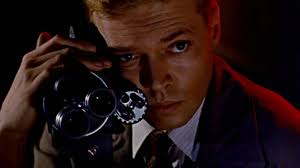
Peeping Tom (1960) came out the same year as Psycho, and both films show up in Roger Ebert’s book, The Great Movies. They are both daring artistic psychological works that explore homicidal behavior linked to parent-child dysfunction. They also implicate the audience in wishing to participate in the main character’s perversion through voyeurism. Peeping Tom is even more focused on the connection between filmmaking and watching the private and sometimes gruesome experiences of others.


The first images of the film are of a target with arrows shot at a bull’s eye. We immediately have a weapon present and a phallic symbol in the form of the arrow that penetrates and, in this case, is also linked to danger. We then see a human eye (remember Janet Leigh’s dead accusing look at Hitchcock’s audience), which adds to the theme of voyeurism, amplified by the man who is secretly filming a woman in front of a shop window. The sexual aspect is evident when she announces her price, which reveals her to be a prostitute. He follows her to her place, and we see things through the viewfinder of the camera which stands in for the view of the predator (not the first time we see events from the killer’s perspective and certainly not the last in films). We hear the sound of a knife (the same phallic weapon that Norman Bates uses) being unsheathed and then witness the horror of the woman as she is attacked.


The killer is Mark Lewis (Carl Boehm), and he returns to the scene of his crime, filming the aftermath, pretending to be a photojournalist. He records his excursion (he later says he is making a documentary) into this dark realm of fear as the police are there, removing the victim from her home, appropriately covered in a red blanket. He works at a store that contains adult material where he photographs young women in sexy outfits. He repeats what the proprietor has told him that magazines that sell are “those with girls on the front covers, and no front covers on the girls.” So, voyeurism is a business that is profitable, and part of society, although people may not want to acknowledge its presence. Thus, a customer receives his nudie pictures in an envelope marked “educational material.”

When Mark goes into a backroom to do his work one of the models says that her fiancĂ© caught her with another man, and she tells Mark to make sure that her bruises don’t show in the photos. The film shows the seedy side of life and how we try to cover it up, which is what the mainstream movie industry has done in its past. When he takes a while to take her picture, the model, Milly (Pamela Green) asks if he has a girlfriend hidden under the camera’s drape. She is kidding, but she is correct because Mark’s lover is the camera, and his intimacy presents itself in a voyeuristic fashion.

The other model we see only in profile at first. She looks lovely, but then she turns to face Mark and reveals a facial deformity on her right side. She wants the disfigurement to stay hidden, but Mark takes out his own camera and says he wants to shoot her as she is. He does not shrink from the unpleasant side of things. The film may be saying we may kid ourselves that life is not tainted, but that is not reality.

The next scene is at Helen Stephens’s (Anna Massey) apartment where she is celebrating her twenty-first birthday with other tenants. She is attractive and one would think innocent, although her blind mother (Maxine Audley) grunts when a guest expresses a compliment about Helen. Those present see Mark peering in from outside a window. He looks like, well, a Peeping Tom. The lattice work of the window looks like a viewfinder, adding to the connection between film, Mark, and us. Mark lives upstairs, and Helen greets him in the hall, inviting in the outsider, but he declines.

Later there is a knock at Mark’s door, and he immediately does what we all do, try to make the place look presentable, not wanting others to see that we don’t live in a messy home. Only Mark’s dirtiness includes his tapes of his sordid activities. He’s an extreme extension of everyday people. Helen is bringing him a piece of cake. He is awkward with others because of his anti-social personality. He reveals that he has lived in that building his whole life. He inherited it from his father, so, he is the landlord, although nobody knows this fact. As the model Milly noted, he is a puzzle. He seems so shy and gentle on the surface (like Norman Bates, whose name sounds like “normal”). He asks if the rent is too high and is willing to lower it. When she says not to tell the others that he is willing to lower the cost, she says the renters will give him no “peace.” He repeats the word, as if not knowing what it means, implying he has had none.

He admits that he works in photography and hopes to direct a film (director Michael Powell possibly making the link between voyeurism and filmmaking. Mark even has a director’s chair). Helen is perceptive since she must have heard his projector as she asks if he was watching a movie reel. He admits that he was, and she asks if it was his own work. She asks to see it, as a sort of birthday gift. He seems willing to let her view his work and maybe feels that he has found someone with whom he can share his secrets. He lets her see his dark room that she admits is huge. The size suggests that there is a vast subconscious, shadowy world below the surface of Mark’s outwardly benign appearance. She stumbles there, implying that the underside of the human psyche can be scary.


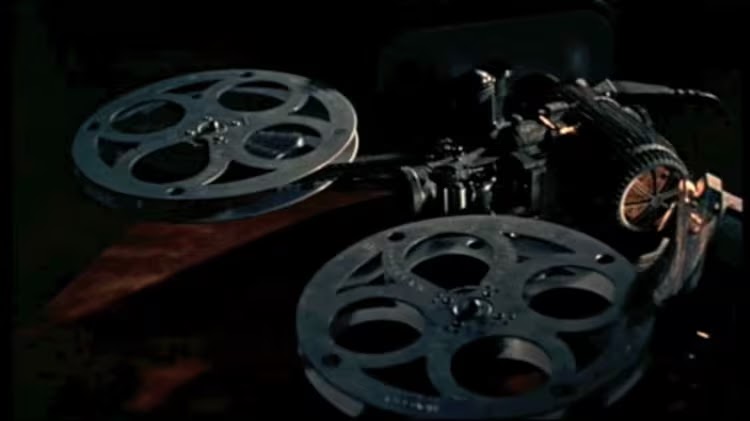
He almost shows her what he was looking at, the removal of the girl he murdered, but he decides not to be that open with her. He instead displays a film of himself as a child, which his father, a scientist, took. The implication is that his father was the influence on Mark’s interest in photography, which is confirmed when there is a scene of his father giving him a camera, the one he still has. The home movie shows how his father experimented on him to see his reaction to fear. He would shine a bright light into young Mark’s eyes which caused him to cry. He dropped a lizard in his bed to frighten him. He also filmed the child looking at two lovers kissing and embracing in the park. He also documented Mark’s reaction to his dead mother and her burial. Helen is obviously upset by these images. Mark now wants to record Helen as she looks at the home movie. His father taught Mark to live life through observing and recording people in distress, and it’s as if Mark is continuing his parent’s scientific studies. Director Powell’s camera shows Mark looking through the turning reel of the film, stressing how he is tied to seeing life through the camera.

As Helen questions him about what this all means, Mark strokes the camera, a masturbatory action again linking how he can only get excited by way of his voyeurism. There is the image of Mark’s young stepmother coming out of the water on the beach, scantily clad in a two-piece swimsuit. We have arousal in an inappropriate way displayed here by means of observation. He calls her the “successor,” as if this woman dethroned the queen in Mark’s life only six weeks after his mother passed away.

After Helen sees how disturbed Mark is, she tells him to turn off the camera. She moves him away from the dark room, as if she is getting him out of his dark state of mind, into the lit outer room, where she wants to shed light on what she saw. Mark tells her his father was a biologist and wanted to know how fear registered on the nervous system, especially with children. We see volumes of his father’s books on the topic. Mark says he had no privacy since his father was always filming him. Thus, he has no problem invading the privacy of others based on his upbringing. Mark seems to rationalize that his father learned from him, and some benefitted from his father’s work. However, Helen doesn’t buy the excuse.

There is then a quick cut to a film set (called The Walls are Closing In, a foreshadowing) where Mark works, but the impression is that we have stepped out of the story and are witnessing the filming of the movie we are watching. It is a deliberate attempt to link imaginary reel life with actual reality. There is a discussion of whether a movie is commercial enough to be made, which fits the making of this controversial work we are watching. There was a criticism of Powell using himself and his son for the characters of young Mark and his father given the disturbing material of the story. The movie takes the joining of fictional and actual characters to a daring level.

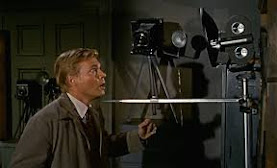
The stand-in actress in the movie Mark is working on, Vivian (Moira Shearer), is supposed to have a secret meeting with Mark about her dancing after the end of the workday. She stays behind to meet him after the set shuts down, but she encounters a dark studio (like Mark’s dark room?). Then spotlights turn on her just the way Mark’s father used bright lights on Mark. He has the place set up with props and marks like a director. He tells Vivian that they will be doing a shoot, which allows him to present the guise of a film piece to manipulate her. He says he wants her to play frightened, which ironically, she says she doesn’t feel afraid. He tells her to imagine that someone is approaching her to kill her, which is what he is actually doing. He agrees that the killer is a madman, and says, “but he knows it, and you don’t.” Mark here seems to realize his mental illness but can’t stop his pathology. He removes the cover at the end of the camera tripod revealing a knife attached to the end. He then records Vivian’s fear as he moves forward amid her screams and kills her. The image of the lethal tripod leg merges Mark’s voyeurism with that of the audience as we vicariously participate with the character in this crime, linking us with Mark’s perversion. Just like Norman Bates, the knife becomes a demonic form of sexual deviance, used for penetration that also destroys.

Mrs. Stephens is a despondent woman who drinks alcohol to excess. However, even though she is blind she senses the suspicious nature of the photographer living upstairs. She says, “I don’t trust a man who walks quietly,” and that his footsteps are “stealthy.” She does condone Helen visiting him. Mark gives her a pin and when she moves the placement of where she might affix the gift, Mark moves his hands to the same places on his upper body. Ebert says Mark here becomes a camera himself, recording what he sees through his own lenses. Again, he seems to only exist by way of what he observes. She tells him she is a librarian working in the children’s section of the library and has had short stories published. She recently had a book accepted about a magical camera and wants him to help her add photos as part of her story. He is thrilled but adds a chilling note that sometimes he photographs some things for no charge. The contrast of the innocence of children and Mark’s dark side is implied here.

While shooting on the movie set, an actor must move a trunk, which is especially heavy. We realize from the deadly encounter with Mark that Vivian’s body is in the trunk, which is discovered in short order. The police, who are also investigating the prior murder of the prostitute, notice the same look of terror on the body of Vivian as they saw on the hooker. As they interview those involved with the making of the film, Mark photographs the proceedings. Mark talks with a fellow worker and says that he is filming the police as part of his “documentary.” The other man jokingly questions whether they will catch Mark recording them. He answers in the affirmative, but he is talking about arresting him for the killings. It implies that he feels that he will be apprehended eventually. When the man asks jokingly if he is crazy, Mark says, “Yes. Do you think they’ll notice?” He is admitting to his deranged mental state, but he is cloaking it in a humorous exchange.

Chief Inspector Gregg (Jack Watson) interviews Mark, who offers his camera as a way, most likely, to show that he is cooperating with the police as to any filming that may prove useful to the investigation. But he constantly reaches out for it during the scene, like a man reaching for his lover, or even a part of himself. Mark photographs the removal of the body from the rafters. As he leans over, objects fall out of his pocket, but he is not discovered, at least not yet. All the above takes place on the movie set, sealing the emotional connection between the fictitious moviemaking and actual events.

The sightless Mrs. Stephens again shows her perceptive abilities as she can feel Mark looking in on them again through the window. She jokingly says, “Why don’t we make a present of that window?” When she shakes his hand she says that he has been running. He says he was hurrying to see Helen, but we know he was escaping the movie studio. Mrs. Stephens asks Mark about the dead actress, but he claims he didn’t know her. The look on his face shows that he registers the mother’s suspicious nature.

On their way to dinner, Helen suggests that Mark doesn’t need to take his always-present camera with him that night. He is defensive at first, but admits that he trusts Helen, and they lock it in what was once Mark’s mother’s room. Mark seems genuinely happy to be with Helen. But, as they head out, he sees a couple kissing, and he instinctively reaches for where his camera would be slung over his shoulder, ready to capture the passion between the man and woman vicariously.

They have a nice evening, but their joy is intercut with the timer ticking away to clock his developing film. The image suggests that the movie we are watching is counting downward, and possibly that Mark’s time is growing short. It may also mean that despite Mark’s attempt to escape his obsession, it is always in the background. When Helen retrieves his camera, she points at herself and wonders how it would photograph her. Mark grabs it out of her hands, repressing the thought of filming her murder. He says he will not film her because, “whatever I photograph I always lose.” How true when it comes to ending a person’s life. She kisses him goodnight, but he doesn’t respond with any passion. After she leaves, he kisses the lens of the camera, emphasizing his displaced, detached emotional personality that can only become involved at a distance.

While looking at the film he made of Vivian, Mrs. Stephens surprises him. This is a fascinating scene. We have a blind woman at home in the photographer’s dark room. She has heard him every night running his camera. She can keep him at bay with her pointy cane, a version of his knife-like tripod. He is on the defensive here at first. She asks what he is looking at and says he can lie to her, but he perceives her intuition and knows she would know the truth. Vivian’s projected image is partially on the screen and also on his back, visually implicating him in her fear. The film ends and he lunges toward the white film screen, arms raised. It appears as if he has been crucified by his own obsession. He says that the light ends too quickly, and he needs a new opportunity. He is talking about what he has filmed but what his words imply is that he feels compelled to seek another victim. It appears it is going to be the mother. However, Mark relents. The two continue to speak in a code as if they are talking about film. But what Mrs. Stephens says is that he needs to seek help and doesn’t want him to see her daughter until he does. He says he will never “photograph” Helen, which means he would not harm her. She says they would move away if he became a threat to Helen. He escorts her back to her place, and she warns him that he will have to tell someone about his problem, a confession really, and the implication is that it will either be a psychiatrist or the police.

Back on the movie set, there is a psychiatrist there to aid the traumatized lead actress. Taking Mrs. Stephens’ advice, Mark asks the shrink, who knew about Mark’s father, if he had insight on someone being a “Peeping Tom.” The technical term is scopophilia according to the psychiatrist. Mark is hopeful, symbolized by his raising the stage elevator as he talks to the psychiatrist. When he hears that it would take a few years of continuous analysis to cure, Mark becomes despondent, as he lowers the lift appropriately. The Chief Inspector is on the set and the psychiatrist mentions to him that Mark was asking about voyeurism, which piques the policeman’s interest. The fellow worker he spoke to before gives Mark a photo of a beautiful woman, which Mark says gives him “an idea.” He then speaks to the man who employs him to shoot sexy photographs. The audience may suspect that he may make one of the models his next victim.


The police are now following Mark as he goes to the store to photograph Millie. Mark realizes he is being tailed and it appears that he films the model, then leaves the store, locking up the place. Meanwhile, Helen seeks out Mark, who is not back yet. She turns on one of his cameras, and we see only her response. Her face goes from being in the light to being hidden in darkness, which reflects what she is witnessing. She gasps and whimpers, seeking escape from the room as she realizes the horror of what she is looking at. Mark shows up and she wants to know if the film she watched was just from his “magic” camera, creating an illusion. But he confesses that he killed the women. He tells her that she should stay in the shadows because if he can’t see her fear, she will be safe. How much his father warped Mark is very evident here.


The store proprietor informs the police that he found Milly’s body. So, Mark is allowing himself to get caught. He is driven to commit his crimes, but he is also a sympathetic character because he realizes his mental illness and wants to end his lethal actions. He reveals to her that his father had the whole house wired for sound. and he plays back his screams that his father recorded. She sees his torment and wants to understand what he actually did. He tells her he let his victims see their fear being recorded in a distorted reflection as the tripod knife penetrated their throats. He acts out but does not consummate the crime with Helen. He records his own fear, as his father once did, as he kills himself with his own weapon. The police burst in right after his suicide as a film reel stops rolling, reflecting the end of the movie.

The film has shown us that we are getting our thrills by also being Peeping Toms. At the end of the movie, we hear Mark’s father saying to his young son that there’s nothing to be afraid of. Despite the fact that we are watching a piece of fiction, our fear is real.

Monday, December 3, 2018

The Conversation


SPOILER ALERT! The plot will be discussed.
1974 was Francis Ford Coppola’s year. He won Oscars for Best Director and Adapted Screenplay for The Godfather, Part II. But he was also nominated for Best Original Screenplay for The Conversation, and that movie was also competing for Best Picture. This film is a cautionary tale about the invasion of privacy in a world of increasingly sophisticated technology, so its theme is relevant for us today. Coppola acknowledged the influence of the movie Blow-Up (which was analyzed in another post on this site) with its themes of observation and voyeurism, taking responsibility for the outcomes of surveillance, and whether what is perceived actually represents reality.


The title of the film sounds like a sociable communication, suggesting a couple of people talking to each other. But when someone listens in and records individuals speaking to each other, an ominous element is added to the proceedings. The first shot of the movie is from above looking down on a public city area, which makes the people below seem insignificant from such a high viewpoint. But, the perception changes as the camera pulls in and focuses on a mime (implying something artificial is occurring, a performance, which is a foreshadowing) who then leads us to Harry Caul (Gene Hackman, who should have received an Oscar nomination). His last name sounds like “call” associating his name to a phone conversation which can be heard and recorded. IMDb also notes that his name was in fact supposed to be “Call,” but a typo turned it into “Caul,” and Coppola liked it because it is the word for a birth defect that involves a membrane surrounding the head. The name could point to Harry’s insulated existence. There is a man with a gun-shaped microphone (implying that listening devices can be dangerous) who looks downward through a telescopic lens from the roof of a building at a young man and woman. Harry is near them. Their conversation is being monitored, and due to interference the sound becomes distorted electronically at times, suggesting the secondhand and possibly inaccurate way that an eavesdropper hears things.
Harry goes into a van which contains surveillance equipment. The vehicle has reflective windows so one can only see out, not in. Two pretty girls apply their lipstick by looking at their reflection in the van’s windows. Stan (John Cazale), who works with Harry, says inside the van that he wants the girls to show him a little “tongue,” as he photographs them. This act of voyeurism shows the violation of the young girls’ privacy. Harry tells Stan to pay attention to his recordings, so he is both offended by the other man’s crude behavior, and he also wants to stay focused on the job. They are observing Ann (Cindy Williams) telling Mark (Frederic Forrest), that she has spotted a man with a hearing aid following them, so one of Harry’s men has been compromised. The fact that Ann is suspicious of being spied upon tells us that there is something that the couple supposedly want to keep secret. Harry’s man was carrying a shopping bag that has a package that looks like it was bought at a store, but which is actually wired for sound. The image suggests that things may not be what they seem. Stan asks who is even interested in the couple, and Harry says he doesn’t know. Stan says maybe the Justice Department or the Internal Revenue Service are involved. They don’t even know the purpose of their sneaky activity, which shows how removed these men are from knowing what is actually going on. Harry says he doesn’t care what they are talking about, he only wants his recording. For him, his profession should be impersonal, but he is dealing with persons, and thus, his work fosters becoming detached and unfeeling about those he spies upon. We learn later that he is working for a private, non-government firm.
Harry goes home to his apartment which has multiple locks and an alarm, which illustrates how paranoid he has become because he knows, through his job, how exposed people are. A fellow tenant wished Harry a happy birthday before he entered his place, and then he finds a gift from the apartment building manager. He calls her and wants to know how the gift was placed in his home, considering it is equipped with an alarm. She tells Harry that she has a key for emergencies like fires. He tells her he has nothing of value so he doesn’t care about his belongings getting burned up. He says he only values that the key to his place is the sole one. He is a suspicious loner whose most valued possession is his privacy, which is ironic, since he violates the privacy of others. She also knows it is his forty-fourth birthday, and he doesn’t understand how she knows about his age and birth date. He says he will now have his mail sent to a post office box with a combination so no one can have a key to it. He takes off his pants while he is talking to her, symbolically lowering his shields in his own sanctuary. It appears that his only pleasure is to play the saxophone along with some jazz heard on his sound system.  But, he plays alone, with a recording substituting for live musicians, which stresses his solitary nature.


Harry goes to work at his factory-like shop, which reflects his dehumanized personality, and which is stocked with inanimate electronic equipment. Stan is there and tells Harry, while reading a magazine called Security World, that Harry is considered a notable person who will be attending a surveillance and security convention. Stan says another person will be at the convention who was involved in industrial espionage, learning and tipping off others about changes in car designs. This activity is unethical and probably illegal, but in the reverse morality world of these invaders of secrets, the infraction is admired. Meanwhile, Harry coordinates the various tapes in order to merge the pieces of the recorded conversation, and he looks through pictures taken of the young couple, trying to assemble a coherent picture, which he fails to do as we find out later.

We next see Harry in a phone booth. He is calling The Director, the man who hired him, to arrange the delivery of his tapes and photographs. Harry tells the person on the other end that he can’t be called back later because he doesn’t trust home phones since they can be tapped. However, Harry is told he can’t talk to The Director, and the person speaking to Harry can’t even assure him that he will be paid in full for his services. He does set up an appointment for Harry. This exchange is impersonal and cryptic. So, there is the implication that conversations can take place, but truth may not be revealed from them.
Harry visits his “girlfriend,” Amy (Teri Garr), who wasn’t sure he was coming. Again, there is a suggestion of a lack of communication. She finds out from him that it’s his birthday. She asks if something special can happen between them on this occasion. He says “like what,” because for him there can’t be anything “special” or significant in a relationship. He is cautious when it comes to revealing too much about himself, which might expose him and make him vulnerable. He says he doesn't have any secrets, but that’s all he does have, which are usually about others. His work reveals the private lives of people, which can make them susceptible to harm. She says she’s one of his secrets, since nobody is even supposed to know about their relationship. She says she sees him spying on her from the staircase, as if he can’t trust anybody, maybe observing what she is doing when he isn’t supposed to be there. Thus, he even carries his profession of eavesdropping into his private life. The two parts of his world are so interconnected, he has become his job. He’s a professional voyeur. She says it’s as if he is trying to catch her at something. She says it amusingly, but she is revealing him to himself. He even listens to her phone conversations. Amy starts singing, “When the Red Red Robin comes bob, bob bobbin’ along,” which is what Ann was singing, and which symbolizes that Harry’s work is overflowing into his private life, since he was paid to spy on a woman, but he also spies on his girlfriend. (The song contains the line, “Wake up, wake up, you sleepyhead,” which perhaps implies that Harry maybe has to “wake up” to the harm that he is doing).

Harry kisses Amy, but still holds onto his eyeglasses, and keeps his coat on, hanging onto his detached facade, showing how he can’t be emotionally connected to her. She asks about his work, since he hasn’t told her what he does for a living. She doesn’t even know about his living arrangements, and she keeps wanting to know more about him. He tells her he doesn’t like answering questions. He pays her rent, so he basically treats her like a prostitute, instead of a girlfriend. She says she was thrilled to have him show up, but says she doesn’t want “to wait for you anymore.” On his way home, he keeps thinking about the couple he observed earlier, still thinking about his work, but maybe envious of the intimacy they displayed at their meeting.
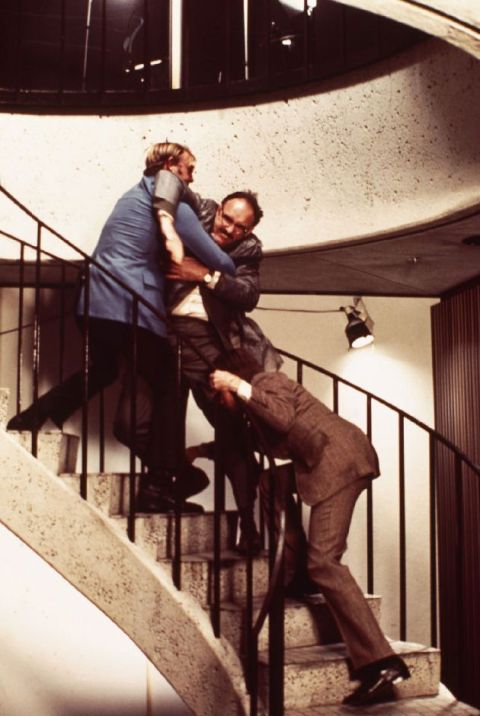
The next day Harry goes to deliver his surveillance materials to The Director, but he isn’t at his office. Instead, an assistant, Martin Stett (Harrison Ford) says he will take the package, and gives Harry the payment for his services. Harry doesn’t like his work being handed to a subordinate because he probably is not sure if it will get to the man who hired him. He most likely doesn’t want to hurt his reputation for confidentiality, which he tries to maintain, although his job shows how difficult that is to do. He gives back the money, and wrestles the package away from Stett, who tells Harry he shouldn’t get involved in what’s going on. Stett says the tapes are dangerous and “Someone may get hurt.” Harry leaves, heads to the elevator, and Mark, the man he spied on, is there. Harry now knows he was hired to conduct surveillance on someone associated with The Director’s office. He then sees Ann there, too.
Harry goes back to his workshop and again listens to the tapes. He listens to Mark and Ann setting up a date and time for something to take place at a hotel. He doesn’t like Stan asking questions about the couple’s conversation. He tells Stan he doesn’t want to be made to explain the personal problems of his clients, again wanting to maintain his distance from the subjects he is recording. Harry also shows his dislike of Stan taking the Lord’s name in vain. In his defense, Stan says it’s just normal human curiosity to ask questions. An agitated Harry says in his business he doesn’t know anything about human nature or curiosity. He would rather be clinical in his actions, and people become abstract subjects to record in his job. Otherwise, it would most likely be too emotionally precarious for him if he cared about who he observes. In the recording, Ann’s suspicions about being recorded make her ask Mark to pretend to laugh to throw off whoever might be observing. So, we know they are planning something that others may be worried about. Harry adjusts the recording and hears Mark say, “He’d kill us if he got the chance.” Thus, we know that the two are involved in something dangerous, and just from what Harry could make out, he believes that Ann and Mark are in a precarious situation.

Harry kneels in a church, and goes to confession. We now know he is a Catholic. That fact explains his distaste for Stan’s swearing. It also shows that Harry has some moral values that he has clung to as an adult. His religious beliefs are in conflict with the subversive activities inherent in his job. Underneath his uncaring surface exists a conscious that is at odds with what harm his professional duties may incur. He confesses to the priest that his work may cause the young couple to get hurt, and he admits that his job has brought harm to someone before.
At the security conference Harry observes new surveillance devices hidden in clocks, under car dashboards, and in phones. It’s a public expo, and it comes off as legitimate, as if new automobiles were on display. The lack of any concern for what is being promoted here makes it seem acceptable to invade the privacy of others. Harry is so secretive and mistrusting that he won’t allow himself to be exposed promoting the technology of others, and he says he builds his own equipment so he can insulate himself, basically keeping him cut off from the world at large. At the convention he sees Stett, appropriately on one of the cameras on display, suggesting that Harry can only participate in the world in an indirect, passive fashion. Merchants express their worry about others stealing from them, so they, ironically, are victims of their own industry. Harry sees Stan there, too. He got a job with another company because Harry keeps him in the dark about their clients. Because Stett is there, and only after Harry believes he may be in danger, does he reach out to Stan, saying that he is being followed and convinces Stan to help Harry. Harry calls Amy, but the number has been disconnected and he can’t get her new number. He is worried about being alone now that he feels threatened, but he didn’t treat Amy in a caring way, so it is too late to obtain comfort from her. Harry confronts Stett who tells him to meet on Sunday at one pm, and The Director will be there to accept the tapes. Harry, suspicious that he has become involved in a dangerous plot, says he’ll think about it.


Harry leaves the expo with other people he knows who are in the surveillance business. Young guys in a Mustang speed by their car and cut them off. Harry’s driver knows how to get info based on the other car’s license plate. He stops the car next to the youths and tells the young driver his name, address, height and weight, just to intimidate him. This scene shows how quickly one can discover personal information about someone. They go to Harry’s shop to have some drinks. Stan finds out from Bernie Moran (Allen Garfield), who says Harry is the best bugger on the West Coast, and he is the best in the east, that the secretive Harry came from New York. Bernie says he bugged his first phone when he was twelve, and boasts that his father thought that his son was very intelligent to accomplish this feat. But, Bernie’s pride derives from unscrupulous activity. Meredith (Elizabeth MacRae), who helped with Bernie’s demonstration at the convention, asks if Harry lives close by, but he doesn’t answer, unwilling to disclose personal information. She talks about herself, but he won’t divulge anything concerning his life. She says she wishes he could talk to her, that they could be friends. He starts to talk about his relationship with Amy, but in a cloaked way. Harry asks Meredith if she were involved with someone who she didn’t know when he would show up, didn’t know anything about him, but might love her, would she stick by him? She asks how would she know if he loved her? He concedes that she wouldn’t, so he basically gets his answer, that it’s unfair to ask someone to stick with a person one knows virtually nothing about.
Bernie says he bugged a presidential candidate who then lost. He takes credit for it, like he earned an infamous merit badge. Bernie seems to be in competition with Harry, trying to one-up him, and wants to get information on his work techniques. When Stan says Harry was able to bug a parakeet, Bernie feels threatened, and makes an excuse for not doing something so difficult by saying that parakeets aren’t his thing. Bernie wants to know how Harry bugged the Teamsters concerning a phony welfare fund, and says Harry was working for the Attorney General at the time. So, the dirty work is sanctioned by a supposedly legitimate person of authority in the government. Harry is surprised Bernie knows who he was working for, so Bernie is bragging about his inside information. These guys even spy on each other, which implies that nobody is safe from scrutiny. Bernie says that only the president of the Teamsters and their accountant knew about the fund, and the boat they were on when they met to discuss their arrangement was bug-proof. Yet, Harry somehow recorded the information. The president of the union thought the accountant betrayed him. The accountant’s family was later found bound, and their heads were cut off. Bernie is indicting Harry for the deaths of three people. Bernie probably isn’t really concerned about how they should take responsibility for their actions. He most likely just wants to discredit Harry based on what happened in this case. But this job is the one Harry told the priest about in confession, so secretly he is feeling torn up about the consequences of his work. Outwardly he says what happened to the victims was not his fault and whatever people do with the tapes is their business. Stan starts to play the tapes of the latest assignment, and Harry shouts to turn them off. Bernie, wanting a challenge to show he is as good as Harry, says he can figure out whatever Harry does to work a case. Stan tells him about the problems involved in bugging the couple, but Bernie can’t work out how to carry out the job successfully. Harry now proudly boasts how he did it, and says it was beautiful. One of the women there asks what did the couple do that put them in danger, but Harry says he doesn’t know, showing how in his profession the people are immaterial. He wants to believe that it’s just the mechanics of getting the information that is important, not the lives affected by the surveillance. Bernie says they should become partners, but wants to look at Harry’s devices, so he probably just wants to steal his versions of the equipment. He says he’s number two, so he has to try harder, and shows how he bugged Harry by placing a pen with a microphone in his jacket pocket. Bernie plays the conversation between Meredith and Harry, which shows how even the buggers, who champion the eavesdropping technology, can become victims, too. Harry was being confessional to the girl, and now feels his shields of privacy have been penetrated. Harry is angry, kicks Bernie out, and breaks the expensive pen, even though Bernie said he would give it to him. Everyone leaves, but Meredith says she’ll stay. Harry starts to play his tape of the couple. He says Ann sounds frightened. About her voice he says, “It makes me feel … something.” He is admitting that he is emotionally compromised, but Meredith says he doesn’t have to feel anything, he just has to do his job, which is what he has been openly, at least, telling himself. Meredith kisses him and leads him to a cot to make love, but Harry is engrossed in the recording. He says after hearing how the couple can get killed that he must destroy the tapes because he “can’t let it happen again,” referring to what Bernie said about the deaths of the three people.

Harry has a nightmare where in a fog, symbolic of how muddled morality has become for him, he tries to warn Ann. He can’t seem to reveal stuff about himself except in his dreams, but it shows how he wants to share, to connect with someone. He says he was paralyzed in his left arm and leg as a child. His mother put holy oil on him to bring about spiritual healing. He says felt disappointed he survived slipping into the therapeutic bath water that he was left in when his mother answered the doorbell. These stories show Harry’s religious background and its ability to instill feelings of guilt. This feeling of responsibility for bad outcomes is reflected in his story about hitting a friend of his father in the stomach at the age of five. The man died a year later, and the dreaming Harry seems to be making it sound like a cause and effect situation. He repeats the words from the tape, “He’d kill us if he got the chance,” trying  to warn her, so as to relieve him of his guilt, at least in his dreams. When he wakes, Meredith is gone, and so are the tapes. So, his work in a underhanded field brings about some payback, as Meredith turned the tables on Harry, appearing to be something other than what she seemed, and making him a victim.

Harry makes a call to Stett. He can’t get in touch with him. Later, he gets a call from Stett, who admits that the tapes are in his possession. Stett says they couldn’t take the chance that Harry might destroy them. Harry is alarmed because Stett has his phone number. He thought he was safe and secure, but he wasn’t. Stett says they prepare a dossier on everybody they do business with, and admits they have been following Harry, which adds a sinister tone to their talk. Stett says that Harry can deliver his photographs, and The Director will pay him in full.
Harry goes to the office building of The Director with the photos. He hears his recording of the couple playing behind a door marked “Private,” which is ironic, since the sound carries beyond the room, and this film argues that hardly anything is private anymore. Stett is there with The Director (Robert Duvall). There is a Doberman Pinscher, present, too, which adds to the scare factor. The Director says angrily to Stett, “You’d want it to be true!” But, Stett says he just wants him to be informed. The Director tells Harry his money is on the table, which Harry counts. On the desk, Harry sees a picture of the Director with Ann. The Director tells Harry to count the money outside, wanting to get rid of him. Harry leaves the photographs, but asks, “What will you do to her?” He doesn’t get an answer, showing how despite his desire to reveal things, he has trouble getting at the truth. As he leaves, Stett reminds Harry of his payment, as if to say he was compensated well for his work, so he should be quiet about it. Harry asks what will The Director do to Ann and Mark, and Stett says, “We’ll see,” which sounds ominous.


Harry knows the day, time, and place the couple talked about meeting. He checks into the hotel room next to the one mentioned on the tape. He looks for the best spot to place his surveillance material, which is under the bathroom sink. He makes a whole in the tile to insert a microphone. He can hear The Director in the adjacent room shouting. Harry is upset as he jumps out from under the sink. He goes on the balcony and can see someone being attacked through the jalousie glass. Harry recoils in horror and writhes on the bed. He puts on the TV so as not to hear, just the opposite of what he does for his profession. The television is tuned to a story about the Watergate scandal, which involved an attempt at bugging, and which adds to the theme of how pervasive surveillance at all levels had become even back then. Later, when things quiet down, Harry goes next door and picks the lock. The place has been cleaned, ready for the next guest, as if nothing happened there. The toilet has a sanitary strip on it, but it sounds like the water is running. Harry flushes it, but it is clogged and it backs up, spilling blood from soaked towels onto the floor.

Harry goes to see The Director, but he is told he has to leave. He struggles and is manhandled by two security men. As he exits the building he sees a car parked outside with curtains on the side for, yes, privacy, but Harry can see it is Ann sitting in the vehicle, so his assumption that she was harmed was false. She glances at him. We then have a scene where Ann is interrogated by the press asking about if she thinks there was any “foul play” associated with the “accident,” and will she now have “corporate control” of her company? She sees Harry and recognizes him. From the reporter’s question, we learn that The Director was her husband. However, we know that Ann on the tape said she loved Mark. A reporter asks if her husband had a history of driving drunk. Harry, as do we, realize that Ann and Mark were the perpetrators of the crime, not The Director (a name that becomes ironic since he is the one who was manipulated), and that perception of the truth as we, and Harry, observed it was false. So Harry’s surveillance does not always provide an accurate picture of reality. Ann and Mark wanted The Director to suspect his wife’s infidelity, hire someone to spy on them, and in the tape provide the location to lure him and kill him. They not only remove the impediment to their being together, but also bestow corporate control to Ann. Harry envisions how the person being attacked in the next hotel room was really The Director, and how the couple made his death look like a car accident. So, appearances can be deceptive as to who is innocent and who is guilty. The phrase “He’d kill us if he got the chance” makes it sound now like a rationalization to initiate a preemptive strike.


Back at his apartment, Harry receives a call, on his supposedly restricted line, but the other party hangs up when he answers. The phone rings again, and we hear a tape rewinding which then plays a recorded message from Stett, (we are now in a world bereft of human communication) who obviously was involved in the plot. The message tells Harry that they know he knows, and warns him not to pursue things further, because they will be “listening to you.” Now he is the target of surveillance. He starts to check his place for bugs. He is not safe in his own sanctuary. He pulls apart outlets, air vents, lights, and his phone. He checks his statute of the Mother Mary, which he breaks apart, symbolically showing his faith in even his own religion to protect him has been destroyed. He starts to become unhinged as he rips apart his walls and floors. His place is in shambles as he plays his saxophone, his music being all that he has left. But, he didn’t check the saxophone. Can he ever be safe and secure in his own privacy? Can we?

The next film is Colossus: The Forbin Project.

Sunday, December 27, 2015

Rear Window

SPOILER ALERT! The plot of the movie will be discussed.

Alfred Hitchcock’s Rear Window is aptly titled. In the literal sense, L. B. Jefferies (James Stewart) looks at his neighbors carrying on their day to day activities through his back window into theirs. But, on a thematic level, the film shows what it looks like when we penetrate (sexual connotation intended – consider Jefferies's phallic appearing telephoto lens) the worlds of people that they would rather keep hidden from the scrutiny of others. As Lt. Thomas Doyle (Wendell Corey) says to Jefferies later in the film, “That’s a secret private world you’re looking into out there. People do a lot of things in private they couldn’t possibly explain in public.”


As usual in Hitchcock’s movies, we are made complicit here in the voyeurism of his main character as he peers into, one may say violates, the privacy of the those living across the courtyard of his apartment. We, the audience, may, at first, be appalled by Jefferies's Peeping Tom activities. But, we are drawn in by the same curious desire to watch the stories of others, the more lurid, the better. Hitchcock is saying that not only is this aspect of human psychology universal, it certainly is part of the nature of watching films. He emphasizes this point by reminding us of the connection between films and voyeurism over the opening credits. The camera is directed through the window of Jefferies’s apartment as the shades rise up, revealing the view, just as a curtain would rise, as it did years ago, in a movie theater. The windows of the apartments appear as story boards that are used to plot out a movie story in illustrated scenes, or may even be suggestive of the "cells" in film celluloid. They may even imply different movie narratives being viewed on split screens. There are the sexual stories served up with the views of Miss Torso and the Newlyweds; there is the sad tale of Miss Lonely Hearts; we have the desire for success in the plot surrounding the Songwriter; there is the slapstick comedy of the couple sleeping on the fire escape when it starts to rain; and of course we have the mystery involving Thorwald (Raymond Burr) and his eventually missing wife. When Lisa Carol Fremont (Grace Kelly), Jefferies’s girlfriend, playfully introduces her name she announces it “reading from top to bottom,” the way credits are displayed in a movie. There are mentionings of “opening night” and a “sold-out house,” again reminding us of the audience’s role of being a viewer of the actions of the others, just like Jefferies, and eventually Lisa and Stella (Thelma Ritter), Jefferies’s physical therapist. The audience identifies with Jefferies as he, too, is viewing a story in the dark, and his responses mirror what we see as we watch what transpires. Earlier on Stella is upset by Jefferies’s peering, and says “We’ve become a race of Peeping Toms,” and should turn our eyes on ourselves; that way, maybe if we saw our own imperfections, we wouldn’t try to expose those of others. But, later she is drawn into the spying, and wants Jefferies’s telescopic lens, saying to him, “Mind if I use that portable keyhole?”


Jefferies is immobilized in a wheelchair with a full leg cast for broken bones sustained during one of his photo shoots. He is a journalist who enjoys putting himself in danger in the field. Hitchcock shows us the picture he took of the car crash he shot which resulted in his injury. So, he is a professional observer who enjoys placing himself in harms way to capture the actions of others. In this way, he is ideally suited for this story because of the dangerous situation he assumes investigating the possible murder across the courtyard. He is at particular risk this time because he cannot escape from his predicament. In a way, his apartment is a prison. This theme of an innocent man at risk of being incarcerated is a continuing theme in Hitchcock’s films, probably going back to the time he was placed in a jail as a child for being a truant to teach him a lesson. He learned it well, only in a different way. His movies show a major distrust of the authorities.

Actually, all of those people Jefferies observes are sort of in their own prisons. The Songwriter is held captive by the need to find that special romantic tune for which he longs. Miss Lonely Hearts is trapped in her emotional isolation, inventing suitors, and accosted by one trying to take advantage of her when she summons the courage to seek a man out. She almost succumbs to suicide because of being held captive by her emotional stress. The voluptuous wannabe dancer, Miss Torso, appears to be very popular, but as Stella points out, she must fight off the male wolves to find someone genuine. The newlyweds appear happy, but the groom eventually looks as if he is caught in a sexual prison, going to the window for relief from his bride’s physical demands. Even Lisa is figuratively confined by being stereotyped as a woman who can't be adventurous because she is a woman. And then there is Thorwald trapped in a marriage to a nagging, demanding wife, who is herself an invalid, mostly confined to her bed. The films shows a variety of ways the characters deal with their various forms of incarceration. All of these stories have romantic relationships at their center.


Jefferies shares in that theme, because he is trying to deal with his girlfriend, Lisa, who wants to get married. She is a city woman who is involved with fashion. He cannot see them together because she is high society and he is always off and running with little warning wearing combat boots, driving jeeps and going to places with scary food options. She refuses to take no for an answer, however. Jefferies almost seems to want to escape his own predicament by viewing the lives being lived out in the other apartments. But, instead, their romantic stories reflect back on his own situation, giving him no relief. He makes disparaging statements about marriage to convince himself that a union with Lisa is not right for him. He says the Songwriter lives alone probably because of an “unhappy marriage.” He states that he thinks marriage will make him static, unable to be active and go places. However, the irony is that he has become stationary because of his so-called active life. When talking about relationships, Jefferies keeps speaking about them in a logical manner. Stella reminds him that there should not be so much thinking involved in matters of the heart. Jefferies’ defense mechanism is divorcing himself from his emotions.  


Jefferies becomes more and more suspicious, as do Lisa and Stella, as he (we) see Thorwald cleaning a large knife and saw, and taking his salesman suitcase of samples on multiple trips at night. Then there is the disappearance of his wife while her purse and jewelry remain behind. Jefferies’s policeman friend, Doyle (Wendell Corey) dismisses their suspicions, saying that Mrs. Thorwald was accompanied by her husband to catch a train to visit a relative. Jefferies and the women believe Thorwald was with his mistress, and seek out evidence. Lisa becomes very bold, and her audacity now makes her very attractive to Jefferies. She enters Thorwald’s apartment after Jefferies lures Thorwald away with a phone call threatening to reveal his crime. Lisa is surprised by Thorwald, but Jefferies is able to summon the police. In a thematically significant image, Lisa shows she has Mrs. Thorwald’s ring on her left hand. This action shows how she is marriage material for Jefferies, as she is more adventurous than he gave her credit for. But Thorwald sees that she is signaling with the ring, and he looks right at Jefferies’ window. Reversing the roles of observed and observer. This cause and effect also shows how danger is attached to relationships. 


In the end, Thorwald comes for Jefferies while Stella tries to get Lisa out of police custody for breaking into Thorwald’s apartment. Jefferies is able to get a call off to Doyle before his assailant arrives. The photographer is only armed with the tools of his trade – a camera and light bulbs, which again stresses the way the movie refers to how movies capture images by using light and darkness. He keeps flashing the bulbs at Thorwald, temporarily blinding him and slowing him down. It’s as if Jefferies has almost no qualms about invading the lives of others (except at one poignant point with Miss Lonely Hearts), but when someone exposes him, he tries to stop them from seeing his world.

Jefferies is rescued by the police, but not after sustaining another broken leg for his precariousness observations. we have all the tales ending happily. Miss Torso is reunited with her true love, who survives his hitch in the military. The Songwriter finds his love tune, which touches Miss Lonely Hearts when he plays it, preventing her suicide. The two are seen together at the conclusion of their movie (and ours). Love and relationships will continue, even though there will be conflicts. The Newlyweds are already sailing through rough waters when the bride finds out that her new husband quit his job. We now see through our eyes (and through the movie's camera lens), since Jefferies is sleeping, that Lisa now wears jeans and is reading a book entitled Beyond the High Himalayas, showcasing her wilder side. But, she then puts the book down and shows how she will retain some of the more traditional feminine aspects when she picks up a copy of Harper’s Bazaar. These two will be joined in the future, but battles may ensue. We have vicariously witnessed the dangers and rewards which accompany the interaction between couples, and the shades to the apartment are then lowered, like the curtains at the end of a film.

The next film to be discussed will be Crash.