Showing posts with label deception. Show all posts

Sunday, July 3, 2022

Night and the City

 SPOILER ALERT! The plot will be discussed!

The first shot of Night and the City (1950), directed by Jules Dassin, is, of the London Tower Bridge. It is nighttime and we see only the silhouettes of people, as if just the dark sides of individuals exist here. The opening voice-over announces, “The night is tonight, tomorrow night, or any other night. The city is London.” The joining of continual darkness and the setting of a city epitomizes elements of film noir, where the underside of humanity thrives (although Dassin, in a 2004 interview, said he didn’t know about film noir elements when he made the movie).


The first scene after the credits starts with an overhead shot showing a person running, trying to escape from danger, which is always present in this world. The image of “running” and the repetition of the word becomes a motif in the film. (Dassin said producer Darryl F. Zanuck warned him to leave the country because he would be targeted by the House Un-American Activities Committee and its “blacklist” of alleged Communist sympathizers, so he fled to London. That running away had its influence on the film).  The fleeing man is Harry Fabian (Richard Widmark). He runs through narrow, twisting alleys and streets. The impression is one of a maze, a puzzle that is meant to thwart a solution.


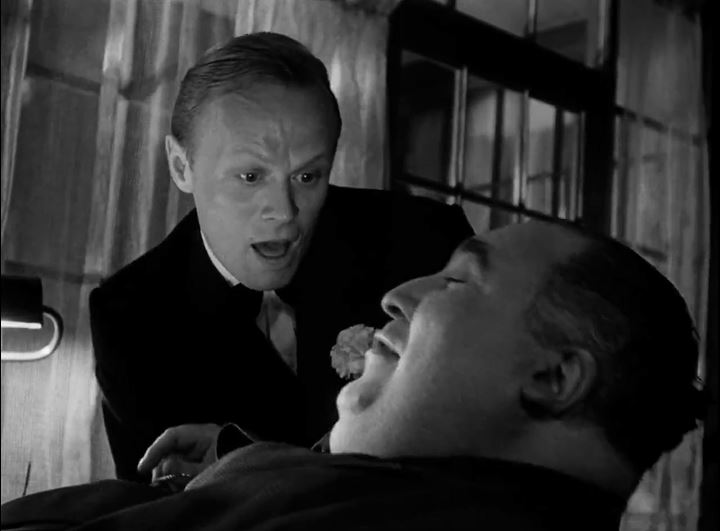
Harry’s pursuer follows him to his flat and stays outside. Harry places a flower in his lapel that he dropped on the street. It’s as if he is trying to clean up for appearance’s sake the dirty part of himself. He enters the flat and calls for his girlfriend, Mary Bristol (Gene Tierney). (Zanuck, unlike some of the characters in the story, showed compassion by wanting to help Gene Tierney who was suicidal after a disastrous love affair. He wanted her cast in the movie, according to Dassin). When she doesn’t answer, he picks up her purse. She then surprises him, saying there isn’t money there. We immediately realize that she is aware of his seedy nature, but, contrarily, still is with him, showing how illogical relationships can be. His first response is anger, and his face is ugly as he accuses Mary of spying on him, as if she is the one doing something wrong, not him. He then quickly switches to a charming smile and tries to cover up his transgression by saying he was just looking for a cigarette. It’s a lame excuse since there is a whole glass full of smokes next to the purse.

She asks who he was running from now, and he acts like that doesn’t happen to him, although we know otherwise. She was worried that he was the victim of foul play since he was gone for three days. He says he was away trying to become a partner in a greyhound racing track operation. She knows he wants her money for the investment. She says they have been through this routine “a thousand times.” It appears that Harry is always looking for a get-rich-quick scheme at the expense of others to satisfy his selfish wants. In contrast to Harry’s pie-in-the-sky activities, she is working hard at a bar to make a decent living. She holds up a happy picture of the two of them in a boat. She describes them as if they were strangers, good people who wanted to lead “decent” lives. It’s as if they have left that part of themselves behind, and what’s left are just empty shells of their former selves. However, the boat they are in is still an object of movement, suggesting the hope for stability was an empty dream. His response to her words is, “I just want to be somebody,” a self-centered statement given that she was talking about their life together.

Mary knows Harry is hiding from Phillip Nosseross (Francis L. Sullivan) and she sees the man Nosseross sent to follow Harry at a phone booth below the window of their place. (“Nosseross” sounds a bit like “rhinoceros,” a large, dangerous, charging animal, something one would run to escape from. Harry says that Nosseross is heavy, equating him with the large creature).

Harry needs five pounds to discharge his debt to Nosseross. While Mary goes out of the flat to see if she can get some money from a neighbor, Harry appears sad as he looks at the photo of the two of them that Mary held, and probably sees something of his past self in that picture. Mary goes to the flat of Adam Dunn (Hugh Marlowe) who has burned his spaghetti and Mary helps douse the flame. He is a designer, and he may have designs on Mary since he says he wishes that they had different schedules. He works during the day (which probably means he is not a creature of the night, like Harry). Does the fire show that he has the “hots” for her, and only she can douse his passion? She works at night at Nosseross’s club, not because she wants to go to the dark side, but has been dragged there by Harry.

Mary says it’s difficult to resist Harry’s charismatic imagination and zeal for his projects. Adam says, “Harry is an artist without an art.” He explains that Harry wants to express himself but doesn’t have the “means,” the specific skill or outlet, to put his imagination into concrete form. Adam says that can “make a man very unhappy,” creating a frustration that may be “dangerous.” He is suggesting that the search to make Harry’s dreams a reality can lead him to the criminal underside of society. In contrast, Adam is artistic in his designs of objects, including figurines and a replica of a bank that holds his money and plays music. Adam has been able to focus his imaginative skills in a creative and not destructive way.

Harry goes to Nosseross’s club, the Silver Fox, where his wife, Helen (Googie Withers), firmly sets the rules for the young women workers as to how to get the male customers to spend more money. The attractive women are the pleasant exterior which hides the mercenary practices in which they are engaged. Nosseross also assigns Harry to engage in a deceptive practice of drumming up business for his club. Harry gets information about a trio of successful American businessmen at a venue. He acts like he found a lost wallet, which is really his, and turns it over to one of the employees there, who is on the take. This action makes it appear (the operative word) that Harry is an honest fellow. He then pretends that he knows an acquaintance of the three men, and thus bonds with the men. It is then he suggests they go to a “private” club for some entertainment. Harry retrieves his wallet just before the three gentlemen depart for Nosseross’s club.

Harry goes to a wrestling match to hustle more customers. However, a bouncer recognizes him and prepares to toss Harry out. Harry says it’s a public place, and the bouncer says, “so is the morgue,” a darkly witty line that suggests that is where Harry may end up. There is an outburst by a man named Gregorius (Stanislaus Zbyszko), a once world-famous wrestler who is there with a young wrestler named Nikolas (Ken Richmond). He yells at his son, Kristo (Herbert Lom), for bringing them to an inferior match. Gregorius blames his son for the extent to which wrestling has declined.

Harry sees a financial opportunity in Gregorius’s displeasure, and stages an outburst where he demands his money back for such a terrible “spectacle” as Gregorius and Nikolas pass by. His rant and some subsequent flattery endear him to the ex-champion. He gets them to have a drink with him. Meanwhile, at the Silver Fox, Nosseross gives a silver fox fur to his wife and asks for a kiss in return. Helen is looking away from him and displays a look of revulsion, but she allows the kiss. The large Nosseross grabs her and is rough with her as she breaks away from him. His base nature here rises and transforms his sophisticated surface.

Harry bursts in and says he can control professional wrestling in London, but Nosseross loudly laughs at him, and Helen wants Harry thrown out. Harry is angry at the dismissive way Nosseross treats him, and says he will get 200 pounds on the condition Nosseross will match it for the investment. Harry goes to the underbelly of society seeking funds from beggars, forgers, and those operating in the black market since he resides in the illegitimate area of finance.

There is a scene where Nosseross and Mary do not know where their romantic partners are. Harry is at a bar and Helen finds him there. Harry is angry at her for forcing him to put up the 200 pounds before Nosseross will commit to supplying some cash. Helen kisses Harry, and we realize there was an intimate connection between the two, and that is why Harry feels betrayed by Helen’s prior statements. However, she has the 200 pounds which causes Harry to be elated. But, she wants him to get the other 200 from her husband to get her a license for her own nightclub which she bought unknown to Nosseross. She can’t tolerate her husband anymore and needs to break away. She says she knows all about running a nightclub since she currently does all the work. She wants Harry to scam her husband and Gregorius. He says he’ll go along with her schemes, but we wonder if he will. So, there is deception upon deception here.


Fergus Chilk (Aubrey Dexter), Kristo’s lawyer, along with a henchman, pay a visit to Nosseross. The attorney tells the club owner that Kristo is “disturbed” by Harry’s attempt to be a rival wrestling promotor, and Chilk wants to meet with Harry. (Nosseross’s office looks like a cage, with bars for its ceiling. The design conveys a feeling of entrapment, as if those dwelling in the darkness of the city create paths that lead to confinement. Similar images are in Alfred Hitchcock’s The Birds, where people, instead of the winged creatures, are caged. Think of Tippi Hedrin in the phone booth, the car, the attic, etc.).

When Helen returns, her husband says he wants to sell the club, and that he has more wealth than she knows. He wants them to travel and enjoy life. But, escape from the world he has attached himself to is not possible. He’s a parasite feeding off a dark part of society, and he can’t leave the host. Helen latched onto him and doesn’t want to leave, since she wants to draw what she can from his nefarious enterprises to start her own. Harry shows up with the money and expects Nosseross to match the sum and they will be wrestling promotion partners. But Nosseross is suspicious as to how Harry attained the cash, and finds that some of his stash is missing. He concludes that Harry and Helen are conspiring against him. Nosseross gives Harry the money, but says he is to be a “silent partner,” and wants the business only in Harry’s name. He doesn’t want any evidence that he was competing with the powerful Kristo. Nosseross rips up the lawyer’s card as he talks to Harry. Nosseross is preventing Kristo’s warning from reaching Harry and is supplying the rope for Harry to hang himself.

It appears that Harry has double-crossed Helen as he has established Fabian Promotions and has his own office and gym for wrestlers to work out. Gregorius and Nikolas are there. He is thrilled to get a desk sign in the mail that announces he is in charge, since feeding his ego has dominated his life. One of Kristo’s wrestlers, The Strangler (Mike Mazurki), shows up to intimidate the men there on behalf of Kristo, but Harry gets him thrown out. However, Kristo shows up in person with his lawyer and tells Harry that he can’t promote matches in England. Kristo rips up Harry’s promotional contract for an upcoming match just like Nosseross ripped up the lawyer’s card that Nosseross was to hand to Harry. The tearing image suggests how there are no ruled to abide by in the world of film noir. However, Kristo thought his father left for Greece and doesn’t know that Gregorius is now Harry’s partner. When Harry reveals this fact, Kristo tells his father that Harry is a swindler. His dad takes no heed of this warning and Kristo tells Harry that if he continues to do business, he better not try and cheat Gregorius. As Harry and Kristo talk, Harry hits a punching bag and Kristo tries to grab hold of it. The action shows the violent interaction present, and the situation is so precarious that even the relationship between father and son takes on sinister connotations.

Harry calls Helen and says that he has her nightclub license, but then tries to dodge a meeting to hand it to her since he is not telling the truth. She is talking to Harry secretly, thinking her husband is asleep (more deception). But Nosseross overhears the conversation, which adds evidence to how Harry and Helen are working against him. Harry pockets the fee from Helen that he says he needs to secure the license, but instead he gives her a forged paper. Everybody here is using everybody else for personal gains.

Despite Nosseross trying to keep his name out of Harry’s business to avoid repercussions, Kristo knows Nosseross’s money is behind Fabian Promotions. Kristo says Harry has promised to conduct wrestling matches in legitimate Greco-Roman fashion. Kristo says Harry will fail from a business standpoint because the public wants showmanship type of wrestling matches. His cynical observation shows how corruption is preferred and prevails in the dark side of life. But economic failure is not enough for Kristo. He wants to defame Harry in Gregorius’s eyes so that Kristo’s father will leave Harry. Nosseross no longer fears Kristo because he openly wants to help him reach this goal.

To do Kristo’s bidding, Nosseross tells Harry that he is pulling out and will not provide extra money for licensing. He says that Greco-Roman wrestling be a failure financially. He says he will only back Harry if he has big names in a match, and suggests booking The Strangler. Harry knows that Gregorius hates The Strangler’s style that panders to the audience’s baser instincts and will leave Harry’s business. Nosseross knows that Harry is only in it for the cash and has no ethics, so Harry promises to set up a match with The Strangler.

Harry attempts to create enough animosity between The Strangler and Gregorius that the latter will agree to a match between The Strangler and Nikolas. At a restaurant he makes The Strangler overhear his remarks about how Gregorius scared The Strangler away at the gym, and that Gregorius demeaned him. The Strangler runs to the gym, threatens Gregorius, and wants to fight right there. Harry passionately tells Gregorius that they should have Nikolas crush The Strangler in the ring and end The Strangler’s cheap form of wrestling that dishonors the sport. (There’s no argument here that Widmark really chews up the scenery in this role). Gregorius agrees. So, Nosseross was right – Harry is a swindler and will lie and manipulate for his own selfish reasons.

Harry goes to Nosseross to supposedly tell him the good news that he has The Strangler signing up for a match that Harry is promoting. Nosseross makes a call to talk to Kristo to Harry’s shock. Nosseross says that he will tell Kristo that Harry stole The Strangler from Kristo. There is now honesty as Nosseross admits that he wants Harry dead because he stole something he paid for. Harry understands that he means Helen, which her husband views only as dehumanized goods. Of course, Helen only married Nosseross so she could inherit his wealth. There is no morality to be seen anywhere. Harry reveals that Gregorius wants the match, so Kristo didn’t put a wedge between his father and Harry. But, Nosseross refuses to give Harry the money to pay The Strangler’s manager for his client’s participation. Without backing, everything Harry planned will fall through. Nosseross calls Harry, “a dead man,” and this conclusion about Harry continues in the story.


Again not caring about the feelings of others, Harry calls Mary to say he’s in trouble to get her out of the flat so he can steal her money to make the wrestling match possible. But Adam sees Harry go into the apartment after Mary leaves and when he runs into Mary tells her that he saw Harry at their building. When she finds him rummaging through her things, she warns him that others are “killing” him. This remark is another reference to declaring Harry as a dead man figuratively and literally in a foreshadowing way.

Harry goes back to the gym and The Strangler is there, drunk, and he taunts Gregorius who is training Nikolas. They begin to fight (the restrictive area of the wrestling ring is another symbol of imprisonment). In an attempt to protect Nikolas, Gregorius tosses him out of the ring, accidentally breaking Nikolas’s wrist. The Strangler’s agent, Mickey Beer (Charles Farrell), says they can’t stop them now because the wrestlers are “like mad bulls.” Civilized rules have been stripped away in this underworld zone and only brutality remains. Gregorius gets The Strangler in a bear hug (more animal imagery) and causes his opponent to temporarily pass out. Kristo arrives and Gregorius says that is what he does to his son’s “clowns.” But the fierce struggle is too much for the older wrestler and he dies. Before that happens he tells Kristo that he should preserve the “art” and “beauty” of Greco-Roman wrestling. Gregorius comes to represent the lofty accomplishments of ancient cultures that have fallen into decay in the modern world, which is mirrored by his own descendant’s corruption.

Harry doesn’t stick around. Krsito does not seem to blame The Strangler. He most likely sees Harry as using him as a tool in to implement his schemes. Beer confirms this suspicion when he confesses to Kristo that Harry taunted The Strangler by making up antagonizing remarks that he attributed to Gregorius. Harry gave The Strangler booze, adding fuel to his irrational rage. The Strangler hears what Beer says and he sees that Harry manipulated him. Kristo puts a bounty on Harry’s head of 1000 pounds and the word goes out to the denizens of the underworld to hunt Harry (an earlier equivalent of what happens to John Wick).

The Strangler barrels through Nosseross’s china shop club like that mad bull that Beer called him. The image of him wrecking the place is very effective in showing how the dark drives of humans can subvert the attempt to suppress them. The Strangler warns Nosseross that he better not be protecting Harry, and says it was not himself but Harry that killed Gregorius. Harry’s selfish ambitions have caused a domino effect that has destroyed lives.

Helen is packed and tells Nosseross her club permit is now her “birth certificate,” implying she can be reborn into a new life. When she tells her husband that she will partner up with Harry, he doesn’t go into details, but he tells her there is no future with Harry. She says she can control Harry, another instance of how people in the film noir story seek power over others. He tells her she will fail and come crawling back to him. But he does not show anger here; it is more like describing the sad inability to escape the vicious circle which the darkness of the city inflicts upon individuals.

That futility in not being able to break free from this dangerous wheel of fortune is stressed by seeing Harry running again through the rat maze of the city streets, repeating his activity at the beginning of the movie. Harry reaches out to Figler (James Hayter), the leader of the city’s beggars, for help. Harry has not shown caring for others so there is no help for him. Figler is just as deceptive as Harry. Even though he pretends to offer sanctuary for Harry, he calls Kristo with information about Harry, hoping to collect the reward.

As Helen prepares to open her new club a police officer stops by saying he received no word that the establishment was cleared for business. Helen shows him her license and offers him a drink. The officer says he is on duty, but he can have some ginger ale. He remarks that he is a new recruit. He represents innocence that has not been corrupted, at least not yet. When he puts his glass down its condensation blurs the print on the license and he concludes that it may be fraudulent. He says he will have it checked out. A dejected Helen returns to the Silver Fox, trying to renew her prior meal ticket, just as Nosseross predicted. But, Nosseross has committed suicide, death apparently being the only way to escape the festering corruption thriving here. Molly (Ada Reeve), a lowly, older worker at the club, who Helen treated badly earlier, informs her that Nosseross left his estate to her. Perhaps it was Nosseross’s last attempt at to repent for his sins. Helen’s hope of being born into a better life is aborted.

Harry goes to Figler’s place. Harry knows the selfish ways of people, it taking one to know one. When Figler acts too protective of him, assuring Harry it wouldn’t be safe if he should leave, Harry gets suspicious. After Figler receives a cryptic phone call, Harry knows he is being sold out and knocks out Figler and leaves. He winds up at the shack of Anna O’Leary (Maureen Delaney) near the riverfront. He is exhausted and says he has been running his whole life, from “welfare officers, from thugs, my father.” It appears that his whole life has felt like a trap from which he has tried to escape. He says he can’t run anymore, and in this fallen world with no way out, that makes him a dead man walking.

Harry mourns the fact that he was so close to achieving the acclaim he sought, but then “an accident” occurred (the fight between the wrestlers) and “everything fell apart.” The best laid plans, etc. But, Harry set those wheels of chaos in motion. He seems to get some insight into his bad actions, repeating, “The things I did.” He says that he hurt Mary, who loved him.

Mary shows up and Harry can’t even look at her. He is so ashamed, as he says to her, “Don’t be kind to me” when she offers him money to get out of London. Admiring his “brains” and “ambition, she generously tells him, “You could have been anything, anything.” (Her words sound like Marlon Brando’s speech in On the Waterfront,” when he says he could have been a “contender,” instead of a “bum”). However, Harry always chose “the wrong thing.” The implication is that when one goes down certain paths a person can lose one’s moral way.

Harry tells Mary he can sacrifice himself and make it look like she betrayed him so she can collect the 1000 pounds. He is duplicating what Nosseross did, attempting a last act of repentance for his misdeeds. She, being a decent person, tells him goodbye, wanting no part of the blood money. Harry still tries to get her the reward by yelling so that Kristo will believe that Mary deserves the bounty. The Strangler appears and lives up to his name, choking Harry and throwing him into the river, granting Harry’s death wish. Adam arrives with the police who supposedly will arrest The Strangler who again has been treated like a tool used by others.

Kristo observes all this activity standing high up on a bridge, like a demonic god ruling over this fallen place where even those who survive are still tainted by the darkness of the nature of this world.

The Next film is If….

Sunday, February 14, 2021

The Stranger

 SPOILER ALERT! The plot will be discussed.


The title of this 1946 movie, The Stranger, directed and starring Orson Welles, who also contributed to the script, suggests the unknown, which by its uncertainty can be a threat. It also implies that what we think we know about a person may not be the truth, and if one has placed trust in a false appearance of reality, betrayal of that trust is possible in the situation. The credits display over a large Gothic clock, which refers to the preoccupation of the villain in the story and points to his mechanistic mind. It may also be a metaphor for how the intricate parts of the mind of the protagonist works in solving a mystery to find the antagonist. The clock is part of a church which symbolizes religious purity on the surface, but evil and danger may exist below the outward appearance of things. There is also a cemetery situated near this church which reminds us of how death is close by. 


Government agent Wilson (Edward G. Robinson) forcefully insists to set a trap for a Nazi war criminal by releasing the unsuspecting Konrad Meinike (Konstantin Shayne) from jail who will lead them to the man they seek. (Wilson breaks his pipe while being emphatic, and the use of the pipe reappears later). Meinike travels to South America under an assumed name. There is a man whose face is hidden by a sign, implying that we can’t know all that is happening around us. He sends a woman, who is his wife, to secretly follow the man. The hidden fellow now is only shown in a black silhouette as he calls Wilson, who he and his spouse are working for. We have an atmosphere of suspense as the black and white photography stresses that secret activities lurk in the shadows. The spy tells Wilson that Meinike is going to have a passport photograph taken.


Meinike is reflected in the camera lens of the photographer (John Brown), which emphasizes that what we see in life and art is viewed through a lens controlled by subjective manipulation, which alters the perception of reality. Meinike demands that the photographer tell him where is Franz Kindler, who is the Nazi Wilson is pursuing. The photographer is frightened and says Kindler is dead (a deception). Meinike states he represents a supreme authority, another lie as it does not turn out to be some Nazi official as we might assume. The photographer tells him that Kindler is indeed alive and hiding in a proper Connecticut town named Harper as Professor Charles Rankin, another sham. 


The photographer hands Meinike a postcard which has a picture of a church with the clock we saw at the start of the movie. The next shot neatly replaces the picture with the actual church and town, a reference to how the postcard is a version once removed from reality, and we are watching a movie that is another step removed from truth. Wilson is on the bus arriving in Harper with Meinike who is also a passenger. As they disembark, Wilson drops his pipe (there it is again) on the seat that Meinike sat on, and Meinike appears shaken, as if the pipe is a warning, and he realizes he is a marked man. Potter (Billy House), who owns the store where the bus stops, listens to a comedy routine on the radio and his continuous laughing contrasts with the seriousness surrounding the two men who have arrived. 


 Meinike runs off to a school after looking up an address in a phone book, and Wilson tails him. Meinike knows he is being followed and leads Wilson into the gymnasium where he lets loose a rope with an attached ring that knocks Wilson to the ground. He appears to be dead (but remember appearances are deceiving in this story). Meinike then goes through a door that warns about using gymnasium equipment at one’s own “risk.” It’s as if the movie is saying that once one enters this realm of intrigue, danger is imminent. 


Having discovered the address from the phone book, Meinike practically bursts into Rankin’s house. He then softens his approach (more dissembling) and asks his wife-to-be on that day, Mary Longstreet (Loretta Young), if he can wait for the absent Rankin. Meinike decides to wait outside and encounters Rankin (Welles) by calling him Kindler. Rankin immediately wants to hide his association with the man and tells him to go into the woods (the archetypal place which represents the hiding of wrongful deeds), and follow the path near the church, the religious façade masking their dark motivations. In their meeting, Meinike tells Rankin he is a changed man. But Rankin says he is, too, but his change is superficial. He has destroyed all documents that could disclose his true identity. He says he is about to marry the daughter of a Supreme Court justice. He notes her lovely appearance, and adds everything is a perfect “camouflage,” which is meant to cover up his despicable past “til the day when we strike again.” He is in hiding until there is another war when he can fight as an enemy from within the country he has deceived. But Meinike has become a born-again Christian and says war is an “abomination.” He says God opened all doors for him and allowed him to be free. The clever Rankin realizes that the authorities allowed Mienike to escape to lead them to Rankin. Meinike admits he was followed but he believes he killed Wilson. He asks Rankin to pray on his knees and confess his sins in order to be forgiven by God. As they kneel, Rankin repeats holy words but as a diversion and he strangles Meinike to eliminate being found out (think of the contrast between Michael Corleone’s religious words at the baptism scene versus his simultaneous murderous commands being carried out in The Godfather).


As Rankin and Mary are getting married, Wilson recovers after being knocked out, and retrieves his pipe, which could be a reference to the detective work of Sherlock Holmes. He questions Potter, since he is the town clerk, and says he knows everybody living there. They play checkers, which Potter wins by diverting Wilson, and the game of opponents playing against each other mirrors what’s happening in the plot. For instance, Rankin used deceptive ploys earlier as he led some of his college students away from Meinike’s body and covered the corpse up after the wedding ceremony. 


 Wilson finds out about the wedding and then asks Potter questions relating to recent residents in the town. He then begins to eliminate those people as suspects as he narrows in on his prey. He goes into the church and finds Noah Longstreet (Richard Long), Mary’s brother, cleaning the inside of the building. Wilson knows about clocks and discovers from Noah that his brother-in-law, Rankin, will be returning from his honeymoon in time for examinations at the school where he teaches, and will be working on the clock. By hardly saying anything, he allows Noah to convey all of this information, including the exact day of the couple’s return. Noah does not look too happy about his sister’s marriage, suggesting he is not a fan of Rankin.


 Wilson, who is knowledgeable about antiques, discusses a Paul Revere item (symbolic of the American fight for freedom?) in the study of Judge Adam Longstreet (Philip Merivale), Mary’s father, when Mary and Rankin (who would not be a fan of Revere) arrive. By pretending to be an antiques specialist, Wilson is also hiding the truth, but his deception is an undercover act to reveal a criminal. Noah is there as well as is Dr. Jeffrey Lawrence (Byron Keith), who treated Wilson for his head wound. This fact is mentioned, and Rankin, the clock specialist, hesitates eating as his mind starts to click into gear. He most likely suspects Wilson based on his recent arrival and Meinike’s relating how he attacked his stalker. The Judge was talking with someone who reported that there were Germans about who wanted to revive Nazism. Wilson deliberately asks Rankin, who is a history instructor, what he thinks of these stories. Rankin seems to be making an objective psychological examination of the German psyche, but he is actually declaring German resolve against defeat. He argues that the German does not link himself to others who have found a broader sense of truth, and has not “come to know for whom the bell tolled.” He says the German still sees himself as a victim of other countries who he considers “inferior,” and recalls the greatness of his Teutonic ancestry embodied in German myths, as he waits for another Hitler who will be his messiah. Wilson says that Rankin must not believe that governmental reforms will work in Germany. Rankin says external concepts of liberty and democracy can’t be imposed from outside and will not take root in Germany. He believes the only solution is “annihilation.” Mary finds it difficult to believe that her husband holds that only a “Carthaginian peace,” which means a total domination of a defeated people, is what is needed to stop the zealously dedicated Germans from rising again. When presented with the concepts of Karl Marx who theoretically wanted to reform and unite the Germans, Rankin says that Marx was a Jew, not a German. Mary invites Wilson to a faculty event, but he declines, saying he will be leaving the town. 


Wilson says in a phone call that he agrees with the person on the other end that Rankin is “above suspicion.” Meanwhile, at home, Mary says it is coincidental that her husband and Wilson are both interested in antique clocks. Rankin already is suspicious of that similarity, and asks to take the family dog for a walk. It is night, which is a time of concealment, and Rankin is being sneaky again among the shadows of the trees as he checks out Meinike’s shallow grave. However, he was not thinking by taking the dog, Red, with him, who starts to dig up the corpse. Rankin attempts to drive the dog away, even kicking the poor animal (offscreen, of course), which shows his cruelty. 


The remark about Marx wakes up Wilson from his sleep, and he calls Washington, D. C. He says that a Nazi would call Karl Marx a Jew, and not a German, which shows condescension toward the communist theorist because of his Jewish heritage. So, Wilson decides not to return to Washington yet. Rankin appears like a black ghost as he approaches Mary in the dark of their bedroom. She wakes up startled and says she had a dream about the “little man” (Meinike) who came to their house. She says in the dream the man moved but his shadow remained behind and began to spread. It could signify the danger that his appearance brought to her false world where appearances seemed benign. Red cries because Rankin put him in the cellar and says during the day he must be kept on a leash. From a practical stance, Rankin doesn’t want the dog near the grave again. But the action also shows his propensity to hide the truth.


Wilson visits Noah who has Red with him since Mary most likely showed her opposition to having the dog restrained. They go out on a boat and Wilson states he can see that Noah does not like his brother-in-law. Wilson divulges he is a sort of “detective” because he wants someone in the Longstreet family he can trust, someone who is not devious and can be open to believing about Rankin’s notorious past. Wilson wants Noah to do some digging to bring to light Rankin’s activities on the day of his wedding. 


Wilson goes to Potter’s store and asks about the bag Meinike left there and has not come back to retrieve. He tells Potter he can open it up given how long ago it was left. Wilson is there waiting for Rankin’s regular stop at the store, and Wilson knows Potter will mention the bag. When Potter describes Meinike, Mary recognizes the description and Wilson observes Rankin grabbing his wife’s arm as if to restrain her from asking any further questions. Her hesitancy reveals to Wilson that Meinike went to see Rankin. Noah shows up and says Red keeps running off into the woods, most likely checking out the grave. Wilson shares his conclusions with Noah, and tells him that his sister must discover who her husband really is. He wonders what excuse Rankin is fabricating (more duplicity) to cover up why he didn’t want Mary to ask Potter about the visitor to the house.


The segue to the next scene answers that question. Rankin says he was a student in Geneva and a woman fell in love with him. They were on a boat and she said she would drown herself if he didn’t commit to her. She jumped off and he says he dived in but couldn’t save her. He says that Meinike was the girl’s brother, knew they were on the boat, and extorted him so he wouldn’t implicate Rankin in her death. He showed up again on their wedding day and he says he gave Meinike more money and the man went away. Mary seems to buy his explanation, but she astutely asks why didn’t the man take his belongings. Rankin offers that once he had money he probably felt he could buy better possessions. He tells Mary that he wants to work on the church clock for a while because it calms him. She says he doesn’t have to walk her home because, “in Harper, there’s nothing to be afraid of.” The line reminds one of the apparently safe town in Alfred Hitchcock’s Shadow of a Doubt, where beneath the illusion of security lurks the existence of evil.


Noah finds Red and he is dead. He and Wilson take him to the doctor who determines that the dog was poisoned. Wilson uses his detective skills to conclude that the mud and leaves on the front paws of the dog indicate he was digging. He calculates how far the animal was found from where he was poisoned based on the doctor’s account of how fast the poison worked. Wilson correctly deduces that Red was digging up Meinike’s body. The dog’s unearthing the corpse fits as a metaphor for what Wilson is doing, exposing what has been hidden below the dissembling surface. 


Rankin learns from Potter that Wilson and Noah took the dog to the doctor and that there is a search for the man who left his bag at the store. Rankin returns home and Mary finds him packing. Rankin truthfully tells her that he is not the man who she believes she married. His existence has been a disguise. She insists he is the man who she fell in love with. But he confesses to killing Red, and says, “murder can be a chain, Mary, with one link leading to another until it circles your neck.” It is an apt metaphor about how violence breeds violence until it claims the one who began its inception. He also admits to killing the man who visited her (Meinike) with the same hands that embraces her. It is an ironic contrast that the parts of the body that show love and tenderness can also be used to destroy life. It points to the duality of human nature. But, Rankin uses the truth to fortify his previous lie, making it appear as if he was protecting Mary and her father. He says that Meinike knew Mary's father was wealthy and wanted more of a payoff which prompted Rankin’s attack on the man. He has manipulated her feelings and, since there is nothing to connect him to the dead man, she promises to keep his secret. Through his deception she is now complicit in his crime.


The body is discovered, and Wilson underestimates the story that Rankin has concocted, believing that what he told Mary would contradict his initial statement about Meinike. But Rankin has been consistent about the extortion lie. Wilson says that Mary must now learn the whole truth about her husband. Meanwhile, Mary is getting nervous, worried about having to identify the body. Rankin attempts to calm her to make sure she provides a consistent story. He fakes his intention to confess to the police if she can’t handle the situation just to reassure her of his devotion to her. Mary’s father calls her and wants to see her alone. While the couple talk, Rankin fiddles with the clock in the room and says he will go work on the church clock while Mary sees her father. The references to the clocks stress that time is running out for Rankin.


Mary finds Wilson with her father. Mary lies when she says she doesn’t recognize Meinike’s photograph. Wilson tells her that she is protecting a murderer. He now reveals his own hidden agenda. He works for the Allied Commission for the Punishment of War Criminals. He says that Meinike ran one of the Nazi concentration camps. Wilson then shows her footage of the mass graves and gas chambers. He says that Franz Kindler conceived of the plan to exterminate as many of Germany’s enemies as possible so that the country would emerge superior to other nations at the end of World War II. He shows the horrors of the camp to convince Mary that she is harboring the monster that created the Nazi death machine. Kindler was an anonymous partner in the genocidal plan so there is no way to identify him, except that he had a mania for clocks. The cold efficiency of how the concentration camps carried out the executions resembles the precise mechanism of how parts of a timepiece work together. Wilson tells Mary that he had Meinike released so he would lead Wilson to Kindler and that only the person who knows who Meinike came to see in Harper can identify Kindler. Mary is stunned and in denial, not believing that Rankin could be Kindler. She denies that anyone visited her on the day Meinike arrived, and says that they are trying to involve her in “a lie.” But a lie is exactly what she has become part of, only it is not Wilson’s but her husband’s deceitful web in which she is entangled. After Mary runs off, Wilson tells Judge Longstreet that his daughter is grappling with the facts versus her not wanting to believe she could fall in love with a monster. Wilson says that if she is unreliable as Rankin’s ally, then he may attempt to kill her. He is using her as bait, and he admits to his manipulation of the Judge’s daughter, but in essence he is fighting coldness with coldness. 


After Wilson states his plan, the church clock chimes, emphasizing the precision of both actors in the cat-and-mouse game and how the contest is coming to an end. Mary runs to the church and climbs the stairs to the clock tower. She tells Rankin the meeting was a trap, but she divulged nothing and that they can prove Rankin isn’t who they say he is by verifying his attendance at the school in Geneva where he said he knew Meinike and his sister. They walk out among the crowd that has assembled to congratulate Rankin for getting the clock to chime. The John Donne poem, referenced earlier by Rankin, comes to mind, which reads, “For Whom the Bell Tolls/It tolls for thee,” indicating that death impacts all of humanity, not just those singled out as victims.


Mary starts closing the drapes in her house, symbolizing her desire to cover things up and not let the light reveal what is going on. Rankin is at Potter’s store. He finds out that Wilson has picked up the ice cream that was ordered for the party at their house that night. He hurries home, most likely worried that Mary might divulge something about the dead man. At the party there is much talk about the murder which greatly upsets Mary. Someone mentions Ralph Waldo Emerson’s statement about crime. Wilson knows the quote which says, “things are arranged for truth and benefit, and there is no den in the wide world to hide a rogue.” There are always clues left behind because, “The laws and substances of nature - water, snow, wind, gravitation - become penalties to the thief.” So, despite efforts to hide wrongful acts, the truth will be revealed, which is consistent with the theme of the film about appearances attempting to conceal reality. 


Mary’s denial of her husband’s guilt is starting to break down as she becomes agitated, cries, and rips off a necklace of pearls, the beads spilling on the floor representing how her defenses protecting Rankin are falling apart. The housekeeper, Sara (Martha Wentworth) reports this incident to Wilson, Mary's father, and Dr. Lawrence. Wilson knows that as she reveals her lack of resolve, Mary will become more of a target for her husband. So, he tells Sara she must be vigilant and relate all incidents. Mary’s father essentially tells Sara that Mary is walking through a minefield of the everyday where a planned attack may appear (that word again) as an accident. 


From that warning we nicely segue to Rankin sawing cuts into the ladder that leads to the church clock tower. He also announces at a meeting that he will soon finish the work of the German clockmakers who preceded him concerning the church timepiece. Metaphorically, his statement sounds like he wants to continue the work of the Nazi genocide machine. This idea is reinforced as he draws a swastika on a piece of paper as he calls Mary to go secretly to the church tower. It is clever that Potter then plays Rankin at checkers and says to Rankin that it’s his move, which Rankin has just made regarding Mary.


Sara makes a fuss about Mary leaving, and pretends (again a charade, but for beneficial purposes) that she is ill. Mary calls Noah and asks that he go to the church to tell Rankin she will be late. She wants Noah not to divulge his activity, which would draw her brother behind Rankin’s veil of deceit. But, Noah calls Wilson and they go to the church while Rankin is still with Potter. Wilson grabs one of the sawed rungs and it gives way. Luckily, he recovers with Noah there to help. Wilson can even smell the glue where the wood was temporarily attached. 


 When Rankin returns home and finds Mary is still alive, he is stunned and becomes unhinged, fiddling with his grandfather clock like it is a security blanket that will restore order. When she explains that she sent Noah to the church he becomes enraged that she told someone of the meeting. He blurts out that if Noah was killed it would be her fault. Mary then becomes frightened as she realizes her husband was attempting to kill her. She now sees that who she thought was her husband is really “the stranger,” and yells, like an accusation, his real name, “Franz Kindler!” Kindler escapes just before Wilson arrives with Noah, and Mary faints out of relief that her brother is still alive. 


Mary awakes in the night and goes to the church, climbing up the bell tower, suspecting that Kindler is hiding there. She came by way of the cemetery (an ominous path) and does find her husband there. She says she was not followed. Wilson and the others discover that she left, and Wilson suspects she is heading for the clocktower. She is carrying a box, but it is a decoy to make Kindler think she had something to give him so he would help her up. She also can play games of strategy. She says that she is there to kill him, but he says she will die instead. She is okay with that if she takes him with her. He says from that height he can see the goings on below, like “God,” and compares the citizens to “ants.” His statement reveals the deluded “master race” belief of the Nazis. But Wilson appears and tells Kindler that he only has to look outside to see all of the people rushing to apprehend the Nazi, which sounds like the citizens of the town that went to destroy Frankenstein’s monster. Kindler says it’s a trick, and Wilson angrily says he doesn’t need tricks, which Wilson says is what Kindler is all about. His bag of deception has now been ripped apart. Wilson says that the world for Kindler has shrunk to the town of Harper and now to the bell tower. Wilson seems to be saying that the Nazi’s area of existence is approaching the size of a prison cell. Wilson notes that the people whom Kindler belittled are now there to take him down.


Kindler uses that lame Nazi excuse that he was “just following orders,” but Wilson points out that Kindler was the one giving the orders. He is able to knock the gun away from Kindler, and Mary grabs it and starts shooting, wounding Kindler. He manages to climb out onto the exterior of the church clock. (This use of mayhem on a place that symbolizes law and justice echoes Alfred Hitchcock’s use of Mount Rushmore in North by Northwest and the Statue of Liberty in Saboteur). One of the large rotating figures, an angel with a sword chasing, appropriately, a demon stabs Kindler, the real evil creature. He is ironically done in by the mechanism he worshipped, and falls to his actual death and symbolically topples from his delusional belief in his superiority.


The next film is It Happened One Night.

Sunday, August 30, 2020

Sabotage

 SPOILER ALERT! The plot will be discussed.


 According to the dictionary definition that is written on the opening title card, the title of Alfred Hitchcock’s 1936 film Sabotage means to “destroy buildings or machinery with the object of alarming a group of persons or inspiring public uneasiness.” So, it is an act of terror that upends the normalcy of society. To achieve this goal, the implication is the saboteur must perform a covert act which means someone has to put on a false, benign appearance to fool others. The dominant theme in this film, as in so many others analyzed here, is that a benevolent facade may be hiding a malevolence beneath the surface. 


The second image is that of a lightbulb, which reminds one of the opening of the last film analyzed here, Murder, My Sweet. The brightness is followed by the city at night. The contrast with light and darkness suggests the desire to reveal, to be aware in order to protect, versus the one to hide an act of wrongdoing. The setting is London, and there is a power failure, symbolizing the dark deed that is taking place, and maybe how evil forces can drain the power from decent people. Men stand around a piece of machinery. They speak succinctly to sum up what is happening. They have found “sand” in the device and say it is “sabotage.” They ask, “Who did it?” and the film visually answers the question when the face of Karl Anton Verloc (Oskar Homolka) appears, appropriately out of the darkness, accompanied by sinister music. A sign is displayed for a station on London’s subway system, the “Underground,” a fitting word since the secret agent carries out his acts beneath the surface to avoid detection. (The movie is based on the novel The Secret Agent by renowned author Joseph Conrad).


At this point the citizens are not alarmed, and they light matches and candles in the streets, not appreciating any true danger. There is a crowd outside the Bijou movie theater because the show has been interrupted. Mrs. Verloc (Sylvia Sydney) deals with demands from audience members to refund their money because of the blackout, which she says was not the theater’s fault. Movies are pretend stories, and when the film is interrupted, this movie suggests, the effect is to destroy the illusion of reality that provides escapism from the harshness of the real world. 


Karl sneaks into the theater and washes his hands, leaving a residue of sand in the sink, suggesting that he can’t hide his crime. However, Ted Spencer (John Loder) saw him enter and tells Mrs. Verloc of her husband’s arrival. Karl pretends to have fallen asleep on his bed while reading a newspaper, which he places over his face, a literal cover-up, disguising his deception. His wife enters using a flashlight and shines it in Karl’s face, supposedly startling him out of his slumber. Hitchcock, even at this early stage in his career, puts the audience in the role of the criminal, as the light shines directly at us, implicating us, suggesting we also try to hide our infractions from scrutiny. Mrs. Verloc reveals to us their dire financial situation when she says that dinner may not be affordable without the cash from the night’s earnings. But Karl says not to worry since he will be obtaining money (for his nefarious activities?). He tells his wife to return the money to the audience since it’s not wise to upset the public. But, causing chaos is exactly the goal of his secret job. 


The people outside argue whether the electricity going out is an “act of God,” which would mean there is no human responsibility. Who is at fault is brought up here. Ted Spencer (John Loder), the grocer next door, is funny as he acts like he is an authority on the law, saying no refunds are in order. But he just spouts phony legal citations and provides double-talk, which is also an act of falseness, adding to the pervasiveness of duplicity. There is humor in the film, as Ted, in response to a question about what is an act of God, says, “I call your face one.” Mrs. Verloc says that they are willing to refund the money just as the lights come back on, so there is no need for any monetary reimbursement. Karl stares at the shining lightbulb again, as if it is his enemy, trying to illuminate what he wants to keep in the shadows. 


Just before dinner, Mrs. Verloc’s young brother, Stevie (Desmond Tester), breaks a plate accidentally, and hides the pieces in a drawer (another hint at the theme of appearance hiding reality). At dinner, Karl says he was willing to reimburse the movie patrons because he dislikes any commotion. He doesn’t want to attract any attention to him that might lead to further investigation into his activities. Ted arrives and mentions that he saw Karl and thus assumed he witnessed the uproar about the power outage. But Karl maintains that he was already there sleeping, thus showing inconsistency in his fake story. There is a window open toward the ceiling in the room that allows for a scream to startle them. It is noted that it sounds like someone is being murdered, and Karl says probably someone is, and after a hesitation notes it is in the movie. The thin line between illusion and reality is stressed here.


Another example of deception, only this time on the part of the police, is the fact that Ted is really an undercover agent for Scotland Yard. He has been spying on Karl, and he tells his superior, Superintendent Talbot (Matthew Boultun) that the man came back to the Bijou right after the act of sabotage. Talbot says that acts of disruption are diversions to draw attention and resources away from the war effort. Ted is told that they don’t have much chance of catching who is behind these operations, so Scotland Yard must try to apprehend the operatives. The implication is that some hide their evil ways so deep that exposing them is almost impossible. Ted’s assignment is to get closer to Mrs. Verloc to see what her husband is up to.


Ted encounters Karl who says he is going out on business. There is an interesting image of a man excavating the street with a pick close to where Karl waits for a tram. It seems as if Hitchcock is providing an image which suggests how the police are trying to unearth what is going on beneath Karl’s seemingly innocent surface. Ted signals another undercover man, who jumps on the tram. It seems deception is needed to fight deception.


Karl’s true destination is the zoo. He visits the aquarium, another reference contrasting the difference between what is going on underneath the surface compared to what is happening above. He meets Vladimir (Austin Trevor) who hired him. The man is not grateful and will not pay Karl because the Londoners seemed to enjoy the power outage, and he wanted an act of terrorism. He suggests that Karl must leave some “fireworks” at the crowded Piccadilly Circus during a celebration. Karl was doing the job for the money, and says he doesn’t want to be involved in killing people. Vladimir tells him to meet someone who will help him earn his money. After the man leaves, Karl gets a vision while looking into a fish tank. He sees Piccadilly Circus melting in an explosion, which shows his troubled mind. He goes to the exit, but is flustered by the revolving exit door, which implies that he feels trapped by his situation. The policeman tailing him helps him out, suggesting that complying with the law may be the best way to escape his guilt.


Ted acts as if he has a chance encounter with Mrs. Verloc and Stevie and invites them to a steak dinner. Stevie is thrilled about the opportunity since the poverty of the family has left them with a diet of just fruits and vegetables. Ted, trying to get information from Mrs. Verloc, asks if Karl has a “sideline” to help with the family income. Ted says he is willing to pay for the expensive dinner despite his grocery job, but we know his real occupation. Mrs. Verloc does not seem very “happy” about her “happy little family,” as Ted calls it. But she is grateful with how Karl has taken care of Stevie, which shows again that Karl is not a typical villain. When asked by Mrs. Verloc if he had ever been to the restaurant, Ted says never. But the man bringing their order notes Ted hadn’t been there for a while but remembered how he likes his meat. So, she has caught the man who is investigating her husband’s lies, telling lies about himself. Mrs. Verlock calls him on his deceptions, and he says that everyone has some mysteries (the film again insinuating we all practice duplicity), and asks about hers, hoping to discover more about Karl. They joke (only partly so on his part) about Karl being sneaky, but she assures him that her husband is “the quietest, most harmless, home-loving person.” The serious look on Ted’s face suggests otherwise.


Ted is drawn to Mrs. Verloc, as is seen by his tearing up a request for payment for the lunch. He tells Talbot that she is innocent, and his boss quickly deduces that Ted is attracted to her. Talbot tells Ted of Verloc’s wanderings at the aquarium and that he is currently at a bird shop. (The birds are obviously in cages, but Hitchcock uses the cage as a symbol for entrapment of people later in The Birds. The aquarium here containing the fish is also a sort of prison). The owner of the shop, Professor Chatman (William Dewhurst), is the one who Vladimir told Karl to visit. The man’s daughter and granddaughter are present. Karl, feeling uneasy that the child is around explosives, asks if the girl knows about what’s going on. The man says he doesn’t know if she knows, and isn’t sure if his daughter does either (although the look on her face is one of distaste). He even admits that he doesn’t know if the child’s father is alive. Everything is a mystery, hidden in the dark, even to the conspirators carrying out the orders delivered by anonymous employers. Karl notes that the objects in the conspirator’s pantry appear to be “harmless,” but the man notes that mixing “a little tomato sauce with some strawberry jam” would cause an explosion. Once more, we have appearances being deceiving. Chatman makes it clear to Karl that he will set off a bomb if ever cornered by the police. The Professor finds his granddaughter's doll next to the explosives, and is apologetic about allowing it to be there. The discovery shows how the innocent are at risk when conspirators plot their plans.


To continue with the deceptive appearance theme, Stevie, with Karl and his wife, says he was talking with Ted who said that gangsters don’t appear threatening, and actually are “quite ordinary looking” like Mr. Verloc. That phony surface, like Verloc’s, makes them more dangerous because they throw people off guard. Mrs. Verloc has discovered that Ted isn’t who he pretends to be, but she innocently attributes his having money to being a member of the family which owns the chain of food stores, and is learning the business. Most of the time, the movie implies, the default of most people is to believe the best about others. 


Ted sees suspicious types entering the Bijou, and he goes in to investigate, pretending (that word again) to just wanting to watch the film. He runs into Stevie, who takes him where the screen and loudspeakers are. Ted acts as if he wants to surprise Karl and he climbs up to a window to look in on Karl’s meeting with the other conspirators. Behind the make-believe danger in the movie theater is the real threat being formulated (but, of course, it isn’t real, because we are watching a movie ourselves). However, one of those in attendance sees Ted’s hand and pulls him into the room. Ted goes along with Stevie’s story about just wanting to see the theater. But, after Ted leaves, one of the men says he recognizes Ted as a policeman who arrested him before. The group begins to disperse, saying they must cancel their project.


The Professor sends Karl a birdcage which, on the surface, seems harmless, but actually carries a deadly bomb in a wrapped package underneath its base. The birds are supposed to be a present for Stevie (more examples of deceptive appearances). Karl, knowing about Ted’s true identity now, asks his wife if Ted was asking questions about him. After she is alone, Stevie appears taller than he is as he pokes his head out from a curtain. Afterall, the theater is a place that presents illusions. He is actually sitting on Ted’s shoulders. But the opening of the curtain coincides with Ted revealing to the suspicious Mrs. Verloc who he really is. He stresses that Karl lied about where he was the night of the blackout. As Ted asks Mrs. Verloc questions about the men who met with her husband, Karl overhears the interrogation, standing behind a curtain to hide his eavesdropping. 


There are more actions that fake safe appearances. Karl tells Stevie to deliver some film reels and along with the disguised explosive package, which he says is a film projector part, to a cloak room in Piccadilly Circus to be picked up. Since the police are suspicious of Karl, and he needs an alibi, he uses Stevie as the courier because his innocent youth will not make him seem like a suspect. Ted confronts Karl without any more deceptions and asks him questions as Stevie proceeds with his task. On his way, Stevie encounters a street salesman who pressures the boy to demonstrate his toothpaste and hair lotion. It is a funny scene, but the fraudulent claims of the salesman contribute to the presentation of false pretenses, and his stress on tooth decay can be a metaphor for social corruption. 


Hitchcock builds suspense by telling us that the bomb is scheduled to go off at 1:45 pm and we see clocks counting down the time as Stevie continues his journey, being interrupted by the day's festivities along the way. His smiling, naive face contrasts with shots of the dangerous package. He hops aboard a bus, but the conductor tells him that the film he carries is flammable, yet he still allows him to step aboard. It is an ironic warning, since the undisguised film is not the threat, but the wrapped benign looking package is. Stevie plays with a sweet puppy on the bus, adding to the feeling of how the innocent are at risk from disguised malevolence. The bus is caught up in traffic and the big hand on a clock moves to the time of detonation. The bomb goes off on the vehicle. (Hitchcock later said he made a mistake killing off a youth in whom the audience became emotionally invested). 


Back at Karl’s house, Ted receives a message that a bus exploded. Karl asks what time it happened, which seems a suspicious question. At the bomb site, Ted finds a label that shows the title of the film that Stevie was carrying. Mrs. Verloc is worried about the missing Stevie, and when she sees the title of the film in the newspaper as being a clue to the bombing, she faints in front of the Bijou. She confronts Karl, who admits his complicity, and says he didn’t want any harm to come to her brother. Karl says his wife has to pull herself together, and says that it could have been him who was killed. He would have been carrying the bomb if Ted hadn’t been close by, spying on him. Karl is trying to dispel his guilt, but is unconvincing. 


Mrs. Verloc goes into the auditorium to watch a cartoon, as she is looking for escape, as most people do when they go to a movie theater. But, the story portrays the killing of “Cock Robin.” The bird in the cartoon becomes associated with the birds given to her brother and possibly even to Stevie himself, and its death in the animated story mirrors the loss of Stevie. That fine line between the real and the imaginary is again crossed here, as what is on the screen reflects upon and comments on real life. 


The morose Mrs. Verloc reenters the living area after the cook says dinner is ready. The scene repeats an earlier one where Karl complains about the food and wonders if they could get some vegetables from the grocer next door, where Stevie had gone to shop. Stevie’s empty seat at the table is painful to view. One wonders why Mrs. Verloc doesn’t turn Karl in at the least and maybe even attack him herself. Hitchcock makes us know that she is thinking about the latter, since she puts down the carving knife and seems to try to restrain herself from picking it up again. Karl observes her and becomes worried. He approaches her and she grabs the knife and stabs him. The parakeets chirp, suggesting Stevie is calling from the grave to acknowledge the act of justice for his death. 


Ted returns and tells Mrs. Verloc that he is there to arrest Karl, the title on the film containers being the conclusive evidence that he was involved in the bombing. He sees Karl’s body and Mrs. Verloc appears numb. But she wants to be transparent, saying they must go to the police. Ted, who confesses his feelings for her, closes and locks the door where the body is. Is he now also trying to cover things up so that Mrs. Verloc will not be perceived as a killer? As they exit the movie theater and go through the crowds, they see policemen escorting a woman, which suggests what is to happen to Mrs. Verloc. She thinks she sees Stevie running toward her, but it is another boy. She has left the Bijou, but she is like the rest of us, who want to remain in denial because it is an attractive alternative to dealing with the pain of actual loss. Ted wants to paint the death as an accident that occurred while defending herself. If they don’t use that scenario, he says that since the body will not be found until the morning they can escape together. They kiss, which shows that she returns his affection.


Miss Chatman (Martita Hunt), the Professor’s daughter, yells at her father for allowing her and her son to become vulnerable because of his activities. She sends him off to retrieve the birdcage to make it look like he was not involved (another phony act). The police follow the Professor. When they arrive at the Bijou after tracking the Professor there, Mrs. Verloc runs to confess her crime. Ted initially prevents her from incriminating herself. The Professor sees the police entering the theater, and the authorities evacuate the audience. Chatman breaks through the door to the inner room and finds Karl’s body. When Superintendent Talbot asks Mrs. Verloc about her husband she blurts out that he is dead. At that moment, the Professor makes good on his earlier threat and sets off a suicide explosion. 


The policeman on duty reports that the bomb’s devastation prevents identification of the bodies, which creates another form of a cover-up. The official statement will be that Karl was blown up by Chatman, thus making it appear that Mrs. Verloc had nothing to do with her husband’s death. The movie implies that sometimes hiding the truth can be the right thing to do if it serves justice and protects the righteous.


The next film is Star Wars.