Showing posts with label Oscar nominated. Show all posts

Sunday, September 15, 2019

Shane


SPOILER ALERT! The plot will be discussed.
Shane, released in 1953, directed by George Stevens (nominated for Best Director) and written by A. B. Guthrie, Jr. (also receiving an Oscar nomination) based on the novel by Jack Schaefer, is a western whose themes center on the western United States moving from a rugged frontier to a territory that is settled and domesticated. Within that context, the movie explores what constitutes a man’s role in this society.


The opening shot shows Shane (Alan Ladd) riding his horse toward the Starett house. The Oscar-winning color cinematography depicts sweeping vistas of the planes with the imposing mountains in the background that show reverence for the appearance of the Old West. Child Joey (Brandon de Wilde, in an Oscar-nominated supporting role) holds a rifle and appears ready to shoot a deer, which implies youthful innocence must soon take a back seat to surviving in the wilderness. But the deer shows alertness as both the animal and the boy see the cowboy approaching. Strangers can be an enemy or a friend since the truth is unsure. That is why the father, Joe (Van Heflin) says, “Let him come,” to see which the man will turn out to be. Shane asks to be able to ride through, saying he didn’t expect to find any fences here. His words show he would rather not encounter barriers to his freedom. The two men represent opposing lifestyles: one is a roamer who fought with his guns to survive; the other, is a reliable, peace seeking family man who would like to be allowed to put down roots, but who may seem dull in comparison. Joe’s wife, Marian (Jean Arthur) looks at Shane possibly as a curiosity, but she may feel instant attraction for the wandering strong handsome man who initially contrasts with her ordinary husband. But, she moves away from the window revealing some modesty since she doesn’t want to be caught observing Shane.

Shane shows his observation abilities by saying how he noticed how the boy, although seeming to hide saw Shane approaching. He compliments Joey by saying, “I like a man who watches things go on around. It means he’ll make his mark someday." This remark makes Joey smile, endearing him to Shane. While dismounting to drink some offered water, Joey cocks his rifle but the sound triggers a startled response from Shane who spins around, ready to draw his revolver. As the father notes, he is an excitable type, and the action hints at Shane’s stressful, gunfighter past. Joey says he just wanted Shane to see his rifle, and says he guesses Shane knows how to shoot. Shane doesn’t want to reveal anything about his past, and modestly says he does a bit.  
Men on horses ride toward the Starett house and Joe initially believes Shane is part of the Ryker group who want to run him off his land. Shane says if Joe lowers the gun he’ll leave because he wants his departure to be his decision. This exchange shows that Shane wants to be in charge of his fate and doesn’t like anyone forcing his will on him. He starts to leave. The riders approach. Rufus Ryker (Emile Meyer) says Joe is a squatter like the settlers, but Joe says he’s a legal homesteader, and the land he lives on belongs to him. Ryker wants him gone before the first snow because he signed a beef contract and needs the land for his cattle business. Ryker says he is giving a warning but could just “blast” him off. Joe says those days are past, suggesting that there has been an evolution away from violent ways, and laws have been passed to incarcerate those who violate the rules. Joe is a man caught between the old belief in the survival of the fittest and the newer, civilized social agreement that promotes peace and resolution through shared community rules and cooperation. Marian tries to calm everyone to avoid hostile behavior. A smiling Shane has not left and appears from behind the house to give support to Joe.

Here we have the old-fashioned role of the wife and mother who her husband calls “the little lady,” as she handles the domestic chores. Marian says supper will be ready soon, suggesting Joe should invite Shane to stay. Joe apologizes and says Joey’s rifle isn’t even loaded, showing how he is still fostering Joey’s childhood while also getting him ready for his adulthood. He shakes Shane’s hand and Joey is elated that he will stay. At supper, Joe goes on at length about how one can make a go of it being a homesteader. Shane seems distracted by Marian. A calf makes a noise, and again Shane is startled and goes for his gun, showing his hypervigilant lifestyle has not given him a sense of peace. When asked where Shane is going, his nomadic response is “one place or another. Someplace I’ve never been.” His life may have adventure, but it may not be deeply fulfilling because the satisfactions are transient. Joe says it’s the first real home his family has had and they will have to kill him before he would leave. Marian is upset by Joe talking about something so disturbing in front of their son. Joe says working the farm is too much labor for him and he had a hired hand once. But the Ryker brothers “knocked out his teeth” according to Joey, so the worker left. This story shows how Joe is up against not only the environment but the men who first arrived in the Old West. Joe comments how the extra plates and forks for the pie make it seem like they’re being fancy, but Marian appears to be trying to impress Shane.
Marian asks Joe to invite Shane to stay the night, pushing to keep the cowboy around. Shane, trying to show that he is worthy of their hospitality, and trying to make a transition to a farm hand, is outside taking an axe to a huge tree stump close to the house. Joe had been fighting for a long time by himself to get rid of the tree remnant. Together they chop at it into the night, and the fit, shirtless Shane and Joe finally are able to use their combined strength to unearth the stump. It’s as if Shane has brought increased manliness to Joe, empowering the man.

The next morning Joey wakes up to see a deer looking for food and water near the house. Showing his desire to grow into a frontiersman, he pretends to shoot it. He comes across the already awake Shane who slept next to the house. Joey wants Shane to teach him how to shoot, and wants him to stay, since his father has delayed showing him how to use a gun. Joey says he heard his dad say to his mother that he wanted Shane to stay to help with the work, but not fight his battles. It is interesting that the male ego is not threatened by needing help to do work, but feels undermined when the man is unable to fight alone, as if violence is a more defining male feature.

While Joey stays with his father as he does chores, Joey asks if Shane will teach him to shoot. Joe says he will do it when he has the time, which shows his desire not to be usurped in his fatherly role, but which also demonstrates how his current role of a family man and tending to the land has taken precedence over other traditional manly activities. Joe admits, however, that he probably can’t shoot as well as Shane, since he knows Shane has probably used his gun more often not being occupied by other activities, and he observed his quick reactions to any threats. Shane went into town to get supplies but didn’t wear his guns, and Joey wants to know why. Joe says he doesn’t wear one himself, but Joey says wearing guns suits Shane, as the boy is aware of the difference between his father and the cowboy. The boy then asks if his dad could beat Shane in a gunfight. Young boys want to emulate their fathers usually, so they want their hero worship to be justified. Joe maturely, though unsatisfactorily, answers by saying there’s no need to know the answer to his boy’s question since Shane is on their side. Joe may be feeling intimidated, however, by his family’s attraction to Shane.

Neighbor Ernie (Leonard Strong) rides up and says the Rykers tore down his fences and let cattle damage his wheat fields. He is ready to bolt because of the harassment. Joe convinces him to meet with others at his place to come up with a plan. Ernie wittily points out his frustration by saying the get-together better come to more than just poking “fingers in the air,” which amounts to angry talk and no action.


At the general store, Shane buys some work clothes and feels strange as he says he hadn’t bought clothes in a while. He is not used to anything resembling a domesticated life. It’s sort of like a skin graft that might be rejected. The Rykers are next store and get wind of a “sodbuster” there, which they derogatorily call “pig farmers.” The desire to settle down and be more civilized draws humiliating insults from the more savage leaning men. Shane just wants to buy “soda pop” for Joey, and the store owner, Grafton (Paul McVey), notes in a sad voice that he wishes more men would drink the harmless liquid, implying the alcohol is fueling repulsive behavior. Grafton is a man who would like to live in a civilized world but must still make a living and so must sell whiskey. When Shane goes to the bar to order the soda, Chris Calloway (Ben Johnson), who is with the Rykers, begins the to inault the Shane. When Shane asks, “You speakin’ to me?” and Calloway says, “I don’t see nobody else standin’ there,” we may have the origin of Robert de Niro’s psychotic version talking to himself in the mirror in Taxi Driver. Calloway then throws whiskey onto Shane’s new work shirt and says now he smells “like a man.” The implications here is that drinking something that submerges one’s rational ability helps to define what constitutes a male. Shane, not giving into his what drove his violent past, stoically takes their derogatory behavior and leaves.
The homesteaders meet at Joe’s place that evening. When Shane shows up, one man says he didn’t like going out at night, and another remarks he won’t move until “the shootin’ starts.” So, there is the suggestion that some of these men have left their violent ways behind them. Torrey (Elisha Cook, Jr.), a man from Alabama, shows up, and he heard about what happened at the bar. He says they can’t count on Shane if it comes to a fight against the Rykers. After they say that Calloway bragged about how he ran Shane out, Joe tries to cover for Shane by saying he told Shane to avoid trouble. Shane walks out saying they can speak more freely without him there, but he really doesn’t want to hear his manliness being questioned. Joe tells them they should go together as a show of force when they need to buy supplies in town. Torrey, who has tried to give up his fighting ways but doesn’t want his masculinity questioned, brags that he doesn’t need any bodyguards and only requires his gun with him. In response, one of them mocks Torrey, playing the rousing “Dixie” and then “Beautiful Dreamer” on the harmonica.
Joey, listening in his bedroom to what the others are saying, tells his mother he can’t believe Shane backed down, since he already has built the stranger into his macho hero. Shane is outside the room in the pouring rain, and Marian opens the window. Joey says he knows Shane wasn’t afraid. Shane says it’s a long story, and Marian has some insight into the man and says she knows, and smiles warmly as she says Shane’s name. She urges him to come in out of the rain, a sort of invitation suggesting he doesn’t have to feel like an outsider here. After Shane walks away, Marian tells Joey not to like Shane too much, because she knows he will not be staying, and then her son will be hurt when he leaves. She can see he is a troubled man and keeps moving to try to escape his past.


Joe and his family are getting ready to head out to meet up with other homesteaders and their families to go into town. Marian is slowing them down, and Joe voices the sexist attitude to Shane that one thing about marriage is a man has to get used to waiting for his wife. He says that it’s worth the wait most times, since Marian looks so pretty, and advises Shane that he should hold out for a woman worth waiting for. Joe doesn’t seem to realize that he is talking up his wife to a man who is attracted to her. But, Shane is also envious of Joe having a family and being settled, while at the same time he is incapable of living such a life.


In town, the families plan an anniversary party for Joe and his wife, and one of the wives says Shane is invited. He is now surrounded by a domestic group of people trying to live decent lives, asking him to join them. However, next to the general store, which represents this settled life, is the underbelly of this world, the bar, where the Rykers and Calloway hang out. Joey gets some candy for returning his soda pop bottle, but Shane deliberately goes into the lion’s den in the bar to return the bottle, trying to redeem his earlier behavior. Calloway starts in on him, reminding him that he should stay out of the bar, and be with the “women and kids, where it’s safe.” Calloway’s words are meant to emasculate. Shane tells him not to “push it,” but of course the man does. Shane orders two whiskeys and says he has to return the favor, so he throws both drinks at Calloway. Shane proceeds to punch him literally and symbolically out of the testosterone laden bar into the “women and kids” area of the store, reversing the castrating image. Some of the farmers tell the others to stay out of it, since it’s not “their fight,” and they don’t want to suffer the ramifications of it. The scene, temporarily, reminds one of Gary Cooper in High Noon, not getting the support of others and having to fight alone. (Although High Noon was released earlier, this movie was completed first, but delayed because of editing).

Shane and Calloway trade punches, but Shane beats him. Joey secretly entered the bar and witnesses the fight. He is eating his candy, showing his youthful innocence, but when Shane lands a hard punch, Joey chomps hard down on his treat, as if his potential for adult brutality is overpowering his childhood. Rufus Ryker sees that Shane would be an asset, and tries to recruit him, but Shane will have nothing to do with him. Rufus, who doesn’t understand honor or loyalty, implies that Shane is sticking around Joe because of his pretty wife. Shane is outraged at the comment. Rufus then says he’ll make Shane pay dearly for his actions. Joey comes up to Shane and says there are too many to fight and he should leave. It is a wise bit of advice, but Shane does not want to show that he will back down again, so he takes on a whole bunch of men. He does well until they finally get a hold of him and Rufus begins to pummel him. Joey tells the others and his dad enters with a club )A phallic symbol?). Together he and Shane beat the others away. Grafton, who continues to represent an evolved male, tries to stop the fighting, and convinces Joe and Shane to leave. Joe seems invigorated as he lets his savage nature surface, spurred on by Shane’s willingness to fight the villains. But Rufus promises the next time they meet up there will be lethal force used.

Marian tends to the men’s wounds, and says they were “wonderful,” which reflects the expected traditional reaction by women who sought protection from men in a hostile situation. The men also show prescribed modest attitudes, with Joe saying Shane did most of the fighting. When Joey says he thought Shane was a “goner” when hit with a chair, Shane says humorously, “It was an easy chair.” Even though Marian says medicating Shane’s head wound will hurt, Joey says Shane won’t complain. The boy is already subscribing to the code of the western hero. Shane can hear Joey telling his mother in the boy’s bedroom that he loves Shane, “almost as much as I love Pa.” Shane looks concerned, because he knows, just as Marian predicted, that he will eventually be moving on. He walks out so as not to embarrass Marian when she comes out of Joey’s bedroom. When she does leave Joey, Joe comes out of their bedroom and Marian asks Joe to hold her tight, almost to reassure herself that she is with the right man.
Ryker sent for Jack Wilson (Jack Palance), a gunfighter, who arrives at Grafton’s store. Torrey visits Ernie, who is ready to leave after the Rykers killed his sow and scared the family. While Torrey is there, the Rykers drive a herd of cattle onto Ernie’s land to damage his property. Torrey still wants to stay, but the fierceness is not as strong in his voice. Shane and Joey see the Rykers as they shout insults across the fields. Joey says that they have cut other farmers’ fences. Shane tells Joey that he would ask them to come through the gate instead if they tried to cut their fences. Shane is trying to model for Joey what peaceful men should do, although he knows that the present world won’t accommodate that behavior. Joey had previously wrapped up Shane’s guns in a blanket, as if putting the violence in Shane’s past to sleep. But the boy now admits that he would like Shane to show him how to shoot. Shane then unwraps the guns, as if awakening the need to use deadly weapons.


Shane agrees to show Joey how to shoot, and demonstrates that he knows quite a bit about being a gunslinger, mentioning the different ways men draw from various holster positions. After Joey asks him to shoot something, Shane fires quickly and hits a target. The sound of the gun is exaggerated, almost sounding like a cannon going off, startling Joey, and Marian, as she approaches. It is the first time a gun is fired in the movie and director Stevens wanted to jolt the audience with the noise. Joey is impressed, but Marian is concerned, and ends the lesson, telling Joey to get ready for the Independence Day celebration. Marian tells Shane that guns won’t be part of Joey’s life. Shane, almost sounding like a representative for the NRA, says that a gun is a tool just like a shovel (not the best analogy, since shovels aren’t meant for killing), and says, “A gun is as good or as bad as the man using it.” Of course the problem lies in the fact that there are many bad men who have access to guns, then and now. Marian, offers the counter argument, saying that they would all be better off, “if there wasn’t a single gun left in this valley,” including Shane’s gun, which shows she is worried about his safety, too. Joe comes riding in and is excited by seeing Marian wearing her wedding dress, and he tells Shane to get ready to celebrate the Fourth of July, which is also the day of Joe and Marian’s anniversary. His entrance stresses Joe is wedded not only to his wife, but to his country’s founding principles of freedom from outside tyranny.

While the celebration takes place, Grafton tries to dissuade Rufus from initiating violence. Rufus says he hasn’t used guns sooner, but he considers the homesteaders to be squatters, and he now must escalate. Wilson has a malicious smile on his face as Rufus speaks. Grafton says he upsets Rufus because, in a way, Rufus is hearing his own conscience bothering him. But Rufus sneers at the word “conscience,” because unlike Grafton, he has no evolved sense of right and wrong. Torrey enters the saloon, and Grafton asks what he wants. Torrey summons up his courage and asks for a drink. He makes a sarcastic toast to Rufus for having run Ernie off of his land. Torrey says that Ernie was a coward, but he is not, and he’s staying. Rufus quietly says that Wilson could easily get Torrey to draw which would give Wilson a reason to gun him down. But, instead they decide that Joe is the one they want, being the leader of the resistance to the Rykers. Torrey, emboldened by getting away with his angry words, breaks the saloon door as he marches out, adding to the atmosphere of violence.
The party has dancing, contests, and fireworks. To emphasize that the United States is a land that welcomes immigrants, Axel (Douglas Spencer), a Swedish farmer, is a friend of the Staretts, and introduces them to the crowd as they have a double reason to celebrate. Joe, demonstrating his domestic bliss, says he wouldn’t trade places with anyone, and gives Marian a kiss. Shane looks downward, showing his envy for what Joe has. Shane does get to dance with Marian, and he is all smiles while doing so. Torrey comes by and describes the gunfighter, whom Shane recognizes as Wilson, noting he’s a fast draw. Torrey suspiciously says that Shane seems to know a lot about the gunslinger business. Torrey says he doesn’t want any part of it, saying the men in that profession are involved in murder. His response seems to be noting it’s one thing to defend your land, but it’s another to make a living out of killing others.

Joe and his family return home from the celebration to find Rufus and Wilson at Joe’s place. Rufus proposes that Joe work for him, and he’ll pay him a good price for his land. Joe refuses, and Rufus says that men like himself “Made this country … with blood and empty bellies.” He says he was wounded fighting Native Americans and fought cattle rustlers. He represents that first wave of tough frontiersmen and is reluctant to give way to the new generation of settlers who benefited from his sacrifices to make the land safe. Rufus says the farmers drain off the water that hurts his cattle. Joe says traders and trappers came before Rufus’s people and tamed the land. He says that Rufus doesn’t have the authority to say nobody else has rights under the law. Joe is making the argument that the settlement of the territory must progress, and the ranchers who came before can’t stop others from settling there.
In town, Wilson sees Axel and Torrey riding up and is ready to gun Torrey down. Rufus doesn’t want any brush with the law, so he wants Wilson to do his dirty work, making it look like a legitimate self-defense if there’s violence. Torrey wants to get a drink, but is confronted by Wilson, sneering as usual, who goads him about the Southern Rebels being trash. Torrey starts to draw, but stops. However, Wilson shoots him, and it justifies the shooting to Grafton after Axel confirmed that Torrey drew his gun.

After Axel tells Joe about Torrey, Joe says he will go into town to confront the Rykers and Wilson. Axel thinks the other homesteaders will leave, so Joe first visits the other settlers, telling them they must stay to attend Torrey’s funeral. After the funeral the others are ready to depart, but Joe says they can have a “settlement” which implies putting down roots. He says they can honor Torrey’s memory by having churches and a school. But one of them notes that also includes graveyards, adding a sense of doom to the talk. Shane says they have a right to stay there and grow, and not give up. Joe says that this land is for more than just people like Rufus, suggesting that things must be allowed to change. After one of their homes has been burned down, the others say they will help as a community to rebuild, stressing the desire to create a place where the preservation of individuality must allow for social responsibility.

Rufus sees Joe as the cement holding the farmers together and vows that he has to go. Joe wants to confront Rufus, which is what Rufus wants. Marian pleads to Shane to convince her husband not to go. But Shane says he can’t tell Joe what’s the right thing to do, since it’s a complicated situation where doing nothing means surrendering his land and his rights. The Rykers invite Joe to a meeting at Grafton’s, saying Rufus is a reasonable man so as to lure Joe into a trap. Calloway, having gained admiration for Shane, doesn’t like an ambush, and admits to feeling a change come over him, and he quits Ryker’s gang. Shane and Calloway shake hands as Shane thanks him for the warning, demonstrating an evolutionary movement away from anger and violence to one of mutual respect.
Joe says to Mariane that he can’t show cowardice that would disgrace his wife and son. It appears, given the circumstances, he feels forced to abandon civilized behavior. Mariane tries to stop him. But if anything happens to him, Joe says that he knows she’ll be taken care of. His words suggest that she will have Shane there for her. Shane shows up wearing his guns and he tells Joe he is no match for Wilson. Marian tries to stop them, saying that the little land and their shack of a house isn’t worth losing life over. But there is a dignity in the code of men that makes it difficult to back down from bullying and injustice. Shane fights Joe to save him. Animals squeal, reflecting the animal instinct in men to fight. Joey is angry about Shane knocking out Joe with a gun, but apologizes when he realizes he was trying to save his dad. Marian asks if Shane is doing this for her, sensing his affection. But, Shane says he is doing it for the family, reflecting a need to use violence in the short term to preserve the peace in the future.
Joey follows Shane to Grafton’s store. Shane tells Rufus his days are over, but Rufus asks what about Shane’s life as a gunfighter? Shane says at least he knows his time is done, illustrating that he has insight into the need to progress away from brutality. Wilson squares off, ready to fight, and Shane calls him “a low-down Yankee liar,” echoing the dead Torrey’s words in a bit of reckoning for how Wilson had killed the man from Alabama. Shane kills Wilson and then shoots Rufus who draws on him. Joey warns Shane about a man with a rifle from the balcony, and Shane takes him out, too.
He tells Joey that he has to ride on because “A man has to be what he is.” By staying with Joey’s family, he tried to “break the mold” but “it didn’t work” for him. But Shane says whether it’s right or wrong, “there’s no going back” from a killing. It brands one, and Shane does not belong in this place where they are trying a way of life that omits that kind of violence. He tells Joey to let his mother know there are no more guns in the valley, like she wanted. In a way Shane was cleaning up that part of land so civilized life could be built upon it. But Joey sees blood on Shane and knows he was wounded. He says the famous line, “Shane! Come back!” but Shane rides away. Will he die? If his time is over, it is a possibility, possibly because sacrifice is needed for a peaceful world to exist.

The next film is Cool Hand Luke.

Sunday, February 19, 2017

Heaven Can Wait (and some Oscar picks)

SPOILER ALERT! The plot of the movie will be discussed.


I decided on a change of pace by discussing a film that makes me feel good whenever I view it. This 1978 movie, co-written with Elaine May, co-directed with Buck Henry, produced and starring Warren Beatty (for which he received Oscar nominations in all of the above categories), is a delightful romantic comedy. But, it also has its sad moments, which it balances very well with the humor, a difficult task to accomplish. Add to this cinematic recipe a dash of satire regarding the American capitalist system, and you have the ingredients for a successful motion picture.
The film begins with the main character, Joe Pendleton (Beatty) running. He runs all through this story, whether outside or later inside in the Leo Farnsworth mansion. In addition to running, he rides a bicycle. He is a professional quarterback with the Los Angeles Rams, so being an athlete, one would expect him to exercise. But the movie implies that Joe just wants to move forward, to get to a goal that he was born to reach. Of course, his running inside the big house also adds comedy to the scenes.

Joe has done a remarkable job of repairing an injured knee without surgery. As trainer Max Corkle (Jack Warden, Oscar-nominated) tells the Head Coach, played by Dolph Sweet, Joe isn’t taking any medications whatsoever. In practice, Joe successfully completes many passes, prompting the Head Coach and Max to say, “He’s looking awfully good.” And that about sums up Joe – besides being a handsome fellow, he is just a good guy, as the rest of the film shows us. The Head Coach decides to make Joe the starting quarterback for the next game, replacing aside the usual starter, Tom Jarrett. Before Joe hears the good news, a reporter asks Joe, after his practice, what he thinks of the Rams’ chances this season. He says that they will go to the Super Bowl and will win. When the reporter then says what does he really think, off the record, Joe repeats the same thing. Joe is a honest person – he doesn’t have separate answers for the same question, because for him, the truth is constant. The reporter then asks him what does he think of his competition, Jarrett. Joe says that the quarterback is not his competition, he’s the starting quarterback for his team. Joe is a team player, who unselfishly wants to help all of his fellow teammates win, not just himself.

However, that doesn’t mean he has no personal aspirations. He tells Max that he doesn’t know if he’ll have a chance to see if all of his hard work (even on his birthday Joe is studying films of his football opponents) will pay off, an ironic statement given his imminent demise. Max is his close friend, to whom Joe administers neck realignments for his aching spinal problem. Max remembers Joe’s birthday, goes to his house with a cake, and tells him, ironically, that he hopes he has many more birthdays, not realizing that this is the quarterback’s last day on earth as Joe Pendleton. This scene is one of many where the sadness sits well along with the comic, as we witness Joe’s extreme health food obsession which includes drinking liver and whey shakes, and we hear Joe badly playing his soprano saxophone, as he does several times in the movie. The film’s soundtrack, with its jaunty (music to jog by?), well-played saxophone, adds a feel-good comic touch and contrasts with the sadness of Joe’s death and the feelings of loss by other characters. But, well-played music, just like a well-played game, also symbolizes what Joe can accomplish if given time.
After Max gives Joe the good news about him being the starting quarterback the following Sunday, Joe, of course, goes out running, and then biking. But, we see a truck veer into an oncoming lane of the road on which Joe is traveling, and there is an unseen accident in a short tunnel. It is important that we don’t see the accident, only hear it, because it allows some suspense until we find out what happened. Joe is now walking with his saxophone in the clouds with an escort from the afterlife (Buck Henry). There are others there in line ready to board a plane to go to their ultimate destination. Joe thinks it’s just a dream, and, of course, runs around and does push-ups, his body comically appearing out of the cloud formation with each upward thrust of his arms. Because he refuses to board, a higher up on the celestial pecking order, Mr. Jordan (James Mason), appears to handle things. He convinces Joe that he is not dreaming, and Joe realizes he is dead. However, he is adamant that he shouldn’t be there. Mr. Jordan gets a readout on Joe’s time of arrival and it is years in the future. The escort is new to the job, and took his assigned person “out” just before the accident to save unnecessary suffering. Mr. Jordan lectures the escort that they operate on probability and outcome, and each outcome is different. So, an escort cannot remove the probable victim’s soul before the outcome. As Joe later tells Max, the escort didn’t take into account that Joe was an athlete, and his sharpened reflexes would allow him to dodge the truck. Mr. Jordan says Joe must be put back into his own body. Joe says, “anybody can make a mistake.” Here again we have Joe's generous nature, and the comical thrust is that even heaven has its bureaucratic glitches.

Unfortunately, when the escort and Joe return to earth and attend Joe’s gravesite burial ceremony, they discover his body was cremated. Max can’t see Joe, and says that he hopes that if there is football in heaven, God will make his dead friend first string. Mr. Jordan takes over and tries to find a substitute body for Joe, and the audience sees a few comic possibilities, including a German speaking race car driver. Joe’s persistence to achieve what he considers his destiny predominates, as he wants an athlete so he can still play football. Mr. Jordan takes him to the house of mega rich businessman, Leo Farnsworth, who is sedated and about to drown in his own bathtub after his wife, Julia (Dyan Cannon, Oscar-nominated) conspired with her lover, Leo’s personal secretary, Tony Abbott (Charles Grodin) to kill Leo. True to his kind nature, Joe runs through the house, despite no one seeing or hearing him, looking for help for the victim, even though the man’s body will allow him to be human again, because he cares about other people. 

What makes Joe accept the use of Farnsworth’s body is a woman, Betty Logan (Julie Christie). The film deglamorizes the beautiful Christie in order to show her as a serious, concerned individual of substance, not just of surface appeal. She has been sending letters and trying to meet Farnsworth. She is from a small English town that will be displaced when Farnsworth’s company builds a refinery there. She meets with Abbott, and says besides callously altering the town’s inhabitants’ lives, the rich man’s company produces toxins that harm the environment. Joe is immediately smitten with Betty, and wants to help her, Mr. Jordan says Joe can help her if he becomes Farnsworth, which Joe agrees to do, but only if it is a temporary arrangement. After he becomes Farnsworth, he tells Mr. Jordan that he still looks and sounds like himself. The “angel” says that inwardly, Joe is the same. So, no matter what we may look like, as we alter our appearance, or grow old, the thrust here is that our essence stays the same, our inner being. From a practical standpoint, this plot element allows Beatty to still portray the main character.

When Joe meets with Betty, she hits him with an onslaught of outrage, and he, in an attempt to quiet her, tries to tell her the truth.  At this point, a funny moment occurs when Joe attempts to calm her by saying she shouldn’t be afraid of who he is because he doesn’t frighten anyone. This statement is immediately followed by his wife entering the room, seeing her supposedly dead husband alive, and screaming. Betty, of course dismisses Joe’s statement that he is not Farnsworth, and thinks he is just playing a demeaning game. She vows to continue her protests. Joe tells Abbott to make sure the company isn’t hurting anyone. Joe is sincere, but his secretary, coming from a corrupt mindset, assumes they are being bugged, and Farnsworth is just putting on a show of honesty. Joe also questions the dishonesty of leaking the rumor of a merger to manipulate an increase in stock prices, which Abbott takes as standard operating procedure.

We then get a humorous attack on the excesses of the super-rich. The Farnsworth house and grounds are extremely oversized. A small canon is discharged when the flag is raised and lowered, depicting an act of usurped importance. Farnsworth wore polo outfits, including a helmet, and various dress military uniforms with epaulets and medals. Joe and Julia, dressed like she is going to visit a head of state, eat at a stretch dinner table. There are servants everywhere, who are conditioned to indulge the wealthy in their normalcy-challenging ways. So, when Joe seems to be talking to no one when the escort and Mr. Jordan show up, they prepare hot cocoa for the unseen guests. Joe is out of place and appears awkward when the servants keep handing him hats representing various pursuits. He asks if he (Farnsworth) plays polo or sails, and the response is, “not really.” At first, he tries to play the part, but the rich man’s phoniness goes against his straightforward honest nature. That is why he says he doesn’t want to see any more hats. He also is not dismissive of the help, and always thanks the servants for preparing his meals. 
Joe prepares for a corporate board meeting, hoping to help Betty. At the event, he invites reporters, and Betty, into the board conference room, to the alarm of the members, because, unlike transparent Joe, they wish to hide the activities of the company that puts profit before social responsibility. He is taken aback that an intelligent creature, such as a porpoise, is killed in the processing of tuna. He points out that there are a number of lawsuits and protests against the company. Joe gives a speech that on the surface seems comical, but which is a blueprint for the way large businesses should be run. And, he appropriately, delivers it using football as a metaphor. He asks if they are having a winning season, and is told that they have had a profitable year. So, if you are ahead, he says, you don’t make mistakes, such as building plants that are harming the environment. He says you protect your players, i. e., society. He says we’re not in it for one game, but for the whole season. In essence, he is urging action that doesn’t shortchange the future for immediate wealth. He says that they shouldn’t be making products that harm the environment, and to Betty’s joy, urges the relocation of the refinery. He says what if these actions cost more. They’ll charge a little more for their considerate behavior. Referring to the porpoise problem he tells them, “If it costs too much, we charge a penny more. Would you pay a penny to save a fish that thinks?” He says, “Let’s be the team that plays by the rules.” So, he and Betty have in common the belief that one should care about the community of people as a whole, the notion that it takes a village, or a team, working together for the individuals belonging to that larger group to prosper.

Joe asks Betty, who says what he said at the meeting was wonderful, to have dinner, and they go out to eat at a hamburger drive-in joint. He says he took her there because Joe thought she wouldn’t want to be seen with a big shot corporate jerk in a more public setting. The place fits his down-to-earth style. When Joe does his trick of pulling a coin from her ear he says that is the only trick he knows. That statement shows that is the only deceptive move he has. The incident confirms his honesty. She has become enamored of him, saying even when she was yelling at him, she saw something likable in his eyes. What she saw was Joe’s inner goodness, which could not be disguised. This scene is a foreshadowing of the last one in the film. They can’t stop looking at each other, and Joe assures Betty that he is getting a divorce.

The escort shows up and says they have found an athlete for Joe. But, he has fallen in love, and now doesn’t want to give up Farnsworth’s body, since he wishes to continue to build on the relationship he has established with Betty as the businessman. He decides to get the body in shape so he can still pursue his athletic dream. He acquires athletic equipment and has Max show up, hoping to convince him to help Joe. (Max’s inability to just light his cigar because Farnsworth’s lighter is a too complicated device for a simple task, emphasizes the rich man’s excess). When he can’t persuade Max to do it for money, Mr. Jordan shows up and tells Joe that he can tell Max the truth, and will be believed. Joe tells the trainer things about his life only a close friend would know. He realigns his neck the way Joe did. He recalls Max’s words at the grave by saying that there was no football in heaven, so God couldn’t make him first string. The convincer is playing the saxophone just the way Max’s quarterback pal did. Joe was talking to Mr. Jordan, invisible, of course, to Max, but then the supernatural helper disappears. Max starts talking to the spot where he thinks Mr. Jordan is standing. After going out for a liver and whey shake for Max, Joe comes back in, sees the trainer talking to no one, and delivers the funny line to Max, “Don’t go crazy on me,” after he appeared earlier to Max to be out of his mind.
Joe starts to practice with the hired help on Farnsworth’s grounds. This activity implies that Joe wants them all to be on the same playing, thus eliminating the social divide between the privileged and the working classes. The only way, however, for Joe to get a tryout with Rams is to buy the team. In the context of the story, we find this acquisition acceptable, but it indicates that those with a great deal of money can get what they want, as opposed to the less financially endowed. Once the Rams’ football players allow Joe to get a pass off, he excels. The Head Coach now repeats what he said about Joe, when he was in his own body, when he says, “He’s looking good,” showing that, in a way, you can’t keep a good man down.

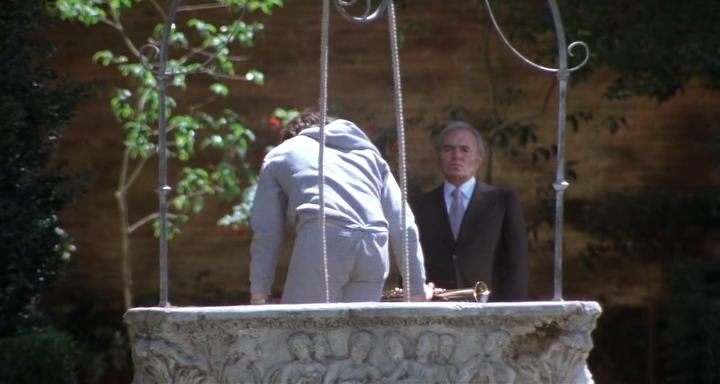
Joe invites ecology groups to the estate, which shows how productive the rich can be when they use their influence to provide meaningful change. Betty is also at this gathering, and the two wander off together, which leads to a foreshadowing image, as they talk near a well. She sees that he is worried, which is due to his concern that he will not be able to stay as Farnsworth. He says to her, “There’s nothing to be afraid of,” and tells Betty what she saw in his eyes she would recognize in another, whoever that person might be, even a quarterback. Later, Joe tells Mr. Jordan that he won’t leave Farnsworth’s body, but Jordan tells him that he must abide by what is written. He assures Joe that there is always a plan, a reason for everything, and, as it turns out, God does, in this film, work in mysterious ways.

At that same water well, Abbott shoots and kills Joe’s Farnsworth, comically because the gun goes off at the same time as does one of the silly daily cannon shots, but also sadly, because Joe is temporarily, again, without a body. Because Farnsworth is missing, having fallen down the well, Max goes to the police because Joe told him about Abbott and his wife plotting to kill Farnsworth. Betty also goes to the police when Farnsworth is nowhere to be found, since he proposed to her, and she knows he would not have gone away. The policeman Krim (Vincent Gardenia) brings Max with him for an interrogation of Julia and Abbott. While the Super Bowl plays on the TV, Krim unleashes Max on the suspected couple. Since the trainer knows so much about their plot to kill Farnsworth, they crack, trying to blame each other for murder. At the same time, the Rams’ quarterback, Jarrett (the athlete the escort was talking about, but did not name), sustains a head injury. It is important that we never see the real Jarrett, because the audience might identify with him, and feel sorry for his loss. He is supposed to die, as Mr. Jordan reassures Joe, saying that it was his time to expire. Joe steps in as Jarrett, and wins the Super Bowl for the Rams.
It seems that there will be an unmitigated happy ending, but that is not the case. Max knows that it is Joe who stepped in, which Joe confirms in the winning locker room. But, Mr. Jordan appears to Joe and tells him when he leaves, Joe will not remember anything about him, or what happened to Joe Pendleton. He will live his life out as Tom Jarrett, because, as it turns out, that is his destiny. When Max sees him again, Joe questions why the trainer is calling him Joe, as he does not recall anything about what had happened. We feel sad for poor Max, who, in a way, has lost his friend Joe for the second time. When Jarrett leaves to go to a celebration party, he runs into Betty who is looking for Max. He asks if they had ever met. The lights go out because they are shutting the stadium down, and in the darkness he repeats Joe’s words, “There’s nothing to be afraid of.” When they are outside (significantly on the playing field, where these two who are team players on and off the field should be) she says that his voice sounded very familiar. He then admits that he really doesn’t want to go the party, and asks if she would like to go for some coffee. She looks in his eyes, and is able to see what she saw in Joe, his inner goodness. She then recalls Joe’s words, and says, “You’re the quarterback,” and says yes, she would love to have some coffee with him.
So, this movie says, the real essence of an individual does not die, and when it comes to achieving one’s dream, and experiencing true love, heaven can, indeed, wait.

The next film is LA Confidential.

Okay, here are a few Oscar picks for next Sunday:

Best Actor: Casey Affleck for Manchester by the Sea

Best Actress: Emma Stone for La La Land

Best Supporting Actor: Mahershala Ali for Moonlight

Best supporting Actress: Viola Davis for Fences

Best Director: Damien Chazelle for La La Land

Best Movie: La La Land


Sunday, January 29, 2017

Up in the Air

SPOILER ALERT! The plot of the movie will be discussed.

This 2009 Oscar-nominated film had its inception before the 2008 Great Recession, but that event changed the tone and direction of this film directed by Jason Reitman, son of Ivan Reitman, who gave us Ghostbusters, and who is a co-producer along with his son on this movie.
The film opens with Woody Guthrie’s song, “This Land is Your Land, This Land is My Land,” lyrics which suggest that the United States is supposed to be shared by all, but the current economic situation presents a different scenario, where many feel dispossessed. The big irony in this story is that the main character, Ryan Bingham (George Clooney), works for a company that is booming, not despite the economic disaster, but because of it. Businesses that are downsizing and laying off tons of workers hire people like Ryan to do the firing for them. They are so cold and unconnected to their employees that they don’t even confront them personally at this most difficult time. And, as Ryan says, these bosses are “pussies” that “don’t have the balls to sack their own employees.” As Ryan’s boss, Craig Gregory (Jason Bateman), says to his employee, because the auto industry is tanking, “Christmas came early” for his fire-for-hire company. And, Craig inspires his troops by telling them, “retailers are down twenty per cent, auto industry is in a dump, the housing market doesn’t have a heartbeat. It is one of the worst times on record for America. This is our moment.” This motion picture is another one that presents us with an upside-down world. Here, capitalism has become so corrupted that many suffer, and those that prosper rejoice at that failure, and feed off of the economic carcass like opportunistic vultures.
Ryan’s life mirrors the topsy-turvy world in which he works by the place he calls home. While most people would consider a permanent house a place of solace, a sanctuary, Ryan has the opposite attitude. He feels most “at home” in the airports, and especially in the sky, flying from layoff city to layoff city. He says, “All the things you hate about traveling - the recycled air, the artificial lighting, the digital juice dispensers, the cheap sushi – are warm reminders that I am home.” The company office where he works is in Omaha, Nebraska, and Ryan’s dislike of having to stay there for any length of time shows when he says, “Last year I spent 322 days on the road, which means I had to spend 43 miserable days at home.” When we do see his condo, it is austere, fittingly appearing as if nobody has been living there. Ryan gives motivational speeches using a backpack as a metaphor for the excess baggage people in the business world carry around, and which weigh them down, grounding them like a flightless airplane. He says, “Make no mistake – your relationships are the heaviest components in your life. Do you feel the straps cutting into your shoulders? All those negotiations and arguments, and secrets and compromises. You don’t need to carry all that weight. Why don’t you set that bag down? Some animals were meant to carry each other, to live symbiotically for a lifetime – star crossed lovers, monogamous swans. We are not those animals. The slower we move, the faster we die. We are not swans. We’re sharks.” And sharks are predators, attacking and feeding violently on others; they die if they don’t keep moving. Ryan, thus, sees a fixed home as a place that will kill him, and, so, he flies, putting distance between himself and any attachments to others.
It is, thus, expected that, when Craig calls him back to hear the company’s new proposed mode of operating the business without the need for traveling, Ryan is outraged. A new employee, a young woman, Natalie Keener (Anna Kendrick), presents her idea of laying people off via the internet through teleconferencing. Ryan confronts Craig with the argument that, even though there is harshness in their work, at least by confronting those losing their jobs in person shows some dignity by including the in-person touch. He says that the inexperienced Natalie hasn’t a clue as to how to deal with the volatility on a case-by-case basis of each firing. Much to Ryan’s surprise, Craig sends Natalie on a mentoring journey with Ryan to cities to see how the firing sessions should be handled. Her online system of firing provides a buffer which relieves the hired gun from the anguish of the firing. But then her boyfriend dumps her in a short, brutal text. Ryan makes the comparison by saying it was like being fired over the internet. When asked if she loved her ex-companion, she talks as if her relationship was a job task when she says, “I could have made it work.” She then lists all of the items that made her boyfriend a good choice. Her speech sounds like what one would see on a spreadsheet.

Personally, Ryan wants to maintain a state of arrested development (the title of a series starring Jason Bateman). When teenagers are “grounded” they are cut off from having fun, and are restricted to the confines of the home. In the adolescent stage, the home can be a prison. And, the puberty period of a male youth lends itself to only wanting to indulge in self-pleasure, divorced from emotional entanglement with another. For this reason, Ryan feels happiest “up in the air,” a place of unattached liberty. Ironically, it is the much younger Natalie who calls Ryan on his selfish childishness, as she now feels the emotional sting of her boyfriend’s leaving, and witnesses up close the suffering of those that are losing their jobs, including one worker played by J. K. Simmons. (There is shot of Natalie sitting in an office surrounding by empty chairs, symbolizing all those who have been fired). When he talks about not being sold on marriage, he scoffs at love and says that despite having a spouse, everyone dies alone, and the failure of most marriages proves that they do not offer security. When he asks her if she has “that moment when you look into somebody’s eyes and you can feel them staring into your soul and the whole world goes quiet for a second,” she says “yes” and he counters with “Well, I don’t.” She says he is like a twelve-year-old, and when he talks about earning enough flying miles to have his name on a plane, she says, “Men get such hard-ons from putting their names on things. You guys don’t grow up. It’s like you need to pee on everything,” thus marking their territories like animals, not evolved humans.

Ryan’s selfishness only gets him material perks in the form of various traveling rewards. When his sister, Kara (Amy Morton), whom he calls the “glue” of his family, always involved in the interaction of its members, says, “You’re awfully isolated, the way you live,” he responds by saying, “Isolated? I’m surrounded.” Yes, but by strangers, not a true love, a friend, or family. His being “up in the air” means he is not “grounded” in the positive sense, of not having someone to rely on, provide sustaining comfort, and to whom he reaps the unselfish rewards of giving emotional sustenance to others. His sister, who is getting married, has little money, and asks that Ryan take pictures of a photo placard of her and her fiancé in front of places he visits so she can have a virtual honeymoon. Ryan complains about this request showing no loyalty to his family, as we see a sign on the wall of the airport terminal which says, “We value your loyalty.” The loyalty Ryan has valued is impersonal and money-based.

A complication occurs in the entrance of Alex Goran (Vera Farmiga) into Ryan’s life (I wonder if her name might conjure up Glenn Close’s character in Fatal Attraction. More on that later). They meet, appropriately, in an airport bar. Their foreplay consists of rating car rental companies and commenting on each other’s rewards cards. She says that one hotel gives you cookies, and that she is a “sucker for synthetic hospitality,” which is all one gets, a hint of the real thing, when it is provided for a price, not given out of sincerity. When Ryan says that he hopes their comparing travel perks doesn’t cheapen their getting to know each other, she says that when you’re comparing elitism, cheap is a “starting point.” They know who they are, and feel that it is okay for them. There is nothing of meaningful substance in their conversation. But, there is humor and chemistry, and they spend the night together. It is noteworthy that when they go to Ryan’s hotel room, he has so many cards, he’s not sure which one opens the door, thus emphasizing his detachment from any place he can call home. Their relationship is “casual” as Ryan describes it, and Alex even reassures him that he doesn’t have to worry about her feelings when she says that he should think of her as someone like himself, “only with a vagina.” Even in their recreational time together, they crash another corporate party, illustrating that they live off of others, just as Ryan and Natalie’s salaries draw from the receding economic well of others.

But, in spite of himself, Ryan becomes attached to Alex. At first, they work out their schedules so that they can see each other as long as it coincides with work. But then Ryan asks Alex if she will accompany him to the wedding of his sister, Julie (Melanie Lynskey). He says for once he doesn’t want to be that guy alone at the bar. He wants to have a dance partner, have a plus-one. The lip-service that he has been giving about the compassionate part of his job, of telling people that anyone who has started an empire or changed the world had to first suffer a loss, and taking people at a time when they are most “fragile” and helping them move forward, may be rubbing off on him. He volunteers to walk Julie down the aisle, but finds out that it is already taken care of. Julie’s future husband, Jim (Danny McBride) tells Ryan about his real estate investment. His words echo the Woody Guthrie song, and contrasts with Ryan’s lifestyle, when he says, “We all need a place to call our own. This is America. It’s what we were promised.” The film is saying that, unfortunately, the country has not lived up to that promise. 
Ryan is now caught between two worlds. When he checks into the hotel in Wisconsin for the wedding, he calls the wedding program a “packet,” which is the word that he uses for the information folder he hands to those he is firing. Hi sister, Kara, has just separated from her husband, adding another statistic to Ryan’s belief that marriages do not offer security. But, he enjoys taking Alex around his hometown, and visiting the school he attended. He seems to be reconnecting with the place he once called home, and also with his family. When Jim gets cold feet, he is the one Kara asks to convince the reluctant groom to go through with the nuptials. Jim voices the fears of many when he looks ahead and only sees a passage of time that ends in death. Ryan admits that marriage is difficult, and there isn’t some universal point to it all. But, he asks Jim, “the most important moments in your life … were you alone?” Jim realizes, as does Ryan as he says these words, that it is better to share life with someone. Ryan’s next words are significant, because he tells Jim, in life, you need a “co-pilot.” So, the man who has been flying solo now understands that is it better to have a fellow traveler on the journey. After he convinces Jim to go to the marriage ceremony, it is fitting that his sister, Kara, says to Ryan, “Welcome home.” He has joined emotionally with his family. The scene hearkens back to the beginning of the film when one of the men who lost his job says that his family consisted of people he worked with, and leaving them made him feel like he was about to die. In a way, Ryan, who was already dead to his family, has been resurrected.
When Ryan returns to the office, he discovers that a woman, who Natalie had fired on the road, followed through with the promise of killing herself by jumping off of a bridge. Natalie is so shaken that she quits, texting Craig, who ironically complains about the method used by Natalie’s boyfriend, since Craig was willing to fire people electronically. She goes to San Francisco which is where she was originally headed, and gets a job with the help of a recommendation from Ryan. Will Natalie marry herself to her job and give up on relationships after her break-up, or be able to find a “co-pilot” after quitting the unsavory work in which she was briefly employed?

Ryan leaves in the middle of one of his speeches about emptying the backpack, not believing in the words anymore. He needs to be with Alex, and makes a trip to her hometown of Chicago without any business agenda attached. Maybe we should have seen omens earlier, such as when the lights went out on the party boat after Ryan says he is now looking at what to put back in the backpack, or when Alex said she hoped Ryan wasn’t changing. There is a reason why she said she couldn’t behave at home the way she was with Ryan. When Ryan arrives at Alex’s house, he finds it is a home, with children and a husband behind the half-open door. He flees, and later has a phone conversation with her. At least he was honest with her. She has been a deception, pretending that she was just like Ryan. She has no sympathy for him or remorse for being misleading. She says he almost “screwed things up. That’s my family. That’s my real life.” In a way, she is the opposite of the Alex in Fatal Attraction: this Alex is the married person selfishly cheating on the spouse. She wants both the freedom of the road (or sky here) and the security of the family home. To her, Ryan was an “escape” from her being “grounded.” She calls Ryan a “parenthesis,” something that is self-contained, limited, not material for a long story.
Craig says there has been a hold on rolling out the teleconferencing layoff program. He needs Ryan “up in the air” again. Natalie said he should use his frequent flyer points to actually travel somewhere, enjoy what the rewards stand for, not just accumulate them. He goes one step further – he gives his sister enough of them to travel around the world on a honeymoon. He now values the loyalty of family. But, after reaching ten million miles he is asked by Chief Pilot Maynard Finch (Sam Elliott), where he is from. He says “I’m from here,” that is, in the sky. At the end of the film he is at another airport, and the movie ends as it started, with Ryan in a plane. Will he ever land and find a permanent home, or will he continue to pass over the homes of others, his “wingtip passing over?”

The next film is Bicycle Thieves.