Showing posts with label conformity and rebellion. Show all posts

Saturday, November 9, 2024

Trainspotting

 SPOILER ALERT! The plot will be discussed.

Trainspotting (1996), directed by Danny Boyle (Slumdog Millionaire), depicts young Scottish men who prefer using heroin to living conformist lives under British rule. However, as the story unfolds, there is a change in the attitude of the main character which implies there may be no good choices for those like him. It is a raw, unsettling movie, but also a courageous one.

The title of the film may refer, according to Irvine Welsh, to taking drugs at a train station, or an obsessive hobby that only those participating in it understand. In that sense, it is an outsider lifestyle divorced from all others. The central character Renton (Ewan McGregor) states at the onset of the story that people can choose a “job,” “a family,” and electrical appliances and other material things that you put into a house with a “fixed interest mortgage.” But his opening monologue gets darker as he skewers the conformity of an average life where one is “sitting on that couch watching mind-numbing, spirit-crushing game shows … rotting away at the end of it all, pissing your last in a miserable home, nothing more than an embarrassment to the selfish fucked up brats you spawned to replace yourselves.” For Renton, at this point, he denies that taking heroin is because of “misery and desperation and death.” He says, “it’s the pleasure of it. Otherwise, we wouldn’t do it. Afterall, we’re not fucking stupid. At least, we’re not that fucking stupid.” He says with drugs one doesn’t have to worry about all the concerns of everyday life, only “scoring.” Later, Renton does concede that their lives are miserable because they were colonized by the British who are all “wankers.” He says that he and his friends took all kinds of drugs and would have “injected Vitamin C if only they made it illegal.” That statement shows that the drug use for these men was an act of rebellion.

He says that his parents were always trying to set him on the so-called right path, but his mother took pills, so she was a user herself. One of his mates, Begbie (Robert Caryle), berates him about Renton’s use of hard drugs. But, Renton’s father drinks large amounts of alcohol and is a violent man. Renton says Begbie didn’t do drugs, “he just did people.” His drug was violence towards others, a much worse way to get high. (Actor Caryle believed that Begbie’s rage was due to being a closeted gay and his fear of being outed translated to an outward eruption).

Renton’s other friends are Sick Boy (Johnnie Lee Miller), Tommy (Kevin McKidd), and Spud (Ewen Bremner). Sick Boy and Spud, along with Renton, shoot up heroin at the place of their provider, Mother Superior Swanney (Peter Mulan), whose AKA is a reference to the Beatles song referring to drug use, “Happiness is a Warm Gun,” with the line, “Mother Superior jumped the gun.” The irony of mixing religious elements with drug use is obvious in the song and in the film.


After waking up after another mind-bending fix, Renton decides to quit his drug habit. He acquires opium suppositories to help him wean off the habit. What follows is a disgusting, surrealistic scene where Renton must find a spot to relieve himself immediately winding up in what he describes as the “worst toilet in Scotland.” The bathroom is revolting with feces wall-to-wall (which was really chocolate), and Renton, after relieving himself, realizes he ejected the suppositories. In a surreal, nightmarish act, he dives into the toilet after them. This scene, if no other, shows that choosing heroin was not a good choice, in contrast to Renton’s earlier manifesto.

Because his sex drive kicks in again after stopping his drug use, Renton zeroes in on a seductive girl at a club, Diane (Kelly MacDonald), and they have sex. He discovers later that she is only fifteen years old. Her innocence is a sham, and her schoolgirl clothes merely a costume. The film implies that the upright appearance of the world is a façade. Renton fears that if his intimacy with Diane is discovered, he will go to jail, although in comparison to the violence of Begbie, his transgressions would be unfairly punished.

Tommy starts to use heroin after his girlfriend breaks up with him. The film shows how drug use can be used as a way to escape any type of pain. However, that hard drug usage is a victimless crime is in question when Allison (Susan Vidler), who is a friend and fellow junkie, reports that her baby is dead, most likely out of neglect. The story implies that Sick Boy is the father. He is devastated, but not scared straight. Instead, maybe because of guilt, he puts himself in more danger. He, Renton, and Spud attempt stealing from a bookstore. Sick Boy escapes, but Spud and Renton are caught. Spud goes to jail because of past violations. Renton escapes incarceration because he undergoes a drug rehabilitation program, which turns out to be a failure. He is on methadone and when he takes heroin later the combination almost kills him. So, it starts to appear that there is no exit from the horrors of his world.

Renton’s parents lock him in his room and make him go cold turkey to quit the habit. In withdrawal, he hallucinates about Diane and Allison’s baby, possibly reflecting his guilt over his underage relationship with the young girl and inability to save the child. There is also the scary possibility of contracting HIV through IV drug use, but luckily, Renton tests negative.

Tommy does not escape that fate, as he contracts the virus after becoming heavily addicted to heroin, and later dies of toxoplasmosis. The now clean Renton saw how his friend was living in squalor and attempts to give his life direction by becoming a real estate agent. He saves money and keeps in touch with Diane, but he does not stay happy in a conventional life for long. Sick boy is a drug dealer, and Begbie is on the run because he committed armed robbery. They invade Renton’s flat, trash it, and steal from Renton. The suggestion here is how difficult it is to detach oneself from the destructiveness of an addictive life.

Spud is released from prison and joins Renton, Sick Boy, and Begbie in selling a large amount of heroin for a huge profit. They go to a pub to celebrate. Begbie gives in to his sociopathic ways, attacking a patron and destroying property. Given Sick Boy’s self-destructive actions and Begbie’s violent behavior, Renton tries to get Spud to join him in stealing the drug money. The timid Spud refuses. While the others sleep, Renton steals the cash and runs off.

In an ironic act at the end of the film, Renton says he will use the money derived from selling drugs to now choose those things he once rejected for a life on drugs.

Tuesday, April 11, 2023

Donnie Darko

 SPOILER ALERT! The plot will be discussed!

Donnie Darko (2001) has the theme of sacrifice to save others, but the demonic rabbit costume in this cult favorite has become iconic, so the movie also has an anti-Easter feel to it, too.

The film starts ominously in a dark outdoor setting with thunder in the background. The name of Donnie Darko (Jake Gyllenhaal) fits the setting. He has been lying on a mountain road in his pajamas next to his bicycle. It’s an odd place to have bedded down for the night. He appears to be waking up from a strange dream. His smile seems to contrast with the threatening situation, which points to the opposing forces in the film.

The contrasts continue as what follows is a sunny day with the title of the film then shown, the character’s name offset by the brightness of the image. Donnie rides his bike past a sign announcing a Halloween event, a fitting notice for this spooky tale. The soundtrack song is sung by Echo and the Bunnymen. Rabbits are important to this story, and give a decidedly anti sweet, Easter feel to the tale. Here a rabbit may suggest the White Rabbit in Alice in Wonderland and the idea of going down the nightmarish rabbit hole. (In Celtic folklore, there is the character of a pooka, a kind of ghost, that sometimes manifests itself as a hare, and can bring about good or bad occurrences, which fits in with the contrasting theme of the film). If you want to see all the times that a rabbit appears, go to IMDb.


On a supposedly proper suburban lawn Donnie’s father, Eddie Darko (Holmes Osbourne) uses a leaf blower, but abruptly points it jokingly at his teenage daughter, Elizabeth (Maggie Gyllenhaal) as she strolls by. The phallic-shaped tool adds a twisted incestual suggestion to the scene, sort of like the garden hose at the beginning of Blue Velvet, implying something dark below the tranquil suburban setting. Donnie’s mother, Rose (Mary McDonnell) is outside at the back of the house reading the Stephen King book It, another creepy image undermining the possibility of safety. (IMDb notes that this novel’s nemesis is dressed like a clown, and much later there is a clown in Frank’s car that is dressed likewise. It adds to the Halloween motif). Donnie walks past his mother weirdly not saying a word considering a note is written on a piece of paper on the refrigerator which says, “Where is Donnie?” (Who would post such a message about a missing family member this way? It adds to the surreal nature of the movie).

At the dinner table Donnie is sarcastic and combative with his sister, Elizabeth, who reveals that Donnie has not been taking his medication. We discover he has a history of schizophrenia accompanied by violence and is prone to sleepwalking, which explains why he woke up on a country road. After dinner, Rose confronts her son about where he goes off at night. He is very hostile telling her to get out of his room, and he calls her a “bitch.” She says she doesn’t recognize him anymore, and that may exhort him to later take some of his medication.

Later in the night we hear a distorted, deep voice telling Donnie to wake up. Donnie sleepwalks again, following the voice to the hedges at the back of the house. He sees the image of a man wearing a grotesque rabbit costume with long upright ears. The rabbit, who is called Frank (James Duval), says he has been watching Donnie and announces, “twenty-eight days, six hours, forty-two minutes, twelve seconds … That is when the world will end.” Donnie took his meds. Is he seeing clearly, and this apocalyptic vision is real, or is his mental illness defying treatment?


The night scene cuts to a TV displaying static in front of the sleeping Eddie, an image representing a lack of communication and comprehension (and possibly a reference to the TV in the ghostly film Poltergeist). Elizabeth comes in the door and immediately thereafter the house shakes as a loud noise sounds. Eddie awakes and runs in slow motion adding to the unreal happening. The film abruptly shifts to the daytime and Donnie is asleep on a golf course, another contrasting image of oddness appearing amid suburban tranquility. That same unnerving jolt out of the ordinary occurs when Donnie gets home and finds a jet engine being hoisted off his house. His family is outside and his younger sister, Samantha (Daveigh Chase) tells Donnie that the large piece of debris fell in his room. If it wasn’t for his sleepwalking, his dive into the surreal, his real world would have ended, but in a bizarre way. Elizabeth tells Donnie about the airplane engine, “They don’t know where it came from.” Now that’s very weird, because there is usually a plane around when one of its engines gets detached.

The FAA arranges for the Darko family to stay at a hotel. Eddie remembers about a young man who died on his way to his high school prom, and says people said the boy was “doomed.” Eddie wonders if that could be Donnie’s case. But his son escaped his fate. Or did he?


Back at school Donnie is sort of famous for escaping death. Teacher Karen Pomeroy (Drew Barrymore) is the defiant teacher who worries about losing children to “apathy,” and the principal later fires her for her counter-culture ways. Here she discusses “The Destructors” by Graham Greene. (October 2 is the day on which Frank tells Donny the world will end. That is Greene’s birthday, according to IMDb. It is thus fitting that the man who wrote about destruction is tied to demise here. In the fiction piece, children break into a house not to steal money but to burn it. Donnie comments that it is an act of rebellion to change things. His comments fit with his antisocial, hostile attitude toward the world as it is.

Another strange incident occurs when Eddie drives Donnie to his therapist, Dr. Lillian Thurman (Katherine Ross). A disheveled old lady with fly-away gray hair stops in the middle of the road and checks her mailbox, which she does every day, and there is never any mail. It’s sort of like a Waiting for Godot scenario, where meaningless action perpetuates. Her name is Roberta Sparrow (Patience Cleveland), also known as Grandma Death. Her appearance fits that nickname. When Donnie gets out of the car to see what’s going on, she whispers something to him, which Donnie does not divulge at this time. We later learn that she pessimistically stresses how every living creature dies alone. Since dire events center around Donnie, it makes sense that a reaper-like person should be contacting him.

Donnie tells Thurman that his new imaginary friend, Frank (the guy in the weird rabbit costume), told Donnie to follow him “into the future.” Donnie says that Frank telling him that the world would end soon was “stupid.” Yet, he calls Frank a “friend,” which sounds as if he is conflicted about Frank’s presence.

In a class, the health teacher, Kitty Farmer, an uptight person, doesn’t teach but plays videos featuring Jim Cunningham (Patrick Swayze) which focus on overcoming fear. There is an atmosphere of foreboding in this film right from the opening scene, followed by Donnie’s personality, the scary rabbit, and the airplane engine accident. (By the way, the movie Harvey deals with James Stewart’s character talking to a human-sized rabbit that is invisible to everyone else. This film is a dark version of that scenario).

Spooky Frank wakes up Donnie again and Donnie appears to be sleepwalking (sleepwalking is a kind of twilight area between waking and sleeping). This time he is carrying an axe. Later, the school’s mascot, which is represented by a large statue of a bulldog, has the axe buried in its head. And the words. “They made me do it,” are written in paint on the sidewalk. Since Donnie committed the vandalism, his free will seems to merge with the dictates of the supernatural that charts the destiny for everyone. However, his words also sound like what a schizophrenic would say. The danger surrounding his personality permeates the movie. He also uses the axe to flood the school by breaking a water main. Donnie fits in with the Greene short story since he is a destructor forcing change to occur.

Donnie gets to know the new girl at the school, Gretchen Ross (Jenna Malone). Since she has just arrived, she is an outsider, like Donnie. Her past adds to her lack of normalcy. Her father is at-large for having stabbed her mother and she and her mother changed their names and are in hiding. Donnie says he was once in jail for accidentally burning down a house, which shows his antisocial past, and a foreshadowing (there is a fire in the Greene short story, remember). She comments that his name sounds like a comic book hero. He responds by saying, “What makes you think I’m not?” He is being funny, but the dialogue adds to the unreal nature of the story, and points to Donnie maybe having special abilities. (If you have watched “the Big Bang Theory,” you know the talk about how comic book characters have alliterative names: Peter Parker, Bruce Banner, Clark Kent, etc. As IMDb points out there are many alliterative names in the film and references to comics, which contribute to the film’s imaginary worldly nature). Donnie shows his intelligence by helping her with an assignment. She comments that he is “weird,” and Donnie has heard this before and feels he is being dismissed; but, she tells him it was a compliment. This story inverts what most consider to be positive and negative. He says that if the school hadn’t closed their moment together here would not have happened. His comment suggests the idea of various timelines. The two quickly decide to be a couple since they are compatible in their nonconformity.

In another session with Dr. Thurman, Donnie repeats how he looks in many of his scenes. His head is bent forward and he looks up, unblinking. Jake Gyllenhaal said, according to IMDb, that he used this look to appear more psychotic. Thurman hypnotizes him, but even his subconscious is rebellious as he refuses to answer her questions, dwells on sexual topics, and is about to masturbate when she terminates the session.

At a PTA meeting, Kitty Farmer rants about the teaching of “The Destructors” because the young people in that book break a water main and flood a house. Since the police suspect that students may have been involved with the vandalism that included flooding the school, Kitty is connecting the dots. Teacher Karen Pomeroy defends her selection by saying the story is “ironic,” suggesting the tale is not a “how to” act piece. Rose questions if Kitty even knows who Graham Greene is, and Kitty reveals her ignorance by citing the TV show “Bonanza,” whose star was Lorne Greene. While the PTA meeting takes place, Frank again visits Donnie, telling the youth he got away with his axe-wielding actions. Donnie continues to take his medication which implies Frank’s appearance is real. Frank says he can do anything, and so can Donnie. The will of the one merges with that of the other. When Donnie asks where Frank came from, the crazy rabbit asks Donnie if he believes in “time travel,” which becomes what the movie revolves around.

Kitty is again teaching her class based on Cunningham’s videos. Donnie has a card that notes a hypothetical character finding a wallet. He is supposed to fit her actions onto the evaluation line that stretches between fear and love. Donnie complains how the whole exercise is meaningless because everything cannot be reduced to these two emotions. Later, in the principal’s office, where we learn Donnie’s test scores show him to be brilliant, Kitty reveals that Donnie, basically, told her to shove her exercise card up her ass. Donnie continues to be the defier of social convention.

Donnie asks science teacher Mr. Monnitoff (Noah Wylie) about time travel. He talks about wormholes, and then gives Donnie a book entitled The Philosophy of Time Travel, which was written by Roberta Sparrow, the strange mailbox lady, who once was a nun, and then a schoolteacher where Donnie attends. Her character is a merging of science and spirituality. Donnie relates to Thurman that Frank mentioned time travel and now he finds out about Roberta, so he concludes the linking of the two is not a coincidence. Donnie takes the “alone” part of the message Roberta whispered to him as meaning that it is absurd, given life’s inevitable solitude in death, to search for the existence of God, and thus, the general meaning of life.

Donnie is waking up from a nap in a chair in his house while his father and pals watch a football game. Donnie seems to be between the awake world and the sleep world most of this movie, and just like Edward Norton’s character in Fight Club, it’s difficult to tell whether or not he is in a dream state. He sees fluid-filled tubes coming out of Eddie’s chest, and also out of Elizabeth and himself. They point to where a person is going. In a way they are predictors. IMDb notes that director/ writer Richard Kelly got this idea from watching John Madden make illustrations of where players will go in a play. So, it’s appropriate that Donnie sees this effect while a football game is playing. Donnie follows his tube and it takes him to his father’s closet where he finds a handgun. As Anton Chekhov said, once you introduce a gun the writer better fire it later.

Donnie would like to kiss Gretchen since they have been going out for two weeks, but she wants it to be at a time that the world shows its beauty. She coincidentally mentions time travel now, stating her wish to be able to go back and replace troubling images with lovely ones. Even though they are in a beautiful park there is a “fat guy” as she puts it, watching them while smoking a cigarette. In this place, it is difficult to maintain the beauty Gretchen seeks. Donnie does not share Gretchen’s hope for that wonderful moment. The next scene is that of Dr. Thurman telling Donnie’s parents that their son is becoming more detached from reality because he finds life increasingly “threatening.” She recommends more therapy and medication for his schizophrenia. This scene is intercut with shots of Donnie using a knife to stab at Frank’s eye across an invisible force field that he seems to be penetrating. Is he trying to destroy his hallucination? Or, is he trying to cut across the barrier between the world we know and the one beyond?

Jim Cunningham presents his personal growth spiel to the high school students. He talks about a struggling individual named “Frank.” Could this reference point to Donnie’s own struggle? Cunningham says that fear is intertwined with premarital sex, smoking, and drinking alcohol. IMDb notes Donnie engages in all three in the movie, showing that he defies the restrictions on these temptations. Donnie gets to the microphone and admits to feeling lost and afraid (probably because of his loneliness), but he says Cunningham is “the antichrist,” a guy who is profiteering on the anguish of others, and not offering any real solutions.

Donnie tells Gretchen that what he has been seeing is described in Roberta Sparrow’s book, so he says what is happening to him is not random. He discusses his theory with Mr. Monnitoff that these tube-like projections show one’s destiny, and that are a way of seeing the predetermined future. The teacher says if someone could see his or her destiny, a person could then change it, negating predetermination. But Donnie sees, or wants to see that we are not alone, and that the future paths can’t be altered by individuals since they are part of God’s cosmic plan. Monnitoff wants to stick to science and not religious matters, implying he could lose his job if it appears that he is influencing a child’s faith.

Donnie now finds Cunningham’s wallet and knows where he lives. So, he is in the position of how to act that duplicated the exercise in Kitty’s class that was based on Cunningham’s teachings. Gretchen and Donnie do a presentation to the science class with illustrations about getting parents to put these glasses on their kids when they sleep. They call them IMG’s which are infant memory generators. Gretchen argues that pleasant images will be shown to instill positive memories in the children. Two guys say the nightmare of this dream proposal could occur if parents might show satanic visions, and they mention Gretchen’s violent father. It’s as if Gretchen wants to create a parental experience that would counter her own life events. Gretchen runs out of the school and Donnie follows her, apologizing for the boys’ statements. She then kisses him, maybe because she is realizing she shouldn’t wait any longer for a perfect moment to happen, since it probably never will.

Again, keeping with the Halloween holiday, Donnie and Gretchen go to the movies to see a horror film, The Evil Dead. But that movie is shown in conjunction with The Last Temptation of Christ. It is a foreshadowing since that movie deals with sacrifice to save others. Gretchen falls asleep. It appears Donnie may be nodding off also, and then Frank appears. Dream or reality? Donnie asks Frank, “Why are you wearing that stupid bunny suit?” To which, Franks says, “Why are you wearing that stupid man suit?” What is really below the surface? Is it man or beast? The lighter and darker sides of reality join here as Frank takes off his headpiece and reveals the eye injury that Danny inflicted upon him. Frank apologizes because he knows what’s coming. A portal opens and Cunningham’s house appears. Frank tells Donnie to burn it down.

Even the dance presentations of children for a Star Search competition show contrasting images. One girl awkwardly dances to an angelic soundtrack and then the performance of the young girls called Sparkle Motion (which includes Samantha Darko) is more rock and roll. Cunningham hosts the event, which we find adds a creepy element. The fire reveals a secret room, a “kiddie porn dungeon” in the house. The police arrest Cunningham. The fire, a destructive act, brings to light a horrible crime. The scene reminds us of the opposing movie titles on the marquee and suggests that there must be sacrifice to set things right. It also reflects what Donnie said about how the Greene story shows that “destruction” is a form of “creation.”

Kitty is not willing to see the facts and remains loyal to Cunningham (does his name show he is a cunning fellow, fooling others, another example of false appearances?), thinks there is a conspiracy to frame her beloved idol (the film showing relevance to current events). She will work to defend Cunningham, and, despite Rose’s animosity toward her, she asks the other woman to fly with Sparkle Motion for a competition. This request brings up the airplane aspect of the story.

Rose sees a calendar with an illustration of the scary bunny on it. The days are crossed off, which we know is the countdown to Frank’s “end of the world” prediction. Rose is concerned about Donnie and wants him to be okay. He asks what it’s like to have a “wacko” for a son. She says it feels “wonderful.” Her allegiance reminds us of how Gretchen feels about Donnie’s questioning mind.

In a session with Thurman, the hypnotized Donnie confesses to his crimes and says he must do what Frank says so he can figure out what is happening. He sees Frank (again as he crosses into dreamland) looking upward. Donnie says he must build a time machine. He says, “the sky’s gonna open up.” Here is another reference to the airplane and its missing engine.

There is one day left until Frank’s predicted day of death. Eddie is away on business and Rose is with Sparkle Motion. Donnie and Elizabeth decide to throw a Halloween party with their parents gone. Everyone is wearing a costume except Donnie, whose “man suit” is a costume hiding his nightmarish self. Gretchen arrives distraught because her mother took off. She says, “I guess some people are born with tragedy in their blood.” Obviously, she is a perfect match for Donnie. They make love while Rose does not receive Dr. Thurman’s phone warning about Donnie since the mother is away. There is also a call from Rose saying that she and the girls will be returning on a late flight. Later, Donnie has on a skeleton outfit, which shows the tragedy intertwined with his life.

Donnie sees those fluid tunnels again, which point to what will happen, and he knows that time is running out since it is one hour to Frank’s deadline. He and Gretchen go to Grandma Death’s place. He knows that time travel connects Grandma Death to Frank. Karen Pomeroy wrote on the board before leaving the school the words “cellar door,” which someone said were the best combination of words in English. There is a cellar door at the house. We are going below the surface again to reveal what hides in the shadows. The school bullies are there, with stockings over their faces trying to hide the nastiness underneath. They drag Donnie and Gretchen outside. One puts a knife to Donnie’s throat and Donnie utters, “Deus ex machina.” In Greek theater, the gods were supposed to reside above the stage and when the playwright wanted to resolve conflicts the “god” would be lowered in a box to dispense supernatural abilities. It has come to be a negative term to show resolution by contrived means. Here the film is playing with the idea, since time travel is the story’s “deus ex machina,” and that is why Donnie calls it the “savior,” which also recalls “Christ” mentioned in the film title on the marquee.

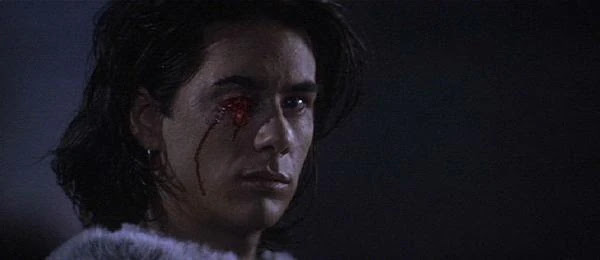
A car approaches at a high speed. Grandma Death is in the road, presiding over the events. Gretchen is thrown into the road and the car strikes and kills her. The car stops and turns around. The driver is Frank. He is wearing the scary bunny outfit. He takes his headpiece off. Donnie has his dad’s gun and shoots and kills Frank. Again, the site of the wound is the eye, a frequent symbol in films (Blade Runner, Chinatown, Bonnie and Clyde). Here, it can refer to the terrible visions that Donnie has been seeing. It’s as if the dead Frank came back through time to inform Donnie of the horrors that would occur.


Donnie takes Gretchen’s body with him to his house and kisses his sister goodbye. Donnie envisions dark clouds forming a time tunnel in the sky. He drives to where the film began on a hillside road. We hear Monnitoff’s words about all you need for time travel is a wormhole and a metal craft entering it. Donnie also remembers Gretchen saying that it would be nice to go back in time to make things better. The plane that Rose is on hits the turbulence of the time tunnel, and we see the engine going into the tunnel. Donnie also goes into the tunnel. He comes out laughing in his bed. He is not out of the house as before when the engine hits. He is killed this time.

Donnie wrote a letter to Grandma Death, saying that he hopes the answers to his questions “will come to me in my sleep. I hope that when the world comes to an end, I can breathe a sigh of relief, because there will be so much to look forward to.” He does get his information while asleep, and it is his world that comes to an end. Perhaps he is now at peace, and he may feel that he will survive in some spiritual form, and that those alive will lead good lives.

The camera glides over all the characters in the story, as the song “Mad World plays with the fitting lyric, “The dreams in which I’m dying are the best I ever had.” Those words could fit what happens to Donnie. Gretchen, who in this corrected timeline didn’t meet Donnie, is alive. She rides by on her bike, and exchanges a sad look with Rose, and a wave. It was a worthy sacrifice.

The next film is Lost in Translation.

Sunday, June 5, 2022

The Breakfast Club

 SPOILER ALERT! The plot will be discussed!

The Breakfast Club (1985) is a study in group dynamics among high school students that focuses on how others, including adults and peers, stereotype individuals. The story demonstrates that although it is comforting to find a secure place to exist, it’s also possible to transcend limited viewpoints. The film is witty, irreverent, and touching, quite an accomplishment for writer/director John Hughes.

The opening sequence contains the hit song “Don’t You Forget About Me,” which stresses the desire of these youths to not just go gentle into that good night. There is a quote shown from rocker David Bowie’s “Changes” that also emphasizes the need for individuality. The lines are followed by glass breaking the camera image, as if to stress the iconoclastic need to destroy being placed in prefabricated molds.

Brian Johnson (Anthony Michael Hall) narrates a letter addressed to Richard Vernon (Paul Gleason), the disciplinary principal that he writes at the end of this detention on Saturday morning in 1984. The assignment from Vernon was to state who they are. Brian says that Vernon pigeon-holed them “in the simplest terms” as “a brain, an athlete, a basket case, a princess, and a criminal.” He admits that is how they even saw themselves, because they were “brainwashed.” As he speaks, we see a destroyed locker. It is Brian’s, and we later learn why it exploded. There are also scribblings displayed that repeat the word “Help!” in a notebook. The movie implies that the plea pretty much sums up the feelings of alienation of adolescent youth.


Claire (Molly Ringwald) arrives in a BMW. IMDb notes how the students come to detention is meaningful. Claire and Allison (Ally Sheedy) ride up in expensive cars, showing their affluent backgrounds. We don’t see Allison’s parents, and the car drives away making it appear as if she is an abandoned child. Brian and Andrew pull up in middle-class vehicles, which hints at the possibility that the parents hope their boys will one day move up in the world. John Bender (Judd Nelson) walks to school, indicating that he is at the bottom of the social hierarchy here with no caring parents, and which may suggest why he shows the most anger being the outcast. (His last name suggests he is someone who “bends” the rules imposed on him).

Claire, feeling privileged, wonders why her father couldn’t use his influence to get her out of the punishment. Brian’s mother orders him to find a way to study during the detention, piling on the pressure to succeed. Andrew’s father tells him that he will not get an athletic scholarship if he becomes “a discipline case,” but doesn’t offer an ethical model, since he says his son’s mistake was getting caught, not doing something wrong. The most enigmatic character is Allison, who not only arrives in a Cadillac, but also wears an expensive coat under which she has clothes that make her look like a homeless person. Definitely a person of at least two minds. Her car almost hits Bender who is oblivious to the danger as he walks in front of it, not caring about what others do or think, or what happens to himself. He may be self-destructive, which we learn derives from his home experiences.


They gather at the school library. Bender comes in knocking stuff around on the librarian’s desk and taking a paper pad, as he broadcasts his dismissal of following any rules. He makes Brian move for no other reason than to intimidate the youth, and uses two chairs to elevate his legs to show he does not take the situation seriously. Allison scurries to the back, stressing her outsider nature.

Vernon comes in and has nothing but contempt for the young people, which, of course, just leads to feelings of resentment and intimidation on their part. Vernon requires them not to move from their seats or talk for nine hours, ridiculous demands. It is here that he tells them to write the essay about who they think they are. Bender goes out of his way to be gross by spitting and catching his own spit as it falls back into his mouth. He is against anything that is socially acceptable. But if he is anti-social, why does he do things that draw the scrutiny of others? Does it show the need for attention that he has not received? It is interesting that he wears layers of clothing. Is it symbolic of armor, the desire to protect himself from the pain he has endured? (Gene Hackman’s character in the movie Scarecrow did something similar). In fact, there is shedding of outer garments by others which symbolizes removing emotional shielding as the story unfolds.

Allison is the real loner. She starts making loud noises as she bites her nails, but she doesn’t do it to draw attention. She is used to being alone. Bender says wittily to her, “You keep eating your hand you’re not going to be hungry for lunch.” Her nonverbal, primal response is to spit a fingernail at him.

Bender continues to be outrageous to shock others, his way of interacting. He acts like he has to pee and pretends he will urinate in the library. He then says they should close the door and, “We’ll get the prom queen impregnated,” a reference to Claire. Lines like that make it difficult at times to feel compassion for his character. (Molly Ringwald has spoken out that she felt upset about these references to implied rape). Andrew shows the proper amount of outrage at Bender’s statement and threatens him. He says that Bender is a nobody and would never even be missed. Bender’s face shows how upsetting that thought is. Claire tells Andrew to ignore Bender, to which Bender says, “You couldn’t ignore me if you tried.” It is a response that can resonate in different ways. Bender wants to make an impression, even if it is a negative one. But, it also suggests the desire of young people to not be dismissed or ignored, and to want to count for something. According to IMDb, Ringwald said this movie is about, “the universal feeling we all have, especially in high school: that we are all outsiders; we all feel alone; and yet we all want to be accepted.”

The topic of connecting with others continues. Claire says to Bender that no school clubs would take him. He, of course, says he wouldn’t want to be members of any of the organizations because they consist of “assholes.” While they are talking, Brian states that he belongs to different academic clubs which shows he is accepted in certain circles. Allison continues her nonverbal responses by forming a gun with her hand and pretends to shoot the awkward, rambling Brian. Bender asks if Claire attends any of the groups with which Brian is associated, and she scoffs, implying they are only for nerds. Bender criticizes her for being elitist. Bender is also sarcastic toward Andrew for competing in wrestling, saying he wants to be just like Andrew, so he needs to get, “a lobotomy and some tights.”  

Bender stops the room door from staying open, instigating the appearance of Vernon, who demands to know who closed the door. Allison’s asocial response is to make squeaking sounds. Bender says a screw must have fallen out of the door. Vernon demands the screw from Bender, who says screws fall out all the time because it’s an “imperfect world.” It’s a funny line, but it also mirrors teenage angst about the world they will inherit. In the face of a common enemy, Vernon, Claire actually backs Bender, asking why he would want to steal a screw. When Vernon asks Andrew to get up to help him keep the door open, Bender mocks attempts by the adult to make things work when he says if they all get up there will be “anarchy.”

Bender continues his sarcastic attacks against Vernon and incurs two months’ worth of detentions. Again, Claire wants to help him out, telling him to stop aggravating Vernon and incurring more punishment. Vernon might actually be right when he tells Bender that he should stop trying to get attention in this negative way. But, IMDb suggests that it’s possible Bender knows that if he is in detention on weekends it’s less time to spend with his abusive father. He may also be acting tough as camouflage so others will not see him as a victim of family trauma.

The students try to amuse themselves individually with juvenile activities, but Allison reveals that she is quite an artist as she sketches a winter scene of a covered bridge in the country. She wears her hair in front of her face, hiding herself from the rest of the world. She uses her own dandruff to create the impression of snow on the drawing, a gross act which offsets her talent and again sets her apart from others.

They finally get around to talking about their parents when Claire says she thinks that her mother and father use her against each other. Allison finally speaks and yells “Ha” as if to question Claire’s take on her family. It is ironic that Claire then tells Allison to “Shut up!” since the girl hasn’t said anything up to then. Bender asks Andrew how he feels about his parents and Andrew sees the Catch-22 in the question for teenagers. He says, “If I say Yes, I’m an idiot, right?” Bender says if he says he gets along with his parents, he’s a “liar.” Bender might want everyone to be like him, deprived of a happy family, which makes him less isolated. The suggestion is that you are a freak if you truly do have a good parental relationship. So, when studious Brian says that his parents’ idea of compassion is “wacko,” Bender tries to invalidate good student Brian’s attempt at joining the anti-parent club by saying to him, “You are a parent’s wet dream.”

Bender starts to get very suggestive with Claire, asking her if she ever was sexual with anyone, and claims he knows that she is an uptight virgin. Claire seems embarrassed by the talk, but she also seems a bit envious that she hasn’t had any physical experiences. Andrew again feels he must become the female defender. He gets Bender in a wrestling hold and then tells him not to talk to Claire. Bender says that he is trying to help her. He probably thinks he is attempting to liberate her from social restrictions that have repressed her freedom.

Carl (John Kapelos), the janitor, arrives in the library and Bender asks how Andrew might get into the “custodial arts.” (Andrew doesn’t think that’s funny because we already heard his father predict failure for him if he lets up on the path to success). Carl cuts right through Bender’s sarcasm and says that he knows everything that goes on in the school, most likely because others ignore him. So, he knows what they talk about and what’s in their lockers, which creates concern on Bender’s face. Perhaps a stash of controlled substances is in his locker. On his ways out Carl notes that the clock there is twenty minutes fast. A smile of respect appears on Bender’s face as he realizes there is much more to Carl than is on the surface. That realization is at the heart of the theme of this story that explodes stereotypes.

The group puts aside their differences and they join together when dealing with a common enemy, which is Vernon. He says it’s lunch time, and they object that they must stay in the room to eat. They at least want milk. Claire says she needs the liquid or she dehydrates. Andrew humorously says, “I’ve seen her dehydrate sir. It’s pretty gross.” Vernon chooses Andrew and Allison to help with the milk retrieval. When asked what she likes to drink, Allison tells Andrew she drinks “tons” of Vodka. In her own way, she likes to shock like Bender. She evades the reason why she is at the detention (we never really find out) and asks Andrew the same question. He evades, too, by talking about his athletic status, and she calls him on his not answering her question. They are not ready to be honest with each other just yet.

Bender, again using sexual outrageousness, tries to open up the buttoned-down Claire and Brian about their sexual experiences. Bender may be trying for honesty, but he also could be looking for weaknesses in others since he feels as if he is always being judged. Brian doesn’t want to admit that he is a virgin and at first lies about his carnal exploits, indicating he didn’t want to talk about them in front of Claire. Bender twists his response to make it seem Brian is indicating he had sex with Claire. Once Brian admits his celibacy, Claire legitimizes the lack of sexual experience and praises Brian for his abstinence. In this way she reverses the usual admiration for males being sexually experienced and, again, undermines a stereotype.

Lunch is very funny, as food matches the perceptions of the youths’ positions in the student hierarchy. Claire is eating sushi, Andrew has an abundance of choices to feed his athlete’s diet, and Allison makes a wacky sandwich consisting of Pixie Stix and Cap’n Crunch cereal. Bender points out that Brian has the standard “nutritious” lunch consisting of apple juice, soup, and a peanut butter and jelly sandwich with the crust cut off. He jokingly asks if his mom married “Mr. Rogers,” to which the naïve Brian says, no, “Mr. Johnson.”

Bender then gets nasty by imitating what he considers to be the bland, superficial conversation that occurs in Brian’s home. He ends the dialogue with a punch to the imaginary face of one of the family members to show his distaste for the banality of Brian’s conforming family existence. He is narrowly categorizing Brian’s life as others do. When Andrew asks what Bender’s home situation is like, Bender depicts a savage, abusive picture, where his father calls him, “worthless, “stupid,” and a “jerk,” to which his mother adds “ugly,” “lazy,” and “disrespectful.” He then imitates his father punching him. Andrew says Bender made up the scenario to match his reputation. But Bender shows them a cigar burn mark on his forearm that he received for spilling paint. Because he feels he is not understood by the others there, he then withdraws into his alienated state. He climbs up onto the landing to the upper level like an animal and looks caged as he puts his head near the steps.

There is a lapse in transition at this point as Bender is now with the others as he leads them out of the library when Vernon leaves his jailer’s post. They go to Bender’s locker in a combined desire to break free of their Saturday prison. Bender retrieves marijuana from his sloppy locker to the outrage of the straight Brian. The quirky Allison steals Bender’s locker lock, which fits in with her outlandish persona. When they hit a dead end getting back to the library, Bender sacrifices himself by singing in the halls and playing basketball in the gym to distract Vernon so the others can get back to the library undetected. He has the least to lose since he is already considered a lost cause and he uses that impression to protect the others.

Back at the library, Vernon reveals that Bender is in detention because he created a false fire alarm. Vernon has a point when he says that it wasn’t a funny act because people rely on the warnings to prevent real catastrophes. He tells the others they shouldn’t find Bender entertaining because in five years Bender will be a total loser. That fear of the future haunts Vernon as we see later. He takes the defiant Bender, who pushes things off desks, out of the library. He brings Bender to a closet and says when he is out of school he will find him and beat him up. Bender is stunned by the violent threat from this so-called model of discipline. Vernon says that nobody will believe Bender over Vernon, who has an upstanding reputation. It is here that the film shows how appearances can be deceiving and thus a person’s dignified façade may hide a monster beneath.

Not one to be confined, Bender escapes the closet through a ceiling panel and crashes through another on his way back to the library. Again, the group coalesces when Vernon enters asking about the “ruckus.” Bender hides under Claire’s desk and continues his sexual harassment of her by putting his head between her legs. Bender retrieves his pot from Brian who he used for his unsuspecting appearance. Thus, he used stereotyping as a weapon against itself. Andrew warns Bender against smoking the weed there, but peer pressure exerts itself as Claire, and then the others, follow Bender.

The following sequence shows how they get to know each other. The marijuana removes inhibitions as Brian sports sunglasses, and the result is to make his look cool instead of nerdy. Maybe he really has a cool side hiding underneath the dorky exterior. Andrew does an energized athletic run around the second floor which includes jumping over bookcases and doing cartwheels which relieves him of inner restrictions. He goes into a room and screams and the glass in the door shatters. The image mirrors what we see at the beginning of the film which symbolizes breaking constricting barriers. Bender goes through Claire’s purse, and the act is symbolic of delving below the surface to see what’s hidden from others. Allison burrowed into Brian’s life, and reveals that she has learned Brian’s height, middle name, Social Security number, etc., because she stole his wallet. Andrew finds a bad fake ID in the stolen wallet, and Brian says that he had one made, not to get booze, but to vote. So, his rule-breaking action, which is contrary to his programming, was really in the service of civic responsibility. Brian, like the others, turns out to be a complex individual.

Allison wants to join in the unmasking and empties the numerous contents of her bag in front of Brian and Andrew. She says that she carries so much stuff as backup if she needs it. When Brian asks if she is going to live on the streets, she says, “I can run away to the ocean, I can go to the country, I can go to the mountains. I can go to Israel, Africa, Afghanistan.” Her words show her desire to escape the confines of the life dictated for her, which is probably one reason why she acts so unconventionally. Brian asks why she must run away at all, and her response is that her life is “unsatisfying.” Andrew’s take is that all young people have unsatisfying lives or else they would never leave their parents’ homes. He is seeing it as a universal situation for everyone growing up which shows that no matter how different they may seem they share a similar fate. Allison however doesn’t seem to want her uniqueness diminished and responds with hostility before departing. As Brian says, “The girl is an island unto herself.” But Andrew tries to break through Allison’s anger and connect with her. He asks if she has problems. She, probably feeling signaled out as defective, counters by saying he has a problem because he does whatever he is told to do. Andrew senses that Allison, by dumping out her bag’s contents, is reaching out to make a connection. He asks if she has problems with her parents and she seems surprised that he has hit upon what is bothering her. When he asks what they did to her she says they “ignore” her. Her outlandish, isolating persona may be a result of her parents’ rejection.

Vernon and Carl have a conversation after Carl finds Vernon snooping through confidential files. Carl says he will not expose Vernon, but he now has leverage over the man despite his seemingly menial job as a custodian. (IMDb points out that in the opening montage Carl’s picture shows he was “Man of the Year” when he attended the school, showing how the future can sometimes be unfulfilling). Vernon says the kids have turned on him, changed, and it worries him that they will take over the country when they are adults. Carl tries to make him see that all teenagers see adults as adversaries. Carl is probably hoping Vernon will have some understanding about the kids and not aggravate the divide between authority and youth. His argument appears to be that if Vernon doesn’t let up on his animosity, he should not “count” on the youth of today taking care of Vernon when he is older.

The students talk about what they would do on a dare, and Allison shocks again by saying she’ll do anything sexual. She says she is a nymphomaniac, and had sex with her psychiatrist, who is married. Claire is disgusted by this admission, and refuses to answer the question about her own sexual history. Allison points out the double sexual standard when she says that if Claire is a virgin, she is considered a prude and if she had sex, she’s defined as a “slut.” Allison implies that the standards that society uses to label people are a “trap.” She says that a girl who acts sexually but does not consummate is considered a “tease.” Andrew then generalizes and says that all girls are teases. His statement shows how society instills its views on its members. The group puts pressure on Claire until she finally shouts out that she never “did it!” Allison now admits that neither has she, and that she is “a compulsive liar.”

Claire is outraged how she was manipulated, and calls Allison “bizarre.” Andrew then stresses the theme of the story when he says that they all are bizarre but “some of us are just better at hiding it.” The suggestion is that what we present to others may disguise who we really are. Andrew then admits, with Allison’s prodding, that he can’t think for himself. He was in detention for taping a boy’s “buns together.” It sounds like a youthful prank, but it caused the boy to lose some skin when the tape was removed, and the victim was humiliated. Andrew realizes that he did this act because of his father, who always brags about the wild stuff he did when he was young. He keeps pressuring Andrew to be “number one,” and that Andrew always has to “win.” Andrew grew up with his father dictating that boys don’t show “weakness.” The boy Andrew attacked was skinny and weak, so Andrew practiced what his father preached. He can’t conceive now how to apologize for what he did and says he hates his dad for being his role model. Andrew reveals that he isn’t some dumb jock, but instead is sensitive and insightful below the macho surface. Bender realizes he isn’t the only one there that has suffered parental abuse and shows his kinship now with Andrew when he says, “I think your old man and my old man should get together and go bowling.”

Brian says he must meet high academic standards, but failed shop because he couldn’t make a lamp. He thought he was taking an easy class, saying “dopes” take shop. His condescension angers Bender who says he took shop. Brian may know trigonometry, but Bender points out the fallacy of social bias when he says without lamps there would be no light. He implies workers are needed to turn intellectual theories into reality.

After the confessions about individual limitations there is a segue into confidence building. Allison, trying to diffuse the tension between Bender and Brian, says her talent is to eat, brush her teeth and play piano with her feet. Brian boasts that he can cook spaghetti. Bender wants to know Claire’s special talent as he says everyone has something to be proud of. She is embarrassed but proceeds to put a lipstick between her breasts and colors her lips without using her hands.

Instead of laughing along with the others, Bender ridicules Claire for the superficiality of her “talent.” She is hurt and when she says she has feelings just like him, he is outraged by the comparison. He mocks her affluent family and says he was given a carton of cigarettes for Christmas. Andrew then voices a cautionary concern when he says, “My God, are we gonna be like our parents?” Claire, showing how Bender’s attack hit home, answers, “Not me, ever.” Bender’s nod acknowledges that he made an impression on Claire. But Allison says it’s inevitable that they will turn into the adults they despise. She says, “When you grow up, your heart dies.” Her pessimism implies that maturity brings with it the end of youthful sensibility.

Brian says he considers them to be his friends now and wants to know what happens when they see each other in school. He hopes that they will continue the friendship they built (which only could have come about by extracting them from the environment they are used to being in). Claire says that they will go back to their old cliques. The others are upset with Claire for submitting to the dictates of peers and her stating that the others will do the same. She says she hates the way things are but tells Brian that he doesn’t understand the pressure exerted on her. Brian starts to cry when he says that he knows the effects of “pressure,” and shows how he is connected to Claire by his feelings of pressure. He admits that he is at detention because he had a gun in his locker. He admits he contemplated suicide because of the “F” he received. But, it turns out that he had a flare gun and it ignited, setting fire to his locker. They all laugh, including Brian, at the lame action, and get hysterical when Allison says she committed no offenses, but is there because she didn’t have anything better to do.

The group cuts loose as Brian plays rock music and they start to lose their inhibitions as they dance wildly. They decide to let Brian write the answer to Vernon’s assignment about who they are. In this way the group speaks as one, united, a far cry from where they were at the beginning of the movie. Claire gives Allison a makeover pushing her hair away from her face and applying make-up. Allison asks why is Claire being nice to her, and Claire says, “’Cause you’re letting me.” It is a meaningful statement. Once Allison allows someone to approach her, lets her defenses down, she can receive friendship, something she previously denied experiencing. Claire’s statement also shows that the attention is not forced upon Allison, who makes the decision to accept a connection. The new look catches Andrew attention. (Ally Sheedy didn’t like the message the makeover sent which is that the girl had to change to get the guy. One could say her character accepted the dictates of what a boy should find attractive which would be contrary to the theme of not going along with conformity. Or, it could be that what she looked like before was the costume, and the transformation brings out that part of her that was lurking behind the surface).

Bender sneaks back into the closet where he was supposed to have remained. Claire surprises him and kisses him. One can argue that he brought down her resistance to someone from his social class and liberated her. However, one could object that he shouldn’t be rewarded for being nasty and a sexual bully.


When they leave the school, Allison and Andrew kiss goodbye and she takes a patch off his jacket as a token of their connection. The same happens between Bender and Claire. She gives him one of her earrings (in front of her father, which is courageous) and he wears it in one of his piercings. Brian narrates what we heard at the beginning which is a repudiation of the roles assigned to them by others. Brian says they discovered their complexity, that each of them is a brain, an athlete, a basket case, a princess, and a criminal. The essay from the Breakfast Club is a declaration of youthful independence, which visually is echoed by Bender’s raised fist as he walks on by.

The next film is Night and the City.