Showing posts with label outsiders. Show all posts

Thursday, February 19, 2026

The Elephant Man

 SPOILER ALERT! The plot will be discussed.

The black and white cinematography in The Elephant Man (1980) gives it a documentary, realistic, grim feel. Mel Brooks produced the movie but didn’t want it publicized because he wanted the film taken seriously. David Lynch is the right person to direct a movie about what society considers grotesque versus the frightening reality of the world at large. The first shot is of the close-up portrait of an attractive woman which is then offset by a heard of elephants marching across the screen. The elephants cry out and we see the woman on the floor silently screaming, supposedly being killed by the elephants. We hear a baby crying, implying a birth has taken place. We then shift to Anthony Hopkins’s character, Dr. Frederick Treves, a surgeon in London, at a sideshow, an appropriate setting for where so-called normal people go to reassure themselves that they are not what deviates from norm.


People either laugh or leave crying as they view those behind human cages, like scary animals in a zoo. Treves follows policemen who wish to remove The Elephant Man display because, as one says, it is inhumane to have this exhibit. The man who presents The Elephant Man, Bytes (Freddie Jones), says that there must be another move, indicating that his entry goes beyond even the average sights at the sideshow. He calls his act “my treasure.” It is an ironic phrase since it can be a term of endearment but also something of economic worth. Exploitation comes to mind.

The background sound of the film is like an industrial hum, similar to what Lynch used in Eraserhead. The usage fits with the scene that has Treves operating on a man who is a victim of a machine accident. The doctor says there have been more of these accidents lately, and he adds “you can’t reason with machines.” That echoes the ominous industrial landscape in Eraserhead and comments on the dehumanization ushered in by the Industrial Revolution. That feeling is backed up by the bleak urban setting with steam and fire present that implies a hellish backdrop. We later get a shot of polluting smoke belching out of smokestacks.

John Merrick (John Hurt) is the title character, and his extreme deformity may be due to a combination of neurofibromatosis type I and Proteus syndrome, although, as IMDb notes, the exact diagnosis was never discovered. That fact implies that it can be difficult for us to understand those that do not swim in the mainstream of society’s waters. At the beginning, Bytes says he “owns” Merrick and Treves calls him “it,” which shows that others do not think of Merrick as a human being. Bytes does a private viewing for Treves after being paid. He says that the mother met her fate in her fourth month of pregnancy on an “uncharted” African Island in an encounter with an elephant. This strange tale creates a fiction for the audience to escape into and to indulge human curiosity into what is considered the deviant aspect of the world. (According to IMDb, many parts of the film do not represent the actual story. For Instance, Merrick was not mistreated as described and could not speak as clearly as depicted).

Treves’s initial motivation in seeing Merrick is selfish as he wants to grow his reputation by also exploiting the man. However, when Treves sees Merrick he neither laughs nor is frightened. Instead, he shows some empathy by shedding a single tear. The first viewing of Merrick is in shadows, so Lynch does not present his physical appearance right away.

 When Merrick appears at Treves’s office, he wears a bag over his head and a bulky coat. It’s one thing for some to pay for a temporary viewing of the grotesque but it’s quite a shock to watch it circulate freely among society. Merrick initially will not respond to Treves and appears frightened of him, probably because of the harsh way others have treated him. It is interesting that his appearance should frighten others, but it is Merrick who is scared.

Treves displays him at The Pathological Society as a specimen, not a person, centering his talk on the extreme deviations from normal appearance. Again, we do not view Merrick yet as the camera shoots an outline of him behind a projection screen. The delayed revealing builds the audience’s suspense but also paves the way for us to get used to the idea of his deformity and accept him as a victim instead of as a monster.

Treves assumes that Merrick was deformed since birth and based on the man being unresponsive assumes he is an imbecile, adding he hopes so since being conscious of his condition would be unbearable. Treves is not exactly being empirically scientific in his conclusions here.

A drunken Bytes beats Merrick upon his return. Merrick has asthma and is suffering after the beating. The youth, who is Bytes’s assistant (Dexter Fletcher), shows concern for Merrick and goes to Treves who admits Merrick to the hospital. It is a young boy, possibly because he maintains some innocence in this depraved situation, who seeks help for Merrick.

Carr Gomm (Sir John Gielgud), the head of the hospital, tells Treves that Merrick should be in a place that deals with “incurables” and not in the hospital. The relegation of those that suffer without hope of being herded into an asylum shows the lack of compassion that existed toward society’s outcasts.

An unsuspecting female aid brings breakfast to Merrick and witnesses his deformed body. She screams in horror. We finally see what she does, but the audience has been somewhat prepared, and the shock is less for us. Treves begins to show more humanity as he attempts to treat and shelter Merrick.

In addition to the background humming there is mechanistic thumping heard. Along with those sounds are the highlighted ticking of a clock, the tapping of shoes on the floor, the striking of a match, and the hiss of gaslights. These become ominous noises, especially to the vulnerable Merrick. He is immediately in jeopardy of becoming exploited by the night porter, Sunny Jim (Michael Elphick), quite an ironic name, who wants to make money off a freak just like Bytes.

Bytes shows up at the hospital and confronts Treves, saying he wants Merrick back. Treves is now in protective mode and says that he knows Bytes beat him and that he is capitalizing on Merrick’s suffering. However, Bytes argues that is exactly what Treves was doing when he wanted to display him for his own betterment. At this point Gomm appears and supports Treves, implying that the police would not look kindly at how Bytes treated Merrick. We have a more humane side appearing on the part of the doctor and Gomm. Treves also gets Merrick to start to talk with him, which shows that if given a chance society’s shunned can be heard.

Treves rehearses Merrick to make a good impression on Gomm, but Merrick is nervous and is not used to conversing. Treves taught Merrick part of Psalm 23 from the Bible, and as Merrick says how “goodness and mercy” shall be part of his life, it seems ironic since that is not what others have shown him. Gomm feels that if his bronchitis gets better and he has recovered from his beating, the hospital is no longer a place for Merrick as he concludes that no further progress is obtainable. But, Merrick continues to recite the psalm beyond the part they rehearsed. Merrick reveals to Treves and Gomm that he read the Bible and The Book of Common Prayer when he was young. He is actually intelligent and knowledgeable. Gomm implies that it must have been horrible for someone the world would not allow to reach his full potential because of the way he looked.

When Merrick’s story becomes known there are two different responses. An actress, Mrs. Kendal (Ann Bancroft, Brooks’s wife) is interested in his mind. Sunny Jim wants to capitalize on his deformed body and charges others to witness the shock of seeing him. Thus, we have the two aspects of the world toward what is aberrant.

Treves has a well-dressed Merrick at his house for tea, and his wife, (Hannah Gordon), treats him with sensitivity. He is overwhelmed that a beautiful woman would treat him so nicely, so alien it is to his experience. They look at each other’s family pictures. The doctor and his wife display photos of their parents and children, showing a connected family. Merrick has a picture of his beautiful mother who has been absent from his life, and says he would be a disappointment to her, which, of course, is no fault of his own. His appearance has deprived him of any sense of family.

Merrick reveals artistic ability as he constructs a paper replica of a cathedral and draws accomplished pictures. One displays what it would be like to be able to lie down like others and have the luxury of sleep without the threat of suffocation due to the weight of an oversized head. The actress, Mrs. Kendal, visits, and she gives Merrick the works of Shakespeare. They read a section of Romeo and Juliet. She is moved by his reading and plays the role of Juliet, and he is Romeo, with the scene ending with a kiss on his cheek. She sees beyond his superficial covering and declares that he is not The Elephant Man. He is Romeo, she says, because she sees he is a romantic at heart. The audience understands society has not nourished the possibilities for this man and has decided that he should not be allowed to flourish.

Because Mrs. Kendal accepts him, and she is regarded as a person of excellent taste, she, in essence, gives Merrick the stamp of approval, and other refined people seek him out. He says that “people are frightened by what they don’t understand.” That is so in his case, because our first impressions are by way of our senses, and we judge by what we see, the packaging, and not what the wrapping envelops beneath the surface.

Mothershed (Wendy Hiller), who supervises the hospital support staff, tells Treves that she does not believe that these sophisticated visitors should meet Merrick. She was resistant at first about caring for Merrick, but now she calls him John, and says that she and her nurses have “bathed,” “fed,” and “cleaned up” after Merrick, which shows “loving kindness.” She claims that the visitors only see Merrick to show that they are providing the appearance of caring so as to be accepted by their peers. She says that Merrick is now on display to be looked at again, only in a different context. She is implying that these upper-class citizens are not appreciating Merrick for his true worth. He admits that he may be like Bytes because he has used Merrick as a curiosity. Although his wife says Merrick is living better than he ever did, Treves still questions his motives. Despite what happens in the daytime, the nighttime (symbolically a demonic part of the day here) allows Sunny Jim to use Merrick as a sideshow freak.

The hospital governing committee meets to determine Merrick’s status. One member says that the man is an abomination and that the hospital is not a zoo which houses animals. That rant contrasts with a shot of Merrick using his imagination to complete the model of the cathedral he has only seen part of. However, Gomm has enlisted the support of the royal family, and the Princess of Wales reads a letter from Queen Victoria that urges a Christian attitude toward Merrick. Gomm gets the hospital to grant a permanent home for Merrick.

This benevolent act contrasts with the cruel actions of Sunny Jim and those who pay him to abuse Merrick, laughing at him, manhandling him, forcing women to kiss him, pouring whiskey down his throat, and making him look at himself in a mirror. Bytes is part of the crowd and kidnaps Merrick. (One could criticize the representation of lower-class individuals as the ones who primarily exploit Merrick).

The steeple that Merrick put on his model is knocked over, signifying the un-Christian-like activity that occurred. When Treves discovers what happened, he is enraged, and confronts Sunny Jim, who is ready to attack the doctor until Mothershed knocks him out from behind.

Bytes takes Merrick to France and puts him in another freak show. He continues to abuse Merrick, beating him and placing him in a cage next to violent baboons. After experiencing a taste of decency, it seems Merrick continues to be the victim of the depraved aspects of people. It takes the other carnival freaks to save him, helping one of their own. They place him on a ship to England. But again, he cannot escape the cruelty of others. Boys harass him, and in his escape, he knocks over a girl. Pursued by a gang he stands up for himself and others like him as he declares, “I am not an elephant! I am not an animal! I am a human being. I am a man!”

The police return Merrick to Treves. Merrick’s health is in decline after all that he has been through. He tells Treves that he has been able to experience happiness because he finally has felt love. After all that has happened to him, he somehow is not an angry, bitter individual, but remains a gentle, sensitive person. He is finally able to go to the theater, a place that Mrs. Kendal said was a beautiful spot to visit. He can experience the beauty of an evening of art, which he can appreciate since he himself is an artist. The show is a fantasy, an escape from the harshness of what most of his life has been. Kendal dedicates the performance to Merrick, and he receives a standing ovation as everyone there sees him, possibly acknowledging his inner beauty.

In his room, alone, he says his model is done, which may also refer to his life being completed. He looks at his drawing of someone who lays down to sleep. He removes the stacked pillows from his bed and lies down for his last mortal rest. It appears that he has finally received what he always wanted, the love of others, and is ready to leave this life in that state. We hear his mother say, “nothing dies,” and it appears his spirit travels down a tunnel to her. The film ends as it began, with an image of her, as Merrick is reborn, free of his mortal coil.

Monday, July 3, 2023

The Accidental Tourist

 SPOILER ALERT! The plot will be discussed.

The film title, The Accidental Tourist (1988), based on Anne Tyler’s novel and directed by Lawrence Kasdan (Body Heat, The Big Chill, Silverado) suggests traveling is something problematic. It implies the danger in the act of traveling, possibly referring to life itself as being a scary trip. Kasdan said that he likes to explore how life is chaotic and how people try to control it. As William Hurt’s Macon Leary (an appropriate last name, suggesting a fear of what may occur) packs a suitcase, he delivers a voice-over narration about the business traveler needing to be aware of things going wrong. However, Macon acts in opposition to his advice, carrying more than one book since he knows he will use them as a tool to not be social. When he says don’t pack anything “dear,” that losing it would “devastate you,” we see him holding a picture of his young son, who he has already lost, and whose picture and memory he carries with him, despite his advice to leave anything precious behind.

On the plane he talks with Lucas Loomis (Bradley Mott), a large man who literally “looms” over others. He swears by Macon’s book, The Accidental Tourist, and says following its advice makes it seem he is traveling in a “cocoon.” That word stresses the isolation that Macon uses to protect himself from the pain that personal relationships can lead to. Loomis points out that despite Macon saying reading a book protects one from intrusive travelers, it didn’t work with Loomis. So much for Macon’s attempt at insulation.

Hurt reunites with his Body Heat co-star, Kathleen Turner, who plays his wife, Sarah. After his return home, we see a distance between the two, as they do not embrace or kiss after his time away. Macon shows more affection for his dog than Sarah. She mentions how the pooch still expects “Ethan to come home.” It’s been a year and the pain of the memory of the loss of their boy has made life with Macon intolerable for Sarah. She tells him she can’t live with him anymore, wants a divorce, and has already secured an apartment. He wants to persevere, but she sees people now as “evil,” since their son was killed by a gunshot wound to the head. Macon certainly wants no close contact with others. She says that his books show how people can travel without feeling “touched” by where they go, as if they never left home, which is what Macon desires. It is interesting that Macon is a man who wants to stay home, but travels a great deal. Perhaps this is either ironic or shows how he is torn about what he wants out of life.

Sarah sounds suicidal as she wonders how she can live in a world of “evil,” and asks what’s the point of existing? After she moves out, Macon continues his daily routines like shaving and eating, probably hoping that maintaining activities will propel him forward through life while not enjoying it.

Macon needs to board his dog, Edward, while he is away again. (Kasdan said that the dog is the “agent” that causes the plot to move forward). The prior place will not accept him because he did some biting (the animal’s anti-social attitude mirrors that of his human companion). Macon notices a boarding place and drags the reluctant Edward inside. There he encounters Muriel Pritchett (Geena Davis, who won the Best Supporting Actress Oscar for this role). Muriel discovers quickly that Macon is available since he says that the apartment complex where his wife lives doesn’t allow pets. Edward seems to take to her right away, and the fact that Muriel smiles and repeats her own name to Macon shows that maybe she is drawn to the dog’s owner, also.

We again have Macon narrating for his readers. He says he encourages the use of the London “underground,” the subway there. Does he like the underground because he suppresses his feelings below the surface? He complains about the abrasive fabrics used in bedding, stressing how foreign traveling can be inhospitable. He says in London one can find food similar to what is in Cleveland. Macon emphasizes that the business traveler is not voluntarily visiting other lands for recreation. So, he wants him to feel like he is not away from home as best as he can. It fits his own desire to stay safe in a secure domicile. He does not wish to take chances on local adventures or cuisine.

Macon returns to pick up Edward. The camera lingers on Muriel to stress her unique expression in her appearance. She has flowers in her hair and very long fingernails. Her clothes are bright with patterns which are a far cry from Macon’s gray-suit wearing advice. She says he can call just to talk with her, but he admits he has no social desire to do so given his preference for being alone.

Macon has a nightmare where his son calls saying he is still at camp and his father forgot to pick him up. It’s an unconscious denial dream about his son’s death, and it also may contain guilt for not being there to protect his son. Macon receives a call from the pushy Muriel, who volunteers to take care of Edward’s growling when Macon leaves the house. She even invites Macon to dinner at her place. He says he would rather handle things on his own, which is his default position. She seems to understand that he is not ready to socialize so says she will leave it up to him if he wants to get in touch.

Macon sustains a broken leg in a Keystone Cop-like accident. He attaches a laundry basket to a skateboard so that it will catch the clothes coming down a shute that he can then wheel to the washer. But Edward hears the washer make a loud noise, gets freaked, and jumps on Macon, who puts his leg in the traveling basket. The broken leg makes the staid Macon even more stationary. Macon winds up at his deceased parents’ house where his quirky siblings live. Amy Wright plays his sister Rose, who drives a beat-up car showing a distaste for change. David Ogden Stiers is brother Porter, and Ed Begley, Jr. portrays brother Charles. They don’t answer the phone since it just interrupts their static way of life with intrusive information. They play a game called “Vaccination,” which is significant because they want to immunize themselves against the invasive elements of everyday disorder.



Julian Hedge (Bill Pullman) arrives. He is Macon’s publisher who came up with the slogan for Macon that says that armchair travelers want to leave home, while traveling armchairs want to stay put, equating some people with furniture, which would seem not to be a complimentary comparison. Julian comments that the family house is really “something.” It looks like a museum and Macon says that it was his grandparents’ home. Apparently, the Leary family likes living a static existence. When Julian discovers that Macon is separated from Sarah, Macon’s explanation for the split is that these things happen for no apparent reason. He is again in the underground, not wanting to bring deeper feelings to the surface. Edward growls as Julian leaves and when Macon reaches for the dog, he bites him. Porter says he should get rid of the dog. We then get a flashback of Ethan (Seth Granger) playing with Edward. Macon says he can’t discard Edward. He retains a connection to his son through the dog.
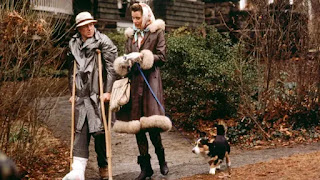

 Rose mentions obedience school. That suggestion brings Macon back to Muriel. She has a way with Edward, but she is not initially successful with training Macon. Muriel tells him that Edward isn’t taking him seriously. So, Macon even has trouble interacting with his dog. Muriel shows her unconventional side again, wearing a tiger-striped dress. She plays with items on the fireplace mantlepiece and has no qualms about exploring family pictures. When she finds out he writes travel books, she says she loves traveling. It fits with her extroverted style. In contrast he says travel is not liberating for him as he lets himself get bogged down in “red tape,” consisting of “ticket lines, custom lines.” She would love to see “romantic” Paris, but instead of acknowledging the wonder of the city, he mentions the rudeness of the citizens. Just like she helps to get the dog back in step with his surroundings, Muriel will help Macon return to a worthwhile life. As Maude in Harold and Maude is the mentor for Harold so he can see the total spectrum of life, it is Muriel’s job to add dimension to Macon’s limited world view.

Even from their first encounter, Julian asks about Rose, who smiles when she sees Julian. When Julian delivers some notes on Macon’s writing, the attraction between the two is obvious as they exchange agreement on the desire for marriage and children. Porter is not there because he went to a hardware store and may have become lost. This family is a real stay-at-home bunch.

That preference carries over in the scene where Macon, after having his cast removed, tells Muriel that he doesn’t go out to see films because he doesn’t “care for movies.” This fellow is such a fun guy. His words are ironic since he is a character in a movie. He says that films make everything seem too close up, while Kasdan gives us a close-up of the two, showing how filmmaking stresses its intentions. Muriel reveals about having a child and is divorced, so her son could use a father figure. Her romantic overtures are quite loud, but Macon is Beethoven-deaf to her flirtations.

Julian is at the Leary’s Thanksgiving dinner where Macon and Charles discovered the turkey was cooked at too low a temperature. Even cooking is a peril to these people. They don’t say anything about their trepidations concerning food safety until the bird is ready to be served, which embarrasses Rose, who prepared the meal. She shows her feelings, saying that they are conspiring to dampen Julian’s love interest in her because they want her to stay and take care of them and the house. She states that her brothers lost their chance at romantic happiness, and she will not give up her opportunity for success in love. Julian, showing his dedication for Rose, says he will have some turkey. Turns out he has two helpings and doesn’t get sick, which makes Rose feel vindicated about her feelings for him.

Muriel’s son, Alexander, has allergies to everything, maybe even what’s in the air, she says. She, too, has her burden in life to carry. She invites Macon to dinner with her and her son. He reluctantly accepts but then goes to deliver a hand-written note to Muriel saying he can’t make it. She opens the door to her place when he slips the note under the threshold. He finally shares his trauma with her and says he can’t have dinner with a child since it is too painful a situation for him. She silently holds him, allowing him to make an embracing confession. He says the loss of his son seemed unreal at first but now he feels worse because, instead of adapting over time to his death, the loss has become more real. He tells her, “Now, I’m far from everyone. I don’t have friends anymore. And everyone looks trivial and foolish, and not related to me.” His words ring true to anyone who has suffered a great loss. It jolts one into a broader perspective about life where everyday matters seem inconsequential. The numbing of emotions is an emotional defense to allow the individual to continue to exist, albeit in a blunted manner. Muriel tucks him into her bed as if comforting a child and says he can sleep there. She cuddles with him, and that closeness that he needed resurrects his physical need for intimacy which he consummates with her.

The next scene has Macon arriving at Muriel’s house and the neighbors recognize him, so we know he’s been around a great deal lately. He is even okay with spending time with Alexander, shopping for clothes, going to movies (which Macon used to dislike). When Alexander experiences negative behavior from other boys, Macon is there to comfort him. The boy holds onto Macon’s hand, establishing a father-son relationship that Macon lost. Macon is more upbeat now, even joking a bit, showing the effect of Muriel’s positive influence on him. The better-behaving dog, Edward, reflects the improvement in Macon’s personality.

In a way, Julian’s relationship with Rose mirrors that of Macon and Muriel. The publisher and the sister are also going through a rebirth cycle, as Julian is excited by Rose’s presence. He has an engagement ring and will ask her to marry him on Christmas. He says to Macon, “Isn’t it amazing how two separate lives can link up together? I mean two differences.” His statement could accurately apply to Macon and Muriel, too.

Porter wants to know what Macon is doing with, “this Muriel person.” The brother is condescending, saying that Macon is too good for the woman living in the slum with the diseased child, and that Macon has changed, obviously for the worse according to Porter. Macon knows he wasn’t such a “catch,” given his downbeat personality, and he probably is grateful for the change in himself. He tells Porter to shut up.

When Macon is concerned about Alexander’s inability to do math problems, he offers to pay to send the child to a private school. Muriel is sternly forthright when she asks about Macon’s intentions. She points out that she can’t jerk the boy in and out of schools if Macon is not committed to the relationship. She feels that sometimes he shows being ashamed to be with her, echoing what Porter said. She suggests that maybe he’ll even go back with Sarah. Their argument continues as he says in response to the possibility of them getting married that the institution is seriously flawed. She is angry, saying his decisions are selfish. Her words point out that Macon has no idea as to what he wants in the long term, and that lack of consistency impacts others with whom he is involved.

On Rose and Julian’s wedding day, showing the couple are not afraid to move forward with their lives, Macon encounters Sarah, who has learned that Macon is living with someone. The looks of Muriel from across the gathering show her worry about Macon having used her and is ready to return to his prior life. The man officiating at the wedding says that marriage is a sort of home, a sanctuary, where people can find solace in turbulent times. His words could imply that Macon might consider obtaining that peace either with Sarah or Muriel.

Muriel wakes up and sees a packed bag on the bedroom floor. Macon is just going to Canada for his writing, but she says that she doesn’t want to fear all the time that he will leave her. He says that he is not, but he tells her to go to sleep instead of definitively declaring his love for her.

Sarah calls Macon while he is in Canada, and says her lease is running out. She asks if she can temporarily stay at the family house. Rose is back there, too, taking care of her brothers, while delivering meals to Julian at their apartment. Sarah expresses feeling an emotional jolt when she received their divorce papers. Macon agrees to the living accommodations, but ends the call abruptly, showing he is upset. The past lives of both Rose and Macon are like black holes, trying to suck the two back into their insulated, womb-like existence. Sarah calls again after moving back to the house and says she is lonely, asks him to come “home” (that safe place) and that they can try to be together again. They do attempt a reconciliation, and even have sex. But, Sarah complains that Macon still lives “sealed up” and doesn’t share what he is feeling. He becomes angry and wants the discussion to end since it reminds him of how Sarah would bring up his faults and say that she knew him “better than he knew himself.”

Macon goes back to the house and Sarah says that she feels happy about being together again, enjoying the little things they shared doing together. She says, “anything different just doesn’t feel right.” The thrust here is that change is unwanted because it is upsetting. Rose tells Sarah, who asks when she is going to move back with Julian, that their apartment’s location would consistently confuse her and she would get lost when she left it. Her statement reminds us of Porter’s inability to navigate outside the family house. The Leary’s are definitely out of their element when outside of their comfort zone.

Macon types and narrates that travelers should not be “lulled into a false sense of security.” He pauses after typing and the sentence could reflect what is happening to him back at the house. Julian is worried that Rose has left him. Macon agrees that Rose (like himself and his brothers) has worn a “groove” in the house and can’t get out of it. Macon actually offers a helpful suggestion. He says that Julian should offer Rose the chance to help him at the office. He says to tell her that he needs her to “get things under control.” Macon knows of the appeal of a steady, safe routine, and believes his sibling Rose will respond to that request.

Macon gets on a plane to Paris. Apparently, Muriel is not ready to give up on Macon, and gets on the same plane after borrowing money for the trip to go to that romantic spot she hoped to visit, Paris. She argues that he needs her because he “was falling to pieces” before being with her. Macon clings to home by waking up Sarah with a phone call to maintain the umbilical cord to his safe past. Muriel pressures him into eating with her. Do they have beef bourguignon? No, they dine at Burger King, because, as Dorothy in The Wizard of Oz would say, “There’s no place like home.”

Macon sprains his back. He seems to require recovery after setbacks, which includes the psychological one involving the loss of his son. His accidents, which fit in with the film title, show how life is an unexpected obstacle course that one can’t escape. Sarah finds out about the back problem from Rose and arrives ready to help Macon. She will visit the other cities on his itinerary so she can help him with his writing. She informs him that Julian moved into the house with the brothers. This fact suggests that Julian is capitulating to the influence of the emotional gravity of the Leary household.

Sarah offers that they go on a second honeymoon after she is done traveling to the other cities. But she saw that Muriel was at the same hotel as Macon. Sarah wants to know if the other woman’s son was what attracted him to Muriel. She also brings up the idea of having another child, which Macon dismisses. It must seem to Sarah that he was fine having another child in his life, but not with her. She feels that Macon could have done something to prevent Muriel from traveling to Paris. There is the implication that Macon’s passiveness may have led to the death of their child. She gives him pills that anesthetize his pain, but the action is symbolic of her wanting to control him, to lull him back into his prior life.

Macon seems to realize that going backward is not the right path for him. He tells Muriel in the morning that he is going back to Muriel. He admits he didn’t take “steps” in the past in a proactive way, but thinks he should now. He says, “I’m beginning to think that maybe it’s not just how much you love someone. Maybe what matters is who you are when you’re with them.” Macon seems to be saying what an individual becomes with the person one loves is what’s important. If loving someone diminishes oneself, then the relationship is unhealthy. He realizes that one can’t plan life like “a business trip.” Life is too complicated and full of variables, so “things just happen.” Muriel helped him “step out,” and “stay out” of the “Leary groove.” He is opening himself up to the sometimes scary randomness of life, which can bring its joys.

A young boy helps Macon get a taxi, and the youth reminds him of his son. It is a sign that he is on the right path, as he encounters Muriel, who is ready to leave, thinking she has lost Macon. They see each other and they smile. He has found a new home.

The next film is The Prestige.

Sunday, April 30, 2023

Lost in Translation

 SPOILER ALERT! The plot will be discussed!

Lost in Translation (2003), written and directed by Sofia Coppola (she won the Oscar for Best Original Screenplay), has at its center two people who feel alienated from others and maybe even themselves as they search for what they want. This sense of feeling “lost” is dramatized by placing the main characters in a foreign land where they are not able to connect to the inhabitants due to the inability to understand the native language and some customs.

Bob Harris (Bill Murray) is an actor who is in Japan to do a whiskey commercial for a nice sum of money which he can use since his show business career has stalled. Tokyo is a modern city lit up like New York, but all the electric signs are in Japanese, which reminds Bob he is the foreigner, the outsider. Bob even sees himself in an advertisement, with Japanese writing next to his face, stressing familiarity and strangeness at the same time. Bob makes a bit or a racist joke about how his greeting is “short and sweet,” and, so, very Japanese. He does stand out as the tall one in the elevator, emphasizing how he is out of place. He receives a message from his wife, Lydia, that says he forgot his son’s birthday. It indicates that he is estranged from his family, which indicates his solitary situation.

He sits on his bed listening to classical music and looks inanimate, as if entropy has taken him over. At the hotel bar two young men recognize him and talk about a car chase in one of his films. He responds minimally to them, and escapes. He does not want the superficial and awkward intrusion of fans. He’s jet-lagged and can’t sleep. The communications he receives from his wife are not about how he is missed but instead are faxes about house remodeling which shows how removed from emotion their relationship has become. Bob’s out-of-sync existence here is stressed by curtains sliding open automatically letting bright light in his room in the morning, forcing him to wake up. And, the shower head only fits at a level that does not accommodate Bob’s taller height.


Charlotte, (Scarlett Johansson) is also sleepless in Tokyo. She is the young wife of John (Giovanni Rabisi), a very busy photographer who has little time for her and basically abandons her in Tokyo. John sleeps soundly, at peace with his life. He runs out in the morning with a drive-by “I love you,” to Charlotte as he rushes out the door. Charlotte is in her underwear a great deal in her room, suggesting she isn’t ready to meet the outside, alien world.

At the shoot for the whiskey commercial, the Japanese director goes on in his native tongue about what he wants. The translator says the director said, “he wants you to turn, look into the camera.” The perplexed Bob asks, “That’s all he said?” That confusion continues throughout the scene. What we have here is a failure to communicate (which is the famous line delivered by Strother Martin in Cool Hand Luke, a story about another outsider).

Charlotte is also experiencing alienation. She goes to a Buddhist shrine that has chanting monks. She wanted to feel something, make a connection to this far-off culture. But, she retreats to her womb-like hotel room and says in a phone conversation that she couldn’t feel anything at this religious place. She tries to express her solitary pain in the phone call but the person on the other end is distracted. Charlotte cries afterwards, showing how desolate she feels. When John returns for a bit all he talks about is his experiences.

Bob watches TV in his room and with everything in Japanese, he can’t find any distraction from his being ill-at-ease in this foreign country. It is funny and upsetting when he watches an old clip of himself dubbed into Japanese.

Then comes the hysterical “Premium Fantasy” woman (Nao Asuka) scene. She is sent by one of Bob's hosts. She shows her exposed leg with thigh-high stockings, and it sounds like she wants him to “lip” them when she actually means “rip” them. It is supposed to be some strange sexual role-playing, as she falls to the floor as if not wanting to be touched and then wanting to be. Bob is confused and embarrassed by this awkward bit of miscommunication.

Bob eats breakfast alone, but Charlotte is just as solitary walking anonymously in a crowd. Bob goes to a photo shoot for stills for the whiskey promotion. He makes jokes since the direction he receives sounds strange to him. For example, he is told to act like “007,” but he comments that James Bond drinks martinis. The director asks for “more,” or does he mean Roger Moore? More (pun intended) confusion.

Bob again seeks refuge in the hotel bar where the lounge singer (Catherine Lambert) performs in an overly dramatic manner. She sings American songs in a way that is not comforting to the visitors. Bob and Charlotte exchange amused looks and gestures across the room concerning the singing. In contrast to what has happened to them so far, there is a connection between them that doesn’t even require words. She is at a table with her husband and others but feels uninvolved with their words. She sends over what looks like sake to the appreciative Bob.

There are several funny quick scenes which show the effects of feeling out of touch with the surroundings. One such slapstick bit occurs when Bob gets caught on a runaway elliptical machine which he can’t control since it only responds to Japanese commands.

John runs into a previous photo client, a flirtatious actress named Kelly (Anna Faris). The two talk and Charlotte looks like she isn’t even there, which shows how one can be left out of the loop even when one’s own language is spoken. Kelly is going under the name “Evelyn Waugh,” which, as Charlotte notes to John, is the name of a male writer. The scene shows how inaccurate language can be if ignorance is involved.

After both can’t sleep and or find anything desirable on TV, Bob (who tries to talk to the bartender who wanders off – again no communication) and Charlotte meet in the hotel bar and begin to talk. When she asks what he is doing there, he is very frank, probably aching, despite his glibness, to connect with someone. He says he is “taking a break from his wife,” and has forgotten his son’s birthday. He is getting paid two million dollars instead of doing a play, which shows how he is admitting to being an artistic sellout. He says the “whiskey works,” so he can get a laugh to soften his opening confessional remarks. She notes that his twenty-five years of marriage is “impressive,” but he deflates her admiration by saying one sleeps one third of an individual’s life, so that brings it down to “sixteen and change.” As IMDb notes, Charlotte finds her husband and later others of her age as being superficial. She is intelligent and searching for answers, as she went to the Buddhist shrine and listens to an audio book about finding one’s true self. Perhaps that is why an older man, like Bob, might have more to offer. He says that when one is young and gets married, “you can drive but there’s still the occasional accident,” which can give hope to someone younger who is having marital questions. She notes that he may be having a “mid-life crisis.” She says that her major was philosophy,” the impractical study of a questioning youth. The older, cynical Bob says, “There’s a lot of money in that racket.” Instead of being upset she jokes by saying so far it’s been “pro bono.” They are beginning to understand each other.

Charlotte decides to go with John to the bar for a meet-up with Kelly. He is reluctant because he knows she doesn’t connect with Kelly, but she wants to spend some time with her husband. The conversation is vapid, including Kelly’s urging to have a “power cleanse.” Charlotte tells a DJ there talking about hip-hop music that she doesn’t know what he is talking about, which pretty much sums up her situation. Charlotte eyes Bob at the bar, who pretends to fall over, as if channeling what she is going through. She walks over to him, and he tells her he is “trying to organize a prison break,” to basically get out of the country. He wants an accomplice, and she says she is “in.” The scene is funny, but it also reveals how they feel trapped by their respective lives.

The soundtrack has a muted, dreamy feel to it, which reflects the unreal sense of being in a faraway land. Bob and Charlotte both use the hotel pool, and those familiar with The Graduate and Ordinary People know how that water experience can symbolize drifting with no direction. Charlotte asks Bob if he wants to come out with her to see some of her friends that live in Japan. He had said that he would be spending the week in the bar, another form of being lost in a liquid environment, so her invitation may be a wish to rescue him.

On the night out they are very relaxed with each other except when Bob arrives at Charlotte’s room. She notes how loud his shirt is by again mentioning his mid-life crisis. He goes into her bathroom and takes off his shirt to turn it inside out. Charlotte looks away, a bit embarrassed by this quick show of intimacy. The party with Charlotte’s Japanese friend, nicknamed Charlie Brown (Fumihiro Hayashi), has all young people there. Despite the age difference and even though there is still the language barrier, Bob has fun because he is with a kindred soul. When Charlotte sings her song, Bob repeats the word “special” as he looks at her. When he sings, he turns to her, as if dedicating his song to her. (When Murray sings karaoke, it brings up memories of his singing on Saturday Night Live). When she goes outside the room for a smoke break, Bob joins her and again they communicate without talking as he takes a drag from her cigarette and she leans her head on his shoulder showing how comfortable they have become with each other. When they get back to the hotel Charlotte is asleep and Bob carries her to her room. He tucks her in and there is a conflicting look on his face as she closes her eyes to go to sleep, which may be part lustful and part parental.

Bob seeks an affectionate connection with his wife on the phone as he shares what happened during the evening. She sent him carpet samples earlier and he says he thinks her choice was the best, but he doesn’t care about something so mundane. He just wants to attempt to reconnect with her. She hangs up before she can hear him say, “I love you.” They are out of sync in their time zones (she is getting up to take the kids to school and it’s the middle of the night for him) and in their feelings.

More great dialogue ensues when they go to a sushi restaurant. Bob again notes the culture clash when he says his shiatsu massage replaced his muscle tightness with “unbelievable pain.” She stubbed her toe, and he looks at it, saying it appears “dead” and he can’t allow her to put it “back in the shoe.” He says either she goes to a doctor or she must leave the toe there. He calls it “black toe,” and suggests they might serve it at the restaurant, exaggerating the type of food the Japanese eat. He employs fractured English and calls it “brack toe.” (There is a lapse in political correctness in the film since he uses the difference in cultures to elicit humor. However, there are beautiful scenes involving religious, social and marriage rituals).


Bob takes Charlotte to a hospital and again there is no understanding what the information clerk says so they must wing it even when it comes to a health issue. There was a good deal of improvisation in the film, because, after all, you have Murray to work with. As he waits for Charlotte to be seen, Bob tries to imitate Japanese with a patient speaking to him in his native language. Bob’s responses are so off the mark that there are two ladies in the background getting hysterical as they listen to Bob’s fractured Japanese. One of my favorite playful lines in the film occurs after Charlotte gets an x-ray of her toe (where, of course, she has no idea what the doctor is saying). Bob is waiting for her with a huge stuffed penguin doll. She asks if it’s for her and he says, “Yeah, it can be for you,” acting as if he bought it for himself.

Despite their bonding, there are several scenes still where Bob and Charlotte are by themselves, looking for diversion from their loneliness. Bob plays golf by himself, and Charlotte looks at pictures of herself and John, which suggests that she only has memories of how nice it once was between her and her husband. It could be that she sees Bob’s failing marriage as a foreshadowing of her own marital collapse.

Charlotte calls Bob and says he can meet her and Charlie and his friends at a club. It turns out to be a strip club and there is an almost naked woman contorting her body to the sounds of a sexually explicit song. When Charlotte arrives she asks where Charlie is. Bob hysterically says he is taking “dance lessons,” as she sees Charlie ogling the woman dancer. She wants to leave and again Bob is on the same page as her even if their surroundings are not.

Both still have insomnia, and given how long this inability to sleep has been going on it indicates the depth of their alienation. They spend time in Bob’s room. He notes her sadness since he has hardly seen her smile. Charlotte demonstrates her perplexity with the Japanese language, and Bob jokes that the locals switch the r’s and the l’s for “yuks” since the natives are not amused by the foreigners. When in doubt, he goes for the laughs to make it easier to deal with unknowable stuff. She says, “Let’s never come here again because it would never be as much fun.” Her line says so much. It shows how she is enjoying his company. It also indicates that she sees them as not ending their relationship because it points to future experiences together. However, it also shows how some joy is fleeting, and can never be recaptured.

They lie in bed next to each other and have a serious conversation. She says she is “stuck,” not knowing what she wants to be. She tried writing and photography, and felt she wasn’t measuring up. She wants to know if finding yourself gets easier. He reassures her that once she matures she will be more self-assured. She appreciates his honesty about how “hard” marriage can be since his wife used to need him around and now she doesn’t. He frankly admits that having kids is scary, but eventually is very rewarding. They are emotionally intimate, and the only physical contact occurs when he touches her foot, and this act is sweet and tender.

Originally, Bob wanted to get out of the country as soon as possible and that is why he didn’t want to do a talk show in Tokyo. But he now says he will extend his stay and do the show since he doesn’t want to leave Charlotte any sooner than he must. The talk show host is very over-the-top, wearing clothes that look like he stole the material from an awning. He does a strange welcoming dance and Bob, as usual, looks like he walked through the looking glass into a strange new world.

Bob receives a call from his wife while he is in a tile tub filled with water. She says the burgundy carpet he liked is not in stock and he should pick out another color. He says she should pick it out because, “I’m completely lost.” When she implies that he is making a big deal over a carpet color he says, “That’s not what I’m talking about.” We know he’s talking about his whole life. He says he wants to eat healthier the way the Japanese do. She snidely says he could stay in Japan and eat like that all the time. When he asks about the children, she again is on the offensive, saying they are getting used to not having their father around. After they hang up Bob sinks below the water, symbolically showing his marriage is also in jeopardy of going under water.

In the bar, the lounge singer sits next to Bob, smiles at him and says “Hi.” The next scene is Bob in bed and the singer is in his room, showing that they spent the night together. Bob does not look happy about what he has done, implying it was not the answer to his feeling of loneliness. Charlotte surprises Bob at his door asking if he wants to go to a restaurant. She hears the woman singing to herself in the background, and this discovery leads to Bob and Charlotte’s first “accident,” as Bob would say, on their relationship road. At the restaurant they are both sullen. She is sarcastic when she says it makes sense that he slept with the singer since, “she is closer” in age to him (than Charlotte, is the implication). She is jealous, and says, “Maybe she liked the movies you were making in the ‘70’s, when you were still making movies.” Her comment takes a shot at how old he is and suggests that he is a has-been. He retaliates by suggesting she is showing immature narcissism when he says, “Wasn’t there anyone else there to lavish you with attention?” Charlotte’s feeling “lost” is signified by her not being able to tell the difference between the offerings on the menu. Their very brief estrangement is seen in the fact that they are now silent.

A fire alarm wakes them up and while waiting outside Bob’s comic stance as he wears his kimono brings a smile to Charlotte’s face. They again bond as they criticize having to cook their own food at the restaurant. He’s leaving the next day and she says that she will miss him. At the bar, he admits he doesn’t want to leave. She says, “So don’t. Stay here with me. We’ll start a jazz band.” They are revealing their feelings for each other more openly now. The “jazz band” reference could show how they are in rebellion against what is around them, including the mediocre music that has been playing in the bar. They exchange a slightly off the lips kiss goodnight.

Charlotte says goodbye to him in the lobby unable to show a public display of affection despite Bob’s extended longing stare at her since there are a bunch of local people present who were attached to Bob’s visit. As he is driven away, he sees Charlotte walking in the street. He stops the car, and they share an extended hug and a long kiss. He whispers to her, and she says, “Okay.” There has been debate about what he says. But that isn’t the point. It is between them, a final act of connection in a disconnected world. The last shots are from the inside of the car, and we get Bob’s perspective as he now wishes he didn’t have to leave a city he first didn’t want to visit.

The next film is The Big Lebowski.