Showing posts with label relationships. Show all posts

Tuesday, December 14, 2021

The Station Agent

 SPOILER ALERT! The plot will be discussed.

 The Station Agent (2003) deals with some of society’s outsiders who come in different shapes, genders, and races, and how they struggle to make connections to each other and the world at large.

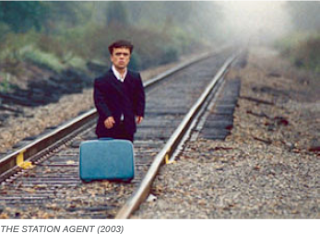
The film opens with Finbar McBride (Peter Dinklage) observing a train arriving at a city station. He pulls out a pocket watch that looks like the kind used by train conductors in the past. The image immediately tells us how he is linked to trains. He is a dwarf, and IMDb notes that St. Finbar was a religious hermit born in the sixth century. He founded a monastery which, ironically, attracted many people and the place became the Irish City of Cork. Fin’s name implies that he, too, wishes to be left alone, but may not be able to escape into a fortress of solitude. At this point, his attachment to trains may show how he would like to settle down in one secure place but must keep moving to find sanctuary.

Fin works at a train shop in New Jersey owned by Henry Styles (Paul Benjamin). It is called The Golden Spike, which refers to the spot where different railroad companies joined their tracks together. It suggests connection. But, at this point, Fin is quite a loner. One can understand why he wants to avoid people since as he walks on the street boys ask him if he knows Snow White, and when he shops at the supermarket, people stare at him and giggle.

Henry and Fin plan on going to a screening of a home movie made on a train trip, but their expectations are not great, and they are right since it is a boring presentation. There are several train enthusiasts attending, but there is no conversation between them, so the impression is that they are content in their oddness which brings them together, but not in a personal way.

In a quick foreshadowing, one of the miniature figures that Finn is painting at the train store topples over, and Henry immediately collapses in the shop and dies. Could the tiny figure represent the upheaval that the diminutive Fin will encounter? Fin meets with Henry’s attorney, Louis Tuboni (Richard Kind), who says in six weeks the shop and its contents will be sold according to Henry’s will. He left some property to Fin, which turns out to be a train depot in a remote part of the state, where according to Tuboni, “there’s nothing.” That may actually seem like an attractive prospect for the socially shunning Fin. The town is called Newfoundland, and the name can indicate a “new” start for Fin.

Like a solitary hobo, he walks along tracks as train cars go by. He reaches the station and looks outside which confirms its remoteness. However, the next morning he is awakened by a man setting up his food truck with the name “Gorgeous Frank’s ” written on it right next to the building. The owner is Joe Oramas (Bonny Cannavale), who is just the opposite of Fin. Joe is a very gregarious fellow who wants to engage Fin in conversation that Fin does not want to be part of. Joe says it’s his father’s truck, who is sick, and Joe has been taking care of business for the past six weeks in the meantime. From Manhattan, Joe is out of his element and he craves some companionship. The only way that Joe even knows that Fin lives right there is when the newcomer takes the mailbox and places it on the porch of the depot so can have access to it. The shot implies that the world as a whole is out of reach for Fin.

Fin is almost run over by Olivia Harris (Patricia Clarkson), who spilled coffee on herself and drove erratically as a result. It seems Fin can only meet people by accident. She offers to give him a ride but as usual he refuses. He offers Joe little information as to why he is dirty and refuses to go with him for a beer. He doesn’t like bars most likely because of receiving ridicule, but will not even drink with Joe alone or take a walk with him, so used is he to feeling safe when by himself. Finn stays where he thinks he feels safe from others as he walks along the railroad tracks. However, he attracts another well-meaning person, Cleo (Raven Goodwin), a young African American girl who follows him. He stops and just says “Hi” to her and she runs off. She is a bit of an outsider herself, and maybe she sensed a connection with Fin because his height matches her own.

There is a knock at the station which is disturbing to the hermit-like Fin, and it is Olivia bringing a bottle of bourbon as a housewarming/apology gift. She sees Fin smoking and she says that she slept with a guy when she was nineteen because he rolled his own cigarettes. It is an awkward statement, injecting a sexual element here. Fin doesn’t have a phone, adding to his desire to be off the social grid, and Olivia likes that, as she admits she has two phones and never answers them. She notes that her former husband gave her one of the phones, and her marital situation indicates she is also not in a connected place in her life. She is physically awkward as she knocks over a ticket box, symbolizing her unstable situation. She admits to losing her son two years prior, so we understand why she is in an emotional limbo. After revealing this fact, she wants isolation also, and tells Fin not to look at her.

She falls asleep on Fin’s couch and Fin slept in the bathtub, giving both of them their privacy. When she wakes, she feels embarrassed that she stayed overnight and runs out. Joe has met her before and suggestively jokes that she must have missed her train the prior night. Joe issues another unwanted knock on Fin’s door, gives him some coffee, and assaults him with unwanted questions about Olivia’s sleepover. He vicariously wants a connection to Olivia, and he so craves human contact, unlike Fin, that he makes Fin promise him that if he and Olivia do something later, he wants to join them. Olivia left her phone there which begins to ring. Fin finds out her address from Joe, and drops off the phone without even trying to talk with Olivia, despite having made her acquaintance. Meanwhile, Olivia is at her place painting, which also designates her as an artistic outsider, expressing herself on the canvas instead of to people. When she gets calls from her husband, she ignores them. A woman stops by and Olivia escapes, saying she has to go out. She is as evasive as Fin. They both wind up at the library, but Fin doesn’t have a library card yet. The library worker, Emily (Michelle Williams) doesn’t see his small-scale approach and is startled, dropping books on the floor, another example of how he doesn’t fit in with the expectations of others. Later, Olivia, who somehow feels safe around Fin, possibly because he is so unobtrusive, checks out the book for him and, according to Joe, leaves it at his doorstep, an attempt to make up for her overextended visit.

Cleo finally has a minimal conversation with Fin, who she innocently thinks, because of his size, might still be going to school. She does then ask if he’s a “midget” to which he responds, “no.” Much of his dialogue at the beginning consists of “yes” or “no” answers reflecting his desire to limit engaging with anyone. Some young men visit Joe’s truck and when they see Fin come out of the station, they make derogatory comments. Joe shuts them down and looks at them with disdain, which shows he is above their prejudicial way of thinking.

Olivia drives past Fin who is sitting near a pond reading. When she gets coffee at Joe’s, he finds out that she passed Fin. Joe asks for a ride to see Fin. While they ride together, she gives monosyllabic responses, mimicking Fin, which shows how she is like him in her social aversion. She does not want to join them, so Joe approaches Fin by himself and finds out that Fin is train watching. However, one goes by with very few cars about ninety minutes apart. Joe, who is starving for something to do, is no satisfied with the activity. They run into Olivia coming out of a store and Joe gets the other two to join him at his truck for dinner. Fin and Olivia seem uncomfortable with the arrangement as Joe tries to morph them into his version of the Three Musketeers. It’s funny when Joe asks Fin if people like him have clubs. Probably the first thing that comes into our minds, and also in Fin’s, is that Joe is making a prejudicial remark about Fin’s height. But Joe follows it with that he means people who love trains. Unfortunately, Joe, the glue holding these three together, must leave to take care of his ailing father. Olivia gets Fin’s lack of desire for social interaction and says she is “cool” with them just eating and not talking.

Joe now becomes Fin’s walking companion as they hike along the tracks and go to the pond to watch trains. The outgoing Joe narrates as he flings stones into the water to pass the time. He engages Fin by asking about the best train routes. Olivia drops off a camera at Fin’s because he admitted he can’t be a train chaser since he doesn’t drive and has no way to photograph the vehicles. Olivia meets Cleo who is pretending she is a conductor on one of the abandoned trains there. The young girl has a track spike collection, so she, too, is drawn to the world of trains, possibly suggesting her inner desire to hit the road and escape her solitary world.

Joe, the urban outsider in this rural area, continues to try to cement the connection with Olivia and Fin. They walk the “right of way,” which Fin explains comes from the government acquiring land to develop railroad passage. Joe, though tall, is the one who is like a child looking for something to do, quite the opposite of the other two, who retreat into their passions, trains and painting. Joe even wants to just play soccer with some kids who show up at his stand, accepting anything that will keep him occupied. Olivia comments to Fin that Joe, “does enjoy life,” which can’t be said for her and Fin at this point. That feeling overwhelms Olivia and she leaves to be alone.

Joe drives his truck and Fin uses the camera that Olivia brought him so they can indulge in some train chasing. Fin actually appears happy for the first time. Joe invites both of them to Olivia’s house so they can screen their film. Olivia is running late and is draped only in a towel when she lets them in, which again adds a sexual note to the encounter. It is the first time the two men see Olivia’s paintings, which startles Joe. As Joe cooks a meal, Fin and Olivia dip their feet in an adjacent pond, and Olivia says she is not used to having a loud person, such as Joe, in her house, again attesting to her state of solitude. She says that the house was a “getaway” place, and she really used to get away, because she couldn’t stand being in her former community where she was the “poor woman whose son died.” We now know why Olivia has withdrawn from the world, and she feels the pain of her loss and dislikes feeling pitied. But Fin gives us little of his backstory. When Olivia asks why he moved there, he jokingly says to be near Joe.

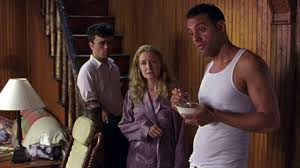
After they enjoy the meal and film together, Fin does admit when asked by Olivia that he was in love once, but he was young and angry, most likely due to harassment, which probably ruined the relationship. He is amazed how people single him out just because of his height even though he is just a regular “boring” person. He asks if she is still in love with her ex-husband, David (John Slattery), and she says yes. Was he fishing to see if he had a chance with her? Joe is passed out and Olivia insists that they stay over. There is a photograph of Olivia’s son next to the bed where Fin is, and he comments that he looked like a happy kid. Moved by Fin’s statement, she gives Fin a goodnight kiss on the lips. Unfortunately, David decides to show up the next morning to find Fin coming down from upstairs and Joe eating cereal. Olivia asks her two houseguests to step outside as Olivia and David argue over the presence of the other two men and the fact that Olivia will not answer David’s phone calls. Olivia is seeking solace from the loss of her son, but David’s appearance invades her emotional and physical escape.

Cleo doesn’t understand Fin’s desire to be left alone and wants him to talk about trains at her school. She is quite angry with him when he says he can’t appear. From her innocent viewpoint, which is the unbiased position the film seems to think we should aspire to, there is no logical reason why he should have to feel inhibited. Meanwhile, Olivia doesn’t show up for her daily coffee at Joe’s truck, not feeling social, and she takes some pills to cope after David’s intrusion. Joe has tried to adapt to being quiet and read along with Fin, just to share his company. But, he does attempt to obtain more personal history from him. Fin admits that he has had sex with a full-sized woman, but not with a person his own size. When Joe presses, Fin cuts him off, most likely not feeling comfortable as to why he should have to talk about how his life is different.

Now that he has verified his address, Fin is able to get his own library card. When he sees Emily again, she says he has a nice chin. It is an intriguing statement and Fin shares the observation with Joe, which shows how these two are becoming buddies. Olivia drives right past Fin and Joe, which shows how the encounter with her husband has made her withdraw into herself. Fin is at the grocery store when Olivia calls in an order as she is probably not willing to even to shop. Fin says he will deliver the items as he most likely wants to know how she is doing. But she has no interest in seeing him and is cold as she pays him for the groceries and immediately closes the door. Fin’s hurt is mirrored in his face as he probably feels that he thought he was getting close to someone who has now rejected him.

Fin told the surprised Joe that he would go with him and his dad to the local bar he was not previously willing to visit. But he is carrying this immediate hurt concerning Olivia there with him. Emily is waiting for her loser boyfriend Chris (Jayce Bartok) who is standing her up. He calls and she is distraught. She confides in Fin, telling him that she is pregnant. She was abrupt with Chris who drives over and pushes Emily around for telling him to get lost. Fin tries to keep Chris away from Emily and then he slams Fin into a car. Emily tells Fin to leave to protect him. Fin looks disgusted since it seems when he tries to connect with someone all he gets is grief. He slams the door closed to his station in anger.

Trains roar past his new home seemingly reminding him of how life is passing him by while he is stationed, as it were, in his predicament. The next day Joe comes by to apologize that he didn’t show up at the bar because his father was not feeling well. Fin is now angry at all the disappointment he has suffered by engaging with others and bluntly tells Joe that he wants to be left alone, which is the only way he feels emotionally safe. He wanders to the bench to watch trains go by and there is a shot there of a father showing his two young sons how to fish. The inclusion of this image sharpens the contrast between those that lead fulfilling average family lives and the outcast world of Fin. Meanwhile, Olivia’s husband continues to just reach her phone machine, as Olivia is absent even from the camera shot to stress her isolation.

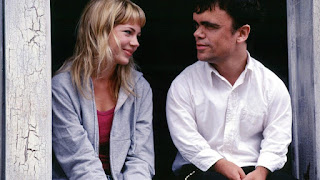
At night Emily visits Fin and apologizes for what happened with her boyfriend. She is on the outs with society, too, right now, as she relates how her family is in an uproar about her being pregnant. She was going to move in with Chris, but probably realizes what a jerk he is. So, she is feeling homeless. In their conversation, Fin says that long ago the station agent would deliver mail and even give haircuts. It is interesting that Fin lives in a place once occupied by a person who was so much a part of the community. Perhaps the building’s abandonment is a reflection on the current disconnected society. Fin says he’s retired now and when she questions why since he is not that old, he says that dwarves retire early. Emily is funny when she comments, “Yea, lazy dwarves.” They then share a passionate kiss, and she asks if she could just sleep there that night. They share the couch with their heads at opposite ends. There is intimacy without the two being physically intimate. She leaves the next day after the usually remote Fin gave her sanctuary for an evening.

Fin starts to sit outside Olivia’s house each day, smoking cigarettes and eating his lunch. He wants to monitor her without intruding, but it does come off as a bit of a stalking maneuver. One time she is on the phone having an angry conversation with her ex-husband. Fin approaches her on her porch to try to offer comfort, but it is bad timing since she is furious. She yells at him, saying she is neither his girlfriend nor his mother and he must leave. He goes to the crowded local bar and gets drunk as he sees those there, including Emily’s boyfriend, stare at him and smile, as if making jokes about him. He explodes, breaking shot glasses with his sweeping arm. He shouts, “Here I am! Take a look. Take a look!” Joe, Olivia, Emily, and Cleo invaded his solitude, and he can’t hide by blending into the background at the bar. He feels as if he can’t escape notice which brings along with it hurt feelings. So, he changes from being a covert center of attention to an overt one.

He stumbles back toward the station on the tracks, the objects that gives him direction. But he is intoxicated and he falls. He sees the light of a train coming at him and he smiles, as if wanting death to free him from his emotional torture. But, it was just an alcohol-induced dream. He wakes up on the tracks. However, his pocket watch was smashed. Could it mean he is ready to move on away from his restrictive past?

He visits Olivia’s house again. She is on the floor and a bottle of pills is next to her. She has fallen, literally and figuratively, just like Fin, by taking a supposedly pain-killing substance. So, what is happening to them bonds them together. She says that David is having a baby in his new relationship, which obviously is horrible for Olivia, as she sees him as replacing loss with hope, which she is not capable of doing in her life. She falls crying into Fin’s arms, and now he is there at the right time to offer her comfort. The next scene has Fin sitting in a waiting room as a doctor talks to Olivia. The implication is that he helped her seek counseling.

Finn, after successfully aiding Olivia, now reaches out to Joe and they greet a smiling Olivia as she is discharged from the hospital and they take her home. Fin and Olivia spend time together in a serene shot near the calming pond. Fin, no longer trying to hide, goes to Cleo’s classroom to talk about trains. He tells the students that the first train was called the “Tom Thumb,” which links him to his passion based on the size reference. The film is not about to say everything will be okay, since one boy makes fun of Fin’s height, and the teacher pulls him out of the class.

The story ends with a relaxing and humorous night scene on Olivia’s porch where Joe has made dinner for her, Fin, and himself. Joe says there is plenty of food left over for the next day. Olivia smiles at him, as his words point to the ongoing friendship between the three. A child in the class asked about another mode of transportation, blimps. Fin asks Olivia and Joe if they know when blimps were invented. Joe says Fin can go to the library and ask Emily. Joe talks about a librarian fantasy, where she loses her glasses and books fly everywhere. Fin says Emily doesn’t have glasses. Olivia tells him, “Well, buy her some, it’s worth it.” Trains have now become a symbol for bringing people together.

The next film is Pickpocket.

Sunday, August 2, 2020

Wild Strawberries


SPOILER ALERT! The plot will be discussed.


Wild Strawberries (1957), written and directed by Ingmar Bergman, deals with familiar issues in the filmmaker’s stories. There is the preoccupation with death and also the anguish that exists between men and women during various stages of romantic relationships. The road trip in the story becomes a journey down memory lane with revelations about feelings surrounding those memories.

Although there are flashbacks that expand the amount of elapsed time taking place, the film has the immediacy of a stage play, as it takes place in one day, conforming to the Aristotelian rule of unity of time. The opening of the film has the main character, 78-year-old physician Dr. Eberhard Isak Borg (Victor Sjostrom), writing his memoir. He sets the stage for his current situation. He says, “In our relationships with other people we mainly discuss and evaluate their character and behavior.” Basically he is saying that we become critical of those around us. This process has led him to become more withdrawn from society, shedding connections to the world, and concentrating on his nonpersonal study of science to escape his loneliness. Other facts, such as that he is a widower and has a son who has no children (suggesting no compensation for his dying by at least having a bloodline to continue his legacy) bring sadness to a man in decline. Borg hesitates at a chess board, but then makes no move, because maybe his life contains no more moves (a reference to Bergman’s The Seventh Seal, how the knight at least tried to beat death at a game of chess?). He is to receive “an honorary degree at Lund Cathedral,” the type of accolade that one receives as one approaches the end of life. 


Borg has a nightmare where he walks in intense harsh light, which produces a disturbing effect. (Bergman’s dream sequences are limited in their surrealism, but instead seem realistic in many ways, which makes them less distancing and thus more chilling). He is lost, and there are “ruined houses” everywhere. The scene suggests a loss of control over one’s life, and of decay. He has a vision of clocks without hands, possibly indicating how he is no longer alive since he is not passing through time, or his time has run out. There is the increasing sound of a heartbeat which abruptly stops, which augers the end of one’s existence. The streets are deserted, showing the absence of life. He sees the back of a stationary figure whose face turns out to look like a featureless, doll-like version of a human visage. The “man” then collapses and decays, with blood oozing out. The shot suggests someone who is both alive one moment and a corpse in decay the next. There then is the sound of a clock chiming, but it is that of a church bell signaling a funeral, as an unmanned horse-drawn hearse passes Borg. The wheel of the carriage gets caught on a streetlight. As the horses struggle to advance the vehicle, the hearse has an annoying squealing noise, which mimics the sound of a rocking baby carriage, suggesting how fast is the time between birth and death. The wheel comes off, and the casket falls and opens. Borg sees a hand hanging out. As he approaches the coffin, the hand grabs him, and he sees his own body pulling him toward death.

Borg wakes and tells his longtime live-in housekeeper, Agda (Jullan Kindahi) that he has fifteen hours before his ceremony and has decided he wants to drive to it, which upsets her plans and that of his son, who expected to meet him at the airport. They squabble but she may be his only long-term connection to another person at this point. When he tries to compliment her, she seems sour because he has disrupted the way she wanted to enjoy the day. He seems hurt by her reaction. There is almost a mother-child relationship going on between them at this point in his life as she tries to take care of Borg and reprimand his unacceptable behavior. Marianne (Ingrid Thulin) appears at breakfast, asking to get a ride with him. She is Borg’s daughter-in-law, and she has been staying at his house, which suggests that there has been trouble with her marriage to Borg’s son, Evald (Gunnar Bjornstrand).
As is seen in his exchange with Agda, Borg likes things done his way. He is bossy and sexist, saying there ought to be a law prohibiting women from smoking. But, he concludes, men can smoke cigars because it is an acceptable “vice” because it is “stimulating and relaxing.” When she asks what vices a woman can indulge in, he stereotypes females, and is condescending, saying she is allowed, “weeping, giving birth, and speaking ill of her neighbors.” (That birth can be considered a vice becomes clear later). She asks how old he is, suggesting that his ideas are old-fashioned. He says he knows she never liked him, but he is married to his son, and they are alike and hold the same principles. He brings up the fact that he lent money to Evald, and his son knows he must pay it back. She points out she knows that her husband shares his father’s ideas, but points out that Borg is wealthy and the loan prevents them from being independent of his influence over them. He continues to stress the point that “a promise is a promise.” Her brutally honest response is that, despite their similarities, Borg’s son “hates” him. This revelation seems to sting the old man, but also implies self-hatred since father and son are similar. 

Since they have opened the door to frankness, Borg asks why Marianne does not like him. She tells him, “you’re utterly ruthless and never listen to anyone but yourself.” She says he puts on the appearance of being “benevolent,” but he is “hard as nails” beneath his charming exterior. Borg says that when she asked that she be able to stay with him for a bit he says he said he was “delighted” to have her as a guest. He has altered his memory to fit the lens of how he views himself. She says he told her that he didn’t want to be involved in their marital problems, and that they should work it out themselves because, “I don’t give a damn.” She adds that his cold comment was, “I have no respect for mental suffering, so don’t come lamenting to me.” He appears to see emotional suffering as a weakness, an attitude which can cause one to lose empathy for the suffering of others. 
On the way, they stop at a house in the countryside where Borg’s family would vacation in the summer when he was a child. He notes to himself that is where the wild strawberries grow. The title of the film thus suggests that Borg, as an old man, is thinking about his early years now, possibly wanting to retreat from death’s approach. He has a daydream of what the house looked like years ago and sees Sara (Bibi Andersson), picking the strawberries. (Borg does not picture himself as a youth in his flashbacks, but is his elderly self, suggesting that he is entering his past like a time traveler, visiting his younger days from his present time). One of his many brothers, Sigfrid (Per Sjostrand) is attracted to Sara. He kisses her and she responds, showing great regret afterwards since she is to marry Isak. Since Borg was not present for this encounter, is he imagining what happened, did Sara tell him, or is he having some type of magical experience? 


Borg’s twin sisters, Kristina (Lena Bergman, the director’s daughter) and Brigitta (Monica Ehrling) are humorous as they speak the same words loudly and in unison, providing a doubling of annoyance. Old Borg wanders through this past scene like a ghost haunting his own life. Uncle Aron (Yngve Nordwall), whose birthday it is, has a hearing-impaired horn which others must shout into, making him a trying person to deal with from the children’s perspective. Aunt Olga (Sif Ruud) dominates the dinner table with an iron hand, dictating what the children are to do and what not to do, such as not to bite their nails. The twins saw Sara and Sigfrid in the wild strawberry patch. Sara throws her spoon at the twins and runs out, embarrassed and ashamed. Sara feels that Isak is good to her, but he is refined, proper, and talks about sin, and she feels inferior to him. However, Sigfrid is “bold and exciting,” and it appears she has more passion for Sigfrid. After mentally traveling to his past Borg says he feels “overwhelmed by feelings of emptiness and sadness” as he sees the opportunity he missed with Sara, whom he truly loved, but who did eventually marry Sigfrid. 


Borg comes out of his reverie when a young woman, also named Sara (Bibi Andersson playing both women) approaches Borg and asks if it is his car nearby. After finding out his name, she jokes about the bible saying Isak and Sara were married, but he corrects her by telling her it was Abraham, which points to the fact that Isak never married the Sara of his past. She asks for a ride south as her ultimate destination is Italy. She is traveling with Anders (Folke Sundquist), who is her boyfriend, and Viktor (Bjorn Bjelfvenstram). She intimately says that she is a virgin, and says she smokes a pipe, which she has in her mouth often in the film. The pipe could be a phallic symbol, hinting at her desire for sexual awakening. Sara is provocative as she admits that she is involved with Anders, but says Viktor is attracted to her, too. Thus, there is a rivalry for her affections, which mirrors Borg’s past, especially since Viktor intends to be a doctor. Borg admits he was once in love with a Sara, who married his brother, had six children and is still alive and beautiful at the age of seventy-five. He says it casually, but his brother lived the life that he wanted, and now it is too late for him. Sara says she can’t think of anything worse than growing old, and then realizes she insulted her driver, who just laughs. Her youthfulness stresses the discrepancy in their ages. Borg’s daydream of the past has materialized into the reality of the present, possibly implying that he can’t escape his destiny.

As they drive with the hitchhikers another car swerves into their lane and almost causes a collision. The oncoming vehicle flips on its side, but no one is hurt. Borg and his passengers help the husband in the other car right the automobile. The husband says they were having a quarrel and his wife was driving and became distracted. The wife is very demeaning toward her husband, talking about his selfishness. She shows her jealousy as she talks about him having “flabby muscles” but still trying to impress Marianne. She has a smug smile on her face when her husband tries to drive the car and it does not operate. We have an example of a relationship gone wrong, which contrasts with Borg’s idealized dream of his love for the younger Sara.


The man, Sten (Gunnar Sjoberg)) and his wife, Berit (Gunnel Brostrom) become additional passengers on Borg’s journey, the car containing a variety of different variations on romantic relationships. Borg, who had withdrawn from social interactions, now is confronted with a number of them. He does not adapt well at first as he is annoyed by Sten’s constant whistling. Marianne is driving and Berit looks harshly at the back of her head, her jealousy being evident. Sten tells them Berit is an actress, so one can’t tell how genuine she is, convincing others she once had cancer. Could it be she was trying to get back her long-lost attention from her husband? Marianne comes to Berit’s defense, saying Sten should leave her in peace. He is sarcastic, saying one should not “get in the way of a woman’s tears,” suggesting that a woman’s crying is a defense mechanism used by her gender. Sten then compliments Marianne’s beauty, while saying Berit is “a bit past her prime.” Marianne says she can sympathize with Berit for several reasons, since she obviously has had her problems with her marriage as well. Sten says it’s his Catholicism that allows him to be merciful toward his wife’s behavior, which of course he isn’t in the way he talks about her. Berit can’t take his sarcasm anymore, and she begins to smack Sten. As he continues his verbal abuse, Marianne has had enough. She kicks them out, saying she wants to protect the younger passengers, possibly hoping to shield their youthful hopes of idealized love in their future.
Borg arrives in the area where he first practiced medicine, and where his ninety-six-year-old mother still lives. They stop at a gas station and the manager, Henrik (Max Von Sydow) and his expectant wife, Eve (Ann-Marie Wiman) praise him for being a wonderful doctor and show gratitude for his past kindness, which contrasts with the man he has become later in life. They refuse to let him pay for the gas and want to name their child after him. He volunteers to be the godfather, as he now welcomes and reaches out toward these people from his past.
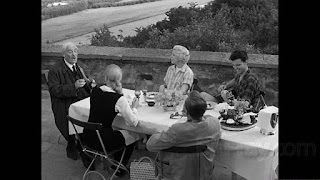
Borg enjoys being social now when they stop for a meal and the others enjoy his stories about his medical director work in the area. Sara says that Anders is going to be a minister. The man of faith contrasts with the man of science, Viktor, as they argue about the existence of God, as Sara tries to mitigate any hostility that may result from the debate. They ask Borg what he believes and he, with the help of Marianne, quotes a poem that talks about the divine beauty in the world. The response mixes nature with spirituality, which contrasts with Borg’s earlier statement about just loving science.
Marianne accompanies Borg as he visits his mother, (Naima Wifstrand). The old lady, at a distance, thinks Marianne is her son’s wife, and wants nothing to do with her, which indicates that Borg had a troubling marriage. The mother is critical that Marianne and Evald have no children, and notes that she had ten, implying Marianne has not lived up to the traditional maternal role. Perhaps the movie suggests that some feel that having children is the way to fight death because it creates new life. Borg is the last of her living children, which adds to the feeling of the fragility of life. Isak is literally the last man standing as death now waits for him. Mrs. Borg lacks generosity as she says her inheritance will not be divided up as her children had thought because she has outlived almost all of them. Mrs. Borg says she feels cold and has felt that way for a long time, which suggests her lack of emotional warmth. Mrs. Borg has a box of her children’s toys, which include a watch without hands. That object is what Borg saw in his nightmare, and adds to the sense of how quickly time has passed between when he was a child to his current state of old age. 
Borg and Marianne return to the car and find Sara alone. She points to the two young men fighting on a hill over religion again, this time adding a physical altercation to their cerebral battle. Sara sent them off out of frustration. Borg listens with amusement as Sara weighs which one of the two lads she likes better. Marianne retrieves the men, acting as a referee. After getting back in the car, Sara asks them comically, “Well. Does God exist?” She is mocking them by suggesting that their fighting is pointless and prideful to think that the two of them could settle a centuries old debate.


Borg sleeps in the car and has another dream. At first he is back in the wild Strawberry patch, the place of his youth, and young Sara holds a mirror which reflects his aged face. Her whole life is ahead of her but he is now close to the end. She asks him to accept it and smile, but he admits that is painful to do, because accepting one's mortality is very difficult. Sara goes to a crib and comforts her baby niece against the scary world she will encounter. After she goes inside the family home, Borg stands near the crib, and the image of where life begins next to where it is headed is haunting. He looks through the window of the house and sees Sara having a lovely dinner with Sigfrid, which shows he has been left out of the life he wanted. 


Borg bangs on the side of the house and is invited in by Sten, the man from the car accident. A room inside becomes a medical classroom with the film’s other characters in attendance. Sten, who is now the Examiner (we tend to mix people and things together in our dreams), gives Borg a test. He can’t see anything in the microscope except the reflection of his own eye, implying he can’t see beyond himself. There are words on the blackboard that are gibberish to Borg, but the Examiner says they state a doctor’s first duty to his patient. Borg says he can’t remember what that is. The examiner says it is to “ask for forgiveness.” The film seems to be saying Borg has left his humility behind as he has grown older, which has led to a lack of empathy. He is then told to diagnose a patient. The patient is Berit (Sten’s wife), and Borg says she is dead. But she is not, and laughs derisively at Borg. The Examiner has decided that he is “incompetent,” and is accused of “callousness, selfishness, ruthlessness.” He says that his “wife has made the charge.” So, his subconscious mind has put himself on trial for how he has acted in his life since he was young. 

The Examiner then takes Borg to witness an intimate encounter between his wife, Karin (Gertrud Fridh) and a lover (Ake Fridell). After having sex, Karin says that her husband acts like he’s a god lording over her, condescending, and “cold as ice,” which reminds us of the way his mother referred to herself, and suggests that the lack of emotional connection is hereditary. Whenever he acts tender, she says, “his hypocrisy makes me sick.” These are most likely the reasons why she has been unfaithful to him. After she disappears, and Borg asks where did she go, the Examiner comments that she was “removed by an operation.” He says it was, “A surgical masterpiece. No pain. Nothing that bleeds or trembles.” Basically, Borg removed his wife from his feelings. Borg comments how silent it is, which is a symptom of the punishment for his “guilt,” which is “loneliness.” 


When he awakes the young people are gathering flowers to honor him on his award night. Borg tells Marianne that he had a dream that shows, “That I’m dead. Although I’m alive.” That zombie-like doll in his first dream is mirrored here. He says it was, “as if I must tell myself something I won’t listen to when I’m awake.” He is saying that his subconscious is informing him about his life. Marianne sees a connection between Borg and his son. Marianne recounts a scene which duplicates the one they are in, only Evald sat where his father now sits. She told him she was pregnant, and she intends to keep the child although Evald strongly reminds her he doesn’t want to bring a baby into this world. He gives her an extreme ultimatum, telling her she must choose between having the child or being married to him. He states how he was unwanted and lived in a home where there was a “hellish” marriage. Since his mother was unfaithful he wonders if he is even Borg’s son. The viability of marriage and parenthood is once more brought into question. He says this life “sickens me.” He says Marianne’s desire, which he again describes as “hellish,” is to create life while he wishes he were “stone-dead.” So, despite his questions about his parentage he is very much his father’s son. 

Borg has now become more understanding and tells Marianne that it’s okay for her to have a cigarette, which he had forbidden earlier. She wonders, after they visited Borg’s mother, if Mrs. Borg’s frigid personality was passed on genetically since both Borg and Evald each considers himself to be a “living corpse.” She wants the Borg’s alienation from the living and its subsequent loneliness to come to an end. She wishes to have the child, so she left Evald. However, she ran to her husband’s similarly predispositioned father, showing how she is emotionally torn. Borg says he sees the same strife between Evald and Marianne that was in his marriage. And, they both acknowledge the same unhappiness between the husband and wife in the car accident, suggesting to them that couples may be doomed to a life of misery. 


This depressing scene is then counterbalanced by the young people giving Borg wildflowers, an appropriate gift from the young, to commemorate his lifetime of accomplishment as a doctor and being a “very wise old man” who “knows everything about life.” But Borg is questioning his wisdom in his private versus his professional existence. The three young people say they hope he will live for many more years. Their celebratory attitude toward one that helped those in need reflects an affirmation of life. The brightness in the lighting of the scene quickly changes to one of darkness as only Borg is seen. His voice-over says it’s getting late, not only because the award ceremony is approaching, but so is his time on earth drawing to a close.


They arrive at Evald’s house, but Marianne says she will only stay the night. However, he and Marianne admit that they are glad to see each other. Borg’s housekeeper, Agda, has come there, too. Along with the young people, there is a sense of at least a temporary respite from Borg’s isolated life. The ceremony is very formal, carried out in Latin, and preceded by a long processional with many people in attendance. Even cannons are fired to salute Borg. It is an extreme rendering, and one feels as if Bergman is satirizing the unemotional pompousness of being saluted by many strangers, as opposed to the simple sincere gratitude of the gas station attendant and his wife. Borg’s voice-over seems to validate this perception because he is thinking of the events of the day as the ceremony is taking place. 
After the event Borg is considerate of Agda, saying she needs a good night’s rest and offers her some of his sleeping medication. He also apologizes for his disagreeable attitude earlier in the day. She thinks he is ill since his kind behavior is so atypical. Borg, looking to get paroled from that sentence of loneliness, says after all these years she should be able to call him by his first name. But she is adamant about maintaining her professional integrity. However, there is a smile on her face as she tells him she is there if he needs her. Sara, Viktor, and Anders serenade Borg as he comes out on the balcony of his bedroom. Their youthful playfulness and scaled down praise give Borg more satisfaction than the stiff proceedings earlier. Sara, the hitchhiker, symbolically joins with the Sara of Borg’s youth, as she says, “it’s you I really love, you know. Today, tomorrow, always.” There is a sweet sadness to her words, which are presently comforting but also suggestive of a missed opportunity. The three young people take a sort of curtain call as they depart.
Borg is in bed ready to go to sleep, but Evald visits him before going to the dance which follows the ceremony. Borg asks Evald about what will happen between him and Marianne. Evald looks away from his father as he is caught in his own dilemma. Evald admits he doesn’t know how to live without his wife, but the problem of having the child remains for him. Borg is now generous as he wants to forgive the loan he gave to Evald. Afterwards, alone with Marianne, Borg warmly tells her that he likes her, and she returns the affection after they have bonded during their revealing journey together. 

In the voice-over, Borg says it “calms” him to recall his childhood memories. He mentally revisits the country house with all his siblings having a happy time in that pastoral setting. Sara, like a spiritual guide, or muse, escorts him to a lovely setting where his father fishes with his mother close to her husband. He is trying to reach out to others now in his old age, and in his memories, he can return to his youth, bridging that great time divide. 

The next film is Glory.

Sunday, December 27, 2015

Rear Window

SPOILER ALERT! The plot of the movie will be discussed.

Alfred Hitchcock’s Rear Window is aptly titled. In the literal sense, L. B. Jefferies (James Stewart) looks at his neighbors carrying on their day to day activities through his back window into theirs. But, on a thematic level, the film shows what it looks like when we penetrate (sexual connotation intended – consider Jefferies's phallic appearing telephoto lens) the worlds of people that they would rather keep hidden from the scrutiny of others. As Lt. Thomas Doyle (Wendell Corey) says to Jefferies later in the film, “That’s a secret private world you’re looking into out there. People do a lot of things in private they couldn’t possibly explain in public.”


As usual in Hitchcock’s movies, we are made complicit here in the voyeurism of his main character as he peers into, one may say violates, the privacy of the those living across the courtyard of his apartment. We, the audience, may, at first, be appalled by Jefferies's Peeping Tom activities. But, we are drawn in by the same curious desire to watch the stories of others, the more lurid, the better. Hitchcock is saying that not only is this aspect of human psychology universal, it certainly is part of the nature of watching films. He emphasizes this point by reminding us of the connection between films and voyeurism over the opening credits. The camera is directed through the window of Jefferies’s apartment as the shades rise up, revealing the view, just as a curtain would rise, as it did years ago, in a movie theater. The windows of the apartments appear as story boards that are used to plot out a movie story in illustrated scenes, or may even be suggestive of the "cells" in film celluloid. They may even imply different movie narratives being viewed on split screens. There are the sexual stories served up with the views of Miss Torso and the Newlyweds; there is the sad tale of Miss Lonely Hearts; we have the desire for success in the plot surrounding the Songwriter; there is the slapstick comedy of the couple sleeping on the fire escape when it starts to rain; and of course we have the mystery involving Thorwald (Raymond Burr) and his eventually missing wife. When Lisa Carol Fremont (Grace Kelly), Jefferies’s girlfriend, playfully introduces her name she announces it “reading from top to bottom,” the way credits are displayed in a movie. There are mentionings of “opening night” and a “sold-out house,” again reminding us of the audience’s role of being a viewer of the actions of the others, just like Jefferies, and eventually Lisa and Stella (Thelma Ritter), Jefferies’s physical therapist. The audience identifies with Jefferies as he, too, is viewing a story in the dark, and his responses mirror what we see as we watch what transpires. Earlier on Stella is upset by Jefferies’s peering, and says “We’ve become a race of Peeping Toms,” and should turn our eyes on ourselves; that way, maybe if we saw our own imperfections, we wouldn’t try to expose those of others. But, later she is drawn into the spying, and wants Jefferies’s telescopic lens, saying to him, “Mind if I use that portable keyhole?”


Jefferies is immobilized in a wheelchair with a full leg cast for broken bones sustained during one of his photo shoots. He is a journalist who enjoys putting himself in danger in the field. Hitchcock shows us the picture he took of the car crash he shot which resulted in his injury. So, he is a professional observer who enjoys placing himself in harms way to capture the actions of others. In this way, he is ideally suited for this story because of the dangerous situation he assumes investigating the possible murder across the courtyard. He is at particular risk this time because he cannot escape from his predicament. In a way, his apartment is a prison. This theme of an innocent man at risk of being incarcerated is a continuing theme in Hitchcock’s films, probably going back to the time he was placed in a jail as a child for being a truant to teach him a lesson. He learned it well, only in a different way. His movies show a major distrust of the authorities.

Actually, all of those people Jefferies observes are sort of in their own prisons. The Songwriter is held captive by the need to find that special romantic tune for which he longs. Miss Lonely Hearts is trapped in her emotional isolation, inventing suitors, and accosted by one trying to take advantage of her when she summons the courage to seek a man out. She almost succumbs to suicide because of being held captive by her emotional stress. The voluptuous wannabe dancer, Miss Torso, appears to be very popular, but as Stella points out, she must fight off the male wolves to find someone genuine. The newlyweds appear happy, but the groom eventually looks as if he is caught in a sexual prison, going to the window for relief from his bride’s physical demands. Even Lisa is figuratively confined by being stereotyped as a woman who can't be adventurous because she is a woman. And then there is Thorwald trapped in a marriage to a nagging, demanding wife, who is herself an invalid, mostly confined to her bed. The films shows a variety of ways the characters deal with their various forms of incarceration. All of these stories have romantic relationships at their center.


Jefferies shares in that theme, because he is trying to deal with his girlfriend, Lisa, who wants to get married. She is a city woman who is involved with fashion. He cannot see them together because she is high society and he is always off and running with little warning wearing combat boots, driving jeeps and going to places with scary food options. She refuses to take no for an answer, however. Jefferies almost seems to want to escape his own predicament by viewing the lives being lived out in the other apartments. But, instead, their romantic stories reflect back on his own situation, giving him no relief. He makes disparaging statements about marriage to convince himself that a union with Lisa is not right for him. He says the Songwriter lives alone probably because of an “unhappy marriage.” He states that he thinks marriage will make him static, unable to be active and go places. However, the irony is that he has become stationary because of his so-called active life. When talking about relationships, Jefferies keeps speaking about them in a logical manner. Stella reminds him that there should not be so much thinking involved in matters of the heart. Jefferies’ defense mechanism is divorcing himself from his emotions.  


Jefferies becomes more and more suspicious, as do Lisa and Stella, as he (we) see Thorwald cleaning a large knife and saw, and taking his salesman suitcase of samples on multiple trips at night. Then there is the disappearance of his wife while her purse and jewelry remain behind. Jefferies’s policeman friend, Doyle (Wendell Corey) dismisses their suspicions, saying that Mrs. Thorwald was accompanied by her husband to catch a train to visit a relative. Jefferies and the women believe Thorwald was with his mistress, and seek out evidence. Lisa becomes very bold, and her audacity now makes her very attractive to Jefferies. She enters Thorwald’s apartment after Jefferies lures Thorwald away with a phone call threatening to reveal his crime. Lisa is surprised by Thorwald, but Jefferies is able to summon the police. In a thematically significant image, Lisa shows she has Mrs. Thorwald’s ring on her left hand. This action shows how she is marriage material for Jefferies, as she is more adventurous than he gave her credit for. But Thorwald sees that she is signaling with the ring, and he looks right at Jefferies’ window. Reversing the roles of observed and observer. This cause and effect also shows how danger is attached to relationships. 


In the end, Thorwald comes for Jefferies while Stella tries to get Lisa out of police custody for breaking into Thorwald’s apartment. Jefferies is able to get a call off to Doyle before his assailant arrives. The photographer is only armed with the tools of his trade – a camera and light bulbs, which again stresses the way the movie refers to how movies capture images by using light and darkness. He keeps flashing the bulbs at Thorwald, temporarily blinding him and slowing him down. It’s as if Jefferies has almost no qualms about invading the lives of others (except at one poignant point with Miss Lonely Hearts), but when someone exposes him, he tries to stop them from seeing his world.

Jefferies is rescued by the police, but not after sustaining another broken leg for his precariousness observations. we have all the tales ending happily. Miss Torso is reunited with her true love, who survives his hitch in the military. The Songwriter finds his love tune, which touches Miss Lonely Hearts when he plays it, preventing her suicide. The two are seen together at the conclusion of their movie (and ours). Love and relationships will continue, even though there will be conflicts. The Newlyweds are already sailing through rough waters when the bride finds out that her new husband quit his job. We now see through our eyes (and through the movie's camera lens), since Jefferies is sleeping, that Lisa now wears jeans and is reading a book entitled Beyond the High Himalayas, showcasing her wilder side. But, she then puts the book down and shows how she will retain some of the more traditional feminine aspects when she picks up a copy of Harper’s Bazaar. These two will be joined in the future, but battles may ensue. We have vicariously witnessed the dangers and rewards which accompany the interaction between couples, and the shades to the apartment are then lowered, like the curtains at the end of a film.

The next film to be discussed will be Crash.