Showing posts with label cult film. Show all posts

Sunday, May 4, 2025

Eraserhead

 SPOILER ALERT! The plot will be discussed.

We recently lost one of the quirkiest and most artistic film directors, David Lynch. Some people hated his work, others love it, and those who love some of his projects dislike others. In any event, he was a challenging filmmaker. I was lucky enough to see Lynch in person at an interview at the Bryn Mawr Film Institute. He related that he was an art student in Philadelphia when he saw air blowing through a window which caused his painting to move. He said it was then that he decided to make motion pictures. He said living in Philadelphia was not a pleasant experience as he observed violence and decay. However, the experience influenced his filmmaking. His movies explore the underbelly of existence. Think of the opening scene in Blue Velvet when the camera moves from the beauty of the garden to the insects swarming over a human ear.

Lynch’s first full-length film, Eraserhead (1977), in black and white, gives us that dark view in a surrealistic landscape. To attempt to analyze this unique work in a traditional manner would be unfair to the film. As Roger Ebert said, “to explain Eraserhead would be like cutting a drum open to see what makes the noise – you may get your answer, but you tend to ruin the drum in the process.” For myself, I feel like the main character Henry Spencer (Jack Nance) when he is asked what he knows. His response is, “Oh, I don’t know much of anything.” I think that may be a good way to start to approach this movie. So, I will draw on my own perceptions, and some from others.

The general view is that the story takes place in either an alternative world or at least a sort of post-apocalyptic one on Earth. Or, it is just an objectification of a Lynch nightmare. There is artificial food, presumably the only kind that can exist, and procreation does not end well. The whole of the film could be seen as a satire on how we as a species have fallen from grace and are irreparably damaged.


The opening has a soundtrack that almost sounds like what is in 2001: A Space Odyssey, when the astronaut flies through the psychedelic light show toward the end of that film. We have the image of a man in a suit, Henry with his high, frizzy hair, floating in space in front of what appears to be a desolate planet. (I always thought, when I first saw the movie poster, that Henry’s hair looked like an eraser which fits the title of the film). The camera dives into a black hole where there is an emaciated, disfigured man (or as Ebert suggests one who has burns) looking out a window which evokes a silent scream from Henry. A diseased sperm seems to emanate from Henry’s mouth. The man pulls a lever and the sperm is sucked into fluid where then floats through another hole. Is this image supposed to be a grotesque version of a conception?


Henry, sporting a nerdish pocket protector, walks through a setting that is drab and barren, with mud, piles of dirt, and tall, filthy buildings. The sound in the background sounds like the drone of machinery, possibly a critique of a world becoming engulfed by mechanization.

He walks into a building that has zigzag carpeting in its lobby, which is what Lynch uses later in his TV show, Twin Peaks. IMDb notes that the pattern may have come from Stanley Kubrick’s influence on Lynch. The effect is one of things being off kilter. The ironwork on the heavy elevator doors has a Gothic feel to it. Henry’s apartment has dirt and grass in it. An IMDb note says that Lynch may be suggesting that below the surface of the human attempt at civilization, there will always be filth and creatures, “both literally and figuratively.” The picture he has of his girlfriend, Mary X (Charlotte Stewart), is in two pieces, one showing her head, as if she is decapitated (a foreshadowing), and thus, a fragmented entity. (The “X” last name of Mary and her parents seems to have something to do with the lack of true identity or individuality).


The landscape appears even more hellish as we hear crashing sounds and smoke emanating from the environment as Henry visits Mary X’s house for the first time. The awkwardness of the meeting with her parents is palpable. Henry scrunches in a corner of a couch, as if trying to recapture the womb experience. We see puppies vying for milk from their mother, their screeching sounds adding to the uncomfortable setting (more foreshadowing). Henry responds that he is a label printer to Mrs. X (Jeanne Bates). But this answer seems out of sync with the fact that Mary X seems to be having some sort of seizure which is only calmed by her mother stroking her hair (a maternal act that Mary X will not be able to sustain). Mr. X (Allen Joseph) says that he remembers that the area used to be a pasture and has declined into a “hellhole,” which implies how civilization has decimated nature. Grandmother (Jean Lange) sits catatonic in the kitchen as Mrs. X places a salad bowl and tosses its contents in her lap. It is humorous and upsetting at the same time, showing the numbing of life here. There is a contorting mechanical cuckoo bird coming out of the clock on the wall. IMDb states that the image may have come from Billy Wilder’s The Lost Weekend, which is a story about an alcoholic experiencing hallucinations. When Henry attempts to cut up a tiny man-made chicken, it spouts oozing dark liquid and its cooked legs begin to move. It is now Mrs. X who goes into a trance and has a fit. What an inviting meal. One will either shake one’s head or laugh at the satiric thrust of this uber strange boyfriend-meeting-the-family scene.


It gets stranger. Mrs. X confronts Henry by asking if he and her daughter had sex. He is very embarrassed. She proceeds to nuzzle him saying things could get worse. Quite an understatement. Mrs. X says there is a baby at the hospital which is very immature. Mary X questions whether it even is a baby, an accurate assessment. Ebert says the “child” could be “a cross between a fetal version of E.T. and some form of skinned ruminant that has been plagued with an eternal cold that causes it to cry, whine and spit up various forms of goo practically around the clock.” Is the implication that this creature is what the human trace is devolving into – a domestic atrocity? The existence of this wild situation contrasts comically with Mary X asking Henry, like any other wife, if there is any mail.

After Mary X leaves for home because she can’t stand the situation, the child/creature becomes sick with facial pustules and breathing problems. Henry tries being a regular father in this highly irregular situation, taking temperatures and using a humidifier.

What follows is a nightmare, although reality in this film is already unreal. Henry’s loudly hissing radiator divides and turns into a stage revealing the smiling Lady in the Radiator (Laurel Near) with grotesquely large jowls. Those deformed sperms from the beginning of the film begin falling on her stage, which she squishes. Henry later encounters these entities supposedly waking up from his sleep, adding to the disgusting aspect of the film. He then has visions of the beautiful woman across the hall (Judith Rogers), who may be a prostitute. They have sex in a tub of water that looks like a witch’s cauldron. The Lady in the Radiator then sings, “In heaven, everything is fine.” The lyrics are ironic since what Lynch is serving up for us is a view of life that is far from heaven.


Henry then sees his own decapitation and his deformed offspring replaces his missing head, as if that horror is what the future holds. His head falls to the street and a boy takes it to a pencil factory where the worker there drills into the skull. The extracted material is used to make eraser head pencils. So, Henry, the nerd with the pocket protector, is an eraser head before actually being reduced to one in this fever dream.


After waking, Henry, who moves like Frankenstein’s monster here (is Lynch Dr. Frankenstein?), witnesses a savage beating from his window, a foreshadowing of what is to come. (The music in the background at this point sounds like sideshow carnival music. Send in the freaks?) He sees the prostitute with a man who has rouge on his cheeks (clown make-up to fit the sideshow feel?) entering her apartment. Henry pictures himself as the creature of his dreams, with the body of a man and the head of his deformed child. He then cuts through the bandages encasing the child, revealing its diseased organs. He then kills the creature with the scissors. Is it a mercy killing or is he trying to abort a decaying future?

Electrical lights blink in the apartment and outlets spark, while Henry sees what appears to be a smooth dinosaur doll head in the shadows. More about evolution? We return to that eerie globe at the beginning that cracks open revealing a hole. The burned/deformed man from the beginning reappears fighting with his levers. Is he a demonic god who has created this fallen world? The last image is of Henry being embraced by the Lady in the Radiator.

Is Henry living in an insane world, or is he himself insane and all this surrealism emanating from his mind? Like the main character in the movie Brazil who finds solace in insanity, is Henry embracing the woman at the end who sings of heaven because that is as close as he can come to escaping the madness? Your guess is as good as any.


Tuesday, April 11, 2023

Donnie Darko

 SPOILER ALERT! The plot will be discussed!

Donnie Darko (2001) has the theme of sacrifice to save others, but the demonic rabbit costume in this cult favorite has become iconic, so the movie also has an anti-Easter feel to it, too.

The film starts ominously in a dark outdoor setting with thunder in the background. The name of Donnie Darko (Jake Gyllenhaal) fits the setting. He has been lying on a mountain road in his pajamas next to his bicycle. It’s an odd place to have bedded down for the night. He appears to be waking up from a strange dream. His smile seems to contrast with the threatening situation, which points to the opposing forces in the film.

The contrasts continue as what follows is a sunny day with the title of the film then shown, the character’s name offset by the brightness of the image. Donnie rides his bike past a sign announcing a Halloween event, a fitting notice for this spooky tale. The soundtrack song is sung by Echo and the Bunnymen. Rabbits are important to this story, and give a decidedly anti sweet, Easter feel to the tale. Here a rabbit may suggest the White Rabbit in Alice in Wonderland and the idea of going down the nightmarish rabbit hole. (In Celtic folklore, there is the character of a pooka, a kind of ghost, that sometimes manifests itself as a hare, and can bring about good or bad occurrences, which fits in with the contrasting theme of the film). If you want to see all the times that a rabbit appears, go to IMDb.


On a supposedly proper suburban lawn Donnie’s father, Eddie Darko (Holmes Osbourne) uses a leaf blower, but abruptly points it jokingly at his teenage daughter, Elizabeth (Maggie Gyllenhaal) as she strolls by. The phallic-shaped tool adds a twisted incestual suggestion to the scene, sort of like the garden hose at the beginning of Blue Velvet, implying something dark below the tranquil suburban setting. Donnie’s mother, Rose (Mary McDonnell) is outside at the back of the house reading the Stephen King book It, another creepy image undermining the possibility of safety. (IMDb notes that this novel’s nemesis is dressed like a clown, and much later there is a clown in Frank’s car that is dressed likewise. It adds to the Halloween motif). Donnie walks past his mother weirdly not saying a word considering a note is written on a piece of paper on the refrigerator which says, “Where is Donnie?” (Who would post such a message about a missing family member this way? It adds to the surreal nature of the movie).

At the dinner table Donnie is sarcastic and combative with his sister, Elizabeth, who reveals that Donnie has not been taking his medication. We discover he has a history of schizophrenia accompanied by violence and is prone to sleepwalking, which explains why he woke up on a country road. After dinner, Rose confronts her son about where he goes off at night. He is very hostile telling her to get out of his room, and he calls her a “bitch.” She says she doesn’t recognize him anymore, and that may exhort him to later take some of his medication.

Later in the night we hear a distorted, deep voice telling Donnie to wake up. Donnie sleepwalks again, following the voice to the hedges at the back of the house. He sees the image of a man wearing a grotesque rabbit costume with long upright ears. The rabbit, who is called Frank (James Duval), says he has been watching Donnie and announces, “twenty-eight days, six hours, forty-two minutes, twelve seconds … That is when the world will end.” Donnie took his meds. Is he seeing clearly, and this apocalyptic vision is real, or is his mental illness defying treatment?


The night scene cuts to a TV displaying static in front of the sleeping Eddie, an image representing a lack of communication and comprehension (and possibly a reference to the TV in the ghostly film Poltergeist). Elizabeth comes in the door and immediately thereafter the house shakes as a loud noise sounds. Eddie awakes and runs in slow motion adding to the unreal happening. The film abruptly shifts to the daytime and Donnie is asleep on a golf course, another contrasting image of oddness appearing amid suburban tranquility. That same unnerving jolt out of the ordinary occurs when Donnie gets home and finds a jet engine being hoisted off his house. His family is outside and his younger sister, Samantha (Daveigh Chase) tells Donnie that the large piece of debris fell in his room. If it wasn’t for his sleepwalking, his dive into the surreal, his real world would have ended, but in a bizarre way. Elizabeth tells Donnie about the airplane engine, “They don’t know where it came from.” Now that’s very weird, because there is usually a plane around when one of its engines gets detached.

The FAA arranges for the Darko family to stay at a hotel. Eddie remembers about a young man who died on his way to his high school prom, and says people said the boy was “doomed.” Eddie wonders if that could be Donnie’s case. But his son escaped his fate. Or did he?


Back at school Donnie is sort of famous for escaping death. Teacher Karen Pomeroy (Drew Barrymore) is the defiant teacher who worries about losing children to “apathy,” and the principal later fires her for her counter-culture ways. Here she discusses “The Destructors” by Graham Greene. (October 2 is the day on which Frank tells Donny the world will end. That is Greene’s birthday, according to IMDb. It is thus fitting that the man who wrote about destruction is tied to demise here. In the fiction piece, children break into a house not to steal money but to burn it. Donnie comments that it is an act of rebellion to change things. His comments fit with his antisocial, hostile attitude toward the world as it is.

Another strange incident occurs when Eddie drives Donnie to his therapist, Dr. Lillian Thurman (Katherine Ross). A disheveled old lady with fly-away gray hair stops in the middle of the road and checks her mailbox, which she does every day, and there is never any mail. It’s sort of like a Waiting for Godot scenario, where meaningless action perpetuates. Her name is Roberta Sparrow (Patience Cleveland), also known as Grandma Death. Her appearance fits that nickname. When Donnie gets out of the car to see what’s going on, she whispers something to him, which Donnie does not divulge at this time. We later learn that she pessimistically stresses how every living creature dies alone. Since dire events center around Donnie, it makes sense that a reaper-like person should be contacting him.

Donnie tells Thurman that his new imaginary friend, Frank (the guy in the weird rabbit costume), told Donnie to follow him “into the future.” Donnie says that Frank telling him that the world would end soon was “stupid.” Yet, he calls Frank a “friend,” which sounds as if he is conflicted about Frank’s presence.

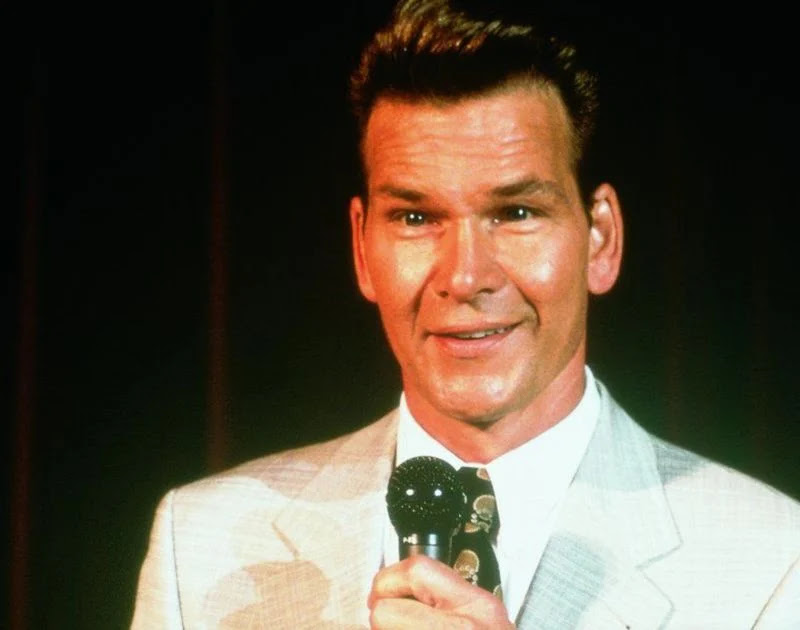
In a class, the health teacher, Kitty Farmer, an uptight person, doesn’t teach but plays videos featuring Jim Cunningham (Patrick Swayze) which focus on overcoming fear. There is an atmosphere of foreboding in this film right from the opening scene, followed by Donnie’s personality, the scary rabbit, and the airplane engine accident. (By the way, the movie Harvey deals with James Stewart’s character talking to a human-sized rabbit that is invisible to everyone else. This film is a dark version of that scenario).

Spooky Frank wakes up Donnie again and Donnie appears to be sleepwalking (sleepwalking is a kind of twilight area between waking and sleeping). This time he is carrying an axe. Later, the school’s mascot, which is represented by a large statue of a bulldog, has the axe buried in its head. And the words. “They made me do it,” are written in paint on the sidewalk. Since Donnie committed the vandalism, his free will seems to merge with the dictates of the supernatural that charts the destiny for everyone. However, his words also sound like what a schizophrenic would say. The danger surrounding his personality permeates the movie. He also uses the axe to flood the school by breaking a water main. Donnie fits in with the Greene short story since he is a destructor forcing change to occur.

Donnie gets to know the new girl at the school, Gretchen Ross (Jenna Malone). Since she has just arrived, she is an outsider, like Donnie. Her past adds to her lack of normalcy. Her father is at-large for having stabbed her mother and she and her mother changed their names and are in hiding. Donnie says he was once in jail for accidentally burning down a house, which shows his antisocial past, and a foreshadowing (there is a fire in the Greene short story, remember). She comments that his name sounds like a comic book hero. He responds by saying, “What makes you think I’m not?” He is being funny, but the dialogue adds to the unreal nature of the story, and points to Donnie maybe having special abilities. (If you have watched “the Big Bang Theory,” you know the talk about how comic book characters have alliterative names: Peter Parker, Bruce Banner, Clark Kent, etc. As IMDb points out there are many alliterative names in the film and references to comics, which contribute to the film’s imaginary worldly nature). Donnie shows his intelligence by helping her with an assignment. She comments that he is “weird,” and Donnie has heard this before and feels he is being dismissed; but, she tells him it was a compliment. This story inverts what most consider to be positive and negative. He says that if the school hadn’t closed their moment together here would not have happened. His comment suggests the idea of various timelines. The two quickly decide to be a couple since they are compatible in their nonconformity.

In another session with Dr. Thurman, Donnie repeats how he looks in many of his scenes. His head is bent forward and he looks up, unblinking. Jake Gyllenhaal said, according to IMDb, that he used this look to appear more psychotic. Thurman hypnotizes him, but even his subconscious is rebellious as he refuses to answer her questions, dwells on sexual topics, and is about to masturbate when she terminates the session.

At a PTA meeting, Kitty Farmer rants about the teaching of “The Destructors” because the young people in that book break a water main and flood a house. Since the police suspect that students may have been involved with the vandalism that included flooding the school, Kitty is connecting the dots. Teacher Karen Pomeroy defends her selection by saying the story is “ironic,” suggesting the tale is not a “how to” act piece. Rose questions if Kitty even knows who Graham Greene is, and Kitty reveals her ignorance by citing the TV show “Bonanza,” whose star was Lorne Greene. While the PTA meeting takes place, Frank again visits Donnie, telling the youth he got away with his axe-wielding actions. Donnie continues to take his medication which implies Frank’s appearance is real. Frank says he can do anything, and so can Donnie. The will of the one merges with that of the other. When Donnie asks where Frank came from, the crazy rabbit asks Donnie if he believes in “time travel,” which becomes what the movie revolves around.

Kitty is again teaching her class based on Cunningham’s videos. Donnie has a card that notes a hypothetical character finding a wallet. He is supposed to fit her actions onto the evaluation line that stretches between fear and love. Donnie complains how the whole exercise is meaningless because everything cannot be reduced to these two emotions. Later, in the principal’s office, where we learn Donnie’s test scores show him to be brilliant, Kitty reveals that Donnie, basically, told her to shove her exercise card up her ass. Donnie continues to be the defier of social convention.

Donnie asks science teacher Mr. Monnitoff (Noah Wylie) about time travel. He talks about wormholes, and then gives Donnie a book entitled The Philosophy of Time Travel, which was written by Roberta Sparrow, the strange mailbox lady, who once was a nun, and then a schoolteacher where Donnie attends. Her character is a merging of science and spirituality. Donnie relates to Thurman that Frank mentioned time travel and now he finds out about Roberta, so he concludes the linking of the two is not a coincidence. Donnie takes the “alone” part of the message Roberta whispered to him as meaning that it is absurd, given life’s inevitable solitude in death, to search for the existence of God, and thus, the general meaning of life.

Donnie is waking up from a nap in a chair in his house while his father and pals watch a football game. Donnie seems to be between the awake world and the sleep world most of this movie, and just like Edward Norton’s character in Fight Club, it’s difficult to tell whether or not he is in a dream state. He sees fluid-filled tubes coming out of Eddie’s chest, and also out of Elizabeth and himself. They point to where a person is going. In a way they are predictors. IMDb notes that director/ writer Richard Kelly got this idea from watching John Madden make illustrations of where players will go in a play. So, it’s appropriate that Donnie sees this effect while a football game is playing. Donnie follows his tube and it takes him to his father’s closet where he finds a handgun. As Anton Chekhov said, once you introduce a gun the writer better fire it later.

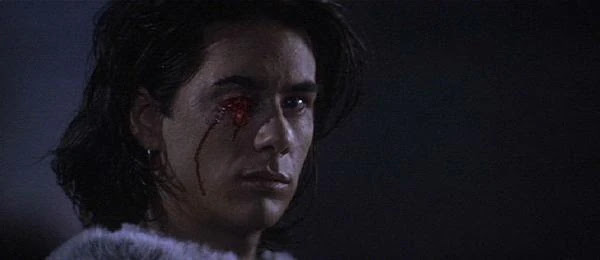
Donnie would like to kiss Gretchen since they have been going out for two weeks, but she wants it to be at a time that the world shows its beauty. She coincidentally mentions time travel now, stating her wish to be able to go back and replace troubling images with lovely ones. Even though they are in a beautiful park there is a “fat guy” as she puts it, watching them while smoking a cigarette. In this place, it is difficult to maintain the beauty Gretchen seeks. Donnie does not share Gretchen’s hope for that wonderful moment. The next scene is that of Dr. Thurman telling Donnie’s parents that their son is becoming more detached from reality because he finds life increasingly “threatening.” She recommends more therapy and medication for his schizophrenia. This scene is intercut with shots of Donnie using a knife to stab at Frank’s eye across an invisible force field that he seems to be penetrating. Is he trying to destroy his hallucination? Or, is he trying to cut across the barrier between the world we know and the one beyond?

Jim Cunningham presents his personal growth spiel to the high school students. He talks about a struggling individual named “Frank.” Could this reference point to Donnie’s own struggle? Cunningham says that fear is intertwined with premarital sex, smoking, and drinking alcohol. IMDb notes Donnie engages in all three in the movie, showing that he defies the restrictions on these temptations. Donnie gets to the microphone and admits to feeling lost and afraid (probably because of his loneliness), but he says Cunningham is “the antichrist,” a guy who is profiteering on the anguish of others, and not offering any real solutions.

Donnie tells Gretchen that what he has been seeing is described in Roberta Sparrow’s book, so he says what is happening to him is not random. He discusses his theory with Mr. Monnitoff that these tube-like projections show one’s destiny, and that are a way of seeing the predetermined future. The teacher says if someone could see his or her destiny, a person could then change it, negating predetermination. But Donnie sees, or wants to see that we are not alone, and that the future paths can’t be altered by individuals since they are part of God’s cosmic plan. Monnitoff wants to stick to science and not religious matters, implying he could lose his job if it appears that he is influencing a child’s faith.

Donnie now finds Cunningham’s wallet and knows where he lives. So, he is in the position of how to act that duplicated the exercise in Kitty’s class that was based on Cunningham’s teachings. Gretchen and Donnie do a presentation to the science class with illustrations about getting parents to put these glasses on their kids when they sleep. They call them IMG’s which are infant memory generators. Gretchen argues that pleasant images will be shown to instill positive memories in the children. Two guys say the nightmare of this dream proposal could occur if parents might show satanic visions, and they mention Gretchen’s violent father. It’s as if Gretchen wants to create a parental experience that would counter her own life events. Gretchen runs out of the school and Donnie follows her, apologizing for the boys’ statements. She then kisses him, maybe because she is realizing she shouldn’t wait any longer for a perfect moment to happen, since it probably never will.

Again, keeping with the Halloween holiday, Donnie and Gretchen go to the movies to see a horror film, The Evil Dead. But that movie is shown in conjunction with The Last Temptation of Christ. It is a foreshadowing since that movie deals with sacrifice to save others. Gretchen falls asleep. It appears Donnie may be nodding off also, and then Frank appears. Dream or reality? Donnie asks Frank, “Why are you wearing that stupid bunny suit?” To which, Franks says, “Why are you wearing that stupid man suit?” What is really below the surface? Is it man or beast? The lighter and darker sides of reality join here as Frank takes off his headpiece and reveals the eye injury that Danny inflicted upon him. Frank apologizes because he knows what’s coming. A portal opens and Cunningham’s house appears. Frank tells Donnie to burn it down.

Even the dance presentations of children for a Star Search competition show contrasting images. One girl awkwardly dances to an angelic soundtrack and then the performance of the young girls called Sparkle Motion (which includes Samantha Darko) is more rock and roll. Cunningham hosts the event, which we find adds a creepy element. The fire reveals a secret room, a “kiddie porn dungeon” in the house. The police arrest Cunningham. The fire, a destructive act, brings to light a horrible crime. The scene reminds us of the opposing movie titles on the marquee and suggests that there must be sacrifice to set things right. It also reflects what Donnie said about how the Greene story shows that “destruction” is a form of “creation.”

Kitty is not willing to see the facts and remains loyal to Cunningham (does his name show he is a cunning fellow, fooling others, another example of false appearances?), thinks there is a conspiracy to frame her beloved idol (the film showing relevance to current events). She will work to defend Cunningham, and, despite Rose’s animosity toward her, she asks the other woman to fly with Sparkle Motion for a competition. This request brings up the airplane aspect of the story.

Rose sees a calendar with an illustration of the scary bunny on it. The days are crossed off, which we know is the countdown to Frank’s “end of the world” prediction. Rose is concerned about Donnie and wants him to be okay. He asks what it’s like to have a “wacko” for a son. She says it feels “wonderful.” Her allegiance reminds us of how Gretchen feels about Donnie’s questioning mind.

In a session with Thurman, the hypnotized Donnie confesses to his crimes and says he must do what Frank says so he can figure out what is happening. He sees Frank (again as he crosses into dreamland) looking upward. Donnie says he must build a time machine. He says, “the sky’s gonna open up.” Here is another reference to the airplane and its missing engine.

There is one day left until Frank’s predicted day of death. Eddie is away on business and Rose is with Sparkle Motion. Donnie and Elizabeth decide to throw a Halloween party with their parents gone. Everyone is wearing a costume except Donnie, whose “man suit” is a costume hiding his nightmarish self. Gretchen arrives distraught because her mother took off. She says, “I guess some people are born with tragedy in their blood.” Obviously, she is a perfect match for Donnie. They make love while Rose does not receive Dr. Thurman’s phone warning about Donnie since the mother is away. There is also a call from Rose saying that she and the girls will be returning on a late flight. Later, Donnie has on a skeleton outfit, which shows the tragedy intertwined with his life.

Donnie sees those fluid tunnels again, which point to what will happen, and he knows that time is running out since it is one hour to Frank’s deadline. He and Gretchen go to Grandma Death’s place. He knows that time travel connects Grandma Death to Frank. Karen Pomeroy wrote on the board before leaving the school the words “cellar door,” which someone said were the best combination of words in English. There is a cellar door at the house. We are going below the surface again to reveal what hides in the shadows. The school bullies are there, with stockings over their faces trying to hide the nastiness underneath. They drag Donnie and Gretchen outside. One puts a knife to Donnie’s throat and Donnie utters, “Deus ex machina.” In Greek theater, the gods were supposed to reside above the stage and when the playwright wanted to resolve conflicts the “god” would be lowered in a box to dispense supernatural abilities. It has come to be a negative term to show resolution by contrived means. Here the film is playing with the idea, since time travel is the story’s “deus ex machina,” and that is why Donnie calls it the “savior,” which also recalls “Christ” mentioned in the film title on the marquee.

A car approaches at a high speed. Grandma Death is in the road, presiding over the events. Gretchen is thrown into the road and the car strikes and kills her. The car stops and turns around. The driver is Frank. He is wearing the scary bunny outfit. He takes his headpiece off. Donnie has his dad’s gun and shoots and kills Frank. Again, the site of the wound is the eye, a frequent symbol in films (Blade Runner, Chinatown, Bonnie and Clyde). Here, it can refer to the terrible visions that Donnie has been seeing. It’s as if the dead Frank came back through time to inform Donnie of the horrors that would occur.


Donnie takes Gretchen’s body with him to his house and kisses his sister goodbye. Donnie envisions dark clouds forming a time tunnel in the sky. He drives to where the film began on a hillside road. We hear Monnitoff’s words about all you need for time travel is a wormhole and a metal craft entering it. Donnie also remembers Gretchen saying that it would be nice to go back in time to make things better. The plane that Rose is on hits the turbulence of the time tunnel, and we see the engine going into the tunnel. Donnie also goes into the tunnel. He comes out laughing in his bed. He is not out of the house as before when the engine hits. He is killed this time.

Donnie wrote a letter to Grandma Death, saying that he hopes the answers to his questions “will come to me in my sleep. I hope that when the world comes to an end, I can breathe a sigh of relief, because there will be so much to look forward to.” He does get his information while asleep, and it is his world that comes to an end. Perhaps he is now at peace, and he may feel that he will survive in some spiritual form, and that those alive will lead good lives.

The camera glides over all the characters in the story, as the song “Mad World plays with the fitting lyric, “The dreams in which I’m dying are the best I ever had.” Those words could fit what happens to Donnie. Gretchen, who in this corrected timeline didn’t meet Donnie, is alive. She rides by on her bike, and exchanges a sad look with Rose, and a wave. It was a worthy sacrifice.

The next film is Lost in Translation.

Sunday, October 2, 2016

Harold and Maude

SPOILER ALERT! The plot of the movie will be discussed.


This 1971 film has one of the odder relationships in movie history, which is one of the reasons it is a dark comedy “cult” classic. But this Hal Ashby directed movie’s early May, late December romance is at the thematic center of a movie that emphasizes the need to reconsider the whole perpetuating cycle of birth, life, and death.
The opening scene is a bit of a shocker as we hear the first of several Cat Stevens songs while Harold (Bud Cort) goes through preparations which culminate in his supposed hanging suicide. As he swings from the rope in one of the many dark, garishly opulent rooms in his family’s mansion, his mother enters, Mrs. Chasen (Vivian Pickles). She is unfazed and asks if Harold thinks he is being funny. As she talks on the phone about an appointment, Harold laughs slightly and then makes fake gagging sounds. This form of suicide could be indicative of the way his mother is emotionally “suffocating” him. She tells him that dinner will be at eight o’clock and that maybe he could be a little more “vivacious.” The black comic tone has been launched.
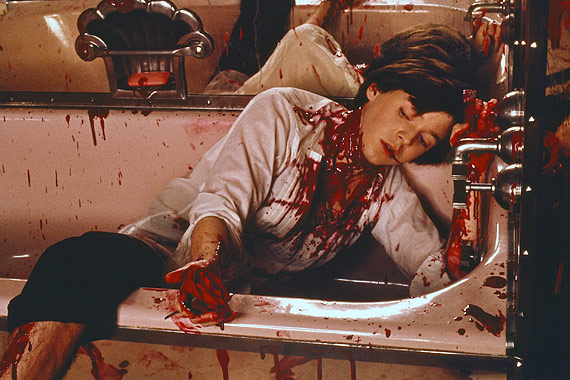
Harold performs several phony suicides during the course of the story, including a pretend self-inflicted gunshot wound, where he initially points the gun at his mother while she fills out all the questions meant for him in a dating questionnaire with her own opinions. In answer to his psychiatrist’s question if the suicides are for his mother’s benefit, he says no, not “benefit.” The movie obviously reflects the anti-establishment, anti-parental authority attitude among the youth in America at the time fueled by the hostility toward the Vietnam War. The house and Mrs. Chasen’s exaggerated clothes show a society preoccupied with material things (similarly satirized in Warren Beatty’s Heaven Can Wait). The movie directs its satiric thrust against the military in the form of Harold’s Uncle Victor (Charles Tyner), a high-ranking armed forces member whose name is ironic, since what he has won along with his glorious war stories is the loss of his right arm. The empty uniformed sleeve responds to the pulling of a cord by simulating a salute, an obvious jab at overzealous patriotism. It is darkly funny that right after Uncle Victor says he sees in Harold a little Nathan Hale, the man who said he regretted that he had only one life to lose for his country, that we have the shot of Harold floating like a dead person in the overly affluent family’s pool as his mother takes a swim, thus satirizing the loss of life for the object-worshiping country America has become.


Harold folds his hands over his chest as he lies on his back with his eyes closed, looking like a corpse at his psychiatric sessions. Harold’s psychiatrist (G. Wood) asks him what he does for enjoyment, the youth says he goes to funerals. He even buys a hearse for his car. He later modifies the sports car his mother provided as a replacement by welding on a hearse-like roof onto the Jaguar, a vehicular “screw-you” to his mother’s controlling nature and her preoccupation with materialism and appearances. Harold, although young, preoccupies himself morbidly with the end of life. Then he meets Maude (Ruth Gordon), a woman approaching the end of life, at a funeral. The first thing she does is offer him a piece of licorice. She brings something pleasurable, and a form of sustenance (although a dubious one) to the sad proceedings. She says “Who sends dead flowers to a funeral? It’s absurd.” She wants to celebrate that death is a part of life, and dead flowers just double down on one side of that process. She sizes up Harold’s inability to see the whole picture quickly. When he answers in the negative to her question about whether he sings or dances, she says, “No, I thought not.”

To emphasize the need to see that panoramic picture of worldly experience, Ashby gives us a joyous parade in the same shot as the funeral procession. Maude wears colorful clothes and carries a bight umbrella in contrast to the dark appearance of the mourners. Maude takes whatever car is available for transportation, including the priest’s at the funeral service. She even steals Harold’s original funeral conveyance, not knowing he owned it. He comments that her auto thefts upset people. She responds by saying, “I’m merely acting as a gentle reminder: here today, gone tomorrow, so don’t get attached to things.” But, she says that doesn’t mean she is averse to collecting stuff. Her “memorabilia” is not to show capitalistic gain, but instead reminds her of past experiences, and helps her appreciate the world. As she says, these things are, “incidental, not integral” to existence. It is significant that Maude lives in a train car. As opposed to Harold’s hearse, this mode of transportation symbolizes that living things are on a journey between two points, birth and death, and there are numerous stops along the way to experience what life offers.

Through her “stuff,” Maude opens Harold up to appreciate the body’s senses. She shows him paintings that stimulate the visual and provides him with smells to savor olfactory delights. He explores the tactile sense by touching a wood sculpture that suggests a vagina. He penetrates the opening with his hand, and even tries to fit his head through it (a substitute for the penis?). In this way, Maude is his midwife into bringing to life his youthful latent sexuality. She also introduces him to expressing himself artistically in dance and music, starting him on his interest in playing the banjo. While still pursuing his disturbingly comical theatrical self-destruction at home to ward off his mother’s picks for a potential mate (self-immolation, dismemberment, and disembowelment), he enjoys himself with Maude in the woods, saving a dying tree, where she celebrates “living things,” and going to a carnival (where they play with toy trains, reinforcing the journey of life initially implied by Maude’s train/home). She tries to convey to him the satisfaction derived from a passion to participate in life. She tells him that she is always looking for “variety” and “the new experience.” When she asks Harold why he would like to be a flower in a field, he says because they all are alike. It probably shows his desire to conform like most young people to the pressure around them to fit in. She says that they may look alike, but all living things are unique, and that specialness should be celebrated. She tells him “that much of the world’s sorrow” comes from people allowing themselves to think that they are not individually important.


She preaches that there are important issues worth fighting for: “Liberty. Rights, Justice … what sense in borders and nations and patriotism.” She sees these creations as mental prisons. She tells him that she used to “break into pet shops to liberate the canaries.” She comments that “the zoos are full, the prisons overflowing ... how the world still dearly loves a cage.” It seems she sees that people sometimes seek security in being told how to live so they can have the relief of giving up the responsibility of choices, and also incarcerating that which interferes with the status quo. He now realizes the incompleteness of his life so far when he says that “I haven’t lived. I died a few times.” Maude understands that many are afraid to risk failures by engaging in possible opportunities. She says, “A lot of people enjoy being dead. But they are not dead, really.  They’re just backing away from life.” Like the coach of a sports team, she exhorts Harold to “LIVE! Otherwise, you got nothing to talk about in the locker room.”

There are two scenes which provide a personal insight into why these two characters act the way they do, and deepen their presentation. Harold admits to Maude in a tearful moment that he was involved in a scientific experiment at school which resulted in an explosion and fire. When he saw how genuinely affected his mother was by the possibility that Harold was dead, he decided that he elicited more real emotion by dying instead of living. A single shot economically lets the audience peer into Maude’s psyche. While the two sit together, Harold sees the imprint of a Nazi concentration camp brand on her arm. We realize that her being a holocaust survivor amplified her commitment to “live life fully.”
The two declare their love for each other, and, yes, become physically intimate. The representatives of the established world order which are outraged at such a union are satirized because they are limited by their restricted ways of thinking. The psychiatrist, with Sigmund Freud’s picture on the wall, is baffled because Harold does not fit into the typical psychoanalytical belief in the Oedipal complex, because he doesn’t subconsciously want to sleep with his mother, but instead wants to have sex with his “grandmother.” The celibate priest, with the picture of the pope behind him, declares his revulsion at the union, while perversely overly imagining the physical appearance of Maude’s aging female form.
Maude already gave us hints early on where the story was headed. She told Harold that “it will all be over” on her approaching 80th birthday. She said that 75 was too young and 85 was just biding time. At a birthday celebration he prepared where he is ready to ask her to marry him, she says what a wonderful farewell he organized, as she has already taken the pills and would be gone soon. Unlike his false suicides, hers is real, but more appropriate because she realizes that she has lived a full life and is ending it on her terms. He tells her that he loves her again, and she encourages his tapping into this feeling by saying, “that’s wonderful. Go and love some more.” He is crushed by her death, and we see him driving his hybrid hearse up a hill. It plunges off a cliff. For a moment we think that he has killed himself for real this time. But, the demolition of the car symbolizes the destruction of his previous morbid outlook on life. The camera points upward to the top of the precipice, and Harold, now in life-affirming mode, plays his banjo, and dances away.

This motion picture challenges preconceived notions about material ownership, patriotism, and especially, love. But, isn’t that what art is supposed to do?

The next film is Gilda.