Showing posts with label Russell Crowe. Show all posts

Wednesday, May 31, 2023

Three Obscure Films

I started having film screenings for neighbors in the new development I moved into. I thought I would provide some brief comments on three somewhat obscure movies.

Who is Killing the Great Chefs of Europe?

This 1978 film starring George Segal, Jacqueline Bisset, and Robert Morley is a load of laughs. Segal and especially Morley are very funny. It’s a whodunit, and despite the movie being a comedy, the deaths are rather gruesome. For those who like mysteries, humor, great locales, and food, this is great entertainment. One of my favorite lines (and there are many) delivered by Morey’s Max, as he wonders about the killings: “Don’t tell me another cook has been murdered! Who is it this time, Aunt Jemima?”

The Last of Sheila

Released in 1973, here is another humorous mystery that has an even darker edge to it, but is still able to be very witty. We have a great script here, filled with so many twists and turns it will make your head spin like Linda Blair. The writers are, believe it or not, Broadway musical composer Stephen Sondheim and actor Anthony Perkins, who it turns out were lovers of puzzles. They have concocted a gem here. The movie has an all-star cast including James Mason, James Coburn, Richard Benjamin, Dyan Cannon, and Raquel Welch. Great locales in this movie, too. Herbert Ross is the director, who also gave us Play it Again, Sam, The Goodbye Girl, and The Turning Point.

3:10 to Yuma

The remake of this film (2007) may not be as famous as the original (both based on the Elmore Leonard story), but it is still pretty good. Christian Bale does an excellent job playing the Job-like farmer who has lost a foot due to friendly fire when he was a soldier, has a severely ill child, and is debt-ridden. In addition, his son has little respect for his non-aggressive ways. Bale’s character has a chance to make some money by transporting a notorious outlaw, played with charismatic bravado by Russell Crowe, who, ironically, likes to quote the Bible. His character is complicated, as he points out that those who want to hang him for his crimes are themselves guilty of atrocities but have hid behind the hypocrisy of those in power. The story focuses on whether Bale’s farmer, through his heroic actions, can prevent his son from losing his goodness in a world of lawlessness.

Tuesday, September 7, 2021

A Beautiful Mind

 SPOILER ALERT! The plot will be discussed.


The title of the film, A Beautiful Mind (2001), takes on depth as the story of mathematician John Nash unfolds. His mental abilities produced Nobel Prize winning insights. But, he also was schizophrenic, so the same mental powers that engendered brilliant rational breakthroughs also created damaging hallucinations. He was someone who was searching for insights in the abstract realm of numbers to be applied to the real world, but he also many times had no connection with reality. 


The opening speech from Professor Helinger (Judd Hirsch) at Princeton University in 1947 to new graduate students places a great deal of pressure on the entering class. There is a focus on using the science of mathematics to fight enemies, breaking codes and building the atomic bomb. Nash sits in the back of the room, his eyes avoiding contact, already establishing himself as an outsider. Helinger’s outlook may have contributed to what John Nash (Russell Crowe, excellent here) thought was his purpose and which fueled his paranoia about foreign adversaries targeting him. 

 At the outside reception, Nash observes patterns in what he sees as lines forming geometric shapes light up as he perceives them. This camera imagery is often used by director Ron Howard (winning the Oscar for Best Director here) and his fellow filmmakers to highlight mental epiphanies, according to IMDb. They are flashes of light, showing how his creativity is drawing things together. The scene also illustrates Nash’s witty humor when he says to a fellow student that “there could be a mathematical explanation for how bad your tie is.” Martin Hansen (Josh Lucas) asks Nash to get him a drink, saying Nash presented himself as a waiter, probably because he is wearing a bow tie. Again, Nash’s sarcasm surfaces as he says, “Imagine you’re getting quite used to miscalculation.” He goes on to say that Hansen’s publications lack anything noteworthy. Rivalry obviously exists between these two winners of the Carnegie Scholarship. Nash has nervous, quirky hand movements which show his awkward social skills. Nash also meets Sol (Adam Goldberg) and Bender (Anthony Rapp) here who become Nash’s friends. 


In his room, Nash encounters his supposed English major British roommate, funny (“Officer, I know who hit me, it was Johnny Walker) Charles Herman (Paul Bettany), who is suffering from a hangover. While he cracks jokes, Nash writes mathematical equations on his dorm window, a sort of metaphor for how his mental powers shed light on his numerical exploits. In answer to Charles’s questions about him, Nash says he is “well-balanced” because he has “a chip on both soldiers.” It is comical, but it also reveals Nash feeling that he must battle adversity. Charles points out that Nash is better with “integers” than people. Nash adds that he had a teacher who said he had “two helpings of brain but only half a helping of heart.” This discussion points to Nash’s lack of emotional connection to others. He admits that he doesn’t like people and they don’t care for him. He is impatient to bypass personal relationships so he will not waste time on his quest to map out “the governing dynamics” of existence and find a “truly original idea” so, as Charles says, he will “matter.” The two are drinking on a roof, which is fitting as Nash looks down literally and figuratively on the other students, calling them, “lesser mortals.” 


Hansen challenges Nash to a board game, and he is astonished that he loses to Hansen. Nash feels his “play was perfect.” Competition is at the center of Nash’s drive to succeed. It is here that he starts to investigate “game theory,” which will lead to the idea of those “governing dynamics” that will be applied to economics and for which Nash will be most known. 


Nash approaches a blonde at a bar and is unsocial to the point of insensitivity. He says he is not sure what he is supposed to say so that they can have sexual intercourse, so maybe they should skip right to having sex. She slaps him and walks out. He must learn to try a different tactic, as we soon discover. 

At present, Nash hasn’t been attending classes, which he sees as being just derivative, and not aiding invention. He doesn’t have a topic for his doctoral dissertation, and hasn’t published anything. Helinger tells him that he can't be recommended for placement in a post-graduate position. Nash sees recognition and accomplishment as the same thing, showing his need for validation as the talented outsider. 


 Nash becomes upset, telling Charles he must follow “their” rules in order to get ahead instead of taking the road less traveled. This idea is symbolized by his pushing his desk away from the window, on which he scribbles his equations, where the light of inspiration shines upon him. Charles counters that argument by telling Nash he must follow his passion outside the walls of the educational institution, and he pushes the desk through the window, watching it fall to the ground. The act shows the need for Nash to break through traditional restrictions on his “beautiful mind.”


 Nash is in the bar again. But now he employs a version of game theory when he tells the other math men that if they avoid making a play for the blonde who is present, then they will not have to compete for her, and the other women there will not consider themselves as second choices. That way, they can all “get laid,” and thus win. He says that economist Adam Smith's idea of everyone doing what’s best for himself will automatically be good for the group is “incomplete.” Crowe does a hand gesture with the fingers of one hand curled up touching his forehead. It seems to signify that he has some idea to communicate, but it also shows his shyness, a way of not looking directly at someone. Nash says that the individual must do what’s good for himself and take into account what’s good for the group. He is devising a plan that allows for participation in a goal-oriented strategy that does not have to produce a loser but instead allows each person in the group to win. He goes back to his desk, restored to its spot near the illuminating window, and he begins writing his equations, revising 150 years of economic theory. Helinger is impressed with Nash’s work and gives him the go-ahead to develop his theories on “governing dynamics.” He chooses his pals, Sol and Bender, to be part of his team.


When we catch up with Nash later he has his doctorate and has gained that recognition he sought, appearing on the cover of Fortune magazine. The Pentagon calls him to attempt to decipher code they believe the Russians are transmitting. After looking at a wall of numbers, the digits illuminate for Nash, and he says that there are latitudes and longitudes among the figures that relate to routing places in the United States. When he asks about what the Russians may be planning, he is basically told to leave as he is not authorized access to further information. He looks up and he sees a man on a walkway, but the others there do not acknowledge this person. 


While in a car, Sen. Joseph McCarthy’s voice is heard, the man who promulgated the “red scare,” and paranoia about communism. The belief that the enemy was among us plays into Nash’s personal feelings of persecution and the urgency being promulgated that mathematics must be used to fight political adversaries. Nash now works at the defense labs at the Massachusetts Institute of Technology. He complains to Sol and Bender that the Russians have the hydrogen bomb, the Nazis found sanctuary in South America, and the Chinese are gaining force. But he complains that he is being underused by being assigned to study stress problems in a dam. He has taken Helinger’s mission that he first heard as a graduate student very much to heart.


Nash must still teach classes as part of the deal to keep his research projects going. At the class, he throws the textbook into the trash, showing his disdain for tradition. He sees the class as a waste of his time. He puts an equation on the board as a kind of test to weed out who is worthy of his teaching efforts. In the class is Alicia Larde (Jennifer Connelly, winning a Best Supporting Actress Oscar for this role). By using her attractive attributes, she is able to persuade the construction workers outside to be quiet during the class, winning Nash’s admiration for problem solving.


 Just as Nash has complained that he isn't getting a chance to show his abilities to fight America’s enemies, the man who Nash called “Big Brother” at the Pentagon observing from above shows up to give Nash a chance at more recognition. He calls himself William Parcher (Ed Harris), and he says he supervised security over J. Robert Oppenheimer’s atomic project. When Parcher brings up how many lives can be lost in the pursuit of weapons, Nash is rather cold, saying progress requires the need for sacrifice. Parcher says Nash’s “lone wolf” life will be advantageous, most likely for performing covert activities. Thus, Parcher’s existence justifies Nash’s anti-social nature and his desire for recognition. As they walk into a “secure” area, Parcher says they know him there, so he doesn’t have to show credentials. Therefore, he does not interact with the guard. The above details become important later.


Parcher takes Nash into what were supposed to be abandoned warehouses. Inside, he sees many men in white coats operating rows of computers. Parcher tells Nash he now has top secret clearance, and calls him the best natural codebreaker around. Parcher’s function then is to bestow the acknowledgement of Nash’s talents that the mathematician believes he deserves. Parcher says that the Russians took a portable atomic bomb that the Nazis had developed, and the locations that Nash identified earlier at the Pentagon are places the Russians are exploring to explode the bomb. Parcher says that the Russians are placing coded messages in newspapers and magazines, and that’s why they need Nash’s help. Parcher makes an interesting observation when he says, “Man is capable of as much atrocity as he has imagination.” His comment adds irony to the title of the film by showing the underside of a brilliant “beautiful mind.” Parcher’s team supposedly puts an implant in Nash’s arm so he will have access to a drop point where he can deliver his findings.


Alicia comes to his office with what Nash calls an “elegant” proof of the problem he wrote on the board, but she made assumptions which didn’t solve the problem. She asks him to dinner, but he says he usually eats alone, and he says he is like Prometheus with a bird circling above. His humorous image reveals that he sees himself as a rebel, like the mythological personage, who gave fire to earthlings. Nash sees himself as a godlike entity who will endure tribulations to bring mental illumination to those incapable of such achievement. 


 Nash takes Alicia to a formal university affair. She is able to navigate his social awkwardness by engaging in his peculiar humor. He draws objects in the night sky by connecting stars with his hand. He sees patterns, maybe where there are none except what we impose on them. The exercise again shows his desire to find form and insights in the universe. However, at the event, he believes men there are observing him, which shows how imagination can warp reality into something ominous. He later drops his sealed classified findings into a lockbox at a gated house by using the changing codes on his implant that are illuminated under a black light. It is done at night and there is a dangerous feel to the place as a car slows down to observe him there.


Nash tells Alicia that his directness has not been socially successful, so it is an effort for him to adapt to the rules of society. She encourages him to say what he wants to say. He concedes that even though he finds her attractive and wishes to have intercourse as soon as possible with her, he feels he must go through “platonic” romantic rituals to reach that outcome. He then says he expects a slap across the face, as he experienced earlier at the bar. Instead, she kisses him passionately, showing that with her his honesty is rewarded, and how the two are compatible.


Charles reunites with Nash and brings his niece, Marcee (Vivien Cardone), who Charles says he has taken custody of since the death of his sister. Charles says he is close by at Harvard. IMDb notes that when Marcee runs through a field full of birds, they do not scatter, suggesting that she doesn’t exist. Nash tells Charles about Alicia and wonders how he can be sure that asking her to marry him is the correct move. Charles says, “Nothing’s ever for sure, John. That’s the only sure thing I do know.” That unpredictability comes from a person who supposedly studies literature, an art form, and it offsets Nash’s longing for mathematical certainty.


Nash meets Alicia at a restaurant and says he needs “proof” and “verifiable data” that would indicate that they can be in a long-term relationship. He says this while bending on one knee. It is like a mathematical marriage proposal. In response, Alicia says she must modify her notions of romance to accommodate his data-driven inquiry. She asks how big the universe is, and he says it is infinite. But, he concedes that impression can’t be proven, so he just believes it. She says it’s the same with love, one can’t prove it, but somehow just believes it. Alicia is able to show that not all things, such as emotions and ideas, can be proven, but they still exist within people.


 The two get married, but on his wedding day Nash sees Parcher with a disapproving look, since the lack of attachments to others supposedly justified his service. This image shows the conflict within Nash. When Nash drops a report off, Parcher drives by, tells Nash the spot is compromised, and they are being followed. They speed away as Parcher fires on the approaching vehicle. The terrified Nash sees the enemy vehicle eventually end up in the water. Nash is distant when he goes home to Alicia, and locks the door of his room behind him, as he is now suspicious of everyone, which reinforces his detachment from others. He looks at his students and out through windows and doors as if everyone is a threat. His warped view of reality paints him as a victim of other forces which are trying to destroy him. 


Parcher visits Nash in his office, and his presence is there to prevent Nash from rejecting his immersion into his world of paranoia. Nash asserts that he has a wife and will soon be a father, and wants to quit so as to shift his focus to positive things, away from his preoccupation with fear. But Parcher is here to assert that feeling of dread by threatening Nash, saying if he doesn’t continue his work, Parcher will not protect him from the Russians. 


There are shadows on the walls of Nash’s house as he keeps watch through his blinds. They appear to be real, but shadows are just optical illusions, like Nash’s fears. Alicia begins to realize there is something wrong with her husband as he acts irrationally, suspicious of why she turned on the light at night, and then ordering her to leave for her sister’s place. She looks at the telephone and it seems she is about to seek help for Nash.


As Nash gives a lecture he sees men entering from the back of the room that he thinks are enemy agents who are after him. He says to his students that one can’t assign values to variables, which shows that Nash can't even find sanctuary among the predictability of mathematics. He runs out of the lecture hall and he is pursued, but not by enemy agents. Dr. Rosen (Christopher Plummer) approaches him and says he is a psychiatrist. Nash punches Rosen and tries to flee. Rosen injects him with a sedative as Nash sees Charles and his niece observe what transpires.


Nash has been admitted to a psychiatric facility where he is in restraints. Nash addresses Charles who he sees there, and he believes that Charles betrayed him by delivering him to the Russians. But, Rosen says there is no one there. If we haven’t already deduced it, Nash has hallucinations. Rosen informs Alicia that Nash is schizophrenic, which many times involves paranoia, and her husband’s belief that he is working to discover conspiracies is a symptom of his mental disorder. Moreover, Nash’s occupation allowed these delusions to go on without being discovered. Rosen gets Alicia to admit she never met Charles, saw a photo of the man, or talked to him on the telephone. Nash said that Charles was his roommate, but Rosen discovered that he lived alone at Princeton. Rosen says he must make Nash distinguish between what is real and what are illusions generated by his otherwise beautiful mind.


 When Alicia gets into Nash’s college office she sees how extreme his activity has been, cutting up magazines and placing pictures and articles all over the walls. Sol and Bender, knowing how offbeat Nash is, gave him a great deal of leeway and did not question his covert activities. Sol followed Nash once to the drop site and now Alicia goes to the estate where Nash was supposed to deliver his findings. The place has been abandoned for some time, with the drop box a broken mailbox and the gate opener busted. 


At the hospital, Nash adapts the “facts” as he sees them to fit his beliefs, as most conspiracy obsessed people do. He says the Russians can’t kill him because he is too well known, so they are confining him. Alicia tells her husband that she found out there is no Parcher and no conspiracy. She shows him all the unopened envelopes he placed in the mailbox. Of course, he walks out on her because the truth will upend his universe, and he can’t tolerate that. 


 He tries cutting out the implant in his arm, but says that it is already gone. Nash starts to get a glimmer of what has been plaguing him. As Rosen prepares Nash for drug therapy, Rosen says how horrible it is to realize that people an individual thought one knew never existed, and that beliefs one held were completely false. It’s as if the “fake news” that one accused others of propagating was real, and one’s own beliefs were the false ones. 


Back at Princeton, Alicia tells Sol that the delusions have passed, but Nash will not show up at Princeton, possibly feeling shame, where his academic competitor Hansen is now department chairperson. She feels an obligation to take care of the man she fell in love with, making sure he takes his medications and encourages him to be active. Sol visits Nash, who tells him not to sit on Harvey, the imaginary rabbit from the film. Nash has kept his sense of humor, saying what’s the point of being “nuts” if one can’t have some fun. But when he hands his indecipherable scribblings to Sol, it is obvious that Nash isn’t capable of functioning efficiently, as he says, due to the effects of the medications he is taking. He still feels that his work is the most important part of his life at this stage. He holds his child while in a stupor, despondent, devoid of any emotional attachment to his family.


Alicia has her own paranoia concerning what Nash states, assuming what he says is influenced by his schizophrenia. He tells her he was talking to the garbage collectors, but she says they don’t pick up trash at night. Then she sees the men working outside. They both giggle, and she apologies, probably realizing she too must adjust to what is really happening. But that light moment is followed by a heartbreaking one as Alicia makes sexual overtures in bed and he resists. He admits it’s the medication, which can decrease the libido drastically. She looks devastated, so the implication is that there has been no intimacy for a long time. She goes into the bathroom and throws a glass of water at the mirror, shattering both, and screams her frustration. When Nash takes the shards out to the trash, it is a metaphor for what is broken in their lives.


Nash secretly stops taking his pills, most likely so he can provide the intimacy that Alicia wants. But, that brings back his condition as he is confronted by Parcher who has armed soldiers with him. He takes Nash to a large shed on Nash’s property that he staffed with personnel and electronic equipment to pinpoint the location of the nuclear weapon the Russians want to detonate. Nash tries to deny the existence of what he sees, but then submits to the fantasy. The film seems to be saying that delusions which feed our preconceptions are difficult to let go.


Alicia hears a radio transmission coming from the dilapidated building on their property, and when she enters she sees that her husband has reproduced his office and plastered the place with newspaper clippings and push pins with thread which try to depict an imagined conspiracy. She runs back into the house where Nash has left their baby alone in a tub filling up with water. He says that Charles was watching over the child, but she can't see him because Charles has “been injected with a cloaking serum.” His own arm implant “dissolved” allowing him to see Charles. The storm that is raging outside mirrors the mental one that is devastating Nash’s mind, tearing down all the sturdy logical ideas that once thrived there. 


Parcher appears and tells Nash that he must get rid of Alicia because she is a national security risk. After Alicia sees Nash talking to nobody, Nash then conjures up Charles and his niece, and Charles tells him to do what Parcher said. Nash is mentally at war with himself, wanting to believe what he sees but also protective of his family. Then, his mathematical rationality bursts through with an epiphany that will not allow a delusion to extinguish. He stops Alicia and says that he realizes that Charles’s supposed niece, Marcee, never ages; therefore, she can’t be real. 


With Rosen present, Nash still sees Charles and his niece, and Rosen says he must return to the hospital for more treatment. Nash says the medication stops him from working, taking care of his child, and responding to his wife. He says he is a problem solver, and he needs time to figure out the solution. But Rosen points out the dilemma, since Nash’s condition is not like a mathematical mystery, and Nash’s mind can’t be the tool to fix things since the defect is in his brain. 


Nash does not want to return to the institution, but fears for how his condition threatens Alicia’s safety. So, he tells her to go to her mother’s place where the baby is already. But, she refuses to leave him, and touches him, saying what’s real is in his feelings, not in his mind. In this way, she expands his sense of reality.


Two months later, Nash visits Hansen at Princeton University. Hansen says he is an old friend, and he no longer seems to be a foe. As opposed to feeling that being apart from others allowed him to excel without distractions, Nash now sees being part of a community will help him become mentally healthy. He just wants to be able to hang out in the library. But, he appears outside, fighting his demons, as Parcher resurfaces and harasses him, while others watch as Nash argues with an illusion.


But, with Alicia supporting his fight to overcome his symptoms without resorting to extreme medical treatment, Nash goes back to the college library each day, writing equations as he once did, on the windowpanes, letting the real and figurative light shine upon him. He now refuses to speak to his imaginary creations. 


Time passes, their son grows up, and there is now a gray-haired Nash in 1978 still working on equations at the Princeton University library. He eventually engages with some students and expresses a desire to teach again. He admits to Hansen that he still sees Parcher, Charles and Marcee, but since he has ignored them, they don’t intrude anymore. Hansen says that they still haunt him, but Nash says. “They are my past. Everyone is haunted by their past.” The problem he must deal with, though, is that Nash’s past just happens to feel like it has more substance in the present than that of others. 


The next jump is to 1994 and Nash is an elderly man, but he is back to teaching and working on his math projects. Someone from the Nobel Prize committee visits him, saying he is being considered for the award based on his bargaining theories that have numerous economic applications and eventually even biological evolutionary considerations. Nash realizes that the visit is to make sure he doesn’t embarrass the prestigious awards ceremony by acting crazy. He admits to the possibility that he may act out because he still sees things that aren’t there. He takes newer medications, and says he is on a sort of mental “diet” where he does not indulge his fantasies. While entering the faculty dining area for the first time in years the other professors pay Nash tribute, as he saw they did many years ago for another professor, by giving him their pens. He has received the recognition he once sought.


 The story concludes with Nash’s Nobel Prize speech where he says all of his mental explorations have brought him to the conclusion that, “it is only in the mysterious equations of love that any logic or reasons can be found.” Love, a supposedly irrational area, has provided him the most meaning concerning existence. He directly thanks Alicia for all that he has come to really understand about life as a whole.


The next film is Zorba, the Greek.

Sunday, June 25, 2017

The Insider

SPOILER ALERT! The plot will be discussed.

Michael Mann’s 1999 film presents profiles in courage. Jeffrey Wigand’s decision to act for the greater good by telling the truth about the tobacco industry causes him to endure personal suffering. The title of the movie is ironic. Wigand was a corporate insider of the status quo, but, by doing the right thing, which should represent normal behavior, he becomes an outsider. But, the CBS producer, Lowell Bergman, must also fight against resistance and the threat of occupational exile, in order to get Wigand’s information out to the public.
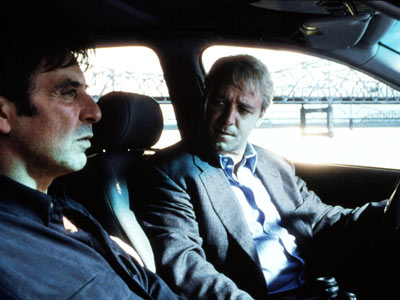
The story starts far from American shores in the Middle East. The camera puts the audience in the position of Lowell Bergman (Al Pacino), a producer for the highly rated and well-respected TV news magazine, 60 Minutes, who has a hood over his head. Hezbollah soldiers take him to meet Sheikh Fadlallah, the leader of the militant organization. After Lowell sets up a meeting between the Sheikh and CBS correspondent Mike Wallace (Christopher Plummer), and the Hezbollah people have left, Lowell tells his assistant “Take your blindfold off. Welcome to the world.” Symbolically, until the journalists deliver the information to us, we reside in the darkness of our ignorance.
The scene switches to scientist Dr. Jeffrey Wigand (Russell Crowe, in an Oscar-nominated performance). He is already becoming an outcast, as he cleans out his desk while the other employees in white lab coats have an office celebration, their jovial attitudes contrasting with his solemn one. There is a slow motion shot of him walking out of the doors of his former place of work, which is a foreshadowing of the last shot of the movie. He drives to his upper-middle-class suburban Kentucky house, which he afforded by taking money from a company that actually undermined the health of the citizens living there, and where he now feels out of place. He delays telling his wife, Liane (Diane Venora), that the tobacco company, Brown and Williamson, fired him. Her first response is not to ask how her husband is doing. Instead, her concern is one of self-preservation, asking about their expenses, and health benefits for their daughter who has asthma. It seems ironic that Wigand, who worked for a business that contributed to so many lung ailments, should have a child suffering from a breathing disorder. Jeffrey, feeling under attack for letting his family down, offers the reassurance that his severance package was a good one, and it included health benefits.

Lowell receives an anonymous package of documents containing the results of a study analyzing fire risks due to cigarette smoking. He needs a technical consultation, and someone recommends Jeffrey. When Lowell calls his house, Jeffrey’s wife answers, and after Lowell says he is with 60 Minutes, she tells Lowell that her husband doesn’t want to speak with him, without even knowing the reason for the call, since she assumes it has to do with his job termination. Being a journalist, Lowell knows there is a story here. (There is a picture of Caesar Chavez on Lowell’s wall, suggesting he admires a rebel who fights for truth, as did the Latino leader). After some back and forth faxes, they meet at a hotel close to Brown and Williamson’s offices. Jeffrey acts very paranoid about the meeting, suspicious of the room service person knocking at the door. Jeffrey says he can do the consultation since it deals with Philip Morris, and does not pertain to his job. His insistence that he can’t say anything else causes Lowell to become extremely curious.

Shortly after his meeting with Lowell, Jeffrey’s former boss, Thomas Sandefur (Michael Gambon), calls Jeffrey in to set down new guidelines for his confidentiality agreement. If he does not comply, all benefits will be terminated. It is possible that the company was following Jeffrey and knew of his meeting with Lowell. Jeffrey is quite angry at the meeting, questioning any justification for calling those present being in the service of true science. He says, “So, what you’re saying is it wasn’t enough to fire me for no good reason. Now you question my integrity? On top of the humiliation of being fired, you threaten me? You threaten my family?” He curses Sandefur, and storms out. Then, he calls Lowell in a rage, saying he sold him out. Lowell gets him to listen to logic, telling him why would he give him up, especially before he received any information from Jeffrey.
Lowell and Jeffrey meet again in the latter’s car during a downpour, indicating the storm of resistance they will have to weather. Not all corporations should be judged the same, according to Jeffrey. He felt that the CEO of Johnson and Johnson did the right thing during the Tylenol scare a while back. The head of that company immediately pulled all bottles off of the shelves, and installed tamper-resistance caps. He put the safety of the people ahead of acquiring wealth. Jeffrey tells Lowell that he went to work for a tobacco company for the money and benefits, and hoped that he could do some good through research. His confidentiality agreement doesn’t allow him to talk any further about his work. Lowell succinctly says that Jeffrey is in a state of conflict, caught between wanting to expose the truth and protecting his family’s economic well-being.
Lowell consults with his staff, including Wallace. The legal advice is that big tobacco never lost a lawsuit. They have tremendous resources, and can tie up the litigation for an extended period of time, causing the opponent to be drained financially. Their defense is the “We didn’t know argument,” which states that if they provide a product which turns out to be harmful, and people choose to use it, the effects are their responsibility. But, Jeffrey knows that the tobacco companies did know that nicotine is addictive, and chemically enhanced its addictive properties, making it extremely difficult for people to exercise free will and stop smoking. Lowell realizes that Jeffrey’s information, because he was a corporate vice-president and noted scientist, would be a crippling blow to the tobacco industry.
Jeffrey becomes a public school science teacher. He tells his students, “I find chemistry to be magical. I find it an adventure, an exploration into the physical building blocks of our universe.” He has transitioned into a job which pays a great deal less than what he used to earn, but which allows him to enjoy his profession. And, he is now working on behalf of the public sector, not to its detriment, inspiring young people with his love of knowledge. He tells his wife that maybe, even though they had to move to a downsized house, this change can be for the better, because he will be able to spend more time with the family. But, his decision to not sign the new confidentiality agreement leaves him open to threats. He is alone as the last person at a golf driving range, when a large man shows up in a suit, hits a few balls before closing, and stares threateningly at Jeffrey. Jeffrey finds footprints in his newly planted garden which shows he is being observed. Also, the destruction of the plants implies that he can’t feel secure enough to put down roots in his new life. His wife receives threatening emails, and Jeffrey finds a bullet in his mailbox. It matches the caliber of one of his guns, and the FBI men who show up are intimidating, implying that Jeffrey, being agitated, may be trying to incriminate his former employer. They also confiscate his computer without even asking permission.

Lowell tries to help Jeffrey as the conspiracy seems to widen against the former tobacco scientist. He calls a contact at the FBI, questioning the way the two agents acted, implying that maybe they may be seeking security jobs with the tobacco companies, or might know people in those jobs, and could have been persuaded to menace the Wigands. Lowell says to his Federal agent friend, “I’m getting two things; pissed off and curious.” His statement carries the threat of how a free press can put fear into questionable activities by threatening to expose them. He also gets private guards to protect the family. However, this need for security further distances Jeffrey and his family as it establishes a barrier between them and the world outside.
Jeffrey admits that he does not like to get pushed around, and after the threats to himself and his family, he tells Lowell he wants to be interviewed. However, when they meet for dinner, he questions Lowell’s sincerity. He says, “I’m just a commodity to you.” Lowell says maybe to the network he is, but to Lowell, he is “important.” Jeffrey wonders if any good will come from his information. He says maybe people watch Lowell’s show because it’s “something to do on Sunday night.” He says maybe what he has to say won’t change a thing, while his family will be “left out to dry, used up, broke, alone.” Jeffrey says all Lowell is putting out there are words. Lowell counters by telling him nobody is making Jeffrey speak out. Lowell tells him not to evade his responsibility by questioning Lowell’s motives. Lowell says he has been putting his reputation on the line publicly, and backing up his words with action, getting stories to inform the people. This back-and-forth exchange highlights the courage needed to open oneself up to attack in order to fight for what’s right.
Lowell wants to work around the confidentiality clause by having Jeffrey compelled to testify in a lawsuit that the state of Mississippi is bringing against the tobacco industry. In the meantime, he and Mike Wallace record the interview for 60 Minutes. Jeffrey says that the CEO’s of the tobacco companies perjured themselves in front of Congress when they said they did not believe nicotine was addictive. As an insider scientist, he knows that they used ammonia to produce “impact boosting,” to cause the nicotine “to be more rapidly absorbed in the lung and therefore affect the brain and nervous system.” Jeffrey says that the tobacco industry inside their doors said they were in “the nicotine delivery business,” so that a smoker would get his or her “fix.” Jeffrey specifically rejected being involved with using a drug that was a flavor-producing additive that was a lung carcinogen, and that is why he was fired.
To illustrate how much influence the tobacco industry has, it pressures a court in Kentucky to put a restraining order against Jeffrey testifying in Mississippi. That state rejected it, but if Jeffrey goes back to Kentucky he could be fined and imprisoned. Jeffrey asks a question that shows how upside-down things have become when he says, “How does one go to jail?’ for telling the truth, and thus endangering his family. After agonizing over what to do, Jeffrey decides to testify anyway. As he rides to the courtroom, Jeffrey passes rows of headstones in a cemetery, possibly reminding us of what is at stake, which represent the lives of numerous individuals that were, and can be, victims of smoking. The disease that tobacco causes becomes a metaphor for a corruption spreading throughout industry and government that threatens the wellbeing of the citizens. However, when he does return to his home, his wife and children have left, his spouse unable to deal with the pressure. As Lowell tells Mike, “These are ordinary people under extraordinary pressure.” In Mississippi, Richard Scruggs (Colm Feore), who is assisting in the prosecution of the tobacco industry, knows what a sacrifice Jeffrey is making. He tells him, “You’re assaulted psychologically. You’re assaulted financially, which is … directed at your kids … You feel your whole family’s future’s compromised. Held hostage.” The soundtrack of the film is a combination of Middle east sounds and jazz. The former adds a mournful, almost sad feel to the film. But both add to a sense of being out of the mainstream of America, which is where Jeffrey finds himself.

Big tobacco then goes after Lowell and CBS, legally. Through a principle called “tortious interference,” they can sue the network for facilitating Jeffrey’s violation of his confidentiality agreement. The CBS lawyer says that the Big Tobacco can sue for enormous sums because “the greater the truth, the greater the damage.” What this implies is that some truths must be concealed if they adversely affect the powerful. The phrase “Too big to fail” comes to mind. Lowell finds out that there is a deal to sell CBS to Westinghouse, and the lawsuit would impair that transaction, and the higher-ups at CBS, including the chief counsel, will suffer financially. So, the tentacles of this financial conspiracy reach into many places. Lowell refuses to shoot an alternative version of Jeffrey’s interview, but Mike Wallace, afraid that Brown and Williamson could wind up owning CBS, cooperates. Wallace records a preface to the severely abridged interview that airs, but CBS even guts that.  

So, now, Lowell, like Jeffrey, who has moved into a hotel room, is all alone, professionally, forced to take a mandatory leave of absence. Jeffrey feels that all he gave up is for nothing if CBS won’t air his interview. However, Lowell works to invalidate smear campaigns against Jeffrey concerning false allegations of shop-lifting and failed custody support involving his prior marriage. He covertly leaks information to The Wall Street Journal and The New York Times, so that information about Jeffrey and Big Tobacco has nothing to do with CBS being involved in breaking his confidentiality agreement. CBS also comes under attack for caving to lawyers and big business, which in a democracy is dangerous because it stunts the free flow of information. As Lowell says to his boss, “Are you a businessman? Or are you a newsman?” With Wallace now on his side, and with, as Lowell says, “The cat completely out of the bag,” CBS airs the complete interview. We see people stopping what they are doing, listening to the program, learning, so that they can make informed decisions. Jeffrey’s daughter looks up with respect at her father as she sees him on the TV, implying that role models are important.

Unfortunately, as Lowell tells Jeffrey, “I’m all out of heroes, man. Guys like you are in short supply.” To which Jeffrey responds, “Yeah, guys like you, too.” In the end, Lowell quits, because his whole assurance of protecting his sources has been compromised by the corporate undermining of the news. He tells Wallace, “What got broken here doesn’t go back together.” He walks out of the building of his employer, and the exit is shown in slow motion, mirroring Jeffrey’s plight at the beginning of the film. Lowell pulls up his coat collar against the unwelcoming cold as an outsider.

Written addendums show that the tobacco companies settled for 246 billion dollars with states that sued them for reimbursement for Medicaid funds paid to smoking victims. Jeffrey Wigand was named teacher of the year in Kentucky. Lowell Bergman taught graduate school journalism at Berkeley, and worked for PBS. The film is a tribute to those who work hard and sacrifice for the good of the many.

The next film is Wag the Dog.

Sunday, February 26, 2017

LA Confidential

SPOILER ALERT! The plot of the movie will be discussed.

This Curtis Hanson directed film came out in 1997, and, if Titanic had not been its competition, would probably have received the Best Picture Oscar. Based on the James Ellroy novel, the movie never lets you forget that Hollywood, and how it is mirrored in others, with its selling of surface beauty at the expense of underlying ugliness, is the focus here.
The title of the motion picture tells you upfront what the story is about – the glamorous draw of the promise of the City of Angels, and the dirty secrets it tries to hide as people there vie for success. Hanson said that the movie industry settled here because filmmakers liked shooting in the soft, soothing sunlight that saturated this part of California. But, as someone said about LA, “you come for a vacation, and go home on probation.” So, there is that underbelly of its people that Hanson wants to expose, and ironically contrast with the celebrity of stardom.
The movie begins in 1952 with a voice-over from tabloid sleaze master Sid Hudgens (Danny DeVito) of Hush Hush magazine. To “hush” is to stifle speech, which is what the successful want done concerning their nasty actions. But, while on one hand, the public doesn’t want its ideal version of the town of dreams shattered, at the same time, it craves to hear the dirt. Why? Maybe for the same reason that people want to look away from a car crash, but can’t because of a perverse morbid curiosity. Or, perhaps they envy the success of movie stars, and want to cut them down, lower them to the level of the drudgery of the lives of everyday working people. Sid says that “Life is good in Los Angeles. It’s paradise on earth. Ha, ha, ha, ha. That’s what they tell you anyway.” We eventually see a collage of murderous hits, as the audience hears Sid relate how crime boss Mickey Cohen, (the criminal version of a star), is now in jail, and a vacuum of illegitimacy exists. However, someone is killing all of his pretender mob lieutenants. At one of the killings, an unidentified person steals a suitcase full of heroin. And, the LA Police Department has a public relations problem because of its inability to solve these crimes.
Detective Bud White, (Russell Crowe), is out on a liquor run with his partner, Dick Stensland (Graham Beckel) for a Christmas party. They come across a house where a man is beating his wife. Bud sent the man to prison before, and is checking up on him. There are holiday decorations on the outside of the building, contrasting the surface appearance of the season of good cheer with the cruel actions inside the home. White rips down the Santa sleigh and lights to get the man to come outside. But, symbolically, the tearing away of a façade shows him to be a man who does not tolerate deception or phony appearances. LA is a strange place for him to be, since Hollywood specializes in presenting illusions. He beats up the man and handcuffs him to the porch so the police will arrest him. White offers comfort to the woman, asking her if she has a place to stay. His name is “White,” suggesting that he is one of the “good guys,” despite his brutal behavior. When they get to the party at the precinct, Stensland says they were late because his partner’s helping the battered woman shows how White has his “priorities all fouled up.” We have an upside-down world here, where decent acts are denigrated.

When the abusive man comes out of his house he asks Bud who is he, and the cop says, “I’m the Ghost of Christmas Past.” The line refers, as we later learn, to Bud’s childhood history. His father was an abuser. As a boy, he tried to stop his father from hurting his mother. His dad tied him to a radiator and then beat his mother to death with a tire iron. The father left, and was never found. Bud later talks about wanting justice, and his anger towards criminals, and especially those who hurt women, may be his attempt to exact the punishment his father never received. Actor Crowe said he wanted Bud’s clothes to be tight-fitting, as if confining the man. The character does look like he is ready to burst out of them at any moment as his rage for criminals builds. It may be that wanting to get free of constraints reflects a desire to make up for having been restrained to that radiator.

On the way to the Christmas party, White goes into a liquor store to buy the booze. He encounters Lynn Bracken (Kim Basinger, in an Oscar-winning Best Supporting Actress role). There is a definite contrast between the way the two appear. He wishes her a merry Christmas. She returns the favor adding, “officer” to her greeting. He says was it that obvious, and she says, “It’s practically stamped on your forehead.” Again, we see that Bud is the man who has nothing to hide. Not so Lynn. Her head is symbolically covered by a hood, so that Bud at first only sees a bit of blonde hair and some of her profile. When he goes outside, Bud notices that the fancy car Lynn is heading towards has a woman with a bandage over her nose. Sensitive to abused women, Bud investigates. The woman, who turns out to be Susan Lefferts (Amber Smith), tells Bud, as does Lynn, that Bud has it all wrong. Honest Bud again comes up against deceptions. The owner inside of the car is Pierce Patchett (David Strathairn). Great name for a man, as we later learn, who sometimes uses plastic surgery to have hookers look like movie stars. Their skin is “pierced” for the surgery, and then they are “patched up” to look like the intended person. Putting a “patch” over something also is an attempt to cover up what is wrong underneath. In Pierce Patchett’s name, we get the theme of surface phoniness. The “pierce’ part also suggests sexual penetration (Psycho anyone?). Pierce has his driver/bodyguard, Buzz Meeks (Darrell Sandeen), deal with Bud. White overcomes the man, and from his wallet discovers the man’s name. Bud gets him to admit that he was an ex-cop, which Stensland confirms, but does not act like he knows the man personally, or the bruised woman in the car.

We encounter Sergeant Jack Vincennes (Kevin Spacey), a narcotics detective, at a glamorous Hollywood party. Jack is the technical adviser on a TV show entitled “Badge of Honor,” an ironic title, since, at this time, honorable policemen are in short supply, and many corrupt cops hide behind the superficial legitimacy of their badges. Jack tells his dancing partner that he teaches the star of the show how to walk and talk like a cop. She says that the actor on “Badge of Honor” doesn’t walk and talk like Jack. He counters with, “Well, that’s ‘cause he’s the television version. America isn’t ready for the real me.” Hollywood presents the sanitized version of reality, the dream in which the people want to believe, in contrast to the seedy reality. The show uses the line from the real TV series “Dragnet,” where the policeman says he wants “just the facts,” which is the opposite of what Hollywood, and corrupt cops want exposed. The “real” Jack works with Sid Hudgens, who gets Jack leads on movie stars having sexual encounters while using drugs. Sid pays Jack for “acting” in his set-up. Jack arrests them, while Sid has the caught actors and actresses filmed at the scene (as reality and staged filmmaking merge). We have invasion of privacy and destruction of careers so that Jack can enhance his career, and Sid’s manipulation of events can increase his readership at the expense of others.
The first time we see Sergeant Edmund Exley, he is being interviewed by a reporter, because in LA, how one appears, one’s public image, is what dominates. His father was a well-known policeman, who was killed in the line of duty. The precinct captain, Dudley Smith (James Cromwell), tells Exley he is a political animal and shouldn’t go into homicide, where he will be called upon to plant evidence on an obviously guilty person, beat a confession out of a suspect he knows to be guilty, and may have to shoot a hardened criminal in the back if there was a chance a lawyer would get the man off. (This last example is an ironic foreshadowing of the end of the film). Exley believes he can mete out justice by not doing any of the above. It is significant that Dudley, as do others, advise Exley to lose his eyeglasses. He looks too cerebral if he wears the lenses, and they want him to play the typical role of the macho cop. It may also symbolize that the removal of his glasses signifies the loss of his clarity of moral vision.
All of the above occur on the same evening. At the precinct, while Exley acts as Watch Commander, Jack arrives and tries to give him a payoff, which Exley refuses. Bud and the others party it up. Then, three Mexicans suspected of assaulting policemen are brought in. Instead of trying to find out “just the facts,” the inebriated cops spread rumors about one of the attacked officers losing an eye and another being in a coma. Exley tries to set them straight by saying they only suffered muscle bruises. The cops tellingly put Exley in a cell, as if truth and justice are being locked out of sight, hidden away from view so the “fake news” can flourish without contradiction. White first tries to control Stensland, but when one of the Mexicans curses him, he, too, joins in the fight, as does Jack, when his clothes are dirtied. (As opposed to Bud’s outfits, Jack dresses the part of a Hollywood leading man, showing he has strayed from his true role in life). The press, who interviewed Exley, are there, and, they photograph the beatings of the Mexicans, adding to the already compromised image of the police department. The newspaper headline is “Bloody Christmas,” mirroring the brutality that Bud exposed at the abuser’s house, which is in sharp contrast to the purpose of the holiday season.
The LAPD need to provide the public the look of an agency that is trying to clean up its mess, while at the same time not shaking things up too much. But, Bud White and others will not snitch on fellow cops who participated in the precinct braw. The Chief of Police suspends White for not cooperating. Using his considerable political skills, Exley agrees to give testimony, saying what he truly believes, that “Justice must be served,” and that the cops “confuse silence with integrity.” But, he bends the concept of justice with pragmatism, by suggesting that those punished should be ones close to retirement. That way they can leave early with full benefits. But, he argues there must be a sacrifice that doesn’t look convenient. Dudley is willing to let Stensland go, but wants to keep Bud because he is willing do the things that Exley said he wouldn’t. At Exley’s urging, the higher-ups use Vince’s love of working on “Badge of Honor” as leverage to get him to testify against those who can retire. In return, Exley receives a promotion. On his way out the door, Stensland turns down Bud’s offer of going for a drink because he says he has a “date.” Dudley gives Bud his badge and gun back, but only if he switches to homicide, not to solve cases, to Bud’s disappointment, but instead to use his muscle to intimidate others from taking over Cohen’s operations. It is interesting that when Dudley asks Bud if he follows everything he told him, Bud says, “In technicolor.” The use of a movie term, which is meant to imply vivid understanding, also has a connotation of something exaggerated, and staged. The place where the physical intimidations take place is the deceptively patriotic named Victory Motel, situated next to an ugly oil rig that plunders the earth in the midst of such an otherwise beautiful setting. 
In his new position, Exley is hated by the other cops for being a snitch. One evening, he takes a call about homicides at the Night Owl Diner. It turns out that many people were shot there, and it appears to be a robbery. Again, what something appears to be on the surface is not necessarily the case in this town. One of the dead is Stensland. But, it turns out that one of the women killed at the restaurant was Susan Lefferts, the surgically altered woman in Patchett’s car. Dudley says they have information that three African Americans were in the vicinity driving a Mercury coup. Exley goes with Jack, and after following a lead, show up at the home of one of the black suspects. However, two of Dudley’s men are already there, and they have found money (presumably the cash stolen from the diner), and the shotguns, which are a ballistics match in the Night Owl case. Exley stops one of these officers from killing the suspects, who look at each other as if some plan was thwarted.
Back at the precinct, Exley again shows his mental skills by playing the suspects off one another. He may not be willing to do Dudley’s required extreme actions to get a felon, but he is not above manipulating, even lying, to incriminate them. (There is a shot which shows the reflections of the police in the window of the interrogation room so that they are seen at the same time as the suspects inside, thus equating the cops with the criminals).  But, the suspects say they had no shotguns, and do not admit to killing anyone. It comes out that they have abducted a woman, and have raped her. Bud, exploding because of harm done to a female, plays forced Russian Roulette with one of the men, getting an address. White rescues the woman after basically murdering her captor and making it look like the man fired at Bud. White is willing to do what he feels must be done for what he calls “justice.” Exley yells at him, and says Bud doesn’t know the meaning of justice. Bud significantly says to Exley that he should go after criminals, instead of cops, referring to his snitching. These words are ironic considering what happens at the end of the film.


Conveniently, the three black suspects escape from jail. Exley remembers the address they disclosed where they acquired drugs. Exley goes there with other men. A gunfight ensues after one of the cops fires first after a bottle accidentally breaks. Exley, the man everyone thought was just good for the use of his brains, uses a shotgun to kill the suspects. He is now accepted as “Shotgun Ed,” and receives the department’s highest commendation. Again, appearances are deceiving as there is more to Exley than first meets the eye. But, those eyes get stained with blood during the shootings, as Exley did not wear his glasses, indicating that he does not yet see that he has been made complicit in a corrupt plot.

Jack was suspended for a while for his participation in “Bloody Christmas,” and as part of the deal, has to work in Vice temporarily before resuming work on the TV show. At one of the busts set up by Sid, he found a business card with the phrase “Fleur de Lis” on it. In Vice, he sees the same name on evidence involving a pornography ring. We later learn that Patchett runs this service, which involves the prostitutes, and since Lefferts was at the diner, there is also a link to the Night Owl killings.
Bud is not satisfied concerning Stensland’s murder, and the coincidental presence at the diner of both his former partner and Lefferts. He goes to the liquor store where he saw Lynn, and tracks down Patchett, who admits to the prostitution ring, but nothing else. Bud also finds Lynn’s address. Director Hanson said that her home was divided into two levels. The downstairs is where she entertains her clients. It represents the fake pretense of having sex with her as a Veronica Lake lookalike. It, like the movies, is a fantasy world. Upstairs is where Lynn Bracken, the real person from Arizona, lives. When Bud first arrives at her place, she is with a man, on the first floor, who acts tough (emphasis on “acting”), wearing an undershirt and a fedora hat. They are watching a movie starring the real Veronica Lake. Thus, the illusion is doubled, since there is only a film of the real person, and just a pretend real actress. When Lynn answers the door, the man asks if she wants him to get rid of Bud. Bud tells the man to get lost, knowing that he is no tough guy, but really a married city councilman, who Bud threatens with the possibility of notifying his wife about his unseemly activity. We are again shown the underside of the supposedly respectable surface of LA in the form of this man.

Even though Bud is on the job, he is obviously attracted to Lynn. She basically says that girls like her, who came to Hollywood to become stars, can only get a chance to act by playing sleazy versions of their idols. She says he is the first man who hasn’t immediately said she looks like Veronica Lake. He says she looks better than the actress. By delivering that line, he is telling her that he sees beyond the pretense, and is perceiving the real Lynn Bracken, who only has changed her hair, but nothing else. She has already observed in the liquor store how he has nothing to hide. When he doubts his intellectual ability to solve cases, she tells him he found Patchett, and her, and that he is smart enough. They become genuine lovers on the second floor of her place, which is free of any false illusions. There is a happy scene where Bud and Lynn go to, where else in this film, the movies, to escape the stressful world they travel in.

After checking out the evidence, Bud concludes that Stensland’s “date” was with Susan Lefferts. He visits Mrs. Lefferts (Gwenda Deacon), who identifies Stensland as Susan’s older boyfriend. Bud searches the house, smells a bad odor which Mrs. Lefferts attributes to a rat that died in the walls, and finds the body of Buzz Meeks. The decaying body, infested with rats, buried under the crawlspace of the house, symbolizes the ugliness beneath the surface of sunny, beautiful LA. Significantly, when Bud emerges, after being asked by Mrs. Lefferts if it was a rat, he says, “Yeah. A big one.” Buzz also finds out from a Mickey Cohen enforcer, Johnny Stompanato (Paolo Seganti) that Meeks came into a large supply of heroin (the missing suitcase), and Bud concludes that he was murdered for stealing the drug.


Jack Vincennes meets up with Sid at a party. Sid takes compromising photos of people for his exploitative version of journalism. (Photography can present illusions, reality, or even manipulated versions of the truth). He gives Jack money to catch the DA, Lowe (Ron Rifkin), in a homosexual encounter with the actor Jack previously arrested at a pot bust, and from whose apartment he picked up the porno ring card. The actor, Matt Reynolds (Simon Baker), thinks he recognizes Jack from a Fleur de Lis party. At a bar, Jack starts to feel guilty about his sleazy actions, and leaves the $50 Sid gave him on his whiskey glass. Hanson drives home the theme of the story when we see Jack under a movie marquee with the film title The Bad and the Beautiful, stressing the dual nature of LA, and, given America’s obsession with the film industry, the country in general. Jack decides to go to the motel and call off the sting, but is horrified to find Reynolds murdered.

Exley, wheeling the Hispanic girl, who was held captive and raped, out of the hospital, learns from her that she lied about the time she was with the black abductors. She gave out the false information (more deception) to tie them to the Night Owl killings, in order to get the justice (that word again, which everyone wants, no matter the cost) she did not think a girl like her would get. (While they are exiting the hospital, they are photographed by the press, the pictures painting a picture of a victim and a hero, but what is not seen is that they are also a liar and a manipulated killer). Since the African American men, who Exley thought he had righteously killed, had an alibi, Exley now starts investigating. When he finds Bud White was also checking evidence, he approaches Jack Vincennes to help him, since Exley wants someone outside the compromised homicide division. When Jack questions Exley why he wants to reopen the Night Owl case, Exley relates how his father was killed by a guy Exley calls Rollo Tomasi, the guy who gets away with the crime. Exley says he forgot for a while why he joined the force. He says, “it was supposed to be about justice.” He, like Bud, lost a parent to somebody who got away with it, and they both want that to stop. When Exley asks Jack why he became a cop, Jack hesitates for quite a while, and says he can’t remember, emphasizing how corrupt he has become. So, he works with Exley for redemption.
 Exley also visits Mrs. Lefferts’ house after finding out that was where Bud went. He too discovers the body and has it sent to the coroner, who identifies it as Meeks. Jack was tailing Bud for Exley, and they find White at Lynn’s house, where they spy on the two who act affectionately toward each other. Since Lynn is one of Patchett’s prostitutes, as was Susan Lefferts, Jack realizes that the there is a connection between The Night Owl, Reynold’s death, and Fleur de Lis. Exley, also attracted to Lynn, goes to interrogate her. She tells him that she sees Bud “because he can’t hide the good inside him.” She sees him because he “doesn’t know how to disguise who he is.” The woman who is a phony in her profession is drawn to the man of no deception. She also says she sees Bud because he not like Exley, who is a master at political deception, but who she does not realize is trying to aim for the higher good. She seduces Exley, because Patchett has sent Sid to photograph their sexual encounter, which Lynn thinks will be used as leverage to protect Bud. Sid’s spying is similar to that of Exley and Jack’s earlier, again showing how the police and the criminal are echoes of each other, and how, as before, photography can manipulate reality.
There is actually a humorous scene in the film, but one which still furthers its theme. Exley and Jack go to a restaurant to question Stompanato. There is a woman there with him. Exley comes on strong, and says the woman is a whore who was cut to look like Lana Turner. A smiling Jack tells Exley it really is Lana Turner, who throws a drink in Exley’s face. Back in the car the two laugh, with Exley saying, tellingly, “How was I to know?” The line between legitimate and illegitimate has become so blurred, even a detective can’t tell the difference, and it is Jack, the man traveling between both worlds, must be the one to reveal the truth.
Jack goes through police records and finds a connection between Meeks, and Stensland concerning an investigation into blackmail, which Dudley signed off on. Jack goes to Dudley’s house, tells him that he and Exley are working on something together, and asks him about what he has discovered. When Dudley is satisfied that Jack has not yet talked to Exley, he shoots Jack. We now realize Dudley is behind all of the killings. With his last laughing breath, Jack utters the name “Rollo Tomasi.” Dudley removes the body, and then starts a sham investigation into Jack’s death. He tells his men, “Our justice must be swift and merciless,” an ironic statement since he has perverted the practice of “justice” through his covert actions, and now in his overt words, exhorting a type of law enforcement that is not deliberate and without compassion. Dudley asks Exley if he knows of a person of interest in Jack’s death, Rollo Tomasi. Exley now knows that Jack sent him a message as to who killed him, and he realizes Dudley is the enemy.

To get Exley out of the way, Dudley tells Bud he needs him at the Victory Motel to interrogate someone he feels will lead them to Jack’s killer. It is all a setup to get Bud to go after Exley. They brutally question Sid, who admits that he had a business relationship with Jack to photograph people in compromising positions, arrest them, and Sid ran stories on those taken into custody. He says about Patchett that he used his prostitutes to be photographed by Sid with people to be blackmailed. He says he has pictures in his car of Exley and Lynn, which the enraged Bud discovers. As he drives away, Dudley says he wouldn’t want to be in Exley’s shoes. Dudley then kills Sid, as he starts to tie up loose ends.

Bud first stops at Lynn’s, who says she thought she was protecting him. His anger then takes over, and it subverts his caring for women, as he hits Lynn. He then feels so much guilt that he quickly and silently leaves her. He goes after Exley, who has checked work reports and sees the link that Jack discovered between Stensland, Meeks, and Dudley. Bud bursts in on him shows Exley one of Sid’s photographs, and then attacks Exley. The latter holds him off long enough to tell him “Think!” He previously called Bud a mindless thug, but now he appeals to his investigative intelligence, as he tells him about Dudley’s conspiracy, and how he pointed Bud at Exley. Bud reveals that Stensland lied to him about not being familiar with Meeks or Lefferts. Stensland and Meeks stole the heroin, Stensland killed Meeks to have it all for himself, and received retribution for the rip off. They start to see how Dudley had his men plant the weapons and the money at the African American suspect’s house before Exley arrived there. They also see how Dudley and Patchett manipulated all of them including Lynn to take over Mickey Cohen’s operation. Bud asks Exley does he want to tear down the Night Owl case that made him. Exley says yes, “with a wrecking ball. You want to help me swing it?” These two who misread each other, now realize they both have the smarts and the guts to exact justice, and they can do it together.
The two visit DA Lowe, and after threatening the man’s life, get him to admit to his being blackmailed, and poor Reynolds was killed because he heard too much about what was going on. Bud’s beating the man up and dangling him from the window raise the question of how far are these two willing to go to exact justice. However, the question is what do you do when the people in charge of the legal system are themselves the criminals? They then go to Patchett’s house. They find him dead and a suicide note left behind. But, Bud sees that his fingers were broken, showing again, that what really happened is not what appears to be the truth. Since Dudley is covering his tracks, they then realize Lynn is in danger. Bud, feeling ashamed of hitting her, sends Exley to protect Lynn. Bud goes to see Sid, who he finds dead. He gets a call to meet Exley at the Victory Motel. When he arrives there, Exley says he thought Bud wanted the meeting. Bud suspected it to be a setup, and says this way may be how the story must end. Dudley shows up with his men. There is a fierce gun battle, and Bud and Exley take out everyone, except Dudley. Exley is wounded in the process, and Dudley shoots Bud, but not before he stabs the captain in the leg, and Exley aims a gun at him. Dudley promises Exley he will be rewarded if he just walks out to greet the police cars arriving. He tells Exley to hold up his badge so the cops will know he is a policeman. This advice echoes the title of the TV show “Badge of Honor,” which is as fake as Dudley’s false presentation of integrity. Exley then does what he told Dudley he wouldn’t do. He shoots Dudley in the back, and then holds up his own badge, his honor, though extralegal, intact. Bud earlier told him to go after criminals instead of policemen. It turns out, they were one in the same.

Exley tells the whole truth to the Chief of Police, who again sees how disastrous it would be for the force if the real story came out. The DA starts to think how to spin it, saying that maybe Dudley can be painted as a hero. Exley, he himself now in the interrogation room, seems to read their minds, and says there has to be more than one hero. We then see the story in the newspaper that Dudley is depicted as a crusader rooting out corruption. Exley is again awarded the Medal of Valor. The ugliness of the truth is once again hidden by the illusion of a happy ending.

Bud somehow survives, and will be going with Lynn back to Arizona, away from La La Land. Exley tells her that even though the police department is using him, he will be using them, presumably to try to have it live up to the standards of a true badge of honor. Exley and Bud exchange a brotherly handshake, and Bud and Lynn drive away. It is ironic that in LA, the two redeeming angels are these flawed ones. The song heard over the closing credits contain the lyrics, “Accentuate the positive.” It is, after all, Hollywood.

The next film is Medium Cool.