Showing posts with label science versus religion. Show all posts

Tuesday, April 11, 2023

Donnie Darko

 SPOILER ALERT! The plot will be discussed!

Donnie Darko (2001) has the theme of sacrifice to save others, but the demonic rabbit costume in this cult favorite has become iconic, so the movie also has an anti-Easter feel to it, too.

The film starts ominously in a dark outdoor setting with thunder in the background. The name of Donnie Darko (Jake Gyllenhaal) fits the setting. He has been lying on a mountain road in his pajamas next to his bicycle. It’s an odd place to have bedded down for the night. He appears to be waking up from a strange dream. His smile seems to contrast with the threatening situation, which points to the opposing forces in the film.

The contrasts continue as what follows is a sunny day with the title of the film then shown, the character’s name offset by the brightness of the image. Donnie rides his bike past a sign announcing a Halloween event, a fitting notice for this spooky tale. The soundtrack song is sung by Echo and the Bunnymen. Rabbits are important to this story, and give a decidedly anti sweet, Easter feel to the tale. Here a rabbit may suggest the White Rabbit in Alice in Wonderland and the idea of going down the nightmarish rabbit hole. (In Celtic folklore, there is the character of a pooka, a kind of ghost, that sometimes manifests itself as a hare, and can bring about good or bad occurrences, which fits in with the contrasting theme of the film). If you want to see all the times that a rabbit appears, go to IMDb.


On a supposedly proper suburban lawn Donnie’s father, Eddie Darko (Holmes Osbourne) uses a leaf blower, but abruptly points it jokingly at his teenage daughter, Elizabeth (Maggie Gyllenhaal) as she strolls by. The phallic-shaped tool adds a twisted incestual suggestion to the scene, sort of like the garden hose at the beginning of Blue Velvet, implying something dark below the tranquil suburban setting. Donnie’s mother, Rose (Mary McDonnell) is outside at the back of the house reading the Stephen King book It, another creepy image undermining the possibility of safety. (IMDb notes that this novel’s nemesis is dressed like a clown, and much later there is a clown in Frank’s car that is dressed likewise. It adds to the Halloween motif). Donnie walks past his mother weirdly not saying a word considering a note is written on a piece of paper on the refrigerator which says, “Where is Donnie?” (Who would post such a message about a missing family member this way? It adds to the surreal nature of the movie).

At the dinner table Donnie is sarcastic and combative with his sister, Elizabeth, who reveals that Donnie has not been taking his medication. We discover he has a history of schizophrenia accompanied by violence and is prone to sleepwalking, which explains why he woke up on a country road. After dinner, Rose confronts her son about where he goes off at night. He is very hostile telling her to get out of his room, and he calls her a “bitch.” She says she doesn’t recognize him anymore, and that may exhort him to later take some of his medication.

Later in the night we hear a distorted, deep voice telling Donnie to wake up. Donnie sleepwalks again, following the voice to the hedges at the back of the house. He sees the image of a man wearing a grotesque rabbit costume with long upright ears. The rabbit, who is called Frank (James Duval), says he has been watching Donnie and announces, “twenty-eight days, six hours, forty-two minutes, twelve seconds … That is when the world will end.” Donnie took his meds. Is he seeing clearly, and this apocalyptic vision is real, or is his mental illness defying treatment?


The night scene cuts to a TV displaying static in front of the sleeping Eddie, an image representing a lack of communication and comprehension (and possibly a reference to the TV in the ghostly film Poltergeist). Elizabeth comes in the door and immediately thereafter the house shakes as a loud noise sounds. Eddie awakes and runs in slow motion adding to the unreal happening. The film abruptly shifts to the daytime and Donnie is asleep on a golf course, another contrasting image of oddness appearing amid suburban tranquility. That same unnerving jolt out of the ordinary occurs when Donnie gets home and finds a jet engine being hoisted off his house. His family is outside and his younger sister, Samantha (Daveigh Chase) tells Donnie that the large piece of debris fell in his room. If it wasn’t for his sleepwalking, his dive into the surreal, his real world would have ended, but in a bizarre way. Elizabeth tells Donnie about the airplane engine, “They don’t know where it came from.” Now that’s very weird, because there is usually a plane around when one of its engines gets detached.

The FAA arranges for the Darko family to stay at a hotel. Eddie remembers about a young man who died on his way to his high school prom, and says people said the boy was “doomed.” Eddie wonders if that could be Donnie’s case. But his son escaped his fate. Or did he?


Back at school Donnie is sort of famous for escaping death. Teacher Karen Pomeroy (Drew Barrymore) is the defiant teacher who worries about losing children to “apathy,” and the principal later fires her for her counter-culture ways. Here she discusses “The Destructors” by Graham Greene. (October 2 is the day on which Frank tells Donny the world will end. That is Greene’s birthday, according to IMDb. It is thus fitting that the man who wrote about destruction is tied to demise here. In the fiction piece, children break into a house not to steal money but to burn it. Donnie comments that it is an act of rebellion to change things. His comments fit with his antisocial, hostile attitude toward the world as it is.

Another strange incident occurs when Eddie drives Donnie to his therapist, Dr. Lillian Thurman (Katherine Ross). A disheveled old lady with fly-away gray hair stops in the middle of the road and checks her mailbox, which she does every day, and there is never any mail. It’s sort of like a Waiting for Godot scenario, where meaningless action perpetuates. Her name is Roberta Sparrow (Patience Cleveland), also known as Grandma Death. Her appearance fits that nickname. When Donnie gets out of the car to see what’s going on, she whispers something to him, which Donnie does not divulge at this time. We later learn that she pessimistically stresses how every living creature dies alone. Since dire events center around Donnie, it makes sense that a reaper-like person should be contacting him.

Donnie tells Thurman that his new imaginary friend, Frank (the guy in the weird rabbit costume), told Donnie to follow him “into the future.” Donnie says that Frank telling him that the world would end soon was “stupid.” Yet, he calls Frank a “friend,” which sounds as if he is conflicted about Frank’s presence.

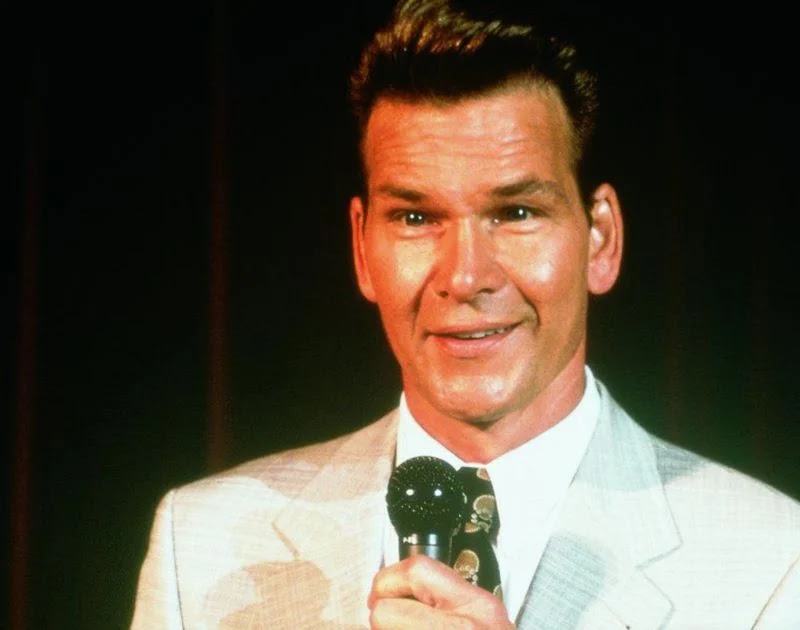
In a class, the health teacher, Kitty Farmer, an uptight person, doesn’t teach but plays videos featuring Jim Cunningham (Patrick Swayze) which focus on overcoming fear. There is an atmosphere of foreboding in this film right from the opening scene, followed by Donnie’s personality, the scary rabbit, and the airplane engine accident. (By the way, the movie Harvey deals with James Stewart’s character talking to a human-sized rabbit that is invisible to everyone else. This film is a dark version of that scenario).

Spooky Frank wakes up Donnie again and Donnie appears to be sleepwalking (sleepwalking is a kind of twilight area between waking and sleeping). This time he is carrying an axe. Later, the school’s mascot, which is represented by a large statue of a bulldog, has the axe buried in its head. And the words. “They made me do it,” are written in paint on the sidewalk. Since Donnie committed the vandalism, his free will seems to merge with the dictates of the supernatural that charts the destiny for everyone. However, his words also sound like what a schizophrenic would say. The danger surrounding his personality permeates the movie. He also uses the axe to flood the school by breaking a water main. Donnie fits in with the Greene short story since he is a destructor forcing change to occur.

Donnie gets to know the new girl at the school, Gretchen Ross (Jenna Malone). Since she has just arrived, she is an outsider, like Donnie. Her past adds to her lack of normalcy. Her father is at-large for having stabbed her mother and she and her mother changed their names and are in hiding. Donnie says he was once in jail for accidentally burning down a house, which shows his antisocial past, and a foreshadowing (there is a fire in the Greene short story, remember). She comments that his name sounds like a comic book hero. He responds by saying, “What makes you think I’m not?” He is being funny, but the dialogue adds to the unreal nature of the story, and points to Donnie maybe having special abilities. (If you have watched “the Big Bang Theory,” you know the talk about how comic book characters have alliterative names: Peter Parker, Bruce Banner, Clark Kent, etc. As IMDb points out there are many alliterative names in the film and references to comics, which contribute to the film’s imaginary worldly nature). Donnie shows his intelligence by helping her with an assignment. She comments that he is “weird,” and Donnie has heard this before and feels he is being dismissed; but, she tells him it was a compliment. This story inverts what most consider to be positive and negative. He says that if the school hadn’t closed their moment together here would not have happened. His comment suggests the idea of various timelines. The two quickly decide to be a couple since they are compatible in their nonconformity.

In another session with Dr. Thurman, Donnie repeats how he looks in many of his scenes. His head is bent forward and he looks up, unblinking. Jake Gyllenhaal said, according to IMDb, that he used this look to appear more psychotic. Thurman hypnotizes him, but even his subconscious is rebellious as he refuses to answer her questions, dwells on sexual topics, and is about to masturbate when she terminates the session.

At a PTA meeting, Kitty Farmer rants about the teaching of “The Destructors” because the young people in that book break a water main and flood a house. Since the police suspect that students may have been involved with the vandalism that included flooding the school, Kitty is connecting the dots. Teacher Karen Pomeroy defends her selection by saying the story is “ironic,” suggesting the tale is not a “how to” act piece. Rose questions if Kitty even knows who Graham Greene is, and Kitty reveals her ignorance by citing the TV show “Bonanza,” whose star was Lorne Greene. While the PTA meeting takes place, Frank again visits Donnie, telling the youth he got away with his axe-wielding actions. Donnie continues to take his medication which implies Frank’s appearance is real. Frank says he can do anything, and so can Donnie. The will of the one merges with that of the other. When Donnie asks where Frank came from, the crazy rabbit asks Donnie if he believes in “time travel,” which becomes what the movie revolves around.

Kitty is again teaching her class based on Cunningham’s videos. Donnie has a card that notes a hypothetical character finding a wallet. He is supposed to fit her actions onto the evaluation line that stretches between fear and love. Donnie complains how the whole exercise is meaningless because everything cannot be reduced to these two emotions. Later, in the principal’s office, where we learn Donnie’s test scores show him to be brilliant, Kitty reveals that Donnie, basically, told her to shove her exercise card up her ass. Donnie continues to be the defier of social convention.

Donnie asks science teacher Mr. Monnitoff (Noah Wylie) about time travel. He talks about wormholes, and then gives Donnie a book entitled The Philosophy of Time Travel, which was written by Roberta Sparrow, the strange mailbox lady, who once was a nun, and then a schoolteacher where Donnie attends. Her character is a merging of science and spirituality. Donnie relates to Thurman that Frank mentioned time travel and now he finds out about Roberta, so he concludes the linking of the two is not a coincidence. Donnie takes the “alone” part of the message Roberta whispered to him as meaning that it is absurd, given life’s inevitable solitude in death, to search for the existence of God, and thus, the general meaning of life.

Donnie is waking up from a nap in a chair in his house while his father and pals watch a football game. Donnie seems to be between the awake world and the sleep world most of this movie, and just like Edward Norton’s character in Fight Club, it’s difficult to tell whether or not he is in a dream state. He sees fluid-filled tubes coming out of Eddie’s chest, and also out of Elizabeth and himself. They point to where a person is going. In a way they are predictors. IMDb notes that director/ writer Richard Kelly got this idea from watching John Madden make illustrations of where players will go in a play. So, it’s appropriate that Donnie sees this effect while a football game is playing. Donnie follows his tube and it takes him to his father’s closet where he finds a handgun. As Anton Chekhov said, once you introduce a gun the writer better fire it later.

Donnie would like to kiss Gretchen since they have been going out for two weeks, but she wants it to be at a time that the world shows its beauty. She coincidentally mentions time travel now, stating her wish to be able to go back and replace troubling images with lovely ones. Even though they are in a beautiful park there is a “fat guy” as she puts it, watching them while smoking a cigarette. In this place, it is difficult to maintain the beauty Gretchen seeks. Donnie does not share Gretchen’s hope for that wonderful moment. The next scene is that of Dr. Thurman telling Donnie’s parents that their son is becoming more detached from reality because he finds life increasingly “threatening.” She recommends more therapy and medication for his schizophrenia. This scene is intercut with shots of Donnie using a knife to stab at Frank’s eye across an invisible force field that he seems to be penetrating. Is he trying to destroy his hallucination? Or, is he trying to cut across the barrier between the world we know and the one beyond?

Jim Cunningham presents his personal growth spiel to the high school students. He talks about a struggling individual named “Frank.” Could this reference point to Donnie’s own struggle? Cunningham says that fear is intertwined with premarital sex, smoking, and drinking alcohol. IMDb notes Donnie engages in all three in the movie, showing that he defies the restrictions on these temptations. Donnie gets to the microphone and admits to feeling lost and afraid (probably because of his loneliness), but he says Cunningham is “the antichrist,” a guy who is profiteering on the anguish of others, and not offering any real solutions.

Donnie tells Gretchen that what he has been seeing is described in Roberta Sparrow’s book, so he says what is happening to him is not random. He discusses his theory with Mr. Monnitoff that these tube-like projections show one’s destiny, and that are a way of seeing the predetermined future. The teacher says if someone could see his or her destiny, a person could then change it, negating predetermination. But Donnie sees, or wants to see that we are not alone, and that the future paths can’t be altered by individuals since they are part of God’s cosmic plan. Monnitoff wants to stick to science and not religious matters, implying he could lose his job if it appears that he is influencing a child’s faith.

Donnie now finds Cunningham’s wallet and knows where he lives. So, he is in the position of how to act that duplicated the exercise in Kitty’s class that was based on Cunningham’s teachings. Gretchen and Donnie do a presentation to the science class with illustrations about getting parents to put these glasses on their kids when they sleep. They call them IMG’s which are infant memory generators. Gretchen argues that pleasant images will be shown to instill positive memories in the children. Two guys say the nightmare of this dream proposal could occur if parents might show satanic visions, and they mention Gretchen’s violent father. It’s as if Gretchen wants to create a parental experience that would counter her own life events. Gretchen runs out of the school and Donnie follows her, apologizing for the boys’ statements. She then kisses him, maybe because she is realizing she shouldn’t wait any longer for a perfect moment to happen, since it probably never will.

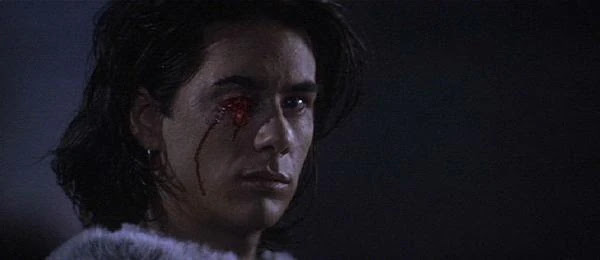
Again, keeping with the Halloween holiday, Donnie and Gretchen go to the movies to see a horror film, The Evil Dead. But that movie is shown in conjunction with The Last Temptation of Christ. It is a foreshadowing since that movie deals with sacrifice to save others. Gretchen falls asleep. It appears Donnie may be nodding off also, and then Frank appears. Dream or reality? Donnie asks Frank, “Why are you wearing that stupid bunny suit?” To which, Franks says, “Why are you wearing that stupid man suit?” What is really below the surface? Is it man or beast? The lighter and darker sides of reality join here as Frank takes off his headpiece and reveals the eye injury that Danny inflicted upon him. Frank apologizes because he knows what’s coming. A portal opens and Cunningham’s house appears. Frank tells Donnie to burn it down.

Even the dance presentations of children for a Star Search competition show contrasting images. One girl awkwardly dances to an angelic soundtrack and then the performance of the young girls called Sparkle Motion (which includes Samantha Darko) is more rock and roll. Cunningham hosts the event, which we find adds a creepy element. The fire reveals a secret room, a “kiddie porn dungeon” in the house. The police arrest Cunningham. The fire, a destructive act, brings to light a horrible crime. The scene reminds us of the opposing movie titles on the marquee and suggests that there must be sacrifice to set things right. It also reflects what Donnie said about how the Greene story shows that “destruction” is a form of “creation.”

Kitty is not willing to see the facts and remains loyal to Cunningham (does his name show he is a cunning fellow, fooling others, another example of false appearances?), thinks there is a conspiracy to frame her beloved idol (the film showing relevance to current events). She will work to defend Cunningham, and, despite Rose’s animosity toward her, she asks the other woman to fly with Sparkle Motion for a competition. This request brings up the airplane aspect of the story.

Rose sees a calendar with an illustration of the scary bunny on it. The days are crossed off, which we know is the countdown to Frank’s “end of the world” prediction. Rose is concerned about Donnie and wants him to be okay. He asks what it’s like to have a “wacko” for a son. She says it feels “wonderful.” Her allegiance reminds us of how Gretchen feels about Donnie’s questioning mind.

In a session with Thurman, the hypnotized Donnie confesses to his crimes and says he must do what Frank says so he can figure out what is happening. He sees Frank (again as he crosses into dreamland) looking upward. Donnie says he must build a time machine. He says, “the sky’s gonna open up.” Here is another reference to the airplane and its missing engine.

There is one day left until Frank’s predicted day of death. Eddie is away on business and Rose is with Sparkle Motion. Donnie and Elizabeth decide to throw a Halloween party with their parents gone. Everyone is wearing a costume except Donnie, whose “man suit” is a costume hiding his nightmarish self. Gretchen arrives distraught because her mother took off. She says, “I guess some people are born with tragedy in their blood.” Obviously, she is a perfect match for Donnie. They make love while Rose does not receive Dr. Thurman’s phone warning about Donnie since the mother is away. There is also a call from Rose saying that she and the girls will be returning on a late flight. Later, Donnie has on a skeleton outfit, which shows the tragedy intertwined with his life.

Donnie sees those fluid tunnels again, which point to what will happen, and he knows that time is running out since it is one hour to Frank’s deadline. He and Gretchen go to Grandma Death’s place. He knows that time travel connects Grandma Death to Frank. Karen Pomeroy wrote on the board before leaving the school the words “cellar door,” which someone said were the best combination of words in English. There is a cellar door at the house. We are going below the surface again to reveal what hides in the shadows. The school bullies are there, with stockings over their faces trying to hide the nastiness underneath. They drag Donnie and Gretchen outside. One puts a knife to Donnie’s throat and Donnie utters, “Deus ex machina.” In Greek theater, the gods were supposed to reside above the stage and when the playwright wanted to resolve conflicts the “god” would be lowered in a box to dispense supernatural abilities. It has come to be a negative term to show resolution by contrived means. Here the film is playing with the idea, since time travel is the story’s “deus ex machina,” and that is why Donnie calls it the “savior,” which also recalls “Christ” mentioned in the film title on the marquee.

A car approaches at a high speed. Grandma Death is in the road, presiding over the events. Gretchen is thrown into the road and the car strikes and kills her. The car stops and turns around. The driver is Frank. He is wearing the scary bunny outfit. He takes his headpiece off. Donnie has his dad’s gun and shoots and kills Frank. Again, the site of the wound is the eye, a frequent symbol in films (Blade Runner, Chinatown, Bonnie and Clyde). Here, it can refer to the terrible visions that Donnie has been seeing. It’s as if the dead Frank came back through time to inform Donnie of the horrors that would occur.


Donnie takes Gretchen’s body with him to his house and kisses his sister goodbye. Donnie envisions dark clouds forming a time tunnel in the sky. He drives to where the film began on a hillside road. We hear Monnitoff’s words about all you need for time travel is a wormhole and a metal craft entering it. Donnie also remembers Gretchen saying that it would be nice to go back in time to make things better. The plane that Rose is on hits the turbulence of the time tunnel, and we see the engine going into the tunnel. Donnie also goes into the tunnel. He comes out laughing in his bed. He is not out of the house as before when the engine hits. He is killed this time.

Donnie wrote a letter to Grandma Death, saying that he hopes the answers to his questions “will come to me in my sleep. I hope that when the world comes to an end, I can breathe a sigh of relief, because there will be so much to look forward to.” He does get his information while asleep, and it is his world that comes to an end. Perhaps he is now at peace, and he may feel that he will survive in some spiritual form, and that those alive will lead good lives.

The camera glides over all the characters in the story, as the song “Mad World plays with the fitting lyric, “The dreams in which I’m dying are the best I ever had.” Those words could fit what happens to Donnie. Gretchen, who in this corrected timeline didn’t meet Donnie, is alive. She rides by on her bike, and exchanges a sad look with Rose, and a wave. It was a worthy sacrifice.

The next film is Lost in Translation.

Sunday, September 6, 2020

Star Wars - Episode IV - A New Hope

 SPOILER ALERT! The plot will be discussed.

Of course most of us have seen the original Star Wars film written and directed by George Lucas. We know it was a pop-culture milestone. I attempted to see it when it first came out in 1977 when it was only playing in one theater in Philadelphia’s downtown district. It was incredibly difficult to buy a ticket. The lines were extremely long. On my third weekend journey to the center part of the city, I finally was able to see the movie. Why did this motion picture become so famous that it spawned so many films and even a TV show (The Mandalorian) along with its own theme park in Walt Disney World? Besides its innovative special effects and fast-paced editing that left audiences energized, the initial story contains archetypal character and has a mythic tale that all human beings can relate to. But, Lucas reinvents the characters and adds individual personality traits that widen their appeal.


 A huge influence on Lucas was Joseph Campbell, the famous scholar who studied and wrote about the world’s myths. This story, like ancient epics, and even Christian ones (such as John Milton’s Paradise Lost) begins “in media res,” that is in the middle of a lengthy tale. Subsequent parts of an epic go backward in time to show what led up to the middle part, and the whole tale concludes with sections that carry the story forward. That is the way the central nine Star Wars movies are structured. The first film introduces us to the opening words, “A long time ago, in a galaxy far, far away,” which reminds the audience of the standard fairy tale opening, “Once upon a time.” The initial words evoke a feeling that we are to be presented with a very old story that is important enough that it has endured for a long time. As the movie progresses it presents technology that is advanced for us, but for the inhabitants it many times looks battered and in need of repair, as we would have to replace an aging washing machine. Through this manner Lucas is able to make science fiction relatable, and adds to the longevity of a timeless tale. As Roger Ebert notes in The Great Movies, this technique (and I believe along with beginning in the middle of the story) “gave the saga the aura of an ancient tale and an ongoing one.”


The movie throws us right into that central area with what becomes a signature orientation message that scrolls into the distance, as if written in the stars. The film begins with the universal struggle between good and bad forces, as the notes tell us that there is a battle between the “evil Galactic Empire” and “Rebel” forces. An empire communicates the accepted understanding that there is no freedom under that type of rule, and the opening remarks note that liberty is what the rebels want to restore. The words “destroy,” “sinister,” and “Death Star,” are all used to refer to the Empire, so we know who the villains are. That this is a type of Biblical David versus Goliath story is implied by the small Rebel blockade runner pursued by the huge Imperial ship. The planet-destroying Death Star is the size of a small moon, another image that stresses the against-all-odds struggle of the Rebellion.


Princess Leia (Carrie Fisher) is trying to get the stolen schematics of the Death Star to the Rebel forces in order to find a way to eliminate this powerful ship. Her craft is damaged by the Imperial vessel and boarded by the Empire’s storm troopers (the name is an obvious reference to Hitler’s Nazi troops). She is able to program a droid (a nice abbreviation of the word “android” which is a robot that has human characteristics) with the specifications. She adds a holographic message to Obi-Wan Kenobi (esteemed Oscar-winning actor Alec Guinness) who she believes is on the sand planet Tatooine, which the two ships are orbiting. The droid is R2-D2 (Kenny Baker) who pals around with another piece of artificial intelligence, C-3PO (Anthony Daniels). The droids are the technological equivalents of movie sidekicks that are found in cowboy and adventure films. Lucas is able to successfully display the human aspects of these machines as R2-D2 is loyal and devoted, and his beeps, whistles, and shrieks mirror upset and exhilaration. C-3PO is fussy, pessimistic (“We’re doomed!” is one of the first things he says), and humorous. He, being a piece of technology, is ironic when he says he hates it when R2 spouts high tech concepts at him. He also at one point says how he hates “space travel” even though he is in a story about star wars. (The movie wouldn’t be anywhere near as appealing without the comic element involving the droids and later the character of Han Solo). 3PO’s cautious, almost off-balance walk with hands out makes him look precarious, like he is trying to navigate a tightrope between the two warring factions. The droids exhibit basic human qualities that those serving the fascistic Empire no longer have and which make the latter’s lack of individuality seem more robotic than the robots. 


The Empire’s second in command is Darth Vader (David Prowse, but it’s James Earl Jones’s deep voice and obscene phone caller heavy breathing that penetrates into our consciousness). His name sounds like “dark” and “invader.” He wears a black outfit, including a cape and a Nazi-like helmet which, according to Ebert, has a scary “fanged face.” The primal color of evil is black, an unfortunate fact, probably because it absorbs all light. White light, in practically all religious scriptures, represents the revealing of truth since it contains all the colors in its inclusivity. Someone who is masked appears more powerful, and scarier, since the abstract mystery displayed seems less understandable and more invulnerable. Vader is especially frightening because he has extrasensory abilities that can detect the presence of some others and is able to use his thoughts to control matter, including power over objects and an individual’s ability to breathe. This aspect of the supernatural is another element that resides in all mythological and spiritual stories, lending universality to the story.


R2 and 3PO are able to escape to Tatooine but Vader imprisons and interrogates Leia to find out the location of the secret Rebel base. Since the two droids left in an escape pod, and the plans for the Death Star are not on board, Vader assumes the details about the Death Star are now on the planet, and sends soldiers to investigate. The droids are captured by Jawas (whose language sounds like early versions of Despicable Me Minions). They are short technological junk scavengers that wear what look like monk’s robes. Their more mischievous nature contrasts with the similarly cloaked religious-like figure of Ben Kenobi who appears later. 


We now meet our hero, Luke Skywalker (Mark Hamill), whose last name suggests that he is destined for a life that transcends that with his Uncle Owen (Phil Brown) and Aunt Beru (Shelagh Fraser) who are moisture farmers in this arid climate. We already see that he would rather leave the domestic setting to do activities with friends away from home. Perhaps the setting symbolizes that, for Luke, it is a desert not only in fact by also figuratively which he must leave in order to grow. His uncle buys 3PO and R2. The connections between Leia, Ben, and Vader to Luke are already starting to form, which will lead to cosmic consequences. 


In cleaning up the droids, Luke releases a part of Leia’s message to Obi Wan-Kenobi, who Luke knows as Ben Kenobi. 3PO translates that R2 says he belongs to Obi Wan-Kenobi and wants to protect the complete message from being heard so only Obi Wan can hear it.  3PO calls his new master “Sir Luke,” which adds a sense of chivalry to Luke, as if he is part of a history of knights, which we eventually learn he is. Luke’s disenchantment with his boring life is evident, and he is excited when 3PO mentions that the droids were involved in Rebel action against the Empire. 


At dinner, Luke says that R2 said that he belongs to Obi-Wan Kenobi. Knowing, furtive glances are exchanged between the uncle and aunt, and we get the hint that there is more to Luke’s story than the bland surface of his life suggests. Owen wants Luke to erase the droid's memory so there will not be any indication that it was stolen. He calls Ben a “wizard,” which hints at special powers, but says the man is crazy, and warns Luke to forget about him. Owen says he thinks that Ben died about the same time as Luke’s father. Luke, wanting to know more, asks if Ben knew his father. Owen dodges the question, not wanting to reveal the truth of Luke’s heritage. Luke wants to go to the Academy earlier, another example of wanting more out of life. But Owen says he needs him now, which shows his hidden agenda of wanting to prevent Luke from putting himself in danger. After Luke wanders off, Aunt Beru says Luke has too much of his father in him so he will not be restrained, which is what Owen is worried about. Of course we don’t learn why Owen is so afraid until the second film.


The next shot is one of the most memorable in film history. Luke, on the cusp of setting out on a life of greatness, stares into a beautiful binary sunset on a hill, symbolizing his desire to ascend to his heroic role. The John Williams score is perfect as it swells and the cinematography is stunning, so we get an emotional surge that opens up the story by bringing an epic taste of what is to occur. 


R2 escapes to complete his mission and Luke and 3PO look for him. When they find him, the dangerous Sand People attack Luke and he is rendered unconscious. But a howling sound wails and scares the Sand People. It is the robed and hooded Ben Kenobi who scared them away. His attire makes him look like a member of a religious order, which he is as we learn. He puts his hand on Luke’s forehead and is able to revive him, so we see he has special powers. 


 When Luke says R2 says he belongs to Obi-Wan Kenobi, Ben shows awareness and concern. He admits that he is Obi Wan, and decides to tell Luke that the young man’s father was a Jedi Knight, like Ben, and that they both fought in wars. The “knight” reference is another instance of adding a sense of ancient history to a modern tale, again making the story feel like a timeless rendering of heroic deeds. Ben praises Luke’s father for being a “cunning warrior,” and a great pilot. Ben acknowledges he has heard of Luke’s ability as a pilot of a landspeeder, cementing the father-son heritage. He says that Owen didn’t want Luke to know about his father for fear Luke would go on some quests, putting himself in danger. But, that is what a crusading knight does. 


Ben gives Luke his father’s lightsaber, one of Lucas’s most well-known creations. It combines future technology with the medieval version of a sword, again nicely welding the old and the new into one uniting object. Ben calls the lightsaber, “An elegant weapon for a more civilized age.” Many times science fiction shows a future that comments on the shortcomings of the present by metaphorically placing events in the future and suggesting the solutions to problems exist in the past. Ben stresses this idea when he informs Luke that for thousands of generations “the Jedi Knights were guardians of peace and justice in the Old Republic, before the dark times, before the Empire.” 


Luke asks what happened to his father. Ben says that he had a pupil named Darth Vader who became “evil.” He betrayed and killed Luke’s father (a distorted version of the truth, which we do not learn until The Empire Strikes Back). We now see that Luke’s connection to the primal fight between good and evil is part of his destiny. Darth Vader hunted down and destroyed the Jedi Knights, and they are all but “extinct.” Ben says that Vader was corrupted by the dark side of the Force, which Ben says “gives a Jedi his power.” Ben describes it as “an energy field created by all living things. It surrounds us, penetrates us. It binds the galaxy together.” By introducing us to the Force, Lucas accomplishes a few goals. He inserts the religious, supernatural element that is in mythological stories. By doing so, he taps into the ageless desire to connect with some power beyond the individual’s basic abilities. It also contrasts materialistic technological achievements with something that transcends the limitations of science. (Even Vader says that the power of the Death Star is “insignificant next to the power of the Force”). And, it offers a hopeful feeling that everyone is connected to each other. 


Since R2 has found the person Leia sent him to deliver his message, the droid plays back the full message. The holographic Leia says that her father served with Ben and she is trying to get the information stored in R2 to help the Rebellion in its most “desperate” time. She says that Ben is their “only hope” of getting R2 to her father on Leia’s home planet of Alderaan since she has failed in that mission. Ben decides that he needs Luke to learn the ways of the Force and help him complete the task. Luke says he can’t abandon his uncle and aunt, but promises to get Ben to a place where he can acquire a transport spaceship. We have the elements of a classic story of a young person who is caught between the draw of staying in the safety of his home and the desire to venture out to expand one’s experience and develop one’s potential. The story of the orphan who discovers his true heritage is also a standard plot in fiction, as that youth seeks a parental figure to fill a void that existed since birth. Ben is that father figure and mentor in this episode of the series


The story taps into the shared fear of losing liberty by having the high ranking Grand Moff Tarkin (Peter Cushing) on the Death Star informing his staff that the Emperor has suspended the Imperial Senate. He now runs the Empire with his local governors. With the use of the Death Star, the plan is to wipe away all that is left of whatever democracy remains in this sector of the galaxy. 


Luke and Ben find a destroyed cargo vehicle that belonged to the Jawas. Ben determines that Imperial storm troopers engineered the attack, and Luke now knows that they are tracking down the information contained in R2. So, he realizes that his family is in danger since the Jawas sold the droids to his uncle. Luke finds the burned remains of his home and aunt and uncle. He no longer has anything to hold him there, so we have him tragically freed to go on his hero quest. Now that he has some understanding of his past and has been personally affected by the evil enemy, he tells Ben he wants to go to Alderaan, learn about the Force, and become a Jedi. Finding one’s purpose is another example of a theme that resonates with everyone.


In the spaceport of Mos Eisley, a place of notorious “villainy” as Ben says, they seek a ship to transport them. Ben’s use of the Force is on display as it serves as a deterrent to that of Vader. He is able to get them past Imperial guards by controlling their minds, and is adept at defending Luke against one of the nasty customers with a lightsaber in the cantina they enter. The place has all sorts of strange looking creatures and the scene combines the right amount of danger and humor. Ben talks with the tall, furry Wookiee, Chewbacca (Peter Mayhew), who introduces them to his partner, the smuggler Han Solo (Harrison Ford). He is the archetypal bad boy who appears to be only interested in himself (his last name is “Solo” after all), but who, according to type, will find his morality and commitment to help others in the end. But Lucas and Ford bring dimension to this stock character by adding humor and swagger. 


While haggling over the deal to go to Alderaan, the rivalry between Han and Luke begins. The proud Han boasts about the speed of his ship, the Millennium Falcon, and the price he charges makes Luke feel like they are being cheated. Han is condescending about Luke’s claim that he is a good enough pilot to fly a ship himself. After Luke and Ben must quickly leave when storm troopers show up, Han tells Chewbacca that the payment will get him out of trouble. So, we know he has a huge outstanding debt, which is in keeping with his unlawful ways. He runs into Greedo (Paul Blake), a pointy, rubber-faced alien with a money-loving name, who is employed by the infamous Jabba the Hut, the creature Han owes money to. Greedo is trying to get the cash for himself and appears ready to do away with Han. Han is cool and can defend himself, blasting away the collector. (The revised version adds a scene that was edited out of the original film where Han meets the giant slug-like criminal, Jabba. Jabba’s gross appearance paints him as a stereotypical fairy-tale villain. Han persuades Jabba to give him more time to compensate for the smuggled cargo he dumped when being chased by Imperial forces. The scene shows Han is only concerned about his own interests at this stage).


Back at the Death Star, Vader notes that Leia has been able to surprisingly resist the use of “mind probe” drugs during the interrogation. Her character in fairy tales would make her the “damsel in distress” who must be rescued by the male protagonist. But, Lucas has made Leia a feminist heroine. She is the one who has taken on the dangerous mission to deliver the Death Star specifications. When Luke eventually says he has come to rescue her, she berates him and Han for not even having a plan, and is the first one to grab a weapon to blast open an escape route. She has a wicked sense of humor when she tells Grand Moff Tarkin that she recognized his “foul stench.” Later she calls Chewbacca a “walking carpet.” The David versus Goliath theme is depicted when she says when she first sees the disguised Luke, “Aren’t you a little short for a storm trooper?” It is again stressed in her words to Tarkin when she says, “The more you tighten your grip, Tarkin, the more star systems will slip through your fingers.” It is a good line, which visualizes how the small by their nature can evade those that are larger, and can live to fight another day. But, Tarkan demonstrates the total destructive nature of the Death Star by obliterating Leia’s home planet of Alderaan. It is an act of genocide, another reference to what the Nazis and other brutal civilizations have tried to accomplish. This action shows how technology can be vastly abusive when in the hands of those whose morality is completely corrupted by power.


 Luke criticizes the Millennium Falcon for being an old ship, but it fits in with Lucas’s providing a lived-in, realistic version of a science fiction tale. Han’s upgrades make it exceptionally fast. Lucas again shows the link between the old and the new, emphasizing the epic scope of the story and showing how those who are young need the wisdom of history and older individuals who have lived it. Likewise the elderly need the vitality of the young to fight for just causes, which is shown as the Falcon and its passengers are able to escape storm troopers and Imperial cruisers.


Ben feels the pain of the millions destroyed by the Death Star, showing how the Force symbolizes how everyone is connected, and the wrongful harm against one affects everyone else. Luke is practicing lightsaber maneuvers and the disbelieving Han says, “Hokey religions and ancient weapons are no match for a good blaster.” At this point he is a cynic who just wants to put his faith in the material aspect of the world. Luke takes Ben’s advice of having his eyes shielded against the small drone used in the exercise. Ben tells him that what one sees can be deceiving, and he should “act on instinct,” and his “feelings,” intangibles that use one’s inner strength, which is the opposite of what Han says. Luke is successful, and Ben says, “You’ve taken your first step into a larger world.” All of us can relate to that path that takes one from the self-centered myopic view of a child to a vision of existence that has more depth and a wider lens of perception. (On a humorous note, one of my favorite alliterative lines occurs here. Han advises not beating Chewbacca at a holographic game because Wookiees can pull arms out of their sockets. 3PO tells R2, “Let the Wookiee win.”)


After realizing that Alderaan is no more, The Falcon encounters the Death Star which draws it in with a tractor beam. Han has hidden compartments in which he smuggled cargo, and the crew remains there until they can escape before being detected. It is an example of what Leia said about the small evading the larger foe. They overpower a couple of storm troopers and are able to hide in plain sight using the uniforms. Once R2 accesses the computer system they know where to release the tractor beam. Ben says he will handle that, and he already knows that Luke’s “destiny lies along a different path” from his. It is another universal example of an individual leaving the instruction and protection of a parent to find one’s own road on which to travel. Ben says the Force will always be with Luke. So, this otherworldly power that Ben has introduced Luke to is Ben’s legacy to his protege, one he hopes will turn out better for Luke than it did for Vader. Vader, however, with his powers of the Force, can feel beyond that which the senses can detect, and notes an old “presence” which he can’t determine just yet. It is that of his old teacher, Obi Wan. 


When R2 discovers that Leia is on board, Luke, who has seen her recording and is drawn to Leia, wants to save her. She is scheduled to be executed. Han doesn't want to stick his neck out, saying, “better her than me.” Luke appeals to Han’s selfish interests by saying there will be a reward if they rescue Leia. After she shows her toughness, Han’s admiration for her is evident when he says he’s “either going to kill her, or I’m beginning to like her.” A little later she admits to admiring his courage as he charges at the enemy so that the others can reach the Falcon. It’s that traditional love/hate relationship that is beginning to reveal itself, with the accompanying humor as the romantic leads insult each other, with their true passion simmering below the surface. 


Lucas has some more fun with the traditional hero quest story as he places the protagonists in a garbage compartment, and even though it is a dangerous situation as the compacting walls close in on them, it is still an unusual and comical challenge which in this case the sidekicks, 3PO and R2, not the principles, as is usually the case, save them. As Luke and Leia head to the ship they are pursued by storm troopers. There follows an Errol Flynn type of scene where, instead of high-tech tools, Luke slings a rope with a small grappling hook around a high outcropping of metal and swings them across a deep air shaft. Leia even gives him a kiss for luck, as an old-fashioned heroine might do, which again links the past to the future appearing setting.


The ages-old face-off between the forces of good (Ben) and those of evil (Vader) is actually a diversion set up by Ben after he deactivates the force field restraining the Falcon. He wants to give Luke, the one who must continue the nobility of the Jedi, and the others time to get away. Vader sees the fight with Ben as a way to show that he was once “the learner” but is now “the master.” But Ben’s morality is superior since to him it’s a desecration to turn the uniting power of the Force into a weapon to foster arrogance. That is why he says Vader is only a “master of evil.” Vader seems to defeat Ben with his lightsaber, but actually Ben transforms himself into a pure spiritual form, leaving no corporeal remains behind. He transcends this world and completely merges with the Force. The scene depicts a spiritual rising above material existence. Luke is devastated as he sees Ben “lose” to Vader, but as he and the others get away, he hears Ben’s disembodied voice telling him to run. 


There are more references to the past with the blaster cannons on the Falcon that swivel like the turret guns used in WWII aircraft (as Ebert notes). When 3PO is damaged, he says “I’m melting,” which is an obvious reference to the 1939 film, The Wizard of Oz, which links the magic in that old movie to the wizardry in this space epic. However, the insightful Leia realizes the enemy allowed them to escape or else they would have been stopped. She realizes that the Imperial forces are tracking them, which is confirmed by Tarkin, who wants to follow Leia and her companions to the secret Rebel base. She just hopes that the specifications of the Death Star are intact and that the Rebellion can find weaknesses in the Death Star. But, Han assures her that he just wants his money, and doesn’t care about the Rebellion. She bitterly tells him he’ll get his money since that is all he cares about. At least in this movie, there is a bit of a love triangle going, another time-honored plot device, as Luke discourages Han’s interest in Leia, who, as we know turns out to be his sister in the later films, and which, in retrospect, is a bit disturbing, like the plot of Back to the Future.


The Falcon arrives at the Rebel base on a moon orbiting the planet Yavin. They review the Death Star schematics. The David and Goliath metaphor appears again here as Rebel Commander General Dodonna (Ales McCrindle) says the Death Star was designed to defend against a large-scale attack, but a smaller fighter craft can penetrate its defenses. It can fly down a narrow trench on the surface and drop torpedoes into a shaft with a small opening that leads to the reactor which will destroy the spacecraft. Luke, the David in this analogy, feels he has the experience to accomplish the task because he “used to bulls-eye womp rats,” back on Tatooine. Dodonna’s last line is now the often repeated “May the Force be with you.” It is an obvious variation on “May the Lord be with you,” the Christian blessing, which connects to the audience by invoking a centuries old phrase, and which also links us to an otherwise alien civilization. 


Han loads up the Falcon with his reward and Luke tries to appeal to his humanitarian side by stressing that Han can add meaning to his life by joining a fight for the greater good. Han does not see attacking the Death Star as an act of “courage” but instead calls it a “suicide” mission, and wants Luke to go along with him since he’s a good fighter. Luke tells him to take care of himself, because that's what he’s “best at,” indicating Han’s inability to see past his own interests. Han, the previously self-proclaimed non-believer in anything that transcends materialistic personal gain, now is able to give the “May the Force be with you” blessing to Luke.


Lucas once more gives us a battle in the stars that is reminiscent of an old airplane dogfight from the past to allow the audience to relate to the story. Before the Death Star is in range of the moon, the Rebels fly their fighters as they meet resistance from laser cannons and Imperial aircraft. R2 is on Luke’s craft for technical assistance to show how humans and machines can merge in harmony for good, and not just for dark purposes. But Luke hears Ben’s voice assuring him that the Force is with him, and that he should trust his “feelings,” and “use the Force” to rise above material restraints. Vader himself joins the battle. He recognizes that Luke is strong with the Force, but just as he is about to destroy Luke’s ship, Han, now committing himself to a cause beyond his own needs, appears and fires on Vader's group, causing Vader’s ship to fly off course. Luke releases the torpedoes without the computer’s aid and uses the Force to find the target and destroy the Death Star. After the hard fought battle, you feel like standing up and cheering, so effective is Lucas’s direction in this sequence.


After landing, the three main characters hug as they rejoice, and Leia says she knew there was “more” to Han than “just money.” Even the self-absorbed 3PO (who originally told R2, “Why I should stick out my neck for you is far beyond my capacity”), shows how the desire to help others is contagious as he offers to donate any of his parts to repair the damaged R2. The film ends in a large hall filled with the troops of the Rebellion, now showing that their size and accompanying spirit has grown in size to take on the Goliath dimensions of the Empire. To John Williams’s triumphant music, Luke, Han, and Chewbacca stride down to the dais where Leia presents medals of valor to Luke and Han, with 3PO and the restored R2 in attendance.


Despite the emphasis on special effects and technology, Lucas’s focus in the story emphasizes the intangibles inside a person, one’s morality, courage, and faith and the desire to care for others.


The next film is The Big Short.