SPOILER ALERT! The plot
will be discussed.

This 2008 film not only
won the Oscar for Best Picture, its director, Kathryn Bigelow, is the only
woman to have been awarded the Best Director Oscar. The film opens with a note
from Chris Hedges that reads, “The rush of battle is often a potent and lethal
addiction, for war is a drug.” It is the mixture of adrenaline with, in this
case, testosterone, that demands a life with a high dose of dangerous action.
The setting is Baghdad, 2004, and there is a loud confluence of Arabic speech,
the voices of American soldiers, and the sounds of military vehicles which
makes the whole scene feel chaotic. The equipment may be high tech, as is shone
by the land robot with its camera, but people are still the ones that die. The
low angle shots from the bot remind us of the mechanistic impersonality of war,
and the jerky camera images elsewhere give the movie a raw, documentary style.
Cameras were placed everywhere to make the audience members feel that they are
part of the action.


Thompson (Guy Pearce)
heads up this particular bomb squad. He constantly surveys the area, looking
for hostiles, as the men use humor to deal with the tension. As occurred in
Vietnam, it is difficult to separate the enemy from those friendly to the
troops. Anyone can use a remote control to set off an IED (improvised explosive
device, the name itself suggesting a spontaneous danger), such is the peril and
unpredictability that exists in modern warfare. The bot finds a bomb under some
covers, which stresses the lethal potential hiding under a nonthreatening
surface. But, the bot has a wagon attached that becomes disabled. Despite the
advanced mechanism, things still go wrong. Thompson exhibits bravado to cope
with the dangerous job as he says that they need to show the locals that if
they leave a bomb in the road, the American soldiers will blow up their road.
Destruction just leads to more devastation. The other men help him put on the
preventative gear, including a helmet, and Sanborn (Anthony Mackie) says,
“Happy Trails,” to him. It is the title of a cowboy song, equating these
soldiers with the Americans who won the Wild West. They are being humorous, but
it resonates with the idea of the rugged individualism that tamed the frontier.
However, the reference also hints at the idea of Manifest Destiny that
justifies incursions in the lands belonging to others.

Thompson is literally in
the hot seat as he walks toward the bomb in the sweltering desert city wearing
the weighty suit. He looks like an alien invader, which in a way he is. A
civilian man approaches Sanborn asking him if he is from California. Is he a
distraction that is part of an attack? Or, is he just a curious bystander? It
is impossible to tell, which makes the situation unclear. Sanborn says Thompson
has entered “the kill zone,” which turns out to be a foreshadowing. Thompson
plants explosives for detonation and starts to walk away from the bombs.
Eldridge (Brian Geraghty) jokes with Sanborn about Iraq needing grass, and they
can plant it and sell it, making a fortune. But humor and death stand
side-by-side here, and as they kid around, Eldridge sees a man with a cell
phone, which can set off the IED. He runs toward the man, telling him to put
down the phone. But the man moves so Eldridge can’t get a clear shot at him. He
sets off the bomb with the cell phone. The shot is at first in slow motion as
we can see how strong the blast is as it heaves up the ground and rips an
abandoned car. The bomb suit actually is no protection against the force of the
blast, and Thompson is killed. (The title of the film refers to explosions
sending victims into a place of suffering).


A grim Sanborn places
Thompson’s possessions in a box next to many others that house the effects of
the multiple casualties of war. Sanborn next visits Sergeant Will James (Jeremy
Renner, who received an Oscar nomination for this performance). (Could the
soldier’s name imply that he is willful?) James is playing hard rock music
loudly. Is it to drown out the demons in his head? Or, is he so used to that
adrenaline rush that he can’t tolerate existing in a restful interval while not
on a mission? He later puts the music on again and calls his new dwelling,
“home sweet home,” which can be a sarcastic remark, and the music is all he has
to make the place feel like his own. Sanborn welcomes him, and tells him they
changed the name of the location from Camp Liberty to Camp Victory, which he
says sounds better. It appears that fighting for freedom is not a sufficient
cause, and only winning is what’s important, as emancipation has become a
secondary goal. James wants the plywood covering the window taken off so he can
enjoy the sunlight. Sanborn says it helps protect against mortar shells. James
rightly says it won’t help if the shell comes through the roof. He seems to cut
through the illusion that there can be any safety here, and he would rather
enjoy the surroundings as best he can while he can.
Eldrigde (who director
Bigelow says is a younger man looking for role models in James and Sanborn)
picks up on the idea that all the supposed protection is just for show. He says
there are many tanks at their location, but they can’t protect them from some
unexpected enemy driving by. He sums it up by saying, “Pretty much the bottom
line is, if you’re in Iraq, you’re dead.” Sanborn seems to be more of a
by-the-book guy, and argues he would rather have the tanks there than not. A
note appears that says there are thirty-eight days left in the rotation in
Bravo Company for the three bomb techs before they can go home. It seems like
the countdown on a fuse to see if they will make it to the end.
As they try to navigate
through the city, the obstacles in the streets reflect how difficult their
service is here. There is a shot of a limping cat crossing a street, which
could reflect on how badly the fighting is going. The inability to assess the
danger of a situation continues as the three men arrive at a spot that was
called in as a possible threat. They do not see any soldiers, so there is a possibility
that the call was a trap. They do discover an unoccupied Humvee, and then see
the soldiers who left it to take cover after calling in the sighting by an
informant of a possible IED. James likes to go rogue on these missions, taking
chances to increase the adrenaline high. He is ready to check out the explosive
without sending in the bot first, which is what Sanborn says is the procedure
they should follow. James gets into the bomb suit and laughs as he says, “Let’s
rock and roll,” which fits with his preference for rowdy music. But, the
careful Sanborn tells Eldridge that James is “reckless.”


James sets off a smoke
bomb. Sanborn is confused by the action, and wants James to communicate in
increments where he is in relation to the IED site. James finally says he is
just creating a diversion (sort of his version of camouflaging danger), doesn’t
know how far down the road he is, and doesn’t seem to care that his fellow bomb
specialists can’t see him. The camera shifts inside the suit, as we see things
from James’s perspective, and hear only his breathing, sort of like Bowman in 2001:
A Space Odyssey, where the character is also in danger. A taxi speeds into
the area and stops next to James, who escalates his violent threats by degrees
to get the driver to back up. He first shoots next to the car, then shatters
the windshield, and then places his gun to the man’s head. After the driver
does put his car in reverse, the soldiers pull the man out of the vehicle and
roughly slam him to the ground. James laughs as he says if the man wasn’t an
“insurgent,” before, he was now. The harsh treatment may be justified given the
situation, but being in this war zone creates actions that can turn a person
into the enemy.

James finds a large
bomb, hidden by innocent looking refuse. He defuses it, but finds it is linked
to four other explosives, showing the potential for extreme destruction in this
“appearances can be deceiving” conflict. There are suspenseful cuts to a local
man running down steps probably trying to set off the devices before James can
disconnect them. He comes face-to-face with James who shows him he has
finished, and the man runs off. Sanborn makes it known that he is not happy
about James being cavalier by not following protocol.
Back at the base, Eldridge,
instead of trying to escape the atmosphere of violence, plays a video game that
features combat, which may show he is being influenced by James. He asks Doc
Cambridge (Christian Camargo) about the line, “Be all you can be,” that the
military uses to recruit soldiers. He says, correctly, that it’s illogical,
because what you can be in a war, mostly, is dead. Doc says Eldridge has to
stop thinking negatively, and asks what he is thinking right then. Eldridge
picks up his unloaded rifle and alternately pulls the trigger showing how in a
split-second, war can obliterate life.

James meets up with a
young local boy who calls himself Beckham (yes, after the famous soccer star)
who is trying to earn a little money selling DVDs to servicemen. He buys one off
of the kid and jokes with him as he offers a cigarette and then takes it back,
telling him he shouldn’t smoke. It is a friendly, almost paternal, exchange,
which shows James has many sides to his personality. Later he encounters the
boy again who is kicking a soccer ball. The boy is funny, using American slang,
showing the Western influence spreading here, for better or worse, and jokes
about getting James all kinds of weird pornography. He tells the youth if he
can stop James from kicking the ball past him he will give him money. The boy
blocks the kick, and James pays him and orders another DVD, hugging the youth,
and saying he’s “a good kid.” But the next scene with Sanborn shows how he
wants to pigeonhole James into a demographic profile. He tells James that how
he acted at the bomb site wasn’t “cool.” James counters by saying that Sanborn
will “get it,” as they proceed, implying his fellow soldier will key into why
James operates the way he does. Sanborn says he was in military intelligence
for seven years, “So, I’m pretty sure I can figure out a redneck piece of
trailer trash like you.” James surprises by not becoming angry and
confrontational, and instead humorously says to Sanborn he is “on the right
track,”

The next day the bomb
squad goes to a building being evacuated. An Iraqi soldier tells James there is
a car that has been parked illegally close by and it sags, implying there is
explosive material inside. James continues his joking by asking the soldier to
check it out, and the man responds alarmingly. James says he is kidding, but
the action also shows that maybe there would not be a need for bombs if the
Americans were not there. Now that the Americans are there, the local military
can’t handle the situation, being so dependent on the American presence. As
James goes to check out the car, a local insurgent fires a shot at the vehicle,
igniting it into flames. Gunfire is exchanged, and the shooter is wounded. The
commander in charge, Reed (David Morse), states, over the assessment that the
man has a “survivable” wound, that the shooter isn’t going to “make it.” He has
decided that the enemy should die for his action, taking on the role of judge
and executioner even though his soldierly duty has already been
fulfilled.
James, cool on the
surface, doesn’t leave the area, but instead puts out the fire and discovers in
the trunk several of the bomb canisters that are similar to the ones he defused
earlier. He then takes off his bomb gear which confounds Sanborn and Eldridge.
James won’t hide behind the false optimistic facade of protocol, and has
assessed the danger head on. He says, “There’s enough bang in there to send us
all to Jesus. If I’m going to die, I’m going to die comfortable.” While James
looks for the trigger, Eldridge sees a guy on a balcony using a video camera.
He may only be ready to put them on “YouTube,” as Eldridge amusingly notes, but
he could be a threat. Even Sanborn does not know how to advise him, where
shooting footage can also be interpreted as the possibility of shooting with a
weapon, so inscrutable is the danger here. The military has completely removed
all the people who could be hurt, so there is no need for James to remain.
James may be cool with others, but he is maniacal alone, cursing his
frustration while trying to find a way to render the bomb inactive. He does not
want to hear Sanborn telling him that there is no need to remain and it is
dangerous for him to stay. James, showing his independence, which is not what
the military is based upon, throws his headset off so he won’t hear Sanborn. He
gives Eldridge the finger when asked to replace it. Comically, even in such a
tense situation, Eldridge tells Sanborn that James’s response was “a negative,”
and says it looks like James “is checking the oil.” James succeeds in finding
the trigger. Back at the Humvee, Sanborn shows his anger at James’s defiance
and what he sees as foolhardy behavior by punching James in the face, warning
him never to turn off his headset.

Reed comes over,
grinning, and seems to like that James is a “wild man,” impressed by his lack
of concern for safety. The film may be suggesting that if James was
unsuccessful, Reed’s attitude might be different, because everybody likes a
winner and hates a loser. Reed asks him how many bombs he had disarmed. James
says he’s not sure. That is not what Reed wants to hear. He’s looking to use
the man’s bravery as a soundbite that he can employ to rally the troops, and it
doesn’t need to be based on fact. Reed says he asked James a question. James
catches on quickly, and makes up a number, saying, “eight hundred and
seventy-three, sir.” When Reed asks the best way to deal with the bombs, James
says, “The way you don’t die, sir.” James knows not to give a technical answer,
and instead delivers the bravado Reed wants, which pleases the commanding
officer, who finds the response worthy of a “wild man.”
Doc checks in with the
anguished Eldridge, who is sarcastic, saying things are good and his leader,
James, is “inspiring.” Doc knows he isn’t being truthful, and Eldridge says
that James will get him killed, but, “At least I’ll die in the line of duty, proud
and strong.” Eldridge is mocking the patriotic fervor that is meant to propel
soldiers into battle. Doc tries to sell the positive side of serving, saying it
can be a unique experience, and possibly “fun,” which is difficult for Eldridge
to swallow. He says to Doc with additional sarcasm that Doc probably arrived at
his conclusion due to his “extensive work in the field.” Eldridge does drop the
attitude and says he appreciates what Doc is trying to do, but he has to be in
the combat zone to appreciate what Eldridge is going through. Doc says he will
try to do that. It turns out that the suggestion literally backfires.

It is now twenty-three
days left in the rotation. The three men are detonating found IEDs when James
tells them to stop temporarily because he has to retrieve gloves he left near
the bombs. He drives off, and Sanborn picks up the detonator in his hand and
darkly talks about how these devices malfunction and go off all the time. He
says that Eldridge might get James’s helmet out of it, although there might be
part of his hair attached to it. Eldridge asks if Sanborn is joking, but
Sanborn is not smiling. He doesn’t set off the charge, but he may have been
serious in wanting to take out one of his own soldiers because he considers him
to be a danger to others. The movie brings up the question as to who is more of
a threat, the enemy or ourselves?
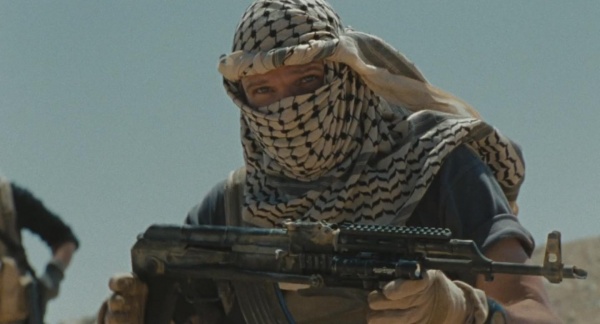
The dilemma of
determining who is the enemy is stressed as the men approach others next to a
SUV. These men are wrapped in local headgear and carry weapons. Sanborn yells
at them to drop their guns. It turns out that they are British contracted
fighters and their Team Leader (Ralph Fiennes) says they are on the same side.
As the bomb squad tries to help them change a flat tire, the real enemy emerges
in the form of sniper fire (by definition, a hidden attack), with one of the
Brits getting shot. The Team Leader shoots escaping insurgents the British team
had captured because they get the bounty for them whether or not they are
alive. So, a mercenary element has replaced the supposed aim of beating a
brutal adversary. They just start firing in the general direction from where
the incoming came, and someone asks who they are shooting. It is a question
that highlights the film’s theme that there is no clear purpose or rationale to
the conflict. One man who is behind the artillery gun firing wildly is just
wasting ammunition. When he is told to stop, he is immediately hit by a shot.
It is reminiscent of the scene in Full Metal Jacket, where all the fire
power and technology of one side can be brought down by a dedicated
sniper.
The men take cover
behind an embankment and see a small building where the enemy must be. The Team
Leader shoots at the building, but his action allows the insurgents to locate
his position. They fire on him, killing the man. Sanborn runs out of ammunition
as he adjusts his aim, and Eldridge must get the ammo from the dead Team
Leader. Again, despite the supposed advanced war machine of the United States,
a soldier must cannibalize the supplies of a dead ally to continue the effort.
Then the new clip jams because of the blood of the dead soldier on it. They
must spit on the ammo and rub it off. It is like a desecration of the dead
person’s life. But, it also shows irony that the blood of someone fighting with
them works against their efforts, suggesting that when blood is spilled, the
situation is dire for all concerned.

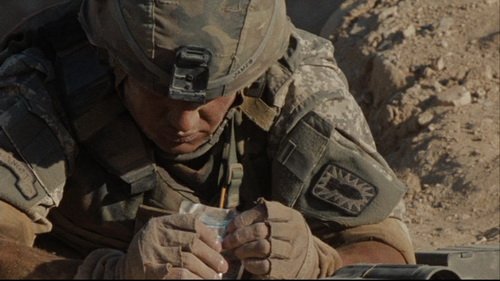
Sanborn is able to shoot
three of the enemy combatants taking cover in the small building. But it is not
just the men on the other side of the battle that the soldiers must deal with.
A fly almost crawls into the eye of Sanborn as he is ready to shoot and one
slips into James’s mouth. It almost symbolizes how this place of death is
infecting those fighting in it. The heat and wind make them thirsty, as James
starts to cough. He and Sanborn must share a juice packet, since it is in short
supply. They must wait out the enemy as the sand of the desert coats them,
almost dehumanizing their features and making them appear as statues as they
sit still in their positions. An enemy fighter approaches from their rear.
Eldridge spots him and shoots, killing him. He looks at his own weapon, which
recalls what he said to Doc about how precarious life is in war, as one moment
turns life into death. As sunset approaches, James calls an end to the siege.
Back at camp, the three
men unwind by being rowdy and drinking together as they listen to loud rock
music. Sanborn finds some stuff stowed under James’s bunk. It reveals that he
is married, but James seems unsure of his marriage status. He feels divorced
from his wife, and probably from others, but she still lives in their house
with their child. James also has collected components of the bombs he has
disarmed, because he finds it interesting that they could have killed him. It
is a morbid fascination. Also, he probably feels the adrenaline rush from
revisiting the scenes in his mind where he came close to death. In a
non-psychotic way, it’s similar to a serial killer collecting trophies.

The men trade punches to
show their macho quotient, but James pushes it too far, pinning Sanborn to the
ground and acting like he is riding him like a bronco. Sanborn pulls out a
knife and puts it to James’s throat. James just smiles, says he was kidding,
and tells Sanborn he is okay, since the man passed James’s “wild man” test.
There is a thin line here between camaraderie and animosity. As James puts the
drunk and battered Sanborn to bed, the man asks James if he thinks he has what
it takes to wear the bomb suit. James smiles and says, “Hell no.” His remark is
not necessarily a criticism. He may be saying that Sanborn is not insane and
reckless enough to do what James is doing. James in his cot puts on the helmet,
showing he can’t seem to escape his addiction to facing death.
Doc, taking Eldridge’s
suggestion, joins him and the others on a maneuver. They are supposed to
acquire some unexploded devices in a building. The place has not been cleared,
so they must be careful. They find a lot of explosives that appear to be their
own weapons, which shows how the enemy turns their armaments around, and
ironically uses them to kill Americans. It’s like a ricochet. It might also
remind us of The Deer Hunter, where violence meant to be directed
outward turns into an instrument of suicide. There is the bloody body of a boy,
who James thinks may be Beckham, on a table. He represents the collateral
damage that occurs when war is unleashed. But, his body has been booby-trapped.
In the senselessness of war, even the dead are turned into weapons. Even though
James overtly acts cool, he is privately affected by the death of the boy and
the fact that he now has to blow the corpse up. He cancels the detonation so he
can find the bomb, which he discovers is sewn into the boy’s chest, symbolizing
how invasive violence can be for those caught up in a war. He cuts it out so he
can show respect for this loss of life by preserving the youth’s body for
burial.


As James carries the
dead boy, Doc is talking to locals about moving their cart to a safe place away
from the area. However, as they leave they drop what appears (that false facade
again) a parcel that turns out to be an IED. It explodes and kills Doc.
Eldridge is devastated since he was the one who urged the man to go out into
the field to see what it was really like for the foot soldiers. Back at the
camp, James calls home. After hearing his wife answer and his baby’s voice in
the background, he can’t talk and hangs up. It’s as if he was reaching out for
help to deal with the horror of the situation. But, he can’t connect with his
other life after his time in the war zone. For him, (with my apologies to The
Wizard of Oz) there’s no place that’s home.
James sees a local man
and asks about Beckham, but the man has taken the boy’s place, selling DVDs.
James wants the man removed, saying he might be a security risk. But the real
reason that he is angry may be that he doesn’t want to accept that Beckham is
dead, and the man’s presence makes the death real for James. He suspects that
the man may be involved with Beckham’s death so he could replace him and get
close to the Americans to spy on them. He uses a gun to force the man to drive
to his destination so James may find out if there is any conspiracy behind the
boy’s disappearance. They arrive at a house which James assumes was Beckham’s
home. He enters the house with his gun asking about Beckham. The man there is
Professor Nabil (Nabil Koni) who says it is his house and says James is his
guest and wants him to sit. A woman enters, scared at the stranger with
a gun, and angry for the intrusion. She yells and smacks James with a
serving tray. He flees. Is James just mistaken or are these people really the
enemy? Even though James wants things to be clearer, the confusion of who is a
friend or a foe here adds to the theme of uncertainty as to any logical clarity
in this war.
It is nighttime as James
heads back to his camp, and even though nobody threatens him, he is an outsider
who is running as if trying to evade a hostile army. To add to the confusion,
because he is not inside the base after hours, he is considered a possible
enemy by fellow American soldiers even though he continues to state that he is
“friendly.” The films stresses here how easily roles can be reversed in the
paranoia induced by the fog of war. He comically gets in by telling the guard
he was at a whorehouse and will share its location with the soldier. Apparently
that information is more conclusive of friendliness than an official ID in this
crazy place.
James, Sanborn and
Eldridge investigate an explosion. It is still night, when it is difficult to
see what is really happening, which is consistent with the film’s theme of the
inexact nature of things. The flames and smoke along with the darkness make the
whole scene look like a surreal vision of hell. Instead of concluding that
there was a suicide bomber involved, James believes it may have been a remote
detonation. He says a successful bad guy hides “in the dark,” which also adds
to the hidden nature of threats in modern terrorist warfare. James wants to
go hunting. Eldridge is willing because he is angry and guilty about Doc, so
rules don’t matter to him, even as Sanborn reminds them that it is not their
job to engage the enemy.

They find tanker trucks
which are similar to the one that was used to cause the explosion. They attack
the nearby buildings from different positions and are in turn fired upon. It
appears this time, James is correct about where the enemy is. Sanborn and James
join up to pursue insurgents dragging the captured Eldridge. They fire on the
insurgents, but accidentally wound Eldridge in the leg. Back at the camp, James
goes into the shower stall with his gear on, and he cries and bangs around, as
if trying to cleanse himself of the desert, the war, and his guilt. James
encounters Beckham, who is still alive, adding to the confusion of the world
there. James just walks away from the boy, wanting to distance himself from the
emotions that caused him to commit reckless acts. James and Sanborn go to see
Eldridge in a helicopter which is evacuating him for treatment. Eldridge is
enraged since his femur is smashed because, as he says, James needed his
“adrenaline fix.” The irony here is that while going after the enemy, James’s
recklessness harmed one of his own men by way of “friendly fire,” the phrase
summing up the contradictory outcomes due to those consumed by war. Eldridge’s
injury also fits in with the theme of violence causing a boomerang effect on
the initiator of dangerous actions.
There are now only two
days left in the rotation. A man approaches a group of American soldiers
wearing a bomb vest that he says was forced onto him. He says there may be a
timer which adds to the suspense of the moment. Is he an innocent man or just
looks like one? Should they shoot him at a distance or try to disarm the
explosive? We again have the combat version of the uncertainty principle. From
a logical point of view, James can play it safe in his short-timer situation.
But he would like to save the man if he can if he happens to be a victim. In
addition, he craves the excitement of the moment that overrides all common
sense. So, he wants to try to disarm the device without killing the man if
possible. But there are only two minutes on the fuse left and the vest is
affixed to a steel harness secured with padlocks. Sanborn wants them to just
evacuate the area and sacrifice the man. He says it’s “suicide” to try and
disarm the bomb. James says that’s why they call them suicide bombs. In a way
he is saying it takes a suicidal action to stop another suicidal event of
greater catastrophe to take place. James waits until the last possible moment
before telling the man he can’t save him. He gets hit with the blast, but the
bomb suit saves him at the distance he reached.
While driving away from
the scene, Sanborn says that he hates “this place,” and says just a little
different outcome can cause a piece of shrapnel to cut his throat. It’s similar
to Eldridge thinking about how just one moment in a war can determine life and
death. He doesn’t want to die, but beyond that he wonders who would even miss
him besides his parents. He wants a son in his life, and asks James how he can
go out there gambling his life since he is a family. James says he doesn’t think
about it, and says he doesn’t know why. He asks Sanborn if he has a clue as to
why James acts the way he does. Sanborn doesn’t know either. The movie seems to
be asking how much do we really understand what makes some people behave one
way and others react totally differently to the same situation?

James is now back home.
He is in a supermarket listening to bland elevator music. His wife says to get
some cereal. The aisle has tons of different boxes to choose from. In the
military, there is a clear course of action, and orders to follow because so
much is on the line. Here, what action to take is burdensome given the
superficiality of the choices. These chores in contrast to military duties seem
bland and purposeless, such as cleaning out the house rain gutters and washing
mushrooms for a meal. To stress this contrast, James relates a news story of
how a suicide bomber infiltrated a group of children, passing out free candy
before detonating. He probably feels his civilian life is meaningless compared
to his military job of trying to save others. He tells his wife that the
military needs more bomb techs, but his wife ignores his comment, not wanting
to deal with what she knows is the inevitability of him leaving again.

James plays with his
baby, and he talks about how the child is happy with all the things he has. He
says that some of the things the child loves now “might not seem so special
anymore … As you get older, there are fewer things you really love.” He admits
to himself that for him there may be only “one” thing he now loves. For him,
the need to try and save others, but also to only feel alive when he faces
death, is what he lives for. It is a solitary life emotionally that he has
chosen. The next shot is James landing back in Iraq. There is an almost
seamless transition to him back in the bomb suit, cut off from others by the
gear, walking alone in an actual and psychological desert, toward an uncertain
fate. The counter is reset, and there are 365 days left in his rotation. But
the number no longer is significant, since a person such as James will keep
doing the job as long as he can.

The next film is Champion.


