SPOILER ALERT! The plot will be discussed.

The title of the film, A Beautiful Mind (2001),
takes on depth as the story of mathematician John Nash unfolds. His mental
abilities produced Nobel Prize winning insights. But, he also was schizophrenic,
so the same mental powers that engendered brilliant rational breakthroughs also
created damaging hallucinations. He was someone who was searching for insights
in the abstract realm of numbers to be applied to the real world, but he also
many times had no connection with reality.

The opening speech from Professor Helinger (Judd
Hirsch) at Princeton University in 1947 to new graduate students places a great
deal of pressure on the entering class. There is a focus on using the science
of mathematics to fight enemies, breaking codes and building the atomic bomb.
Nash sits in the back of the room, his eyes avoiding contact, already
establishing himself as an outsider. Helinger’s outlook may have contributed to
what John Nash (Russell Crowe, excellent here) thought was his purpose and
which fueled his paranoia about foreign adversaries targeting him.

In his room, Nash encounters his supposed
English major British roommate, funny (“Officer, I know who hit me, it was
Johnny Walker) Charles Herman (Paul Bettany), who is suffering from a hangover.
While he cracks jokes, Nash writes mathematical equations on his dorm window, a
sort of metaphor for how his mental powers shed light on his numerical
exploits. In answer to Charles’s questions about him, Nash says he is
“well-balanced” because he has “a chip on both soldiers.” It is comical, but it
also reveals Nash feeling that he must battle adversity. Charles points out that
Nash is better with “integers” than people. Nash adds that he had a teacher who
said he had “two helpings of brain but only half a helping of heart.” This
discussion points to Nash’s lack of emotional connection to others. He admits
that he doesn’t like people and they don’t care for him. He is impatient to
bypass personal relationships so he will not waste time on his quest to map out
“the governing dynamics” of existence and find a “truly original idea” so, as
Charles says, he will “matter.” The two are drinking on a roof, which is
fitting as Nash looks down literally and figuratively on the other students,
calling them, “lesser mortals.”

Hansen challenges Nash to a board game, and he
is astonished that he loses to Hansen. Nash feels his “play was perfect.”
Competition is at the center of Nash’s drive to succeed. It is here that he
starts to investigate “game theory,” which will lead to the idea of those
“governing dynamics” that will be applied to economics and for which Nash will
be most known.
Nash approaches a blonde at a bar and is
unsocial to the point of insensitivity. He says he is not sure what he is
supposed to say so that they can have sexual intercourse, so maybe they should
skip right to having sex. She slaps him and walks out. He must learn to try a
different tactic, as we soon discover.
At present, Nash hasn’t been attending classes,
which he sees as being just derivative, and not aiding invention. He doesn’t
have a topic for his doctoral dissertation, and hasn’t published anything. Helinger
tells him that he can't be recommended for placement in a post-graduate
position. Nash sees recognition and accomplishment as the same thing, showing
his need for validation as the talented outsider.

Nash becomes upset, telling Charles he must follow “their” rules in order to get ahead instead of taking the road less traveled. This idea is symbolized by his pushing his desk away from the window, on which he scribbles his equations, where the light of inspiration shines upon him. Charles counters that argument by telling Nash he must follow his passion outside the walls of the educational institution, and he pushes the desk through the window, watching it fall to the ground. The act shows the need for Nash to break through traditional restrictions on his “beautiful mind.”

Nash is in the bar again. But now he employs a version of game theory when he tells the other math men that if they avoid making a play for the blonde who is present, then they will not have to compete for her, and the other women there will not consider themselves as second choices. That way, they can all “get laid,” and thus win. He says that economist Adam Smith's idea of everyone doing what’s best for himself will automatically be good for the group is “incomplete.” Crowe does a hand gesture with the fingers of one hand curled up touching his forehead. It seems to signify that he has some idea to communicate, but it also shows his shyness, a way of not looking directly at someone. Nash says that the individual must do what’s good for himself and take into account what’s good for the group. He is devising a plan that allows for participation in a goal-oriented strategy that does not have to produce a loser but instead allows each person in the group to win. He goes back to his desk, restored to its spot near the illuminating window, and he begins writing his equations, revising 150 years of economic theory. Helinger is impressed with Nash’s work and gives him the go-ahead to develop his theories on “governing dynamics.” He chooses his pals, Sol and Bender, to be part of his team.

When we catch up with Nash later he has his
doctorate and has gained that recognition he sought, appearing on the cover of Fortune
magazine. The Pentagon calls him to attempt to decipher code they believe
the Russians are transmitting. After looking at a wall of numbers, the digits
illuminate for Nash, and he says that there are latitudes and longitudes among
the figures that relate to routing places in the United States. When he asks
about what the Russians may be planning, he is basically told to leave as he is
not authorized access to further information. He looks up and he sees a man on
a walkway, but the others there do not acknowledge this person.
While in a car, Sen. Joseph McCarthy’s voice is
heard, the man who promulgated the “red scare,” and paranoia about communism.
The belief that the enemy was among us plays into Nash’s personal feelings of
persecution and the urgency being promulgated that mathematics must be used to
fight political adversaries. Nash now works at the defense labs at the
Massachusetts Institute of Technology. He complains to Sol and Bender that the
Russians have the hydrogen bomb, the Nazis found sanctuary in South America,
and the Chinese are gaining force. But he complains that he is being underused
by being assigned to study stress problems in a dam. He has taken Helinger’s
mission that he first heard as a graduate student very much to heart.


Nash must still teach classes as part of the
deal to keep his research projects going. At the class, he throws the textbook
into the trash, showing his disdain for tradition. He sees the class as a waste
of his time. He puts an equation on the board as a kind of test to weed out who
is worthy of his teaching efforts. In the class is Alicia Larde (Jennifer
Connelly, winning a Best Supporting Actress Oscar for this role). By using her
attractive attributes, she is able to persuade the construction workers outside
to be quiet during the class, winning Nash’s admiration for problem solving.

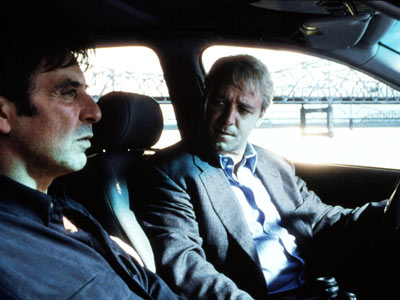
Just as Nash has complained that he isn't getting a chance to show his abilities to fight America’s enemies, the man who Nash called “Big Brother” at the Pentagon observing from above shows up to give Nash a chance at more recognition. He calls himself William Parcher (Ed Harris), and he says he supervised security over J. Robert Oppenheimer’s atomic project. When Parcher brings up how many lives can be lost in the pursuit of weapons, Nash is rather cold, saying progress requires the need for sacrifice. Parcher says Nash’s “lone wolf” life will be advantageous, most likely for performing covert activities. Thus, Parcher’s existence justifies Nash’s anti-social nature and his desire for recognition. As they walk into a “secure” area, Parcher says they know him there, so he doesn’t have to show credentials. Therefore, he does not interact with the guard. The above details become important later.

Parcher takes Nash into what were supposed to be
abandoned warehouses. Inside, he sees many men in white coats operating rows of
computers. Parcher tells Nash he now has top secret clearance, and calls him
the best natural codebreaker around. Parcher’s function then is to bestow the
acknowledgement of Nash’s talents that the mathematician believes he deserves.
Parcher says that the Russians took a portable atomic bomb that the Nazis had
developed, and the locations that Nash identified earlier at the Pentagon are
places the Russians are exploring to explode the bomb. Parcher says that the
Russians are placing coded messages in newspapers and magazines, and that’s why
they need Nash’s help. Parcher makes an interesting observation when he says,
“Man is capable of as much atrocity as he has imagination.” His comment adds
irony to the title of the film by showing the underside of a brilliant
“beautiful mind.” Parcher’s team supposedly puts an implant in Nash’s arm so he
will have access to a drop point where he can deliver his findings.
Alicia comes to his office with what Nash calls
an “elegant” proof of the problem he wrote on the board, but she made
assumptions which didn’t solve the problem. She asks him to dinner, but he says
he usually eats alone, and he says he is like Prometheus with a bird circling
above. His humorous image reveals that he sees himself as a rebel, like the
mythological personage, who gave fire to earthlings. Nash sees himself as a
godlike entity who will endure tribulations to bring mental illumination to
those incapable of such achievement.

Nash takes Alicia to a formal university affair. She is able to navigate his social awkwardness by engaging in his peculiar humor. He draws objects in the night sky by connecting stars with his hand. He sees patterns, maybe where there are none except what we impose on them. The exercise again shows his desire to find form and insights in the universe. However, at the event, he believes men there are observing him, which shows how imagination can warp reality into something ominous. He later drops his sealed classified findings into a lockbox at a gated house by using the changing codes on his implant that are illuminated under a black light. It is done at night and there is a dangerous feel to the place as a car slows down to observe him there.
Nash tells Alicia that his directness has not
been socially successful, so it is an effort for him to adapt to the rules of
society. She encourages him to say what he wants to say. He concedes that even
though he finds her attractive and wishes to have intercourse as soon as
possible with her, he feels he must go through “platonic” romantic rituals to
reach that outcome. He then says he expects a slap across the face, as he
experienced earlier at the bar. Instead, she kisses him passionately, showing
that with her his honesty is rewarded, and how the two are compatible.

Charles reunites with Nash and brings his niece,
Marcee (Vivien Cardone), who Charles says he has taken custody of since the
death of his sister. Charles says he is close by at Harvard. IMDb notes that
when Marcee runs through a field full of birds, they do not scatter, suggesting
that she doesn’t exist. Nash tells Charles about Alicia and wonders how he can
be sure that asking her to marry him is the correct move. Charles says,
“Nothing’s ever for sure, John. That’s the only sure thing I do know.” That unpredictability
comes from a person who supposedly studies literature, an art form, and it
offsets Nash’s longing for mathematical certainty.
Nash meets Alicia at a restaurant and says he
needs “proof” and “verifiable data” that would indicate that they can be in a
long-term relationship. He says this while bending on one knee. It is like a
mathematical marriage proposal. In response, Alicia says she must modify her
notions of romance to accommodate his data-driven inquiry. She asks how big the
universe is, and he says it is infinite. But, he concedes that impression can’t
be proven, so he just believes it. She says it’s the same with love, one can’t
prove it, but somehow just believes it. Alicia is able to show that not all
things, such as emotions and ideas, can be proven, but they still exist within
people.

The two get married, but on his wedding day Nash sees Parcher with a disapproving look, since the lack of attachments to others supposedly justified his service. This image shows the conflict within Nash. When Nash drops a report off, Parcher drives by, tells Nash the spot is compromised, and they are being followed. They speed away as Parcher fires on the approaching vehicle. The terrified Nash sees the enemy vehicle eventually end up in the water. Nash is distant when he goes home to Alicia, and locks the door of his room behind him, as he is now suspicious of everyone, which reinforces his detachment from others. He looks at his students and out through windows and doors as if everyone is a threat. His warped view of reality paints him as a victim of other forces which are trying to destroy him.

Parcher visits Nash in his office, and his
presence is there to prevent Nash from rejecting his immersion into his world
of paranoia. Nash asserts that he has a wife and will soon be a father, and
wants to quit so as to shift his focus to positive things, away from his
preoccupation with fear. But Parcher is here to assert that feeling of dread by
threatening Nash, saying if he doesn’t continue his work, Parcher will not
protect him from the Russians.

There are shadows on the walls of Nash’s house
as he keeps watch through his blinds. They appear to be real, but shadows are
just optical illusions, like Nash’s fears. Alicia begins to realize there is
something wrong with her husband as he acts irrationally, suspicious of why she
turned on the light at night, and then ordering her to leave for her sister’s
place. She looks at the telephone and it seems she is about to seek help for
Nash.

As Nash gives a lecture he sees men entering
from the back of the room that he thinks are enemy agents who are after him. He
says to his students that one can’t assign values to variables, which shows
that Nash can't even find sanctuary among the predictability of mathematics. He
runs out of the lecture hall and he is pursued, but not by enemy agents. Dr.
Rosen (Christopher Plummer) approaches him and says he is a psychiatrist. Nash
punches Rosen and tries to flee. Rosen injects him with a sedative as Nash sees
Charles and his niece observe what transpires.
Nash has been admitted to a psychiatric facility
where he is in restraints. Nash addresses Charles who he sees there, and he
believes that Charles betrayed him by delivering him to the Russians. But,
Rosen says there is no one there. If we haven’t already deduced it, Nash has
hallucinations. Rosen informs Alicia that Nash is schizophrenic, which many
times involves paranoia, and her husband’s belief that he is working to
discover conspiracies is a symptom of his mental disorder. Moreover, Nash’s
occupation allowed these delusions to go on without being discovered. Rosen
gets Alicia to admit she never met Charles, saw a photo of the man, or talked
to him on the telephone. Nash said that Charles was his roommate, but Rosen
discovered that he lived alone at Princeton. Rosen says he must make Nash
distinguish between what is real and what are illusions generated by his
otherwise beautiful mind.

When Alicia gets into Nash’s college office she sees how extreme his activity has been, cutting up magazines and placing pictures and articles all over the walls. Sol and Bender, knowing how offbeat Nash is, gave him a great deal of leeway and did not question his covert activities. Sol followed Nash once to the drop site and now Alicia goes to the estate where Nash was supposed to deliver his findings. The place has been abandoned for some time, with the drop box a broken mailbox and the gate opener busted.
At the hospital, Nash adapts the “facts” as he
sees them to fit his beliefs, as most conspiracy obsessed people do. He says
the Russians can’t kill him because he is too well known, so they are confining
him. Alicia tells her husband that she found out there is no Parcher and no
conspiracy. She shows him all the unopened envelopes he placed in the mailbox.
Of course, he walks out on her because the truth will upend his universe, and
he can’t tolerate that.

He tries cutting out the implant in his arm, but says that it is already gone. Nash starts to get a glimmer of what has been plaguing him. As Rosen prepares Nash for drug therapy, Rosen says how horrible it is to realize that people an individual thought one knew never existed, and that beliefs one held were completely false. It’s as if the “fake news” that one accused others of propagating was real, and one’s own beliefs were the false ones.
Back at Princeton, Alicia tells Sol that the
delusions have passed, but Nash will not show up at Princeton, possibly feeling
shame, where his academic competitor Hansen is now department chairperson. She
feels an obligation to take care of the man she fell in love with, making sure
he takes his medications and encourages him to be active. Sol visits Nash, who
tells him not to sit on Harvey, the imaginary rabbit from the film. Nash has kept
his sense of humor, saying what’s the point of being “nuts” if one can’t have
some fun. But when he hands his indecipherable scribblings to Sol, it is
obvious that Nash isn’t capable of functioning efficiently, as he says, due to
the effects of the medications he is taking. He still feels that his work is
the most important part of his life at this stage. He holds his child while in
a stupor, despondent, devoid of any emotional attachment to his family.
Alicia has her own paranoia concerning what Nash
states, assuming what he says is influenced by his schizophrenia. He tells her
he was talking to the garbage collectors, but she says they don’t pick up trash
at night. Then she sees the men working outside. They both giggle, and she
apologies, probably realizing she too must adjust to what is really happening.
But that light moment is followed by a heartbreaking one as Alicia makes sexual
overtures in bed and he resists. He admits it’s the medication, which can
decrease the libido drastically. She looks devastated, so the implication is
that there has been no intimacy for a long time. She goes into the bathroom and
throws a glass of water at the mirror, shattering both, and screams her
frustration. When Nash takes the shards out to the trash, it is a metaphor for
what is broken in their lives.
Nash secretly stops taking his pills, most
likely so he can provide the intimacy that Alicia wants. But, that brings back
his condition as he is confronted by Parcher who has armed soldiers with him.
He takes Nash to a large shed on Nash’s property that he staffed with personnel
and electronic equipment to pinpoint the location of the nuclear weapon the
Russians want to detonate. Nash tries to deny the existence of what he sees,
but then submits to the fantasy. The film seems to be saying that delusions
which feed our preconceptions are difficult to let go.


Parcher appears and tells Nash that he must get
rid of Alicia because she is a national security risk. After Alicia sees Nash
talking to nobody, Nash then conjures up Charles and his niece, and Charles tells
him to do what Parcher said. Nash is mentally at war with himself, wanting to
believe what he sees but also protective of his family. Then, his mathematical
rationality bursts through with an epiphany that will not allow a delusion to
extinguish. He stops Alicia and says that he realizes that Charles’s supposed
niece, Marcee, never ages; therefore, she can’t be real.
With Rosen present, Nash still sees Charles and
his niece, and Rosen says he must return to the hospital for more treatment.
Nash says the medication stops him from working, taking care of his child, and
responding to his wife. He says he is a problem solver, and he needs time to
figure out the solution. But Rosen points out the dilemma, since Nash’s
condition is not like a mathematical mystery, and Nash’s mind can’t be the tool
to fix things since the defect is in his brain.
Nash does not want to return to the institution,
but fears for how his condition threatens Alicia’s safety. So, he tells her to
go to her mother’s place where the baby is already. But, she refuses to leave
him, and touches him, saying what’s real is in his feelings, not in his mind.
In this way, she expands his sense of reality.
Two months later, Nash visits Hansen at
Princeton University. Hansen says he is an old friend, and he no longer seems
to be a foe. As opposed to feeling that being apart from others allowed him to
excel without distractions, Nash now sees being part of a community will help
him become mentally healthy. He just wants to be able to hang out in the
library. But, he appears outside, fighting his demons, as Parcher resurfaces
and harasses him, while others watch as Nash argues with an illusion.

But, with Alicia supporting his fight to
overcome his symptoms without resorting to extreme medical treatment, Nash goes
back to the college library each day, writing equations as he once did, on the
windowpanes, letting the real and figurative light shine upon him. He now
refuses to speak to his imaginary creations.
Time passes, their son grows up, and there is
now a gray-haired Nash in 1978 still working on equations at the Princeton
University library. He eventually engages with some students and expresses a
desire to teach again. He admits to Hansen that he still sees Parcher, Charles
and Marcee, but since he has ignored them, they don’t intrude anymore. Hansen
says that they still haunt him, but Nash says. “They are my past. Everyone is
haunted by their past.” The problem he must deal with, though, is that Nash’s
past just happens to feel like it has more substance in the present than that
of others.

The next jump is to 1994 and Nash is an elderly
man, but he is back to teaching and working on his math projects. Someone from
the Nobel Prize committee visits him, saying he is being considered for the award
based on his bargaining theories that have numerous economic applications and
eventually even biological evolutionary considerations. Nash realizes that the
visit is to make sure he doesn’t embarrass the prestigious awards ceremony by
acting crazy. He admits to the possibility that he may act out because he still
sees things that aren’t there. He takes newer medications, and says he is on a
sort of mental “diet” where he does not indulge his fantasies. While entering
the faculty dining area for the first time in years the other professors pay
Nash tribute, as he saw they did many years ago for another professor, by
giving him their pens. He has received the recognition he once sought.

The story concludes with Nash’s Nobel Prize speech where he says all of his mental explorations have brought him to the conclusion that, “it is only in the mysterious equations of love that any logic or reasons can be found.” Love, a supposedly irrational area, has provided him the most meaning concerning existence. He directly thanks Alicia for all that he has come to really understand about life as a whole.
The next film is Zorba,
the Greek.