Showing posts with label suspense. Show all posts

Monday, April 27, 2026

Heat

 SPOILER ALERT! The plot will be discussed.

The title, Heat (1995), written and directed by Michael Mann, takes on different meanings in this film. It refers to the police. It also can represent the pressure the characters feel in the pursuit of their jobs. It may also suggest the adrenalin-driven high one gets performing a dangerous act.

The first shot is of a train station at night with steam rising from the earth, a rather hellish look. Neil McCauley (Robert De Niro) passes a reproduction of Michelangelo’s Pieta, which suggests sacrifice, but here there is little redemption felt here for the characters, and the feeling here is not spiritual. Neil is in disguise as a paramedic who steals an ambulance. His appearance is a deception as he is not here to ease anyone’s pain. We see patients who reflect the meaning of the statue by being in various stages of suffering, reflecting the agony of the world at large.


Police Lt. Vincent Hanna (Al Pacino) is with his wife, Justine (Diane Verona) and his stepdaughter, Lauren (Natalie Portman), who worries about making a good appearance for her father who is picking her up. How Vince’s job conflicts with home life becomes evident later.

Neil and his gang literally knock over an armored car with a truck. One of the crew, Waingro (Kevin Gage), is a loose cannon and shoots one of the guards which sets off a gunfight and the killing of all the guards. The scene shows how plans can go sideways when you are dealing with outlaws, the very definition of the word meaning they function outside society’s rules. Once restraint is lost, a domino effect of chaos can occur.


Neil meets Nate (Jon Voight) who hired Neil for the robbery of bearer bonds that belonged to a crooked businessman, Roger Van Zant (William Fichtner). Nate confirms that the big shot was insured for the theft of the bonds, will get full reimbursement, and then can buy back his own merchandise for at a large discount. The scene shows that men died as collateral damage so that crooks could help a supposed legitimate businessman scam the system.

Vincent shows up at the crime scene and realizes that except for the killings he is dealing with a professional group who knew they had limited time to pull off the robbery and only went for the bearer bonds, which they knew about. They also chose a location that was easy to exit. The exploding of the bomb used to enter the armored car was executed efficiently. All he has to go on is to check fences, that someone heard a robber call someone “Slick,” and maybe trace where the explosives were bought. Vincent also realizes that these robbers will not hesitate to eliminate witnesses once violence is in play. We have the start of professionals on both sides of the law working to defeat their opponents.


Neil shows his impatience and brutality because one of his men escalated the crime. He batters Waingro against the wall and table of a diner where he meets with his men and says Waingro won’t get a share of the heist. Neil is ready to kill the man outside, but Michael Cherrito (Tom Sizemore) stops him because police are nearby, not because it’s wrong to kill the man, which shows the lack of accepted morality. While they are distracted, Waingro escapes. We have another loose end in the process of committing a crime.

Chris (Val Kilmer), one of the crooks, brings home less cash than expected from the robbery and his wife, Charlene (Ashley Judd), gets into an argument with him because he needed cash to pay off gambling debts. She calls him, “a child growing older.” Chris explodes, breaking things. There is arrested development here which shows more cracks in the chain holding these robbers together, and there is the emphasis on the inability to balance home life with activity outside of the family.

That problem is also evident in Vincent’s home. Lauren’s father never showed up. Vincent is very critical of the missing dad, but he himself was scheduled to have dinner with his wife four hours prior. Vincent is sarcastic when he says he’s sorry that he didn’t share that he dealt with dead guys on the street. His words suggest his family’s details aren’t as important as his job.

Family continues to be the topic as Neil meets a woman, Eady (Amy Brennemen) in a restaurant. He is suspicious of her at first, trusting nobody, which shows how his line of illegal work causes him to be cautious. After she says she works at the bookstore he frequents they strike up a conversation. He learns that she has “a tight family,” while he admits that his mother died many years ago and he doesn’t know where his father and brother are. The dialogue shows how he is a loner which contributes to his feeling less vulnerable in his work. He has comes to terms with his isolated situation, telling her he is “alone,” but he is not “lonely.” She admits to being lonely and the two kiss and then have sex. But Neil cannot have a relationship in his mind and leaves early the next day.


Vincent’s intimidating ferocity is on show in the scene with Albert Torena (Ricky Harris), an informant, at the man’s chop shop for stolen vehicles. Vincent is loud, sarcastic, and threatening, and Albert promises to have his brother provide information for Vincent.

Chris crashes at Neil’s house which has no furniture. Neil isn’t even emotionally invested in his home. When Chris asks when he’s going to get furniture and a wife, Neil’s answer to both questions is, “When I get around to it,” which basically means never. He stresses the importance of not getting involved in the life they have chosen when he tells Chris, “Have no attachments. Allow nothing to be in your life that you are not willing to walk out on in 30 seconds flat if you spot the heat around the corner.” For Neil, the heat is the police, but in this movie it can mean anything that threatens to anchor you to anything else, leaving you as an easy target.

An example of how the social system discourages going straight is in the character of Breedan (Dennis Haysbert). He is on parole and shows up for a job at a diner to be a grill man. Instead, the manager makes him clean toilets and mop floors. He also says he will state that Breedan stole or did other violations unless he plays ball, which includes giving the boss twenty-five percent of his pay. The implication is that it’s easy to see why convicts revert to criminal activity when they are not given a fair chance at rehabilitation.


Neil finds out that Charlene is cheating on Chris with Alan Marciano (Hank Azaria). Since Chris says that Charlene is his world, which is the opposite of what Neil preaches, Neil concludes he must keep his partner happy. He tells Charlene that she must give Chris one more chance. If Chris screws up again, Neil promises to help Charlene get situated on her own.

Vincent meets Albert’s brother, Richard (Tone Loc), who just wants to work the system, like others, to get Vincent to arrest his competitors who steal cars. He mentions that an ex-convict he knows calls people “Slick.” Vincent discovers that Richard was talking about Michael Cherrito, so Vincent now knows Cherrito was involved in the armored car robbery. He learns what the guy looks like, including tattoos. He gets Cherrito’s criminal record and orders full surveillance.

Van Zant was supposed to pay Neil to buy back the stolen bearer bonds. However, the crooked businessman Van Zant wants to kill who stole from him even though he is making out on the deal. His attitude shows how revenge many times blinds a person to the consequences of getting even. He sends two men to fake the payment and kill Neil. However, since nobody trusts anybody in the underbelly world of crime, Neil has his men there and they kill Van Zant’s men. Neil calls Van Zandt and says there is a dead man on the other end of the phone line. There are attempts at doing business here but since there are no social rules in effect, it becomes open season on others quite easily.

We get two views of the opposing teams at dinner with their respective families. Neil is alone, of course, and he must feel the need for temporary companionship because he calls Eady. He wants to connect with her and asks her to go with him to New Zealand to start a life together. But the destination is far away, divorced from the rest of her current world. To be with him she must meld with his separateness.

 As Neil, Cherrito, and Chris and their families exit the restaurant, Vincent and his men observe them from the roof, since they tailed Cherrito. They recognize Chris, but not Neil, because he secured his anonymity.

We have symmetry now as the police and their families go out to dinner. But the comradery is broken when Vincent gets a call about the homicide of a young call girl. We know that Waingro is the killer, and we learn that there have been other hookers that suffered the same deaths by crushed skulls. The film shows us different layers of ferocity on both sides of the law, but there are some criminals that are more depraved and dangerous than others who harm those outside of the battle between cops and robbers.

The scene between Vincent and his wife Justine at this point is very good at showing the divide between the job of a homicide detective and his home life. Vincent doesn’t want to share the grotesque details of what he sees with his spouse because he doesn’t want to contaminate his family with the evil he confronts every day. However, by keeping Justine in the dark (and this scene is shot in shadows to stress that fact) means, as Justine says, “You don’t live with me, you live among the remains of dead people. You sift through the detritus, you read the terrain, you search for signs of passing, for the scent of your prey, and then you hunt them down. That's the only thing you're committed to. The rest is the mess you leave as you pass through.” Vincent lives for the heat of the hunt, and he admits that he doesn’t want to vent because he needs the “angst” to fuel his predatory drive. She eventually has an affair because it’s a way of getting free from Neil emotionally.

Vincent and his team observe Neil and his gang at a supposed robbery of a precious metals repository. However, one of Vincet’s men bangs his rifle against a truck. Neil, on guard duty, hears it. In the infrared camera it looks like Neil can see Vincent, almost in an extrasensory way, and he pulls out of the heist so that Vincent feels forced to let them go since all he has them on is a misdemeanor.

Neil feels that the robbery is compromised, but he sees it as his last job because he wants out with Eady. Chris has a precarious financial situation with his gambling. But Neil tells Cherrito that it’s better for him not to participate. Cherrito says, “for me, the action is the juice.” It’s that adrenalin heat that these guys desire, and in that sense they are the same as Vincent.

Because he has Chris under surveillance, Vincent also has the man’s wife observed. Which means he knows she has been seeing Marciano. Vincent is able to pressure him based on prior illegal activities to give up information on Chris. Here the film shows how the police put the heat on others by threatening them to get what they want.

Vincent’s team observes Neil, Chris, and Cherrito at a refinery next to a scrap yard. It appears that they are scoping out the area. Vincent later goes to the same location and realizes there is nothing there to steal. He now understands that they have been outwitted and they have been “made.” Neil is high up taking pictures of them, so he knows who he is dealing with. Vincent gets a kick out of it because, in a perverse way, he enjoys a worthy adversary. He is getting off on that “juice” Cherrito mentioned. Neil gets information about Vincent from Nate who also gives him schematics and other information for their bank heist. Despite learning that Vincent was in the Marines, is smart, and was on his third marriage which shows his dedication to bringing hoods down, Neil says the job is worth it. Is it the “juice,” the money, or both?

Vincent follows Neil in his car, pulls him over, and strangely invites him for a cup of coffee. Their conversation is like two noir combatants sizing each other up, finding things in common, showing some mutual respect, and throwing down their gauntlets. Neither of them leads a “regular” life consisting of “barbecues and ballgames.” Neil admits he has a woman in his life but will leave her in that thirty second time slot if he has to because that is the “discipline” he has pledged himself to. Each admits they don’t know how to live any other way and don’t want to. Neil says he will not go back to prison he will put Vincent down if he gets in his way. Vincent says he will do the same if Neil turns the wife of an innocent man into a widow.

Neil is smart enough to shake the tails on him and his crew. But there are loose cannons in the world of the unlawful to foul up the best laid plans. In this case, it is Waingro. He’s the monkey in the wrench, as John McClain would say. Waingro is the serial killing psycho who wants revenge for the roughing up Neil gave him. So, he goes to Van Zant for help.

Neil has his wheel man, Trejo (played by the appropriately named Danny Trejo) lead the police in another direction. Here we have a contrived plot device as Neil just happens to be in the diner where he recognizes the unhappy Breedan and offers him the getaway job because, sadly, it is better than being abused in a legitimate job. He tosses his crappy boss to the ground, and the audience sympathizes with this harsh action because people understand the unfairness of Breedan not getting a fair chance at being legit.


The police get a tip from an informant about where Neil’s team is robbing the targeted bank. What follows is a prolonged modern version of a shootout at the not O.K Coral as Vincent and the police exchange automatic gunfire with Neil’s gang on the streets of LA. The scene shows the upheaval of the safe, civilized life that can be wiped away in a moment. Breedan is killed and Chris is wounded while several policemen are shot. Cheritto, in a cowardly and horrifying act, uses a child as a shield. But Vincent gets an opening and shoots him in the head.

Neil gets Chris to a doctor who he pays to cover up the treatment for a fractured clavicle. Neil wants to follow his discipline, which means getting out, but Chris loves Charlene and doesn’t want to leave without his wife. His attitude shows how the world of crime doesn’t allow for love and marriage. He does go along with Nate with the plan to escape at first, but then leaves to find his wife.

Neil knows that the tip came from Trejo. He looks for the man, but he finds him near death. His naked wife is also dead, and we can assume the rapist/killer Waingro was at the bottom of all that happened, forcing Trejo to reveal Neil’s plans to the cops. Trejo says that Van Zant was involved. Trejo asks for a mercy killing and Neil obliges him. And the hits keep on coming.

Vincent tracks down the snitch who took the information from Trejo and tipped them off because he wants to follow the trail that leads him back to Neil. Meanwhile, Neil wants revenge and finds out from Nate where Van Zant lives and shoots him. He is on the trail to get Waingro. Both Vincent and Neil are hunters despite being on different sides of the law.

The police acquire Marlene and her son. Sergeant Drucker (Mykelti Williamson) uses manipulation to convince Marlene to give up her husband or else she will be considered an accessory, and her young son will go into the system. She gives in to the request. The scene shows again how the police leverage people, here giving Marlene a bad or worse choice. Marlene is able to get around her situation by giving her husband a signal to stay away as he approaches. Of course, even though Chris escapes, husband and wife can’t be together, and that’s the tradeoff.

Meanwhile, Vincent has used a beating to get information out of the tipster, Hugh Benny (Henry Rollins), to find out about the hotel where Waingro is hiding. Here there is more coercion, as the ends justify the means for Vincent here. Vincent leaks the location so that Neil will learn where Waingro is and Vincent can intercept him there.

Eady was living in a naïve romantic dream world about Neil, not really wanting to know how they can go off to New Zealand easily. Now she knows he is on the run and she tries to escape. She is both somebody Neil cares about and is also a loose end. So, he wants her to leave with him. He allows her the choice, however. Now he has come to realize he can’t be alone anymore, and he only wants the rest of his life to be with her. His sincerity wins her over. Nate has provided Neil with a plane and documents to leave the country. Neil looks like he’s ready to take off, but abruptly turns off the road and heads to get Waingro.

Vincent thinks Neil has escaped and heads out, throwing his TV out of the car, busting it up in the process. The shattering of the TV, which he said his wife’s lover was not allowed to watch, represents the breakup of his marriage. He then gets another jolt when he finds his stepdaughter, Lauren, in the bathtub after an attempted suicide attempt by self-inflicted wounds. He wraps towels as torniquets and saves her. Lauren is collateral damage resulting from her father’s neglect and the actions of both her mother and Vincent in their relationship. As Neil has come to a realization about himself, Vincent seems reconciled to who he is. When he asks Justine if there is any hope for the two of them, he is doubtful, He says to her, “all I am is what I’m going after.” Justine realizes that’s true and gives him permission to go to the hotel where Waingro is.

Neil sets off a fire alarm, steals a jacket so he can pretend to be with hotel security, goes to Waingro’s room, and shoots him dead. The police have the room under surveillance, so Vincent knows Neil is there and gives chase. He spots Neil as he approaches the car next to Eady, who is there, waiting for Neil. The crook does what he said earlier, which is to leave behind any possibility of a connection to another when he is at risk. But, he already should have left and then he would have escaped. He pursued his own view of vengeful justice. Now, he pays for it. Vincent follows him and just as Neil is about to shoot Vincent, the policeman sees Neil’s shadow (representing Neil’s dark side?), turns, and shoots his prey.

In the end the two men live up to who they are. Neil repeats what he said earlier about not going back to jail, remaining an outlaw until the end. Vincent remains the hunter. Neil holds out his hand just before he dies and Vincent grabs it, a last handshake representing understanding between the two.

Saturday, July 12, 2025

The Ipcress File

 SPOILER ALERT! The plot will be discussed.


There were spy stories on film before the early 1960’s, most notably by Alfred Hitchcock, which leaned toward the seedy side of a secret agent’s life. However, after the James Bond franchise started, the impression then became what a glamorous life spies had, bordering on superhero status. John le Carre’s stories changed the direction back to the grim view, and in 1965 his The Spy Who Came in from the Cold appeared on screen and so did The Ipcress File. The latter, produced by Harry Saltzman, a producer behind many James Bond flicks, presented an anti-hero as the focus of the story, but kept some of the Bond humor. It also jump-started the career of Michael Caine, the first leading man to wear non-dashing eyeglasses.


The movie’s plot centers on the inability of several top British to continue their work. The latest one is named Dr. Radcliffe (Aubrey Richards). He is kidnapped and his bodyguard is killed during the abduction, which happens on a train (trains are good places for intrigue. Think of North by Northwest, Murder on the Orient Express, even the Bond film, Frome Russia with Love). The secret agent boss is the condescending Colonel Ross (Guy Doleman), who recruits Harry Palmer (Caine) to replace the dead agent. Our first view of Harry is when a loud alarm clock rings, like an alert sounding, waking him. We see blurred vision through his myopic eyes which becomes clear after he puts on the eyeglasses. The shot suggests how reality can be distorted by deceptive people until the perception of them becomes clear.

The musical score is adept at mimicking the feeling of something mysterious that ends in climatic notes suggesting revelation. Think of Henry Mancini’s work in Experiment in Terror and Charade.

Harry lives a modest life except for the surprising fact that he is a gourmet who enjoys a cup of freshly ground coffee made in a French press which hints at his special nature which contrasts with his boring current assignment. He occupies a sleazy stakeout room where he reports boring details of his observations. It is quite a contrast to the exotic locales and adrenalin-pumped Bond or Matt Helm adventures. Harry’s wit appears early when his relief shows up and the man expresses disdain for their boss. Harry says he must do some “wiping” because the tape is “still running.”

The first meeting with Colonel Ross is in a shadowy room, which reflects the covert dealings of these operatives. Those shadows persist throughout the film. As IMDb notes, many camera views appear through half-open doors, over shoulders, or through windows or screens to suggest people are spying on others. In this first scene with Ross the camera is aimed upwards. As IMDb notes, it makes the viewers feel as if they are crouching, looking at things from below. That lurking perspective may be to place the audience in the positions of spies themselves, which, of course, is the feeling Hitchcock conveys in his films that stress the audience’s voyeurism.

Ross’s condescending nature is evident as he immediately chastises Harry for not being secretive enough when he doesn’t close the door as he enters. Harry’s wages are pitiful even for the time, and since he is transferring to a promotion, Ross says he will get him a pittance more. Harry says, in a quietly sarcastic way, that he can now get that “infrared grille” he wanted. The squabbling over wages would never appear in a Bond movie, and the conversation grounds the story in what concerns everyday people. Ross says he is transferring Harry to a spot that can make better use of his talents. Later, we see how telling that remark is. The caustic Ross says that Harry’s new boss, Major Dalby (Nigel Greene), does not have Ross’s “sense of humor.” Harry wittily says, “Yes sir. I will miss that sir.”

The interchange between Ross and Dalby conveys much with action and words. Ross thuds his umbrella and an attaché case on Dalby’s desk, implying he’s upset with Dalby’s work. When the Major says he hopes Ross isn’t suggesting that his section was negligent in Dr. Radcliffe’s disappearance, Ross’s response of “There’s no question of that,” can be taken two ways, which fits in with the secretive nature of their work. He adds menace to his conversation when he threatens that if they don’t get Radcliffe back, their superiors may shut Dalby’s office down. He notes that Harry is a bit “insubordinate” but a good man. Ross downplays that aspect of Harry as we see for his own purposes, which, of course, are hidden here.

When Harry meets Dalby for the first time, he again forgets to shut the door. Could that fact suggest that Harry is more transparent and not as devious as his superiors? Ross’s superior attitude is more subtle, but Dalby’s manner is blunt, harshly threatening Harry if he doesn’t toe the line. He reads from Harry’s personnel file, which labels him, “Insubordinate, insolent. A trickster. Perhaps with criminal tendencies.” Dalby admits that the “last quality may be useful.” What does that say about the fine line between the lawful and the unlawful? Dalby makes sure that Harry understands that he reports to Dalby first, not Ross. Other than the fact that Dalby is his immediate superior, why this rule? Is he being secretive within his own organization, or does he suspect Ross of being a traitor?

Instead of the exotic devices that Q supplies Bond, Palmer just gets a different gun and observes some film footage with other agents of the likely man who has the power to kidnap Radcliffe and sell him to the highest bidder. The assignment is to track down the person, Grantby, known as Bluejay (Frank Gatliff), a deceptively benign name, and his second-in-command, Housemartin (Oliver MacGreevy), and let them know the British government wants to buy the scientist back. At the briefing, Harry develops a friendship with Jock Carswell (Gordon Jackson).

The grumpy Alice (Frida Bamford), with a cigarette dangling from her lips which reinforces her sour disposition, is a sort of anti-Moneypenny employee, not lovely or fun. She instead is a bureaucrat, doling out restrictions and forms. Dalby wants his operatives to fill out a field report every time they make an inquiry. It’s not Harry’s style, so instead of getting bogged down in the numerous leads that Dalby issues (deliberate procrastination?), Harry uses a source at Scotland Yard to find Bluejay who showed up at the same place three times for long enough to get parking tickets. It implies that the man could have been doing some business at the location. (The gray, rainy weather is another attempt to de-romanticize the work).

After acquiring Bluejay’s car license number, Harry stakes out the place where the car shows up. Housemartin appears to put more change in the parking meter, and that allows the astute Harry to follow the man into a science museum library. The studious setting contrasts with the intrigue that transpires, although the science part fits what’s happening to the “brain drain” that England is experiencing. After making contact with Bluejay, the man gives Harry a phone number to call later. Harry’s intelligence is on display as he immediately goes to a phone booth and discovers that the number is invalid. When he tries to stop Bluejay outside, he gets into a fight with Housemartin, who escapes and drives his boss away. The camera films the fight through a car window, suggesting the way one spies on others.

On his way back to his place with his foodie goodies, Harry is clever enough to notice the light on in his flat. He has his gun out and the camera gives us a covert shot through a keyhole in keeping with the spy story. Fellow agent Jean Courtney (Sue Lloyed) is there, holding Harry’s automatic pistol. She notes it’s forbidden to use it, and Harry’s sharp response is that his mother gave it to him for Christmas. He quickly realizes that she is on the job, and she admits that Dalby sent her to assess Harry as a new member of the team (which turns out to be a lie). However, it again shows the suspicious nature of the profession. He asks Jean to put on Mozart as he prepares a fine meal, which points to Harry’s refined tastes despite his otherwise unsavory existence. Jean confirms Harry’s “criminal tendencies” by noting while in the military Harry was illegally exploiting the Germans for profit and was caught. Instead of serving a two-year prison sentence, the intelligence service offered a difficult-to-decline stint as a spy. Here, you either go to jail or work in a job for the government. The story does not offer good alternatives.

Harry’s connections note that Housemartin was arrested, but somebody impersonating Harry and Jock pretended to interrogate the man and killed him. Duplicity and murder are part of the goings on here. Housemartin was in possession of electrical equipment in a suitcase, which the killers took with them. Housemartin was apprehended at an abandoned factory. Harry lies (in this profession it obviously comes in handy he realizes) about his authority on the phone and gets a team to join him at the factory. Dalby shows up and Harry justifies his not following the rules because he thinks the missing scientist is there. Whoever was there cleared out. It seems, suspiciously, like others are always one step ahead of Harry. Harry says that if Radcliffe had been there, he would have been “a hero.” Dalby’s curt response is, “He wasn’t. And you’re not.” There is no larger-than-life super heroism going on here, as in Bond or Marvel films. However, Harry does find a piece of audio tape that did not get destroyed in a stove in the factory. It has “IPCRESS” written on it. When they play the tape all they hear is what sounds like strange, distorted sounds.

Ross appears at the grocery store while Harry buys his food. Ross has trouble navigating his shopping cart among the people there, suggesting that his clandestine life causes him to be out of his element when it comes to the average citizen. He is only there to try and get Harry to photograph the IPCRESS file, and to keep his actions secret from Dalby. He threatens Harry with imprisonment if he doesn’t keep the request private. Dalby didn’t want Harry to report any findings to Ross, and now Ross is acting suspiciously, meeting outside of work, and keeping secrets from Dalby. Harry is caught in the middle of questionable activity by two agents who are supposed to be patriotic government workers. What adds to the duplicity is Harry thinks Jean is working for Ross, and she thinks he is still working for Ross. It doesn’t stop them from becoming intimate despite their suspicions.


Dalby has made contact with Bluejay and they meet at an outdoor band concert to discuss the exchange of cash for Radcliffe. Interestingly, Dalby brings Harry with him, which does not seem necessary. The subsequent rendezvous is at a dark underground garage, which fits the secret activity occurring. Both sides carry automatic weapons as cash is counted while a doctor checks out the sedated Radcliffe. The transaction goes smoothly until Harry sees someone lurking in the shadows and opens fire. Dalby discovers Harry has killed an American agent, who was tailing Bluejay. Again, we do not have a flawless protagonist, and the death indicates the danger of a hidden agenda.

Harry becomes Radcliffe’s bodyguard. The scientist seems physically fine but does not remember anything about his abduction. When he is to give a talk about his area of expertise, he begins to repeat the same words over and over while we hear the sounds that were on the tape Harry discovered. So, we know that he has been brainwashed in a sort of The Manchurian Candidate manner. The scientist appeared healthy on the surface but was defective underneath, adding to the theme of appearances being deceptive.


More devious activity occurs when Harry spots a man smoking a pipe tailing him. Turns out the man is also a CIA agent (Thomas Baptiste) who is suspicious of Harry’s killing of one of his comrades. He says he will continue to follow him and if he concludes that Harry is crooked, he will kill him. These men operate outside the law. Dalby and Ross meet, and Dalby said he assigned Harry the task of exacting repayment from Bluejay for the selling of “damaged goods.” Ross believes that Radcliffe fits the pattern of many other scientists who no longer participate in scientific research. Both Dalby and Ross are cold emotionally as they decide to let Harry suffer his fate if the CIA agent decides to kill him.

The pipe-smoking CIA agent sees Harry talking to Bluejay, which makes Harry seem like he is conspiring with a kidnapper. What is on the surface in this film is not what it seems. At the office, Jock has been doing research, and he found something that discusses “Induction of Psychoneurosis by Conditioned Reflex Under Stress.” He prompts Harry to realize that IPCRESS is an acronym for this type of devious mental manipulation that the scientists have experienced.

The next scene finds Jock shot to death while driving Harry’s agency-issued car. Harry tells Jean that he believes the American agent thought it was Harry in the car and shot Jock. Maybe or maybe not, but in any case we have more false appearances. Jean suggests more hiding when she invites Harry to stay at her place for safety purposes. When Harry goes to his place to gather his belongings, it is obviously dark inside, until Harry turns on the light which reveals a deadly reality. The American agent lies dead on the floor. In Hitchcock fashion, someone is falsely setting Harry up as a guilty person.

Back at the office Harry finds that the IPCRESS file is missing. He calls Dalby to meet in person. He doesn’t trust talking on the phone because he knows that things have degenerated to the point that his world is under attack. When he meets Dalby he says Ross probably stole the file because he wanted him to microfilm it. Dalby says he will take care of the body in the apartment, but he will not protect Harry because he is too “hot.” The spy world exists in this film in the underbelly of society where it is callous and perilous.


Since Dalby told Harry to disappear, he plans on taking a train (not a safe place in these films as we have seen). After he leaves Jean’s apartment she calls Ross. We wonder now if even the woman he has become close to is a false ally. Another shot through a window shows a hand clearing the view of Harry on the platform. Danger seems to be lurking behind every supposedly safe corner.

Dalby tells Ross about the dead American agent in Harry’s flat. Ross says that there is a high casualty rate in Dalby’s department, to which Dalby says, “I wonder why?” Again, the sinister acts seem to anticipate Harry’s every move and the implication behind Dalby’s words is that he suspects Ross is behind the nasty business.

As suspected, Harry is abducted from the train. He is rendered unconscious, and when he wakes he finds himself in a cell. He has not been the only victim there because there are scratches on the wall, which suggests that his fate is not a positive one. He pries loose a metal clip from his cot and adds scratches to the wall which indicate he is there for several days. A captor looks through yet another peep hole, adding to the spy motif. Harry experiences cold. He has little food and drink, as he can’t touch the overheated cup in a revolving opening which tempts and then removes sustenance.

Grantby (Bleujay) is there saying they are in his home country of Albania, but at this point, can one trust anything someone says? Harry doesn’t have his glasses, and we see images through his eyes, and the blurring shows a distorted reality.

They don’t let Harry sleep and subject him to the loud, disorienting sound found on the IPCRESS tape. He experiences pulsing videos on all four walls in a room where he is bound in a chair. The purpose is to break his resistance so he will suffer the same fate as the scientists. After the bombarding sounds and images, lulling colors and sounds follow. Bluejay’s hypnotic voice tells Harry to forget about the IPCRESS file, and even his own name. The sense of one’s own identity is at risk in this totalitarian space.

Harry is clever and distracts the conditioning on him by using pain by rubbing his wrist against the leather restraints. They put padding on the restraints, but Harry uses the metal clip he secretly holds in his hand to create pain, an act of deception of his own. However, he can’t maintain his resistance and drops the bloody piece of metal in the conditioning room. Bluejay says when a voice says, “Now listen to me. Listen to me,” he is to obey that voice. Bluejay tries to set up Harry as the fall guy who killed agents and stole the IPCRESS file to be sold to his country’s enemies. Bluejay orders Harry not to remember any of this programming until he hears the voice.

Harry escapes, and in keeping with all the false information in the story, he is in London, not Albania. He calls Dalby. We find that it is Dalby who is the traitor as he has Bluejay with him. For Ross’s sake, Dalby had to pretend (more deception) that he was trying to find out about the problem with the scientists. Dalby tells Harry the triggering words and orders him to call Ross and tell him to meet him at the warehouse where he had been held, which has been abandoned by the IPCRESS team. (There is a red lampshade next to Dalby in this scene. As IMDb points out, Dalby is associated with red in many scenes. Other examples are: in the park, the military band members wear red outfits and play "The Thin Red Line", which Dalby likes; his sports car has a red interior; he stands next to firefighting equipment in the last scene, and there is a red bucket near him when we see he is the villain. Along with his sinister mustache, the film paints him as a devil figure, and red can associate him with the Soviet Union in existence at the time).

 Bluejay said he would have liked more sessions with Harry. So, when Dalby shows up at the warehouse, Harry is not conditioned enough to blindly follow his programming. He suspects Dalby as much as Ross. We see him now spying through an open door while he was the one being observed in the past, indicating that the situation has shifted. It is interesting that he tells Dalby to stand under the light. Yes, he wants to see him, but it also implies wanting to bring the truth out in the open. When Ross shows up, he disarms him and says he knows one of them is a traitor. He discovers that Jean was working for Ross, not Dalby, as we already know.

Dalby then uses the words, “Now listen to me,” and tells him to shoot Ross. Harry wavers, slams his hand against some movie projector equipment (interesting that this shot, in a movie, shows how film can be used for dangerous purposes). This act which breaks the trance, and he then shoots and kills Dalby as the man pulls out a gun. Harry is angry at Ross for using his insubordinate nature to reveal Dalby’s double-agent status. Ross’s response is, “That’s what you’re paid for.” Considering what a small sum that is, we see what little compensation Harry, the working-class spy, must settle for despite the perilous nature of the job.

Sunday, January 24, 2021

Gaslight

 SPOILER ALERT! The plot will be discussed.


The title of this film, Gaslight (1944, although there is a shorter 1940 version), directed by George Cukor, has become a psychological term which indicates when a person manipulates another to the point where there is doubt on the part of the victim about the perception of reality. So, the theme of illusion versus reality dominates the story. The movie also deals with how love for a person is not as important to some who value materialism as the primary source of affection.


The film begins with the street gas lamps being lit in London around 1874. The image is meaningful since brightness is supposed to shed light on what has been obscured by darkness. Ironically, in this film, the gaslight is used by the villain to suggest what is not there, and thus makes the heroine not believe her own eyes. There is a flashback to Thornton Square in the city and a newspaper headline notes there has been a strangling at this location, with the killer still at large. Paula Alquist (Ingrid Bergman, winning the Best Actress Oscar for this role) is dressed in mourning black as she leaves the house where her Aunt Alice, a concert singer, and she lived. Alice Alquist was the victim noted in the newspaper. Paula is to go away to Italy and is advised to forget the gruesome past and focus on her own future as a singer. 


Time has passed and Paula is practicing singing opera with the help of Maestro Guardi (Emil Rameau). Her selection is from Lucia Di Lammermoor, an opera which has a woman going insane, an instance of foreshadowing. Gregory Anton (Charles Boyer) is playing the musical accompaniment. After he leaves, Guardi tells Paula that her heart is not in her singing, that she seems too happy to be playing a part that is tragic. He guesses that she is in love, and tells her that she did know tragedy in her past, but she should enjoy her current joy because “happiness is better than art.” He is advocating a vacation away from her singing and immersing herself in life instead (the Victorian Age poets such as Browning, Tennyson, and Arnold were torn between withdrawing from society to create art versus engaging in life’s adventures). However, while she believes she is choosing an outgoing life, the result is just the opposite.


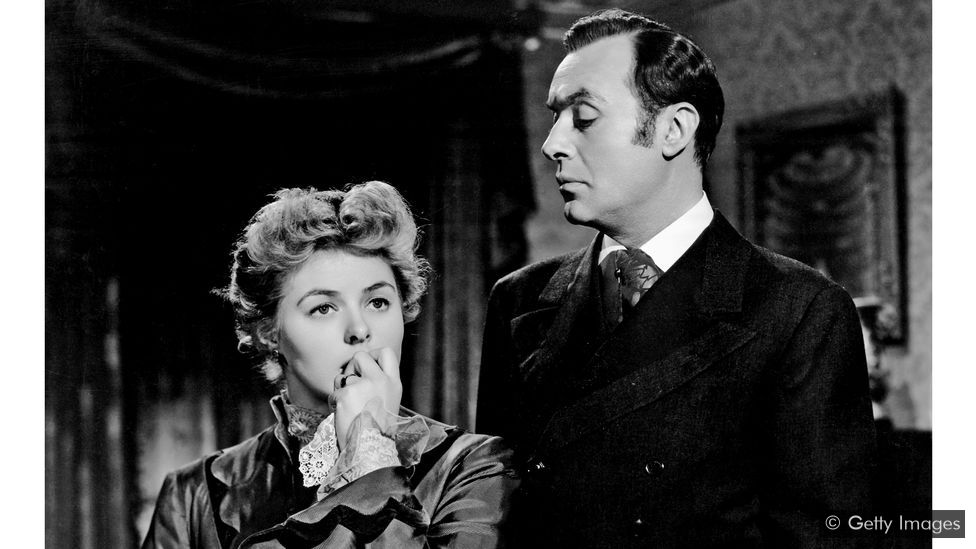
It turns out that Gregory is the man she is in love with. Outside, he states how he wants to marry her. She admits she is hesitant because she doesn’t know much about him, having only known each other for two weeks. That is the first red flag waved at us. He asks if she is afraid of him, and she says “never,” which will turn out to be an ironic statement. Paula does decide to slow things down a bit and go away for two weeks.


 On the way to her retreat at Lake Cuomo, an elderly British woman, Miss Bessie Thwaites (Dame May Whitty), who loves a lurid tale of murder, exhibits her excitement about a book she is reading that has a woman finding out that the man she married has six previous wives “buried in the cellar.” Here is more foreshadowing about the hidden sinister nature of a lover. The woman resides in Thornton Square, where Paula lived and her aunt was murdered. It is a spooky coincidence. Appropriately, as it turns out, Paula, after hearing about murders from Miss Thwaites, encounters Gregory, who surprises Paula right outside her train car door. Even though she said she wanted to be away from him for this trip, she is so under his spell that she is happy to see him.


The two get married and go on their honeymoon. It seems very romantic, but then he suggests that they settle in London, because he was there once and always thought it would be comfortable living in a house in one of the city’s squares. London is the place that embodies disturbing ghosts of Paula's past, and she is upset to hear about it. She tells him that she didn’t know her father and her mother died when she was young, so her Aunt Alice raised her. She left the house to Paula, which came to feel like a “house of horror” in Paula’s dreams. (It does seem convenient that Gregory wants to live in the type of house in London that Paula just happens to own). But, she says that she hasn't lived in fear since she has known Gregory because he has driven it away. Her statement turns out to be ironically inaccurate. She proclaims that she has found “peace” with his love, and declares, despite his false objections, that she can now live in the Thornton Square house with him.


 Paula and Gregory arrive at the Alquist house. The couple enter the building to a soundtrack with slow bass tones, suggesting Paula’s dread of the place. The house looks like an abandoned museum with furniture and chandeliers cloaked in cloth, looking like burial shrouds. The dark lighting and shadows add to the macabre feel. The appearance is reflected in Paula’s words when she says the drawing room used to be full of light and life, and now, “the whole place seems to smell of death.” She is caught up in the remembrance of the horrible loss of her aunt. There is a painting of her aunt in the role of the Empress Theodora over the fireplace, and Gregory appears awestruck by the portrait. Gregory points out that Paula resembles her aunt, which is another ominous fact. Paula found her body right under the painting. Paula says she can’t be there with all these reminders of her aunt’s death. According to IMDb, the crowded interior setting symbolizes “Paula’s increasing sense of claustrophobia.” Gregory suggests that they put all of Aunt Alice's stuff in storage so Paula will not be reminded of her death. Paula wants to have parties in the house again, but Gregory wants their privacy for a while. This isolation will be used for devious reasons. Gregory begins to play the piano, and Paula comments that the music he plays is what her aunt used for an encore. It is another interesting coincidence, showing how Gregory may know more about Paula’s aunt than he divulges. Paula picks up some sheet music which contains a letter to her aunt written two days before the murder from a person named Sergis Bauer. It relates wanting to see Alice again after Bauer followed her to London. At the man’s name, Gregory hits a symbolically discordant note, stands up, and forcibly grabs the letter out of Paula’s hands. He tries to recover by saying that it isn’t the letter, but the fact that all of these reminders of what happened to her aunt will bring back Paula’s fears. He says she must forget her. It is interesting here that Gregory encourages forgetting something and later accuses Paula of being absent-minded. But, Paula quietly disagrees, distinguishing between remembering her aunt from forgetting what “happened to her,” as she looks sideways in a wary way at what Gregory suggested. 


Miss Thwaites questions the Antons’ cook, Elizabeth (Barbara Everest) about the couple receiving visitors. Elizabeth tells her that Gregory doesn’t feel that seeing others is good for Paula, and she notes that Paula “hasn’t been feeling too well lately.” By being more isolated, Paula has no means of diverting herself from her grief about her aunt, and doesn’t have objective reference points to gauge her emotional status. She becomes more dependent on Gregory, and also more vulnerable. Interestingly, Miss Thwaites says the house looks fine from the “outside,” which metaphorically suggests that the benign appearance may be misleading. 


 Gregory is giving instructions to the new housemaid, the sassy Cockney, Nancy (Angela Lansbury, in her first film role, for which she received an Oscar nomination), who reveals an immediate attraction for Gregory. During the film she comes onto Gregory which he fuels with his compliments and thus makes her an unwitting ally in undermining Paula. He brands Paula as disturbed by saying Nancy must not “bother” Paula “about anything,” with the excuse that his wife is “highly strung.” Gregory issues a warning when he says Nancy should remember his instruction, since the prior employee did not keep her distance from Paula and was fired. Here is more evidence of Gregory’s attempt to dominate Paula's life. 


It is three months since Paula and Gregory were married and he gives her a brooch that belonged to his mother. The pin needs fixing, and he tells her that she loses things so she must remember he is putting it in her purse in the meantime. He is undermining her mental capacity here as she must defend her memory in this scene. She seems glad to get out for the afternoon, which emphasizes the impact of her recent confinement on her. Nancy comments to Elizabeth that Paula doesn’t look ill to her, and the suspicious Elizabeth comments that Gregory “keeps telling her she is,” which builds concern about Gregory’s intentions.


The couple visit the Tower of London, an ominous place for Paula given its history of imprisonment. The guide relates gruesome details about beheadings, the separation of the brain from the body, which, given this story, reminds one of “losing one’s head,” a possible reference to insanity. Appropriately, at this moment Paula opens her purse after using a handkerchief and can’t find the brooch. She is confused as to how she could have misplaced it. She wanders off searching for the missing object, and when Gregory approaches her, she pretends that nothing is wrong, covering up her version of the truth.


 The couple stroll outside and pass by Brian Cameron (Joseph Cotton), who appears to recognize Paula as he doffs his hat. She reflexively smiles in return. Brian tells his children that he feels as if he has seen a ghost, most likely because Paula looks like her dead aunt. Gregory interrogates Paula as to why she acted as if she knew the man if she says she didn’t. He sows more of his doubts about her sanity when he says her present behavior is, “like the other things.” He tells her that she has been forgetful and suggests maybe it’s because she is tired. She hooks onto that reason and wants to go home, reflecting fear about her own mental health. He says that they should still see the Crown Jewels in another building. Since he said he didn’t know London she wonders how he knows where the jewels are, which creates doubt concerning Gregory’s honesty. His excuse is that the guide told them and uses her inquiry to add being overly “suspicious” to her list of symptoms. As they look at the Crown Jewels, Gregory seems to know their whole history, and looks mesmerized as he relates facts about them. In the crowd is Brian who secretly observes the couple. Paula again says she wants to go home, which she has come to feel is her sanctuary.


At the house, Gregory asks for the brooch to be repaired, which agitates Paula, given her husband’s accusations about her absent-mindedness. She sadly confesses she doesn’t have it, and asks if he is sure he placed it in her purse. He is condescending as he wonders why she doesn’t even remember him putting it there. His plan is working since she admits that she is starting to “not trust my memory at all.” He plays it down telling her not to “worry,” but the concern has already taken hold.


 Paula wonders, if she and Nancy have not turned on additional lamps, why the gaslight in her bedroom has diminished in brightness (the fuel supply to individual lamps goes down when other lights are used). Here is the source of the title of the movie which metaphorically links the decrease in the lamp’s flame to a lack of rational powers. Alone, Paula hears footsteps in the boarded-up floor above her, where her aunt’s belongings have been sequestered. Paula’s wide eyes reflect her fears concerning her mental faculties.


Miss Thwaites encounters Brian in the square as he stares at Paula’s house. She assumes Brian is curious about the murder that took place there and comments that the new inhabitants are odd. She mentions that Paula never leaves. But, Paula now comes through the front door for a walk. She hesitates and goes back to ask Nancy for an umbrella. The housemaid, acting as Gregory’s proxy, asks what she should tell Paula’s husband if he asks where she is and what she is doing. Paula is so unsure of herself at this point and intimidated by Gregory’s assessment of her that she aborts her walk and retreats to the supposed safety of the house.


Brian’s curiosity leads him to look at the police records at Scotland Yard regarding Alice Alquist’s death. Brian is the assistant to General Huddleston (Edmund Breon), who is upset that Brian is digging through the cold case’s documents. Brian admits that he was a fan of the deceased singer, met her once, and thought her beautiful. The General says that Brian is using the case to meet the woman who looks like Alice. But, Brian says he thinks there is something odd going on. The General accidentally mentions that the famous jewels of another country, which Alice owned, went missing after her death, and this fact was thought to be the motive behind the killing. The absence of the jewels was hidden from the public, which lends to the film’s theme of concealed motives. This revelation also adds insight into Gregory’s fascination with precious gems, since he said of the Crown Jewels that they “have a life of their own,” as if they were more alive for him than other people. Brian subsequently enlists a policeman, Williams (Tom Stevenson), to aid him in his investigation.


 Gregory appears to be sleeping in a chair in front of a fireplace, but he is awake, which adds to him being a man of deceptive appearances. Paula seems to want to add fuel to the fire, but hesitates. When Gregory shows that he is not asleep he tells her to ring for the housemaid to tend to the fireplace. She says she can do it, but he sternly says that they have discussed the matter before, and he insists that she call for Nancy. At this point Gregory has caused Paula to be afraid of doing anything, in this case warning her that she might set the house on fire. When Nancy arrives, Gregory seductively comments about how pretty Nancy looks. He mentions that there is a new policeman patrolling the area (Williams), and possibly her makeup is to attract him as she has other cops before. His words instill in Paula his supposed jealousy toward Nancy. But they also show his astute observational abilities about the new patrolman. After Nancy leaves, Paula questions Gregory’s flirting with the housemaid, which has made Nancy hostile toward Paula. Gregory just uses Paula’s accurate observations to paint his wife as imagining things.  He pretends to be concerned by saying it hurts him when she is “ill and fanciful,” portraying her as prone to delusional thinking. 


Gregory shows his anger again when Nancy says that Miss Thwaits is there with someone else, which turns out to be Brian, and they want to visit with Paula. Paula says they have turned away the neighbor several times. Gregory erupts, saying Miss Thwaits is a “busybody” and he doesn’t want people in his house, and then tells Nancy to send them away. Paula is wide-eyed at the ferocity of her husband’s reaction. She says she would like to see Miss Thwaits, and then he calmly places the blame on Paula by saying all she had to do was to say so. 


Gregory tells Paula that she has no time for company since she must prepare for going out that evening. She was unaware of that fact, but is now wondering if Gregory told her and she forgot. Paula darts her eyes around in worry, as if searching her memory (Bergman visited a mental institution and found patients shifted their eyes about out of uncertainty about what was happening). He says that it is a surprise and that he is taking her to the theater, so she hasn’t forgotten about it. She is elated that this fact is not another item she does not remember. She dances and sings as he plays a waltz. But, he stops and looks stern again as he points out that a small painting has been removed from the wall. He asks her to get it, and of course she doesn’t have an inkling as to what happened to the painting. She is getting whiplash from how she is being jerked from one emotional state into another. The servants swear that they did not remove the picture. Gregory glares at Paula and tells her to find the item. She goes up the stairs and reaches for the painting behind a statue on the landing. She says it was the same place the picture was found twice before and that is why she looked there. He now deprives her of going to the theater after getting her hopes up by saying she is in no state to go out. She concludes, “then I don’t know what I do anymore,” which is exactly the desperate state that Gregory wants her to be in. She pleads that she needs his patience to deal with her as she clings to his stability to keep her sane. It is ironic since he is the one driving her mad. She begs that he not go out because she hears voices and footsteps and is afraid of the house when she is alone. He closes the bedroom door on her, as if locking a prison cell. 


Gregory goes out in the London fog which is symbolic of the psychological confusion in which he is enshrouding Paula. He has a studio where he says he works on his music. He acts as if he is walking there, but then stops and hides in the shadows, suggestive of his covert activities. Paula again hears walking above her in the closed-off section of the house. The gaslight dims, supposedly for no reason, adding to her fears of irrationality.


 Brian attends a concert organized by Lady and Lord Dalroy (Heather Thatcher and Lawrence Grossmith), hoping to sit next to Paula to find out why she is so isolative. But Gregory wrote they were not going because Paula was not well. However, Paula gets dressed up and asserts that she is feeling okay and wants to get out into the world and visit with Lady Dalroy, who was kind to her as a child. Gregory, not wanting to support her in this act of independence, tells her she must go by herself. When his ploy doesn’t work to keep her home, he then acts happy to go with her. He is like Dr. Jekyll and Mr. Hyde as he shifts back and forth between pretending to be loving and supportive and then acting harsh and dismissive. Nancy calls a cab for the couple and is approached by Brian’s spy, Constable Williams from Scotland Yard, and we learn that he has been seeing her on a regular basis so he can gather information. 


 As the music plays at the concert, there is a shot of Gregory and Paula listening with Brian seen in the background, pictured between the couple, implying he is coming between the Antons, like a wedge to pry apart the destructive connection between the two. Gregory catches Brian looking at them and senses a threat since he most likely remembers him from his previous walk with Paula. Paula is finally looking happy as she hears the pianist playing music she loves. But, Gregory will not allow her that pleasure as he tells her that his watch is missing, again injecting doubt as to her rationality. Her eyes dart around again as if trying to escape the fear of madness. Bergman is quite good at showing a look that implies she wants mercy and not the judgment that Gregory delivers. He takes her purse and pulls out the watch, like a policeman finding the damning evidence of a transgressor. Paula breaks down in tears and disrupts the proceedings, and he escorts her out. Gregory’s plotting substantiates his claims among those in attendance that his wife is not emotionally well. 


At home, Gregory berates Paula by saying he tried to confine her to the house to prevent her from doing “these crazy, twisted” things. As she questions her sanity, she searches her actually rational mind as to when his accusations began. She remembers it was when she found the letter dated just prior to her aunt’s murder from Sergis Bauer which stated he wanted to see Alice again. He agrees with her but now says that there was no such letter, and she hallucinated its existence. He says that he learned that her mother also heard voices and footsteps and went insane and died in an asylum. The thought that she may have inherited that madness pushes Paula to break down in fearful tears. Gregory is in a rage now as he accuses her of wanting to go to the concert to meet Brian, who she continues to deny ever knowing. Despite his accusations that she is a liar, she pulls it together to say that she “never lied” to him. He says that she knew Brian but probably forgot about him like everything else. He has laid the groundwork to now call in doctors, and says the required number is “two,” which means he is talking about certifying her to be institutionalized. 


Gregory again walks outside in the foggy night, which mirrors his dark deeds, as Williams passes him by. Gregory lights a cigarette and the match reveals a sign that shows the house next door is open to new renters. There is a man standing behind the trees in the square observing Gregory, and it is Brian. Gregory repeats his previous actions of hiding in a back alley and then he disappears as neither Williams nor Brian sees him afterwards. There is no back entrance to his own house, so the two men wonder if Gregory somehow went back to his own place for some reason through the adjacent empty property.


There are more noises from above Paula’s bedroom and of course we can assume that it is Gregory gaining access to the closed off section of the house and creating the commotion and drawing gas from lights to drive Paula crazy. She cries out to Elizabeth, who is hard of hearing, which seems to be the reason that Gregory hired her so she wouldn’t hear the sounds being made by him. 


Williams visits Brian as he is drawing a sketch of how Gregory might be getting back inside the house. Williams said he saw Gregory during the night walking back to his house and he appeared disheveled, as if he was rummaging in a cellar. The constable also says that Gregory told Nancy that Paula may be going away for some time and wanted Nancy to stay on and look after him. Brian and Williams plot to have Williams occupy Nancy that night as Brian gets inside the house to talk with Paula while Gregory is out. 


 Brian gets past Elizabeth by saying he is there to help Paula. Despite Paula’s attempts to dismiss Brian, he persists and gains her trust by showing her a glove her Aunt Alice gave him when he attended one of her performances. She is happy to see that the glove matches the one she has. He sees the light dim and hears the noises above, which shows Paula that she is not imagining things as her husband made her believe. Brian gets her to admit that all these odd occurrences happen when Gregory is away and then they stop when he returns. Brian gets her to conclude that it is her husband entering next door and accessing the boarded-up floor above from the roof. Brian discovers that all her aunt’s belongings are in the secluded area. Brian must be guessing that Gregory is searching for the missing jewels that could be hidden among Alice’s personal items. 


We finally get a look at this secret upper floor as Gregory tosses and rips items looking for the jewels. Brian asks if Gregory has a weapon and Paula directs him to his desk. Gregory’s revolver is missing, and Paula discovers the letter that Gregory said she imagined. The name of Sergis Bauer is familiar to Brian who remembers that he was the pianist who played for Alice Alquist. The handwriting on the letter to Alice and the one sent to Lady Dalroy are the same, so Gregory is Bauer, and hid the true reality behind a false façade. Brian says that Bauer killed Paula’s aunt and searched for the jewels but couldn’t find them. By marrying Paula and then having her declared mentally incompetent, he would have open access to Paula’s aunt’s possessions. Brian also knows that Sergis Bauer has a wife who lives in Prague. All that was deceptively hidden is now revealed. Paula is devastated because she realizes there was, “nothing real from the beginning,” no real caring, and the man who she loved and thought loved her was a fraud. The things that she felt might be delusions were real, and what she thought was true was a lie.  


 Back upstairs, Gregory sees moonlight coming in through the skylight as it illuminates a dress that Alice wore. The jewels were sewn into it and Gregory removes them. Brian, thinking Gregory will return to the house from the street, waits for the man outside. Instead, Gregory squeezes through an opening where the boarded-up door leads to the house. He goes to his desk and finds that it has been opened. He accuses Paula of breaking into the desk and she tells him that a man arrived and opened it. Gregory questions Elizabeth who strangely says there was no man, which feeds into the idea that Paula is delusional. (Is Elizabeth complicit in Gregory’s plot? Possibly not, as she may just not want to contradict her employer. The film is unclear in answering this question). Just as Paula begins to think she hallucinated Brian, he shows up at Gregory’s bedroom door. He entered the upper floor and now has the dress from which Gregory stole the gems. 


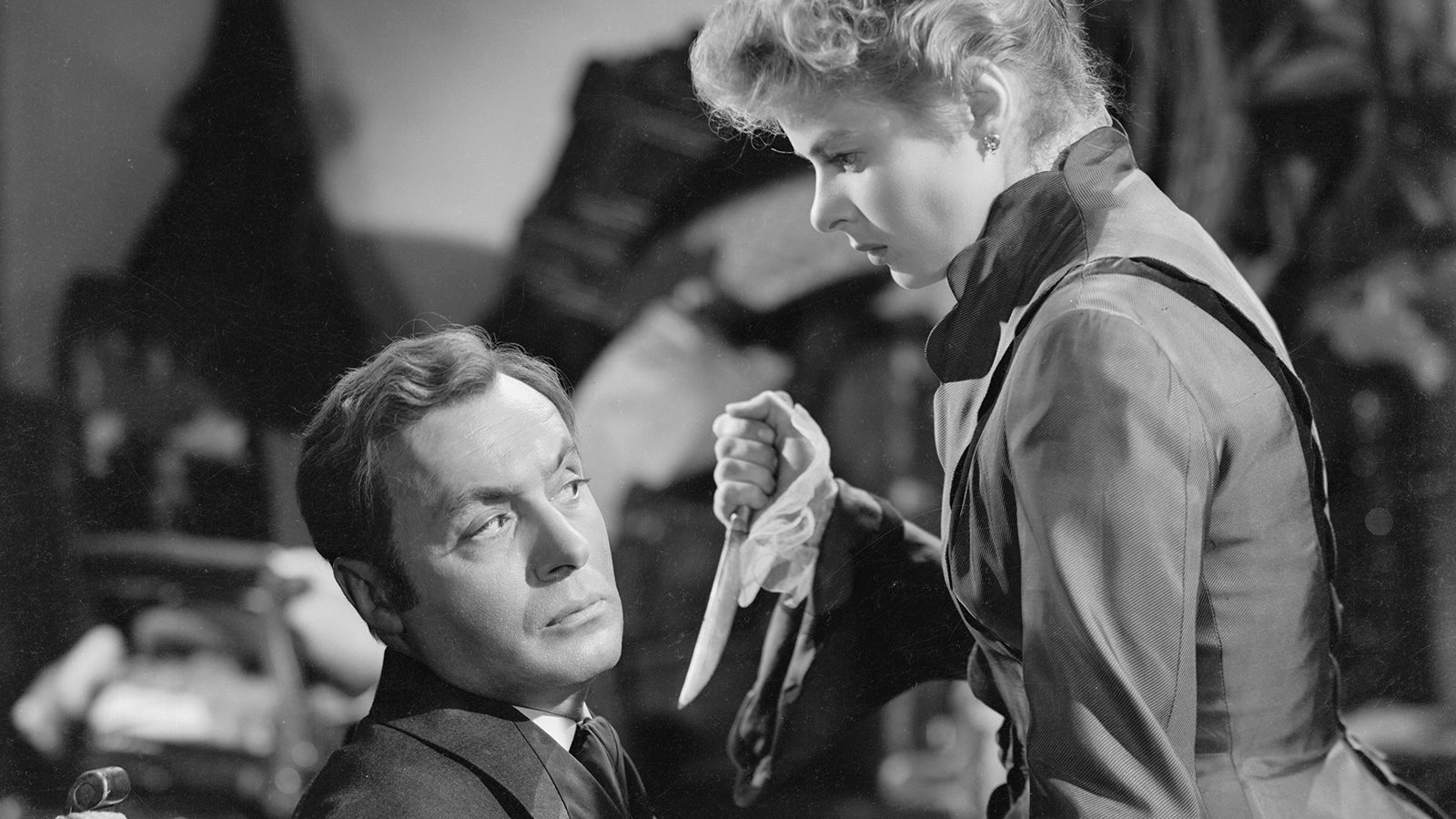
Gregory tries to shoot Brian, but the latter prevents him as the gun discharges. Gregory heads for the upstairs room with Brian and Williams, who heard the shot go off, chasing him. They overcome Gregory and tie him to a chair. Brian hands Paula the jewels. She wishes to speak to Gregory alone. He tries to talk his way out of it, saying Brian is lying about Gregory because Brian is in love with her. He tries to tell lies that he hopes she wants to believe. He says he changed his name because his early life was a musical failure. When he mentions Italy, she insightfully says that she felt that maybe she “dreamed” those times, since they now seem unreal because he was not who he pretended to be. He asks her to go to a drawer to get a knife and free him. She picks up the knife and is sarcastic, saying she is mad so she can’t be holding a knife, or maybe she misplaced it, but can’t remember. She then finds the brooch he hid, and yells at him, saying that because she is insane, as he said, she can have no pity for him. She calls to Brian to take Gregory away.


As he leaves, Gregory says that the jewels were “a fire in my brain that separated us,” and admits he always wanted them. As he says these words, his eyes widen and shine like a blaze. For Gregory, the objects he obsessed over having, came to possess him.


The film ends with Brian escorting Paula onto the balcony of the upper floor as the cloudy night will make way for the light of day, and will allow Paula to see things clearly again, and freely.


The next film is The Grapes of Wrath.