Showing posts with label psychological drama. Show all posts

Tuesday, June 3, 2025

Insomnia

 SPOILER ALERT! The plot will be discussed.

This film (2002) is a remake of the movie done in 1997 which was a Norwegian story set inside the Artic Circle. The setting is here is Nightmute, Alaska, which fits the constant daylight experienced by the residents. The opening shot shows someone applying blood to a fabric, presumably to frame an individual. Then there are shots of the white Alaskan environment as Detective Will Dormer (Al Pacino) rides in a plane over the frozen land with his partner Detective Happy Eckhart (Martin Donovan). His first name will become ironic as the story plays out. As IMDb points out Dormer’s last name in Romance languages implies sleep, which is also ironic here because that is something he will get little of.


They are met by the enthusiastic Ellie Burr (Hillary Swank), a fan of Dormer. (Could her last name refer to the cold exterior?). They meet Chief Nyback (Paul Dooley), an old acquaintance of the visiting detectives. The Chief requested their help although he notes that there is an Internal Affairs investigation going on that may involve Dormer. We quickly realize that there may be a dark side to the protagonist here. Director Christopher Nolan uses doubles in his films to show the negative aspects of his protagonists, such as in the Batman movies, Memento, and The Prestige.

Dormer insists upon seeing the body of seventeen-year-old Kay Connell despite being told all the evidence is in the report. It points to Dormer’s insight and experience. Dormer realizes that the killer took his time to wash the victim’s hair and cut the nails, not applying any makeup. He and Burr conclude the murderer must have known the victim and wanted to erase any traces of her that might connect them. The process was patient and methodical revealing a calculating killer. Dormer observes that the perpetrator “crossed the line and didn’t even blink. You don’t come back from that.” The idea of stepping over the line of legality and morality and the resultant fall from salvation is something that the film addresses.

After examining Kay’s room, Dormer sees that she cut out the picture of her best friend, Tanya (Katharine Isabelle). It is proof that animosity developed between the girls. He also observes gifts that her boyfriend, Randy (Jonathan Jackson) could not afford to give her. Dormer concludes there must be an admirer of some means involved. When Dormer says he wants to visit the school, the local police inform him that it’s ten o’clock at night. It’s the time of year there that has only daylight. Ian Nathan, in Christopher Nolan: The Iconic Filmmaker and his Work. says Nolan liked how the original movie “reversed the poles on film noir.” I assume that means that film noir movies take place mostly in the dark to mirror the dark deeds characters do. Here the light exposes those wrongful actions.

Even though Dormer doesn’t want to discuss his department investigation, Eckhart drops a bomb saying he has cut a deal which means he will testify concerning evidence used in arresting drug dealers. Dormer sees the Internal Affairs action as a means for others to get promotions, indication that selfish, not admirable, behavior is the motive. Dormer leaves upset. This fact makes what happens later question Dormer’s motives.

Dormer presses boyfriend Randy for information and realizes he doesn’t know the mystery person Kay was seeing even after Randy beat her, showing his brutal side. The police find Kay’s backpack which contains a mystery by A. J. Brody. Dormer is trying to discover connections to the victim since he believes it will lead him to her secret admirer who he believes is the killer.

Dormer sets up a trap, saying they are still looking for Kay’s backpack at a certain location. They stake out the area. The scene takes place in a fog on rugged terrain, which is symbolic of mystery and perhaps the inability for Dormer to see what is morally correct. The suspect shows up and wounds a police officer. In pursuit, Dormer fires at a shadowy figure which turns out to be Eckhart. Dormer goes along with the story that it was the suspect who killed Eckhart. Dormer tells the dead detective’s wife about the death, and it is ironic when she tells Dormer not to arrest the person who killed her husband. She doesn’t realize that she is actually telling Dormer to kill himself.

Burr is now investigating Eckhart’s death. Again, ironically, she doesn’t realize that it is Dormer she is after. He hides his gun just as he hides his criminality. The lawful here becomes the unlawful, as morality is turned upside down. Dormer cannot sleep. The brightness of the day will not allow him the luxury of escaping from his deeds into the relaxed darkness of dreams. He thinks he sees Eckhart among other policeman, as if the man is haunting him. Dormer is suffering from guilt, which is a major element in Nolan’s films: the leaving of the family in Interstellar; the drowning death at the beginning of The Prestige; the possibility that Leonard is the cause of the death of his wife in Memento; the torment the main character feels in creating a weapon of mass destruction in Oppenheimer.

Warfield, the IA investigator, calls Dormer at the restaurant where Rachel Clement (Maura Tierney) works. (Does her name imply that she is the opposite of the inclement weather in the area, and can bestow individual clemency?). Dormer is nasty to Warfield, which may rise out of his guilt that his past wrongful actions will surface.

The police found a .38 caliber bullet at the foggy area and Dormer doesn’t let it be known that he also picked up the .38 caliber weapon left by the suspect. He shoots a bullet from the .38 caliber gun into the body of a dead dog and exchanges the casing for the .9 caliber bullet that killed Eckhart. The lack of sleep causes sounds in the police office to appear loud and disturbing. However, it could also mean that his world has become distorted by his upending the moral order in his life. Burr gives him a report to sign to close out Eckhart’s death investigation. Possibly due to a guilty conscience, he doesn’t sign it. He tells Burr to be thorough in her investigation. We may have here the compulsion found in Edgar Allan Poe perpetrators to confess their crimes.

As Burr takes another look at the evidence and finds inconsistencies, Dormer gets a call from the killer, Walter Finch (Robin Williams). He says he saw Dormer shoot Eckart and pick up Finch’s gun. He knows that Dormer is experiencing insomnia, and that he hides his clock to not remind him of how much sleep he is losing. At the end of the conversation he says, “We’re partners in this.” It shows how he is the demonic replacement for Eckhart. Finch may be a manifestation of Dormer’s darker self, his evil double, another element of Poe’s writing appearing here.

By bringing the victim’s best friend, Tanya, to the dump where her body was found and intimidating her by saying he will reveal that she cheated on her best friend with Kay’s boyfriend, Dormer gets Tanya to reveal that Kay’s secret admirer was Brody, the crime novel writer, who is really Finch.  

Finch calls Dormer again, and again, shows how well he knows him by telling Dormer his state of insomnia. He says that no one would believe him if he says that the shooting was an accident because of the scrutiny on Dormer in the IA investigation. Finch says that he’s not who Dormer thinks he is. It is an ironic statement because it suggests that the surface an individual projects is not the reality beneath. That point can be applied to Dormer also. Finch says he is not a murderer, just like Dormer thinks he isn’t. But then Finch raises the question that maybe the shooting of Eckhart wasn’t an accident. Nolan likes to insert enigmatic possibilities in his stories.

Dormer finds out where Finch lives and breaks into his apartment. Dormer sees pictures of Finch so he can now recognize him. Finch left a piece of paper at the top of the door so when he returns and finds it has fallen, he knows someone is there. He runs off and Dormer chases after him across a river filled with floating lumber. Dormer falls in and almost drowns. Does this scene imply that Dormer is unable to reach steady moral ground?

Dormer returns to Finch’s apartment and receives a call from Finch telling him to feel at home by taking a shower and resting there. Maybe he can even feed Finch’s dogs. His words are another indication that Dormer and Finch could be doppelgangers. Finch is intelligent because he says Dormer should know he’s not going to return to his place. And the only way he knows that Finch is the killer is because he told him so (although we know that Tanya’s statements point to him as a person of interest). Finch sets up a meeting between him and Dormer. Dormer plants the .38 caliber gun in Finch’s apartment. Dormer is trying to frame a man for a killing he himself committed.

Burr has been following Dormer’s advice about checking out the little details surrounding a crime. She realizes that the shot that killed Eckhart came from a different location and now she discovers, as did Dormer, that Finch, a local writer, is the author of all the books in Kay’s position, one of which was autographed, which means she knew him. Later Burr finds a newspaper that features the LA investigation. She repeats what Dormer once said, “A good cop can't sleep because he's missing a piece of the puzzle. And a bad cop can't sleep because his conscience won't let him.” More irony here that Dormer’s protégé is on the trail that leads to himself.

Maybe the best scenes in the film occur between Pacino and Williams. Here they meet on the ferry. Dormer tries to diminish what Finch says about them being in the same situation, not meaning to kill their victims. But Finch is persuasive, saying if it comes out that Dormer shot Eckhart, even if he says it was an accident, it meant that all his IA problems disappeared, which would seem suspicious. It would also ruin his legacy of being an effective cop. It might cause many of those he put away to have grounds to be released, if Dormer is shown to be a cop who alters evidence. Finch says when he was young, he was impressed by the police, and that is why he writes about them. He even wanted to be once, he says, but couldn’t pass the tests. All his statements show how similar he and Dormer are. They speak with their faces close to each other, which suggests they are two sides of the same coin. Finch says that they should steer the investigation toward the boyfriend, Randy. Dormer coaches Finch since he will be brought in for questioning because of the signed copy of the book in Kay’s possession. Dormer tells him not to elaborate, and that the investigation will lead to Randy. Dormer, however, does not reveal that he planted the gun at Finch’s place. After he leaves the ferry, Finch reveals that he taped their conversation, insurance that he has the goods on Dormer.

Finch calls Dormer again and the latter asks if Finch still has Kay’s dress. He feeds that line to Finch who now says that is evidence they can plant on Randy. Dormer really wanted to discover if he could find evidence in Finch’s possession to pin the killing on him. Since Dormer says he can steer the investigation he needs more facts about Kay’s death. Finch says he wanted to comfort Kay when she came to him distraught about how Randy hit her and was fooling around with Tanya. But Kay laughed at him when he held her and kissed her. He says that he hit her to stop her from laughing and his humiliation was the force that led to his beating her. Here we see that Finch’s pathology is deeper than that of Dormer’s. His telling Dormer about what happened is like a confession, an attempt to relieve the feeling of guilt. He says he thinks he will be able to sleep now. The theme of insomnia not allowing one to escape guilt is stressed here. It is telling that when Finch gives Dormer the opportunity to unburden, Dormer hangs up. He can’t so readily expel his guilt.

Finch, during his interrogation, diverges from Dormer’s advice, telling how Kay was afraid of Randy, how he abused her. Then he reveals that Kay said Randy had a .38 revolver that he hid in a heating vent, which is where Dormer hid the gun at Finch’s place. Here Finch is communicating that he knows Dormer was trying to manipulate him and the reason Dormer didn’t want Finch to say anything about Randy was because he wanted Finch to be the prime suspect. Dormer then takes over the questioning once he realizes what Finch is doing. He says that Finch gave the young girl gifts, implying Finch was grooming her, like a pedophile. After Dormer goes into a rage, he leaves the room.

Dormer can’t find the gun in the air vent at Randy’s place. It was a ruse by Finch. The police come and find the weapon where Finch relocated it. They then arrest Randy ironically on evidence that Dormer manipulated to prevent himself from being implicated. Now, instead, an innocent person is targeted for something he didn’t do. Dormer has done the opposite of what a cop is supposed to do.

Dormer and Finch meet again, and Finch says that it’s over because he now can go on with his life, scumbag Randy is in jail, and Dormer’s reputation is intact. He gives the tape to Dormer who disposes of it and points his gun at Finch. But Finch reminds him that his outburst at the police headquarters shows he would be a prime suspect in Finch’s death. Dormer then says he will tell the cops about everything. Finch reminds Dormer he destroyed any evidence of the two ever having a previous conversation that implicated Finch.

Finch is very smart and has thought it all out, except that Burr finds more about what happened. She uncovers a .9 mm shell at the site of Eckhart’s death, which undermines the .38 caliber gun being the weapon that killed Eckhart. She notes in some case files involving Dormer that a .9 mm was used. She encounters Dormer who looks wasted due to insomnia. Burr gives him a hug and can feel the .9 mm gun, and since none of the local cops carry that firearm, she is very suspicious.

Back as his hotel room, Rachel asks Dormer why he is moving furniture around to block the window. Even though it is dark in there, he still says it’s bright. Metaphorically he can’t hide his guilt anymore. He now does confess to Rachel about the case under investigation back home. He describes how a pedophile kidnapped, tortured, raped, and finally killed a boy. Dormer says he knew the man was guilty. Tellingly, he says his job is to “assign guilt.” Now he is placing that guilt on himself. The shot at the beginning of the film that showed blood being absorbed onto fabric involved Dormer taking blood from the victim and planting it in the perpetrator’s home. He admits he knew it “would catch up” to him, and mentions the investigation. He says the “end justifies the means.” He doesn’t sound convinced, probably realizing it is a rationalization. He asks Rachel, who he has put in the position of a clergyperson, what she thinks. She says it might be that it seemed like the right thing to do at the time. But can he live with his actions? And that is the vital question this film asks.


There is an interesting cut to Burr who holds the .9 mm casing and now she must decide what to do, and can she live with her decision? Dormer picks up his badge and gun and decides to go after Finch, no matter the means or the consequences. Burr promised to meet Finch at his cabin where she does not know he killed Kay. He said he had letters from Kay that told of Randy’s abuse. He has no such letters that he could create in time for this visit. Dormer can’t find any evidence at Finch’s empty apartment so he too heads to the cabin. Burr notices Kay’s dress and Finch knocks her out. What follows is Finch getting the drop on the disoriented Dormer. He disarms him and beats him. Burr shows up and Finch escapes to get more firepower. Burr realizes that Finch is Kay’s killer, and he witnessed Dormer shooting Eckhart. Dormer admits these facts and adds that he just isn’t sure if killing Eckhart was an accident. Dormer sneaks up on Finch and they fight. They eventually exchange gunfire. Both receive fatal wounds. The shot of Finch falling dead and disappearing gradually in the water symbolizes the death of Dormer’s darker self.

As Dormer is dying, Burr is ready to throw away the .9 mm casing saying nobody has to know. He stops her and says, “Don’t lose your way,” as he had, forgetting to abide by the law. He says to just let him “sleep.” He can now have the ultimate escape from his guilt in the comfort of an eternal rest.

Monday, July 3, 2023

The Accidental Tourist

 SPOILER ALERT! The plot will be discussed.

The film title, The Accidental Tourist (1988), based on Anne Tyler’s novel and directed by Lawrence Kasdan (Body Heat, The Big Chill, Silverado) suggests traveling is something problematic. It implies the danger in the act of traveling, possibly referring to life itself as being a scary trip. Kasdan said that he likes to explore how life is chaotic and how people try to control it. As William Hurt’s Macon Leary (an appropriate last name, suggesting a fear of what may occur) packs a suitcase, he delivers a voice-over narration about the business traveler needing to be aware of things going wrong. However, Macon acts in opposition to his advice, carrying more than one book since he knows he will use them as a tool to not be social. When he says don’t pack anything “dear,” that losing it would “devastate you,” we see him holding a picture of his young son, who he has already lost, and whose picture and memory he carries with him, despite his advice to leave anything precious behind.

On the plane he talks with Lucas Loomis (Bradley Mott), a large man who literally “looms” over others. He swears by Macon’s book, The Accidental Tourist, and says following its advice makes it seem he is traveling in a “cocoon.” That word stresses the isolation that Macon uses to protect himself from the pain that personal relationships can lead to. Loomis points out that despite Macon saying reading a book protects one from intrusive travelers, it didn’t work with Loomis. So much for Macon’s attempt at insulation.

Hurt reunites with his Body Heat co-star, Kathleen Turner, who plays his wife, Sarah. After his return home, we see a distance between the two, as they do not embrace or kiss after his time away. Macon shows more affection for his dog than Sarah. She mentions how the pooch still expects “Ethan to come home.” It’s been a year and the pain of the memory of the loss of their boy has made life with Macon intolerable for Sarah. She tells him she can’t live with him anymore, wants a divorce, and has already secured an apartment. He wants to persevere, but she sees people now as “evil,” since their son was killed by a gunshot wound to the head. Macon certainly wants no close contact with others. She says that his books show how people can travel without feeling “touched” by where they go, as if they never left home, which is what Macon desires. It is interesting that Macon is a man who wants to stay home, but travels a great deal. Perhaps this is either ironic or shows how he is torn about what he wants out of life.

Sarah sounds suicidal as she wonders how she can live in a world of “evil,” and asks what’s the point of existing? After she moves out, Macon continues his daily routines like shaving and eating, probably hoping that maintaining activities will propel him forward through life while not enjoying it.

Macon needs to board his dog, Edward, while he is away again. (Kasdan said that the dog is the “agent” that causes the plot to move forward). The prior place will not accept him because he did some biting (the animal’s anti-social attitude mirrors that of his human companion). Macon notices a boarding place and drags the reluctant Edward inside. There he encounters Muriel Pritchett (Geena Davis, who won the Best Supporting Actress Oscar for this role). Muriel discovers quickly that Macon is available since he says that the apartment complex where his wife lives doesn’t allow pets. Edward seems to take to her right away, and the fact that Muriel smiles and repeats her own name to Macon shows that maybe she is drawn to the dog’s owner, also.

We again have Macon narrating for his readers. He says he encourages the use of the London “underground,” the subway there. Does he like the underground because he suppresses his feelings below the surface? He complains about the abrasive fabrics used in bedding, stressing how foreign traveling can be inhospitable. He says in London one can find food similar to what is in Cleveland. Macon emphasizes that the business traveler is not voluntarily visiting other lands for recreation. So, he wants him to feel like he is not away from home as best as he can. It fits his own desire to stay safe in a secure domicile. He does not wish to take chances on local adventures or cuisine.

Macon returns to pick up Edward. The camera lingers on Muriel to stress her unique expression in her appearance. She has flowers in her hair and very long fingernails. Her clothes are bright with patterns which are a far cry from Macon’s gray-suit wearing advice. She says he can call just to talk with her, but he admits he has no social desire to do so given his preference for being alone.

Macon has a nightmare where his son calls saying he is still at camp and his father forgot to pick him up. It’s an unconscious denial dream about his son’s death, and it also may contain guilt for not being there to protect his son. Macon receives a call from the pushy Muriel, who volunteers to take care of Edward’s growling when Macon leaves the house. She even invites Macon to dinner at her place. He says he would rather handle things on his own, which is his default position. She seems to understand that he is not ready to socialize so says she will leave it up to him if he wants to get in touch.

Macon sustains a broken leg in a Keystone Cop-like accident. He attaches a laundry basket to a skateboard so that it will catch the clothes coming down a shute that he can then wheel to the washer. But Edward hears the washer make a loud noise, gets freaked, and jumps on Macon, who puts his leg in the traveling basket. The broken leg makes the staid Macon even more stationary. Macon winds up at his deceased parents’ house where his quirky siblings live. Amy Wright plays his sister Rose, who drives a beat-up car showing a distaste for change. David Ogden Stiers is brother Porter, and Ed Begley, Jr. portrays brother Charles. They don’t answer the phone since it just interrupts their static way of life with intrusive information. They play a game called “Vaccination,” which is significant because they want to immunize themselves against the invasive elements of everyday disorder.
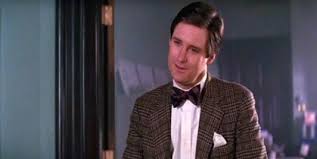


Julian Hedge (Bill Pullman) arrives. He is Macon’s publisher who came up with the slogan for Macon that says that armchair travelers want to leave home, while traveling armchairs want to stay put, equating some people with furniture, which would seem not to be a complimentary comparison. Julian comments that the family house is really “something.” It looks like a museum and Macon says that it was his grandparents’ home. Apparently, the Leary family likes living a static existence. When Julian discovers that Macon is separated from Sarah, Macon’s explanation for the split is that these things happen for no apparent reason. He is again in the underground, not wanting to bring deeper feelings to the surface. Edward growls as Julian leaves and when Macon reaches for the dog, he bites him. Porter says he should get rid of the dog. We then get a flashback of Ethan (Seth Granger) playing with Edward. Macon says he can’t discard Edward. He retains a connection to his son through the dog.
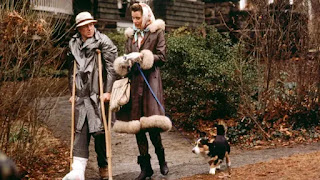

 Rose mentions obedience school. That suggestion brings Macon back to Muriel. She has a way with Edward, but she is not initially successful with training Macon. Muriel tells him that Edward isn’t taking him seriously. So, Macon even has trouble interacting with his dog. Muriel shows her unconventional side again, wearing a tiger-striped dress. She plays with items on the fireplace mantlepiece and has no qualms about exploring family pictures. When she finds out he writes travel books, she says she loves traveling. It fits with her extroverted style. In contrast he says travel is not liberating for him as he lets himself get bogged down in “red tape,” consisting of “ticket lines, custom lines.” She would love to see “romantic” Paris, but instead of acknowledging the wonder of the city, he mentions the rudeness of the citizens. Just like she helps to get the dog back in step with his surroundings, Muriel will help Macon return to a worthwhile life. As Maude in Harold and Maude is the mentor for Harold so he can see the total spectrum of life, it is Muriel’s job to add dimension to Macon’s limited world view.

Even from their first encounter, Julian asks about Rose, who smiles when she sees Julian. When Julian delivers some notes on Macon’s writing, the attraction between the two is obvious as they exchange agreement on the desire for marriage and children. Porter is not there because he went to a hardware store and may have become lost. This family is a real stay-at-home bunch.

That preference carries over in the scene where Macon, after having his cast removed, tells Muriel that he doesn’t go out to see films because he doesn’t “care for movies.” This fellow is such a fun guy. His words are ironic since he is a character in a movie. He says that films make everything seem too close up, while Kasdan gives us a close-up of the two, showing how filmmaking stresses its intentions. Muriel reveals about having a child and is divorced, so her son could use a father figure. Her romantic overtures are quite loud, but Macon is Beethoven-deaf to her flirtations.

Julian is at the Leary’s Thanksgiving dinner where Macon and Charles discovered the turkey was cooked at too low a temperature. Even cooking is a peril to these people. They don’t say anything about their trepidations concerning food safety until the bird is ready to be served, which embarrasses Rose, who prepared the meal. She shows her feelings, saying that they are conspiring to dampen Julian’s love interest in her because they want her to stay and take care of them and the house. She states that her brothers lost their chance at romantic happiness, and she will not give up her opportunity for success in love. Julian, showing his dedication for Rose, says he will have some turkey. Turns out he has two helpings and doesn’t get sick, which makes Rose feel vindicated about her feelings for him.

Muriel’s son, Alexander, has allergies to everything, maybe even what’s in the air, she says. She, too, has her burden in life to carry. She invites Macon to dinner with her and her son. He reluctantly accepts but then goes to deliver a hand-written note to Muriel saying he can’t make it. She opens the door to her place when he slips the note under the threshold. He finally shares his trauma with her and says he can’t have dinner with a child since it is too painful a situation for him. She silently holds him, allowing him to make an embracing confession. He says the loss of his son seemed unreal at first but now he feels worse because, instead of adapting over time to his death, the loss has become more real. He tells her, “Now, I’m far from everyone. I don’t have friends anymore. And everyone looks trivial and foolish, and not related to me.” His words ring true to anyone who has suffered a great loss. It jolts one into a broader perspective about life where everyday matters seem inconsequential. The numbing of emotions is an emotional defense to allow the individual to continue to exist, albeit in a blunted manner. Muriel tucks him into her bed as if comforting a child and says he can sleep there. She cuddles with him, and that closeness that he needed resurrects his physical need for intimacy which he consummates with her.

The next scene has Macon arriving at Muriel’s house and the neighbors recognize him, so we know he’s been around a great deal lately. He is even okay with spending time with Alexander, shopping for clothes, going to movies (which Macon used to dislike). When Alexander experiences negative behavior from other boys, Macon is there to comfort him. The boy holds onto Macon’s hand, establishing a father-son relationship that Macon lost. Macon is more upbeat now, even joking a bit, showing the effect of Muriel’s positive influence on him. The better-behaving dog, Edward, reflects the improvement in Macon’s personality.

In a way, Julian’s relationship with Rose mirrors that of Macon and Muriel. The publisher and the sister are also going through a rebirth cycle, as Julian is excited by Rose’s presence. He has an engagement ring and will ask her to marry him on Christmas. He says to Macon, “Isn’t it amazing how two separate lives can link up together? I mean two differences.” His statement could accurately apply to Macon and Muriel, too.

Porter wants to know what Macon is doing with, “this Muriel person.” The brother is condescending, saying that Macon is too good for the woman living in the slum with the diseased child, and that Macon has changed, obviously for the worse according to Porter. Macon knows he wasn’t such a “catch,” given his downbeat personality, and he probably is grateful for the change in himself. He tells Porter to shut up.

When Macon is concerned about Alexander’s inability to do math problems, he offers to pay to send the child to a private school. Muriel is sternly forthright when she asks about Macon’s intentions. She points out that she can’t jerk the boy in and out of schools if Macon is not committed to the relationship. She feels that sometimes he shows being ashamed to be with her, echoing what Porter said. She suggests that maybe he’ll even go back with Sarah. Their argument continues as he says in response to the possibility of them getting married that the institution is seriously flawed. She is angry, saying his decisions are selfish. Her words point out that Macon has no idea as to what he wants in the long term, and that lack of consistency impacts others with whom he is involved.

On Rose and Julian’s wedding day, showing the couple are not afraid to move forward with their lives, Macon encounters Sarah, who has learned that Macon is living with someone. The looks of Muriel from across the gathering show her worry about Macon having used her and is ready to return to his prior life. The man officiating at the wedding says that marriage is a sort of home, a sanctuary, where people can find solace in turbulent times. His words could imply that Macon might consider obtaining that peace either with Sarah or Muriel.

Muriel wakes up and sees a packed bag on the bedroom floor. Macon is just going to Canada for his writing, but she says that she doesn’t want to fear all the time that he will leave her. He says that he is not, but he tells her to go to sleep instead of definitively declaring his love for her.

Sarah calls Macon while he is in Canada, and says her lease is running out. She asks if she can temporarily stay at the family house. Rose is back there, too, taking care of her brothers, while delivering meals to Julian at their apartment. Sarah expresses feeling an emotional jolt when she received their divorce papers. Macon agrees to the living accommodations, but ends the call abruptly, showing he is upset. The past lives of both Rose and Macon are like black holes, trying to suck the two back into their insulated, womb-like existence. Sarah calls again after moving back to the house and says she is lonely, asks him to come “home” (that safe place) and that they can try to be together again. They do attempt a reconciliation, and even have sex. But, Sarah complains that Macon still lives “sealed up” and doesn’t share what he is feeling. He becomes angry and wants the discussion to end since it reminds him of how Sarah would bring up his faults and say that she knew him “better than he knew himself.”

Macon goes back to the house and Sarah says that she feels happy about being together again, enjoying the little things they shared doing together. She says, “anything different just doesn’t feel right.” The thrust here is that change is unwanted because it is upsetting. Rose tells Sarah, who asks when she is going to move back with Julian, that their apartment’s location would consistently confuse her and she would get lost when she left it. Her statement reminds us of Porter’s inability to navigate outside the family house. The Leary’s are definitely out of their element when outside of their comfort zone.

Macon types and narrates that travelers should not be “lulled into a false sense of security.” He pauses after typing and the sentence could reflect what is happening to him back at the house. Julian is worried that Rose has left him. Macon agrees that Rose (like himself and his brothers) has worn a “groove” in the house and can’t get out of it. Macon actually offers a helpful suggestion. He says that Julian should offer Rose the chance to help him at the office. He says to tell her that he needs her to “get things under control.” Macon knows of the appeal of a steady, safe routine, and believes his sibling Rose will respond to that request.

Macon gets on a plane to Paris. Apparently, Muriel is not ready to give up on Macon, and gets on the same plane after borrowing money for the trip to go to that romantic spot she hoped to visit, Paris. She argues that he needs her because he “was falling to pieces” before being with her. Macon clings to home by waking up Sarah with a phone call to maintain the umbilical cord to his safe past. Muriel pressures him into eating with her. Do they have beef bourguignon? No, they dine at Burger King, because, as Dorothy in The Wizard of Oz would say, “There’s no place like home.”

Macon sprains his back. He seems to require recovery after setbacks, which includes the psychological one involving the loss of his son. His accidents, which fit in with the film title, show how life is an unexpected obstacle course that one can’t escape. Sarah finds out about the back problem from Rose and arrives ready to help Macon. She will visit the other cities on his itinerary so she can help him with his writing. She informs him that Julian moved into the house with the brothers. This fact suggests that Julian is capitulating to the influence of the emotional gravity of the Leary household.

Sarah offers that they go on a second honeymoon after she is done traveling to the other cities. But she saw that Muriel was at the same hotel as Macon. Sarah wants to know if the other woman’s son was what attracted him to Muriel. She also brings up the idea of having another child, which Macon dismisses. It must seem to Sarah that he was fine having another child in his life, but not with her. She feels that Macon could have done something to prevent Muriel from traveling to Paris. There is the implication that Macon’s passiveness may have led to the death of their child. She gives him pills that anesthetize his pain, but the action is symbolic of her wanting to control him, to lull him back into his prior life.

Macon seems to realize that going backward is not the right path for him. He tells Muriel in the morning that he is going back to Muriel. He admits he didn’t take “steps” in the past in a proactive way, but thinks he should now. He says, “I’m beginning to think that maybe it’s not just how much you love someone. Maybe what matters is who you are when you’re with them.” Macon seems to be saying what an individual becomes with the person one loves is what’s important. If loving someone diminishes oneself, then the relationship is unhealthy. He realizes that one can’t plan life like “a business trip.” Life is too complicated and full of variables, so “things just happen.” Muriel helped him “step out,” and “stay out” of the “Leary groove.” He is opening himself up to the sometimes scary randomness of life, which can bring its joys.

A young boy helps Macon get a taxi, and the youth reminds him of his son. It is a sign that he is on the right path, as he encounters Muriel, who is ready to leave, thinking she has lost Macon. They see each other and they smile. He has found a new home.

The next film is The Prestige.

Wednesday, December 29, 2021

Pickpocket

 SPOILER ALERT! The plot will be discussed.


If you know Dostoyevsky’s Crime and Punishment, you don’t need Roger Ebert to point out the echoes of that story in Robert Bresson’s Pickpocket (1959). However, Ebert’s insights help to clarify this story about a man, Michel (Martin LaSalle), who, like Raskolnikov, sees himself as superior to the rest of society, and thus existing in a plane above the morality of others. However, Ebert notes in his book, The Great Movies, that Michel, “fearing he is worse” than the general population, “seeks punishment” for his crimes. Could it also be that he is an emotional vampire who is empty inside and is attempting to suck out the spirit of others that he robs?

The film begins with a sort of disclaimer which says the filmmaker is not presenting a thriller, but instead is providing a story about a man with a compulsion, and that the situation also brings together two people who may never had otherwise met each other. Bresson, thus, is giving us a character study that is the primary focus, and the events are the vehicle which brings these people together, and to us.

The music that plays as the titles are displayed sounds like a classical dirge that suggests crime can be artistic but also can lead to the undoing of the criminal artist. The beginning has Michel, who is writing in a journal, succinctly summing up what he thinks is his superior nature. We hear his voice as he narrates his tale. He says others think of committing certain acts, but he has actually done them.

At the racetrack, where people are carrying money to bet, he surveys the crowd. His eyes are always moving, observing where he can strike, like a predator. Ebert points out that the pickpocket must get close to the victim, suggesting sexual intimacy. Michel approaches a woman, and his close proximity shows he is penetrating her personal space. The way he strokes the female’s purse (which prostitute’s sometimes call the vagina) appears sensual. When he releases the catch, he gives out a slight sigh and closes his eyes, which is relief he didn’t get caught, but may also imply sexual satisfaction. Even the way he inserts his hand and removes the money is suggestive. As he exits the location he says he was “walking on air,” which stresses his ecstasy at violating the standards meant for the mediocre masses. However, he is arrested, probably because the woman saw him close to her and described him after realizing she was robbed. But, because he was not caught in the act, he is released. He later says he needs to think about what has happened, which implies he is experiencing the exhilaration of getting away with his crime, the fear that he almost was caught, and the guilt of breaking the law. As Ebert points out, Bresson does not allow his actors to show emotion to give away their feelings, and that the audience must surmise what the characters are feeling by the action he, as the director, presents.

As he goes to his mother’s place, Michel admits that he does not visit her often. He does not have a key, which shows his lack of connection to her. The neighbor, Jeanne (Marika Green), lets him in and she is the one who knows more about his mother’s ill health than he does. He will not even go in to see her, and hands Jeanne some money to give to his mother. Ebert suggests that, since we don’t really know, Michel may want to avoid a reminder of his connection to an ordinary woman.

Michel meets with a friend, Jacques (Pierre Leymarie), who appears to know Michel has the talent to be a good pickpocket because he has good ‘hands.” The two join a third man, a policeman, L’inspecteur principal (Pierre Pelegri), who knows about different types of crooks. When pressed about why he thinks some people break the law, Michel is philosophical. He rhetorically asks, “Can we not admit that certain skilled men, gifted with intelligence, talent or even genius, and thus indispensable to society, rather than stagnate, should be free to disobey laws in certain cases?” L’inspecteur principal notes the danger in people deciding that they are “supermen.” Michel says these special individuals will benefit society when they act according to their superiority, which they recognize in themselves. But L’inspecteur principal notes that it would be difficult to find someone who doesn’t consider himself to be “exceptional.” He adds by questioning the concept of a “useful thief,” saying that would create a “world upside down,” a reversal of the social order. Michel counters by saying, “It’s already upside down. This could set it right.” Michel is arguing that if the world is so flawed it needs an outlaw to correct its wayward path. Of course, one could also argue that breaking more laws would only create more chaos. In this exchange we have the closest connection to Raskolnikov in Crime and Punishment. L’inspecteur principal, according to Jacques later, is becoming suspicions of Michel, whose verbal justification of criminal activity could be part of a desire to be found out to get acknowledgement of his talent, but also possibly to get caught as penance for his transgressions.

Michel continues his narration, saying that even though he does not want to return to his seedy apartment, which only has a latch as a lock, he questions if his desire to steal is based on the acquisition of money. While on the metro, he scopes out a victim and feels compelled to pickpocket him, although he does not act yet. He continues to practice his technique and is successful the next time he rides the train. Michel, as Ebert points out, is unremarkable in appearance. Of course, by not calling attention to himself, he is able to perform his illegal actions unnoticed. The idea that this type of criminal act is done by making appearances look innocent is demonstrated when Michel hides a stolen wallet inside a folded newspaper. The fact that the theft is done in an underground vehicle suggests symbolism that implies wrongdoing is propelled by the forces of the underside, that part of one’s psychology that rebels against the standards imposed from without.

One of Michel’s marks stops him on the way out of the metro, confronting Michel with the theft of his wallet. Michel gives it back and quickly leaves, feeling defeated. He then stays in his apartment for a while, probably requiring solitary sanctuary for his failure. His place is full of books that he reads, which also feeds his ego regarding how he values being thought of as an intellectual. As he sits in the small living space, it almost looks like a jail cell, which also implies that Michel is already imprisoned by his compulsion.

Jacques brings Jeanne to Michel to tell him that his mother is very sick. He still is not able to find it within himself to visit her, despite admitting that he loves her. His contradictory attitude is still not explained, and we can only guess at why he feels alienated from his mother. He follows a man who was sizing up his place and finds out that he is a pickpocket who then helps Michel perfect his technique. The classical music is back as the hand maneuvers are put on display, equating the movements with an artistic work, despite the fact they are illegal.

Despite Michel’s intense observational ability, he, ironically, misses seeing a note left by Jeanne urging him to come to see his mother. The implication is that his connection to others is not his primary concern. However, he now visits his dying mother, who passes away after she says he can accomplish anything. Her statement also is ironic, since he can construe her encouragement to justify his pickpocketing enterprise. He cries at her funeral, which is the first time we see any emotion on the part of Michel, thus demonstrating he can have feelings for others.

After bringing his mother’s few belongings to his apartment with Jeanne, he asks her if people are judged. She mistakenly thinks he is talking about his mother, who Jeanne says will be treated kindly in the afterlife. He is most likely thinking about himself. He questions, “Judged how? According to laws? What laws? It’s absurd.” She asks if he believes in “nothing.” His sarcastic response is, “I believed in God, Jeanne, for three minutes.” He is an existential character who has thrown away concepts of absolute rights and wrongs, but he has not replaced any traditional spiritual beliefs with another code. The poet William Blake created his own mythology because, he said, he must build a system to follow or be enslaved by one created by another.


Michel and his accomplice/mentor use their slight-of-hand skills to steal from several people. A second pickpocket then joins the team. Back in his apartment Michel finds Jacques there picking up a book about a famous pickpocket. Jacques is concerned about his friend being interested in a life of crime. He says that thieves “disgust” him because they are “idlers.” But Michel defends the “Prince of Pickpockets” noted in the book, saying the famous crook read constantly. When Jacques stresses that thieves go to prison. Michel asks his friend if he knows what prison is. The implication here is that Michel is already in the prison of his own compulsion to steal, which sprang from his outsider personality.

Jacques brings the book about the pickpocket to a meeting that includes the L’inspecteur principal. The policeman asks Michel if he knows how many of these “supermen” lawbreakers there are. Michel says no, because they are smart enough never to have been caught, which can imply that he is smart enough never to be captured. L’inspecteur principal invites Michel to talk with him about the book. Michel afterwards tells Jacques that he knows the policeman and Jacques suspect him of breaking the law. But, he says he will go see L’inspecteur principal anyway. Here we have his arrogance showing, but also that contrary subconscious desire to have his illegal activities discovered. He meets with the policeman, but it is a brief encounter and Michel believes it was a trap to get him away from his apartment so it could be searched. When he returns he finds that his stash behind the wall molding has not been touched.

He meets with Jacques and Jeanne, only to leave them to steal a watch. The next scene reveals that he has hurt his hand and leg and his clothes are dirty. He must have failed at keeping his theft covert and fallen while running away from the scene of his crime. His pickpocketing is a dangerous activity, but it is the adrenalin rush that makes it attractive. Jacques finds Michel at his apartment in his disheveled state. Michel shows some jealousy, wondering if Jacques and Jeanne have fallen in love. Perhaps he has some genuine feelings for her, but is it enough to save him from his antisocial behavior?

Michel narrates that working with his partners was going along very well. But, he says it can’t last. He is obviously a pessimist about life. There is a wordless sequence which presents a clinic on pickpocketing. The three thieves work seamlessly at a train station removing wallets and substituting purses under the arms of women for the stolen ones. They move the goods between them for safekeeping so none of thieves gets caught with the merchandize. The audience marvels at the skill of these crooks, maybe even cheering for their talents. But these men are victimizing innocent people. In this way, Bresson is like Alfred Hitchcock, who implicates his audience in wrongdoing in his films as he has the viewers get thrills from their voyeurism and vicarious involvement. Bresson, like Hitchcock (think of Psycho, Strangers on a Train, Shadow of a Doubt, Rope), even puts the audience in a position where they wish for the perpetrators to escape capture.

L’inspecteur principal confronts Michel at his place. Michel tells him he knows the policeman suspects him and he shows anger here saying he does not want to be hounded. The inspector says that there was a report that an old woman stated she was robbed but the complaint was withdrawn. Then the woman’s son was at the racetrack right after that and was arrested as a possible pickpocket. He admits he is talking about Michel and confesses that he should have considered Michel as the person who stole from his mother. So, we see that Michel’s compulsion even makes his own mother a victim. Could he have stolen from her as a sort of revenge for coming from an ordinary upbringing? The policeman simply leaves and refuses to tell Michel his future plans concerning the suspected thief.


Michel knows that Jeanne was questioned by the police in connection with his mother’s robbery. Jeanne says that his mother dropped the complaint. Jeanne is the opposite of Michel. She is an innocent and does not suspect Michel until he calls her an “idiot” for not realizing that he lives without any evidence of income, and states that his mother must have come to realize her own son stole from her. She is appalled that he could have done such a horrible thing. Her goodness is a challenge to his amoral behavior. His cynical response is that just knowing a deed is considered wrong doesn’t preclude one from committing it. He is again asserting his option to dismiss conventional morality if he is above it. He says she has accepted her lot in life even though it has inflicted her with a drunken father and an absent mother. He most likely is asserting the right to alter one’s inherited situation if it is detrimental, even if it means breaking the rules to right the wrongs. She provides a sort of spiritual, fatalistic attitude, saying things must occur for a reason. He says to her, “are you that naïve?” This exchange shows how opposite these two are in their approach to life’s tribulations. She admits that she believes that he is a thief, but instead of recoiling from him, she hugs him, as if offering Michel a chance at redemption if he can experience kindness.

He retrieves what he stole and escapes on a train to avoid being arrested. He writes that he went to Italy and then England where he continued being a pickpocket for two years, but he lost all of what he stole on gambling and women. He returned to Paris “penniless.” So, the acquisition of wealth, to “get ahead” as he told Jeanne, was not really his goal. It was the act of stealing that interested him.

He visits Jeanne, whose father has taken all of her belongings. She now has a baby, and Jacques is the father. She says she couldn’t marry him because she didn’t love him, and it would have been a deception. She is above being dishonest. Michel promises to help her, perhaps because her being a good person who has not had an easy life and who showed him compassion brings out the humanity in him. He gets a legitimate job and gives money to Jeanne.

The story returns to the racetrack, where it began, providing a sense of closure. A man there shows Michel that he has a lot of money in his pocket from his winnings. But, Michel sees that the horse the man chose did not win. So, he suspects the man to be a policeman. Out of arrogance, he attempts to pick his pocket anyway, but the cop catches Michel in the act and puts handcuffs on him. Did he subconsciously try to get arrested out of guilt or feelings of inadequacy? In jail, Jeanne visits, and he says, “These walls, these bars – I don’t care. I don’t even see them.” Maybe that’s because he has always felt imprisoned by the way life treated him. What bothers him is that he “let his guard down” and was caught, which undermines his vision of himself as being superior to failure. He says he will confess everything (the prison bars suggest the divider is a confessional) but will then refute what he says just as a way of stubbornly resisting his defeat.

He eventually gets a letter from Jeanne telling him that her baby has been very ill, so she continues to suffer life’s tribulations. She promises, however, that she will see him again. When she visits, they are separated by the barrier, but they touch each other, and he kisses her head gently. The last words are, “Oh, Jeanne, what a strange way I had to take to meet you.” He, ironically, has made a meaningful emotional connection to her at a time when his actions have prevented him from being with the woman he cares about.

The next post deals with recent films.