Showing posts with label U.S Navy. Show all posts

Monday, July 19, 2021

The Caine Mutiny

 SPOILER ALERT! The plot will be discussed.


The Caine Mutiny (1954) deals with the strains of military command, and honor and self-sacrifice versus selfishness. The film begins with a graduation ceremony for ensigns in the U. S. Navy who are about to join the fight in WWII. The man giving the address uses high-minded words that do not anticipate what happens when the fight against the enemy is compromised by confrontation with fellow seamen. Willie Keith (Robert Francis), a Princeton graduate, is one of the ensigns who, despite his adult status as a military man, is controlled by his wealthy mother. Mrs. Keith (Katherine Warren) bullies him into coming to her party instead of celebrating with fellow soldiers. He disappoints his girlfriend, May Wynn (same as her actual name), by gesturing he will join up with her later instead of introducing her to his mother right then. Willie probably knows that his mother will not like any woman who lessens the connection to her. Willie meets the angry May later at the club where she sings. She becomes more upset when she realizes he only has a couple of days to spend with her until he ships out. There is the sexual implication that instead of going out that they could use the forty-eight hours otherwise. She stops him short, and suggests that they get married first. She knows he's dominated by his mother, and her hopes of liberating him fall flat as he dismisses the idea of a wedding.


After Mrs. Keith’s overprotective advice about staying safe no matter what, Willie travels to Pearl Harbor to board the Caine, a minesweeper, which is a dilapidated ship. It does not live up to Willie’s expectations of a battleship or aircraft carrier that would carry him into glorious battle. As one man says of the Caine, “the only thing that’s keeping the water out is rust.” Willie meets communications officer Lt. Tom Keefer (Fred MacMurray), who fancies himself a writer. If there is a villain in the story it is Tom, not Lt. Commander Queeg (Humphrey Bogart), the captain. Tom is an elitist who stirs up trouble but doesn’t have the courage to stand by his convictions, allowing others to take responsibility for actions he incites. He calls Willie’s orders, “Those monstrous papers that transform ex-civilians into men without minds.” His comment reveals his disdain and his prejudice as to how the military functions. (It’s interesting that the story is based on Herman Wouk’s novel, and that the writer made the author the bad guy).


Willie also encounters the executive officer, the second in command, Lt. Steve Maryk (Van Johnson). He is a man who becomes torn between his military loyalty and what he feels he must do to protect the other servicemen. Steve takes Willie to see the current captain, Blakely (Warner Anderson), who tells him he is in the “junkyard navy,” suggesting he better adjust his expectations. Tom orients both Willie and Ensign Barney Harding (Jerry Paris) while displaying his sarcasm. He says that during a year and a half they have yet to sweep one mine, which means that their equipment was “designed by geniuses to be run by idiots.” He says that to run the engine room, “all you need is any group of well-trained monkeys. Ninety-nine percent of everything we do is strict routine. Only one percent requires creative intelligence.” He continues to show contempt for those who must do the dirty, hard work of fighting the war. 


At lunch, Tom says that those assigned to the Caine are “all doing penance, sentenced to an outcast ship, manned by outcasts, and named after the greatest outcast of them all.” He is, of course, referring to Cain who killed his brother as told in the Bible. He is likening deployment on the ship as the equivalent of permanent exile for violating the rules of society. Blakely even complains about wanting relief from the Caine. He says he received a request from an admiral to have Willie transferred to his staff. His mother probably used her influence to try and have her son reassigned to a cushier position. Willie is obviously embarrassed by his mother’s attempt at gaining preferential treatment for him, and requests to stay onboard, to which Tom says he will regret that decision. Tom only cares about his own needs and is not concerned about integrity. Steve, however, puts himself in danger of a shark attack by diving overboard to retrieve some lost equipment, something the self-serving Tom would never do. 


Blakely summons Willie to reprimand him for not decoding and delivering a dispatch that the ensign forgot when he was aiding Steve in his rescue mission. Blakely enters a negative comment in Willie’s record. The ensign feels that it was just one mistake and that everyone on the Caine is not performing the way they should. He basically feels that Blakely’s negative stance encourages the poor attitude of the other sailors. It turns out that the dispatch stated that Blakely is being relieved. When asked if that is favorable to Willie, he says it is. His response turns out to fit the saying, “watch out what you wish for.”


Blakely tells the new captain, Queeg, the ship should be made into “razor blades” given its rundown appearance. This physically negative assessment also applies to the crew according to Blakely, but he says each man is a worthy soldier. However, being assigned to a second-rate vessel most likely plays into Queeg’s doubts about his own self-esteem which places self-imposed pressure on him to counter the look of failure with which he has become associated. Blakely unofficially accepts a watch as a going-away gift from the sailors, but says that he will run it one half-hour late to remind him of the fouled-up crew of the Caine. He’s being falsely sarcastic, but it does reflect the negativity that the men of the Caine have come to adopt. 


Queeg’s first interaction with the officers of the crew is standard military toughness tempered by some humor as Queeg says he had some tough times in the Atlantic and sometimes thought the enemy was going after him personally. They laugh but it does hint at Queeg’s paranoia that becomes overt later. Blakely was loose with the rules and said that may have made him a lesser captain. Queeg is just the opposite, wanting unreasonably high standards to be followed. He considers himself a “book” man, and says that he is the ultimate authority since there is “the right way, the wrong way, the Navy way, and my way” of doing things. He rewrites accepted standards of performance to fit his level of desired achievement by saying, “excellent performance is standard, standard performance is sub-standard, and sub-standard performance is not permitted to exist.” On the one hand he sounds extremely exacting; however, could it be that the crew’s acceptance of mediocrity aids in bringing out the worst in Queeg? 


 We get an immediate example of Queeg’s placing overemphasis on small details to build up his sense of self-worth when he tells his officers that untucked shirt tails, non-regulation haircuts, and facial hair will not be permitted. He assigns Willie to be the “morale officer,” but the annoying rules that he must impose produce the opposite of creating good feelings onboard. Queeg says they have been assigned to tow targets and they will be the best at that job. He pulls out three metal balls that he rotates in his right hand which becomes a manifestation of his obsessive, ruminating mind. One could say that he is losing his “marbles,” his mental faculties, and he is trying to hold onto them before going insane. After Queeg leaves the cabin, Willie says the captain “certainly is Navy,” to which Tom wittily says, “Yeah, so was Captain Bligh.” His comment indicates that an overzealous attitude toward adherence to regulations can lead to cruelty. Since Bligh’s actions led to the mutiny on the Bounty, Tom’s remark is also a foreshadowing. 


During the assignment, one of the seamen, nicknamed “Horrible” (Claude Akins), the name possibly implying the state of affairs on the Caine, wears his shirt out because of a heat rash. Not a good enough excuse for Queeg. He yells through the public address system for Willie and then also blames Tom since he was the officer on deck during this lack of regulatory appearance. He tells Tom that his duties preclude his novel writing, which is all that Tom really cares about. Queeg’s focus on minor infractions allows him to lose sight of more important issues. As he yells at the crewmen, the Caine continues on the course Queeg set and the ship navigates in a circle and cuts the target towing line. Queeg is so insecure he can’t admit he is at fault, so blame must be placed elsewhere, and instead says the towing line was faulty. 


Queeg then shifts his harsh manner to a more genial one when talking with Willie. He shows that he is a character with different facets. He attempts to explain his concern about “petty” details, saying “big things are made up of details.” He says that a loose nail in a horseshoe can lead to the loss of a battle. Because of this point of view, he admits that a captain’s job can be lonely and misunderstood. In a way, he is looking for some relief from that isolation. He tells Willie, “Forget that I bawled you out.” Willie seems relieved. But Queeg tends to veer off his mental course when he can’t see the big picture of the forest by concentrating on the individual trees. 


 Tom receives a message that the Caine must return to San Francisco, and he believes Queeg will be reprimanded for the towing line incident, and he reminds Willie he will be able to see May. However, Willie doesn't seem excited about the prospect, since his relationship with her most likely reminds him of his inability to stand up to his mother. It is interesting that Willie’s taking orders from his mother led him to being a soldier taking commands. Mrs. Keith and May meet him at the pier, and he first gravitates toward his mother but then quickly introduces May. His attempt at independence continues as he plans some time at Yosemite Park with May. His mother makes him promise not to do anything “rash,” which means getting married, which would loosen the tightness of her apron strings. 


At Yosemite, Willie’s attempted defiance of his mother’s rule is evident as he says he came without needing any permission. It is suggested that he and May spent the night together, since in response to his marriage proposal the next day she says she doesn’t want him to feel obligated to marry her because he feels it is “the decent thing to do.” She tells him “no” about the marriage because she sees that he is more concerned with making a show of independence than really not caring what his mother wants. She says that he will be miserable without Mrs. Keith’s blessing. So, his default position is taking orders. Later Tom emphasizes this point when he tells Willie that he has to get over being impressed by those in authority, like captains and parents. This sequence allows for some time off of the boat, but some may argue that the romantic sublot distracts from the suspense of the main story.


Contrary to Tom’s prediction, Queeg is still the captain, who says that there was some misunderstanding about what happened with the tow line. Queeg said that they were in San Francisco to get new radar equipment installed as opposed to Queeg’s removal, which is what Tom had hoped for. Queeg told the admiral that he was at a disadvantage in inheriting such a lowly ship and crew and that he would work to compensate for this fact. Any mistakes he makes he denies and places the blame on others, which is a political maneuver. Their new orders are to assist in an invasion. 


During the mission to escort Marines in amphibious landing craft to a beach, Queeg makes a couple of blunders, allowing the inexperienced Willie to take command and thus putting the Marines in danger of a collision with the Caine. Steve compensates for these mistakes. There is heavy fire around them and Queeg appears shaken. He possibly is experiencing post-traumatic stress disorder from previous battles. He pulls out of the area too quickly and leaves a yellow dye marker in a feeble attempt to help the Marines navigate to shore.


The yellow stain becomes a symbol for the men of Queeg’s supposed cowardice. They even make up a sarcastic song called “Old Yellowstain.” Steve hears them and puts a stop to it since it is cruel as he sees it to insult the man. Queeg has another meeting where he says he doesn’t feel well, probably because he is upset by his actions during the assignment. He again shows his humanity as he tries to make a connection, as he did with Willie, by saying he has a wife, child and a dog who are fond of him, so he is like the crew, and they should not be afraid of him. He says he can use “constructive loyalty,” so he is asking for “help.” He likens a ship to a family, which, despite differing ideas, the members “pitch in for the good of the family.” His eyes shift around as if seeking some support and says he would listen to their suggestions. Nobody reaches out a hand to help the shaky captain, so what follows is not entirely Queeg’s fault.


After the meeting, Steve looks at the plaque that shows that the ship is named after a war hero, not the biblical criminal that Tom metaphorically suggested. Fiction writers do warp reality. Tom has no sympathy for Queeg and amusedly suggests contacting columnist Walter Winchell, another winter, to go outside the chain of command to blow the whistle on Queeg. Steve and Willie were moved by Queeg’s speech, but Willie says the man turned coward on them. Steve points out Willie’s inexperience and stresses that Queeg has been worn down by his past combat encounters. Tom quashes any sentimentality, which is what a writer should do, but not necessarily a human being. Tom doesn’t see Queeg as being exhausted by war but instead paints him as a “Freudian delight.” He says that he has a pathology that indicates paranoia separate from his military life. Tom says the metal balls, not looking others straight on (which would most likely imply looking for threats), and constant headaches point to mental problems. Steve is defensive, saying “everybody’s a screwball in some way. That doesn’t make them crazy.” Tom, always thinking of his own interests, says he will not go to the fleet physician’s office with Steve unless he supports Tom’s viewpoint. Steve doesn’t believe the diagnosis at this point and says they must drop the accusations immediately or he will report them.


Tom’s comments have worked their way into Steve’s thoughts. He reads a book about mental disorders and begins a log about possible examples of Queeg’s psychiatric problems. Incidents are enacted showing Queeg not informed about the showing of a movie and then prohibiting films for thirty days. It’s possible since he wasn’t notified, his subconscious felt neglected, and he lashed out in retribution. He penalizes everyone by denying recreational liberty because some are not wearing combat gear during an exercise. He actually sees a few men not outfitted but by the time Willie looks all the men are equipped, and it appears to him that Queeg is seeing things that aren’t there. Steve notes that the morale on the ship is very low.


 The famous incident that follows in this story revolves around a gift the ship received from another vessel which consisted of a gallon of frozen strawberries. Queeg calls his officers together at one o’clock in the morning about the remainder of the fruit that he says is missing. He has a steward dole out sand to represent the portions eaten at dinner and interrogates each officer as to the number of servings they had. He says there should be a quart remaining. Not only was this a prized gift that he sees as having been stolen, but he continues to see himself as the victim of conspiracies to make him look like a fool, which would point to a paranoid state of mind. He orders an investigation to go through the night, an extreme demand considering this “petty” incident that is similar to one he talked about earlier.


 The officers, represented by Steve and Tom, report that their findings were inconclusive. Queeg of course is unsatisfied and says that he has been able to reason it out that a duplicate key to the icebox was fashioned by the crook. Of course, there is no evidence of this fact, only a possibility that Queeg has constructed to justify his warped view of events. Queeg’s plan is to collect all the keys onboard and label which ones belonged to whom. Then have the men strip so they can’t hide any keys. The key that opens the door will identify the thief. He relates that he found the culprit of a similar crime on another ship. Thus, his pathology has its roots earlier on. Queeg insists that the strawberry felon will not toss the key because he went to too much trouble to make it, which is a dubious claim. There is joking about the whole affair during the stripping, as Meatball (Lee Marvin) wants to know if they will x-ray him to see if he swallowed the key. Harding is leaving because his wife is ill, and he confides to Steve, Tom, and Willie that he saw the mess seamen eat the rest of the strawberries. He told Queeg who threatened him with a delayed departure if he revealed the facts. Queeg didn’t want his theory about the key undermined since it would make him look foolish. He probably wanted to show himself off as a great detective. 


Tom tells Steve that Queeg is reenacting his triumph over discovering the cheese robber, implying he is attempting to bolster his paranoid ego. Tom is like Iago whispering in Othello’s ear, urging him to act on his suspicions. He quotes regulations that would allow Steve to relieve Queeg of command. After the strawberry investigation, Steve asks Tom and Willie to accompany him to talk to the fleet admiral. But, the cowardly Tom pulls out since he only wants others to take risks to get what he wants. He says that the admiral will not believe them since those not on the Caine haven’t seen Queeg’s mannerisms and will side with Queeg since it will only seem like he was disciplining them. He even admits that he has, “a yellow streak fifteen miles wide. I’m too smart to be brave,” which shows how he has disdain for those soldiers who put their lives on the line to protect their country. The film suggests that his selfishness would mean defeat in war if all are as “smart” as he is. Steve abandons the meeting since he needed Tom to make the argument. 


A typhoon engulfs the area. Queeg will not admit they are in trouble which fits with his concern over his self-esteem. He freezes when the ship is in danger of sinking because he wants to hold to the course that was initially ordered. He doesn’t want to look like he is not following his assignment. But Steve points out that the orders did not take into account the danger they are in. Steve relieves him and changes course, saving the ship. Queeg, not willing to admit his inability to handle his duties then says all officers who go along with Steve will all be convicted of mutiny.


 Barney Greenwald (Jose Ferrer), a lawyer, meets with Steve, Willie, and Tom, who says he is “holding” the coat of the other man, and says he is a “friend of the family.” His inappropriate humor does not fit the seriousness of the situation, which Greenwald points out. Tom will not put himself in the same category of the other two as he distances himself from the effects resulting from his actions. Greenwald says he thinks what happened “stinks,” and that eight other lawyers turned down the case. He is there to talk with Steve before he decides to defend him. This resistance to defend Steve’s actions shows how the allegiance to the chain of command is difficult to counter. Greenwald points out that a few ships were lost regardless of the competency of the captains because of the ferocity of the storm. The overwhelming number of ships in the fleet were saved without having to remove captains, the lawyer says. Greenwald points out that the Navy has psychiatrists that will testify to Queeg’s sanity. Tom says Steve should get a medal and that paranoids are shrewd at not being detected. He says, “They walk a thin line between sanity and lunacy.” Greenwald points out that Tom is no psychiatrist, but if he was the one who first recognized Queeg’s symptoms, then he can testify. He tells Tom that he will share in the responsibility for the removal of Queeg if he does so. Tom points out that he isn’t on trial and walks out. Steve is honorable, unlike Tom, and says it’s his responsibility alone for what happened. Greenwald says he’d rather be the prosecutor, but takes the case. Greenwald is sarcastic when he says that Steve will plead not guilty because he is “a great naval hero.”


 Lt. Commander Challee (E. G. Marshall) is the prosecutor who points out Queeg’s experience and the crew’s subjective dislike of the captain for being strict. When Tom is on the stand he lies that he wasn’t the one that suggested Queeg’s mental illness and says he wasn’t on the bridge to determine who was right or wrong When Steve relieved Queeg. He then says that he did not think the evidence shows that Queeg should have been relieved of command. He sells out Steve to save his own skin. Greenwald doesn’t cross-examine because he says that Tom will just continue to lie and make it more difficult for Steve. (One may question why Greenwald would not recall Willie to the stand to contradict Tom’s testimony). Willie, outside the courtroom and ignorant of the testimony, thinks Tom is good with words and knows what he was doing. Tom says, “Yeah, I knew what I was doing.” It shows that he realizes how he double-crossed his friend. 


Lt Commander Dickson (Whit Bissell) says that Queeg was not mentally unstable, but says he compensated for his problems. Greenwald brings out that Queeg had an inferiority complex brought about by his childhood and arduous service that made him have “rigidity of personality, feelings of persecution, unreasonable suspicion, a mania for perfection, and a neurotic certainty that he is always in the right.” He gets the doctor to admit that Queeg has a paranoid personality. Dickson says that that kind of disorder would not cause a problem for someone in command. Greenwald points out Dickson’s lack of naval experience so he was not qualified personally to know how the strains of naval command would act upon a paranoid personality. But Dickson saw those in positions of authority in private life, so the prosecutor tries to show that Dickson’s judgment is sound.


 Steve is not convincing as a witness since he hasn’t the understanding to professionally judge Queeg’s mental competence. But, he says, as Willie pointed out earlier, these distanced reviewers were not witnessing Queeg’s actions firsthand. 


Queeg takes the stand and reverses the accusations, stating that Steve was the one who was acting wildly and thought he was the only one who was in the right. Queeg says that Willie was a poor officer who sided with Steve, but he is not angry with them and says he feels “extremely sorry for them.” He is crafty, as Tom said, and appears very reasonable at this point. When Greenwald questions him, Queeg’s personality problems surface when he is under stress. He admits to several crewmen being disloyal, and becomes flustered when answering about cutting the towline and dropping a yellow dye so he could steam away from an intense situation. He becomes agitated when insisting that there was a duplicate key to the freezer housing the strawberries. When Greenwald says he can produce Ensign Hardy who will state that he told Queeg that the mess seamen ate the remaining strawberries and that Queeg conducted a false search to justify his prior accusations. It is at this point that Queeg pulls out his marbles in his hand and says that Harding will only tell lies. The court can now see Queeg’s agitation and paranoia for themselves, which surfaces under stress that is far less intense than that of a ship in a typhoon. 


There is a celebration following the court’s acquittal of Steve, which is inappropriate given how an experienced officer was humiliated in court. Tom shows up and is grateful to Steve for not telling the others how he sold his friend out. Steve is a decent man who turns the other cheek and says to just forget it. Greenwald arrives, drunk, and sick about his part in the court martial. He indicts the partygoers for their lack of empathy and refusal to help Queeg when he was open to connecting with his fellow officers. He sees their actions as contributing to the man’s downfall. Greenwald points out that people like Queeg were protecting the country while those like the young Willie were at Princeton. Greenwald then confronts Tom, and calls him the “man who should’ve stood trial,” and he discloses what Tom said on the stand. Greenwald says to Tom that, “you hated the Navy. And then you made up this whole idea. And you managed to keep your skirts nice and starched and clean, even in the court martial. Steve Maryk will always be remembered as a mutineer. But you, you’ll publish your novel, you’ll make a million bucks, you’ll marry a big movie star, and for the rest of your life you’ll live with your conscience, if you have any. Now here’s to the real author of “The Caine Mutiny.” Here’s to you, Mr. Keefer.” Greenwald is likening Tom’s manipulation of people as to how a writer controls his fictional characters. He then throws his glass of champagne in Tom’s face and says he’ll wait for him outside if he wants to fight concerning what he said. Greenwald stresses Tom’s lack of courage for what he stands for when he says, “I’m a lot drunker than you are, so it will be a fair fight.”


Willie finally seems to find the balance he sought between service to others and individuality. He defies his mother and marries May but then reports to his new ship that happens to have his original skipper, Blakely, as captain. The man, like Steve, does not carry a grudge about Willie’s earlier disapproval of him, and maybe actually agrees now with Willie’s original assessment of him. He allows Willie to take the ship out so that the young ensign can gain the experience needed to be a successful leader.


The next film is Safe.

Sunday, July 21, 2019

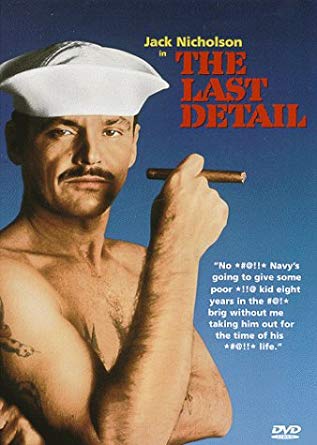
The Last Detail


SPOILER ALERT! The plot will be discussed.
There’s a great deal of talent associated with this 1973 comedy-drama. The director is Hal Ashby, the man who directed Coming Home and Bound for Glory. The screenwriter is Robert Towne, who on an Oscar for Chinatown. And of course, there is Jack Nicholson, receiving an Oscar nomination for Best Actor for his role here. The script uses a great deal of profanity, but by doing so it lends an authenticity to a story about sailors who bond in this different kind of buddy road movie. One of the soldiers is going on his “last detail,” and the other two, given the nature of the assignment, wish it was their last.
Before there is a visual, the sound of marching music is heard, with drums prominent, stressing how soldiers are supposed to fall into formation with the orders issued by their superiors. The tale begins on a Navy base in Norfolk. There is a sign which reads “Transient Personnel” office. The men here are between assignments, waiting for the next ship to take them out to sea. The impression as the movie unfolds is that sailors represent social outsiders who prefer being on ships than on land, and do not fit in well with civilians whose lives anchor them to their dull lives. The MAA (Master of Arms) summons Petty Officer Buddusky (Nicholson) and Petty Officer Mulhall (nicknamed “Mule”) (Otis Young). Neither of these men want to be bothered, acting insubordinate or profane, wishing to bide their time until they can resume their real jobs at sea. As Mule says, he doesn’t want to go on any “shit detail.” Mule’s name suggests he is stubborn about how he is used to living his life in the Navy sailing on the oceans. He is sarcastic to the messenger the MAA sent, telling him to say to the MAA that if Mule is in transit, by definition, he can’t be found.


The MAA Chief (Clifton James) calls them lucky “sons-of-bitches” because they pulled temporary duty as “chasers,” and have to go to Portsmouth Navy Prison. Their assignment is to transport a sailor named Meadows (Randy Quaid, nominated for Best Supporting Actor), who was sentenced to eight years and a dishonorable discharge. Buddusky emphasizes how extreme the punishment is by jokingly asking if Meadows killed “the Old Man,” the commanding officer. The Chief says that Meadows only stole forty dollars. Typical of the earthy humor in the film, Mule asks the Chief if he is “shitting” him, which prompts the Chief to say he wouldn’t do that since Mule is his “favorite turd.” The reason Meadows pulled such a stiff sentence is because he tried to steal the cash from the polio disease contribution box. That charity happens to be the Commander’s wife’s favorite charity, and she is responsible for the base contributions. Buddusky and Mule look sideways at each other, understanding the cruel use of power surrounding Meadows’s fate. They must travel north to Washington, D. C., New York City and Boston before dropping their prisoner off at the prison. Buddusky, wanting to make the most out of this “shit detail,” tells Mule it will only take two days to get Meadows to Portsmouth, but they’ve been given a week, so they should deliver him quickly and pocket the rest of the per diem allowance so they can have some fun with the money. This best laid plan does go astray.
Buddusky is placed in charge. They acquire the handcuffs, keys and sidearms for the trip. Meadows is obviously intimidated and seems very meek, staring down most of the time. The Chief tells Meadows that Buddusky and Mule are mean bastards so he shouldn't give them any grief. Buddusky gives Mule a look that implies that the Chief is unnecessarily piling on the misery given Meadows’s plight. Before they leave on a bus Buddusky asks Meadows if he has to use the restroom, and that one of them has to go with him. Buddusky just means they must guard him at all times, but Meadows reassures him he won’t kill himself. Buddusky laughs uncomfortably at Mule, and seems surprised Meadows would say such a thing. But it communicates how awful Meadows feels given the cruelty of his sentence, which eventually brings sympathy from the other two, who basically only saw the detail as a way for them to have some leave time. Buddusky already shows some compassion by taking off the cuffs, telling Meadows that the Navy says that on certain vehicles a prisoner needs the use of his hands to protect himself.

Director Ashby uses ambient sound in places like the snack bar and train stations to give a realistic feel. Since these guys don’t know each other, they begin to become acquainted as they embark on their road trip. On the train, Buddusky asks Mule where he’s from, which turns out to be just outside of New Orleans. After Mulhall tells Buddusky to call him “Mule,” Buddusky says there were troubles with his name, too, and people would call him, “Bad Ass,” which is the kind of nickname a macho sailor would embrace. Meadows chimes in by telling them that he didn’t even get possession of the forty dollars because he was caught while trying to lift the cash. They laugh rather immaturely at the pathetic situation Meadows found himself in. Buddusky says those in power really “stuck it” to him, and he says they put it in and “broke it off.” His graphic comment prompts Mule, who also shows sympathy here, to tell Buddusky to go easy on Meadows.

Buddusky asks Meadows if he has a record. He says not in the Navy, but a couple of times with civilian cops. Buddusky’s formal questioning is funny as he asks if it “was in the nature of a felony or a misdemeanor.” Meadows says it “was in the nature of shoplifting.” But he never was in jail. Buddusky is trying to find out if Meadows is a lifetime crook, hoping that he will discover that Meadows deserves to be imprisoned. Instead, the fact that Meadows is unjustly being incarcerated for petty infractions for an extended period is only reinforced. Buddusky tries to lessen the blow by saying that they’ll knock a couple of years off for good behavior. Buddusky says that’s something, but the look on Mule’s face shows that two years is little consolation.
Meadows is asleep and the other two notice he shoplifted some stuff that Meadows stored in his coat sleeve. When they wake him he panics and runs, but they get him back in his seat. Meadows starts crying and says he steals stuff that he doesn’t need, like hair tonic, and model cars. It appears to be a compulsion, but we find out later the possible reason for his thefts may be related to his childhood. Buddusky and Mule seem upset by this realization that Meadows has psychiatric problems. Mule is concerned about how to deal with him, so Buddusky suggests getting off the train at Washington, D. C., and letting Meadows cool off.

Here they are in the seat of the national government dragging the handcuffed Meadows around as rousing marching music plays, the soundtrack contrasting with the lack of patriotic arousal inherent in their predicament. The rigid Mule, not comfortable with any deviation in the plan, is worried they will miss the train. But Buddusky says they have plenty of time to get to their destination. Buddusky wants to know if he can trust Meadows not to run away or steal anything. They hope to get a bite to eat without making a scene. Meadows wanted cheese melted on his burger, but when the food arrives and it is not as he ordered, he does not complain, saying it’s okay. Buddusky wants to provide Meadows with some simple comforts before getting locked up. Acting a bit like Nicholson’s character in Five Easy Pieces, Buddusky demands that he send the burger back. When it is returned to Meadows with the cheese properly melted, he is happy for the first time on the journey.


Encouraged that he is lightning Meadows’s spirits, Buddusky now wants to get Meadows a beer. Meadows says he’s not old enough, to which Buddusky says “everybody’s old enough for a beer,” like it’s sort of an American inalienable right. Buddusky says Meadows is going away for eight years and receiving a dishonorable discharge, so the least they can do is get him a beer. Buddusky continues to try to ease his conscience for having to take Meadows to jail for an unjust stretch of time. They go to a bar and the bartender (Don McGovern) says the law says he has to serve Mule (making a racial reference because Mule is black), but says he needs to see ID for Meadows. Meadows wants to get out, but Mule, enraged at the racism directed at him, tells the bartender to shove it. Buddusky says he better not be reaching for a club under the counter. The bartender says he’ll call the shore patrol. Buddusky then explodes, calling the man a “redneck,” saying he is the shore patrol, followed by him whipping out his gun. Mule persuades Buddusky to leave. When they get outside, the three of them whoop it up, thrilled by the macho confrontation. Buddusky boasts that he scared that “cracker” and the other two agree loudly that Buddusky lives up to his nickname “Bad Ass.” Buddusky is excited now playing the role of the tough party guy who is going to show Meadows a good time before he goes to Portsmouth. He vows that Meadows isn’t leaving town until he gets some beer.

They buy some six-packs and get roaring drunk, with Mule’s enjoying the fun outweighing his strictness for procedure, only momentarily upset that they missed the next train. Buddusky says they’ll just get a hotel room for the night and take the train in the morning. Buddusky and Mule say what they are doing beats being in “Shit City,” and Meadows says it even beats being in Portsmouth, where he is going to prison. Buddusky is trying not to think about the end of the trip, and is upset about the reminder. So he says Meadows has “a hell of a knack for killing a conversation.” Buddusky starts showing Meadows how to be a signalman, as if he is going to have a career instead of going to jail. Meadows is quite good at it, which impresses Buddusky. He says Meadows, like him, has a “flair” for going through the motions. This connection adds to a feeling of kinship despite their opposing roles of guard and prisoner.

Meadows asks why did Buddusky get so angry at the bartender, since he was just doing his job. Buddhusky asks the mild-mannered Meadows if he ever just gets mad just to get it out of his system. Meadows says he gets angry at injustice (yet he doesn’t seem angry about what is happening to him), but that is too abstract for Buddusky. He wants the anger directed toward unfairness to be personal. He asks if Meadows ever gets angry at the “Old Man” for sending him to prison. Meadows starts to say, again, the Commander was just doing his job. Buddusky is incensed about the wrong perpetrated against Meadows, and is upset at Meadows for not being enraged. Meadows says there was something that made him angry once. It wasn’t that the Marine guards beat him up, which shows how he has been excessively brutalized, but that one of them asked him if he believed in Jesus Christ. The guard said he was Jesus in the brig. Meadows felt that he was awful to say that. (Meadows is a sort of Christ-figure, since he leans toward turning the other cheek, and is being sacrificed while others do cruel acts, as they project their sinful ways onto him, using him as a scapegoat). But Meadows only response, as opposed to Buddusky’s wanting to have punched out the Marine, was to hope the Navy chaplain wouldn’t hear what the Marine said. The cynical Mule says that chaplains just want to cozy up to commanders, but Meadows is a sort of a defender of the faith, saying that it isn’t easy being a chaplain. Buddusky is so frustrated with Meadows he tells him to hit him, which Meadows can’t do because he likes Buddusky, even though he is taking him to prison. Buddusky is seeking penance for what he is having to do, reminding Meadows of the fact that he is taking him to jail. Meadows, in a Christ-like way, says Buddusky is only doing his job. Buddusky is livid because he isn’t being punished for his guilt, which he feels he deserves, but instead is being forgiven in a Christian manner.

Buddusky wants to take Meadows to see his mother. Mule is again resistant at first, but when the unselfish Meadows says he doesn’t want to get them into trouble since they have been so nice to him, Mule caves, feeling guilty about not responding generously when he is treated with kindness. The Golden Rule seems to be in play here. They go to Camden, NJ. Sadness accumulates as Buddusky hears Meadows talk about his father having left them and starting a new family far away in Seattle. Meadows thinks he has a sibling there, but is not sure. This uncertainty adds to the poignancy. He points out where he graduated from high school, and says a teacher wanted him to be a veterinarian. That remark makes Buddusky’s face reflect even more sorrow for Meadows’ pathetic life that never reached its childhood’s goals. It’s freezing as they go to Meadows’s mother’s house, but nobody answers the door, adding to the futility of the situation. Buddusky asks if Meadows wants to wait around despite the cold, or ask a neighbor, which is what Meadows says he will do. He goes off, and Mule, his duty kicking in, is worried that they shouldn’t give him a chance to run off. They find him talking to the neighbor, as he said he would. Buddusky says that Meadows really wants to go to jail because given his psychological problems, “on the outside, too many things can happen to him, all of it bad.” Buddusky is now rationalizing his having to deliver the young man to Portsmouth, as if it’s the best thing for him.

Meadows finds out his mother is out for the day. Buddusky says they might want to wait in the house in case she comes home early. When he pushes open the unlocked door, the place looks like a garbage dump. During the silent pause that follows, Buddusky looks like he can see that Meadows had a miserable childhood, which may have warped him, and made him want to steal stuff, since he had so little for himself while growing up. Meadows says, “I don’t know what I would’ve said to her anyway.” It is a way of covering up the disappointment of not seeing her, but his words also point to him having no connection to his own mother.

Back on the train, Buddusky, still trying to relieve his guilt, says that Meadows's mom should write her congressman to try and get him off. Mule is coldly practical here, saying that won’t accomplish anything. They would either have to let Meadows go, or drop him off, and they aren’t going to set him free. Meadows starts crying and goes to the restroom. Buddusky blames Mule for upsetting Meadows, but Mule believes he is just being realistic, and says how much he hates this “detail,” since he knows how lousy it makes him feel to be part of this unfair activity. Mule finds himself in jeopardy if they don’t distance themselves emotionally from Meadows, because he can’t do anything about the young sailor’s plight, and it will only make Mule feel worse if he lets his feelings interfere with his duty. Mule says that the Navy is the best thing that happened to him and he doesn’t want to mess it up by straying off the mission with Buddusky. Mule accuses Buddusky of trying to impress Meadows with his rebellious actions, but Buddusky, implying that it isn’t about trying to make himself important, says he’s only trying to show Meadows a good time. Mule counters by saying that Meadows can’t have “a good time” because he doesn’t know how, and it won’t help him get through his eight years in prison. Even though Buddusky argues correctly that Meadows enjoyed himself in Washington, Mule doesn’t want his fatalistic, detached attitude disrupted. That way, he won’t feel responsible for the cruel deeds done by the arm of the service he said was “the best thing that ever happened” to him.

They have two hours at the station in New York before taking the next train, and Mule doesn’t want to leave the building to avoid getting into more mischief. Buddusky puts his shore patrol gear in a locker, as if abdicating his association with the detail. Mule, reluctantly, follows his action. As if in defiance of Mule’s directions, Buddusky shows how he can be rowdy without leaving the train station by getting into a brawl with Marines in the men’s room. Mule and Meadows help him with the fight, with Buddusky, acting like a big brother, being proud that Meadows joined in. Afterwards, Buddusky even gets Mule to admit it was fun roughing it up, as the men engaged in exhilarating, if juvenile, macho rowdiness.
To continue his quest to divert Meadows from his fate, Buddusky takes them to a place he says has the best sausage sandwiches. Then they go to a bar where Buddusky hustles an opponent in a game of darts. He then splits the money with the other two, telling Meadows they’re partners which, psychologically, raises Meadows to a place of equality with his traveling companions. He has treated Meadows so that feels like he finally belongs with others, which obviously is something Meadows was deprived of in his life. Both Buddusky and Meadows perform their signalman movements on the street. When Buddusky says that Meadows should put in for the job, the three of them then become quiet, reality silencing them, since they know Meadows will not have that opportunity.

They hear chanting and Meadows wants to check it out. There is a type of religious gathering that Buddusky humorously tells Meadows he’ll explain later, while having no clue about what is going on. Meadows takes a piece of paper which notes the words to chant, and Buddusky, exercising his sailor’s right to be profane, says Meadows can pray for all of them to get laid. The sweet Meadows questions if that is something they should be chanting for. They go to an X-rated store and Buddusky, continuing his carnal musings, makes a crude reference pertaining to oral sex. Again, in contrast, the innocent Meadows says he never experienced that activity. Meadows, again contrasting with the lascivious Buddusky, is so unworldly that he believes a fictitious sexual story about the talents of a one-eyed prostitute who “winks” guys to pleasure. More fitting with Meadows childlike mentality, Buddusky and Mule take their prisoner to a skating rink where Meadows has fun on the ice. Buddusky, feeling fulfilled in his quest, gives Mule an “I told you so,” as Meadows shows that he can have a good time. Buddusky tells Meadows he can have a bracelet inscribed, and Meadows wants it to read he is a signalman, which shows that is the closest he will get to his dream.


They go to a cafe and have some coffee while Meadows is chanting. A woman, Donna (Luana Anders), hears him and walks over. She knows about the religion, and says Meadows can chant for anything. When he doesn’t say what he is chanting for, she says it can be for a girl. Donna invites him over to her table and then all of them to her apartment for a party, where a culture clash occurs. The hippie types there and the sailors can’t relate to each other, entrenched in their lifestyles. There is a young male who pushes Mule to complain about President Nixon. One of the women wants to know why there aren’t more black sailors. Mule, satirically, says you have to get a recommendation from a white guy. Buddusky keeps hitting on one of the women by talking about the sailor’s life, which couldn’t be any more irrelevant to her world. When another woman asks how he felt going to Vietnam, Mule says if “the man” says you have to go, you go. He is a soldier and sees no way around following orders, which is incomprehensible to the anti-establishment young people of the time protesting the Vietnam War and racial injustice. 
Meadows reveals to Donna that he is being taken to prison. She says why not go to Canada, and he again unselfishly says the guys are his friends, and if he escaped, they would pay for it, which Meadows can’t allow. Meadows, Buddusky’s sexual preoccupation probably rubbing off on him, probably thought he was going to have sex when Donna takes him upstairs and takes off her shoes. But, instead, she chants for his escape. The sailors miss their train again and then catch it the next day. On the ride to Boston, Meadows now has the desire to stand up for himself, as he sends eggs back because they weren’t cooked to his liking. The other two laugh, and Buddusky gives Meadows an approving nod, feeling his self-assertiveness training is being adopted by his protege, as Meadows says he’s “learning.”
In Boston, Buddusky wants Meadows to lose his virginity. They ask a cab driver about a brothel, and the driver was a sailor himself, so the “manly” kinship of the military world is exhibited. He takes them to a place where he gets a cut of the action. Meadows has to pick one of the girls, most of them understandably looking bored and tired. He chooses a very slight girl (Carol Kane) and Buddusky tells her to do a good job since, unfortunately, the memory of the encounter has to last a long time. The inexperienced Meadows climaxes immediately, and is embarrassed. Buddusky is supportive, telling Meadows it’s okay, and he’ll pay for him to go again. While they wait, Mule asks if Buddusky was ever married. He says he was, to a woman who wanted him to go to trade school and be a TV repairman. He says all of this like it would be a dreary job, driving around in the smog to fix televisions out of a Volkswagen bus. Buddusky says, “I just couldn’t do it.” His story stresses the outsider mentality of the sailor who doesn't want to be tied down to the rules of the land. Mule never married, and brags about all the places he has been able to visit. Given his “in transit” preference for living, he says he wouldn’t know what to do without the Navy. Buddusky says that they are “just a couple of lifers,” and it almost sounds like they are in jail, too, but it is a self-imposed imprisonment because they don’t know any other way to be.


Meadows is able to perform this time with the girl, and he is sweet to her, and she to him. Later he says that he knows it could be an act, but he tells Buddusky that he thinks she liked him. He says she probably did, which helps Buddusky believe he is helping Meadows feel good about himself. They have a little time before dropping him off. Meadows doesn’t want to repeat anything, most likely because the first times things are experienced make them feel special. It is a cold day, with snow on the ground, and Meadows says that if it was nice outside they could have a picnic.

Buddusky tries to deliver on that wish, as the next scene finds them at a snow-covered park where they start a fire to cook hot dogs. Buddusky didn’t remember the buns, and is pissed because Mule yells at him for forgetting. They’re anger is misplaced because they are really upset about delivering Meadows to Portsmouth. Buddusky says to Mule that Meadows has come a long way over only a couple of days. He most likely feels fulfilled, but also sad that Meadows won’t have time to continue his growth. Mule, wanting to end their feeling badly about the situation, says they should get it over with. Buddusky agrees, but doesn't move. Buddusky then says Meadows won’t stand a chance at Portsmouth, getting kicked around there. Mule knows where Buddusky is implying, and says he doesn’t want to hear that, because he can’t entertain the idea of freeing Meadows. Meadows wanders off and signals “bye, bye.” He takes off, but Buddusky can’t let him go despite what he said earlier. He is pissed probably because he feels betrayed that Meadows is running off after he showed the young man some kindness, and didn’t let Buddusky decide whether to free him. It is almost that Mule was right, that showing Meadows an enjoyable time, ironically, made his incarceration seem more intolerable to him. Buddusky catches up with Meadows and hits him several times, taking out his anger over the situation on Meadows for making him be part of the lousy detail.

They drop Meadows off and he is hustled off by the guards without being able to say goodbye as the prison doors clang shut, the metallic sound echoing the harshness of the situation. Buddusky and Mule are reprimanded for abusing the prisoner because they refuse to blame Meadows for trying to escape his unfair sentence. Also, someone in Norfolk forgot to endorse their orders, so they are told their trip was not approved, yet they traveled anyway. Mule says they want to see the superior officer. The Marine officer (Michael Moriarty) doesn’t want to have a problem, so he tells them to get out. As they march out Buddusky lets his anger out at the Marines and Mule again says he hates the detail, as if it is an abstraction, but they are really feeling miserable for what happened to Meadows. They stride off in their anger which undermines the patriotic music of “Anchors Away” playing in the background.

After a short break, the next film is Witness.