Showing posts with label Michael Douglas. Show all posts

Sunday, September 29, 2019

Falling Down


SPOILER ALERT! The plot will be discussed.
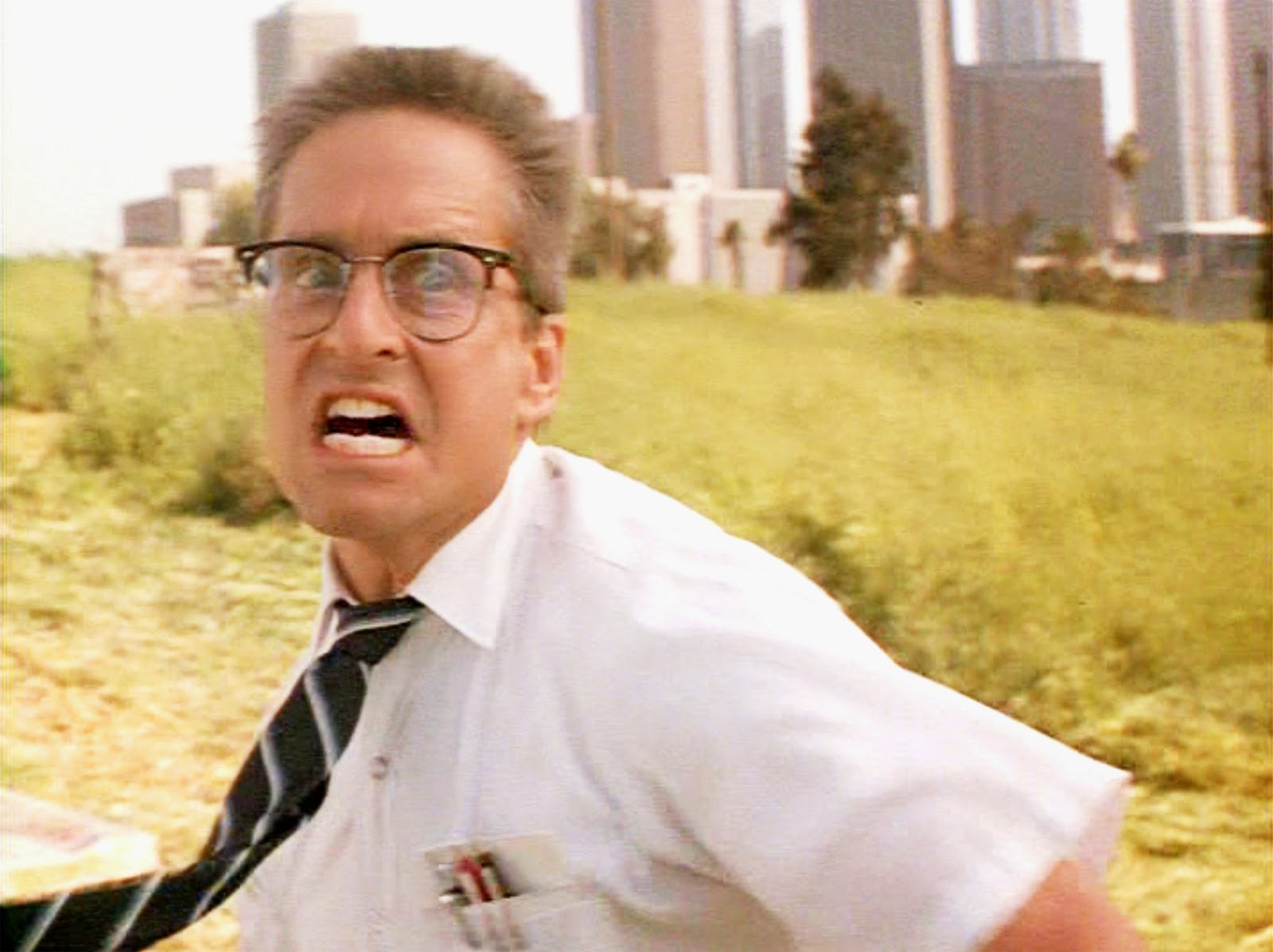
There are far too many incidents where a male goes off the deep end and becomes violent, sometimes killing his family before committing suicide. Falling Down tells a story about one such individual, but the character is complex, and there is an attempt here to explore why these individuals who feel broken by the hopelessness of their lives are ticking time bombs. The movie starts out with a close-up of the face of Michael Douglas who plays D-Fens, (the name used in the film’s credits), his mouth and then his eyes, which stresses how he views things. It’s a hot day and it is claustrophobic in his car, adding to the pressure cooker sensation experienced by the main character. He and others are caught in a massive traffic jam in Los Angeles. While they are waiting, a woman is doing her make-up and children are playing catch in a bus, trying to deal with the situation. The camera presents an American Flag, implying what America has become, a vision of life going nowhere.
D-Fens looks nerdy with his eyeglasses, white shirt and tie. He has a crew cut which makes him, contradictorily, look like a military man, maybe suggesting he wants to get out and attack. He is observing his surroundings, appearing tense, as the Garfield window doll and people honking and yelling on their cellphones are adding to his frustration. Bumper stickers say, “Financial Freedom,” which we discover the main character does not have, and “Christ Died for Our Sins,” although D-Fens does not feel redeemed. One sticker indicates a lack of caring about others with the words, “How am I driving? Dial 1-800- Eat Shit.” D-Fens’s A/C isn’t working and flies pester him. Even his window handle won’t work. He starts to swat insects all over the car, as he appears unhinged. He gets out of his car with his briefcase, looking like a man at the end of his workday, but appearances are deceiving. He upsets the man in the vehicle behind him since the abandoned car will add to the traffic problem. De-Fens tells the man he’s “going home,” which we all want to do, but with this man we learn he really doesn’t have a place he can escape to.
He starts to walk between the stopped vehicles toward an underpass embankment as he begins his urban odyssey. Detective Prendergast (Robert Duvall) happens to be behind D-Fens’s car. He sees a billboard that depicts a woman’s blouse that is low cut, and there is a superimposed drawing of a fellow on her upper chest who appears to be climbing out of the piece of clothing. Prendergast laughs, showing he can keep his sense of humor despite the situation. Prendergast exits his car and notices that the abandoned car’s license plate says, “D-Fens.” A motorcycle cop comes by and tells Prendergast that he is calling for a towing vehicle, which Prendergast realizes is overkill and takes too long, despite it being the proper procedure. The detective says they should just push the abandoned over to the side. The motorcycle cop says there are high speed vehicles that make that move dangerous, which shows how the cop’s rigid bureaucratic adherence is blind to the fact that nobody is moving. The civilian says D-Fens said he was going home. As the two policemen push the car aside, the civilian driver, despite the inappropriateness of the situation, makes a sales pitch for linoleum and ceramics to the cops, showing how capitalism dominates no matter what is going on. The motorcycle cop is sarcastic, saying “lucky me,” when Prendergast informs the officer he caught him on his last day as a policeman, and he becomes angry when Prendergast grabs his bike so it won’t fall. Not the best attitude to bond with others.


Beth (Barbara Hershey), the ex-wife of D-Fens, is returning home to her house at the beach with her daughter, Adele (Joey Singer). D-Fens calls on a public phone, but can’t get himself to say hello. He walks through a seedy graffiti-covered section of the city. He goes to a food market store and becomes more frustrated because he can’t get more change for a phone call unless he buys something. The owner, Mr. Lee (Michael Paul Chan), behind the counter speaks broken English, which makes it difficult for D-Fens to understand, fueling his anger. He announces that the soda he picked up is too expensive to get change for the call. He wants to bargain for a lower price. His American xenophobia surfaces, telling Mr. Lee the owner wants to take his money but won’t, “even learn my language,” arguing that is a prerequisite to be a worthwhile citizen. He lumps all Asian cultures together, so even though the man is Korean, he assumes he is from China. D-Fens says his country has given a great deal of money to Korea, and gets into a physical altercation with the man. A collection of souvenir flags spills to the ground, symbolic of the sullied image of America being presented by D-Fens’s actions to the audience, but also indicating how D-Fens internally feels that his country has declined by letting in unworthy immigrants. He grabs the baseball bat (a very American symbol) the shopkeeper reached for and begins smashing items in the store. The frightened Korean man tells D-Fens to take his money. Outraged, D-Fens says he’s not a thief, that the Korean is a crook for charging so much for the soda. D-Fens does not see himself as a criminal, but a man who feels he has been disenfranchised from the American Dream. He says he is rolling back prices to 1965 as he stands up for his rights as an “American consumer.” He channels the anger of many working-class people who feel they are being exploited. He asks the price of different products, and then smashes the displays as the owner announces the high numbers. He stops only when Mr. Lee agrees to the fifty cents D-Fens is willing to pay for his soft drink. De-Fens pays that amount, and walks out with his first acquired weapon, the stumpy wooden bat. However, D-Fens’s violence shows he has a pathology which goes deeper than just feeling disillusioned with the direction of the country.
Prendergast finds sand in a drawer of his desk, as his fellow cops play a prank on him about retiring to Arizona. They joke about how one man was run down two minutes after leaving the office on his last day by an impounded vehicle. It turns out that their joke foreshadows the serious situation that Prendergast will encounter. Sandy (Rachel Ticotin), who is Prendergast’s ex-partner, asks if he will be leaving early since it’s his last day. His conscientiousness and reluctance show when he doesn’t see why he shouldn’t put in a full day of work, even though he has been lately relegated to a desk. He looks at a photo of a young girl, and his look is sad, suggesting that his daughter died.

There is then a good segue scene showing D-Fens’s girl, Adele, as she plays with a water pistol (more foreshadowing), linking the main characters’ lives concerning children and Prendergast’s profession. It is the daughter’s birthday, and the mother is on the phone talking about a party, causing D-Fens to become even more frustrated by a busy signal as he tries again to call his family. He walks past an ominous set of large block-printed graffiti which repeats the word “KILL” several times (additional foreshadowing).
Prendergast gets a phone call from his needy wife, Amanda (Tuesday Weld) who is worried that he was making the move to Arizona because of her. He dodges the issue by saying that the main thing is that they are together. She is so insecure that she wants him home right away. So, he has marital problems, as does D-Fens. He has a snow globe in his hand and he sings, “London Bridge is falling down,” referring to the British bridge that was moved to Arizona, and where they will be going. But, we now get the reference for the title of the film, although in this story it is America, from the point of view of D-Fens, that is “falling down.” Prendergast cheers her up by getting her to sing along, and calls her “my fair lady,” the line from the song, which shows his affection for Amanda.


D-Fens looks at the city through a hole in his shoe, another image of how his view of America is from the perspective of a person on a low rung of the social ladder. He picks up an abandoned classified ads section which has circles around the previous owner’s job prospects that probably didn’t pan out. He uses the paper to cover the hole in the shoe, which is all the ads are good for, employment prospects not being plentiful for people in this poor section of town. Two Latino men approach D-Fens, harassing him, saying he is trespassing on private property and loitering. White people might sympathize with the Caucasian guy here, feeling that all he is doing is walking through an area that is different racially from where he comes from. Even though the action of the men is not justified, it suggests the many times a person of a different skin color was targeted for walking through a white neighborhood and charged with the same offenses. Also, for many impoverished people, their neighborhood is all they have left. D-Fens says there were no signs telling him to not sit there. One of the Latino men says the graffiti is a sign that warns to stay away. D-Fens sounds reasonable when he says that this is a territorial dispute and he respects that this area is their home. He says he understands their argument because he wouldn’t want them on his property. His remarks sound bigoted, but as we see later his anger is not just ethnically driven. But, they won’t just let him move on, saying he must pay a toll. They want his briefcase, which he refuses to turn over. One of the men flashes a knife. D-Fens, again erupting in frustrated rage, grabs the bat hidden behind the briefcase, and clubs the men, who flee, as he throws the bat at one of them. He tells them to “clear a path” since he declares again that he is going home. He picks up the knife of one of the young men, replacing the bat with a weapon dedicated solely to harm.

In contrast, the retiring Prendergast turns in his weapon as he looks at a newspaper article about a policeman getting shot, possibly indicating his reluctance to retire and give up the fight against lawbreakers. Mr. Lee shows up to report how his market was trashed. He is brought to Prendergast, but after explaining there was no robbery (Prendergast’s assigned department), since the man took no money and actually paid for his soda, the crime is reclassified as an assault. Lee says the man took his bat which he used for “defense.” It doesn’t click just yet with Prendergast about the license plate that said “D-Fens.”

Members of the Latino gang go searching for D-Fens, along with a young woman, Angie (Karina Arroyave), who urges them to let go of their desire for revenge and get treated at the hospital. De-Fens calls his wife again and says he is coming home for his daughter’s birthday. Beth says he can’t come home, she has custody of the child now and he doesn't even have the means to pay support, so he has no paternal privileges. She says it is not his home anymore and Adele is doing fine without him. These words hit at his failure as a parent. We now realize that he is not just some frustrated worker who was caught in traffic trying to get home. He has had severe financial and marital problems, and she is his ex-wife, who is afraid of his unstable behavior which pre-existed today’s events. Beth threatens to call the police.
The gang of youths find De-Fens talking on the pay phone. They kick Angie out of the car, probably because they believe they are doing men’s work, which amounts to acts of revenge. These guys have quite an arsenal of guns. They begin shooting automatic weapons, missing De-Fens who is behind some cars and instead they wound innocent bystanders. The gang members drive their car erratically as they try to wound De-Fens, and get into a terrible accident. Only one member is conscious. De-Fens is unfeeling about the bystanders who were shot as he approaches the car and simply says, “You missed.” He picks up one of the weapons and shoots the awake youth in the leg, acting like he is giving him a lesson on how awful it is to get shot. De-Fens takes their bag of armaments and tells the conscious car victim he needs to take shooting lessons. There are complicated emotions at work here in the presentation of the story. On the one hand we may be outraged by these violent youths who have no respect or decency for the welfare of others. But De-Fens, who acts like a vigilante who is demonstrating the anger due to wrongs inflicted on law-abiding citizens, is also unfeeling in his actions toward others, and also breaks laws because he feels he has a higher purpose to right wrongs.


Prendergast has an exit meeting with his captain, Yardley (Raymond J. Barry), a white self-absorbed macho guy who is seen punching a boxing bag in his office, turning the room into a gym. Yardley is condescending, acting like Prendergast is going out on early retirement with a reduced pension because he couldn’t cut it anymore. He implies that it may be due to Prendergast getting wounded, so he is safe now at a desk job. Prendergast is very deferential, and says no, it has nothing to do with his injury. The captain then asks about Prendergast’s kids, but he has none, since he lost his daughter, which shows how little Yardley knows about his own men.

De-Fens watches poor people on the street, with one man trying to sell stuff and another holding up a sign that reads he will work for food, which most likely adds more proof of his country’s decline. De-Fens tries to walk through an area but he meets another obstacle because there is a closed section where construction is being done. Meanwhile, Beth has called the police and talks with a cop. The film continues to add details about De-Fens’s personality. She confirms that she has a restraining order because of her ex-husband’s bad temper. She says that he never hit the child but there were times when she ran away before he could harm his wife. Beth says he has the potential for hurting others, which has been borne out by this day’s actions.

A man in the park (John Fleck) tells De-Fens that he drove from Santa Barbara and needs money and asks to lend him some cash that he will send back to De-Fens. The suspicious De-Fens wants to see his driver’s license. The man says he doesn’t have a license. De-Fens than questions how he drove a long way with no license. The guy says he hasn’t eaten in days, but he is munching on a sandwich. The beggar then has the audacity to demand money, which De-Fens refuses to give, and tells him to get a job. The man wants one of D-Fens’s bags that he can sell. De-Fens makes a decision here when he says he no longer needs the briefcase and gives it to him. This action shows he has quit attempting to be a working man who fits into society and instead embraces the bag of guns because he is bent on destroying whatever obstacles that stand in his way. The briefcase only contains lunch food, which confirms that De-Fens’s appearance of being a working man is a fake. We have here the depiction of the marginalized American white male’s anger being directed toward those he considers to be unproductive members of society who want to siphon off the hard-earned wages of the working class. This perspective however does not take into account the dire plight of the working man which may be due to exploitative employers, and does not consider how poverty-stricken members of society have been penalized by punitive aspects of a profit-driven economy.

Prendergast sees the young Latino woman, Angie, who was in the gang’s car that went after De-Fens, being interrogated. Prendergast does not yet know that Mr. Lee’s market and the drive-by shooting are connected. When the woman mentions a white guy with a baseball bat he barges in and confirms that the man had on a white shirt and tie. The detective kicks Prendergast out, not valuing the retiring veteran policeman’s help. But Prendergast looks at a city map and can see how the two altercations fit together geographically and chronologically.


De-Fens tries to order breakfast at a fast food restaurant just three minutes after the time that service ends. The employee is smug in her denial of him being able to order what he wants. De-Fens is similar to Jack Nicholson’s character in The Last Detail and Paul Newman’s Cool Hand Luke in that he is rebelling against the constricting rules closing in around him. De-Fens then asks for the manager, who is just as insensitive, not agreeing with De-Fens’s reminder that the “customer is always right,” a public relations line that isn’t even aspired to at this point. De-Fens pulls out an automatic weapon, which accidentally goes off, firing shots into the ceiling. De-Fens is amusing as he still tries to be normal in the midst of his antisocial behavior. He tries to placate the customers, saying he means them no harm and wants them to continue enjoying their food, as if that’s possible at this point. De-Fens almost sounds shaken as he asks again quietly for his breakfast, which they immediately give him. The implication is that an average person must resort to extreme means just to be treated fairly. De-Fens then changes his mind and wants lunch. He walks around the restaurant asking if everybody is doing okay, not in touch with the emotional trauma he has inflicted on them. When he asks one woman if she is enjoying her lunch the lady vomits out of fear, and De-Fens quips she must not like the special sauce. De-Fens is then critical of the squashed hamburger he receives which contrasts with the photograph on the wall of a large beef patty. In a way he is articulating the public’s feelings about being treated badly. But, he refuses, although dangerously, to submit to the mistreatment, unlike most submissive people.

Prendergast has lunch with Sandy. She questions his move to Arizona, noting that the decision is his wife’s idea. Prendergast says his wife only had her looks to fall back on when she was younger, and she is not handling getting older well, so he is accommodating her wishes. And he adds that the main reason he is being unselfish is because, “I love her,” which is the most important redemptive characteristic of human beings. Prendergast stands in contrast to De-Fens because the policeman can deal with the traffic jam, his family issues, and his job situation, in a civilized manner, at least up to this point, whereas De-Fens has snapped because he cannot deal with these conflicts.
Another detective interrupts their lunch, reporting the incident at the fast food restaurant. The cop says that it was odd that the man paid for his lunch. Prendergast, showing he still has game when it comes to being an investigator, remembers that the man who busted up Mr. Lee’s market also paid for his soda. He tells Sandy to find out if the man at the fast food place wore a white shirt and tie. She later calls him back and confirms the clothes, but informs Prendergast that he doesn’t have a baseball bat but was instead carrying a bag full of guns, which demonstrates how the lethal potential of his choice of weapons is escalating.

As De-Fens walks through the city’s depressed area, he encounters an African American man (Vondie Curtis-Hall) picketing in front of a savings and loan building, carrying a sign which reads, “Not Economically Viable.” He shouts out that is why the bank denied his application for a loan. He is arrested and says that is what happens to people who are “not economically viable.” The thrust here is that once a person falls on hard times the rules are rigged against him to try to recover. As the police car stops next to De-Fens, the black man says to De-Fens, “Don’t forget me.” As IMDb notes, the man and De-Fens are wearing the same type of clothes, even duplicating the tie pattern, which shows how De-Fens feels connected to this black man. De-Fens nods his head, as if promising that he, for one, knows what can happen to the unsuccessful in society. As the man is taken away, De-Fens buys a child’s snow globe (echoing Prendergast’s London Bridge globe) as a birthday gift for his daughter. He places this innocent child’s object, ironically, in the same bag next to the weapons. Later, when a man complains that De-Fens is hogging the public phone booth, De-Fens destroys the booth with gunfire. He again shows his dark humor by saying, “it’s out of order.” De-Fens has progressed to the point that he is beyond accommodating anything that gets in his way or questions his actions, which shows the danger of unrestrained individuality.
The hole in De-Fens’s shoe is getting worse. He goes into an Army surplus store. The owner is a neo-Nazi named Nick (Frederick Forrest) who listens to a police scanner. As he shows De-Fens some hiking shoes he shouts derogatory comments at a couple of presumably gay men in the store. De-Fens shows here, as he did with the protesting African American, that he is not prejudicial toward any one type of group. He doesn’t like anybody who acts badly, which includes the white workers at the restaurant or this fellow as he pulls out a handgun when one of the gay men confronts him.

Prendergast tells Angie he knows she is telling the truth about the white man who attacked her gang friends. But, he also correctly concludes that De-Fens took a gym bag full of guns off of her friends and asks Angie to confirm the number of weapons. She says there were “lots of guns,” not exactly a positive argument endorsing the proliferation of firearms.
Meanwhile, De-Fens sees a police car park near the store, and Sandy and her partner approach the establishment. Sandy questions Nick, asking if he saw a man in his late thirties, who was wearing a white shirt and a tie, and carrying a gym bag. De-Fens is in a fitting room trying on shoes. Nick pushes the gym bag out of sight and lies by saying he hasn’t seen De-Fens. He then closes the store. Nick brings De-Fens in the back which has all kinds of weapons and military gear, including Nazi books and war souvenirs. He says he heard about De-Fens’s activities during the day on the scanner, and starts to use anti-Semitic and black racial slurs. He keeps saying he is backing De-Fens because, “we’re the same, you and me.” De-Fens says they are not the same, distancing himself from this man by saying, “I’m an American,” which to De-Fens means all of those qualities that he feels are worthy, including, “freedom of speech, the right to disagree!” He calls Nick, “a sick asshole.” Nick is outraged and tries to handcuff De-Fens while spouting his racist language. De-Fens tells Nick he can’t spread his legs, lean forward, and also have his hands cuffed behind him because of “gravity,” explaining “I’ll fall down.” This is another reference to the title of the movie, suggesting that he and the rest of the country’s people are all in this precarious position. (As IMDb notes, Nick’s extreme disgust about homosexuals mingled with his preoccupation with male rape in prison, along with him standing in a position that implies he may sexually assault the bent over and bound D-Fens, suggests that Nick may be gay, and is in deep denial). When Nick takes the snow globe out of the gym bag and throws it, smashing it, De-Fens stabs him with the knife he took from the Latino man, meting out some ironic justice that takes down the bigot with a person of color’s weapon. This irony is suggested by Nick’s statement, “This isn’t one of mine.” Nick looks at his wound and says, “Oh my God,” to which De-Fens again mixes in dark humor by saying that Nick gets it, because he’s exercising “freedom of religion.” Instead of leaving, De-Fens again goes too far and shoots Nick.


Prendergast tries to do his job on his last day by trying to convince Captain Yardley and the other cops working the case involving De-Fens that he has evidence that the incidents are tied together, and the perpetrator is heading west. The captain dismisses Prendergast’s argument, and tells him he doesn’t like Prendergast because he never heard him curse, claiming that is the sign of “real men.” He also claims that Prendergast was afraid to go back into the streets. Prendergast assures him he wasn’t afraid, not saying that he took the desk job to soothe his wife’s fears. The captain here reveals his macho prejudice, showing that there are nasty people on both sides of the law. Sandy decides to help him on his quest which is in counterpoint to De-Fens’s law-breaking journey.

De-Fens calls his wife and sounds menacing, saying he is on his way home, and he realizes that he can’t turn around because his actions have put him, “past the point of no return.” He compares himself to the Apollo 13 astronauts who had to go around the dark side of the moon before reemerging and heading back to earth. He seems to know that he has gone to the “dark side” of his soul and now has reappeared as someone who can’t go back to trying to fit in with the rest of society. Even though the police who had stayed a while at her house after Beth called have now left, she lies to her ex-husband, saying they are there. De-Fens is now frightening in his single-mindedness, intimidating Beth by saying there are countries that say it’s okay, “to kill your wife if she insults you.” His argument in favor of free speech seems not to extend to one’s spouse.

Prendergast and Sandy arrive near Mr. Lee’s store to question him. After getting out of the car, Prendergast looks up and sees the billboard that a graffiti artist painted on. He is at the same spot where he was earlier in the day in the traffic jam. He now remembers the guy who left his car close to where the crimes took place. He recalls the personalized license plate read “D-Fens.” He sees Mr. Lee and calls out “Defense,” which is what the shopkeeper said he kept his bat for. Prendergast tells Sandy to find out the address associated with the plate, since a witness said the man said he was going home.
We are in another traffic snarl as people sink to their baser natures, calling each other ugly names while stuck in a sea of cars. (Too bad they don’t sing and dance as they do in La La Land, but that was a fantasy). De-Fens punches one driver who is yelling ugly epithets at a woman, shutting down the bad behavior he has been ranting against. He has traded in his white-collar outfit for what he found in the surplus store, and he now looks like a soldier, wearing what GI’s put on when going on a mission in a jungle, which is how De-Fens perceives this urban sprawl. The traffic is a mess because the street is closed off for repairs. A worker tells De-Fens he can’t pass there (not a good day to tell De-Fens he can’t do something), and that he is there to stop people from “falling in” due to the underground construction (another reference to the film’s title). De-Fens tells the worker that the street was fine two days ago and believes there’s nothing wrong, that they are just keeping inflated budgets by acting as if work has to be completed. He again voices complaints that one can hear from any average person who has suffered because of forces beyond one’s control. The worker sees a gun tucked in De-Fens’s pants. De-fens keeps demanding that the worker say what he wants to hear, that there is nothing that needs repair. Afraid, the worker tells him that there’s nothing wrong, which satisfies De-Fens, who is so self-righteous in his crusade, he won’t allow anything to contradict him. De-Fens then says that he will give him something to fix. He took a rocket launcher from the surplus store. A boy on a bike tells him how to use it because he saw how to do it on TV, satirizing the questionable skills exposed to children through the media. But the boy here innocently thinks that they are filming a show, which De-Fens, joking ironically, calls “Under Construction.” The phallic-shaped launcher and the guns could represent De-Fens trying to regain his masculinity. De-Fens prematurely (another sexual reference?), triggers the weapon, releasing his anger, firing the device under the street causing a large explosion.
Prendergast and Sandy arrive at the home of De-Fens’s mother (Lois Smith), which is where the license plate led them. De-Fens’s real name is William Foster. One of the walls in the house has pictures of a man in a military uniform, presumably De-Fens’s father. There are small American flags in a vase. The impression is that this was a patriotic family, which points to the feeling that his country has now failed De-Fens. The mother is herself defensive, and Sandy alienates her by acting official. But, Prendergast wins her over by praising her display of little crystal figurines. The woman shows them her son’s room which is very neat. She thinks he is still working at a defense plant. Prendergast senses the mother’s wariness about talking about her son. He believes she knows something is wrong with him. He gets her to reveal that her son sometimes won’t even speak at dinner. The mother says De-Fens eats like a machine and she is so nervous she chews the same piece of food. When she spits it out she says he looks at her like he will kill her. We get a picture of a disturbed control freak who can’t handle things not going the way he wants. Prendergast finds De-Fens’s wedding ring in a drawer and a picture of his ex-wife and child. Prendergast finds out the ex-wife’s maiden name is Trevino and Sandy discovers that De-Fens was fired from his job a month ago, suggesting that his mental instability was already becoming manifest for a while.


De-Fens, not following any restrictions on freedom, climbs a fence that says “No Trespassing” onto a private golf course. He tells some senior men that he is passing through. One of the men is an elitist who yells about how he doesn’t want someone from the outside interrupting his game. He hits a ball at De-Fens, who pulls out a shotgun, and calls back that he is trying to kill him with a golf ball because of his silly game. He says that the land should be used for children and families to have picnics and enjoy a petting zoo, implying the area has been cut off for those who can afford the expensive fees. He shoots their electric golf cart which then rolls off toward a water hazard. The man who hit the golf ball falls down (referring to the title again), appearing to have a heart attack. He gasps that his pills are in the cart. De-Fens has no sympathy for the damage he is causing, as if the man has received justice for trying to prevent De-Fens from passing through the fairway. He tells the suffering man he’ll die wearing his silly little hat. For De-Fens, his will supersedes the lives of others at this point.

De-Fens scales another fence as he has moved from the poor side of town to the rich one, and he sees wrongdoing no matter the economic area. He complains to a man who is having a cookout with his wife and little daughter that his barbed wire caused him to cut his hand, as if he has the right to go wherever he pleases. The man is actually the caretaker and he is barbecuing there while the owner is away. Once De-Fens realizes that these people are not part of the exclusive upper class, his anger subsides. The people at the golf course have called the police, and De-Fens moves the family under cover. He finds out that a plastic surgeon owns the property. De-Fens jokes and says he is in the wrong field, and wonders if there are “correspondence courses” for that medical specialty. But, while he is trying to be funny, he holds onto the child’s hand, as if substituting her for his daughter. De-Fens confesses that he was fired, and is “obsolete,” (which hints that part of the reason, which happens to many people, may be he was replaced by automation) and can’t even support his daughter. He echoes the situation of the African American man who was arrested, and most likely many others, saying he’s “not economically viable.” De-Fens is astounded again for being viewed as a bad person when the man asks to be a hostage, but to leave his family alone. De-Fens says that he has no desire to harm the man’s family. He then reminisces about how ideal things were with his family and mentally escapes into a daydream fantasy about how everything will be the way it was.

At the police station, Prendergast and Sandy check out Beth’s single name, Trevino, linked with Foster, De-Fens’s name. Prendergast learns about the murder of the surplus store owner. Sandy reveals that she visited the store earlier. Then they get word about the man dressed in military clothes who terrorized the men at the golf course and the family at the doctor’s home. Prendergast looks at De-Fens’s progress on the map and deduces that the ex-wife lives in Venice even before Sandy provides the address.

Beth called the police after De-Fens’s threatening phone call, but the policewoman who arrives at her house shows no compassion, acting like it’s just a prank. Only Prendergast and Sandy seem to really care about following through on the case. De-Fens calls Beth from Santa Monica Pier, which is right next to Venice, and talks about how the ice cream shop they frequented no longer is there. She immediately hangs up as she realizes he is very close and takes her daughter out of the house. He quickly understands that she may try to escape, but when he arrives at her home, they are gone. De-Fens looks at home videos of his family when he lived there. He now has the daughter’s water pistol replacing the real gun he held before, showing how torn this man is between his affection for his family and his pathological violent impulses to have things his way. But the home movies dispel his idealized version of the past. They reveal how domineering he was, yelling at his family, and scaring his daughter who cried as he tried to force her onto a toy horse he bought.

The Venice cops tell Sandy in a phone call that they can’t justify a visit three times in one day to satisfy the complaints of a “hysterical” woman. This is a flaw in the plot because it is difficult to believe that they would not investigate when other cops call them verifying the danger Beth is in. So, we have the main characters move to a confrontation on the Santa Monica Pier (which shows up in several Hollywood films). Before that happens, Prendergast takes on some of De-Fens’s aggression, finally setting his wife straight. She calls him and is jealous that Sandy answered the phone and yells at him to come home. He tells her to “shut up” and have dinner waiting for him when he gets to his house, as Sandy stifles laughter on the side. And, when Sandy’s partner makes a negative remark about Prendergast’s wife, the retiring cop responds to the insult to Amanda by punching the guy. (This event occurs at an office goodbye party for Prendergast, where, as IMDb points out, there is a retirement cake decorated with the London Bridge, another reminder of the film’s title).
By watching one of the videos De-Fens realizes that Beth may again want to bring their child on her birthday to the pier, and maybe Beth would not think that he would go back there after going to her house. Prendergast and Sandy arrive at Beth’s house. Sandy goes in and De-Fens shoots her and escapes. Prendergast gets the neighbors to call 911 and he goes after De-Fens. Beth and her daughter are at the pier and the girl is thrilled to see her father running toward them. He hugs and kisses Beth who says she wants him to leave them alone. He reminds her that they made vows that said “‘till death do us part,” which is frightening considering the circumstances, and he then pulls out a handgun. 

She says he is sick, and De-Fens says that walking through the city is what’s really sick. Prendergast shows up and acts folksy, not confrontational, eating a snack, and saying he used to fish off the pier, but the fish are now poisonous, and the water can infect a swimmer. He says he is retiring to a place that some would call paradise, and others would say there is nothing but a muddy lake there. Prendergast says everyone has their own idea of paradise, which connects to De-Fens’s concept of perfection for himself and America. While Prendergast talks he flashes his revolver at Beth to show he’s a cop. Prendergast says that paradise for him was having babies. He said his wife had a child for him which tells us why he is now willing to sacrifice for her. He says that his daughter was two years old, went to sleep, and didn’t wake up, which connects with De-Fens’s feelings of loss. Prendergast hands popcorn to Adele who shares it with her father, as he puts his gun down. De-Fens is distracted as he hears police sirens, and Prendergast intervenes, getting Beth and the girl to run away. Prendergast says he knows that De-Fens was going there to kill his family and then himself. De-Fens is surprised to realize he is now “the bad guy.” He says he helped build missiles to protect America, and should be rewarded, not punished. De-Fens says they lied to him about who gets rewarded. Prendergast says they lie to everybody, so that doesn’t make De-Fens special, only his little girl does. Prendergast wants him to give up. De-Fens says he has a gun and they should have a showdown, as if they are in a Hollywood Western. He says if he gets killed at least his daughter will get the life insurance, and he doesn’t want to see his girl grow up while he’s in prison. He counts to three and draws, but he only has his daughter’s water pistol, so he knows he’s going to die. Prendergast doesn’t know the gun is a fake, fires, and after being shot, De-Fens falls into the Pacific Ocean, an affront to its peaceful name.
Captain Yardley, now in front of the press and trying to grab positive publicity, hypocritically now praises Prendergast. Prendergast passes by the cameras and as the captain thanks him, Prendergast now finds the right time to curse and tells him “Fuck you very much.” He sees Sandy off to the hospital and tells Beth to let her daughter enjoy her birthday party without mentioning her father to keep her in an innocent state for another day. In answer to Adele’s question about his name, he says it’s “Mud,” which he says it will be when his wife finds out he decided to still be a cop. The movie seems to be saying that there is a need for him and other decent individuals to try to keep the country from “falling down.”

The next film is Get Out.

Sunday, May 26, 2019

Wonder Boys


SPOILER ALERT! The plot will be discussed.
If you haven’t had the pleasure of watching Wonder Boys (2000) you should treat yourself by viewing this clever story directed by Curtis Hanson, who made the excellent LA Confidential. The writing is marvelous and both Michael Douglas and Tobey Maguire should have received Oscar nominations.

Besides referring to those who succeed in art at an early age, the title could refer to artists, and in this case writers, who use their imaginations to create as they “wonder” about what they observe. Great artists do not copy reality, but instead enhance upon it. But, observing and not participating often makes artists outsiders. They can become dysfunctional in some ways, not being able to deal with day-to-day life. This story deals with authors, and good writing requires tough choices if it is serious, and should not be self-indulgent. However, sometimes the self-absorption of authors can lead to inflated egos and pretentiousness.
Appropriately for a story about writing, Douglas’s Professor Grady Tripp (the last name referring to his drug use, or taking a vacation from life?) is reading stories written by his college creative writing workshop students. The voice-over is effective here because the words are so well crafted, based on the acclaimed Michael Chabon novel, and provide insight into characters. Tripp is reading from a story by one of his best students, James Leer (Maguire), who Tripp describes as being the “sole inhabitant of his own gloomy gulag,” emphasizing the young man’s outsider existence, and the unhappiness that seems to be reflected in his work. His comment also pertains to the feeling of failure that plagues serious writers who are never satisfied with their own compositions. There is a lot of rain and cold weather in the movie, suggesting the inclement life of Tripp and his fellow travelers during the course of the story. The professor says he was distracted since his wife left him that morning, but “Wives had left me before,” he says, indicating his past problems with relationships.

Hannah Green (Katie Holmes) is a talented writer, “insightful, kind” and always wears red cowboy boots, so there is an element of attraction here in Tripp’s observation, as we learn that he has been involved with younger, beautiful women. She rents a room in the professor’s house. The other students are nasty in their criticisms of James’s work, probably envious that they can’t write as well as he does. Hannah comments that James has the courage to “forget us,” that is, not worry about how his work does not cater to the audience. Tripp reminds his students that the college’s WordFest (which sounds like a literary Renaissance fair) is to occur that weekend. The professor worries about James being so morose. Hannah, though young, is almost maternal, as she is concerned about Tripp’s state of mind following the breakup of his marriage.


Tripp says that he feels good being able to be alone and clear his head while driving following the workshop. But, he smokes a joint, not something one does to get unfogged. He uses drugs the way he uses his writing, as an escape from the pressures of reality. There is also a bit of self-destructiveness added to the recipe of what makes someone a writer, since he is driving under the influence, and death is the ultimate escape.


Terry Crabtree (Robert Downey, Jr.), Tripp’s editor, flies in for WordFest, and was influential in getting Tripp’s last novel, Arsonist’s Daughter, published. The work was a critical success and brought both of them praise. That was seven years prior, and Tripp has not followed up with another completed book. The lack of recent successes finds both Tripp and his editor suffering from damage to their current reputations. Crabtree is there to check out the status of Tripp’s next novel. Crabtree, who we learn is gay, signaling him out as an outsider at the time the movie was released, arrives with another social outcast, a transvestite, calling themselves Antonia Sloviak (Michael Cavadias). Tripp makes it sound as if he has almost completed his new book, but his evasiveness about its progress undermines his reassurances.


The start of the WordFest weekend begins at Sara and Walter Gaskell’s house. He (Richard Thomas) is the English Department Chairperson, Tripp’s boss, and she (Frances McDormand) is the college Chancellor who also happens to be Tripp’s lover. Walter’s dog is named Poe, befitting an English Department head. Poe always growls, appropriately like a creature from a gothic tale, at Tripp, probably sensing he is a threat to the married couple’s domestic bliss. The dog is blind so just smelling Tripp keeps him barking in the vicinity of the professor’s scent. Sara (McDormand) and Tripp go upstairs and she immediately informs him that she is pregnant. Sara provides a “simple” solution to their situation: since Trip’s wife has left and the two of them are involved, they should get divorced, marry, and raise the baby. He repeats the word “simple” with less than enthusiasm, showing how for him making a decision to commit to Sara is complicated.


Walter does not know about his wife’s infidelity or pregnancy. His Harvard education has not provided him with more insight than his visionless dog, who Tripp says knew about him and Sara “from day one.” Walter is obsessed with baseball great Joe DiMaggio and his wife, Marilyn Monroe, and collects memorabilia concerning them. Walter says that every woman wants to be Marilyn Monroe, and Antonia, the transvestite, agrees, but she is also a he, so some men might want to be Monroe, too. This movie presents various sexual lifestyles undermining Walter's rigid theories of masculinity, represented by the bat swinging DiMaggio, and femininity, in the person of sex symbol, Monroe.

Tripp sees Q (Rip Torn), a writer who is rich and famous, and completes a novel every eighteen months. For those reasons, Tripp dislikes him, as many struggling writers probably despise James Patterson, who cranks them out quicker than that, with help, of course. Q (revealing his arrogance by allowing himself to take sole possession of a letter of the alphabet and assuming everyone will know it pertains to him) is talking with Hannah. Tripp shows his envy by trying to undermine their conversation to make a materialistic derogatory crack about Q’s expensive house in the Hamptons. He also lets Q know that Hannah had two stories published in the prestigious Paris Review literary magazine, implying she is probably a better writer than he is. Another professor compliments Tripp by saying he has placed Arsonist’s Daughter on his syllabus for three years. But, as Tripp walks away, he hears the professor’s female companion comment how it’s been a long time since that novel came out. The scene suggests that even if a writer produces a great piece of work, the public just wants more, and if it’s not forthcoming, the author is labeled a has-been. This attitude is the reader’s and critic’s version of “what have you done for me lately?”

Tripp goes outside to continue his escapism with his pot smoking. James is standing on the lawn with a small handgun. He immediately makes up an elaborate story about how it isn’t real, and was acquired by his mother at a penny arcade in Baltimore during the time she was in Catholic school. Tripp says, “that’s convincing,” sort of sarcastically acknowledging the quality of the fiction. James says the pistol is like a lucky rabbit’s foot. Tripp highlights James’s oddness by pointing out the strange preference for a gun instead of a rabbit’s foot. James says Hannah invited him to the Gaskell’s place, but says he isn’t supposed to be there, the statement sort of summing up his life. He and Hannah like old films and saw one with Frances Farmer and Gene Tierney, both of whom, Tripp and James note, eventually went insane, apparently pointing out how artistic types aren’t “normal” and prone to mental illness. Tripp shows his affinity with James’s peculiar ways by agreeing with him that the movie sounds like a good one. James then says that Tripp isn’t like his other teachers, and Tripp comments that James is not like his other students. So they recognize how they are, in their own ways, not swimming in society’s mainstream. Tripp apologizes that he didn’t cut off the criticism of James’s story in the writing workshop sooner. James notes that the students hated the latest story more than the others, meaning he has been getting continuous rejection because he isn’t following accepted norms. He says it doesn’t matter, because it only took him an hour to create the story. Tripp is astonished at the quality of the writing produced in so short a time, acknowledging James’s talent. He asks James if he’s cold and wants to go inside. James says it’s colder there, and Tripp agrees, as they goth get no warm reception from others due to their nonconformist ways. James was attracted to the property’s greenhouse because it looked like the depiction of heaven he saw in a movie, with people living in places that were made of glass with light shining through them. A film is a work of art and James finds refuge in something imaginative that takes him away from the harshness of real life.

Tripp convinces James to stay. They go inside, and Crabtree has his “gaydar” on. He seems immediately interested in James, who he quickly perceives not to be straight. Hannah, who was involved in a conversation about films, mentions that James would probably know about actor George Sanders’s suicide. Again we have a reference to an artistic person seeking escape for not fitting into the world around him. James, an expert on old movies and misfits, knows that Sanders died from an overdose of pills, and states the exact day and place. Hannah says that James “knows all the movie suicides,” humorously anointing him as the info king of Hollywood’s tragic social dropouts. James then lists a slew of deaths, most of them by pills, with the occasional self-inflicted gunshot wound. Crabtree is intrigued, and wants James to accompany him and Tripp after leaving the party, comically calling it a “field trip” (a pun on the professor’s name) sponsored by a faculty member.

Tripp takes James secretly upstairs, opens up Walter's safe (knowing the combination - 5641 - which IMDb points out represents the number of consecutive games DiMaggio had a hit, and the year in which the record was established), and shows James the fur-collared jacket worn by Marilyn Monroe on the day of her wedding to DiMaggio. (Monroe did have such a jacket). James, like Antonia, shows a female admiration for the garment. Movie stars like Monroe, and the motion pictures they acted in, provide a fiction that offers an escape from otherwise unfulfilling lives. Monroe’s death, however, was another example of an unhappy artist’s life ending in an early tragic death. Unfortunately, James seems to have a strong connection to the destiny of these once happy actors who eventually no longer fit in among the living. Since Tripp says Walter doesn’t tell Sara how much his collected items cost and the fact that Tripp knows the lock combination, allows James to deduce that Tripp has a relationship with the Chancellor. Hannah also mentioned to James that Tripp’s wife left him that day, so James now knows that there is no happiness in these marriages. James looks dejected, and says that the Monroe jacket, without its owner, looks lonely there, and he shares that sadness derived from his traveling a solo path. Tripp admits to being lonely, too, so they have that in common, also.

For animal lovers like myself, we just have to remember that the dark comedy surrounding Poe’s fate is just pretend. The dog shows up smelling his nemesis and attacks Tripp, sinking his teeth into his leg. James, whose gun is quite real, puts the dog down. They have to do something with the canine corpse so they wrap it up and put it in Tripp’s car. Poe’s body seems to stick around with Tripp for quite a while, sort of haunting him as a reminder of his messy, unresolved situation with Sara. Tripp comically says that he would take the blame for the dog because unlike James, he has tenure. While putting Poe in the trunk, James notes how much storage there is as it holds a suitcase, garment bag, Antonia’s tuba, and a dog’s body. Tripp adds more humor by saying “That’s just what they used to say in the ads.” Tripp finds some pain medication in Crabtree’s bag to relieve his throbbing leg. He had offered James weed before and now asks if he would like some of the painkillers. James declines both times, saying how he wants to feel in control. Probably feeling judged, Tripp, sarcastically noting how the unpredictable James goes around with a loaded gun, comments, “You’re fine. Yeah, you’re just fit as a fucking fiddle.” He then apologizes, but James now defiantly takes the pill followed by a swig of booze.
The two go to the WordFest auditorium gathering where Q is the keynote speaker. Q starts out by looking penetratingly at the audience and saying in a somber voice, “I … am a writer.” Tripp looks at James, with an “are you kidding me” look referring to the pretentious pronouncement. Q goes on with an exaggerated metaphor about the writing process by saying, “What is the bridge from the water’s edge of inspiration to the far shore of accomplishment?” James, his inhibitions lessened by the consumed intoxicants, laughs out loud, interrupting the speech. It’s the kind of moment people may relish because they would like to do the same when faced with a person so full of himself.
Tripp sees Sara and that glimpse reminding him of his situation, along with the drugs, makes him feel faint. He wanders out into the hallway, swoons, and then passes out. He comes to on the floor with Sara above him as she reveals that he has “had another one,” of his episodes, his subconscious way of not dealing with his problems. He is ready to tell her about Poe, but she assumes that instead he will say that he still loves his wife, who is young and beautiful, and will stick with her. He doesn’t give her the right answer when he reminds her that his wife left him, so it’s not up to Tripp about how to fix his marriage. What she wants to hear is that he loves Sara. She then starts to smoke a cigarette and says she won’t have the baby. He takes the cigarette out of her mouth, an act of caring paternity. She asks what else can she do? Since he seems to agree that he doesn’t know what can be done, she becomes angry, because he can solve the problem by being with her. She discovers the gun that Tripp took, and he then becomes part of James’s fiction, saying that it is a cap gun, “a souvenir from Baltimore.” She is grounded enough in reality to not be fooled by the story.
Crabtree helps carry out the doped-up James, who converts his disappointing real life into a story, talking in the third person, saying, “It was so embarrassing. They had to carry him out.” Tripp asks Crabtree how James is doing, and Crabtree provides another of the film’s many great lines, saying, “He’s fine. He’s narrating,” which reflects James’s comfort zone. Antonia, who hoped to hook up with Crabtree, is disappointed as he now is focusing on James. Tripp gives “Tony,” which is what they are calling themselves now, having to accommodate the locals with an acceptable male identity, a ride back home. (IMDb notes that “Tony” may be a reference to the cross-dressing character played by Tony Curtis in the film Some Like it Hot, which also starred Marilyn Monroe). Tony tells Tripp that Crabtree is worried about getting fired due to not having any successes in years, and is pinning his hopes on Tripp’s work-in-progress book. Tony says Crabtree said that Tripp wasn’t “one of those writers who has a success and then freezes up and never has another.” Tripp looks into the rearview mirror as Tony talks, and his reflection shows that he worries that he may be one of those failures. He says that he may have to rescue James, but Tony astutely says Tripp may need some rescuing himself, which may be necessary because of the trap he has put himself in.

Tripp goes to the bar where he asked James to visit with him and Crabtree. His editor is there with James. Q is dancing with Hannah, and Tripp is probably a little jealous. James appears to be asleep sitting up in a booth. The editor, noting James’s condition, observes that Tripp made a raid on the “Crabtree pharmacopoeia,” the invented word implying he must have a lot of drugs in his stash. James admitted to Crabtree that he has a book, which Tripp knew about, but he didn’t know, as Crabtree informs him, that James finished it already. Crabtree asks if James is a good writer, and Tripp says not yet, as he tries to keep the editor, who is hungry for a comeback, from pouncing literally, and figuratively on James. Crabtree is sure the young man is gay, and does not agree with Tripp’s view that investigating James’s “sexual confusion,” as Tripp puts it, will add to his problems. Crabtree believes the youth needs to find clarity.


A pregnant waitress with the unusual name of Oola (Jane Adams) serves them their drinks. Things that are different intrigue these outsider types. They see a fellow that looks a bit like James Brown, with a pompadour hairstyle. Tripp and Crabtree play a game they have enjoyed in the past by improvising stories about those they observe, which is what fiction writers do, using real life as an inspiration to entertain and maybe comment on the human condition (which is what Q was trying to say, only badly). They give the guy the amusing name of Vernon Hardapple (Richard Knox), and he happens to be Oola’s love interest. Throughout the movie they keep calling him Vernon, unable to disconnect themselves from the fantasy world they have created. They make up a whole backstory about the man, but get stuck, and the supposedly unconscious James rescues them by adding to the scenario, talking about Vernon’s involvement with a gangster called Freddy Nostrils (a great name, just the right amount of exaggeration of what a mobster might be nicknamed).
Hannah dances with Tripp and says she is re-reading his famous novel, and talks about how beautiful it is. She says he wrote something about her in her copy of the book, and seems to be coming onto him by saying that she isn’t as innocent as he thinks she is. He is torn, being attracted to her but saying the world needs those who haven’t been corrupted by others, including, supposedly, himself. Tripp tells Hannah to take James home, but since the young man makes up everything, she has no idea where he lives. He tells her to take him to Tripp’s place to sleep it off. Tripp offers Q and Crabtree a lift, making sure they don’t see the deceased dog in the trunk. “Vernon” appears and says that Tripp stole his car. He makes a scene, with Crabtree humorously saying to Tripp, “Do you owe him a book, too?” There is a comic driving sequence with Tripp going the wrong way on a one-way street (an image stressing Tripp’s nonconformity), and ending with Vernon registering his complaint by leaving his butt impression on the car’s hood by jumping on it. He then exits with a theatrical bow (another nod to artistic expression). Q speaks for all of us when he says, “What the hell was that?”

James, although in and out of consciousness, pleads for his backpack. It was left at the college hall where WordFest took place. The janitor, Sam Traxler (Alan Tudyk, who you will recognize if you are a fan of Joss Whedon’s work) lets him in, and says he knows he’s there for the backpack because there is a manuscript in it, which Traxler probably believes belongs to Tripp. It is actually James’s novel, entitled The Love Parade. The impatient Crabtree drove off with Q, and Traxler gives Tripp a ride. There is also a biography of Errol Flynn in the backpack (another movie reference), and, assuming Tripp is reading it, Traxler asks if the story is true that the actor put paprika on his penis to make sex more stimulating for women. Everyone apparently loves an exotic story in which to escape, and Tripp, a spinner of tales, has fun going along with the story, saying how Flynn “used to rub all sorts of things on it. Salad dressing, ground lamb.”

As they pass by Sara in her greenhouse, the one that looks like heaven to James, an unearthly sanctuary far removed from life on earth, Tripp says in a voice-over that he loved that Sara was addicted to the printed word, and he manufactured “her drug of choice.”  This line is witty, but also fits in with the film’s theme of how those who feel the need to get away from everyday existence seek it through various means. Tripp arrives at his house and discovers that James stuffed the Marilyn Monroe jacket in his backpack. He probably wanted to hold onto his idea of a happy fantasy represented by the movie star, and thought he was rescuing it from what he labeled its loneliness in the closet. He projected his own state of mind onto the jacket, and its removal may even symbolize his own need to get out of the “closet” as a gay man.
Tripp wakes up the next morning and finds his car has returned. Crabtree is in bed with James. He says in the voice-over that he had to put everything aside and work on his book, probably feeling guilty after encountering the prolific Q and learning that James finished his work. He says that it started out as a small novel but ballooned to the point that he is now on page 2611. He says that the ending kept “getting further away.” He says that he knew the ending was out there and he “could see it,” but he then starts to feel a fainting spell coming on. It’s as if he doesn’t want to finish the book, because he is afraid it will be a failure once it is given to others. The inability to complete his work is symbolic of how he can’t cope with the problems in his life, and when he tries to deal with either the ending of his story or his relationship issues, he passes out as one of his forms of escape.


He wakes up looking at James who says he put him on the floor. Tripp is wearing what looks like a woman’s robe, so James says he must really miss Emily, his wife. He says the clothing does not belong to her. He just likes writing in it. The clothing here reminds us of Antonia and it may be another example of the transvestite theme that shows nonconformity. But, these instances of wanting to dress up as someone else also furthers the story’s theme about the desire to enter another make-believe world. James, always seeking a tale, says “there’s probably a story behind that.” Tripp says there is, “but it’s not very interesting,” which is a way of saying he doesn’t want to talk about it. James sees Tripp’s mammoth manuscript and Tripp confirms that it is single-spaced, making it an oversized load of a book. Since it was a while since his last novel, James says some of his fellow students thought Tripp was “blocked.” Tripp says he doesn’t believe in writer’s block. James, stating the obvious, says, “No kidding.” It’s not Tripp’s writing that is blocked, it’s his life.

James gets a phone call from an anonymous man asking if Tripp lived there and wanted to know about his car. Tripp most likely realizes it was “Vernon” calling. A police car arrives and Tripp tells James to hide. The cop says that the Gaskell’s dog is missing as well as an item from the safe. Tripp pretends he doesn’t know anything about it, and evades questions about James, acting like a father wanting to protect his wayward child.

Tripp wants to visit his ex-wife and takes James with him. His leg is hurting, and then Tripp slips on the steps outside, injuring his hand. The problems of his reality are taking hold of him, like the way Poe clamped down on his leg. While at the store to buy some band aids, Tripp asks where James lives. Typically, James creates another story. He says he was kicked out of his apartment. Tripp, echoing James, says there must be a story there, and James repeats Tripp’s earlier evasion by saying, “There is, but it’s not very interesting.” He hesitates as he adds to his fiction, saying he now stays at the bus station, where he knows the janitor who allows him to put his stuff in a broken locker. He’s been there for a couple of weeks and had the gun for protection. His words have a similar feel to the improvisation about Freddy Nostrils. In a voice-over, Tripp reveals that he knows James is making it all up, saying his “story was the stuff of bad fiction.” But, Tripp is too preoccupied to seek out “where the page ended with him and real life began,” which is what the film seeks to explore about all of its characters (who are totally fictional, because, you know, it’s a movie). 


On a detour to visit Sara, James, the former sober individual, no longer wanting a life anchored by control, smokes Tripp’s marijuana that he keeps in his glove compartment. Tripp buys a pathetic peace offering in the form of a “Thinking of You” inscribed balloon for Sara. He says to her that he needs to talk with her, but again can’t deal with the reality of the relationship. He says he wants to be with her, but that doesn’t mean he plans on doing so. She tells him it’s not enough to want them to be together, which only has the intangible substance of a desire. She also says she hasn’t made up her mind about having the baby, or about him. She is forcing him to find his own way here since his commitment is required given the importance of the situation. He must find his own way, driven by what he wants, and says she isn’t going to draw him a map, because “Times like these, you have to do your own navigating.” She notices James in Tripp’s car, and asks what he’s doing with Tripp. He says he, who can’t seem to resolve his own problems, is helping James work through some issues. Sara drives the irony home by saying of James, “Isn’t he lucky.”

Back in the car, James weaves another tale, although Tripp doesn’t realize it at the time. James says his dad, who lives in Carvel, Pennsylvania, outside of Scranton, needs pot for his colon cancer. He says the town is a “hellhole,” consisting of “three hotels and a mannequin factory,” where his dad worked at for thirty-five years, and where he met his mother, who was a fry cook who became an exotic dancer. The strangeness of this story illustrates how much James enjoys soaring with his flights of fancy. Tripp reminds James that he said his mother went to Catholic school, to which he comically recovers with, “When we fall, we fall hard.”

Tripp had said that “the moment didn’t present itself,” so Tripp hadn’t told Sara about the jacket and the dog. Now, as James smokes a joint, Tripp reminds James that he said he didn’t want to get high because he wanted control over his emotions. James repeats Tripp’s words for his own purposes again, and will in the future, by saying his use of intoxicants just needed “the moment to present itself.”
They wind up at Emily’s house, and Tripp says he thinks he’s there to end things with his wife on the right note, but he’s not sure, because he is afraid of how life’s stories will turn out (as opposed to fictional ones). James explores the home’s alcohol opportunities as well as sweets to satisfy his sugar-driven pot high. He tunes on the TV and watches a part of an old movie (it’s The Picture of Dorian Gray, which is appropriate since that story deals with art and the ugliness of life, and stars George Sanders, one of the actors James mentioned committed suicide, a sort of escape artist one might say). Sanders’s character says we should “give form to every feeling, reality to every dream.” This speech about self-fulfillment preaches giving substance to hopes, not residing in a pretend world of just possibilities, as some of the main characters here seem to want to do. James changes the channel, enjoying, appropriately, the unreality of Judy Garland singing in a musical. Mickey Rooney in the movie says something about how it must be terrible to be a “has-been,” and this line resonates with Tripp’s fearful feelings about his writing career and how failure may cause him to crash-land, grounding him so he can’t fly above the debris of his life.

In Emily’s bedroom, even though he says that Emily’s house feels good, like a place to wake up to on Christmas, Tripp admits to himself that he didn’t really know his child-bride. It’s only when he woke up and left this make-believe dream existence to be with Sara, a more mature woman representing true life, did he feel at home. He calls Sara, but when he admits to being at Emily’s house, she misunderstands the purpose of the call, and tells him she can’t wait for him trying to figure out if he wants to reconcile with Emily. Emily’s parents arrive at the house, and the father (Philip Bosco), after helping to take care of Tripp’s leg, tells him that Emily didn’t feel like he was there for her, which is pretty obvious since he doesn’t seem to have been there for anyone, until James’s needs “presented” themselves.

In the car, James muses about how the students hate him, and Tripp tells him it’s because he is a vastly superior writer than any of them. But, he also says that it doesn’t matter what others say about his writing because, in Tripp’s dejected state, he says that writing doesn’t mean anything anymore. But, James says that Tripp’s novel meant something to him. It was why he came to study with Tripp, and why he wanted to be a writer himself. Given the shambles of his life, Tripp says for that, “you have my eternal apologies.”

When they stop at a diner, Tripp asks a telephone operator about Carvel, Pennsylvania. But, there is no listing for it, and when Tripp says he’s not just making this up as he goes along, he realizes that is what James is doing. He eventually is able to contact James’s parents who show up, dressed well, and say that it was okay, the party they were going to was on the way. They don’t act parental since they seem not to understand when Tripp says James would probably like to be with his family. Back in the diner, James wants to stay with Tripp. He says that the couple are his grandparents who have taken care of him since his parents died, and they keep him in the basement. Tripp then, appropriately, adds melodramatic Edgar Allan Poe touches to James’s story, embellishing James’s narrative. James says they treat him like a freak. Tripp says that is what he is, and “welcome to the club,” because they both are, asking James to acknowledge his outsider citizenship. James says that his parents don’t know who he is, but Tripp says he doesn’t either, since he hasn’t said anything truthful to him. James says that he just wanted to spend time with Tripp, who coldly seems to have had enough of his student, and says, “I’m a teacher. I’m not a Holiday Inn.”

Unfortunately, (or maybe on purpose?) James left his backpack with Tripp. Parked, Tripp reads James’s manuscript. He returns home but while he was gone there has been a student party at his house with Crabtree in attendance. Hannah found Tripp’s book, and started to read it. Tripp tells Crabtree that he read James’s book and says it’s very good because, “it’s true.” Even though the artist may want to remove himself or herself from life, if the work speaks honestly to the reader, it reaches the level of human truth. Tripp admits that he called James’s parents not for what was best for the young man but for himself, to get rid of him. Hannah finds James’s address in the phone book, and Crabtree wants he and Tripp to go and liberate James.

On the way, Tripp, starting to confront reality, gets Crabtree to face the truth that his job is at risk, and the editor reveals that his bosses act like he doesn’t even work there anymore. At James’s house, they hear a typewriter and Rodgers and Hart music emanating from the finished basement, confirming James’s location. As James goes to get changed, Crabtree sees that the young man has been writing about Tripp, describing the physical pain concerning his leg. James typed, after what Tripp had told him about the futility of writing, “that his hero’s true injuries lay in a darker place.” James was writing about Tripp’s wounded creative soul not being able to truly realize itself, as James has been able to do. James went on to write Tripp’s character not only could not inspire others, it was not able to inspire itself. This sad portrait of himself adds to Tripp’s feelings of failure. To make sure that James won’t be found missing, Tripp gets the bizarre idea, worthy of a true social outsider, of placing Poe in the bed covered by blankets.
They get back to Tripp’s place, and Crabtree and James wind up in a bedroom. Tripp finally has the guts to call and confess his love for Sara to Walter. The next day, Sara shows up and says that one of their students is missing, and a dead dog was found in his bed. Tripp admits that it’s his fault. Sara asks where is the Marilyn jacket. Tripp left it in his car, which is now missing. She says that the authorities are now involved, and the “puberty police,” as Tripp call the young cop, shows up at that moment. Tripp goes upstairs to advise the two men that the cops have arrived. They are in bed with Crabtree reading James’s book. James says that Tripp looks terrible, who says everything’s fine. James throws back his own words, saying sure, Tripp’s “fit as a fuckin’ fiddle.” As James walks out of the room, Crabtree says he’s going to publish James’s book, saying with editing it could be brilliant. Tripp then makes a perfect literary allusion, saying that with the police there, James could be the next “Jean Genet. Been a long time since somebody wrote a really good book in jail.” (Genet was a gay writer who was imprisoned). In the pervasive pouring rain the police take away James, but he tells Tripp that even if he is expelled, he was the best teacher he ever had. Sara makes a joke about wondering if this is what they meant when the college promised a “liberal education.” After questioning, he admits that he called during the night and said he loved her. Sara told her husband it “didn’t sound like” Tripp, which is understandable, given his wishy-washy behavior up to this point about his dedication to Sara.
Tripp knows he has to get the jacket back, and needs to borrow Hannah’s car to do so. She tells him, after reading a lot of his book, that although containing “beautiful” language, it is too detailed. She reminds him that as a writer he says that one has to make choices, (that is, as to what to change and delete), and he hasn’t made any choices at all, and her statement points to his problem with his non-writing life, too. She suggests that he should not write so much “under the influence,” which also addresses his desire to not face life’s responsibilities.


In Hannah’s car, Tripp reads his weighty manuscript while Crabtree drives. Tripp says his car was given to him as collateral by someone who owed him money. Tripp now realizes that it really belongs to “Vernon,” and they must find him. They go to the bar where they saw “Vernon” before, and the car is there. But, the jacket is missing. In his difficulty with dealing with this new complication, Tripp has one of his “episodes” after looking at James’s gun that remained in Tripp’s car. When he comes to, there is the waitress Oola wearing the jacket. “Vernon” has a gun drawn because Tripp has one in his hand, which he accidentally discharges. Crabtree, panicking, tries to drive Hannah’s car over, lets the door fly open, and all of Tripp’s manuscript flies out.
The next scene has “Vernon” and Oola driving Crabtree and Tripp. He says the wind-blown manuscript was the only copy. Crabtree suggests that maybe it was for the best, that Tripp’s subconscious was letting go of the work that wasn’t working. When Oola asks him what the story was about, Tripp admits sadly, “I don’t know.” Vernon says if he didn’t know what it was about, why was he writing it? A good question, and Tripp’s pathetic response is that he couldn’t stop, the sort of answer an addict might give. Tripp asks whether their child is a boy or a girl, and “Vernon” says as long as it looks like Oola, “I really don’t care.” Tripp is presented with a couple about to have a child, like he and Sara, but unlike his situation, Vernon and Oola do not question their love for each other, and their desire to be together. They know their place in the world. Tripp repeats James’s words this time about Marilyn Monroe having small shoulders, just like Oola’s. He lets her keep the jacket, because her dream in life has come true (as was advocated by the character in the movie James was watching). She was not escaping into a delusion but instead she was making her wishes manifest themselves in reality.

Tripp seems to have come to a realization about the purpose of his life. He tells Crabtree that one can’t make someone a writer. A teacher, which is what he is, can only encourage someone to find his or her own voice and keep trying. He says that “it does help if you know where you wanna’ go.” Helping his students “figure that out,” along with Sara in his life, has kept him going. He tells Crabtree to improvise and try to get James off the hook.
At WordFest’s closing ceremony, Crabtree has made it known that his company will be publishing James’s novel. Tripp is there to cheer his student on, calling him a “Wonder Boy,” which reminds one of the carving on Roy Hobbs’s bat, and identifies James as a “Natural” when it comes to good writing. When James sees Tripp, who urges him to take a bow, James performs a dramatic one (reminding us of “Vernon”), and smiles. Crabtree makes a deal to prevent James from incurring disciplinary action by promising to publish Walter’s book about DiMaggio and Monroe.


Tripp goes looking for Sara. He takes the weed out of his pocket and drops it down the atrium to Traxler, liberating himself of the crutch. He starts to swoon, but we then hear him speaking, and we realize that the voice-over we have been listening to was Tripp writing the story, which is the movie we are watching. He says he lost his wife and his job, but now, like his students, he knows where he’s going and he has someone to help him along that road. Sara drives up to their place with their child. He looks all cleaned up, and types on a laptop. He is now able to save his writing, like he has saved his life.

The next film is Moneyball.