Showing posts with label Hitchcock. Show all posts

Monday, September 19, 2016

Marnie

SPOILER ALERT! The plot of the movie will be discussed.


Yes, another Alfred Hitchcock film. And, it won’t be the last. The director just offers so much to talk about. Although many of his movies deal in some form with sex, this 1964 piece is probably his most overt on the subject, and its lack of subtlety may lessen its accomplishment. But, it still lends itself to meaningful discussion.
Hitchcock recycles elements from previous projects here. The first shot in the film is at a train station. Not unfamiliar territory for the director. He used a train and a tunnel in North by Northwest to imply sexual intercourse, and it’s possible the opening scene harkens back to that suggestion. The title character’s trauma induced amnesia is reminiscent of Gregory Peck’s condition in Spellbound, and both characters have an adverse reaction to a color related to the traumatic event: for Peck’s character it is black lines against a white background, and in this film, it is red (Marnie becomes upset when she sees clothing, flowers, or ink which is colored red, and the film turns red, mirroring what is going on inside of Marnie’s mind). The opening has the camera focus on a purse. We then cut to a scene where Sidney Strutt (Martin Gabel) tells the police that an employee by the name of Marion Holland stole $10,000 from his business. In the film Psycho the similarly named Marion Crane steals money, and we also see it stashed in her purse. Psycho dealt with the love-hate relationship between a son and his mother. Here, it is between a daughter and a mother. When we hear the line, “I always thought a girl’s best friend was her mother,” it echoes the one used by Norman Bates, who says, “son” instead. Like Psycho, we have a dysfunctional relationship with a mother, and the psychological fallout resulting from that family dynamic. 

One may find that Hitchcock is presenting a misogynistic view here of female sexual deviance and criminality. Even the book Sean Connery’s Mark Rutland reads is entitled Sexual Aberrations of the Female Criminal.  However, I think it’s more objective to approach this motion picture as a case study primarily of one traumatized female. To counter the anti-female argument, Hitchcock immediately shows us the male preoccupation with sex by how detailed Strutt describes the thief, saying she was “five-five, 110 pounds, size 8 dress, blue eyes, black wavy hair, even features, good teeth.” He lingers over his words, suggesting he is enjoying the picture he conjures. He hired her even though she had no references, which shows his interest in her was purely physical. He gripes by implying she held a high opinion of her looks because she would tug down on her skirt, as if she were hiding a “treasure.” Of course, this comes off like he was angry because he couldn’t get a decent look at the goods. Mark happens to be in the office because he does business with Strutt, and the former’s sexist aspect comes out because he urged Strutt to pretty his place up with attractive women. While talking with Strutt he realizes that he has seen the criminal before, describing her as the “good looking one with the legs.”
We see Marnie (Tippi Hedrin), her real name, washing out the dark coloring to reveal her true blonde hair. She has taken on numerous identities as we see her sorting through several Social Security cards with different names. We, thus, realize that she has committed a number of these thefts. But, it also implies that she may not know who she really is, what is the true nature of her personality. She escapes to a stable in Virginia where the workers know her by the name of Edgar, her true last name. She enjoys riding her beloved horse, Forio. In mythical literature, the horse can symbolize sexual power. Or, in this case, it could be that Marnie, who we later learn is sexually “frigid,” is displacing her sexual desire by riding a horse because in her mind she could never “ride” a man. In fact, there are many references to animals in the movie. Marnie applies for a payroll job at Mark’s office. He appears to recognize her, is intrigued as she again tugs down at her skirt as he observes her, and allows her to get the job. He later says he wanted to be a zoologist and once trained a wild jungle cat, getting the creature to trust him. This story implies an analogy to his developing relationship to Marnie. He solidifies this connection when he says he studied the instinctual behavior or predators, and females in the animal world are mostly predatory, as Marnie has been in her preying on employers. He seems almost cold at times, like a detached scientist studying a specimen. They go to the horse races in Atlantic City, and, in addition, Mark’s father loves horses. Mr. Rutand (Alan Napier) says that “the best thing for the inside of a man or a woman is the outside of a horse.” This line sounds like he is just talking about riding, but the act of wrapping legs around a horse, and the idea that it’s best for the “inside” of a person, sounds sexual, and later Mark says his father understands “basic animal lust,” and judges people by their “smell,” which associates men with primal physical sensation. On the other hand, Marnie, despite her affection for Forio and the subconscious need for intimacy it indicates, says that the whole idea of intimacy in marriage is “degrading, it’s animal.” Later in the story, Marnie says that Mark acts like, when it comes to her, he has caught an animal. He says that is true, a wild one. It is probably her wildness that brings out both his interest in animal behavior and his more intellectual interest in solving her psychological mystery. It is no big surprise that the movie presents men as accepting the basic instinctual sexual drive that is associated with animals since humans belong to that family. For Marnie, however, her experiences have alienated her from her instincts.

Let’s get back to Marnie’s visit with her mother after her trip to the stables. She goes to Baltimore to see Bernice Edgar (Louise Latham). We learn that the money Marnie has been stealing is not for herself but instead for her mother. She has not been at home much, probably because she does not feel accepted there. She appears to be trying to buy her mother’s love which she has found elusive for many years. Bernice lavishes more attention on the bratty neighbor’s child, a substitute Marnie who also has blonde hair, than she does on her own daughter. Marnie notes how her mother avoids contact with her. Marnie says she feels there must be something wrong with her that her mother doesn’t love her own daughter. This parental modeling has not helped with Marnie’s inability to deal with intimacy. In addition, mom’s disgust of men has shaped the child’s attitudes toward the male gender. Bernice does not like the highlights in Marnie’s hair, thinking it is meant to draw the attention of males. She says, “Men and a good name don’t go together,” and “Decent women don’t get mixed up with men.” For Bernice, a “good name” and being “decent” mean a woman does not appear sexually easy. Marnie does not drink, smoke, or dress suggestively. She reassures her mother by saying that they don’t need men and that they can do okay for themselves. Today this attitude might indicate an attempt at declaring female empowerment. However, in the context of this story, Marnie and her mother are not examples of independence but of damaged aversion toward males.
The scene at Mark’s place of business when Marnie is working there on a Saturday is a psychologically symbolic one. A violent storm erupts while Marnie is inside his office. He keeps reassuring her, but her fear of the storm seems to have triggered a re-experiencing of a trauma as she presses herself against the door, as if trying to escape, saying she wants the “colors” to stop. The wind causes a large tree branch to break through the huge picture window, shattering the glass. One could interpret the storm as an expressionistic projection of the turbulence inside Marnie since she is attracted to Mark at the same time she loathes him as a man. The thick tree wood appears phallic as it thrusts through the protective interior of the supposedly safe housing. Mark then calms Marnie, comforting her with gentle forehead kisses and an embrace. Is this scene a foreshadowing of the sexual act later between Mark and Marnie? Is this just an incident that draws Mark into wanting to understand the mystery behind this woman? Is it symbolic of a breakthrough toward which Marnie is heading in trying to gain self-understanding? It may be a “breakthrough” for Mark, also, to move forward because the storm destroys the Pre-Columbian art pieces that belonged to his deceased wife. After Marnie says she is sorry that the storm destroyed them, he says everything “has to go sometime.”
Marnie and Mark spend a lot of time together, and she even has a room when she wants to stay at the Rutland family home. Mr. Rutland says his son is sneaky, illustrated by the way he hides booze in tea, and later Mark steals a hidden kiss from Marnie in the stables, an appropriate place where Marnie temporarily associates him with the area where horses reside. But, she robs his office, too. He catches her in the act, tells her she he knows about her lies, even about the fact that she is really from the south by the way she pronounces words. She tells him some truth about growing up poor in Virginia, and reveals her real name. He says it’s his lot in life to have fallen in love with a liar and a thief. He covers up her theft, and eventually anonymously pays back Strutt for the money she stole.

On the one hand Mark is not romantic in the least. He says Marnie will marry him and that way she doesn’t have to steal since she will be part owner of his wealth. He says the marriage will make her his legal possession, because it would either be him or the police. After the ceremony, he sarcastically tells the preacher thanks for being there because without him, it wouldn’t have been legal. On their honeymoon cruise he learns that Marnie can’t bear the thought of physical intimacy. The thought of him touching her makes her feel like she’s going to die. He says she needs a psychiatrist. Her response is “Oh men! You say ‘no thanks’ to one of them and Bingo! You’re a candidate for the funny farm.” Again, her words do hit accurately at the male ego in a general sense, but in Marnie’s case, she actually does have a mental condition, which today would probably fall under a diagnosis of post-traumatic stress disorder. He promises to be kind to her. They sleep in separate beds. But her adversity finally gets the better of him and one night he bursts into her room and pulls off her robe. He then is sorry for his action, and covers her back up. Some may say what follows is a rape, but Marnie voluntarily lies back on the bed and allows Mark to have sex with her. However, she looks like she goes into a type of catatonic state to remove herself mentally from what is to her an intolerable act. The next day she tries to drown herself in the ship’s swimming pool. Mark wants desperately to find out about Marnie’s past. She says to him, “You’re dying to play doctor,” which also carries the sexual connotation of the game sexually curious children play. Her response of “church, purify, cleanse” to the word “water” implies her desire to be her mother’s version of “decent.” When he says “sex” she first says Jack and Jill, innocent gender roles, but then progresses to “masculine/feminine” which makes her think of physical intimacy that leads to her aversion when she says, “I’ll slap your face if you come near me again.” She says “me” in response to “death” which shows her distraught state, and she counters the word “red” with “white” wanting to blot out her fearful past. She then begs for help. They cut the honeymoon short and return home. They begin to make some progress together.

However, Lil (Diane Baker), the sister of his deceased first wife wants Mark for herself. She overhears about Marnie’s past as the newly married couple talk and invites Strutt to a family dinner party hoping that the businessman will recognize the woman who stole from him. He does, but Mark uses his influence to keep the theft a secret. Lil is another negative female character in the film, presented as a gold-digger. But, Hitchcock balances her marriage-for-money schemes with Mark’s admitting that the Rutland family would get out of economic woes by marrying the occasional heiress. It appears both sexes can use the marital arrangement for financial gain.


Mark eventually brings Marnie’s horse Forio to the Rutland home, smoothing the way psychologically for her to transfer her feelings from the animal to him. When she must kill her horse after the accident of jumping over a wall permanently injures the animal, it can be seen as symbolic of her painfully freeing herself of the sexual surrogate. However, her first impulse is to steal from the safe in the house and pack so she can run away. Mark stops her and she breaks down in his arms, feeling emotionally broken by her mental state. Lil actually helps Mark by overhearing Marnie talk to her mother living in Baltimore. He has a private investigator find out about Bernice Edgar’s past, including the fact that she killed a man when Marnie was six years old. Mark brings Marnie to her mother’s house to bring everything into the open. Bernice was a prostitute once, and on a stormy night one of her men (Bruce Dern) in white suits (sailors) went into Marnie’s room and caressed the girl. Bernice came in to stop him, but the sailor fell on the mother, hurting her leg. Marnie was the one who actually killed the sailor, hitting him with a fireplace poker. The blood flowing down the man’s head is the reason for her reaction to the color red, and the weather of that night caused her fear of storms. Bernice said she was the one who killed the sailor out of self-defense, fearing that the authorities might take Marnie away from her. She admits to becoming pregnant with Marnie at the age of fifteen, when she was lured into having sex with a boy whose sweater she wanted. She finally tells her daughter that she was the one thing in the world she truly loved. Marnie’s revulsion concerning sex came from her mother’s sexual promiscuity leading to the violence, and Bernice’s subsequent preaching of negativity toward intimacy with men.
Marnie says that she grew up “decent” by her mother’s sexual definition of the word, but she was also a liar, a cheat, and a thief. Sexual repression has a tendency to surface in distorted, sometimes, anti-social ways. Marnie and Mark leave the house. They hear girls singing a song that was heard earlier in the film when Marnie first visited her mother. The lyrics include the word “purse,” which is a slang term used by prostitutes to refer to a vagina, and which reminds us of the yellow purse, the creased end of which resembles female genitalia, carried by Marnie in the first scene. Does the ending suggest an alternate version of the Adam and Eve story, that the innocence of girls is always in jeopardy of being corrupted by men?

The next film is Altered States.

Sunday, July 31, 2016

Suspicion

SPOILER ALERT! The plot of the movie will be discussed.

The title of this 1941 Alfred Hitchcock mystery is a significant one. Observations may arouse the suspicion that someone has committed a crime, but suspecting, in and of itself, is not knowing. Not knowing something to a certainty allows for the exploration of the theme of surface reality versus hidden truth. When applied to a story, this theme generates apprehension, as the audience waivers, as does its surrogate main character, between deciding who is guilty and who is innocent. Hitchcock’s movies often center on exterior appearance versus interior reality, and its related theme of guilt versus innocence.

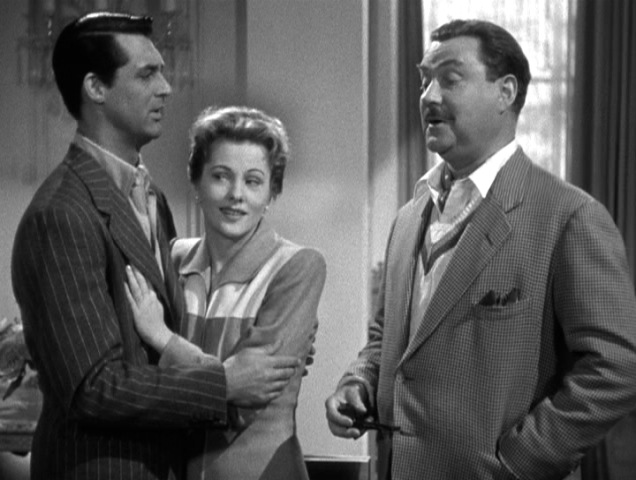
The director has an ideal actor for his purposes in Cary Grant playing Johnnie Ayesgarth. In a terrific performance, Grant is dizzying as he alternates between looking dashingly likeable and dangerously sinister. The fact that he is so physically appealing only makes Lina McLaidlaw (Joan Fontaine, Best Actress for this role, the only acting Oscar awarded for a Hitchcock film), and the audience, susceptible to allowing those good looks conceal some ugliness lurking below the surface. His wit just enhances his attractiveness, but scrutiny of his lines reveals some of his true character. When a photographer asks if he would provide a bit more of a smile, Johnnie says, “not at this hour of the morning,” which tells us that exuding so much charm takes a toll. He says to Lina, “You’re the first woman who I ever met that said yes when she meant yes.” This statement on the surface is a humorous jab at the female sex, but it also shows that Johnnie is no stranger to understanding deception. 

Hitchcock places the opening credits over drawings of a safe bucolic scene. But, they are illustrations, something not real, the veracity of their pleasantness can be questioned. He then ironically contrasts this view with Johnnie speaking in the dark as the train that carries him and Lina goes through a tunnel. The fact that we can’t see him lends mystery as to who he really is. Hitchcock likes using the sexual innuendo of the train and tunnel, since he employs it again at the end of North by Northwest (another Cary Grant vehicle laden with false outer appearances). The opening has another Freudian reference when Johnnie talks about cigars as we see that Lina is reading a psychology book, which implies that she knows something about people’s personalities, and which may explain her doubts about Johnnie later. But, the train also throws people together, sometimes creating strange couplings, as it does here and in another Hitchcock movie, Strangers on a Train.
We witness Johnnie’s conniving ways immediately as he says that he bought a first class ticket, but the railway line mistakenly gave him a third class one. He takes, without permission from a person he has just met, one of Lina’s stamps to make up the difference for the cost. It turns out that he is journeying to the same peaceful countryside setting seen in the opening drawing in which Lina lives with her parents. Johnnie goes to a fox hunt. Could it be that we are being told to look out for red herrings, since that is what was used at these hunts to lead the hounds astray? Johnnie finagles time alone with Lina by getting her neighbors to go with him to her home by saying they will all go to church services together. Religious rituals are not really what is on Johnnie’s mind. He steals time alone with Lina at a remote spot. Hitchcock then gives us a masterful scene. He shoots it from a distance, emphasizing the inability to see detail, and it appears that Johnnie is grabbing Lina, maybe taking advantage of her, and she is struggling. He says that her reaction was as if she thought he was trying to kill her, an ominous remark considering her later suspicions. Lina seems to have the same feeling that he is acting in a threatening manner, but Johnnie says he is trying to reach around her to fix her hair. So, we have been manipulated by the director to suspect Johnnie’s benign exterior, but his behavior here is innocent consistent with his pleasant appearance.
However, Johnnie is not the only one whose appearance is deceiving. Lina comes off all prim and proper. She dresses conservatively. After their walk together, she says goodbye to Johnnie. She then overhears her parents talking about a rumor concerning Johnnie getting thrown out of a club for cheating. They then say they have nothing to worry about her falling for him, because Lina makes a good spinster. Johnnie comes up behind her, and she turns and kisses him. She doesn’t like the role of a repressed virgin and is actually attracted to the “bad boy.” She is supposed to see him again, but then is bitterly disappointed when he breaks their date, and says he has to go away. By now, Lina is obsessed with him, and is devastated that she can’t get in touch with Johnnie. She feels ill, and won’t go to a party. But, her symptoms disappear when she receives a message that Johnnie will be there and wants to see her. He wasn’t even invited to the ball, and crashes it, like he did when he rode in first class on the train. He cashes in on his charm, using it as his ticket to gain entrance where others not so suave would be denied access. When they meet he says that he stayed away because he was scared about how much he cared for her. She professes her love. And now, in a candid move, in front of a painting of her father, he admits that he really isn’t such a nice guy. But, his playful honesty in front of the portrait makes him even more attractive. Lina now also becomes deceptive as she elopes, keeping her parents in that same dark we experienced in the tunnel.
The couple go on a whirlwind honeymoon through Europe and come home to a luxurious house manned with servants. Lina, apparently in denial about her new husband, is taken aback when she learns that Johnnie paid for the trip and lodgings with borrowed money. He is broke, and says that she’ll probably come into an inheritance to eventually pay off bills, but why not enjoy life now. He even suggests asking her father for some funds. She is outraged by this proposal, but also is savvy enough to know that his looks and charm could have garnered him a wealthier bride. She accuses him of being a child, which is quite accurate, since he just thinks about what he wants in the moment without worrying about the cost of satisfying those desires.

The story gives Lina, and us, emotional whiplash as Johnnie veers sometimes toward sweetness and generosity and then turns toward coldness and selfishness. He says he has a job offer and she believes he is working. But she finds out from his best friend, Beaky (Nigel Bruce), that he hasn’t been at work for a while, was going to the horse races, and sold the two museum quality chairs that her father gave them, and which she loved, so he could gamble. Just when she feels crushed by his actions, he comes in with gifts for everyone, including a fur coat for the maid, after winning big on a long shot at the races. She is thrilled that he is able to buy back the chairs and her love flourishes again. They drink a toast to his good luck, but he warns Beaky that he can’t handle brandy. His friend has a coughing fit, and Johnnie looks cold discussing his friend’s reaction to the alcoholic beverage. Is it concern or is he plotting? Hitchcock wants us to be unsure, since uncertainty keeps us interested in the story. But, the film also makes a statement about how difficult it is to be certain about people, and thus this perception shows how precarious life can be.
Lina’s doubts concerning her husband resurface when she discovers that again he has not been working for several weeks. She visits his place of employment and discovers from Johnnie’s employer, Captain Melbeck (Leo G. Carroll) that there was an audit of one of Johnnie’s accounts, and money was missing. She packs her bags, writes a goodbye note, but can’t bear to leave him. She rips it up. She does let him know she found out that he lost his job, and he is deceptive again when he conceals the fact that he must pay back the missing funds.

He now presents a project to turn a rocky coastal area into a resort, and forms a corporation with Beaky because his friend has substantial funds to provide for its development. Beaky is quite naïve and goes along with the project. Lina, now aware of her spouse’s scheming ways, warns Beaky of the pitfalls in such a risky investment. Johnnie overhears her and becomes quite nasty about not wanting her to interfere in his business matters. The next day he surprises her in the garden, and her cliché statement that he frightened her takes on added meaning in the context of the movie. But, he now goes from Hyde to Jekyll again as he says that he is not going to drag Beaky into the land development plan. But, he then wants to take Beaky out to the cliffs to show him how it isn’t a good idea. Lina, now not knowing what her husband’s motivations are, envisions Johnnie throwing his friend off the precipice in order to collect from the corporation they have established. Again, she is relieved when she sees them back at the house after their trip. Beaky even says that his friend stopped his car from going over the edge, thus saving Beaky’s life (a foreshadowing of the end of the movie). When it comes to Johnnie, the viewer must feel like Lind Blair’s spinning head in The Exorcist.
Before Beaky goes to Paris, where his securities are held, to cancel their deal, the two decide to go to London for a night on the town. Lina is then visited by the police who inform her that Beaky died in Paris after drinking brandy with an Englishman who ordered large portions of the drink. They want to know where Johnnie is, being British and a friend of the deceased. When Johnnie arrives home he says he heard about Beaky, but he didn’t go to Paris with him. Lina finds out that he was trying to borrow against her life insurance policy but proceeds were only payable upon her death, and that Johnnie said he needed more time to pay back Melbeck. Since she now suspects him in Beaky’s death, she is afraid for her life.
We have learned that Johnnie is interested in murder mysteries, and is friends with a local mystery writer, Isobel Sedbusk (Auriol Lee). Lena visits her to ask about her knowledge concerning her books’ topics and learns that Johnnie borrowed a book in which a person dies from ingesting too much brandy. Later the couple are at a dinner party where the writer and a local medical examiner are present. The latter two discuss murder by poisoning and Johnnie pushes for the name of a concoction that is untraceable. That evening, Lina tells her husband she wants him to sleep in another room. He becomes very upset about his being thrown out of their bedroom. She is very upset and wakes up with the writer at her bedside. Johnnie seems caring again, and he called Isobel to comfort her. In their conversation, the writer admits that she told Johnnie about a recently discovered way of poisoning someone without leaving any evidence. That evening we have a shot of Johnnie climbing the stairs ominously in shadows, bringing Lina a glass of milk, which she does not drink, fearing that it contains the untraceable poison.

The next day she packs and says she wants to visit her mother. Johnnie insists on driving her to her mother’s house. He speeds up the car as it skirts the edge of the road along a steep cliff. Her door opens, and again it is difficult to determine his actions, as it was when he was reaching to fix her hair earlier. Is he pushing her out of the car or is he reaching to bring her back in? It turns out that, just as with Beaky, he was trying to save her. Lina now realizes that she, and of course the audience, has not seen the whole picture. Our suspicions did not allow us to see how much in despair her husband was about not being able to pay back the money to Melbeck. He was desperate to please the woman he loved, and so saddened that she was turning away from him that he contemplated killing himself with the poison. She wants them to return home and start over. He says that it’s too late, that he is not good for her. But, the film ends with his turning the car around and placing his arm around Lina.
The mystery writer at one point says, “I always think of my murderers as my heroes.” I would think this ambiguous line appealed to Hitchcock. Aren’t we attracted to the “bad boy” just as is Lina? Didn’t Billy Joel sing that the sinners were much more fun than the saints? Aren’t we intrigued by Norman Bates, the sweet looking young man who is really a psychotic killer with a tortured past? Don’t we want the car carrying the body to not hesitate as it sinks in the muddy pond, as we almost root for Bates to cover up the crime? Here we have someone who appears to be innocent, but who is really deceptive and manipulative. However, we must resist overreacting in our disappointment so as to not to judge him too harshly because as it turns out he is not guilty of murderous intent. Johnnie is an attractive individual with a shiny smile that conceals a dark side. But maybe, like Lina, we see something of ourselves in the wrongdoer. Maybe that is why it should be difficult to cast that stone.

The next film is Michael Clayton.

Friday, October 30, 2015

North by Northwest

I am publishing a couple of days early and will be skipping a week. But, I will be posting again on Nov. 15, 2015.

SPOILER ALERT! The plot of the movie will be discussed.

The title of this Alfred Hitchcock directed movie is ironic, pointing to a specific direction, considering all of the misdirection that occurs in the story. This film is primarily about pretending. The main character is Roger Thornhill (Cary Grant), who, like Don Draper, is in advertising, and thus a professional in disguising the whole truth. He becomes immersed, possibly as a form of divine retribution, in a situation rich with deception. And deception can lead to danger which is implied by the opening credits which have the names sliding down the side of a building (a foreshadowing of the last scenes on Mt. Rushmore?).


A hotel pageboy calls for someone named George Kaplan at the same time Roger flags him down about sending a telegraph. He is mistaken for Kaplan, and is kidnapped by some thugs. He is taken from Manhattan to the Long Island estate belonging to Lester Townsend. Roger is locked in the library and is confronted by “Townsend” (James Mason) and his secretary, Leonard (Martin Landau). He is questioned as Kaplan and despite his protestations that he is not the man, Mason’s character does not believe him. It appears that Kaplan is a secret agent on the trail of Mason’s organization. Leonard and a henchman force whiskey into Roger, causing him to be extremely intoxicated. They place him in a moving car, hoping he will die in a DUI accident. Roger thus is put onto a road literally and figuratively which he does not know where it will lead him (more misdirection). He survives and then returns with the police to the estate. They meet a woman pretending to be “Mrs. Townsend” who acts as if Roger was an old friend who came to a party there already inebriated. She implies that the stolen car in which Roger had been placed was accidentally borrowed by the drunken ad man. The library is now presented as a different room, with no liquor cabinet and no bourbon stained sofa pillows. Mrs. Townsend says that her husband is at the United Nations, where he works. The man outside appears to be a gardener, but was one of the henchman who kidnapped Roger (more pretending). Since he was drunk and in a car not his own, and the house belongs to a prominent person, the police dismiss Roger’s story.


Mason’s character had told Roger the room number where Kaplan was staying at the hotel. He goes to the room and discovers that Kaplan was not seen by the maid or valet. He pretends to be Kaplan to enter the room, which of course makes it difficult to argue that he is not the man. The room appears to have been occupied since there are clothes, personal items, and a photograph that shows Mason. Roger goes to the UN to confront Townsend (again calling himself Kaplan because he concluded from the photograph that was in the hotel room that Kaplan knew Townsend) only to find that it is not Mason. The real Townsend says the house is currently unoccupied and his wife is deceased. One of the thugs, Valerian (Adam Williams), who pretended to be the gardener at the estate, throws a knife and kills Townsend, who collapses into Roger’s arms. Roger grabs the knife and pulls it out of the victim’s back. A photographer covering the General Assembly session takes a picture. Thus, it appears that Roger is the killer of a person whose house he visited earlier in a drunken state. (There is a flaw in the plot here – the local police went with Roger to the Townsend estate and saw the “wife” who is actually dead. This would lend credence to Roger’s story).


Roger now becomes what is a recurring theme in Hitchcock films – the innocent man pursued for a crime he did not commit. There is then a scene with members of an American spy agency having a meeting. We learn that there is no George Kaplan, who was invented to throw off Mason, whose real name is Vandamm, from discovering the real secret agent on his trail. Roger now has augmented this charade by becoming the physical embodiment of the red herring. In a cold-blooded decision made by the spy chief, The Professor (Leo G. Carroll – yes, he becomes the head of the spy network later in the TV series The Man from U.N.C.L.E.), it is decided to do nothing and continue to let Roger remain in danger as a way to preoccupy VanDamm and his men.


Roger, on a train to Chicago to find the fictitious Kaplan at one of the hotels mentioned by Vandamm, encounters Eve Kendall (Eva Marie Saint). She recognizes him as the fugitive, but is obviously attracted to him and helps Roger hide out in her sleeping car. Eve is also not what she appears, as we find out when she sends a message to Vandamm who is on the train along with Leonard. The next day, Roger escapes detection by the police by dressing up as a railway porter (yes, more pretending) assisting Eve. The police discover the porter whose clothes Roger used, and Roger hides out in the men’s room, lathering up his face for a shave so he won’t be detected (more use of disguise). Eve is supposedly calling Kaplan for Roger so the two can meet, but she is actually talking to Leonard who gives her instructions as to what to do with Roger. Eve seems very upset when after telling Roger to meet Kaplan out in a rural section outside of Chicago. She abruptly leaves him.


Roger is left off at a bus stop in farm country, but Kaplan is nowhere to be found (of course). A man waiting for a bus sees a crop duster plane and comments that it is dusting where there are no crops. Again, the plane is pretending (that word again) to be something else. Roger has been set up and the plane moves in for the attack. Roger again escapes, as the duster flies into a passing truck, and explodes, killing those onboard the aircraft. Roger heads back to the hotel ready to confront Eve about her double-cross, since he is told that the record showed Kaplan checked out at the time Eve was supposedly talking to him. When she sees that he is alive she embraces him, relieved, thus confusing Roger. She receives a call, writes down the address, and takes the piece of paper with her as she leaves. Roger uses a pencil to expose the address etched in the page beneath (for an advertising guy, he is quite adept at getting out of tight spots and tracking things down). He arrives at an auction, where Vandamm is with Leonard and Eve. Vandamm is acquiring a statuette. Roger confronts them, and makes a scene so that the police will take him away from Vandamm’s thugs. The Professor is at the auction, and intervenes with the police. The spy informs Roger about the invention of Kaplan and the need for him to play along a little more by pretending to be him. The government wants to find out about Vandamm’s network which deals in stolen secrets. We now learn that, again, Eve is not what she seems. She is actually helping the spy agency by going undercover.


A meeting is set up between Roger, acting as Kaplan, and Vandamm, who arrives at the Mt. Rushmore attraction center. Vandamm has a house nearby and The Professor said that he will be leaving the country from that location. Roger says he will withhold saying anything about Vandamm’s dealings if he gives Eve to him to get what she has coming for betraying him. Eve pulls out a gun and shoots Roger. It is all a ruse. Eve’s gun fired blanks (a fake gun pretending to be a real one). The deception was acted out to persuade Vandamm that Eve was on his side, despite her revealing emotions concerning Roger. Eve and Roger meet under the supervision of The Professor. She tells Roger that she fell in love with Vandamm before she knew about his criminal nature. Roger now wants them to go off together, but The Professor says she will be leaving with Vandamm to continue her spying. Roger is upset, but pretends (sorry, but it keeps showing up) to go along with the plan. He escapes the hospital room where he has been hidden to keep up the false story about his demise. He goes to Vandamm’s house. He sees the landing strip where the plane will land to help Vandamm escape. He overhears a conversation between Vandamm and Leonard where he learns that the statuette from the auction holds stolen microfilm. Leonard says he does not trust Eve. He found her gun and fires it, showing it just used blanks. Vandamm says he will drop her out of the plane. (There is a possible subtext going on here that Leaonard may be gay and have feelings for Vandamm. Van damm says that Leonard is “jealous” of Eve, and Leonard says his “woman’s intuition” makes him suspect her.)


Roger is able to warn Eve by dropping his monogrammed matchbook with a message in front of her from the upstairs level of the house. After they leave for the plane, Roger is confronted by the maid who stops him at gunpoint. It turns out she has the same gun with the blanks, which Roger recognizes, and the discharging of the blanks distracts Vandamm. Eve grabs the statuette and runs. She and Roger then try to make their escape over the face of Mt. Rushmore. Valerian pursues them, but they prevail, and the thug falls to his death. Leonard grabs the statuette in a tussle with Eve. She stumbles and Roger saves her by grabbing onto her with one hand as he hangs onto the edge. Leonard starts to grind his foot on Roger’s hand, but is shot by park rangers who are with The Professor. The statuette breaks revealing the microfilm inside (another object that is not what it appears on the surface). Vandamm is placed into custody. It first appears that Roger is trying to help Eve off of the cliff, but the scene shifts to him lifting her to the upper birth in a train as they speed off to their honeymoon, another image that is not what it seems.


The use of Mt. Rushmore here is similar to what Hitchcock does with The Statue of Liberty in Saboteur. In both pictures, he depicts, ironically, violence and criminality occurring at locations that symbolize awe-inspiring morality, reminding us that sometimes we only attain a semblance of a civilized state.

Another way that this film isn’t what it seems is the way it subverts the drama with a great deal of humor. Roger is incredibly cool given his circumstances, shooting off one-liners. When he is abducted by the thugs, he asks if he can call his dining partners to explain he is being kidnapped. When he is held captive in the library at the Townsend estate he says it’s good because, “I can catch up on my reading.” At the auction, he says to Vandamm, “I didn’t realize you were an art collector. I thought you just collected corpses.” There is definitely a great deal of double entendre between him and Eve. She says she can handle herself by saying, “I’m a big girl,” To which he responds, “Yeah, and in all the right places, too.” When she invites Roger to stay hidden in her room on the train, she says, “It’s going to be a long night … And I don’t particularly like the book I started.” Once they are in her compartment and he is in the upper birth where he hid he asks her why she is so nice to him. She answers by saying, “Do you want me to climb up and tell you why?” And the last image of the film is the none too subtle image of the train going into a tunnel. Oh, Hitch, you rascal, you.

The next movie is 12 Angry Men.

Sunday, March 29, 2015

The Birds

SPOILER ALERT! The plot will be discussed.


Cages.  Humans are the only beings that put other living creatures in them. Alfred Hitchcock in his youth was truant from school once, and was placed in a jail cell for a period of time by a policeman who wanted to teach him a lesson. It certainly did.  Hitchcock has used the theme of the threat of incarceration in several films. Confinement symbolizes how we selfishly wish to control the world, sometimes at the world’s expense.


Hitchcock's The Birds starts in a pet store, where all types of animals are in cages. Mitch (Rod Taylor) is looking for love birds for his young sister (Veronica Cartwright).  Melanie (Tippi Hedrin) wants a mynah bird. Melanie is supposedly mistaken by Mitch for the sales lady, but he realizes she is the daughter of a big time newspaper publisher. She has led a rather reckless life, consorting with people who like to party. He mentions how she lives in a "gilded cage." It is difficult even for her to escape confinement, although hers is an affluent cell. He is a lawyer and admits to wanting to put people in jail. The theme of the human desire for confinement has been immediately established.

Melanie wears a fur coat (animal cruelty?) and invades Mitch's privacy by using sources to find out where he lives (Bodega Bay). When she gets there, the man who helps her rent a boat to surprise the sister with love birds looks like he works behind a cage-like structure. Melanie is a predator, a bird of prey perhaps, hunting Mitch down, possibly wanting to cage him for herself. She invades his "nest" – his hometown and his family, which includes Mitch's mother played by Jessica Tandy. Melanie drives recklessly, too. She does not care about the harm she may inflict, but only wants self-gratification. When Mitch's ex-girlfriend, Annie (Suzanne Pleshette), asks who is knocking at her door, Melanie’s self-centered answer is "Me." She is sexually aggressive even in front of the ex-girlfriend, lies to Mitch about previously knowing Annie, and pushes Annie into letting her stay at her house. A bird slams into the door, as if to punctuate Melanie's self-involved audacity. At least in the beginning of the film she is representative of the selfish aspect of humanity that doesn't consider the disastrous repercussions of that self-centeredness. 


Melanie's actions seem to set off the subsequent bird attacks. The ones involving children are especially chilling.  First, there is one at the sister's birthday party. Then, there is an assault at the school, a place of innocence, where the students are singing a sweet, sing-song tune as the crows gather on the monkey bars where the children would normally play at recess. The placement of this attack is, thus, ironic. The school is a place where we should learn, but it emphasizes that we have not learned how to respect the world around us, and nature in particular, as we satisfy our wants.

As the birds continue their attacks, it is the people who are now confined, hiding to protect themselves. Melanie and the children are cornered in a car. She is trapped in a claustrophobic phone booth as the birds ram into it. Townspeople and visitors huddle in the diner. When a woman confronts Melanie as the prime mover of these events, she stares right into the camera, basically accusing the audience of causing this horror, and calling us evil. In this scene, Hitchcock is indicting us all.

Mitch's mother is afraid of losing him. She wants the nest protected since she has lost her former protector, her husband, whose picture looms on the wall of the house, reminding her of the lost patriarch. In the last attack of the film, the main characters are huddled inside their house, again emphasizing the cage motif. While the rest sleep, Melanie goes to an upstairs bedroom to investigate sounds. The birds have broken into the house, and now attack Melanie. She, the one who has disrupted the harmony of society and nature, is punished by the formerly abused creatures who are now the ones who break through the house's defenses, showing the humans what it is like when the rules of respectful existence are broken.

In the shot where the camera pulls back and looks down at the burning gas station, and the birds come into view as they fly down for an attack, it looks as if God is sending angels of death down as a punishment. The story is a bleak one. It is "the end of the world" as the scripture quoting character in the diner says. The only hope given us at the end as Mitch drives his family away from the house, is that Melanie, in her fragile state, is now part of the family, and the mother appears to be ready to resume her role as a nurturer, taking the young woman under her wing. But, they take the lovebirds with them, as pets still in a cage, implying that the humans have learned nothing.

Next week’s movie is The Road to Perdition.

Sunday, November 16, 2014

Vertigo

(A version of this post first appeared on the Bryn Mawr Film Institute Blog)

SPOILER ALERT! The plot will be discussed.

My father was a big Alfred Hitchcock fan because he was the “Master of Suspense.” But, there is so much more going on in his art. He addresses voyeurism often, which is fitting, since audiences live vicariously through the characters filmmakers present on the screen. However, Hitchcock goes further, making the audience, from the perspective of the camera lens, an unseen presence stepping into the stories themselves. We become a Peeping Tom, like Jimmy Stewart in Rear Window; we observe Janet Leigh through the hole in the wall, in Psycho; we are accused directly in the diner scene of causing the coming apocalypse, in The Birds.

In Vertigo, Jimmy Stewart's weird obsession with Kim Novak takes this voyeurism to the point of obsession. The voyeur has no respect for the individual, who is only a means to satisfy the voyeur's fantasy. In the opening credits we see a woman's face and then her eye. We then look into that eye, and there is a spinning pinwheel. Right from the beginning, Hitchcock is saying that a man can become unbalanced with obsession over a woman.


Stewart's detective Scottie discovers that he has acrophobia while hanging from a gutter after chasing a criminal. He is then traumatized by witnessing a fellow policeman fall off the roof trying to save him. Falling becomes a motif in the film. The story takes place in hilly San Francisco, which symbolizes the precariousness of Scottie's predicament. (Scottie lives right near Coit Tower.)  Probably because he feels guilty about the dead police officer, he dives into the bay to save Novak's character. But the jump also shows how dangerous his obsession can become. Of course, there are the falling deaths from the tower, and Scottie has dreams of falling off the tower. After the death of his fantasy woman, he drops into a state of catatonia, unable to be in the real world. The falling theme also refers to the danger of falling in love with the wrong person, for both Scottie and Novak's Judy. One could push it and say, for Scottie, the towers are phallic symbols, and the fear of falling could symbolize the fear of impotence in real life, thus encouraging the escape into fantasy.

The acrophobia is not only a plot device so that Scottie can't witness Thomas Helmore's Gavin throwing his wife off the tower. It also symbolizes Stewart's inability to see the big picture from a height. He can only see as far as his version of a dream woman lets him. The first scene deals with beauty and sex, as Scottie’s ex-fiancée, Midge (Barbara Bel Geddes) draws fashion pictures and discusses a newly designed bra. She is not the Hitchcock ice-goddess, since she just draws beauty and clinically describes the bra's engineering. When she draws a picture of Novak as Gavin's wife Madeleine and substitutes her own face, Scottie quickly departs the room, showing how she does not fit his sexual requirements. She is real and can't compete with a dream girl. Gavin is an old friend, who knows of Scottie's disability, and wants Stewart to find out where his wife is going on her mysterious trips. At first Scottie is the voyeur spying on her beauty at the restaurant. Hitchcock places the audience in the car seat, following Novak, joining the detective in his fantasy. When he follows her through a dark walkway and opens the door, the scene lights up with the beautiful colors of flowers which the equally beautiful Novak is buying. It reminds one of Dorothy opening the door to her drab house to witness the awe of Oz, which, of course is a fantasy land, and which can be dangerous, just like Scottie's obsession.


The husband says a dead woman is possessing his wife. She goes into spells, visits her grave, and looks at the dead woman's painting on the wall of the gallery. Scottie observes that the curl in Novak's hair mirrors the curl of the dead woman in the painting. We realize that the circular curls also echo the theme of spinning wheels, leading to actual and symbolic vertigo. The story of the ghost plays into the whole unreal, fantasy theme of the film. Scottie sees Madeleine check into a hotel, but the concierge says she was not there that day, and there is no evidence of her in the hotel room. After Scottie rescues Madeleine from the bay, the camera shows her clothes hung up and drying in his home, and Novak naked under the covers in his bed. This is kind of creepy, knowing that she has been undressed by a stranger. It is as if Stewart's character presumptuously has actually taken possession of her (in contrast to her pretending to have become possessed) as an object in his fantasy world. When they are in the sequoia forest, Madeleine seems to disappear for a while, like an unearthly spirit. After his release from the mental institution, Scottie looks for Madeleine wherever he goes, like a morbid ghost hunter. It is ironic that he becomes haunted by the ghost of a woman who pretended to be haunted by another dead woman. Of course, when Scottie accidently sees Judy, thinking she is only a Madeleine look-a-like and not part of the murder conspiracy, he wants to resurrect the dead Madeleine, forcing the now-in-love Judy to again play the same part. When Scottie finally recreates her with make-up, hair styling, and clothes, Hitchcock makes Novak look like she is a ghost, as she materializes out of the hotel room's wall in a neon sign induced mist.


Scottie's obsession is a kind of madness. Gavin says there is madness in Madeleine's family, which sets the stage for the belief that she would commit suicide (her name has the word "mad" in it).  And, Scottie's madness leads to a sort of personality suicide as he realizes at the end, as Roger Ebert says in his book, The Great Movies, that another man (Gavin) created the woman he wanted to forge. Thus, Scottie's dream was not even his own. First he lost the person he wrongly thought was his ideal woman incarnate, and then he loses the woman he thought he created to be his perfect reproduction of his ideal.  For Hitchcock, the desire to possess one's dream person is an impossible act and can only turn life into a nightmare.