Showing posts with label Julie Christie. Show all posts

Monday, May 18, 2026

Far From the Madding Crowd

 SPOILER ALERT! The plot will be discussed.

In Far from the Madding Crowd (1967), based on the Thomas Hardy novel, we have one of the themes that Hardy explored in other works, and that is the role of fate. While some see this concept as romantic, Hardy shows how destructive it can be as well as how it upends the notion of free will. “Madding” can mean maddening or frenzied. Since this story takes place in a pastoral area, the word in the title may indicate irony, because the idealistic connotation of the rural area conflicts with the tumultuous happenings in the tale.

The opening shots are of the countryside, and they depict the seaside and unspoiled land. Some of the names in the story reflect the rural area and the personality of the characters. Alan Bates plays Gabriel Oak, which points to a sturdy fellow who has an angelic first name, the one which refers to a heavenly heralder. He raises sheep and we first see him call one of his sheep herding dogs, Boxey, “mad,” which is a foreshadowing. (Sheep may also be a religious reference to the “Lamb of God,” a sacrificial symbol).

Bathsheba Everdene (Julie Christie) lives close to Gabriel. Her name is also a reference to a Biblical person. Bathsheba in the holy text was involved in an adulterous relationship with King David, later married him, gave birth to Solomon and was a powerful person herself. The implication is that she is passionate and strong. Her last name could signify a person who is rooted in nature and is an earth mother character capable of resilience.

Gabriel brings a lamb to Bathsheba’s home as a gift, but his true purpose is to ask to marry her. Bathsheba was staying with her aunt, Mrs. Hurst (Alison Legatt). He pleads his case in the pragmatic way of a working man. She says she does not belong to any man, which indicates her independence. Later she shows her pride by saying he wasn’t good enough for her. She tells him she can’t marry him because she doesn’t love him despite his declaration of love for her.

We get a shot of Gabriel and his sheep from high above which suggests how small his life is compared to the viewpoint of the cosmos. At night, Boxey goes wild and drives all of Gabriel’s sheep out of their pen and over a cliff to their deaths. There is no explanation for the dog’s irrational behavior. The act ties in with Hardy’s view of unfathomable fate where anything can happen, and people are powerless to stop what is beyond their control. Garbriel shoots his dog who represents the whims of predetermination. However, Gabriel finds solace when he thanks God that he’s “not married.” He promised Bathsheba that he would be a man of means, and now he can’t deliver on that claim.

Gabriel walks past a group of soldiers and this image hints at how the universe throws people together even though they don’t realize the connection at the time. Sergeant Frank Troy (Terence Stamp) encounters Fanny (Prunella Ransome), his lover, on the road with his fellow soldiers. He promised to marry her and says she’ll come when he calls for her. His military position and attitude present him as a man who wants to be in control, which is difficult to do from Hardy’s perspective.

Gabriel goes to the town to look for employment as a bailiff, a person who manages large farms. He meets William Boldwood (Peter Finch), another character with a meaningful name implying strength and a connection to the land. He owns a large property and says he’s looking for a shepherd instead. When Gabriel meets another man Gabriel says he is a shepherd. The man says he wants a bailiff. Poor Gabriel can’t seem to win so far. Others view him as a failure because he owned his own farm and now must work for someone else.

Gabriel gets a ride in a wagon with a couple of men, one of whom is named Poorgrass (John Barrett). We have another name of significance, here suggesting that in the farmland, he is low on the social ladder. The conversation reveals that Bathsheba inherited a property from her uncle. The men comment on Bathsheba’s vanity and the foolishness of leaving a farm to a female. Is she self-absorbed, or are men not capable of accepting a willful woman in charge?

Gabriel jumps off the wagon when he hears people in distress. There is a fire (another force that warps human plans) and Gabriel helps them fight the blaze. He saves the hay ricks, showing he defies life’s obstacles. It turns out to be Bathsheba’s farm, and she hires him. Has fate driven him off his own land so that he can reunite with Bathsheba?

Bathsheba shows how to take command when she fires the bailiff for stealing barley. Like Gabriel, she tries to meet the challenges life throws at her. She decides to take on the job of bailiff to ensure honesty in handling the farm’s affairs. Men try to take advantage of her because of her gender and complain that she isn’t assuming the traditional role of the submissive female.

She has just taken over control of the farm and reviews those men who worked the land for her uncle. One is named Cain, who they call Cainy (Freddie Jones), because his mother was confused as to whether the brother killer in the Bible was Cain or Abel. It’s another small example of the whims of the universe as he is a person judged on his name just because of a misunderstanding. To add to the cruelty attributed to existence is Andrew Randle (Andrew Robertson) who stutters and is thought to be cursed. Other names are Temperance (Harriet Harper) and Soberness (Denise Coffey), assumed by Bathsheba to be women since the film implies these are attributes that men do not adhere to. One of the workers says those two females are “yielding” women, implying they are promiscuous. Bathsheba has feminist attributes and dismisses that slander and the man who uttered it. She concludes her staff interviews by saying, “Don’t anyone suppose because I’m a woman, I don’t know the difference between bad goings-on and good. I’ll be up before you’re awake, I shall be afield before you’re up, and I shall have breakfasted before you’re afield. In short, I shall astonish you.” Quite a boast, bordering on hubris, which the Greeks condemned for being presumptuous as a mere mortal.

Boldwood visits Bathsheba’s farm. He is rather abrupt, lacking social attributes, banging on her door without even getting off his horse, and is curt in his speech. He tells a servant he is there to offer aid to the new owner of the farm. Is he being courteous or assuming a woman needs help? Bathsheba is intrigues by the man. Liddy (Fiona Walker) says he “is married to his farm.” Temperance says, “There’s no woman can touch him, miss. ‘Tis said he has no passionate parts.” Liddy says Boldwood was courted by “sixes and sevens,” which means in a confusing way. (So much for the youth acting like saying 6 - 7 is a modern notion. I remember people using it when I was young). They say many women have tried to win his affections but failed. Perhaps Bathsheba sees the man as a challenge. She finds a Valentine’s Day card at the farm and sends it to Boldwood.

It turns out that Fanny works at the Everdene farm, which shows how the universe intertwines destinies. Troy and Fanny are to be married but when the day arrives, Fanny mistakenly shows up at the wrong church. Fanny learns of her mistake but is too late. Troy is enraged for being made a “fool” of, which shows he is prideful, too. The whims of fate again torture individuals.

Bathsheba comments to Gabriel that the sheep herd is doing well. He says they have been lucky, an ironic statement given the theme of the story. She corrects him by saying, “I’ve been lucky.” Her words show her ego and remind Gabriel that she is in charge. It is a selfish statement which does not allow for Gabriel’s hard work and points to how she does not wish to share her luck.

After Bathsheba impresses Boldwood at the marketplace by avoiding a swindle by opportunistic businessmen, we later get a glimpse of Boldwood’s sterile existence. He eats in his home alone, except for his dogs. He stares at the clocks over his fireplace as they tick away his emotionally empty life. He throws the valentine into the fireplace fire. But passion has gripped him now. He visits Bathsheba and proposes marriage. However, his idea of marriage is old-fashioned as he says he will take care of everything when they merge the farms. She is sorry for her carelessness in sending the card and tells him she doesn’t love him. He is obsessed with her now. Here a simple whimsical act wreaks havoc on another person.

Bathsheba confronts a jealous Gabriel about her going off with Boldwood. The two verbally spar as she reminds him of his place below hers. He criticizes her for playing with Boldwood’s affections to satisfy her own “vanity.” She fires him, the penalty for his accurate honesty.

Then the sheep become ill. Bathsheba summons Gabriel who says he will not be ordered to do a favor. Bathsheba reluctantly sends a message asking him not to abandon her. He arrives and releases toxic gas from each sheep, showing his worth. She is grateful now and asks if he will stay. After being treated decently now, Gabreil remains on the farm.

At an outside feast for the farm workers Poorgrass sings the song “Seeds of Love.” Its lyrics talk of being unlucky in love and being beaten down, but then experiencing rebirth, like seeds growing into flowers. The song shows the need for resilience in a challenging world. The words could apply to the lives of Bathsheba and Gabriel. Boldwood shows up at the gathering. Bathsheba asks Gabriel to relinquish his seat at the table so that Boldwood can sit down. The action could suggest that Boldwood is displacing Gabriel for Bathsheba’s attention. In private she tells Boldwood that she will give him an answer by harvest time about his marriage proposal. Gabriel warned her about toying with the man’s feelings, but she is still keeping him hanging on.

Bathsheba encounters Troy at night in the fields. Her skirt gets caught on his boot spur, a suggestion of an animal getting caught in a trap. It is another accident involuntarily drawing people into each other’s lives. He is flirtatious and praises her beauty. Afterwards she stares into a mirror and smiles, enjoying seeing her image and the compliments she received. It is a narcissistic image.

We switch to an interesting scene that contains a beehive. It produces sweet honey, but the sting of the bees must be avoided. It could be a metaphor for the joys and torments of life. Bathsheba is tending to the hive when Troy appears. He says that beneath Bathsheba’s beauty there can be pain, which is true in this story. He, like Gabriel and Boldwood, declares his love for her immediately. She dismisses the notion of love at first sight in a sort of defiance of how emotion can best reason.


Living up to her last name, Everdene, Bathsheba runs in the countryside as if she belongs to nature. Troy shows up and demonstrates how a sword is used. Interestingly, he labels the moves after farming harvesting methods, meshing his background to hers. The sword is a longstanding phallic symbol. He wants to use her as a model for the enemy. She seems frightened and he says if she is afraid, he can’t “perform,” which has a sexual connotation. She is aroused by his swordsmanship which is exciting in its technique and its danger. He concludes his exhibition by kissing her and she submits willingly.

The tables are turned now as it is Bathsheba who yearns for the man. At first, she’s at 6’s and 7’s about Troy, saying to the female servants she hates him but doesn’t want to hear anything negative about him. She tells Liddy that she has fallen for Troy and doesn’t want to believe the negative stories about him. His reputation with the ladies precedes him. He’s the attractive bad boy who creates excitement.

He is absent for a few days which makes her want him more. She finds him on the beach where a man is selling provocative paintings of exotic nudes and violent rituals. The veneer of respectability starts to fall away when passion stirs. As they talk, we only hear the roar of the ocean which implies crashing primal urges in her. We don’t need words since she shows animated pleading with him along with crying. He is in charge and he exhibits distant amusement at the conquering effect the soldier, in his uniform, has on her. Before them appear older men and a woman in formal attire, their restrained appearance contrasting with the younger passionate couple.

Boldwood feels tortured as Bathsheba rides her wagon back and forth before his farm as she was supposed to inform him of her decision about his marriage proposal. Boldwood confronts Troy with a deal. He wants the soldier to marry Fanny and Boldwood will enrich him. Troy is sadistic as he tells Boldwood to watch how he kisses Bathsheba so he can learn about women. Boldwood’s only unselfish concern is that Bathsheba is happy and is willing to make the same deal if Troy will marry her. Troy adds a final blow by announcing he and she are already married.

Not only Boldwood suffers from watching these two being married. Gabriel must also endure her joined to a disreputable person. Troy parties irresponsibly as he spreads his carelessness by getting the other male workers drunk. It falls to the sturdy Gabriel Oak with the help of the strong Bathsheba to save the farm’s haystacks from a destructive storm. Nature is always a contrary force that can wreck the plans of people.

Boldwood says to Gabriel after the storm that damage to his own farm was due to being distracted by his preoccupation with Bathsheba. He says he will “not give up” his will to continue working despite how much Bathsheba has hurt him. He seems to be trying to convince himself of his endurance and to recapture his pride.

The same flamboyance that made Troy seem attractive carries with it a self-indulgence that is disreputable as he gambles away Bathsheba’s money. Troy finds a pregnant Fanny hiding in the farm stable. He still has feelings for her and promises to help her. When he goes inside the house there is a shot from Troy’s point of view, and he sees the elaborate clock device he bought for Bathsheba. There is also another clock chiming. The references to clocks in the film are a reminder of life passing by inexorably. There is no turning the back the clock to change the past and there is no slowing it down to avoid future events that may be unfortunate.

Troy wants money from Bathsheba to help Fanny, but he says it’s for gambling. Bathsheba is hurting from the disappointment in their marriage. He says romance ends when marriage occurs. Her idealism leads to disenchantment, but she still yearns for the excitement she felt initially.

Fanny dies in childbirth, but there is no mention of the death of her baby. As a former worker on the farm, Bathsheba has the coffin stay temporarily at the house. She begins to suspect the relationship between Fanny and Troy. She opens the coffin and sees the dead infant. She knows now that Troy was intimately involved with Fanny. Troy shows up and, despite everything. Bathsheba believes that through her own will she can get Troy to forsake feelings for Fanny. But the film shows that personal wishes are often stunted by the universe’s plans. Troy is devastated by the loss of Fanny and his child. He is harsh when he tells Bathsheba that Fanny means more to him dead than Bathsheba ever did or does now.

Those crushing words send Bathsheba into retreat to the woods for sanctuary, where her last name implies is her true home. She hears a child reciting a prayer that implores God to save all from works of “darkness.” It is the plight of humans to look for salvation when all seems lost. Troy prepares a lovely gravesite for Fanny only to have it washed away by a storm. The water pours out of the mouth of a demon gargoyle, which implies that the young boy’s prayer may be in vain.

Troy strips off his clothes near the beach and dives into the sea. It appears he has committed suicide by drowning, but it is a deception so that he can escape the confines of his marriage. When Bathsheba hears of the drowning she faints at the marketplace. Boldwood carries her and the image is like the Pieta, as if Boldwood is a parental person, not a possible mate.

Throughout Bathsheba’s grief, Gabriel continues to be the sturdy support his last name of Oak implies. A year passes and Boldwood’s infatuation with Bathsheba continues, pressing her for a promise that in six years when Troy is presumed dead, she will marry him. He continues to try to forge his own destiny despite the odds against him. She says for him to wait until Christmas before she can make the promise. It is what she did before, keeping him hanging on, and he doesn’t wish to learn from his past disappointments.

There is a faire with an image of a young woman balancing herself on a wire. It’s another image of trying to navigate the precariousness of existence. Troy is there in disguise as a comic performer, pretending to be a thief, which in reality he was, stealing Bathsheba’s money and her heart. Boldwood is there with Bathsheba, who seems to recognize Troy’s swordsmanship for a moment. Troy sees his wife and seems to be interested in her again.

At a fancy Christmas party that Boldwood throws for Bathsheba, Gabriel and Bathsheba talk about the promise made earlier to Boldwood. Gabriel tells Bathsheba that marrying someone she doesn’t love is wrong. She now sees marriage as old-fashioned, something her experience has tarnished.

On this night when Bathsheba agrees to marry Boldwood in six years, when he should be at his happiest, when he believes he has control over his destiny, Troy appears demanding the return of his wife. As he drags her away Boldwood shoots and kills Troy in defiance of his fate. Bathsheba also has her hopes dashed as she still loves the man who, despite his faults, still rouses her passion.

Boldwood is in prison and waits for the gallows to end his life. After eight months have passed, Gabriel tells Bathsheba he is leaving for America. He feels that now, when Bathsheba is most “helpless,” he must leave or he will never have freedom from her unrequited hold on him. She later goes to him and urges him to stay. He says he will stay only if when each looks up, they will see the other for the rest of their lives. They get married and seem happy. Perhaps by standing by patiently Gabriel has been able to have the destiny he wanted. However, the ending is not promising. The camera focuses on the elaborate clock that Troy gave to Bathsheba, and there is the figure of a soldier that is part of the instrument. The device suggests that Troy’s memory could spell trouble for the couple as time goes by.

Monday, October 7, 2024

Doctor Zhivago

 SPOILER ALERT! The plot will be discussed.

Director David Lean explored culture classes in his films, even if they were within one country. In Doctor Zhivago, a long and sad story, he adapts the Boris Pasternak novel that depicts life under the czars that led to the rule of the Communist Party which followed the revolution in Russia. The story distills these sweeping events by focusing on the lives of individuals, with a love story at its center.

The tale begins after the revolution and is told in flashback. The establishing shot shows a mass of women marching through a tunnel at the site of a dam under the supervision of one individual. That image sums up Russian rule under Communism, where only those at the top of the hierarchy have individuality and the rest of the population is lumped together as one organism.

The man observing is Yevgraf Zhivago (Alec Guinness), a general, the half-brother of Yuri Zhivago (Omar Sharif). He tells the Engineer (Mark Eden) that life was intolerable in the past where some resorted to cannibalism to survive. (Notice that the Engineer at this point has no name, only his profession; the job he does for society as a whole is what is important here). Yevgraf is interested in a young woman, Tonya Komarovsky (Rita Tushingham) who may be Yuri’s daughter. The mother would be Lara (Julie Christie), who was Yuri’s inspiration for a book of poems, which the government only recently allowed the populace to read once the Communists gained enough power to allow anything that wasn’t dominated by the Party line.

Tonya is not very informative about her early life, not remembering her father and losing her mother while young. This story is about history and Tonya’s gap of information allows for the retelling of the past by Yevgraf. The shots of Ural Mountains and the expanse of the territory (the film was actually shot in Spain) show the dwarfing of individuals as young Yuri (Tarik Sharif) attends the funeral of his mother. It is a harsh introduction to the finality of the death of an individual in contrast to the enduring sky above.

The Gromykos, affluent family friends who live near Moscow, adopt young Yuri. Alexander Gromykos (Ralph Richardson) gives Yuri the balalaika which the young boy’s mother played so well. Mother Anna (Siobhan McKenna) says Yuri’s mother had a “gift” for playing it. It is this artistic side, like older Yuri’s ability to create poetry, in contrast to medicine and politics, which seems to be inherited. The daughter of the Gromykos. also Tonya, is eight years old, the same age as Yuri. We hear Lara’s theme played on the balalaika as Yuri stares at the instrument which suggests the young boy’s destiny. The harshness of the windy coldness that blows off his mother’s grave markings suggests the wiping away of what would have been Yuri’s life if circumstances were different.

The adult Yuri’s medical mentor urges him to do research, but Yuri wants to go into general practice to experience life. The elder doctor says Yuri will “find that pretty creatures do ugly things to people.” The statement is a foreshadowing. Yuri rides the same streetcar as Lara, but doesn’t see her face since she is bundled up against the cold. But they look out the window at the same time and their traveling in the same direction is more foreshadowing. The shot of her getting off the vehicle is a bookend to the end of the film.

Lara sees Pasha (Tom Courtney), her fiancé, a revolutionary of the Communist movement, handing out leaflets. Lara rescues him from the authorities pretending to be his sister and that she will handle him. Pasha says he is not like the Bolsheviks because they do not know right from wrong, but he does. His self-righteousness is evident, and Lara teases him about him being a “prig.” Her remark also points to her rejection of conformity of behavior. Yet, she has been drawn to him, possibly to balance out her rule-breaking nature.

Victor Komarovsky (Rod Steiger), whose last name tells us of a connection to Tonya, is the opposite of Pasha. He does not worry about ethical behavior as he is the lover of Lara’s mother, a dressmaker, and lusts after the daughter, who is only seventeen (despite Christie looking older). Lara is a passionate woman, and Pasha puts all his drives into the impending revolution.

When Lara’s mother is ill, Victor takes Lara to an upscale restaurant. He says she is his niece to defer any criticism about such a young woman being with an older man. The opulent venue contrasts with the Communist protesters outside who have signs that state the need for freedom and food. As Lara and Victor dine the protesters’ singing interrupts the diners. But Victor’s witty condescending remark about how the disrupters will probably sing in tune after the revolution restores the security of the upper-class clientele. Interestingly, Victor pours some of his alcoholic drink into Lara’s glass. Maybe a symbolic sexual exchange of fluids that suggests the corruption of a young woman?

The next scenes show Victor taking advantage of Lara’s sexual awakening in the sleigh ride as soldiers “mount” their horses to attack the protesters. The images indicate a sort of rape of the lower classes by the privileged. Yuri has been adopted into the upper-class world and he observes the horrifying attack of the soldiers fittingly from a balcony above. The camera moves to the level of the protesters to put the audience in the middle of the chaos. However, there are cuts to Yuri who becomes rattled by what he sees. There are bodies and injured people left in the street and Yuri enters the street to use his medical skills. He is not allowed to help the victims as the authorities just load the people into carts to be hauled away to what is surely a horrible fate. There is blood on the virgin snow, symbolic of the attack on the purity of ideals which is echoed by Lara’s succumbing to the aptly named Victor’s exploiting of Lara’s innocence.

Next, the adult Tonya (Geraldine Chapman) arrives from France saying how well Yuri’s poetry is received in France. It is a happy meeting, compared to the following scene where Pasha shows up at the dress shop with a facial wound he received in the demonstration, the residuals of his battle with the forces in power. Sasha has a gun he wants Lara to keep, and as the Russian Chekhov said, once you show a gun, the writer must fire it at some point. Lara is appalled by this turn of events. Pasha shows how violence will escalate now as he says there will be no more peaceful protests. She feels guilty because she was dining while the violence occurred outside. She also carries guilt for her sexual activity and confesses to the priest. But she continues to see Victor and wears a sexy dress he bought for her. He forces alcohol on her and despite her protests of his crude ways, she doesn’t stop seeing him. She is a young woman torn between her passionate drives and social restrictions on behavior.

Yuri assists with an emergency house call and that is how he becomes involved in Lara’s life. Victor found Lara’s mother after she made a suicide attempt. Victor told the naïve Lara that her mother probably knew of Lara’s affair with Victor. Victor doesn’t want the scandal to come out because he has connections with everyone, no matter what the political party. He is an amoral survivor who uses advantages for himself wherever he can find them.

The doctors pump the mother’s stomach and save her. Yuri goes to tell Lara about her mother’s condition. As he looks for her, we hear Lara’s theme again, letting us know about the connection that will join them. But Yuri witnesses Lara kissing Victor in gratefulness for getting her mother help. Yuri finds out that Victor took care of his birth father’s will and tried to devalue the estate and garner more for himself. Yuri is immediately disgusted by Victor after what he has seen and knows.

There is a meeting between Pasha, Lara, and Victor, who says he wants to ensure that Lara will be well cared for. Pasha, whose mother and father died miserably, says he cares for the revolution even more than Lara. He admits he has little experience in the ways of love, and only kisses Lara on the forehead. The implication is he does not know how to satisfy her sexually. Victor sees that he is a “young crusader” who will only give Lara a meager life.

Back at the dress shop, he tells Lara that Pasha is a “high-minded” man who people say they admire but really despise, most likely because of his holier-than-thou stance. Victor sees Lara as an “alive” woman but also calls her a “slut,” and precedes to take her by force, but she appears amenable once the sexual overture occurs. He says not to delude herself that it was “rape.” As a viewer we dislike Victor, because he has abandoned principles so he can survive and take what he wants at any cost to others. Lara has been used, but she has also allowed herself to be used. Perhaps her life has not led her to find a man who is both passionate and principled. And that is where Yuri comes in.

There is a Christmas party where Yuri’s engagement to Tonya is announced. The scene is one of opulence again and the time of year is supposed to be a joyous one. However, Lara has the gun that Pasha gave her and she shoots Victor in the arm at the party, using her anti-establishment fiancé’s weapon to pierce the rich comfort of the wealthy. In a way, she becomes a sort of comrade in arms in the revolution. She encountered Pasha before the act, and he now parts the crowd escorting her out. Victor wants no police involvement to keep his scandal unofficial, but Yuri, who saw them together at the dress shop, knows of his acts. While Yuri treats Victor’s wound, the latter says Yuri’s father was a good man who was devoted to his mother, and he admits that the revolutionaries may win. Here Victor seems compassionate and open-minded. But then he wants to ensure Yuri will keep Victor’s relationships with Lara and her mother secret, his selfish ways again appearing. When Yuri asks what happens to Lara when Victor is finished with her, the crude and cynical part of Victor says he gives Lara to Yuri as a wedding gift.

We again have contrasting edits as Yuri and Tonya share a loving sleigh ride, hugging and kissing, even though Yuri has his mind on Lara. Pasha reads a letter from Lara in which she confesses her indiscretions. He at first wants to strike Lara, but then reconsiders and then embraces her.

Yevgraf’s narrative voice returns, and we see him look younger as he talks about how his mission was to use the conflict to undermine the peasants sent to fight for a cause that was not in their interests. The “lucky” one lost parts of their bodies while many died. He said those that volunteered to fight may not have been happy in their marriages, and the shot tellingly zeroes in on Pasha who enlists while leaving Lara and their child in the Urals, while Yuri also departs, serving as a doctor. Pasha is a leader and men follow him, but he leads them to death, his “high-minded” ways not allowing for Victor’s realism.

Four years later Yevgraf’s narration says that soldiers who fought gave up, went home, and that was the beginning of the “revolution.” There is a confrontation between the deserters and the reinforcements which shows the inception of what Yevgraf worked for. Lara is there as a nurse volunteer looking for Pasha and encounters Yuri, helping him tend to the wounded. He shows he is on her side when he says Victor was “a good man to shoot at.”

They are with the soldiers when they find out that the czar is in prison and Lenin is in Moscow as civil war occurred. One of the soldiers says that there will be no more czars, that there will be a worker’s country with “no more masters,” and there will be “only workers in a workers’ state.” Sounds good, but as we know, idealism can come crashing down when it confronts the reality of the human condition.

Tonya receives a letter from Yuri and she seems upset that he mentions how good Lara is at helping men heal (could he be talking about his own need for emotional nourishment?). As one of the men there says, going home, which should be joyful, will lead them to the civil fighting. Lara irons clothes (a scene that will affect Yuri later) and says she is happy there even if she is away from her child, but away from conflicts. Yuri is shot in darkness as they talk as he admits he would be jealous of losing her. She reminds him that, so far, they have done nothing that would hurt his marriage, and she doesn’t wish to. Lean is showing us a story that is full of conflicting emotions.

The soldiers leave as does Lara. When Yuri returns to Moscow, the large house he lived in now has resident managers who are humorless and hostile toward Yuri, not because of who he is, but because he was part of the upper class. The Christian hospital is now called a “reformed” institution, meant to obliterate any religious associations that would compromise devotion to the revolution. Yuri says that he understands that there is an outbreak of typhus, but the Communist leader there says it is a false rumor, or in our terms “fake news,” which shows the Red Guard desire to get rid of any negativity involving their rule.

When Yuri sees his boy, Sasha (Jeffrey Rockland), the boy slaps him. Is it because he has been away for so long? Or is it due to Communist indoctrination to despise the upper class? Alexander joins them in the one room now allocated to the family. There is little food, and Alexander wonders how they will survive the winter. There is more to help unfortunate people. But it is the unelected Communist Party that decides who gets what. Yuri notes that those in charge have the “power” but not the “right” to order people about, stressing the unfairness of the situation. He finds one man suffering from starvation, which the Party does not want to acknowledge. Yuri’s attitude of defiance is “noted” by a government official, which is a threat to anyone who wants the truth to surface.

Tonya is in tears because they don’t have enough fuel to keep the stove burning. Yuri goes out and rips wood off a fence and Yevgraf sees his brother for the first time in an act of vandalism. He says, “Nothing ordered by the Party is beneath any man.” His statement shows how those in power have the right to tell others to perpetrate any act, no matter how small or heinous. However, Yevgraf does not apprehend Yuri, perhaps because he is his half-brother. Although he admits that if “you get hold of a man’s brother you’re halfway home.” His words play on his relationship to Yuri, but reveals the total abdication of any personal will to the party in power. He says he admires his brother for his selflessness, but shows his ruthlessness when he adds, “I’ve executed better men than me with a small pistol.” The “small” adjective shows that admirable people can be easily eliminated if they try to defy the Communist Party’s rule.

The local party head carried out his threat and ordered the reduction of living space in Yuri’s apartment and people start taking many of the family’s items. Yevgraf enters and with just a snap of his fingers all the intruders leave without a word, such is the power of those in the upper hierarchy. He revealed that he is Yuri’s brother. Yuri, the caring person that he is, kisses and embraces his brother. Yuri uses his medical background to state a metaphor when he tells Yevgraf that he appreciates that the party was cutting out the “tumors” that had grown under the old regime. But the “body,” the population as a whole, must continue to live while the precise incisions are being made. He implies that the party is killing the country by that lack of precision in making changes. Yuri’s independent thought makes Yevgraf the narrator say that Yuri had a “noose” around his head and didn’t realize it. The brother admires Yuri’s poetry but lies and says it is disliked for its “petty bourgeoisie” content, although he takes a volume away with him which shows his respect for the verse. Yevgraf advises Yuri that he must leave the city so his ideas will not be so apparent and arranges transport.

Yuri and his family get on a train headed out of Moscow, where there are many wanting to depart. The party says there are voluntary workers on board, but they are really part of a forced labor contingent, showing how lies are declared as truths. On the train, Yuri looks out of a small window at the vastness of the frozen countryside and stares at the moon above. It mirrors what he did to find some relief from the dire circumstances at his mother’s burial.

The train stops and Yuri is brought aboard the train with Pasha in charge. We learn that Pasha is a renegade in the wilderness eliminating those White Russians fighting for the old guard. He is ruthless in his devout embracing of the revolution. Pasha says that he once admired Yuri’s poetry but because of the party line he says he shouldn’t anymore. The poems are full of “feelings, insights, affections” which seem “trivial” now. Pasha is saying that everything revolves around the economy of the masses and individual expression is irrelevant. He says, “The personal life is dead in Russia. History has killed it.” That includes even his own family, since he hasn’t seen Lara since the revolution began. He admits that even destroying a village is necessary if anyone even sells horses to the Whites. When there is absolute allegiance to any creed without question, the story is saying that tyranny follows.

Despite Yuri’s objections to Pasha’s tactics, the commander releases him. Perhaps because he is the brother of Yevgraf who is a member of the “secret police.” They finally arrive at Alexander’s family home in Varykino, but here, too, the Reds have acquired it and it is locked. They can live in the cottage nearby. They receive news that the czar and his family have been executed, which shows, as Yuri says, “there’s no going back.” The story shows how complacency in life can quickly be eliminated.

Yuri again gazes out the window looking for that feeling of transcendence, but he feels nothing to inspire his poetry writing as he stares at the barren, wintry landscape and cannot put his pen to good use. Tonya is ironing the clothes and as Yuri looks at the activity we know he is thinking of Lara, who, as noted above, did the same when they worked together. Both Alexander and Tonya suggest Yuri get out and go to Yuriatin. What they don’t know is that is where Pasha told Yuri that Lara now resides.

He doesn’t go then, but spring comes, and the fertility of the countryside suggests a connection to Lara who has become a life force symbol suggesting the stirring of passion. There is a shot of a blooming flower and then there is the face of Lara confirming the connection. Yuri sees her in the town library, a place that implies a merging of poetic and female beauty.

They tell each other their stories, walk arm-in-arm, and go to her place where they release their sexual desires for each other. (One can only feel badly for Tonya, who is kind and optimistic through all the trials they endured and is now pregnant). He continues to visit Lara and gets to know her daughter, Katya (Luxy Westmore). He tries to break it off with Lara, who is in tears, and knows he doesn’t have it in him to abandon her.

Red partisans basically kidnap Yuri on the road because they need a doctor in their relentless attacks against what they see are counterrevolutionaries. They can blackmail Yuri as they know about Lara. They justify their crimes against individuals in the name of political beliefs. It seems that there is no end to the purging of those who are not marching to the step of the new guard. To women wandering through the frozen wasteland it doesn’t matter if there are White or Red soldiers, only “soldiers” since death does not have an allegiance. Yuri asks Razin, the Communist leader here, if he ever loved a woman. Razin echoes Pasha about the death of private life when he says he “once had” a wife and four children.

Yuri deserts those that captured him and walks all the way in the wintry weather only to find his family has left Varykino. The half-frozen Yuri goes to Lara’s place where she left him a note saying she heard in the town that he was alive, and left him some food. She wrote she was going to Varykino. Lara returns and nurses Yuri for three months, telling him his family is safe in Moscow. She met Tonya when people told her to look for Yuri at Lara’s place. Tonya wrote Yuri a letter saying that they now have a daughter, and the family is going to Paris, where Tonya spent time. Tonya left his mother’s balalaika at Lara’s, which starts to show how the story is coming full circle. Both Tonya and Lara find each other good people. If history hasn’t killed individual life, it may have softened it, and it appears the suffering has led to an understanding between the two women.  

Of all people to show up, Victor appears and says he is there to help them get out of Russia by going to the eastern shore. He says that Yuri is a deserter, and his poetry is considered subversive. Alexander and Tonya are engaged in a criminal attempt to leave the country. Victor is useful because of his connections on both sides of the fight which has made him a survivor. But his lack of morals and arrogance disgusts Yuri and Lara, and Yuri throws him out. Victor is spiteful in the rejection saying everyone is made of “clay,” that is lowly. He wants to drag everyone down to his selfish, amoral level. Perhaps he is feeling resentful that he can’t be as upright a person as Yuri.

Yuri and Lara do heed Victor’s warning and wish to delay as much as possible their separation at the hands of the Communist Party. They go to the family home at Varykino, which they find a frozen carcass of its old self, like the rest of old Russia. They make the place somewhat livable. During the night there, Yuri finds ink and paper and begins writing poetry that will become the volume dedicated to Lara.

Victor shows up again. He tells Yuri that Pasha is dead. He was acting on his own and carried out deeds without the sanction of the government. The Communist leaders used Lara as bait and now that he’s dead Lara is in jeopardy. Victor’s continued attempts to rescue the couple demonstrate the complexity of his character as he seems to be seeking some redemption.

Lara and her daughter go with Victor and Yuri gives her the balalaika. There is no room on the sled for Yuri. He says he will follow, but Lara knows Yuri would never leave Mother Russia. This time he looks out a window of the house and sees his loss as Para disappears. Lara says to Victor she went with him because she will be a mother again, carrying Tonya, named, most likely, to honor Yuri’s wife. The scene shifts back to Yevgraf and the grown Tonya. He says that for eight years Yuri and Lara were separated. Yevgraf protected his brother in Moscow and got him a job at his old hospital. On a streetcar Yuri, suffering from a heart condition, saw Lara, and, echoing how they first met and did not connect, they again do not meet. Yuri, trying to go after Lara, left the vehicle and died of a heart attack. At the funeral Lara sought Yevgraf’s aid in locating Yuri’s and her daughter. (Why Lara did not say how she and the young Tonya became separated is confusing, as well as how Yuri saw Lara from the streetcar became known to Yevgraf).

While there is a poster of Stalin on display on a wall, Yevgraf says Lara left him and was never heard of again. He says she probably died in a forced labor camp as so many others under the authoritarian rulers of Russia. Tonya finally divulges how she became separated from Lara. She was a young child and there was fighting in the streets and a fire, and she says her “father” let go of her hand. Yevgraf says it was Victor who abandoned her, revealing that he could not shake his selfish survival drive. Yevgraf says he hopes Tonya will consider that he is her uncle and offers the help of a family member. David is the engineer from the beginning of the movie, and he has a name for Tonya, her boyfriend, despite her country’s erasing individuality.

As the young couple walks away Tonya is carrying the balalaika. When asked if she plays well, David tells Yevgraf that she is a master. She says that no one taught her. Passed down from Yuri’s mother, Yevgraf says that the ability to play is a “gift,” just as it was for Yuri’s mother. Despite the upheaval suffered by the country, somehow the bonds that link a family endure.

Sunday, February 19, 2017

Heaven Can Wait (and some Oscar picks)

SPOILER ALERT! The plot of the movie will be discussed.


I decided on a change of pace by discussing a film that makes me feel good whenever I view it. This 1978 movie, co-written with Elaine May, co-directed with Buck Henry, produced and starring Warren Beatty (for which he received Oscar nominations in all of the above categories), is a delightful romantic comedy. But, it also has its sad moments, which it balances very well with the humor, a difficult task to accomplish. Add to this cinematic recipe a dash of satire regarding the American capitalist system, and you have the ingredients for a successful motion picture.
The film begins with the main character, Joe Pendleton (Beatty) running. He runs all through this story, whether outside or later inside in the Leo Farnsworth mansion. In addition to running, he rides a bicycle. He is a professional quarterback with the Los Angeles Rams, so being an athlete, one would expect him to exercise. But the movie implies that Joe just wants to move forward, to get to a goal that he was born to reach. Of course, his running inside the big house also adds comedy to the scenes.

Joe has done a remarkable job of repairing an injured knee without surgery. As trainer Max Corkle (Jack Warden, Oscar-nominated) tells the Head Coach, played by Dolph Sweet, Joe isn’t taking any medications whatsoever. In practice, Joe successfully completes many passes, prompting the Head Coach and Max to say, “He’s looking awfully good.” And that about sums up Joe – besides being a handsome fellow, he is just a good guy, as the rest of the film shows us. The Head Coach decides to make Joe the starting quarterback for the next game, replacing aside the usual starter, Tom Jarrett. Before Joe hears the good news, a reporter asks Joe, after his practice, what he thinks of the Rams’ chances this season. He says that they will go to the Super Bowl and will win. When the reporter then says what does he really think, off the record, Joe repeats the same thing. Joe is a honest person – he doesn’t have separate answers for the same question, because for him, the truth is constant. The reporter then asks him what does he think of his competition, Jarrett. Joe says that the quarterback is not his competition, he’s the starting quarterback for his team. Joe is a team player, who unselfishly wants to help all of his fellow teammates win, not just himself.

However, that doesn’t mean he has no personal aspirations. He tells Max that he doesn’t know if he’ll have a chance to see if all of his hard work (even on his birthday Joe is studying films of his football opponents) will pay off, an ironic statement given his imminent demise. Max is his close friend, to whom Joe administers neck realignments for his aching spinal problem. Max remembers Joe’s birthday, goes to his house with a cake, and tells him, ironically, that he hopes he has many more birthdays, not realizing that this is the quarterback’s last day on earth as Joe Pendleton. This scene is one of many where the sadness sits well along with the comic, as we witness Joe’s extreme health food obsession which includes drinking liver and whey shakes, and we hear Joe badly playing his soprano saxophone, as he does several times in the movie. The film’s soundtrack, with its jaunty (music to jog by?), well-played saxophone, adds a feel-good comic touch and contrasts with the sadness of Joe’s death and the feelings of loss by other characters. But, well-played music, just like a well-played game, also symbolizes what Joe can accomplish if given time.
After Max gives Joe the good news about him being the starting quarterback the following Sunday, Joe, of course, goes out running, and then biking. But, we see a truck veer into an oncoming lane of the road on which Joe is traveling, and there is an unseen accident in a short tunnel. It is important that we don’t see the accident, only hear it, because it allows some suspense until we find out what happened. Joe is now walking with his saxophone in the clouds with an escort from the afterlife (Buck Henry). There are others there in line ready to board a plane to go to their ultimate destination. Joe thinks it’s just a dream, and, of course, runs around and does push-ups, his body comically appearing out of the cloud formation with each upward thrust of his arms. Because he refuses to board, a higher up on the celestial pecking order, Mr. Jordan (James Mason), appears to handle things. He convinces Joe that he is not dreaming, and Joe realizes he is dead. However, he is adamant that he shouldn’t be there. Mr. Jordan gets a readout on Joe’s time of arrival and it is years in the future. The escort is new to the job, and took his assigned person “out” just before the accident to save unnecessary suffering. Mr. Jordan lectures the escort that they operate on probability and outcome, and each outcome is different. So, an escort cannot remove the probable victim’s soul before the outcome. As Joe later tells Max, the escort didn’t take into account that Joe was an athlete, and his sharpened reflexes would allow him to dodge the truck. Mr. Jordan says Joe must be put back into his own body. Joe says, “anybody can make a mistake.” Here again we have Joe's generous nature, and the comical thrust is that even heaven has its bureaucratic glitches.

Unfortunately, when the escort and Joe return to earth and attend Joe’s gravesite burial ceremony, they discover his body was cremated. Max can’t see Joe, and says that he hopes that if there is football in heaven, God will make his dead friend first string. Mr. Jordan takes over and tries to find a substitute body for Joe, and the audience sees a few comic possibilities, including a German speaking race car driver. Joe’s persistence to achieve what he considers his destiny predominates, as he wants an athlete so he can still play football. Mr. Jordan takes him to the house of mega rich businessman, Leo Farnsworth, who is sedated and about to drown in his own bathtub after his wife, Julia (Dyan Cannon, Oscar-nominated) conspired with her lover, Leo’s personal secretary, Tony Abbott (Charles Grodin) to kill Leo. True to his kind nature, Joe runs through the house, despite no one seeing or hearing him, looking for help for the victim, even though the man’s body will allow him to be human again, because he cares about other people. 

What makes Joe accept the use of Farnsworth’s body is a woman, Betty Logan (Julie Christie). The film deglamorizes the beautiful Christie in order to show her as a serious, concerned individual of substance, not just of surface appeal. She has been sending letters and trying to meet Farnsworth. She is from a small English town that will be displaced when Farnsworth’s company builds a refinery there. She meets with Abbott, and says besides callously altering the town’s inhabitants’ lives, the rich man’s company produces toxins that harm the environment. Joe is immediately smitten with Betty, and wants to help her, Mr. Jordan says Joe can help her if he becomes Farnsworth, which Joe agrees to do, but only if it is a temporary arrangement. After he becomes Farnsworth, he tells Mr. Jordan that he still looks and sounds like himself. The “angel” says that inwardly, Joe is the same. So, no matter what we may look like, as we alter our appearance, or grow old, the thrust here is that our essence stays the same, our inner being. From a practical standpoint, this plot element allows Beatty to still portray the main character.

When Joe meets with Betty, she hits him with an onslaught of outrage, and he, in an attempt to quiet her, tries to tell her the truth.  At this point, a funny moment occurs when Joe attempts to calm her by saying she shouldn’t be afraid of who he is because he doesn’t frighten anyone. This statement is immediately followed by his wife entering the room, seeing her supposedly dead husband alive, and screaming. Betty, of course dismisses Joe’s statement that he is not Farnsworth, and thinks he is just playing a demeaning game. She vows to continue her protests. Joe tells Abbott to make sure the company isn’t hurting anyone. Joe is sincere, but his secretary, coming from a corrupt mindset, assumes they are being bugged, and Farnsworth is just putting on a show of honesty. Joe also questions the dishonesty of leaking the rumor of a merger to manipulate an increase in stock prices, which Abbott takes as standard operating procedure.

We then get a humorous attack on the excesses of the super-rich. The Farnsworth house and grounds are extremely oversized. A small canon is discharged when the flag is raised and lowered, depicting an act of usurped importance. Farnsworth wore polo outfits, including a helmet, and various dress military uniforms with epaulets and medals. Joe and Julia, dressed like she is going to visit a head of state, eat at a stretch dinner table. There are servants everywhere, who are conditioned to indulge the wealthy in their normalcy-challenging ways. So, when Joe seems to be talking to no one when the escort and Mr. Jordan show up, they prepare hot cocoa for the unseen guests. Joe is out of place and appears awkward when the servants keep handing him hats representing various pursuits. He asks if he (Farnsworth) plays polo or sails, and the response is, “not really.” At first, he tries to play the part, but the rich man’s phoniness goes against his straightforward honest nature. That is why he says he doesn’t want to see any more hats. He also is not dismissive of the help, and always thanks the servants for preparing his meals. 
Joe prepares for a corporate board meeting, hoping to help Betty. At the event, he invites reporters, and Betty, into the board conference room, to the alarm of the members, because, unlike transparent Joe, they wish to hide the activities of the company that puts profit before social responsibility. He is taken aback that an intelligent creature, such as a porpoise, is killed in the processing of tuna. He points out that there are a number of lawsuits and protests against the company. Joe gives a speech that on the surface seems comical, but which is a blueprint for the way large businesses should be run. And, he appropriately, delivers it using football as a metaphor. He asks if they are having a winning season, and is told that they have had a profitable year. So, if you are ahead, he says, you don’t make mistakes, such as building plants that are harming the environment. He says you protect your players, i. e., society. He says we’re not in it for one game, but for the whole season. In essence, he is urging action that doesn’t shortchange the future for immediate wealth. He says that they shouldn’t be making products that harm the environment, and to Betty’s joy, urges the relocation of the refinery. He says what if these actions cost more. They’ll charge a little more for their considerate behavior. Referring to the porpoise problem he tells them, “If it costs too much, we charge a penny more. Would you pay a penny to save a fish that thinks?” He says, “Let’s be the team that plays by the rules.” So, he and Betty have in common the belief that one should care about the community of people as a whole, the notion that it takes a village, or a team, working together for the individuals belonging to that larger group to prosper.

Joe asks Betty, who says what he said at the meeting was wonderful, to have dinner, and they go out to eat at a hamburger drive-in joint. He says he took her there because Joe thought she wouldn’t want to be seen with a big shot corporate jerk in a more public setting. The place fits his down-to-earth style. When Joe does his trick of pulling a coin from her ear he says that is the only trick he knows. That statement shows that is the only deceptive move he has. The incident confirms his honesty. She has become enamored of him, saying even when she was yelling at him, she saw something likable in his eyes. What she saw was Joe’s inner goodness, which could not be disguised. This scene is a foreshadowing of the last one in the film. They can’t stop looking at each other, and Joe assures Betty that he is getting a divorce.

The escort shows up and says they have found an athlete for Joe. But, he has fallen in love, and now doesn’t want to give up Farnsworth’s body, since he wishes to continue to build on the relationship he has established with Betty as the businessman. He decides to get the body in shape so he can still pursue his athletic dream. He acquires athletic equipment and has Max show up, hoping to convince him to help Joe. (Max’s inability to just light his cigar because Farnsworth’s lighter is a too complicated device for a simple task, emphasizes the rich man’s excess). When he can’t persuade Max to do it for money, Mr. Jordan shows up and tells Joe that he can tell Max the truth, and will be believed. Joe tells the trainer things about his life only a close friend would know. He realigns his neck the way Joe did. He recalls Max’s words at the grave by saying that there was no football in heaven, so God couldn’t make him first string. The convincer is playing the saxophone just the way Max’s quarterback pal did. Joe was talking to Mr. Jordan, invisible, of course, to Max, but then the supernatural helper disappears. Max starts talking to the spot where he thinks Mr. Jordan is standing. After going out for a liver and whey shake for Max, Joe comes back in, sees the trainer talking to no one, and delivers the funny line to Max, “Don’t go crazy on me,” after he appeared earlier to Max to be out of his mind.
Joe starts to practice with the hired help on Farnsworth’s grounds. This activity implies that Joe wants them all to be on the same playing, thus eliminating the social divide between the privileged and the working classes. The only way, however, for Joe to get a tryout with Rams is to buy the team. In the context of the story, we find this acquisition acceptable, but it indicates that those with a great deal of money can get what they want, as opposed to the less financially endowed. Once the Rams’ football players allow Joe to get a pass off, he excels. The Head Coach now repeats what he said about Joe, when he was in his own body, when he says, “He’s looking good,” showing that, in a way, you can’t keep a good man down.

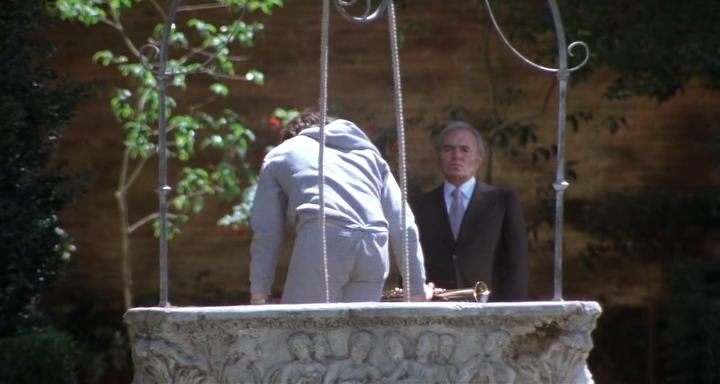
Joe invites ecology groups to the estate, which shows how productive the rich can be when they use their influence to provide meaningful change. Betty is also at this gathering, and the two wander off together, which leads to a foreshadowing image, as they talk near a well. She sees that he is worried, which is due to his concern that he will not be able to stay as Farnsworth. He says to her, “There’s nothing to be afraid of,” and tells Betty what she saw in his eyes she would recognize in another, whoever that person might be, even a quarterback. Later, Joe tells Mr. Jordan that he won’t leave Farnsworth’s body, but Jordan tells him that he must abide by what is written. He assures Joe that there is always a plan, a reason for everything, and, as it turns out, God does, in this film, work in mysterious ways.

At that same water well, Abbott shoots and kills Joe’s Farnsworth, comically because the gun goes off at the same time as does one of the silly daily cannon shots, but also sadly, because Joe is temporarily, again, without a body. Because Farnsworth is missing, having fallen down the well, Max goes to the police because Joe told him about Abbott and his wife plotting to kill Farnsworth. Betty also goes to the police when Farnsworth is nowhere to be found, since he proposed to her, and she knows he would not have gone away. The policeman Krim (Vincent Gardenia) brings Max with him for an interrogation of Julia and Abbott. While the Super Bowl plays on the TV, Krim unleashes Max on the suspected couple. Since the trainer knows so much about their plot to kill Farnsworth, they crack, trying to blame each other for murder. At the same time, the Rams’ quarterback, Jarrett (the athlete the escort was talking about, but did not name), sustains a head injury. It is important that we never see the real Jarrett, because the audience might identify with him, and feel sorry for his loss. He is supposed to die, as Mr. Jordan reassures Joe, saying that it was his time to expire. Joe steps in as Jarrett, and wins the Super Bowl for the Rams.
It seems that there will be an unmitigated happy ending, but that is not the case. Max knows that it is Joe who stepped in, which Joe confirms in the winning locker room. But, Mr. Jordan appears to Joe and tells him when he leaves, Joe will not remember anything about him, or what happened to Joe Pendleton. He will live his life out as Tom Jarrett, because, as it turns out, that is his destiny. When Max sees him again, Joe questions why the trainer is calling him Joe, as he does not recall anything about what had happened. We feel sad for poor Max, who, in a way, has lost his friend Joe for the second time. When Jarrett leaves to go to a celebration party, he runs into Betty who is looking for Max. He asks if they had ever met. The lights go out because they are shutting the stadium down, and in the darkness he repeats Joe’s words, “There’s nothing to be afraid of.” When they are outside (significantly on the playing field, where these two who are team players on and off the field should be) she says that his voice sounded very familiar. He then admits that he really doesn’t want to go the party, and asks if she would like to go for some coffee. She looks in his eyes, and is able to see what she saw in Joe, his inner goodness. She then recalls Joe’s words, and says, “You’re the quarterback,” and says yes, she would love to have some coffee with him.
So, this movie says, the real essence of an individual does not die, and when it comes to achieving one’s dream, and experiencing true love, heaven can, indeed, wait.

The next film is LA Confidential.

Okay, here are a few Oscar picks for next Sunday:

Best Actor: Casey Affleck for Manchester by the Sea

Best Actress: Emma Stone for La La Land

Best Supporting Actor: Mahershala Ali for Moonlight

Best supporting Actress: Viola Davis for Fences

Best Director: Damien Chazelle for La La Land

Best Movie: La La Land