SPOILER
ALERT! The plot will be discussed.
This
1991 film from director Terry Gilliam, is a redemption tale. The Fisher King,
in Arthurian legend, usually refers to a knight who requires the healing of a
physical wound, but which symbolizes the salvation of the soul. This movie
shows how the two main characters and the women in their lives are on quests to
acquire their individual Holy Grails. The story also addresses the issue of
homelessness as it relates to the neglect of the poor in an affluent society.
The
film starts with the theme song of shock jock Jack Lucas (Jeff Bridges, in a
terrific performance), which is “Hit the Road Jack.” The song reflects his
unsympathetic attitude toward his listeners, but eventually describes how he
drops out of show business after feeling responsible for a tragedy. The movie
is prescient in depicting how the manipulative power of the media can do harm.
The first shot includes a closeup of Jack’s mouth as he speaks into a radio
microphone, which emphasizes this theme.
The
first person who calls into Jack’s show is a woman who speaks hesitantly and
says her husband is driving her crazy finishing her thoughts, which is what
Jack sarcastically does. The husband is probably being driven “crazy” by the
way the woman speaks, showing how people are at each other's throats because of
communication issues. (The movie uses the “crazy” theme to show that
irrationality takes on many forms). When the woman says Jack has hit the
problem on the head, he says somebody should hit her on the head. So, the form
of entertainment he provides is one of degradation. He exploits scandals. But
he makes a good observation about the desire in people to achieve notoriety,
even if it is an infamous kind. A woman calls in to complain about his
comments. Jack points out her hypocrisy when he says she had sex with a senator
in the parking lot of Sea World and now wants privacy.
Jack
receives a call from Edwin Melnick, who has phoned in before, and now says he
saw a woman he was attracted to at an exclusive, upscale spot. He apparently
has been lonely for a long time and has tried to meet women. Jack has turned
his sad situation into a sideshow, manipulating him into disastrous encounters.
Jack, as shock jocks do, attacks everybody, and tells him not to deal with
yuppies, who only marry their own kind, causing mental deficiencies due to
“inbreeding.” Jack says, “They’re not human.” He calls them evil and says “they
must be stopped … It’s us or them.” Edwin says in a quiet voice, “Okay, Jack.”
Little does Jack realize what he has set into motion. His sign-off song is “I
Got the Power,” which drives home the force inherent in having the big
microphone. Jack ends his show talking about having sex with the teenager of
his choice, which is not only off-putting, it’s illegal, but implies the rules
don’t apply to the very powerful. He finishes his program, akin to the
narcissistic bragging of any current day politician, by saying, “Thank God I’m
me.”
Off
the air, Jack is praised by his agent, Lou Rosen (David Hyde Pierce), in Jack’s
limo. Lou says Jack is in demand for a TV job. A beggar knocks on the window of
the luxurious car, highlighting the huge discrepancy in the economic situations
of the two men. Jack says a couple of bucks won’t make a difference anyway,
without thinking that maybe a more equitable allocation of wealth added with
compassion might. The scene shows Jack’s pessimism about the human condition.
Back
at his condo, Jack, looking in a mirror, stressing his narcissism, says how he
hates his cheeks. He is now concerned about his looks because the next day he
will be filmed for the first time, and he will be a “voice with a body.” His
girlfriend must feel like a confined possession because she says she would like
to get out for a change. He bemoans the fact that she doesn’t seem supportive
of how important the next day is for him. She tries to cut his ego down to size
by saying he’s only doing a sitcom, “not defining pi.” He says he thought his
biography should be entitled, “Jack Lucas: The Face Behind the Voice,” but now
it will change to “The Face and the Voice,” or just “Jack!” The exclamation
point emphasizes his preoccupation with himself.

He
dances in his upper story apartment, after going over his lines, and declaring
that he’s “got this.” Literally and figuratively on top of the world, Jack then
experiences the bomb drop that decimates his life and forces him to confront
the repercussions of the reckless use of his power. On the TV he hears his own
voice that ignited his listener to violence. Edwin Melnick went to that yuppie
bar, an after-work place called “Babbitt’s” (a Sinclair Lewis reference about
greed?). He opened fire with a shotgun and killed seven people before shooting
himself. Jack looks on horrified as the newscaster says that Melnick was a
lonely, invisible man, who went to what was then the social network, the
airwaves, “looking for friendship, and finding only pain and tragedy.”
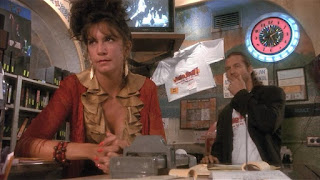
There
is a jump forward of three years, and now Jack is sitting at the back of a
video store in a rundown part of the city, looking as seedy as the beggar he
arrogantly dismissed. He hasn’t changed his negative attitude as he says,
“Garbage. People are garbage,” as he reads a tabloid. He will later discover
that there are those worth saving among those that people have discarded like
trash. It is interesting that although he left one source of media, radio, he
latched onto another, video, not quite being able to divorce himself from the
entertainment business. Anne (Mercedes Ruehl, winning a supporting actress
Oscar for this role) wonders if he’ll do any work, as she sees him reach for
some booze, calling it sarcastically his “Breakfast of Champions.” But, he does
not want to work because he is resistant to come into contact with others,
possibly afraid of social interaction based on his past. Camera shots show
people through Jack’s perspective, as faces look distorted, showing how he sees
everyone as grotesque. Anne says she loves him, but he is in one of his
“emotional abyss” moods, and when he says he hates desperate people, she
corrects him by saying he hates people in general. His devaluing of individuals
may be a defense mechanism to lessen the impact of his having hurt others.
As
they watch a TV show and Anne laughs, he looks grim, and says it’s not funny.
He says he watches it to show him how unfunny it is, because he says that the
country has no appreciation of quality, and that makes him feel good that he
never was in a sitcom. If he was famous because of starring in one, it would
mean that he was “not really talented,” which would be a huge blow to someone
who is so self-involved. It turns out that the show is the one he was supposed
to star in, and he is rationalizing his fall from fame, trying to not feel the
pain of that loss. He is still selfish, continuing to only be concerned about
his own situation. Anne correctly calls him “sick,” and “self-absorbed.” He
hasn’t made any attempts at trying to fix the devastating effects of the
shooting on him.
Jack
wanders off drunk in the rain. He sees a rich guy with his son as the man is
accosted by a beggar, just as Jack once was. The boy gives Jack a Pinocchio
doll. Does this gift signify that Jack is lying to himself? Does he have to
gain some insight to get out of his self-imposed exile? Jack talks to the doll
about how Nietzsche said there are those who are destined for greatness, like,
Jack says, Walt Disney (which connects to the doll), and Adolf Hitler (the
Nazis appropriated their view of Nietzsche’s works to advance their movement).
Both men dealt to a degree in escape from reality, although for benign and evil
reasons. The rest of us are what Nietzsche described as “the bungled and the
botched.” He says that the majority of people are “the expendable masses,” who
“get pushed in front of trains, take poison aspirin, get gunned down in Dairy
Queens.” The “gunned down” reference connects to the restaurant massacre, and
he seems to now be identifying himself with those who are “teased” into
thinking they can be great, but can’t achieve greatness. He asks the Pinocchio
doll if he ever feels as if “you’re being punished for your sins?” Of course,
Pinocchio was, for his lies and, for quite a while, being denied the chance of
becoming a real boy. In a way, Jack is incomplete as a human being, too, and
has been psychologically punished for his sins. But he is just bemoaning his
experience, not learning from it.

Jack,
not being able to deal with his failure and guilt, straps concrete to his feet,
goes to city’s river edge, and is ready to drown himself. Local vigilante types
drive up to the garbage-strewn area and consider Jack to be part of the vagrant
population that has befouled their city. They ironically associate Jack with
the same element of society he turned his back on. They pour gasoline on him
and are ready to burn him like trash, like one of the garbage people Jack
railed against. Parry (Robin Williams, in an Oscar-nominated performance) shows
up appearing like a comic version of Don Quixote. (His name sounds like a
fencing term, which means to deflect a blow, and could refer to his adopting
his knighthood persona as a mental defense mechanism. Also, as IMDb points out,
his name can refer to the knight Percival who sought the Holy Grail, or
Parsifal, the fool, who brought redemption to the Fisher King, Amfortas, just
as Parry helps save Jack). Parry is a street person who comically uses a trash
can cover for a shield. He is accompanied by other vagrants, one of whom holds
a lug wrench which looks like a cross, adding a religious crusader element to
their actions. They begin to sing “I like New York in June/How about you?” It
is an ironic song given their predicament, but they are positive-sounding
lyrics to help deal with their fate. Here, Jack encounters a man who has also
been harmed by life, and Parry, too, has been exiled from the world, but into a
realm of fantasy to escape his pain. Parry says there are “three things in this
world that you need: Respect for all kinds of life; a nice bowel movement on a
regular basis; and a navy blazer.” It sounds silly, but he is just saying that
people must care about others first, and then the individual just requires
warmth and a decent diet. The lesson is that striving after other things
amounts to seeking excesses. Parry is able to sling a ball at one of the
attackers, knocking him down. He ties up the man with tape as the other runs
off. Parry has rescued Jack from physical harm from himself and others, and
later eventually aids in saving him psychologically. Jack says he needs a drink
and Perry says humorously that he knows a place with great ambiance.

They
go to an outside refuge for street people. Many of those gathered there seem
mentally disabled, left to survive on their own. There is a fire burning,
looking a bit like a surrealist inferno. The sleeve of Jack’s coat catches fire
and he waves it with such force that the flames die out. The response of the
area’s denizens is to applaud, like it was theater, so absurd is life to them.
They force alcohol on Jack and he passes out, awakening in Parry’s underground
“domicile,” a building boiler room (a reference to hell, as are the many
inclusions of fire, suggesting the two characters are in a version of Hades).
Parry wants to give Jack some food, saying his guest’s stomach must be like a
“tabula rasa,” which shows Parry is an intelligent, witty fellow. Parry has
auditory hallucinations, engaging in conversations with imaginary “little
people” who he says sent him to Jack. He tells them he knows “He’s the one,”
referring to Jack, which in knighthood terms, means his “champion,” the one to
help Parry. Parry holds up a self-fashioned sword (made from metal from a Ford
vehicle, showing how discards can be transformed into something more
significant) and declares himself a “knight” on a special quest. He says he and
the little people serve God and Parry is the lord’s “janitor,” a sort of refuse
superhero acting as an agent of the deity.
Parry
says the little people told him to look at a specific issue of an architecture
magazine. In a picture there is a trophy, which Parry says is the Holy Grail,
“God’s symbol of divine grace,” sitting on a bookshelf. The Holy Grail quest
can represent a desire to return to nobility, purity, and salvation. Doubting
Jack, who thinks Parry is a benign psychotic, questions Parry’s belief, saying,
“Some billionaire has the Holy Grail in his library on Fifth Avenue.” Parry
carries forward the joke by saying who would think one would find anything
“divine on the Upper East Side,” of New York, since the modern world is in such
a state of decline. He tells Jack he can’t get the Grail himself because “he’s”
out there. Parry is referring to the Red Knight, an imaginary adversary, which
represents the horror from Parry’s trauma blocking his quest for salvation.
(IMDb notes that in medieval mythology Parsifal battled the Red Knight, which,
like in this story, is a psychological projection of the questing knight). Jack
has to leave, and Parry says he shouldn’t be a stranger and they can get
together and “rummage,” which sounds like an odd activity for two people to
share. But, symbolically, that is exactly what these two men must do, dig into
their psyches to unearth their respective happier selves.
On
his way out of the boiler room, Jack encounters the apartment superintendent
(Al Fann) who says he allows Parry to stay there out of compassion for his
tragedy. We find out that fate has brought Jack and Parry together, because
Parry’s wife was killed in the yuppie club by Melnick, the man who Jack had
spoken to on the radio. Back at the video store, Anne shows her concern for
Jack. He doesn’t tell her about his possible suicide attempt. She tells him
that she loves him, realizing he doesn't yet have the capacity to say it back,
adding “although it wouldn’t break your jaw to try.” He is thinking about Parry
now, his guilt magnified by coming into contact with someone who suffered from
his actions. He asks Anne if she knows what the Holy Grail is, and she says it
was “Jesus’s juice glass.” When asked if she believes in God, she says yes, she
was brought up a Catholic, but believes man was made in the devil’s image
because “most of the shit that happens comes from man.” She feels women came
from God, because God creates, as do women by giving birth to babies. Women are
attracted more to the devil, the bad boy, because saints are boring. Which may
explain why she is with Jack. She says that the purpose of life is for men and
women to get married so the devil and God can get together and work things out.
Anne may seem common, but her insight here hits the mark because both Jack and
Parry must participate in battles between their inner angels and demons.
Jack
returns to Parry’s basement dwelling and encounters the superintendent again,
who tells Jack that Parry was in a mental hospital at one point. Parry’s real
name is Henry Sagan, and he taught medieval history at Hunter College (which
explains his fixation on the Grail story). He didn’t speak for a year, and then
invented his Parry persona. Jack looks at a document that has “The Fisher King”
written on it, noting the essay deals with a “mythic journey” which is what
Parry feels he must undertake. Parry and his wife lived in that building, and
the manager let him stay in the basement after getting out of the mental
facility. Jack looks at a picture of Parry’s wife as the manager tells him how
Parry was very much in love with her.
Back
at Anne’s place, Jack looks at the newspaper clippings that contain headlines
about Jack’s radio program and the slayings. He says to her that he is cursed,
being brought into contact with a man who was damaged by the shootings. He
seems to be searching for a way to “just pay the fine and go home.” He still is
self-centered, because his primary concern is to end his torment, but the fact
that he has guilty feelings is a sign that he can be redeemed.

Jack
goes looking for Parry. When he finds him, Parry brings Jack along as he
follows a woman, Lydia Sinclair (Amanda Plummer), who is very awkward, bumping
into a person, and knocking over paperback books at an outside stand. (IMDb
notes that in Holy Grail legend, the Sinclair clan is mentioned, which thus
ties Lydia to Parry’s salvation). Parry, although attracted to Lydia, says of
her fiction reading, “She’s into trash, but what are you going to do?” This
line is funny, but ironically foreshadows that she may be able to care for
someone like Parry who lives among the city’s trash. He knows she eats
dumplings on Wednesdays, and they see her dropping them in her lap. (Parry
presses himself against the restaurant's window to observe Lydia, upsetting
upscale-looking customers, which stresses the differences between the have and
have-nots). Parry may like Lydia because she is, like him, an outsider. Jack
gives Parry some money, a sort of easy way out of making amends. Parry sees it
as a generous act, but it’s not what he wants or needs. He gives the money to
another street person, which upsets Jack, but which again shows Parry’s caring
nature.

Parry
takes Jack to the billionaire’s house, which looks, appropriately, like a
medieval castle, and where Parry believes the Holy Grail now resides. Jack
tells him there is no Holy Grail, but Parry says the Crusades were not just a
papal publicity stunt. Jack warns him it will be dangerous for Parry to try to
break into the house. He keeps calling Parry derogatory names, such as “moron,”
but Parry only sees the good in Jack, thrilled that he wants to protect Parry.
He says to Jack, “You’re a real human being. You’re a friend,” which is exactly
the opposite of what Jack feels about himself, since he labels himself “scum.”
Parry is offering healing words for the damaged Jack.


Jack
tells Parry that there are no little people, and starts to tell him that he is
making up his story, and used to teach at Hunter College. Parry is not ready to
have his protective delusion stripped from him, and he shouts and writhes on
the ground. He has a vision of the fire-exuding Red Knight because he is the
symbol of his trauma, his hell, that keeps him from facing reality. But, Parry sees
the Red Knight turn around and retreat, so Parry feels that the creature is
afraid of Jack, who Parry has charged with helping him fight what frightens
him. Parry runs off supposedly after the Red Knight. Jack follows him, showing
how he does care about Parry. When he catches up to him in Central Park up on a
rock, Parry tells him about the Red Knight. Jack, ready to call it quits, looks
up to the sky and says that he wants to let it be known he gave Parry some
money. He appears to be talking to God. Parry has a quizzical look on his face.
He is the man who talks to imaginary little people, but asks Jack who is he
talking to, which in an irreverent way, lumps belief in God with the delusions
of the mentally ill.


There
is screaming by a man that interrupts their discussion. He has been knocked
over by affluent types (again class disparity is stressed) riding horses. Jack
wants to let it go, but Parry, again modeling decency for Jack, says Mother
Teresa has retired, so they have to pitch in. The man (Michael Jeter), in
response to Jack’s leaning toward leaving, says don’t worry, he’ll be fine
bleeding in horse excrement, adding “How very Gandhi-esque of you.” He is able
to be funny despite his circumstances. They take him to a hospital emergency
room crammed with the casualties of society, where Parry tries to fight the
misery of the wounded and demented by singing. (The shot of Jack holding the man reminds one of the Pieta by Michelangelo, with Jack the unlikely nurturing figure he must become). The man they rescued says he was
a cabaret singer, (another instance of the need for harmony symbolized by
referencing music) but has fallen on hard times since all of his friends have
died, which probably refers to the AIDS epidemic. His story points to more
evidence of the neglect the nation had towards marginal groups in America
during the early HIV era.

Jack,
still sticking with Parry, hoping to pay his “fine,” waits with him for Lydia
in crowded Grand Central Station, where the homeless are shoved to the sides of
the building as the rest of the citizens rush past them, literally and
figuratively leaving them behind. The commuters are doing what Jack is trying
to do, drop some money in the cups of beggars to dispel their societal guilt.
When a coin misses the cup of a war veteran in a wheelchair, Jack says the
donor didn’t even look at the man. The veteran says, “He’s paying so he don’t
have to look.” By donating a little money, the passerby purchases an exemption
from having to face the inequities in society that might cause him to feel he
must do something about them. The veteran says that he is like a “traffic
light,” because someone at work will think twice about defying his
condescending boss when he realizes his life is better than the crippled bum on
the street. The thrust here is that the penalty for not compromising oneself in
the capitalist game is severe.

Parry
sees Lydia in the train station crowd and she is preceded by several nuns
(hinting at her saving powers?). She passes by him and then, in Parry’s mind,
all of the people begin to dance a waltz, showing how, to him, she has magical
powers to bring people together. The usually clumsy Lydia glides effortlessly
through the crowd. For Parry and the injured cabaret singer in the park, music
symbolizes the need to bring everyone together to remedy a discordant world.
The harmony is transient, as the clock strikes five pm, and the spell is
broken, like midnight in the Cinderella tale, and there is noisy, frenetic
movement again. Meanwhile, in a scene that is in counterpoint to Parry’s
romantic daydream, Annie sits alone at a dinner table waiting for Jack. She
complains to an empty chair, which is supposed to contain Jack, about how she
has had it with his lack of being there for her. (There are several times in
the film where people speak to no one, showing the need to connect to others).
It’s
nighttime, and Jack and Parry are back in Central Park. Jack is worried that
they can get killed there at night. Parry, in contrast, is free from fear, and
gets naked, looks at the night spy, and hopes to bust up clouds by staring at
them. Parry again appears liberated and Jack is full of negativity. Jack starts
to leave in frustration, venting into the air about Parry’s behavior. Parry
asks him again who is he talking to, as the line between being crazy and sane
is blurred. Jack submits to lying down, but stays clothed. However, he still
goes to the dark side by hypothesizing about how they both will be murdered,
and the press will note he was next to a naked guy, which will increase the
sales of his biography since the media loves sleazy situations (another example
of Jack’s self-absorption). Parry notes Jack’s pessimism, with a bit of an
understatement, when he says, “you don’t seem like a happy camper.”
Parry
then relates his version of the Fisher King story. He says it starts with the
King as a boy in the forest to spend a night alone to prove his courage that
would make him fit to be a regent. He gets a vision of the Holy Grail
surrounded by fire, the “symbol of God’s divine grace.” He hears a voice that
tells him, “You shall be keeper of the Grail so that it may heal the hearts of
men.” Unfortunately, the boy was “blinded” by thinking about a life “filled
with power and glory and beauty.” He feels “invincible,” like a god, and
reaches into the fire (there it is again) that houses the Grail. The Grail then
vanishes, and he is burned by the fire. As he became older, the wound grew
deeper. Life for him lost its “reason,” and he has no faith in anyone, even
himself. He couldn’t experience love. “He began to die.” A fool wanders in, not
realizing he was speaking to a king, and asks what does the man want. The king
says he needs some water. The fool takes a cup, fills it with water, and the
king drinks. The king finds that it heals his wound, and realizes the cup he
holds is the Holy Grail. He asks the fool how did he find it, and the fool says
he does not know. He only knew that the King was thirsty. The story could
relate to Jack, since he was arrogant and only sought worldly gain for himself,
and Parry could be considered the “fool” who saves him. But, in the movie, the
good deed must be reciprocated, and Jack must also help Parry. The story points
to the healing power of compassion.
Parry
says he heard the Fisher King story at a lecture once, and he starts to say it
was at Hunter College. Just as he about to have a breakthrough to reality, he
imagines seeing the Red Knight again, spouting that hellfire, which scares him
back into the protection of his mental fortress. Jack diverts him by asking why
he hasn’t asked Lydia for a date. Parry says he hasn’t earned the right, which
fits in with the knightly code of chivalry he has adopted. Jack says that she
can help him get the Grail because the love of a woman “keeps you going, gives
you strength, and makes you feel like you can do anything.” Parry asks Jack is
that what his girlfriend does for him, and Jack says “sure.” Parry can see Jack
is not sincere in his expressed happiness, so he recalls the Pinocchio doll
that Jack gave him, by pretending to show a growing a long nose, implying that
Jack is lying. But, Jack here at least acknowledges the possibility of the
power of love.

Jack
tells Anne that if he gets Parry and Lydia together things might turn out
better for him. Jack has upped his quest for redemption by exchanging his money
offer for an attempt at matchmaking. He tries to lure Lydia to the video store
by calling her and saying she has won free rentals, even though she tells him
she does not have a tape player. She hangs up, so Jack sends the cabaret
singer from the park to deliver a singing telegram that she should claim her
prize. His thick mustache makes him look like one unattractive drag queen as he
loudly sings his song, doing a hilarious Ethel Merman turn, at the office where
Lydia works. We again have music as the agent used to bring people together.

Jack
has Parry pretend he works at the video store. Lydia is definitely kooky as she
is overly critical that she only gets ten free rentals and then knocks over
lots of tapes. Parry tries to help her, but she only wants Ethel Merman
musicals (which shows she, too, secretly seeks to find a romantic dance
partner. The love of music is the key - pun intended - that the outsiders share
to connect them with others). Lydia likes Anne’s nails, and Jack gets her to
promise to do Lydia’s nails that evening so that there is a chance for her to
get close to Parry.
While
Parry has some food at Anne’s place, he says that a man would be “crazy” not to
want to settle down with her. (He, the supposed insane person, comments on the
irrational acts of others). Anne’s response is that “most men are,” which refers
to Jack and other males. Anne greets Lydia who walks around the apartment
looking ill at ease, touching things, not able to be still. She just seems out
of place in a social situation. As Anne does Lydia’s nails, she asks if she is
seeing anyone, and Lydia says, “Does it look like I am seeing anyone?” Her
response is almost hostile, implying it’s obvious that she isn’t involved,
which reveals her lack of self-worth. While Anne prepares Lydia for the “date,”
Jack is cleaning up Parry, putting on him some of his own clothes, which he
comically shortens by using staples. Parry asks about Jack’s feelings toward
Anne, so in a way he is reciprocating Jack’s efforts by urging him toward a
committed relationship with Anne. Lydia says to Anne that some people are just
meant to be alone, which can be a rationalization that justifies an
isolationist lifestyle. She says she doesn’t know how to have a conversation,
but Anne, helping her gain confidence, argues that is what they are having.

On
the double date, we find out that Lydia works at a romance novel publisher,
which explains why she checks those types of books out. She calls them trashy,
as did Parry earlier, but now he says that “there’s nothing trashy about
romance.” He says that in romance there is passion, imagination, and beauty.
And he says that one finds some “wonderful things in the trash,” which he
should know about as he has gone through a great deal of refuse. He holds up a
tiny chair he made from a soda cap and bobby pins, illustrating how artists
take from the everyday and turn the stuff of life into art. Jack earlier said
that people are “garbage,” as if they should be discarded, and then he finds
Parry whose life Jack has trashed and
who he discovers is worth salvaging.

They
have dinner at a Chinese restaurant, since Lydia loves dumplings. Of course
Lydia drops the food, and also spills water, coughs on the plates, and belches.
Parry grabs a dumpling with his hand, and also drops stuff, some of which he
appears to be doing to mimic Lydia’s actions, to make her feel more accepted.
The two even play with the food. Anne whispers that the two social misfits are
“made for each other. It’s scary, but true.” Parry sings the song that Groucho
Marx originated about “Lydia the Tattooed Lady,” and the reference to the
absurdist humor of the Marx Brothers fits in well with these misfits. As Parry
sings, Jack acts more affectionately toward Anne, which maybe shows that
helping Parry indeed is also having a positive effect on Jack. Again, music is
the positive force that joins people in harmony, as we see the camera pull back
and others in the restaurant listen to Parry, becoming part of the musical
moment.
The
two couples pair off. Jack and Anne are hysterical, laughing at the way the
other two played hockey with their food. Anne surprises Jack by quoting the
Latin phrase that translates to “love conquers all.” She quickly qualifies it
by saying that it doesn’t apply to them. She says that she is very proud of him
because he did something good for another person. Jack is complimentary for a
change as he tells her that she was “great” and says that he is grateful for
her help. They kiss, laugh, and go up to the apartment.
Lydia
is so down on relationships that she states unfortunately what many women have
experienced. She predicts that Parry, after walking her home, will come up to
her apartment, they will get comfortable, he will sleep over, but then will be
distant in the morning. They will exchange phone numbers, but he will never
call. She will initially be elated but then will feel like dirt. She says why
should she put herself through all of this anguish, and runs off. Parry goes
after her and says he had no intention of going to her place because he wants
something longer lasting than one night. He confesses that he grew fond of her
by observing her daily routines, which shows he is willing to put in the time
to have a lasting relationship. She sees that he is not just looking for a
one-night stand and gives him a kiss.

But
the thought of actually being in love again triggers memories of how he lost
his last love. The Red Knight appears, the specter that tries to scare him away
from any attempt at facing the horror of his past and reintegrating Parry with
his real identity, Henry Sagan, so he can move forward. There are bloody images
of his wife being killed (the red of the blood is mirrored in the color of the
Red Knight), and Parry runs through the streets, fleeing from the memory of
that terrible night. His mental illness is depicted in an image of the arms of
the oversized borrowed jacket flapping around him, resembling a straitjacket.
He flees to the same spot where he met Jack. The vigilantes show up with the
shadow of the Red Knight behind them. As one whips out a knifes, Parry
substitutes the Red Knight slashing at him with his sword. The men beat him,
and Parry offers no resistance as he wants to die rather than relive the horror
of the massacre.
Jack
feels that he has been released from his guilt based on what he has done for
Parry. He calls his agent, who says that Jack can get back into radio if that’s
what he wants. Anne is thrilled that he will be working again, and thinks that
they can look for a better place to live together. But Jack still hasn’t
learned the lesson of true altruism. He still views life as a way to benefit
himself. He saw his time with Anne as just a halfway house experience, a
temporary place for him to crash, literally and figuratively. He used her and
now wants to be on his own to concentrate on his career again, “now that
everything’s taken care of,” except for Anne’s feelings. She loves him and is
devastated.
Jack
then gets a call from the hospital because he gave Parry his wallet to pay for
the dinner. Although Parry was beaten, the real problem is that he has fallen back
into his catatonic state. The doctor says he will be transferred to the mental
institution after the hospital discharges him. Jack does try to make an effort
to say he is family, but the doctor says that might allow Parry to be
discharged to him, but Jack would not be equipped to care for him. Anne says
that Lydia found her prince and now he’s fallen into a coma. It’s sort of a
gender reversal of the “Sleeping Beauty” story. She says with bitterness, “some
women have no luck,” which includes her. She walks away and Jack says, “I’ll
call you,” the phrase that Lydia notes men say when they have no intention of
getting in touch.
Jack
is back in his arrogant capitalistic saddle, doing a radio show, and he is
negotiating other projects, as we wear his theme song, “I Got the Power,”
showing how music can also expose the egoism that separates instead of joining
people. After exiting a limo, the cabaret singer from the park recognizes Jack
and calls out to him, a kind of reminder of how Jack has discarded those that
helped him during his tough time. A TV executive (John de Lancie) pitches Jack
a tasteless “comedy” about the homeless that will not be depressing, he says,
but funny and upbeat. It will have “wacky and wise’ homeless people who are
“happy” because “they love the freedom, the adventure” of their situation. So,
the thrust here is to cash in on those who are destitute, and make it look okay
to exploit them by falsely showing how much they actually have going for them.
Jack has seen the homeless, and he knows that they are not happy people. He is
so upset about the project that he runs out of the office.

Jack
goes to Parry’s boiler room abode and looks at Parry’s book about the Holy
Grail. He picks up the Pinocchio doll and brings it to the mental hospital
where Parry is a patient. Lydia is there, but doesn’t see Jack, as she talks to
an attendant about items she has brought, indicating that she has been a
regular visitor to see Parry. Jack places the doll on the bed near the
catatonic Parry. Jack argues with himself even though he appears to be talking
to the unresponsive Parry (another example of someone not able to converse with
another, but here, it’s like a soliloquy, as Jack tries to deal with his
internal conflicts). Jack says things have been great, he’s getting a cable
show, and has a gorgeous girlfriend. He says he’s not going to do it, he’s not
“God” and can’t magically fix things. He is, of course, talking about getting
the cup that Parry thought is the Holy Grail. He tries to convince himself that
many people have problems but still survive, and it’s easier for Parry to just
sit there, in “his comfortable little coma.” But, if he wants to know what hard
is, Jack says, “Try being me.” Despite his regained success, it feels empty to
him now that he has seen the suffering of others that he helped bring about. He
admits to feeling like he has “nothing,’ because what he does have is all
superficial. He finally has his epiphany. He says if he does get the cup he’ll
not be doing it because he “felt cursed or guilty or responsible.” Those are
selfish motives. He says if he does it, “it’s because I want to do this for
you.” The unselfish act is the one that is truly a worthy one.

The
next image is the castle-like home of the rich person, the one, in a Robin
Hood-like act, who must have his treasure taken to help the less fortunate.
Jack is wearing Parry’s coat and hat as he participates in the knightly scaling
of the fortress. He confronts a stained glass window that resembles the Red
Knight, as we hear the horse winnowing, showing how Jack’s life is, to use the
musical metaphor, now in sync with that of Parry’s. He even comments that he
hears the horse, showing how he is sharing Parry’s hallucination. As he grabs
the cup, he notices that the old man who owns the place appears to have taken
some pills and may have fallen into a stupor or even has died. Does the man who
held the power have to sleep in order for the victim of society to awake? Jack goes to the mental ward and puts the cup
in Parry’s hands, and eventually falls asleep at the foot of the bed. Parry’s
hands start to move, stroking the cup. He opens his eyes, and Jack, who has his
head turned away from Parry, also has his eyes open. They have become awake
both spiritually as well as physically. Parry says he had a dream about being
married to a beautiful woman, and asks, “Can I miss her now?” So his unconscious, repressed past, is now
breaking through to his conscious state, and he is ready to now deal with his
loss. He thanks Jack for making it possible.


The
next day, Lydia visits the mental hospital and is astonished to find Parry’s
bed empty. He has been resurrected and he is leading the other patients, in
what else, a song, spreading his melodic happiness to others. He and Lydia
embrace, and Jack takes his place, leading the group, showing how they all are
joined by the music and lyrics. Parry and Lydia’s love is contagious, and Jack
realizes he truly loves Anne, now knowing that standing by someone when they
are suffering is the real expression of love. After he tells her that he loves
her, she smacks him for putting her through it. But then they passionately
kiss, knocking over the videos, mirroring Lydia and Parry’s first encounter.


The
film concludes with Jack and Parry in the park at night, both now naked,
liberated from their mental prisons, looking at the sky. Jack asks, per their
previous nighttime park encounter, if he is making the clouds move. Parry asks
if Jack is “crazy,” which is funny given Parry’s history, and says it’s due to
the wind, of course. His fanciful life as Parry has now mingled with the real-life
experience of Henry Sagan. The film ends with, what else, the two of them
singing, “How about You?” They look at the skyline of New York and there is a
magical movie ending as the lights of the city illuminate and fireworks burst
in the air as the fearful fire has been replaced by joyful illumination.
After
a week off, the next film is Charly.


