SPOILER ALERT! The plot will be discussed.
Shane, released in 1953, directed by George
Stevens (nominated for Best Director) and written by A. B. Guthrie, Jr. (also
receiving an Oscar nomination) based on the novel by Jack Schaefer, is a
western whose themes center on the western United States moving from a rugged
frontier to a territory that is settled and domesticated. Within that context,
the movie explores what constitutes a man’s role in this society.


The
opening shot shows Shane (Alan Ladd) riding his horse toward the Starett house. The
Oscar-winning color cinematography depicts sweeping vistas of the planes with
the imposing mountains in the background that show reverence for the appearance
of the Old West. Child Joey (Brandon de Wilde, in an Oscar-nominated supporting
role) holds a rifle and appears ready to shoot a deer, which implies youthful innocence
must soon take a back seat to surviving in the wilderness. But the deer shows
alertness as both the animal and the boy see the cowboy approaching. Strangers
can be an enemy or a friend since the truth is unsure. That is why the father, Joe (Van Heflin) says, “Let him come,” to see which the man will turn out to be.
Shane asks to be able to ride through, saying he didn’t expect to find any
fences here. His words show he would rather not encounter barriers to his freedom.
The two men represent opposing lifestyles: one is a roamer who fought with his
guns to survive; the other, is a reliable, peace
seeking family man who would like to be allowed to put down roots, but who may
seem dull in comparison. Joe’s wife, Marian (Jean Arthur) looks at Shane
possibly as a curiosity, but she may feel instant attraction for the wandering
strong handsome man who initially contrasts with her ordinary husband. But, she
moves away from the window revealing some modesty since she doesn’t want to be
caught observing Shane.
Shane
shows his observation abilities by saying how he noticed how the boy, although
seeming to hide saw Shane approaching. He compliments Joey by saying, “I like a
man who watches things go on around. It means he’ll make his mark someday." This
remark makes Joey smile, endearing him to Shane. While dismounting to drink
some offered water, Joey cocks his rifle but the sound triggers a startled
response from Shane who spins around, ready to draw his revolver. As the father
notes, he is an excitable type, and the action hints at Shane’s stressful,
gunfighter past. Joey says he just wanted Shane to see his rifle, and says he
guesses Shane knows how to shoot. Shane doesn’t want to reveal anything about
his past, and modestly says he does a bit.

Men
on horses ride toward the Starett house and Joe initially believes Shane is
part of the Ryker group who want to run him off his land. Shane says if Joe lowers the
gun he’ll leave because he wants his departure to be his decision. This
exchange shows that Shane wants to be in charge of his fate and doesn’t like
anyone forcing his will on him. He starts to leave. The riders approach. Rufus
Ryker (Emile Meyer) says Joe is a squatter like the settlers, but Joe says he’s
a legal homesteader, and the land he lives on belongs to him. Ryker wants him
gone before the first snow because he signed a beef contract and needs the land
for his cattle business. Ryker says he is giving a warning but could just
“blast” him off. Joe says those days are past, suggesting that there has been
an evolution away from violent ways, and laws have been passed to incarcerate
those who violate the rules. Joe is a man caught between the old belief in the
survival of the fittest and the newer, civilized social agreement that promotes
peace and resolution through shared community rules and cooperation. Marian
tries to calm everyone to avoid hostile behavior. A smiling Shane has not left
and appears from behind the house to give support to Joe.
Here
we have the old-fashioned role of the wife and mother who her husband calls
“the little lady,” as she handles the domestic chores. Marian says supper will
be ready soon, suggesting Joe should invite Shane to stay. Joe apologizes and
says Joey’s rifle isn’t even loaded, showing how he is still fostering Joey’s
childhood while also getting him ready for his adulthood. He shakes Shane’s
hand and Joey is elated that he will stay. At supper, Joe goes on at length
about how one can make a go of it being a homesteader. Shane seems distracted
by Marian. A calf makes a noise, and again Shane is startled and goes for his
gun, showing his hypervigilant lifestyle has not given him a sense of peace.
When asked where Shane is going, his nomadic response is “one place or another.
Someplace I’ve never been.” His life may have adventure, but it may not be
deeply fulfilling because the satisfactions are transient. Joe says it’s the
first real home his family has had and they will have to kill him before he
would leave. Marian is upset by Joe talking about something so disturbing in
front of their son. Joe says working the farm is too much labor for him and he
had a hired hand once. But the Ryker brothers “knocked out his teeth” according
to Joey, so the worker left. This story shows how Joe is up against not only
the environment but the men who first arrived in the Old West. Joe comments how
the extra plates and forks for the pie make it seem like they’re being fancy,
but Marian appears to be trying to impress Shane.
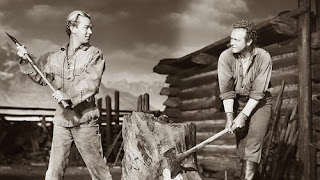
Marian
asks Joe to invite Shane to stay the night, pushing to keep the cowboy around.
Shane, trying to show that he is worthy of their hospitality, and trying to
make a transition to a farm hand, is outside taking an axe to a huge tree stump
close to the house. Joe had been fighting for a long time by himself to get rid
of the tree remnant. Together they chop at it into the night, and the fit,
shirtless Shane and Joe finally are able to use their combined strength to
unearth the stump. It’s as if Shane has brought increased manliness to Joe,
empowering the man.
The
next morning Joey wakes up to see a deer looking for food and water near the
house. Showing his desire to grow into a frontiersman, he pretends to shoot it.
He comes across the already awake Shane who slept next to the house. Joey wants
Shane to teach him how to shoot, and wants him to stay, since his father has
delayed showing him how to use a gun. Joey says he heard his dad say to his mother
that he wanted Shane to stay to help with the work, but not fight his battles.
It is interesting that the male ego is not threatened by needing help to do
work, but feels undermined when the man is unable to fight alone, as if
violence is a more defining male feature.
While
Joey stays with his father as he does chores, Joey asks if Shane will teach him
to shoot. Joe says he will do it when he has the time, which shows his desire
not to be usurped in his fatherly role, but which also demonstrates how his
current role of a family man and tending to the land has taken precedence over
other traditional manly activities. Joe admits, however, that he probably can’t
shoot as well as Shane, since he knows Shane has probably used his gun more
often not being occupied by other activities, and he observed his quick
reactions to any threats. Shane went into town to get supplies but didn’t wear
his guns, and Joey wants to know why. Joe says he doesn’t wear one himself, but
Joey says wearing guns suits Shane, as the boy is aware of the difference between
his father and the cowboy. The boy then asks if his dad could beat Shane in a
gunfight. Young boys want to emulate their fathers usually, so they want their
hero worship to be justified. Joe maturely, though unsatisfactorily, answers by
saying there’s no need to know the answer to his boy’s question since Shane is
on their side. Joe may be feeling intimidated, however, by his family’s
attraction to Shane.
Neighbor
Ernie (Leonard Strong) rides up and says the Rykers tore down his fences and
let cattle damage his wheat fields. He is ready to bolt because of the
harassment. Joe convinces him to meet with others at his place to come up with
a plan. Ernie wittily points out his frustration by saying the get-together
better come to more than just poking “fingers in the air,” which amounts to
angry talk and no action.

At
the general store, Shane buys some work clothes and feels strange as he says he
hadn’t bought clothes in a while. He is not used to anything resembling a
domesticated life. It’s sort of like a skin graft that might be rejected. The
Rykers are next store and get wind of a “sodbuster” there, which they
derogatorily call “pig farmers.” The desire to settle down and be more
civilized draws humiliating insults from the more savage leaning men. Shane just
wants to buy “soda pop” for Joey, and the store owner, Grafton (Paul McVey),
notes in a sad voice that he wishes more men would drink the harmless liquid,
implying the alcohol is fueling repulsive behavior. Grafton is a man who would
like to live in a civilized world but must still make a living and so must sell
whiskey. When Shane goes to the bar to order the soda, Chris
Calloway (Ben Johnson), who is with the Rykers, begins the to inault the Shane.
When Shane asks, “You speakin’ to me?” and Calloway says, “I don’t see nobody
else standin’ there,” we may have the origin of Robert de Niro’s psychotic
version talking to himself in the mirror in Taxi
Driver. Calloway then throws whiskey onto Shane’s new work shirt and says
now he smells “like a man.” The implications here is that drinking something
that submerges one’s rational ability helps to define what constitutes a male.
Shane, not giving into his what drove his violent past, stoically takes their
derogatory behavior and leaves.

The
homesteaders meet at Joe’s place that evening. When Shane shows up, one
man says he didn’t like going out at night, and another remarks he won’t move
until “the shootin’ starts.” So, there is the suggestion that some of these men
have left their violent ways behind them. Torrey (Elisha Cook, Jr.), a man from
Alabama, shows up, and he heard about what happened at the bar. He says they
can’t count on Shane if it comes to a fight against the Rykers. After they say
that Calloway bragged about how he ran Shane out, Joe tries to cover for Shane
by saying he told Shane to avoid trouble. Shane walks out saying they can speak
more freely without him there, but he really doesn’t want to hear his manliness
being questioned. Joe tells them they should go together as a show of force
when they need to buy supplies in town. Torrey, who has tried to give up his
fighting ways but doesn’t want his masculinity questioned, brags that he
doesn’t need any bodyguards and only requires his gun with him. In response,
one of them mocks Torrey, playing the rousing “Dixie” and then “Beautiful
Dreamer” on the harmonica.

Joey,
listening in his bedroom to what the others are saying, tells his mother he
can’t believe Shane backed down, since he already has built the stranger into
his macho hero. Shane is outside the room in the pouring rain, and Marian opens
the window. Joey says he knows Shane wasn’t afraid. Shane says it’s a long
story, and Marian has some insight into the man and says she knows, and smiles
warmly as she says Shane’s name. She urges him to come in out of the rain, a
sort of invitation suggesting he doesn’t have to feel like an outsider here.
After Shane walks away, Marian tells Joey not to like Shane too much, because
she knows he will not be staying, and then her son will be hurt when he leaves.
She can see he is a troubled man and keeps moving to try to escape his past.


Joe
and his family are getting ready to head out to meet up with other homesteaders
and their families to go into town. Marian is slowing them down, and Joe voices
the sexist attitude to Shane that one thing about marriage is a man has to get
used to waiting for his wife. He says that it’s worth the wait most times,
since Marian looks so pretty, and advises Shane that he should hold out for a
woman worth waiting for. Joe doesn’t seem to realize that he is talking up his
wife to a man who is attracted to her. But, Shane is also envious of Joe having
a family and being settled, while at the same time he is incapable of living
such a life.

In
town, the families plan an anniversary party for Joe and his wife, and one of
the wives says Shane is invited. He is now surrounded by a domestic group of
people trying to live decent lives, asking him to join them. However, next to
the general store, which represents this settled life, is the underbelly of
this world, the bar, where the Rykers and Calloway hang out. Joey gets some
candy for returning his soda pop bottle, but Shane deliberately goes into the
lion’s den in the bar to return the bottle, trying to redeem his earlier
behavior. Calloway starts in on him, reminding him that he should stay out of
the bar, and be with the “women and kids, where it’s safe.” Calloway’s words
are meant to emasculate. Shane tells him not to “push it,” but of course the
man does. Shane orders two whiskeys and says he has to return the favor, so he
throws both drinks at Calloway. Shane proceeds to punch him literally and
symbolically out of the testosterone laden bar into the “women and kids” area
of the store, reversing the castrating image. Some of the farmers tell the
others to stay out of it, since it’s not “their fight,” and they don’t want to
suffer the ramifications of it. The scene, temporarily, reminds one of Gary
Cooper in High Noon, not getting the
support of others and having to fight alone. (Although High Noon was released earlier, this movie was completed first, but
delayed because of editing).
Shane
and Calloway trade punches, but Shane beats him. Joey secretly entered the bar and
witnesses the fight. He is eating his candy, showing his youthful innocence,
but when Shane lands a hard punch, Joey chomps hard down on his treat, as if
his potential for adult brutality is overpowering his childhood. Rufus Ryker
sees that Shane would be an asset, and tries to recruit him, but Shane will
have nothing to do with him. Rufus, who doesn’t understand honor or loyalty,
implies that Shane is sticking around Joe because of his pretty wife. Shane is
outraged at the comment. Rufus then says he’ll make Shane pay dearly for his
actions. Joey comes up to Shane and says there are too many to fight and he
should leave. It is a wise bit of advice, but Shane does not want to show that
he will back down again, so he takes on a whole bunch of men. He does well
until they finally get a hold of him and Rufus begins to pummel him. Joey tells
the others and his dad enters with a club )A phallic symbol?). Together he and Shane beat the
others away. Grafton, who continues to represent an evolved male, tries to stop
the fighting, and convinces Joe and Shane to leave. Joe seems invigorated
as he lets his savage nature surface, spurred on by Shane’s willingness to
fight the villains. But Rufus promises the next time they meet up there will be
lethal force used.
Marian
tends to the men’s wounds, and says they were “wonderful,” which reflects the
expected traditional reaction by women who sought protection from men in a
hostile situation. The men also show prescribed modest attitudes, with Joe
saying Shane did most of the fighting. When Joey says he thought Shane was a
“goner” when hit with a chair, Shane says humorously, “It was an easy chair.”
Even though Marian says medicating Shane’s head wound will hurt, Joey says
Shane won’t complain. The boy is already subscribing to the code of the western
hero. Shane can hear Joey telling his mother in the boy’s bedroom that he loves
Shane, “almost as much as I love Pa.” Shane looks concerned, because he knows,
just as Marian predicted, that he will eventually be moving on. He walks out so
as not to embarrass Marian when she comes out of Joey’s bedroom. When she does
leave Joey, Joe comes out of their bedroom and Marian asks Joe to hold her
tight, almost to reassure herself that she is with the right man.

Ryker
sent for Jack Wilson (Jack Palance), a gunfighter, who arrives at Grafton’s
store. Torrey visits Ernie, who is ready to leave after the Rykers killed his
sow and scared the family. While Torrey is there, the Rykers drive a herd of
cattle onto Ernie’s land to damage his property. Torrey still wants to stay,
but the fierceness is not as strong in his voice. Shane and Joey see the Rykers
as they shout insults across the fields. Joey says that they have cut other
farmers’ fences. Shane tells Joey that he would ask them to come through the
gate instead if they tried to cut their fences. Shane is trying to model for
Joey what peaceful men should do, although he knows that the present world
won’t accommodate that behavior. Joey had previously wrapped up Shane’s guns in
a blanket, as if putting the violence in Shane’s past to sleep. But the boy now
admits that he would like Shane to show him how to shoot. Shane then unwraps
the guns, as if awakening the need to use deadly weapons.


Shane
agrees to show Joey how to shoot, and demonstrates that he knows quite a bit
about being a gunslinger, mentioning the different ways men draw from various
holster positions. After Joey asks him to shoot something, Shane fires quickly
and hits a target. The sound of the gun is exaggerated, almost sounding like a
cannon going off, startling Joey, and Marian, as she approaches. It is the
first time a gun is fired in the movie and director Stevens wanted to jolt the
audience with the noise. Joey is impressed, but Marian is concerned, and ends
the lesson, telling Joey to get ready for the Independence Day celebration.
Marian tells Shane that guns won’t be part of Joey’s life. Shane, almost
sounding like a representative for the NRA, says that a gun is a tool just like
a shovel (not the best analogy, since shovels aren’t meant for killing), and
says, “A gun is as good or as bad as the man using it.” Of course the problem
lies in the fact that there are many bad men who have access to guns, then and
now. Marian, offers the counter argument, saying that they would all be better
off, “if there wasn’t a single gun left in this valley,” including Shane’s gun,
which shows she is worried about his safety, too. Joe comes riding in and is
excited by seeing Marian wearing her wedding dress, and he tells Shane to get
ready to celebrate the Fourth of July, which is also the day of Joe and
Marian’s anniversary. His entrance stresses Joe is wedded not only to his wife,
but to his country’s founding principles of freedom from outside tyranny.
While
the celebration takes place, Grafton tries to dissuade Rufus from initiating
violence. Rufus says he hasn’t used guns sooner, but he considers the
homesteaders to be squatters, and he now must escalate. Wilson has a malicious
smile on his face as Rufus speaks. Grafton says he upsets Rufus because, in a
way, Rufus is hearing his own conscience bothering him. But Rufus sneers at the
word “conscience,” because unlike Grafton, he has no evolved sense of right and
wrong. Torrey enters the saloon, and Grafton asks what he wants. Torrey summons
up his courage and asks for a drink. He makes a sarcastic toast to Rufus for
having run Ernie off of his land. Torrey says that Ernie was a coward, but he
is not, and he’s staying. Rufus quietly says that Wilson could easily get
Torrey to draw which would give Wilson a reason to gun him down. But, instead
they decide that Joe is the one they want, being the leader of the resistance
to the Rykers. Torrey, emboldened by getting away with his angry words, breaks
the saloon door as he marches out, adding to the atmosphere of violence.

The
party has dancing, contests, and fireworks. To emphasize that the United States
is a land that welcomes immigrants, Axel (Douglas Spencer), a Swedish farmer,
is a friend of the Staretts, and introduces them to the crowd as they have a
double reason to celebrate. Joe, demonstrating his domestic bliss, says he
wouldn’t trade places with anyone, and gives Marian a kiss. Shane looks
downward, showing his envy for what Joe has. Shane does get to dance with
Marian, and he is all smiles while doing so. Torrey comes by and describes the
gunfighter, whom Shane recognizes as Wilson, noting he’s a fast draw. Torrey suspiciously
says that Shane seems to know a lot about the gunslinger business. Torrey says
he doesn’t want any part of it, saying the men in that profession are involved
in murder. His response seems to be noting it’s one thing to defend your land,
but it’s another to make a living out of killing others.
Joe
and his family return home from the celebration to find Rufus and Wilson at
Joe’s place. Rufus proposes that Joe work for him, and he’ll pay him a good
price for his land. Joe refuses, and Rufus says that men like himself “Made
this country … with blood and empty bellies.” He says he was wounded fighting
Native Americans and fought cattle rustlers. He represents that first wave of
tough frontiersmen and is reluctant to give way to the new generation of
settlers who benefited from his sacrifices to make the land safe. Rufus says
the farmers drain off the water that hurts his cattle. Joe says traders and
trappers came before Rufus’s people and tamed the land. He says that Rufus
doesn’t have the authority to say nobody else has rights under the law. Joe is
making the argument that the settlement of the territory must progress, and the
ranchers who came before can’t stop others from settling there.

In
town, Wilson sees Axel and Torrey riding up and is ready to gun Torrey down.
Rufus doesn’t want any brush with the law, so he wants Wilson to do his dirty
work, making it look like a legitimate self-defense if there’s violence. Torrey
wants to get a drink, but is confronted by Wilson, sneering as usual, who goads
him about the Southern Rebels being trash. Torrey starts to draw, but stops.
However, Wilson shoots him, and it justifies the shooting to Grafton after Axel
confirmed that Torrey drew his gun.
After
Axel tells Joe about Torrey, Joe says he will go into town to confront the
Rykers and Wilson. Axel thinks the other homesteaders will leave, so Joe first
visits the other settlers, telling them they must stay to attend Torrey’s
funeral. After the funeral the others are ready to depart, but Joe says they
can have a “settlement” which implies putting down roots. He says they can
honor Torrey’s memory by having churches and a school. But one of them notes
that also includes graveyards, adding a sense of doom to the talk. Shane says
they have a right to stay there and grow, and not give up. Joe says that this
land is for more than just people like Rufus, suggesting that things must be
allowed to change. After one of their homes has been burned down, the others
say they will help as a community to rebuild, stressing the desire to create a
place where the preservation of individuality must allow for social
responsibility.
Rufus
sees Joe as the cement holding the farmers together and vows that he has to go.
Joe wants to confront Rufus, which is what Rufus wants. Marian pleads to Shane
to convince her husband not to go. But Shane says he can’t tell Joe what’s the
right thing to do, since it’s a complicated situation where doing nothing means
surrendering his land and his rights. The Rykers invite Joe to a meeting at
Grafton’s, saying Rufus is a reasonable man so as to lure Joe into a trap.
Calloway, having gained admiration for Shane, doesn’t like an ambush, and
admits to feeling a change come over him, and he quits Ryker’s gang. Shane and
Calloway shake hands as Shane thanks him for the warning, demonstrating an
evolutionary movement away from anger and violence to one of mutual respect.

Joe
says to Mariane that he can’t show cowardice that would disgrace his wife and
son. It appears, given the circumstances, he feels forced to abandon civilized
behavior. Mariane tries to stop him. But if anything happens to him, Joe says
that he knows she’ll be taken care of. His words suggest that she will have
Shane there for her. Shane shows up wearing his guns and he tells Joe he is no
match for Wilson. Marian tries to stop them, saying that the little land and
their shack of a house isn’t worth losing life over. But there is a dignity in
the code of men that makes it difficult to back down from bullying and
injustice. Shane fights Joe to save him. Animals squeal, reflecting the animal
instinct in men to fight. Joey is angry about Shane knocking out Joe with a
gun, but apologizes when he realizes he was trying to save his dad. Marian asks
if Shane is doing this for her, sensing his affection. But, Shane says he is
doing it for the family, reflecting a need to use violence in the short term to
preserve the peace in the future.

Joey
follows Shane to Grafton’s store. Shane tells Rufus his days are over, but
Rufus asks what about Shane’s life as a gunfighter? Shane says at least he
knows his time is done, illustrating that he has insight into the need to
progress away from brutality. Wilson squares off, ready to fight, and Shane
calls him “a low-down Yankee liar,” echoing the dead Torrey’s words in a bit of
reckoning for how Wilson had killed the man from Alabama. Shane kills Wilson
and then shoots Rufus who draws on him. Joey warns Shane about a man with a
rifle from the balcony, and Shane takes him out, too.

He
tells Joey that he has to ride on because “A man has to be what he is.” By
staying with Joey’s family, he tried to “break the mold” but “it didn’t work”
for him. But Shane says whether it’s right or wrong, “there’s no going back”
from a killing. It brands one, and Shane does not belong in this place where
they are trying a way of life that omits that kind of violence. He tells Joey
to let his mother know there are no more guns in the valley, like she wanted.
In a way Shane was cleaning up that part of land so civilized life could be
built upon it. But Joey sees blood on Shane and knows he was wounded. He says
the famous line, “Shane! Come back!” but Shane rides away. Will he die? If his
time is over, it is a possibility, possibly because sacrifice is needed for a
peaceful world to exist.
The
next film is Cool Hand Luke.


