Showing posts with label Emma Thompson. Show all posts

Sunday, December 8, 2019

Stranger Than Fiction


SPOILER ALERT! The plot will be discussed.
This delightful realistic fairy tale plays with the idea that art imitates life, and shows how life is influenced by art. It also depicts how, in the face of life’s struggles that eventually lead to death, people are saved in a variety of ways. The movie does an excellent job of balancing serious issues with humorous moments and dialogue, as it explores the shifting line between tragedy and comedy.
The film begins with a woman circling want ads and a boy receiving a bicycle as a gift. Then there is Emma Thompson’s voice saying what follows is a story about Harold Crick (Will Ferrell) and his wristwatch, which the camera zooms in on after the shot moves from outer space to Harold’s apartment, suggesting how larger forces interact with an individual’s life. Thompson (in another wonderful performance) is Kay Eiffel, a writer, so it is appropriate that she is telling a story. This performance is my favorite Ferrell role. He has stuck to comic, often silly, movies, but here he shows that he has range and can bridge the area between comedy and drama with underplayed acting.

Eiffel says Harold “was a man of infinite numbers.” He spoke little since mathematics, not words, ruled his life. The narrator notes that Harold brushed his teeth each day seventy-six times, thirty-eight in one direction and thirty-eight in another. For twelve years he tied a single knot in his tie to save time compared to a double knot, but his wristwatch (which has anthropomorphic attributes in this tale) thought it made his neck look fat, “but said nothing,” silence being what is expected of a watch. The implication here is that although human, Harold is likened to a mechanism, while his watch, an object, is like a person.  Harold also ran to catch his bus, with an apple in his mouth, at the same rate each workday. When he ran, his watch would “delight” in the wind “rushing over its face,” demonstrating that at this point it, ironically, has more emotion than the person who is wearing the timepiece. The film’s visuals display numbers on the screen throughout the movie to stress the arithmetic that Harold has allowed to determine his world. 

Harold is a senior agent at the Internal Revenue Service, a place that primarily deals with numbers, and he reviewed the exact same number of cases each day. He is like Rain Man in his ability to calculate sums as his co-workers test him (and interestingly, Dustin Hoffman is in this movie). He would take exactly 45.7 minutes for lunch, as his life is parceled down to fractions of time. His wristwatch lets him know exactly when to perform each action, showing Harold dwells in the safety of a numbers-driven technological environment. His life is as inhuman as his calculations, devoid of social interaction, since he walked, ate, and slept alone. The narrator says that, “on Wednesday, Harold’s wristwatch changed everything.” It’s as if Harold’s regimented life might be subverted by his underlying need for the personal touch.

For stories to be interesting, there must be twists. But, it is not only the change in his watch that supposedly alters the story. Harold now hears Eiffel’s voice announcing his every measured move, and he confusedly calls out to whoever is saying what he is doing. Fiction and reality here become one in this story within a story (but we are watching a movie so the overall structure is fictional). The Voice says that ironically Harold’s numbers-based existence “would become the catalyst for an entirely new life.” It’s as if hearing this omniscient narrator alerts Harold that he is about to embark on a different way of living.
Because the Voice makes him conscious of his automatic activities, Harold changes his movements as he reflectively observes himself, and the numerical pictorial graphics crash to the street as he slows his usual pace, showing how he is now capable of breaking free of his routines by becoming self-aware. Of course his initial reaction is one of confusion and fear. He no longer can concentrate on his work because of the intrusive narrator. He believes he is “being followed” by a woman’s voice. He is standing in an isolated, sterile white filing room at the office, reflecting on the barrenness of his world, and for that matter, every person’s life that is dominated by boring routine. He tells his co-worker, Dave (Tony Hale), to listen to the Voice (which Dave can’t hear) as he places a folder into a box. The narrator likens the sound of the interaction of the two objects as “a wave scraping against sand.” The Voice says that for Harold the sound could signify “what he imagined to be a deep and endless ocean,” which Harold confesses he actually felt. Here, art, in this case the story, lends poetic language and insight into the endless repetition of the Groundhog Day life many people live. 
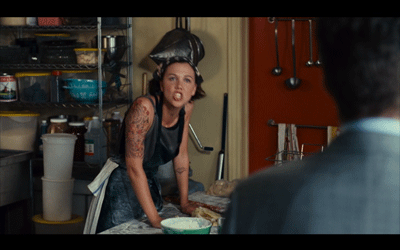
A female co-worker approaches the two men and robotically drops off the new audits. In a monotone she says, “have a good day.” This small incident shows that Harold is not alone in his humanity-denying existence. He takes the baker, Ana Pascal (Maggie Gyllenhal in a great performance), to investigate (the screenwriter, Zach Helm, noted that he used the names of mathematicians for his characters to mirror Harold’s life and those living worker bee lives). Ana is a tattooed woman who is dynamic in her actions and speech compared to the stiff Harold. She slams dough around her work area as she curses the “taxman,” with others in the eatery joining in on the scorn (because, let’s face it, even if you grant it’s necessity, nobody likes taxes). She admits to deliberately paying only seventy-eight percent of her taxes, because although she supports using funds for certain government programs, she does not approve of excessive spending on defense programs, “corporate bailouts and campaign discretionary funds.” She included a letter with her tax return addressed to the “Imperialist swine.” He asks if she belongs to an anarchist group, which she comically points out that would be a contradiction in terms. 
The Voice intervenes, saying that Harold, although not prone to fantasies (ironic, since this story is one) can’t help but be sexually aroused by the passionate baker (a profession that stresses satisfying physical appetites. But, “pascal” suggests Easter, which deals with resurrection, hinting at the woman’s effect on Harold). She tells him that he is staring at her breasts, and he tries to cover up his carnal observation by saying if he was doing what she said, “it was only as a representative of the United States Government.” It’s as if he is trying to convince himself that he can only allow himself to be interested in her in an official capacity. He can’t continue and says he will return.

Outside, Harold uncharacteristically yells at the Voice to “Shut up!” His automaton facade is breaking down. He looks up at the sky as he screams, as if cursing God as the camera pulls back upward away from him. The next counterpointal shot is from high up on a building rooftop as Harold’s God looks down on the people below. It is Eiffel, the writer whose voice Harold was hearing, and who supposedly has the fate of her characters in her hands. She waves her hand above some people below, which is followed by a man with a hose diverted by a boy on a bike (remember him from the first shot?), and the man accidentally sprays a woman (the one at the beginning looking for a job in the newspaper). Random people become connected by God, or in the case of a story, the writer, (and here the screenwriter who makes the writer a character, too) an artist, who like a divinity, has the power to create. 
The writer appears to jump off the roof. But that is a fiction, as she contemplates her own imagined actions, and is really waving her hands while in her apartment while standing on a desk. Penny Escher (Queen Latiffah) comes in and asks if she is Miss Eiffel, a name that shows how she towers above her subjects, but, given her imaginary jump, also implies the precariousness of her position as she struggles with the writing that in her case points to how she, too, feels powerless over the direction of her story. Eiffel says she was doing research standing on her desk (where she writes) imagining a demise from a jump from a building. Penny was sent by the publisher to be a secretarial assistant. But Kay Eiffel sees her as a spy because the publisher believes she has writer’s block. The author doesn’t want to admit to the stunted storytelling, and with a straight face won’t admit that her chain smoking is due to her anguish, saying humorously the cigarettes came “pre-smoked.” She asks Penny what she thinks about jumping off a building. She wants to explore the depths of human nature, and dismisses the idea that Penny doesn’t think about those negative things, only wanting to feel happy. Eiffel says everyone has thought about the nature of suicide. Eiffel would want to argue against those who only want art to divert, and people to be in denial about the darker aspects of what it is to be human. Eiffel says that she saw a picture where a person leaped off a building, and her face looked serene in death. Eiffel thinks it’s because the jumper enjoyed the wind rushing past her face (the way she described what Harold’s wristwatch felt, its mechanical face having the sensation of a human face. Maybe Eiffel is suggesting even a person living like a machine can enjoy life’s sensations, even if it must coincide with the death of the robot-like body).

Eiffel believes Penny was sent because, “I don’t know how to kill Harold Crick.” All God’s children have to die, but it is still disconcerting, even in a story, to hear that causing an individual’s death is premeditated. In the human realm, that act is called murder. Eiffel is antagonistic toward Penny as she struggles with her plot. Penny says she has helped twenty authors complete thirty-five books, and “never missed a deadline.” So, despite Eiffel’s dismissal of her ability to help, Penny says she can contribute to the solving of the writer’s problem. It appears at this point, Penny is only there to help Eiffel meet her contractual obligation.


At work, Harold receives an email, not very personal, from Dr. Cayly (Tom Hulce) to report to Human Resources. Cayly, sporting a New Age look with necklaces and appearing like a phony latter-day hippie, says he had a “convo” with a fellow employee who said Harold was acting “wibbly-wobbly.” Cayly wonders if Harold is experiencing “cubicle fever.” Harold sits in a chair in front of a large phony backdrop depicting the sky with clouds. It probably is meant to make a person entrapped in one of those cubicles feel like the worker is outside. But Harold may feel like his head is starting to soar above the mundane, as the clouds appear to be moving behind him, despite his denial that anything is “wrong” with him that would prevent his ability to perform his bureaucratic duties. The Voice calls Cayly an idiot as the man talks about “trees” being trees. Harold can’t dispel the smell of brownies from the bakery and the seductive nature of Ms. Pascal. Cayly tells Harold he should take an overdue vacation, which turns out to be good advice.

While on the street, the Voice says that Harold’s watch was acting up, and Harold never paid attention to it except to find out the time, which, according to the Voice, drove the watch “crazy.” Again, the instrument takes on human characteristics, as the machine apparently has more of a will than does Harold at this point. The Voice says that the watch then stopped, and would become an instrument of “fate” leading to Harold’s death. When Harold hears about his impending demise, he uncharacteristically yells out alarmed questions about this prediction among startled people waiting for the bus. He goes back to his apartment calling for answers as he duplicates the circumstances when he first heard the Voice, ritualistically brushing his teeth. But the communication is only one-way, from writer to character. Since Eiffel is unsure as to how to do away with Harold, no further information is forthcoming. In a frustrated frenzy, Harold becomes his own narrator, describing how he is shaking a lamp around, smashing it to the floor, and kicking it. In a sense he has taken charge of his actions in a sort of emancipation. He continues to narrate as he trashes his place. He addresses himself in the third person, like he is now the author, and describes himself as “distraught,” a human emotion he has not allowed himself to experience.


Harold sees a psychiatrist, Dr. Mittag-Leffler (Linda Hunt), who says what he is describing is schizophrenia. He disagrees because with that condition, a voice tells the person to do something. But the Voice Harold hears describes what he has already done, or is doing, “accurately and with a better vocabulary” than he would be able to produce. Harold correctly says that the female Voice talks about him like he is “a character in my own life.” The problem is the Voice comes and goes, so he does not have access to the whole tale, and needs that information to prevent his death. He doesn’t want medication and asks if what he is hearing, even if it is in his own mind, is a story about himself, then what would be her advice. She says to go see someone who knows literature, which Harold thinks is a good idea. 
Now is where Hoffman’s character, Professor Jules Hilbert, appears, and he says it is “dramatic irony” that the narrator won’t say how long Harold has to live. So, we have been presented with real life, fiction and its interaction with reality, and now we have a literary critic to analyze this combination. Hoffman is very funny as his character delivers rapid lines without inflection as he performs other actions, including brushing his teeth or giving swimming lessons. He asks insightful questions, such as the number of steps they climbed, or the number of ceiling tiles in the bathroom, noticing Harold was counting. The professor has made an accurate conclusion about Harold’s mathematical obsessive-compulsive disorder. Hilbert wants to know if Harold was ever married, finding out that the taxman was engaged to a fellow auditor who left him for an actuary. Hoffman comically comments on the blandness of the life of numbers by saying, “How heartbreaking.” He finds out Harold lives alone and has no pets, which points to his socially vacant life. Hilbert discovers it is an unfamiliar woman’s voice doing the narration, and that Harold is worried about her death prediction since she was right about how he disliked his job. At first Hilbert dismisses his ability to help since he is a literature person and Harold’s story doesn’t sound very literary. But when Harold says that the Voice said to him, “Little did he know ...” Hilbert becomes interested since that phrase is a literary convention, and he says he wrote papers on “little did he know,” and taught classes on it. (Being a person who attended graduate school as an English major, I can attest that is the kind of overly scholastic statement a professor would say). His conclusion is that Harold doesn’t know what is happening which moves his story away from a purely psychological problem to the professor’s area of expertise. Hilbert is here to help, but like Penny, it is not yet personal for him, since he asks Harold to come back on Friday, but then remembers the man’s death may be “imminent,” so he might be dead soon, and Hilbert doesn’t want to miss out on this intellectual project. He wants Harold to show up the next morning.
The Voice announces the arrival of Ana on the bus on which Harold is riding just as he is questioning his way of life. She wants to avoid him, but the rocky ride places her in a chair near him. He apologizes for “ogling her,” and she accepts his being sorry for his poor manners. He jokes now, a departure for him, because of her rebellious ways, asking if she is going to a flag-burning event. She returns the humor saying she was going to her “weekly evil-conspiracy and needlepoint group.” He continues the funny exchange by saying he can’t join her because he left his “thimbles and socialist reading material at home.” Ana laughs and the Voice says that Harold didn’t want to ruin the meeting by making a fool of himself, probably being aware of his social inexperience, and left the bus many blocks before his stop. 

Harold visits the professor as arranged. The scholar has several questions from a literary stance about the Voice, and again Hilbert does not seem considerate of Harold’s feelings. His questions imply that Harold lives in a world of fiction, asking him if he has received any gifts, like a wooden horse, referencing The Iliad. He wants to know if Harold is the king of anything, and makes references to trolls. Harold, who is having a fantasy experience, still finds the questions ludicrous since otherwise his life is excruciatingly ordinary. Hilbert then ventures into other narrative elements, asking if Harold was ever made of “stone, wood, lye, varied corpse parts,” the latter referring to Frankenstein. The professor says he is attempting to find out what kind of story Harold is in, and he has ruled out much of Greek literature, several fairy tales, Chinese fables, and that Harold is not Miss Marple, Scout Finch, or a “golem.” The professor believes Harold should be relieved that he is not one of the latter. Hilbert seems outlandish, but so is Harold’s predicament.
Meanwhile, Eiffel is out in the pouring rain with Penny as the writer imagines herself driving and going off a bridge to her death after avoiding that child on that same bicycle. She is taking what she has physically perceived and is attempting to transform those impressions into part of her story. Ironically, the opposite is true, since her fiction has manifested itself into Harold’s actual life simply by calling her character Harold Crick. Penny says that many people die from pneumonia by exposing themselves to inclement weather, voicing her disdain for being outside in the storm. Eiffel’s attention is only drawn to how she might give Harold pneumonia instead of worrying about her own health. Her immersion into her tale has removed her from being part of reality, just like the characters in a book. Penny now is showing more concern for the writer than her work by bringing her nicotine patches to help (that word again) her quit smoking. Eiffel is not interested in nicotine patches for her own well-being, as she notes she is not “in the business of saving lives” in her writing, but just “the opposite.” Her fiction mirrors her outlook on life, at least at this point.

The movie shifts back to the professor asking Harold questions. Harold’s favorite word is “integer,” which is funny, sad, and appropriate. Harold confesses to only wanting one thing more out of his life, which is to play the guitar. So, there is this seed of whimsy and artistry hidden inside his tamped down personality. Hilbert says they must determine if he is in a “comedy or a tragedy.” He says literature has the opposing elements of continuity of life and the inevitability of death. He says (and these are standard elements of the two forms) in comedies the protagonists get married in order to produce offspring, and in tragedy the main character dies. Hilbert points out that in comedies, the romantic interest enters and initially hates the protagonist. Harold tells Hilbert that he met Ana who despised him. Hilbert says it sounds like the making of a comedy, and Harold should develop that, as if he is giving an assignment to a creative writing student. Only Harold’s story is taking place in reality (although not really, because, yes, it is a movie). The film here is investigating, within a fictional story, the conventions on which it is based, reflecting on the world of art which it is a part of. But, it also is stepping outside the traditional narrative structure by satirizing standard storytelling by commenting on it. 

Harold tabulates what interactions with Ana seem like they fit under the comedy and tragedy headings. She says she is paying only what she believes she owes, and he tries to make a joke by saying he needs to know the amount of her delinquency to determine the “size of her cell.” The remake doesn’t go over well, so he gets down to business, trying to make sense of her mess of tax files. Her messy life and the eccentric customers in her bakery contrast with Harold’s mathematically precise mindset. 


At the end of the day auditing Ana’s sloppy records, the bakery is closed and she offers Harold a cookie. He says he doesn’t like them, which is like admitting he does not sensually indulge himself in anything. His mother didn’t bake and he only ate store-bought cookies as a child. Despite her animosity for Harold’s job, she shows compassion for him, helping him (the movie’s primary theme), and offers him a chance to enjoy himself. Acting maternal and nurturing toward him, she gives Harold milk with his cookie and tells him to dip it. He deeply enjoys the new experience. He asks when she decided to be a baker, and it happened while she was a student at Harvard Law School, which one would not have thought she attended. She dropped out and says she barely was admitted, mainly because of her essay about wanting to make the world a better place (more helpfulness). She still seems committed to that enterprise based on her resistance to certain government spending noted earlier. There are also postings on the bulletin board in the bakery about various humanitarian causes. Her good will efforts took the shape of her baking during late night study sessions with classmates, and that is how she found her calling. She made students happy, which improved their grades. She developed a following and decided in order to make the world a better place she would “do it with cookies.” As she lists the types of desserts she began to make, Harold looks aroused as the desires for satisfying appetites appear to stimulate him and bring him to life. She wants to give him cookies to take home, but he reverts to his rule-dominated stance by noting the offer would be a gift and it would compromise him if it came to light. She says that she wouldn’t tell anyone, but he says he should purchase the desserts. Because she feels she didn’t touch his humanity and he didn’t trust her, she becomes upset and tells him to leave. He realizes that she specifically baked the cookies for him, and was just being nice. He says he “blew it,” and after seeing all the tallied strokes on the negative side of his ledger, he concludes he is in a “tragedy.”

Back with Professor Hilbert, Harold says he has failed with Ana and in his attempts at making his story a comedy. Hilbert says it appears that Harold is driving the plot as he acts and the Voice responds to his actions. Hilbert, again commenting on the writing process we are actually experiencing as we view the story, says plots move forward either by external forces or by the behavior of characters. Harold’s story seems to be dependent on his actions, so Hilbert says do nothing, which will prevent his demise. Hilbert is starting to try to help Harold as a person, not a make-believe creation.

Harold tries to stay on his couch the next day, as he watches documentaries on animals being preyed upon or captured, which mirrors his fears about what is happening to him. He doesn’t even answer his phone. But as he watches his television, a huge crane bashes through the wall of his apartment. He yells at the demolition men, who accidentally were at the wrong address. Back with Hilbert, the professor, analyzing storytelling as usual, says “meeting with an insurance agent the day your policy runs out is coincidence. Getting a letter from the emperor saying he’s visiting is plot. Having your apartment eaten by a wrecking ball is something else entirely.” He concludes that Harold does not control his ultimate “fate,” and Harold also has come to the same sobering belief. 

As they continue their discussion outside the classroom, Hilbert says the narrator may very well kill him, so he should just live his life by having an adventure, or just “finish reading Crime and Punishment,” (I know I have thought I didn’t want to die before reading a special book), or eating “pancakes.” Harold is outraged that he should use the remainder of his life by just eating pancakes, but Hilbert is funny but insightful when he says that it depends on the life being led and the “quality of the pancakes.” If Harold’s life has been so unsatisfying, the consumption of good food may be the way to go. Harold says that what is happening is not philosophy or a story about him, it’s his life. Hilbert says he should then make his life the one he always wanted. Hilbert shows real concern for Harold’s status here. Actually, Hilbert’s remarks fit everyone, since we all are mortal, and we should ask ourselves what do we do to maximize the time we have? 
Harold crashes at his friend Dave’s place, since his own apartment has been literally crashed. Dave’s apartment looks like someone into Space Age technology decorated it. He, too, seems to want to break out of his dreary adult life by accessing the imagination of the child within him. That is why Dave says that if he knew he was going to die soon, he would go to Space Camp. His friend’s bucket list choice seems to inspire Harold. While brushing his teeth Harold defiantly changes the manner of his dental routine, trying to take matters into his own hands. He goes into a music store as the Voice notes how Harold counts all the instruments and their parts, showing how difficult it is for him to break his cold, mathematical preoccupation. He said before he always wanted to play the guitar, but the Voice says Harold seemed to only be able to “stand” there without doing anything. The Voice says that Harold had trouble finding a guitar that “spoke” to him, meeting his needs. The Voice is comical as she notes several funny lines the various guitars may be saying, including one with two long necks that said it was “compensating” for something else. The narrator says Harold spotted the one that called to him, a mistreated instrument (like Harold?) that still “spoke with conviction and swagger,” characteristics Harold possibly wished to exhibit. It said to Harold, “I rock,” while Harold in his life just let things roll over him.
 Eiffel is with Penny in a hospital emergency room looking for ways people might die. They observe a man being treated for a gunshot wound. The author is still trying to determine how to end Harold’s life, but the victim here was in a gang fight, and his situation doesn’t fit Harold’s non-gang member status. There is a man there staring at the patients, and Eiffel says he just likes to look at sick people. Penny humorously observes that Eiffel made her comment “oddly with disdain,” since that is exactly what the writer is doing. Eiffel says they are in the wrong place and need to see people who are lost causes. She tells a nurse that it’s fine that the people there are sick and suffering, but she needs to observe the terminal. The woman asks if Eiffel is afflicted with something, and she responds, “only writer’s block.” We laugh at her response, but she is detached from the world she is supposed to be channeling in her writing, and in that distancing she mirrors Harold and Hilbert, although the latter two are showing some emotional growth. 

The Voice says that with every “strum” of his guitar Harold “became stronger in who he was, what he wanted and why he was alive.” His music, a form or artistic expression (as is literature and film) adds human dimension to Harold’s soul. He now cohabited with Dave, so he was no longer alone, and ate his meals with his friend. He didn’t count brushstrokes while cleaning his teeth, or steps to a bus stop, and didn’t wear neckties (a form of bondage when you think about it). The impact of art is stressed as Harold goes to the movies (he views Monty Python's The Meaning of Life, appropriate for what Harold is going through) and did what song lyrics advocated, as he “lived his life.” There is a quick shot of Harold rising in an elevator, a metaphor for his ascending spirit.
But the narrator points out that “Harold’s journey was still incomplete.” Harold visits Ana, and he brings her “flours,” in numerous bags, not flowers, which would be the typical romantic gesture, since she is, after all, a baker. He tells her flat out that he “wants” her, and he really hasn’t said that to anyone before, expressing his needs. He now doesn’t care about breaking any rules that would prohibit such a relationship, and in that sense, he is connecting with her rebellious nature. 
She asks him to bring his gift up to her place. She makes him dinner (appetites being satisfied again), and he tells humorous stories about his encounters in his job. She has a guitar, but doesn’t play. He says he knows only one song, and she wants him to play it. His old instincts make him refuse at first, but he overcomes the resistance to let go of restraints, and plays. He sings “Go the Whole Wide World,” which urges a search for that special girl. She is won over, and passionately kisses him. She now says she “wants” him, too, and they make love.

Harold visits Hilbert and says triumphantly that he is in a comedy since the woman who initially hated him is now falling in love with him. Hilbert says that’s wonderful but it invalidates a list of seven living authors who could be writing his story given the tragic course his plot was following. In a coincidence (whose elements Hilbert described earlier), a contrived one here, Kay Eiffel, a favorite Hilbert writer, is being interviewed on the TV in the professor’s office. Harold realizes that it is Eiffel’s voice he is hearing, and the book she is writing, appropriately titled Death and Taxes, fits Harold’s situation. It is about, she says, not being able to connect with life and the “looming certainty of death.” When he tells Hilbert hers is the Voice, he is upset because she wasn’t on his list as the interview is ten years old, and she has not published anything lately and became a recluse. He taught a class on her writings, and he has tried to find her. He says she kills all of her heroes. Harold goes off to track her down through her publisher.

Eiffel is out getting cigarettes (a way of killing herself off, too?), and she notices a grocer spilling some apples, one of which rolls into the street, which reminds us of how Harold would chew on an apple on his way to catch his bus. She comes back to her apartment and tells Penny she knows how to kill Harold. She believes her way will be “ironic” and “possibly heartbreaking.” 

Meanwhile Harold is kicked out of the publishing house. But, he uses the IRS computer system (which, let’s face it, is one inclusive database) to acquire Eiffel’s phone number. She is now narrating Harold’s stifled attempts to make a call as the phones are down at his office and Dave can’t get a signal on his cell to help him. An old man is hogging the pay phone on the street. Harold goes into the subway and dials Eiffel’s number, and as she types “the phone rang,” Eiffel’s phone does in fact ring out. Eiffel is intrigued because every time she writes that the phone rings, hers does. She answers and Harold says who he is, tells her he knows she is writing about him, and even quotes passages he heard. Even though Eiffel is creating this tale, she thought it was all in her imagination. This revelation freaks Eiffel out. (There seems to be a flaw in the film here, since in Eiffel’s story, her version of Harold Crick doesn’t know about a writer composing his life; so then, why is she narrating about him trying to make a call to the writer narrating his actions?).


Harold shows up at Eiffel’s place, and Penny introduces herself as the writer’s assistant. Harold humorously returns the courtesy by saying his name and adds he is Eiffel’s main character. Eiffel is overcome by the fact that he appears exactly as she pictured him for her book. A writer wants to precisely envision his or her characters, but not to the point of actually conjuring them up. The implication is that people need to have the escape hatch of being able to separate fiction from reality. He points out that “the little did he know” line, which he accurately describes as “third person omniscient,” revealed that someone other than Harold was telling the story. He mentions Hilbert, and she knows him from his letters to her. He tells her that now that they met, she should realize that she can’t kill him. She falters, and Harold asks, horrified, if she has already written his demise. Eiffel is being forced to actually engage with someone on a real life and death basis instead of removing herself from the real effects of what happens to people, and which she only described before. She says she had written a rough outline on the bus on her way back from her cigarette run, but it wasn’t typed yet. So Harold’s fate is caught in a sort of transition stage. Penny, being sympathetic toward Harold, says he should be able to read what she wrote. Later, Harold provides a humorous and sad comment concerning his plight when he says, “I may already be dead, just not typed.” He was already dead spiritually until recently, but the typing of his actual demise is like the carrying out of the actual death sentence.

Harold visits Hilbert, explains the situation, says he can’t read how the story might end, and asks him to read it to advise him. Hilbert reads the story as we see a shot of that boy on the bike, which we know will play a part in some kind of accident. Hilbert offers his apologies but says the novel is brilliant, Eiffel’s masterpiece, and it won’t be great unless Harold dies in the end. He is arguing the importance of the transcendence of great art over the life of one person. He says that Harold will eventually die anyway, and another routine loss of life “won’t be nearly as poetic or meaningful as what she’s written.” Hilbert says that is what tragedy is because “a hero dies but the story lives on forever.” But there’s a huge difference between pretending about the eventuality of a death and actually causing one. 

Harold keeps riding a bus as he reads Eiffel’s story, being carried along by the narrative as the bus carries him around, as a passenger, because he is not the driver of the book or the vehicle. Penny enters Eiffel’s apartment and finds objects littered about. Eiffel is stretched out on her desk, like a corpse on a morgue slab, asking Penny about how many people she has killed off. She has killed eight people, and now wonders why every book she wrote concludes with a death, adding the characters were nice people. After he finished reading the story Harold returns the manuscript to Eiffel who is on the street. He tells her the writing is beautiful and it can only end one way to be great, as Hilbert had said. He seems resigned to endure the sacrifice. 
The Voice says that Harold concluded some unfinished business the night before his death. He visited Ana and she cooked for him, they watched some old movies, and they said they “adore” each other. He gives her a way of deducting all the food she gives away so she won’t owe taxes. She says she wants to make a point by breaking the law. He counters with he also wants to make the world better which means keeping her out of jail. The movie suggests true salvation comes from helping each other.


Harold picks up his human-like watch and leaves Ana in the morning. He gets dressed for work knowing what is supposed to happen. The boy who rides the bike awakes to his alarm clock. Harold handles an apple in his damaged apartment, and we, and he, know that piece of fruit will be there at his death. The Voice notes how things had changed for Harold over the past weeks. He thought he was not late for his bus on this day that he was to return to work. But he did not realize that when he asked for the time a month earlier, the person erred by noting the time was three minutes later than the actual time. Dependence on a set schedule to live your life can’t save one from harm because there are always outside forces to be reckoned with. If Harold had been on time, he wouldn’t have been at the stop when the boy falls off his bike and Harold wouldn’t have needed to go into the street to help the child. But he is there, and he unselfishly, yes, “helps” the boy. A bus then comes by and smacks into Harold as the apple rolls on the street (is the apple symbolic of the loss of innocence and expulsion from Eden?). Eiffel is a nervous wreck, racked with guilt, as she can’t light her cigarette and smacks the top of her desk on which her typewriter sits. 


Eiffel shows up at Hilbert’s office. She hands over her manuscript and says he may be interested in the new ending. Harold is not dead. He is badly injured, and in bandages in a hospital bed. Through the window of the hospital room is a large clock in a building, reminding us of how he used to live by what a timepiece displayed. Despite his fractures and head injury, a shard of metal from his watch obstructed a severed artery that kept the blood loss to a minimum, allowing him to live. The shard can’t be removed so it will remain in his arm. Is this a compromise of living with time but not letting it control us, becoming a tool, but not a self-torture device?


Ana shows up at the hospital and she kisses Harold, thankful he is still alive. He says he didn’t have a choice; he had to save the boy. The thrust here is that self-sacrifice should triumph over one’s desire for personal well-being. Back in Hilbert’s office, the professor reads the revision. Eiffel looks down from the window as she did previously on the rooftop, but she no longer waves her hand like an omnipotent god. He says the story is now only okay, because the ending doesn’t fit with the rest of the book. She says she’s fine with “okay.” She says she will rewrite the rest to fit the new ending. He asks why did she change the ending. She said it was a story about a man who doesn’t know he’s about to die and then dies. But, if he has that knowledge, and dies willingly, knowing he can stop it, then, she says, “Isn’t that the type of man you want to keep alive?” Eiffel has evolved from reflecting her pointless philosophy of life to accepting that we are all saved each day in some way. The title of her book is Death and Taxes, referring to the quote from Benjamin Franklin noting that these two things can’t be avoided. However, at least temporarily, Harold has given Ana a way to avoid paying her owed taxes, and he has escaped an early death.

Using the Voice, she now writes about her new attitude in the new book ending. She says that as Harold ate a cookie (something I find worth living for) he knew things were going to be okay. Eiffel says, “Sometimes when we lose ourselves in fear and despair in routine and constancy, in hopelessness and tragedy, we can thank God for Bavarian sugar cookies.” Or, she says we find salvation in someone touching a hand, or a “kind gesture.” There is then a shot of Dave receiving an envelope from Harold enrolling him in Space Camp. There is the “Subtle encouragement,” of another as Penny puts some patches on Eiffel’s typewriter to urge her to quit smoking. There is also the healing of “a loving embrace,” as the relieved father hugs his bike-riding son who is uninjured. And, the writer adds, there are other small things that make life better, even “maybe the occasional piece of fiction.” Her conclusion is that these small things are here to help and save our lives. And in this story, a wristwatch saved Harold Crick. So, the story of life can be a comedy, not a tragedy.

Next time, there will be short reviews of some recent films.


Sunday, August 18, 2019

2019 Recent Films


SPOILER ALERT! The plots will be discussed.

I thought I would change things up a bit and provide some brief comments on films that have come out in recent months.

Late Night

This movie is written by and stars Mindy Kaling, who has a personality that is almost impossible not to like, unless you are just into dark, depressing movies, which, I know, have their apocalyptic appeal. Her character gets a job as a comedy writer on Katherine Newbury’s (Emma Thompson) long-running late night talk show, basically as a “diversity hire.” Katherine has no female writers on her staff despite her supposed feminist ways. It’s a bit hard to accept that Molly, whose only comedy background is cracking jokes while working at a chemical plant, gets the job. She is a young fan of Katherine’s but the show does not appear relevant anymore. Katherine has a biting wit and can be difficult to work with. Some of her soft side comes through when dealing with her husband, played by John Lithgow, who has Parkinson’s disease. But, our sympathy for her is undercut since Katherine had an affair with the writing staff’s womanizer (High Dancy), who tries to put the moves on Molly, too. Katherine is reluctant to do topical humor, first appearing ready to use Molly’s abortion joke, but then deciding to skip over it at the last moment.

Katherine’s emotional side comes across when she witnesses Molly’s humor during a stand-up routine at a charity event. Katherine proceeds to go onstage and is genuine in her feelings about the possibility of her show being cancelled and is more vulnerable in her humor. Katherine starts to use some of Molly’s jokes and interacts more with the audience. The network still tries to replace her with a sleazy comic. Katherine fires Molly for telling her she’s wrong not to fight back, but eventually does stand up for herself, and rehires Molly. Time passes, and there is more diversity at the show and it is a success again.

Despite Kaling’s appeal, and Thompson’s talent, the film just doesn’t gel. The plot is not believable, and the jokes fall flat. The characters have no real depth to them. There is one hilarious scene, though, that satirizes the absurdity of untalented people who become “stars” on the internet. Katherine has a YouTube celebrity on her show whose claim to fame is her sniffing her dog’s butt and then fainting. The film argues that just because something is odd doesn’t make it worthwhile, and the proliferation of these type of mindless diversions contributes to the dumbing down of our culture.


Yesterday

Oscar winning director Danny Boyle’s comedy-drama presents a speculative story about what the world would be like if the music of the Beatles did not exist. It starts out with its focus on a somewhat talented singer-songwriter, Jack Malick (Himest Patel), living in Suffolk, England, who gets small gigs booked by his childhood friend, Ellie Appleton (Lily James, the “Apple” part of her character’s name suggestive of what is to come?). He is playing at a sparsely attended tent at a festival when there is a world-wide power outage. Jack, on his bicycle, gets knocked out after a bus hits him. Later, Ellie gets him a new guitar and he starts to play “Yesterday.” His friends think it’s wonderful and believe Jack wrote it. After realizing they are not kidding, he can’t find any evidence of the Beatles or their songs (or Coca Cola, cigarettes, and Harry Potter for that matter, suggesting the world would be quite a different place for the better and the worst if some things never came into existence).

He strains his memory to recall as much of the songs’ music and lyrics since there is no reference material. He sees this opportunity as a way for him to finally realize his dream of becoming successful. It’s great to hear the songs, but we realize that at this point Jack’s quest is self-serving. Despite the quality of the work, it still takes some time for a producer to want to record the songs, but Jack gets a boost from pop star Ed Sheeran playing himself. Jack eventually becomes hugely popular, but there is a bit of humor on how Jack’s rendition of “Back in the U.S.S.R.” is out of date given the fall of the Soviet Union. Some songs are of their time. In addition, the record company wants to change the name of the “White Album” to “The One and Only,” an ironically erroneous title since the songs belong to others, not to Jack. Sheeran also retitles “Hey Jude” to “Hey Dude,” illustrating how in the wrong hands a song can be greatly diminished.

As the story continues we learn that there are two other people who remember the Beatles music, and there is the suggestion that Jack will be revealed as a fraud. But, the movie takes an unexpected, and gratifying turn, in that the two show up at a major concert and are thrilled that Jack has brought the Beatles’ music back to life. Jack acknowledges to the world that the songs are not his, but were created by John, Paul, George and Ringo. He wants the music available for free. There is a shift away from Jack’s personal drive for fame to his understanding of the importance to ensure the world is enriched by the songs.

Another marvelous twist in the story is that Jack tracks down the still living John Lennon (Robert Carlyle, who, through digital enhancement and make-up, looks and sounds exactly like an elderly Lennon). Since Lennon didn’t become famous in this dimension, he was not assassinated, and is currently seventy-eight, and has had a wonderful life with his wife and children. The film poses the question as to which life was better for Lennon, one of fame and fortune cut down at an early age, or one of longevity and happiness? The movie leaves us to ponder the question, and the different ways that life can play out depending on the circumstances.

The long-simmering love between Jack and Ellie is consummated, they are married, and we hear him and school children happily singing the delightful, “Ob-La-Di, Ob La Da,” showing us that Jack can also be successful without fame.


Crawl

Okay, this movie probably swam past a lot of people this summer because there have been scary films about alligators before, and they have fallen into the B-Movie category, or even B-minus. Yes, this story is unbelievable in how the main characters can survive the onslaught of these nasty amphibians. But, the film works in many ways.

The main character is Haley (Kaya Scodelario), and we first see her competing in a University of Florida swim relay race. There are flashbacks of her as a child with her father, Dave (Barry Pepper), who was her gung-ho coach, calling her a “predator,” to encourage her when she lost a contest. This opening shows how she wants to live up to her father’s expectations, and how she is as much of a beast as the gators she will be confronting.

To add to the great atmospheric tension of the movie, there is a category 5 hurricane bearing down on the state, and Haley gets a call from her sister telling her that their father isn’t answering her calls. Their parents are divorced, and we later find that Dave was selling the family house. Haley avoids the police roadblock and makes it to the house where she finds her dad in the basement where an alligator bit him and he broke his leg. She eventually fights off two alligators, blinding one, but she also suffers a bite. She eventually shoots one of the critters while the gator has the hand holding the gun in its mouth. Anyway, there are other people who show up and many more alligators. There are several casualties along the way until daughter and father, though chewed on, beat off the predators and are eventually saved.

The special weather effects are convincing, the alligators are scary, and there is a Jaws-like suspense to the film. The amusing closing song is “See you later, alligator.” (On a personal note, when I first went to the theater to see this movie, it was a hundred degree day, with the air conditioning working overtime to fight the heat. Besides myself, there was a young couple in the theater. After about a half-hour, we heard a loud dripping sound, followed by the ceiling coming down in front of us. The other fellow went to get an employee who gave us passes, and I eventually saw the rest of the film - at another theater. I told the couple I like special effects, but bringing the hurricane into the theater was taking it a bit too far, and I was waiting for an alligator to slither out of the ceiling tiles.)


Once Upon a Time in Hollywood

This latest Quentin Tarantino film is supposedly his next to last movie. It is a good thing that this isn’t his final work, because, for me, it was a disappointment. In prior films, Tarantino has taken real historical events, such as the war with the Nazis in Inglourious Basterds, and slavery, in Django Unchained, and then rewrote the past through the art of movie magic by killing off Hitler and the slave owners in those motion pictures, giving audiences satisfactory justice and revenge, imaginative thought it may be. He does the same thing here, erasing the Manson Family murders, by having his stars, Leonardo DiCaprio, as former TV lead Rick Dalton, and Brad Pitt, as his stunt double Cliff Booth, killing off the bad guys and saving Roman Polanski’s actress/wife, Sharon Tate (Margot Robbie). (Referencing his own Inglourious Basterds, Rick was in a film where he incinerated Nazis, as Pitt’s character did in Basterds, and uses the retained working flamethrower to cremate one of the Manson clan).

The movie shows Hollywood at a time when TV was the inferior version of motion pictures, and television actors were considered second-class entertainment citizens. Rick goes the way of Clint Eastwood, graduating from playing TV cowboys to acting in Spaghetti Westerns. Cliff hangs onto a living as long as Rick is earning, and we see that he lives marginally in a trailer with his dog. He even has to be the alcoholic Rick’s chauffeur. The whole Manson element shows the perversion of the hippie movement of the time, and the fear experienced by some of Hollywood’s elite that they might be targets of anti-establishment forces. Cliff seems like a working-class hero who has the courage to enter the Manson compound to check on an old Hollywood friend whose land the Manson group is inhabiting. And it is funny to see him hold his own in an impromptu fighting match with the bragging Bruce Lee. But he has a dark past where he may have killed his wife, but was not convicted. (A reference to the Natalie Wood death?). After Rick helps save Tate, the doors to her mansion open up, and Rick is invited in, as if the gods of Hollywood may deem to raise him to movie star status.

Unlike other Tarantino films that thrive on witty, quirky dialogue delivered by odd but fascinating characters, this movie is not very funny, the characters not terribly interesting, and the plot drags in many spots. Quentin, let’s hope you’re saving your best for last.

The next film is The Road.

Sunday, March 17, 2019

Saving Mr. Banks


SPOILER ALERT! The plot will be discussed.

One might not think a story about the creator of Mary Poppins would be an appropriate subject for a film analysis. But you would be denying yourself a rewarding experience since Saving Mr. Banks presents an interesting psychological study of a woman who was torn between redemptive fantasy and unsentimental practical reality, and who used fiction and eventually a connection with Walt Disney to reconcile these opposing forces.

The movie takes many liberties with what actually happened. The author of the Mary Poppins books never did like the movie version much, Walt Disney didn’t take her on a tour of Disneyland, and he didn’t visit her in London. But what matters is the way the story portrays character and theme, since the film is an adaptation of the truth, and comments on the nature of art, as the last post on The Pianist noted how that movie used music to comment on the creative process.
 The film begins with a shot of the clouds, and the transitions between scenes later also inhabit the sky, as flying becomes a metaphor for escape into an imaginative world not anchored by unhappy realities on earth. As the music from the Oscar- winning song from Mary Poppins, Chim Chim Cheree, plays, we hear the haunting words that open that film, here spoken by an unseen Travers Goff (Colin Farrell), father of future writer P. L. Travers (Emma Thompson, in a role that should have been nominated for a Best Actress Oscar). He speaks them quietly: “Winds in the east/ Mist coming in/ Like something is brewing/ About to begin/ Can’t put me finger/ On what lies in store/ But I feel what’s to happen/ All happened before.” By the end of the film these words are repeated after they take on more meaning, as we shall see. As a child, Travers’s real name is Helen, but her father called her Ginty (Annie Rose Buckley), who we see as a young child looking up at the sky. There is a cut to the adult Pamela Travers looking up as did her younger self, remembering her early life. It’s 1961 there is a family picture close to her which includes a shot of the father. The flashbacks throughout the movie demonstrate how Travers is consumed by the past, and the scenes showing her childhood become less separated from the current time period as her life story, the story of Mary Poppins, and the movie to be made of her creation are so intertwined.


Diarmuid Russell (Ronan Vibert), Travers’s literary agent, shows up at her London townhouse. She notes looking out her window that a cherry blossom looks like a pink cloud on a stick. The observation shows how she transforms reality through subjective perception, which is what a fictional writer does. He thinks they were going to a business meeting, but she canceled. He says that she has no more money (the need for such dragged her father’s life into alcoholism, as is later shown) since royalties have dried up and she refuses to write more books. She is very formal, saying not to call her “Pamela,” but instead prefers, “Mrs. Travers.” She dismisses the idea that they are friends, despite their long relationship, showing her rather cold personality. Her anti-socialism and stern disposition create her psychological armor which protects her from a world she sees as a danger to her emotions. There have been overtures for twenty years to make a film based on her character of Mary Poppins, and now Walt Disney has given her script approval and an assurance of no animation. She does become emotional because she is protective of Mary. She decides to go for a two week stay to assess the circumstances of making a movie before signing over the rights.

She says something about wanting to keep her house, which has nothing to do with the present. But it does to the past as there is a cut to her childhood as Ginty makes a tiny house out of flowers, which again stresses the idea of imaginative play. Her father comes over and plays with her, pretending to be looking for the Royal Princess Ginty McFeatherfluffy. The name sounds like a comical fairy tale character that he has created (the emphasis is on make-believe and invention). Even the name sounds like something that flies above the earth, which ties in with the shots of the sky and possibly the idea of flying to freedom. He says he promises to never lose her, a point that is taken up later in connection with writing.

Travers is difficult with others, not having exited the comfort zone of her London life in quite a while. She is on the plane and complains that there is not enough room for her bag which she insists must be above her seat. The woman who volunteers to move her own bag to accommodate Travers is even treated harshly when Travers asks her if her child will be a “nuisance” on an eleven-hour flight. This crankiness comes from a woman who wrote children’s stories, thus showing the duality in her personality. As the plane is ready to leave, she says to herself, “I hope we crash,” so pessimistic is she about this trip. (She doesn't appear to relish being in an airplane, so negativity about flying in real life contrasts with her inner desire to soar above the mundane world which is shown by endowing Mary Poppins with the ability to use her umbrella to fly).


In a scene from the past, the Goff family in 1906 Australia is leaving what used to be their house with its staff (maybe that is also why Travers said she wants to keep her house, because she didn’t like being uprooted as a child) for a new job in a new place. For Ginty it at first seems like an adventure since her dad has them playfully marching to the train station. The mother, Margaret (Ruth Wilson), seems sad about leaving the more prominent area for a faraway place. But then even Ginty seems unhappy as she looks out the back of the train as it moves away from her previous home. As the camera pulls back, we see a shot of the father taking a swig from a whiskey bottle, the first sign of the self-destructive way he escapes the harshness of reality.
 The smoke from the train turns into clouds in the sky as the plane carrying Travers flies through them. She lands in Los Angeles and Ralph (Paul Giamatti), whose name we don’t learn until much later, is there to drive her. He says, “the sun came out just to say hello to you.” Her no-nonsense response is “Don’t be preposterous.” When she asks what the city smells like he says “jasmine,” but she says, “chlorine and sweat.” His fanciful ways subconsciously remind her of her father and the sadness of losing him, which she wants to suppress. As they drive she has a look on her face that implies she continues to not like the smell of her surroundings. In the back of the limo alcohol decanters clink, and she says “absurd,” which possibly is also a negative reaction due to her alcoholic father. She then shuts the sliding panel between herself and Ralph so she won’t hear his conversation as she tries to maintain her isolation from others who she feels inflict on her a cheerful perspective on life.

Her hotel room is full of Disney merchandise, such as stuffed animals and balloons. Again, these representations of fantasy are upsetting to her down-to-earth protective facade. She sees a fruit basket and immediately says “no pears,” throwing them out into the swimming pool. There is a flashback as they approach the new family home which is a run-down rural house that the father calls “a palace” and an old horse a “mighty steed.” He tells his wary wife that they will “make beautiful memories here, my angel.” His use of “beautiful” and “angel” (someone who flies in the clouds?) show what one might say is optimism, but his continuous pretending demonstrates living in denial about reality, and can seem irresponsible and reckless in an adult. Back in 1961 Travers puts on the TV and sees Walt Disney (Tom Hanks) doing a bit with Tinkerbell (an imaginary creature that flies) and fairy dust making him fly (again a reference about escaping off of the earth). Travers turns off the TV saying that is how she deals with Walt’s fantastic ideas, refusing to expose herself to flights of fancy.

When Ralph picks her up and says the sun is shining again, she says she would rather be given credit for bringing the rain, which she argues is not sad because it brings life. He counters with “so does the sun.” She tells him to be quiet. She won’t allow for the fact that rain comes from gray skies and keeps people inside, and the sun allows one to be outdoors and engage in the world in warmth and light. She has become so glum that she doesn’t allow for positive feelings in her real (as opposed to literary) life anymore.


She is met at Disney Studios by Don DaGradi (Bradley Whitford) the movie’s writer, whom she discourages by saying she might not sign off on a script. There is also Richard (Jason Schwartzman) and Robert Sherman (B. J. Novack) who are writing the movie’s music and lyrics. Her attitude is very negative as she says that her story does not lend itself to musical “chirping and prancing.” She refuses to take a tour of the studio to show off its assets, saying, “nobody likes a show-off.” Her comment again stresses her reactionary attitude to performing, which is what epitomized her father. Indeed, movies themselves, being showy spectacles, are antithetical to her restrained character.

She keeps calling him “Mr. Disney,” but DaGradi and Disney say to call him “Walt” because they are all on a first name basis there. Their informal, trusting attitude is counter to her reserved, protective stance. Disney says that many years ago his two daughters read her books and were delighted. He said a father can’t break a promise to his children, which is why he has been persistent in trying to get the rights to her books to make a movie. His desire to keep a vow to his children is also suspicious to her, since for now she feels that her father did not keep his, as was noted earlier, when he said he would never be separated from her. Indeed, Disney’s bringing to visual and auditory life a world of escapist imagination is what she has run away from in her real life. But, Disney is actually the perfect person for her to deal with since he has merged the two worlds by being a practical businessman who makes his living in the fanciful, as she has done, at least in the past, with her writings.


Travers argues that Mary Poppins does not sing, but instead does recitations. She is “not a giddy woman. She doesn’t jig about.” Travers says singing is “frivolous,” and is “wholly unnecessary in a governess.” Disney and his team want to accentuate the fun of being a child and finding the child inside of adults, but she lost that sense of childhood enjoyment in her life because of how the harshness of life destroyed her child-like father. She says to Disney that she doesn’t want Mary turned into “one of your silly cartoons.” This statement, although honest, is rather insulting. He promises that the film will not be animated, and he hopes to win her over to his view of the movie. To her, Mary Poppins and the Banks are “family,” and she is worried about allowing anyone to interfere with those she has invented that gives her comfort which her real family was not able to sustain. On the way out of his office he says let’s make something “wonderful,” and she questions if that’s possible outside of her own closely held fictional world.
With her mouth in its perpetually turned down expression, Travers complains to DaGradi and the Shermans that all of the pastries brought to the script room express unnecessary “jollification.” Kids love sweets but in her life she is not in a childlike state of mind. She calls it “vulgar,” and says the amount of food could save a starving nation. She is funny in her insults. When they say the character of Bert will be played by Dick Van Dyke because he is one of the “greats,” she says actors Olivier, Burton, and Guinness fit under that category, not a song-and-dance man like Van Dyke, which stresses her reverence for the “serious” artist.
They start singing along to the “Chim Chim Cheree” song which uses the made-up word “responstible” to rhyme with “constable.” She says comically “unmake it up.” Travers is upset by the song “Supercalifragilisticexpialidocious,” because, again, it is a fabricated word. In a flashback, her father pretends that a chicken is a magically transformed aunt. He says she is their mother’s “horrendiferous sister.” Her father would use made-up words, and so we understand her current antagonism to the Shermans’ invented vocabulary as it conjures up the painful memory of her lost, playful father. In another flashback which emphasizes transformation, the father rides up on the family “steed,” and tells Ginty that the horse is really a secret Uncle Albert. He says that a witch turned him into a nag because she hated the sound of his laugh. He says Albert can only be fixed by teaching “the witch to be happy again.” This statement could be the theme of the movie, because it refers to what must happen to Travers to move forward.
In the limo, Ralph’s statement that “a leisurely stroll is a gift,” is a response to Travers’s complaint that she sees nobody walking in LA. She seems impressed by his poetic observation, which shows a warming up of her attitude toward him. When he says the ride through the panoramic view of the hillside is beautiful, she says dismissively, “If you like that sort of thing.” We then see a flashback of her riding with her dad on the horse through a field of wildflowers. She has these memories which should be happy ones but instead give her pain because of their association with what she has lost.

At the studio, she is upset that the drawing of the Banks house looks too “grand,” and that they are normal, everyday people. They have changed Mrs. Banks into a suffragette, but DaGradi and the Shermans wonder why would she be leaving the children so much if she doesn’t have something to do. Travers defends Mrs. Banks, probably feeling like she is protecting the memory of her own mother. She also complains that Mr. Banks has a mustache which is what Disney wanted (as we learn later, Disney has his own father issues, and his dad wore a mustache). Her story is very personal so even the facial hair matters. There is a flashback that has her father, looking in a mirror, shaving to allow for “silky” kisses for his daughter. Even though it is many years later, his saying “swish” when shaving makes her say the same word when Travers cleans the bathroom mirror.

There is a memory of Ginty’s father leaving work because he wanted to play with his girls. He tries to appease his wife by saying he would make up the work hours later. He offers his wife a pear, and this scene (and later, one other) shows why Travers can’t tolerate the reminder of that fruit in her adult life. While they play, Margaret pulls a bottle of whiskey out of his coat pocket which shows how he is skipping work and escaping his grown-up responsibilities with alcohol consumption. When he and his wife are together she asks if her sister, Ellie, (who is the “horrendiferous sister” in his story, and who represents a fixer of problems) should visit to help out. But he is very much against it, saying he will “endure” the job at the bank. This real-life experience, of course, finds its way into the Mary Poppins story, and explains why the last name of the father in Travers’s fiction is “Banks.”

Back in 1961, Travers complains that the songs of the Shermans have lyrics that are too “giddy and carefree,” just like Disney’s theme park. After singing, “Just a spoonful of sugar helps the medicine go down,” the Shermans argue that the way the music goes up on the word “down” makes its sound ironic, unexpected, like Mary herself, who goes up the staircase, and reflects how Mary is magical while acting practical, which of course reconciles those two worlds. Travers says that the lyrics are simplifying life, “encouraging children to face the world unarmed.” She says that Mary Poppins is the enemy of whimsy and sentimentality. Travers argues that Mary is “truthful.” As to the children, Travers says that Mary doesn’t sugarcoat “the darkness in the world … She prepares them for it.” Travers says that a room doesn’t magically clean itself. She argues that one must be responsible for doing tasks that will prepare oneself for the future. She felt her father prevented her from dealing with the grim side of life by providing her with his fantasy world. She throws the script out the window to symbolize that it has no weight, no “gravitas.” Disney counters by questioning how she can criticize the use of “whimsy,” when she invented a woman “who sent a flying nanny with a talking umbrella to save the children.” Travers asks if he really thinks that Mary is there to save the children. She walks out because they have missed the point, which, of course, is implied by the title of the movie.
A flashback shows Ginty’s father in a drunken rant at the bank where he works. Ginty witnesses this scene as the boss fires him. She asks if he has lost his job, “again.” That last word shows that she knows of his failures, but has been going along with his fantasies to cover them up. The boss, with the child present, reconsiders and says that he won’t fire him. But he tells the father that he should act responsibly for his daughter’s sake. In a field, an open setting suggesting freedom as opposed to the enclosed walls of the bank, he tells Ginty that this world is “just an illusion.” For him, living in the realm of imagination is the way to truly inhabit one’s soul. He says that if they hold onto that belief, “they can’t break us,” and can’t “make us endure their reality. Bleak and bloody as it is.” He goes on to say that “money, money, money,” when it becomes so important, “it’ll bite you on the bottom.” He is a tragic figure, who has an idealist’s outlook that is crushed by a mercenary world. He says his statement while taking a drink and she has ice cream, contrasting his adult destructive denial of grown-up life with a sugar escape that is innocent and appropriate for a child.

Back in LA, Travers says on the phone to her agent that her subconscious might be targeting her, giving her odd dreams, for wanting to consider giving Mary up. She accurately describes what is happening to her, although she may not be completely aware of its deeper implications, when she says, “I’m at war with myself.” She repeats her father’s words to her about the evils of money, which she feels drove her to this place. So, she is of two minds concerning the fanciful and the practical when it comes to what she feels about her father. There is a bit of a turning point here, as she grabs the large Mickey Mouse doll and hugs it in bed, like a child, seeking an imaginary friend to help protect her from the scary things in life. So, contrary to her earlier argument, sometimes “whimsy” is life-enabling for a child, and the child inside of the grown-up. After hours, in the script room, Disney visits Richard Sherman, still at the piano, as Robert sleeps on a couch. Disney says he understands what Travers is going through. He couldn’t give up Mickey when he was starting out. To him, just like for her, a person’s creations are one’s family.

Back in Australia, Ginty pretends to be a hen laying eggs. Her father thinks it’s marvelous and says he can see her sprouting feathers, so strong is his imaginary powers. Margaret, calling her by her real name, Helen, tells her to set the dinner table, and he yells at his wife when she repeats the order, because he doesn’t want his daughter’s imagination thwarted. He tells her never to stop dreaming, and that she “can be anyone you want to be.” He’s telling her that her imagination will give her the power to lift herself over entrenched obstacles. She says she wants to be just like him, but he wisely warns her not to be. He realizes that he has not been able to find a way to balance the world of the child and the one of the adult inside of himself. He goes into his bed, cries, and gulps alcohol.


As the Shermans sing the song in the bank that satirizes the saving of “tuppence,” Travers reminisces about a day at a fair where her father, who is the bank manager, is supposed to give a speech. Ginty looks for him, and finds him drinking in a tent. The memories interlace with the singing in the script room as the two worlds blend together. Her father looks sweaty, slurring his speech, coughing, displaying exaggerated speech. As he talks about the importance of the bank, the singing sarcastically deals with the same topic. The father brings Ginty up on the stage, says she has a bank account, and mistakenly says the crowd should give her “a drink” for being so practical. His words undermine the practicality of what he is supposed to be advocating. He then says, embarrassingly, that he must “relieve” himself, and falls off the stage, showing his daughter how his defiance of the “bleak and bloody” world has not allowed him to “endure their reality.”
Travers is upset about how they are depicting Mr. Banks as being too cruel, as she now begins to feel disturbed by how she has exiled her own father from her life. She talks with Ralph outside and he reveals that he has a daughter in a wheelchair, and that is why he cares about the weather being sunny, so that she can be outside. She sees how her driver was dealing with, not escaping from, a terrible reality by trying to be positive. She is feeling guilty because of how she dealt with her father as he experienced liver failure due to his alcoholism. In a flashback, he asks Ginty to find him some alcohol, which she discovers. Later Ginty’s mother goes to her and says that she knows that her daughter gave the liquor to her father, enabling his self-destructive way of dealing with life. Her mother tells her to look after her sisters and walks away in her nightgown and goes into the river. Ginty follows her on the horse and goes into the river, stopping her from committing suicide. In this memory we see how she was able to save at least one parent by dealing with the reality of the situation, not running away from it. These incidents may be why she moved away from trying to live like her father in life, but kept his spirit alive in her writings.

As Ginty tends to her father, she says “winds from the east” which she later uses as the clue that Mary Poppins is arriving in her story. In real life, it is code for the arrival of Aunt Ellie, Margaret’s sister, who becomes the prototype for Mary Poppins. She has the umbrella with the parrot head, which talks in the story. She says that she will fix everything. She even has the carpetbag, which is the basis for the bottomless bag in the story, from which she pulls out numerous treatments and a pineapple. Even the line in the story about closing “your mouth, we are not a codfish,” is uttered by her. Ellie says, “spit spot,” too, like Mary, so she is strict, but with a bit of a smile and playfulness. As the mother and girls help Ellie clean up, Ginty sees blood coming out of her coughing father’s mouth. She has tuppence and he asks that she buy him pears, which she later drops, and which cements her current aversion for the fruit, so strong is the influence of the past on her present.
In LA, Disney, despite her objections, gets Ralph to drive Travers to Disneyland. He wants her to ride on the carousel, which she declines. He says, “there’s a little bit of a child in all of us.” But she says not in her, denying that youthful fun that she has buried inside of her. Despite his advocating impractical diversion, he shows his practical side by passing out pre-signed autograph cards and saying he brought her there for monetary gain, betting twenty bucks that he could get her on a ride. He shows his embodiment of both the pragmatic and the fanciful.

DaGradi says that they thought about what Travers had said about Mr. Banks. They agreed with her that Mr. Banks is not cruel, so they have a new ending. Mr. Banks fixes the broken kite and they perform “Let’s go and fly a kite.” She is pleased about the change. When DaGradi sees how she is moving her feet to the music he takes her hand and dances with her. They finish singing together, as Disney is happily surprised to find that she loves the song. It points back to the first image of the film and the transitions in the movie which show being in the clouds and pretending to fly as a metaphor for mentally escaping from the harshness of life.

However, Travers learns there will be animated penguins in the film and she feels betrayed by Disney. He says that the film only has a cartoon sequence but most of the movie consists of live action. She is angry, flings the unsigned contract at him, and asks for Ralph to pick her up. Ralph tells her that he didn’t know who she was, but his daughter does. She gave him one of her books, he read it and loved it, and he shows it to her. She offers to sign it, and, since she didn’t even ask his name before, she finally discovers it now. She says she is Pamela, offering friendship, rare for her, by using her first name. She tells him about some great people, such as Einstein and Van Gogh, who had disabilities, including Disney himself, who she says has concentration and hyperactivity problems, but they still excelled. She tells Ralph that she should tell his daughter Jane she “can do anything that anyone else can do.” This statement is a variation on what her father told her about being whatever she wanted to be. Instead of turning her back on something her father preached, she is now embracing it.


Travers has returned to England, and Disney finds out by looking at her travel documents that her real name is Helen Goff. In a flashback which shows her father has died, Aunt Ellie says to her sister that they should not hide the existence of death from Ginty. As the young girl looks at her dead father in his bed, she yells at her aunt because she said she would fix everything. In real life, not all things can be made better. Perhaps that is why the adult Travers in fiction created a character based on her aunt but who she transformed into a person who could truly solve problems that can’t be solved in reality.

Disney follows Travers to England. He says that she misjudged him. She thinks that he just wanted Mary Poppins as “another brick in my kingdom.” She wanted him to disappoint her and set him up to do that in her mind. But he says he wouldn’t have pursued her work for twenty years just for money. He says that life disappoints her, but Mary Poppins doesn’t. She counters by saying that is because she isn’t real. But he says to his daughters she’s real, as she is to so many others. What he is really saying is what we all do when we suspend disbelief to empathize with a story and its characters since their plight resonates with ours. We then exist in their world in our imagination.
Disney says he had his own Mr. Banks, his father, and he, too, was projecting a father figure onto the character. His father was a tough businessman and wanted to save every penny, which is what the bankers in Mary Poppins advise. He tells Travers that it was very cold and snowy in Missouri delivering his father’s newspapers. And if he didn’t do his job, Disney’s mother warned her son that his father would punish him and his brother with a beating. He says that he is tired of being consumed by that history and asks her doesn’t she want to live a life “that isn’t dictated by the past?” He shows his insight when he tells her that Mary doesn’t come to save the children, but is there to save “the father.” Which is what Travers tries to do in her fiction, creatively trying to save her dad. She took his first name as her last. She now calls Disney by his first name which shows him making the connection to her dad, only Disney has been able to be practical and fanciful, too. He says that her books show forgiveness, and she has to forgive herself. In one of the flashbacks, when her father was dying she gave him a poem, a piece of imaginative writing. He was feeling the need to discourage her from following in his footsteps and said it wasn’t “Yeats.” She said earlier that she didn’t want to let him down again when she considered signing over the rights of her book. She has sentenced herself for life because she feels guilty about disappointing her father. Disney tells her that her father’s life will be redeemed as many will watch their movie. Disney is saying that redemption is what “storytellers do.” They can instill hope by rewriting real life stories by using imagination.
She signs the contract with the Mickey doll sitting opposite her, as she makes peace with Disney’s version of her work. She also starts writing again, after getting a creative transfusion. Disney doesn’t invite her to the premier because he is worried she might undermine the movie by her disparaging ways. Her agent realizes that she wasn’t invited and says Mary wouldn’t stand for that. Travers actually does want to go, and shows up anyway. Ralph rides her to the theater. Mickey escorts her in, showing a compromise with the fanciful. She is still not that thrilled with the dancing penguins but likes the “Step in Time” song. She cries as the character of Bert tells the Banks children that he feels badly for their father because he is being caged in a bank, which is how Travers remembers what happened to her dad. She sings along with the kite song and as Chim Chim Cheree plays she sees her father saying he will never leave her, because as we see he lives on in her imagination, her writings, and the movie.
What storytelling does is recreate and transform through imagination what all humans have experienced in common in the past and will again in the future: life; death; love; hate; joy; sadness, etc. By refreshing these tales they become relevant again. So, the film ends as it began, with the same words: “Can’t put me finger/ On what lies in store/ But I feel what’s to happen/ All happened before.”

The next film is Paper Moon.