Showing posts with label dreams. Show all posts

Friday, March 21, 2025

Open Your Eyes

 SPOILER ALERT! The plot will be discussed.


Open Your Eyes (1997) deals with the theme of illusion versus reality and how individuals can create their own versions of heaven and hell. (The film was remade in English entitled Vanilla Sky, starring Tom Cruise). 

The first words in the film are the title. It is a female voice recorded on the main character’s alarm clock. It is supposed to wake him from his dream. But it also refers to seeing things as they really are. And that is the problem that the protagonist, Cesar (Edwardo Noriega) must address.  

When Cesar takes a shower, the shower door and the bathroom mirror fog up. He must wipe away the moisture on the mirror to see himself. It is symbolic of Cesar trying to see things clearly. He drives in the middle of the day, but the streets are deserted. The film takes us into the surreal even though appearances seem realistic. Cesar is dreaming and then the opening repeats itself, only this time there is a woman in Cesar’s bed, who he is dismissive of. The woman is Nuria (Najwa Nimri), who will become the femme fatale of the story. 

Cesar picks up his friend, Pelayo (Fele Martinez). Through their conversation we learn that Cesar is wealthy and is a playboy who never sees a woman twice (although he did with Nuria). Pelayo says he is unpopular with women as opposed to the handsome Cesar. Cesar says anyone would want to look “normal” like Pelayo. That statement is a bit of foreshadowing. The two are playing racquet ball and Cesar says that God made him miss hitting the ball. 

There is a drastic shift to a scene where Cesar is on the floor wearing a mask and talking to a psychiatrist who asks him if he believes in God. Cesar now says he doesn’t. The psychiatrist, Antonio (Chete Lera), says Cesar will not let him see his face because Cesar wears a mask due to deformity. It is interesting that Antonio says, “I only believe what I see,” which seems to contradict his believing that God caused Cesar’s facial disfigurement. In the context of the movie, what one sees isn’t necessarily believable, as we find later.  

Cesar is in prison because he killed someone. Antonio has been talking to him for two months. Cesar is rich because his parents died in an accident, and he inherited his father’s business fortune. That his parents lost their lives in an accident mirrors what happened to Cesar. Is that what happened or is it a strange coincidence? Cesar has an alternative truth as he says it’s his partners who have railroaded him and are stopping him from attaining his wealth. He says he sits on the floor because it is the only thing that feels real as everything else seems like a lie. He is actually close to the truth here.  

Antonio says Cesar must tell him what happened to him for the psychiatrist to leave him alone. The flashbacks are Cesar telling his story. There is a jump back to his birthday party where Pelayo brings a date, Sofia (Penelope Cruz, who repeats her role in Vanilla Sky). When he goes to his room, he finds Nuria is there even though she was not invited. She tries to seduce him. He leaves and uses Sofia to make Nuria believe that he has moved on. It is a deception, like so much of this film. When he finds out that Sofia is studying to be an actress, he says that actors are liars because “they show emotions” they “don’t have,” and she could be pretending to be friendly to him. So, we have the film, a fictional story, commenting on the invented world of its characters.   

Pelayo is angry because it appears to him that Cesar is putting the moves on Sofia. However, he is very drunk and admits that he may be seeing things. His is actually seeing things clearly and his altered state paradoxically turns out to be a valid way of viewing the situation. Pelayo says that Sofia may be “the girl of my dreams.” It is a statement that is often used, but in the context of this story, it gains resonance because of the ambiguity between reality and dreams. 

When Cesar takes Sofia home, she kids about how her family earns money as arms dealers. It’s another fiction as they play with what is real and not. They draw pictures of each other. Sofia’s is a caricature, which is an exaggeration of reality, while Cesar’s is an accurate depiction of reality. This action again shows the theme of the film, and makes a comment about making movies. They see an ad om the TV about cryonics, which becomes an important issue in the story, dealing with freezing people after they die so they can then be awakened when their bodies can be treated for whatever caused their deaths. He admits in his narration to the psychiatrist that he felt love for Sofia, something new for him. 

Nuria convinces him to go for a ride. In her desperation due to his lack of caring for her she drives the car over an embankment and into a wall. The next scene finds Cesar walking up to Sofia in a park and he says the incident with Nuria and the car crash was a dream. However, he can’t remember his party, and we realize this meeting with Sofia is a dream. What is real and what is a dream seems to be what the film is asking. We are in The Matrix territory here. What supposedly happened was that Nuria died and the handsome face of Cesar was disfigured. He had been in a coma for three weeks and he says that the doctors couldn’t fix his face and gave him the mask he now wears as he talks to the psychiatrist. Antonio insists that Cesar is in denial, and that if he takes off the mask he will realize the doctors fixed his face.  

Cesar has a memory of driving and seeing Sofia after the accident and Sofia appeared to have a mask on which reflects what happened to him. But she is really dressed like a mime. She is in actress mode, appearing as something she is not. More deceptive appearances. She is panhandling and when the rain washes away her makeup, she is still playing a part according to Cesar. He says her smile is phony. She says she didn’t contact him because he would feel uncomfortable in his deformed state. He says she is the one who is uncomfortable. What is the truth? He says he had a dream that they would meet like this. Again, the dream state is evoked, and it turns out to be a fitting reference.


At a bar he meets Pelayo and Sofia. He is wearing his mask, but Pelayo says he can’t hide his face. Does that mean he can’t hide who he really is, an egocentric person. Has he been a monster inside even though his appearance was lovely before? He places the mask so it faces his back. He appears to be two-faced, a phony. Outside, however, he tells Pelayo he is his best friend, which seems sincere. Sofia first leaves and then Sofia, and Cesar falls asleep on the pavement. This is an important dividing point in the story.

When he wakes up he thinks he sees Nuria, but when he looks again, it is Sofia, and she is caring, and kisses him. Again, what is really happening? The next scene has Cesar back in the psychiatric penitentiary where Antonio looks at his drawings of Sofia. Cesar says never in his worst nightmares did he envision being in a place like the mental institution. The word “nightmare” is the negative side of the dream state, but it is just as false as a nice dream. Antonio asks him about another dream, and he says he was in an office he never visited, signing papers. He then says his doctors found a “miracle” cure, miracle being something out of the usual state of reality. He says it seemed like science fiction, which is what this film is, and the way things happen in a movie, which is what the audience is experiencing. Stories are fiction that reflect on reality, but are not real.

The doctors are successful, and Cesar and Sofia are together, and he and Pelayo are friends. But Cesar has another dream, and he sees that his face is still disfigured. Real or imaginary? He is in bed with Sofia he believes, but it turns out to be Nuria, who says she is Sofia. He ties her up and she says she never was in a car accident. Is he dreaming again, or has he been dreaming all along? Or is he insane? The police say that the girl he thinks is Sofia exists in his imagination, not in real life.

A man that he has seen on TV in the Life Extension ads confronts Cesar and tells him he is dreaming. He says the people in the bar are at his control, but they can destroy him if he gives into his demons. When he says he just wants the people to be quiet, there is silence. He tells this story to the psychiatrist, who hypnotizes him. In this dream state he recalls that he signed a contract after which he took pills. When he wakes up from the hypnosis he says he didn’t take any medications and that it was a dream, and he can tell the difference between reality and a dream. We know he can’t, nor can we at this point in the story.

He tells Antonio that he went to Sofia’s apartment. One minute the woman there is Nuria but then turns back into the Sofia he remembers. They make love, but during the lovemaking she turns back into Nuria. He says that he put a pillow over her face and suffocated her. In a mirror he sees his reflection which shows his deformed face. Mirrors, as has been noted elsewhere on this blog, often refer to another part of an individual’s personality.

The psychiatrist believes that Cesar is deranged and that he needs further treatment in the hospital. In the ward he again sees the representative from Life Extension, Duvernois (Gerard Barray). Cesar realizes he has been calling someone Eli in his memory, but it stands for L.E, Life Extension. He gets Antonio to take him to an L.E. office, which he has seen in his dreams. The representative there tells him that a person is frozen and can be revived in the future when there will be medical procedures to correct the fatal problem. There are options that can maintain the brain in a virtual reality which is controlled by the individual. Cesar questions what happens if the dream turns into a nightmare? Is that scenario what’s happening to Cesar?


Caesar says he is in a dream, but Antonio says that then the psychiatrist doesn’t exist, and that Cesar is being delusionary. It’s his dilemma, to try to understand what is his reality. He takes the mask off, and we see what he sees, that his face is still disfigured. He says he wants to wake up, struggles with a guard, gets his gun and shoots people. Antonio also gets shot, but suffers no effects. Cesar sees someone at the top of the building. Up there is Duvernois who says that everything after he woke up from sleeping in the street was his dream. He never saw Sofia again, became despondent, signed the Life Extension contract 150 years ago and committed suicide by taking pills. He created Antonio to help him understand what was happening to him. Sofia appears and so does Pelayo. Duvernois says they are just characters Cesar created from his memories and imagination, just like the filmmakers of this movie did. He has a choice: he can try to set his dream onto a happier course or end it. Medical knowledge now exists to correct his disfigurement. However, he must die in his dream world by jumping off the building to wake from his virtual reality. His face is no longer deformed as he stands on the edge of the building. He jumps from the building. The screen goes black, and we hear the female voice again saying, “Open your eyes.”

Was Cesar delusional or did he really live in an artificial dream state? Do we have the courage to face the truth about our lives or pretend to believe in a different version of the truth? These are the questions posed by this film.

Sunday, August 2, 2020

Wild Strawberries


SPOILER ALERT! The plot will be discussed.


Wild Strawberries (1957), written and directed by Ingmar Bergman, deals with familiar issues in the filmmaker’s stories. There is the preoccupation with death and also the anguish that exists between men and women during various stages of romantic relationships. The road trip in the story becomes a journey down memory lane with revelations about feelings surrounding those memories.

Although there are flashbacks that expand the amount of elapsed time taking place, the film has the immediacy of a stage play, as it takes place in one day, conforming to the Aristotelian rule of unity of time. The opening of the film has the main character, 78-year-old physician Dr. Eberhard Isak Borg (Victor Sjostrom), writing his memoir. He sets the stage for his current situation. He says, “In our relationships with other people we mainly discuss and evaluate their character and behavior.” Basically he is saying that we become critical of those around us. This process has led him to become more withdrawn from society, shedding connections to the world, and concentrating on his nonpersonal study of science to escape his loneliness. Other facts, such as that he is a widower and has a son who has no children (suggesting no compensation for his dying by at least having a bloodline to continue his legacy) bring sadness to a man in decline. Borg hesitates at a chess board, but then makes no move, because maybe his life contains no more moves (a reference to Bergman’s The Seventh Seal, how the knight at least tried to beat death at a game of chess?). He is to receive “an honorary degree at Lund Cathedral,” the type of accolade that one receives as one approaches the end of life. 


Borg has a nightmare where he walks in intense harsh light, which produces a disturbing effect. (Bergman’s dream sequences are limited in their surrealism, but instead seem realistic in many ways, which makes them less distancing and thus more chilling). He is lost, and there are “ruined houses” everywhere. The scene suggests a loss of control over one’s life, and of decay. He has a vision of clocks without hands, possibly indicating how he is no longer alive since he is not passing through time, or his time has run out. There is the increasing sound of a heartbeat which abruptly stops, which augers the end of one’s existence. The streets are deserted, showing the absence of life. He sees the back of a stationary figure whose face turns out to look like a featureless, doll-like version of a human visage. The “man” then collapses and decays, with blood oozing out. The shot suggests someone who is both alive one moment and a corpse in decay the next. There then is the sound of a clock chiming, but it is that of a church bell signaling a funeral, as an unmanned horse-drawn hearse passes Borg. The wheel of the carriage gets caught on a streetlight. As the horses struggle to advance the vehicle, the hearse has an annoying squealing noise, which mimics the sound of a rocking baby carriage, suggesting how fast is the time between birth and death. The wheel comes off, and the casket falls and opens. Borg sees a hand hanging out. As he approaches the coffin, the hand grabs him, and he sees his own body pulling him toward death.

Borg wakes and tells his longtime live-in housekeeper, Agda (Jullan Kindahi) that he has fifteen hours before his ceremony and has decided he wants to drive to it, which upsets her plans and that of his son, who expected to meet him at the airport. They squabble but she may be his only long-term connection to another person at this point. When he tries to compliment her, she seems sour because he has disrupted the way she wanted to enjoy the day. He seems hurt by her reaction. There is almost a mother-child relationship going on between them at this point in his life as she tries to take care of Borg and reprimand his unacceptable behavior. Marianne (Ingrid Thulin) appears at breakfast, asking to get a ride with him. She is Borg’s daughter-in-law, and she has been staying at his house, which suggests that there has been trouble with her marriage to Borg’s son, Evald (Gunnar Bjornstrand).
As is seen in his exchange with Agda, Borg likes things done his way. He is bossy and sexist, saying there ought to be a law prohibiting women from smoking. But, he concludes, men can smoke cigars because it is an acceptable “vice” because it is “stimulating and relaxing.” When she asks what vices a woman can indulge in, he stereotypes females, and is condescending, saying she is allowed, “weeping, giving birth, and speaking ill of her neighbors.” (That birth can be considered a vice becomes clear later). She asks how old he is, suggesting that his ideas are old-fashioned. He says he knows she never liked him, but he is married to his son, and they are alike and hold the same principles. He brings up the fact that he lent money to Evald, and his son knows he must pay it back. She points out she knows that her husband shares his father’s ideas, but points out that Borg is wealthy and the loan prevents them from being independent of his influence over them. He continues to stress the point that “a promise is a promise.” Her brutally honest response is that, despite their similarities, Borg’s son “hates” him. This revelation seems to sting the old man, but also implies self-hatred since father and son are similar. 

Since they have opened the door to frankness, Borg asks why Marianne does not like him. She tells him, “you’re utterly ruthless and never listen to anyone but yourself.” She says he puts on the appearance of being “benevolent,” but he is “hard as nails” beneath his charming exterior. Borg says that when she asked that she be able to stay with him for a bit he says he said he was “delighted” to have her as a guest. He has altered his memory to fit the lens of how he views himself. She says he told her that he didn’t want to be involved in their marital problems, and that they should work it out themselves because, “I don’t give a damn.” She adds that his cold comment was, “I have no respect for mental suffering, so don’t come lamenting to me.” He appears to see emotional suffering as a weakness, an attitude which can cause one to lose empathy for the suffering of others. 
On the way, they stop at a house in the countryside where Borg’s family would vacation in the summer when he was a child. He notes to himself that is where the wild strawberries grow. The title of the film thus suggests that Borg, as an old man, is thinking about his early years now, possibly wanting to retreat from death’s approach. He has a daydream of what the house looked like years ago and sees Sara (Bibi Andersson), picking the strawberries. (Borg does not picture himself as a youth in his flashbacks, but is his elderly self, suggesting that he is entering his past like a time traveler, visiting his younger days from his present time). One of his many brothers, Sigfrid (Per Sjostrand) is attracted to Sara. He kisses her and she responds, showing great regret afterwards since she is to marry Isak. Since Borg was not present for this encounter, is he imagining what happened, did Sara tell him, or is he having some type of magical experience? 


Borg’s twin sisters, Kristina (Lena Bergman, the director’s daughter) and Brigitta (Monica Ehrling) are humorous as they speak the same words loudly and in unison, providing a doubling of annoyance. Old Borg wanders through this past scene like a ghost haunting his own life. Uncle Aron (Yngve Nordwall), whose birthday it is, has a hearing-impaired horn which others must shout into, making him a trying person to deal with from the children’s perspective. Aunt Olga (Sif Ruud) dominates the dinner table with an iron hand, dictating what the children are to do and what not to do, such as not to bite their nails. The twins saw Sara and Sigfrid in the wild strawberry patch. Sara throws her spoon at the twins and runs out, embarrassed and ashamed. Sara feels that Isak is good to her, but he is refined, proper, and talks about sin, and she feels inferior to him. However, Sigfrid is “bold and exciting,” and it appears she has more passion for Sigfrid. After mentally traveling to his past Borg says he feels “overwhelmed by feelings of emptiness and sadness” as he sees the opportunity he missed with Sara, whom he truly loved, but who did eventually marry Sigfrid. 


Borg comes out of his reverie when a young woman, also named Sara (Bibi Andersson playing both women) approaches Borg and asks if it is his car nearby. After finding out his name, she jokes about the bible saying Isak and Sara were married, but he corrects her by telling her it was Abraham, which points to the fact that Isak never married the Sara of his past. She asks for a ride south as her ultimate destination is Italy. She is traveling with Anders (Folke Sundquist), who is her boyfriend, and Viktor (Bjorn Bjelfvenstram). She intimately says that she is a virgin, and says she smokes a pipe, which she has in her mouth often in the film. The pipe could be a phallic symbol, hinting at her desire for sexual awakening. Sara is provocative as she admits that she is involved with Anders, but says Viktor is attracted to her, too. Thus, there is a rivalry for her affections, which mirrors Borg’s past, especially since Viktor intends to be a doctor. Borg admits he was once in love with a Sara, who married his brother, had six children and is still alive and beautiful at the age of seventy-five. He says it casually, but his brother lived the life that he wanted, and now it is too late for him. Sara says she can’t think of anything worse than growing old, and then realizes she insulted her driver, who just laughs. Her youthfulness stresses the discrepancy in their ages. Borg’s daydream of the past has materialized into the reality of the present, possibly implying that he can’t escape his destiny.

As they drive with the hitchhikers another car swerves into their lane and almost causes a collision. The oncoming vehicle flips on its side, but no one is hurt. Borg and his passengers help the husband in the other car right the automobile. The husband says they were having a quarrel and his wife was driving and became distracted. The wife is very demeaning toward her husband, talking about his selfishness. She shows her jealousy as she talks about him having “flabby muscles” but still trying to impress Marianne. She has a smug smile on her face when her husband tries to drive the car and it does not operate. We have an example of a relationship gone wrong, which contrasts with Borg’s idealized dream of his love for the younger Sara.


The man, Sten (Gunnar Sjoberg)) and his wife, Berit (Gunnel Brostrom) become additional passengers on Borg’s journey, the car containing a variety of different variations on romantic relationships. Borg, who had withdrawn from social interactions, now is confronted with a number of them. He does not adapt well at first as he is annoyed by Sten’s constant whistling. Marianne is driving and Berit looks harshly at the back of her head, her jealousy being evident. Sten tells them Berit is an actress, so one can’t tell how genuine she is, convincing others she once had cancer. Could it be she was trying to get back her long-lost attention from her husband? Marianne comes to Berit’s defense, saying Sten should leave her in peace. He is sarcastic, saying one should not “get in the way of a woman’s tears,” suggesting that a woman’s crying is a defense mechanism used by her gender. Sten then compliments Marianne’s beauty, while saying Berit is “a bit past her prime.” Marianne says she can sympathize with Berit for several reasons, since she obviously has had her problems with her marriage as well. Sten says it’s his Catholicism that allows him to be merciful toward his wife’s behavior, which of course he isn’t in the way he talks about her. Berit can’t take his sarcasm anymore, and she begins to smack Sten. As he continues his verbal abuse, Marianne has had enough. She kicks them out, saying she wants to protect the younger passengers, possibly hoping to shield their youthful hopes of idealized love in their future.
Borg arrives in the area where he first practiced medicine, and where his ninety-six-year-old mother still lives. They stop at a gas station and the manager, Henrik (Max Von Sydow) and his expectant wife, Eve (Ann-Marie Wiman) praise him for being a wonderful doctor and show gratitude for his past kindness, which contrasts with the man he has become later in life. They refuse to let him pay for the gas and want to name their child after him. He volunteers to be the godfather, as he now welcomes and reaches out toward these people from his past.
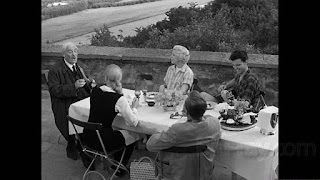
Borg enjoys being social now when they stop for a meal and the others enjoy his stories about his medical director work in the area. Sara says that Anders is going to be a minister. The man of faith contrasts with the man of science, Viktor, as they argue about the existence of God, as Sara tries to mitigate any hostility that may result from the debate. They ask Borg what he believes and he, with the help of Marianne, quotes a poem that talks about the divine beauty in the world. The response mixes nature with spirituality, which contrasts with Borg’s earlier statement about just loving science.
Marianne accompanies Borg as he visits his mother, (Naima Wifstrand). The old lady, at a distance, thinks Marianne is her son’s wife, and wants nothing to do with her, which indicates that Borg had a troubling marriage. The mother is critical that Marianne and Evald have no children, and notes that she had ten, implying Marianne has not lived up to the traditional maternal role. Perhaps the movie suggests that some feel that having children is the way to fight death because it creates new life. Borg is the last of her living children, which adds to the feeling of the fragility of life. Isak is literally the last man standing as death now waits for him. Mrs. Borg lacks generosity as she says her inheritance will not be divided up as her children had thought because she has outlived almost all of them. Mrs. Borg says she feels cold and has felt that way for a long time, which suggests her lack of emotional warmth. Mrs. Borg has a box of her children’s toys, which include a watch without hands. That object is what Borg saw in his nightmare, and adds to the sense of how quickly time has passed between when he was a child to his current state of old age. 
Borg and Marianne return to the car and find Sara alone. She points to the two young men fighting on a hill over religion again, this time adding a physical altercation to their cerebral battle. Sara sent them off out of frustration. Borg listens with amusement as Sara weighs which one of the two lads she likes better. Marianne retrieves the men, acting as a referee. After getting back in the car, Sara asks them comically, “Well. Does God exist?” She is mocking them by suggesting that their fighting is pointless and prideful to think that the two of them could settle a centuries old debate.


Borg sleeps in the car and has another dream. At first he is back in the wild Strawberry patch, the place of his youth, and young Sara holds a mirror which reflects his aged face. Her whole life is ahead of her but he is now close to the end. She asks him to accept it and smile, but he admits that is painful to do, because accepting one's mortality is very difficult. Sara goes to a crib and comforts her baby niece against the scary world she will encounter. After she goes inside the family home, Borg stands near the crib, and the image of where life begins next to where it is headed is haunting. He looks through the window of the house and sees Sara having a lovely dinner with Sigfrid, which shows he has been left out of the life he wanted. 


Borg bangs on the side of the house and is invited in by Sten, the man from the car accident. A room inside becomes a medical classroom with the film’s other characters in attendance. Sten, who is now the Examiner (we tend to mix people and things together in our dreams), gives Borg a test. He can’t see anything in the microscope except the reflection of his own eye, implying he can’t see beyond himself. There are words on the blackboard that are gibberish to Borg, but the Examiner says they state a doctor’s first duty to his patient. Borg says he can’t remember what that is. The examiner says it is to “ask for forgiveness.” The film seems to be saying Borg has left his humility behind as he has grown older, which has led to a lack of empathy. He is then told to diagnose a patient. The patient is Berit (Sten’s wife), and Borg says she is dead. But she is not, and laughs derisively at Borg. The Examiner has decided that he is “incompetent,” and is accused of “callousness, selfishness, ruthlessness.” He says that his “wife has made the charge.” So, his subconscious mind has put himself on trial for how he has acted in his life since he was young. 

The Examiner then takes Borg to witness an intimate encounter between his wife, Karin (Gertrud Fridh) and a lover (Ake Fridell). After having sex, Karin says that her husband acts like he’s a god lording over her, condescending, and “cold as ice,” which reminds us of the way his mother referred to herself, and suggests that the lack of emotional connection is hereditary. Whenever he acts tender, she says, “his hypocrisy makes me sick.” These are most likely the reasons why she has been unfaithful to him. After she disappears, and Borg asks where did she go, the Examiner comments that she was “removed by an operation.” He says it was, “A surgical masterpiece. No pain. Nothing that bleeds or trembles.” Basically, Borg removed his wife from his feelings. Borg comments how silent it is, which is a symptom of the punishment for his “guilt,” which is “loneliness.” 


When he awakes the young people are gathering flowers to honor him on his award night. Borg tells Marianne that he had a dream that shows, “That I’m dead. Although I’m alive.” That zombie-like doll in his first dream is mirrored here. He says it was, “as if I must tell myself something I won’t listen to when I’m awake.” He is saying that his subconscious is informing him about his life. Marianne sees a connection between Borg and his son. Marianne recounts a scene which duplicates the one they are in, only Evald sat where his father now sits. She told him she was pregnant, and she intends to keep the child although Evald strongly reminds her he doesn’t want to bring a baby into this world. He gives her an extreme ultimatum, telling her she must choose between having the child or being married to him. He states how he was unwanted and lived in a home where there was a “hellish” marriage. Since his mother was unfaithful he wonders if he is even Borg’s son. The viability of marriage and parenthood is once more brought into question. He says this life “sickens me.” He says Marianne’s desire, which he again describes as “hellish,” is to create life while he wishes he were “stone-dead.” So, despite his questions about his parentage he is very much his father’s son. 

Borg has now become more understanding and tells Marianne that it’s okay for her to have a cigarette, which he had forbidden earlier. She wonders, after they visited Borg’s mother, if Mrs. Borg’s frigid personality was passed on genetically since both Borg and Evald each considers himself to be a “living corpse.” She wants the Borg’s alienation from the living and its subsequent loneliness to come to an end. She wishes to have the child, so she left Evald. However, she ran to her husband’s similarly predispositioned father, showing how she is emotionally torn. Borg says he sees the same strife between Evald and Marianne that was in his marriage. And, they both acknowledge the same unhappiness between the husband and wife in the car accident, suggesting to them that couples may be doomed to a life of misery. 


This depressing scene is then counterbalanced by the young people giving Borg wildflowers, an appropriate gift from the young, to commemorate his lifetime of accomplishment as a doctor and being a “very wise old man” who “knows everything about life.” But Borg is questioning his wisdom in his private versus his professional existence. The three young people say they hope he will live for many more years. Their celebratory attitude toward one that helped those in need reflects an affirmation of life. The brightness in the lighting of the scene quickly changes to one of darkness as only Borg is seen. His voice-over says it’s getting late, not only because the award ceremony is approaching, but so is his time on earth drawing to a close.


They arrive at Evald’s house, but Marianne says she will only stay the night. However, he and Marianne admit that they are glad to see each other. Borg’s housekeeper, Agda, has come there, too. Along with the young people, there is a sense of at least a temporary respite from Borg’s isolated life. The ceremony is very formal, carried out in Latin, and preceded by a long processional with many people in attendance. Even cannons are fired to salute Borg. It is an extreme rendering, and one feels as if Bergman is satirizing the unemotional pompousness of being saluted by many strangers, as opposed to the simple sincere gratitude of the gas station attendant and his wife. Borg’s voice-over seems to validate this perception because he is thinking of the events of the day as the ceremony is taking place. 
After the event Borg is considerate of Agda, saying she needs a good night’s rest and offers her some of his sleeping medication. He also apologizes for his disagreeable attitude earlier in the day. She thinks he is ill since his kind behavior is so atypical. Borg, looking to get paroled from that sentence of loneliness, says after all these years she should be able to call him by his first name. But she is adamant about maintaining her professional integrity. However, there is a smile on her face as she tells him she is there if he needs her. Sara, Viktor, and Anders serenade Borg as he comes out on the balcony of his bedroom. Their youthful playfulness and scaled down praise give Borg more satisfaction than the stiff proceedings earlier. Sara, the hitchhiker, symbolically joins with the Sara of Borg’s youth, as she says, “it’s you I really love, you know. Today, tomorrow, always.” There is a sweet sadness to her words, which are presently comforting but also suggestive of a missed opportunity. The three young people take a sort of curtain call as they depart.
Borg is in bed ready to go to sleep, but Evald visits him before going to the dance which follows the ceremony. Borg asks Evald about what will happen between him and Marianne. Evald looks away from his father as he is caught in his own dilemma. Evald admits he doesn’t know how to live without his wife, but the problem of having the child remains for him. Borg is now generous as he wants to forgive the loan he gave to Evald. Afterwards, alone with Marianne, Borg warmly tells her that he likes her, and she returns the affection after they have bonded during their revealing journey together. 

In the voice-over, Borg says it “calms” him to recall his childhood memories. He mentally revisits the country house with all his siblings having a happy time in that pastoral setting. Sara, like a spiritual guide, or muse, escorts him to a lovely setting where his father fishes with his mother close to her husband. He is trying to reach out to others now in his old age, and in his memories, he can return to his youth, bridging that great time divide. 

The next film is Glory.

Sunday, April 10, 2016

Mulholland Dr.

SPOILER ALERT! The plot of the movie will be discussed.


When I saw director David Lynch when he visited the Bryn Mawr Film Institute he spoke of the days he lived in my hometown, Philadelphia. He said the ugliness, the squalor there was sort of scary, disturbing. He also implied that because of those seemingly negative qualities that the city was wonderful. This impression may seem like a paradox, but for Lynch the darker side of life, the underbelly of the human psyche, was what fascinated him as an artist. It is similar to how the young boy in the movie American Beauty sees beauty in a dead bird or in paper trash swirling in the wind. In Lynch’s films, such as Blue Velvet, which I have written about previously, and in the television show Twin Peaks, the bizarre, the threatening part of life coexists with what appears to be the acceptable aspect of existence. But that “normal” world seems less real than one would expect, almost phony, and certainly less interesting, to the artist, and usually to the audience, than its counterpart.
 In Mulholland Dr., which Lynch wrote as well as directed, he again explores two different worlds, but here he is presenting two different stories in one film with each one having his disturbing, surreal elements because they spring from the main character’s personal experiences. To understand the enigmatic narrative, we must first understand what is happening. Then, we can delve into what Lynch may be trying to say through these stories. The best way to analyze the movie is to see the much longer first part of the film as a wish-fulfillment dream of the main character based on the short second part’s real world experiences, many of which are told in flashback. However, this may be too simplistic, which I will point out later.
The movie begins with a surreal sequence of young people dancing to jitterbug music against a bright blue background, as the figures and their shadows vary in size. It also foretells the type of film which is being shot later in the story. Superimposed over these images are shots of a smiling Betty (Naomi Watts). This unrealistic opening suggests the stream-of-consciousness of a dream. We also get a quick shot of someone in a bed with a pillow, which implies that we may be entering someone’s dream state. The upbeat, although strange, start segues to a drive at night with contrasting ominous music and the car light lit Mulholland Dr. street sign. The car doing the lighting stops, and the dark-haired woman in the back says that this is not where they should be stopping. At gunpoint, she is told to get out by one man, and another opens the car door. Rowdy, recklessly driven cars slam into the parked car, killing the men. The woman survives, and staggers away. She sneaks into the apartment of a woman who is leaving on a trip so she can sleep.


Betty lands at the Los Angeles airport, and we learn that she is an aspiring actress. She is all bubbly and in awe of being in LA. She met an elderly couple on the plane, and they hit it off. They seem sweet and encouraging. But, as we see them drive away in a cab, their smiles are grotesquely broad, and they bare too much teeth, which suggests a bit of nightmare invading Betty’s happy dream-come-true of being in LA. Coco (Anne Miller), who is the manager of the apartment complex where Betty’s actress Aunt Ruth (Maya Bond) resides, escorts Betty to her aunt’s home. The actress relative is on location shooting a film. The apartment is where the dark-haired woman is crashing. Betty finds her naked in the shower, which hints at their eventual sexual relationship. The woman has amnesia, so she says her name is Rita (Laura Elena Harring) after seeing the poster of the Rita Hayworth film Gilda hanging in the apartment. Rita has a handbag that contains a large sum of money and a triangular-shaped blue key.


 At a Winkie's restaurant, Dan (Patrick Fischler) tells Herb (Michael Cooke) about a frightening dream (a dream within Betty’s dream which pretends to be reality?) he has had involving a scary man living behind the dumpsters at the rear of this particular restaurant. Here again, we have a nightmare in counterpoint to the hopeful actress dream of Betty. Dan wants to look in the back so he can dispel his fear by proving that the creature does not exist. When they go to investigate, a shaggy-haired dark-skinned man with a long, pointed nose appears. Dan collapses. But, Herb only acknowledges his concern for his friend. Did he see the dark man, or was this a nightmare demon Dan hallucinates? At another point, Betty says, “I’m in a dream place,” when speaking about LA. So, the film often alerts the audience to the fact that what they are seeing may not be real.
Director Adam Kesher (Justin Theroux) has a meeting with studio big shots and gangster types, the Castigliani brothers. One of them, played by the film’s composer Angelo Badalamenti, spits out what to him is unacceptable espresso onto a napkin. The brothers throw a head shot of an actress by the name of Camilla Rhodes (Melissa George) at the studio men because she is the one that they want as the lead in Kesher’s new movie. They keep saying, “This is the girl.” We see another bigger shot (ironically played by dwarf-sized Michael J. Anderson) in a room with a glass window who is the puppeteer pulling the studio strings. Kesher storms out and smashes the Castigliani’s car windshield. He returns home and finds his wife in bed with the pool guy, who says to him, “Just forget you even saw it. It’s better that way.” This remark echoes what is happening to Rita, who may be better off not knowing about the shady men who died at the car crash and the money in the handbag. Kesher stays at a sleazy hotel. The manager tells him that men showed up to say that Kesher’s credit cards can’t be used and he is broke. He is told to meet a “cowboy” (Lafayette Montgomery) at a ranch, who tells him that he has to pick Camilla for the role. Another unreal incident is how did these men know where Kesher escaped to, since he only paid in cash for the room?

In an unreal coincidence, Betty and Rita go to the same Winkie’s as did Dan and Herb. Betty, using the pay phone outside the restaurant, verifies that there was an accident on Mulholland Dr. While being served coffee at the diner, Rita notices that the waitress’ name is Diane, which reminds her that she knew a woman named Diane Selwyn. We also have a scene where an inept hit-man, Joe (Mark Pellegrino) kills a man for a black address book. Since they talk about a car accident, we know that these men are associated with the criminals involved with Rita. This impression is confirmed when Joe tells a prostitute to be on the lookout for the missing brunette. When Betty and Rita call Diane Selwyn’s number, Rita realizes it is not her, but she says she knows the voice. One of the neighbors at the apartment complex, Louise Bonner (Lee Grant), is clairvoyant according to Coco. Bonner says to Betty, “that’s not your name,” and advises her to get rid of Rita. This scene fits in with the dream nature of this part, possibly showing how the nightmare of reality is trying to intrude into Betty’s wish-fulfillment dream state.
Betty’s aunt set her up for an audition. She runs through the lines with Rita, and the two laugh at the bad dialogue. Some of her lines include saying how she hates the person she is talking to, and threatening to kill the other person in the scene. She says these words to Rita, which is an omen of what will happen in the second part of the movie. But, when Betty plays the scene at the studio, she changes the feel of the scene, and delivers a steamy, completely mesmerizing performance. The female casting director at the audition says that the film for which she read will never happen and takes her to see Kesher, who is auditioning women for his movie, The Sylvia North Story. Betty must leave to go with Rita to find Diane Selwyn. Camilla Rhodes auditions, and Kesher reluctantly repeats what he has been told to say: “This is the girl.”
 Betty and Rita go the what they believe is Diane’s apartment. They see men lurking about the area. They find the woman’s neighbor there, who tells them they switched apartments. We get a sniff of subtext here from the neighbor’s hurt and angry attitude that she and Diane may have been involved, which foreshadows the relationship between Betty and Rita. Betty enters Diane’s place through an open window, and lets Rita in. They find Diane’s decomposing corpse inside. Did the criminals associated with Rita’s past kill her, and were waiting for Rita to show up? Rita believes so, and goes back to Betty’s place to cut her hair. Betty finishes cutting her hair, and gives Rita a short blonde wig. They stand next to each other staring into a mirror. They look similar. It is interesting that they later make love, as if Betty is trying to make Rita into her own image, and may need to feel love for herself.

In the middle of the night, Rita, in a dream, starts to speak Spanish, and calls out the word, “Silencio.” She remembers a theater by that name and convinces Betty to go with her to that place. It is here where this world becomes more dream-like. The master of ceremonies there says everything at the theater is a recording, an illusion, as musicians pretend to play music, and a woman appears to be singing, but is not. At one point, the emcee disappears at the front of the stage. Betty reaches into her bag and a blue box magically appears there. We had the blue background of the opening, the blue key, and now this blue item, the coincidences lending themselves to the surreal nature of this world. When the women return to the apartment, Betty mysteriously disappears from the bedroom, just as the emcee had done. Is she waking up, and thus exiting her dream? Rita fits the triangular-shaped key into the box, and opens it. It seems as if her reality is sucked into the box, which drops onto the floor of Aunt Ruth’s bedroom, who is now there as if none of what preceded took place. However, the woman heard the sound of the box dropping, but finds nothing when she enters the room.
We then have what seems like a transition between Betty’s dream and a waking state. We see Diane’s bedroom with the corpse, but the image alternates with one of an alive woman in the bed. There is a vision of the Cowboy who says it’s time to wake up. Betty is now Diane Selwyn, in the apartment we saw in Betty’s dream. In the first part, after Rita dons the blonde wig, Betty says to her, “You look like someone else,” which shows the real world intruding in subliminally, telling Betty that Rita is not who she seems. The neighbor we also saw in the first part appears, collecting things from her former apartment, and she tells Diane that two policemen had been around, looking for her. We see a normal-shaped blue key sitting on the coffee table. Diane, even though awake, hallucinates that Rita is in her apartment, but her name is Camilla Rhodes. So, we know how that name showed up in her dream. But, then we see this Camilla half-naked on the couch, and the similarly topless Diane practically forcing herself on her, as Camilla tells her she must stop. The blue key is no longer on the table, so what follows is a flashback from here until the very end which shows most of the elements that appeared in the first part rearranged.
 Camilla and Diane are actresses, and they auditioned for Kesher’s movie, The Sylvia North Story, which was Kesher’s film in the first part, too. The two women became lovers. However, Camilla broke it off, which devastated Diane. Camilla became involved with Kesher. Camilla invites Diane to a party, and has a car pick her up. The driver stops where Rita did in the first part, and now it is Diane who says, “this is not where we are supposed to stop,” the words Rita used. Camilla appears and leads her up to the party. We see a man dressed like a cowboy, who turns into the western fellow of the first part. We also see a person drinking coffee who morphs into the espresso-sipping gangster brother in the dream. It is here where she meets Coco, who is really Kesher’s mother. Diane, in answer to some questions, states she had an aunt, who in this story died, and left her some money. Diane also says she won a jitterbug contest, which explains why we have young people doing that dance at the beginning of the dream. Kesher, talking about his divorce, laughingly says his ex-wife got the pool guy, while the director got the pool, which refers to the infidelity scene in the dream. Camilla then humiliates Diane by kissing a girl who showed up in the dream as Camilla Rhodes in the first part. It makes sense that in the dream she plays Camilla, the woman who gets the part. It also allowed Betty in the dream to keep Camilla in the form of Rita, but wipe her past clean with amnesia so Betty could help her, make her dependent on her, and fall in love with her.
In the next flashback, Diane meets with Joe, the hit-man, at Winkie’s, where she sees the person she dreams as Dan. The waitress’ name here is Betty, which is the name Diane uses for herself in the dream story of the first part. She is there to hire Joe to kill Camilla. She, like the gangsters, presents a headshot of an actress, in this case the real Camilla, and she, in this world, says the words, “This is the girl.” Joe says confirmation of the hit will be signaled by the appearance of the blue key he holds up in front of her. She asks what does it open? Joe just laughs. Now, this world, too, becomes surreal. We see the scary man behind the dumpsters, and he holds the blue box. It drops to his feet, as the box dropped at the end of the dream to the floor. We see the old couple who appeared as Betty’s flight friends, as tiny creatures scurrying away from the box. Is Diane imagining this part, psychotically answering her own question about the key? We are back in Diane’s apartment again, and the blue key is again on the table, signaling the end of the flashbacks which supplied her dream. We hear knocking at the door by the policemen possibly investigating Camilla’s murder, the light of the police car flashing in the background. Is this scene real, or more hallucinations on Diane’s part, brought on by paranoia? She is possibly driven insane with guilt about the killing of Camilla. She imagines the elderly couple, full-sized now, laughingly assaulting her. She pulls out a gun and shoots herself. She is now dead on the bed, just the way Diane was found in the dream. Did Diane as Betty foresee her own death?
So, is it that straight second part-is the reality-first-part-is-the-dream the only way to understand what happens? Perhaps. Maybe the scene in the second part which shows the scary man with the box is not part of Diane’s story, since she doesn’t really experience him, as she does the other parts that are the bases for the dream of the first part. Maybe Lynch is referring to the demons that lurk in all of our minds, not just in Diane’s suffering state. After Diane dies, we, the audience, see a surreal smoky mist rising from the bed. If Diane is now dead, and this is the “real” world, she cannot be experiencing this phenomena, or imagining it. After her death, we, not Diane or Betty, go back to the Silencio theater, which did not appear in the second part, the only suggestion for its existence in part one is Kesher speaking Spanish at the party. We see a glowing microphone stand, and the woman in the balcony we saw in the dream, who instead of saying the end, utters the word, “Silencio.”
I think Lynch is talking about the movie-making process. He has his main characters, and some supporting ones, be in the acting profession. We see the Hollywood sign twice in the film. We have auditions. Lynch may be satirizing the studios who try to manipulate the artist’s vision when he deals with the movie executives caving to disreputable interests, interfering with the director’s motion picture. At that Bryn Mawr Film Institute visit, Lynch said his primary advice to new filmmakers was to get final cut to protect their work. Movies spring from imagination, and involve the imaginations of the audience. In the first section, Betty, when suggesting they call the police to find out about the possible accident, says to Rita, “We’ll pretend to be someone else,” which is what actors do, and which we do as we are sucked into the movie’s world, much as we are sucked into the blue box in this film. Of course, this imaginative pretending to be someone else refers to how the two characters are different people in the two stories. But, it also points to how a director can take the same actresses and have them become different people depending on how you tell the story. Rita taking the name of an actress emphasizes the way people reinvent themselves in the dream world of film. Betty uses the same overwrought words of the script at her audition, but through art, transforms them into something moving. At Silencio, the emcee (the director?) tells the audience in the theater, and the audience watching the movie (also in a theater), that what we are seeing is not really happening in front of them. It is a recording, an illusion, of reality. But, Betty and Rita, in a theater, as are we, are still moved by the woman’s dubbed singing of the Spanish version of Roy Orbison’s “Crying,” as are we. That emotional moment is reality for us.

“Rhodes” is Camilla’s last name in the film. Mulholland Dr. is a road. When you take a ride with David Lynch down a cinematic road, that trip takes many imaginative turns.

The next film is Invasion of the Body Snatchers.