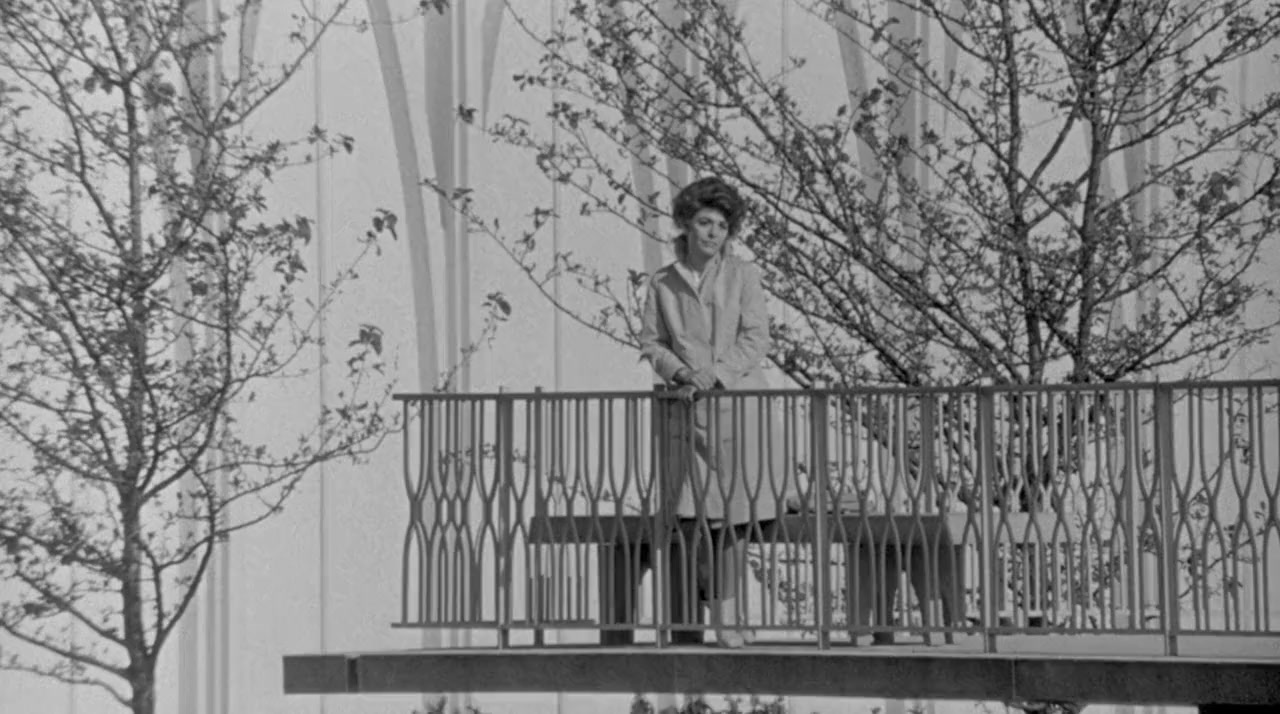
Showing posts with label Sidney Poitier. Show all posts

Sunday, March 7, 2021

The Slender Thread

 SPOILER ALERT! The plot will be discussed.


The Slender Thread (1965) is future Oscar winner Sydney Pollack’s motion picture directorial debut. The screenwriter is Stirling Silliphant, who will go on to write the Oscar winning In The Heat of the Night. The movie’s establishing shot is an aerial view of Seattle (the Space Needle tells us the city). The camera moves from the general to the specific by zeroing in on one individual, Inga Dyson (Anne Bancroft). (Does her last name sound like “die soon”?). The implication is that there are many stories in the city, and here is one of them. The music changes from soothing sounds to jazz-like instrumentals that sound somewhat discordant, which fits the sad look on Inga’s face as she stands alone next to an outside fountain. The soaring water and the rising elevator on the Space Needle contrast with Inga’s depressed mood.


The camera pulls back to its original height and the placid music returns until the shot pulls in on Alan Newell (Sidney Poitier). (His last name could suggest that he will try to help someone break away from old feelings and make her a “new” person who feels “well” again). He is a psychology student who is leaving classes at a university. The music switches back to jazz as Alan walks past protestors with pickets announcing a union debate. It appears that the film is saying that things may appear fine from a distance but when we look closely, we see that problems exist. He drives in his car away from the campus to his volunteer telephone position at a “crisis clinic” that has a suicide hotline.


The camera pulls away once more to introduce another character, Mark Dyson (Steven Hill), who is at the city’s pier. He hands over some documents to a harbor official and we see in his wallet a photo of Inga, which portrays her smiling broadly, a sharp contrast to the woman we have just seen. Mark is her husband and a commercial fisherman. 

 Inga is driving erratically on the same road as Alan, which is an indication of how their separate paths will merge that evening. Inga’s car has a plastic flower attached to its radio antenna. Could it be that with this image of the flower coupled with the reckless driving we have something hopeful that encourages one to hang onto the “slender thread” of life and works to fend off the impulse to seek oblivion? The happy feeling the flower suggests contrasts with the desperate look on Inga’s face. 


 At the clinic Alan encounters Dr. Joe Coburn (Telly Savalas), who wants to leave to have some time with his child (his desire to be with his family will contrast with Inga’s estrangement from hers). Alan juggles several books and is hoping for a quiet night so he can study for his finals which take place the next day. No such luck. Even secretary Marian (Indus Arthur) leaves after she finishes preparing coffee for Alan. Marian tells him that it has been a silent night. But Alan can’t settle in as a drunk barber calls who is just using the clinic to complain. Then Alan receives a call from Inga who says she needs to talk to someone. Alan can tell immediately by the somber sound of her voice that she requires his attention. He tries to get information from her as he puts her voice on a loudspeaker system so he can perform other actions when he isn’t using the handset. She does indicate that she is a “Mrs.” not a “Miss,” is thirty years old, and mentions Mark’s name. He tries to gently coax information out of her, and Inga says he seems adept at handling “disturbed” people. She says she can make that disturbed state go away with the right amount of “pills.” He is concerned now and asks if she is thinking of taking “barbiturates.” She says she isn’t thinking of taking them. He seems relieved at that remark, but she says she has already swallowed them. The story now introduces a ticking clock which builds suspense as we become invested in the race to save Inga. 


Alan has Dr. Coburn’s phone number in case of an emergency, but Inga is saying “Goodbye” so he must act on his own. Alan says he needs to talk to her, just like she called because she needed to talk to someone, so he asks if they can deal with those needs together. He admits he is just a student volunteer, which lets her know that he is not a jaded shrink who uses standard psychiatric techniques, and that he actually wants to connect with her. After being frank, he pretends to need a cup of coffee, and goes to another line to trace the call. He tells the telephone operator to contact Dr. Coburn for him so he can stay on the line with Inga. He gives the phone company authorization to locate Inga (this is 1965, so finding the location of someone on the line is time-consuming given the existing technology. The behind-the-scenes look at the telephone machinery here is repeated in Pollack’s excellent Three Days of the Condor). 


Alan is again truthful when he says he really doesn’t know how to handle the situation despite training to develop a “rapport” with the caller. He has made a rudimentary sketch of her so he can better relate to Inga in a more concrete way. She admits he has a nice voice but is still ready to hang up. He pleads with her to stay on the line and asks why she wanted to end things that day. Instead of just talk, Pollack dramatizes her words. She says it wasn’t anything significant that happened. She was going to work that morning, carrying flowers (that symbol of hope), and she was smiling as she left the elevator at her office where she is employed. She puts the flowers on a tray with coffee for her boss, but he calls her and says he is extending his skiing vacation. It’s a disappointment, and she seeks to have lunch with a colleague, Jinny (Kay Doubleday), who adds to the negativity by saying she is supposed to meet someone else. 


Alan’s frustration is mirrored in his pacing around the room like a caged animal. He is incredulous that the circumstances she recalled would cause her to want to kill herself. Inga says it was just that she was trying to keep busy so she wouldn’t have to “think,” which means she was already precariously troubled. She questions how he knows her name, but she did tell him during her narration of what occurred earlier in the day. Nevertheless, she is suspicious that he is trying to trace where she is. He lies when he says he doesn’t know anything about tracing. He is dishonest at the same time he is asking for trust because he instinctively thinks the deception is for the greater good of trying to help this person. He asks when she took the pills, most likely to ascertain how much time she has left. She wonders why he cares. After all, she is just the disembodied voice of a stranger. Alan again is honest as he admits he doesn’t know why, just like she can’t state the exact cause of why she chose that day to end her life. Finding the cause of each effect is not an easy task.


The phone company finds the call is coming from a spot close to the airport, but they need to send a person there to verify the trace. An operator calls Alan and gives him the above information, along with the fact that Dr. Coburn’s phone is busy. Alan tells the operator that they should have a police car go to Coburn’s house. Alan is in the stressful position of jumping back and forth between phone connections to get help and still keep Inga on the line. She is suspicious why he was so short with the other caller, and he again alternates between truth and lies. He makes her laugh and says she would like to have met him under other circumstances. He asks that she tell him where she is so they can become acquainted, but the only response he gets is resigned silence. He tells her how much it upsets him that she should die, but she says she is not afraid and feels “wonderful,” her voice almost sounding elated due to being liberated from her worries.


 He presses her for more context as to why she has made this choice. As she tells her story we again get a dramatization which shows Inga going home and seeing her twelve-year-old son, Chris (Greg Jarvis), outside. When Inga goes inside the house her husband looks dejected and is angry because an inheritance check was sent to Chris from his dead “father.” We realize Inga was involved with another man and Chris isn’t Mark’s son. Inga is stunned that this secret was revealed. She says she was seeing another man just before marrying Mark, and pretended that the child was his but was born premature. (Inga is worried about Alan being truthful with her because she knows from her own actions how deceitful people can be). Mark is furious and, before he storms out of the house, says that a person is owed the truth. Yet we see that in this movie that sometimes total honesty may hurt others.


Inga, probably feeling as if she has lost her family, walks to the edge of the beach and heads into the water, trying to drown herself. But, a young couple who are making out see her and prevent her death. Inga is then hospitalized and medicated. When Mark visits her, she is sarcastic when he says he went to church and she asks if he informed the “congregation” about her suicide attempt. She wonders if she should apologize for “not dying.” When he starts to go, she drops the attitude and asks him to stay. She says they could start to make things right by him bringing her flowers. They are again a symbol of life and hope for her here. She says in time Mark can forget about the paternity problem since nobody has to know, not even Chris. She is employing here what Alan does which is to tell a falsehood for the general good. But the religious Mark wonders what rules she lives by. He says to her, “Do you think that not getting caught in a lie is the same as telling the truth?” (The same line is delivered by the moral character played by Robert Redford in Three Days of the Condor). For Mark, it’s a matter of personal ethics, not just how things appear. 


Inga cries after telling that segment of her story, and it sounds as if she drops the phone. That sound energizes Alan as he calls out to Inga because he probably thinks she passed out due to the medications. She hasn’t, but was just reaching for tissue. She says it’s not “natural” that he’s “so kind.” That is a viewpoint of someone who has become very cynical about humanity. He again is forthright with her, saying he’s not kind and that he sits by the phone at the clinic because it’s part of the curriculum. She laughs about how he can use what’s happening to write about the “crazy” lady who killed herself. It’s gallows humor she is employing, which is the default type of joking when there is no hope in sight.


 Dr. Coburn arrives, but doesn’t want his presence revealed since it would interrupt the trust that Alan is developing with Inga. He says that if he starts talking to Inga she will hang up. So, in a way, his pretending not to be present is also a deception. Coburn says Inga’s “capacity” for dying is greater than their ability at the moment to keep her alive, and Alan has been able to have her hold on up to this point. Coburn tries to gather information on another line while he listens to what Inga is saying on the loudspeaker. She has put on the TV and there is a laugh track heard. Inga wonders about the lack of sincerity in getting paid to laugh, which brings up the problem about honesty again. (The prompting to have a person laugh on command comes up later). She says the laughter of a person can live on after the individual dies because he or she was recorded. It’s as if she is searching for some type of life after death, or she may be being sarcastic about how the expressed joy is tarnished since the employed laugher eventually dies. 


The phone company and police department investigations continue. Based on the information Coburn provided, Sergeant Harry Ward (Paul Newlan) calls the clinic to inform them of Inga’s last name. Also, Detective Judd Ridley (Ed Asner) volunteers to search for Inga based on facts relating to her identity and where they have traced the call thus far. There is a medical technician (Jason Wingreen) who has arrived at the clinic to monitor Inga on the phone connection, and Marian returns to help out. They hear an airplane that is either landing or taking off on the speaker, which tells them Inga is near an airport, which seems fitting since she wants to escape from her life.


 Inga sounds sleepy as she says she can’t visualize her own death. She tells Alan that she feels numb and it's dark. These are physical observations, but they can also reflect her mental state. Alan gets loud, telling her time is running out and that she can’t think her decision is the right choice for her. She tells him not to deliver a sermon, because that was what Mark made her listen to. There is a flashback to when Mark took her to church, and during the mass she says it seemed like she was a child being spanked, which suggests that she felt as if her husband was belittling her. She says her family looked like a “picture of togetherness,” but the surface appearance was deceiving. The priest’s sermon talks about one being “shipwrecked” if there is no “pilot,” which means one's moral compass must rely on God to set the direction. Mark looks pensive as he hears these words and exchanges glances with Chris. Mark is probably thinking about what he should do concerning his wife’s secret and the knowledge that he is not the true father. The mass ends but Inga remains in the pew alone, which shows her isolation from her family. Mark approaches her and she asks why he brought her there. He says it’s a place of “faith” which he hoped would help them both. She obviously is not a churchgoer and he is, but neither have received the help that he hoped for. He can’t forgive her, even though that is what his faith preaches, and she can’t forgive herself, as she says she feels “evil,” an attitude Mark has fostered. With that belief, is it a wonder that she became suicidal? As he leaves the church, Chris tries to give him a departing hug, but Mark is not warm toward the boy he raised but does not see as his own. Mark goes off to his job as a fisherman (St. Peter was a fisherman who initially turned away from Jesus after the crucifixion), leaving Inga with her primal doubts about her worth as a person.


Back in the present, the medical technician says Inga’s breathing is decreasing and he gives her thirty minutes to live, which increases the tension in the story. Inga is philosophical now, as she wonders if there is an afterlife, which in this context means she is looking for justification for ending her present life. Alan is frustrated and his anger comes out as he berates her for giving up because she made a mistake like so many others do. She is upset with his preaching, and Dr. Coburn warns Alan that he will lose her if he continues “moralizing.” Even though he put his hand over the phone, Inga thinks she heard another voice, and he must lie again to reassure her that it is just the two of them. She shows her dark humor by saying they just had their “first fight,” making them sound like a couple under these morbid circumstances.


The police know where Inga lives and they go to her house but find she asked someone to stay the night with Chris while her husband is away fishing and she may be driving to Portland, Oregon. Mark’s boat is called The Provider, which fits in with the traditional role of the man being the primary earner in the family. But, it also ironically shows that he hasn’t been an emotional “provider” for his wife, who subsequently seems to be psychologically out to sea. 


Alan is sweating now as Inga’s respirations are almost half of what they should be. He says she is making the situation like a game, but her winning the smaller contest will mean she will lose the bigger one involving her life. He isn’t getting anywhere with her as she says he must be tired of repeating the same argument. She just wants him to be “sweet,” but he says he can’t give up, because he now has come to care about her. She has given up on others while he will not give up on her, which suggests that type of caring may be the reason that makes life worth living. She asks if he would have forgiven her for her past mistake, and says when Mark came back from his fishing run he “almost” forgave her. We have another enactment, as Inga waits for Mark’s boat at the pier. She bought a “soft” dress, (to fight his hardness?) which is white (to suggest the innocence of a bride?). They try to joke, but it seems forced. He suggests going with fellow fisherman Charlie (Dabney Coleman) and his wife, Edna (Janet Dudley), to a club, where there is rock music and wild dancing. The people there are full of life (the opposite of Inga’s present state) as they gyrate along to what the band plays. Inga is enjoying herself, but feels as if she can’t go on the dance floor, probably for feeling she doesn’t deserve to have fun, even though Charlie and Edna join in, and Mark suggests the two of them dance also. His doubts about Inga show on his face again. There is a daydream on Inga’s part as she sees herself and Mark in silhouette as they appear to be ready to make love. She is caught between what she hopes for and what is.


Back home, Mark hesitates before entering the house, not sure if he is ready to go in. The two wordlessly go to the bedroom. He changes into his pajamas and robe in the bathroom, and she has bought a nightgown for this night. She turns to him to unzip her dress, but he doesn’t react sexually to her. As she goes into the bathroom to change, he sits on the bed, looking tense, unsure as to what he should do concerning his resentful feelings toward Inga. He gets into bed with his hands behind his head, implying he will be keeping them off of her. Her face as she leaves the bathroom goes from hopeful to disappointed. After she is in bed, he says, “I’m sorry,” and turns away, so she is left with his quiet condemnation of her.


We are back in the present, and Inga is fading as she says her legs feel like “anchors,” she can’t wiggle her toes, and she slurs her words. She tells a joke, but there is a hopeless slant to it. Alan doesn’t laugh, and she says she wants to hear his laugh. She seems to want to have a fun, positive moment with someone who is a stranger but with whom she has made a meaningful connection in life just before her death. He is put into the position of those paid to laugh for soundtracks. At first he can’t, but then becomes hysterical, as if letting out all his frustration at the absurdity of the situation. The others in the room start to quietly chuckle, as we know laughter can be contagious. But because it goes on, Inga’s stern voice orders Alan to stop, perhaps because she feels as if her situation is being ridiculed, or that the extreme response contrasts too sharply with the fact that this conversation may be her last. 


 Detective Ridley finds Inga’s car and Art Foss (Steven Marlo), a telephone company employee, arrives at the station on the city's outskirts to verify the trace. Inga says Alan will be a “celebrity” on campus the next day for trying to talk down a “stupid” person. Inga’s words continue to mirror her husband’s and her own view of her worthlessness. Alan personalizes their link by saying he doesn’t have many “friends,” thus admitting he feels she is now one of them. He goes on to tell her that she will have no legacy, because there will not be any “history,” or “love” or “beauty” connected to her life, and her story will not be heard. Even though it isn’t explicit, his being an African American connects her to him because he expresses that he knows what it’s like to be marginalized. He calls her a “good” person, and says the world needs more of those. He offers her how he still celebrates the smallest aspects of life and wants her to join him in that perspective, which suggests she could then hold onto that “slender thread” of life.


 She relates that earlier in the day she was on the beach and children showed her a dying bird. The flashback shows her going to the liquor store to get some brandy and is honest with the shopkeeper that it is for a bird, hoping that her humanitarian act will be appreciated. But she is greeted with sarcasm by the shopkeeper, and she becomes angry as she leaves saying to him that he doesn’t seem to care “if something dies.” She wishes Alan had been there because he obviously does care about keeping an imperiled creature alive. She returns to the beach but she finds the children gone, and they made a small grave for the now deceased bird. They placed a flower on it, another appearance of that object. Is it meant to show sympathy for the dead, or is it also an ironic symbol of lost hope, given the use of flowers in this story? She pours the brandy over the marker, and then stomps on the grave, showing the futility of trying to make a difference by doing a good deed. She goes to the pier to be with her son and sees Chris sailing a model version of Mark’s boat, with the “Provider” name on it. He hands the model to her because he is going to play a baseball game, abandoning her to her loneliness. The boat probably reminds Inga of how Mark thought of Chris as his son, and now that her secret has been discovered, that bond has been weakened. 


We then return to the opening shot of the film. Inga tells Alan that there were coins in the water fountain that stood for all the people who made wishes on them. She most likely sees those hopes dashed. She says she had no place to go and even tried to get arrested by driving erratically to gain some kind of attention, but nobody noticed her. That includes Alan, who was on the road at the same time, so he was an unknowing accomplice to her desire to end it all. She kept looking for help as she went to the hospital where she was treated for her suicide attempt, but the doctor who treated her no longer worked there. The nurse offers to have the on-call resident, Dr. Morris (H. M. Wynant), see her as she is desperate to grab onto a mental lifesaver. (Flowers are again seen in the background, suggesting the reaching out for hope). When he arrives he says he can’t treat her unless she commits herself. She says she just needs somebody to talk to immediately, but instead finds herself placed on bureaucratic hold. It is ironic that the only way she does get somebody to listen is by the extreme act of attempting suicide. 


There is a scene that shows her emptying pills on a bed in a motel room as she tells Alan she wondered how she could swallow all of them, but she did. She writes a note to Mark saying she hates him, but then tears it up, probably feeling guilty about her anger at his lack of forgiveness. She sees the phone number for the newly opened crisis clinic in a news story and that is how she came to talk with Alan.


In the present, Alan yells at her that his love for her as a human being isn’t enough to pull her back to the living. He says she has to act to save herself and threatens to hang up the phone. Before he does, she begs that he not leave her. At the same time, the police establish the motel where Inga is staying. Mark is notified and he gets a ride on a helicopter to the shore. Detective Ridley heads to the motel address. The information is sent to the clinic, and Alan is overjoyed as he tells Inga he loves her, and she returns the sentiment. He is thrilled, but Dr. Coburn deflates his hopes (a lot of that is happening in this film) when he says that Inga is not registered in her name, is not using the motel telephone operator, and there are two hundred rooms to search. 


There is a party in the lobby of the motel and the jubilant people contrast with the life and death search going on. Inga is not staying as a single guest because the authorities checked out all of those rooms. Inga registered as a couple, maybe not wanting to lose her husband, even in death. She is about to pass out, but she does tell Alan that she is not on the ground floor. As that “slender thread” is about to be severed, she finally asks for help in an attempt to hang on. She falls out of the bed with the phone off of the hook, and passes out. Mark arrives at the clinic, takes the phone and calls out to Inga. They hear the police break down the door to the room and they tell Alan and the others that Inga is still breathing. The line goes dead, but luckily Inga is not. Alan can finally hang up. Mark smiles in relief and tells them he will let them know how Inga is doing when he gets to the county hospital. It appears that he is committed at this point to being there for his wife. 


 Alan says he feels good and beats his chest in triumph. Coburn says he’s going to the hospital to follow-up on Inga, and says he knows Alan will be fine by himself, acknowledging his confidence in the student-volunteer. He asks Alan if he wants to see Inga. He thinks about it for a moment, smiles, and says “no.” He did his job to keep that slender umbilical thread intact in the moment of crisis. It is now time for others to help her strengthen that connection to her life.


The next film is A Few Good Men.

Sunday, January 5, 2020

Blackboard Jungle


SPOILER ALERT! The plot will be discussed.
Blackboard Jungle (1955), directed by Richard Brooks, may seem tame now, but when it was released it tackled subjects the film industry avoided, such as teen violence, sexual candor, and racial issues in public schools. Even the use of rock and roll music was new, as the film begins and closes with “Rock Around the Clock,” by Bill Haley and the Comets, which became one of the biggest selling singles of all time thanks to this movie. The story begins with notes announcing the intent of the film, saying juvenile delinquency is on the rise and there is a need to address it. The title of the motion picture obviously is contradictory since it contrasts a school, a place that is meant to perpetuate a civilized society, with an uncivilized environment where the brutal survival of the fittest law dominates. The film uses references to fighting and music to drive home its theme.


Richard Dadier (Glenn Ford), the name suggesting a paternal parental figure, is a teacher arriving on the first day of classes at an all-boy high school. There are several others there applying for jobs at the inner-city school. Some may be just looking for employment because they couldn’t get a job in a better school district, or they may want to make a difference in the lives of at-risk youths. There is a mother asking her boy, as she drags him away from playing in the streets near an open fire hydrant, if he wants to be “a bum.” Her remark immediately shows us the local perception that the children in the lower-class part of the city may be doomed to failure. Kids in the schoolyard are dancing the suggestive jitterbug, demonstrating their rebelliousness to established social norms that held little promise for them. The high school boys whistle at an attractive woman walking by, not caring about the unrestrained, sexually harassing nature of their behavior.
Principal Warneke (John Hoyt) interviews Dadier for an English teacher position. The “war” in the educator’s name suggests there is a battle raging with the youths. Ford, who usually plays a hard-boiled character, sounds and looks nerdy here, and later becomes more combative out of necessity. The principal notes that Dadier speaks very softly as Dadier says he attended an all-girls college because after returning from the war as a navy veteran (more references to confrontation), there was educational assistance for veterans, but there weren’t many openings at the colleges. His background at a school with a female student body seems to undermine his qualifications to deal with hardened male students. Warneke asks if Dadier can be heard at the back of a classroom. Dadier says he was in plays in college and the principal asks him to project his voice. Dadier quotes from Shakespeare’s Henry V, about going “once more unto the breach,” which is a rallying war speech, again stressing the fight the educators have on their hands. Even Warneke notes its appropriateness. Dadier gets the job, but when he asks Warneke about the school’s disciplinary problems, Warneke cuts him off saying there are no such problems while he is principal. He is worried about his reputation more than fixing the problem, and so acts like it doesn’t exist. Dadier gives his paperwork to Miss Brady (Henny Backus), the secretary, who is curt and unfeeling, calloused from performing her job in this scholastic battlefield.
The next shot is of a teacher hitting a punching bag, highlighting again the fighting theme. The instructors talk about the need for discipline and obedience and complain about the principal’s denial of the problem. Jim Murdock (Louis Calhern), the teacher’s name suggesting like word “murder,” (more violent imagery) talks about taking a ruler to an unruly student, but one man says that the student will take that ruler and beat him to death. The teachers often vent about the seriousness of the situation but use dark humor to cope with it. The incongruity of a place of education turning into a penitentiary is emphasized here. Teachers view themselves as guards, and Murdock likens the situation at the school to the prison on Alcatraz. One of the teachers is named Manners (Tom McKee), his name possibly suggesting a desire to restore social rules. Murdock’s negativity is evident as he calls the school “the garbage can of the educational system.” He shows his defeated soldier’s mentality when he tells Dadier “don’t be a hero and never turn your back on the class.” He sarcastically says he’s been there twelve years and received two Purple Hearts (the military references abound) with no salary increase. Murdock says that they sit on the “Garbage can” so women can walk around safe from the dangerous youths. There is an attractive female teacher, Lois Hammond (Margaret Hayes), her name suggesting Hammond organs, which introduces the theme of harmony versus discordance. She asks if there aren’t some students who are not lost causes. Murdock asks if wearing her form-fitting outfit requires some bodyguards to protect her, which turns out to be a foreshadowing remark. (We have the sexism of the times revealed here with Murdock’s comments). Dadier echoes the thought about how all the kids can’t be bad, but Murdock asks why not, pointing to the hopeless abyss that people like him have accepted.

Josh Edwards (Richard Kiley, who later starred on Broadway in Man of La Mancha), a mathematics teacher, walks into Dadier’s classroom and talks about his conflicting feelings about teaching, wanting to do something meaningful and reaching a “goal.” But he also realizes he’s just doing a job. Edwards says despite the talk, a teacher should be able to handle any student. Dadier is doubting any success here already, saying Edwards’s enthusiasm may wear off soon, and the ability to handle difficult kids is questionable. 

Anne (Anne Francis, who starred in Forbidden Planet), Dadier’s wife, who is four-months pregnant, meets her husband at a restaurant. He wants to surprise her with a celebratory dinner since he was hired for the teaching position. (He ordered champagne, again showing the out-of-date ideas of the time). She is upset that she had a miscarriage before. He says no guilt should exist. He doesn’t want negativity from their past or what surrounds his job to intrude on their happy time. He says that the baby will have her looks and his brains (another marginalizing comment about females). When they go outside two hot rod cars race with one flipping on its side in front of the couple, showing how they can’t avoid the danger around them. Someone in the street makes angry comments about the youths driving the cars. The feelings here are similar to those expressed by adults in Rebel Without a Cause and The Fugitive Kind (both films analyzed in other posts on this blog).
The next day there is a very noisy gathering of students in the auditorium, (the word means a place to listen. Noise always contrasts with harmonic melodies in this story). One teacher says it sounds like when he landed in Salerno, Italy in World War II. Dadier says that at least the boys aren’t shooting at them. But the other man notes, “not yet.” The analogy to the teachers fighting a war with the students continues. The female teacher, Hammond, shows up with a more demure outfit and asks if the students will like her. Murdock continues the violence motif (and the sexist one) by saying the boys may “fight over” her. The boys shout derogatory remarks, saying that when the speaker says, “testing 1,2,3,4,” that he can count, showing he graduated from this school. Their sarcastic comments reveal their perception of the low level of education they feel they are receiving. The speaker retaliates, as if returning fire, by saying their remarks consist of “stupid nonsense.” Dadier satirically comments that the man probably teaches public speaking. When Hammond is introduced she is met with sexually aggressive taunting, showing the students’ lack of respect and decency. The scene demonstrates the hostility that escalates when people are entrenched in their combative stances.

While moving in the halls, Dadier tries to keep order. There is a boy in a suit who is crying, obviously from being bullied, because his studious appearance makes him stand out, ironically becoming an outsider and a target in a place meant for education. When Dadier asks the boy what’s wrong, the boy sees other students who give him intimidating looks to warn the youth against snitching. Dadier asks the name of a student, who is Artie West (Vic Morrow, the future star of TV’s Combat series and who died acting in the movie version of The Twilight Zone). Dadier wants him to write down the names of those who talk, which would be informing on others, and West isn’t about to do that. Dadier doesn’t understand the alternate rules that govern the school at this point.
Dadier goes into the restroom and finds boys smoking, He asks sarcastically if the place is the officers’ club, another military reference. Dadier tells them to leave, but two are slow to depart in defiance. Gregory Miller (Sidney Poitier) says the other student is Emmanuel “Trades,” (Paul Mazursky, the future renowned director). Miller makes up the boy’s last name, who Miller says jokingly had the school named after him. Miller’s words show that academic opportunities are not available to those attending the school. When Dadier threatens to take Miller to the principal’s office, Miller stresses the power struggle between them by saying Dadier can do what he wants because he holds “all the cards.” He keeps calling Dadier “Chief,” but it is in a mocking manner to show disgust for the teacher’s position of control over him. He says to Emmanuel, “Let’s go, bright boy,” but Emmanuel derisively says to Dadier that Miller meant him, not the teacher, which shows a lack of any respect for the intelligence of Dadier. They go through the doors to the restroom, which look like the ones used in saloons in the Old West, where gunfights occurred, another image suggesting violence.

In his classroom, Dadier tells everybody to sit and settle down. West keeps talking, and rebelliously asks Dadier “why” should he stop talking, as if there is no point to paying attention to the teacher. Dadier writes his name on the blackboard in a bit of a condescending manner by breaking up the syllables and pronouncing them. At this point a baseball, an object usually associated with American pride but which here is used like a weapon, hits the blackboard like a cannonball, removing a chunk of the surface where Dadier has written his name. The sound is like an explosion, resembling incoming fire aimed directly at the teacher. Dadier picks up the ball, but instead of escalating the battle, does not try to single anyone out, and uses humor by saying whoever threw the ball will never play for the New York Yankees. Here, Dadier diffuses the violence. There is a slight smile on Miller’s face as he appreciates the comment and Dadier’s not taking the usual authoritarian reaction to the students. 

Some of the boys call Dadier “Daddy-O,” making fun of his name, but their word strengthens the connection to the teacher as a paternal symbol. Dadier says pronunciation is an important part of English and he wouldn’t want to fail anyone for not being able to say his name. When Dadier tells West to say Dadier’s name and to take his hat off, West responds with a threat, asking the teacher if he ever had to fight thirty-five guys at once. West’s remark reveals that he relies on others to fight his battles, and hints at his insecurity and weakness. Dadier does not back down, and tells West to take off his hat or else he’ll knock it off. West looks around the classroom for support, but the others turn away, realizing Dadier is not someone who can be easily intimidated. West backs down when it is he alone fighting in the conflict. 

The students joke around some more, with Miller mockingly repeating Dadier’s statement that they would be surprised that English can help them get a job, pessimism being the ruling feeling here. Dadier tells West to stay after school, and the others make gay sexual suggestions about the detention. Dadier goes along with the kidding to a degree, as West asks why Dadier will come back the next day. Dadier says he would miss seeing West, which shows he can play along with the boys’ humor. Dadier asks why one student, Santini (Jamie Farr, later coming to fame in M*A*S*H*), keeps smiling. Miller explains that the boy is an “idiot,” since the politically correct “mentally challenged” was not used at this time, and these boys wouldn’t have been sympathetic enough to say it anyway. But, the film highlights the lack of the period’s education system in trying to accommodate someone with a disability.  
Dadier asks Miller to stay after class. He says he looked up Miller’s records and thought he was a natural leader. Dadier says he knows that Miller is smarter than the rest of his classmates and the other students will follow his example. He asks Miller to consider using his leadership talents. Miller first dismisses the idea, but agrees to consider what Dadier said. As he leaves the room, West and a few other boys look at Miller, suggesting their dislike with the possibility of him being a traitor, conspiring with the enemy. 


Hammond offers to give Dadier a ride home at the end of the day. As she goes downstairs to meet him at the door, she lifts her skirt to straighten her stockings. It appears she has romantic notions toward the married Dadier. However, a student, Joe Murray (Peter Miller), at the bottom of the stairs, covertly watches her actions, suggesting there will be trouble ahead. Dadier hears Murdock at the elevator saying the students don’t know anything about mathematics, only how to multiply themselves, showing his belief in the baser nature of all his students. His surrendering in this battle to negativity can be seen when he says there will be a never-ending chain of substandard students going through the school. Dadier goes downstairs to join Hammond, but she is not there. However, he finds a woman’s shoe in the hallway, and we know that she is in trouble. Dadier hears Hammond scream from inside the locked library, where Murray is grabbing her, trying to take off her dress. The movie again depicts ironic contrast by showing a vile act in the library, a place where culture and learning should be taking place. Dadier takes his briefcase, which is supposed to be used for scholastic purposes, and makes it a tool of destruction, breaking the door window to get into the library. He then must further debase the briefcase by turning it into a weapon to fight Murray. Murray throws books at Dadier, perverting the objects of learning by transforming them for violent purposes. The student tries to escape through a closed window, but only succeeds in cutting and hurting himself. As others come to help, teacher Edwards asks what happened. Murdock cynically says it’s just the first day of school, as if mayhem is customary here.

Dadier tells his wife Annie how upsetting it was to hear Hammond scream. Annie voices the antiquated sexist idea that the woman probably dressed sexy and provoked the attack. Dadier assures her that she did not dress seductively. Annie is jealous, since her husband knows exactly what Hammond was wearing, and asks if Hammond is attractive. She asks what she was wearing when he came home, but he playfully turns the tables on her because she doesn't remember what he was wearing. His response is a smart rebuttal of stressing the importance of how women look as opposed to men, and how feelings of love are more important than just appearance. 

Around the schoolyard, the students talk about Dadier’s overcoming Hammond’s attacker. Dadier’s reputation as a fighter spreads and the boys exaggerate the facts, saying that Dadier carries brass knuckles and was a boxing champion in the Navy. The boys now see him as a challenger to their toughness, and a threat to them personally. Miller ignores Dadier when he addresses him, and other boys are silent as they give him threatening looks as they crowd the doorway to the school, making it more difficult for the teacher to enter the building. In his classroom, everyone is eerily quiet. Dadier has sentences on the board which allow a choice between correct and wrong grammatical responses. He picks Miller first, since he is a leader, and hopes he will initiate proper class participation. But Miller subverts the process, deliberately giving the wrong answer. The rebellion continues as each student follows Miller’s lead by giving the incorrect word. 
Dadier takes their rebelliousness and turns it against them. showing their actions have consequences. He says to copy the numerous sentences and for homework they must choose answers, which will count as a test that may determine whether they pass or fail the course. He asks to see Miller outside the classroom. When he accuses Miller of arranging the silent treatment and giving the wrong answers, Miller says maybe the boys don’t like it that Hammond’s attacker, Murray, is going to jail. Miller says Dadier’s earlier complimentary comments were a “snow job,” as he questions the teacher’s sincerity. (It does not seem believable that at the time in which the movie is set that an African American student is accepted as a leader, but it is an admirable act to portray him as such).
Hammond asks Dadier to escort her safely to her car and wraps her arm around his for security, but also to get closer to him. West sends his girlfriend to spy on Dadier and Edwards at a bar. The two teachers have some drinks, and Dadier is a bit drunk, wondering if there were many teachers who were alcoholics, given what has happened already during their day. Edwards is very disappointed that the circumstances get in the way of allowing him to do what he wants, which is to teach. He loves jazz, and has a great record collection, with some irreplaceable recordings. He wants to play them for his students to show how the disciplines of music and mathematics overlap in an attempt to enrich their world. 
Edwards says they should take a dark backstreet shortcut to the bus stop. As they walk, Edwards says that the students are just ignorant, but Dadier at first adds they are also bad. He admits shortly that he doesn’t really think they all are lost causes (like Murdock does). Some boys go past the two men, bumping into Dadier, while others follow behind. Suspense again builds as we anticipate an ambush. Dadier says he hears footsteps, and then one boy jumps out calling him “Daddy-O” and hits Dadier, which symbolizes an attack on a surrogate parent. Several boys assault Dadier and Edwards, who suffers collateral damage since the attack is revenge for what happened to Miller at the hands of Dadier. It is ironic that the students harm Edwards after he had just defended the boys. 
Anne was planning a romantic dinner but Dadier comes home with wounds from the ambush, undermining their time together. (It seems unlikely that Dadier wouldn’t have been sent to a hospital to be treated since the police were called by a neighbor near the bar and arrived at the scene). Anne says he won’t be going back to the school, but Dadier, showing his desire not to retreat, says he will return because even though he is beaten up, “I’m not beaten.” It is suggested here that physical danger can be overcome with mental toughness.

Dadier goes to another school and talks with the principal, Professor Kraal (Basil Ruysdael), who was Dadier’s teacher in college. Dadier says he’s going back to his school, but he admits he doesn’t believe the kids want to learn. Kaal says that Dadier is like a blind man who feels the tail of an elephant and thinks it’s like a snake. In other words he is being microscopic, and not appreciating the bigger picture. Kaal takes him around the school and the children there are learning Latin, science, and are orderly at assembly as they sing the national anthem, with its words highlighting the ideals of the United States. (Important to note, there appears to be a single person of color among the student body, but then there are few in Dadier’s school. So the film doesn’t single out one race as problematic, but it doesn’t show children of color exceling). Dadier says anyone can teach successfully at Kaal’s school because the student body is from a different part of society that is receptive to receiving an education. Professor Kaal says all children are entitled to an education, but Dadier argues how can he reach students who have low IQ's or act like wild animals (the “jungle” of the movie title surfacing here). Kaal agrees that the teacher preparation in college was not adequate to deal with the problematic younger generation, which is where the film lays some of the blame for the lack of scholastic accomplishment at schools with a disadvantaged student body. But, he says there are many schools that are successful compared to where Dadier works. (Is this the case today with large inner-city schools having persistent violence and poor academic results?) Kaal offers him a job there, but Dadier says he’ll try again at his school, showing his desire not to surrender his hopes.

Dadier was out for a week, and walks in with a police detective asking him to give up the names of his assailants. Dadier is reluctant, saying it was dark, and points out identifying the perpetrators will do more harm than good. He is probably thinking about the boy who assaulted the teacher and was arrested, which just spawned revenge. The detective says that the current generation had no fathers around because they were in the military, and the mothers were at work, so they had “no home life, no church life, no place to go.” He says they formed gangs to fill the void so they could be where they felt they belonged. The movie may speak to educational shortcomings today where those who come from deprived neighborhoods seek a group where they feel they belong and join gangs as the only alternative. He says the kids are like the rest of the world, “mixed up, suspicious, scared.” (Again, the film may seem relevant to people today who may relate to those feelings given the political climate). The detective says that the problems cut across social classes, but we have already seen a school that was successful, so the possibility of children receiving a successful education is not shown to be out of reach. 

Dadier enters the classroom and West, one of the attackers, just smiles at Dadier, as if gloating. Miller makes a joke about Dadier needing make-up to cover his bruises, and makes a covert gay reference about knowing guys who use cosmetics. The effect is one of stressing traditional manly stoical appearances when dealing with physical altercations. The whole room begins to shake as a loud noise fills the room. Miller tells Dadier that they installed a new machine shop. Obviously the school management doesn’t seem to care that they are making a difficult situation worse. Dadier brought in a tape recorder to encourage participation and move the focus away from himself to the students. The class wants Morales (Rafael Campos) to talk, but Dadier wants another boy. Miller challenges Dadier, saying maybe he doesn't want someone who doesn’t speak English so well. Miller here points out bigotry in the system. Morales is allowed to speak. He jokingly relates to what happened in his morning, repeatedly using the word “stinking,” but it reveals how awful his life is. But then West uses an ethnic slur referring to Morales while accusing Dadier of bigotry, showing West is the one who is really prejudiced. Morales retaliates with a derogatory comment about West’s Irish ancestry. Dadier tells them to stop, basically saying derogatory words are like throwing verbal punches, each one eliciting a retaliatory response. The class ends with the machine shop blaring its sounds and shaking the classroom, showing that noise has replaced communication, and chaos has been substituted for order.
As Principal Warneke scolds Murdock for slapping a student, (emphasizing how physical blows just escalate violence), Dadier arrives after being summoned by Warneke. In Warneke’s office, the principal complains about “brutality, stupidity, and bigotry,” elements that create destruction in a society. (Just like in the classroom, there is discordant noise created by trains nearby, emphasizing the lack of harmony in this environment). A student twisted the situation in Dadier’s classroom, saying that the teacher was bigoted, using slurs including the “n” word. Warneke accuses Dadier of prejudice, but an angry Dadier says he used them as negative examples as to what not to say. This scene shows how the system can be manipulated when the person in authority is more concerned with how he will appear instead of checking into the facts first. Warneke assigns Dadier the job of putting on the Christmas show, since he had some dramatic training in college. Bringing up the benevolent time of Christmas contrasts with the lack of “peace on earth” at the school. As Dadier leaves Warneke, he encounters Miller after school as the student is working on a carburetor in shop. Dadier wants to know if Miller tried to get him into trouble with the principal. Miller plays with Dadier by not denying he twisted what was said in the classroom. When Dadier accuses him of being involved with the beating, Miller seems genuinely outraged and says Dadier just has it out for him. Miller goads Dadier, saying he wants to hit the student and that will finish him as a teacher. Dadier starts to make a racial reference, but stops short, apologizing to Miller, who seems surprised that Dadier did the right thing by asking forgiveness.
Outside the school, West is with others as they plan to steal a newspaper truck. Dadier wanders nearby to get a newspaper from a newsstand. The boys hit the driver of the truck and ride off. West knows enough to just direct the heist, but not actually participate. He throws a bottle at Dadier to distract him as the teacher tries to follow the truck. West acts like somebody else threw the bottle of booze (that he illegally was drinking), but Dadier questions the boy’s presence there at the scene of the crime. He points out all of the boys are wearing identical jackets, indicating they belong to the same gang. West, stressing that he attends the school of reality, tells Dadier that the teacher is in his classroom now. He says the first lesson is not to butt in, showing how this delinquent defies Dadier’s attempt to help, so cynical is he and his generation of marginalized youths. West’s words stress what he feels is the irrelevance the school has to offer to help him in his precarious life on the streets. 
Edwards is playing his records when West and his classmates arrive, without Miller, who is absent. Edwards says the music is for his next, more advanced class. This condescension just irritates the boys, and they also want to hear music. Edwards relents, but when he does not trust West touching the records, West’s anger surfaces and he destroys all of Edwards’s rare collection of recordings. All that is left is the scratching of the phonograph needle, again providing an example of noise replacing melodic sounds. Dadier shows up, and Edwards says he just doesn’t “understand,” because there is no logic in pointless destruction. 

Dadier wants his students to contribute to pay for the loss of Edwards’s record collection. West makes a joke about whether they would get a tax deduction, which satirizes the fact that they are so poor that the idea is a ridiculous one. Later, in their lounge, the teachers show their contempt for the students. Murdock says the kids will probably steal the contributions for Edwards’s records. Another says he’d like to rig up an electric chair to shock the boys, a particularly nasty comment implying the students will eventually be condemned to execution. Murdock shows scorn about the principal just making the students write five hundred times that they will respect the property of others following the destruction of the records. Dadier chastises them, for either being too brutal (which has no effect on kids who are used to brutality at home and on the streets), too apathetic, or too accommodating. He admits he is just a “fumbler” and is no more successful than the others. But he, as opposed to Murdock, believes they can’t give up and have to continue to try to connect with the boys. 

Anne gets an anonymous letter warning her that her husband is involved with another woman, an obvious reference to the female teacher, Hammond. This scene shows that the attack on Dadier even invades his home life. Since Dadier hasn’t come home yet, Anne is jealous, and goes to the school. But she is reassured as her husband comes out alone and says that he helped Edwards clean his desk since he quit. Anne says that Kraal responded to her letter and she urges Dadier to get a job at his ex-professor’s school. Dadier sidesteps the issue, because he still feels that if the students were just left to teachers who didn’t believe in helping them, then they would be lost forever. The scene ends with the noisy elevated train again blaring discordant sounds.

In contrast, the next scene has Dadier entering the assembly room because he hears harmonious singing. Miller leads several other black students in a hymn, appropriately containing the words “let my people go,” which fits in with the plight of African Americans, and probably echoes the feeling of confinement that the school signifies for the students. Miller guesses that Dadier wants him and the other students to be part of his Christmas program, which Miller admits is what they have been practicing for. While they talk, Dadier handles a lock that sits on the piano. Could it symbolize how the students and the teachers feel imprisoned in this malfunctioning educational system, and Dadier is trying to find a way to escape the dilemma, open things up between himself and his students? Dadier tries to reach out to Miller, asking him what are the rules that make Miller cooperative when the two are alone, but not in class. Miller avoids answering, since he isn’t ready to break through what divides the two of them yet. 

Dadier shows a cartoon that is entertaining and funny which tells the story of “Jack and the Beanstalk.” They all enjoy it, but West is the holdout, looking sullen because the others may be shaking off his negative influence. The discussion that follows explores the question the cartoon story raises as to who is the hero and who is the criminal. The students want to see more stories, and being an English teacher, Dadier is happy to oblige. Other teachers are surprised to see Dadier’s students excited. Murdock is still skeptical. In a way, he is West’s counterpart on the faculty, still finding solace in cynicism, which justifies not trying to work at attempting positive actions.

Anne keeps getting letters and then receives a call saying that Dadier is with Hammond. The voice sounds like that of West. At the school Dadier works with other teachers and Miller on the show. After the other teachers leave, Hammond remains. (She is taking care of the costumes, which is a stereotypical role for a woman to be employed at). She says she doesn’t have any purpose in her life and she puts the moves on Dadier. She admits to being bored and she asks why don’t they just leave the school and go away together. He is not interested since he is committed to his marriage and his job, in contrast to most of the teachers there. 
Dadier walks Miller to his job telling him he should continue his education because he really doesn’t want to be a car mechanic. Miller seems to be giving into the same defeatist attitude as the other students and teachers, saying that car mechanics are needed by white and black people, so it will give him a living. The sense of incarceration is at work here since Miller feels locked into what jobs he must take. He expresses his confinement when he says he has to live in a black neighborhood. He says that he and Dadier are on “opposite sides of the fence,” which shows again the divide that occurs in a stagnated, partisan society. Miller says that he tried giving school a chance at first, but found the other students don’t care about what happens to them, neither do the teachers, and not even his parents. Dadier says that many African Americans have found success now, and that he should keep trying. He makes a pact with Miller that he won’t quit if Miller tries to go after what he wants out of life.

When Dadier arrives home there are a number of people outside saying his wife had terrible pain and was rushed to the hospital. The doctor tells Dadier that Anne had a boy that is still in danger since he was premature. The doctor says Anne seemed upset, almost mentally unbalanced, concerning something secret, and wonders if there were any problems she was experiencing. Dadier comforts Anne and reassures her of his love. On the way out, the neighbor who helped Anne out of the apartment saw the letters that insinuated Dadier was involved in an affair. 

Dadier is outraged by the letters. Later, after the Christmas show, which was a success, he rants in front of Murdock, saying that the other teacher was right, that the school is a “garbage can.” After what happened to his wife, Dadier gives into the nihilism that surrounded him. Murdock, realizing he was wrong, actually encourages him to stay, saying Dadier showed that not giving up allowed him to reach the kids, and that enthusiasm spilled into Murdock’s classroom. Dadier talks about going far away from the “delinquents,” but Murdock says that if Dadier quits here, he’ll keep on giving up no matter where he goes. Dadier repeats what Miller says about it doesn’t matter because nobody cares. Dadier talks about how teachers get less money than so many other workers, which implies how the country does not respect what teachers do. 

Dadier is at the hospital and seems very sad while the announcer on the radio, in contrast, wishes everyone a happy new year. He gives into negativity as he says that maybe their son may not live. Anne tries to encourage him, saying she was like his students, that “somebody told me a lie and I believed it.” She doubted him because she believed the lie about his infidelity. The suggestion here is that the kids were told that there was no point to work toward achieving their goals, and they accepted the falsehood, and capitulated to a life of failure. (Could her statement have relevance to our current divided society that gives into fears and believes fake stories and unsubstantiated conspiracy theories?) Even though her epiphany may seem forced here, she delivers a positive message. She says she now understands why he wanted to remain at the school because kids need the same things as do all people, which are “patience, understanding, and love.” The doctor enters and brings the good news that their boy is out of danger. He turns the radio back on with its New Year’s celebration sounds, in contrast to the noise previously heard in the film. He wishes them a happy new year, offering hope for the future.

Back in the classroom, Dadier tries to teach the boys practical information about applying for jobs through the want ads. West says it’s cheaper to steal a Cadillac than work for one, as he continues to undermine cooperating within the system. Dadier takes the test paper from Belazi (Dan Terranova) and deducts points to show that the arithmetic that Artie employs doesn’t work, because one has to pay with penalties for breaking the rules. When he tries to get West to bring up his paper for cheating, the boy challenges Dadier. Miller comes out in support of Dadier and West tells him to stay out of it, calling Miller “Black boy.” Dadier doesn’t want Miller to get into a fight as he is trying to shield him from acting violently. West challenges Dadier to force him to go to the principal’s office. He mockingly calls him “Daddy-O,” denying his parental authority. West pulls a knife, and cuts Dadier on the hand. Miller stops Belazi from helping West. The other students don’t come to West’s aid, and Dadier points out that West isn’t so tough without his gang. Dadier accuses him of twisting the teacher’s lesson about prejudice, jumping him and Edwards with other boys, and writing letters and calling his wife. Dadier is able to disarm West, and slams him against the blackboard repeatedly, as if trying to break down the “blackboard jungle.” West pleads that Dadier not do this there, implying it is too humiliating in front of the others to be beaten. Belazi, West’s only remaining ally, grabs the knife but Morales gets it and plunges it into a desk, breaking off the blade. This disarming of the fight mentality that permeated the school from the beginning of the movie is followed by another symbolic act. Santini, the mentally challenged student, takes the American flagpole and thrusts it into Belazi, as if showing that the country's ideals will vanquish those that would try to destroy them. The students now are protective of Dadier, saying they want him to have his cut cared for. Miller says they are all willing to help him take Belazi and West to the principal's office, showing they realize that the two don’t, as Dadier says, “belong in their classroom.” Dadier has acknowledged that the students have ownership over their education. They are now willing to discard the lie that there has to be a war between them and the faculty, and can banish the liars who foster that division for their own power grab. Without support from the others, Dadier knows that the two hardcore boys have no backup, and will go with him. Dadier has performed the exorcism of the evil elements in his classroom. West sucks his thumb momentarily, symbolically showing that he is reduced to the misbehaving baby that the father, Dadier, must discipline. 


The last scene has Miller bringing Dadier the can that has a small amount of money in it to reimburse Edwards for the broken records, an attempt to restore wholeness to the broken relationship between teachers and students. Miller asks if Dadier will be leaving the school. When Dadier asks what does he think, Miller says that Dadier knows the ropes now, and it would be a shame to have to break in a new teacher. Miller uses humor to act as if the students were the ones that did the instructing. Dadier asks if Miller was quitting, but Miller says they had a pact so he’ll see him again. A social contract has been made in an attempt to bring people together. The film suggests that maybe we could all learn from what the main characters are trying to teach.

The next film is Ulee’s Gold.