SPOILER ALERT! The plot will be discussed.
The title of this 1979 winner of the Best Picture Oscar pretty much gets to the heart of the story. And, hearts can be the casualties of the civil war that derives from the conflict that rips apart the emotional fabric shared by two people who married because of their love for each other. Although the movie might seem out of date now, it actually broke ground in presenting the fallout of divorce in a film, reassessing gender roles in a domestic union, and showing the predicament of a single parent in American society. What makes this motion picture resonate with audiences is how true it feels to so many people who have shared the experiences of the main characters.
The first shot is of Joanna Kramer (Meryl Streep in her first Oscar-winning role, here for supporting actress). The image looks like a portrait of a sad and drained woman. Her hand rests near her face, her wedding ring prominently visible, immediately telling us that it is her marriage that the story will be focusing on. While tucking in her seven year old son, Billy (Justin Henry) for the night, we know from the sorrowful way she tells him that she loves him that this is not easy for her. There is a wrenching irony in her son’s statement when he says, “I’ll see you in the morning.” Added irony exists in the bright, fluffy clouds painted on the boy’s bedroom walls, implying the parent’s desire for Billy to always have pleasant days.

It is obviously late in the day, since the boy is going to sleep, and it is late in Joanna’s marriage. While she packs her bags, there are cuts to her husband Ted (Dustin Hoffman, also winning his first Oscar, for Best Actor), shooting the breeze with his boss at the advertising firm where he works. He is talking about buying an expensive coat as a symbol of his success when he was promoted, which emphasizes that he measures success by material gains, and not by the state of his family’s emotional health. He is oblivious to the late hour, and the fact that he is ignoring his family, until another worker walks in saying how he must get home. But, before he leaves, Ted’s boss, Jim O’Connor (George Coe), tells Ted that he will be handling a big money account. While walking on the street, Ted passes impoverished street musicians, playing the Vivaldi piece which opens the film. This quick shot stresses stresses how this society does not reward the beauty of their artistic achievement. (Director Robert Benton making an analogy to struggling filmmakers?).

When Ted arrives home, he is not even aware of Joanna’s luggage, showing how he has not paid attention to her in the marriage. He is on the phone checking about a work activity, and just keeps talking, with no attempt to see how his wife is doing. He says to her, as a bit of gossip, that a fellow employee committed suicide. This line is significant as it shows how Ted sees it as a bit of surprising news that doesn’t really affect him, but which indicates how the collateral damage that the rat race capitalism in which he is engaged has also impacted his own life. Joanna must interrupt Ted, nervously telling him that she is leaving him. Her short list of facts also carries meaning. She is leaving him her credit cards, which tell us that she has not established credit of her own. She has withdrawn two thousand dollars from their joint account, the amount she had when entering the marriage, illustrating that she has little economic independence. She gives him the receipts to pick up the laundry and dry cleaning, emphasizing that he must now pick up the clothes, and she has paid the bills. These are all domestic responsibilities that he has absented himself from.

Ted’s response is condescending, insensitive, and self-centered. He is not thinking of her pain. He only sees how she has ruined his big work news. He reveals his attitude when he says to her that he is sorry that he was late but he was busy making a living. He seems to think that her extreme act is just because he is coming home late this night. He flashes her a charming smile that shows how he thinks he can easily smooth out what he considers to be a simple bump in their relationship road. Joanna again performs an almost missed act that carries significance. She tugs at her wedding ring, as if wanting to free herself of this torment. But, she does not take it off, symbolizing how difficult it is to end her ties to this life to which she has committed herself, no matter how much distress she is in. Ted then asks, “Tell me what I did?” Men and women can connect with this statement, because men many times do not seem to be able to figure out what they have done wrong, and having to ask shows their lack of insight into their partner’s complaint. Also, it points to the male disposition to fix things quickly, as if they equate relationship repair with using a wrench to tighten a loose bolt.
Joanna goes into the hall, pleading with Ted that if he makes her stay she will eventually jump out a window (echoing Ted’s co-worker’s suicide). She tells him that he married the wrong kind of person for the wife he wanted. At this point, she blames herself. She says she is no good for Billy, lacking patience, and emotionally not capable of being a good mother in her current state. As she is ready to leave him she admits that she doesn’t love him anymore, which emphasizes the finality of her connection to him. (Streep once said, because she creates backstories for her characters, that Jonna never really loved Ted). She departs in the elevator, and elevators are used two other times in the story to show the varying degrees of separation between these two people. Here it is used to demonstrate Joanna pulling away from Ted.

Ted seems incapable of dealing with the situation, and is in denial. He makes calls to find out where Joanna has gone. He feels that Joanna will come to her senses, as it were, and return, because she can’t get far without so much of her personal items. He doesn’t see that she wants to start over, leaving behind the refuse of her past life. Even in this family crisis, he says on the phone that he has a great deal of work to do, showing where he places his priorities. The couple’s friend who lives in the same building, Margaret (Jane Alexander) visits. Ted doesn’t want to take responsibility for what has happened to his marriage, showing the universal male response to lash out when a man’s pride is hurt. So, he wants to put the blame on Margaret. She has broken up with her husband, and he accuses her of putting the idea to leave in Joanna’s mind. Ted, again showing his selfishness, says, “Can’t you understand what she’s done to me?” Margaret says that Joanna was a very unhappy person, and it took courage to leave. Ted counters by saying, “How much courage does it take to walk out on your kid?” It is understandable to agree with Ted here, because many of us believe one puts a child first, no matter what the sacrifice. But, knowing the importance of putting her son’s happiness first, it is extremely difficult for Joanna to admit that she is actually a threat to Billy’s happiness, and therefore, must leave.

The movie many times is able to use humor despite the unsettling nature of its topic. One instance occurs the morning after Joanna’s departure. Ted tries to make Billy think nothing is wrong as he tries to prepare French toast. Even though he acts like men are superior cooks, he has no kitchen skills, and his attempt at making breakfast is a disaster. He lets part of the eggshell fall into the bowl and tells Billy it’s okay because it just makes the food crunchy. He uses a coffee mug for the egg mixture, and can’t fit the bread slices in it. He lies to cover up his inadequacies. He says that all restaurants fold the bread. He puts way too much coffee in the French press to the point he can’t even push down on the grounds. His son knows more about making the meal than dad does. Billy warns his father about his mistakes, which Ted won’t acknowledge, which is what he did with wife. When the bread is burning, Billy alerts him, and Ted carelessly grabs the hot pan handle and burns himself. He then yells out, “Goddamn her!” His phony positive facade crumbles even after a little testing, and he again places fault elsewhere for his situation.
There is a little more humor when Ted drops Billy at school on his way to work. Billy’s vulnerability starts to show as he asks if his mother will pick him up after school. Ted says she probably will and, if not, he will. Billy then asks what if his father gets killed. Ted says then Mommy will pick him up. A child’s desire for security is so strong, the actual death of the father is not really comprehended. Billy is just seeking protection for himself. And, Ted plays along with Billy’s concerns about his problem, as opposed to Billy not being worried about the supposed demise of his father.
Ted is still in denial as he calls home from work, thinking Joanna may have returned. At work, Ted shares what has happened concerning Joanna with his boss. Ted says he may have been wrong to not pay attention to his wife’s needs because he was so absorbed with his work lately. However, he sees it as an acute problem, not that there were fundamental flaws with the marriage. He exhibits a stereotypical sexist attitude by saying that Joanna and her friend Margaret started to “yap, yap, yap” about “women’s lib.” His boss shakes his head and smiles in agreement, joining Ted in the condescending belief that women’s liberation is just some fad and an annoyance, and a woman will calm down after a bit and return to her husband. Ted says it was just Joanna’s way of getting his attention to be more attentive, so he does not here understand the depth of the problem. His boss does say that currently Billy is a “problem.” He advises Ted to send Billy away to stay with relatives so that Ted can deal with the big account. His reaction reflects a cold, bottom line, business attitude by considering a young child as a hindrance to the job, as opposed to showing caring and understanding for Ted and Billy’s plight. Ted says he has not let his home life interfere with his job in the past, (that was because Joanna took care of everything at home, and is an ironic statement in light of what follows) and he will be totally committed to the job. But he reveals a chink in his reassuring armor as his voice stammers and he shows signs of sobbing. He says he is a survivor, and he demonstrates that fact later, but for his family instead of for his job.

At home, Ted’s neglect as to how to deal with Billy comes back to punish Ted. Billy spills liquid on his job materials on the coffee table as he plays while his father ignores him, engrossed in his work. Ted, of course, blames Billy, instead of realizing he should take responsibility for not taking precautions about how messy things can get when a child plays. Ted begins to realize his extreme domestic shortcomings to the point he must rely on Billy when they go shopping. Billy only knows items by design and color, so when he mentions to his dad that they need cereal, Ted asks, “What color?”
Ted does not use good judgment when a letter from Joanna for Billy arrives and he doesn’t read it ahead of time. He still assumes that she will say when she will return home. Instead, Joanna’s letter, although attempting to be kind, basically tells her young son that she will not be physically present. As Ted reads the letter, Billy turns up the volume on the TV so as to drown out the hurtful message. Ted can see the pain his child is undergoing, and he begins to place Billy at the top of his concerns. He goes through the apartment and starts to remove objects and pictures of Joanna in an attempt to lessen Billy’s being reminded of his loss. But, it is an act that makes Joanna the villain without Ted admitting his part in her absence.

Ted’s boss notices, as do we, that Ted is shifting his priority from work to his son. But, he is still late in picking Billy up from a party, and here again Billy’s response is a universal reaction to which an audience can identify. He is angry with Ted, because when a child is picked up last, and a parent is very late in arriving, it looks like the adults don’t care enough about their boy or girl to show up when the other parents appear. More relatable acts shown are Ted saving time by cooking TV dinners, telling his child not to eat with their hands, and putting away all the scattered toys at the end of the day. There is a wordless scene where the two wake up and Billy gets some donuts to eat, Ted gets the juice and glasses, and both do some reading while at the breakfast table, the father the newspaper, and the child a comic book. They fall into a routine that seems boring but really provides security, free from trauma. Ted is late for a meeting at work, carrying groceries that he took time to buy for later that day, and his secretary tells him about the PTA meeting that evening, which shows how he is becoming immersed in his son’s world. Ted takes a photo of Joanna that was in a drawer in Billy’s room, and places it in view. He seems to be starting to gain some compassion for Joanna, and realizes that Billy should not forget about his mother.

A shortcoming in the film is that it does not show how Ted bonds with Margaret. We are made to accept that they are now close friends hanging out together at the playground with their children, with Margaret sharing her feelings about her divorce. Her comments that she still feels that there is a link to her ex-husband, who left her, because there was love between them once and they share their offspring are feelings many who are divorced would share. Also relatable is her belief that her ex failed the love test, since if he truly cared, he would never have left.

Eight months have passed since Joanna left, and Ted’s boss is now angry that Ted missed an important meeting involving the big money client. It is because Ted now puts more of his time and energy into taking care of Billy. The boss’ anger is aggravated as Billy calls during the meeting to ask a question about the amount of TV time he is allowed. The stress leads up to the improvised “Salisbury steak” confrontation between Ted and Billy. (Hoffman, although refusing screenwriting credit, contributed to making the script authentic by adding his perspectives based on the divorce he was currently going through). This scene rings true for all parents and children, as Billy, like most kids, acts rebellious, testing parental limits. Ted says he should eat all of his Salisbury steak dinner or he will not get ice cream. Billy goes for the dessert first. Audiences will nod their heads in recognition when Ted says Billy will be “in big trouble” if he eats the ice cream, and when Ted adds, “you’ll be very, very sorry,” if he doesn’t eat his meal first.

They say nasty things to each other, as most parents and children do, and then they apologize, which is also a familiar occurrence. Billy voices his concern that he is afraid that Ted will leave, too. The boy feels, as do most children of divorced couples, that it’s the child’s fault when a parent leaves the marriage. Ted makes sure that Billy knows that his mother didn’t leave because of him. He expresses his epiphany to his son. “I think the reason why Mommy left was because for a long time,” Ted says, “I kept trying to make her be a certain kind of person. A certain kind of wife that I thought she was supposed to be. And she just wasn’t like that … I think that she tried for so long to make me happy, and when she couldn’t, she tried to talk to me about it. But I wasn’t listening. I was too busy, too wrapped up just thinking about myself. And I thought that anytime I was happy, she was happy. But I think underneath she was very sad. Mommy stayed here longer than she wanted because she loves you so much … She didn’t leave because of you. She left because of me.” After many months, Ted finally understands how he undermined Joanna’s individuality and thus her happiness.


The film offers the possibility that a working father that separated himself from his family to focus only on his work can become a nurturing parent. Ted now shows up at Billy’s Halloween pageant at the boy’s school, prompting him on his lines. Ted teaches Billy how to ride a bike and now Ted takes the time to listen to his son’s stories about school and other classmates. He also is trying to leave behind the hurt inflicted by the divorce on his romantic life by becoming intimate with a fellow worker, Phyllis Bernard (JoBeth Williams). In a funny scene, Phyllis gets up naked out of Ted’s bed to use the bathroom and unexpectedly encounters Billy. She is only wearing her large eyeglasses, and she calls Ted “Kramer,” which contrasts her professional demeanor with her nudity. She tries to cover her private parts while Billy, seemingly oblivious to her unclothed appearance, asks her if she likes fried chicken. It’s almost as if the boy is interviewing her to see if she will be an acceptable playmate for his dad. When Phyllis goes back into the bedroom she tells Ted, “I met your son.” Awkward! Maybe not such a good idea to bring the strange woman home for sex, Ted.
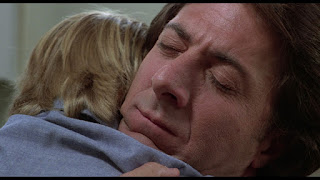
While at the playground with Margaret, Billy falls while climbing on some bars and cuts his face badly near his eye. Ted, while carrying his son, runs Billy to the hospital emergency room. He has to have several stitches, but Ted stays with him, encouraging him to get through the ordeal, holding him to steady Billy. Ted is now a totally committed father. That he can now see the big picture involving the welfare of Billy is shown when he asks Margaret to take care of him in the event something happens to Ted.


It is now fifteen months that Ted and Billy have been on their own, and we see that Joanna is back, spying on them from a coffee shop as Ted drops his son off at school. She contacts Ted and they meet at a restaurant. Joanna has been living in California, and had been in therapy. She says that she was a mess when she left, but now she found herself, is back in New York, and has a job. She says she has learned that she loves Billy and wants him to live with her. Ted is enraged, says with finality that she can’t have him, slaps a wine glass against the wall, and leaves. It is here where lawyers become involved, and the Kramer vs. Kramer conflict becomes legally ugly, as both legal representatives exaggerate the other party’s failings. This battle is also something that resonates with audience members.
To add to Ted’s woes his boss fires him. At the restaurant where it takes place, Ted tells his now ex-boss, “Shame on you.” His employer has forsaken loyalty,
compassion, and respect of family for money, and it is shameful. Ted’s lawyer says that they have little chance of winning custody if he is unemployed. Ted shows his survivorship skills, but now he uses them for the sake of his son. While everyone is partying just before Christmas, he forcefully get a lead from an employment agency and goes for a job for which he is overqualified and which will make him take a drop in salary. The new boss wants to think about it, but Ted, knowing he is a bargain for the job he wants, gives an ultimatum that they have to make the decision right away. While the executives think it over, there is a shot of Ted, silent, serious, in a corner, as a raucous office party surrounds him. He has put aside self-indulgent entertainment during the most festive time of the year in order to insure that he can take care of his son. He gets the job, and later takes Billy to see his new office on a top floor where the thrilled boy can see the whole city from the windows. When once Ted excluded his family from his work, he now invites Billy into the world of his occupation. He asks Billy what's written on the outside of the office. Billy says Kramer, and follows it with, “That’s us.” The boy now has that sense of inclusion and security as he feels connected as a member of his family, again a universal desire we all seek.

In the courtroom, Ted’s Lawyer, John Shaunessy (Howard Duff), wants to make it look like Joanna is not a stable person, who was a failure at the longest relationship she ever had, with Ted. When she looks at Ted he shakes his head, but she nods “yes.” She does make her case saying that she was always somebody’s daughter, wife, or mother, but did not know who she was independent of others. She says that she was unhappy after two years of marriage and wanted to work, but Ted dismissed her desires by saying that she wouldn’t make enough money to pay a babysitter. He placed monetary circumstances over her emotional needs. She had zero self-esteem, but after leaving and getting therapy she found who she was as an individual and discovered an outlet for her artistic and emotional needs. She now has a satisfying, well-paying job. Despite her actions which initially were contrary to the tradition maternal role, she now asserts that Billy needs her more than Ted because she is “his mother.”

Here is where the film questions the traditional idea that the mother is always the best person to raise a child. When Ted takes the stand, he argues that a woman just by the nature of gender should not automatically be considered a better parent. He says that he and Billy have built a life together and asks Joanna not to destroy that bond because the damage may be “irreparable.” Even Margaret takes the stand and tries to directly address Joanna to convince her that Ted has changed and that he and Billy are “beautiful” together. Joanna’s lawyer attacks Ted by saying he is working “down the ladder of success” because he was let go by his former employer and took a substantial pay cut in his new job. But, his change in employment was due to putting Billy first, missing an important deadline because his son was sick. It shows that in a money-driven environment, one must be able to do everything, excel at work and family caring, or else punishment in one form or another results. Ted had told Joanna about Billy’s injury, and now the lawyer brings it up to make Ted look like a negligent father. After the session is over, Joanna goes to Ted to apologize, saying she did not know the lawyer would use that event against him. Ted, shaking his head in disillusionment at Joanna, says nothing. He is now the one taking the elevator, leaving her alone because of her actions. The situation has flipped.

Ted meets with his lawyer who tells him that the judge went with “motherhood all the way.” Ted gets some visitation rights. He wants to appeal, but Shaunessy tells him that it will cost a lot more in money, and Billy will now “pay” because he will have to put the boy on the stand. Billy will be put in the position of exposing the faults of his parents and the guilt that goes along with that, and asked to choose between Ted and Joanna, a devastating situation for such a youngster. Ted, again caring more about his child then himself at this point, decides not to appeal. He tries to prepare a tearful Billy for his living with his mother, making it look like he’ll be happy being with Joanna. But, the boy cries because his father won’t be there to read to him each night, and tuck him in bed.

On the day Billy is supposed to get picked up by Joanna, the French toast breakfast scene is recreated. Only this time, it proceeds like clockwork, as Billy helps his dad prepare the meal flawlessly. They have come a long way. Ted gets a call from Joanna who wants to meet him in the lobby alone. She tells him that she felt bad that she didn’t paint those pretty clouds on the walls of the bedroom at her place so that Billy would feel like he was home. She says that she now realizes that he is “already home.” She tells Ted that she won’t take him away. She now rides the elevator again, but this time it is under more pleasant, inclusive circumstances, to tell her son she will be in her boy’s life, and that he can also be in his father’s.
Hoffman told a story about how he wanted a real court reporter for the film. He asked the woman who was in the movie if she primarily worked divorce proceedings. She said she used to, but it was so disturbing, she burned out. When Hoffman asked what she did now, she said she covered homicides. She said it was less upsetting. Her story shows how devastating divorce can be, and why audiences identified so much with this story they made the film the highest grossing movie of the year.
The next film is The Candidate.


