SPOILER
ALERT! The plot will be discussed.
For
this post, I used director Francis Ford Coppola’s Restoration version of the
film, which is three hours and twenty-two minutes long. So, this analysis is
quite lengthy.
Like
The Godfather, this 1974 sequel (also winner of the Best Picture Oscar)
further explores the contrasting elements within the lifestyle of the Italian
Mafia. The lawbreaking with its accompanying violence exists while at the same
time there is the impossible desire to keep the sanctity of the private family
intact and separate from the business world. Coppola again uses organized crime
as a metaphor for unscrupulous capitalist activity.
The
first image echoes the last scene in The
Godfather where there is the act of kissing the hand of the ironically
named Godfather. The shot serves as the demonic version of the kissing of the
Pope’s ring. The next image is the chair that Vito Corleone, the gangster boss
of the first movie, sat in, which serves as a type of mobster throne, as opposed
to the papal chair.

The
story begins with narrative information about Vito Corleone, whose last name is
Andolini, and who was born in the town of Corleone, Sicily. Where one comes
from is important because of the emphasis in Italy on roots and family, so the
fact that Vito’s last name is later transformed into the name of the place of
his birth shows a close connection between the man and his origins. In 1901,
his father was murdered because of an insult involving the local Mafia boss.
There is a funeral procession for Vito’s father with nine-year-old Vito and his
mother walking next to the coffin. This solemn ceremony is violated by the
sound of gunfire, and as people scatter, someone shouts that they have killed
Vito’s older brother, Paolo, who swore revenge, and had disappeared into the
hills. Vendettas keep the violence going in this country, as is seen by the
fact that there are so few men in Corleone by the time Michael visits in the
first movie.

Young
Vito (Oreste Baldini) and his mother (Maria Carta) visit the Mafia boss, Don
Ciccio (Giuseppe Sillato). She says her husband was killed because he would not
give into Ciccio’s will. This information shows that the men in Vito’s family
do not bow to others. Vito’s mother says that her son is “dumb-witted” and
hardly speaks, (but we know later he is quite intelligent) so she argues he
poses no threat to Don Ciccio. He says it’s not Vito’s words he is afraid of.
In the gangster world, one must always be looking for attacks. Although the
mother says Vito is weak, Ciccio says that he will grow up and be strong and
seek revenge. Despite her begging, he refuses to spare her son. She has a
contingency plan and pulls out a knife, holds it to the Ciccio’s throat, and
tells Vito to run. Ciccio’s men overpower the mother and shoot her dead. Vito
runs away. If Ciccio had spared his family, and not tried to kill Vito, is it
possible that Vito would not have sought revenge later? Apparently compassion
is not in the Mafia playbook.

Ciccio’s
men go through the town warning anyone who protects Vito will be punished.
Despite the threat, a family (not a criminal one) does show sympathy, and helps
him escape. He is all alone in the world and travels by ship to New York, which
passes by the Statue of Liberty, the symbol of freedom and hope to all those
who arrive in America. That same statue is in the first movie in the “leave the
gun, take the cannoli” murder scene, which shows how the American Dream can
turn into a nightmare. Immigration officials make a mistake by substituting the
town for Vito’s last name, revealing how negligence in processing the many
people entering the country can shortchange a person’s individuality. The
immigration workers place a chalk “X” on Vito’s clothes, indicating he may be
mentally challenged, as his mother noted. It turns out that others
underestimate his potential. The doctor who examines him says he has smallpox
and must be quarantined for three months. Vito’s early life is thus a hard one.
During this whole time he doesn’t speak, but as he looks through the window in
his room on Ellis Island at the Statue of Liberty, he finally uses his words to
sing, seeking some comfort in this lonely situation. Being alone becomes an
important theme in the rest of the story.

There
is a jump forward to 1958 to the first Holy Communion ceremony of Anthony Vito
Corleone (James Gounaris), Vito’s grandson, Michael’s boy, at Lake Tahoe,
Nevada. Religion and family continue to dominate the Corleones after Michael
has made his move to Nevada as he proposed in the first movie. There is an
opulent reception on the lake following the ceremony, which contrasts with the
poverty of Vito’s young life, and shows how the Corleones have prospered
monetarily. Connie (Talia Shire) shows up with her latest lover, Merle Johnson
(Troy Donahue, whose real name is the same as that of his character). She has
been in revolt against Michael after he killed her abusive and traitorous
husband right after the baptism of her son. Mama Corleone (Morgana King) says
that she was supposed to show up a week earlier, noting her daughter’s carefree
ways. She lectures Connie about seeing her children more often, which is a
violation of the family code of behavior that is ethically strict, as opposed
to the lawbreaking inherent in the family business.

Nevada
Senator Pat Geary (G. D. Spradlin) is there with his wife, who we later learn
he cheats on repeatedly, cheapening his public show of decency. The senator
thanks the Corleone family for their contribution to the state through a
college endowment in the name of young Anthony. Geary mispronounces “Vito” and
“Corleone” which is a form of disrespect, but also shows how he still distances
himself from the Mafia family, presenting himself as a ceremonial acquaintance
only. Later, he pronounces the name with the correct Italian version, showing
his phoniness in this scene. There is then a photo opportunity with Michael
Corleone (Al Pacino), his wife Kay (Diane Keaton), and the senator and his
wife, showing how Geary is used to the public display of insincerity. Michael,
however, has spent most of his life in the shadows, and now wants to fulfill
his father’s wish that the family move into legitimacy. He is in denial about
how it is impossible to achieve his goal given the Corleone past.


In
contrast to the brightness of the outside public festivities, we have a dark
scene in Michael’s private office, with adopted brother, lawyer Tom Hagen
(Robert Duvall). This juxtaposition is similar to the opposing settings at the
onset of the first film that takes place during another religious ceremony, the
outside wedding of Connie and Carlo, with Vito granting nefarious favors in the
office in his New York home. (The Holy Communion event, which sounds like a
gathering of righteous people gives way to a sort of satanic conclave inside).
The humanitarian display at the ceremony is followed by the corruption evident
in a government figure in the person of Senator Geary. He points out that
Michael already owns three hotel/casinos in Las Vegas and Reno, but for the
fourth he needs a gaming license that was not grandfathered in. The senator
wants upfront money and a cut of the revenues of all the casinos. Geary reveals
he is exploiting the situation not only for the cash, but out of bigotry. He
says he doesn’t like Michael’s “kind,” meaning Italian, dirtying up “this clean
country” with “oily hair” trying to present themselves “as decent Americans.”
Obviously he is not one to talk, since he is not fighting against organized
crime here, but instead is using it for his own gain. Geary says he despises
the Corleone “masquerade” of looking presentable while acting dishonestly.
Michael keeps his cool, but accurately tells Geary that “we are both part of
the same hypocrisy,” as the senator also portrays himself as an upstanding citizen
while hiding his corrupt nature. Michael feels he can make the distinction that
Geary does not, which is that Michael’s dirty business activities do not
desecrate the members of his family. Geary wants to keep his facade of
respectability by not dealing directly with Michael, and only wants to use an
intermediary. Michael tells Geary that he won’t give him anything, and expects
the senator to put up the twenty-five grand for the gaming license. The senator
just smirks at Michael dismissively, and then walks out of the room. Geary puts
on his genial facade as he is hypocritically cordial to Kay, who is with his
wife.

Michael
has his hands full with his family and business associates. One of his mob
lieutenants, Frank Pentangeli (Michael V. Gazzo) is drunk and unruly. He wants
to see Michael about the death of Clemenza, one of the friends of Vito
Corleone, Michael's father. The death may not have been by a heart attack
according to Willi Cicci (Joe Spinell), Pentangeli’s associate. Pentangeli is
not thrilled to have to wait so long to see Michael, which hints at how that
anger will be used later to try to frame Michael.

Johnny
Ola (Dominic Chianese), who works for Hyman Roth (Lee Strasberg), a gangster
who was Vito’s business partner, makes an appearance. Al Neri (Richard Bright),
one of Michael’s bodyguards, greets Johnny and ushers him into a meeting with
Michael and Tom. (Ola brings an orange from Florida as a gift from Roth.
Oranges were used in the first film and are employed here, too, as ominous symbols
of approaching death. (They have been used since the Godfather in other movies as deadly forecasters, such as Children of Men and Identity). Michael dismisses Tom saying he is only involved in
certain aspects of the business. This slight obviously hurts Tom’s feeling, and
shows how the criminal life requires Mike to be paranoid in his carefulness to
the point that his slights to his own family members can come back to hurt him,
at least in the case of Fredo later. Ola says that Roth will back Michael in
taking over the casino he wants. Ola says that they are losing a number of
organized crime’s members by death, “natural or not,” prison, and deportation.
His words emphasize the business’s hazards. He says Roth has survived because
“he always made money for his partners,” stressing the need to spread the
wealth and not foster anger and mistakes because of greediness. His statement
may be a veiled threat that Michael should not try to gain too much individual
power.

Connie
meets with Michael and says she wants to book passage on a cruise to Europe
since she and Merle are to be married. Michael is upset since she was just
divorced and he sees her as out of control, hooking up with a gigolo. He
lectures her about a lack of concern for her children, since she sees them only
on weekends. He tells his sister that her son was picked up in Reno for
stealing. Again, he feels his big crime dealings should remain separate from
the lives of family members, who should conform to ethical rules. Such is the
duality in the Italian American criminal world, which is used as an allegory
here for the double nature of the political-economic sector in America. Connie admits that she needs
money and that is why she has come to Michael. He says that she can live within
the confines of the family estate with her children and be deprived of nothing.
But, there is a price to pay, because she must do what Michael dictates, which
is to not marry Merle, who Michael talks about dismissively as if he isn’t
there. Michael is right that Connie is at sea before she even sails, but he
acts like a controlling parent dealing with a child. He says that if she
doesn’t do what he says, “you’ll disappoint me.” In any other family that would
not be so ominous.
As
the Holy Communion celebration goes into the night, Michael and the family,
which includes Deanna (Marianna Hill), Fredo’s wife, have dinner together. She
is obviously not Italian, since she doesn't know the toast “Cent’anni,” which
means they should live for a hundred years, which Connie says might happen if
their father were still alive, implying Michael is not a worthy successor. The
back-and-forth in time format of the film is set up to compare Vito’s life and
actions as he went from Italy to New York with Michael’s further westward
movement to Nevada in a compromised type of immigrant journey westward to
search for the new Eden in America. Michael’s plans meet numerous hurdles,
which include Geary and Pentangeli, and Deanna’s drunken spectacle of herself
on the dance floor. She questions Fredo’s masculinity when he tries to
intervene, and Fredo admits to being incapable of dealing with his wife, since
the men here seem to be required to control the females. Again, the public
display of unruliness, such as Pentangeli’s spilling wine and Deanna’s actions,
spoil the appearance of respectability. Even though Michael tells his brother
that he has nothing to apologize for, Fredo’s feelings that Michael is ashamed
of him leads to his betrayal later.
Pentangeli
finally meets in private with Michael, and is angry that he must give the
gangster Rosato brothers territory to run in New York. He tells Michael that
Clemenza did not promise the brothers anything and hated them. Michael wants
him to cooperate because the Rosato brothers are pals of Hyman Roth, and he doesn’t
want to hinder his dealings with Roth. Pentangeli feels that Michael has lost
touch with what’s really happening because he is now out of New York and living
in luxury in the Sierra Nevada Mountains, an image suggesting Michael has
elevated himself too high above his workers. Pentangeli says that the brothers
are disrespectful, doing “violence in their grandmothers’ neighborhoods.” The
thrust here is that you can be violent in the proper course of gangster
business, but not if it spills over into the lives of the civilian family
members. What these men don’t want to face is that it is impossible to prevent
the overflow of violence from one world into the other. Pentangeli reflects the
bigotry of his times, and uses ethnic slurs to criticize the Rosato brothers
for hiring Hispanic and African Americans. He says that the Rosato brothers
make money off of whores and selling drugs, leaving gambling, a lesser vice, as
the least important source of income. Thus, in the gradation of criminal
activity, Frankie lives up to the “-angeli” part of his name, since he is more
noble than the newer types of criminals. He wants the Rosato brothers dead, but
Michael insists that he can’t allow that. He reminds Pentangeli that Vito
worked with Roth and respected the man. But Pentangeli says that Vito never
trusted Roth. Pentangeli makes an exaggerated display of loyalty saying that
there won’t be any trouble from him, but his manner of announcing his
compliance shows his unhappiness with the decision.
Michael
asks how the baby inside of Kay is doing. He asks if she thinks it’s a boy, and
she gives him the macho answer he wants, saying yes. But, she has a troubled
look on her face. She reminds him that he said (in the first film) that the
Corleone family would be completely legitimate in five years, but seven years
have passed, and he is still a mobster. He says, “I’m trying,” but his task is
insurmountable. He later goes to a place of supposed safety, his bedroom, with
his wife in bed. His son has drawn a picture of his dad wearing a black hat and
riding in a limo. It is interesting that he sees his dad as a big shot in a
long car, not as a person who is at the family dinner table or other place with
his wife and children, despite Michael’s adulation of the idea of family. The picture
shows him away, on business, in a car, but the child is too naive to see things
critically, and only looks at things literally. Kay is awake and asks, “why are
the drapes open?” Michael is attuned to the possibilities of treachery, so he
immediately drops to the floor and pulls Kay there as bullets riddle the
bedroom. Michael still won’t concede that he can’t keep the danger inherent in
his criminal world from bleeding into his private life.
Michael
knows this attack must be an inside job since the curtains were drawn open,
allowing for clear shots. Michael tells his henchman, Rocco, to use the many
guards to keep the shooters alive so he can find out who is behind the
attempted murder. Inside the house, Kay is with her children and gives Michael
an accusing look, and this violent assault may be what eventually leads her to
break with her husband.
Michael
tells Tom that he kept things from him, but it’s not because he doesn’t love
him. He says he admires Tom, and he may have been trying to keep him untouched
by the dirty business Michael was involved in. Michael says to Tom that he
knows he is the only one he can trust following the shooting. What he is saying
is the withholding of information turned out to be a test of Tom’s loyalty,
since without knowledge of certain operations Tom had no reason to betray
Michael. He says Fredo, although having a “good heart,” is “weak” and “stupid,”
so he can’t rely on him in matters of “life and death.” As it turns out the
continual slighting of Fredo becomes a flaw in Michael’s strategy. Tom, almost
in tears, says he always wanted to be considered a real brother to Michael,
since his non-Italian background and being adopted, has, despite always being
valued, made him feel somewhat like an outsider. Michael tells Tom he will take
over and be the Don. Michael knows that the shooters are already dead, killed
by a traitor who wants to shut down any chance of being found out. When Tom
finds it difficult to believe that men such as Neri and Rocco could be
involved, Michael says that those around them are “businessmen,” and “their
loyalty is based on that,” which means when money is involved, connections to
people are secondary. However, Michael believes that loyalty can be found
within the family, which turns out to be incorrect, but this miscalculation
turns out to be due to Michael’s own actions. He says that their father said
think like people around you think, and on that basis, “Anything is possible.”
Given that suspicious belief system, which derives from existing in a selfish
environment, one has to be constantly on guard against individual agendas.
The
bodies of the two shooters are found, as Michael suspected. Michael goes inside
to comfort his son, Anthony, but he really is denying the danger he puts his
son in by diverting him from the dark side of Michael’s livelihood. He tells
his son everything will be okay, which is not true, and asks him if he liked
his party, which is a weird thing to say to a child after his father was almost
shot to death. The boy says that there were a lot of presents from people he
didn’t know, whom Michael calls “friends,” but who were really there out of
obligation, to make money, or afraid not to attend. Michael tells him he has to
leave the next day because of “business,” which is used a great deal here, as
in the first film, to emphasize that the word encompasses all sorts of sins.
Anthony wants to go with his father and says, “I could help you,” which is what
a boy wants to do for his dad. But he must be denied, not only because of his
age, but because Michael’s “business” precludes innocence in any form.
Michael’s response of, “Someday you will,” is ominous, given how unscrupulous
behavior is carried down through the generations of lawbreaking families.

There
is a shift back in time to the adult Vito Corleone in New York City in 1917,
where Vito comforts his young child, as did Michael. (The sepia coloring
provides a sense that we are looking at a moving photograph album containing
old pictures). Vito’s friend takes him to an Italian theater where his
girlfriend has a role. The show portrays a longing for Italy and an Italian
man’s attachment to his mother. The son has undermined his love for his “Mama”
by coming to America, which symbolically means that the immigrant has lost maternal
protection by leaving his native country to be an orphan in another land. The
girlfriend’s character is considered a tramp by the man since she lured him
away from his love for his mother. America symbolically is a dangerous
seductress here. The show is a bit Oedipal, and does not present women as love
interests in a positive light. Vito’s friend talks about how beautiful the
actress is, but Vito believes in rules and proper conduct when it comes to the
family, saying the woman may be beautiful, but, “for me, there’s only my wife
and son.” The family is what is supposed to be most important, so the desire to
separate the criminal activities from one’s home life is an old tradition.
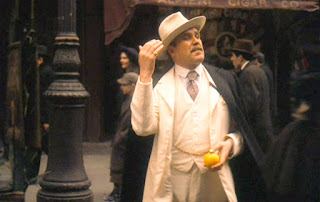
Here
is where Vito encounters the Mafia, or The Black Hand, in the form of Don
Fanucci (Gastone Moschin), who stands up, blocking the girl from Vito’s
friend’s view. He first calls the man a bum and tells him to sit. When Fanucci
turns around, and Vito’s friend sees who it is, he is afraid and apologetic.
When Fanucci walks out he passes the camera like a looming, dark presence,
eclipsing others. Vito and his pal go around the back of the theater to see the
actress, but Fanucci is threatening the owner of the theater and the actress,
who is his daughter. Vito’s friend cowers, not willing to try to rescue the
woman, and says they must leave. Vito holds his ground, seemingly not afraid,
which foreshadows how he will be able to deal with the Mafia in the future.
Vito says he doesn’t understand why Fanucci intimidates other Italians. But,
his friend says that everybody pays Fanucci in the neighborhood for protection,
supposedly since immigrants were discriminated against and did not always find
equal treatment under the law. But, in the end, they paid so they wouldn’t be
harmed by their so-called protectors.

Vito
is preoccupied with what he saw at the theater, but will not discuss his
feelings with his wife, which sets a pattern of keeping wives in the dark about
their husband’s thoughts. As the couple eats, the young Clemenza (Bruno Kirby)
calls into Vito’s window from another apartment. (The name "Clemenza" is an ironic one since it suggests "clemency"). He gives Vito a package to
hide. Vito takes it, and finds guns inside. He does this behind the closed door of the bathroom, excluding his wife from what is going on. Later, when Clemenza asks if he
peeked at the contents, Vito says he is not interested in things that don’t
concern him. He is being deceptive, a tactic needed later when he is part of
the criminal world. Also, he wants to show that he can be trusted with a
secret. Vito does not seek the gangster life, but seems to be drawn into it by
what occurs around him. When Clemenza acts like a friend of his is giving Vito
a beautiful rug, it is obvious that they are breaking into a private home of a
prosperous person to get the “gift.” The lesson learned here by Vito is that if
playing by society’s rules gets one nowhere, laws must be broken in order to
get ahead. Also, Clemenza says he knows how to repay a favor, which binds
people to each other, and is a tenet in the criminal world, and, for that
matter, in business and politics.
Vito
works at the store owned by the father of the friend who took him to the
theater. Fanucci visits the store where Vito works, and his friend says the
Mafia man is now exploiting the citizens more, asking for twice as much in
protection money. Fanucci gets Vito fired because he wants Vito’s boss to hire
his nephew, which means that he must let Vito go. The owner tries to give Vito
food, but Vito realizes that it is not the shop owner’s fault, and refuses the
gift. He tells the man that he always treated Vito well, and he will remember
that. Later, as is shown in the first film, the exchange of favors, but outside
the confines of the law, is the foundation on which the gangster families
became powerful.
As
the story returns to the 1950’s, Michael goes to Florida to meet with Hyman
Roth, who lives in a modest home. He tells people he lives on a pension, which
again is a deceptive front. Roth, like the older Vito in the initial movie,
looks like a harmless old man, but is quite the opposite. Roth has the TV on,
watching sports. He says he likes baseball, which sounds mainstream American,
but then he follows by saying he’s liked baseball “Ever since Arnold Rothstein
fixed the World Series in 1919,” referring to the Black Sox scandal. His last
name is Roth which resembles the famous gangster’s name, and shows how there is
an underbelly of corruption that operates below the clean-cut surface of
American competition. Roth says that he is glad Michael survived the attack,
because good health is more important that success, money, and power. But, it
is just a line, and Roth wants all of the above. Michael tells Roth that
Pentangeli tried to have him killed for refusing to get rid of the Rosato
brothers. He wants Roth to know nothing is more important than their plans for
the future, which Roth agrees, and says they will be making history together.
Michael asks if it is okay that Pentangeli is “a dead man.” Roth’s cold
response is “He’s small potatoes.” The two compliment each other, with Michael
telling Roth he is a “great man,” and that he can learn much from him. As we discover,
this is all posturing, as these two are out to get each other.
The
sunshine of Florida which pretends to reflect the warmth between friends is now
exchanged for the snowy cold of New York, which accurately mirrors the harsh
reality of what Michael knows about Roth. He waits for Pentangeli at his home,
which is where Michael grew up, and to which he still feels attached. He says
he was glad the house was not sold to “strangers,” so important are close
relationships to Michael, but which, ironically, given his dealings, keep
deteriorating. He shows his real anger when he yells how disgusted he is that
he was attacked in his home, “In my bedroom where my wife sleeps! Where my
children come to play.” It was a violation of keeping business and family life
separate. He tells Pentangeli that he knows it was Roth who tried to kill him.
He wants Pentangeli to settle his differences with the Rosato brothers instead
of starting a war. He says his father taught him, “Keep your friends close, but
your enemies closer.” It’s pretty sad when you must place your friends further
from you than your enemies. He wants Roth to see that he helped him with the
Rosato brothers, which will make him confident that their friendship is strong.
Michael says he wants time to find out who is the traitor in his family that
set him up. Michael practices the art of deception to discover deception, but
all of this dissembling just leads to more lies.
The
next scene shows us who betrayed Michael. Fredo gets a call in the middle of
the night from Johnny Ola, Roth’s man. He says he needs more help, and wants to
know if Pentangeli is really trying to make a deal with the Rosato brothers, or
is it a double-cross. Fredo has obviously been feeding Ola information, and
Fredo tells him that they involved him in something that he did not bargain
for. Did Fredo not know that there would be an attempt on Michael’s life? If
so, who opened the drapes in the bedroom? And who killed the two gunmen? Was it
Fredo? It seems unlikely he would be up to that task. If he wasn’t the killer,
then that leaves someone else in the Corleone camp. We are never given a
complete explanation. Perhaps the audience is left with the idea that in this
world one never can know all of the conspirators. When Fredo’s half-asleep wife
asks who called, he says it was a “wrong number.” Boy, is that right.
Carmine
Rosato (Carmine Caridi) meets with Pentangeli at a bar where they are supposed
to close their deal over sharing the territories. But, the other Rosato
brother, Tony (Danny Aiello, who will go on to do many memorable roles), tries
to strangle Pentangeli, saying, “Michael Corleone says hello.” (Apparently,
Aiello improvised his line, but it plays well in the story line). They drag
Pentangeli to the back. A cop comes in wondering why the bar looks dark and
closed, but people are in there. The Rosato brothers leave Pentangeli on the
floor as a shootout takes place outside. Were the Rosato brothers not planning
to kill Pentangeli, but just wanted to make him think Michael double-crossed
him so he would become Michael’s enemy? Probably not, but since Pentangeli
survived the attempt on his life, Roth later uses Pentangeli to try and bring
down Michael.

We
then move to a bordello operated by Fredo. Tom Hagen appears and goes into a
room where Senator Geary is with the bloody body of a dead hooker. She is handcuffed
to the bed. Geary remembers nothing, only that he woke up on the floor and says
that he would never hurt the woman. Tom exchanges looks with Neri, Michael’s
henchman. It is implied here that they set the senator up so as to manipulate
him. The deceiving continues to multiply, along with the dead bodies. Tom says
that it was lucky that Fredo runs the place and Tom can now clean up the
incident. Tom says that Geary’s alibi is that he stayed as Michael’s guest at
the Lake Tahoe residence. Tom informs Geary that the woman has no family, and
it will be like “she never existed,” and he waves his hands, like a magician
making someone disappear. He says to Geary, “All that remains is our
friendship.” They preyed on the senator’s weakness for sex, made it look like
they did him a huge favor, and allowed him to still appear to be wholesome. The
Corleones will ask for payback concerning the gaming license, and whatever else
the mobster family needs. As Michael told Geary, the politician and the
gangster are part of the same hypocrisy.
Kay
wants to take the children to New England, but Tom says she can’t leave the
Lake Tahoe compound for her own safety. She views her confinement as a type of
imprisonment. She has compromised her life to the point where because of her
marriage to Michael, there is a threat to her life and that of her children no
matter where she is. The quality of her life has become diminished because of
her husband’s criminal activities.
Michael
is in Havana to meet with Roth at a gathering hosted by the government of
people investing in Cuba. Michael and Roth sit at a table with corporate heads,
so the movie links criminals with corporations when it comes to trying to make
a profit. They pass around a gift to the President of a solid gold telephone
from United Telephone and Telegraph, a symbol of how businessmen try to imitate
King Midas, who, of course didn’t turn out well in the story, since acquiring
material wealth at the exclusion of all else is self-destructive.

Michael
and Roth meet with other crime bosses as they gather to divide up the spoils
(with the film using the obvious metaphor of cutting up a cake with the island
of Cuba decorated on it) derived from having a government that they can control
for their own profit. Roth implies that they are like any other corporations
that make contracts with nations when he says, “This kind of government knows
how to help business, to encourage it.” Cuba is contributing money along with the
Teamsters Union and the crime bosses in a type of unholy alliance to turn
Havana into a casino town with hopes of being more profitable than Las Vegas.
Again we have the equating of illegal organizations with supposedly upstanding
entities as they all work together for personal gain. Roth drives home the
point when he says that they have what they always wanted, “real partnership
with government.” But Michael questions the soundness of investing in Cuba
since he saw a rebel explode a grenade, killing himself and policemen rather
than being arrested. Roth is not happy about Michael casting doubt on their
enterprise, and asks what that incident meant to Michael. He says the rebels
are fighting the country’s government for a cause, not money, and are willing to
make ultimate sacrifices that may allow them to win their fight. Roth tries to
downplay the significance of the event, his greed blinding him from considering
Michael’s keen insight.

Later
in his hotel room, Roth points out to Michael that he didn’t want the fact that
the Corleone upfront two-million-dollar investment not arriving yet reflected
Michael’s worrying about the rebels. The old man keeps acting like he is ready
to die, and he wants to ensure that he hands off his wealth to those he cares
about. It is a pretense, since Roth is making himself appear more fragile than
he is to hold off enemies who feel they can just wait for his death to rise to
his place of power. Roth appeals to Michael’s desire to go legitimate by saying
that there will be enough cash derived from their deal to fund someone who
wants to run for the United States presidency. This suggestion is pretty scary,
since it implies that a dangerous, unscrupulous person, by reason of wealth,
can ascend to the highest office in the country. Roth says to Michael, “We’re
bigger than U. S. Steel,” the story continually drawing similarities between
criminal behavior and capitalism.

Fredo
arrives with the money, saying he doesn’t know what the cash is for. Michael
tells him about the investment in Cuba and that the two million dollars is a
gift for the President of Cuba. Fredo says that Havana is a great town and asks
if anybody they know is there. Michael says that Johnny Ola and Roth are there,
but then Fredo lies when he says he doesn’t know them and never met the two
men. They hang out together and Fredo says he wishes he would have married
someone like Kay, instead of his erratic wife, revealing how he is envious of
his brother. Fredo says he also wishes he could be more like their father. He
notes that their mom said he was left on the doorstep by gypsies. These
statements point to Fredo’s insecurities and how his family treated him as a
failure. Michael tries to be positive, telling him he’s no gypsy. Fredo
confesses that he was mad at Michael, probably for shutting him out of any real
responsibility, and therefore not respecting him, which does coincide with what
Michael told Tom about how he felt Fredo lacked intelligence and was weak.
Fredo wishes he could go back into the past and “spend time” like they are
doing now, so they could have been closer.
Michael
tells Fredo that Senator Geary and other government officials will be flying in
and he wants Fredo to show them a good time so as to pave the way to get
government favors. He confides to Fredo that on the way back to his hotel from
a New Year’s Eve party at the Presidential Palace (in a military vehicle, so he
will feel safe, deception always employed in these schemes to throw the victim
off), he will be assassinated. He says it’s Roth who is out to get him, and
echoing his father in the first film about the hoodlum Barzini, Michael says,
“It was Roth all along.” He says Roth has been lying about making Michael his
successor, and really wants to live forever. So, he wants a powerful person
like Michael out of the way so he can keep the profits to himself. Michael says
that he has already made a plan to thwart the attack, and that “Hyman Roth will
never see the New Year.”
Michael
meets again with Roth, who knows Fredo came with the money. Michael wants time
to think about investing, but he’s just stalling to carry out his assassination
plot. He also wants to know who gave the order to kill Pentangeli, since he
didn’t. The unspoken accusation is that Roth did. Roth counters with the story
of Moe Green (who was in the first film) who was Roth’s partner a long time ago
(and was modeled after gangster Bugsy Siegel, who helped create Las Vegas).
Roth calls Green a great man of vision, and Roth loved him. But, he defied
Michael and as Roth says, “somebody put a bullet through his eye.” Roth says he
didn’t question who gave the order, “because it had nothing to do with
business.” Here we have the acceptance of murder committed in the course of
conducting business, so important is making a profit that a person’s life is
secondary. As was noted in the initial movie, cruelty in the moneymaking world
is “not personal,” the “person” part of that word being negated when business
is transacted. Roth doesn’t give Michael any more time, saying they will be
partners if the money is on the table when he wakes up from his nap; otherwise,
their relationship will be terminated.
Fredo
and Michael entertain some senators and a judge at a club, showing how
gangsters and politicians intermingle well. Geary, not having learned from his
overindulgence in his sexual appetites, tells Fredo he’s interested in hooking
up with one of the local beautiful women. Johnny Ola is there and again Fredo
acts like they have never met before. They go to a sex club, and Fredo has consumed
a great deal of alcohol at this point. Geary asks Fredo where did he find this
club, and Fredo lets slip, “Johnny Ola brought me here.” He goes on to say that
Roth won’t go to these places, but Ola knows them well. Michael’s eyes shift
toward his brother, realizing Fredo lied to him about knowing Roth’s henchman,
and now sees his own brother as a traitor. This betrayal is especially painful
coming from his immediate family, the place where he put all his trust. Now,
Michael feels he can’t believe anyone who pretends to be his ally, suggesting
that the lying that goes around comes around to harm the deceiver.
Later,
Michael’s silent bodyguard/assassin (Amerigo Tot), dressed in black, looking
like the angel of death, sneaks into Roth’s hotel room and kills Ola. But he
must get out before murdering Roth since doctors are there preparing to send
the old man to the hospital. The killer goes to the hospital, tries to smother
Roth, but is killed by military guards. So, Michael has failed despite his intelligent
plotting to stop his powerful nemesis.

Michael
and Fredo are at the Presidential Place for the New Year’s celebration. But as
Michael predicted, the rebels have the government on the run. Soldiers march in
and the President announces his capitulation. The irony here is that Roth’s
dream of welding together government and criminality into a type of
capitalistic heaven is defeated by the communist forces of Fidel Castro.
Michael aggressively hugs Fredo, telling him there is a plane waiting to take
them to Miami, since Michael knew he would need to get away quickly if Roth was
killed. He fiercely kisses Fredo on the lips, a combination of love and
violence resulting from the realization of treachery. It's sort of a kiss of death. Michael tells his brother
he knows that it was Fredo who is the traitor, and says, “You broke my heart.”
Michael here acknowledges that his reliance on the love for his family is
shattered. Fredo slinks off, afraid of his own sibling’s wrath. In the mobs of
people trying to flee the revolutionary forces, Michael sees Fredo and tells
him to come in his car to escape. But Fredo, who knows about his brother’s past
acts of vengeance, runs off in fear. As Michael heads to the airport, the
revolutionary forces yell “Fidel” which drives home the defeat of the “Gangsta’s
Paradise” dream. (My apologies to Coolio for the reference).
Back
in the states Michael meets with Tom, asking him what he bought Michael’s son
for Christmas, so it will seem like he knew about the gift. Michael, the family
man, has let his business take precedence over his connecting with his family
on the most family-oriented holiday. But, of course, appearances must be
maintained, so he will lie about previously knowing what was bought. Tom says
that Roth used a private boat to get out of Cuba. He had a stroke, but
recovered, the man seemingly having cat-like nine lives. He is in Miami. Fredo
apparently made it to New York. Michael says he wants Tom to get in touch with
his brother and tell him he knows Roth misled him and didn’t know they were
plotting to kill Michael. What Michael says may be what he believes, but it
really doesn’t matter to him. The fact that Fredo did something behind
Michael’s back with a rival is enough to condemn him. Tom reluctantly tells
Michael that Kay had a miscarriage, which strikes another blow against
Michael’s need for a strong family foundation. He is angry that Tom can’t tell
him if it would have been a boy, which is what he had hoped for to help carry
on the manly Sicilian legacy.
There
is then a shift to Vito, who is concerned about baby Fredo having pneumonia,
indicating a time when the vitality of the family was paramount (no pun
intended as to the studio that released the film). (The superimposing of images
at the beginning of these time shifts into the past as Michael contemplates his
situation could mean that he is actually thinking about his father’s early
life, and is nostalgic about it. However, Coppola presented the two movies in
sequential order for television, which would argue against these flashbacks
just being in Michael’s mind). Fanucci, always wearing a white suit, presenting
a fake benevolent impression since his intentions are always sinister, jumps
onto Vito’s truck and informs him that he knows that he and his partners are
stealing goods. He tells Vito that he needs to give Fanucci a cut of the action
to be allowed to continue, since it is Fanucci’s neighborhood. If Vito doesn’t
comply, the cops will be called to go after Vito, and he will be ruined. In
another false appearance, instead of protecting his countrymen, Fanucci is
actually exploiting them.
Vito
tells his partners, Clemenza and the younger Tessio (John Aprea), about
Fanucci’s demands. Clemenza says they have to pay since Fanucci works for a higher-level
Mafia boss who has connections with the police. Thus, the illicit connections
between gangsters and law enforcement officers go way back, since money has
always been used as a tool for corruption. Before eating his pasta Clemenza
makes the Catholic Sign of the Cross, another example of how these hoods
compartmentalize their ethical religious beliefs and their criminal actions.
Vito declares that it is unfair having the fruits of their labor taken away
from them. He could be sounding like any worker in the capitalist system who
slaves away as big shots reap the gains of his labor. Vito says that they
should each only give him fifty dollars for Fanucci. Vito says, “I guarantee
he’ll accept what I give him.” He wants them to not have knowledge of his
lethal plan, to protect them, maybe, but also because they would try to stop
him from carrying it out. In English, Vito says, “I’ll take care of
everything,” which shows how he is on his way to becoming an Italian American
Mafia boss. He tells them that they should remember that he did them a favor,
and so, he will expect reciprocity, which is, as was noted before, how
alliances are formed in any business situation.
The
Godfather movies use religious ceremonies as contrasting ironic backdrops
during which violence occurs. In the first film, the ending has the
assassinations of the heads of the warring Mafia organizations occurring at the
same time as the baptism of Michael’s godson. Here, there is a religious
procession in the streets. Traditional music mixes with the “Star Spangled
Banner,” demonstrating the allegiances to both the old and new countries. After
giving Vito the small amount of money, Clemenza asks Vito if Fanucci will go
for the reduced offer. Vito responds with what may be the first occurrence chronologically of a version of the famous line when he says, “I’ll make an offer he
don’t refuse,” a statement that carries a lethal underside to its falsely
benevolent surface.
Vito
meets with Fanucci and gives him the money, which the man is not happy about.
But Vito smiles, acts congenial, and says he’s a little short for right now.
Fanucci admires Vito’s “guts,” and actually offers Vito the opportunity to work
for him. He even tells Vito that there are “no hard feelings,” and says, “If I
can help you, let me know.” Vito could let it go at that, and join up with
Fanucci, but he most likely feels he must honor his partnership with Clemenza
and Tessio, and he no longer wants to be somebody’s puppet. Also, Fanucci still
expects the rest of his payment.


Fanucci
struts around the neighborhood like he owns it, accepting greetings from the
intimidated inhabitants. He walks in the opposite direction of the religious pageant, which could suggest that his presence is demonic. He passes by a marionette show which depicts violence and which symbolizes how
those in power manipulate others. But, Fanucci is carrying one of those ominous
oranges, an indication that death is imminent. The religious statue that men
carry through the streets has lots of donated money attached to it. The strange
image combining the worship of the spiritual and the material at the same time
is an appropriate image that reflects the attitudes of these Catholic
gangsters. Vito stalks Fanucci from the rooftops, symbolically showing how he
places himself above the laws of man and God. Vito has hidden a gun, wrapped in
a towel, a disguise masking its lethal intent, similar to how Vito presented
himself in his meeting with Fanucci. The hidden gun ties in with the stashed weapon that Vito's son, Michael, will use in the original film. Like father, like son. Vito waits outside Fanucci’s apartment and
then shoots him as fireworks go off, drowning out the shots. As has been noted,
the film is loaded with acts of deception. Even after the man is dead, Vito
brutally desecrates the body by shooting Fanucci through the mouth to stress
that who killed this scary man must be feared even more. After performing this
homicidal act, which criminals would excuse as necessary to conduct “business,”
Vito then assumes his other persona as a caring family man, telling the infant
Michael, “your father loves you very much.” The family is waving American flags, another image joining domestic love with patriotism, but tinged with violence after what Vito has done.

In
Michael’s adult world, there is a U. S. Senate investigation into organized
crime where the senators question mobster Willi Cicci. The committee chairman
asks if he is a member of the Corleone crime syndicate, but Cicci corrects the
senator, saying he belonged to the “family.” His response shows that even
though mobsters tried to keep their private family separate from their criminal
affairs, they still built their “business” on a family model, expecting
obedience to rules and the maintenance of loyalty. But, as Michael said
earlier, money can’t buy true fidelity. Cicci admits that he was an assassin
for the Corleone family, but says he never received a kill order from Michael
personally. In an inappropriate manner, Cicci jokingly picks up on Senator
Geary’s phrase by saying that there were a number of “buffers” between him and
Michael. Cicci was Pentangeli’s associate, and since the Rosato brothers
implied that Michael ordered Pentangeli’s death, Cicci may be testifying to get
back at Michael.

Back
at the family home in Lake Tahoe, Michael looks dejected and doesn’t let Kay
know he is home. He is not even there to comfort her after the supposed
miscarriage, almost as if he blames her for depriving him of another son, which
turns out, in fact, to be the case. Later, Michael goes to his mother asking
her if being strong to protect the family can cause one to lose it. He is
talking metaphorically, weighing whether his actions have distanced himself
from the family members, and exposed them to harmful forces. She says that he
can’t lose his family, but she is being literal. He says times are changing and
he means for the worse, moving away from the time when his father gained
prominence.

The
story moves, appropriately, to Vito’s time, before the changes that Michael
bemoans. Vito is now known in the neighborhood as a man of power, and he
appreciates others showing him respect. So, when a man offers him free fruit,
he is willing to grant a favor in return for the act of goodwill. Vito’s wife
wants her husband to help a neighbor, Signora Colombo (Saveria Mazzola), who
was evicted by her landlord for keeping a dog that her son loves, but that
neighbors complained about. The landlord is Signor Roberto (Leopoldo Trieste),
known as a slumlord, and Vito confronts the man very politely, asking him to
reconsider his actions. Vito shows his generosity by willing to pay the rent
six months in advance. Roberto is belligerent, and dismisses Vito’s request to
show compassion for a woman who is poor and has no family to help her. Vito
tells Roberto to ask around about him, and he will find that Vito knows how to
return a favor. Once the landlord discovers that Vito has mob connections, he
comes to Vito looking worried and ready to apologize. The landlord now calls
him Don Vito, showing how Vito has replaced Fanucci as the new, more
compassionate crime boss of the neighborhood. After a few stern, wordless looks
from Vito, Roberto not only allows Signora Colombo to stay with her dog, but
agrees to reduce the rent substantially. He is afraid to stay any longer and
comically has trouble opening the door to leave (the lock was rigged without
the actor knowing about it, and he improvises wonderfully). Such is the power
that fear can generate, but, when used nobly, as here, it can be a force for
justice when legitimate channels are unresponsive to the pleas of the
disadvantaged. Vito then raises the sign on his imports store, the legitimate
front for his illegitimate business operations.
Back
at the Senate hearings, Michael now testifies. Geary utters platitudes about
his Italian American constituency, and makes the statement about how some of
his “best friends are Italian American.” It has become a joke that when a person
announces that members of an ethnic group are among his friends, those
“friends” probably do not exist. Geary then starts to figuratively distance
himself from Michael and the Mafia, saying that there should be no defaming of
all Italian Americans because of “a few rotten apples,” Michael being one of
the “rotten” ones apparently. Then he departs the committee to work on another
one, literally disconnecting himself from the people who did him favors, but
who now are politically dangerous to be associated with. Michael perjures
himself, denying his mobster associations. Kay is there and has to publicly
hear her husband accused of the murders he committed or ordered in the first
story. Michael reads a statement to clear his “family name,” hoping to have his
children live their lives “without a blemish on their name and background.” We
again have Michael trying to accomplish the impossible task of trying to keep
his family untainted by the poison of his unlawful life, and can only attempt
to do so by being even more dishonest by pretending to be a law-abiding
citizen.
The
Senate committee chairperson announces at the end of the session that there
will be a witness to corroborate the accusations against Michael. The next
scene is a good segue since it shows Pentangeli in the custody of U. S.
Marshalls. He has made a deal to inform on Michael, and lives in a comfortable,
protected residence on an army base. But, he is dejected, probably because he
has forfeited his freedom, feels guilty about betraying a fellow criminal, and
feels that he will be marked for death after he testifies.
Michael’s
people have found out that Pentangeli is still alive, and Roth was the one who
engineered the attempt on Pentangeli’s life. Fredo is now at the Tahoe home,
and Michael talks to him to see if he can learn anything from him. Fredo looks
defeated as he appears collapsed in a chair. He says he didn’t know much about
Roth. He confirms that Roth made it look like Michael was Pentangeli’s enemy.
Fredo becomes angry when Michael says he always took care of him. He says he
was the older brother and Michael disrespected him, giving him menial jobs.
Fredo says that Johnny Ola had approached him and said if Fredo could make the
deal between Roth and Michael go quicker there would be “something in it” for
Fredo. Because Michael’s harsh business ways belittled his brother, Fredo
sought empowerment from a man who turned out to be Michael’s enemy. Fredo
reveals the corruption in the U. S. Government itself, because the Senate
lawyer is Roth’s man. Michael makes no attempt to understand his brother’s
pain. He tells him he is nothing to him now, not a brother or a friend. He
tells him “I don’t want to know you, or what you do.” He doesn’t want him in
his house and when Fredo visits their mother, he wants notice so Michael
doesn’t have to be there to see him. Secretly, he tells his henchman Neri that
he doesn’t want anything to happen to Fredo while their mother is still alive.
Michael may want to spare his mother that grief, but he conveys that he will
eventually order the execution of his brother.


At
the Senate hearings, Pentangeli sees that Michael has brought his brother,
Vincenzo Pentangeli (Salvatore Po), who, according to what Tom tells the
senators, came at his own expense from Sicily to be there for his brother.
Pentangeli’s subsequent testimony contradicts his sworn affidavit. He says he
just made up stuff about the Corleones to make a deal. He admits he only was in
the olive oil business with them. It is not made clear whether the brother’s
presence was meant to convince Pentangeli that Michael was not his enemy, or
whether Vincenzo would be harmed if Pentangeli testified against Michael. In
any event, without his testimony, Michael is off the hook.

Kay
tells Michael she and the children are leaving him. She no longer wants
anything to do with him and his business. His power has corrupted him and he
ruptures the wall that he erected to separate his criminal behavior from how he
acts with his family. He now treats his wife the same way he does those in his
world of crime. He orders her around, and will not tolerate opposition. She
sadly admits that she feels no love for him at all. He says that he will change
and that they will have another child. To make sure that he will want nothing to
do with her, she tells him the truth about having an abortion, not a
miscarriage. She says their marriage is an abortion, “Something that’s unholy
and evil,” the opposite of what Michael’s religion teaches, and whose laws he
only pretends to follow. She says that she didn’t want to bring another one of
his sons into his demonic world. Her actions strike at the very core of
Michael’s reverence for family and children, and his desire to have descendants
carry on the Corleone legacy. It adds to his feeling that he is being betrayed
on all fronts, and that he no longer can trust anyone, which is the risk of
choosing the life he leads. He responds by striking Kay. Just like he told his
brother, he no longer wants to see her. As he feared when he spoke to his mother,
he is losing his family.


There
is a return to Vito’s time, as he takes a trip to Sicily with his wife and
children to visit relatives, which contrasts with Michael’s deteriorating
family situation. But, Vito also has darker motives. He goes to the house of
Don Ciccio, the man who murdered his family. Vito, as he did with Fanucci,
throws his enemy off guard by pretending to be a respectful and congenial
businessman, even kissing Ciccio’s hand, in the manner one greets a gangster
boss. When the old man asks his father’s name he tells him it was Antonio
Andolini. And then, Vito cuts him, killing the man who ordered the deaths of
his father, mother, and brother. Ciccio was right to fear an older Vito. The
Sicilians always follow through with their vendettas, so important is their
commitment to avenge wrongs, and in so doing, perpetuating the state of
violence.

Michael’s
mother has now passed away. Fredo cries at the wake held at the Tahoe estate,
and is comforted by his sister, Connie. Tom tells Fredo that Michael will not
see him even on this day of grief when family members usually comfort each
other. This fact shows how emotionally hardened Michael has become, his
isolation deepened with the loss of his mother. Michael has his children there,
and he told Kay that he would use all of his power so she would not take them.
He has succeeded in his threat, but at what cost to their well-being. Connie
tells Michael she would like to stay close to home now. She admits that she
hated him, and acted in self-destructive ways so she could hurt him. But, now
she realizes that he was just being strong, like their father. She says she
forgives him, but hopes that he can forgive Fredo. She says he needs her now,
and wants to take care of him. She is right, since she is the one family member
who actually wants to be closer to Michael. However, they do not embrace, but
instead she kisses his hand, which is more the act of a Mafia subordinate than
that of a sister, stressing the impossibility of separating the worlds of criminality
and family. This point is further made when Michael goes to Fredo and embraces
him, as a brother should. But it is a false show of affection, as Michael gives
Neri a cold look, reminding his henchman what Michael said about Fredo’s fate
after Michael’s mother died.
Michael
then plots the death of Roth, who has tried and failed to be allowed to live in
several countries. His passport is only valid for a return to the United
States, and he will be arriving in Miami. Tom sees no point in going after the
man, since he is supposed to be terminally ill. Michael does not buy that the
man’s death is imminent. Tom says it’s impossible to get at him, since Roth
will be met at the airport by the IRS, Customs, and the FBI. Michael (while
significantly eating one of those ominous oranges) says it’s not impossible to
kill Roth. Michael’s dark, cynical view is that if it’s one thing that history
has taught us, it’s that “you can kill anyone.” Tom says that Roth and the
Rosato brothers are “on the run,” and he asks if it’s worth going after them.
Tom says that Michael has won, and asks him, “Do you want to wipe everybody
out?” Michael replies that he just wants to get rid of his enemies, but
violence and greed seem to create new ones seeking revenge or power. Michael
now even doubts Tom’s loyalty, wondering if he will leave to pursue an offer to
be a vice president of a casino in Las Vegas. Tom says he turned down the
offer, but just because he didn’t mention the job possibility, in Michael’s
paranoid mind, it causes him to suspect Tom. Michael says that if Tom isn’t
going along with the program, Tom can take his wife, family, and his mistress
and move them all to Vegas. Tom is very hurt by the way Michael is now treating
him, threatening exile from the family he has loyally served, especially after
Michael earlier on told Tom he was the only person he could trust.
Fredo
is very sweet with his nephew, Anthony. Near the lake, he says that he used to
go fishing with his father and brothers, and he caught a fish every time he
said a Hail Mary prayer. His nostalgia, mixed with spirituality, speaks of a
close family time that no longer exists. Fredo’s feeling of safety and love is
really a cruel distraction, perpetrated by Michael, to prevent Fredo from
seeing what is to come. Tom meets with Pentangeli and assures him that his
brother has returned home safely. They, like Fredo, talk of times past, even
going back to the ancient Roman period, which the Mafia modeled themselves
after, using the same military terms, such as “regimes,” “capos,” and
“soldiers.” Pentangeli compares the Corleone family to the rule of the Roman
Empire, as he tries to elevate criminality to a level of greatness. During
those times, men who failed to overthrow the Emperor were allowed to take their
lives by slitting their veins in a bath, knowing that their families would be
taken care of. This practice seems civilized to Pentangeli, and he takes
comfort from the talk with Tom, which has communicated to Pentangeli what he
should now do. Tom translates his name, calling him, “Frankie Five-Angels,”
adding an ironic religious feel to their conversation that offers suicide as a
way to seal the deal to protect one’s loved ones.
Kay
is visiting with the children, but Connie warns her to leave soon since Michael
is approaching, and if she doesn’t go she will face his anger. She makes it to
the back door, as she is reduced to having to sneak about to see her son and
daughter. She pleads for their son to kiss him before she goes. She had hinted
earlier that Anthony was damaged by the terrible events that the family
experienced. Michael appears and closes the door on Kay repeating what happened
at the end of the first film, symbolizing how she has been shut off from the
love and emotional connection she once hoped for.


Fredo
is preparing to take Anthony fishing, but Connie says that the boy will be
going to Reno with his father. This is another deception in order to isolate
Fredo so he can be killed by Neri in the boat. It is heartbreaking to hear
Fredo tell his nephew that they will go fishing together the next day, since
there will be no tomorrow for Fredo. The movie reaches its climax like the
first one, with several deaths. Roth is shot at the airport, and Pentangeli
commits suicide. We see autumn leaves blow across the lawn, signifying the end
of life. Fredo is killed on the lake, the murder following his reciting the
Hail Mary prayer, containing words that, appropriately, make a plea to pray for
sinners, and there are many of them here.


Michael
sits alone in a dark room at the house. There is a flashback, this time
probably a memory of Michael’s, to when the whole family was together around a
dinner table, a fitting place for Italians to gather. Michael, along with his
brothers, Fredo, Sonny (James Caan), and Tom, as well as Connie and her future
husband, Carlo (Gianni Russo), are there, as well as Vito’s associate, the
older Tessio (Abe Vigoda). It is right around the time of the bombing of Pearl
Harbor by the Japanese, and Sonny says that those enlisting to fight are
“saps,” because they “risk their lives for strangers.” Michael says that is
what their father would say. Sonny, like Vito, puts the family even above
country, so tribal is the feeling perpetuated through the generations of Italian
American mobsters. Sonny says one’s countrymen “are not your blood.” At this
time, in contrast to what he later believes, Michael says he doesn’t feel that
way. He announces that he has quit college and enlisted. Sonny is very angry,
mostly because he fears losing his brother pointlessly as a soldier fighting a
war that he sees as having nothing to do with the family. Tom says that their
father had to “pull a lot of strings” to get Michael his deferment (the
“strings” reference fits the marketing image for these films, with the crime
boss being the puppet master who manipulates others). Tom says that he and
their dad talked about Michael’s future, which Michael finds strange, since he
wasn’t consulted about his own life. He says he has his own plans, but as we
know, those plans never take place. Michael’s independence here seems at odds
with his future immersing of himself in all things tied to his family.

Michael
is left alone at the table as the rest go to greet their father on his
birthday. Then there is a shot of Vito holding Michael waving goodbye on the
train in Sicily. The final shot is of a solitary Michael at Lake Tahoe. The
cumulative effect is a vision of a lonely man bereft of the family he treasured
due to a combination of the life he inherited and the path he chose to follow.
The
next film is The Night of the Hunter.