Showing posts with label Philip Seymour Hoffman. Show all posts

Wednesday, December 10, 2025

Almost Famous

 SPOILER ALERT! The plot will be discussed.

Almost Famous (2000) springs from writer/director Cameron Crowe’s experiences as a writer for Rolling Stone magazine, including his interactions with The Allman Brothers, The Who, and the Eagles. (Crowe won an Oscar for Best Screenplay for this movie). The character William Miller (Patrick Fugit) is Crowe’s alter-ego, and he and others associated with rock and roll celebrities are famous adjacent, noteworthy by association. The film deals with the nature of celebrity, its highs and lows and the fallout on those that enter its sphere, along with the need to be independent, and not a follower.

The opening credits show how personal the story is for Crowe. A desk drawer opens and it has memorabilia of his association with rock bands. A person hand writes some of the credits on a paper pad, showing the analog period in which the tale is told.


The movie begins in San Diego with young William (Michael Angarano) talking to his mother, Elaine Miller (Frances McDormand, with yet another Oscar nomination, this time for supporting actress. They discuss To Kill a Mockingbird and Shakespeare. Their exchange shows her intellectual bent.

Daughter Anita (Zoe Deschanel) comes into the house, and Elaine, a college professor, is immediately suspicious of her activities. She knows that she has been kissing a boy, and she discovers that Anita has a Simon and Garfunkel album she is clutching under her coat. Elaine warns of how modern music is about sex and drugs and says the musical duo pictured on the album cover are “on pot.” These allegations seem ridiculous to us now, knowing of the beauty and insight of Simon and Garfunkel’s music. Mom is pushing vegetarian foods and not celebrating Christmas in September, not December, but when the holiday will not be commercialized. Anita asks, “What else are you gonna ban?” It is interesting that Elaine, a supposed liberal, can be repressive in her self-righteous attitudes.

Anita pushes the supposedly knowledge-championing Elaine into telling William the truth about his age. He thinks he started school early and is twelve years old. Mom had him skip a grade and he is really eleven. The boy already feels put upon by others because he is underdeveloped according to them. Anita says that mom has deprived him of reaching puberty at the same time as his peers. Self-righteous Elaine says, “Adolescence is a marketing tool,” as if it doesn’t really exist. Elaine does not believe in being “typical.” Her rebelliousness against anything accepted by others stigmatizes younger people looking for community among their peers.

Anita leaves to be a stewardess, ready to travel, which Elaine said William should do when he gets older. But Elaine sees William as “unique,” and her daughter as “ungrateful” of her love just because she is “rebellious.” Elaine also rebels against society, but she doesn’t tolerate any deviation from her own ideas. Anita tells William that “one day you’ll be cool,” which is what William yearns for, since it is a path to being revered by others, and eventually, becoming famous. Anita leaves him her record collection under his bed, to help him along the way to the realm of coolness. She leaves a note for William to play Tommy by The Who, and says he will hear his future listening to the album. It is an interesting choice. Tommy, who is not able to hear, speak, or see, is an outsider. His ability to be a pinball wizard despite his handicaps allows him to become famous by being “cool.” But then, he wants to mold everyone into his own image, and his followers reject him for forcing his version of conformity on the masses. It is sort of an ironic message for William, and it sounds like a version of what happened to Elaine.

The story jumps forward to 1973, and the teenage William hears music critic Lester Bangs (Philip Seymour Hoffman), who visits San Diego, spout his views on the current state of rock and roll on the radio. The name “Bangs” fits what he does, whacking at the music industry. William meets Lester at the radio studio. He has been sending pieces he writes, and Lester admits William is a good writer. But his advice is the opposite of what his sister wanted for her brother. To be a music critic one must be “uncool,” Lester says. That allows the writer to be objective. He must be “honest” and “unmerciful.” He says that the bands will just try to bribe the critic with booze, drugs, and women to write praiseworthy reviews. He advises that the rock musicians are “not your friends.” Lester realizes that William will not be better off being a lawyer, which what his mother wanted, and he gives him a job to write about the group, Black Sabbath.

William isn’t allowed to go backstage for his interview. Outside he meets Penny Lane (yes, from the Beatles song). Kate Hudson (also nominated for a Best Supporting Actress Oscar) plays Penny, who tells William she altered the groupies into what she calls the “Band Aids.” They are here to inspire the musicians. She says they do not have intercourse with the band members just to become close to those who are famous, although one girl says they do give “blow jobs,” which compromises the mission.


William’s knowledge of an opening band called Stillwater wins over the musicians, who at first called him “the enemy,” and they let him go backstage. (Peter Frampton wrote the Stillwater songs for the film). The band first says they play for the audience, not critics. But when William compliments them, they enjoy the praise. The film shows that everyone likes the critics when they are favorable and condemns them when they are negative. A band member has the belief that rock and roll can change the world, but admits to lower ambitions saying the money is good, and “the chicks are great.”

Penny catches up with William to give him a backstage pass, so she does follow up on her intentions. She plays with his face and tells him, “now you look mysterious.” It’s as if one must have an air of mystery, an element of being “cool,” to become popular. Just upfront honesty does not appear to be enough. William introduces Penny to Stillwater member Russell Hammond (Bully Cudrup), and there appears to be chemistry between the two. After the concert, Russell tells William to visit the band in LA and bring Penny with him. He is going under the name of “Harry Houdini.” Using an escape artist’s name, again, shows mystery is part of the cool allure.

To stress the divide between the cool and the uncool, when Penny tells William they live in the same city, he says they live in two different worlds, despite their proximity. She says she has decided to live in Morocco for a year, saying she needs to find a new crowd. Her words suggest that the Band Aid world of girls with rock stars has become jaded for her. She asks him if he wants to go with her, and the excited William, hoping to break out of his uncool world, says yes.

William lies to his mother about where he is going, and travels with Penny to LA to the Hyatt House hotel, which Russell called “The Riot House,” the play on words showing the contrast between a cool name and an uncool one. There are nerdy types running around gushing about seeing members of Led Zeppelin and getting autographs, wanting to decrease the degrees of separation from those who are famous.

Polexia Aphrodisia (Anna Paquin), one of the Band Aids, tells William that Penny used him so she could get close to Russell, showing how self-interest exists even under the appearance of camaraderie. Later, Penny admits to William that she sees Russell as her last project. She is true to her words about not just being a groupie. She actually wants to help Russell live up to his potential for greatness.

Rolling Stone gets wind of William’s writing and calls him to do a piece on Stillwater. William contacts Lester who again tells him not to be friends with the musicians and that the magazine consists of “swill merchants.” While talking, he wears a shirt that says, “Detroit Sucks,” so cynical has he become. He flies his negativity like a nihilistic flag.

Mom, with great trepidation, insisting on academic standards being kept, and stating “no drugs,” her mantra, allows William to go on tour with the band. When she calls, one of the Band Aids answers, who tells mom that William is doing a great job, is a real gentleman, and is still a virgin. In other words, his uncoolness remains intact. William’s phone call to his mother later occurs while another Band Aid talks about his “purple aura,” and that she has pot for him, which shows how William is caught between two worlds.

William keeps trying to get an interview with Russell, but the musician says he’ll talk off the record, because he doesn’t want honesty to tarnish his being “cool.” But, he admits some of the band’s actions, like being unfaithful to girlfriends and wives back home, should not be discovered by “millions.” Russell also admits that the more success the band has, it becomes harder to split from them, since he feels he is a more advanced musician. He says he and William should be friends for the night, which is what Lester advised against, since journalistic integrity is lost without objectivity. What the audience is seeing here is how art and personality are two separate worlds. While a bandmate still doesn’t trust a journalist among them, he admits it would be cool to be on the cover of Rolling Stone. The ambivalent world of rock stars is evident here.

At a concert, Russell receives an electric shock from an ungrounded microphone. This scene is based on a true event. According to IMDb, Les Harvey of Stone the Crows died due to being electrocuted by an ungrounded mic. Here, the image implies how being in a rock band, which is rebellious while still seeking acceptance, can be dangerous.

In Topeka, the band has a blow-up about T-shirts that depict Russell large and the others out-of-focus in the background. The lead singer, Jeff Bebe (Jason Lee) is particularly feeling unappreciated by Russell. After the argument, Russell grabs William to go out and find some “real people, real feelings.” That suggests that the rock business is feeling phony to him. He, as well as Penny and some others, may find that they can be close to William because of his youth. They may be attracted to what they see is his innocence, his lack of corruption.

Russell says William is real and finally asks about him. William admits to his father dying of a heart attack and how his mother and sister don’t talk. There is some actual sharing in the moment. Then they get invited to a party by passersby, and Russell agrees that they should go. Russell feels that connecting to these “real people” are what he is after. At the party, he is feeling intellectual, talking about how George Orwell’s predictions in 1984 are coming true. The response is that one guy wants to show him feed a mouse to his snake. So much for grand ideas.

William becomes the adult here as he warns the partygoers not to give Russell more LSD. Instead of connecting with real people, Russell delves into the delusional, yelling out, “I am a golden god!” which was attributed to Led Zeppelin singer, Robert Plant. He is on the roof and says that his last words are “I’m on drugs” which the crowd prefers to “I dig music,” and they want him to risk his life, jumping into the pool then just going back to the hotel. The movie implies that the fans want the outrageous from their idols so they can live vicariously through their heroes doing actions that they can’t or won’t do.

William gets Russell back with the band and bad feelings evaporate as the whole touring bus sings along to Elton John’s “Tiny Dancer.” So, music is still the glue that holds them together. William needs to get his interview with Russell before going home. Penny tells him he is “home.” And there lies the conflict. William is in and out of his true home.

In the hotel room William gets advice over the phone from Lester about how to stall Rolling Stone by calling his article a “think-piece” about a “mid-level band” dealing with fame. It may be a ploy, but it actually fits what’s going on. When William asks Penny, after she continues to name-drop rock stars, if she knows any regular people, she says “famous people are more interesting.” That shows the opposite drive from a regular person, as opposed to Russell’s urge to connect with “real” people. They show the desire to break out of where one currently resides.

The Band Aids decide to “de-flower” William, but Penny does not participate. Their friendship appears to be on a different level. The other girls are just playing around with no real connection to the young writer. When he asks them who he is to them he gets his answer when they tell him to take out the laundry.

Now in Cleveland, he has a phone call with his mother. Russell interrupts it and tells Elaine that William is fine, and they are taking good care of him. She, however, cuts through his crap, and tells him that he can overcome his debauchery to reach greatness, and that he would not want to meet up with her if anything unsavory happens to her son. Russell alters his attitude, becoming subservient, as if receiving parental guidance that he needed.

Dennis Hope (Jimmy Fallon) arrives, a big-name band promoter, saying Stillwater needs to move fast to capitalize on their increasing success. (His name “Hope” is a bit ironic here, as he is more for opportunity than the idealistic feel of “hope). He says they must cash in quickly, saying Mick Jagger will not make it as a rock star when he’s fifty. (Jagger still tours at age 82. So, the implication is that one can play the long game). But Stillwater goes with Hope, and they trade in their trusty touring bus for an airplane for transportation to reach more gigs quicker.

William witnesses a card game between rock band members, and Russell agrees to give up Penny and the other Band Aids for fifty dollars and a case of beer to the rock group Humble Pie. William is becoming more cynical about the rock business, and accepts the original idea of him, being a journalist, as “the enemy” who can expose secrets. When Penny wants to go to New York to pursue Russell it is William who tells her to “wake up,” since Leslie (Liz Stauber), Russell’s girlfriend, will be there. He then tells her about the poker game. She tries to hide her hurt. As William points out there is so much phoniness, that they live in a made-up life, with invented names.

In New York, Leslie shows up, but so does Penny, and she is crushed when another band member says she is with him as a diversion. After William tells the band they will be on the cover of Rolling Stone magazine, Penny runs off and tries to overdose on Quaaludes. William follows her and calls a doctor at the hotel. She is alone as she feels deserted since the other Band Aids have gone off with other rock groups. She is collateral damage to the fame of others. William says a funny line to the almost unconscious Penny when he changes the opening line of Star Trek by saying he’s going where many have gone before, and tells her he loves her, which he follows with a kiss.

As Penny gets her stomach pumped, we ironically hear “My Cherie Amour,” whose lyrics about the pretty little girl who is adored contrast with the upsetting scene before William. Later he finally learns her real name is Lady Goodman, which she says her mother thought she would become and who she would marry. He says goodbye as she flies back home to San Diego.

The band is on a plane that hits an electrical storm. When it looks like they might not make it, they start to shout out confessions. One admits to being a hit-and-run driver, another says he is gay, Jeff says he slept with Leslie, and the affair between Russell and Penny comes out. When they call Penny just a “groupie,” William gets angry and says she cared about the band and they just used her, and he was in love with her. The threat of death makes everyone become real quickly, no longer hiding behind their false personas. As Russell and William say goodbye, Russell no longer is trying to suppress anything ugly about the band. He tells William to write whatever he wants.

At the Rolling Stone office William is grilled about what he has submitted, and he asks for one night to clean up the story. He talks to Lester, who again tells him he can’t be friends with the musicians. He knows they made William feel “cool,” but he is not cool, and neither is Lester. They are the “uncool.” And, Lester says most great art is about them. He says the art of those who are cool doesn’t last. The real art is about, “pain and conflict and guilt and longing.” Lester again says the best William can do for the musicians is to be “honest and unmerciful.”

William writes honestly and the magazine loves his story, especially about the confessions on the airplane. But when the factchecker calls the band, they feel like they all come off badly, in other words “uncool,” which is exactly how they behaved. The film suggests honesty that shows people as vulnerable is not what hero-worshipping is about. Russell denies almost all of the story, and the magazine drops William’s piece.

William meets his sister, Anita, at the airport in San Francisco. She sees that he has broken free of their mother and says they can have an adventure together. But, he decides at this point he needs the comfort and safety of home after his initiation into the actualities of his idealized vision of modern musicians. Mom is happy to see both her children despite their disobeying her. The implication is that unconditional love works that way.

At the end of the Stillwater tour, it takes one of the Band Aids, Sapphire (Fairuza Balk), to shame Russell about ditching Penny, almost causing her suicide, and denying William’s story. She says that being a true fan is dedicating yourself to the music and the band that creates it. Here, the dedicated fans come off as the honest ones.

Russell calls Penny. At first he lies, saying there are a lot of people around, so he can’t say much. He then realizes truth is the way to go and admits he is alone. He says he is sorry, and he’s best when he is around her. He wants her address so he can, this time, come to her.

She gives him an address, but it is William’s. When he arrives, Elaine says there’s hope for Russell yet, and she’s right. He called Rolling Stone and said everything William wrote was true. He realizes that they both wanted to be with Penny, but she wanted them to be together, so that is why she gave him William’s address. Russell realizes he never knew Penny’s real name. William smiles, because he does, which makes him feel special. William finally gets the interview with Russell he was aiming for, and it will be an honest one.

Penny flies off to Morocco where she said she always wanted to go. She seems to realize that it’s not just famous people who are interesting. By following her dream, so is she.

Saturday, May 20, 2023

The Big Lebowski

 SPOILER ALERT! The plot will be discussed!

As I have done in the past, this post derives from a Bryn Mawr Film Institute class on The Coen Brothers’ The Big Lebowski (1998). It is a funny movie that deals with masculinity and politics in a story that is a variation on film noir and the Western.

  A tumbleweed blows across the screen at the beginning of the movie to the song “Tumblin’ Tumbleweeds.” We then see the city of Los Angeles, and California is as far west as you can go on the continental United States. But, LA is a far cry from what the Old West was. In a way the film is about the passage of time and what vanishes and what endures.


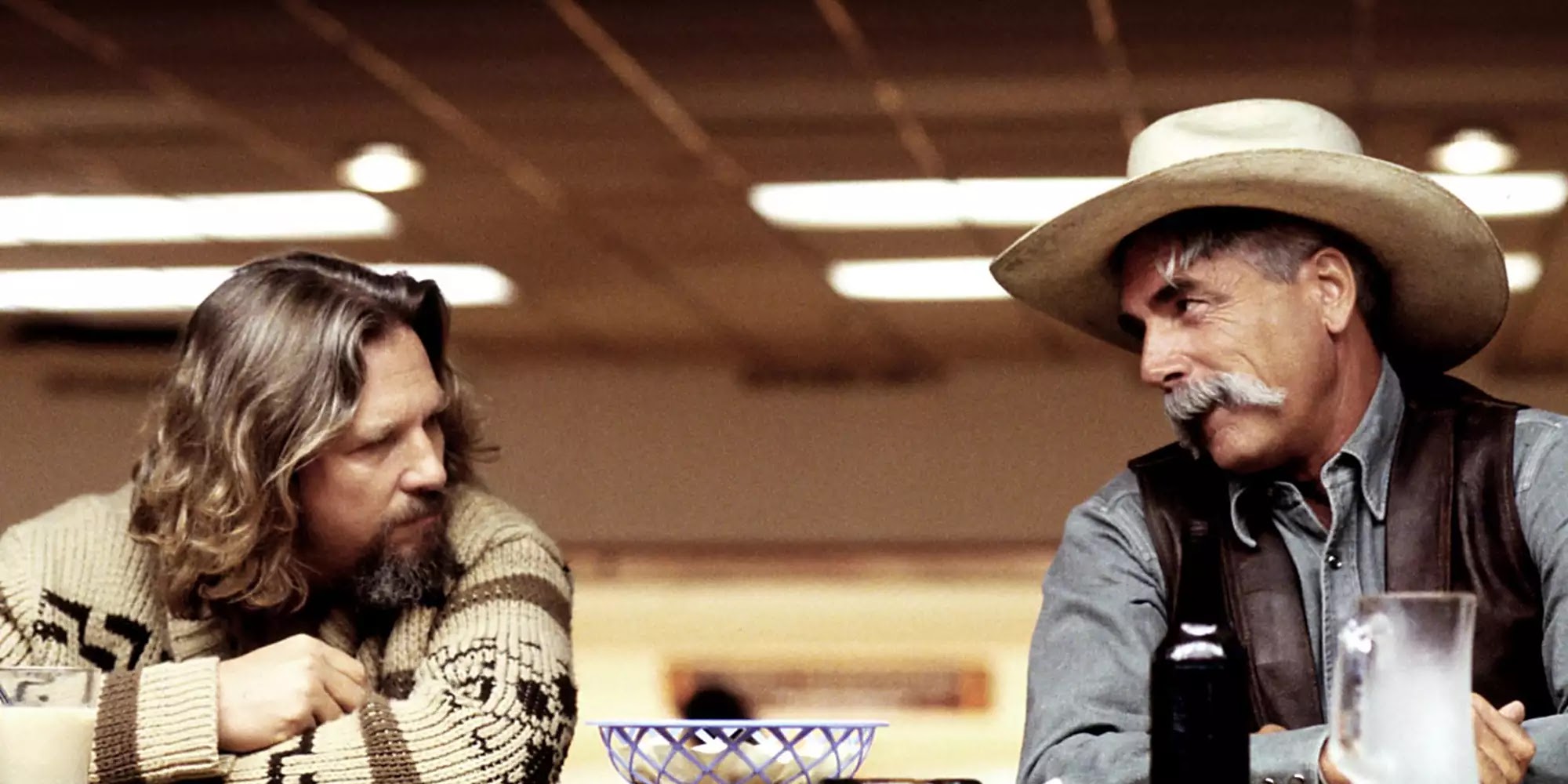
The main character is the Dude (a hilarious performance by Jeff Bridges). He is a stoner, a modern-day tumbleweed, just floating along, but surviving with little resistance against the forces around him. The Stranger (Sam Elliot), with a Texas drawl, narrates this story, which adds an anachronistic touch to the tale. A “dude” was originally the term for a “city slicker,” someone who dressed in a fancy manner and was out of his element on a ranch. So, the Dude would not fit in with cowboys. But he certainly doesn’t dress like a fashionable gentleman. He likes wearing pajamas and a bathrobe, and he’d rather be in bed or just hanging around his apartment relaxing, smoking a joint.  


His chill life is violently interrupted by a couple of goons from pornographer Jackie Treehorn (Ben Gazzara) who burst into his apartment and start banging things up, demanding that Jeffrey Lebowski (the Dude’s name) pay money that is owed by his wife, Bunny. Here is where the film noir aspect comes in. The Coens said that they wanted a comic variation on writer Raymond Chandler (movie titles like The Big Sleep and The Big Heat influence the title of this film). The Dude tries to explain that they have the wrong man because they think he is rich. These guys are not too bright because just looking at the Dude and where he lives would show he is not wealthy. The Dude demonstrates he is a witty guy even under duress, like a film noir detective. When one of the thugs keeps pushing his head into the toilet asking where is the money, the Dude says, “it’s down there somewhere, let me take another look.” When one of the thugs picks up a bowling ball and asks what it is, the Dude replies, “obviously you’re not a golfer.” When the Dude comes out with these occasional cool lines he mirrors the stylized dialogue of a Noir story. Before the henchmen realize the mistaken identity problem, one pees on the Dude’s Oriental rug. The Dude laments this action because, as is repeated in the story, the rug “really tied the room together.” Despite his foggy life, the Dude still wants to have focus where the strands of what’s happening are “tied … together.”

 During the movie, we get some of the Dude’s backstory. He mentions that when he was in college, he “occupied” buildings. He was a protester against “the establishment,” someone associated with the 1960’s radical group Students for a Democratic Society, known as the SDS. He later wants to be represented by lawyers William Kunstler and Ron Kuby who defended radical leaders during that protest era. His activist ways eventually changed into his current go-with-the-flow lifestyle, possibly because his past ventures didn’t generate the change he hoped for.


He discovers who is the Big Lebowski (David Huddleston), visits him, and asks for reimbursement for his rug since he is the innocent victim as a result of the borrowing excess of Bunny, the “trophy wife.” Dude can’t escape how the current political scene is dominated by Republicans. Lebowski’s servile aide, Brandt (Philip Seymour Hoffman), shows pictures of Lebowski’s connection to people like Nancy Reagan. Dude even repeats President George W. Bush’s statement on television that Saddam Hussein’s “aggression will not stand.” The Dude, however, is talking about his rug, and it is ironic that he is quoting a Republican leader. There is a framed mirror on Lebowski’s wall that has the tag of Time Magazine’s Person of the Year, which turns out to be one’s own reflection. Probably Lebowski sees himself that way when he views his own face. Here we see the Dude looking at himself. It is a complicated image. Is the Dude a doppelganger of his rich self? Has he ironically become a member of the Republican collage? We also see a picture of Richard Nixon bowling in the Dude’s apartment. Has he come to identify with his old nemesis because the Dude has taken up bowling? Or, as The Stranger asks, is the Dude “the man for his place and time,” and currently represents the time of the film, the early 1990’s, and deserves to be on the cover of Time?

 Lebowski is elderly and paralyzed in a wheelchair. Does his disabled status reflect the current dysfunctional state of the union? He states that the “bums” like the Dude “lost” the battle to subvert the status quo. But we find out later from his daughter, Maude (Julianne Moore), that her father’s wealth comes from her mother, and Maude manages the money. Lebowski lectures the Dude about how he is a self-made man, but he is the phony who is the “bum.” As one of our class’s instructors noted, Lebowski uses the word “achieve” a great deal. For this rich guy, achievement is measured in wealth, not what one does in life irrespective of accumulated funds. The Dude walks out and steals one of the rugs in the mansion as reimbursement for his loss, exercising his own version of ethics.


The Dude finds refuge from the world at the bowling alley with his friends Walter (John Goodman) and Donny (Steve Buscemi). As stated in the class, here is a place where these men can “achieve,” by bowling a good game and possibly winning a tournament. Interestingly, we never see the Dude bowl. Does that mean he can’t escape past failures? The Dude is not laid back when it comes to Walter, who infuriates him with his aggressive actions. The Coens said they saw these two acting like a turbulent married couple. Walter makes everything about his past as a soldier in Vietnam. He is a stickler for rules, which majorly contrasts with the easy-going Dude. It may be that the chaos of America’s failure in the Vietnam War causes Walter to overreact in post-war life as he can searches for order after chaos. For instance, Walter pulls out a gun to threaten a bowler who crosses the foul line but still wants his roll to count. The Dude sides with the bowler and wants to relax the rules. Walter also has converted to Judaism, and wants to comply with its religious dictates.


Lebowski hires the Dude to deliver a million dollars in ransom for the supposed kidnapping of wife Bunny. He says he thinks the culprits are the same guys who broke into the Dude's place, so the Dude can confirm they are the culprits. Despite his unfocused mind, the Dude channels the film noir private eye and concludes that there is something not right about what appears to be a crime. He knows Bunny needs money and he believes she is faking her own kidnapping to extract a ransom.

 Walter complicates the money drop by going along for the ride and substitutes his dirty underwear in a suitcase for the money bag. He wants to confront the crooks. The whole episode is like the Keystone Cops, ending with the Dude crashing his car which eventually gets stolen out of the bowling alley parking lot, with the money suitcase in it. Lebowski says he heard from the kidnappers that they didn’t receive the ransom, and Lebowski points the finger at the Dude, who is now in trouble with the kidnappers.


However, it is not Treehorn’s men who come to threaten the Dude, but a bunch of “nihilists,” including Karl Hungus (Peter Stomare), a porn star who worked with Bunny in adult films (his work name indicates his attribute for the job). These guys want the ransom money from the Dude. They drop a marmot in the Dude’s bathtub as they threaten to cut off his “Johnson.” One of the film’s main themes centers on threatened masculinity. There is the Bob Dylan song that talks about “the man in me.” After Bunny is kidnapped, Lebowski muses about what is the right thing a man should do. When the Dude has his dream sequence, he sees himself being pursued by these nihilists coming at him with castration-threatening enlarged scissors. A huge bowling ball comes at him, ready to squash him. The story implies the use of the bowing pins and balls as symbols of male genitalia. Walter plays the role of the aggressive male, perhaps to compensate for his impotence in not being able to save his fellow soldiers in Vietnam. The Dude may also be suffering from testosterone failure in his inability to bring about change in society in his past. The loss of masculinity is also referred to by the passing of the cowboy era, including the fact that the fictional writer of the TV series Branded is in an iron lung when the Dude and Walter search for the missing money. Even the cab driver tells a story about a woman “bustin’ … agates.”


The ironically named character of Jesus (John Turturro), a fellow bowler, is a demonic figure who invades the sanctuary of achievement of these men whose masculinity is on the line. He has partially sheer socks and a painted baby fingernail, which depicts him as more traditionally effeminate than male (Bunny paints her toenails), which may suggest why he overcompensates with his overly machismo posturing. He licks his bowling ball which could be symbolic of a testicle. Walter tells the Dude that Jesus is a pederast, with a record of exposing himself to an eight-year-old child. There are several references to anal intercourse, including Jesus saying he'll take Walter's gun, stick it up his butt and pull the trigger. Our discussion noted that the Coens deflate Jesus’s character by making him look ridiculous in his exaggerated boasting. (As one of our instructors rightly noted, the comical allusions to homophobia probably wouldn’t make it into a film today as being politically incorrect).


Maude takes back the rug that the Dude stole from the Lebowski mansion, which he subsequently was allowed to keep. The Dude is on a search for an object, similar to the hunt for the Maltese Falcon. Maude invites the Dude to her artist’s studio where she tells him that the rug was a gift from her mother, so her father had no right to let the Dude have it. Maude says that those so obsessed just with sex do not love, and she puts Bunny is this category. So, there is a distinction drawn here between proving sexuality and the ability to show true emotion in the form of love. She shows the beginning of a porno film that has Bunny in it with Hungus. The film has Hungus as a cable guy visiting the scantily clad Bunny. The Dude delivers one of his funnier lines when Maude says one can imagine what happens next in the film, and the Dude says, “He fixes the cable?” It is here that Maude mentions her father’s lack of personal funds and that he embezzled a million dollars from a charity for children to get the ransom.


Treehorn wants his money. He drugs Dude when he doesn't get the right info from him, which gets the Dude in trouble with cops so Treehorn can toss the Dude’s place to look for the cash. In film noir movies the private eye usually gets knocked out. As one of our instructors noted, the Coens fill the blackouts with dreams. The Dude's dream here is like his carpet because it ties the story together. Many of the images already shown in the movie appear here. For example, there are the bowling pins and balls, and the outfit that Hungus wears in the porno (there are numerous other examples on IMDb). The Dude is more of a swaggering male here, dancing suggestively in a Busby Berkeley inspired erotic musical called Gutterballs. He drifts between the legs of the short-skirted dancers, looking upwards. However, there are then the scissors that undermine this macho wish-fulfillment.

The Dude deduces that Lebowski didn’t care what happened to Bunny, and actually wanted to get rid of her because of her gold-digger ways. So, the suitcase he gave them didn’t contain any money and Lebowski was keeping the cash for himself. The twisty noir aspect of the story continues when Bunny shows up drunk, crashing her car into the Lebowski fountain. (There are several car accidents in the film, suggesting how chaos upends order or calmness). She wasn’t kidnapped and was just on a holiday in Palm Springs which she didn’t tell anybody about. The nihilists just used her absence to try to extort money. The Dude confronts Lebowski, correctly concluding that the old man was setting the Dude up as the patsy for the missing money.


In a comical confrontation with the nihilists, Walter gets to do battle one more time and helps defeat the fake kidnappers. But, sadly the innocent Donny has a heart attack in the middle of the confrontation, and dies. There was a foreshadowing of this event, as IMDb points out, since he always threw strikes until just before his demise. There is a humorous burial as Walter allows Donny’s ashes, carried in a coffee can, to blow all over the Dude when Walter attempts to toss them into the ocean.

At the bowling alley, the Dude meets up with the Stranger, and issues his famous line about how, despite everything, “the Dude abides.” The Stranger, addressing the audience, says, “the whole durned human comedy keeps perpetuatin’ itself down through the generations.” IMDb notes that the word “abides” in the script may come from the Bible’s Ecclesiastes, which reads: “One generation passes away, and another generation comes: but the Earth abides forever.” The Dude had sex with Maude, and the Stranger says that the Dude will become a father. Despite all the craziness in the world, life still goes on.

The next film is The Accidental Tourist.

Sunday, June 2, 2019

Moneyball


SPOILER ALERT! The plot will be discussed.
Moneyball is a 2011 film directed by the talented Bennett Miller who also made the excellent movies Capote and Foxcatcher. It received Oscar nominations for Best Picture, Best Actor, Best Supporting Actor, and Best Screenplay, with Aaron Sorkin being one of the writers.

This is a sports movie centering on Major League Baseball, and its theme revolves around the desire of a couple of men who want to overcome traditional notions of what it takes to be successful. The film uses the baseball story to make a comment about how the quest of the main characters applies to life in general. The argument here is that American professional sports teams are big businesses which pay tremendous amounts of money to promote star players to generate revenues from advertising, product endorsements, and ticket sales. To accomplish these goals, Major League Baseball wants athletic versions of entertainment stars which will be attractive to fans who want to worship enhanced versions of themselves. Therefore, those athletes who are not physically attractive or who may perform in a non-orthodox manner will be discarded despite their admirable abilities.
It is 2002 after the Oakland Athletics had a terrific season the prior year only to lose in the playoffs. The next year the team lost many of its star players to other outfits who had larger payrolls than the A’s. General Manager Billy Beane (Brad Pitt) must rebuild a winning roster at bargain-basement prices. He was a major league player who did not become a success despite being aggressively recruited by scouts who made it sound as if he would be a star. He gave up other career chances because the thrust of the over-the-top recruiting pitches unfortunately did not consider any failings that he as a player might have. Beane’s experience taught him that a young player will believe the hype even though he may not really be prepared for the difficulties he may encounter.
While visiting the Cleveland Indians office, Beane meets an overweight, nerdy, young man named Peter Brand (Jonah Hill, who has since dropped a great deal of the poundage. Brand is not the name of the real-life person, who is Paul DePodesta). Beane is curious about Brand’s advisory capacity, since the guy definitely doesn’t look like a fellow who would have a career in professional sports. But, that is the point of the film. Brand says that because he offers an alternative way at looking at the game, he is considered a “leper” and is “ostracized.” The film illustrates that people don’t like change, especially if it upends their preconceived notions of what they think is right.

Beane coaxes Brand to tell him his story. The young man is a Yale University economics graduate. He advocates applying a statistical model developed by Bill James to recruit players. Brand, being an outsider, can see that those running professional baseball teams “think in terms of buying players … your goal should be to buy wins. And in order to buy wins, you need to buy runs.” He says that star players are overpaid, and losing those who receive large salaries “opens up all kinds of interesting possibilities” to take advantage of ball players who have been overlooked.

Beane goes back to Oakland and after contemplating what Brand has said, calls him up and asks him if he would have picked Beane on the first round of the draft. Brand says no, he would have waited until the ninth, would not have offered a bonus, and would have assumed Beane would have accepted a scholarship to go to college. If Brand had been the scout recruiting Beane he would have not rushed prematurely into a game he was unprepared for and would have received his education and had time to mature. Brand’s response confirms that Beane made the right choice in having purchased his contract from the Indians. Brand is made Assistant General Manager.


To get those runs he mentioned, Brand says it’s necessary to zero in on “one number.” He uses mathematics to determine which players get on base the most. They may not be flashy with how they do it, so someone who walks a great deal won’t generate a high salary. Brand argues his statistics can find those individuals who have value, are not expensive, and thus meet the A’s monetary restrictions. He tells Beane, “People are overlooked for a variety of biased reasons and perceived flaws. Age, appearance, and personality.” He offers the example of Chad Bradford (Casey Bond), the “submarine” relief pitcher, who releases the ball as his hand almost touches the ground. Brand says of him, “Nobody in the big leagues cares about him, because he looks funny.” The man may be “one of the most effective relief pitchers in baseball,” but because he doesn’t conform to what people perceive to be the right look for a pitcher, the A’s can get him for a relatively minuscule salary. Brand says that they can afford twenty-five players that can form a winning team because “baseball undervalues them.” He calls them “an island of misfit toys.” He could be talking about himself, since he might easily be dismissed because of his youth and his looks before anyone even hears what he has to say. Luckily, Beane listened.


There is a great image of Brand walking into a room at the A’s front offices and sitting down next to an outdated, clunky personal computer. He then opens up his sleek laptop and gets down to work. The shot sums up the antiquated mindset of those still running the game, and he is at least been given the chance to show the need to move forward. He doesn’t have long to wait to make his presence felt. Beane calls him into a scout and coach meeting where there is a great deal of resistance to the players Beane wants to sign up. These guys are more concerned about public image. On the plus side for one player they note he has a “classy swing,” which doesn’t have anything to do with whether he can get on base safely. On the negative side they note he has “an ugly girlfriend,” which one says means it communicates that he has “no confidence.” Appearances seem to matter more than scoring runs to these old-timers.

Beane tries to make his argument that they must recreate the strong players they lost “in the aggregate,” which is probably too uppity a word for these guys. Beane wants to acquire a few men that combined have the abilities of a star player, and he can do it by paying out less money. He tells them, “It’s an unfair game,” which is a reference to the subtitle of the book on which the film is based. He says that their team is at the low end of the spectrum financially, which has allowed the A’s to have “been gutted. We’re like organ donors for the rich. Boston’s taken our kidneys, Yankees have taken our heart. And you guys just sit around talking the same old ‘good body’ nonsense like we’re selling jeans.” Beane wants them to move away from flash and on toward substance. That means, “We’ve got to think differently.”


Bean can be very congenial most of the time, and is unselfish about his own problems when dealing with his daughter, Casey (Kerris Dorsey, who, appropriately, sings the song, The Show,” which, if you remember Bull Durham, is what they call playing in the majors). But he is not above having outbursts of anger. He tosses over his desk at one point because his newly formed team has trouble at the outset meeting his expectations as they must get used to working together. After one loss, he unleashes his anger in the locker room as the team members play music and dance. He rhetorically asks, “You think losing is fun?” He lets them know that the sound of losing is silence, and then he knocks over a table. He is a man on a mission because he feels he was misused in his youth by the standard operating procedures of professional baseball.

In order to make the changes he deems necessary, Beane feels justified in crossing job lines and making his own scouting and managerial decisions. One scout, Grady Fuson (Ken Medlock) is particularly belligerent, and Beane fires him. He wants to sign a catcher, Scott Hatteberg (Chris Pratt), who can’t throw anymore, and turn him into a first baseman, since that position mostly requires catching the ball. Beane puts so much emphasis on getting on base (Hatteberg gets a lot of walks), that he underestimates how difficult it is for the player to learn a new job. He tells Hatteberg, “It’s not that hard,” but one of the coaches, Ron Washington (Brent Jennings) then says, “It’s incredibly hard,” trying to bring Beane back to reality. But, to Beane’s credit, he tells Hatteberg, “we’re gonna’ teach you.” And later, he tells Washington to be encouraging in order to build the new first baseman’s confidence. Beane later tries to improve morale by making sure the players get free soda, and he convinces veteran player David Justice (Stephen Bishop) to be a mentor to the younger team members.
Beane is on the receiving end of the seething, dismissive manager, Art Howe (Philip Seymour Hoffman). Howe came off a winning season but the team did not win the World Series, and now the players that made Howe become a winner are gone. Despite those facts he wants more than a one-year contract. Beane is not willing to grant that request given that Howe subscribes to the antiquated way of looking at the game. Beane does overstep his jurisdiction by telling Howe who should play at certain positions. When Howe refuses to go along with Beane’s suggestions, Beane trades away the team members Howe won’t put on the bench. From Beane’s standpoint, when those entrenched in their ways won’t consider any alternative ways of acting, he feels he must wield his power to overcome the obstacles to progress.

Beane must endure a great deal of negative feedback from the press and the fans at the beginning of the season as his experiment begins and there are a number of losses. But then the team turns it around. They start a winning a streak. However, because those that worship whatever is in place as opposed to anything new, the baseball establishment, after seven wins in a row, wants to award the praise for the team’s success to Howe for making the best of a bad situation. But Beane does not complain because he is not looking for accolades. He wants to make a difference. He says to Brand, “All I heard was ‘seven in a row.’”

The team goes on to win nineteen consecutive games. The American League record of twenty straight wins seems to be in the bag as the A’s open up an eleven to nothing lead in the next game. Beane, who does not watch the games, and is on the road when he hears the score, decides to turn around and defy any jinx he may have thought he may instill on the team by returning to the stadium to watch the contest. Incredibly, the A’s blow the huge lead, and the game is tied. But, in what seems like an act of vindication, the catcher-turned-first baseman, Hatteberg, who Beane fought to get in the lineup, hits a home run to win the game, and secure the record.

But the record is not enough for Beane. He says to Brand, “it’s fun for the fans. It sells tickets and hot dogs. Doesn’t mean anything.” Brand is astonished since he feels that they have triumphed. Beane says he has been in the game a long time and if they don’t win the last game of the World Series, the old guard, “will erase us. And everything we’ve done here, none of it will matter.” Beane isn’t in it only for glory or money. He wants to make a difference that lasts. If the A’s become champions, “on our budget, with this team, we’ll have changed the game. And that’s what I want. I want it to mean something.”
The A’s do not win the World Series, and Beane is correct in his prediction. The sports press, the owners, and the impressionable fans turn their backs on Beane’s attempts to revolutionize Major League Baseball. They say the wins were a fluke, and that even though the team had a successful season, the general manager’s model is flawed and unsustainable. But, the owner of the Boston Red Sox, John Henry (Arliss Howard) doesn’t think so. Beane visits him in Boston, and Henry points out to Beane that even though the A’s lost their stars, “you won more games without them than you did with them.” And, the A’s won as many games as the New York Yankees at a far lower cost. He says that all the teams should be adopting Beane’s plan, or else, “they’re dinosaurs,” implying they are waiting for extinction to kick in. He also provides the theme of the film when he connects Beane’s difficult struggle to anyone bucking entrenched institutions. Henry states, “whether it’s the government or a way of doing business, or whatever it is,” those in power feel threatened by change. They are worried about “losing their jobs,” and “the way they do things,” most likely because they are not strong enough to be flexible in order to adapt, even though new ways work better than the old ones.

Henry offers Beane a huge contract that would make him, as Brand says, the highest paid GM in baseball history. But, Beane turns it down, because he wants to continue his efforts without money being the incentive for his efforts. When Beane felt that he had failed to accomplish what he set out to do, Brand shows him footage of a 240-pound catcher who was usually scared to run to second base after getting a hit because he was so heavy. But, on one occasion the player gets a hit and rounds the bag. Just as he feared, he falls down, and looks devastated. What he didn’t know was that he hit a home run. Brand states the obvious, calling it a metaphor for Beane’s situation, which the general manager gets. The thrust is Beane isn’t recognizing what he has accomplished.
The closing notes state that the Boston Red Sox won the World Series the next year based on the model that Beane championed. As Henry said, “the first guy through the wall” of established prejudice always gets bloodied. The movie argues that those who have the courage to fight are worthy of our praise.

The next film is Selma.