Showing posts with label Elia Kazan. Show all posts

Sunday, February 24, 2019

Gentleman's Agreement


SPOILER ALERT! The plot will be discussed.
It would be easy to dismiss this winner of the Best Picture Oscar for 1947 as being dated and preachy. Even its director, Elia Kazan, who won the Best Director Oscar for his work, said that it lacked passion, according to IMDb, probably because there are several times that the characters seem to be delivering morality speeches. But, because at the time of its making anti-Semitism was openly widespread, this film is courageous in taking on the subject of discrimination against Jewish people.
Phil Schuyler Green (Gregory Peck) is a journalist and a widower. He has gone by his middle name, which sounds like “Skyler.” The name sounds as if his head is in the clouds, not wanting to be grounded by earthly pragmatism. His last name allows for the possibility that it was changed by shortening it to avoid being labeled a Jew. But, it can also imply that he lacks knowledge about the extent of anti-Semitism at the beginning of his investigation. At the beginning of the story he is walking with his young son, Tommy, (a pre-teen Dean Stockwell) in New York City. They had moved with his mother from California. In a way Phil is on a journey, forced out of his West Coast comfort zone due to the death of his wife, and is in a mental zone where he is open to new discoveries. Tommy sees a statue of Atlas, and after Phil tells him about the myth, the boy says that is what his dad is doing, according to his grandmother, trying to shoulder the world’s problems. So, we immediately learn that Phil looks beyond the problems of his immediate life, and is concerned about the conditions of others.


Mrs. Green (Anne Revere) wishes Phil luck since he is applying for a writing job at a publication entitled Smith’s Weekly. He meets its publisher, John Minify (Albert Dekker), who says he is going to talk a while about an idea he has, which turns out to be a piece about anti-Semitism. Phil goes to a dinner party at Minify’s house. Phil meets a woman named Kathy Lacy (Dorothy McGuire), who is Minify’s divorced niece, and who suggested the article on anti-Semitism. Phil is surprised she was interested in such a controversial topic. She calls him on making his mind up too quickly about people, generalizing about who she is, “too well-bred, self-confident, artificial.” So, what she is accusing him of in a gentle way is being prejudicial himself by stereotyping the kind of woman she is.  However, he admits to his prejudice, which shows he is open to criticism and the views of others, and that objectivity can lead to change.
Phil admits at breakfast with his family that he isn’t thrilled about his assignment at first because he isn’t sure how he can add to what has already been written about the topic. Tommy asks about anti-Semitism. Phil describes the basics, but, finds it difficult to explain why there is discrimination, and he feels uncomfortable describing such ugliness in the world to an innocent child. By focusing on Tommy here and elsewhere, the film shows how absurd bigotry is from the perspective of someone who hasn’t been corrupted by it. Phil says that religious beliefs transcend national boundaries. Unfortunately, that fact trumps nationality when it comes to hate. So, if one is an American Jew, what bigoted people see is not a countryman, but that aspect of the person they have been told to despise. What the individual is in all his or her complexity is ignored.

After Tommy goes to school, Mrs. Green says it was difficult to explain these issues to Phil when he was young, which points to how bigotry has persisted for so long even in America. She says that it would be beneficial if the problems with prejudice against Jews could be explained “well enough” so future generations wouldn’t have to continue to have this kind of “talk.” Phil appears to want to contemplate what she has said and takes a walk during his lunch break to consider his assignment.

Phil goes to Minify and says he decided to do the story because of how difficult it was to explain anti-Semitism to his son. He wants research, “facts and figures,” but Minify wants a personal angle on the story that will draw people in instead of cold statistics. Here is the important thrust of the movie. Minify doesn’t want to focus on the extremists, which are not a large section of the country, and can be dismissed. He wants to show how the problem of anti-Semitism has a “wider spread.” He wants to reach many people to show they can’t dismiss bigotry as an isolated problem.

Phil’s dinner with Kathy shows his own prejudice again about women. He seems pleased when she says she wanted to have “a nice home” with children, but when she talked about her uncle and his wanting to send her to Vassar, he “looked bleak.” She tells him that his “face takes sides, as if you were voting for and against.” So, the thrust here is that all of us discriminate unfairly, and we have to be called on it.
Phil has been working for a week to get a slant on how he wants to approach his story. He has a Jewish friend, Dave Goldman (John Garfield), who he feels would be a good person to talk the story over with. But he is in the military and deployed overseas. Phil gets the idea of writing the story about feelings, instead of statistics. Phil says he and Dave grew up together and had similar backgrounds, the only difference is that Dave is Jewish. Phil feels that Dave’s response about bigotry toward himself as an American citizen would be valuable. Phil starts to write a letter to his friend, but is not comfortable including the slurs and slights, and also he says it’s difficult getting second-hand feelings from another person. A symbolic image is inserted as the scene ends with Phil breaking some walnuts, showing how his situation is like a hard nut to crack.


Mrs. Green wakes up with chest pain. The doctor says that she can, even with a heart condition, live long if she maintains a healthy life. (It is funny to see the doctor prescribing lifestyle advice while smoking a cigarette). Phil says he feels defeated about the story and will tell his boss that he is quitting the assignment. He tells his mom that when he wanted to write about people from Oklahoma, he became one of them, or when he wrote about coal miners, he went into the mines as a worker, and didn’t just interview coal miners. While talking, he realizes he has to use the same strategy, that is, become Jewish for a period. His name, Phil Green, doesn’t designate him as coming from any particular origin. His appearance is average like his pal Dave, so he won’t be signaled out by bigots as belonging to a specific racial type. He sees Kathy and they start to kiss. He starts talking about marriage, but she hesitates because she was divorced and is not sure about another commitment. But she has fallen in love with him. And she accepts Tommy. He doesn’t tell Kathy yet about his plan.
When he tells Minify, they decide that they will be the only two, outside of his family, who should know Phil’s plan. They even decide to make it seem that he is Jewish in dealing with Phil’s secretary and others at the publication so that there will be no leaks undermining the investigative reporting. Here is where it can get complicated, because he will be subjecting himself to anti-Semitism without the safety net of saying it was a cover. They go before the editorial staff of the periodical. One man says Phil’s story will only stir things up, making the discriminatory situation worse. Minify says that if they don’t do the story it would be like adding “to the conspiracy of silence,” pretending anti-Semitism doesn’t exist. Phil, already establishing his cover, says to the staff that it’s a good idea, and has nothing to do with Phil being Jewish.
Phil tells his secretary to write letters of application to clubs, resorts, employers, apartment houses, and medical schools. He says to make duplicates, half with Schuyler Green on them, and the others from Phil Greenberg. But his secretary (June Havoc) is Jewish and says the Greenbergs will be rejected and the Greens accepted. She says if his first name was really Saul, he would already have experienced rejection, and wouldn’t have to go through this process. She changed her name from Estelle Walovsky. She applied for a job as Elaine Wales after she was rejected employment under her real name. Under the changed name she was hired. And this happened at Smith’s Weekly (a very non-diverse name), where they both work. So, Phil doesn’t have to go far to see where anti-Semitism is practiced. This scene shows how anti-Semitism exists even at a place that aims to expose it. She asks if he had changed his name like her, because she already heard that he was Jewish after the meeting with the editorial staff. Bigotry spreads its venom quickly, even at a so-called liberal establishment.

Phil talks to the physician who is treating his mother. Phil was given the name of a Dr. Abrahams at Mt. Sinai Hospital, but the doctor wants to refer him to other specialists. He says that Abrahams is a good man, not prone to charging too much or setting up too many office visits, “the way some of them do.” Phil asks by “them” does he mean doctors in general, or because Abrahams is Jewish. The doctor says he guesses that some non-Jewish doctors also charge too much, but he made it sound like it was a pervasive trait among Jewish doctors. When Phil says that he is Jewish, the doctor seems taken aback, caught in his narrow-minded assumption that because Phil isn’t Jewish because he doesn’t “look” like a Jew, that Phil will share in the physician’s prejudicial views. So, the doctor feels safe in exposing his own bigotry. He then covers up and says that he doesn’t believe in prejudice, even after exhibiting it.

Phil writes “Greenberg” under “Green” on his apartment mailbox. The superintendent sees him do it, says he has to change the name at the post office, and starts to scratch out “Greenberg.” He probably doesn’t want it known that a Jewish person lives in his building. Phil basically says that he was accepted as a resident there already, but because of a name change that may indicate he is Jewish, he is now viewed differently. He tells the man to leave the name alone.

He meets Kathy and tells him the angle of how he will write his story, but at first says that he will let it be known that he is Jewish. Because he doesn’t use the word “pretend,” she reacts by being surprised that he is Jewish, He reveals that he will be maintaining a cover story, but he is now sensitive to the problem and suspects prejudice on her part. She reassures him of her feelings against anti-Semitism, but points out the practical problem that even if he comes out after the article saying he is not really Jewish, people will doubt it. She does seem upset that even the employees at the magazine will think he is Jewish. She appears concerned about the fallout of the deception. The movie argues that it seems okay to protest injustice as long as one is insulated from being attacked personally. Their dinner together is quiet. He says that he has to go, and she responds in short sentences. He leaves without a goodnight kiss. He then reconsiders and goes back, and they kiss. She apologizes for being skittish, and he for being oversensitive, which can happen to someone who experiences being a target of bias.

Phil tells Minify about his secretary and the publisher voices his anger at the personnel department head, Lou Jordan (Harold Vermilyea), about the fact that his place of business has no Jews employed. Miss Wales finds out that there will be an ad in the newspaper for hiring people without discrimination as to religious background. She says if one “bad’ Jew gets in then it spoils it for all the “good” Jews. She uses the slur “kikey,” when referring to what she considers to be undesirable Jews. She says suppose the new worker is a woman who uses too much rouge or is loud and happens to be Jewish. Then, she feels, it will spoil it for what she considers to be upstanding Jews. Phil makes it clear that he won’t tolerate anti-Semitism from anyone, even if it comes from somebody who is Jewish. The scene illustrates how some people of a victimized group, who have been able to dodge personal bias, become paranoid and discriminate against members of their own ethnic background to protect themselves instead of fighting against bigotry in general.

Anne Dettrey (Celeste Holm, winning the Best Supporting Actress Oscar for this role) is the fashion editor at the publication. She goes out for a drink with Phil and they meet a fellow worker, Bert McAnny (Curt Conway). He asks if Phil was in public relations in the military because he’s clever. The implication is that by being a smart Jew he evaded combat. Phil picks up on the hint and asks why wouldn’t he be a just another G. I. Bert uses the usual fake liberal response by starting to say that some of his best friends are Jewish. Anne cuts him off and has Phil ask for the check to get rid of Bert. After he leaves she points out his phony liberalism.


Anne invites Phil to a dinner party and she seems disappointed when he asks if he can bring his girlfriend. When Phil picks up Kathy to go to Anne’s place, Kathy says her family wants to meet him. But she wants to be able to tell her sister and mother that he is pretending to be Jewish. Since his mother knows about his going under cover, Kathy makes the argument that it’s all in the family, stating that her sister and mother will be part of the family soon when they get married. He hesitates, worrying about the secret getting out, but seems to agree. The bigger red flag here is why does Kathy seem to be in a rush to tell her family? Is she upset about anyone thinking she is dating a Jew?
At Anne’s party they meet a renowned scientist, Professor Lieberman (Sam Jaffe). He makes the argument that he is not religious and so are many people who still say they are Jewish. He goes on to say that there are no generalized attributes that make someone Jewish. Yet, people will call themselves Jewish out of pride because “the world still makes it an advantage not to be one.” White Presbyterians don’t have to publicize their designation because they are not persecuted.


Back at Kathy’s place, Phil, after thinking about it, tells Kathy not to tell her sister about his pretending to be Jewish. But Kathy already has, and now her sister’s husband knows, too. Kathy wants Phil not to pretend to be Jewish at a party in Connecticut with the “suburban” types who would make it a messy situation for her sister. Her attitude reeks of phony liberalism, which promotes fighting bigotry, but only at a distance. She says that if he really was Jewish she would be able to “manage,” and he sarcastically says, “Thanks.” They fight and he leaves.

Phil gets a call from his friend Dave who is back in the states. He was offered a job and hopes to move his family to New York. Dave sees that Phil is upset, and he tells him about the fight with Kathy. Phil tells him about pretending to be Jewish for the story. Dave calls him a crazy fool. He says that Phil hasn’t been insulated from prejudicial treatment, so Phil has been feeling the sting acutely. Phil wants to know if in time one gets indifferent to the bigotry. Dave says no, but Phil is going out of his way to confront it, “telescopes” the problem, and gets the onslaught of prejudice all at once. That is why, Dave says, Phil is feeling it in a concentrated way.
At a restaurant, Phil and Dave, who is still in uniform, meet up with Anne. A drunk says he doesn’t like officers and when he finds out that Dave’s last name is Goldman, the man says he especially doesn’t like an officer if he’s a “yid.” Dave pushes the guy, and is ready to hit him, but holds off as an employee gets the man out of there. Dave still gets angry at being victimized, but he also has learned restraint, knowing how to pick his battles. Phil gets a phone call from Kathy. She says that she had it out with her sister and brother-in-law and feels good about telling them not to reveal Phil’s pretending to be Jewish. Throughout the film, Kathy seems to be waging an internal war about how she feels and how she should act.

At the party thrown by Kathy’s sister, Jane (Jane Wyatt), Kathy notes that several couples failed to show. Kathy tells her sister that they stayed away because they were avoiding being with someone who is Jewish. But, as Phil points out to Kathy as they take a walk alone, many people at the gathering were very pleasant to him and asked about the article he was writing. So, not everyone is anti-Semitic, even in an upscale Connecticut suburb. They go to the house Kathy had built where she hoped her husband and children would live. She never moved in there with her ex-spouse because by the time the cottage was finished, the marriage was done. She says she knew it while it was being built, but used the project to evade her marital problems. She says that she couldn’t live there with someone she didn’t love, and can’t live there alone. She says she was waiting for Phil, but would she be able to be there with him if he was really Jewish?

Kathy, Phil, and Dave, are with Anne who tells the engaged couple that they should know that having their honeymoon at Flume Inn will be troublesome because it is “restricted.” Dave says it’s difficult to pin down the people that are restricting access based on ethnicity because they know how to stealthily evade the accusations. Dave says he’s going home to where his family lives because nobody will offer him a decent place to live in New York. Phil says he’s going to confront the management of Flume Inn not only because of the anti-Semitism, but because prejudice in general goes against what the country “stands for,” the desire for equality and democracy. Phil is able to see the big picture, that if one doesn’t stand up against racism in one instance, it allows the problem to exist on a larger scale.
At the Flume Inn hotel registration desk, Phil says he has a reservation and asks if the hotel is restricted. The clerk calls the manager and he asks if Phil wants to make sure that there are no Jews staying there, or does Phil follow “the Hebrew religion.” The manager then looking for a way out of the situation says there are no vacancies, trying to evade the accusation that the resort is restricted. Then Phil states that he is Jewish and that the hotel doesn’t let Jews stay there. The manager just walks away, avoiding any more interaction, not providing any more evidence of the accusation, just as Dave said.

Back at his place, Kathy tells Phil that letting Dave stay at the cottage in Connecticut would only make him feel uncomfortable being around all the anti-Semites. She says there is another suburb that doesn’t sell or rent places to Jews. She says there seems to be a “gentleman’s agreement” to restrict access to Jewish people. Phil is outraged at the term “gentleman,” which is supposed to be a positive term, coupled with the “agreement” part which allows people to lead lives of covert prejudice. Kathy wants Phil to see that she is being practical, about how badly Dave will be treated in a restricted area, but Phil says he couldn’t live in the cottage now with Kathy knowing that bigotry exists in the area. They are interrupted by Tommy who is in tears because other children called him a “dirty Jew and a stinking kike.” Kathy tries to reassure the boy by saying that he isn’t Jewish and it’s just a “horrible mistake,” which sends the wrong message by making it sound better not to be included with the Jewish race. Phil immediately shuts Kathy up and consoles Tommy.

Afterward Phil is angry with Kathy because she tried to console Tommy by saying it was better to be a white Christian. What he sees now is that the so-called decent people act like anti-Semitism is just reserved for the lunatic fringe, “far away in some dark place with low-class morons.” But by avoiding to fight against prejudice, the “nice” people help bigotry to continue, “and wonder why it grows.” She says she is angry that she is forced to take sides on the problem and implicitly blames the Jews for making people have to force a confrontation. She is tired of feeling judged, and admits that she is glad that she is not Jewish, just like people would rather be healthy than sick, young instead of old, pretty instead of ugly. But her argument is flawed, since it is wrong to discriminate against any group of people by marginalizing their lives based on who they are. She says she hates Phil for taking away the hope of their future happiness. But what is a person if not his or her principles?

Phil tells Dave what happened to his son. Dave says it hurts the most when kids are targeted. His own children couldn't go to a restricted camp. A pal of his in the Army was hit by enemy fire and the last words he heard contained a racial slur.


Phil goes to the office and gives Miss Wales the first installments of the article. Since it’s entitled “I was a Jew for eight weeks,” she now knows that he is a “Christian,” (which sounds rather limiting as to the choice of religions one has in America) and is surprised. He says that he is the same person as before, only the labels have changed. Yet, she can’t understand why someone would give up the advantages of a Christian lifestyle. He tells her that she, although being Jewish, is acting like an anti-Semite by going along with the system that perceives Christians as being superior to Jews.

Phil sees Minify. He tells the publisher he is leaving and going back to California, since he feels there’s no need to stay if he’s not going to be with Kathy. Anne, just now finding out that Phil wasn’t Jewish, says that the piece is “dynamite,” and if everyone had to endure the prejudice he did, then it would end the discrimination overnight. She guessed that he broke up with Kathy since she wasn’t there when Anne and Dave came over to Phil’s place. She asks Phil over for dinner. Even though Phil doesn’t want to talk about Kathy, Anne persists, saying she can’t tolerate hypocrites, and puts Kathy in that category. Anne says that Kathy would rather not have Dave take the job than have him causing a fuss living in her old neighborhood. She says, “She’s afraid. The Kathys everywhere are afraid of getting the gate from their little groups of nice people.” They don’t fight, just do a little “griping,” while letting others do the tough work to end discrimination. She insists it has to be done with action. She says that she would want to bring up a child with someone who shared her own basic beliefs, and that if two people are made for each other, time will reveal their connection. This last part comes true here, although not as Anne had hoped. He asks if she is proposing, and she says maybe she is.
Kathy asks Dave to meet her at a restaurant. She asks Dave if he thinks she is an anti-Semite. He says no, and she informs him that it was her idea that she passed onto her uncle to have Phil write a story about anti-Semitism. She called Dave after she heard a man tell a racist joke about Jews. She says she felt ill afterwards and wanted to yell that what he said goes against what she and her friends stand for. But he gets her to confess that she didn’t do anything about her outrage. He says fighting prejudice is a different kind of war, but one derives satisfaction in fighting back against the enemy. Dave says that Phil understands that now. Dave asks if one lets bigoted remarks pass, when does one take a stand? Dave says that the guy telling the joke is out in the open, easy to bring down, but those that let the racist joke go are the hidden enemy. Kathy finally realizes that she became mad at Phil when she should have been angry at the bigots. Dave says a husband wants his wife, beyond being a mother and romantic companion, to be a “sidekick” who will “go through the rough spots” with him. (This of course accepts the sexist premise that a man should lead the way, but that is another battle).


Back at his place, Phil finds his mother reading his article. He says that “time is getting short. Not enough people, and the time’s running out.” The film is saying that there must always be vigilance against hatred based on prejudice. Otherwise, we surrender our freedoms and beliefs to those who seek an upper hand by exploiting fear and placing blame on those who represent social diversity. Mrs. Green gives the film’s optimistic message when she says she would like to live to be very old so that maybe she’ll see a day when everyone will live peacefully together. Dave comes in and says that he’ll be taking that job because Kathy is letting him live in the cottage, and she promised to fight back at anyone who gives him trouble. The film concludes on a hopeful note as Phil goes to Kathy’s place, and they embrace and kiss, at least providing a happy romantic ending. Although anti-Semitism isn’t practiced as openly now as when the movie was made, it still exists, like a beast always looking to be fed by unscrupulous people.

The next film is In a Lonely Place.

Sunday, April 23, 2017

A Face in the Crowd

SPOILER ALERT! The plot of the movie will be discussed.

Even before Network in 1976, this 1957 film directed by Elia Kazan predicted how unscrupulous people can undermine society by manipulating the media, a concern that plagues the world today.

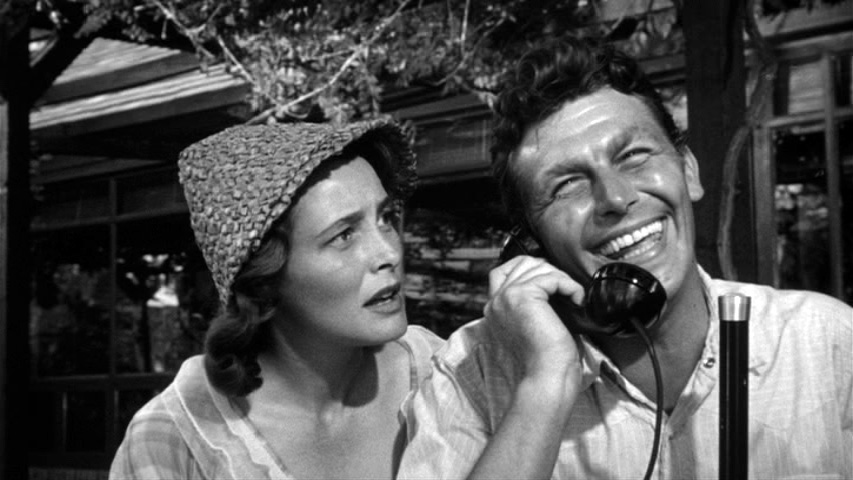
The first shots in the movie show small town Arkansas residents of modest means, unpretentious, playing checkers and whittling sticks. The music we hear is folksy, featuring the sounds of a strumming guitar and whistling. There is no whiff in the air of intellectual urban American culture here. These are the citizens that will become the fuel which propels Lonesome Rhodes (Andy Griffith, in his powerful film debut, nothing like benign Andy Taylor in his future TV role) to stardom. At this point, he is a traveling, hard-drinking bum, who avails himself of the nightly accommodations supplied by county jails. He is “discovered,” similar to a movie star, by radio journalist Marcia Jeffries (Patricia Neal), who gets the local sheriff, Big Jeff Bess (the actor’s real name), who we learn is attracted to her, to allow her to record prisoners in the Pickett County jail as part of her interview program. It is called “A Face in the Crowd,” because the movie was based on a story in a collection of short stories entitled Some Faces in the Crowd. But the title is significant, because it encapsulates what a democracy is, the emphasis on the individual amid a larger entity consisting of many people. It also hints at the perversion of the democratic system, as that “face,” when projected out of proportion to its place in society, can sway that collection of individuals acting as one massive organism.
Marcia just wants the captive men to tell personal stories. They react as many do; they shun being in the spotlight. When she mentions that maybe someone can sing a song, they suggest a man named Larry Rhodes (the last name suggests someone who wants to keep moving, and is not prone to committing to anyone, or anything, else). He is sleeping after the police arrested him for drunk and disorderly conduct, behavior he generally never relinquishes in the story. He is hostile at first. When Marcia explains what she is doing in the jail, his first response reveals his selfish, narcissistic personality by saying, “What do I get out of this?” Marcia says that she studied music at prestigious Sarah Lawrence College, in the state of New York, where she learned that one can appreciate real American music by listening to it “from the bottom up.” One can understand from this condescending attitude why common rural folk would resent conceited intellectuals.
 
Rhodes makes a deal as a condition to performing: the sheriff will release him in the morning. In her introduction, it is Marcia who gives him the nickname “Lonesome,” which conjures up sympathy, but suggests the American worship of the rugged individualism of the western cowboy. Rhoades is rustically poetic (talking about how darkness “douses” the daytime), and charismatic as he tells stories about his relatives in the Arkansas town of Riddle (a name which implies hidden truths about its purported ex-resident). Marcia can see how he can connect with an audience emotionally, as he says how a man one dislikes earlier in the day becomes a best friend in the loneliness of the night. He offers up a passionate rendition of a blues song as he accompanies himself with his “Mama guitar.” He says that the instrument, an object, means more to him than any woman he encountered. This statement is telling, because we learn that he views people, especially women, as being disposable.

Marcia plays her recording for her uncle, J. B. Jeffries (Howard Smith), the radio station owner, who wants to hire Rhodes for a spot on the air. They have to track him down after his release from jail. Rhodes is not enthusiastic at first, saying the offer sounded too much like a job, which means it was too much like work. He, like many Americans, wants his freedom from anything that will tie him down. He is headed for Florida, where he will do some fishing. Jeffries admits to a yearning to go fishing, but when asked by Rhodes why doesn’t he go, says he can’t afford to. These two men at this point illustrate the opposing elements in the American mythos – the respect for hard work and responsible behavior, and the lust for unencumbered, self-satisfying freedom. Marcia reels Rhodes in with the capitalistic lure when she tells him he can make enough money to fly to Florida if he does the show. Rhodes easily says goodbye to his traveling companion, Beanie (Rod Brasfield), who just as nonchalantly shrugs off his fellow traveler’s departure, since both men know the solitary code of the vagrant. But, at this point, Rhodes doesn’t want to get rid of his old clothes, always looking for that quick getaway.
Rhodes’s on-the-air persona connects with people, because he instinctively knows how to provide what they want to hear. The masses work hard every day, so he says that they are pushed by bosses to “hurry,” which is always associated with jobs. But, he had a cousin named Harry, who rushed around, so he was nicknamed “Hurry.” One day, while running quickly, he tripped, and killed himself. His relatives put a sign on his grave which said he was in a hurry to get there. With such a story, he wins over his audience by sympathizing with their plight, but doing so in a down-to-earth humorous way. He woos female listeners by saying how the men in their lives don’t appreciate them (which is, as we see, exactly how Rhodes mistreats women).

He receives a great deal of fan mail. Advertisers want to buy time on his program. As Marcia says, they love his voice, his guitar, his songs, his ideas. But when she asks him if his stories are true, he admits that Riddle doesn’t even exist, and that his father was a con-man (as we see Rhodes is a chip off of the old swindling block), who deserted his family. His mother dragged him from place to place (thus both parents instilling the desire for wandering), and his real family consisted of “uncles,” men his mother took up with. In a way, as a character, he is a predecessor of Mad Men’s Don Draper, a man running away from his real sordid past, inventing a new one, and who is so good at fabrication, he goes into advertising. But, unlike Draper, Rhodes appears to be happy. Marica comments that he puts his whole self into his loud laugh. He says that he puts his whole self into everything he does, and that exuberance is appealing to a country that admires all-out energy.
Early on, Rhodes realizes his ability to be a Pied Piper, manipulating the behavior of those listening to his voice. He gets into a bar fight with jealous Sheriff Big Jeff, (who is running for mayor), because of how much time Marcia spends with Rhodes. He says the sheriff’s name is a joke, and notes where he comes from, they find out who should be spared useful labor because of their limitations. So, to see if Big Jeff would make a better dogcatcher than a mayor, he says on the air that the townspeople should bring their dogs over to Big Jeff’s house. The citizens fill the sheriff’s yard with their dogs in what for them is a humorous activity, but which shows the seriousness of Rhodes’ potential influence. He tells the children of the town on a hot day to go over to the studio owner’s house, without Jeffries’s knowledge, so they can swim in his pool. This action makes him appear to be a sort of champion of the downtrodden, revolting against those more fortunate than themselves. Marcia asks him what it feels like to be able to say anything which can change peoples’ behavior. He first seems not to realize this power, but then there is a look of epiphany on Rhodes’s face as he says, “yeah, I guess I can.” He makes advances on Marcia, and when she responds coolly, he says she is putting up a front, because all women want the same thing underneath. So, he shows how he wants to reduce everyone to his baser level. She implies that he has not lacked company, because many of the local women have sought him out.

Rhodes begins to get wider press attention. Then others come calling, looking for a way to cash in on his budding notoriety. He acquires an entertainment agent, who gets his percentage by landing Rhodes an offer to appear on a Memphis television station. Rhodes is a good negotiator, and gets his price, bringing Marcia with him. So, she, too, is benefiting from his success. At the Pickett train station, the whole town comes out to say goodbye. On the surface, he acts like they are his family, but as soon as he turns his head away from the crowd, he says how he is glad to leave this “dump.” When he sees the scowl on Marcia's face, he covers up by saying he was just kidding, and she should “know better than to believe everything I say.” But, that is precisely the problem with his audience – they don’t know him enough to realize that underneath that big smile and laugh, he is not always telling the truth. 
One of the writers at the Memphis station is Mel Miller (Walter Matthau), who Rhodes disdainfully calls “Vanderbilt ’44,” referring to the year Mel graduated from that college. We again see the contempt toward the educated, probably coming from an inferiority complex which derives from a deprived upbringing, a disdain which Rhodes champions among those who share his background. He rejects scripts, and ad-libs. The audience can identify with his lack of sophistication about TV cameras. Not only does he control what is said on the program, he even gives the cameraman direction, telling him to do a close-up on him. The camera becomes a perfect instrument to focus on and magnify his narcissism and desire for power (similar to what some politicians, past and present, use TV and other media to do). The studio wants to package him their way, building on the cliché populist image he presented in Pickett. But, what Marcia admires, initially, about Rhodes is that “he is his own man.” He, instead of telling folksy stories, says he went walking the first night in Memphis, and encountered a black woman, whose house burned down, which she cannot rebuild because she couldn’t afford insurance. He brings her onstage, a courageous act at the time to bring an African American on camera in a southern state, as Mel points out. He urges each viewer to contribute twenty-five cents, no more, since they can’t afford it (relying on their charity without exploiting it). Plenty of money is received, but Rhodes grandstands the generosity by having staff bring in wheelbarrows full of coins. But, this use of his popularity shows how it can be used for a beneficial purpose. He even spouts a humanitarian belief, when he says there, “ain’t nothing you can’t do when you let the best part of you take over.” Unfortunately, as he becomes more famous and wealthy, he does not practice what he preaches.
At this point, though, Rhodes is still in maverick mode, and is more concerned about acting independently, even if it does not appear to be to his benefit. He makes fun of the mattress sponsor for his program, owned by a man named Luffler (Charles Irving). When Rhodes refuses to “kowtow” to a wealthy man’s interests, it appears Luffler will fire him. He stops by Marcia's hotel room to say goodbye, saying they got a good ride for their money, and shook things up for a while. She is so moved by his strong individualism, that she kisses him and invites him into her room to spend the night.
But, Rhodes has become so influential that the public won’t allow him to be fired. People picket in front of Luffler’s company, and burn his mattresses. At the same time, an ambitious office worker, Joey DePalma (Anthony Franciosa), pretends to be Rhodes’ agent and pitches him to a New York advertising agency to help save a faltering client of theirs, a company that makes an ineffective vitamin named Vitajex. DePalma is the guy who told Rhodes he should mention products and places to eat in his broadcast so he could get free stuff. When Marcia questioned the legality of this practice, his response was, “Nothing’s illegal if they don’t catch you,” to which Rhodes laughed in agreement. The unethical DePalma becomes Rhodes new mentor into the ways to work the con on the large stage. He finds Rhodes in Marcia’s room, and tells him the news that he’s going to New York where he will do his show live while viewers watch it across the nation. 
In New York, one ad executive wants to have dignity in promoting Vitajex. Rhodes displays his innate marketing skills by saying if someone is too dignified, where he comes from, people think that person will steal your watch. Again, we have the disdain for anyone who is not seen as ordinary because then the extraordinary is considered a threat. He says the pills look pale, and should be yellow, to reflect the energy of the sun. He says they should repackage the fake vitamin to make people think it will boost the male libido (sort of the first Viagra), with no basis in fact, mind you. Perception is what sells. He takes some of the Vitajex, and then chases women around the room. He makes up a song on the spot with the catchy line, “Vitajex, what you doin’ to me/You fill me full of ecstasy.” Rhodes likes bringing everything down to shared, primal, nonintellectual drives. The ad campaign that follows puts into effect his vision: scantily clad girls sing the jingle; a sexy woman sprawled out on a bed shows a huge bottle of the vitamin while she says she bought her boyfriend a year’s supply; a cartoon features a bashful pig (supposedly representing most males) who, after taking Vitajex, is aggressive with females; after someone takes the pills, there is a picture of a thermometer reading going up, like an erection, mirroring the heat of passion that supposedly the pill produces; Rhodes audience chants out, “Jex, jex, jex!” instead of the word “sex,” as they reach an vocal orgasmic climax. The film shows, satirically, but presciently, how the media can whip susceptible audiences into a frenzy. We then get a close-up of Rhodes mouth, with his braying laugh, supposedly sharing the viewer’s joy, but also sounding harshly demonic, as if laughing at the people he has fooled.

The head of the company that manufactures Vitajex, General Haynesworth (Percy Waram), sees Rhodes as a potent tool to mold public opinion. He tells Rhodes that he wants to promote the entertainer as an American institution. He compares him to the Washington Monument (to which some would say, how far we have fallen?). He tells him that, as usual, "the masses had to be guided with a strong hand by a responsible elite," which is not what Rhodes had been preaching. He is now being a traitor to the very people his followers scorn by controlling the masses so they will follow the dictates of the “elite.” He appeals to Rhodes’ ego by telling him he has at his disposal the most powerful instrument for persuasion - television.

Rhodes becomes what Haynesworth said he can be, an American force to be reckoned with. He is everywhere. His picture appears on Life magazine. He has a mountain named after him, as well as a battleship, that he christens. His popularity continues to snowball, as he appears on a fictionalized version of the TV show “This is Your Life,” where he is reunited with his derelict friend, Beanie. He hosts telethons, where he presents the appearance of a philanthropist. (Later, Kazan emphasizes the reality aspect of his story by inserting real news people into the film, including Walter Winchell, and Mike Wallace). Rhodes is given the penthouse floors of a luxurious New York apartment building to live in. He entertains women there, but one night he feels empty, despite his success. He craves more than the transient women he has enjoyed. He calls Marcia, and she goes to him. He says she is the only one he can trust, who is honest with him. Of course, it is all about him, as he doesn’t show any concern for her feelings after he had numerous affairs after she spent the night with him. He now asks her to marry him, and although she is drawn to him, she knows about his ways, and pleads that he not hurt her. Her concerns are well founded, since Rhodes estranged wife (Kay Medford) appears, to whom he is still legally married. She wants a monthly income to keep his past quiet. She says he “takes a bite out of every broad he comes across.” She even says that he beat her. We hear this history while, ironically, we hear Rhodes singing his folksy, amicable music in the background.

 When Marcia goes to confront him, we see how Rhodes’s phoniness is starting to peak. Three musicians are rehearsing a song they wrote that Rhodes will say is his own. DePalma is trying out a laugh-track machine that also provides recorded applause, so that whatever Rhodes does can be met with manufactured enthusiasm, real people no longer being needed in his narcissistic world. When she angrily tells Rhodes that she knows that he is married, he says that he tried to divorce his wife in Mexico, but the judge turned out to be a phony (like everything in his life). He says he will make a trip to Mexico to terminate the marriage right after he judges a baton-twirling contest back in Arkansas. She sees Mel, who is now in New York, and he has feelings for Marcia. He never trusted Rhodes, but wishes her well.

On the surface, the baton-twirling competition looks like pure, wholesome Americana. But, there is a dark underside to the proceedings. The young girls, around seventeen years of age, are wearing skimpy costumes, and we see the older men ogling them, one actually licking his lips. Ironically, the people sing about reading the bible while male sexual appetites are whetted. The girls act like groupies, swarming all over Rhodes. Close-ups of Rhodes show him to be exhibiting a lascivious smile as he watches the girls manipulate their phallic-symbol batons. He focuses on one beauty, Betty Lou Fleckum (Lee Remick, in her film debut), who returns the flirtatious looks, and tells him later, with sexual innuendo, that she placed his picture above her bed. Rhodes picks her as the winner. Everything Rhodes does now is amplified by the opportunistic media, so this event is televised. Mel and Marcia watch the show, and Mel comments on how difficult it is to resist how seductive TV can be, when he says, “You gotta be a saint to stand all the power that little box can give you.” And, Rhodes is anything but a religious icon. Betty Lou personifies that temptation which is impossible for a narcissist like Rhodes to decline.

So, when Rhodes comes back to New York by way of Mexico, he not only acquired his divorce, but also married Betty Lou there. The devastated Marcia proclaims his new wife’s symbolic nature, when she tells him, “Betty Lou is your public, all wrapped up in yellow ribbons into one cute little package. She’s the logical culmination of the great twentieth century love affair between Lonesome Rhodes and his mass audience.” (Remember how Rhodes wanted the Vitajex pills to be “yellow,” because for him the color meant sexual energy). She tells him how he has become what he used to “harpoon,” namely the big shots who pulled the strings, controlling average people. He moans about how the bigger he becomes, the smaller she makes him feel, which for an egomaniac such as Rhodes, this process is intolerable. When he called her to the penthouse before when his rise to success seemed overwhelming, he said he couldn’t live without her. Now he says he can’t live with her, because of her judgmental attitude. Marcia becomes all business in her bitterness, demanding a large percentage of his enterprise, which she believes she deserves, as she reminds him that she was the one who made up the whole “Lonesome Rhodes” persona. In a way, she is Dr. Frankenstein, and Rhodes is the monster she created.
Probably the most chilling scene for current viewers of this film, because what it predicts has come to pass, occurs when Haynesworth recruits Rhodes to help sell his candidate, Senator Worthington (ironically not “worth” much) Fuller (Marshall Neilan) as the next president. The fact that the rich Haynesworth is choosing the future national leader stresses the undermining of the democratic process. His group of political groomers watch a film in which Fuller gives a dignified, factual speech. But, Beanie, Rhodes’ old pal, yawns, and it is this type of person, who Rhodes calls a “bush monkey,” is the voter Fuller needs to win over. Rhodes basically tells Fuller that he must compromise his standards by reaching out to the uneducated to be victorious. The senator is a “product” to be sold, which today we would call his “brand.” Rhodes says Fuller needs “capsule slogans” (sound bites?) to quickly and simply get his sales pitch across. Rhodes says Fuller has to create a whole new personality, basically putting up a public façade which has nothing to do with his private self, much the same way Rhodes has done.  He needs to have a nickname, and calls Fuller “Curly,” because of his receding hairline, which shows he has a sense of humor, and is not above making fun of himself. He tells Fuller to relax his jaw, because a tight-looking mouth makes him appear as a “sissy,” which implies that he must project traditional heterosexual manliness. Rhodes says that people don’t buy something they “respect,” they buy what they can “love.” He wants to take the mind out of politics and replace it with a sentimental appeal to the emotions. Basically, what he is advocating is a dumbing down of America, where leadership is achieved through a conglomerate of political shrewdness, big business, and celebrity. 

DePalma sees Rhodes as being in the next administration’s cabinet, which shows how far he sees the man’s reach can extend. But even a supporter such as Haynesworth, who wants to be the power behind the curtain, is wary about Rhodes’ tendency to, what we call now, “going rogue.” In fact, we see Rhodes telling Haynesworth to “shut up,” when he is in the middle of cooking up his latest TV show, where he will be the “Voice of Grassroots Wisdom,” spouting his philosophy on stage with a bunch of cornpone yes-men. Rhodes shows his egoism when he tells Marcia, “I’m not just an entertainer. I’m an influence, a wielder of opinion, a force … a force!” (What we now call an "influencer").

On the new show, Fuller appears, acting like he is just one of those good old boys on the stage. Rhodes stops him whenever the senator uses a big word, making him substitute a simpler one. Fuller is now proclaiming the anti-Federal government stance of rural conservatives, saying that the American people have become used to being “coddled” from cradle to grave. He says that Daniel Boone didn’t need unemployment compensation. This rugged individualism, that Rhodes endorses, actually compromises his base of followers, although they don’t realize it because of Rhodes’s charisma. It doesn’t take into account lay-offs, catastrophes (both natural and man-made), illnesses, and other afflictions that befall average folk who don’t have the resources that the rich have to endure hard times.
Mel finds Marcia in a bar watching Rhodes’s TV show. He says that he left the TV station in Memphis, and has written an exposé on Rhodes, entitled Demagogue in Denim. He has found a company that will publish his book. He tells Marcia, who Mel sees still is drawn to Rhodes, that she is allowing herself to be used. Rhodes and she are making money though, even selling a line of “Mama Guitars” modeled after the one owned by Rhodes, which demonstrates how marketing can take something meaningful, and trivialize it. He says that she has allowed herself to be Rhodes’ “shock absorber,” cushioning the possible jarring effects of his ex-wife and ex-girlfriends. But, Mel says he didn’t spare himself in his book, since he lost part of his soul having worked for Rhodes.

Rhodes finds DePalma coming out of Betty Lou’s bedroom. He wants to fire him, but he tells Rhodes he does not have the moral high ground, having cheated on Betty Lou. DePalma also owns 51 per cent of Rhodes Enterprises, so he is really the boss. DePalma also says that all he has to do to destroy Rhodes is to leak what he knows about him to the press. This scene shows how celebrities, even though they have money, power, and influence, lead a fragile existence because others prey upon their popularity, and their fame makes them a very visible target for those who want to undermine them. Betty Lou tries to take a page from Rhodes’s book, acting innocent, but Rhodes wrote the book, so he sees through her. Since she has no corporate sway as does DePalma, he basically fires her as his wife, equating her to any employee who “flops.” She has caught the fame bug from him, saying she is supposed to perform her baton act on the Ed Sullivan Show. He will pay her severance, but he says she must remain back in Arkansas; he, thus, denies her chance at stardom won off of his name.
In a type of entitled rebound move, Rhodes goes to his default woman, Marcia, starts to take off his clothes, and assumes she will provide him with sex, while calling himself “the king.” He tells her that Fuller will create a special cabinet post for him, “Secretary of National Morale.” Because of his way with the masses, his job will be to sell whatever the administration wants to pursue. He spells out his agenda to her, based on his messianic view of himself. He calls the American people his flock of sheep: “Rednecks, crackers, hillbillies, hausfraus, shut-ins, pea-pickers – everybody that’s got to jump when somebody else blows the whistle. They don’t know it yet, but they’re all gonna be ‘Fighters for Fuller.’ They’re mine! I own ‘em! Marcia, you just wait and see. I’m gonna be the power behind the president – and you’ll be the power behind me!”
Because she recognizes the horror she has engendered, Marcia runs out on Rhodes. In her absence, preparations for the next show fall into chaos without Marcia’s coordination. Rhodes is manic, yelling at his staff and belittling everybody on the set. He says he is used to ad-libbing, and goes on live, as usual, hypocritically saying that the family that prays together stays together. Marcia shows up and, at the end of the show, when the credits roll, and the sound is supposed to be turned off, she broadcasts Rhodes’ contemptuous words that he speaks to his onstage rednecks. He calls his audience “morons,” and says that he can “take chicken fertilizer and sell it to them as caviar. I can make them eat dog food and think it was steak … Good night you stupid idiots. Good night you miserable slobs. They’re a lot of trained seals. I toss them a dead fish and they’ll flap their flippers.” We then see his followers at home, watching their TV sets, and turning on the man they thought was their champion. DePalma, a despicable fellow who is just more quietly selfish than Rhodes, is already pitching someone to replace Rhodes. It is ironic that the instrument that created the Lonesome Rhodes phenomena, television, is used by Marcia to bring about his downfall. Kazan provides us with a metaphor for Rhodes’ fall (a sort of tarnished version of the expulsion from the biblical paradise), as we witness the audience’s rage at the same time he goes down an elevator, the camera focusing on each successive descending floor number.

Mel shows up at the studio, and tells Marcia that she will not be free of Rhodes until she tells him that it was she that destroyed his career. They go to his penthouse where multiple no-shows have turned his party to launch his “Fighters for Fuller” venture into a failure. Rhodes is now on the verge of a breakdown, even bellowing racist remarks at his African American servants who snicker at his ranting. He is shouting out into the night as Beanie plays the applause machine. He sees Marcia, and again, tries to suck her into having pity for him, threatening to jump off the building. But, Marcia won’t succumb this time, and admits to her deed. He says he’s not through. Mel says that after a while he probably will be on TV again, but his huge following will be lost. There will be new names and fads to follow, and soon people will be saying whatever happened to “What’s-his-name?” As Mel and Marcia get a cab on the street, Rhodes continues to yell into the night, but now nobody is listening. Mel says that the one saving grace is that people learn, and now they’re on to him. The last shot, appropriately, is that of a large Coca Cola sign, a symbol of the influence of salesmanship.
This film is in a great tradition of movies, including All the King’s Men, The Candidate, and All the President’s Men, which show in a democracy, powerful people must act responsibly; otherwise, if they exploit a free society’s vulnerability to demagoguery, all of its members are in danger.

The next film is American Beauty.

Sunday, October 11, 2015

On the Waterfront

SPOILER ALERT! The plot of the movie will be discussed.

We worry today about children caving into peer pressure to commit wrongful acts, and being bullied. Well, this movie, released in 1954, shows that these issues carry into adulthood and how the results can be deadly. The theme here is about either choosing to survive in the existing situation, no matter how oppressive, or making a sacrifice to change the way things are for the good of others.


The controversy surrounding this film centers on whether it is a defense of director Elia Kazan’s decision to “name names” during the Senator McCarthy anti-communist witch-hunts. But let’s put that aside since that real life era existed in a different context than what is presented in this story. Here, on the docks of Hoboken, New Jersey, the longshoremen union has been corrupted by the influence of the mob. The union boss is Johnny Friendly (Lee J. Cobb), whose name is ironic since he is anything but a nice guy. (His actual name is Skelly). He and his goons decide who will work on any given day, and whether they will have to do backbreaking work or pull easier assignments. These exploiters skim money off of the union dues, take a cut from the payment for work done, and keep the workers impoverished so that they must borrow money from the union and pay loan shark interest rates. There is an ironic scene early on where Friendly throws one of his workers out for taking money for himself. Johnny says he can’t tolerate “skimming,” yet he is the ultimate skimmer. There is a telling scene where one of the goons tosses the tokens which allow work for the day in the air. The laborers fight among themselves so they can earn their meager wages, instead of battling the bosses who control their right to work.


The film starts with ex-professional boxer Terry Molloy (Marlon Brando in an Oscar winning performance) luring Joey Doyle to a rooftop where they keep their pigeon coops. He was ordered to do so by Friendly, but Molloy believes that the bosses are only going to “lean on him” a bit because Joey was ready to expose the corruption to the Waterfront Crime Commission. Instead, Joey is thrown off of the roof. Terry’s conscience, long dormant, starts to awaken after this incident involving the murder of a friend. The conflict within him is intensified for three reasons: one, his brother is Charlie the Gent (Rod Steiger), Friendly’s right hand man; two, Terry develops feelings for Joey’s sister, Edie (Eva Marie Saint, another Oscar winner for her role) who he knew when they were in school together as children; three, Terry is goaded into action by Father Barry (Karl Malden).


Barry is shoved in the right direction by Edie, who knows a few things about the Catholic faith. Her father sent her away to study with nuns and become a teacher so she could escape the depressing world in which her father and brother toiled. After Joey’s death. Barry tells Edie that if she needs him, he’ll be at the church. She says with anger, “Did you ever hear of a saint hiding in a church?” The priest holds a meeting in the lower church chapel to urge the discontented workers into action. One of those present says that they were made to be “D and D,” “deaf and dumb,” when it came to the strong-armed tactics of the union leaders. Barry says that “We protect murderers with our silence.”

Terry is ordered to attend the meeting to inform on those present. But, when the workers attending are attacked, he rescues Edie. At this point Brando did a bit of improvisation in a scene with Eva Marie Saint that Kazan left in because it worked so well. Saint dropped her glove. Brando picks it up and handles it tenderly. It shows the gentler qualities of a man that has been used to living a life of brutality. He, like Rick in Casablanca earlier on in that film, feels that that the only side to be on is your own. But, here, Brando puts the glove on, in essence exchanging the boxing glove that he used to wear literally and has worn figuratively, for a feminine item that symbolizes his desire for loving intimacy with a moral, caring woman. She says, “Shouldn’t everybody care about everybody else?” He is cynical about her philosophy of winning people over with kindness and patience, but he admires her and it elevates him to a higher ethical level.


Let’s get back to those pigeons. In a way, Terry’s association with these birds mirrors his own predicament. They can fly, which allows them to rise above the human turmoil below them. But, their freedom has been restrained because they are caged in coops. This becomes a symbol for the loss of the workers’ control over their own lives. There are bars on windows of apartments, too, and fences all around showing how the laborers are imprisoned in their poverty. The workers are boxed in the holds of ships, again stressing the prison theme. Terry also feels confined in his life of being a lackey for Friendly and his brother. But he likes being above it all, on the roof with his birds. He admires the pigeons for mating for life, which shows their commitment to each other. He says the city is full of hawks, and, unfortunately, he must cage the pigeons to protect them. He is shown to care for the underdog, or, in this case, underbird. Of course, the pigeons also are associated with the phrase “stool pigeon,” a term Terry does not want applied to himself. Another bird, a canary, is also a name used to mean someone who informs on others, because they “sing.” The corrupt union men say about Joey, after he is murdered, that he was a canary. One of them says, “Maybe he could sing, but he couldn’t fly.” Terry wants to do both.


Beside Father Barry and Edie being taught by nuns, there are other religious references in the movie. The TV antennas on the roofs resemble crosses. Kayo Dugan (Pat Henning) is killed on the ship after he tells Barry that he will testify against the bosses. (Terry tries to warn him, showing his movement to a moral high ground). The priest gives a speech on the ship about how Dugan’s death along with Joey Doyle’s were crucifixions, and those allowing the deaths to occur share in the guilt. Later, when Charlie defies Friendly by allowing Terry to live, Charlie’s body is hung up on a hook in another crucifixion image. The priest says if you hurt one person, you hurt all others. He echoes what Edie told Terry about caring for everybody, which is basically what Christ taught. As part of his being sorry for his sins, Terry confesses to Barry about his involvement in Joey’s death. The priest tells him he must confess to Edie, too. When he does, all we hear is the blaring sound of a ship’s horn, almost as if the angel Gabriel is sounding his instrument, announcing Judgment Day. Jimmy Doyle’s jacket is given to Dugan, and is then passed on to Terry, like a relic from martyrs. When Terry breaks the glass on a door window to protect himself and Edie from Friendly’s henchmen, he bleeds from the hand like Christ being nailed to the cross.


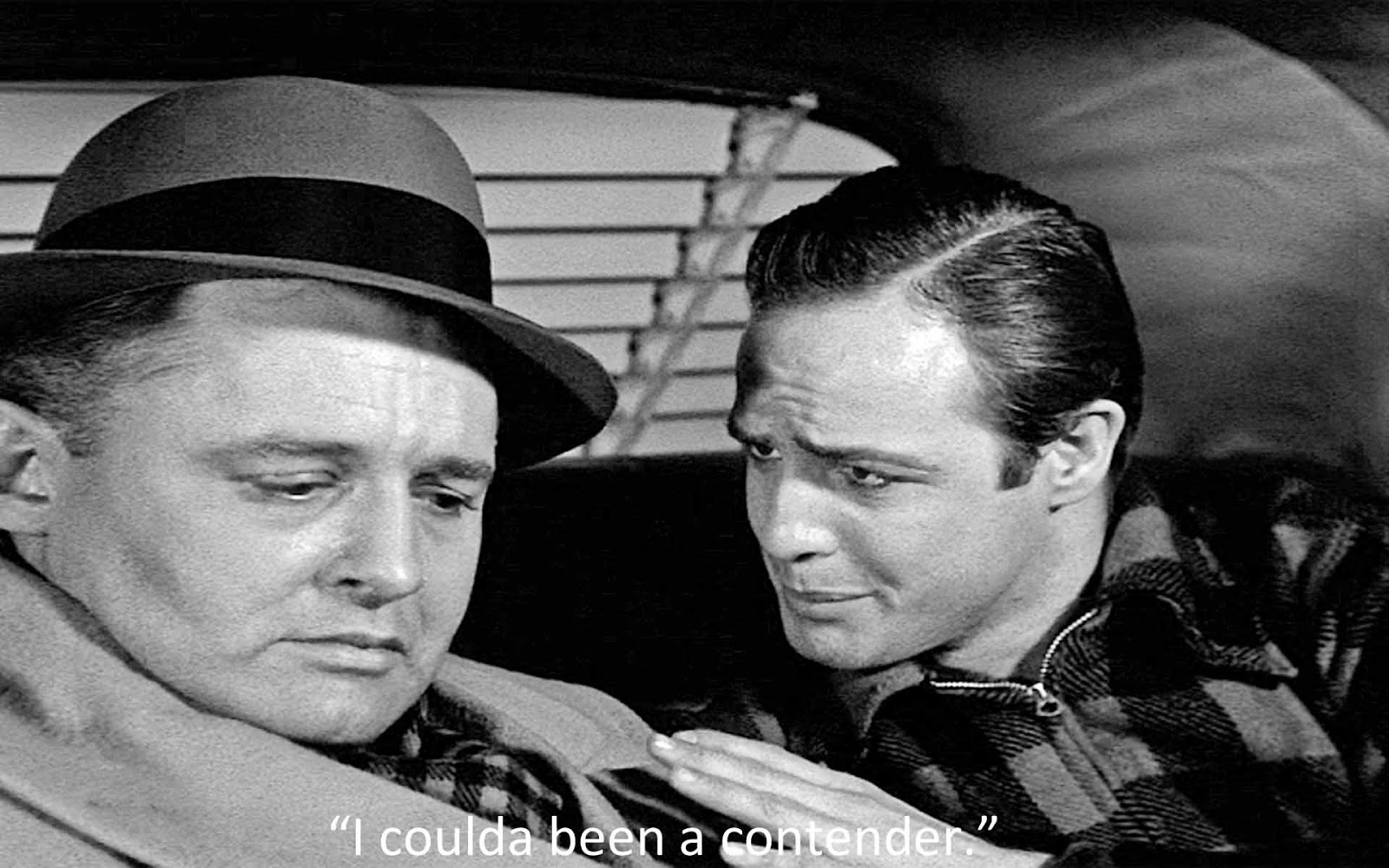
The most famous scene in the movie is the one with Terry and Charlie in the back seat of a cab. During filming, they had difficulty shooting through the back window from inside the vehicle. Someone said they rode in a cab with blinds in the rear. They used that suggestion. The result created an intimate setting for the exchange. Charlie has been told by Friendly that if Terry couldn’t be convinced not to testify, then Charlie would have to kill him. When he tells Terry he has to make up his mind by the time they reach their destination, Terry understands what is really happening: that his own brother has been ordered to kill him. Instead of anger and violence following this realization, we have a quiet scene of disappointment and heartbreak. Terry doesn’t grab the gun or knock it out of his brother’s hand. He gently just pushes it aside with his fingers. His sadness is palpable. When Charlie tries to place the blame onto someone else for Terry’s failure as a fighter, Terry lets him know that it was Charlie’s fault for making him take dives. Terry tells him that he should have looked out for him. That is what a brother should do – love and care for his sibling. Instead Terry makes him understand that Charlie has been betraying him for a long time. When he tells his brother, “It was you, Charlie,” the truth is almost unbearable for the both of them. Charlie then realizes he can’t kill his own brother, and by letting Terry go, he must join the list of those sacrificing their lives to bring about moral change.


Barry convinces Terry that he must fight in a court instead of a boxing ring. After he exposes Friendly, he does not run and hide. He goes to the docks to claim his right to work, and lead by example. The others finally defy Friendly, and say they will only work if Terry does. Even though he is beaten up by Friendly’s goons, he drags himself to the loading dock to put in his day’s work. His fellow longshoremen follow him, pushing Friendly aside. Terry may have lost his actual brother, but he has now become part of an army of kindred souls. As Edie said: everybody should care about everybody else.


Next week’s movie is Julia.