SPOILER ALERT! The plot will be discussed.

The Last Seduction (1994), along with Body Heat and Basic Instinct, break ground in the film noir genre by not punishing the femme fatale characters for using male sexual obsession for their own benefit. These are scary women, but there is an empowerment factor introduced in these films that leads to female characters in movies like The Piano and The Contender, and subsequent films and TV shows, that attack the sexual double standard.
The film begins with a jazz score, which can
point to the rule-breaking, subversive nature of the main character. There is
an overhead shot of a statue of a large bird mounted atop a New York City
building as the camera looks down on the traffic below. Is the fowl a predatory
animal ready to swoop down on its prey, like the main character? On the office
desk of Bridget Gregory (Linda Fiorentino, who would have received an Oscar
nomination if the film hadn’t originally appeared on cable TV) is a display
with coins in it stating they represent the “One Ounce Liberty Dollar.” This
shot may suggest that Bridget values her independence which money can secure
for her. She is a tough supervisor whipping her male subordinates with an
emasculating attitude to sell the coin sets. The scene stresses a reversal of
gender dominance.
Meanwhile, Bridget’s husband, Clay Gregory (Bill
Pullman), a sleazy doctor, has a briefcase full of prescription drugs that he
is selling to a dealer. Clay (something Bridget can mold for her own purposes?)
thinks he is going to be shot when the pusher’s henchman pulls a gun. But Clay
is paid his money, although he must store it on his person as he picks up the
literal and figurative “dirty” money from the ground.


He wants to celebrate by going out on the town, but she encourages him to take a shower first, since he smells, as he says, of “fear.” Unfortunately for him he is up against a fearless female. She empties out a condom box (another item linking her to sexual power), places it on the bed, and writes a note. She has a talent which allows her to write backwards, which implies that she can reverse the usual perception of women as seen by society. It also may suggest that what she shows on the surface is the opposite of what she is planning beneath the deceptive appearance she displays. Her note, which Clay knows must be viewed in a mirror to decode, says they can’t celebrate without prophylactics, so she went out to buy some. It is meant as a delaying tactic, but Clay catches on quickly and realizes she has run off with the money. He is undressed and sees her dashing off in the street. He yells in a threatening voice that she “better run.”
Bridget had no intention of sharing the cash
with Clay. She just used him as a pawn to get what she wanted, while he is the
one committing the crime and putting himself in danger. She grabs a cab to an
underpass where she has a car waiting for her escape. Before she drives away,
she pulls off her wedding ring, showing how the marriage means nothing to her,
and indicates her freedom from being attached to a man.
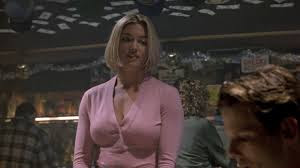
She stops for gas at a small town called Beston (not really the ‘best” place to be) in New York State on her way to Chicago, which is still twelve hours away. Bridget seems impatient and annoyed by the tedious trip. She eyes a bar where Mike Swale (Peter Berg) looks like he is in a funk as he drinks with a couple of pals, Chris (Brien Varady) and Shep (Dean Norris). We learn that he didn’t like living in this dead-end town, went to Buffalo, says it “didn’t work out,” and is back. He will not elaborate, and we find out why later. But his attitude makes him a prime target for the exciting Bridget. An old flame, Stacy (Donna W. Scott) greets Mike as she heads to the counter. One of the men acts like an adolescent, making a lewd gesture. Mike warns that the women living there are all “anchors,” suggesting that they will tie men down to this loser place. His words indicate that he still wants to escape. One of his pals asks if Mike has lost his “dick” for not wanting to pursue the local women, and it turns out to be a relevant statement when we learn what really happened in Buffalo. Mike is wearing a wedding ring and he takes it off (which echoes Bridget’s earlier action). The act indicates he was married in Buffalo, and also wants freedom. He wants to leave Beston, but tells his friend he needs to grow a new set of “balls” to do so. Does this suggest he felt psychologically castrated by what happened to him in Buffalo?

Bridget walks in and demands a Manhattan (a place she just left but her sense of city superiority to this hick town is symbolized by her order). The bartender is hostile to this entitled female and ignores her in an exaggerated way. She then voices disdain for the demure sexual role placed upon women by saying who does she have to “suck” to get a drink. But her words are also sexually alluring so she works both sides of the coin (which is what was objectively displayed on her desk earlier). Mike shows shock but smiles at Bridget’s language, which excites him, since she is like a shot of adrenalin to this sleepy town. His friend Shep calls her “city trash,” and asks what Clay sees in Bridget. His response is “maybe a new set of balls.” He wants to reassert his masculinity, and he sees Bridget as an opportunity to do that.

To recapture his manhood Mike gets the bartender to give Bridget her drink, and he pays for it. Her initial response is to tell him to get lost. He then boasts to her that he’s “hung like a horse.” She comically calls him “Mr. Ed,” and she quickly assesses that this handsome guy is someone she can use for her own gratification. She becomes the sexual aggressor, unzipping his pants and feeling around inside, humorously saying she wants to examine the goods before buying. They go to his place after she interrogates him to make sure it meets her basic standards of livability. Bridget wastes no time on sentimentality or being romantic. She is tougher than most men pretend to be.


She drives into town and her hard, ill-mannered ways contrast sharply with the townspeople who all say “good morning” to her. She does not return their polite greetings and even eyes them suspiciously, as if sincerity does not exist in her mind. She finds a job managing the sales solicitation department of an outfit called Interstate Insurance Company, since she has experience in the field. She secures confidentiality by using the male perception of a woman being a victim by saying her husband beat her and doesn’t want her real name on any official records. Her boss, Bob Trotter (Herb Mitchell) buys her story and notices her trick of being able to sign her name backwards. He doesn't realize that the fake name she uses, Wendy Kroy, is New York spelled backwards (if you drop off the “dy” of the first name). Again, we have her inverting the truth.

Coincidentally, Mike also works at the same company and runs into her as she leaves Bob’s office. She finds this fact inconvenient and tells him that he should consider the sex they had as just a fantasy because she doesn’t want him to mess up her “image.” She continually pretends to be something she is not for her own purposes. Here, she most likely doesn’t want it known that she is sexually adventurous as a small town will not accept a woman with that trait which is usually associated with men.

In her private office she again calls Frank and tells him she has a six-month work contract. He wants plausible deniability, and doesn’t want to know where she is so that Clay can’t get him to legally reveal anything. After he served Clay with divorce papers, per Bridget’s directions, Clay asked about Bridget’s whereabouts because he needs money to pay a loan shark. Frank advises her to send some cash to Clay so he will not be so desperate to hunt her down. She is reluctant, and Frank jokingly asks, “anyone check you for a heartbeat recently?” since she acts so uncaring. She agrees to call her husband, which she does. Clay reaches for the phone and his hand has been splinted, the results of an encounter with the loan shark. She calls him through the operator so he will not know where the call is coming from. When he answers, he fishes for the location from the operator, but the smart Bridget immediately disconnects the call as this literal battle between the sexes continues.


Bridget returns to the same bar and maintains her sarcasm toward the bartender. She has the same attitude toward Mike. She looks irritated by his joining her by asking aren’t there any other bars in town for him to frequent. He shows he can be condescendingly witty like her by saying he couldn’t get any info on her from the other secretaries. When she gets pissed off about the secretary reference he interrupts her by showing he knows exactly her job position. She likes his edgy comment and they have sex outside the back door of the establishment. He, being more traditionally feminine, wanting more of a commitment, asks where he fits in with her plans. She plays the more masculine role again by calling him her “designated fuck,” and walks off, sexually satisfied.
They continue having sex in his car and
apartment, keeping her place off-limits, wanting separate autonomy. But he says
that he doesn’t like being emotionally distanced. She is using him “like a sex
object,” which she admits is accurate. Their encounters stress the reversal of
the usual female/male positions (recalling again her writing backwards). When
he pushes to find out what she is “afraid of” since she will not open up to
him, she plays the tender female who has been hurt in the past and fears
falling in love with him, making her vulnerable. Then she undercuts her words
by flatly saying, “Will that do?” She says she likes her privacy which
maintains her emotional sovereignty.
Mike isn’t enough of a diversion for her and she
is bored in this small town, biding her time pending the divorce, and wants to
return to New York. She calls Clay again, but she takes her lawyer’s advice and
protects herself from Clay tracing her calls by quickly asking him to give her
the phone number of the public phone outside. She is right to be suspicious
because Clay has a private investigator, Harlan (Bill Nunn) tapping his phone.
Harlan has an early version of a mobile phone and Clay gives her that number so
Harlan can trace it. Clay jumps around to simulate being out of breath running
to the outside line and opens the window to make it sound like he is in a public
phone booth. When she calls he wanders away and she insightfully wonders why
it’s quiet. She specifically says she is entitled to the cash because he hit
her, but we know she was plotting to steal from him already. But her mentioning
this act stresses her desire for revenge against the abusive ways of men, a
tendency that she exploits for her own purposes. She says she needs to get back
to New York and is willing to pay off the loan shark and Clay’s private
detective, which he admits to hiring to suggest honesty. But Clay and Harlan
didn’t deactivate the home phone line in the apartment and when it rings
Bridget quickly realizes the scam and hangs up. After she phones Frank he
assures her that the most Clay got was an area code, which is what Harlan acquired,
showing she is in “cow country.”
Bridget’s desire for privacy on her terms is
stressed as Mike must apologize for accidentally walking in on her in the
bathroom. Also, she tells him that a woman loses half her acceptability at a
job if others know who she is sleeping with, another example of the need for
her to put on an act of sexual respectability. When he touches her as they
enter the workplace, in order to maintain autonomy, she smacks him and pretends
to accuse him of sexual harassment in the atrium of the building, turning the
female employees against Mike. Again, we have the appearance of the opposite of
what is true displayed because Bridget must hide her real self to get what she
wants given society’s preconceptions concerning women.

Meanwhile, Clay is giving prescriptions for drugs to sleazy visitors for cash. Harlan says he has nothing to go on to find Bridget. Clay is not a dummy, and when he happens to look at a New York poster hanging on his wall in a mirror, he sees the city’s name in reverse, which clues him into what name Bridget has used as an alias. He knows she is obsessed with leaving the farm orchards behind and returning to the Big Apple. He gives Harlan the backwards name of Wendy Kroy to investigate.
After five days Bridget approaches Mike at the
bar, and he is still angry at her. She has moved to a townhouse and is actually
willing to let him visit her there, a big move for her. He says he wants them
to share stuff, and she actually starts to open up by suggesting what might happen
when a person steals a large sum of money. He cuts her off, assuming she is
just giving him an exaggerated story. She is the girl who cried wolf, told too
many lies and now nobody believes the truth. He says being a claims adjuster,
some clients share more “intimacies” about themselves in a few minutes than he
has learned about her. He relates about one woman who wished she knew the sum
of her husband’s insurance policy earlier because she would have killed him
herself. Mike says you can learn a great deal about a credit report, and saw
that the woman’s husband was a cheater because there were three credit cards he
authorized for use by three different women. And, he had an apartment in his
name only. The gathering of disreputable information piques Bridget’s larcenous
and vengeful interests.
Bridget gets Mike to go to the company after
hours to make a list of clients whose credit reports show credit card
authorizations for women other than wives or daughters and who hold separate
living places in their own names. She wants men who carry at least a quarter-of-a-million-dollar
life insurance policies as incentives for the wives. She talks about selling
murder to the female spouses of these cheating men, but just as a practical
joke. She gets one woman on the phone and asks about the credit card of one of
the women he was involved with by pretending that is who she is talking to,
while knowing it is actually the wife. The spouse starts to cry, saying her
husband has cheated before. Bridget says that someone she knew had her
philandering husband killed and that there are people who handle this activity.
The woman actually seems interested and that is when Bridget says she is just
kidding. Mike says Bridget is sick if she thinks what she did is fun, but she
says if he wants to get closer, he must share in her messing with people's
minds. She offers sex at her place as a reward, so, she is also messing with
Mike’s head. He makes the call. Her phone scheme fits in with the theme of the
film of avenging the deeds of disreputable males. In a way, the wrong actions
of men have created the monster that is Bridget.
At Bridget’s place, she asks Mike about his
ex-wife, a guess on her part that he was married and wanting to make up for
lost time. In a switch, he doesn’t want to talk now, and Bridget reminds him
about wanting to open up. He says his ex, Trish, was someone he married in
Buffalo and it was a mistake. He said all he wanted, until recently, was to get
out of this small, dull town. She presses him about what changed. He says it
was her, coming from someplace “big” and choosing him, which means he is
“bigger” than Beston. She has made him feel exceptional by having him win the
sophisticated, sexy woman contest. He doesn’t realize he is just a tool to be
used for Bridget’s purposes. He does understand that she continually makes him
know that she is “bigger” than he is. So, she alternately builds him up and
lets him down. But, like many people in denial about a lopsided relationship,
Mike believes that she will see the light and will come to realize that he is
her equal.
The receptionist at the office tells her a
“black man” (Harlan) was looking for her. She rightly assumes that since she is
in hiding, anybody seeking her is connected to her husband. She admits to Mike
at his place that someone is after her, but doesn’t disclose the details,
wanting to use Mike as a protective buffer. She tells him she wants to carry
out a murder of a cheating, wife-beating husband, a man insured by another
company to add distance to the crime. She says the man deserves it, justifying
the act based on the man getting what he deserves. She probably actually
believes that part. She manipulates him emotionally, saying if he loves her,
she will do it with her, and wants him to go with her to New York after getting
payment. Mike’s first reaction is that she is sick and needs psychiatric help,
but he has been mesmerized by her which is why he doesn’t permanently leave her
or alert the authorities.

After Mike walks out to get some space, Bridget
shows a moment of vulnerability, saying to herself that she is “scared.” Her
instincts are correct again. When she gets into her car, Harlan gets in, too.
But she has brought some pepper spray to a gunfight, and Harlan’s pistol trumps
her weapon. She tries to make a deal with him to split the money, but he isn’t
buying her ploy. She says the money is in the bank (but we have seen she hid it
in her house), and gives him a phone number to get the balance. He gets back
into the car after the phony phone call at a booth, but he was smart enough to
take her car keys to foil her plan to drive away. He realizes the cash is at
her place and they start to drive there. She starts to ask him if it’s true
about black men having large penises, and says she’ll show him her ass if he
shows his genitalia. He dismisses her at first, but she flirtatiously persists.
There is a shot of her looking at the dashboard which shows the car is equipped
with only a driver's side airbag. We know Bridget is up to lethal no good. She
wears him down and Harlan releases his seat belt to unzip his pants. She revs
up the engine and speeds right into a pole. The airbag deploys, saving Bridget,
but Harlan is propelled right through the windshield. She has again flipped the
switch of gender power by using the male fixation on sex to her own benefit.
Bridget continues playing the prescribed female
role of victim to control men at the hospital where she is treated after the
impact with the airbag. (It is a Catholic hospital because there is a crucifix
with Christ on the wall in her room. The decor is ironic, associating her with
someone who suffered). The policeman questioning her agrees to keep her name
confidential to protect her from her abusive husband. He asks why the victim’s
penis was exposed, and she says that Harlan threatened to “impale” her with his
large member. Here she is also working male racial stereotypes to her advantage
with the police to reverse the reality of what really occurred.
Mike shows up at the hospital with flowers,
feeling very sorry he left her unprotected. After all this time he still is
under her sexual spell and doesn’t realize that others need to be protected
from her. He rightly admits that he doesn’t “understand” her. She utilizes the
present situation to say that killing a worthless woman abuser is justified,
and morality is subjective because the President authorizes killing often. She
says she can’t stay in Beston much longer, possibly referring to his earlier
statement about it being too “small” for him and her. She gets up to depart and
when he asks if she has been discharged, she fires back that he is always
following rules, tying him to the confines of the small town from which he
wants to escape.
She calls Clay knowing that since he is aware of
where she is she must buy some time to prevent further intimidation. She is
right again because Clay has Harlan’s replacement, a local cop, Bert (Mike
Lisenco), who he has promised some of the recovered money, sitting outside her
house. He also threatens to expose her culpability in the drug deal if she
tries to inform the police of his involvement. He says he is “interviewing
sociopaths” who will delight in doing horrible things to her if she does not
cooperate. She says she wants a week to wrap things up where she is before
returning the money to him. She agrees to send him $15,000 so he can pay his
loan shark some cash. He asks why she double-crossed him, and she says because
he struck her. He rightly says that is just an excuse, but she says now she gets
to hit him back, and adds after hanging up “hard.” We know she wants the money
and her revenge.
She lies to Mike, telling him she is going to
New York for the weekend to keep him away. Playing the typical unthreatening
female role of housekeeper to disarm her opponent, she heats up store-bought
cookies to make it look as if she baked them, and walks to the stakeout man’s
car wearing an apron. However, she was also banging nails into a strip of wood.
Quite a contrast in cooking stuff up. She has the wood attached to the straps
at the back of the apron, like a scorpion concealing the stinger, pretends to
drop a cookie, and places the puncture-enhanced object under the car’s rear
tire. She later calls a cab and instructs the driver to take her to Buffalo. When
Bert tries to tail her, the nails do their job.
In Buffalo, Bridget, a sort of evil genius when
it comes to human psychology, suspects that there is something she can use
concerning Mike’s marriage. She bribes an official to find out where Trish, Mike’s
ex, lives. She visits Trish (the one-named Serena), but we do not see the
meeting to heighten the reveal later in the story. But, Bridget’s smile shows
that the information she has received is satisfying. Meanwhile, Mike, at the
local Beston bar, finds out from his friend Chris that Bridget asked him about
the one secret Mike had that he wouldn’t want her to know. Chris assumed it was
about Buffalo, but he says he didn’t say anything. Chris, showing the primitive
male desire to boast to other men about sexual conquests, tells Mike that
Bridget offered to give him oral sex for the information. Mike, displaying
primal jealousy, hits Chris, and gets him to admit he was the one who made a
pass at Bridget.

Mike leaves extremely upset about learning of Bridget’s
questions about his past. He gets drunk and calls her, thinking she is in New
York, just to leave a message. (Even Bridget’s phone machine message is scary,
with her voice darkly comic, saying, “Don’t be afraid. It’s only a machine”).
He says he loves her, and Bridget, listening, rolls her eyes again at what she
most likely considers pitiable sentimentality. But he now sounds as if he would
do anything if only she loved him, too, which seems to interest her. She starts
to draw on a pad of paper next to her phone. She somehow knows exactly how Mike
will act. He drives over there intoxicated, and bangs into trash cans,
mirroring his reckless state. He enters the place and heads to the answering
machine to erase his humiliating message. He sees that Bridget has drawn a
heart with their two names inside it. He takes the sheet of paper, believing
that she has loving feelings for him. Bridget is actually hiding under the bed,
which both physically and psychologically indicates her concealing what she is
really up to.
Bridget continues to stage her plan. When Mike
thinks she has returned from New York he goes to Bridget’s place and finds a
planted round-trip ticket which falsely indicates she went to Miami, which is
where the cheating man lives who she suggested they kill for money. After
letting him pressure her she admits that she killed the man and then shows
money in a suitcase (the cash she took from Clay) that she pretends was paid by
the widow to commit the murder. He is shocked and she tells him that his
provincial ideas of morality show that there is no love that he feels is worth
killing for. She is again hitting at his fear of feeling “small.” She kicks him
out and then, alone, laughs at her convincing performance.
At work Mike goes to Bridget’s office saying he
is trying to accept what is happening. She says she has money now and nothing
is stopping her from returning to New York. She has driven him to a desperate
mental place and he bites on her bait, asking what he would have to do to be
able to be with her. She says they must have a “partnership of equals,” which
means he must kill a man for which the wife will pay a large amount of money.
She says that will be the end of it, they will be equals, and they can live off
the money in New York together. She seals the deal with a kiss and sits in his
lap, a man’s most vulnerable sexual spot. But, he says that he doesn’t want to
be with her that much to be like her, and leaves.
However, Bridget has another ace up her sleeve
(an apt cliche here since it is something hidden to con someone). She writes a
letter pretending (what else) to be Trish, saying she is moving to Beston and
will be working at Interstate, assuring him nobody has to know their secret.
The letter states she just wants to be near him. Bridget is tightening the
noose around Mike, making him desperate to find a means of escape. As Bridget
expected, Mike shows up saying he will do what she wants as long as he never
has to return to Beston and revisit his past.
To stop the observing Bert from following her,
Bridget once more uses sexual preconceptions as a weapon. She calls the police
and says that a man in a car tried to expose himself to her little girl. A
police car pulls up and detains Bert as Mike picks up Bridget and they drive
off. She has written him a “cheat sheet” to memorize so he knows what to do
involving the killing of their victim. As he recites the instructions that
Bridget wrote we watch his dramatized actions. Mike thinks he’s going after a
guy named Cahill who is in his apartment where he meets with one of his
extramarital girlfriends. Mike has a gun and a knife and he’s supposed to tell
the man he’s just there to rob the place. He is to get the man to handcuff his
arms and legs and then Mike is supposed to gag him. After that he is to knock
him out and stab him to death (no noise). There is one extra act he must
do which is to turn out the lights. She says it’s a psychological act that
denotes completing an “unpleasant chore.” Of course one should realize by now
that she has sent him to kill Clay.

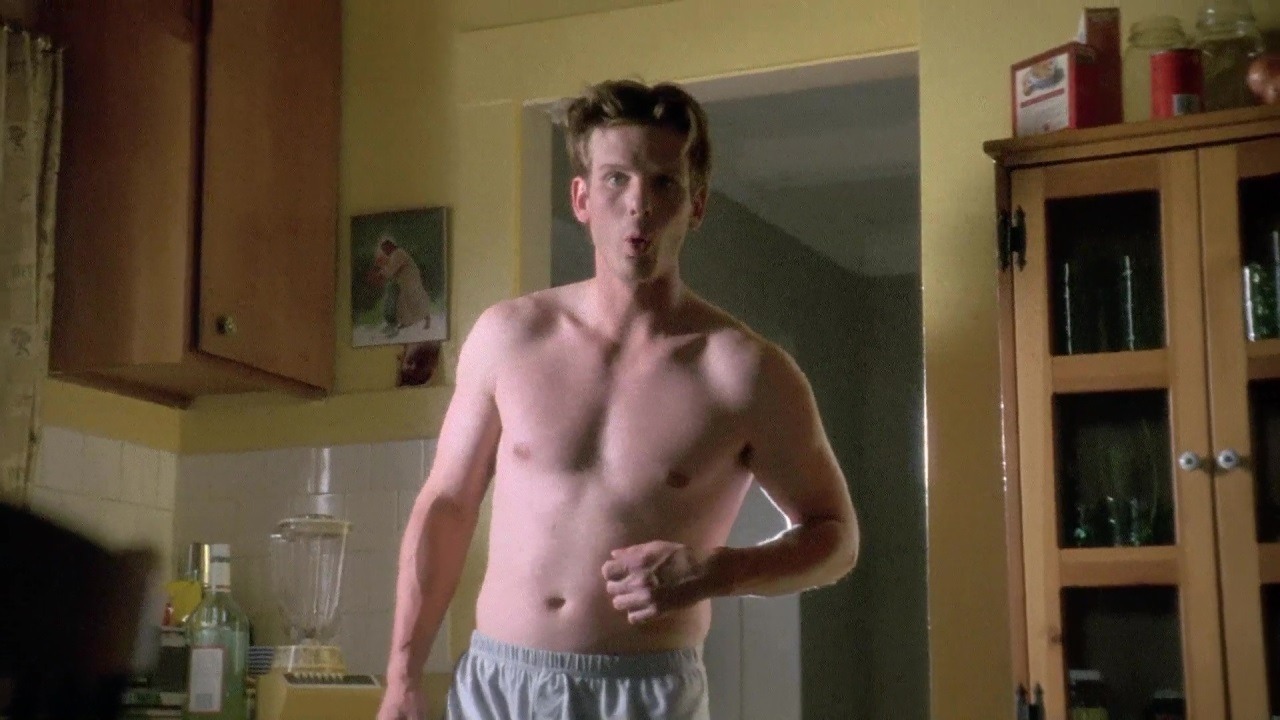
Mike is supposed to make sure the victim doesn’t make a sound. Why? Because Clay might say things that would lead Mike to realize it’s a set up. Indeed, Clay is able to say he just writes prescriptions and has nothing worth stealing. But Mike knows Cahill isn’t a doctor. Still, Mike is about to stab Clay but then throws the knife down and says out loud, “I’m sorry Wendy, I just can’t do it!” Clay’s eyes widen and he yells behind his gag, with realization, the name “Wendy.” He hops over to their wedding picture. Mike removes the gag and Clay fills him in about the stolen money and how she sent him to kill Clay. He realizes she seduced Mike, probably by the way he sounded disappointed he let her down. Mike says the mailbox has “Cahill” on it. Clay concludes that she is close by so she was able to relabel the mailbox. Everything is a deception. Clay is very smart and can see the chess moves Bridget is making. He says that she will call the cops and frame Mike for the murder. But, he realizes that she would have to check that Mike did the deed. So, Clay says there must be a signal. Mike realizes it is the turning out of the lights that would let her know Mike killed Clay.

Outside, Bridget, calmly smoking a cigarette (she smokes often, showing her cool by using the film noir prop), sees the lights go off. After entering the dark apartment the framed marriage photo slides to her feet. Mike, holding the gun, turns on the lights and she says she wouldn’t have turned Mike in. Clay calls it “bullshit,” and comments that the suitcase she brought in would support her charade that the two reconciled and the jealous Mike came to kill Clay. But, he is still in handcuffs. Despite what Mike has learned, he doesn’t want to wholly believe that Bridget doesn’t care for him and so he didn’t free Clay, who is in the way of Mike being with Bridget. She always is prepared for contingencies and uses the fact that Clay is bound to empty a can of Mace down his throat, killing him. Mike says she isn’t human, but she says she did it for “us” (substitute “me” for “us”).
Bridget has a backup plan as she probably
thought Mike would not go through with the killing. She tells him that it will
look like he killed her husband and then raped her. She starts to undress. As
he is ready to call the police she uses her secret weapon, Trish. We get a
flashback that dramatizes what probably happened with her and Mike in Buffalo.
It turns out Mike married a transsexual who was still anatomically a male, and
Bridget uses slurs and degrading language to stoke Mike’s shame and anger.
Bridget knows he will want to retaliate by proving his manhood. He is
irrational now after what has happened and wants to get back at Bridget. He
hits her and then rapes her as he says he will play her sick game. Bent over
the sofa, she calls the cops. The 911 operator hears her crying out that she is
being raped and that her rapist killed her husband.


Mike is in jail and meets with the Public Defender (Jack Shearer) who tells him that the keys he had to enter the apartment were duplicates which the prosecution will say he made. He says they need just one piece of hard evidence. Mike says there may be one thing. There is a cut to Bridget, enjoying her wealth by being chauffeured in a limo. She comes out of her old apartment building and burns that one bit of evidence, the mailbox label that reads “Cahill.” She then drives away after successfully completing her last seduction.
Yes, Bridget is an amoral creature. But one
can’t help but admire her intelligence. She uses the accepted stereotypical
role of the powerless woman to satisfy her own desires and avenge herself,
although unlawfully and selfishly, against male dominance.
The next film is The
Ruling Class.


