Showing posts with label thriller. Show all posts

Sunday, September 15, 2024

Duel

 SPOILER ALERT! The plot will be discussed.

I have been showing films and leading discussions at my housing development. The most recent movie was one made for television in 1971. It’s entitled Duel, and it’s the film that put Steven Spielberg on the map. His directorial ability to build suspense here shows how he was ready to make Jaws.


Richard Matheson wrote the story, and he is a respected writer of horror and science fiction stories, including I am Legend and Hell House. He wrote several episodes for the original Twilight Zone series. This tale involves the character of David Mann (Dennis Weaver) who is on a business trip driving on a fairly desolate prairie road that looks like it belongs in the Old West. He passes a slow-moving truck, and that’s when things go badly for him. The trucker plays a cat-and-mouse game with him, zooming past, slowing down, and preventing him from passing. The harassment escalates as he waves David on when there is oncoming traffic which almost gets David killed. The trucker starts to bang into the back of David’s car and even tries to push him into the way of a train.

The theme of this movie deals with old-fashioned masculinity and emasculation. David’s last name is “Mann,” which implies he stands for a modern male who doesn’t live up to his name. His wife tells him on the phone that she is upset with him because he didn’t confront someone who made a pass at her. She says the fellow tried to “rape” her, but David implies it was more like making a pass at his wife and says he wasn’t going to get into a fistfight with the guy. David listens to a talk radio show and the man calling in says he is not the head of the house any longer because he stays at home, takes care of the house and the babies, and his wife is the breadwinner. A gas attendant says, after David notes he doesn’t need to get a hose fixed, “You’re the boss.” To which David says, “Not in my house.”


The title of the film suggests a deadly old-fashioned confrontation between two combatants. In this case, the weapons have been updated to motor vehicles. The setting is rural and primitive, as if we are dealing with an occurrence at the O.K. Corral. We never see the driver of the truck, only a hairy arm, a cowboy hat, and cowboy boots. He is symbolic of the idea of a rugged, individualistic male of the Old West. The truck he drives is a fuel tanker with the words “Flammable” written on the back. It’s like the truck is announcing its ferocity and making a challenge. At one point the truck sits under a dark underpass, and when its headlights come on it appears like a ferocious animal waiting for its prey.

Let’s get back to that hose that needs repair. It is one of several phallic symbols in the movie. The gas attendant carries the gas nozzle around, suggesting the male organ. On the radio there is a man who plays music on such things as a bicycle pump. The trucker tries to run David down while he is at a rattlesnake farm. And there is that train (think of the end of North by Northwest). All these male symbols stress how David’s manhood is in jeopardy, and how he must try to win it back.


David drives a Plymouth Valiant, the name of the car suggesting that there is that fierceness inside of David, waiting to be released. He does in fact confront the trucker at the climax of the story. He aims his car, damaged after attempting several escapes and with that hose bursting, at the oncoming truck near the edge of a cliff. He transforms his unimposing briefcase into a combatant’s tool and uses it to hold down the gas pedal so his Valiant will ram the truck. The collision causes flames, obscuring the trucker’s view. He is unable to halt his forward movement, and the truck and car tumble over the edge. Spielberg lets the camera linger on the destroyed truck until its wheels no longer turn. It’s like witnessing the death of a modern, menacing, stalking beast.

Mann jumps for joy as he celebrates the primal male urge to vanquish the enemy.

Sunday, May 3, 2020

The Third Man


SPOILER ALERT! The plot will be discussed.
Sometimes I have written posts about movies that class members analyzed at the Bryn Mawr Film Institute. Since we have not been able to meet in person due to the pandemic, we used Zoom to talk recently about The Third Man (1949), directed by Carol Reed with a screenplay by famed author Graham Greene. As our instructors noted, this film is subversive in many ways. Instead of filming on a movie set as was the norm, the story was shot on location in Vienna. Given the city, one would expect classical music from the likes of Mozart to play in the background. Instead, director Reed used the now famous zither soundtrack played by Anton Karas, which resembles upbeat Greek dancing music, but which, as Roger Ebert implied, has a melancholy feel to it. We also don’t see the great Orson Welles until most of the film has played, and he is on screen for a very short time. (Later use of stars in this limited way are Janet Leigh in Psycho and Marlon Brando in Apocalypse Now). The film also does not have an upbeat ending, which defied the rules of the time.
The unconventional moviemaking aspects reflect how the story indicates that the devastation of World War II has swept away the reliable rules on which the world was based. What’s left of the great architecture of Vienna stands in stark contrast to the rubble that makes the metropolis, as the cynical narrator at the beginning says, look, “Bombed about a bit.” He notes that what happened in Vienna didn’t “really look any worse than a lot of other European cities.” So Vienna is representative of the horror the war inflicted over the entire continent. The narrator is a child of the new chaos who “never knew the old Vienna,” the one of tradition and civilized culture. He only knows about the current time when the black market prospers in the darkness, but which has its casualties, too, just like the war, since “amateurs” meet their ends in this moral vacuum. To accentuate what the narrator says there are shots of stolen goods being exchanged and a dead body floating in the river. 

The narrator sets the stage by saying Vienna was occupied in four zones by America, Great Britain, France, and Russia. Outsiders, who don’t speak the native language, and don’t share a standard means of communication, have torn the city apart. The result is instability, a sense that the world is, as Ebert says, “out of joint.” Reed and cinematographer, Robert Krasker, convey that feeling of disorientation by employing numerous tilted shots, called Dutch Angles. The movie uses large, distorted, looming shadows in dark streets, reminiscent of paintings by Georgio de Chirico, and, as Ebert mentions the results are “an expressionistic nightmare.” The style of the film suggests how danger has filled the void left by the absence of an orderly, meaningful universe. 


The narrator then introduces us to the specific tale to be told. Holly Martins (Joseph Cotten) is an American writer who has money problems and has come to Vienna at the invitation of his college friend, Harry Lime (Welles) to accept a job. However, Holly discovers that Harry died in an automobile accident and was buried. There are inconsistencies about whether Harry died instantly or had time to communicate his wishes about Holly and his girlfriend, Anna Schmidt (Alida Valli). Also, the accident supposedly occurred in the presence of Harry’s physician, Dr. Winkel (Eric Ponto), and two other people Harry knew, Baron Kurtz, played by Ernst Deutsch (does he really have that title, and if so, he does not act nobly), and a man named Popescu (Sigfried Bauer). That all three happened to be there at the same time seems too coincidental to Holly. After Major Calloway (Trevor Howard) tells Holly that he was investigating Harry for murder and racketeering, and eventually tells him that he thinks Harry was murdered. Holly vows to find out what really happened to his friend. Harry’s building porter (Paul Horbiger) tells Holly that there were three men who carried Harry away from the accident. One was Kurtz, another Popescu, and another, an unidentified “third man.”


Holly writes old-fashioned Western novels. They tell stories about good guys in white hats beating bad guys in black hats, and then most likely the hero rides off into the sunset toward a happy life. He is an anachronism, naive and ill-equipped to deal with the current post-war world where there is no noble battle between good and evil being fought. When the porter says that Harry either went to hell, the man points upward, or he went to heaven, and he points downward. Anne says to Calloway that when it comes to Harry, the Major is seeing things “upside down.” Indeed, almost everything in this movie is upended and not what it seems as secrets reside under appearances, or is the opposite of what is expected. There is the character named Crabbin (Wilfrid Hyde-White) who says he represents the British cultural department in Vienna, a place that has had its culture ravaged. Crabbin’s last resort to promote literature is to enlist the bottom-of-the barrel pulp writer Holly, who isn’t even from Vienna, to speak at a lecture. Crabbin wants Holly to talk about “The crisis of faith.” Holly’s response is, “What’s that?” Crabbin says, “Oh, I thought you’d know.” As this conversation shows, everybody is clueless here, especially about what to believe in. Even the ride to the lecture doesn’t appear to be what it seems. Holly is told a car is waiting for him. Inside is an imposing, silent man who recklessly drives away. Holly has no idea where he is going until he gets to Crabbin’s event, and is frightened along the way. Again, uncertainty and doubt reign in this confusing time. Holly and Anna discover that Kurtz, Winkel and Popescu were all secretly involved in criminal activity with Harry, who was getting a hospital worker, Joseph Harbin, to steal penicillin. Harry then diluted the drug so he could sell larger amounts on the black market to the victims of the war, causing many people to suffer and die. Even Anna has something to hide since she has a fraudulent passport because she doesn’t want to be turned over to the Russians. 
Besides the skewed camera angles, the film uses different tactics to suggest that there are no social or moral anchors to steady people’s orientation, which leaves the characters feeling detached from the stability that civilizations are meant to provide. Many of the characters are in such a fog they can’t even get the names of others straight. Holly calls Calloway, “Callahan.” Dr. Winkel’s name should be pronounced as if it starts with a “V,” but the “W” sound is used instead. Anna addresses Holly as, “Harry.” (More on that later). Ebert points out that even the name on Harry’s tombstone is wrong. Communication breaks down as the meaning of words is muddled. A British MP tells Anna that they must follow “protocol.” Anna says she doesn’t know “what protocol means.” The MP responds, “Neither do I.”  Also, the movie includes professions that feature putting on shows and presenting pretend events. Holly is a fiction writer. Anna is an actress. An amusement park is depicted. We are, after all, watching a made-up work, a film. Reality begins to lose its hold in this atmosphere, and surrealism takes over. So, when a huge, ominous shadow approaches, suggesting danger, turns out to be a little guy selling balloons the implication is that we can’t trust what we believe to be true. 
Holly eventually discovers that Harry is alive, which is another example of the upside-down nature of this world. Harry is supposed to be underground, below the surface. But, that is a lie, and he is alive and above ground, so what is above the surface and that which is below it are deceptions. When they dig up Harry’s grave they find the body of the penicillin provider, Joseph Harbin, there instead. The implication was that it was Harry who was “the third man” carrying the body. To get at the truth is difficult in this world, as Calloway says, “We should have dug deeper than a grave.” (Harry Lime’s last name, according to IMDb, could refer to writer Graham Green’s last name, a lime being green. However, to “lime” a leaf or twig is to use a sticky substance to catch or ensnare something. That definition would fit in with Harry’s character). 

Holly sends a message to Harry through Kurtz and Winkel to meet him near the Ferris wheel at a fairground. We then have the pivotal scene between Holly and Harry. The criminal is deceptively charming, throwing others off guard, who do not suspect him to have done nasty deeds. The two ride the Ferris wheel, a symbol of the rotating, upside-down upheaval of morality that has taken place, and the resulting disequilibrium that ensues. Holly confronts his old friend with how he has created victims with what he has done with the penicillin. Harry presents a cynical, nihilistic philosophy that places self-interest above the concerns for others in an ethically barren existence. He says, “Victims? Don’t be melodramatic. Look down there. Tell me, would you really feel any pity if one of those dots stopped moving forever? If I offered you twenty thousand pounds for every dot that stopped would you really, old man, tell me to keep my money, or would you calculate how many dots you could afford to spare?” Harry, at the top of the ride, is like a merciless god, feeling himself above any laws or rules, and the only obligation he has is to himself. He goes on to say that the whole world shares his view now since, “Nobody thinks in terms of human beings. Governments don’t.” His pessimistic view of life on earth is shown when he says, “the dead are happier dead. They don’t miss much here, poor devils.” Harry even argues that mayhem coincides with greatness, while caring and harmony lead to nothing noteworthy. He says, “in Italy for thirty years under the Borgias, they had warfare, terror, murder, and bloodshed, but they produced Michelangelo, Leonardo da Vinci, and the Renaissance. In Switzerland they had brotherly love - they had five hundred years of democracy and peace, and what did they produce? The cuckoo clock.” Harry even made a deal to expose Anna’s fake passport if the Russians would let him hide in their sector. But, he wouldn’t dream of atoning for his transgressions. He indicts Holly’s innocent ignorance of the state of affairs when he says, “You didn’t expect me to give up? … Oh, Holly, you and I aren’t heroes. The world doesn't make heroes outside of your stories.” Harry almost thinks about killing Holly after he finds out that he told the police about seeing Harry alive. It’s possible this betrayal shows Harry that Holly also has faltering ethics. He tells Harry that they can meet again, but without any police presence.

Holly has fallen in love with Anna, and makes a deal with the authorities that he will set a meeting with Harry if they let Anna go free. But, Anna does not have romantic feelings for Holly, and is repulsed by the deal he has made. She still loves Harry, even after learning of his crimes. What does that say about her moral compass? Calloway takes Holly to see the patients that Harry put in harm’s way. Holly agrees to lay a trap for Harry. Now let’s get back to how Anna would substitute Harry’s name when addressing Holly. At the stakeout, Holly sits in a cafe. Written on the window next to him is the word “dopple.” This shot implies that Harry and Holly are doubles of the same person, each representing positive and negative qualities. Holly can go the dark side, as he has done, betraying Harry.


Anna appears and warns Harry of the ambush. Harry goes into the underground sewers. He has descended into the hell of the underworld where his befouled soul already belongs, where he can’t hide by pretending to be something other than what he is. The authorities pursue him and Harry shoots one of Calloway’s men. Holly picks up the fallen man’s gun and goes in pursuit. Harry finds himself trapped, like “a cornered rat,” as Ebert observes. Harry slowly nods as Holly approaches, giving Holly permission to perform a vigilante killing. Although justice has been dispensed, it is outside of the legal system, and Holly now has the stain of killing another human being darkening his previous innocent nature.
Ebert says the film, “reflects the cold war years of paranoia, betrayal, and the bomb.” Given that gloomy perspective, it is no wonder that the last image of the movie has a long shot of Anna walking toward Holly, but then passing him by without a sign of recognition. There is no riding off into the sunset with the promise of living happily ever after. The journey ahead is a difficult and lonely one.

The next film is Saving Private Ryan.

Sunday, August 18, 2019

2019 Recent Films


SPOILER ALERT! The plots will be discussed.

I thought I would change things up a bit and provide some brief comments on films that have come out in recent months.

Late Night

This movie is written by and stars Mindy Kaling, who has a personality that is almost impossible not to like, unless you are just into dark, depressing movies, which, I know, have their apocalyptic appeal. Her character gets a job as a comedy writer on Katherine Newbury’s (Emma Thompson) long-running late night talk show, basically as a “diversity hire.” Katherine has no female writers on her staff despite her supposed feminist ways. It’s a bit hard to accept that Molly, whose only comedy background is cracking jokes while working at a chemical plant, gets the job. She is a young fan of Katherine’s but the show does not appear relevant anymore. Katherine has a biting wit and can be difficult to work with. Some of her soft side comes through when dealing with her husband, played by John Lithgow, who has Parkinson’s disease. But, our sympathy for her is undercut since Katherine had an affair with the writing staff’s womanizer (High Dancy), who tries to put the moves on Molly, too. Katherine is reluctant to do topical humor, first appearing ready to use Molly’s abortion joke, but then deciding to skip over it at the last moment.

Katherine’s emotional side comes across when she witnesses Molly’s humor during a stand-up routine at a charity event. Katherine proceeds to go onstage and is genuine in her feelings about the possibility of her show being cancelled and is more vulnerable in her humor. Katherine starts to use some of Molly’s jokes and interacts more with the audience. The network still tries to replace her with a sleazy comic. Katherine fires Molly for telling her she’s wrong not to fight back, but eventually does stand up for herself, and rehires Molly. Time passes, and there is more diversity at the show and it is a success again.

Despite Kaling’s appeal, and Thompson’s talent, the film just doesn’t gel. The plot is not believable, and the jokes fall flat. The characters have no real depth to them. There is one hilarious scene, though, that satirizes the absurdity of untalented people who become “stars” on the internet. Katherine has a YouTube celebrity on her show whose claim to fame is her sniffing her dog’s butt and then fainting. The film argues that just because something is odd doesn’t make it worthwhile, and the proliferation of these type of mindless diversions contributes to the dumbing down of our culture.


Yesterday

Oscar winning director Danny Boyle’s comedy-drama presents a speculative story about what the world would be like if the music of the Beatles did not exist. It starts out with its focus on a somewhat talented singer-songwriter, Jack Malick (Himest Patel), living in Suffolk, England, who gets small gigs booked by his childhood friend, Ellie Appleton (Lily James, the “Apple” part of her character’s name suggestive of what is to come?). He is playing at a sparsely attended tent at a festival when there is a world-wide power outage. Jack, on his bicycle, gets knocked out after a bus hits him. Later, Ellie gets him a new guitar and he starts to play “Yesterday.” His friends think it’s wonderful and believe Jack wrote it. After realizing they are not kidding, he can’t find any evidence of the Beatles or their songs (or Coca Cola, cigarettes, and Harry Potter for that matter, suggesting the world would be quite a different place for the better and the worst if some things never came into existence).

He strains his memory to recall as much of the songs’ music and lyrics since there is no reference material. He sees this opportunity as a way for him to finally realize his dream of becoming successful. It’s great to hear the songs, but we realize that at this point Jack’s quest is self-serving. Despite the quality of the work, it still takes some time for a producer to want to record the songs, but Jack gets a boost from pop star Ed Sheeran playing himself. Jack eventually becomes hugely popular, but there is a bit of humor on how Jack’s rendition of “Back in the U.S.S.R.” is out of date given the fall of the Soviet Union. Some songs are of their time. In addition, the record company wants to change the name of the “White Album” to “The One and Only,” an ironically erroneous title since the songs belong to others, not to Jack. Sheeran also retitles “Hey Jude” to “Hey Dude,” illustrating how in the wrong hands a song can be greatly diminished.

As the story continues we learn that there are two other people who remember the Beatles music, and there is the suggestion that Jack will be revealed as a fraud. But, the movie takes an unexpected, and gratifying turn, in that the two show up at a major concert and are thrilled that Jack has brought the Beatles’ music back to life. Jack acknowledges to the world that the songs are not his, but were created by John, Paul, George and Ringo. He wants the music available for free. There is a shift away from Jack’s personal drive for fame to his understanding of the importance to ensure the world is enriched by the songs.

Another marvelous twist in the story is that Jack tracks down the still living John Lennon (Robert Carlyle, who, through digital enhancement and make-up, looks and sounds exactly like an elderly Lennon). Since Lennon didn’t become famous in this dimension, he was not assassinated, and is currently seventy-eight, and has had a wonderful life with his wife and children. The film poses the question as to which life was better for Lennon, one of fame and fortune cut down at an early age, or one of longevity and happiness? The movie leaves us to ponder the question, and the different ways that life can play out depending on the circumstances.

The long-simmering love between Jack and Ellie is consummated, they are married, and we hear him and school children happily singing the delightful, “Ob-La-Di, Ob La Da,” showing us that Jack can also be successful without fame.


Crawl

Okay, this movie probably swam past a lot of people this summer because there have been scary films about alligators before, and they have fallen into the B-Movie category, or even B-minus. Yes, this story is unbelievable in how the main characters can survive the onslaught of these nasty amphibians. But, the film works in many ways.

The main character is Haley (Kaya Scodelario), and we first see her competing in a University of Florida swim relay race. There are flashbacks of her as a child with her father, Dave (Barry Pepper), who was her gung-ho coach, calling her a “predator,” to encourage her when she lost a contest. This opening shows how she wants to live up to her father’s expectations, and how she is as much of a beast as the gators she will be confronting.

To add to the great atmospheric tension of the movie, there is a category 5 hurricane bearing down on the state, and Haley gets a call from her sister telling her that their father isn’t answering her calls. Their parents are divorced, and we later find that Dave was selling the family house. Haley avoids the police roadblock and makes it to the house where she finds her dad in the basement where an alligator bit him and he broke his leg. She eventually fights off two alligators, blinding one, but she also suffers a bite. She eventually shoots one of the critters while the gator has the hand holding the gun in its mouth. Anyway, there are other people who show up and many more alligators. There are several casualties along the way until daughter and father, though chewed on, beat off the predators and are eventually saved.

The special weather effects are convincing, the alligators are scary, and there is a Jaws-like suspense to the film. The amusing closing song is “See you later, alligator.” (On a personal note, when I first went to the theater to see this movie, it was a hundred degree day, with the air conditioning working overtime to fight the heat. Besides myself, there was a young couple in the theater. After about a half-hour, we heard a loud dripping sound, followed by the ceiling coming down in front of us. The other fellow went to get an employee who gave us passes, and I eventually saw the rest of the film - at another theater. I told the couple I like special effects, but bringing the hurricane into the theater was taking it a bit too far, and I was waiting for an alligator to slither out of the ceiling tiles.)


Once Upon a Time in Hollywood

This latest Quentin Tarantino film is supposedly his next to last movie. It is a good thing that this isn’t his final work, because, for me, it was a disappointment. In prior films, Tarantino has taken real historical events, such as the war with the Nazis in Inglourious Basterds, and slavery, in Django Unchained, and then rewrote the past through the art of movie magic by killing off Hitler and the slave owners in those motion pictures, giving audiences satisfactory justice and revenge, imaginative thought it may be. He does the same thing here, erasing the Manson Family murders, by having his stars, Leonardo DiCaprio, as former TV lead Rick Dalton, and Brad Pitt, as his stunt double Cliff Booth, killing off the bad guys and saving Roman Polanski’s actress/wife, Sharon Tate (Margot Robbie). (Referencing his own Inglourious Basterds, Rick was in a film where he incinerated Nazis, as Pitt’s character did in Basterds, and uses the retained working flamethrower to cremate one of the Manson clan).

The movie shows Hollywood at a time when TV was the inferior version of motion pictures, and television actors were considered second-class entertainment citizens. Rick goes the way of Clint Eastwood, graduating from playing TV cowboys to acting in Spaghetti Westerns. Cliff hangs onto a living as long as Rick is earning, and we see that he lives marginally in a trailer with his dog. He even has to be the alcoholic Rick’s chauffeur. The whole Manson element shows the perversion of the hippie movement of the time, and the fear experienced by some of Hollywood’s elite that they might be targets of anti-establishment forces. Cliff seems like a working-class hero who has the courage to enter the Manson compound to check on an old Hollywood friend whose land the Manson group is inhabiting. And it is funny to see him hold his own in an impromptu fighting match with the bragging Bruce Lee. But he has a dark past where he may have killed his wife, but was not convicted. (A reference to the Natalie Wood death?). After Rick helps save Tate, the doors to her mansion open up, and Rick is invited in, as if the gods of Hollywood may deem to raise him to movie star status.

Unlike other Tarantino films that thrive on witty, quirky dialogue delivered by odd but fascinating characters, this movie is not very funny, the characters not terribly interesting, and the plot drags in many spots. Quentin, let’s hope you’re saving your best for last.

The next film is The Road.

Sunday, April 29, 2018

Training Day

SPOILER ALERT! The plot will be discussed.
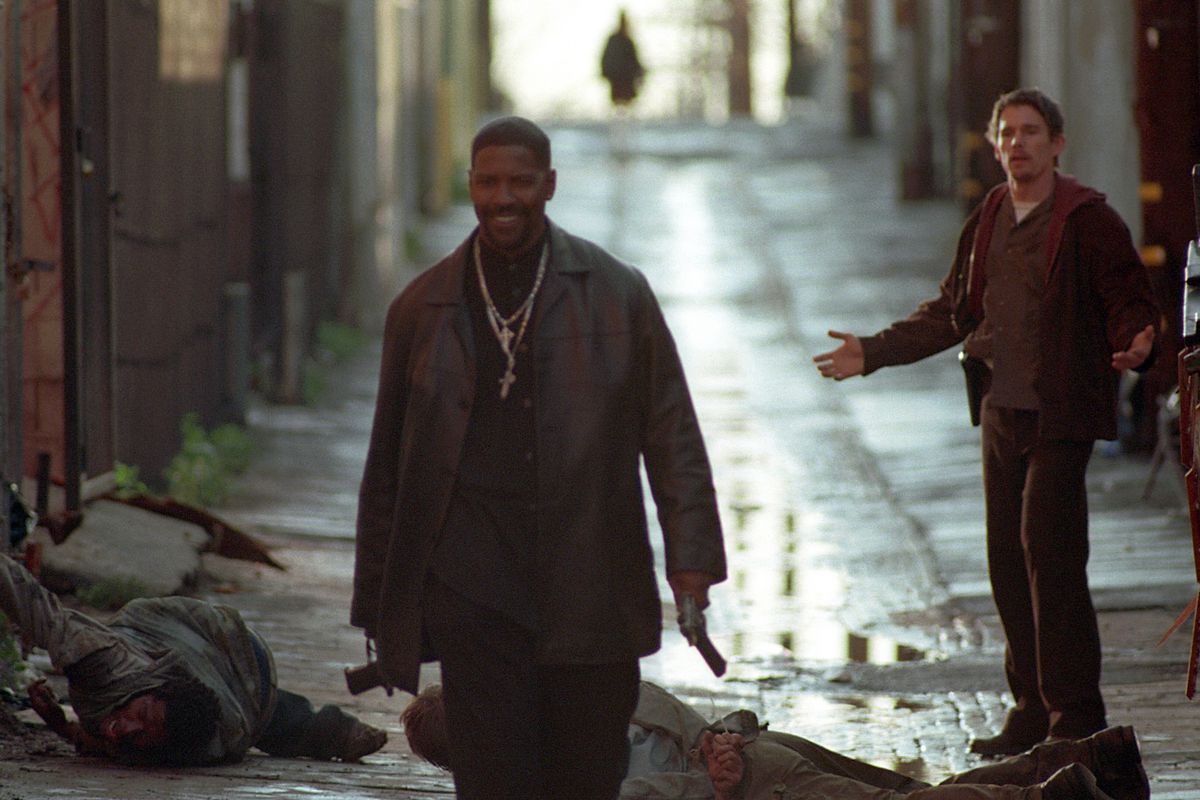
This 2001 film, from African American director Antoine Fuqua and writer David Ayer, presents us with two world views: one, the right-side-up version, represented by LA police officer Jake Hoyt (Ethan Hawke); and the other, the upside-down one, embodied by narcotics detective Alonzo Harris (Denzel Washington in a Best Actor Oscar-winning performance). In a way, Jake is the before picture of an uncompromised rookie cop who wants to “protect the streets” by getting rid of dangerous drugs, and Alonzo is the after photo of a man who lost his idealism and has crossed the legal line, going from by-the-book methods to illegal ones to put away criminals. While doing so, Alonzo serves himself as much as the community, maybe more so. (You can find this theme of crossing the line in David Mamet scripts. Think of The Verdict, House of Games, and The Untouchables, among others). Actually, as we get to know these two characters, and others, it’s not really that black and white. There may not he fifty shades of gray, but there are a number of them in this story.
The first shot is of the sun rising on this “training day.” We have the classical “unity of time” in this movie, everything taking place within one twenty-four hour period. The movement of the sun at the start of the film is like the curtain rising on a stage play. We see subsequent shots of the sun as it marks the movement of the story until it sets at the end of the tale. The fact that Jake must prove himself, and Alonzo must solve his problem in the same compressed span of hours escalates the plot’s tension. Jake is already awake when his alarm goes off at five in the morning. He is nervous because today he must demonstrate that he is worthy of joining Alonzo’s special narcotics undercover unit. His wife, after nursing their baby daughter, adds to the pressure when she tells him not to screw up this opportunity. Although wanting to be a good cop, Jake is selfishly interested in getting promoted and making more money. He is envious of the nice homes of his superiors. Later when Alonzo pushes him to state why he really wants to join his team, Jake reveals his ambition when he says, “I wanna make detective.”

Jake receives a phone call from Alonzo. In this brief exchange we start to see what kind of person Alonzo is. He tells Jake that his men “don’t go to roll call,” saying that is for “patrol ferries.” (Alonzo several times belittles other policemen, such as one changing a person’s tire, by not acknowledging their contributions), and when Jake starts to thank him for the opportunity to serve with him, Alonzo hangs up on him. Alonzo believes the rules do not apply to him, whether they involve his job or even manners. When Jake arrives at the cafe to meet Alonzo, the latter practically ignores him as he reads the newspaper. Jake is uncomfortable, not knowing what to do, and when he talks, Alonzo chastises him for interrupting his morning ritual. Alonzo is a jaded man, calling the printed news mostly “bullshit,” and reads it only for entertainment purposes. Since Jake interrupted his fun, he bullies Jake, making him perform for Alonzo, having him tell a personal police story, which Alonzo then criticizes as being boring. Jake, however, sees his story as an example of having saved someone from getting killed by a heavily armed guy, which is a cop’s job. (In this conversation, Alonzo uses the word “boom,” as he does often in the movie, which not only sounds like a gun going off, and which points to him being dangerous, but it also signifies how Jake, and us, never know “what’s going to happen,” as there are surprises in the plot. As he tells Jake later, “This shit’s chess, it ain’t checkers”).

Alonzo also drags the conversation into the sexual gutter, saying he has five boys, and if “You ever need a son, you let me know. I’ll hook your old lady up. I can’t miss.” Jake asks him to leave his family out of the conversation. Alonzo says, “I respect that.” But, he doesn’t, and then starts asking Jake about his sex life with his wife. Alonzo also insults Jake’s virility for not making a sexual move on his female training officer. Alonzo is crude and demeaning, asking Jake if he has a penis, and if so, he should reach into one of the pockets on either side of his male organ, and find some money. So, Alonzo even makes Jake pay for Alonzo’s breakfast. Maybe Alonzo humiliates Jake because he regards Jake’s Boy Scout attitude as naive and dangerous, or maybe he resents Jake for holding onto the values he has lost along his crooked way.
Alonzo’s rogue ways are evident in the way he crosses the street, defying the traffic signals. He wears his two guns openly, as if he’s a sheriff in the Wild West. His car is a 1979 Chevy Monte Carlo with hydraulics that jack the vehicle up, mirroring Alonzo’s arrogance. And, his ride is his “office,” showing how he doesn’t even have to report to division headquarters, like other policemen. He looks more like a hoodlum than a cop, but then again, he is supposed to be undercover, (even though the whole neighborhood knows who he is), and his impressive arrest record allows him to indulge his posturing. Alonzo doesn’t have to walk the straight and narrow ethical path, and, instead can be the “zig-zag man,” because, as he says, they build prisons because of him. His cynical attitude is reflected when he advises Jake to forget about what he learned at the police academy, because abiding by the rules will get him killed in the real world.

The law according to Alonzo allows small time drug dealers to operate so that they will inform on the big time criminals, and Alonzo can make the big busts that allow him so much legal latitude. He takes Jake to where one of his confidential informants does business. This young Latino man can be lethal according to Alonzo, but he allows him to stay on the streets just so Alonzo can extract information from the youth. That is why Alonzo calls the dealer his “teammate,” because Alonzo has blurred the line between cop and criminal. He bends the law, doing favors for crooks, like getting this fellow’s mom out of INS detention, thus putting them in his debt. Alonzo also says that he allows the young man to sell illegal substances to make some money for his family. In his twisted way, Alonzo has rationalized his actions by accepting the pessimistic premise that dealing drugs is the only way the boy can earn a living.
The dealer sells marijuana to some white youths in a car. Alonzo chases them and scares them, saying if they show up again in this neighborhood he will have the local hoodlums sexually assault the girlfriend, who is in the back seat. He confiscates their purchase, but doesn’t arrest them. He isn’t going to bring them in for a small purchase, so why does he stop these kids? In a strange way he is protecting white youths by making them afraid to enter this territory, as if he doesn’t want to rock the “white privilege” boat, which may bring him grief. He also appears to want to use their “product” to show Jake that he must be willing to take drugs in order to go undercover. Jake at first declines, sticking by his ethical standards, but Alonzo is brutal in his admonishment of Jake’s refusal. He puts a gun to Jake’s head, saying Jake would blow his cover, and would be a dead man. Alonzo tells him, “You turn shit down on the streets, and the chief brings your wife a crisply folded flag.” He then stops the car (in the middle of traffic, again defying the rules) and tells Jake to get out of the Monte Carlo because he doesn’t want him on his team. Knowing that he may blow his chances for promotion and putting drug dealers away, Jake smokes the pot. Jake admits to smoking weed in school, and Alonzo says that fact wasn’t in his records, making the point that everyone has “secrets,” and even the supposedly clean Jake has some dirty laundry in his past.
Jake starts to feel very mentally altered, and Alonzo admits that he gave him pot laced with the much stronger PCP. Jake is alarmed because he thinks he will fail a urine test and will be fired. But, Alonzo assures him he’s safe, because their lieutenant always gives his team a week’s notice when a drug test will be performed. Here again we see how Alonzo operates outside of the law. He tells Jake he smoked the stuff of his own free will. He says nobody put a gun to Jake’s head, which is exactly what Alonzo did, as he makes a dark joke about how he has manipulated Jake.
Their next stop is at the home of Roger (Scott Glenn), who we know must have made a great deal of illegal money since he is talking about “retiring” soon and going to the Philippine Islands. He and Alonzo behave like they are old friends, and we learn for the first time from Roger that Alonzo has recently incurred the wrath of some Russian gangsters while he was in Las Vegas. (Alonzo seems to associate more with outlaws than policemen). Alonzo tells Roger he is working out his problem, which turns out to be a foreshadowing of how Alonzo will double-cross Roger. Roger tells a cryptic joke that he says will tell Jake everything he needs to know about life on the streets. Jake, in his altered state, says he already knows what it’s all about, “Smiles and cries,” which a surprised Roger agrees with. Jake says, “You gotta control your smiles and cries, because that’s all you have and nobody can take that away from you.” It’s as if Jake is saying that you can’t count on anything else, so living the hard life in the inner city, you can only rely on what moves you to laugh and cry. Alonzo scoffed at the line, but maybe Jake understands more about the people living in Alonzo’s community than what one would expect. Roger reinforces the idea that Alonzo was once like Jake, wanting to clean up the streets when he was a rookie.
As they drive, Jake sees two men trying to rape a young Latino girl. He tells Alonzo to stop the car, which the jaded cop does reluctantly. Jake takes on two tough guys who don’t seem to care that he is a policeman, yelling obscenities at him. Alonzo just watches, acting like a detached judge, assessing Jake’s performance. Jake overcomes the men, one with a choke hold, while sustaining a bit of a beating. Alonzo again doesn’t want to bother himself with arrests here. He threatens one of the men, beats him with the pistols he’s carrying, and takes their drugs and money. Alonzo just tells the girl to go home. Jake is angry because he wants do his job by taking her statement and getting the the two men off of the street. He also finds the girl’s wallet that she left behind. After hearing from the girl where she came from when she yells at her attackers, Alonzo says that the girl’s family will exact revenge. Jake says that is “street justice.” Alonzo, who no longer believes in the effectiveness of  working within the legal system, has no problems with, as he puts it, “the garbage men taking out the garbage.” When an upset Jake says, “so just let the animals wipe themselves out, right?” Alonzo’s reply is, “God willing.” His invoking the deity here seems ironic given the barbarity of what he is advocating. Alonzo has accepted the idea that the ends justify the means, and basically says you have to use the enemy’s tactics to defeat him. So his motto is, “it takes a wolf to catch a wolf.” Alonzo points out that Jake using the choke hold was not playing by the rules, but he did it because “you did what you had to do.” For a moment Jake looks like he might join Alonzo’s pack. He howls like a wolf and drinks a beer, as does Alonzo while driving, which again, is illegal.
Alonzo wants information out of a man named Blue (Snoop Dogg), who is a paraplegic ex-con in a wheelchair. After Alonzo makes Jake run after Blue in a comic-sad chase sequence given Blue’s disability, Alonzo threatens Blue with breaking parole because he is carrying a gun. He also takes a pen off of Jake and, in a act of police brutality, sticks it down the paraplegic’s throat, making him vomit up some crack he had swallowed. Jake is again upset by Alonzo’s actions, but Alonzo, true to character, doesn’t see the problem. We later learn that it was Alonzo who shot Blue and put him in the chair. This scene shows that there are felons out there, but the police are even more of a threat to the legal system because they act with impunity as they pretend to uphold the law.
Blue gives Alonzo the name of a connected drug dealer known as the Sandman. Alonzo and Jake go to this man’s house. There is more disregard for procedure and individual rights, as Alonzo pretends to have a warrant (which turns out to be an Asian restaurant menu), and forces his way into the Sandman’s home. He is not there, but his wife (Macy Gray) and child are. Jake is awkward keeping the wife and the boy on the sofa because he is not really sure why he is there (in more ways than one), after having urged Alonzo to get a real warrant, and then seeing that Alonzo grabbed money from a bedroom. Alonzo appears to be searching for drugs, but he really just wants the Sandman’s stash of cash to help him with his problem with the Russians. When the wife demands the warrant and sees that it is a fake, she yells at the two cops, “You ain’t the police.” She is figuratively correct, since Alonzo isn’t acting like a law abiding cop, doing an illegal search and seizure. She yells to the neighborhood men to stop Alonzo and Jake, and the men open fire on the cops. Alonzo participates in the gunplay, and his car sustains rear windshield damage, as the scene looks more like crooks fighting crooks, instead of the police battling lawbreakers.
Alonzo next takes Jake to one of the most dangerous neighborhoods in the city. He warns Jake never to enter this part of town alone. Alonzo talks to one of the locals, Bone (Cle Sloan), who thanks Alonzo for helping a relative (probably by skirting the law). But, after Alonzo walks away, Bone says he’s sick of Alonzo and can’t stand him, probably because he does these favors and expects all of the residents to treat him like royalty. Alonzo is here to have sex with a woman, Sara (Eva Mendes), who is hospitable to Jake, and is almost reluctant to abandon him to babysit Alonzo’s young son in the living room. When Alonzo comes out later, Jake and his boy are napping. The look on Alonzo’s face is sinister as he wakes Jake in an ominous manner, pressing his gun to his leg. Alonzo speaks gently to his son, who appears sad, maybe because his father is leaving, or maybe because, even at that young age, he knows how scary his world is. Alonzo exploits those who live in dire circumstances. Otherwise, if he cared about Sara and the boy, he would remove them from their dangerous surroundings.
In contrast to where they were, Alonzo drives Jake and himself to a fancy restaurant where he will meet with the “Three Wise Men.” We again have an upside-down reference here, comparing the biblical travelers who brought gifts at the birth of Christ to three high level corrupt cops who must be given a share of the illegal funds acquired by their minions as payment for approving the carrying out of illegal acts. (Although one could argue that there are too many people of color depicted as criminals in the film, one should also remember that the notorious big shots on either side of the legal divide are white men). Alonzo introduces the men to Jake as some of LAPD’s “finest,” which really means that they are the “finest” at being crooked. Alonzo then exiles Jake to another part of the restaurant. One of the men, Doug Roselli (Harris Yulin) tells a story about how a burglar he caught fooled a judge into thinking he was mentally unbalanced, thus escaping imprisonment in a penitentiary. Alonzo’s first reaction is that you have to give the man credit for working the system (which shows Alonzo’s moral flexibility). When Doug doesn’t share this view, this “Wise” man says he’ll take the burglar out. It isn’t a matter of justice for Doug. He just didn’t like his arrest record being tarnished.

One of the men, Lou Jacobs (Raymond J. Barry) says he doesn’t know why he’s talking to Alonzo, because, “I don’t talk to dead men.” They know about Alonzo’s trouble with the Russian mob. Alonzo says he can solve his problem if they will allow him to “cash in on an account,” his oldest one. This statement is code for killing a drug dealer and taking his money so he can pay off the Russians. Alonzo says the guy has to be taken out or else he will be a “high security risk,” and would expose the police involvement in the drug business. But, he has to ask permission from these three men, who instead of respecting the law, give him the green light to rob and commit murder. They realize that they will no longer get a cut of the criminal’s business, but they are willing to let that go because they want to keep Alonzo working for them. Alonzo must pay them to get a genuine search warrant to make the the police activity against the drug dealer appear to be legal. Alonzo puts the money he took from the Sandman’s home in the trunk of one of the men’s cars. It’s a Mercedes, which shows how well these men have profited by using their power to perpetuate criminal activity to enrich themselves. Stan Gursky warns Alonzo to make sure he makes the hit look legitimate, so he says to him “I don’t want to see you on the front page,” because that would damage their outward appearance of legitimacy.
Alonzo calls his team and tells them to bring picks and shovels. It turns out that Roger is Alonzo’s target. Alonzo tells him that he has to dig up the four million dollars buried underneath Roger’s kitchen floor because the Three Wise Men said “You gotta render unto Caesar.” We have another instance here where Alonzo, engaged in criminal acts, ironically makes a religious reference, in this case a quote from Jesus, which has the effect of sharpening the contrast between what is the right and the wrong thing to do. Alonzo wants to turn in three million and keep a million for themselves. Jake does not want a cut, which makes the others apprehensive about Jake since now he can turn them in without incriminating himself. One of the men says, “Someone didn’t sleep through ethics class,” because school is a dream world that should not be confused with the real one. It fits in with what Alonzo said earlier that Jake had to forget what he learned at the police academy to survive outside of it. Alonzo tells Jake that he will kill Roger because he is “a virgin shooter beyond suspicion,” and the death will appear legitimate (again, there is irony in that Jake’s uncorrupted past would be used to hide a murder). When Jake refuses to do the deed, Alonzo shoots Roger, and uses the victim’s gun to fire two shots at one of the men, Jeff (Peter Greene), to make it look like Roger’s death was an act of self-defense. Alonzo says they will still say Jake did it, for which Alonzo says Jake will receive the Medal of Valor. In this upside-down world, a murder can be passed off as an act of heroism. Another irony is that one of the bullets Alonzo shoots at his bullet-proof vest wearing “teammate,” Jeff, actually gets through, which points to how Alonzo’s “chess” games can prove dangerous to the players. Alonzo first threatens to kill Jake, too, whose death he will pin on Roger. However, Jake grabs the gun from Alonzo, but Alonzo says if Jake doesn’t play along, he’ll have him tested for drugs and the PCP in his blood will end his career.

After the police and ambulance arrive, Alonzo drives off with the money he skimmed off the top, and he and Jake drive to a Latino area. In the car, Jake is angry about the killing of Roger, and wonders how Alonzo could murder his friend. Alonzo says he wasn’t a friend; he was a man who sold drugs to kids for ten years. Alonzo makes it sound as if he exacted justice without bothering the overburdened legal system. He says, “the world is a better place without him. The man was the biggest major violator in Los Angeles.” Of course, Alonzo doesn’t say that he took Roger out now, not because he was corrupting young people with illegal drugs, but because he needed his money. Alonzo wants Jake to take his cut, because the others won’t feel comfortable if he doesn’t. He says, “Sometimes you gotta have a little dirt on you for anybody to trust you,” and Alonzo and his unit are “comfortable” living in, and contributing to, a dirty, corrupted world. Jake still refuses. We don’t know it yet, but Jake’s desire to play by the rules convinces Alonzo that he has to have him eliminated. He is already on the phone in the car to a Latino gang leader, Smiley (Cliff Curtis), and tells him, “Make sure that bathtub is clean, homey.”

Alonzo makes a stop under the pretense of delivering packages to Smiley’s house. He says, “I do try to do some good in the community.” But whatever “good” Alonzo does, he wants major payback. There is money in one of the items Smiley opens. Alonzo pretends to have to use the bathroom, but actually leaves. The money is payment for Smiley and his companions to kill Jake. Smiley decides to tell Jake about Alonzo’s problem. He says that Alonzo is a “hot head.” There was a Russian in Las Vegas who was nasty toward Alonzo, and Alonzo beat the man to death. It turns out that the Russian was connected to the Russian mob, and they gave Alonzo until midnight of this “training day” to come up with a million dollars, or else he would be killed. Smiley and his men beat Jake up and drag him to that “clean” bathtub in order to shoot him. Smiley says to Jake, “You got the right to be bitch-slapped,” parodying what the police are supposed to say when reading a suspect his Miranda rights. Probably for Smiley and his crew, killing Jake must feel like payback for the times they have been brutalized by the cops and what they endured in prison (being raped is alluded to earlier by Sniper, played by Raymond Cruz). Before shooting Jake, they go through his pockets for money and find the wallet of the young girl Jake rescued from being raped. The girl turns out to be Smiley’s cousin, and he is incensed that Jake has this item. Jake gets out the story of how he helped her. Smiley calls his cousin and she confirms the story. Smiley thanks Jake and sets him free. So, as opposed to what Alonzo was saying, Jake’s putting himself in harm’s way, not for a big drug bust, but just to do the right thing, pays off and saves his life.
Night has now come toward the end of this long day. Jake, looking battered but hardened and focused, rides the bus, and loads his gun. He goes to the neighborhood where Sara lives, the one Alonzo said Jake shouldn’t enter without him. Jake has not complied with his training, since he bothered to save the young girl, wouldn’t shoot Roger or take a cut from the cash they took from him, and now dares to go to the neighborhood called “a jungle.” Bone ask why Jake is there. He can see he means business, and Jake says, “I’m here for Alonzo.” They let him go, because they hate Alonzo, and figure, in a variation of what Alonzo said earlier, “let the garbage men take out the garbage.”

Jake sneaks into the house and gets Alonzo’s son to hide in a closet. Jake gets the drop on Alonzo who is with Sara in the bedroom. Jake wants to arrest Alonzo and confiscate the money. Alonzo flicks a cigarette at Jake, distracts him, and a gunfight ensues. Sara tells Jake that Alonzo went out the window, so she obviously is also not thrilled about being under Alonzo’s thumb. The two cops fight, but Jake gets the worst of it. Interestingly, Alonzo doesn’t finish Jake off, underestimating him. Jake is able to jump down from a balcony and cause Alonzo to crash his car. Alonzo thinks he can bribe the men in the area to shoot Jake. But, they have had enough, and Bone puts a gun on the ground, telling Alonzo he has to do his own dirty work. They don’t mind Alonzo being brought down as long as they don’t get blamed for it. Alonzo’s thinks he can take advantage of Jake’s reluctance to shoot someone, especially a fellow officer. But his arrogance causes him to belittle Jake, who shoots him in the butt before Alonzo can reach the gun on the ground. Jake says he has acquired knowledge on this training day. He says, “You wanna know what I learned today? I’m not like you.” He yanks off Alonzo’s badge, sort of court martialing him, stripping him of his ability to continue to hide his crimes behind his policeman’s facade, and says, “You don’t deserve this.” Alonzo has been so corrupted by the abuse of his power as a cop that he can’t face defeat. He continues to threaten the community, saying, “I’m the police. I run shit around here. You just live here.” His total embracing of his arrogance is seen when he says, “King Kong ain’t got shit on me.” Not only is he delusional about his strength, he also is ignorant of how much more noble Kong was then he is.

The community allows Jake to leave with the bag of money. Alonzo drives to the airport, maybe hoping he can get out of town. But, the Russians have been following him. They use vans to cut him off. They open fire on Alonzo’s car. He staggers out, still in egotistical denial about his fate, trying to reach his trunk for a weapon. They finish him off with a gangster’s version of a twenty-one gun salute. He ironically becomes an example of the street justice he advocated, since he crossed the line and became a criminal who was wiped out by his own kind.
The film ends with Jake going home after a day at work, but what a day it was. We hear a radio voice-over saying, “A Los Angeles Police Department narcotics officer was killed today serving a high-risk warrant near LAX.” A cover-up, most likely concocted by the Three Wise Men. Will Jake, a lone, honest cop fighting corruption, be able to bring them down and put an end to the corruption? What do you think?

After a week off, the next film is North Country.