Showing posts with label Woody Harrelson. Show all posts

Sunday, May 13, 2018

North Country

SPOILER ALERT! The plot will be discussed.
Given the current consciousness raising concerning the mistreatment and empowerment of women inspired by the #MeToo movement, this 2005 film directed by Niki Caro deserves a closer look. (Also, this topic is of personal importance to me, since I have written about it before, and it will be the central theme in my upcoming novel, The Bigger Picture, a mystery that focuses on the depiction of women’s sexuality in movies).

The main character in this story is Josey Aimes (Charlize Theron, in an Oscar-nominated performance). The first name suggests the feminine version of a regular “Joe” (you know, like “Joe the Plumber”), someone who is a regular blue collar worker, trying to make ends meet. “Aimes” can indicate a person who takes “aim” at those who contribute to and allow an unjust system that represses and harms her because she is a woman who wants to make a living in the traditionally male dominated iron mining industry. (One could argue that Theron’s own personal history made her particularly sensitive to male abuse and female retaliation, since her father was a dangerous alcoholic who was killed by Theron’s mother).

We are told that the film takes place in 1989 in Northern Minnesota, and that the first time a woman became a mine worker was in 1975. But, even after thirteen years, the ratio of miners was still thirty to one in favor of the males. The script is based on the true story centering on Lois Jenson who sued the Eveleth Mines for sexual harassment. The first shot in the film is of a very young girl at Christmas, which is supposed to be a joyous time, one of wonder and innocence for children. But, the girl, Karen (Elle Peterson), is playing with a Barbie doll, which shows how society starts early in trying to program females to focus on their appearance to attract men. The merry season is dashed by a car which approaches Josey’s house, obviously driven by someone who is drunk. The scowl on Josey’s face wordlessly tells us that her man is behind the wheel. We next see Josey on the kitchen floor, blood on her face, which we know came from her husband hitting her. Even though we witness these scenes, most of the events are in the past, and Josey describes them in a courtroom (although up until the end, some of what is depicted involves internal flashbacks in Josey’s mind triggered by current abuse).

The Pearson company which owns the iron mine has strategically hired a woman lawyer, Leslie Conlin (Linda Emond), who is questioning Josey. After the assault by her husband, she left with Karen and Sammy (Thomas Curtis), her early teenage son. Josey drives through the “north country” in winter, which seems to mirror the symbolically emotionally cold environment she will encounter in her new home. But, Josey tells Conlin, she “did what I had to do” to survive, which meant not calling the cops about her husband, because presumably that would just have meant more dealings with conspiring men. When Conlin addresses her as “Mrs.” Josey says “There’s no Mrs. here,” which shows she wants to free herself of the necessity of counting on the unreliable and painful attachment to a man. But her new start didn’t provide the liberty she sought. She tells the attorney that Conlin doesn’t know how tough life is “in the pitt,” which is a literal and figurative description of what Josey and other women miners have had to endure.

In a flashback, Josey arrives at the home of her parents. Her father, Hank (the superb Richard Jenkins), instead of considering his daughter’s side of the story, automatically assumes the bruises on Josey’s face resulted in her husband finding out that she cheated on him. There are also judgmental looks at a church service aimed at Josey because of the gossip that she is promiscuous, the double sexual standard being in full force here. At a Catholic Holy Communion reception, (the belief in the Christian attitude of good will to others contrasts with just the opposite behavior in this place), women comment about how Josie was always beautiful, as if that is the most important female attribute, and one which creates envy among other women who may excel more in other areas, but are not admired for those strengths. So, they gossip how Josey is nothing but trouble for her parents, as Josey’s mother, Alice (Sissy Spacek) pretends not to overhear. At the bar, Hank talks to another man who says marriage problems are ironed out by going “out to the shed,” which is where you hit kids in the past to discipline them. He admits that his wife left him several times, and that’s how they worked out the “kinks” in the relationship. This short scene shows how these men see violence as an intrinsic part of a marriage. It’s like a battleground for them.
Josey gets a job at a hair salon, and meets an old friend, Glory (Frances McDormand) there. They become reacquainted, and the dialogue between them is revealing. Josey shows her surprise when she learns that Glory drives a truck at the mine. She has been programmed to think a woman would only do secretary work at a place populated by men. When Glory jokingly asks if Josey left her husband because she found out that he was wearing ladies underwear, Josey says isn’t “wife beating” reason enough? It’s as if violence toward women is accepted in a marriage, but the non-threatening activity of cross-dressing is the real perversion. Glory informs Josey that there are openings at the mine, and the pay there is much better than that of a hairdresser. Josey wants to be independent and the fact that Glory performs a job that was traditionally assumed to be only for men inspires Josey to apply.

When her father hears about Josey working at the mine, he asks her if she wants to be a lesbian now. The prejudicial assumption is that a woman doing a physically demanding job must be more sexually male than female. Hank also says that there have been more accidents at the mine lately, and he blames that fact on the perception that women can’t handle the workload. This is a priori reasoning, where you make an unsubstantiated assumption, and then only look for evidence exclusive of all others to justify a belief.

There are more cuts to the courtroom where Conlin asks who is Sammy’s father. Josey says she doesn't know. By stating ignorance surrounding the paternity of her son, Josey comes off as being promiscuous. But, the real reason, we learn later, is that she is ashamed to admit a childhood assault. Here we get personal flashbacks of Josey when she was in high school, where a boy approaches her and grabs her butt. She smiles, because this behavior was considered permissible as an acknowledgment of physical attractiveness, the predominate way a girl was valued, as opposed to being condemned as a violation. We then witness a lascivious look on the face of a teacher as he watches the two students.

Speaking of violations, Josey, and other potential female mine workers, must undergo a gynecological examination to make sure they are not pregnant before starting their employment. It’s as if the traditional role of motherhood precludes employment in the manly world of the mines. We jump back to the courtroom where Conlin says that Josey freely submitted to the examination, but, it was more like forced submission. Josey rightly tells Conlin she didn’t have to have an internal examination before joining her law firm, which stresses that some types of employers remained unevolved.

Josey’s mom, Alice, reflects her programmed sexism when she tells her daughter that each person has a circumscribed role to play in society. Josey should be a mother and she will shame her father by working at the mine, implying that Josey is defying the natural order by seeking work that should be reserved for men. After this confrontation, Josey moves in with Glory and her husband, Kyle (Sean Bean). Kyle no longer works at the mine after being injured. He is supportive of Glory, and his delicate work with watches shows that he does not need a machismo-infused job to define his manliness.

Glory advises Josey that she can’t be a “cowgirl” while working at the mine, but has to be a “cowboy.” Glory is a union representative and plays ball with the men in order to get some concessions for the women workers. (When she gets port-a-potties for the women and one of the men suggestively asks what do the men get, she has to participate in their raunchy humor by saying they get discounted blow-jobs). Women have come across this problem when working in many professions that were exclusive to men. They are forced to play by the rules that men created, and sometimes must submerge their feminine identity and act like men. This capitulation amounts to a gender surrender.
There are numerous incidents that show sexual harassment and abuse in the film. Some critics have said the movie is heavy-handed. The fact is that the filmmakers had to leave some of the incidents out because there were so many. The Human Resources representative, Arlen Pavich (Xander Berkeley), flat out tells the women that he and the other men don’t want the women there because the job is dirty and physically demanding, and the mine is no place for a woman. But, the Supreme Court ruled against job discrimination, so they have been forced to employ the women. He says to Josey that he was told by the doctor that she looks good under the work clothes. Pavich then lectures the women that they must play along with that type of joking, and have a sense of humor to survive there. Of course that view perpetuates debasement of women under the guise of humor. It would not be tolerated if a person’s religion or ethnicity were openly ridiculed in the workplace. The men here create a hostile work environment (which later becomes the definition for sexual harassment) because, as Pavich says, more steel is imported at cheaper prices, which has compromised American factories, and led to layoffs. The men see the women as taking their jobs, and want them to stay in the homes to take care of the children and do domestic chores, thus keeping the females under their economic thumbs (The Handmaid’s Tale anyone?). So, they write derogatory sexual comments on the women’s locker room and bathroom, make lewd comments, grope them, leave semen on their clothes, and even lock one in a port-a potty, knocking it over and immersing the woman in human waste. After one of the women finds a huge rubber penis in her lunchbox, Josey says “It won’t leave the toilet seat up. It won’t fart in bed. I might just marry it.” Her humorous preference for an inanimate object shows how disappointing actual males have become in her life.

Josey’s primary sexual harasser is Bobby Sharp, (Jeremy Renner). Bobby is the boy who grabbed young Josey’s behind in her flashback. He requests that she be his assistant in the “powder room,” a particularly filthy place that has the euphemistic name for a woman’s bathroom, where the female employees, despite being in “manly” jobs, are told they must do what women do, which is clean up. There are some men who do not approve of their co-workers actions, including Ricky, (Corey Stoll), who intervenes when the abuse gets really oppressive. But, he is sarcastically called a “Boy Scout” by the men, which shows that even the enlightened males working at the mine are intimidated into falling into line with the anti-female agenda. (Later in a bar, Josey dances with Ricky and asks him if he is a “nice” man, which seems to be a type of person that she has found to be rare in her life). Glory tells Josey she just has to take what the men have to “dish out” if she wants to keep her job. And, Josey, who now has a place of her own and can take her kids out for a nice meal, does appreciate the independence that a decent wage can bring her. She admits that for the first time she actually feels like she is “living.”

At the local bar where the miners unwind, Josey and the female workers enjoy an evening together with the male employees also present. This scene shows the complexity of male-female interactions. Glory’s husband, Kyle, is at the bar with a friend, Bill White (Woody Harrelson), an attorney, and ex- hockey star (showing him to be a man of brains and brawn) who has returned from New York following his divorce. He reveals his hurt ego, and sexist bias, when he complains to Kyle that the judge ordered his wife to pay him alimony. Why has he returned to this town? Possibly to get a testosterone transfusion because he feels less manly since his ex-spouse makes more money than he does? One of the inebriated miners, angered by Kyle and Glory giving Josey a place to stay, accuses Kyle of helping Josey just so he can have a “three-way.” For this man, the sexual component is the only way he understands how men relate to women. Bill, trying to be the peacemaker, gets between the other two men, but his evolved, reasoning side becomes undermined in the heat of the moment, and he winds up punching the drunk worker out, reverting to the macho side of his personality. Glory wants to set Bill up with Josey, but he is romantically gun-shy at the moment, after being wounded by the break up of his marriage, and unsure of his role as a man at the moment. One of the women miners, Sherry (Michelle Monaghan, in one of her early roles), a bit under the influence, comes onto the more senior Bill. He awkwardly says that he has “underwear” older than she is. Sherry, being a young, attractive woman, has been brought up thinking that her sexuality is the only weapon in her feminine arsenal, and to have it rejected is very disarming. She lashes out, and questions Bill’s heterosexuality. So she, too, reduces the male-female dynamic to one of sexuality.
At work, Bobby lies to Josey about a conveyor belt being clogged so he can get her way up at the elevated end of the mechanism, isolated. The height is symbolic of the dangerous precipice on which she finds herself by trying to shake up the masculine system. After he orders the operator to start up the machinery, the deafening sound would drown out a person’s yells. Bobby presses himself against Josey and says that they should kiss and make up. She struggles and he lets her go, but he seems to not understand why she is so resistant to him, given their time in high school together. There is a cut back to the courtroom, and we see that Bill became Josey’s lawyer. Pavich, the Human Resources worker, is on the stand and says that Josey was just paranoid and there was no evidence that would make him take action when she reported harassment to him. Pavich says that a man will always try to cross the line when it comes to sexual abuse, and it’s the job of the woman to smack him back over that line. His testimony accepts the notion that “boys will be boys,” and absolves males from responsibility for their actions, as if they have no control over their drives. He places the burden on the women to defend themselves, even though men have rigged the rules so that they have the social and economic power to force their will on the female population.

In the background the film displays on televisions the Anita Hill-Clarence Thomas sexual harassment proceedings. This element shows that the unfair exertion of male power over women not only exists in a remote mining town but also at the level of the Supreme Court, which is supposed to represent the highest standard for justice. Alice turns the TV off in the Aimes home, an act that implies that Josey’s mother feels that fighting gender abuse is hopeless. She says that Anita Hill’s action has only brought harm to Thomas’ family, so she does not feel sympathy for him, but her worry is for his wife and children. At this point she feels the same way about Josey, as does Hank, as they both believe that Josey is stirring up trouble by working at the mine and complaining about the men’s behavior, when there is no way to change the way things are. Josey tells her dad that she works just as hard as he does and she deserves her earnings. When he questions that she is saying that she is the same as him, she says no, because she has to perform her duties while being constantly harassed and worrying about being raped.

Those at the forefront of struggles against unfairness and oppression usually suffer the most because they are the first in the line of fire when the entrenched system is still powerful and exerts its resistance to change. Josey’s actions have their fallout. Her son, Sammy, loves hockey, but the boys won’t pass him the puck because the players’ fathers have told them not to do so in retaliation against Josey’s charges. At a hockey game, Bobby’s wife, after he’s told her lies about what is actually happening at the mine, publicly shouts at Josey, accusing her of trying to seduce her husband. This open attack slanders Josey, and undermines her complaints by spreading gossip (the precursor to social media bullying) and making it appear that Josey is the sexual predator. Sammy, at a very vulnerable age when it comes to peer pressure, blames his mother, calling her a “whore.” He feels the pressure of the status quo bearing down on him, and quits the hockey team. He blames Josey, and says that a mother should stay at home, and cook and clean.
The women mine workers are split concerning Josey’s urging for them to be vocal about the sexual harassment. Sherry, who is the victim in the port-a-potty incident, hates the treatment, but needs the job to take care of her sick mother. Peg (Jillian Armenante) is the most resistant to Josey, and later denies on the stand that there was misconduct against the women, despite the fact we see that the men have written under her operating booth references to charging for oral sex. To justify her opposition, Peg buys into the male explanation for “crossing” that harassment line, which is that women are “asking for it,” of which she accuses Sherry. It is like blaming the victim for causing the crime instead of accusing the perpetrator. Big Betty (Rusty Schwimmer) is more sympathetic to the cause. But, no woman is willing to accompany Josey to her meeting with the big boss, Don Pearson (James Cada), who earlier encountered Josey at a restaurant and was encouraging about coming to him if she had any problems. In the meeting, Pearson has three other men with him, including Pavich who already has told Josey she has raised no “legitimate” issues. The room full of men is meant to be intimidating, immediately communicating to Josey who has the power. Pearson shuts her down quickly, saying that since she is so unhappy in her job he will waive the two-week notice period and she can quit immediately. Josey is stunned by how Pearson turns out to be just as hostile as the male workers, again showing how pervasive is the anti-female attitude. She says she needs the job. Pearson then cruelly says she should stop wasting time stirring up the other women and spending time in the beds of co-workers (thus joining in on the slander about her sexual behavior).

The final straw for Josey again occurs in the “powder room” when Bobby literally knocks her down, jumps on her, and grabs her by the crotch. He says to her that she likes “that,” which hints at his wanting to believe that she is sexually available. She breaks away and later confronts Bobby in the cafeteria, now calling him out in public, mirroring what happened to her at the hockey game. But, she is in the right, and refuses to keep the harassment silent, as the other women have. One of the men says that Bobby was with him all day, and even Ricky, although appalled, won’t stand up for Josey, which shows how the status quo hinders the men who oppose sexual abuse from speaking up. Big Betty allows Josey to take her car to go home, and Josey announces that she quits.
Josey asks Bill to sue the mining company. He tells her at first to forget about it. The defense will use the “nuts and sluts” defense, which means they discredit a woman’s claims by either depicting her as deranged, imagining wrong deeds, or else saying that the woman was seductive and encouraged the sexually aggressive male activity. Bill demonstrates the attitude of the times by saying she is beautiful, and Josey knows that he means she can get a man to take care of her. But, Josey’s been through that, and she tells Bill now she wants to take care of herself and her children. Later, after sharing a drink with Kyle, Bill notices all of the animal heads mounted on the walls of the bar. On the one hand, it points to the male desire to validate their manliness by gathering trophies, which extends to the sexual arena. But, on the other hand, Bill realizes that animals are safer in a herd than if they try to go it alone. He tells Josey that he will represent her if they can enlist other women and pursue a class action sexual harassment suit, which has never been done before.

Glory has developed ALS, and her condition deteriorates. Even though she no longer is an employee, she shows up at a union meeting to still be useful in trying to negotiate solutions to some of the problems brought about by Josey’s actions. Again, the intimidating all male gathering politely dismisses her, since now she is no longer a force to be reckoned with. Back in the courtroom, the judge (John Aylward) tells Bill that he will consider his case to be a class action suit if he can get three plaintiffs. Josey approaches Glory later in her hospital room to join the lawsuit, but Glory is so bitter, she dismisses Josey. The company’s lawyer, Conlin, aggressively tries to pressure Glory to state that there was no sexual harassment, even threatening to subpoena the dying woman, which shows to what lengths the company will go to not change their policies. Pearson is even condescending to his own female attorney, saying that he hired her, not because she is the best lawyer, just the best woman attorney, so it appears that he is fair toward women. But he tells her that there are certain jobs, like being a football player or a miner, that are not meant for women. Conlin points out the repercussions of a legal loss. The company has no insurance against “punitive damages,” and a negative ruling means paid leave for pregnancies and the implementation of new sexual harassment policies, which will affect all businesses. Pearson says they will win by depicting Josey as a woman of low morals. Conlin brings in Bobby to get some dirt on Josey so she can present her as a woman with a sordid past.

Alice brought money to Josey to help her now that she is unemployed. When Hank finds out he says he worked hard for that money, but Alice says that so does she. She tells her husband how much would he owe her if she charged him for all the loads of laundry she washed. Hank, still giving lip service to the loose morals argument against his daughter because all of his co-workers plead innocence to him, says that Josey brought shame onto the family. Alice is now angry, and tells him his daughter just had a baby outside of a marriage, she didn’t rob a bank. Her statement points out how unfairly punitive is the gender double standard’s condemnation of women’s sexual activity. Alice, now feeling the need to protect her daughter and lend her support, takes a room at a motel because she can’t abide her husband’s failure to defend his daughter.
The union members have a meeting, which is stoked by a speech by Bobby which urges exoneration of the male workers and praises the women miners for not joining Josey’s lawsuit. Josey arrives with Bill and courageously tries to address the crowd. The men are loudly sexually abusive. Hank finally gets up and tells the gathering that Josey has the right to speak. Hank takes the microphone and tells the workers that he was a miner all of his life, “And I’ve never been ashamed of it until now.” He points out that words like “bitches” and “whores” were never used when they took their daughters and wives to the company picnic. The implication here is that as long as the women stayed in their designated roles, they were exempt from scorn. Hank says some of the words shouted and written at work, and the grabbing of the women’s “privates,” are acts so bad that he deems them “unspeakable.” He indicts the men and praises his daughter when he says, “You’re all supposed to be my friends, my brothers. Well, right now I don’t have a friend in this room. In fact the only one I’m not ashamed of is my daughter.” These words show how Hank has reversed what is shameful: it’s not his daughter’s past, but instead it is the the oppressive sexism of the men. The changes in the behavior of Alice and Frank may be too abrupt in the script, but that fact does not diminish the power of their acts and words.
In order to negate the legitimacy of Josey’s claims, Bobby told Conlin that Josey has always been promiscuous, even having sexual relations with a high school teacher. Conlin brings the teacher, Paul Latavansky, (Brad William Henke) into the courtroom. On the stand, Josey now shares what were her private memories. The teacher, the one previously seen with the lewd look on his face, caught young Josey and Bobby drinking alcohol and kissing, and brought them in for detention. After dismissing Bobby, the teacher raped Josey in the classroom. Josey saw that Bobby could see that the teacher violently pressed her, crying, against the windowed classroom door, but the young boy ran away from the scene. Sammy is the teacher’s son, and Josey kept it a secret. She was like most young people who are sexually assaulted, who wonder why such a horrible thing happened to them. Were they at fault? They are made to feel ashamed and don’t want to reveal the attack, afraid they will be blamed, which is especially how girls have been made to feel. And, they feel powerless to blame an adult for a wrongdoing. After finally hearing the secret that Josey has been keeping about the assault, Hank goes after Latavansky, and is restrained and removed from the courtroom. There are no witnesses to verify Josey’s version of what happened, so Conlin argues that the testimony is self-serving.

Sammy doesn’t want to believe that he is the child of a rapist, and not the son of a soldier who died in the war, which is what Josey had told him to shield him from the truth. While hanging out with Glory’s husband, Kyle, Sammy says his mother is just a whore who is lying so she can win her case. Kyle says that Sammy can accept the truth because his mother could have put him up for adoption, but didn’t, and took care of him, was proud of him, and always went to his hockey games. Sammy goes home and Josey is honest with him about not initially wanting him after the assault. But once she felt him move inside of her, she knew that he belonged to her, not her rapist. She assures him that none of the ugliness that was part of his conception attached itself to Sammy.
It is difficult to accept harsh truths when it is easier lie to oneself and cover up terrible acts. Which is what Bobby did. He couldn’t stand the guilt of not helping Josey when she was being raped, so he rewrote history to put the blame on Josey, and labeled her a slut. When Bill gets Bobby on the stand he uses the rough sport of hockey as a metaphor to break down Bobby’s defenses by saying a real man must bleed, suffer, in order to show his courage. By impugning his masculinity if he doesn’t show courage and tell the truth, Bill gets Bobby to finally admit that Josey was raped. He didn’t report the attack because, he says sobbing, “what was I supposed to do?” Bill sums up the problem and the difficulty of the solution presented by the movie. He says, “What are you supposed to do when the ones with all the power are hurting those with none? Well, for starters, you stand up.” In the back of the courtroom, Glory is there, unable to speak, but making a rattling noise. She has prepared a statement which Kyle reads, and which announces that she’s “not dead yet,” and that she stands with Josie. One by one, many in the courtroom stand up, including some of the women workers, Josey’s parents, and some male miners. Josey has her class action suit.
The ending has Bill giving Sammy some hockey pointers, and we hear that Josey has won the case. The last shot is of Josey showing Sammy how to drive. She is now the one in control of the road ahead of her. A message informs us that in the real case, there was a modest financial settlement, but sexual harassment policy was established to protect the current women workers, and those that followed.
It is important to see where progressive change sprang from and the courageous sacrifice made by many to achieve justice. But this case ended in 1998, after a fourteen year struggle. And, as we see in the headlines daily, sexual abuse of women has continued for many years after the end of this case, carried out by unscrupulous men in the very industry that produced this film, and at all levels of government. We must continue to, as Bill says in the film, “stand up” to make a difference.

The next film is Norma Rae.

Sunday, July 2, 2017

Wag the Dog

SPOILER ALERT! The plot will be discussed.

This blog has discussed films such as A Face in the Crowd and Network which predicted the abuse of the media in a democratic society in order to manipulate the population. But, this 1997 satire, directed by Barry Levinson, presents that deceptive practice at the highest level of the American government, which uses modern cinematic technology to pull off the fraud.

The movie begins with a reference to the title. The written heading says that the dog can wag his tail because the dog is smarter than his tail. If the tail is smarter, than it will wag the dog. The story (co-adapted by David Mamet) implies that the expanse of the American population is being outsmarted by a few individuals who manipulate the masses to serve them, instead of the other way around.

The president is up for re-election within two weeks. In a despicable act, he is accused of molesting a young girl belonging to a Girls Scouts-like organization in the White House. The story immediately provides us with a person of low morality at the highest level of government. His campaign ad emphasizes that the people shouldn’t gamble by choosing someone new to the office, saying “Why change horses in midstream?” To modern ears, the slogan sounds corny, but Abraham Lincoln used it. His reputation of being  “Honest Abe,” ironically contrasts with how far the integrity of politicians has fallen. What follows stresses how honesty has become an almost extinct entity in current politics.


The White House brings in the ultimate fixer, Conrad Brean (Robert De Niro). Conrad’s default position is who knows what the truth is? He’s not concerned with the veracity of the scandal, because as he says, “What difference does it make if it’s true? If it’s a story and it breaks, they’re gonna run with it.” Thus, he knows that the press will flood the media with the allegation, because people love a juicy story, if it is real or fake. So, he immediately starts with small lies, so he has time to concoct larger ones. The whole goal is to distract the citizens, which he has found he can easily sway, away from the scandal long enough to get the president re-elected. The chief executive is in China, and Connie wants him to stay there while he works on the plan. First, he says the word to the press will be that the president is sick. This unknown man can now wield such power as to dictate what the president is to say and do. He says that the delay has nothing to do with the “B-3 bomber.” A White House aide says there is no such plane. Connie says, “I just said that. There is no B-3 bomber, and I don’t know why these rumors get started!”  Connie knows that just by denying something that no one has any idea about will trigger human curiosity. So, this “fake news” will then provide the diversion he needs. By propagating a negative, the speaker is protected from accusations of lying, since no positive position was claimed.

Connie decides that the best distraction would be a war. When he is told that we are not at war, he says “We’re gonna have the appearance of a war.” And, there is what passes for truth – appearances. If it looks true, or even better, if it feels real, then we embrace it. There is no longer a reliance on facts, because facts can be manipulated. What the news does not highlight is just as important as what it does. It comes down to accepting what we believe to be true. Perception becomes reality. Connie says we are at war with Albania. When asked why that country, his response is “Why not?” To prove a negative leads to never-ending futility, because anything can be hypothesized in the absence of some evidence. That is why science first observes phenomena, constructs a hypothesis based on concrete evidence, and then tests it. In addition, Connie appeals to emotion instead of concrete facts, saying nobody knows about Albania. He says, “They keep to themselves. Shifty. Untrustable.” He picks an obscure country so he can sow his seeds of mistrust on virgin unawareness. Again, the news release is framed to claim plausible deniability. Hostile actions with Albania are denied, so any references to the supposed B-3 bomber can’t be assumed to be connected to the hypothetical aggression. Connie has given the press and the people something to chew on, even if it is imaginary food for thought.

What better place to get help to present the “appearance” of a war than Hollywood, which has a long history of making war movies? So, Connie, accompanied by an assistant, Winifred Ames (Anne Heche), seeks the assistance of famous movie producer Stanley Motss (Dustin Hoffman, in an Oscar-nominated role). We first encounter him in a tanning bed, because appearance is what counts, not underlying substance, even if the appearance rests on fakery, like his tan. When Stan asks why him, Connie spouts out several war slogans, including, “54-40 or Fight” and “Remember the Maine!” He says that we recall the phrases, what we would now call “sound bites,” but can’t remember the wars. People remember the Marines raising the flag in WWII, or the naked girl involved in a napalm bombing in Vietnam, but not the story surrounding them. It is the catchiness of the slogans and the emotional visuals that capture the interest of the people. These elements are what Hollywood excels at. Connie emphasizes that television focused in on the one smart bomb going down a chimney in the Gulf War, out of all the missions conducted, to extrapolate the whole campaign from one visual. And from that one image the war was sold. He tells Stan, “War is show business.” To back up his argument, he says to Stan that what if that shot of the smart bomb was done on a film stage in Virginia with a scale model of the building. When Stan asks if that’s true, Connie’s consistent response about truth is “How the fuck do we know?” He later says that the first draft of the Warren Commission said that Kennedy was killed by a drunk driver. For Connie, everything is open to interpretation. Given the level of modern technology, how do we separate fact from fiction? If those in charge, the film is saying, are dishonest, then democracy is at risk, since voting should rely on informed decisions.

As Winifred and Connie watch a press conference with the White House press secretary, Stan begins to see Connie’s point. The journalists start to ask questions about the fictitious Albania conflict and the B-3 bomber, ignoring the presidential scandal. Stan asks to contribute to the White House stance, and the press secretary says exactly what Stan tells Connie, who relays it on his cell phone. But, Stan says that the press secretary didn’t “sell” the lines, which shows how Stan is joining the team that merges politics and show business. Winifred notes that Stan lives in a home larger than the White House, which indicates that fiction can be more powerful than fact.


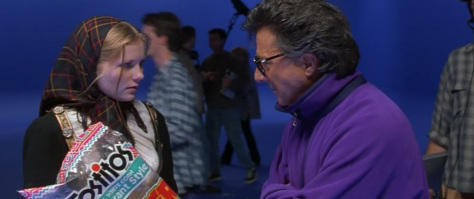
Stan now begins to concoct the story-line, supplementing Connie. He says that Albania has a suitcase nuclear bomb that they are trying to sneak into the United States through Canada, because the Albanian terrorists want to destroy our way of life. This story-line enlists patriotism. Stan then gathers people around him the way he does when he makes a movie. They call their production a pageant, which is a pretend spectacle. He recruits people, like Denis Leary’s Fad King, who helps with marketing war items so that the fake war can turn a profit. He enlists a country-western singer, Johnny Dean (Willie Nelson) to write a patriotic song that is produced like “We are the World.” There is a brief but telling shot which has Stan putting the president on hold as he tells his Cecil B. DeMille story. The point is the movie producer is running the show now, so the tail is wagging the dog. This idea is further demonstrated when Stan is filming the phony Albanian peasant girl escaping the Albanian terrorists. Stan wants her to appear to be carrying a calico cat, but the president wants a white feline. Stan’s response is “I hate when they start to meddle.” A man who produces make-believe stories is the boss now, turning the real political world into a fabrication. A bag of potato chips is digitally morphed into a cat, and a blue screen becomes an Albanian village. The state-of-the-art filmmaking process, if presented as reality, sabotages real life. Connie says, “It makes you glad to live this long” to see this kind of technology, a statement that combines an awe for scientific achievement undercut by the scary way it is being used in this story.

The people involved in this false production don’t care about the country’s democracy. They don’t even vote, except for the Oscars, says Stan, which shows how his business of creating illusion is more important to him than the actual well-being of the country he lives in. But the peasant girl, played by Kirsten Dunst, and anybody else in the production, can never say a word about their participation in the “pageant,” or else, Connie quietly threatens, people will come to their homes and kill them. It is a chilling moment when Connie threatens the actress, suggesting how easily a totalitarian state can come to exist.

Connie builds on the made-up story by wanting the president to land at an airport where it is raining. The president can then cover an Albanian girl and her relative, symbolically protecting them. The phony Albanians present a sheaf of a harvest based on some concocted version of a ceremony that Connie dreamed up that will show thanks to the president for protecting Albanians from terrorists. On the phone, Winifred asks if there is any way there can be rain at the American air base for the presidential landing. These people have so much power, they see themselves as god-like, believing they can alter the weather. This self-perception is encouraged by being around Stan, who as a filmmaker can manipulate the weather for a scene, and who tells Connie that he could have provided a rain-making machine, instead of diverting the plane to a city where there was wet weather.

Connie’s plans hit a snag when the CIA stop the car carrying him and Winifred. William H. Macy’s agent says that there is no war, there are no terrorist training camps in Albania, and no suitcase bomb exists, based on their intelligence gathering. Connie convinces him to let them go by giving a speech that predicts the type of war in which we are engaged today. He tells the CIA agent that if he doesn’t get with the program, then he isn’t doing his job, and will lose his employment. He tells him, “The war of the future is nuclear terrorism. It is and it will be against a small group of dissidents … and you can call this a ‘drill,’ or you can call it ‘job security,’ … And if there ain’t no war, then you, my friend, can go home and prematurely take up golf. Because there ain’t no war but ours.” Connie’s tail is wagging the heck out of this dog, claiming that no war takes place unless he says so. He can control the message through the media, which is the most dominant way to disseminate what he decides is the news. After his speech, Winnifred says Connie gave a “great performance,” which cements the idea that the political world and the show business world have become one.

But, Connie’s “agreement” with the CIA falls apart. The president’s electoral opponent says he talked with the CIA, and announces on network news that there is no war with Albania. A dejected Connie says the war is over, because he “saw it on television.” Whatever appears in the media is taken as truthful. However, Stan lives in a world of illusion, and can’t distinguish between fact or fiction. His producing powers, which have given him the control over life and death in films, makes him feel omnipotent. So, anytime things go wrong, he says, “This is nothing,” because he won’t allow himself to be subject to the limitations of actual life. He says that it is his war, and now it needs an “Act Two.” He sees life as a story, and he and the Fad King say that the tale of a war must have a hero. They invent a war hero who has been left behind enemy lines, like a discarded shoe, and who must be rescued. He needs a nickname, so they come up with “Old Shoe.” Connie gets Johnny Dean to come up with a ballad about loss and redemption, a favorite Hollywood plot. To add to the authenticity that the song was made a long time ago, and now remembered to fit the current situation, as opposed to appearing suspiciously produced recently, Connie says that the recording of the song should be scratchy. To show the extent of this conspiracy, they have it inserted into the Library of Congress, and one of Connie’s female aides sleeps with a journalist, so she can plant the idea of the old song matching the story. A video of the song shows a young girl crying as she listens to the words. Stan says they could have used fake tears, but the actress actually cried. This fact shows they have sold this falsehood so well, that the actors involved have deluded themselves, and accept the phoniness as real. Connie and Stan start to fling tied-together shoes onto electric wires as a sort of yellow-ribbon type of symbol symbolizing the hope for Old Shoe’s return. They can make money out of this activity by selling shoes and t-shirts, connecting the sales pitch to hero-worship. The Fad King says that they will say that Old Shoe ate little burgers in the field, and they will then sell these burgers at franchises, with the sales pitch that they are good to eat, “Behind enemy lines – or anywhere.” Fiction and politics produce profits in a capitalistic three-way.

Stand writes a speech for the president to deliver about the lost war hero. But, the chief executive doesn’t like it, calling it too corny. Stan meets with the president, sits at his desk in the oval office, and presents his speech to White House secretaries, who cry. The president is sold. When Stan sits in the White House in the president’s chair, it is a significant image because it shows how appearance, illusion, and fiction now control the country. Connie gets military records, and they come up with William Schumann (Woody Harrelson), his name being appropriate for someone being called “Old Shoe.” But, there is a mix-up, as the records accessed soldiers in “special prisons,” instead of “special programs.” The real Schumann is a far cry from the pretend one Stan invented. Harrelson’s sergeant is a psychotic inmate who raped a nun. The scene where they meet Schumann and put him onboard a plane flying to his supposed arrival back in the states becomes farcical, but is still very funny. Connie calls someone saying they are going to need a whole lot of Schumann’s medications. Schumann keeps saying he must get back to base so he can eat his “beans.” He randomly comes out with lines like, “I owned a Camaro,” and sings, “I like the night life/I love to boogie.” At times, he does not know how he arrived where he is. In a way, his out of touch with reality world presents the nightmare version of what happens when reality is altered, as is occurring deliberately here.

The plane crash-lands in a storm, and, luckily for the conspirators, the local rural owner of a gas station shoots and kills Schumann when the latter tries to sexually assault his daughter. There is a hero’s funeral for Schumann with the pretense that he sustained fatal injuries. Stan looks at the funeral from inside the airport terminal. He says, showing how reality and illusion are inseparable, that it is a complete fraud, “and it looks a hundred percent real. It’s the best work I’ve done in my life, because it’s so honest.” What a contradictory statement, because he associates exactitude in presenting a fiction for reality as being free from something fraudulent.

The jump in the president’s popularity is accurately attributed by one newscaster to the “spin” placed on events, not the actual events themselves. However, the media also attributes the president’s success to the “Why change horses in midstream?” campaign. This is too much for Stan, who previously expressed how producers don’t get enough credit for their work. Despite Connie’s pleadings, Stan leaves saying he is going to announce his part in the proceedings. Connie gives the nod to the security man, giving approval for Stan’s elimination. In this world, the manipulators of reality have power over life and death to protect the vision they project to the people.

Stan’s death is, of course, a lie, attributed to a heart attack. But then, he lived deeply in a life where illusion ruled. A news commentator says they are not sure of his age, since there are conflicting biographies. The film ends with a news report of violence in Albania. Is this real, or is the fraud continuing? Director Barry Levinson at the time of the making of the movie said that, because of technology, it is becoming difficult to tell the difference between real and fake news. Senior news journalist Tom Brokaw stated that we must realize that there is, as in other disciplines, a scale of reliable providers. We, using our objective reasoning skills, must assess the reputations of information providers, and believe those without resorting to bias.


The next film is Pressure Point