SPOILER ALERT! The plot of the movie will be discussed.
When I saw director David Lynch when he visited the Bryn
Mawr Film Institute he spoke of the days he lived in my hometown, Philadelphia.
He said the ugliness, the squalor there was sort of scary, disturbing. He also
implied that because of those seemingly negative qualities that the city was
wonderful. This impression may seem like a paradox, but for Lynch the darker
side of life, the underbelly of the human psyche, was what fascinated him as an
artist. It is similar to how the young boy in the movie American Beauty sees beauty in a dead bird or in paper trash
swirling in the wind. In Lynch’s films, such as Blue Velvet, which I have written about previously, and in the
television show Twin Peaks, the
bizarre, the threatening part of life coexists with what appears to be the
acceptable aspect of existence. But that “normal” world seems less real than
one would expect, almost phony, and certainly less interesting, to the artist,
and usually to the audience, than its counterpart.

In Mulholland Dr., which Lynch wrote as well as directed, he again
explores two different worlds, but here he is presenting two different stories in
one film with each one having his disturbing, surreal elements because they
spring from the main character’s personal experiences. To understand the
enigmatic narrative, we must first understand what is happening. Then, we can
delve into what Lynch may be trying to say through these stories. The best way
to analyze the movie is to see the much longer first part of the film as a
wish-fulfillment dream of the main character based on the short second part’s
real world experiences, many of which are told in flashback. However, this may
be too simplistic, which I will point out later.

The movie begins with a surreal
sequence of young people dancing to jitterbug music against a bright blue
background, as the figures and their shadows vary in size. It also foretells
the type of film which is being shot later in the story. Superimposed over
these images are shots of a smiling Betty (Naomi Watts). This unrealistic
opening suggests the stream-of-consciousness of a dream. We also get a quick
shot of someone in a bed with a pillow, which implies that we may be entering
someone’s dream state. The upbeat, although strange, start segues to a drive at
night with contrasting ominous music and the car light lit Mulholland Dr.
street sign. The car doing the lighting stops, and the dark-haired woman in the
back says that this is not where they should be stopping. At gunpoint, she is
told to get out by one man, and another opens the car door. Rowdy, recklessly
driven cars slam into the parked car, killing the men. The woman survives, and
staggers away. She sneaks into the apartment of a woman who is leaving on a
trip so she can sleep.


Betty lands at the Los Angeles
airport, and we learn that she is an aspiring actress. She is all bubbly and in
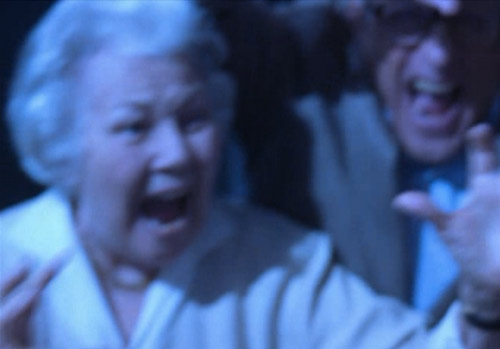
awe of being in LA. She met an elderly couple on the plane, and they hit it
off. They seem sweet and encouraging. But, as we see them drive away in a cab,
their smiles are grotesquely broad, and they bare too much teeth, which
suggests a bit of nightmare invading Betty’s happy dream-come-true of being in
LA. Coco (Anne Miller), who is the manager of the apartment complex where
Betty’s actress Aunt Ruth (Maya Bond) resides, escorts Betty to her aunt’s
home. The actress relative is on location shooting a film. The apartment is
where the dark-haired woman is crashing. Betty finds her naked in the shower,
which hints at their eventual sexual relationship. The woman has amnesia, so
she says her name is Rita (Laura Elena Harring) after seeing the poster of the
Rita Hayworth film Gilda hanging in
the apartment. Rita has a handbag that contains
a large sum of money and a triangular-shaped blue key.


At a Winkie's
restaurant, Dan (Patrick Fischler) tells Herb (Michael Cooke) about a
frightening dream (a dream within Betty’s dream which pretends to be reality?) he
has had involving a scary man living behind the dumpsters at the rear of this
particular restaurant. Here again, we have a nightmare in counterpoint to the
hopeful actress dream of Betty. Dan wants to look in the back so he can dispel
his fear by proving that the creature does not exist. When they go to
investigate, a shaggy-haired dark-skinned man with a long, pointed nose
appears. Dan collapses. But, Herb only acknowledges his concern for his friend.
Did he see the dark man, or was this a nightmare demon Dan hallucinates? At
another point, Betty says, “I’m in a dream place,” when speaking about LA. So,
the film often alerts the audience to the fact that what they are seeing may
not be real.

Director Adam
Kesher (Justin Theroux) has a meeting with studio big shots and gangster types,
the Castigliani brothers. One of them, played by the film’s composer Angelo
Badalamenti, spits out what to him is unacceptable espresso onto a napkin. The
brothers throw a head shot of an actress by the name of Camilla Rhodes (Melissa
George) at the studio men because she is the one that they want as the lead in
Kesher’s new movie. They keep saying, “This is the girl.” We see another bigger
shot (ironically played by dwarf-sized Michael J. Anderson) in a room with a
glass window who is the puppeteer pulling the studio strings. Kesher storms out
and smashes the Castigliani’s car windshield. He returns home and finds his
wife in bed with the pool guy, who says to him, “Just forget you even saw it.
It’s better that way.” This remark echoes what is happening to Rita, who may be
better off not knowing about the shady men who died at the car crash and the
money in the handbag. Kesher stays at a sleazy hotel. The manager tells him
that men showed up to say that Kesher’s credit cards can’t be used and he is
broke. He is told to meet a “cowboy” (Lafayette Montgomery) at a ranch, who
tells him that he has to pick Camilla for the role. Another unreal incident is
how did these men know where Kesher escaped to, since he only paid in cash for
the room?


In an unreal
coincidence, Betty and Rita go to the same Winkie’s as did Dan and Herb. Betty,
using the pay phone outside the restaurant, verifies that there was an accident
on Mulholland Dr. While being served coffee at the diner, Rita notices that the
waitress’ name is Diane, which reminds her that she knew a woman named Diane
Selwyn. We also have a scene where an inept hit-man, Joe (Mark Pellegrino)
kills a man for a black address book. Since they talk about a car accident, we
know that these men are associated with the criminals involved with Rita. This
impression is confirmed when Joe tells a prostitute to be on the lookout for
the missing brunette. When Betty and Rita call Diane Selwyn’s number, Rita
realizes it is not her, but she says she knows the voice. One of the neighbors
at the apartment complex, Louise Bonner (Lee Grant), is clairvoyant according
to Coco. Bonner says to Betty, “that’s not your name,” and advises her to get
rid of Rita. This scene fits in with the dream nature of this part, possibly
showing how the nightmare of reality is trying to intrude into Betty’s
wish-fulfillment dream state.

Betty’s aunt
set her up for an audition. She runs through the lines with Rita, and the two
laugh at the bad dialogue. Some of her lines include saying how she hates the
person she is talking to, and threatening to kill the other person in the
scene. She says these words to Rita, which is an omen of what will happen in
the second part of the movie. But, when Betty plays the scene at the studio,
she changes the feel of the scene, and delivers a steamy, completely
mesmerizing performance. The female casting director at the audition says that
the film for which she read will never happen and takes her to see Kesher, who
is auditioning women for his movie, The
Sylvia North Story. Betty must leave to go with Rita to find Diane Selwyn.
Camilla Rhodes auditions, and Kesher reluctantly repeats what he has been told
to say: “This is the girl.”

Betty and Rita
go the what they believe is Diane’s apartment. They see men lurking about the
area. They find the woman’s neighbor there, who tells them they switched apartments.
We get a sniff of subtext here from the neighbor’s hurt and angry attitude that
she and Diane may have been involved, which foreshadows the relationship
between Betty and Rita. Betty enters Diane’s place through an open window, and
lets Rita in. They find Diane’s decomposing corpse inside. Did the criminals
associated with Rita’s past kill her, and were waiting for Rita to show up?
Rita believes so, and goes back to Betty’s place to cut her hair. Betty
finishes cutting her hair, and gives Rita a short blonde wig. They stand next
to each other staring into a mirror. They look similar. It is interesting that
they later make love, as if Betty is trying to make Rita into her own image, and
may need to feel love for herself.


In
the middle of the night, Rita, in a dream, starts to speak Spanish, and calls
out the word, “Silencio.” She remembers a theater by that name and convinces
Betty to go with her to that place. It is here where this world becomes more
dream-like. The master of ceremonies there says everything at the theater is a
recording, an illusion, as musicians pretend to play music, and a woman appears
to be singing, but is not. At one point, the emcee disappears at the front of
the stage. Betty reaches into her bag and a blue box magically appears there.
We had the blue background of the opening, the blue key, and now this blue item,
the coincidences lending themselves to the surreal nature of this world. When
the women return to the apartment, Betty mysteriously disappears from the
bedroom, just as the emcee had done. Is she waking up, and thus exiting her
dream? Rita fits the triangular-shaped key into the box, and opens it. It seems
as if her reality is sucked into the box, which drops onto the floor of Aunt
Ruth’s bedroom, who is now there as if none of what preceded took place.
However, the woman heard the sound of the box dropping, but finds nothing when
she enters the room.

We then have
what seems like a transition between Betty’s dream and a waking state. We see
Diane’s bedroom with the corpse, but the image alternates with one of an alive
woman in the bed. There is a vision of the Cowboy who says it’s time to wake
up. Betty is now Diane Selwyn, in the apartment we saw in Betty’s dream. In the
first part, after Rita dons the blonde wig, Betty says to her, “You look like
someone else,” which shows the real world intruding in subliminally, telling
Betty that Rita is not who she seems. The neighbor we also saw in the first
part appears, collecting things from her former apartment, and she tells Diane
that two policemen had been around, looking for her. We see a normal-shaped
blue key sitting on the coffee table. Diane, even though awake, hallucinates
that Rita is in her apartment, but her name is Camilla Rhodes. So, we know how
that name showed up in her dream. But, then we see this Camilla half-naked on
the couch, and the similarly topless Diane practically forcing herself on her,
as Camilla tells her she must stop. The blue key is no longer on the table, so
what follows is a flashback from here until the very end which shows most of the
elements that appeared in the first part rearranged.

Camilla
and Diane are actresses, and they auditioned for Kesher’s movie, The Sylvia North Story, which was
Kesher’s film in the first part, too. The two women became lovers. However,
Camilla broke it off, which devastated Diane. Camilla became involved with
Kesher. Camilla invites Diane to a party, and has a car pick her up. The driver
stops where Rita did in the first part, and now it is Diane who says, “this is
not where we are supposed to stop,” the words Rita used. Camilla appears and
leads her up to the party. We see a man dressed like a cowboy, who turns into
the western fellow of the first part. We also see a person drinking coffee who
morphs into the espresso-sipping gangster brother in the dream. It is here
where she meets Coco, who is really Kesher’s mother. Diane, in answer to some
questions, states she had an aunt, who in this story died, and left her some
money. Diane also says she won a jitterbug contest, which explains why we have
young people doing that dance at the beginning of the dream. Kesher, talking
about his divorce, laughingly says his ex-wife got the pool guy, while the director
got the pool, which refers to the infidelity scene in the dream. Camilla then
humiliates Diane by kissing a girl who showed up in the dream as Camilla Rhodes
in the first part. It makes sense that in the dream she plays Camilla, the
woman who gets the part. It also allowed Betty in the dream to keep Camilla in
the form of Rita, but wipe her past clean with amnesia so Betty could help her,
make her dependent on her, and fall in love with her.

In the next
flashback, Diane meets with Joe, the hit-man, at Winkie’s, where she sees the
person she dreams as Dan. The waitress’ name here is Betty, which is the name
Diane uses for herself in the dream story of the first part. She is there to
hire Joe to kill Camilla. She, like the gangsters, presents a headshot of an
actress, in this case the real Camilla, and she, in this world, says the words,
“This is the girl.” Joe says confirmation of the hit will be signaled by the
appearance of the blue key he holds up in front of her. She asks what does it
open? Joe just laughs. Now, this world, too, becomes surreal. We see the scary
man behind the dumpsters, and he holds the blue box. It drops to his feet, as
the box dropped at the end of the dream to the floor. We see the old couple who
appeared as Betty’s flight friends, as tiny creatures scurrying away from the
box. Is Diane imagining this part, psychotically answering her own question
about the key? We are back in Diane’s apartment again, and the blue key is
again on the table, signaling the end of the flashbacks which supplied her
dream. We hear knocking at the door by the policemen possibly investigating
Camilla’s murder, the light of the police car flashing in the background. Is
this scene real, or more hallucinations on Diane’s part, brought on by
paranoia? She is possibly driven insane with guilt about the killing of Camilla.
She imagines the elderly couple, full-sized now, laughingly assaulting her. She
pulls out a gun and shoots herself. She is now dead on the bed, just the way
Diane was found in the dream. Did Diane as Betty foresee her own death?

So, is it that
straight second part-is the reality-first-part-is-the-dream the only way to
understand what happens? Perhaps. Maybe the scene in the second part which
shows the scary man with the box is not part of Diane’s story, since she
doesn’t really experience him, as she does the other parts that are the bases
for the dream of the first part. Maybe Lynch is referring to the demons that
lurk in all of our minds, not just in Diane’s suffering state. After Diane dies,
we, the audience, see a surreal smoky mist rising from the bed. If Diane is now
dead, and this is the “real” world, she cannot be experiencing this phenomena,
or imagining it. After her death, we, not Diane or Betty, go back to the
Silencio theater, which did not appear in the second part, the only suggestion
for its existence in part one is Kesher speaking Spanish at the party. We see a
glowing microphone stand, and the woman in the balcony we saw in the dream, who
instead of saying the end, utters the word, “Silencio.”

I think Lynch
is talking about the movie-making process. He has his main characters, and some
supporting ones, be in the acting profession. We see the Hollywood sign twice
in the film. We have auditions. Lynch may be satirizing the studios who try to
manipulate the artist’s vision when he deals with the movie executives caving
to disreputable interests, interfering with the director’s motion picture. At
that Bryn Mawr Film Institute visit, Lynch said his primary advice to new
filmmakers was to get final cut to protect their work. Movies spring from
imagination, and involve the imaginations of the audience. In the first
section, Betty, when suggesting they call the police to find out about the
possible accident, says to Rita, “We’ll pretend to be someone else,” which is
what actors do, and which we do as we are sucked into the movie’s world, much
as we are sucked into the blue box in this film. Of course, this imaginative pretending
to be someone else refers to how the two characters are different people in the
two stories. But, it also points to how a director can take the same actresses
and have them become different people depending on how you tell the story. Rita
taking the name of an actress emphasizes the way people reinvent themselves in
the dream world of film. Betty uses the same overwrought words of the script at
her audition, but through art, transforms them into something moving. At
Silencio, the emcee (the director?) tells the audience in the theater, and the
audience watching the movie (also in a theater), that what we are seeing is not
really happening in front of them. It is a recording, an illusion, of reality.
But, Betty and Rita, in a theater, as are we, are still moved by the woman’s
dubbed singing of the Spanish version of Roy Orbison’s “Crying,” as are we.
That emotional moment is reality for us.
“Rhodes” is Camilla’s last name
in the film. Mulholland Dr. is a road. When you take a ride with David Lynch
down a cinematic road, that trip takes many imaginative turns.
The next film is Invasion of the Body Snatchers.