Showing posts with label psychological study. Show all posts

Tuesday, December 14, 2021

The Station Agent

 SPOILER ALERT! The plot will be discussed.

 The Station Agent (2003) deals with some of society’s outsiders who come in different shapes, genders, and races, and how they struggle to make connections to each other and the world at large.

The film opens with Finbar McBride (Peter Dinklage) observing a train arriving at a city station. He pulls out a pocket watch that looks like the kind used by train conductors in the past. The image immediately tells us how he is linked to trains. He is a dwarf, and IMDb notes that St. Finbar was a religious hermit born in the sixth century. He founded a monastery which, ironically, attracted many people and the place became the Irish City of Cork. Fin’s name implies that he, too, wishes to be left alone, but may not be able to escape into a fortress of solitude. At this point, his attachment to trains may show how he would like to settle down in one secure place but must keep moving to find sanctuary.

Fin works at a train shop in New Jersey owned by Henry Styles (Paul Benjamin). It is called The Golden Spike, which refers to the spot where different railroad companies joined their tracks together. It suggests connection. But, at this point, Fin is quite a loner. One can understand why he wants to avoid people since as he walks on the street boys ask him if he knows Snow White, and when he shops at the supermarket, people stare at him and giggle.

Henry and Fin plan on going to a screening of a home movie made on a train trip, but their expectations are not great, and they are right since it is a boring presentation. There are several train enthusiasts attending, but there is no conversation between them, so the impression is that they are content in their oddness which brings them together, but not in a personal way.

In a quick foreshadowing, one of the miniature figures that Finn is painting at the train store topples over, and Henry immediately collapses in the shop and dies. Could the tiny figure represent the upheaval that the diminutive Fin will encounter? Fin meets with Henry’s attorney, Louis Tuboni (Richard Kind), who says in six weeks the shop and its contents will be sold according to Henry’s will. He left some property to Fin, which turns out to be a train depot in a remote part of the state, where according to Tuboni, “there’s nothing.” That may actually seem like an attractive prospect for the socially shunning Fin. The town is called Newfoundland, and the name can indicate a “new” start for Fin.

Like a solitary hobo, he walks along tracks as train cars go by. He reaches the station and looks outside which confirms its remoteness. However, the next morning he is awakened by a man setting up his food truck with the name “Gorgeous Frank’s ” written on it right next to the building. The owner is Joe Oramas (Bonny Cannavale), who is just the opposite of Fin. Joe is a very gregarious fellow who wants to engage Fin in conversation that Fin does not want to be part of. Joe says it’s his father’s truck, who is sick, and Joe has been taking care of business for the past six weeks in the meantime. From Manhattan, Joe is out of his element and he craves some companionship. The only way that Joe even knows that Fin lives right there is when the newcomer takes the mailbox and places it on the porch of the depot so can have access to it. The shot implies that the world as a whole is out of reach for Fin.

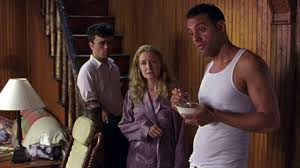
Fin is almost run over by Olivia Harris (Patricia Clarkson), who spilled coffee on herself and drove erratically as a result. It seems Fin can only meet people by accident. She offers to give him a ride but as usual he refuses. He offers Joe little information as to why he is dirty and refuses to go with him for a beer. He doesn’t like bars most likely because of receiving ridicule, but will not even drink with Joe alone or take a walk with him, so used is he to feeling safe when by himself. Finn stays where he thinks he feels safe from others as he walks along the railroad tracks. However, he attracts another well-meaning person, Cleo (Raven Goodwin), a young African American girl who follows him. He stops and just says “Hi” to her and she runs off. She is a bit of an outsider herself, and maybe she sensed a connection with Fin because his height matches her own.

There is a knock at the station which is disturbing to the hermit-like Fin, and it is Olivia bringing a bottle of bourbon as a housewarming/apology gift. She sees Fin smoking and she says that she slept with a guy when she was nineteen because he rolled his own cigarettes. It is an awkward statement, injecting a sexual element here. Fin doesn’t have a phone, adding to his desire to be off the social grid, and Olivia likes that, as she admits she has two phones and never answers them. She notes that her former husband gave her one of the phones, and her marital situation indicates she is also not in a connected place in her life. She is physically awkward as she knocks over a ticket box, symbolizing her unstable situation. She admits to losing her son two years prior, so we understand why she is in an emotional limbo. After revealing this fact, she wants isolation also, and tells Fin not to look at her.

She falls asleep on Fin’s couch and Fin slept in the bathtub, giving both of them their privacy. When she wakes, she feels embarrassed that she stayed overnight and runs out. Joe has met her before and suggestively jokes that she must have missed her train the prior night. Joe issues another unwanted knock on Fin’s door, gives him some coffee, and assaults him with unwanted questions about Olivia’s sleepover. He vicariously wants a connection to Olivia, and he so craves human contact, unlike Fin, that he makes Fin promise him that if he and Olivia do something later, he wants to join them. Olivia left her phone there which begins to ring. Fin finds out her address from Joe, and drops off the phone without even trying to talk with Olivia, despite having made her acquaintance. Meanwhile, Olivia is at her place painting, which also designates her as an artistic outsider, expressing herself on the canvas instead of to people. When she gets calls from her husband, she ignores them. A woman stops by and Olivia escapes, saying she has to go out. She is as evasive as Fin. They both wind up at the library, but Fin doesn’t have a library card yet. The library worker, Emily (Michelle Williams) doesn’t see his small-scale approach and is startled, dropping books on the floor, another example of how he doesn’t fit in with the expectations of others. Later, Olivia, who somehow feels safe around Fin, possibly because he is so unobtrusive, checks out the book for him and, according to Joe, leaves it at his doorstep, an attempt to make up for her overextended visit.

Cleo finally has a minimal conversation with Fin, who she innocently thinks, because of his size, might still be going to school. She does then ask if he’s a “midget” to which he responds, “no.” Much of his dialogue at the beginning consists of “yes” or “no” answers reflecting his desire to limit engaging with anyone. Some young men visit Joe’s truck and when they see Fin come out of the station, they make derogatory comments. Joe shuts them down and looks at them with disdain, which shows he is above their prejudicial way of thinking.

Olivia drives past Fin who is sitting near a pond reading. When she gets coffee at Joe’s, he finds out that she passed Fin. Joe asks for a ride to see Fin. While they ride together, she gives monosyllabic responses, mimicking Fin, which shows how she is like him in her social aversion. She does not want to join them, so Joe approaches Fin by himself and finds out that Fin is train watching. However, one goes by with very few cars about ninety minutes apart. Joe, who is starving for something to do, is no satisfied with the activity. They run into Olivia coming out of a store and Joe gets the other two to join him at his truck for dinner. Fin and Olivia seem uncomfortable with the arrangement as Joe tries to morph them into his version of the Three Musketeers. It’s funny when Joe asks Fin if people like him have clubs. Probably the first thing that comes into our minds, and also in Fin’s, is that Joe is making a prejudicial remark about Fin’s height. But Joe follows it with that he means people who love trains. Unfortunately, Joe, the glue holding these three together, must leave to take care of his ailing father. Olivia gets Fin’s lack of desire for social interaction and says she is “cool” with them just eating and not talking.

Joe now becomes Fin’s walking companion as they hike along the tracks and go to the pond to watch trains. The outgoing Joe narrates as he flings stones into the water to pass the time. He engages Fin by asking about the best train routes. Olivia drops off a camera at Fin’s because he admitted he can’t be a train chaser since he doesn’t drive and has no way to photograph the vehicles. Olivia meets Cleo who is pretending she is a conductor on one of the abandoned trains there. The young girl has a track spike collection, so she, too, is drawn to the world of trains, possibly suggesting her inner desire to hit the road and escape her solitary world.

Joe, the urban outsider in this rural area, continues to try to cement the connection with Olivia and Fin. They walk the “right of way,” which Fin explains comes from the government acquiring land to develop railroad passage. Joe, though tall, is the one who is like a child looking for something to do, quite the opposite of the other two, who retreat into their passions, trains and painting. Joe even wants to just play soccer with some kids who show up at his stand, accepting anything that will keep him occupied. Olivia comments to Fin that Joe, “does enjoy life,” which can’t be said for her and Fin at this point. That feeling overwhelms Olivia and she leaves to be alone.

Joe drives his truck and Fin uses the camera that Olivia brought him so they can indulge in some train chasing. Fin actually appears happy for the first time. Joe invites both of them to Olivia’s house so they can screen their film. Olivia is running late and is draped only in a towel when she lets them in, which again adds a sexual note to the encounter. It is the first time the two men see Olivia’s paintings, which startles Joe. As Joe cooks a meal, Fin and Olivia dip their feet in an adjacent pond, and Olivia says she is not used to having a loud person, such as Joe, in her house, again attesting to her state of solitude. She says that the house was a “getaway” place, and she really used to get away, because she couldn’t stand being in her former community where she was the “poor woman whose son died.” We now know why Olivia has withdrawn from the world, and she feels the pain of her loss and dislikes feeling pitied. But Fin gives us little of his backstory. When Olivia asks why he moved there, he jokingly says to be near Joe.

After they enjoy the meal and film together, Fin does admit when asked by Olivia that he was in love once, but he was young and angry, most likely due to harassment, which probably ruined the relationship. He is amazed how people single him out just because of his height even though he is just a regular “boring” person. He asks if she is still in love with her ex-husband, David (John Slattery), and she says yes. Was he fishing to see if he had a chance with her? Joe is passed out and Olivia insists that they stay over. There is a photograph of Olivia’s son next to the bed where Fin is, and he comments that he looked like a happy kid. Moved by Fin’s statement, she gives Fin a goodnight kiss on the lips. Unfortunately, David decides to show up the next morning to find Fin coming down from upstairs and Joe eating cereal. Olivia asks her two houseguests to step outside as Olivia and David argue over the presence of the other two men and the fact that Olivia will not answer David’s phone calls. Olivia is seeking solace from the loss of her son, but David’s appearance invades her emotional and physical escape.

Cleo doesn’t understand Fin’s desire to be left alone and wants him to talk about trains at her school. She is quite angry with him when he says he can’t appear. From her innocent viewpoint, which is the unbiased position the film seems to think we should aspire to, there is no logical reason why he should have to feel inhibited. Meanwhile, Olivia doesn’t show up for her daily coffee at Joe’s truck, not feeling social, and she takes some pills to cope after David’s intrusion. Joe has tried to adapt to being quiet and read along with Fin, just to share his company. But, he does attempt to obtain more personal history from him. Fin admits that he has had sex with a full-sized woman, but not with a person his own size. When Joe presses, Fin cuts him off, most likely not feeling comfortable as to why he should have to talk about how his life is different.

Now that he has verified his address, Fin is able to get his own library card. When he sees Emily again, she says he has a nice chin. It is an intriguing statement and Fin shares the observation with Joe, which shows how these two are becoming buddies. Olivia drives right past Fin and Joe, which shows how the encounter with her husband has made her withdraw into herself. Fin is at the grocery store when Olivia calls in an order as she is probably not willing to even to shop. Fin says he will deliver the items as he most likely wants to know how she is doing. But she has no interest in seeing him and is cold as she pays him for the groceries and immediately closes the door. Fin’s hurt is mirrored in his face as he probably feels that he thought he was getting close to someone who has now rejected him.

Fin told the surprised Joe that he would go with him and his dad to the local bar he was not previously willing to visit. But he is carrying this immediate hurt concerning Olivia there with him. Emily is waiting for her loser boyfriend Chris (Jayce Bartok) who is standing her up. He calls and she is distraught. She confides in Fin, telling him that she is pregnant. She was abrupt with Chris who drives over and pushes Emily around for telling him to get lost. Fin tries to keep Chris away from Emily and then he slams Fin into a car. Emily tells Fin to leave to protect him. Fin looks disgusted since it seems when he tries to connect with someone all he gets is grief. He slams the door closed to his station in anger.

Trains roar past his new home seemingly reminding him of how life is passing him by while he is stationed, as it were, in his predicament. The next day Joe comes by to apologize that he didn’t show up at the bar because his father was not feeling well. Fin is now angry at all the disappointment he has suffered by engaging with others and bluntly tells Joe that he wants to be left alone, which is the only way he feels emotionally safe. He wanders to the bench to watch trains go by and there is a shot there of a father showing his two young sons how to fish. The inclusion of this image sharpens the contrast between those that lead fulfilling average family lives and the outcast world of Fin. Meanwhile, Olivia’s husband continues to just reach her phone machine, as Olivia is absent even from the camera shot to stress her isolation.

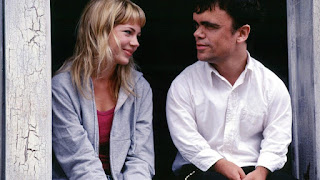
At night Emily visits Fin and apologizes for what happened with her boyfriend. She is on the outs with society, too, right now, as she relates how her family is in an uproar about her being pregnant. She was going to move in with Chris, but probably realizes what a jerk he is. So, she is feeling homeless. In their conversation, Fin says that long ago the station agent would deliver mail and even give haircuts. It is interesting that Fin lives in a place once occupied by a person who was so much a part of the community. Perhaps the building’s abandonment is a reflection on the current disconnected society. Fin says he’s retired now and when she questions why since he is not that old, he says that dwarves retire early. Emily is funny when she comments, “Yea, lazy dwarves.” They then share a passionate kiss, and she asks if she could just sleep there that night. They share the couch with their heads at opposite ends. There is intimacy without the two being physically intimate. She leaves the next day after the usually remote Fin gave her sanctuary for an evening.

Fin starts to sit outside Olivia’s house each day, smoking cigarettes and eating his lunch. He wants to monitor her without intruding, but it does come off as a bit of a stalking maneuver. One time she is on the phone having an angry conversation with her ex-husband. Fin approaches her on her porch to try to offer comfort, but it is bad timing since she is furious. She yells at him, saying she is neither his girlfriend nor his mother and he must leave. He goes to the crowded local bar and gets drunk as he sees those there, including Emily’s boyfriend, stare at him and smile, as if making jokes about him. He explodes, breaking shot glasses with his sweeping arm. He shouts, “Here I am! Take a look. Take a look!” Joe, Olivia, Emily, and Cleo invaded his solitude, and he can’t hide by blending into the background at the bar. He feels as if he can’t escape notice which brings along with it hurt feelings. So, he changes from being a covert center of attention to an overt one.

He stumbles back toward the station on the tracks, the objects that gives him direction. But he is intoxicated and he falls. He sees the light of a train coming at him and he smiles, as if wanting death to free him from his emotional torture. But, it was just an alcohol-induced dream. He wakes up on the tracks. However, his pocket watch was smashed. Could it mean he is ready to move on away from his restrictive past?

He visits Olivia’s house again. She is on the floor and a bottle of pills is next to her. She has fallen, literally and figuratively, just like Fin, by taking a supposedly pain-killing substance. So, what is happening to them bonds them together. She says that David is having a baby in his new relationship, which obviously is horrible for Olivia, as she sees him as replacing loss with hope, which she is not capable of doing in her life. She falls crying into Fin’s arms, and now he is there at the right time to offer her comfort. The next scene has Fin sitting in a waiting room as a doctor talks to Olivia. The implication is that he helped her seek counseling.

Finn, after successfully aiding Olivia, now reaches out to Joe and they greet a smiling Olivia as she is discharged from the hospital and they take her home. Fin and Olivia spend time together in a serene shot near the calming pond. Fin, no longer trying to hide, goes to Cleo’s classroom to talk about trains. He tells the students that the first train was called the “Tom Thumb,” which links him to his passion based on the size reference. The film is not about to say everything will be okay, since one boy makes fun of Fin’s height, and the teacher pulls him out of the class.

The story ends with a relaxing and humorous night scene on Olivia’s porch where Joe has made dinner for her, Fin, and himself. Joe says there is plenty of food left over for the next day. Olivia smiles at him, as his words point to the ongoing friendship between the three. A child in the class asked about another mode of transportation, blimps. Fin asks Olivia and Joe if they know when blimps were invented. Joe says Fin can go to the library and ask Emily. Joe talks about a librarian fantasy, where she loses her glasses and books fly everywhere. Fin says Emily doesn’t have glasses. Olivia tells him, “Well, buy her some, it’s worth it.” Trains have now become a symbol for bringing people together.

The next film is Pickpocket.

Sunday, March 17, 2019

Saving Mr. Banks


SPOILER ALERT! The plot will be discussed.

One might not think a story about the creator of Mary Poppins would be an appropriate subject for a film analysis. But you would be denying yourself a rewarding experience since Saving Mr. Banks presents an interesting psychological study of a woman who was torn between redemptive fantasy and unsentimental practical reality, and who used fiction and eventually a connection with Walt Disney to reconcile these opposing forces.

The movie takes many liberties with what actually happened. The author of the Mary Poppins books never did like the movie version much, Walt Disney didn’t take her on a tour of Disneyland, and he didn’t visit her in London. But what matters is the way the story portrays character and theme, since the film is an adaptation of the truth, and comments on the nature of art, as the last post on The Pianist noted how that movie used music to comment on the creative process.
 The film begins with a shot of the clouds, and the transitions between scenes later also inhabit the sky, as flying becomes a metaphor for escape into an imaginative world not anchored by unhappy realities on earth. As the music from the Oscar- winning song from Mary Poppins, Chim Chim Cheree, plays, we hear the haunting words that open that film, here spoken by an unseen Travers Goff (Colin Farrell), father of future writer P. L. Travers (Emma Thompson, in a role that should have been nominated for a Best Actress Oscar). He speaks them quietly: “Winds in the east/ Mist coming in/ Like something is brewing/ About to begin/ Can’t put me finger/ On what lies in store/ But I feel what’s to happen/ All happened before.” By the end of the film these words are repeated after they take on more meaning, as we shall see. As a child, Travers’s real name is Helen, but her father called her Ginty (Annie Rose Buckley), who we see as a young child looking up at the sky. There is a cut to the adult Pamela Travers looking up as did her younger self, remembering her early life. It’s 1961 there is a family picture close to her which includes a shot of the father. The flashbacks throughout the movie demonstrate how Travers is consumed by the past, and the scenes showing her childhood become less separated from the current time period as her life story, the story of Mary Poppins, and the movie to be made of her creation are so intertwined.


Diarmuid Russell (Ronan Vibert), Travers’s literary agent, shows up at her London townhouse. She notes looking out her window that a cherry blossom looks like a pink cloud on a stick. The observation shows how she transforms reality through subjective perception, which is what a fictional writer does. He thinks they were going to a business meeting, but she canceled. He says that she has no more money (the need for such dragged her father’s life into alcoholism, as is later shown) since royalties have dried up and she refuses to write more books. She is very formal, saying not to call her “Pamela,” but instead prefers, “Mrs. Travers.” She dismisses the idea that they are friends, despite their long relationship, showing her rather cold personality. Her anti-socialism and stern disposition create her psychological armor which protects her from a world she sees as a danger to her emotions. There have been overtures for twenty years to make a film based on her character of Mary Poppins, and now Walt Disney has given her script approval and an assurance of no animation. She does become emotional because she is protective of Mary. She decides to go for a two week stay to assess the circumstances of making a movie before signing over the rights.

She says something about wanting to keep her house, which has nothing to do with the present. But it does to the past as there is a cut to her childhood as Ginty makes a tiny house out of flowers, which again stresses the idea of imaginative play. Her father comes over and plays with her, pretending to be looking for the Royal Princess Ginty McFeatherfluffy. The name sounds like a comical fairy tale character that he has created (the emphasis is on make-believe and invention). Even the name sounds like something that flies above the earth, which ties in with the shots of the sky and possibly the idea of flying to freedom. He says he promises to never lose her, a point that is taken up later in connection with writing.

Travers is difficult with others, not having exited the comfort zone of her London life in quite a while. She is on the plane and complains that there is not enough room for her bag which she insists must be above her seat. The woman who volunteers to move her own bag to accommodate Travers is even treated harshly when Travers asks her if her child will be a “nuisance” on an eleven-hour flight. This crankiness comes from a woman who wrote children’s stories, thus showing the duality in her personality. As the plane is ready to leave, she says to herself, “I hope we crash,” so pessimistic is she about this trip. (She doesn't appear to relish being in an airplane, so negativity about flying in real life contrasts with her inner desire to soar above the mundane world which is shown by endowing Mary Poppins with the ability to use her umbrella to fly).


In a scene from the past, the Goff family in 1906 Australia is leaving what used to be their house with its staff (maybe that is also why Travers said she wants to keep her house, because she didn’t like being uprooted as a child) for a new job in a new place. For Ginty it at first seems like an adventure since her dad has them playfully marching to the train station. The mother, Margaret (Ruth Wilson), seems sad about leaving the more prominent area for a faraway place. But then even Ginty seems unhappy as she looks out the back of the train as it moves away from her previous home. As the camera pulls back, we see a shot of the father taking a swig from a whiskey bottle, the first sign of the self-destructive way he escapes the harshness of reality.
 The smoke from the train turns into clouds in the sky as the plane carrying Travers flies through them. She lands in Los Angeles and Ralph (Paul Giamatti), whose name we don’t learn until much later, is there to drive her. He says, “the sun came out just to say hello to you.” Her no-nonsense response is “Don’t be preposterous.” When she asks what the city smells like he says “jasmine,” but she says, “chlorine and sweat.” His fanciful ways subconsciously remind her of her father and the sadness of losing him, which she wants to suppress. As they drive she has a look on her face that implies she continues to not like the smell of her surroundings. In the back of the limo alcohol decanters clink, and she says “absurd,” which possibly is also a negative reaction due to her alcoholic father. She then shuts the sliding panel between herself and Ralph so she won’t hear his conversation as she tries to maintain her isolation from others who she feels inflict on her a cheerful perspective on life.

Her hotel room is full of Disney merchandise, such as stuffed animals and balloons. Again, these representations of fantasy are upsetting to her down-to-earth protective facade. She sees a fruit basket and immediately says “no pears,” throwing them out into the swimming pool. There is a flashback as they approach the new family home which is a run-down rural house that the father calls “a palace” and an old horse a “mighty steed.” He tells his wary wife that they will “make beautiful memories here, my angel.” His use of “beautiful” and “angel” (someone who flies in the clouds?) show what one might say is optimism, but his continuous pretending demonstrates living in denial about reality, and can seem irresponsible and reckless in an adult. Back in 1961 Travers puts on the TV and sees Walt Disney (Tom Hanks) doing a bit with Tinkerbell (an imaginary creature that flies) and fairy dust making him fly (again a reference about escaping off of the earth). Travers turns off the TV saying that is how she deals with Walt’s fantastic ideas, refusing to expose herself to flights of fancy.

When Ralph picks her up and says the sun is shining again, she says she would rather be given credit for bringing the rain, which she argues is not sad because it brings life. He counters with “so does the sun.” She tells him to be quiet. She won’t allow for the fact that rain comes from gray skies and keeps people inside, and the sun allows one to be outdoors and engage in the world in warmth and light. She has become so glum that she doesn’t allow for positive feelings in her real (as opposed to literary) life anymore.


She is met at Disney Studios by Don DaGradi (Bradley Whitford) the movie’s writer, whom she discourages by saying she might not sign off on a script. There is also Richard (Jason Schwartzman) and Robert Sherman (B. J. Novack) who are writing the movie’s music and lyrics. Her attitude is very negative as she says that her story does not lend itself to musical “chirping and prancing.” She refuses to take a tour of the studio to show off its assets, saying, “nobody likes a show-off.” Her comment again stresses her reactionary attitude to performing, which is what epitomized her father. Indeed, movies themselves, being showy spectacles, are antithetical to her restrained character.

She keeps calling him “Mr. Disney,” but DaGradi and Disney say to call him “Walt” because they are all on a first name basis there. Their informal, trusting attitude is counter to her reserved, protective stance. Disney says that many years ago his two daughters read her books and were delighted. He said a father can’t break a promise to his children, which is why he has been persistent in trying to get the rights to her books to make a movie. His desire to keep a vow to his children is also suspicious to her, since for now she feels that her father did not keep his, as was noted earlier, when he said he would never be separated from her. Indeed, Disney’s bringing to visual and auditory life a world of escapist imagination is what she has run away from in her real life. But, Disney is actually the perfect person for her to deal with since he has merged the two worlds by being a practical businessman who makes his living in the fanciful, as she has done, at least in the past, with her writings.


Travers argues that Mary Poppins does not sing, but instead does recitations. She is “not a giddy woman. She doesn’t jig about.” Travers says singing is “frivolous,” and is “wholly unnecessary in a governess.” Disney and his team want to accentuate the fun of being a child and finding the child inside of adults, but she lost that sense of childhood enjoyment in her life because of how the harshness of life destroyed her child-like father. She says to Disney that she doesn’t want Mary turned into “one of your silly cartoons.” This statement, although honest, is rather insulting. He promises that the film will not be animated, and he hopes to win her over to his view of the movie. To her, Mary Poppins and the Banks are “family,” and she is worried about allowing anyone to interfere with those she has invented that gives her comfort which her real family was not able to sustain. On the way out of his office he says let’s make something “wonderful,” and she questions if that’s possible outside of her own closely held fictional world.
With her mouth in its perpetually turned down expression, Travers complains to DaGradi and the Shermans that all of the pastries brought to the script room express unnecessary “jollification.” Kids love sweets but in her life she is not in a childlike state of mind. She calls it “vulgar,” and says the amount of food could save a starving nation. She is funny in her insults. When they say the character of Bert will be played by Dick Van Dyke because he is one of the “greats,” she says actors Olivier, Burton, and Guinness fit under that category, not a song-and-dance man like Van Dyke, which stresses her reverence for the “serious” artist.
They start singing along to the “Chim Chim Cheree” song which uses the made-up word “responstible” to rhyme with “constable.” She says comically “unmake it up.” Travers is upset by the song “Supercalifragilisticexpialidocious,” because, again, it is a fabricated word. In a flashback, her father pretends that a chicken is a magically transformed aunt. He says she is their mother’s “horrendiferous sister.” Her father would use made-up words, and so we understand her current antagonism to the Shermans’ invented vocabulary as it conjures up the painful memory of her lost, playful father. In another flashback which emphasizes transformation, the father rides up on the family “steed,” and tells Ginty that the horse is really a secret Uncle Albert. He says that a witch turned him into a nag because she hated the sound of his laugh. He says Albert can only be fixed by teaching “the witch to be happy again.” This statement could be the theme of the movie, because it refers to what must happen to Travers to move forward.
In the limo, Ralph’s statement that “a leisurely stroll is a gift,” is a response to Travers’s complaint that she sees nobody walking in LA. She seems impressed by his poetic observation, which shows a warming up of her attitude toward him. When he says the ride through the panoramic view of the hillside is beautiful, she says dismissively, “If you like that sort of thing.” We then see a flashback of her riding with her dad on the horse through a field of wildflowers. She has these memories which should be happy ones but instead give her pain because of their association with what she has lost.

At the studio, she is upset that the drawing of the Banks house looks too “grand,” and that they are normal, everyday people. They have changed Mrs. Banks into a suffragette, but DaGradi and the Shermans wonder why would she be leaving the children so much if she doesn’t have something to do. Travers defends Mrs. Banks, probably feeling like she is protecting the memory of her own mother. She also complains that Mr. Banks has a mustache which is what Disney wanted (as we learn later, Disney has his own father issues, and his dad wore a mustache). Her story is very personal so even the facial hair matters. There is a flashback that has her father, looking in a mirror, shaving to allow for “silky” kisses for his daughter. Even though it is many years later, his saying “swish” when shaving makes her say the same word when Travers cleans the bathroom mirror.

There is a memory of Ginty’s father leaving work because he wanted to play with his girls. He tries to appease his wife by saying he would make up the work hours later. He offers his wife a pear, and this scene (and later, one other) shows why Travers can’t tolerate the reminder of that fruit in her adult life. While they play, Margaret pulls a bottle of whiskey out of his coat pocket which shows how he is skipping work and escaping his grown-up responsibilities with alcohol consumption. When he and his wife are together she asks if her sister, Ellie, (who is the “horrendiferous sister” in his story, and who represents a fixer of problems) should visit to help out. But he is very much against it, saying he will “endure” the job at the bank. This real-life experience, of course, finds its way into the Mary Poppins story, and explains why the last name of the father in Travers’s fiction is “Banks.”

Back in 1961, Travers complains that the songs of the Shermans have lyrics that are too “giddy and carefree,” just like Disney’s theme park. After singing, “Just a spoonful of sugar helps the medicine go down,” the Shermans argue that the way the music goes up on the word “down” makes its sound ironic, unexpected, like Mary herself, who goes up the staircase, and reflects how Mary is magical while acting practical, which of course reconciles those two worlds. Travers says that the lyrics are simplifying life, “encouraging children to face the world unarmed.” She says that Mary Poppins is the enemy of whimsy and sentimentality. Travers argues that Mary is “truthful.” As to the children, Travers says that Mary doesn’t sugarcoat “the darkness in the world … She prepares them for it.” Travers says that a room doesn’t magically clean itself. She argues that one must be responsible for doing tasks that will prepare oneself for the future. She felt her father prevented her from dealing with the grim side of life by providing her with his fantasy world. She throws the script out the window to symbolize that it has no weight, no “gravitas.” Disney counters by questioning how she can criticize the use of “whimsy,” when she invented a woman “who sent a flying nanny with a talking umbrella to save the children.” Travers asks if he really thinks that Mary is there to save the children. She walks out because they have missed the point, which, of course, is implied by the title of the movie.
A flashback shows Ginty’s father in a drunken rant at the bank where he works. Ginty witnesses this scene as the boss fires him. She asks if he has lost his job, “again.” That last word shows that she knows of his failures, but has been going along with his fantasies to cover them up. The boss, with the child present, reconsiders and says that he won’t fire him. But he tells the father that he should act responsibly for his daughter’s sake. In a field, an open setting suggesting freedom as opposed to the enclosed walls of the bank, he tells Ginty that this world is “just an illusion.” For him, living in the realm of imagination is the way to truly inhabit one’s soul. He says that if they hold onto that belief, “they can’t break us,” and can’t “make us endure their reality. Bleak and bloody as it is.” He goes on to say that “money, money, money,” when it becomes so important, “it’ll bite you on the bottom.” He is a tragic figure, who has an idealist’s outlook that is crushed by a mercenary world. He says his statement while taking a drink and she has ice cream, contrasting his adult destructive denial of grown-up life with a sugar escape that is innocent and appropriate for a child.

Back in LA, Travers says on the phone to her agent that her subconscious might be targeting her, giving her odd dreams, for wanting to consider giving Mary up. She accurately describes what is happening to her, although she may not be completely aware of its deeper implications, when she says, “I’m at war with myself.” She repeats her father’s words to her about the evils of money, which she feels drove her to this place. So, she is of two minds concerning the fanciful and the practical when it comes to what she feels about her father. There is a bit of a turning point here, as she grabs the large Mickey Mouse doll and hugs it in bed, like a child, seeking an imaginary friend to help protect her from the scary things in life. So, contrary to her earlier argument, sometimes “whimsy” is life-enabling for a child, and the child inside of the grown-up. After hours, in the script room, Disney visits Richard Sherman, still at the piano, as Robert sleeps on a couch. Disney says he understands what Travers is going through. He couldn’t give up Mickey when he was starting out. To him, just like for her, a person’s creations are one’s family.

Back in Australia, Ginty pretends to be a hen laying eggs. Her father thinks it’s marvelous and says he can see her sprouting feathers, so strong is his imaginary powers. Margaret, calling her by her real name, Helen, tells her to set the dinner table, and he yells at his wife when she repeats the order, because he doesn’t want his daughter’s imagination thwarted. He tells her never to stop dreaming, and that she “can be anyone you want to be.” He’s telling her that her imagination will give her the power to lift herself over entrenched obstacles. She says she wants to be just like him, but he wisely warns her not to be. He realizes that he has not been able to find a way to balance the world of the child and the one of the adult inside of himself. He goes into his bed, cries, and gulps alcohol.


As the Shermans sing the song in the bank that satirizes the saving of “tuppence,” Travers reminisces about a day at a fair where her father, who is the bank manager, is supposed to give a speech. Ginty looks for him, and finds him drinking in a tent. The memories interlace with the singing in the script room as the two worlds blend together. Her father looks sweaty, slurring his speech, coughing, displaying exaggerated speech. As he talks about the importance of the bank, the singing sarcastically deals with the same topic. The father brings Ginty up on the stage, says she has a bank account, and mistakenly says the crowd should give her “a drink” for being so practical. His words undermine the practicality of what he is supposed to be advocating. He then says, embarrassingly, that he must “relieve” himself, and falls off the stage, showing his daughter how his defiance of the “bleak and bloody” world has not allowed him to “endure their reality.”
Travers is upset about how they are depicting Mr. Banks as being too cruel, as she now begins to feel disturbed by how she has exiled her own father from her life. She talks with Ralph outside and he reveals that he has a daughter in a wheelchair, and that is why he cares about the weather being sunny, so that she can be outside. She sees how her driver was dealing with, not escaping from, a terrible reality by trying to be positive. She is feeling guilty because of how she dealt with her father as he experienced liver failure due to his alcoholism. In a flashback, he asks Ginty to find him some alcohol, which she discovers. Later Ginty’s mother goes to her and says that she knows that her daughter gave the liquor to her father, enabling his self-destructive way of dealing with life. Her mother tells her to look after her sisters and walks away in her nightgown and goes into the river. Ginty follows her on the horse and goes into the river, stopping her from committing suicide. In this memory we see how she was able to save at least one parent by dealing with the reality of the situation, not running away from it. These incidents may be why she moved away from trying to live like her father in life, but kept his spirit alive in her writings.
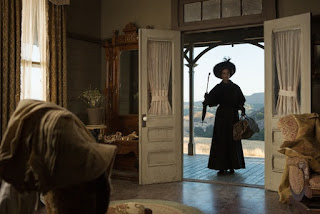
As Ginty tends to her father, she says “winds from the east” which she later uses as the clue that Mary Poppins is arriving in her story. In real life, it is code for the arrival of Aunt Ellie, Margaret’s sister, who becomes the prototype for Mary Poppins. She has the umbrella with the parrot head, which talks in the story. She says that she will fix everything. She even has the carpetbag, which is the basis for the bottomless bag in the story, from which she pulls out numerous treatments and a pineapple. Even the line in the story about closing “your mouth, we are not a codfish,” is uttered by her. Ellie says, “spit spot,” too, like Mary, so she is strict, but with a bit of a smile and playfulness. As the mother and girls help Ellie clean up, Ginty sees blood coming out of her coughing father’s mouth. She has tuppence and he asks that she buy him pears, which she later drops, and which cements her current aversion for the fruit, so strong is the influence of the past on her present.
In LA, Disney, despite her objections, gets Ralph to drive Travers to Disneyland. He wants her to ride on the carousel, which she declines. He says, “there’s a little bit of a child in all of us.” But she says not in her, denying that youthful fun that she has buried inside of her. Despite his advocating impractical diversion, he shows his practical side by passing out pre-signed autograph cards and saying he brought her there for monetary gain, betting twenty bucks that he could get her on a ride. He shows his embodiment of both the pragmatic and the fanciful.

DaGradi says that they thought about what Travers had said about Mr. Banks. They agreed with her that Mr. Banks is not cruel, so they have a new ending. Mr. Banks fixes the broken kite and they perform “Let’s go and fly a kite.” She is pleased about the change. When DaGradi sees how she is moving her feet to the music he takes her hand and dances with her. They finish singing together, as Disney is happily surprised to find that she loves the song. It points back to the first image of the film and the transitions in the movie which show being in the clouds and pretending to fly as a metaphor for mentally escaping from the harshness of life.

However, Travers learns there will be animated penguins in the film and she feels betrayed by Disney. He says that the film only has a cartoon sequence but most of the movie consists of live action. She is angry, flings the unsigned contract at him, and asks for Ralph to pick her up. Ralph tells her that he didn’t know who she was, but his daughter does. She gave him one of her books, he read it and loved it, and he shows it to her. She offers to sign it, and, since she didn’t even ask his name before, she finally discovers it now. She says she is Pamela, offering friendship, rare for her, by using her first name. She tells him about some great people, such as Einstein and Van Gogh, who had disabilities, including Disney himself, who she says has concentration and hyperactivity problems, but they still excelled. She tells Ralph that she should tell his daughter Jane she “can do anything that anyone else can do.” This statement is a variation on what her father told her about being whatever she wanted to be. Instead of turning her back on something her father preached, she is now embracing it.


Travers has returned to England, and Disney finds out by looking at her travel documents that her real name is Helen Goff. In a flashback which shows her father has died, Aunt Ellie says to her sister that they should not hide the existence of death from Ginty. As the young girl looks at her dead father in his bed, she yells at her aunt because she said she would fix everything. In real life, not all things can be made better. Perhaps that is why the adult Travers in fiction created a character based on her aunt but who she transformed into a person who could truly solve problems that can’t be solved in reality.

Disney follows Travers to England. He says that she misjudged him. She thinks that he just wanted Mary Poppins as “another brick in my kingdom.” She wanted him to disappoint her and set him up to do that in her mind. But he says he wouldn’t have pursued her work for twenty years just for money. He says that life disappoints her, but Mary Poppins doesn’t. She counters by saying that is because she isn’t real. But he says to his daughters she’s real, as she is to so many others. What he is really saying is what we all do when we suspend disbelief to empathize with a story and its characters since their plight resonates with ours. We then exist in their world in our imagination.
Disney says he had his own Mr. Banks, his father, and he, too, was projecting a father figure onto the character. His father was a tough businessman and wanted to save every penny, which is what the bankers in Mary Poppins advise. He tells Travers that it was very cold and snowy in Missouri delivering his father’s newspapers. And if he didn’t do his job, Disney’s mother warned her son that his father would punish him and his brother with a beating. He says that he is tired of being consumed by that history and asks her doesn’t she want to live a life “that isn’t dictated by the past?” He shows his insight when he tells her that Mary doesn’t come to save the children, but is there to save “the father.” Which is what Travers tries to do in her fiction, creatively trying to save her dad. She took his first name as her last. She now calls Disney by his first name which shows him making the connection to her dad, only Disney has been able to be practical and fanciful, too. He says that her books show forgiveness, and she has to forgive herself. In one of the flashbacks, when her father was dying she gave him a poem, a piece of imaginative writing. He was feeling the need to discourage her from following in his footsteps and said it wasn’t “Yeats.” She said earlier that she didn’t want to let him down again when she considered signing over the rights of her book. She has sentenced herself for life because she feels guilty about disappointing her father. Disney tells her that her father’s life will be redeemed as many will watch their movie. Disney is saying that redemption is what “storytellers do.” They can instill hope by rewriting real life stories by using imagination.
She signs the contract with the Mickey doll sitting opposite her, as she makes peace with Disney’s version of her work. She also starts writing again, after getting a creative transfusion. Disney doesn’t invite her to the premier because he is worried she might undermine the movie by her disparaging ways. Her agent realizes that she wasn’t invited and says Mary wouldn’t stand for that. Travers actually does want to go, and shows up anyway. Ralph rides her to the theater. Mickey escorts her in, showing a compromise with the fanciful. She is still not that thrilled with the dancing penguins but likes the “Step in Time” song. She cries as the character of Bert tells the Banks children that he feels badly for their father because he is being caged in a bank, which is how Travers remembers what happened to her dad. She sings along with the kite song and as Chim Chim Cheree plays she sees her father saying he will never leave her, because as we see he lives on in her imagination, her writings, and the movie.
What storytelling does is recreate and transform through imagination what all humans have experienced in common in the past and will again in the future: life; death; love; hate; joy; sadness, etc. By refreshing these tales they become relevant again. So, the film ends as it began, with the same words: “Can’t put me finger/ On what lies in store/ But I feel what’s to happen/ All happened before.”

The next film is Paper Moon.

Monday, September 19, 2016

Marnie

SPOILER ALERT! The plot of the movie will be discussed.


Yes, another Alfred Hitchcock film. And, it won’t be the last. The director just offers so much to talk about. Although many of his movies deal in some form with sex, this 1964 piece is probably his most overt on the subject, and its lack of subtlety may lessen its accomplishment. But, it still lends itself to meaningful discussion.
Hitchcock recycles elements from previous projects here. The first shot in the film is at a train station. Not unfamiliar territory for the director. He used a train and a tunnel in North by Northwest to imply sexual intercourse, and it’s possible the opening scene harkens back to that suggestion. The title character’s trauma induced amnesia is reminiscent of Gregory Peck’s condition in Spellbound, and both characters have an adverse reaction to a color related to the traumatic event: for Peck’s character it is black lines against a white background, and in this film, it is red (Marnie becomes upset when she sees clothing, flowers, or ink which is colored red, and the film turns red, mirroring what is going on inside of Marnie’s mind). The opening has the camera focus on a purse. We then cut to a scene where Sidney Strutt (Martin Gabel) tells the police that an employee by the name of Marion Holland stole $10,000 from his business. In the film Psycho the similarly named Marion Crane steals money, and we also see it stashed in her purse. Psycho dealt with the love-hate relationship between a son and his mother. Here, it is between a daughter and a mother. When we hear the line, “I always thought a girl’s best friend was her mother,” it echoes the one used by Norman Bates, who says, “son” instead. Like Psycho, we have a dysfunctional relationship with a mother, and the psychological fallout resulting from that family dynamic. 

One may find that Hitchcock is presenting a misogynistic view here of female sexual deviance and criminality. Even the book Sean Connery’s Mark Rutland reads is entitled Sexual Aberrations of the Female Criminal.  However, I think it’s more objective to approach this motion picture as a case study primarily of one traumatized female. To counter the anti-female argument, Hitchcock immediately shows us the male preoccupation with sex by how detailed Strutt describes the thief, saying she was “five-five, 110 pounds, size 8 dress, blue eyes, black wavy hair, even features, good teeth.” He lingers over his words, suggesting he is enjoying the picture he conjures. He hired her even though she had no references, which shows his interest in her was purely physical. He gripes by implying she held a high opinion of her looks because she would tug down on her skirt, as if she were hiding a “treasure.” Of course, this comes off like he was angry because he couldn’t get a decent look at the goods. Mark happens to be in the office because he does business with Strutt, and the former’s sexist aspect comes out because he urged Strutt to pretty his place up with attractive women. While talking with Strutt he realizes that he has seen the criminal before, describing her as the “good looking one with the legs.”
We see Marnie (Tippi Hedrin), her real name, washing out the dark coloring to reveal her true blonde hair. She has taken on numerous identities as we see her sorting through several Social Security cards with different names. We, thus, realize that she has committed a number of these thefts. But, it also implies that she may not know who she really is, what is the true nature of her personality. She escapes to a stable in Virginia where the workers know her by the name of Edgar, her true last name. She enjoys riding her beloved horse, Forio. In mythical literature, the horse can symbolize sexual power. Or, in this case, it could be that Marnie, who we later learn is sexually “frigid,” is displacing her sexual desire by riding a horse because in her mind she could never “ride” a man. In fact, there are many references to animals in the movie. Marnie applies for a payroll job at Mark’s office. He appears to recognize her, is intrigued as she again tugs down at her skirt as he observes her, and allows her to get the job. He later says he wanted to be a zoologist and once trained a wild jungle cat, getting the creature to trust him. This story implies an analogy to his developing relationship to Marnie. He solidifies this connection when he says he studied the instinctual behavior or predators, and females in the animal world are mostly predatory, as Marnie has been in her preying on employers. He seems almost cold at times, like a detached scientist studying a specimen. They go to the horse races in Atlantic City, and, in addition, Mark’s father loves horses. Mr. Rutand (Alan Napier) says that “the best thing for the inside of a man or a woman is the outside of a horse.” This line sounds like he is just talking about riding, but the act of wrapping legs around a horse, and the idea that it’s best for the “inside” of a person, sounds sexual, and later Mark says his father understands “basic animal lust,” and judges people by their “smell,” which associates men with primal physical sensation. On the other hand, Marnie, despite her affection for Forio and the subconscious need for intimacy it indicates, says that the whole idea of intimacy in marriage is “degrading, it’s animal.” Later in the story, Marnie says that Mark acts like, when it comes to her, he has caught an animal. He says that is true, a wild one. It is probably her wildness that brings out both his interest in animal behavior and his more intellectual interest in solving her psychological mystery. It is no big surprise that the movie presents men as accepting the basic instinctual sexual drive that is associated with animals since humans belong to that family. For Marnie, however, her experiences have alienated her from her instincts.

Let’s get back to Marnie’s visit with her mother after her trip to the stables. She goes to Baltimore to see Bernice Edgar (Louise Latham). We learn that the money Marnie has been stealing is not for herself but instead for her mother. She has not been at home much, probably because she does not feel accepted there. She appears to be trying to buy her mother’s love which she has found elusive for many years. Bernice lavishes more attention on the bratty neighbor’s child, a substitute Marnie who also has blonde hair, than she does on her own daughter. Marnie notes how her mother avoids contact with her. Marnie says she feels there must be something wrong with her that her mother doesn’t love her own daughter. This parental modeling has not helped with Marnie’s inability to deal with intimacy. In addition, mom’s disgust of men has shaped the child’s attitudes toward the male gender. Bernice does not like the highlights in Marnie’s hair, thinking it is meant to draw the attention of males. She says, “Men and a good name don’t go together,” and “Decent women don’t get mixed up with men.” For Bernice, a “good name” and being “decent” mean a woman does not appear sexually easy. Marnie does not drink, smoke, or dress suggestively. She reassures her mother by saying that they don’t need men and that they can do okay for themselves. Today this attitude might indicate an attempt at declaring female empowerment. However, in the context of this story, Marnie and her mother are not examples of independence but of damaged aversion toward males.
The scene at Mark’s place of business when Marnie is working there on a Saturday is a psychologically symbolic one. A violent storm erupts while Marnie is inside his office. He keeps reassuring her, but her fear of the storm seems to have triggered a re-experiencing of a trauma as she presses herself against the door, as if trying to escape, saying she wants the “colors” to stop. The wind causes a large tree branch to break through the huge picture window, shattering the glass. One could interpret the storm as an expressionistic projection of the turbulence inside Marnie since she is attracted to Mark at the same time she loathes him as a man. The thick tree wood appears phallic as it thrusts through the protective interior of the supposedly safe housing. Mark then calms Marnie, comforting her with gentle forehead kisses and an embrace. Is this scene a foreshadowing of the sexual act later between Mark and Marnie? Is this just an incident that draws Mark into wanting to understand the mystery behind this woman? Is it symbolic of a breakthrough toward which Marnie is heading in trying to gain self-understanding? It may be a “breakthrough” for Mark, also, to move forward because the storm destroys the Pre-Columbian art pieces that belonged to his deceased wife. After Marnie says she is sorry that the storm destroyed them, he says everything “has to go sometime.”
Marnie and Mark spend a lot of time together, and she even has a room when she wants to stay at the Rutland family home. Mr. Rutland says his son is sneaky, illustrated by the way he hides booze in tea, and later Mark steals a hidden kiss from Marnie in the stables, an appropriate place where Marnie temporarily associates him with the area where horses reside. But, she robs his office, too. He catches her in the act, tells her she he knows about her lies, even about the fact that she is really from the south by the way she pronounces words. She tells him some truth about growing up poor in Virginia, and reveals her real name. He says it’s his lot in life to have fallen in love with a liar and a thief. He covers up her theft, and eventually anonymously pays back Strutt for the money she stole.

On the one hand Mark is not romantic in the least. He says Marnie will marry him and that way she doesn’t have to steal since she will be part owner of his wealth. He says the marriage will make her his legal possession, because it would either be him or the police. After the ceremony, he sarcastically tells the preacher thanks for being there because without him, it wouldn’t have been legal. On their honeymoon cruise he learns that Marnie can’t bear the thought of physical intimacy. The thought of him touching her makes her feel like she’s going to die. He says she needs a psychiatrist. Her response is “Oh men! You say ‘no thanks’ to one of them and Bingo! You’re a candidate for the funny farm.” Again, her words do hit accurately at the male ego in a general sense, but in Marnie’s case, she actually does have a mental condition, which today would probably fall under a diagnosis of post-traumatic stress disorder. He promises to be kind to her. They sleep in separate beds. But her adversity finally gets the better of him and one night he bursts into her room and pulls off her robe. He then is sorry for his action, and covers her back up. Some may say what follows is a rape, but Marnie voluntarily lies back on the bed and allows Mark to have sex with her. However, she looks like she goes into a type of catatonic state to remove herself mentally from what is to her an intolerable act. The next day she tries to drown herself in the ship’s swimming pool. Mark wants desperately to find out about Marnie’s past. She says to him, “You’re dying to play doctor,” which also carries the sexual connotation of the game sexually curious children play. Her response of “church, purify, cleanse” to the word “water” implies her desire to be her mother’s version of “decent.” When he says “sex” she first says Jack and Jill, innocent gender roles, but then progresses to “masculine/feminine” which makes her think of physical intimacy that leads to her aversion when she says, “I’ll slap your face if you come near me again.” She says “me” in response to “death” which shows her distraught state, and she counters the word “red” with “white” wanting to blot out her fearful past. She then begs for help. They cut the honeymoon short and return home. They begin to make some progress together.

However, Lil (Diane Baker), the sister of his deceased first wife wants Mark for herself. She overhears about Marnie’s past as the newly married couple talk and invites Strutt to a family dinner party hoping that the businessman will recognize the woman who stole from him. He does, but Mark uses his influence to keep the theft a secret. Lil is another negative female character in the film, presented as a gold-digger. But, Hitchcock balances her marriage-for-money schemes with Mark’s admitting that the Rutland family would get out of economic woes by marrying the occasional heiress. It appears both sexes can use the marital arrangement for financial gain.


Mark eventually brings Marnie’s horse Forio to the Rutland home, smoothing the way psychologically for her to transfer her feelings from the animal to him. When she must kill her horse after the accident of jumping over a wall permanently injures the animal, it can be seen as symbolic of her painfully freeing herself of the sexual surrogate. However, her first impulse is to steal from the safe in the house and pack so she can run away. Mark stops her and she breaks down in his arms, feeling emotionally broken by her mental state. Lil actually helps Mark by overhearing Marnie talk to her mother living in Baltimore. He has a private investigator find out about Bernice Edgar’s past, including the fact that she killed a man when Marnie was six years old. Mark brings Marnie to her mother’s house to bring everything into the open. Bernice was a prostitute once, and on a stormy night one of her men (Bruce Dern) in white suits (sailors) went into Marnie’s room and caressed the girl. Bernice came in to stop him, but the sailor fell on the mother, hurting her leg. Marnie was the one who actually killed the sailor, hitting him with a fireplace poker. The blood flowing down the man’s head is the reason for her reaction to the color red, and the weather of that night caused her fear of storms. Bernice said she was the one who killed the sailor out of self-defense, fearing that the authorities might take Marnie away from her. She admits to becoming pregnant with Marnie at the age of fifteen, when she was lured into having sex with a boy whose sweater she wanted. She finally tells her daughter that she was the one thing in the world she truly loved. Marnie’s revulsion concerning sex came from her mother’s sexual promiscuity leading to the violence, and Bernice’s subsequent preaching of negativity toward intimacy with men.
Marnie says that she grew up “decent” by her mother’s sexual definition of the word, but she was also a liar, a cheat, and a thief. Sexual repression has a tendency to surface in distorted, sometimes, anti-social ways. Marnie and Mark leave the house. They hear girls singing a song that was heard earlier in the film when Marnie first visited her mother. The lyrics include the word “purse,” which is a slang term used by prostitutes to refer to a vagina, and which reminds us of the yellow purse, the creased end of which resembles female genitalia, carried by Marnie in the first scene. Does the ending suggest an alternate version of the Adam and Eve story, that the innocence of girls is always in jeopardy of being corrupted by men?

The next film is Altered States.