Showing posts with label anti-establishment. Show all posts
Showing posts with label anti-establishment. Show all posts
Wednesday, March 4, 2026


Sunday, July 31, 2022
If....
SPOILER ALERT! The plot will be discussed!

The story is set at an English boarding school, and
Anderson said he likes stories that are a microcosm of society. A note at the
beginning urges the need for knowledge, but the result of what these students
learn is the opposite of what the educational establishment desired. The somber
words of the school song are sung, and they brim with loyalty and duty. As the
credits roll, the music is replaced with disruptive sounds of boys in contrast
to the lyrics, showing that there is a desire to fight rigidity and just enjoy
their youth. The film breaks the story into chapters with different headings
and some begin with religious readings and singing which then contrasts with
the actions of those in charge and those that revolt against them.
The seniors, or “Whips,” rule as prefects over others.
This oppressive hierarchy is entrenched in British custom. At the beginning of the
school year, those returning to the school call the first-year students “scum,”
and remind them they have no right to address the older students. One Whip tells
a new student to carry the senior’s belongs to his room, and in a very
derogatory command tells the youth to warm up his toilet seat. Basically, they
treat the first-year students as slaves.


The students gather in a hall and are told that they
should “work,” and “play,” but “don’t mix the two.” I guess these students
aren’t supposed to whistle while they work. They are urged to see themselves as
a family, which as it turns out is quite dysfunctional. Those in charge believe
“discipline” will contribute to helping the entire school which, in turn, will
help each individual. Sounds good in a speech, but in practice, the result is
not what is hoped for.
Rowntree is a sadist who relishes his power over the
others. He threatens them if they repeat the prior year’s slackness, and
reminds them that they are restricted from going into the nearby town. Bells
sound before each activity, used almost like a Pavlovian type of behavior
modification. What follows is a humiliating inspection for venereal disease.
The boys must drop their trousers and the matron (Mona Washbourne) inspects
their genitals with a flashlight.
The dormitory inspection ranks with what the U. S. Marines
must endure. The Whips go to each room and the students must be in their beds.
Jute can’t even keep his diary there, but must leave it in the sweat room, such
is the absurd strictness of the institution. There is “lights out” ridiculously
early and “no talking.” After the Whips leave, Mick sarcastically applauds and tells
Stephans what a good job he has done, mimicking the Whip’s compliment. Mick’s
pals echo Mick, and one says, “One night we’re gonna massacre you, Stephans.
I’ll do it for free.” At the time it sounds like an exaggerated schoolboy threat,
but it turns out to be more foreshadowing.
There is more religious singing which is offset by the students complaining about the denial of access to girls at another school. The more the institution denies these youths adequate freedom, the more irreverent they become. The history teacher (Graham Crowden) introduces a bit of unorthodox behavior as he rides his bike into the classroom while singing a traditional song, undermining the lyrics. He also opens the windows as if to let fresh ideas enter the minds of the students as he questions them about their ideas. Perhaps his actions suggest that history offers a basis to question the present. However, the film also depicts the corruption of power by showing the geometry teacher, who is also the chaplain (Geoffrey Chater), as someone who preaches proper behavior while hitting students and otherwise manhandling them. There is a stark contrast as he teaches geometric rules while breaking those of human decency. The Headmaster (Peter Jeffrey), while teaching a class, acknowledges that some of Britain’s rules are “silly,” but necessary, nonetheless. However, he does not provide an adequate defense of the statement. He goes on to say that “Britain today is a powerhouse of ideas, experiment, imagination.” He says that the schools must “meet” the “challenge” of dealing with all the changes that are occurring.
But the Headmaster has an idealistic approach to his
job, calling it “exciting.” The school is entrenched in regimented behaviors
that are anything but adrenalin inducing. What follows his speech is an
indoctrination of Jute to learn, in addition to his regular studies, all the
jargon and slang that Rowntree requires. That perversion of education includes misogyny,
as the Head Whip wants town girls to be called “tarts.” Brunning (Michael
Newport), a fellow student, tells Jute that, “it’s not just a matter of knowing
the answers. It’s how you say it.” If he fails then they all “get beaten.” Such
is the extreme nature of how power can corrupt a child’s school life.

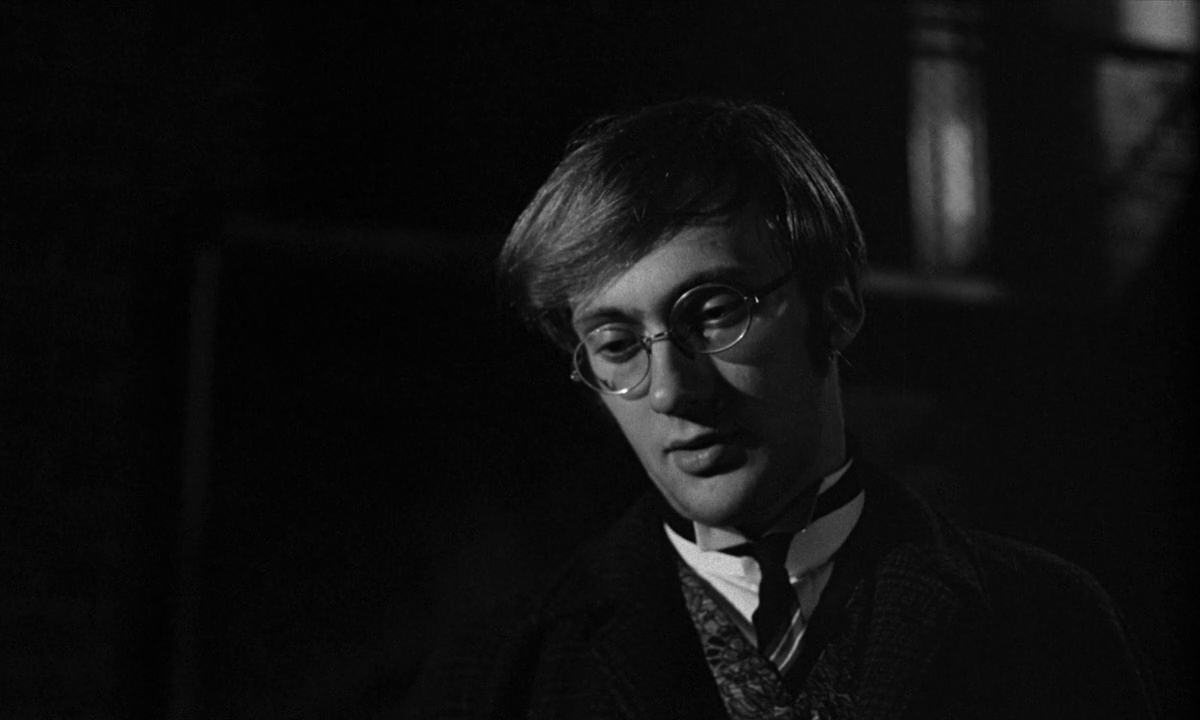


Mick is so obsessed with death that he practices his
own demise, putting a bag over his head as Johnny times him to see how long he
can last without running out of air. Mick wonders what’s the worse way to die,
and he, Johnny, and Wallace suggest different ways. Johnny says cancer is bad
because his mother endured six months of suffering before the end came. He
seems upset by this fact, but Mick shows morbid fascination about how nasty
death can be, which shows how pathologically dangerous he is. He even comments that
“the night’s dead,” which indicates how he sees lifelessness in everything.
Led by Rowntree, the Whips control Mr. Kemp and get
him to allow them to administer strict discipline to those in his dormitory who
they see as trying to rock the boat, even if their brutal actions turn the ship
into the Titanic. After singing their religious songs the students can indulge
themselves in some dessert. But, the deceptively sedate Mrs. Kemp comes down
hard on one lad as she yells that he was trying to pick up another bun. She does
not want the boys to indulge their appetites.


The Headmaster tells Mick, Johnny, and Wallace about
how the reverend could have been hurt. As he says these words, a bit of
surrealism occurs. The Headmaster opens a large drawer in which the chaplain is
stretched out as if resting in a coffin. He then rises and shakes the hands of
the three students as a sign of accepting their apologies. Again, Anderson is
jarring the audience out of the comfort of a standard narrative to show that
their status quo is under siege. The Headmaster then says that although he
knows that acts of youthful individualism are to be expected, there are limits
to that expression. However, he then gets petty about the limitations, focusing
on hair length. He spouts the platitude that “Those who are given the most also
have the most to give.” However, this statement is not about generosity being
disbursed to the needy. Instead, he assigns the boys manual labor as a way of
“giving” back to the school and they must clean out the church basement.
Philips joins them, and one object they find during
their chore is a stuffed alligator. It could be that the dangerous animal
symbolizes what evil can lurk below the surface of a benign exterior. Ditto the
deformed fetus they discover in a locked cabinet. The waitress suddenly appears
in this scene, another bit of taking us out of the normal course of the
narrative. Together they find a large supply of military weapons, including
mortars, hand grenades, and various types of guns. The grinning Mick tells us
without words what he plans to do with these destructive tools.
The next section is called “Crusaders,” which calls to
mind the combatants of the Middle Ages whose wartime exploits were blessed with
religious justification. That merging of religion and war is emphasized at a school
assembly on Founders Day where parents and dignitaries assemble. General Denson
(Anthony Nicolls) and a church bishop are in attendance. The general, most
likely the father of the student of the same name, goes on about how some are
belittling traditional rules and obedience, and that they must defend those qualities
to preserve freedom. What his words imply contradictorily is that one must give
up freedom to hold onto it. He then adds the need for warlike actions to
preserve liberty. That justification for violence can be used by others who
feel that their freedom is being deprived by those in power. That
interpretation can encourage insurrection.

The film ends with a closeup of Mick firing his
machine gun directly at the camera as if telling the audience they better fix
things or this story might turn into real life. His image is followed by a dark
screen with the word “If …” painted in blood red. The movie has delivered its
warning shot.
The next film is Angel Heart.
Sunday, June 13, 2021
A Hard Day's Night
SPOILER ALERT! The plot will be discussed.

Ebert notes that the black-and-white photography
provides a “semi-documentary style” as the film follows a day in the life of
the famous quartet as they evade zealous fans, rebel against those who would
contain them, and eventually perform at a concert. As Ebert says, the film does
not follow standard filmmaking procedures, and instead uses handheld cameras
and quick cutting that make it appear as if the shots were “snatched during
moments of real life.” But that realistic look is in ironic contrast to the
absurd antics of John Lennon, Paul McCartney, George Harrison, and Ringo
Starr.
The title of the film came from Ringo who was
describing how rest was needed after a trying day being The Beatles. But it is
writer Owen who created “stereotyped” versions of the band members, according
to IMDb, after observing them on tour. He depicted Paul as “cute” and
“sensible,” John as the “smart-ass,” George as “quiet and shy,” and Ringo as
“dim-witted and sad.” In real life, the personalities of these individual
musicians were more complex, so the film is a fictional version of the factual
people. Larry David does the same thing in Curb Your Enthusiasm.


The opening sequence, with the lively title track playing in the background, is one of movement. John, George and Ringo are fleeing from the adoring female fans. They run, jump, and ride to get away. Only Paul, in disguise with a beard and mustache sits still because he is with his grandfather (Wilfrid Brambell) on a bench. (IMDb notes that Paul was indisposed for a while because of a car accident, and William Shears was used as a stand-in. In Sgt. Pepper’s Lonely Hearts Club Band, Paul sings an introduction to the “one and only Billy Shears”). But they all meet up at a station to go on a train, another moving object. This sequence conveys youthful energy, but also a sense that the musical celebrities find it difficult to obtain that sense of liberation. Indeed, when they are not moving they are in confined areas, such as rooms, cars, and train compartments that symbolize how their fame, although allowing them monetary gain and the ability to express their musical abilities, also limited them as individuals.
On the train there is the first of many
references to Paul’s grandfather being “very clean.” According to IMDb, the
phrase is a reverse reference to actor Brambell’s role in a British TV series
entitled “Steptoe and Son” (which was the inspiration for the American show
“Sanford and Son”), where Brambell’s character was called a “dirty old man.”
John says that they will probably have to look after the old man, but his
response is, “I look after meself.” His attitude is unexpected since one would
expect the old man to be a conservative type. But the script defies
expectations, and Grandfather likes to get into mischief and is a rebel. Paul
calls him “a villain, a real mixer.” Paul adds his grandfather, “costs you a
fortune in breach-of-promise cases.” That type of dialogue is funny because it
sounds formal coming from blokes who came off the streets of Liverpool.
Shake (John Junkin) and Norm (Norman
Rossington), the group's handlers, show up, and Norm immediately wants to put
restrictions on the four, saying “let's not cause any trouble.” After
Grandfather goes with Shake and Norm for some coffee, a proper looking
middle-aged gentleman (Richard Vernon) enters the compartment. The long-haired
boys seem to be an existential annoyance to the conservative man, as he views
them with suspicion. He immediately tries to control the situation by closing
the window (metaphorically implying he does not want fresh ways of thinking to
be in his presence). Paul wants the window open, and John points out that the
majority there doesn’t want it closed, stressing democracy. But the older
fellow argues he has sway because he has been around longer, basically arguing
that age outranks youth. He doesn’t want them playing rock music on Ringo’s
radio, either. He says he “fought the war for your sort,” and Ringo’s funny
response is, “I bet you’re sorry you won,” since the man is so hostile toward
those he protected. The Marx Brothers influence at playing with language can be
heard when the traveler says, “I shall call the guard,” and Paul says, “Ah, but
what?” That response is followed by an absurd shot of the boys outside the
train with a bicycle running alongside the man’s window, stressing that he is
treating them like little children.
The Beatles join Shake, Norm, and Grandfather in
the dining car. Norm and Shake are arguing over the ridiculous point that Shake
is acting taller than Norm. Paul discovers that it’s his grandfather that
instigated the conflict, even though the two men never argue. Paul says that
Grandfather doesn’t like “unity.” He’s being depicted as an anarchist, just the
opposite of the elderly man in the compartment. Grandfather creates more chaos
when young girls enter the car. Paul makes a move on them for himself and the
others, but then Grandfather says the young men are convicts and the females
should flee. In a way, The Beatles were guilty of defying conventional
norms.

Paul and John find Grandfather with a much
younger woman. He says he is engaged, another ridiculous moment. The next shot
is Grandfather in a cage in the storage part of the train, looking like his
free spirit has been imprisoned. But, the Beatles join him, so they, too, are
confined by their own fame, as girls show up outside the barrier. We then have
the artifice of the movie undermining the documentary feel, as the quartet
plays “I Should Have Known Better,” when they are only supposed to be playing
cards.

The “surging” girls are waiting for them at the
train station (John asks if he could be “surged,” which again echoes the Marx
Brothers’ love of wordplay and also shows the plus side of being a rock star).
More physical fleeing takes place suggesting an attempt to escape the
suffocation of fame. Shake has to carry the band’s instruments because The
Beatles don’t have the luxury of privacy to bring their own. But, for that
sacrifice of privacy, they do experience adoration and the freedom to have
others do work for them. The film shows the two sides of success.

Ringo gets an invitation to go to a fancy club,
but Norm, trying to control the band’s members so that they don’t become a
publicity embarrassment, denies Ringo the opportunity to go. Grandfather steals
the invitation, and even though he openly discourages attendance there, he
likes the idea of being at a place that has “easy money and fast women.” Norm
wants the band to stay in the hotel and answer their fan mail. After Norm
leaves, John grabs his jacket to go out, which is his defiant response to being
told to stay put, and they go out dancing to their own recorded music.
Grandfather, exercising his own rebelliousness, goes gambling at the club. When
he goes broke, he unscrupulously pretends to be a waiter and gets a large tip
from a patron so he can continue to bet. There is a shot at the dance club that
has a young woman resting her booted foot on the hand of a companion as John
sits at the table. In Howard Hampton’s essay, “The Whole World is Watching,”
this brief image conveys, “the way the cool and wry and fetishistic are all
folded into everyday conversation, ordinary life.” It’s a hint of how The
Beatles are in the vanguard of “a transformed social world that's being
sculpted before your eyes.” However, Norm (an appropriate name for someone who
wants things to adhere to the “norms” of behavior so that things appear to be
“normal”), shows up and wants The Beatles to leave.
Norm gets the lads back to the hotel to do the
chore of answering their mail. But, they find the butler whose clothes
Grandfather took to go to the fancy club, and they use that excuse to break
away once more to find the old man. They get into the exclusive club because
they are, after all, The Beatles, so celebrity has its privileges. Shake gets
into the exclusive club by saying he’s “Ringo’s sister,” so absurdity keeps
surfacing in the film.
The next scene has John enjoying himself as he plays
like a child unencumbered by adult restrictions while taking a bath. He
pretends he is a German U-Boat commander. As he sings, “Rule Britannia,
Britannia rules the sea,” he then has one boat bash another, a sort of satiric
jab at England’s imperialism. As IMDb points out, John holds a toy submarine
and shouts out “Help!” which predicts the subsequent Beatles movies, Help!
And Yellow Submarine. When Norm again tries to manage John by telling
him to get out of the bathtub, he pulls the stopper, but only John’s hat and
the toy submarine remain after the water drains. John walks in harassing Norm
to stop fooling around. It’s an absurdist reversal of their roles.
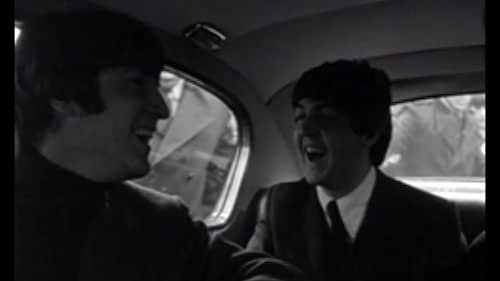
The band rides to a press conference at the
theater where they will perform. When they exit the car they go through a
homeless person’s tent and the screaming female fans knock the shelter away,
leaving the poor man without his covering. The shot seems to stress how all
this fame and money contrasts with the poor people who are left behind in the capitalistic
rat race.
When the musicians enter the reception room,
Norm continues his restrictive role by trying to curtail the band’s efforts to
indulge in any alcoholic beverages. The film also makes fun of the same tired
questions that reporters ask The Beatles. Commenting supposedly about the size
of Ringo’s nose, John says, “I never noticed his nose till about six months
ago.” When asked how he found “America,” John’s sarcastic response is, “Turn
left at Greenland.” When confronted with the extremely obvious question, “Has success
changed your life,” George does not dignify the question as he simply says,
“Yes.” When asked what he calls the hairstyle he has, George says, “Arthur,”
again playing with language. When an interviewer wants to know with whom Ringo
identifies between the two warring youthful factions in England at the time,
the “mods” or the “rockers,” Ringo’s famous line is “I’m a mocker.” The
response shows how he makes fun of the question and the conflicting parties,
but also how he implies the best way to resolve differences is through
unification. Paul has to keep saying that he is just “good friends” with all
the suggestions of romantic connections, which shows how he must publicly
comment on all his private social activities. Despite the supposedly factual presentation
of the narrative, there are references to the mothers of John and Paul, who, in
fact, were deceased at the time of the filming. So, the movie is playing with
fact versus fiction.


Norm wants to lock them away until the performance, but of course they get out through the fire escape as the energetic “Can’t Buy Me Love” plays. What follows is a frenetic rambling by the four as they luxuriate in their freedom in a sports field. The shots from above emphasize the extent of the open-air lack of restrictions. The use of fast-action and slow-motion camera work adds to the playful kinetic liberation. As soon as the song is done, another old-timer enters trying to ground their flight to freedom, saying the area is private property and therefore off-limits.

George accidentally passes by an office where people in the fashion industry work. They think his look is close enough to a real Beatle that they can use him to sell their goods. Exploitation of The Beatles brand is what is suggested here, with the company employees not able to recognize genuine talent from imitators. George describes certain shirts as “grotty,” which means grotesque. IMDb says the clothing is similar to what the Dave Clark Five wore, the inferior band that followed The Beatles in what was known in the recording industry as “The British Invasion.” The fashion executive says that no matter how “grotty” it appears, the corporate world will make kids want it or else the youths will feel diminished in the eyes of their peers. He says the new trend will be “to care passionately and be right wing.” It’s a sort of indoctrination to gain control, and the individualistic George wants nothing to do with it. He says that their “trendsetter” female spokesperson is a “drag” and people make fun of her. George is thrown out because the fashion boss only wants affirmation of his preconceived views.

When the band members return to their ready
room, they are again chastised by Norm for wandering off. John gets on his knees
and jokingly begs not to be “caned,” for being “led astray,” a jab at the
English boarding school system that overreacted by using corporal punishment if
a boy broke the rules. The tailor is measuring Paul who walks away, and John
cuts the tape measure and mocks the Queen by using a high-pitched voice,
saying, “I now declare this bridge open.” It’s another bit of rebellious humor
that pokes fun at the reigning establishment.

They get more disapproving and controlling
static from the Director because the band isn’t on time to practice another
tune and he wants them not to move “out of position” once they take the stage.
They make fun of his sweater, saying he probably doesn't have a wife because he
has such bad taste in clothes. Paul says that the Director’s assistant probably
knitted the sweater for him, and then John says, “She knitted him.” It’s a
damning line, associating the man in authority with an old-fashioned practice
because he can’t keep pace with how the world is changing.
After a marvelous rendition of “And I Love Her,”
they go to the makeup room to make fun of the established order. Ringo is under
a dryer as he wears the hairy headgear of a Buckingham Palace guard while he
reads a magazine entitled The Queen as John points out that it’s an
“in-joke.” Paul drapes a protective shroud around him like a classical actor
and mockingly quotes from Hamlet as he says, “Oh, that this too, too
solid flesh would melt.” John sports a beard and satirizes a proper gentleman
as he mentions shopping at the famous British luxury department store, Harrods,
which is situated where “you turn right at the corridor and past the
fireplace.” Before going back on stage, John does some exaggerated dance moves
to jokingly comment on the traditional way some dancers are performing their
rehearsal. Everything about this movie is iconoclastic.

After another song, Norm wants the band to stay
put at the theater, but John and Paul are as defiant as ever, and go off with a
couple of girls. Norm assigns Ringo to look after Paul’s grandfather, who
continues to stir up trouble by harassing Ringo about reading a book instead of
going out in the world and living it up. Grandfather keeps playing the part of
rulebreaker, as he critiques traditional scholarly pursuits. But he also exploits
the teasing Ringo receives from the other Beatles, saying they are taking
advantage of his “good nature.” He convinces Ringo to go “parading,” and Ringo
takes off right before the show, causing the others to attempt to retrieve
him.

As Ringo walks about, two girls recognize him and he escapes into a shop where he puts on a coat and hat so he can’t be recognized. Disguised, he then approaches a girl who calls him “shorty” and dismisses him. As an abstract celebrity he is pursued, but as himself, he is rejected, which is a cynical comment on the nature of fame. He tries to take what we now call a selfie by mounting his camera on a rock. When he uses an extension cord to trip the shutter, the camera shoots off into the river. It’s the kind of loser gag Woody Allen will later put to good use. When Ringo chucks a large brick into the river, a cop rides by on a bicycle and reprimands Ringo. It’s another example of too much control being exerted. But then Ringo becomes the old guard when a young boy (David Janson) rolls a tire and Ringo trips on it. The Beatles’ drummer then tells the boy he is causing trouble. The youth has skipped school as part of his rebelliousness. Ringo discovers the boy has three friends (just like Ringo) who also are playing hooky, and Ringo says he, too, is a “deserter.” So, Ringo sees some of himself in the young boy.

Ringo continues to play the screenwriter’s lame character as he has to pay for stale food and disrupts men playing some pub games. He even gets his glass of beer smashed by putting it down in the wrong place. He almost hits a parrot with a dart and spears a patron’s sandwich. He’s seen as a “troublemaker” and when he gets thrown out of the pub and kicks some trash onto the street, a policeman is there, of course, sternly observing these minor infractions. But when Ringo tries to be chivalrous by putting his coat over puddles of water for a woman to walk over, he accidentally has her fall into a manhole. Luckily, there is a worker who breaks her fall, but it’s enough for the cop to arrest Ringo.

Meanwhile, Grandfather forged the signatures of
the bandmates on a bunch of Beatles photos and tries to pass them off as
genuine to the crowd in front of the theater. After causing a commotion, he too
is arrested. He rants about police brutality and kicks the policemen at the
station. He says he is “a soldier of the Republic,” which IMDb notes refers to
the I.R.A. So, Grandfather is associated with a radical group of Irishmen who
fought against British dominance. We therefore have more insurrectionist
references. The police say they just tried to protect him from the mob of
girls, but Grandfather runs off, just like the band members were doing.

After Grandfather sneaks into the theater and
tells John, Paul, and George that Ringo is at the police station, the film has
a modern version of a wacky Keystone Cops segment as the officers and the
musicians run about while the appropriately fast-paced “Can’t Buy Me Love”
plays. While the cops chase the four young men, they overlook a thief trying to
break into a car, stressing the authorities lack of fair law enforcement, as
one oblivious cop uses the crook in the stolen auto to chase the quartet.


The next film is Whose
Life Is It Anyway?
Subscribe to:
Posts (Atom)